Stand Up to Tyranny: How to Respond to the Evils of Our Age

By John W. Whitehead & Nisha Whitehead

Source: The Rutherford Institute

“The church must be reminded that it is not the master or the servant of the state, but rather the conscience of the state. It must be the guide and the critic of the state, and never its tool. If the church does not recapture its prophetic zeal, it will become an irrelevant social club without moral or spiritual authority.”—Martin Luther King Jr. (A Knock at Midnight, June 11, 1967)

In every age, we find ourselves wrestling with the question of how Jesus Christ—the itinerant preacher and revolutionary activist who died challenging the police state of his time, namely, the Roman Empire—would respond to the moral questions of our day.

For instance, would Jesus advocate, as so many evangelical Christian leaders have done in recent years, for congregants to “submit to your leaders and those in authority,” which in the American police state translates to complying, conforming, submitting, obeying orders, deferring to authority and generally doing whatever a government official tells you to do?

What would Jesus do? 

Study the life and teachings of Jesus, and you may be surprised at how relevant he is to our modern age.

A radical nonconformist who challenged authority at every turn, Jesus spent his adult life speaking truth to power, challenging the status quo of his day, pushing back against the abuses of the Roman Empire, and providing a blueprint for standing up to tyranny that would be followed by those, religious and otherwise, who came after him.

Those living through this present age of government lockdowns, immunity passports, militarized police, SWAT team raids, police shootings of unarmed citizens, roadside strip searches, invasive surveillance and the like might feel as if these events are unprecedented. However, the characteristics of a police state and its reasons for being are no different today than they were in Jesus’ lifetime: control, power and money.

Much like the American Empire today, the Roman Empire of Jesus’ day was characterized by secrecy, surveillance, a widespread police presence, a citizenry treated like suspects with little recourse against the police state, perpetual wars, a military empire, martial law, and political retribution against those who dared to challenge the power of the state.

A police state extends far beyond the actions of law enforcement.  In fact, a police state “is characterized by bureaucracy, secrecy, perpetual wars, a nation of suspects, militarization, surveillance, widespread police presence, and a citizenry with little recourse against police actions.”

Indeed, the police state in which Jesus lived (and died) and its striking similarities to modern-day America are beyond troubling.

Secrecy, surveillance and rule by the elite. As the chasm between the wealthy and poor grew wider in the Roman Empire, the ruling class and the wealthy class became synonymous, while the lower classes, increasingly deprived of their political freedoms, grew disinterested in the government and easily distracted by “bread and circuses.” Much like America today, with its lack of government transparency, overt domestic surveillance, and rule by the rich, the inner workings of the Roman Empire were shrouded in secrecy, while its leaders were constantly on the watch for any potential threats to its power. The resulting state-wide surveillance was primarily carried out by the military, which acted as investigators, enforcers, torturers, policemen, executioners and jailers. Today that role is fulfilled by the NSA, the FBI, the Department of Homeland Security and the increasingly militarized police forces across the country.

Widespread police presence. The Roman Empire used its military forces to maintain the “peace,” thereby establishing a police state that reached into all aspects of a citizen’s life. In this way, these military officers, used to address a broad range of routine problems and conflicts, enforced the will of the state. Today SWAT teams, comprised of local police and federal agents, are employed to carry out routine search warrants for minor crimes such as marijuana possession and credit card fraud.

Citizenry with little recourse against the police state. As the Roman Empire expanded, personal freedom and independence nearly vanished, as did any real sense of local governance and national consciousness. Similarly, in America today, citizens largely feel powerless, voiceless and unrepresented in the face of a power-hungry federal government. As states and localities are brought under direct control by federal agencies and regulations, a sense of learned helplessness grips the nation.

Perpetual wars and a military empire. Much like America today with its practice of policing the world, war and an over-arching militarist ethos provided the framework for the Roman Empire, which extended from the Italian peninsula to all over Southern, Western, and Eastern Europe, extending into North Africa and Western Asia as well. In addition to significant foreign threats, wars were waged against inchoate, unstructured and socially inferior foes.

Martial law. Eventually, Rome established a permanent military dictatorship that left the citizens at the mercy of an unreachable and oppressive totalitarian regime. In the absence of resources to establish civic police forces, the Romans relied increasingly on the military to intervene in all matters of conflict or upheaval in provinces, from small-scale scuffles to large-scale revolts. Not unlike police forces today, with their martial law training drills on American soil, militarized weapons and “shoot first, ask questions later” mindset, the Roman soldier had “the exercise of lethal force at his fingertips” with the potential of wreaking havoc on normal citizens’ lives.

A nation of suspects. Just as the American Empire looks upon its citizens as suspects to be tracked, surveilled and controlled, the Roman Empire looked upon all potential insubordinates, from the common thief to a full-fledged insurrectionist, as threats to its power. The insurrectionist was seen as directly challenging the Emperor.  A “bandit,” or revolutionist, was seen as capable of overturning the empire, was always considered guilty and deserving of the most savage penalties, including capital punishment. Bandits were usually punished publicly and cruelly as a means of deterring others from challenging the power of the state.  Jesus’ execution was one such public punishment.

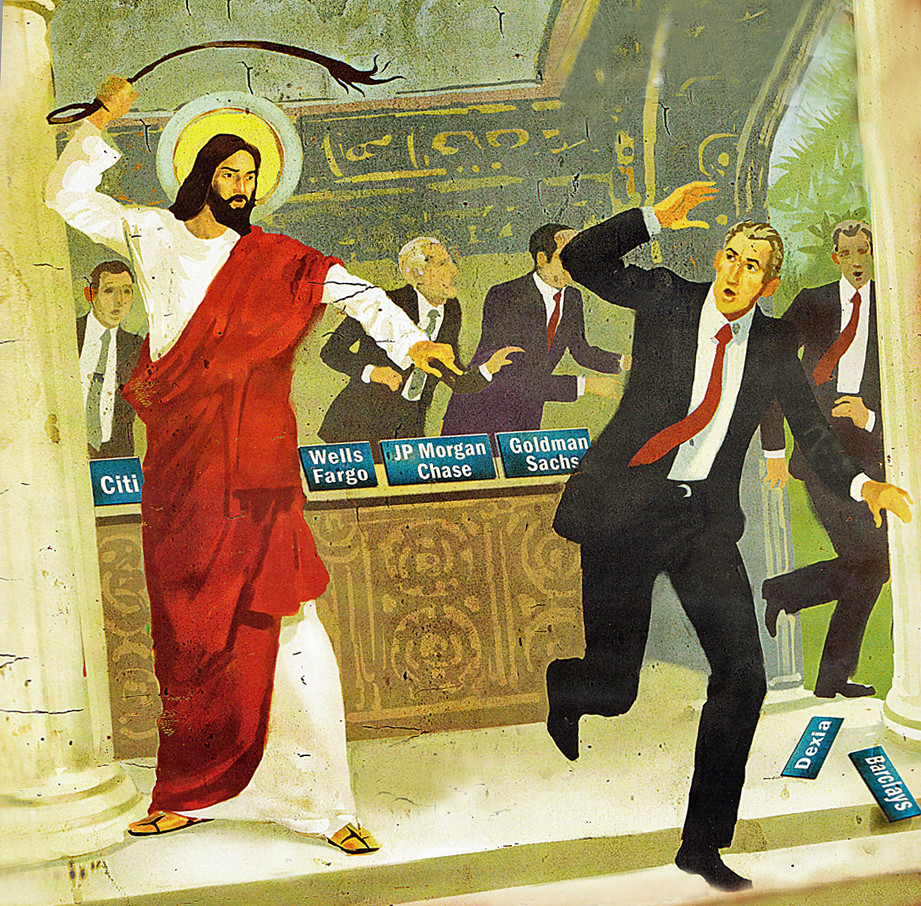
Acts of civil disobedience by insurrectionists. Starting with his act of civil disobedience at the Jewish temple, the site of the administrative headquarters of the Sanhedrin, the supreme Jewish council, Jesus branded himself a political revolutionary. When Jesus “with the help of his disciples, blocks the entrance to the courtyard” and forbids “anyone carrying goods for sale or trade from entering the Temple,” he committed a blatantly criminal and seditious act, an act “that undoubtedly precipitated his arrest and execution.” Because the commercial events were sponsored by the religious hierarchy, which in turn was operated by consent of the Roman government, Jesus’ attack on the money chargers and traders can be seen as an attack on Rome itself, an unmistakable declaration of political and social independence from the Roman oppression.

Military-style arrests in the dead of night. Jesus’ arrest account testifies to the fact that the Romans perceived Him as a revolutionary. Eerily similar to today’s SWAT team raids, Jesus was arrested in the middle of the night, in secret, by a large, heavily armed fleet of soldiers.  Rather than merely asking for Jesus when they came to arrest him, his pursuers collaborated beforehand with Judas. Acting as a government informant, Judas concocted a kiss as a secret identification marker, hinting that a level of deception and trickery must be used to obtain this seemingly “dangerous revolutionist’s” cooperation. 

Torture and capital punishment. In Jesus’ day, religious preachers, self-proclaimed prophets and nonviolent protesters were not summarily arrested and executed. Indeed, the high priests and Roman governors normally allowed a protest, particularly a small-scale one, to run its course. However, government authorities were quick to dispose of leaders and movements that appeared to threaten the Roman Empire. The charges leveled against Jesus—that he was a threat to the stability of the nation, opposed paying Roman taxes and claimed to be the rightful King—were purely political, not religious. To the Romans, any one of these charges was enough to merit death by crucifixion, which was usually reserved for slaves, non-Romans, radicals, revolutionaries and the worst criminals.

Jesus was presented to Pontius Pilate “as a disturber of the political peace,” a leader of a rebellion, a political threat, and most gravely—a claimant to kingship, a “king of the revolutionary type.” After Jesus is formally condemned by Pilate, he is sentenced to death by crucifixion, “the Roman means of executing criminals convicted of high treason.”  The purpose of crucifixion was not so much to kill the criminal, as it was an immensely public statement intended to visually warn all those who would challenge the power of the Roman Empire. Hence, it was reserved solely for the most extreme political crimes: treason, rebellion, sedition, and banditry. After being ruthlessly whipped and mocked, Jesus was nailed to a cross.

As Professor Mark Lewis Taylor observed:

The cross within Roman politics and culture was a marker of shame, of being a criminal. If you were put to the cross, you were marked as shameful, as criminal, but especially as subversive. And there were thousands of people put to the cross. The cross was actually positioned at many crossroads, and, as New Testament scholar Paula Fredricksen has reminded us, it served as kind of a public service announcement that said, “Act like this person did, and this is how you will end up.”

Jesus—the revolutionary, the political dissident, and the nonviolent activist—lived and died in a police state. Any reflection on Jesus’ life and death within a police state must take into account several factors: Jesus spoke out strongly against such things as empires, controlling people, state violence and power politics. Jesus challenged the political and religious belief systems of his day. And worldly powers feared Jesus, not because he challenged them for control of thrones or government but because he undercut their claims of supremacy, and he dared to speak truth to power in a time when doing so could—and often did—cost a person his life.

Unfortunately, the radical Jesus, the political dissident who took aim at injustice and oppression, has been largely forgotten today, replaced by a congenial, smiling Jesus trotted out for religious holidays but otherwise rendered mute when it comes to matters of war, power and politics.

Yet for those who truly study the life and teachings of Jesus, the resounding theme is one of outright resistance to war, materialism and empire.

Ultimately, as I point out in my book Battlefield America: The War on the American People, this is the contradiction that must be resolved if the radical Jesus—the one who stood up to the Roman Empire and was crucified as a warning to others not to challenge the powers-that-be—is to be an example for our modern age.

After all, there is so much suffering and injustice in the world, and so much good that can be done by those who truly aspire to follow Jesus Christ’s example.

We must decide whether we will follow the path of least resistance—willing to turn a blind eye to what Martin Luther King Jr. referred to as the “evils of segregation and the crippling effects of discrimination, to the moral degeneracy of religious bigotry and the corroding effects of narrow sectarianism, to economic conditions that deprive men of work and food, and to the insanities of militarism and the self-defeating effects of physical violence”—or whether we will be transformed nonconformists “dedicated to justice, peace, and brotherhood.”

As King explained in a powerful sermon delivered in 1954, “This command not to conform comes … [from] Jesus Christ, the world’s most dedicated nonconformist, whose ethical nonconformity still challenges the conscience of mankind.”

Furthermore:

We need to recapture the gospel glow of the early Christians, who were nonconformists in the truest sense of the word and refused to shape their witness according to the mundane patterns of the world.  Willingly they sacrificed fame, fortune, and life itself in behalf of a cause they knew to be right.  Quantitatively small, they were qualitatively giants.  Their powerful gospel put an end to such barbaric evils as infanticide and bloody gladiatorial contests.  Finally, they captured the Roman Empire for Jesus Christ… The hope of a secure and livable world lies with disciplined nonconformists, who are dedicated to justice, peace, and brotherhood.  The trailblazers in human, academic, scientific, and religious freedom have always been nonconformists.  In any cause that concerns the progress of mankind, put your faith in the nonconformist!

…Honesty impels me to admit that transformed nonconformity, which is always costly and never altogether comfortable, may mean walking through the valley of the shadow of suffering, losing a job, or having a six-year-old daughter ask, “Daddy, why do you have to go to jail so much?”  But we are gravely mistaken to think that Christianity protects us from the pain and agony of mortal existence.  Christianity has always insisted that the cross we bear precedes the crown we wear.  To be a Christian, one must take up his cross, with all of its difficulties and agonizing and tragedy-packed content, and carry it until that very cross leaves its marks upon us and redeems us to that more excellent way that comes only through suffering.

In these days of worldwide confusion, there is a dire need for men and women who will courageously do battle for truth.  We must make a choice. Will we continue to march to the drumbeat of conformity and respectability, or will we, listening to the beat of a more distant drum, move to its echoing sounds?  Will we march only to the music of time, or will we, risking criticism and abuse, march to the soul saving music of eternity?
Is Real-World Activism Part of our Spiritual Journey?

By Richard Enos

Source: Collective Evolution

We are living through a time that is shaking us down to our foundations. This ‘Pandemic’ has led to actions being taken by our governments that seem to completely disregard the rights of citizens and the rule of law. And there is mounting evidence that the severe measures being employed have not had any positive impact on our collective health and safety, and in fact are only serving an agenda to strengthen the grip of control enjoyed by the ruling class.

I don’t begrudge people who still believe that all we have to do to return to some form of normalcy is continue obeying protocols, but support for that idea is dwindling, as more people start to wonder if compliance is really the answer or if it is actually the problem itself. Questions surrounding these measures are being asked everywhere we turn: Why are small businesses being shut down, while multinational corporations that pose just as much ‘risk’ are able to open? Why are children being forced to wear masks and distance within schools when the science and statistics indicate that such measures are unnecessary and even harmful? Why are our governments trying to convince us that the Covid vaccine will solve the problem, while telling us that we will still have to wear masks after receiving it?

A Spiritual Battle

It is healthy to question things that don’t make sense to us, and we deserve answers. We have every right to defy commands we feel are unjustified–especially when our government oversteps and ignores the very laws it is supposed to uphold. And rather than heeding the growing discontent, and giving even the faintest impression that they are trying to ‘serve the public,’ the government is pushing back on our defiance like never before.

Let there be no doubt: we are in the midst of a spiritual battle.

But have courage. I believe that everything that is happening around us, as nefarious as it may be at some level, is being guided by a higher intelligence. And that higher intelligence has brought forth a situation that gives us an opportunity to begin to take charge of what is happening on the planet.

At this moment in history humanity is emerging from a state of adolescence and moving into adulthood, where we are starting to take responsibility, individually and collectively, for the condition the world is in. It is when a critical mass of people adopt this mindset that we will be able to turn this ship around, and get out from under the thumb of the ‘father figure’ of our adolescence, the current self-serving ruling class.

Confronting Our Fear

Indeed, one of the major stumbling blocks many of us face in standing up against what is going on is overcoming our fear of authority. Most of us first experienced a fear of authority at the hands of our parents, and as Edward Snowden explains in the short clip below, the ruling class has created a system that continues to stoke this fear and force our compliance from the time we enter school until we die.

As individuals, it is certainly worthwhile to ask ourselves if any trust we still have in our authority figures is justified, or if our compliance is just fear-based programming. Do we feel afraid to stand out or speak out, are we worried that we will be shamed by family, shunned by friends, unable to fit in at work or school? To truly act as free individuals we need to become still and grounded when we ask these questions, so that we can hear the quiet but reassuring voice of our higher self, reminding us of who we really want to be and what we want to do. This is the only authority you really need to follow.

Now certainly I don’t presume to tell anyone what ‘right action’ is for them. In fact it is no longer a time for you to blindly follow anyone, as I illustrated in my documentary ‘The Leaderless Movement.’ So we shouldn’t be guilted or shamed into defiance any more than we should be guilted or shamed into compliance. It’s time for each of us to find our center. From there, you do whatever feels right to you. That might very well mean doing nothing at the moment. But if you happen to notice, when you get into a state of stillness, that your inner voice has been gently coaxing you to stand up for your principles and be active in the world, then you owe it to yourself (and the rest of humanity, I might add) to overcome whatever fear you might have and follow through.

What is Real-World Activism?

When we think of real-world activism the first thing that often comes to mind is our right to assemble and protest. Some may dismiss this out of hand because it evokes unpleasant images of fighting and violence. But that is not an inherent quality of standing up for our personal rights and freedoms. The vast majority of gatherings and demonstrations in Canada and around the world regarding pandemic measures have been peaceful, and that’s the only way they are going to be effective. Certainly the time for pitchforks and streetside guillotines has long passed us by. If we decide that our only objective is to tear down the ruling class and subject them to bloody retribution then we are just perpetuating the division that the ruling class has used this whole time to keep their small elite group running the show.

Real-world activism does not actually require you to stand against anything. Of course many of us are angry about what we see going on in the world and we don’t like it. And that is a healthy thing. Our anger awakens us out of complacency and into action. But once we are activated, it’s important to move on to the next emotional stage, which is a firm resolve to stand for something, like the basic principles of personal freedom and human dignity that we all share. This opens us up to our connection with each other and fuels our desire to improve not only our own lives but those of our fellow human beings as well. This eventually leads us to looking at the way the entire planet is being governed and wondering why we are continuing to give our consent to it.

And of course real-world activism is not limited to participating in demonstrations and protests. It could simply be the way we conduct ourselves in our daily lives when we deal with those in some position of authority. Usually it is something that affects us personally that spark us to action. In my case, I remember the day clearly, when I read that my grade 1 son would be required to wear a mask in school. That is the day I jumped out of my chair and put the time and effort into researching the matter and then contacting those involved. This eventually led to a string of frustrating and uncomfortable conversations with people of authority from a principal to a director of education, documented in my article ‘How I Obtained a Conscientious Exemption From Mask-wearing at School for my Child.’ Early on, I had a sense that the whole exercise was not only done for my son, as I had decided after losing trust in the system that I was not willing put him through a single day at school; I also felt I wanted to learn how to stand up for my rights so that I could help others who were in the same situation.

Effective activism always has a spiritual component. It requires us to look at ourselves in the mirror and do the inner work that builds self-responsibility and changes the way we show up in the world. It requires us to look at the world with more discernment and a devotion to truth. We have long been divided by deception, but the singularity of truth unites us, and the sharing of truth empowers us and sets us free.

The Takeaway

What is unprecedented about the events that we are living through right now is that we are all personally affected one way or another. Nobody has been left untouched, and that makes it more difficult for people to continue sitting this one out. We are all being called to some form of engagement, and it’s likely that things in the world will keep getting worse until enough of us are involved. And this is why I believe that higher intelligence is orchestrating this. For when we reach a critical mass and the behemoth that I call the ruling class finally falls, we will have learned how to take responsibility for the condition of the world, we will be more educated in the deceptive ways of power, and we will have begun to connect to each other and unite at a deep level. This will put us in a position where we will already have the tools to start creating a world that serves us all.

The Raging Twenties: A New Map of Dystopia

Pepe Escobar’s new book Raging Twenties: Great Power Politics Meets Techno-Feudalism tells the story of a new phase of the U.S. empire.

By Pepe Escobar

Source: Consortium News

The Raging Twenties started with a murder: a missile strike on Gen. Soleimani at Baghdad airport on Jan. 3, 2020. Almost simultaneously, that geopolitical lethality was amplified when a virus cannibalized virtually the whole planet.

It’s as if Time has been standing still – or imploded – ever since. We cannot even begin to imagine the consequences of the anthropological rupture caused by SARS-CoV-2.

Throughout the process, language has been metastasizing, yielding a whole new basket of concepts while solidifying others. Circuit breaker. Biosecurity. Negative feedback loops. State of exception. Necropolitics. New Brutalism. Hybrid Neofascism. New Viral Paradigm.

This new terminology collates to the lineaments of a new regime, actually a hybrid mode of production: turbo-capitalism re-engineered as Rentier Capitalism 2.0, where Silicon Valley behemoths take the place of estates, and also The State. That is the “techno-feudal” option, as defined by economist Cedric Durand.

Squeezed and intoxicated by information performing the role of a dominatrix, we have been presented with a new map of Dystopia, packaged as a “new normal”, featuring cognitive dissonance, a bio-security paradigm, the inevitability of virtual work, social distancing as a political program, info-surveillance, and triumphant Trans-humanism.

A sanitary shock was superimposed over the ongoing economic shock – where financialization always takes precedence over the real economy.

But then the glimpse of a rosy future was offered towards more “inclusive” capitalism, in the form of a Great Reset, designed by a tiny plutocratic oligarchy duly self-appointed as Saviors.

All of these themes evolve along the 25 small chapters of this book, interacting with the larger geopolitical chessboard.

SARS-CoV-2 accelerated what was already a swing of the power center of the world towards Asia.

Since WWII, a great deal of the planet lived as cogs of a tributary system, with the Hegemon constantly transferring wealth and influence to itself – via what analyst Ray McGovern describes as SS (security state) enforcing the will of the MICIMATT (Military-Industrial-Congressional-Intelligence-Media-Academia-Think-Tank) complex.

This world-system is irretrievably fading out – especially due to the interpolations of the Russia-China strategic partnership. And that’s the other overarching theme of this book.

As a proposal to escape our excess hyper-reality show, this book does not offer recipes, but trails: configurations where there’s no masterplan, but multiple entryways and multiple possibilities.

These trails are networked to the narrative of a possible, emerging new configuration, in the anchoring essay titled “Eurasia, The Hegemon and the Three Sovereigns.”

In a running dialogue, you will have Michel Foucault talking to Lao Tzu, Marcus Aurelius talking to Vladimir Putin, philosophy talking to geoeconomics – all the while attempting to defuse the toxic interaction of the New Great Depression and variations of Cold War 2.0.

With the exception of the anchoring essay, this is a series of columns, arranged chronologically, originally published here on Consortium News/Washington D.C., Asia Times/Hong Kong and Strategic Culture/Moscow, widely republished and translated across the Global South.

They come from a global nomad. Since the mid 1990s I have lived and work between (mostly) East and West. With the exception of the first two months of 2020, I spent the bulk of the Raging Twenties in Asia, in Buddhist land.

So you will feel that the scent of these words is inescapably Buddhist, but in many aspects even more Taoist and Confucianist. In Asia we learn that the Tao transcends everything as it provides serenity. There’s much we can learn from humanism, stripped-off metaphysics.

2021 may be even fiercer than 2020. Yet nothing condemns us to be lost in a wilderness of mirrors while, as Ezra Pound wrote,

a tawdry cheapness

shall reign throughout our days.

The hidden “secret” of this book may be actually a yearning – that we’re able to muster our inner strength and choose a Taoist trail to ride the whale.

For those who don’t use Amazon, here is a mini-guide on how to order Raging Twenties: Great Power Politics Meets Techno-Feudalism.

IN ORDER TO UNDERSTAND THE WORLD TODAY YOU MUST UNLEARN THIS ONE THING

By Sigmund Fraud

Source: Waking Times

At present, we are dangerously trending toward chaos, total world war, civil war, incivility, and a complete breakdown of civil society, and to the indoctrinated, it’s difficult to understand why exactly this is happening. As the stress of this mounts, the misinformed lash out at friends, family members and strangers who do not fully subscribe to their worldview. The battle really is one of understanding how the world works, and with such epidemic false perceptions, people choose the wrong targets for their ire.

If one were to unlearn, however, many of the things we’ve been taught about how our world works, re-educate the self, and re-orient to a more complete and truthful assessment of the world today, the picture becomes more clear, things make more sense, and a pathway to unity opens up. One thing we can all agree on, though, is that we’ve all been duped in big ways, most notably in the one arena which affects everyone, everyday, at every time. Money.

False = Money is Real and the Economy is Capitalist

Trained to worship money and the idea of infinite growth, it’s tough to understand just how much unnatural stress is being introduced in our world by a financial system and world economy which is operates explicitly for the profit a few key players. The money is fiat, and its value is controlled by privately run organizations who have the power to enslave the entire world with debt.

Furthermore, the system is not capitalism, but rather something beyond capitalism. Post capitalism, perhaps, as it more closely resembles the zombie ghost of capitalism, soullessly eating everything in its path with no interest at all in sustainability.

Recently speaking on this matter, financial analyst Max Keiser explained the result of having central bank managed interest rates kept artificially low in order to enrich those at the top of the pyramid. This is one major piece of very large and hidden puzzle.

“There’s no incentive to save money, there’s only an incentive to commit fraud. So if there’s no incentive to save money, then there’s no capital, and without capital there’s no capitalism. So you have, unfortunately, now a situation where it’s the survival of the most fraudulently inclined. It’s a kakistocracy, which is rule by the least capable of a society.” ~Max Keiser

This short interview with Max Kaiser by Luke Rudkowski sheds more insight on this issue:

The system we have today is really more akin to an elaborate slave plantation. All money that we use today in public is borrowed from private banks, and we pay dearly for the privilege of using it.

This is because money is created out of debt in a one-to-one increase in public debt. The national debt is $20 Trillion. That means the (roughly) 234 million US Americans would have to pay approximately $62,000 each to pay it off. This includes babies, children, poor people, and homeless people. There are even those who claim that it’s mathematically impossible to pay off the debt. And almost every country is in debt to every other country. It’s the height of insanity.

As former Governor of the Federal Reserve Marriner Eccles said, “If there were no debts in our money system, there wouldn’t be any money.” ~Gary ‘Z’ McGee

The stress in our world stemming from a global banking system designed to enslave is felt everywhere, from endless wars to unaffordable healthcare and evermore expensive food. Yet while few people really understand how this works, we are battling a war of propaganda and mind control.

Making sense of the world today is no easy task for those who’ve yet to abandon the standard American diet of propaganda and mental programming. Indoctrination works in a couple of key ways. Firstly, beliefs are instilled and reinforced by repetition, and secondly, undesirable beliefs are ignored and cast aside as fringe. What’s left is a mind which focuses on what it’s supposed to focus on, constructing a reality around a false and incomplete picture of the world.

This is food for thought for free thinkers, with the aim overcoming petty division in order to create a more prosperous and unified future.

Defeating The Global Elite’s Coup D’état: The Great Reset

By Robert J. Burrowes

Worldwide, international organizations such as the World Health Organization (WHO), governments and the corporate media, acting as agents of the global elite, continue their efforts to preoccupy the human population with measures supposedly being taken to address the non-existent virus labelled SARS-CoV-2.

For just two of the most recent of the ever-lengthening list of documents and videos demonstrating non-existence of the virus, see ‘COVID-19: The virus does not exist – it is confirmed!’ and ‘Statement On Virus Isolation (SOVI)’.

Unfortunately, this lie is succeeding in distracting the vast bulk of the human population from the ongoing elite coup to take complete control – politically, economically, socially, spiritually and even physically – of the human population under the guise of the World Economic Forum’s ‘Great Reset’. See ‘The Great Reset’ and ‘Now is the time for a “great reset”’.

Hence, the elite coup – which includes implementation of the technological measures necessary to facilitate the fourth industrial revolution as well as the agenda of the transhumanists – now rapidly gathers pace, at enormous cost to the human population and our prospects for survival.

In brief, this coup has many facets notably including the deployment of 5G to enable comprehensive surveillance, digital ID (possibly implanted in your brain: see ‘Beware the Transhumanists: How “Being Human” Is Being Re-Engineered by the Elite’s Coup’) linked to your bank account and health records, a social credit ID that will end up dictating every facet of your life, the digitization of money, robotization of the workforce and the military as well as, in the words of Dr Joseph Mercola, the complete transformation ‘of government, energy and finance to food, medicine, real estate, policing – even how we interact with our fellow human beings. The globalist technocracy is using the COVID-19 pandemic to bypass democratic accountability, override opposition, accelerate their agenda and to impose it on the public against our will.’ See ‘Who Pressed the Great Reset Button?’

But for a more detailed summary of the essential details of this coup, see ‘Corrupt Science and Elite Power: Your Techno-Slavery is Now Imminent’. For a summary of the enormous and increasing costs, see ‘The Elite’s COVID-19 Coup Against a Terrified Humanity: Resisting Powerfully’. And for the evidence of the coup’s adverse impact on human survival prospects, see ‘The Elite’s COVID-19 Coup to Destroy Humanity that is also Fast-Tracking Four Paths to Human Extinction’.

However, while the bulk of the human population remains unaware of what is being planned for us, or naively believes the sanitised version of events presented by elite agents – such as the World Health Organization, governments, official medical spokespeople and the corporate media – enough people are concerned about the serious threats to humanity’s future or, at least, about the very damaging impacts of the lockdowns and other measures such as the ‘gene-altering injectables’ being marketed as ‘vaccinations’, that resistance to this elite coup is also gathering pace. And while this is an encouraging sign, the resistance being conducted so far falls well short of what is necessary given the imminence, multifaceted nature and enormity of the threats.

As a result, Homo sapiens rushes headlong to the cliff-edges of both tyranny and extinction.

So who is resisting, how are they doing so and what else must be done to defeat this coup?

The Resistance So Far: Individual Scholars and Groups

Of course a substantial number of individuals and groups have made the effort to investigate and analyse what is happening ‘beneath the surface’ of this coup and these efforts have resulted in a multitude of documents and videos such as these, for example:

This interview of Catherine Austin Fitts for the film ‘Planet Lockdown’.

This video ‘“The New Normal” New documentary exploring the origin and purpose behind the covid narrative’.

This latest video by Professor Michel Chossudovsky: ‘The 2021 Worldwide Corona Crisis’. Or you can read his article ‘The 2020 Worldwide Corona Crisis: Destroying Civil Society, Engineered Economic Depression, Global Coup d’État and the “Great Reset”’.

And this article by Dr Joseph Mercola which explains the network of organizations centrally involved in ‘The Web of Players Trying to Silence Truth’.

The Resistance So Far: Health Professionals

Many health professionals and others have been consistently exposing the lies that underpin the official narrative being promulgated by the (badly misnamed) World Health Organization, the United Nations, the World Economic Forum, national governments and the corporate media. One outcome of this effort to educate people was the formation of the World Freedom Alliance, which you can join.

Another initiative, undertaken by the 1,500 members of United Health Professionals, was to issue an initial ALERT on 26 August 2020, titled ‘STOP to: terror, madness, manipulation, dictatorship, lies and the biggest health scam of the 21th century’. They urged an immediate halt ‘to all crazy and disproportionate measures that have been taken since the beginning to fight SARS-CoV-2 (lockdown, blocking the economy and education, social distancing, wearing of masks for all, etc.) because they are totally unjustified, are not based on any scientific evidence and violate the basic principles of evidence-based medicine.’ Subsequent alerts of a similar nature have followed.

Other initiatives, among many, have included this recent video by 33 doctors warning against getting the experimental vaccines. Watch ‘33 doctors around the world issue dire warning, to not get the covid vaccine’.

Leo Hohmann simply reminds us that Dr. Tal Zaks, the chief medical officer at Moderna, admitted in 2017 that ‘We are actually hacking the software of life’ thus ‘totally debunking the establishment media’s lie that mRNA vaccines don’t alter your genetic code’ when that, of course, is the actual purpose of messenger RNA vaccines. See ‘Moderna’s top scientist: “We are actually hacking the software of life”’.

Other authors make a point of highlighting the high death rate among those vaccinated, even on official sites which clearly understate the extent of the problem. See, for example, ‘460 Dead 243,612 Reported Injuries from COVID19 Vaccines Reported in the U.K.’ and ‘COVID Vaccine Injury Reports Grow in Number, But Trends Remain Consistent’.

An earlier report noted that the US was forced to change official guidelines in response to the enormous vaccine injury rate. See ‘CDC Issues New Guidelines, Launches Probe After 1000s Negatively-Affected Following COVID-19 Vaccination’.

And Denmark, Iceland and Norway have simply halted administration of the vaccine ‘after reports of blood clots among some people who had received the inoculation’. See ‘COVID: Several European countries halt use of AstraZeneca vaccine’.

If the above doesn’t have you questioning the elite-driven narrative, check out this website with its multitude of videos challenging elite dogma in relation to the ‘virus’: ‘Questioning Covid’.

Of course, you will find very little of the above in the corporate media, with its huge advertising revenue from the major pharmaceutical corporations giving them no incentive to risk losing this income by telling the truth.

The Resistance So Far: Legal

Another series of initiatives is the ongoing efforts to challenge the legal basis of the lockdowns and other official policies supposedly in response to the virus. Watch, for example, Dr. Reiner Fuellmich outline the basis of one legal challenge in ‘“Crimes Against Humanity”: The German Corona Investigation. “The PCR Pandemic”’ and see these two documents submitted to governments in Australia by the Concerned Lawyers Network: ‘Re: Notice of Liability & Potential Claims, 6 November 2020’ and ‘Re: Notice of Liability & Potential Claims, 11 December 2020’.

One challenge has been posed by scholars and a judge drawing attention to the ways in which forced mask-wearing and forced vaccines violate The Nuremberg Code, 1947. See, for example, Judge Anna Von Reitz’s ‘A Plague of Liars’ and Makia Freeman’s ‘Do Mandatory Masks and Vaccines Break the 10 Points of the Nuremberg Code?’

Two of the legal challenges under way in the United States are those being conducted by New Mexico Attorney Ana Garner against declaration of the public health emergency and mandatory administration of the unapproved experimental injectables. Watch ‘It’s Here: First Court Case Against Mandatory Vaccination – Attorney Interview’.

Of course, there are other legal challenges taking place in various countries but, again, you won’t hear much about them in the corporate media.

The Resistance So Far: Police and Military

Police and military personnel around the world have also taken a stand in defence of human freedoms won long ago but now under siege once again.

For example, police in Spain formed Policías Por La Libertad (‘Police for Freedom’) and this is now spreading around the world, including to Australia, the Netherlands, Sweden and the United States, for example.

The mission of this international movement is to re-humanise our societies, bringing back trust and unity between the security forces and the people. The peaceful marches, events, campaigns and content created by Police For Freedom aim to educate people about their human rights, civil liberties, constitutional rights as well as the ethical code of conduct for the police and security forces.

We are colleagues from different occupations who want to continue to carry out our work based on our personal and professional ethics, without being influenced by fears, deceptive narratives, immoral rules or differences of opinion.

The Association of French Reserve Army Officers issued their extensive and damning report ‘Investigative Report on the Covid-19 Pandemic and its Relationship to SARS-CoV-2 and other Factors’ in May 2020. Its conclusion noted that ‘The management of the health “crisis” seems to be a pretext for a totalitarian global takeover’ and includes the ‘intention to impose a global cryptocurrency, a vaccine with nano-chips and a subcutaneous electronic chip’ with ‘5G installations, both terrestrial and aerial (Elon Musk’s satellites in low-Earth orbit)… clearly part of this “total war” project.’

Of course, plenty of military personnel are simply resisting vaccination personally, given the long history of abuse of service personnel with experimental ‘vaccinations’. At one US base, ‘as little as 30 percent of personnel are accepting the vaccine’. See ‘A THIRD of all military personnel are refusing to receive the COVID-19 vaccine with alarmed commanders aiming to make the shot mandatory “as soon as possible”’.

The Resistance So Far: ‘Ordinary’ People

Resistance to one or other features of the coup by individuals, communities, businesses and religious organizations, despite being largely ignored or denigrated by the corporate media, has been considerable with plenty of demonstrations, street theatre and other nonviolent actions documented all over the world. For just one article outlining some of the resistance in Europe last year, see this summary: ‘Anti-Lockdown Protests All Across Europe’.

But perusal of the progressive media will quickly reveal some of the many initiatives undertaken by activists and others who have no trouble ‘seeing through’ the fog of lies and misinformation with which certain international agencies, governments, tame medical personnel and the corporate media are deluging us. For example, you can watch ‘10,000 Protesters In Vienna March Against Coronavirus Restrictions’.

More recently, this resistance has gathered pace considerably, including among the small business community. For example, in mid-January restaurant-owners in Italy, other parts of Europe, Mexico and elsewhere opened their doors in defiance of lockdown measures reminding people that collective civil disobedience of any magnitude is extraordinarily difficult to stop. See ‘“I Am Open”: 50,000 Italian Restaurant Owners Plan to Ignore Lockdown’.

And, more broadly, hundreds of Polish businesses reopened in January as well. See ‘Lockdown Rebellion: Highlanders in Poland’s “Winter Capital” to Reopen Hundreds of Businesses’. https://www.breitbart.com/europe/2021/01/14/lockdown-rebellion-highlanders-polands-winter-capital-reopen-hundreds-businesses/

Such is the resistance taking place across Europe, that some prominent commentators have been led to ask ‘Is a Revolutionary Movement Developing in Europe? Rejecting the Lockdown and the Mask’.

Are you reading about any of this in the corporate media?

What Can We Do to Halt ‘The Great Reset’ and Defend Ourselves against the Elite Coup?

Understanding the many elements of what is taking place and, therefore, what is necessary to address it effectively, is the first step to responding powerfully.

Important points in this understanding include two I have made above: The global elite is driving what is happening and, using the ‘virus’ (for which there is no documented scientific proof in existence) as a ‘cover story’, is conducting a coup to take complete control of our lives.

But there is a third, and deeper, point that it is vital to understand: This coup has only proceeded this far because existing parenting, educational and religious practices indoctrinate and terrorize children into a lifetime of submissive obedience. Hence, the bulk of the human population is too (unconsciously) frightened to even question the elite-driven narrative, let alone seek out and analyze the evidence for themselves and then act powerfully in response. For detailed explanations, see ‘Why Violence?’ and ‘Fearless Psychology and Fearful Psychology: Principles and Practice’.

So if we are to succeed in defeating this elite coup, we must be strategically thoughtful in how we approach it.

This is why it is important to point out that entreaties to key international organizations and governments, as well as legal challenges, must ultimately fail. The global elite operates without official constraint, well beyond the ‘rule of law’ and has long controlled all key international organizations as well as governments and legal systems (and the medical and pharmaceutical industries, for that matter) so that they serve elite interests. Therefore, initiatives directed at these elite agents will inevitably come to nought, as history has repeatedly demonstrated. See, for example, ‘The Rule of Law: Unjust and Violent’.

So while I acknowledge the sincerity and genuine effort being put into such activities as lobbying politicians and legal challenges, for example, unless sufficient people are willing to take action that fundamentally undermines the power that enables the global elite to implement its agenda, humanity faces a dark future. It is for this reason that, once again, I outline below the measures that are necessary for us to succeed.

Hence, if you would like to be part of the campaign to defeat the elite coup, see the list of strategic goals necessary to achieve this outcome, and other aspects of this campaign, starting here: Coup Strategic Aims.

Anita McKone has presented a simpler version, with explanations and examples of actions you can take, here: ‘We Are Human, We Are Free’. Her song, of the same title, can be heard here: ‘We are Human, We are Free’.

If you wish to focus on resisting the deployment of 5G – the central pillar that will enable so many of the technological measures of the coup to be implemented while causing enormous other harm in the process – scroll down ‘Campaign Strategic Aims’.

To undertake action that is strategically-focused, it will be useful if more people understand the principles and practice of nonviolent action, which can be taught by some nonviolence educators around the world. See, for example, ‘Nonviolent Action/Strategy Workshops in Australia’.

If you wish to campaign to avert one or more of the four most immediate paths to human extinction, you can see a list of strategic goals for doing so here: Campaign Strategic Aims.

If you wish to nurture children to be better equipped to understand what is happening and far more able to critique it and act powerfully, see ‘My Promise to Children’.

If you wish to reduce your vulnerability to elite control, consider joining those who recognize the critical importance of reduced consumption and greater self-reliance by participating in ‘The Flame Tree Project to Save Life on Earth’. In addition, you are welcome to consider signing the online pledge of ‘The People’s Charter to Create a Nonviolent World’.

More simply, if you like, you might consider committing to:

The Earth Pledge

Out of love for the Earth and all of its creatures, and my respect for their needs, from this day onwards I pledge that:

  1. I will listen deeply to children. See ‘Nisteling: The Art of Deep Listening’.
  2. I will not travel by plane
  3. I will not travel by car
  4. I will not eat meat and fish
  5. I will only eat organically/biodynamically grown food
  6. I will minimize the amount of fresh water I use, including by minimizing my ownership and use of electronic devices
  7. I will not own or use a mobile (cell) phone
  8. I will not buy rainforest timber
  9. I will not buy or use single-use plastic, such as bags, bottles, containers, cups and straws
  10. I will not use banks, superannuation (pension) funds or insurance companies that provide any service to corporations involved in fossil fuels, nuclear power and/or weapons
  11. I will not accept employment from, or invest in, any organization that supports or participates in the exploitation of fellow human beings or profits from killing and/or destruction of the biosphere
  12. I will not get news from the corporate media (mainstream newspapers, television, radio, Google, Facebook, Twitter…)
  13. I will make the effort to learn a skill, such as food gardening or sewing, that makes me more self-reliant
  14. I will gently encourage my family and friends to consider signing this pledge.

Conclusion

Under cover of a non-existent virus and pandemic, the global elite is now implementing a coup that has been carefully planned and prepared over several decades: It is the logical culmination of a millennia-long process of consolidation and expansion of elite control, at the expense of humanity and the biosphere. I have briefly outlined this history in ‘Why Activists Fail’.

If you question the sanity of the global elite for doing this, you are right to do so. See ‘The Global Elite is Insane Revisited’.

The fundamental aim of this elite coup, readily discernible by reading their documentation over the past 50 years, is to substantially reduce the human population and keep those still alive, subject to permanent surveillance as well as mind and behavioural control, as ‘techno-slaves’.

If you wish to resist this fate for humanity, you are welcome to join us.

Biodata: Robert J. Burrowes has a lifetime commitment to understanding and ending human violence. He has done extensive research since 1966 in an effort to understand why human beings are violent and has been a nonviolent activist since 1981. He is the author of ‘Why Violence?’ His email address is flametree@riseup.net and his website is here.

Post-Pandemic Landscapes: Behavior Modification as the New Consensus Reality

By Kingsley L. Dennis

Source: Waking Times

The ‘Covid Event’ gave the unreal world its great coup over the place of the real. This perception intervention gave the final stimulus necessary to tip the twenty-first century into an awaiting technologically manipulated reality. A new landscape is emerging where, for the first time, the human mind is finding itself out-of-place within its own territory. What are now being termed the emerging ‘post-pandemic’ landscapes are likely to be hazardous territory for our mental, emotional, and physical states. The human condition is under modification.

New forms of power are on the rise, embedded within structures of health security, that are re-imagining our social lives, living and workspaces, and our physical and digital movements. Until now, the spider’s web of social control mainly operated below the waterline in a space where an almost intangible world existed beyond governance or accountability.  Now the Kraken awakes and is unashamedly coming to the surface. The beast of behavior modification is spreading its tentacles through our most established social and cultural institutions without shame – all in the name of health security (the new nom de plume of social management).  These institutions include the media, city life, the office, and – perhaps most of all – the online-digital world. The modification of these spaces is set to further desensitize, anesthetize, and dehumanize us. It is as if the collective human mind is being groomed and prepared for a new consensus reality of ‘normalized dissonance.’

The post-pandemic landscape is merging physical pandemics with its own viral digital epidemics that are infecting the human psyche. The Italian philosopher Franco Berardi has noted that our ‘electronic mediascape’ is putting ‘the sensitive organism in a state of permanent electrocution.’[1] The social body is being deliberately targeted by strategies that cause anxiety, fragmentation, exhaustion, confusion, polarization, and fear. We can see this through national and local lockdowns; social distancing; anti-social interaction; social ostracization; loss of economic independence, and more. In early July, Prof Sir Venki Ramakrishnan, president of the Royal Society (the UK’s national academy of science) stated publicly that face masks should be worn in all public spaces (as they already are in many places in Europe and worldwide). Not wearing a face covering, he added, ‘should be regarded as “anti-social” in the same way as drink driving or failing to wear a seatbelt.’[2] This is nothing short of encouraging a regime of public shaming. The human condition is being subjected to a new rhythm of the modern power-machine that is breaking down our social alliances.

The established conditions that created a sense of social reality are being dissolved and replaced with processes aimed at managing the masses through forms of separation and quantification. That is, the techniques necessary to begin the formation of a technologized humanity. These processes seek to reduce human life, and its environment, to something measurable and predicable – a life ordained by algorithms. These imposed changes are creating a disequilibrium in the human psyche – a fragmentation of the human self. Furthermore, they are seeking to break down our trusted social relations.

There is something insidious creeping up into the global collective that is attempting to create a world of sleepwalkers, plied with fear-pills, updated with vaccines, programmed with nonsense, and dismissive of alternative thinking. As a conscious, biological organism we are being prepared to mimic the automation of the machine. Humanity is mentally sleeping and slipping into the void where a new form of the ‘social collective’ awaits us.

Techniques are being devised and employed to produce normalized and standardized behavior in order to create a socially managed populace. The collective human mind is being adapted and adopted into an infrastructure of control that operates largely through modes of digital connectivity. I refer to this rising mechanism of social engineering as the modern power-machine (MPM) that exerts control over human expression and autonomy of behavior. To enact this, a consortium of institutions have been selected to structure contemporary societies toward specific functions that give the promise of security and human well-being whilst developing increased social dependency. This is the post-pandemic landscape now rapidly arising and to which all future generations shall be born into.

Childhood’s End

Luciano Floridi, a professor of philosophy and the ethics of information, believes that human civilization is shifting into a phase of ‘hyperhistory.’ A hyperhistorical society that is dependent upon integrative technologies, says Floridi, could also become human-independent – that is, not needing us. Life on this planet is being developed into an infrastructure that favors machinic intelligence and artificial organisms, thus de-territorializing the human experience. Our urban environments may soon be more conducive to artificial life than biological ones. No one is yet ready for the mutation at hand. We are being programmed to take on a new position in the world that will erode the possibility of human transcendence; a world where the ‘flesh robot’ will eventually become the reality consensus.

We are witnessing an unprecedented migration of humanity from its physical space to the digital-sphere – an environment of surveillance and technocratic social management. The incoming generations will recognize no fundamental difference between the digital-sphere and the physical world as this mergence will form the reality they are born into. To the new generations, the digital-physical-sphere will be their only reality for they will have been born without the offline-online distinction. In the words of Luciano Floridi, they were born onlife. This is now their reality, and it is ‘onlife.’ The world that many of us recognized as being human will never be the same again. With the ‘onlife’ mode, a new era of history begins. Childhood comes to an end when they stop being a child and become a user. It is then that they inhabit whole new realities – realities they may believe to be ‘user-generated’ when in fact the reverse is more the case.

Connectivity and access will be part of the regime of the new power-machine. And the rights of access are going to be a matter of consensus health security (as addressed in New Dawn 180/181).  To be a part of the power-machine will mean opting-in to its sanctioned, and on-surveillance, connections. Soon, opting out will be made an almost impossible alternative. Connecting into the power-machine will become the new cartography of the ‘human reality.’ Living ‘manually’ will become one of the last few remaining sites of resistance as human life becomes regulated-by-automation.

The City as Machine Cradle

Modern living, especially within dense urban metropolises, as well as within poverty-stricken neighborhoods, severely affects the human psychological condition, as well as affecting the nervous system. Journalist Naomi Klein has noted how a form of ‘Pandemic Shock Doctrine’ is emerging where city metropolises are forming suspicious partnerships with large tech conglomerates to re-design city living. Klein has stated that the quarantine lockdowns were not so much to save lives ‘but as a living laboratory for a permanent — and highly profitable — no-touch future.’[3] One tech CEO that Klein interviewed commented that: ‘There has been a distinct warming up to human-less, contactless technology…Humans are biohazards, machines are not.’[4] Several local city governments are in negotiations with large private tech companies to create a ‘seamless integration’ between city government, education, health, and policing operations. Further, the individual home will become a smart-enclosed hub for the urban dweller. All this, and more, as a ‘frontline pandemic response.’

Online learning, the home office, telehealth, and online commerce are all now a part of an emerging investment landscape to convert existing physical-digital infrastructures to cloud-based ones that will be incorporated into the arriving fully-completed 5G network. All in the name of providing citizens with a securitized ‘virus free’ landscape. Erich Schmidt, ex-CEO of Google/Alphabet and now chair of the Defense Innovation Board that advises the Department of Defense on military A.I., announced publicly with a straight face:

‘The benefit of these corporations, which we love to malign, in terms of the ability to communicate, the ability to deal with health, the ability to get information, is profound. Think about what your life would be like in America without Amazon.’[5]

Schmidt has now been hired to head up the task force commissioned to reimagine New York’s post-Covid reality. And he won’t be alone. High-tech is now jumping to get into partnerships with local governments in order to bring a safer, more ‘securitized’ landscape into civil society – all for ‘our’ benefit.

The business office landscape is also under re-organization to further regulate and isolate the social interactions of working colleagues. It can be said that a new form of business behavior modification is in the works. In a recent business analysis published in Bloomberg by Jeff Green and Michelle F. Davis, they suggested that:

The pre-Covid workplace, with its shared desks and common areas designed for “creative collisions,” is getting a makeover for the social distancing era. So far, what employers have come up with is a mash-up of airport security style entrance protocols and surveillance combined with precautions already seen at grocery stores, like sneeze guards and partitions.[6]

The authors of the report also foresee that the newly returned office worker will likely be encased in a makeshift cubicle made of plexiglass sheets. A new mode of anti-interaction is clearly in the works.

Hundreds of major companies, at least, are planning what they call ‘employee re-orientation programs’ and have already hired ‘thermal scanners’ to monitor employees for fevers, according to the article’s sources. The authors also noted that there has been a spike in job postings for ‘tracers,’ who would track down the contacts of anyone who tests positive for the covid-19 virus. In short, companies are now looking for a range of solutions to keep people away from one another throughout the working day. IBM, for example, is looking into using existing sensors or finding new technology to detect when people are too close together or ‘trending’ in that direction. Another report from the UK[7] noted how companies were looking into developing their own specialist employee smartphone apps that would operate elevators hands-free. The language employers are using includes creating ‘safe bubbles’ around employees and monitoring so that these ‘safe bubbles’ do not overlap. How would they manage such monitoring?

Various companies, the UK report goes on to say, are looking to teach artificial intelligence (AI) to monitor the video cameras that are monitoring the employees. Dr Mahesh Saptharishi, Motorola Solutions’ chief technology officer (based in Boston) explained that AI algorithms can offer feedback about ‘pinch points’ where people are too close together. Instead of employers (read ‘humans’) having to spend time (read ‘waste time’) watching the actual video, they can ‘ask’ the AI how well social distancing is being observed overall, and where problem points are.[8] So that’s the issue solved then. We’ll just rely on AI algorithms to tell us how to ‘social distance’ in our non-interacting bubbles and we can modify our behavior accordingly. Job done!

What this also signifies is that in order to be able to modify our behavior, machine intelligence will need to gather ever greater datasets about us. That is, ‘smart cities’ and ‘secure offices’ equals increased surveillance which equals expanded datasets. The ‘Black Iron Prison’ that Philip K. Dick saw coming is now hitting us squarely in the form of surveillance capitalism.

Surveillance Capitalism

Professor Shoshana Zuboff, the author of the widely acclaimed The Age of Surveillance Capitalism, has said that digital connection is now a means to others’ commercial ends. With the rapid rise of data collection for commercial gain, Zuboff says that: ‘The result is that both the world and our lives are pervasively rendered as information.’[9] People are reduced to being less than products because they are rendered into being a mere ‘input’ for the creation of the real product which is the data. Predictions about peoples’ futures are sold to the highest bidder so that these futures can be profited from or altered to favor better commercial gains. Zuboff considers surveillance capitalism to be, at its core, parasitic and self-referential – a parasite that feeds on every aspect of every human’s experience.

Human experience is considered free to be taken as raw material and it is this that becomes the product of value. From this material, organizations decide to intervene in our lives to shape and modify human behavior in order to favor the outcomes that are most desirable for commercial gains. Behavioral modification is now in the hands of private capital – and undertaken with the minimal amount of external oversight. At its most basic, humans have been reduced to ‘batteries’ that produce datasets for algorithms and machine learning to process. What is most worrying is that, by and large, the general populations are ignorant of what is going on quite literally beneath their fingertips. As Zuboff notes, people unknowingly end up funding their own forms of domination.

Through its operations of technocratic ‘normalization’ and the deliberate breaking up of social alliances, the power-machine age is manufacturing a new standardization of the human body and mind. With the encroachment of socially managed interventions, people are made vulnerable to the increased destabilizing of the human self. The human sense of ‘self’ and identity has become a fragile thing; it is analyzed, scrutinized, and criticized through social media; it is modified through surveillance capitalism; and it is increasingly being rendered by AI facial recognition systems such as Clearview. As these post-pandemic landscapes become increasingly rolled out in more social environments, we are likely to see, as a consequence, an ever-greater fragmentation of the human self.

The Fragmented Self

It is no exaggeration to say that humanity is entering a period of existential crisis that has perhaps not been last witnessed since the Middle Ages. Only this time, we don’t have our religious institutions to offer us salvation. The responsibility is upon our shoulders of finding salvation through becoming fully human in the face of dehumanizing forces. At present, we are being bombarded with such contradictory information that many people are unable to find coherence or to make a whole picture out of the shards. That is, the human mind is finding it increasingly difficult to see the patterns and to connect the dots. Many people will also now be experiencing forms of cognitive dissonance. One definition of this state is: ‘Cognitive dissonance refers to a situation involving conflicting attitudes, beliefs or behaviours. This produces a feeling of mental discomfort leading to an alteration in one of the attitudes, beliefs or behaviours to reduce the discomfort and restore balance.’[10]

The result of this is that the mind desperately wishes to reduce this discomfort and restore balance by seeking – or being provided with – a coherent picture, or closure. The danger here is that this ‘closure’ or ‘coherent picture’ may be provided by an external source, institution, or body (a structure of orthodox ‘authority’) and many people will jump onto it as a way of gaining closure, and thus comfort. When, in truth, we need to find this coherence and closure within ourselves, through our own resources. With the increasing breakdown of social relations and an interactive human environment, people’s consciousness is being further pushed into compartmentalization where events are seen as random rather than interrelated and meaningful. This lack of meaningfulness will be compensated for by the rise of virtual attractions as the digital-sphere increasingly becomes the ‘safe and secure’ home that people turn to. Critical thought, perceptive observation, and intuitive knowing will be under the onslaught of nullifying behavior modification.

As we are now seeing in the public space, self-identity (race, sexuality, etc) is becoming a target of division, further creating doubt, anxiety, and social polarization. Psychologically, people are being pushed to acquiesce, submit, and accept the measures that are being implemented as the ‘new normal’ post-pandemic landscapes. And the more we submit, the more we become vulnerable to further submission and disempowerment. Bureaucratic regimes and administrative structures will creep further into our living, work, and leisure lives until a form of what French philosopher Michel Foucault calls disciplinary power will dominate over the human condition. New forms of social discipline and collective obedience are fostering an artificial and engineered state of perception. We are right in the middle of a time of intense ‘enforced socialization,’ or what Edward Snowden recently referred to as an ‘architecture of oppression.’ For some, the only response to this overwhelming ‘architecture of oppression’ will be to find their comfort zones – such as sitting in their chairs at home with their ‘surrogates’ roaming the digital-physical landscape on their part.[11] Or, as the 2008 computer-animated sci-fi film Wall-E depicted, growing lazy and obese while robots cater to all their needs, while indulging in infantile entertainments. We can only hope this shall never be the case.

Humanity has entered unprecedented times. Such times demand an unprecedented response. It appears that we are now being asked to ‘step up’ to accept our responsibility for our human becoming, and so to become fully human. By doing nothing, we are allowing our behavior to be modified and our self-identities to be splintered. In these post-pandemic landscapes, the choices we make will be choices that, like never before, determine our future as a human species. I suggest it is time now for declaring our unity as an empowered fully human species – by not accepting the push of the power-machine into distanced and disempowered individuals.

THE INDIVISIBILITY OF LIFE

By Julian Rose

Source: Waking Times

‘Know Thyself.’ On a tombstone in an English churchyard is the following inscription, “Here lies John Bailey. The fact that he died does not guarantee that he lived.”

And that is surely the point. ‘To Live’ is the dynamic expression of existence; not being stuck in some soulless routine permanently in fear of stepping out of line with a sterile status quo.

The art of living involves the assertion of freedom, creativity and empathy with and for fellow humans and all living beings. It is our deepest self expression of an organic sense of purpose. The will to live is expressed through the flow of that warm inner feeling called ‘love of life’.

When, within the human experience, attempts are made to block this flow by forces opposed to Life, our ‘love of life’ causes us to adopt an unwavering commitment to fight for the preservation of all that is good, real and humane. In other words, to defend the basic tenets of a civilised society. Many actively engaged individuals find themselves in this position today.

But why such a high proportion of humanity fails to respond to this ‘Life-call’, preferring instead a ‘no risk’ three dimensional sub-existence – is an unsolved conundrum – in spite of thousands of divergent explanations being put forward?

However, one thing we do know is that when some form of material wealth or power is experienced by those who have sidelined their innate spirituality, it becomes an addiction around which a fixated dependency immediately forms. From there on, such individuals only experience existence as a sterile ambition-chasing game.

In these circumstances, Life becomes reduced to a competition to build and protect material wealth and status; and all those who reject such extremity – but nevertheless remain essentially passive – serve as fuel for the ambitions of these vampires.

The present pyramid of top-down economic and political oppression is built upon this catastrophic deviation from the organic, spirit led, path of Life.

The net result of this deviation from truth is the manifestation of a compensatory expression of the suppressed life-force. The original expression, blocked from following its organic path, turns in on itself and starts to devour that which would otherwise have guided the individual to the light.

Whereas, to openly give free voice to that Divine source of which we are all descendants, is the supreme individual expression of the life force with which we have all been blessed.

We are living through a time of open manifestation of the domineering anti-life materialistic obsession, stripped of all spiritual energy. What we are seeing on a daily basis today, emanating from the top end of the ‘competition pyramid’, is a ‘pandemic’. But it has nothing to do with a virus and everything to do with a feverish grasping for ultimate power and control over others – which includes all life forms down to the very DNA of life itself.

Taken at its face value, this is an abject expression of clinical insanity. If such an extremity was expressed within a family unit, the perpetrator would be recognised as deeply disturbed and in need of serious help and quite possibly of being isolated for fear of causing serious harm to others.

But when the same symptoms are displayed by politicians, bankers, media editors, corporate directors, the police and so forth – it is not recognised as insanity or even megalomania – but as an  ‘acceptable’ type of eccentric behaviour, which is grudgingly seen as ‘par for the course’.

This should lead us all to reflect on how such a stark departure from a human path of life could ever have been engineered into existence.

How a set of values applied to leadership within a family and to political/corporate ‘leadership’ – could be so starkly different. And how such a schizophrenic state of affairs could be allowed to continue to prevail in every corner of the world?

My conclusion is that such a gross imbalance exists due to the engineered separation of primary values within the greater social community, so as to create a divide and conquer controlling agent within society. Once this is in place, schizophrenic actions are not seen for what they are, they are taken as the norm.

In reality, there is no such division between values and responsibilities we see as important within families and those we see as important within political and business affairs. They are indivisible. That which expresses truth – and guidance based upon this truth – has Divine origins. The Divine is whole.

But by the time formal education and parental ambition (for siblings) has weighed-in, a separation of the material and the spiritual/social is all too often made manifest. It is as though these two realms were innately antagonistic.

This state of affairs is the signature of a bankrupt society. An engineered split that looks distinctly like the work of demons; as there is no natural explanation for why antagonism should exist between material and spiritual realms.

All animate and inanimate life is built of spirit and matter – ‘spirit-matter’ – which cannot be separated into opposing elements. But that separation is exactly what the proponents of an increasingly robotic human race have set their sights on.

To reinstate the wholeness which is our natural birthright, and to ensure its continuity throughout the life cycles that proceed from childhood through adolescence and into adulthood, is the essential task all caring, humanitarian and feeling individuals cannot turn away from.

‘Living’ means bringing a better world into being. Encouraging the spark of Life to rise up out of the ashes of a dystopian wilderness. To let Life educate us rather than those who police the status quo.

The verb ‘to educate’ comes from the Latin ‘e-ducare’ meaning ‘to draw out from’. This is a direct reference to encouraging the manifestation of our innate creativity.  Not the ‘fact absorbing’ mission that has been forced on young people during decades of ‘schooling’. The real meaning of such words has been deliberately obfuscated.

The imperative for getting this new dynamic moving cannot be overstated. Much of humanity is on the brink of psychological, psychotic and schizophrenic imprisonment. A state which cannot help but deeply imbalance the very fabric of our living planet.

Faced by this dramatic challenge to create unity out of disunity, we have to draw strongly upon the well of our deeper selves. For the ‘real me’ and the ‘real you’ are the only forces that can rise-up and radiate enough light to penetrate and dissolve the false clouds hanging over this world.

But how can one exert light, freedom and justice when all around fellow humans are covering their faces with a mask of anxiety and fear? When every news item inflates a lie? When the whole world seems turned up-side-down by demonic double speak?

Yes, that is the predominant question on millions of minds right at this moment.

The answer lies in the expression “know thyself”. “Thyself” as an eternal spirit/being of cosmic origins which has – temporarily – taken on a human form and is currently resident on Planet Earth.

‘A cosmic being having an earthly experience’.

Once you and I can detach ourselves from living the lie and primarily identify ourselves with a state of ‘non-attachment’ to the material and ego-led realm, we are free. We cannot be destroyed. We have become eternal. At one with our Creator.

This is a place completely out of reach of our oppressors – whatever form they may take. From here we can go into battle for planet Earth and planet people with not a trace of fear; knowing that when we give all for the cause of truth, Truth returns all to us – with a bonus!

This is how we are to defeat the demonic entities which we have allowed to occupy and rule this planet. They are but mirrors of our failure to follow the call of truth. To BE our true selves. To listen and respond to the inner voice of deeper guidance.

We have the will to quite simply dump our old false existence and transform from pseudo-humans into real humans, indivisible from the divine wellspring of Life. For each one of us, that is our uniquely individual challenge. When expressed collectively, it forms the foundation of a new society.

Of such beings, when they finally pass, it will be stated “The fact that this brave soul had a human experience is here recorded. May that soul continue its great exploration of the divine infinite from whence it came.”

RUDOLF STEINER: DWELLER ON THE THRESHOLD

By Gary Lachman

Source: Waking Times

The most enigmatic figure to emerge from the “occult revival” of the early twentieth century was also the most successful, the Austrian “spiritual scientist” Rudolf Steiner (1861-1925). Although many of his contemporaries were outwardly more eccentric – think of Madame Blavatsky, Gurdjieff or Aleister Crowley – it’s precisely Steiner’s sobriety that is so striking, making him seem somewhat out of place in the often flamboyant world of the esoteric.

We generally associate ideas of the occult, higher consciousness and spiritual worlds with exotic, extraordinary characters with something of the trickster about them; Blavatsky, Gurdjieff and Crowley would certainly fall into this category. Steiner was precisely the opposite. Standing at the lectern with his pince-nez in hand, he projected an image of irreproachable rectitude. Steiner was earnestness incarnate, his one gesture of bohemian extravagance the flowing bow ties he was fond of wearing, a remnant of his early student days. Where Blavatsky, Gurdjieff and Crowley each took pains to present a formidable self-image, there was something simple and peasant-like about Steiner. Combined with this wholesomeness was an encyclopedic erudition. If we were to use an archetype to describe Steiner, it would have to be that of “the Professor” – or more precisely, “the Doctor,” as he was known by those around him. Commenting on her magnum opus, The Secret Doctrine, Madame Blavatsky once remarked that she “wrote, wrote, wrote” like the Wandering Jew “walks, walks, walks.” Steiner too wrote a great deal, but his main mode of disseminating his ideas was lecturing, and in the years between 1900 and 1925, he lectured, lectured, lectured, delivering more than 6,000 talks across Europe.

In a dry and often pedantic style, Steiner informed his audience of the results of his spiritual research, his “supersensible” readings of the occult history of the world made available to him through what is called “the Akashic Record.” In matter-of-facts terms, he introduced them to his teaching, Anthroposophy, telling them along the way about ancient Atlantis, life after death, astral and etheric bodies, the true meaning of Christianity and much, much more. Yet this humble, self-effacing character became one of the most influential, and simultaneously vilified, forces in the spiritual and cultural life of early twentieth century Europe, and his ideas are still relevant today.

Steiner’s efforts to lead “the Spiritual in the human being to the Spiritual in the Universe” have produced remarkably concrete results. Since his death, more than 1,000 schools around the world work with Steiner’s pedagogical principles, not to mention the many special-needs schools, working along lines developed by Steiner a century ago. There are also the hundreds of “bio-dynamic” farms, employing Steiner’s agricultural insights, developed decades in advance of our interest in ecology and organic foods. The practical application of Steiner’s ideas had also informed very successful avenues in holistic healing, the arts, architecture, economics, religion and other areas.

Given these achievements in the “real world,” which certainly exceed those of other esoteric teachers, why isn’t Steiner better known? You would reasonably expect the average educated person to have some idea of who, say, Jung is, or Krishnamurti, or the Dalai Lama; possibly even Blavatsky, Gurdjieff or Crowley. But Steiner? He remains something of a mystery, a name associated with a handful of different disciplines and endeavours, but not solidly linked to any one thing. He remains, as one of his most eloquent apologists, the Inkling Owen Barfield, called him “the best kept secret of the twentieth century.” It’s certainly time that he was better known.

Rudolf Steiner was born on 27 February 1861, in the small rural town of Kraljevec in what was then Hungary but is today part of Croatia. His father was a telegraph operator for the Southern Austrian Railway, and Steiner spent his first years amidst magnificent scenery: mountain ranges and green plains were his playgrounds. Steiner felt that it was significant that he grew up in a part of Europe where East meets West, as it was also significant that childhood had an equal measure of natural beauty and modern technology – at the time, both the railways and the telegraph were relatively new innovations.

In Knowledge of the Higher Worlds and its Attainment (1905), Steiner relates that a crucial experience on the path of higher consciousness is an encounter with the Guardian of the Threshold, a spiritual being embodying one’s unredeemed karma. Well before his career as an esoteric teacher, Steiner was himself a dweller on several thresholds, having one foot in the mysteries of nature, the other in the methodology of science. It was this combination of mystic visionary and disciplined thinker that gave Steiner’s later career its peculiar character.

When Steiner was eight, his father was transferred to Neudörfl, near the border with Lower Austria. An argument with the local teacher led his father to educate the boy himself, and this meant that he spent a great deal of time on his own at the railway station where his father worked. Young Steiner was deeply introverted; as he admits in his Autobiography (1925), he had great difficulty relating to the outer world. He also had an inquisitive mind and was obsessed with many questions the adults he knew seemed unable to answer. This subjectivity might have taken a morbid turn were it not for his discovery of mathematics. When Steiner came upon a book of geometry, it was a revelation. “That one can work out forms which are seen purely inwardly, independent of the outer senses, gave me a feeling of deep contentment. I found consolation for the loneliness caused by the many unanswered questions. To be able to grasp something purely spiritual brought me an inner joy. I know that through geometry I first experienced happiness.”1

Steiner’s joy upon discovering geometry may strike us as odd, yet the experience was essential in getting him through an early crisis. What impressed Steiner so greatly about geometry was that it seemed to offer proof that within the mind there existed a kind of “soul space,” an inner equivalent of the external space of the natural world. The soul space was “the setting for spiritual beings and events.” Thoughts for the young Steiner were not “mere pictures we form of things”; they were rather the “revelations of a spiritual world seen on the stage of the soul.” Geometry, Steiner believed, although produced by the human mind, had an objective reality independent of it, and for him this meant that the soul space in which it was revealed was also real.2

Rather precocious stuff, perhaps, but Steiner’s early years included an event that made him question the outer world’s monopoly on reality.

A Paranormal Encounter

One day at the railway station, he had a paranormal experience, an early manifestation of his psychic abilities. Sitting in the waiting room, he saw a strange woman enter; although he didn’t know her, he felt she resembled other members of his family. Standing in the middle of the room, the woman spoke to the boy. “Try to help me as much as you can – now as well as in later life,” she said. Then she walked into the stove and disappeared. Steiner decided not to tell his parents, afraid that they would scold him for lying. But he noticed that his father was sad, and he later discovered that a female relative who lived in the neighbouring town had committed suicide at the same time that he had had his vision.

This early experience marks for Steiner the beginning of a life-long involvement with the dead. Much of his later esoteric teaching involves accounts of the soul’s experiences in the afterlife and of the machinery of karma and reincarnation, the balancing of the spiritual books that casts the departed back into the stream of life in order to complete their tasks. While other boys of his age were fantasising about the Austrian equivalent of cowboys and Indians, Steiner was preoccupied with the reality of the spirit worlds and the soul’s encounter with the beings that inhabit them.

Later, as a young man, Steiner would on two occasions have unusual opportunities to verify some of his ideas about the meaning of death. Twice he would come into intimate contact with families in which the father was a recluse who would die soon after Steiner made their acquaintance. Yet on both occasions, although never actually meeting the man, Steiner formed a profound intuitive relation with the deceased, so deep and insightful in fact that he was asked by both families to give the funeral orations. Later still, during his years as an esoteric teacher, Steiner informed his followers that one means of helping the dead in their spiritual journeys was to read to them from his writings.

When Steiner was eighteen, his father was transferred once again, this time to Inzersdorf. His new location had the advantage of being close to Vienna, and it was decided that Steiner would study at the Technical School there. Although he had leanings toward literature and philosophy, he chose instead to work towards becoming a science teacher.

One day on the train to Vienna, he met a man who would have a profound influence on his life. Felix Koguzki was a herb-gatherer who travelled to Vienna regularly to sell his wares. It’s not known how they fell into conversation, but the teenaged Steiner soon discovered that this simple, uneducated man had strange experiences like his own, and a deep, personal knowledge of the other worlds. He was the first person with whom he could speak about his spiritual visions, and their talks boosted Steiner’s confidence; more than likely, they also convinced him that he wasn’t crazy.

Meeting a Master

Around the same time, Steiner had an encounter with another individual whose name has not come down to us. Steiner refers to him only as “the Master.” The French writer Edouard Schuré, author of the bestselling The Great Initiates (1889), and later a friend and follower of Steiner, remarked that the Master was “one of those potent personalities who are on Earth to fulfil a mission under the mask of some homely occupation.” Steiner had by this time read widely in philosophy, specifically the German Idealists, and had worked his way through Hegel, Schelling and several others, absorbing Kant’s Critique of Pure Reason during his history class, which bored him. Steiner was obsessed, then and later, with refuting scientific materialism, and this became the impulse that drove his philosophical studies.

Although he doesn’t mention this episode in his Autobiography, in a lecture given in Berlin in 1913, Steiner spoke of the experience. Speaking in the third person, he told his audience: “from that time onward a soul-life began to develop in the boy which made him entirely conscious of worlds from which not only external trees or mountain speak to the human soul, but also the Beings who live behind them…”3

What little we know of the Master is that he pointed out some passages in the work of Johann Gottlieb Fichte, one of Kant’s most important followers, which helped Steiner in his quest. Fichte’s work focused on the centrality of the human ego, the “I,” the locus of consciousness and the self that scientific materialism argued was mere illusion. Steiner’s spiritual experiences convinced him that this was palpably false and the “I,” rather than being an illusion, was a concrete, irreducible reality. For the next twenty years, until Steiner’s re-invention as a spiritual leader, his work would focus on developing a methodical epistemology proving this fact.

Introduction to Goethe

The single most important influence on his ideas, however, was the work of Johann Wolfgang von Goethe. Goethe is best known for his drama Faust (1808-1832), which takes a cautionary tale about a pact with the Devil and transforms it into an archetype of Western consciousness. Although he’s never enjoyed the same reputation among English speakers, Goethe is one of the Olympians of Western literature, sharing the top shelf with Plato, Dante and Shakespeare (Jung too thought Goethe a key figure, even to the extent of sometimes believing he was an illegitimate descendent of the great man.) Often regarded as the last true Renaissance man, Goethe was not just a giant of literature but also a statesman, traveller, and most important for Steiner, a scientist, making important contributions to botany, anatomy, mineralogy, and optics. Through his literature tutor Karl Schröer, who opened his mind to Goethe’s importance, Steiner was offered what must have seemed the chance of a lifetime. At twenty-two, he was head-hunted as the editor of Goethe’s scientific writings for a major edition of the polymath’s work.

For an unknown rural scholar to be offered such a position might seem unusual, but the general consensus on Goethe’s scientific musings at this point was that they were useless as science and dreary as literature; in truth, no one else wanted the job of editing them. Aside from his early success in proving that the human upper jaw contained the intermaxillary bone found in other mammals – Goethe was, in a different way, an evolutionist long before Darwin – most scientists found Goethe’s attempts to disprove Newton’s theory of colour, or to demonstrate the existence of what he called the Urpflanze, the archetypal plant from which others emerged, muddleheaded if not insane.

Yet for Steiner, Goethe’s science was the prototype for what would become his own phenomenology of the spirit worlds. Instead of the conventional scientist’s cold, dispassionate eye regarding the world as mere matter, passive to his intrusions, Goethe called instead for “objective imagination,” an active participation in the reality under scrutiny. The subjectivity of the scientist – his state of consciousness – was vastly more important than the increasingly hair-splitting exactitude provided by his instruments. This “objective imagination” became for Steiner the basis for his own “supersensible cognition.”

Encountering Nietzsche

Steiner’s work on Goethe opened many doors. One led to Weimar, Goethe’s city, where he was asked to work on the Goethe Archive, another prestigious task. Although Steiner found few congenial colleagues, the work had other compensations. He was introduced to the city’s literary and cultural life and made many acquaintances. One in particular led to a momentous meeting. Elizabeth Forster Nietzsche, sister of the ill-fated philosopher, approached Steiner to work with her in establishing a Nietzsche Archive. This led to Elizabeth introducing Steiner to her brother, who had been insane from syphilis for several years. Elizabeth had taken to dressing the defenceless Friedrich in a toga, and positioning him by the window, where his blank stare and unkempt appearance provided the impression of a great prophet. Steiner, aware of Nietzsche’s madness, was nevertheless impressed – not with the figure before him, but with its spiritual aura. He saw Nietzsche’s soul “hovering over his head, infinitely beautiful in its spiritual sight…” It was a soul that “brought from former lives on Earth golden riches of great spirituality…”4

If mention of Nietzsche’s “soul” brimming with “golden riches of great spirituality” suggests to readers familiar with the author of Beyond Good and Evil and The Antichrist that Steiner was as ignorant of Nietzsche’s philosophy as his sister Elizabeth notoriously was, they should have a look at Steiner’s book Friedrich Nietzsche: Fighter for Freedom (1895), a remarkable perceptive study which at times even reads like Nietzsche. Throughout his career, Steiner had an uncanny knack for entering into and defending the ideas of thinkers with whom he had profound disagreements – like the staunch materialist Ernst Haeckel – a critical sympathy that often led to much misunderstanding.

When his work at Weimar was ending, rather than embark on academic career (Steiner had received his doctorate in philosophy during his stay and could easily have found a comfortable niche somewhere), he decided instead to move to Berlin, home of Germany’s nascent avant-garde. He had by this time published what many believe to be his most important book, The Philosophy of Freedom (1894), an exhilarating, if often difficult work of epistemology which Steiner believed established beyond doubt the reality of the human “I.” Others, like the influential philosopher Eduard von Hartmann, author of the once immensely popular The Philosophy of the Unconscious, were less convinced and suggested he had muddled the question. Steiner, however, was undaunted and believed he had a mission to disseminate his ideas. He also needed to find work. Although his followers tend to see Steiner’s life as the undeviating unfolding of a pre-ordained destiny – and Steiner himself, we must admit, contributes to this belief – like the rest of us, he was looking for his place in the world and the means to get on in it. He was also filled – rightly so – with the conviction of his own genius. The literary and cultural world of Berlin might offer opportunities not available elsewhere.

Steiner, however, made the thoroughly impractical decision of buying a moribund periodical, The Magazine for Literature. His previous brief catastrophic experience in Vienna as an editor of a political magazine seemingly forgotten, Steiner proceeded to run the already failing Magazine for Literature into the ground, alienating its readers with his persistent exhortations regarding the spiritual life. In the age of Strindberg, Wilde, Ibsen, Wedekind, and Shaw, Steiner’s idealism seemed a stale leftover from a forgotten time.

Yet, although he bemoaned the burden destiny had placed on him, Steiner seems to have enjoyed hobnobbing with bohemians: his acquaintances include poets, playwrights, novelists and political activists. In fact, his reputation among the demi-monde caused academics to cancel their subscriptions, and Steiner earned the unique distinction of being the one esoteric teacher – as far as I know – to have a periodical banned in Czarist Russia, because its editor was known to socialise with anarchists.

It was also in Berlin that Steiner married his first wife, although one gets the impression that the relationship with Anna Eunicke was little more than platonic. Anna had been Steiner’s landlady in Weimar, and when he moved to Berlin she followed him. There he moved in with her again, and, almost as an afterthought, married her in 1899 in a civil ceremony. (It was in the Eunicke household in Weimar that Steiner had had one of his experiences with the death of a reclusive father.) Anna, not particularly well-educated or cultured, was apparently very happy to have Herr Doctor Steiner under her roof; Steiner, for his part, thus avoided the “misery of living alone,” as well as that of the cheap lodgings and bad food he had endured up till then. Anna was ten years older than Rudolf, and their relationship raises the question of Steiner’s sexuality, of which there is no mention in the entire 406 pages of his Autobiography. I do have it on the authority of one Steiner scholar, Christopher Bamford, that the Doctor was indeed celibate.

Berlin & Theosophy

But it was in Berlin that Steiner’s real career began. For a time he seemed willing to speak to any group who would listen to him. He lectured on history and other subjects at the Workingman’s College, surreptitiously slipping large doses of Idealism to budding Marxist materialists. He also lectured to the Giordano Bruno Society and The Coming Day, a quasi-Nietzschean cultural group. He managed, however, to alienate all of this (as well as Anna Eunicke, whom he soon left) when he accepted a request to lecture to the Berlin Theosophical Society. For years, Steiner had tried to express his insights into the spiritual worlds under the cover of philosopher. Now, at the turn of the century and the age of forty, he decided to forgo the camouflage and speak directly of his experiences.

Steiner quickly rose to prominence among the Theosophists and was soon made head of the society’s branch. One member of his audience was particularly struck. Marie von Sivers, who became Steiner’s second wife in 1914, was a Baltic Russian actress. She asked if it weren’t time for a new spiritual movement to arise in Europe. More to the point, didn’t Steiner think he should lead it? Steiner did, but he insisted that any such movement would be firmly based on Western esoteric sources. Steiner had recently passed through a spiritual crisis which convinced him that the “Christ event” was the single most important incident in human history. He had no time for “Eastern wisdom” or mystic Mahatmas. He more or less adopted the cosmic evolutionary framework of Madame Blavatsky’s Secret Doctrine and informed it with large helpings of German Idealist philosophy and Christian mysticism, developing a peculiarly idiosyncratic neo-Rosicrucian system of esoteric thought, aided by his own readings of the Akashic Record. In light of this it’s difficult to ignore the occult historian James Webb’s remark that Steiner joined the Theosophical Society in order to take it over.

His relationship to the society was rocky, and in 1913 he and its head, the ex-Fabian Annie Besant, came to rhetorical blows over C.W. Leadbeater’s advocacy of the Indian boy Krishnamurti as the second coming of Christ. Steiner was disgusted at the idea, and even more so at Leadbeater’s known paedophilic predilections. He demanded Besant’s resignation; she retaliated by ex-communicating him. Steiner left with much of his flock – by this time several thousand – and started his own group, the Anthroposophical Society. As opposed to Theosophy, which spoke of the wisdom of the gods, anthroposophy was concerned with the wisdom of the human being.

Building a New Movement & the Goetheanum

Practically the first thing Steiner did was to build a temple for his new movement. Land was secured in Dornach, Switzerland, and during WWI Steiner gathered a community of followers from several different countries to construct the Goetheanum, a weirdly beautiful fusion of art nouveau and Expressionist architecture that Steiner himself designed. His lecturing was curtailed by the fighting, but his greatest popularity came with the war’s end. Steiner’s plan to reconstruct Europe, The Threefold Commonwealth (1922), sold some 80,000 copies in its first edition, and audiences for his public appearances were now in the thousands; on one occasion the crowds outside a Berlin auditorium were so great they stopped traffic.

This period, however, also saw the start of the anti-Steiner campaign that would plague him henceforth. Practically everybody hated him: Catholics, Protestants, Marxists, proto-Nazis, not to mention other esotericists. There were at least two attempts on his life, and the number of occult attacks fomented by the “black brotherhoods” is unknown. One clear victory from this time was the establishment of the first Steiner school in Stuttgart in 1919. Based on pedagogical principles developed over decades of tutoring – in Vienna he had cured a retarded hydrocephalic boy to the extent that child grew up to earn a medical degree – Steiner’s educational ideas earned him deserved renown, and an international reputation among experts that continues today.

Steiner endured vilification in the press and disruption at his lectures with equanimity, but one victim of the attacks was, many believe, the Goetheanum, which burned to the ground on New Year’s Eve 1922. Arson by right-wing proto-Nazis is the common assumption, although an electrical fault remains a possibility. In any case, a decade’s effort, not to mention an architectural wonder, was lost overnight: the building was made of the same wood as that used in making violins and burned fiercely. Steiner took the tragedy as a sign that some changes in the society were necessary. His original occult teachings, based on the idea of an evolution of consciousness and the ability to achieve “supersensible thinking,” were, he felt, obscured by the success of subsequent initiatives.

Steiner education, the Christian Community (a religious group using Steiner’s ideas), the Threefold Movement for social change, eurythmy – a form of what he called “visible speech” – and newer developments like bio-dynamic farming and anthroposophical medicine were taking centre stage. Steiner had attracted many younger followers after the war, eager to rebuild society, and these clashed with his older, more esoterically inclined devotees. Bickering within the Anthroposophical Society, whose numbers had swollen in the post-war years, threatened to undo much that had been achieved. On the first anniversary of the Goetheanum’s destruction, Steiner announced plans for a second temple; it stands today in Dornach, defiantly made of concrete. He also told his followers that he was reconstructing the society as well. Although he had not previously even been a member of the society, remaining only its spiritual guide and adviser, he now declared himself president of the newly formed General Anthroposophical Society which, although most successful in Germany, today has branches around the world.

Ahriman & Coming World Inferno

Steiner’s last years were spent in sowing as many seeds as possible for future work; they were also darkened by his belief in a coming world conflagration, when the archangel Michael, overseer of the current stage of human consciousness, would face off against the power of Ahriman, a spiritual being who seeks to prevent humanity’s development. Steiner spoke ominously of the incarnation of Ahriman, an Antichrist-like figure, whose display of miraculous powers would precede a catastrophic “war of all against all.” Steiner believed this unavoidable destiny would take some time to unfold – Ahriman is scheduled to arrive in the 3000s – yet many of his followers suspect that in recent years the process has been speeded up. Steiner himself had grave doubts about the growing pace of technological development, warning his followers that materialist science gains its great power through unwittingly releasing Ahrimanic entities. In his last communications, Steiner called on his followers to develop their consciousness in order to rise above nature to the same extent that technology sank below it. He also gave series of lectures about karma and its work in human history.

Steiner died on 30 March 1925. He had been ill for at least a year with an undisclosed stomach ailment, although there is some speculation he had been poisoned. He continued lecturing until it was physically impossible for him to do so, and his followers were astounded when, on the evening of his last scheduled lecture, they found a note saying that it had to be cancelled because of the Doctor’s health. Nothing like this had ever happened before. The Doctor, they believed, was invulnerable.

The exact nature of Steiner’s illness remains unknown, but it is clear that his inability to refuse help to those who came to him was a key factor. Along with his public and private lectures, and his practical work as a teacher, architect, and agriculturalist, Steiner made himself available to any who needed his counsel. For many years, he had practically no free time, and wherever he went his hotel room saw a constant stream of visitors including, on one occasion, Franz Kafka. Some asked about their astral bodies; others their diet or their marriages; Kafka asked about his writing. Steiner advised them all, giving little bits of himself to thousands. He was, as the Russian novelist Andrei Biely, a follower, once remarked, “a giant of the power of kindness.”5 It’s not hard to see how such solicitude would eventually wear anyone down.

In the end, it’s difficult to give an exact assessment of a man whose work combines cogent criticisms of Kant with accounts of life in Atlantis. But this “mild, gentle, good, kindly man,” whose achievement in “humanitarian terms is remarkable and enduring,” as the psychiatrist Anthony Storr wrote of Steiner in his study of gurus, Feet of Clay, remains, for devotees and non-initiate alike, something of an enigma.