
America is exceptional — in all the wrong ways

By Maj. Danny Sjursen

Source: Axis of Logic

I was born and raised in an America far more Orwellian than many now remember. Matters have gone so far off the rails since 9/11 that few seem to recall the madness of the 1980s. The U.S. had a celebrity actor for president, who railed about America’s ostensibly existential adversary—the Soviet “evil empire.” Back then, Ronald Reagan nearly started a nuclear war during the all-too-real Able Archer war game. He also secretly sold missiles to Iran, and then laundered the windfall to the Contras’ Central American hit squads, resulting in some 100,000 dead.

Looking back from 2019, at least as the contemporary media tell it, those were the good old days. Heck, even Barack Obama—faux liberal that he was—proudly and publicly admired Reagan. Oh, and one of Reagan’s favorite campaign slogans: “Make America Great Again.”

Today, matters seem to be coming farcically full circle, what with Elliott Abrams—convicted in the aforementioned Iran-Contra scandal—being appointed special envoy to Venezuela, and Uncle Sam again bullying a Latin American country. Welcome to America’s own grisly ’80s foreign affairs theme party! Which all got me thinking, again, about the whole notion of American exceptionalism. Only a country that truly, deeply believes in its own special mission could repeat the hideous policies of the 1980s and hardly notice.

Perhaps one expects this absurd messianism from the likes of The Donald, but the real proof is that America’s supposed progressives—like Obama—also obediently pray at the temple of exceptionalism. “Orwellian” is the only word for a nation whose leaders and commentariat were absolutely aghast when candidate Obama was seen without (gasp!) an American flag pin on his lapel. Even more disturbing was how quickly he folded and dutifully adorned his mandatory flair. This sort of nonsense is dangerous, folks: It’s hypernationalism—the very philosophy that brought us World War I.

So it was this week, while sitting on a plane reading my oh-so-bourgeois Economist, and getting infuriated about seeing Elliott Abrams’ war-criminal face, that my thoughts again turned to good old American exceptionalism. My opinions on the topic have waxed and waned over the course of a career spent waging illegal war. First, as a young cadet at West Point, I bought it hook, line and sinker; then, as an Iraq War vet and dissenter, I rejected the entire notion. Only now, observing the world as it is, have I begun to think that America really is exceptional after all—only in all the wrong ways.

Humor me, please, while I run through a brief laundry list of the ways the US of A is wildly and disconcertingly different from all the other “big-boy countries” in the developed world. Let’s start with domestic policy:

  • The U.S. has been the site of exponentially more mass shootings than any other nation. And unlike in New Zealand—where officials took immediate steps to tighten gun control in the wake of its recent tragedy—American politicians won’t do a thing about it. We also own more guns per capita than any other country in the world. In second place is Yemen.
  • The U.S. is essentially alone in the Western world in not guaranteeing health care as a basic human right. It spends much more cash, yet achieves worse health outcomes than its near-peer countries.
  • America is home to some of the starkest income inequality on the globe—right up there with Turkey and South Africa.
  • The U.S. keeps migrant kids in cages at the border, or did until recently. Even more exceptional is that Washington is largely responsible for the very unrest in Central America that generates the refugees, all while American conservatives proudly wear their “Christianity” as badge of honor—but wasn’t Jesus a refugee child? Maybe I read the wrong Bible.
  • America is alone among 41 Western nations in not guaranteeing paid family leave. How’s that for “family values?”
  • As for representative democracy, only the U.S. has an Electoral College. This fun 18th-century gimmick ensures that here in America—in 40 percent of its elections since 2000—the presidential candidate with fewer votes actually won. Furthermore, our peculiar system ensures that a rural Wyoming resident has—proportionally—several times more representative power in Washington than someone who lives in California.
  • Similarly, America counts several non-state “territories”—think Guam, Samoa, Puerto Rico—that don’t even get to vote for the president that it can legally send  to war. But hey, why should we grant them statehood? It’s not as though some of them have higher military enlistment rates than any U.S. state … oh, wait.
  • The U.S. is essentially solo in defining corporations as “people,” and thanks to the Citizens United Supreme Court ruling, has lifted limits on money in politics. Buying elections is officially as American as apple pie.
  • The USA locks up its own people at the highest rate in the world and is nearly alone among developed nations in maintaining the death penalty. Last year, the U.S. was the only country in the Americas to conduct executions and the only Western democracy to do so. But our friends the Saudis still execute folks, so it’s got to be OK. Dostoyevsky famously claimed that “the degree of civilization in a society can be judged by entering its prisons.” How are we doing there?

Then there’s the foreign policy of the great American empire:

  • The U.S. spends exponentially more on military defense than anyone else, and more than the next seven competitors (most of which are allies) combined.
  • America’s bloated military is all by itself in dotting the globe with hundreds of foreign military bases—by some estimates more than any country or empire in world history. As for our two biggest rivals,  Russia has 21 (mostly close to home); China has maybe three.
  • Benevolent, peaceful, freedom-loving America is also the world’s top arms dealer—even selling death-dealing weapons to famous human rights abusers.
  • After Syria signed on, the U.S. became the last nation on earth not party to the Paris Climate Accord. Heck, the occupant of the Oval Office doesn’t even believe in man-made climate change.
  • Then there’s the discomfiting fact that the U.S.—along with Russia—won’t even make a “no-first-use” pledge regarding nuclear weapons. And that’s reality, not “Dr. Strangelove.”
  • The U.S. was first and, until recently, alone in flying its drone fleet through sovereign national airspace and executing “terrorists” from the sky at will. I wonder how Washington will respond when other countries cite that American precedent and do the same?
  • Only the U.S. Navy patrols all the world’s oceans in force and expects to maintain superiority everywhere. And only the U.S. boasts near total control of the goings-on in two whole continents—unflinchingly asserting that North and South America fall in its “sphere of influence.” Crimea abuts Russia and the people speak Russian—still, the U.S. denies Moscow any sphere of influence there or anywhere else. Ah, consistency.

Of course there is so, so much more, but let’s end our tour of American “exceptionalism” there in the interest of time.

What’s so staggeringly unique about the United States is ultimately this: It stands alone among historical hegemons in denying the very existence of its empire. This, truly, is something new. Kids in 19th-century Great Britain knew they had an empire—they even colored their colonies red on school maps. Not so here in the land of the free and the home of the brave. No, Washington seems to believe its own lie—and has its people convinced—that the U.S. is no empire at all, but rather a benevolent “democratic” gentle giant.

American colonies were founded from the outset as mini-empires wrested from the natives. Next, the nascent U.S. grew up enough to take what was left of the continent from the Mexicans. Since then, Washington has been trolling the world’s oceans and spreading the gospel of its own hyper-late-stage capitalism and bullying others in order to get its way. Sure, there are countries where worse human-rights abusers and worse authoritarian regimes are in power. But do we really want to be competing for last place? Especially if we’re supposedly so exceptional and indispensable?

Me, I’m sick of patriotism, of exceptionalism, of nationalism. I’ve seen where all those ideologies inevitably lead: to aggressive war, military occupations and, ultimately, dead children. So count me as over hegemony—it’s so 20th-century, anyway—and bring on the inevitable decline of U.S. pretense and power. Britain had to give up most of an empire to gain a social safety net. That was the humane thing to do.

Empire of Lies: Are ‘We the People’ Useful Idiots in the Digital Age?

By John W. Whitehead

Source: The Rutherford Institute

“Back in the heyday of the old Soviet Union, a phrase evolved to describe gullible western intellectuals who came to visit Russia and failed to notice the human and other costs of building a communist utopia. The phrase was “useful idiots” and it applied to a good many people who should have known better. I now propose a new, analogous term more appropriate for the age in which we live: useful hypocrites. That’s you and me, folks, and it’s how the masters of the digital universe see us. And they have pretty good reasons for seeing us that way. They hear us whingeing about privacy, security, surveillance, etc., but notice that despite our complaints and suspicions, we appear to do nothing about it. In other words, we say one thing and do another, which is as good a working definition of hypocrisy as one could hope for.”—John Naughton, The Guardian

“Who needs direct repression,” asked philosopher Slavoj Zizek, “when one can convince the chicken to walk freely into the slaughterhouse?”

In an Orwellian age where war equals peace, surveillance equals safety, and tolerance equals intolerance of uncomfortable truths and politically incorrect ideas, “we the people” have gotten very good at walking freely into the slaughterhouse, all the while convincing ourselves that the prison walls enclosing us within the American police state are there for our protection.

Call it doublespeak, call it hypocrisy, call it delusion, call it whatever you like, but the fact remains that while we claim to value freedom, privacy, individuality, equality, diversity, accountability, and government transparency, our actions and those of our government rulers contradict these much-vaunted principles at every turn.

For instance, we claim to disdain the jaded mindset of the Washington elite, and yet we continue to re-elect politicians who lie, cheat and steal.

We claim to disapprove of the endless wars that drain our resources and spread thin our military, and yet we repeatedly buy into the idea that patriotism equals supporting the military.

We claim to chafe at taxpayer-funded pork barrel legislation for roads to nowhere, documentaries on food fights, and studies of mountain lions running on treadmills, and yet we pay our taxes meekly and without raising a fuss of any kind.

We claim to object to the militarization of our local police forces and their increasingly battlefield mindset, and yet we do little more than shrug our shoulders over SWAT team raids and police shootings of unarmed citizens.

And then there’s our supposed love-hate affair with technology, which sees us bristling at the government’s efforts to monitor our internet activities, listen in on our phone calls, read our emails, track our every movement, and punish us for what we say on social media, and yet we keep using these very same technologies all the while doing nothing about the government’s encroachments on our rights.

This contradiction is backed up by a Pew Research Center study, which finds that “Americans say they are deeply concerned about privacy on the web and their cellphones. They say they do not trust Internet companies or the government to protect it. Yet they keep using the services and handing over their personal information.”

Let me get this straight: the government continues to betray our trust, invade our privacy, and abuse our rights, and we keep going back for more?

Sure we do.

After all, the alternative—taking a stand, raising a ruckus, demanding change, refusing to cooperate, engaging in civil disobedience—is not only a lot of work but can be downright dangerous.

What we fail to realize, however, is that by tacitly allowing these violations to continue, we not only empower the tyrant but we feed the monster.

In this way, what starts off as small, occasional encroachments on our rights, justified in the name of greater safety, becomes routine, wide-ranging abuses so entrenched as to make reform all but impossible.

We saw this happen with the police and their build-up of military arsenal, ostensibly to fight the war on drugs. The result: a transformation of America’s law enforcement agencies into extensions of the military, populated with battle-hardened soldiers who view “we the people” as enemy combatants.

The same thing happened with the government’s so-called efforts to get tough on crime by passing endless laws outlawing all manner of activities. The result: an explosion of laws criminalizing everything from parenting decisions and fishing to gardening and living off the grid.

And then there were the private prisons, marketed as a way to lower the government’s cost of locking up criminals. Only it turns out that private prisons actually cost the taxpayer more money and place profit incentives on jailing more Americans, resulting in the largest prison population in the world.

Are you starting to notice a pattern yet?

The government lures us in with a scheme to make our lives better, our families safer, and our communities more secure, and then once we buy into it, they slam the trap closed.

It doesn’t matter whether you’re talking about red light cameras, DNA databases, surveillance cameras, or zero tolerance policies: they all result in “we the people” being turned into Enemy Number One.

In this way, the government campaign to spy on our phone calls, letters and emails was sold to the American people as a necessary tool in the war on terror.

Instead of targeting terrorists, however, the government has turned us into potential terrorists, so that if we dare say the wrong thing in a phone call, letter, email or on the internet, especially social media, we end up investigated, charged and possibly jailed.

If you happen to be one of the 1.31 billion individuals who use Facebook or one of the 255 million who tweet their personal and political views on Twitter, you might want to pay close attention.

This criminalization of free speech, which is exactly what the government’s prosecution of those who say the “wrong” thing using an electronic medium amounts to, was at the heart of Elonis v. United States, a case that wrestled with where the government can draw the line when it comes to expressive speech that is protected and permissible versus speech that could be interpreted as connoting a criminal intent.

The case arose after Anthony Elonis, an aspiring rap artist, used personal material from his life as source material and inspiration for rap lyrics which he then shared on Facebook.

For instance, shortly after Elonis’ wife left him and he was fired from his job, his lyrics included references to killing his ex-wife, shooting a classroom of kindergarten children, and blowing up an FBI agent who had opened an investigation into his postings.

Despite the fact that Elonis routinely accompanied his Facebook posts with disclaimers that his lyrics were fictitious, and that he was using such writings as an outlet for his frustrations, he was charged with making unlawful threats (although it was never proven that he intended to threaten anyone) and sentenced to 44 months in jail.

Elonis is not the only Facebook user to be targeted for prosecution based on the content of his posts.

In a similar case that made its way through the courts only to be rebuffed by the Supreme Court, Brandon Raub, a decorated Marine, was arrested by a swarm of FBI, Secret Service agents and local police and forcibly detained in a psychiatric ward because of controversial song lyrics and political views posted on his Facebook page. He was eventually released after a circuit court judge dismissed the charges against him as unfounded.

Rapper Jamal Knox and Rashee Beasley were sentenced to jail terms of up to six years for a YouTube video calling on listeners to “kill these cops ‘cause they don’t do us no good.” Although the rapper contended that he had no intention of bringing harm to the police, he was convicted of making terroristic threats and intimidation of witnesses.

And then there was Franklin Delano Jeffries II, an Iraq war veteran, who, in the midst of a contentious custody battle for his daughter,shared a music video on YouTube and Facebook in which he sings about the judge in his case, “Take my child and I’ll take your life.” Despite his insistence that the lyrics were just a way for him to vent his frustrations with the legal battle, Jeffries was convicted of communicating threats and sentenced to 18 months in jail.

The common thread running through all of these cases is the use of social media to voice frustration, grievances, and anger, sometimes using language that is overtly violent.

The question the U.S. Supreme Court was asked to decide in Elonis is whether this activity, in the absence of any overt intention of committing a crime, rises to the level of a “true threat” or whether it is, as I would contend, protected First Amendment activity. (The Supreme Court has defined a “true threat” as “statements where the speaker means to communicate a serious expression of an intent to commit an act of unlawful violence to a particular individual or group of individuals.”)

In an 8-1 decision that concerned itself more with “criminal-law principles concerning intent rather than the First Amendment’s protection of free speech,” the Court ruled that prosecutors had not proven that Elonis intended to harm anyone beyond the words he used and context.

That was three years ago.

Despite the Supreme Court’s ruling in Elonis, Corporate America has now taken the lead in policing expressive activity online, with social media giants such as Facebook, Twitter and YouTube using their formidable dominance in the field to censor, penalize and regulate speech and behavior online by suspending and/or banning users whose content violated the companies’ so-called community standards for obscenity, violence, hate speech, discrimination, etc.

Make no mistake: this is fascism.

This is fascism with a smile.

As Bertram Gross, former presidential advisor, noted in his chilling book Friendly Fascism: The New Face of Power in America, “Anyone looking for black shirts, mass parties, or men on horseback will miss the telltale clues of creeping fascism. . . . In America, it would be super modern and multi-ethnic—as American as Madison Avenue, executive luncheons, credit cards, and apple pie. It would be fascism with a smile. As a warning against its cosmetic façade, subtle manipulation, and velvet gloves, I call it friendly fascism. What scares me most is its subtle appeal.”

The subtle appeal of this particular brand of fascism is its self-righteous claim to fighting the evils of our day (intolerance, hatred, violence) using the weapons of Corporate America.

Be warned, however: it is only a matter of time before these weapons are used more broadly, taking aim at anything that stands in its quest for greater profit, control and power.

This is what fascism looks like in a modern context, with corporations flexing their muscles to censor and silence expressive activity under the pretext that it is taking place within a private environment subject to corporate rules as opposed to activity that takes place within a public or government forum that might be subject to the First Amendment’s protection of “controversial” and/or politically incorrect speech.

Alex Jones was just the beginning.

Jones, the majordomo of conspiracy theorists who spawned an empire built on alternative news, was banned from Facebook for posting content that violates the social media site’s “Community Standards,”which prohibit posts that can be construed as bullying or hateful.

According to The Washington PostTwitter suspended over 70 million accounts over the course of two months to “reduce the flow of misinformation on the platform.” Among those temporarily suspended was Daniel McAdams, Executive Director of the Ron Paul Institute.

Rightly contending that tech companies are just extensions of the government, former Texas congressman Ron Paul believes that social media networks under the control of Google, Apple, Twitter and Facebook are working with the U.S. government to silence dissent. “You get accused of treasonous activity and treasonous speech because in an empire of lies the truth is treason,” Paul declared. “Challenging the status quo is what they can’t stand and it unnerves them, so they have to silence people.”

Curiously enough, you know who has yet to be suspended? President Trump.

Twitter’s rationale for not suspending world leaders such as Trump, whom critics claim routinely violate the social media giant’s rules, is because “Blocking a world leader from Twitter or removing their controversial Tweets, would hide important information people should be able to see and debate. It would also not silence that leader, but it would certainly hamper necessary discussion around their words and actions.”

Frankly, all individuals, whether or not they are world leaders, should be entitled to have their thoughts and ideas aired openly, pitted against those who might disagree with them, and debated widely, especially in a forum like the internet.

Why does this matter?

The internet and social media have taken the place of the historic public square, which has slowly been crowded out by shopping malls and parking lots.

As such, these cyber “public squares” may be the only forum left for citizens to freely speak their minds and exercise their First Amendment rights, especially in the wake of legislation that limits access to our elected representatives.

Unfortunately, the internet has become a tool for the government—and its corporate partners—to monitor, control and punish the populace for behavior and speech that may be controversial but are far from criminal.

Indeed, the government, a master in the art of violence, intrusion, surveillance and criminalizing harmless activities, has repeatedly attempted to clamp down on First Amendment activity on the web and in social media under the various guises of fighting terrorism, discouraging cyberbullying, and combatting violence.

Police and prosecutors have also targeted “anonymous” postings and messages on forums and websites, arguing that such anonymity encourages everything from cyber-bullying to terrorism, and have attempted to prosecute those who use anonymity for commercial or personal purposes.

We would do well to tread cautiously in how much authority we give the Corporate Police State to criminalize free speech activities and chill what has become a vital free speech forum.

Not only are social media and the Internet critical forums for individuals to freely share information and express their ideas, but they also serve as release valves to those who may be angry, seething, alienated or otherwise discontented.

Without an outlet for their pent-up anger and frustration, these thoughts and emotions fester in secret, which is where most violent acts are born.

In the same way, free speech in the public square—whether it’s the internet, the plaza in front of the U.S. Supreme Court or a college campus—brings people together to express their grievances and challenge oppressive government regimes.

Without it, democracy becomes stagnant and atrophied.

Likewise, as I make clear in my book Battlefield America: The War on the American People, if free speech is not vigilantly protected, democracy is more likely to drift toward fear, repression, and violence. In such a scenario, we will find ourselves threatened with an even more pernicious injury than violence itself: the loss of liberty.

More speech, not less, is the remedy.

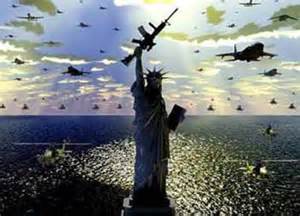
America the Epicenter of Pure Evil

aa-American-Empire-statue-of-liberty-and-military

By Stephen Lendman

Source: SteveLendmanBlog

No nation in world history harmed more people grievously over a longer duration than America – never beautiful, no bastion of democratic values, no advocate of world peace and stability.

Bipartisan lunatics run things, a criminal cabal, humanity’s greatest threat. The domestic and geopolitical agendas of each new administration is worse than its predecessors.

Elections when held are farcical. Duopoly power always wins, monied interests alone served, ordinary people increasingly harmed – full-blown tyranny and nuclear war perhaps following the next major state-sponsored false flag.

Americans have no say on how they’re governed, democracy a mirage. None whatever exists. Scoundrel media and self-serving politicians pretend otherwise – most people either unaware of how they’re ill-served or too indifferent to try changing things, going along with what harms them.

Intelligent people I know are too preoccupied in their daily lives to realize and get involved against the grave danger facing humanity.

The likelihood of a Hillary presidency should terrify everyone – a war goddess, the greatest threat to world peace of any leader in US history if she succeeds Obama.

Yet media scoundrels serve as her press agents. Polls show her ahead. US voters are so out-of-touch, uninformed and indifferent, they support what demands opposition.

I tremble at what’s coming with her in charge. Things may never be the same again. How many more wars will be waged?

How many victims will die or be gravely harmed with her as president? Will the remnants of social justice be entirely discarded? Will police state ruthlessness be harsher than ever? Is unthinkable nuclear war likely?

Is Orwell’s dystopian nightmare on steroids our future? Will Americans ever awaken to the clear and present danger they face? Will they revolt or remain dismissive?


Stephen Lendman lives in Chicago. He can be reached at lendmanstephen@sbcglobal.net.

His new book as editor and contributor is titled “Flashpoint in Ukraine: How the US Drive for Hegemony Risks WW III.” http://www.claritypress.com/LendmanIII.html

Visit his blog site at sjlendman.blogspot.com. 

Arcadian Gates by T.A. Wardrope: Dystopia on the Fringe

51J0Tmr3+IL._SX330_BO1,204,203,200_By Brian Whitney

Source: Disinfo

T.A. Wardrope‘s new novel, Arcadian Gates, tells the story of how ten years ago, the entire nation was struck by a chemical weapon which destroyed most people’s memories. Akiry, a young woman who makes her way smuggling amongst the lower caste of the rebuilt country, is haunted by dreams of a daughter she otherwise does not remember. As civil war erupts in the city around her, she takes the last chance she has to find the truth about her daughter and her past.

We talked to author and Disinfo contributor T.A. Wardrope about his new book.

T.A., Thanks for talking to me. Can you tell me a little bit about what inspired Arcadian Gates and what your process was writing it?

The book began as a short story in a writing workshop. I had fun with it and so I just kept building it forwards and backwards for quite a few years. There was a substantial amount of world building that was a byproduct of writing Akiry’s story. Next thing I knew I had a book with a glossary and a map on the inside cover.

The story itself evolved as I tried to understand Akiry’s relationship to the world around her. I wanted a dystopia that was drawn from the lore and theories that Disinfo readers would recognize. Fringe stuff that you might hear about on Darkness Radio or Art Bell’s classic Coast to Coast AM. There’s kind of a unified conspiracy theory under the whole thing. A substantial amount of Terence McKenna and William Burroughs influence too. I joke that it is my “Streets of Fire”; one book that has everything I enjoy about science-fiction in the mix.

In your book almost an entire nation loses its memory due to a chemical weapon. Memory is always a fight, even in the best of times, it can be tricky and elusive, can you touch on how the loss of a nation’s memory changes everything?

Oh, I think we can just look around. I think that part of the book comes from a place of satire or critique. Americans, in particular, are very good at forgetting the lessons of the not-so-distant past. This bizarre hyper news cycle is a particularly troublesome symptom of this. By making something so very important for a few days, nothing becomes important at all. It’s very Orwellian.

But within the Administrated Republic, the weapon’s effect allows for a constantly shifting narrative of history. It’s the least subtle method of the winner defining history. Practically speaking, families are separated, identities destroyed, and personal empowerment disintegrated. It’s very hard for people to trust who they are if they don’t really know their past. Plus the shared experience allows for national community and a national wound that is easy to use as needed. Again, we can look at our recent history for evidence of that. That Administrated Republic just takes all of this to the next level of control. They had their reasons, though. I wanted them to be much more authentic than your standard dystopic power state. I had as much writing their side of things as I did the roughnecks in Akiry’s world.

You seem to have the chops of someone who has long been a student of the Sci-fi masters. What writer influenced you along your path?

Oh, thank you. There’s a solid foundation of Isaac Asimov, Frank Herbert, Ray Bradbury and David Drake. But the actual authors who had a direct influence on how I thought about the world of Arcadian Gates would be people like Philip K. Dick, William Burroughs, Samuel Delaney, J.G. Ballard, China Mieville, Moebius, Alan Moore, Robert Anton Wilson and Margaret Atwood. My program advisor at Hamline, Lawrence Sutin, is a PKD scholar so his input was especially helpful. I am a student of cinema too, so there’s plenty of influence from that realm. Some folks have asked me to write a screenplay version, but the book seems basically unfilmmable to me. Movies about underdog drug dealers don’t get the kind of budgets it would need to get made correctly.

Are there lessons to be learned from the Dystopian world that we see in Arcadian Gates?

I see it as satire in the tradition of 1984, Brave New World or We, so the lessons available in the story are just as evident in the world around us now. I think that one reason dystopia was so popular with young readers is that the world around them is a dystopia in many ways and fiction just distills that into a less confusing form. Arcadian Gates isn’t a YA book, by any means, but every part of it is drawn from history or historical theory. I didn’t write it for a particular moral, though, I wanted to keep it focused on how one woman navigates this world and how her actions reverberate throughout that world. I suppose the lesson is that history is a collision of millions of stories driven by many more decisions and desires. Akiry’s journey is one of those stories.

What are you up to next?

I am working on a pair of books drawn from the Sirius Business blog that runs here on Disinfo. One of those will actually be in the same continuity of Arcadian Gates. There will be a sequel to Arcadian Gates, as Akiry is just getting started. In between the books there are some short stories written that are both in continuity and some not at all related. Those could wind up in a collection at some point. Finally, I’m doing some more world building for a project that is firmly grounded in the horror side of things. Sometimes I wonder if I love the development stuff too much, even the shorts have considerable background to them.

More info on all of this stuff will pop up on social media. I’ve got more things planned in support of Arcadian Gates, too. Readings and maybe some convention visits. Being an indie author requires a having a finely honed sense of the balance between creative work and promotional work. I’ve still got a lot to learn in both of those aspects, I think. I’ll be learning advanced time engineering. Whiskey, too. Plenty of whiskey.