
Saturday Matinee: The Third Man

The Trouble with Harry Lime

By David H. Schleicher

Source: The Schleicher Spin

I initially felt a fool for not having seen The Third Man earlier. However, in retrospect, having now read most of Graham Greene’s major works, and having received some keen insight into the back-story of producer Alexander Korda through Kati Marton’s book The Great Escape, I feel I was able to enjoy The Third Man even more for the staggering masterpiece that it is.

As a European/American co-production bankrolled by two legendary hands-on producers, David O. Selznick and Alexander Korda, The Third Man was masterfully crafted by director Carol Reed from a screenplay by British novelist Graham Greene. The film served as a pinnacle of the film noir movement and is a prime example of master filmmakers working with an iconic writer and utilizing an amazing cast and crew to create a masterwork representing professionals across the field operating at the top of their game.

Fans of Greene’s novels need not be disappointed as the screenplay crackles with all that signature cynicism and sharp witted dialogue. Carol Reed’s crooked camera angles, moody use of shadowing and external locations (Vienna, partially bombed out, wet and Gothic, never looked more looming and haunting) and crisp editing are the perfect visual realizations of Greene’s provocative wordplay and often saturnine view of the world. Reed’s brief opening montage and voice-over introducing us to the black market in Vienna is also shockingly modern, as it is that energetic quick-cut editing that has influenced directors like Scorsese to film entire motion pictures in just such a style. Also making the film decidedly timeless is the zither music score of Anton Karas, a bizarre accompaniment to the dark story that serves as a brilliant contradiction to what is being seen on screen.

The story of The Third Man slides along like smooth gin down the back of one’s throat as characters, plot and mood meander and brood along cobblestone streets and slither down dark alleys in an intoxicated state. Heavy drinking hack writer Holly Martins (Joseph Cotten, doing an excellent Americanized riff on Graham Greene himself) arrives in post WWII occupied Vienna to meet up with his old pal Harry Lime (Orson Welles) only to find that Lime is reportedly dead, the police (headed by a perfectly cold Trevor Howard) don’t seem to care, and Lime’s charming broken-hearted mistress (Alida Valli, perfect as another Greene archetype) has been left behind. Of course, Martins can’t leave well enough alone as conspiracy, murder, unrequited romance, and political intrigue ensue. Welles benefits greatly from being talked about for most of the film and appearing mostly in shadows spare for two scenes: the famous ferris wheel speech, and a climatic chase beneath the streets of Vienna through Gothic sewers. His top hap, dark suit, and crooked smile are the stuff of film legend.

The side characters, however, are what make The Third Man such a rich, rewarding experience. We’re treated to small glimpses into the mindsets of varying people ranging from a British officer obsessed with American Western dime-store novels (of which Martins claims his fame) to an Austrian landlady eternally wrapped in a quilt going on and on in her foreign tongue as international police constantly raid her building and harass her tenants. The brilliance is that one needs no subtitles to understand her frustration. These added layers of character and thoughtful detail, hallmarks of Greene, set The Third Man in a class above the rest of film noir from the late 1940’s era.

Make no mistake, The Third Man is arguably one of the most finely crafted films ever made. One’s preference towards noir and Greene’s world-view will shape how much one actually enjoys the film. For the sheer fact it has held up so well over the decades and has clearly influenced so many great films that came after it, its repeated rankings as one of the greatest motion pictures ever made can not be denied. With a good stiff drink in hand, and Graham Greene’s collection dog-eared on my bookshelf, The Third Man is undoubtedly now one of my favorite films. Reed’s closing shot of a tree-lined street along a cemetery and Joseph Cotten leaning against a car smoking a cigarette while Alida Valli walks right past him with that zither music score playing is one that has left an indelible mark on my memory and enriched my love of film as art.

Watch The Third Man on Hoopla here: https://www.hoopladigital.com/movie/the-third-man-joseph-cotten/18085476
Saturday Matinee: Catch-22

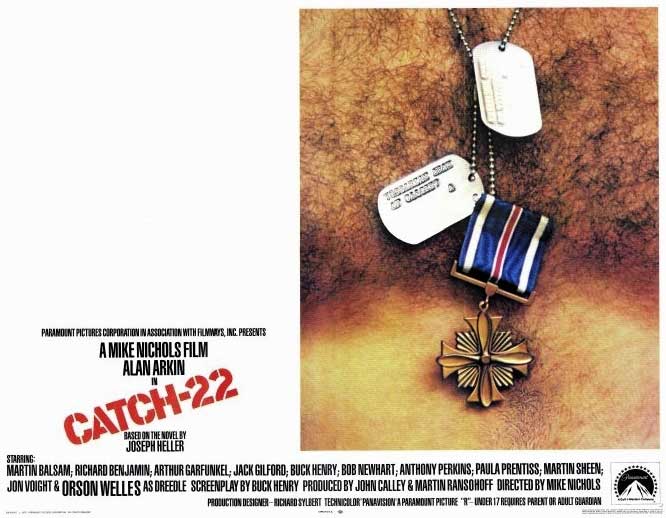
Classic Film Review: So was “Catch-22” the failure we remember it to be?

By Roger Moore

Source: Movie Nation

Perhaps it took a humorless, career-crippling George Clooney TV version of Joseph Heller’s novel to make us better appreciate Mike Nichols’ daring, infamously-expensive version of “Catch-22.”

Released at the height of the Vietnam War, suffering in comparison to Robert Altman’s equally anti-war dramedy “M*A*S*H,” seemingly more on a par with with equally cynical action comedy “Kelly’s Heroes,” which has had the benefit of a lot more TV exposure, “Catch” still plays the way it did way back in 1970 — as a pricey, “difficult” satire with a “difficult” shoot as baggage.

But wipe away the “Catch-22 lore,”the people cast and cast-aside, the fact that Nichols wanted the more age-appropriate Al Pacino as Yossarian, the young bombardier/anti-hero, and grapple with the film’s disordered narrative, the nightmarish focus of the story — an active-duty combat airman flying through and ranting through what we now call Post Traumatic Stress Syndrome, coupled with a tinge of guilt.

It’s amazing to see now. And considering how our war movies, from “300” to “Midway,” “Greyhound” to “Flyboys” and even at times, “Dunkirk,” are made now — with digital planes and ships and sometimes tanks — they really don’t make’em like this any more.

Nichols made the most of his coastal Mexican location, showing off all 17 WWII vintage B-25s taking off and landing every chance he got. You couldn’t do that today.

And that cast. Alan Arkin makes a fine, perplexed and outraged Yossarian, a sane man trapped in the insanity of war, an actor who never hits a punchline too hard, never takes the character’s exasperation into parody.

“Let me see if I’ve got this straight. In order to be grounded, I’ve got to be crazy. And I must be crazy to keep flying. But if I ask to be grounded, that means I’m not crazy anymore, and I have to keep flying.”

“You got it,” Doc Daneeka (Jack Gilford) tells him. “That’s Catch-22.

“Whoo… That’s some catch, that Catch-22.”

Orson Welles as a grumpy general, Tony Perkins as a put-upon chaplain, Martin Balsam as the murderously vain Col. Cathcart, Buck Henry as his venal sidekick, Col. Corn (screenwriter Henry was never better, as an actor), baby-faced Bob Balaban as the always-crashing, always-tinkering, even-tempered Orr, it’s a dazzling corps.

Bob Newhart half-stammering through Major Major Major, a very young Martin Sheen raging as the pilot Dobbs, Art Garfunkel as the innocent co-pilot Nately who falls for an Italian hooker, Charles Grodin as an upper-class twit navigator, a smarmy, befuddlingly upbeat Richard Benjamin (cast, with his wife Paula Prentiss as a nurse Yossarian chases), the famous French star who fled to Hollywood Marcel Dalio is the wizened old Italian who figures Italy has already won the war, since it has surrendered and Americans are still fighting and dying. And there’s a sea of actors we’d come to recognize on TV (“The Bob Newhart Show” is over-represented) in the years that followed.

Jon Voight stands out, just enough, as the grinning opportunist Milo Minderbender, a stand-in for every war profiteer you’ve ever read about, working the angles, an impersonal unpatriotic multinational corporation who wins no matter who loses.

Like its two contemporaries, “M*A*S*H” and “Kelly’s Heroes,” it’s a guy’s movie with a dated leering quality about the opposite sex. It’s heavy-handed, here and there, betraying Nichols — feeling his oats after “The Graduate” — indulging in some serious “blank check” filmmaking.

And reading, over the years, of all the people Nichols wanted to cast, or cast and then replaced, you kind of wish he’d moved on from Gilford, a future Oscar nominee who doesn’t bring enough cowardly sniveling to the good doc.

“Catch-22” was popular enough that they did a pilot for a sitcom based on it, as was the case with “M*A*S*H.” Richard Dreyfuss had the lead in that.

Over the years, I’ve interviewed half a dozen actors from that all-star cast, and often, without prompting, they’d bring it up. It took half a year of their lives, most of them, and burned itself into their memories, even if it wasn’t the blockbuster Paramount expected it to be.

Watching it again, outside of the academic settings where it turned up in “film as satire” classes and the like, it feels more cinematic than the scruffy, Altmanesque “M*A*S*H,” a movie marred by that stupid screen-time-chewing football game. It’s less fun than the more-watchable “Patton” and even “Kelly’s Heroes” (which is FAR longer).

But as a darker-than-dark comedy about the futility and insanity of war, it towers above its contemporaries in ways that should have scared-off George Clooney. It’s the best film of a seemingly-unfilmmable classic novel we’re ever going to get.

MPAA Rating: R, graphic violence, blood, nudity, profanity

Cast: Alan Arkin, Martin Balsam, Buck Henry, Tony Perkins, Bob Newhart, Paula Prentiss, Richard Benjamin, Marcel Dalio, Bob Balaban, Art Garfunkel, Martin Sheen, Jack Gilford, Peter Bonerz, Norman Fell, Austin Pendleton, Jon Voight and Orson Welles.

Credits: Directed by Mike Nichols, script by Buck Henry, based on the Joseph Heller novel. A Paramount release.

Running time: 2:02

____________________

Watch Catch-22 on Kanopy here: https://www.kanopy.com/en/product/3216674

Saturday Matinee: Orson Welles Short Double Feature

Orson Welles Narrates Animations of Plato’s Cave and Kafka’s “Before the Law,” Two Parables of the Human Condition

By Colin Marshall

Source: Open Culture

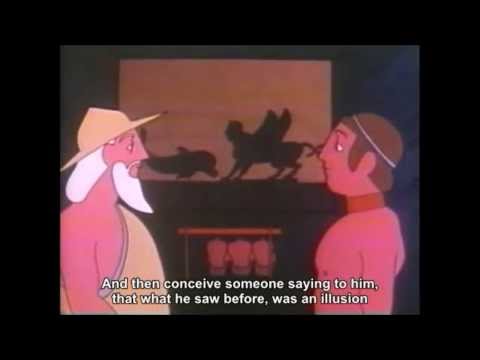
You’re held captive in an enclosed space, only able faintly to perceive the outside world. Or you’re kept outside, unable to cross the threshold of a space you feel a desperate need to enter. If both of these scenarios sound like dreams, they must do so because they tap into the anxieties and suspicions in the depths of our shared subconscious. As such, they’ve also proven reliable material for storytellers since at least the fourth century B.C., when Plato came up with his allegory of the cave. You know that story nearly as surely as you know the ancient Greek philosopher’s name: a group of human beings live, and have always lived, deep in a cave. Chained up to face a wall, they have only ever seen the images of shadow puppets thrown by firelight onto the wall before them.

To these isolated beings, “the truth would be literally nothing but the shadows of the images.” So Orson Welles tells it in this 1973 short film by animator Dick Oden. In his timelessly resonant voice that complements the production’s hauntingly retro aesthetic, Wells then speaks of what would happen if a cave-dweller were to be unshackled.

“He would be much too dazzled to see distinctly those things whose shadows he had seen before,” but as he approaches reality, “he has a clearer vision.” Still, “will he not be perplexed? Will he not think that the shadows which he formerly saw are truer than the objects which are now shown to him?” And if brought out of the cave to experience reality in full, would he not pity his old cavemates? “Would he not say, with Homer, better to be the poor servant of a poor master and to endure anything rather than think as they do and live after their manner?”

Plato’s cave wasn’t the first parable of the human condition Welles narrated. Just over a decade earlier, he engaged pinscreen animator Alexandre Alexeieff (he of Night on Bald Mountain and and “The Nose,” previously featured here on Open Culture) to illustrate his reading of Franz Kafka’s story “Before the Law.” The law, in Kafka’s telling, is a building, and before that building stands a guard. “A man comes from the country, begging admittance to the law,” says Welles. “But the guard cannot admit him. May he hope to enter at a later time? That is possible, said the guard.” Yet somehow that time never comes, and he spends the rest of his life awaiting admission to the law. “Nobody else but you could ever have obtained admittance,” the guard admits to the man, not long before the man expires of old age. “This door was intended only for you! And now, I’m going to close it.”

“Before the Law” describes a grimly absurd situation, as does Welles’ The Trial, the film to which it serves as an introduction. Adapted from another work of Kafka’s, specifically his best-known novel, it also concerns itself with the legal side of human affairs, at least on the surface. But when it becomes clear that the crime with which its bureaucrat protagonist Josef K. has been charged will never be specified, the story plunges into an altogether more troubling realm. We’ve all, at one time or another, felt to some degree like Joseph K., persecuted by an ultimately incomprehensible system, legal, social, or otherwise. And can we help but feel, especially in our highly mediated 21st century, like Plato’s immobilized human, raised in darkness and made to build a worldview on illusions? As for how to escape the cave — or indeed to enter the law — it falls to each of us individually to figure out.


Saturday Matinee: Future Shock

future-shock

Future Shock: Orson Welles Narrates a 1972 Film About the Perils of Technological Change

By Jonathan Crow

Source: Open Culture

The beginning of the 1972 documentary Future Shock, directed by Alex Grasshof, shows Orson Welles, bearded and chomping on a cigar, standing on an airport people mover. He turns to the camera and delivers a monologue in his trademark silken baritone. “In the course of my work, which has taken me to just about every corner of the globe, I see many aspects of a phenomenon which I’m just beginning to understand. Our modern technologies have changed the degree of sophistication beyond our wildest dreams. But this technology has exacted a pretty heavy price. We live in an age of anxiety and time of stress. And with all our sophistication, we are in fact the victims of our own technological strengths –- we are the victims of shock… a future shock.”

The documentary itself is wonderfully dated. From its bizarre opening montage; to its soundtrack, which lurches from early electronic music to jazz funk; to some endearing video special effects, which, for whatever reason, mostly centers around Orson Welles’s head, the film feels thoroughly rooted in the Nixon administration. Yet many of the ideas discussed in the movie are, if anything, more relevant now than in the 1970s. Watch it above.

The term “future shock” was invented in Alvin Toffler’s hugely bestselling book of the same name to describe the constant, bewildering barrage of new technologies and all the resulting societal changes those technologies bring about. Anyone who has struggled to comprehend a new, baffling and supposedly essential social media platform, anyone who has been driven to paralysis over the number of choices on Netflix, anyone who found their livelihood decimated because of a hot new app knows what “future shock” is.

Toffler (along with his wife and uncredited co-writer Heidi Toffler) argued that we are in the midst of a massive structural change from an industrial society to a post-industrial one – a society that boggles the mind with an overload of information and an overload of consumer choices. “Change,” as they wrote, “is the only constant.”

Along the way, the Tofflers managed to predict the collapse of America’s manufacturing sector, along with things like Prozac, temp jobs, the internet and the meteoric rise and fall of insta-celebs (Alex from Target, we hardly knew you.) Other predictions – underwater cities, paper clothes and being able to choose your own skin color – haven’t yet come to pass. Still, they had a surprisingly good track record considering these predictions were written over four decades ago.

The video ends with a plea from not Welles, but Toffler himself, who is seen addressing college students.

If we can recognize that industrialism is not the only possible form of technological society, if we can begin to think more imaginatively about the future, then we can prevent future shock and we can use technology itself to build a decent, democratic and humane society. […] We can no longer allow technology just to come roaring down at us. We must begin to say “No” to certain kinds of technology and begin to control technological change, because we have now reached the point at which technology is so powerful and so rapid that it may destroy us, unless we control it. But what is the most important is we simply do not accept everything; that we begin to make critical decisions about what kind of world we want and what kind of technology we want.


Related Content:

Isaac Asimov Predicts in 1964 What the World Will Look Like Today — in 2014

Arthur C. Clarke Predicts the Future in 1964 … And Kind of Nails It

Walter Cronkite Imagines the Home of the 21st Century … Back in 1967

The Internet Imagined in 1969

Marshall McLuhan Announces That The World is a Global Village

Jonathan Crow is a Los Angeles-based writer and filmmaker whose work has appeared in Yahoo!, The Hollywood Reporter, and other publications. You can follow him at @jonccrow. And check out his blog Veeptopus, featuring lots of pictures of badgers and even more pictures of vice presidents with octopuses on their heads.  The Veeptopus store is here.

Saturday Matinee: Get to Know Your Rabbit

MV5BMTYwODkxMjIxNF5BMl5BanBnXkFtZTYwNTU3NzM5._V1_SX214_AL_

“Get to Know Your Rabbit”(1972) is an offbeat comedy Brian DePalma directed early in his career about a successful but unsatisfied corporate executive Beeman (Tommy Smothers) who quits his job to become a tap dancing magician under the mentorship of Mr. Delesandro (Orson Welles). When his new venture becomes a successful corporation, Beeman finds his path has come full circle. The film features a brief uncredited cameo by cult character actor Timothy Carey as a cop.

Saturday Matinee: F for Fake

Via Dangerous Minds:

If you’ve seen Orson Welles’ late period quasi-documentary F for Fake, then you know about the mysterious art forger Elmyr De Hory. In his freewheeling cinematic essay, Welles explored the funhouse mirror life of de Hory, who found that he had an uncanny knack for being able to paint counterfeits of Picasso, Matisse, Modigliani and Renoir’s work. After some of his fakes were sold to museums and wealthy collectors, suspicions were raised and his legal troubles—and a life spent moving from place to place to avoid the long arm of the law—began.
At the time Welles met up with Elmyr in the early 70s, he was living in Ibiza and had been the subject of Fake! The Story of Elmyr de Hory the Greatest Art Forger of Our Time written by notorious “biographer” Clifford Irving, who himself figures prominently in the film. During the course of filming F for Fake, Irving (who was later portrayed by Richard Gere in The Hoax), was serendipitously revealed to have forged his own “autobiography” of Howard Hughes (not to mention Hughes’ signature). The resulting film, an essay on the authorship of “truth” in art, is a dazzling, intellectuality challenging masterpiece that can never quite decide if it’s a fake documentary about a fake painter of fake masterpieces who himself was the subject of a fake biographer… or what it is. (It’s no wonder that Robert Anton Wilson was such a fan of F for Fake, which figures prominently in his book, Cosmic Trigger II).

F or Fake also calls into question the nature of “genius”: If Elmyr’s forgeries were good enough to pass off as Picasso or Modigliani’s work, or even to hang in museums under the assumption that they were the work of these masters, wouldn’t Elmyr’s genius be of equal or even nearly equal value to theirs? (Worth noting that it was ego that got in the way of Elmyr’s scam at several points in his life: He was often left apoplectic at hearing how much crooked art dealers were making from his paintings!)

De Hory’s former bodyguard and driver, Mark Forgy, has kept Elmyr’s archive since his suicide in December 1976. In recent years Mr. Forgy has been trying to make more sense of Elmyr’s odd life. From the New York Times:

“I’m so far down the rabbit hole,” Ms. Marvin said in a recent phone interview, “I’m just not going to rest until I find out who this man is.”

A few weeks ago, she and Mr. Forgy traveled to western France and unrolled a dozen de Hory paintings that had been discovered in a farmhouse’s attic. In Budapest, they found birth records, dated 1906, for Elemer Albert Hoffmann, son of Adolf and Iren. No one knows when Elemer upgraded his name, or how he financed art studies in Munich and Paris before moving to New York in 1947.

He claimed that his father was a Roman Catholic and a diplomat, but the Budapest ledgers list Adolf as a Jewish merchant. The Nazis killed his entire family, Mr. de Hory said. But a cousin named Istvan Hont visited the artist’s villa on Ibiza, where Mr. Forgy was working at various times as a chauffeur, secretary and gardener. Mr. Hont, it turns out, was the forger’s brother.

Mr. Forgy knew that his boss copied masterpieces but did not much question their life on Ibiza, in which they kept company with celebrities like Marlene Dietrich and Ursula Andress. “I accepted the amazing with a nonchalance,” Mr. Forgy said in a recent phone interview. Mr. de Hory was the focus of Orson Welles’s 1974 documentary “F for Fake,” and Clifford Irving breathlessly titled his book “Fake! The Story of Elmyr de Hory the Greatest Art Forger of Our Time.”

After Mr. de Hory’s suicide, Mr. Forgy returned to Minnesota. “I went into deep seclusion” working as a night watchman and house restorer, he said. He held onto the papers and paintings. “I have schlepped them around endlessly,” he said. “The walls here in the house look like the Pitti Palace in Florence.”

His wife, Alice Doll, encouraged him in recent years to examine the stacks of false passports, Hungarian correspondence and Swiss arrest reports. Ms. Marvin contacted him last year. She had helped organize a show about faked and stolen art at the National Museum of Crime & Punishment in Washington, including a portrait of a pensive brunette by Mr. de Hory imitating Modigliani.

The researchers are now raising money for the documentary, developing an exhibition for the Budapest Art Fair in November and preparing to interview a nonagenarian de Hory cousin in Germany. They also plan to send paintings for lab analysis. “We’re trying to create a forensics footprint of his work,” Ms. Marvin said.

They already know that Mr. de Hory tore blank pages out of old books for sketching paper and bought paintings at flea markets to scrape and recycle the canvases. His fakes have become collectibles. Last fall, at a Bonhams auction in England, a buyer paid more than $700 for a seascape of crowded sailboats, with a forged Raoul Dufy signature on the front and “Elmyr” on the back.

Elmyr website

Watch the full film on Kanopy here: https://www.kanopy.com/s?query=f%20for%20fake

Podcast Roundup: Halloween Edition

Photo: The Onion

Photo: The Onion

Though I don’t regularly feature podcasts delving into horror/sci-fi aspects of pop culture or the world of metaphysics and the paranormal, today seems an appropriate time to share a few in observance of Halloween, All Hallow’s Eve, Samhain, Day of the Dead, etc.

10/27 Maja D’Aoust and Erik Davis discuss magical and synchronistic aspects of politics and modern culture at Expanding Mind: Show link: http://prn.fm/category/archives/expanding-mind/

10/28 A great discussion on John Carpenter’s 1982 remake of “The Thing” and what makes it a classic horror film at the Debatable Podcast: Show link: http://debatablepodcast.tumblr.com/post/65307821240/episode-56-the-thing-with-sip-eric-sipple-joins

10/29 Guillermo Jimenez and Dr. Paul Cantor have a conversation about the political meaning of apocalyptic “end of the world” narratives in shows like The Walking Dead, X- Files, Fringe, and Falling Skies from a libertarian perspective: Show Link: http://tracesofreality.com/2013/10/29/tor-radio-the-truth-behind-the-walking-dead-liberty-vs-authority-in-pop-culture-with-dr-paul-cantor/

10/30 Tim Binnall and David Acord commemorate the 75th anniversary of Orson Welles’ infamous “War of the Worlds” radio broadcast with an analysis of the program, how it came to be, its importance in the context of emerging technology and the field of media literacy, and how it’s connected to conspiracy and UFOlogy: Show link: http://www.binnallofamerica.com/boaa103013.html

Judging from the last few minutes of this trailer for his film “F For Fake”, Welles himself was involved in perpetuating the mystery and speculation surrounding his War of the Worlds broadcast:

10/30 The always educational “Stuff They Don’t Want You to Know” video podcast covers the origins of Halloween traditions:

Show link: http://www.howstuffworks.com/podcasts/stuff-they-dont-want-you-to-know.rss