Global One Percent Celebrate at the Bohemian Grove

bohemian-grove

By Peter Phillips

Source: Dissident Voice

July 18th 2015 was the first day of this year’s summer camp for the world’s business and political aristocracy and their invited guests. 2,000 to 3,000 men, mostly from the wealthiest global one percent, gather at Bohemian Grove, 70 miles north of San Francisco in California’s Sonoma County—to sit around the campfire and chew the fat—off-the-record—with ex-presidents, corporate leaders and global financiers.

Speakers this year giving “Lakeside Chats” include past Secretary of Defense and the CIA Leon Panetta, Paul Volcker Jr. former Federal Reserve Chairman, retired Admiral Mike Mullen former Chairman of the Joint Chiefs of Staff, NYU Law Professor Bryan Stevenson, producer Norman Lear, the founder of AOL Steve Case, and Christopher Hill former US Ambassador to Iraq.

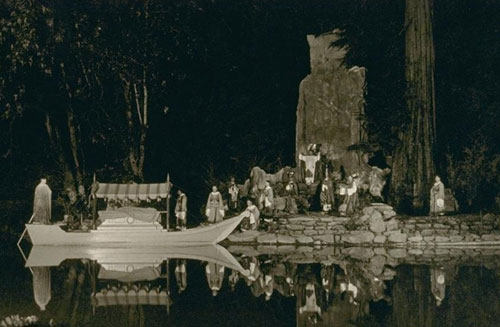
The Bohemian Grove summer encampments have become one of the most famous private men’s retreats in the world. Club members and several hundred world-class guests gather annually in the last weeks of July to recreate what has been called “the greatest men’s party on earth.” Spanning three weekends, the outdoors event includes lectures, rituals, theater, camp parties, golf, swimming, skeet shooting, politics, sideline business meetings and feasts of food and alcohol.

One might imagine modern-day aristocrats like Henry Kissinger, the Koch brothers, and Donald Rumsfeld amid a circle of friends sipping cognac and discussing how the “unqualified” masses cannot be trusted to carry out policy, and how elites must set values that can be translated into “standards of authority.”

Private men’s clubs, like the San Francisco Bohemian Club, have historically represented institutionalized race, gender and class inequality. English gentlemen’s clubs emerged during Great Britain’s empire building period as an exclusive place free of troublesome women, under-classes, and non-whites. Copied in the United States, elite private men’s clubs served the same self-celebration purposes as their English counterparts.

The San Francisco Bohemian Club was formed in 1872 as a gathering place for newspaper reporters and men of the arts and literature. By the 1880s local businessmen joined the Club in large numbers, quickly making business elites the dominant group. More than 2,500 men are members today. Most are from California, while several hundred originate from some 35 states and a dozen foreign countries. About one-fifth of the members are either directors of one or more of the Fortune 1000 companies, corporate CEOs, top governmental officials (current and former) and/or members of important policy councils or major foundations. The remaining members are mostly regional business/legal elites with a small mix of academics, military officers, artists, or medical doctors.

Foremost at the Bohemian Grove is an atmosphere of social interaction and networking. You can sit around a campfire with directors of PG&E, or Bank of America. You can shoot skeet with the former secretaries of state and defense, or you can enjoy a sing-along with a Council of Foreign Relations director or a Business Roundtable executive. All of this makes for ample time to develop personal long-lasting connections with powerful influential men.

On the surface, the Bohemian Grove is a private place where global and regional elites meet for fun and enjoyment. Behind the scene, however, the Bohemian Grove is an American version of building insider ties, consensual understandings, and lasting connections in the service of class solidarity. Ties reinforced at the Grove manifest themselves in global trade meetings, party politics, campaign financing, and top-down corporatism.

Peter Phillips is a Professor of Sociology at Sonoma State University, and President of Media Freedom Foundation/Project Censored. He wrote his dissertation on the Bohemian Club in 1994. Read other articles by Peter, or visit Peter’s website.


The enduring reality of government by wealth and some of its consequences

Plutocracy-2

By John Chuckman

Source: Intrepid Report

If you really want to understand the world in which we live—its endless wars, coups, interventions, and brutality towards great masses of people—you need to start with a correct understanding of the political machinery at work.

Talk of liberal interventions or fighting for rights, Western values, and democracy are hopelessly naïve and mostly deliberately deceptive. America’s record in such matters is one of securing everything from bananas, copper, and crude oil concessions to, at the very least, foreign governments obedient to its mandates after removing a disliked leader, whether elected or not. There is no concern for principles outside of their being featured in blowhard, insincere political speeches. The interests of America’s government do not match the interests of ordinary people, those in America or anywhere else, and, were the informed consent of the governed genuinely involved in launching bloody adventures, they likely never would happen.

The underlying reality of how people in the West are governed now compared to hundreds of years ago is surprisingly unchanged, much the way the rules governing how chemical bonds form have not changed despite a long and great parade of events and discoveries in the visible world. Despite all the revolts, revolutions, congresses, constitutions, and great movements over the centuries, we are in fact governed in the same essential way, people.

Of course to see this, you have to strip away the forms and rituals we have constructed over the centuries, forms and rituals which create impressive effects much like the green smoke and thunderous voice of the Wizard of Oz, a wizened old man who worked from his curtained control room, pulling levers and hitting buttons to create intimidating effects. Most Americans remain impressed with the smoke and thunder and cheap magic tricks, it requiring some dedicated effort to shake off well-done illusions, and, as I’ve written before, Americans work extremely hard in their jobs or live a kind of marginal life trying to scrape by on low wages or part-time work, either of which situations leaves little time or inclination to question what government is really doing and for whose benefit.

And so long as America remains under the rule of wealth, it is unlikely other states, as in Western Europe, will emerge from it because America’s establishment has such decisive influence—economic, financial, military, and political—over many of them.

What is considered as wealth changes over time and with economic development, and with those changes so do its interests as well as the practices of its power. Great deposits of copper ore or crude oil In the Middle Ages were virtually worthless. Wealth then was land for agriculture, forestry, and hunting, with the family names of owners determined by their estates. The revenue from that natural wealth was converted to great houses and jewels and the implements of war. War, too, was a source of wealth with most wars being little more than adventures for dominance and looting on a grand scale. Again, as in our own day, they were dressed up with slogans about principles or causes which had almost no meaning. The case of the “Christian” Crusades, which continued their pillaging and orgy of killing, on and off, for centuries, springs to mind. Soldiers and sailors, up until modern times, were not motivated by their paltry pay and poor supplies, it being understood as a condition of employment that they would enjoy a share of the bounty looted in any campaign.

Today, the forms wealth are as diverse and complex as is our society, and many of them are not apparent to ordinary people in the way great estates and hunting rights and obligations in war and peace to great lords were apparent in 800. Even as late as, say, 1850, wealth in the form of belching factories employing armies of people was often still quite apparent, but today’s complex banking and securities and financial institutions are not well understood by most people, although they represent immense wealth just as real in its demands and power as estates and obligations of the 9th century. Wealth today also comes from huge global manufacturing concerns of every description often with operations scattered out of sight, great shipping and transportation fleets, or electronic and communications empires. Land itself remains an important form of wealth where it can produce industrial-scale crops or contains deposits of valuable minerals or can generate flows of electricity or has been developed into great cities or resorts. War remains a source of wealth, only on a scale which could not have been imagined a few hundred years ago, but the spoils no longer go to soldiers in professional armies, they go to those responsible for the war, often in forms not easily recognized, as with special rights and concessions and secret arrangements.

As the nature of wealth evolved from the Middle Ages to the Modern Era, outward forms and rituals of government also changed. We have moved from the near-absolute power of kings and autocrats through aristocracies and republics with senates to a great variety of forms, parliaments and congresses, which appear designed to yield, to one degree or another, to the consent of the governed.

But appearances, as in the case of the Wizard of Oz, can be deceiving.

Today, a single wealthy individual cannot make the kind of demands upon ordinary people that marked arrangements in the Middle Ages—although that must be qualified as I’m sure anyone who has become involved in a dispute with a wealthy neighbor or a great corporation will be happy to explain—but the class of wealthy people can indeed make just such demands, and they do so all the time. You will be taxed to pay for the schemes that their lobbying establishes, your water and air will contain the pollution of their manufacturing and mining, your children will be sent to kill and die in their wars, the ethics or morals you were taught as a child will be trampled upon, and virtually all important legislation will deal with the rights and interests of wealth, and not those of the broad mass of people.

In America, once in four years you will be asked to choose between two names, both of which have been closely vetted by the powers that be, to elect as head of government. Not only have they been vetted, but the immense costs of their campaigns in reaching you on television, at rallies, and with opinion polls to regularly fine tune their words will be paid almost exclusively by those whose real interests are at stake in every major election, the wealthy and their important serving institutions of government. The end effect is not really all that different than the old single-candidate Soviet elections at which the press trained Americans to sneer.

Many of America’s founding fathers had dark suspicions about the existence of wealth being secure in the presence of democratic government, and that is why they created forms—mostly adapted from Britain, a place no one regarded as a democracy then—to keep wealth safe. Over a couple of centuries, the original arrangements were modified, the country moving from a tiny one percent or so privileged voters—for perspective, that’s roughly the same as the percent of voters in China’s Communist Party deciding who rules the country—to something approaching universal suffrage, but always arrangements were made to safeguard wealth against the assumed predations of democracy.

In elections for the American Senate, the legislative body with real power, authority, and privilege, you again will be asked to choose between two well-vetted and well-connected candidates. Others may run, but they will be rendered helpless by the vetted candidates’ flood of money and resources, you will never hear their voices, and America’s press—itself an empire of wealth serving wealth—will waste no time on their views. In the case of the Senate, you will be asked once in six years to vote, with the elections staggered so that only one-third of that body faces election at any time—a perfectly-conceived formula for keeping the old bunch in charge despite issues which might have generated election discontent. In fact, you can never “throw the bums out” in America. Anyway, there really isn’t much risk for senators running for re-election, with incumbents winning about 95% of the time. Senate seats are so secure they sometimes become family sinecures, handed down from father to son. After the election, unless you live in a small-population, insignificant state, you will never see or meet your senator, and you will certainly have no opportunity to lobby. Virtually all seeing, meeting, and lobbying will be done by the wealthy sponsors of the successful candidates or by their hired help.

The average American senator is said to spend two-thirds of his or her time securing funds for the next election, and such elections have now been bid-up to unbelievable amounts of money. The huge costs serve as what economists call “a barrier to entry,” a kind of high financial wall which keeps others from entering the political market, or, if somehow they do manage to enter, keeps them from effectively competing. Only the other wealth-vetted and connected candidate will have any hope of collecting a big enough pot of money to threaten an incumbent. The belief that people giving millions of dollars to candidates expect nothing in return is not even worth discussing. What they get—apart from goodies like important and prestigious appointments or valuable government contracts—is access, and access is exactly what most people never enjoy. Intimate access to politicians in high office, people always mindful of the necessity for another overflowing campaign war chest, is genuine power.

It is not impossible to have compatibility between democracy and wealth, but it requires a set of laws and regulations concerned with campaign financing, lobbying, and disestablishing a political duopoly of two privileged parties, laws which simply cannot happen in America over our lifetimes. In America, law makes corporations persons, and the highest court, packed by judges appointed to serve wealth’s interests, has ruled that campaign money is free speech. These are not things easily turned around.

The American system of campaign financing not only assures the secure power of domestic wealth, it assures also the influence of wealthy lobbies serving the interests of foreign states, Israel being the most outstanding example. Other foreign states also exploit this system to varying degrees, but no other state has more than five million American citizens in great part keen to serve its interests. And many of them are successful, affluent, and well-placed people enjoying a connected set of organizations and well-funded lobbies. Other foreign states also do not enjoy having many of their lobbyists in America being dual-citizens, free to move back and forth between the country being lobbied and the country being lobbied for, surely an ethical issue for politics and foreign affairs of the first magnitude. It is a unique situation in many respects, and it has helped create a unique set of problems in the world.

The wealthy interests of America happen to share some important interests with lobbyists for Israel, including securing the Western world’s supply of energy and not permitting the rise of states of any power in the Middle East who disagree with America’s essential views. It is important to keep in mind that “America’s essential views” are not necessarily the views of most of the American people and that many of those “essential views” have never received genuine informed consent. Elections conducted the way America’s high-level elections are conducted are incapable of bestowing meaningful consent, especially in vitally important matters.

The Israeli-American alliance is something of an unholy one because in binding America so closely to Israel, some huge and unresolvable conflicts have been created. Israel is associated with a long series of wars and abuses in the region, and, ipso facto, so is America. Israel, given the nature of its founding, expansion, and practices, is not liked by any neighboring states, although many now cooperate secretly, and sometimes even openly, in areas of mutual interest and have learned to tolerate its existence, the way generally eased by large American bribes or equally large American threats.

Traditionally, states in the Middle East are not democracies. Their often short histories have given limited opportunity for wide-spread development and prosperity creating a strong middle-class, the sine qua non for democracy. With the United States always (insincerely) praising democracy—including Israel’s grotesque contradiction of “democracy for some but not others”—it has been caught in a bind between supporting what it says it opposes and opposing what it says it supports.

Its proposed solution was a huge CIA project, nicknamed “the Arab Spring” by America’s wealth-serving and often dishonest press, a set of manufactured uprisings intended to bring a semblance of democracy to the region. It has been largely a failure, ending with some countries trapped in chaos or civil war and others, notably Egypt, briefly gaining a government Israel hated intensely, the truth being that genuine democracy in virtually any of these countries will not be friendly to Israel’s geopolitical ambitions in the region nor to those of its American promoter and protector. While the “Arab Spring” was allowed to proceed in some states, in others, where it was neither intended nor desired, such as Saudi Arabia or Bahrain, spill-over effects were deliberately and violently suppressed with American assistance. So the American-Israeli relationship now still locks the United States effectively in fighting against democracy in some countries and in supporting absolute monarchs and oligarchs in others, while in still others, such as Syria and Iraq, it is involved literally in smashing them as states, in violation of all international law and long-term good sense.

The entire situation is an ongoing disaster and is almost certainly not sustainable over the long term. How do you insist a huge country like Egypt remain a backwater without democratic rights indefinitely? How can you justify the destruction of an ancient and beautiful country like Syria? How can you justify supporting absolute monarchs and keeping their people in total political darkness? How do you continue supporting Israel in its abuse of millions, depriving them of every human right, or in its constant aggression to secure its hegemony? The drive for regional hegemony is all that is behind Israel’s constant hectoring of Iran, and how is that behavior different to the aggressive wars condemned by the Nuremburg Tribunal? It’s not, of course. Further, destructive, deliberately-induced conflicts like that in Syria, by degrading its economic advance, only slow the day for democracy’s having a real chance to emerge.

So here is America, self-proclaimed land of the free, mired in a vast situation where it works to suppress democracy, supports tyrants, and supports aggressive war because its leaders, with no genuine consent of the governed, have put it there, and this is just one of many unhealthy and destructive consequences of wealth’s rule in the United States. Wealth has no inherent interest in democracy, and it is entirely up to a people anywhere to demand respect for democracy through laws.

John Chuckman is former chief economist for a large Canadian oil company. He has many interests and is a lifelong student of history. He writes with a passionate desire for honesty, the rule of reason, and concern for human decency. John regards it as a badge of honor to have left the United States as a poor young man from the South Side of Chicago when the country embarked on the pointless murder of something like 3 million Vietnamese in their own land because they happened to embrace the wrong economic loyalties. He lives in Canada, which he is fond of calling “the peaceable kingdom.” John’s columns appear regularly on Counterpunch, Media Monitors, Politics Canada, Baltimore Chronicle, Intrepid Report, Scoop (New Zealand), Asian Tribune, Aljazeerah.info, Smirking Chimp, Dissident Voice, and many other Internet sites. He has been translated into at least ten languages and is regularly translated into Italian and Spanish. Several of his essays have been published in book collections, including two college texts. His first book has just been published, “The Decline of the American Empire and the Rise of China as a Global Power,” published by Constable and Robinson, London. Contact him at jc60649@yahoo.com.


U.S. Wealth-Concentration: The Most-Accurate Current Estimates

un2

By Eric Zuesse

Source: Washington’s Blog

CURRENT REALITIES:

Wealthiest Tenth (10%) of Americans Own 75% of America; They Draw 40% of All U.S. Income.

Wealthiest Hundredth (1%) of Americans Own 43% of America; They Draw 20% of All U.S. Income.

Wealthiest Thousandth (0.1%) of Americans Own 22% of America; They Draw 8% of All U.S. Income.

Wealthiest Ten-Thousandth (0.01%) Own 11.2% of America; They Draw 5% of All U.S. Income.

Wealthiest 0.0025% (Forbes 400) Own 2.75% (of all trackable privately-held wealth, not including ‘non-profits’ that are controlled by them).

That last (2.75%) is this $2.29 trillion divided by this $83,296 billion (representing all of the privately owned wealth in the U.S.), in the final quarter of 2014.

Incidentally, the wealthiest tenth are worth over $1 million and draw incomes above $200,000; so: they’re all “millionaires” in common parlance; all of the “top 10%” are.

Following will be mirror-images of the above-cited breakdowns:

Poorest 90% of Americans Own 25% of America; They Draw 60% of All U.S. Income.

Poorest 99% of Americans Own 57% of America; They Draw 80% of All U.S. Income.

Poorest 99.9% of Americans Own 78% of America; They Draw 92% of All U.S. Income.

Poorest 99.99% of Americans Own Less Than 88.8% of America; They Draw Less Than 95% of All U.S. Income.

Poorer 50%: Comprehensive figures for the wealthier and poorer 50% of Americans haven’t been published as recently. However, for the year 2010, the wealthier 50% of Americans owned 98.9% of America, and the poorer 50% of Americans owned 1.1% of America. That was the year after the crash had supposedly ended in 2009. The last prior year in that same study was 2007, the economic peak, and it showed the wealthier half owning 97.5% of America, and the poorer half owning 2.5% of it. In other words: the losses from the Wall Street economic crash went overwhelmingly to the poorer half of the U.S. population (their wealth going down from 2.5% to only 1.1% of America’s total), because of the bailouts to Wall Street. Wall Street complains about “welfare programs,” as if it’s the poor who get bailed out; but those complaints are merely part of Wall Street’s — and their billionaires’ — scams that are targeted to sway fools. The figures show the exact opposite to be the actual truth. America is overwhelmingly a kleptocracy by the top against everybody else; not a “welfare state for the poor.” That’s just aristocrats’ scam, pumped by the economists they hire, and by the ‘news’ media which are controlled by aristocrats, and believed by suckers they fool.

HERE ARE THE TRENDS:

Right before the crash, in 2006 and 2007, the top 1% owned 33.8% of America; they drew 21.4% of all U.S. income.

A Congressional Research Service study, “An Analysis of the Distribution of Wealth Across Households, 1989-2010,” found that between the economic peak in 2007, and the end of the opening phase of the Wall Street bailouts in 2010, wealth-inequality in America soared, rising even faster than it had been rising during the George W. Bush years. As a consequence, whereas in 2007, the top 1% owned 33.8% of America, by 2010 this figure had risen to 34.5% — and the latest figure is 43%; so, this soaring is continuing (it wasn’t occurring only at the start of Obama’s Administration). What was bad under Bush has thus become lots worse under Obama, despite all of Obama’s rhetoric against wealth-inequality. And yet the Wall Street bailouts continue (under the guise of “QE”), as if the trickle-down policies of Obama and the Republicans had “ended” the “recession” for Americans generally, instead of only for the top 1% — which latter was the reality, and which reality makes a mockery of economists, who say that the “recession ended in 2009.” “Ended,” for whom? The policy is to bail out the megabanksters who made trillions from the MBS scams that brought the economy down — those people were bailed out when they were deep in the hole — while not bailing out their homeowners and cheated investors, who never recovered; statistics show they continue to suffer from those crimes. As a consequence, under Obama, wealth has risen only for the wealthiest of Americans.

However, incomes have been rising slightly for everyone else. For example, the “Bottom 99% Incomes Real Growth” during “2009-2014” was only 4.3% — less than 1% per year — while for the “Top 1%” it was 58% during that 5-year time-expanse. But that — bad as it is — is nonetheless an improvement, on income.

Throughout Obama’s first term, 2009-2012, the “Bottom 99% Incomes Real Growth” had been only 0.4% — less than 1% throughout that entire four-year period. The “Top 1%” received 95% of the “Incomes Real Growth” then. And yet, even though even the incomes of the bottom 99% of the U.S. population were stagnant throughout that four-year period ending in 2012 (all of Obama’s first term), economists still say that the “recession ended in 2009.” And the reality was even worse than this incomes-picture shows, because, in terms of wealth, which is even more important than income, there hasn’t yet  been a “recovery,” in the U.S., for the bottom 99% of Americans. What there has been, instead, is continuing scams, misinforming the public, about what’s actually happening, and what happened, and what caused it to happen. It’s just a racket.

THE DEEPER MEANING:

Under Presidents G.W. Bush and Barack Obama, economic inequality in America has been more extreme, for more years, than under any Presidents in all of the previous U.S. history. But, at least, Bush didn’t pretend to care about it. Obama does. He pretended to a concern for justice which he never really had; he was always merely faking liberalism. It was thus entirely true-to-form that President Obama had his Solicitor General present an argument to the U.S. Supreme Court that lying in politics is Constitutionally protected “free speech.”

But what, then, is really left of ‘democracy’ in the U.S.? After all, even before Obama, democracy in America was already dying, if not yet dead. And what meaningful democracy can even possibly exist in a nation where lying in politics is constitutionally protected ‘free speech,’ which no state may penalize, under any conditions? How may “the people” even conceivably rule in a republic where politicians can reasonably be expected to win only lying-contests, because not to lie in such a nation is not to be politically competitive there at all? Can democracy really consist of contests in deception? Is such a political race-to-the-bottom consistent with democracy?

Or, is it instead the case that such extreme wealth-disparities as exist in the U.S. are the natural result of decades of politics being (perhaps increasingly within recent times) little more than lying-contests? Is that the deeper truth, behind the deplorable figures here?

Is this extreme inequality the result of state-imposed reduction of ‘democracy’ to being basically contests in deceiving the public? Is that what it’s really all about — a racket, basically, against the public, for and on behalf of the aristocracy?

Is this extreme inequality the intended result, or is it merely the result of the stupidity of those who just happen to win high national office in the United States?

Do the farm animals just happen to end up as burger-meat? Or is that what they are there for? We know. Do they?

Congress Approves Greater Corporate Predation

2013-08_cartoon

By Stephen Lendman

Source: Steve Lendman Blog

On June 18, House members narrowly approved fast track Trade Promotion Authority (TPA) – using procedural gimmicks, bribes and heavy pressure, the usual way corrupt politicians operate.

On June 23, Senate members followed suit. A cloture motion to end debate passed – clearing the way for a Wednesday vote expected to support TPA.

Public Citizen President Robert Weissman commented saying:

The usual “legislative contortions an gimmicks…hand(ed) (corporate predators) their top priority” – the right to ram through Congress with minimal debate and no amendments anti-consumer rapacious trade deals no responsible societies would tolerate.

Overwhelming public opposition doesn’t matter. So-called “free” trade deals are hugely unfair.

People know “these deals will means more export of jobs, more downward pressure on wages,” said Weissman – plus more environmental destruction and loss of consumer protections.

Proposed TPP and TTIP trade bills are corporate scams – designed to rip off populations for maximum profits, no matter the cost to human lives and welfare.

They’ll wreck public healthcare. They’ll make it unaffordable for growing millions. They’ll undermine food safety. They’ll advance environmental destruction. Their secret provisions if made public would cause mass outrage.

Weissman struck a positive note saying when “the American people see what (are) actually in (these) agreements, they are going to force their representatives in Washington to vote (them) down.”

Environmental organization 350.org executive director May Boeve expressed “outrage that Congress…voted to fast track pollution, rather than the job-creating clean energy we need to address climate change.”

“It’s clear this deal would extend the world’s dependence on fracked gas, forbid our negotiators from ever using trade agreements in the fight against global warming, and make it easier for big polluters to burn carbon while suing anyone who gets in the way.”

“That’s why we’re so disappointed President Obama has taken up the banner for ramming this legislative pollution through the halls of Congress, in a way he never pushed for a climate bill.”

Food and Water Watch executive director Wenonah Hauter said “(s)enators who who provided the margin of Fast Track victory will face angry voters in their next elections.”

“Constituents will hold them accountable for putting the interests of transnational corporations ahead of the public.”

Monied interests run things. Whatever they want, they get. Congressional support for fast track and nightmarish trade deals to follow alone show why America is unfit to live in.


Stephen Lendman lives in Chicago. He can be reached at lendmanstephen@sbcglobal.net.

His new book as editor and contributor is titled “Flashpoint in Ukraine: US Drive for Hegemony Risks WW III.”

http://www.claritypress.com/LendmanIII.html

Visit his blog site at sjlendman.blogspot.com.

Listen to cutting-edge discussions with distinguished guests on the Progressive Radio News Hour on the Progressive Radio Network.

How America Became an Oligarchy

OLIGARCHY

By Ellen Brown

Source: Counterpunch

“The politicians are put there to give you the idea that you have freedom of choice. You don’t. . . . You have owners.”

— George Carlin, The American Dream

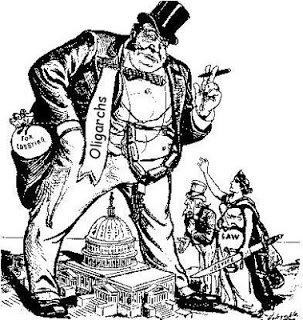
According to a new study from Princeton University, American democracy no longer exists. Using data from over 1,800 policy initiatives from 1981 to 2002, researchers Martin Gilens and Benjamin Page concluded that rich, well-connected individuals on the political scene now steer the direction of the country, regardless of – or even against – the will of the majority of voters. America’s political system has transformed from a democracy into an oligarchy, where power is wielded by wealthy elites.

“Making the world safe for democracy” was President Woodrow Wilson’s rationale for World War I, and it has been used to justify American military intervention ever since. Can we justify sending troops into other countries to spread a political system we cannot maintain at home?

The Magna Carta, considered the first Bill of Rights in the Western world, established the rights of nobles as against the king. But the doctrine that “all men are created equal” – that all people have “certain inalienable rights,” including “life, liberty and the pursuit of happiness” – is an American original. And those rights, supposedly insured by the Bill of Rights, have the right to vote at their core. We have the right to vote but the voters’ collective will no longer prevails.

In Greece, the left-wing populist Syriza Party came out of nowhere to take the presidential election by storm; and in Spain, the populist Podemos Party appears poised to do the same. But for over a century, no third-party candidate has had any chance of winning a US presidential election. We have a two-party winner-take-all system, in which our choice is between two candidates, both of whom necessarily cater to big money. It takes big money just to put on the mass media campaigns required to win an election involving 240 million people of voting age.

In state and local elections, third party candidates have sometimes won. In a modest-sized city, candidates can actually influence the vote by going door to door, passing out flyers and bumper stickers, giving local presentations, and getting on local radio and TV. But in a national election, those efforts are easily trumped by the mass media. And local governments too are beholden to big money.

When governments of any size need to borrow money, the megabanks in a position to supply it can generally dictate the terms. Even in Greece, where the populist Syriza Party managed to prevail in January, the anti-austerity platform of the new government is being throttled by the moneylenders who have the government in a chokehold.

How did we lose our democracy? Were the Founding Fathers remiss in leaving something out of the Constitution? Or have we simply gotten too big to be governed by majority vote?

Democracy’s Rise and Fall

The stages of the capture of democracy by big money are traced in a paper called “The Collapse of Democratic Nation States” by theologian and environmentalist Dr. John Cobb. Going back several centuries, he points to the rise of private banking, which usurped the power to create money from governments:

The influence of money was greatly enhanced by the emergence of private banking. The banks are able to create money and so to lend amounts far in excess of their actual wealth. This control of money-creation . . . has given banks overwhelming control over human affairs. In the United States, Wall Street makes most of the truly important decisions that are directly attributed to Washington.

Today the vast majority of the money supply in Western countries is created by private bankers. That tradition goes back to the 17th century, when the privately-owned Bank of England, the mother of all central banks, negotiated the right to print England’s money after Parliament stripped that power from the Crown. When King William needed money to fight a war, he had to borrow. The government as borrower then became servant of the lender.

In America, however, the colonists defied the Bank of England and issued their own paper scrip; and they thrived. When King George forbade that practice, the colonists rebelled.

They won the Revolution but lost the power to create their own money supply, when they opted for gold rather than paper money as their official means of exchange. Gold was in limited supply and was controlled by the bankers, who surreptitiously expanded the money supply by issuing multiple banknotes against a limited supply of gold.

This was the system euphemistically called “fractional reserve” banking, meaning only a fraction of the gold necessary to back the banks’ privately-issued notes was actually held in their vaults. These notes were lent at interest, putting citizens and the government in debt to bankers who created the notes with a printing press. It was something the government could have done itself debt-free, and the American colonies had done with great success until England went to war to stop them.

President Abraham Lincoln revived the colonists’ paper money system when he issued the Treasury notes called “Greenbacks” that helped the Union win the Civil War. But Lincoln was assassinated, and the Greenback issues were discontinued.

In every presidential election between 1872 and 1896, there was a third national party running on a platform of financial reform. Typically organized under the auspices of labor or farmer organizations, these were parties of the people rather than the banks. They included the Populist Party, the Greenback and Greenback Labor Parties, the Labor Reform Party, the Antimonopolist Party, and the Union Labor Party. They advocated expanding the national currency to meet the needs of trade, reform of the banking system, and democratic control of the financial system.

The Populist movement of the 1890s represented the last serious challenge to the bankers’ monopoly over the right to create the nation’s money. According to monetary historian Murray Rothbard, politics after the turn of the century became a struggle between two competing banking giants, the Morgans and the Rockefellers. The parties sometimes changed hands, but the puppeteers pulling the strings were always one of these two big-money players.

In All the Presidents’ Bankers, Nomi Prins names six banking giants and associated banking families that have dominated politics for over a century. No popular third party candidates have a real chance of prevailing, because they have to compete with two entrenched parties funded by these massively powerful Wall Street banks.

Democracy Succumbs to Globalization

In an earlier era, notes Dr. Cobb, wealthy landowners were able to control democracies by restricting government participation to the propertied class. When those restrictions were removed, big money controlled elections by other means:

First, running for office became expensive, so that those who seek office require wealthy sponsors to whom they are then beholden. Second, the great majority of voters have little independent knowledge of those for whom they vote or of the issues to be dealt with. Their judgments are, accordingly, dependent on what they learn from the mass media. These media, in turn, are controlled by moneyed interests.

Control of the media and financial leverage over elected officials then enabled those other curbs on democracy we know today, including high barriers to ballot placement for third parties and their elimination from presidential debates, vote suppression, registration restrictions, identification laws, voter roll purges, gerrymandering, computer voting, and secrecy in government.

The final blow to democracy, says Dr. Cobb, was “globalization” – an expanding global market that overrides national interests:

[T]oday’s global economy is fully transnational. The money power is not much interested in boundaries between states and generally works to reduce their influence on markets and investments. . . . Thus transnational corporations inherently work to undermine nation states, whether they are democratic or not.

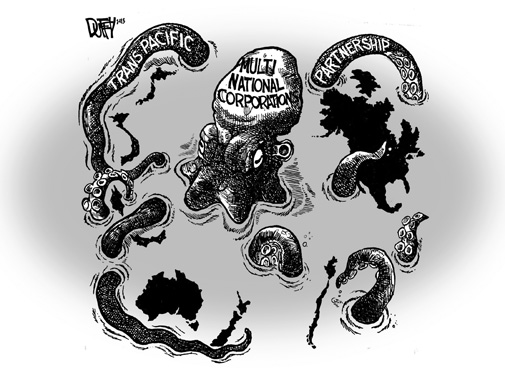
The most glaring example today is the secret twelve-country trade agreement called the Trans-Pacific Partnership. If it goes through, the TPP will dramatically expand the power of multinational corporations to use closed-door tribunals to challenge and supersede domestic laws, including environmental, labor, health and other protections.

Looking at Alternatives

Some critics ask whether our system of making decisions by a mass popular vote easily manipulated by the paid-for media is the most effective way of governing on behalf of the people. In an interesting Ted Talk, political scientist Eric Li makes a compelling case for the system of “meritocracy” that has been quite successful in China.

In America Beyond Capitalism, Prof. Gar Alperovitz argues that the US is simply too big to operate as a democracy at the national level. Excluding Canada and Australia, which have large empty landmasses, the United States is larger geographically than all the other advanced industrial countries of the OECD (Organization for Economic Cooperation and Development) combined. He proposes what he calls “The Pluralist Commonwealth”: a system anchored in the reconstruction of communities and the democratization of wealth. It involves plural forms of cooperative and common ownership beginning with decentralization and moving to higher levels of regional and national coordination when necessary.

Dr. Alperovitz is co-founder of an initiative called The Next System Project, aimed at defining the issues in a national political debate as a first step to realizing the possible. He quotes Prof. Donald Livingston, who asked in 2002:

What value is there in continuing to prop up a union of this monstrous size? . . . [T]here are ample resources in the American federal tradition to justify states’ and local communities’ recalling, out of their own sovereignty, powers they have allowed the central government to usurp.

Taking Back Our Power

If governments are recalling their sovereign powers, they might start with the power to create money, which was usurped by private interests while the people were asleep at the wheel. State and local governments are not allowed to print their own currencies; but they can own banks, and all depository banks create money when they make loans, as the Bank of England recently acknowledged.

The federal government could take back the power to create the national money supply by issuing its own Treasury notes as Abraham Lincoln did. Alternatively, it could issue some very large denomination coins as authorized in the Constitution; or it could nationalize the central bank and use quantitative easing to fund infrastructure, education, job creation, and social services, responding to the needs of the people rather than the banks.

The freedom to vote carries little weight without economic freedom – the freedom to work and to have food, shelter, education, medical care and a decent retirement. President Franklin Roosevelt maintained that we need an Economic Bill of Rights. If our elected representatives were not beholden to the moneylenders, they might be able both to pass such a bill and to come up with the money to fund it.

Ellen Brown is an attorney, founder of the Public Banking Institute, and author of twelve books including the best-selling Web of Debt. Her latest book, The Public Bank Solution, explores successful public banking models historically and globally. Her 300+ blog articles are at EllenBrown.com. Listen to “It’s Our Money with Ellen Brown” on PRN.fm.


FAA investigating Florida mailman’s landing of gyrocopter on U.S. Capitol lawn

1dfb9_1956

By Ben Montgomery

Source: Tampa Bay Times

Doug Hughes, a 61-year-old mailman from Ruskin, told his friends he was going to do it. He was going to fly a gyrocopter through protected airspace and put it down on the lawn of the U.S. Capitol, then try to deliver 535 letters of protest to 535 members of Congress.

The stunt seemed so outlandish that not even his closest friend thought he would pull it off.

“My biggest fear was he was going to get killed,” said Mike Shanahan, 65, of Apollo Beach, who works with Hughes for the Postal Service.

After 21/2 years of planning, Hughes came hovering low over the buildings of northeast D.C. about 1:20 p.m., like a distant bird. He rounded the Washington Monument a few minutes later, flew straight up the expanse of the National Mall and brought his small craft down right in front of the Capitol, where he was quickly surrounded by police and surrendered without incident.

The flight stunned police, Secret Service and witnesses. Authorities briefly shut down the Capitol as a security measure. The incident brought out dozens of reporters and cameras from national media outlets — exactly what Hughes had hoped for. Hughes, who sees himself as a sort of showman patriot, a mix of Paul Revere and P.T. Barnum, wanted to do something so big and brazen that it would hijack the news cycle and turn America’s attention toward his pet issue: campaign finance reform.

“No sane person would do what I’m doing,” Hughes told the Tampa Bay Times in the weeks before he took flight. He was doing it, he said, because the United States is “heading full-throttle toward a breakdown.”

“There’s no question that we need government, but we don’t have to accept that it’s a corrupt government that sells out to the highest bidder,” Hughes said.

It’s hard to say whether the message got through.

“I don’t think anyone noticed it,” said Sophia Brown, visiting Washington from England. “We noticed it, but nobody made a big deal about it.”

Richard Burns, 27, a worker at a marijuana lobby group in Washington, stood by the Capitol in wonder and solidarity.

“I don’t know whatever it was he was doing, but I support him,” Burns said.

Gil Wheeler, 53, a pilot from Las Vegas, said the biggest problem was how the letter carrier reached restricted airspace in the first place.

“This is just another question for Homeland Security,” Wheeler said. “We still have a lot of questions to ask.”

Late Wednesday, U.S. Capitol Police said Hughes had been arrested, charged under Title 49 of U.S. Code and processed at their headquarters. He was then transferred to the central cellblock in Washington. The FAA was investigating.

News reports said Secret Service agents were investigating at Gettysburg Airport, a small airport in Pennsylvania, where they believe Hughes took off.

Hughes didn’t know whether he would even make it. He imagined being shot down, blown down. Almost every scenario he could imagine involved some type of resistance. Barring that, he said: “They will put the cuffs on me. And they will try to establish who is behind this. . . . The authorities are going to be out to get me.”

His wife could not be reached for comment.

Hughes contacted a Tampa Bay Times reporter last year, saying he wanted to tell someone about his plan and motivation. He said he had no intention of hurting anybody and that he didn’t want to be hurt. By that time, he had already been visited twice by the Secret Service, he said.

The first visit, Hughes told the Times, came one night last spring at about 1 a.m. The agent was accompanied by a Hillsborough County sheriff’s deputy. In a statement issued to media outlets Wednesday, the Secret Service said it interviewed Hughes on Oct. 5, 2013, and that a “complete and thorough investigation was conducted.”

The Secret Service agent asked him questions about his plan, Hughes said, and he said he was honest in his replies, if not totally forthcoming with details. Yes, he did own a gyrocopter. Yes, he kept it in a hangar at the small airport in Wauchula. Yes, he had talked of doing something big to bring attention to the issue of campaign finance reform. No, he was not planning to crash into any buildings or monuments in Washington, D.C.

I’m not a violent person, Hughes remembers saying. All I want to do is draw attention.

Someone inside his circle of secrecy had reported him, telling the Secret Service that Hughes was talking about committing a daring act of civil disobedience that also happened to be a federal crime.

Two days later, Hughes said, the same agent showed up at the post office where Hughes works and asked more questions. One of Hughes’ colleagues told the Tampa Bay Times that he, too, answered questions from the Secret Service.

And then, for months, nothing. That was it, Hughes said. No other questions. No other contact. Hughes put his plan into action.

He bought a burner cell phone and a videocamera and tested a livestream video feed from his gyrocopter. He built a website offline that explained why he was doing this. He bought $250 worth of stamps and stuffed envelopes with his letter:

“I’m demanding reform and declaring a voter’s rebellion in a manner consistent with Jefferson’s description of rights in the Declaration of Independence,” he wrote in his letters. “As a member of Congress, you have three options. 1. You may pretend corruption does not exist. 2. You may pretend to oppose corruption while you sabotage reform. 3. You may actively participate in real reform.”

Late last week, he loaded the gyrocopter onto a trailer and headed for an undisclosed location outside the nation’s capital.

His livestream showed that he took off about 12:10 p.m. Wednesday. He intended to fly about 300 feet high, at 45 mph and wound up landing on the west lawn of the Capitol shortly before 1:30 p.m.

Hughes knew there was a risk he could be shot out of the sky, though he hoped it wouldn’t come to that.

“I don’t believe that the authorities are going to shoot down a 61-year-old mailman in a flying bicycle,” he said. “I don’t have any defense, okay, but I don’t believe that anybody wants to personally take responsibility for the fallout.”

In the end, his flight occurred without incident or escorts. The Times published a story about Hughes’ plans on its website, tampabay.com, shortly after noon when it was clear he had actually taken off and was attempting his flight. His livestream cut in and out but showed his progress. A Times reporter called the Secret Service in Washington, D.C., shortly before 1 p.m. to see if officials were aware of a man in a gyrocopter flying toward the capital. Public information officers there who did not give their names said they had not heard of the protest. They referred a reporter to Capitol Police. A public information officer did not immediately answer.

Sgt. Trina Hamilton in the watch commander’s office said: “He hasn’t notified anybody. We have no information.”

Hughes’ friend, Mike Shanahan, after receiving a call from Hughes early Wednesday, said he contacted a Secret Service agent and left a message but never heard back. Hughes had told his friend he was in Washington, Shanahan recalled. But when Shanahan tried to access the live-streaming website, he could not find it and was unsure if Hughes was really going to take flight.

Before his flight, Hughes said he knew what was at stake. He figured he’ll lose his job of 11 years. And he could lose his tidy little house across from a pond with a fountain. He knew he would lose his freedom. That means losing, at least temporarily, his Russian-born wife and his polite 12-year-old daughter who plays the piano and wins awards at the science fair. He kept them in the dark, he said, for fear they’d be implicated.

Hughes is a slender, soft-spoken, pedantic man, with thinning gray hair and hearing aids. He has no criminal record and it’s rare to hear him curse. But he said he needed the show, the very dramatic public act of civil disobedience, to focus the nation’s attention on campaign finance reform, a topic that in most quarters makes eyes glaze over. Money, he says, has corrupted the democracy.

At the root of Hughes’ disdain is the Supreme Court’s 2010 decision in Citizens United vs. Federal Election Commission, in which the court decided campaign contributions were a form of “political speech” and struck down limits on how much corporations and unions could give to political contenders. The decision changed the game. Campaign spending went through the roof. In Hughes’ mind, there was a parallel spike in favor-dealing and the government is now practically owned by the rich. Hughes likes to point out that nearly half the retiring members of Congress from 1998 to 2004 got jobs as lobbyists earning some 14 times their congressional salaries.

But nobody seems to care.

Hughes thinks the answers are out there, and they’re nonpartisan. He points to reform thinkers like political activist Cenk Uygar and Harvard legal theorist Lawrence Lessig, who launched a political action committee to end political action committees. The motto: “Embrace the irony.”

“I’m not promoting myself,” Hughes said a few weeks ago. “I’m trying to direct millions of people to information, to a menu of organizations that are working together to fix Congress.”

His idea began to blossom 2½ years ago, after his son, John Joseph Hughes, 24, committed suicide by driving his car head-on into another man, killing them both. “Police: Suicidal driver caused deadly crash,” read the headline in the Leesburg newspaper. He was crushed by grief, and disappointed that his son had killed himself — and someone else — to make a stupid, worthless point.

“Something changed in me,” Hughes said. With mourning came a realization. The years Hughes spent thinking about and writing about mundane political issues were for naught if he didn’t have a way to make a point. His political frustrations and grief merged. He doesn’t condone what his son did, but it offered a lesson.

“He paid far too high a price for an unimportant issue,” Hughes said. “But if you’re willing to take a risk, the ultimate risk, to draw attention to something that does have significance, it’s worth doing.”

He has always wanted to fly. Growing up in Santa Cruz, Calif., he used to ride his bike to Sky Park and watch the planes come and go, and read books about the Wright brothers and Kitty Hawk.

At first he thought about using an ultralight fixed-wing plane, but that felt too threatening. He finally found the gyrocopter, which has unpowered helicopter blades on top for lift but gets its thrust from a propeller on the back. The cockpit, if you can call it that, is wide open. “This is as transparent a vehicle that I could come up with,” Hughes said. “You can literally see through it.” He can land the craft in a space the size of half a basketball court.

Hughes told the Times he planned to set up a delayed email blast to alert as many TV and newspaper breaking news desks as he could find, as well as the Secret Service.

The Secret Service statement said it did not receive notification of the flight. Several reporters told the Times they received the email. The Times reported about Hughes’ flight on Twitter and Facebook as it was happening, but most media attention came after his landing at the Capitol. His website went up as scheduled, which broadcast a choppy livestream of his trip.

His biggest fear all along, he said, was losing his nerve.

“I have thought about walking away from this whole thing because it’s crazy,” he said. “But I have also thought about being 80 years old and watching the collapse of this country and thinking that I had an idea once that might have arrested the fall and I didn’t do it.

“And I will tell you completely honestly: I’d rather die in the flight than live to be 80 years old and see this country fall.”

Times staff writers Zachary T. Sampson and Lauren Carroll and researcher Caryn Baird contributed to this report.


This is the text of the letter that Doug Hughes wants to deliver to members of Congress:

Dear ___________,

Consider the following statement by John Kerry in his farewell speech to the Senate —

“The unending chase for money I believe threatens to steal our democracy itself. They know it. They know we know it. And yet, Nothing Happens!” — John Kerry, 2-13

In a July 2012 Gallup poll, 87% tagged corruption in the federal government as extremely important or very important, placing this issue just barely behind job creation. According to Gallup, public faith in Congress is at a 41-year record low, 7%. (June 2014) Kerry is correct. The popular perception outside the DC beltway is that the federal government is corrupt and the US Congress is the major problem. As a voter, I’m a member of the only political body with authority over Congress. I’m demanding reform and declaring a voter’s rebellion in a manner consistent with Jefferson’s description of rights in the Declaration of Independence. As a member of Congress, you have three options.

1. You may pretend corruption does not exist.

2. You may pretend to oppose corruption while you sabotage reform.

3. You may actively participate in real reform.

If you’re considering option 1, you may wonder if voters really know what the ‘chase for money’ is. Your dismal and declining popularity documented by Gallup suggests we know, but allow a few examples, by no means a complete list. That these practices are legal does not make them right! Obviously, it is Congress who writes the laws that make corruption legal.

1. Dozens of major and very profitable corporations pay nothing in taxes. Voters know how this is done. Corporations pay millions to lobbyists for special legislation. Many companies on the list of freeloaders are household names — GE, Boeing, Exxon Mobil, Verizon, Citigroup, Dow …

2. Almost half of the retiring members of Congress from 1998 to 2004 got jobs as lobbyists earning on average fourteen times their Congressional salary. (50% of the Senate, 42% of the House)

3. The new democratic freshmen to the US House in 2012 were ‘advised’ by the party to schedule 4 hours per day on the phones fund raising at party headquarters (because fund raising is illegal from gov’t offices.) It is the donors with deep pockets who get the calls, but seldom do the priorities of the rich donor help the average citizen.

4. The relevant (rich) donors who command the attention of Congress are only .05% of the public (5 people in a thousand) but these aristocrats of both parties are who Congress really works for. As a member of the US Congress, you should work only for The People.

1. Not yourself.

2. Not your political party.

3. Not the richest donors to your campaign.

4. Not the lobbyist company who will hire you after your leave Congress.

There are several credible groups working to reform Congress. Their evaluations of the problem are remarkably in agreement though the leadership (and membership) may lean conservative or liberal. They see the corrupting effect of money — how the current rules empower special interests through lobbyists and PACs — robbing the average American of any representation on any issue where the connected have a stake. This is not democracy even if the ritual of elections is maintained.

The various mechanisms which funnel money to candidates and congress-persons are complex. It happens before they are elected, while they are in office and after they leave Congress. Fortunately, a solution to corruption is not complicated. All the proposals are built around either reform legislation or a Constitutional Amendment. Actually, we need both — a constitutional amendment and legislation.

There will be discussion about the structure and details of reform. As I see it, campaign finance reform is the cornerstone of building an honest Congress. Erect a wall of separation between our elected officials and big money. This you must do — or your replacement will do. A corporation is not ‘people’ and no individual should be allowed to spend hundreds of millions to ‘influence’ an election. That much money is a megaphone which drowns out the voices of ‘We the People.’ Next, a retired member of Congress has a lifelong obligation to avoid the appearance of impropriety. That almost half the retired members of Congress work as lobbyists and make millions of dollars per year smells like bribery, however legal. It must end. Pass real campaign finance reform and prohibit even the appearance of payola after retirement and you will be part of a Congress I can respect.

The states have the power to pass a Constitutional Amendment without Congress — and we will. You in Congress will likely embrace the change just to survive, because liberals and conservatives won’t settle for less than democracy. The leadership and organization to coordinate a voters revolution exist now! New groups will add their voices because the vast majority of Americans believe in the real democracy we once had, which Congress over time has eroded to the corrupt, dysfunctional plutocracy we have.

The question is where YOU individually stand. You have three options and you must choose.

Sincerely,

Douglas M. Hughes

http://www.TheDemocracyClub.org

The Calling: How Cronyism Worsens Income Inequality (and Freed Markets Reduce It)

cronyism-out-of-control

By Steven Horwitz

Source: Future of Freedom Foundation

I recently gave an introductory Public Choice talk sponsored by Students for Liberty at the University of Ottawa. The next speaker was my friend Anne Rathbone Bradley, who was Skyping in from Washington. Anne gave a terrific talk about cronyism and rent-seeking that nicely complemented many of the points I’d made. But one of the side issues she raised really stuck with me, and I want to expand on it.

Anne connected cronyism (I hesitate to call it “crony capitalism”), rent-seeking, and income inequality in a way I hadn’t quite thought about before. The key to the connection is to realize some important truths about the political process.

The first truth is that cronyism is no accident. It is no accident that the U.S. economy has increasingly become one in which your connections to political power matter more for your ability to increase your wealth than does producing a product or service that consumers wish to buy. We are becoming what Ayn Rand deftly termed an “aristocracy of pull.”

The ability of some to get wealthier through political connections does trouble many on the political left, but they often argue that with better elected officials, or more ethical businesspeople, or limits on campaign contributions, we could dramatically reduce this sort of cronyism. What their argument misses is that as long as government gives out goodies, private-sector actors will find ways to get their hands on them. If you really want to take the money out of politics, you need to make it harder for politicians to hand out money.

For libertarians, the state is always little more than a dispenser of privileges to special interests. This is not an accident of who is elected or who is wealthy. Government privileges provide an easy path to profit for those who can capture them — and with none of the hard work of actually competing in the market. This is why many people, including those in the private sector, like the state.

The second important truth is that these political privileges are much more likely to be captured by those who already have financial and political power. Despite the fantasy believed by so many that government regulation and other interventions are all about constraining the rich and powerful in the name of the masses, in fact a great deal of government regulation is driven by the desires of those same rich and powerful to become more so. The more power we give to government, the more power we are giving to those with the money and connections to access political power. In other words, expanding the state gives more power and privilege to the powerful and privileged.

The last truth is that when private-sector actors seek to use political privileges to enhance their profits, they often do so by blocking smaller competitors’ access to the market, or by raising their costs of competing. When Walmart supports a higher minimum wage, it thereby favors raising the costs for their small mom-and-pop rivals. When taxicab companies defend their monopoly privileges, they intend to shut firms like Uber and Lyft out of the market altogether. When entrenched hairdressers demand that hair braiders be licensed, the established practitioners mean to raise their competitors’ costs or shut them out altogether.

When we put all three of these truths together, we get a story about the way in which those who already have wealth and power can and do make use of the state to block the upward mobility of their poorer, less-powerful potential competitors. Small-business owners, Uber and Lyft drivers, and African-American women who want to open hair-braiding businesses are trying to grab on to the bottom rungs of the income ladder and work their way up. These are the very people — start-up entrepreneurs and the working poor — that those critical of the market claim to care about.

In a world where government has all of these powers to intervene in markets, rent-seeking and cronyism are inevitable. Regulation will ensure that those who know the right people can tilt the regulatory playing field in their favor. The result will be a worsening of the income inequality that concerns so many. The rich will get richer through rent-seeking and cronyism, and they will do so at the expense of the poor and relatively powerless. If rent-seeking and cronyism worsen income inequality, and the source of rent-seeking and cronyism is the state’s ability to intervene, then a pretty good case can be made that freed markets will give us a world with less income inequality than the status quo.

Libertarians are right to point out that inequalities of income are not inherently bad. If the existing pattern of incomes were the result of a truly freed market (like in the famous, if simplified, Wilt Chamberlain example in Robert Nozick’s Anarchy, State, and Utopia), there would be no reason for worry. This is especially true because in a freed market, dynamic change would ensure that the same people do not occupy the same rungs on the ladder from year to year.

However, if inequalities are instead the result of a mixed economy in which those who already have wealth and power can enhance it at the expense of those with less — not to mention the consumers who lose out on the benefits of greater competition and lower prices, then libertarians are right to object and look for solutions. Of course, asking for more state action to combat state-driven inequalities is unlikely to work and very likely to make matters worse.

Thus, we can ground our arguments against government intervention in the market in our desire to reduce inequalities that are not the result of voluntary exchanges that benefit both parties.

Finally, this whole argument gives libertarians another reason to love the sharing economy of Uber, Lyft, AirBnB, and the rest. Not only are such companies providing important competition for established firms and thereby lowering prices and bringing better services and more options to consumers, they are also part of the fight against the unearned privileges of the rich and powerful and the fight against politically driven, and therefore unjustified, increases in income inequality.

Classical liberalism needs to reassert its long-standing commitment to progressive goals, even as it rejects the means preferred by most so-called progressives today. We have an opportunity to bring new allies to our cause by recognizing the interrelationships among rent-seeking, cronyism, the sharing economy, small businesspeople, and income inequality. Let’s not overlook it.

Individual Wealth in Perspective

billionairehousing

By James Hall

Source: Negotium

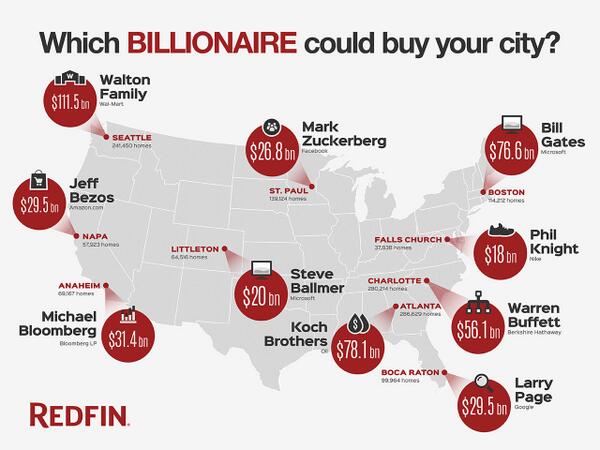
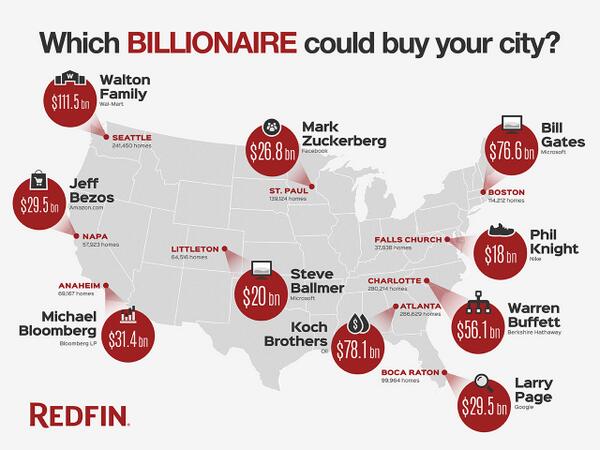
A quaint comparison of what money can buy in today’s market has Bill Gates being able to afford every home in Boston. His $76.6 billion reported by the Washington Post or the $78.4 billion by Forbes seems a pittance when put up against John D. Rockefeller’s peak wealth of $318.3 billion (based on 2007 US dollar). According to your resident commissars over at MSNBC, “The median net worth of American households hasn’t changed much over the past decades, it’s about $20,000.” So if Gates decided to purchase all the Beantown houses, whom would he pay for the bricks and mortar? Certainly, most Americans may think of “their home is their castle”, but few actually own a debt free deed to their grand estate. No wonder the banks and financial institutions, are so fond of placing liens on real property.

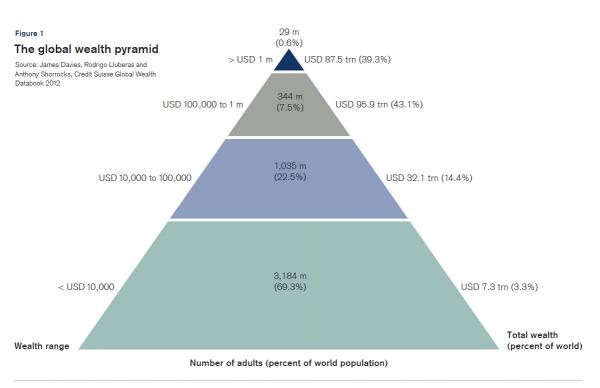
The proportional context of looking at individual wealth within the relative value of global wealth is examined in the essay; It’s A “0.6%” World: Who Owns What Of The $223 Trillion In Global Wealth, seems trite. Zerohedge concludes, “The bottom line: 29 million, or 0.6% of those with any actual assets under their name, own $87.4 trillion, or 39.3% of all global assets.”

CSwealth

Here are the stunning facts:

“In 2012, 3.2 billion individuals – more than two-thirds of the global adult population – have wealth below USD 10,000, and a further one billion (23% of the adult population) are placed in the USD 10,000–100,000 range.

The average wealth holding is modest in the base and middle segments of the pyramid, total wealth amounts to USD 39 trillion, underlining the potential for new consumer trends products and for the development of financial services targeted at this often neglected segment.

The remaining 373 million adults (8% of the world) have assets exceeding USD 100,000.

And then the top of the pyramid: 29 million US dollar millionaires, a group which contains less than 1% of the world’s adult population, collectively owns nearly 40% of global household wealth.

Some 84,500 individuals are worth more than USD 50 million, and 29,000 are worth over USD 100 million.”

After absorbing this macro economic analysis, it should ease the pain that the stewardship of world wealth is in such trustworthy hands. No need to burden the masses with the weight of building wealth, when that formula for getting to the top of the financial pyramid, has room for only the few. The expert obelisk creators never meant for wealth sharing and the tools to construct one’s own prosperity are not included in your capital accumulation education. The liability of mortgage and property tax obligations to retain your edifice requires regular payments to maintain the privilege of possession. Ownership is only a conditional wealth asset.

Investopedia says 3 Simple Steps To Building Wealth are:

“You need to make it. This means that before you can begin to save or invest, you need to have a long-term source of income that’s sufficient enough to have some left over after you’ve covered your necessities.

You need to save it. Once you have an income that’s enough to cover your basics, you need to develop a proactive savings plan.

You need to invest it. Once you’ve set aside a monthly savings goal, you need to invest it prudently.”

Ordinary consumers do not build great fortunes. The elementary prescription for “getting ahead” is severely limited in thinking for a world that frequently conducts business as a blood sport. However, many of the enterprises that carve out a market for their products or services have a distinct edge over the unconnected entrepreneur. Namely, government directed and controlled startups or collaborated ventures frequently become the commercial giants of the economy. Here lays the confusion when defining wealth as an accounting device of personal ownership of assets.

In addition, governments are often in the privatization and sale of state assets. The Economists reports that the “IMF estimate that non-financial government assets average 75% of GDP in advanced economies. In most countries, these are worth more than financial assets (stakes in listed firms, sovereign-wealth and securities holdings and the like).”

Liquid cash flow and high worth individuals, especially with inside track contacts, are able to cherry pick sweet heart deals. Such opportunities, usually transfers treasure, but infrequently are engines of new wealth creation. The only guarantee is that money, made or lost depending upon the accounting needs of the vulture predator, is never an option for the normal hard working taxpayer.

Unless people accept the reality that creating and growing wealth is a noble objective that involves the widespread commerce participation of a merchant class, the outrageous disparity of the top down wealth stream will widen even more, as the top tier inclusion narrows to fewer mega-billionaires.

Global business encourages transnational conglomerates with commercially identifiable names and logos. When entire economies prevail under a business plan that eliminates any rival competition, and achieves sole market dominance, the prospects to advance the individual wealth ledger of the average person diminishes.

An opportunistic society can only exist when independent business flourishes. Government bureaucrats and corporate technocrats oppose an unambiguous free market economy. As the map of the über-billionaires illustrates, their checkbook could swallow up entire cities. However, digesting, let alone growing communities into quality environments for future generations, takes an active involvement in the wealth building process that rewards contributing players.

Without a widespread populace practicing mutually beneficial business transactions, the capacity to achieve the skills necessary to compete successfully, will never develop. Instead of making money, saving money and investing money, learn the aptitude of business as a lifelong endeavor.

The poor will always be scraping the bottom, until they learn how to advance their abilities for the betterment of their own families. The alternative to greater concentration of wealth is to initiate a viable substitute to the financial stranglehold that furthers the appetites of egomaniacs like the character, Bretton James in the movie Money Never Sleeps. In the end, the true individual wealth that anyone can attain is the sincerity and moral substance of his or her own character. Money may not snooze from making more cash, but is only a means to elevate living a life worth lived.

In such a quest, the super rich may have a net worth equivalent to one’s property, but they can never afford the essence of your family or measure of your community.