
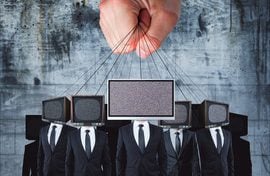
Questioning The Official Story About Official Stories: A Role for Citizen Investigations

By Time Hayward

Source: Tim Hayward Blog

Official stories, according to the official story about them, are (nearly) always true. The ‘nearly’ gets mentioned just because, on rare occasions, an official story is acknowledged to have been wrong, as, for instance, with Iraq’s falsely alleged weapons of mass destruction in 2003. But that’s considered an exception to the rule, and to extrapolate from it to a more pervasive mistrust is to be foolish, ill-informed or even a dupe of hostile propaganda. In fact, diagnosing what is wrong with sceptics about official stories, and proposing ways of curing or otherwise dealing with them, are now becoming a growth industry in the media and academia. So we hear a lot about how dissenting from official narratives is to fall victim to ‘conspiracy theory’ or ‘disinformation’; and dissenters may be diagnosed as needing re-education or even psychological help. As for the dissent itself, this is increasingly subject to censure and censorship.

However, a major question is left unaddressed: What is it that’s supposed to make official stories so credible?

The assumption is that official stories are produced by people with relevant expert knowledge, so disputing them is a product of ignorance; and since experts have credentials, experience and the backing of competent institutions, rejecting their expertise is unwise or even delusional. Also assumed is that official stories are generally produced and disseminated in good faith.

But are those assumptions generally warranted? In probing their grounds we are brought to question whether the official meta-story, as we may call it, overstates reasons for automatically accepting official stories and underestimates the competence that members of the public can bring to independent inquiries.

Why Believe Official Stories?

No serious thinker would suggest that an official story should be believed just because it comes from officials. Indeed, use of the very expression ‘official story’, in practice, tends to imply that there is also some alternative story that does not have the backing of officials but might be more credible. We know, too, that many societies from various times and places have maintained order by invoking all manner of mythological stories, ideological stories, and blatantly discriminatory stories. Sometimes this has meant denying, suppressing or persecuting as heretics people engaged in rigorous intellectual questioning of officialdom.

A more plausible reason for believing official stories has been set out by the philosopher Neil Levy (2007). He points out that we all know most of the things we know in life because we have learned them from others: our direct personal experience of the world is extremely limited compared to the expanse of our general knowledge and the intricacies of our more specialist understandings. We rely on the testimony and good faith of others in almost everything we do, so just to live a normal life in society we trust a wide range of institutions and social arrangements. To doubt their general dependability would contradict the tacit assumptions that get us through life and would render inexplicable how even a tolerably well-ordered society could ever be possible.

The force of that consideration is strong, but not absolute – and how strong also depends on what kinds of communication we are referring to as official stories. It is strongest if one uses the term to refer to all public communications that emanate from an official source. In actual usage, however, that is not how the term ‘official story’ is normally understood. We don’t regard it as an ‘official story’ that to get a passport you need to submit an authenticated photograph of yourself; we don’t regard it as an ‘official story’ that in UK cars are to be driven on the left; and nor do we these days regard it as an ‘official story’ that smoking is bad for our health. By far the greater part of public pronouncements, like these, are simply taken to state how matters stand. When the distinctive term ‘official story’ occurs, it is typically in contexts where a public pronouncement has met with scepticism. So, for example, whereas we seldom nowadays hear the rationale for mandating wearing seatbelts in cars referred to as an ‘official story’, because there is no longer serious dissent, recent claims that the rationale for mandating mRNA injections against SARS-Cov2 was substantially comparable to that for seatbelts encountered resistance: the ‘official story’ about the benefits and safety of the mRNA injections has been subject to criticism from some sections of medical and scientific communities.

Of course, the mere fact of scepticism in some quarters does not mean that a given official story is necessarily mistaken, but it does highlight how an official story is not just an uncontroversial statement of how matters stand. It leads thoughtful people to look more closely at the nature of authority claimed for an official story.

Are There Experts in Expertise?

The authority claimed for official stories derives, as Levy explains, from the fact of being produced by ‘people socially acknowledged as the relevant experts on a topic’ (Levy 2022). Relevance here is understood in terms of knowledge and experience relating to the salient subject matter. However, certain people might officially be appointed as relevant experts, on other bases, such as known affinities with the organisation’s mission. So it is possible for designated experts to support an official story while a number of other people with materially relevant knowledge and experience take a quite different view.

Even among designated expert advisers, however, achieving an authoritative consensus on the kind of matter that official stories relate to is not straightforward. This is for reasons similar to those involved in giving policy advice (see e.g. Grundmann 2017). Insofar as an official story appeals to a scientific basis, it should be borne in mind that findings of science – a process of open, collaborative and progressive inquiry – have a provisional status, with all scientific statements being in principle corrigible. This means that a scientific adviser’s confidence can never be completely unconstrained or unhedged. Zeynep Panuk (2021) refers to a ‘paradox of scientific advice’ that arises from the difficulties of basing decisions on scientific knowledge that is almost always uncertain and subject to disagreement. Panuk cites experience of how overconfident scientists in advisory committees may suppress dissent so as to present a consensus view, only to find that its implementation had unfortunate or even disastrous consequences. Recent experiences of overconfident pronouncements on ‘The Science’ during the Covid pandemic have furnished further examples (Miller 2022Nelson 2022).

The kind of controversy for which an ‘official story’ comes into play will not normally reduce to some specialist detail of basic science, or even a collection of these, but will concern a situation involving many factors – including those pertaining to social organisation, human action and decision-making. Such situations are similar to those where policy advice is sought from scientific experts (SAPEA 2019 Ch. 2; Martin et al 2020). Official stories are seldom if ever straightforward statements of scientific opinion on a single well-defined scientific research question: they typically relate to situations where many interacting variables may not all be clearly disaggregable. There is in principle no necessary reason why an independent and unofficial grouping of investigators with materially relevant expertise might not be as well-suited to an inquiry as an official grouping. In fact, challenges to official stories can sometimes draw on impressive constellations of expertise.

Citizen Investigations

If the official meta-story may overestimate the dependability of designated expert advice, it may also underestimate the investigative competence of ordinary citizens. For challenges to official stories can be mustered not just by isolated individuals, caricatured as ‘doing their own research’ while ‘reading things on the internet,’ but by well-informed collaborative groups. These can be better able to track truths than independent individuals: ‘the superiority of the group over the individual does not require that one member has the right answer prior to deliberation: group deliberation may enable the aggregation of the genuine insights of several members and the rejection of the false hypotheses of some of the same individuals.’ (Levy 2019: 316)

Furthermore, if it is the case that ‘[g]roups of individuals who are strangers to one another are better at tracking truths than groups of individuals who have a shared history’ (Levy 2019: 318) then this is an advantage of groups comprising people who come together in cyberspace from all walks of life and may have little or no biographical information about those they connect with. Citizens doing their own research sometimes start their own Wikis, or form groups on Reddit, or informally deliberate via Twitter or Telegram. Sometimes they create investigative collectives offline.

It was from participating in chatrooms, for instance, that the now much-feted organisation Bellingcat originated: its founder, Eliot Higgins, a gamer-turned-investigative-citizen, would review copious amounts of war footage from his sofa in Leicester and discuss his observations in chatrooms. The work of his investigative collaborative has come to be ‘commended in the global media and by global agencies such as Amnesty International and Human Rights Watch.’ (Nguyen and Scifo 2018: 377) Impressed by the methods of ‘open source intelligence’ (D’Alessandra and Sutherland 2021), curators of official stories in the West – particularly those relating to geopolitical issues involving Russia – have bestowed accolades on Bellingcat, along with generous funding and encouragement.

So, there is precedent for treating citizens’ investigations as authoritative. Other groups of citizen investigators, that do not receive any funding, have mounted significant challenges to some of the West’s own official stories. Thus, directly countering Bellingcat, on occasion, is the Working Group on Syria, Propaganda and Media which has earned the confidence of whistleblowers rather than officials (OPCW 2020).

Aside from the benefits of collaboration, the reality of serious dissent in the digital sphere is that it can involve myriad critical individuals with significant independent claims to epistemic authority in their professional fields and who exhibit judicious awareness of both their own limitations and the value of others’ insights. For instance, challenging various official narratives are whistleblowers who include scientists, diplomats, intelligence officers, and various state or corporate employees. Challenges come too from professionals with relevant specialist expertise across fields like medicine, architecture, engineering, pharmaceuticals, and a gamut of others. Also worth highlighting are those journalists with previous careers in mainstream media organisations who found they could only maintain their professional integrity by becoming independent.[1] When a group of people independently deliberating together can include, for instance, a former head of a nation’s armed services, a UN weapons inspector, a senior diplomat, an intelligence officer, a world leading International Relations expert and a seasoned war correspondent, the insights they generate regarding situations relevant to foreign policy may well be no less sound than those informing the official story.[2] Indeed, in virtue of their freedom from institutional constraints, they may be more reliably informative for the public than the official story.

If serious challenges to official stories have become more prevalent in recent years, as they arguably have, this is likely due in good part to the sheer extent to which mainstream media have excluded the voices of experts who, maintaining their professional integrity and independence in the face of sometimes considerable hostility, have continued to articulate their challenges to official stories. Attentive members of the public notice this – just as they notice when the force of the state is brought to bear on those who bring to light its lies and malfeasance, and not only in high profile cases like Edward Snowden, Chelsea Manning, Katharine Gun or Julian Assange.

Part of the official meta-story currently is that the internet and social media are being flooded by targeted disinformation that is misleading and confusing people. However, from another perspective one might see that thanks to digital communications citizens can become aware of arguments developed by other experts which are suppressed by protectors of an ‘official story’. An example would be the authors of the Great Barrington Declaration (GBD) (2020), advocating an approach to dealing with the Covid situation characterized as ‘focused protection’ instead of the officially promoted lockdown approach. Lay persons may not be able to adjudicate first hand between recommendations from the GBD and the John Snow Memorandum (2020), which defended lockdown, but they can understand enough to know that the latter does not command an unproblematic consensus such as would be rational simply to defer to. Members of the public can assess the trustworthiness of expertise and official stories without a high level of technical knowledge, as science studies scholars have shown (Yearley 2005; Hess 2012).

People understand that if a view is suppressed rather than openly addressed and rebutted the reason might be that it cannot be rebutted. If an attentive public observes that dissent is simply treated as inadmissible, and especially if those formulating it are subject to smearing or censorship, then there is a corresponding diminution of public trust in the orthodox view.

Tension At The Heart of An Official Story

If the claim that the authority of an official story derives from an expert consensus can be questionable, something more certain is that an official story is asserted with the kind of authority that comes with power. People may defer to an official story not because they necessarily find it credible but out of a prudent concern to avoid the costs of dissidence. Those with power can also incentivise wider media of communication to stick to the narrative. This difference between epistemically earned authority and politically declared authority is a tension at the heart of official stories. Understanding it helps explain why we find a good many journalistic and scholarly studies of the supposed pathologies of dissident citizens and rather little reflection on the real nature of the authority of official stories.

Today we find a welter of studies of online ‘disinformation’ that trace webs of connection across cyberspace seeking to link influential dissenting accounts on social media with bots and trolls associated with malign actors. These communications are said to be engaged in strategically. That is, their aim is to persuade the public to accept a pre-established story rather than to allow people to determine, through open deliberations, what the most credible story is.

Yet this is exactly what the promulgators of official stories themselves do. Regardless of whether the content of a given official story is reliable or not, the form of an official story – in virtue of fulfilling its official function – is that of a strategic communication. Its communication, as official, is presented as a matter not for deliberation but for public acceptance. It is not submitted to public scrutiny with an implicit invitation for critical feedback. It is not up for discussion. It is communicated not to advance debate but to settle it.

This is the inherent tension in an official story: its assertion of epistemic authority depends on an implicit claim that it can be backed by processes of deliberative reasoning, but the pronouncement of an official story as a settled opinion curtails any such process.

What this means in practice has been illustrated, for instance, in the situation arising with the UK Government’s Covid response, which professedly aimed to ‘Follow The Science’ (Stevens 2020). This notion can only ever be ‘a misleading oversimplification’ of what it means to base policy on science (Abbasi 2020), and when UK government ministers claimed to be ‘guided by the science’, what they meant in practice was being guided by their scientists: ‘Ministers formed strong relationships with key scientific advisors, relied on evidence from their Scientific Advisory Group for Emergencies (SAGE), and ignored or excluded many other sources.’ (Cairney 2021) Thus a policy of public communications was decided on the basis of a selective interpretation of scientific findings. But more than this, instead of caution in the face of uncertainty, a policy of robustly promoting a particular view involved the use of psychological operations of a kind more normally associated with a war effort than with public health advice (Sidley 2021, 2022).

Unfortunately, as that example also showed, the defence of an official story against criticism can include counter-measures taken to smear and discredit dissenters. This is never an edifying approach, but is especially troubling when it involves discrediting serious critics who have their own credible claim to epistemic authority. This was illustrated in the case of the eminent scientists who signed the Great Barrington Declaration. They were widely vilified not only in the media but even by other academics, for pointing to certain established principles of epidemiology – including those developed over the two preceding decades of pandemic preparedness planning – that were being set aside and overridden by policy-makers on the basis of modellers’ projections in favour of a ‘zero-covid’ strategy (Ioannidis 2022). This vilification involved not only overt smearing but also something more insidious, namely, the pre-emptive dismissal of their views – notwithstanding their impeccable academic pedigree – as too far ‘beyond the pale’ to warrant serious consideration (HART 2022).

This situation showed that the other institutions of civil society, including the media and academia, which the official meta-story claims provide critical scrutiny, can in fact simply amplify official strategic communications. Thus the organisations that Levy recommends we rely on as guarantors of the authors of official stories can in reality see it as their responsibility to promote and defend the official story rather than question it. Public perceptions that this is the case are accompanied by a deficit of trust in the media and institutions more generally.

The official meta-story blames ‘conspiracy theorists’ and other critical questioners for this lack of trust. But perhaps that gets things the wrong way round.

Conclusion

Trust is something that has to be won, and, if betrayed, it can be lost. As the public’s trust in official stories diminishes, the official meta-story looks to blame this on ‘conspiracy theorists’ and other ‘disruptive influences’. Perhaps a more credible story about official stories would include serious reflection on how they might be made more transparently trustworthy.

Meanwhile, it is reasonable to suggest that each serious challenge to an official story should be assessed on its merits. This does not mean being swayed by extravagant contrarian hypotheses, since these should be treated with even more caution, and, when appropriate, summarily rejected. It does mean being duly aware of how the presumption in favour of official stories is necessarily defeasible. That is the case not just because any story may prove to be mistaken, even in all good faith, but also because we know that any organisation with politically-conferred authority is liable at times to come under political pressures that may, in certain circumstances, override scruples of honesty.

References

Abbasi, Kamran. 2020. ‘Covid-19: politicisation, “corruption,” and suppression of science’. BMJ; 371:m4425, 13 November: doi:10.1136/bmj.m4425   

Cairney, Paul. 2021. ‘The UK Government’s COVID-19 Policy: What Does “Guided by the Science” Mean in Practice?’ Frontiers in Political Science 315 March.https://www.frontiersin.org/articles/10.3389/fpos.2021.624068 DOI: 10.3389/fpos.2021.624068

D’Alessandra, Federica and Kirsty Sutherland. 2021. ‘The Promise and Challenges of New Actors and New Technologies in International Justice’. Journal of International Criminal Justice, 19(1): 9–34. https://doi.org/10.1093/jicj/mqab034

Great Barrington Declaration. 2020. https://gbdeclaration.org/

Grundmann, Reiner. 2017. ‘The Problem of Expertise in Knowledge Societies’. Minerva 55, 25–48 (2017). https://doi-org.ezproxy.is.ed.ac.uk/10.1007/s11024-016-9308-7

HART [Health Advisory and Recovery Team]. 2022. ‘The crushing of dissent throughout the covid era’, 8 October: https://www.hartgroup.org/the-crushing-of-dissent-throughout-the-covid-era/

Hess, David J. 2012. Science Studies: An Advanced Introduction. New York: NYU Press.

Ioannidis, John P. 2022. ‘Citation impact and social media visibility of Great Barrington and John Snow signatories for COVID-19 strategy.’ BMJ Open 2022;12:e052891. doi:10.1136/ bmjopen-2021-052891

John Snow Memorandum. 2020. https://www.johnsnowmemo.com/

Levy, Neil. 2007. ‘Radically Socialized Knowledge and Conspiracy Theories’, Episteme 4(2): 181-192.

Levy, Neil. 2019. ‘Due deference to denialism: explaining ordinary people’s rejection of established scientific findings’. Synthese 196: 313-327.

Levy, Neil. 2022. ‘Do Your Own Research!’ Synthese 200: 356. https://doi.org/10.1007/s11229-022-03793-w

Martin, Graham P., Esmée Hanna, Margaret McCartney and Robert Dingwall. 2020. ‘Science, society, and policy in the face of uncertainty: reflections on the debate around face coverings for the public during COVID-19’. Critical Public Health 30:5: 501-508, DOI: 10.1080/09581596.2020.1797997

Miller, Ian. 2022. Unmasked: The Global Failure of COVID Mask Mandates.

Nelson, Fraser. 2022. ‘The lockdown files: Rishi Sunak on what we weren’t told.’ The Spectator, 27 August: https://www.spectator.co.uk/article/the-lockdown-files-rishi-sunak-on-what-we-werent-told/

Nguyen, An and Salvatore Scifo. 2018. ‘Mapping the Citizen News Landscape: Blurring Boundaries, Promises, Perils, and Beyond.’ In Journalism, edited by Tim P. Vos. Berlin/Boston: De Gruyter.

OPCW [Organisation for the Prohibition of Chemical Weapons]. 2019. ‘Report Of The Fact-Finding Mission Regarding The Incident Of Alleged Use Of Toxic Chemicals As A Weapon In Douma, Syrian Arab Republic, On 7 April 2018.’ OPCW Technical Secretariat S/1731/2019: https://www.opcw.org/sites/default/files/documents/2019/03/s-1731-2019%28e%29.pdf

Panuk, Zeynep (2021) ‘COVID-19 and the Paradox of Scientific Advice.’ Perspectives on Politics 20(2): 562-576. DOI: https://doi.org/10.1017/S1537592721001201

SAPEA [Science Advice for Policy by European Academies]. 2019. Making sense of science for policy under conditions of complexity and uncertainty. Berlin: SAPEA. https://doi.org/10.26356/MASOS 

Sidley, Gary. 2021. ‘A Year of Fear.’ The Critic 23 March: https://thecritic.co.uk/a-year-of-fear/

Sidley, Gary. 2022. ‘Britain’s unethical Covid messaging must never be repeated.’ The Spectator 6 February: https://www.spectator.co.uk/article/britain-s-unethical-covid-messaging-must-never-be-repeated/

Stevens, Alex. 2020. ‘Governments cannot just ‘follow the science’ on COVID-19’. Nature Human Behaviour 4, 560: https://doi.org/10.1038/s41562-020-0894-x

Yearley, Steven. 2005. Making Sense of Science: Understanding the Social Study of Science. Thousand Oaks, CA: Sage.


[1] This is the case, for instance, with Jonathan Cook (formerly of The Guardian), Chris Hedges (formerly with the New Yorker), John Pilger (award-winning documentary film maker), and the late Robert Parry who founded the independent outlet Consortium News.

[2] This is to characterize part of the composition of the Berlin Group 21 that has produced the Statement of Concern relating to whistleblowers from the OPCW. See https://berlingroup21.org/ and associated press release: https://www.einnews.com/pr_news/538579944/leading-international-voices-call-on-opcw-and-its-scientific-advisors-to-allow-all-douma-investigators-to-be-heard

Big Media: Selling the Narrative and Crushing Dissent for Fun and Profit

By Charles Hugh Smith

Source: Of Two Minds

The profit-maximizing Big Tech / Big Media Totalitarian regime hasn’t just strangled free speech and civil liberties; it’s also strangled democracy.

The U.S. has entered an extremely dangerous time, and the danger has nothing to do with the Covid virus. Indeed, the danger long preceded the pandemic, which has served to highlight how far down the road to ruin we have come.

The danger we are ill-prepared to deal with is the consolidation of the private-sector media and its unification of content into one Approved Narrative which is for sale to the highest bidders. This is the perfection of for-profit Totalitarianism in which dissent is crushed, dissenters punished and billions of dollars are reaped in managing the data and content flow of the one Approved Narrative.

So don’t post content containing the words (censored), (censored) or (censored), or you’ll be banned, shadow-banned, demonetized, demonized and marginalized. Your voice will be erased from public access via the Big Media platforms and you will effectively be disappeared but without any visible mess or evidence–or recourse in the courts.

That’s the competitive advantage of for-profit Totalitarianism–no legal recourse against the suppression of free speech and dissent. And if you’re shadow-banned as I was, you won’t even know just how severely your free speech has been suppressed because the Big Tech platforms are black boxesno one outside the profit-maximizing corporation knows what its algorithms and filters actually do or exactly what happens to the disappeared / shadow-banned.

Shadow-banning is an invisible toxin to free speech: if you’re shadow-banned, you won’t even know that the audience for your posts, tweets, etc. has plummeted to near-zero and others can no longer retweet your content. You only see your post is online as usual, because this is the whole point of shadow-banning: you assume your speech is still free even as its been strangled to death by Big Tech black box platforms.

Since Andy Grove’s dictum only the paranoid survive is my Prime Directive, I’ve paid a bit more to have access to server traffic data. So I can pinpoint precisely when I was shadow-banned: my overall traffic fell off a cliff and the number of readers visiting from links on Big Tech platforms fell from thousands to near-zero.

The new consolidated Big Media Totalitarians play an interesting game of circular sources: in the traditional, now-obsolete / suppressed form of journalism, a reporter would be required to identify a minimum of three different sources for the story, and make at least a desultory effort to present two sides of the issue.

That model is out the window in the USSA’s Big Media Totalitarian regime. Now reporters only have to use a completely bogus, fabricated source in another Big Media story. Just being in another Big Media platform / publication is now “proof” that the source is legitimate.

In other words, investigative journalism is nothing but a Potemkin Village of circular sources conjured out of thin air by Big Media. Here’s an example from my own experience of being shadow-banned.

1. A completely bogus organization pops up out of nowhere and doesn’t bother identifying its owners, managers or sources.

2. This complete travesty of a mockery of a sham fabrication then issues a list of websites which it claims, with zero evidence, are stooges / outlets of Russian propaganda.

3. With zero investigation of this slanderous, evidence-free “source,” the venerable Washington Post (owned by Jeff Bezos) publishes an evidence-free hit piece glorifying this fabrication on Page One.

4. The other Big Media giants then amplify the bogus slander because it came from a “legitimate source,” the Washington Post.

Do you understand how circular sourcing works now? Once a flagrantly bogus bit of propaganda is embraced by one Big Media giant as part of the Approved Narrative, then every other Big Media / Big Tech corporation promotes the fabrication as “real news” even as it is obviously the acme of “fake news”, a complete fabrication.

The fake “source” was called PropOrNot, and the list included dozens of well-respected independent websites, all slandered with a completely fake accusation for one reason: each site had published some content that cast a skeptical eye on the crowning of Hillary Clinton in 2016 and the crushing of Bernie Sanders’ campaign by Big Media’s Approved Narrative.

As long as you post videos of kittens and kids dancing, you’re OK because your content (owned and controlled by the platform you posted it on–read the terms of Service) is free to the platforms and they use your content to “engage” users which generates billions in profits.

But if you question the Approved Narrative, you put a big day-glo target on your back. Now if you’re a multi-millionaire, you know, a top 0.1% per-center, you can afford to keep posting dissenting views even after you’ve been demonetized and your income falls to near-zero.

The rest of us aren’t quite so privileged. This is another of the toxic elements in Big Media / Big Tech’s consolidated control of what was once known as free speech: They don’t have to ban your content outright, which might cause a few ripples of tame protest; all they have to do is starve you into submission by strangling your source of income.

Thanks to watertight terms of service, even a multi-millionaire is legally powerless against the USSA’s Big Media Totalitarian regime. By posting content, you already gave away all your rights. So you can go solo and post content on some obscure corner of the web that no one knows exist, but that’s the functional equivalent of being banned and demonetized.

So go right ahead and enter a sound-proof box and scream your head off; nobody can hear you. Welcome to the totally privately owned, legally untouchable Big Tech / Big Media Totalitarian regime that will let you know what’s in the Approved Narrative because that’s all you’re allowed to see.

Gordon Long and I cover these topics and many more in our latest video Buying the Narrative (35:41) Since I’d like the video to actually be viewed more than 11 times, I avoided using the terms (censored), (censored) or (censored), and that’s the final fatal poison delivered by our profit-maximizing Big Tech / Big Media Totalitarian regime: self censorship. You know what you can’t say, so don’t say it. Stick with the kitten videos and you’ll be just fine.

You’ll be just fine but you no longer live in a functioning democracy. The profit-maximizing Big Tech / Big Media Totalitarian regime hasn’t just strangled free speech and civil liberties; it’s also strangled democracy.

It’s all fun and games until the pendulum of Totalitarian Consolidation and its Approved Narrative reaches an extreme (like, say, right now) and the pendulum swings back to an equal extreme at the other end of the spectrum. Keep in mind that hubris and money are no match for history: the more powerful you claim to be, the greater your fall. The way of the Tao is reversal.

Welcome to the U.S.S.A.’s Banquet of Consequences (December 8, 2020)

Virus of Mass Destruction

Medical personnel arrive to perform COVID-19 coronavirus infection testing procedures at Glen Island Park, Friday, March 13, 2020, in New Rochelle, N.Y. (AP Photo/John Minchillo)

By CJ Hopkins

Source: Consent Factory, Inc.

There comes a point in the introduction of every new official narrative when people no longer remember how it started. Or, rather, they remember how it started, but not the propaganda that started it. Or, rather, they remember all that (or are able to, if you press them on it), but it doesn’t make any difference anymore, because the official narrative has supplanted reality.

You’ll remember this point from the War on Terror, and specifically the occupation of Iraq. By the latter half of 2004, most Westerners had completely forgotten the propaganda that launched the invasion, and thus regarded the Iraqi resistance as “terrorists,” despite the fact that the United States had invaded and was occupying their country for no legitimate reason whatsoever. By that time, it was abundantly clear that there were no “weapons of mass destruction,” and that the U.S.A. had invaded a nation that had not attacked it, and posed no threat to it, and so was perpetrating a textbook war of aggression.

These facts did not matter, not in the slightest. By that time, Westerners were totally immersed in the official War on Terror narrative, which had superseded objective reality. Herd mentality had taken over. It’s difficult to describe how this works; it’s a state of functional dissociation. It wasn’t that people didn’t know the facts, or that they didn’t understand the facts. They knew the Iraqis weren’t “terrorists.” At the same time, they knew they were definitely “terrorists,” despite the fact that they knew that they weren’t. They knew there were no WMDs, that there had never been any WMDs, and still they were certain there were WMDs, which would be found, although they clearly did not exist.

The same thing happened in Nazi Germany. The majority of the German people were never fanatical anti-Semites like the hardcore N.S.D.A.P. members. If they had been, there would have been no need for Goebbels and his monstrous propaganda machine. No, the Germans during the Nazi period, like the Americans during the War on Terror, knew that their victims posed no threat to them, and at the same time they believed exactly the opposite, and thus did not protest as their neighbors were hauled out of their homes and sent off to death camps, camps which, in their dissociative state, simultaneously did and did not exist.

What I’m describing probably sounds like psychosis, but, technically speaking, it isn’t … not quite. It is not an absolute break from reality. People functioning in this state know that what they believe is not real. Nonetheless, they are forced to believe it (and do, actually, literally, believe it, as impossible as I know that sounds), because the consequences of not believing it are even more frightening than the cognitive dissonance of believing a narrative they know is a fiction. Disbelieving the official narrative means excommunication from “normality,” the loss of friends, income, status, and in many cases far worse punishments. Herd animals, in a state of panic, instinctively run towards the center of the herd. Separation from the herd makes them easy prey for pursuing predators. It is the same primal instinct operating here.

It is the goal of every official narrative to generate this type of herd mentality, not in order to deceive or dupe the public, but, rather, to confuse and terrorize them to the point where they revert to their primal instincts, and are being driven purely by existential fear, and facts and truth no longer matter. Once an official narrative reaches this point, it is unassailable by facts and reason. It no longer needs facts to justify it. It justifies itself with its own existence. Reason cannot penetrate it. Arguing with its adherents is pointless. They know it is irrational. They simply do not care.

We are reaching this point with the coronavirus narrative. It is possible that we have already reached it. Despite the fact that what we are dealing with is a virus that, yes, is clearly deadly to the old and those with medical conditions, but that is just as clearly not a deadly threat to the majority of the human species, people are cowering inside their homes as if the Zombie Apocalpyse had finally begun. Many appear to believe that this virus is some sort of Alien-Terrorist Death Flu (or weaponized Virus of Mass Destruction) that will kill you the second you breathe it in.

This is not surprising at all, because, according to the official narrative, its destructive powers are nearly unlimited. Not only will it obliterate your lungs, and liquidate all your other major organs, and kill you with blood clots, and intestinal damage, now it causes “sudden strokes in young adults,” and possibly spontaneous prostate cancer, and God knows what other medical horrors!

According to all the “scientists” and “medical experts” (i.e., those that conform to the official narrative, not all the other scientists and medical experts), it is unlike any other virus that has ever existed in the history of viruses. It certainly doesn’t follow the typical pattern of spreading extensively for a limited period, and then rapidly dying down on its own, regardless of what measures are taken to thwart it, as this Israeli study would seem to indicate.

Also, “we have no immunity against it,” which is why we all have to remain “locked down” like unruly inmates in a penitentiary until a vaccine can be concocted and forced onto every living person on earth. Apparently, this mandatory wonder vaccine will magically render us immune to this virus against which we have no immunity (and are totally unable to develop immunity), which immunity will be certified on our mandatory “immunity papers,” which we will need to travel, get a job, send our kids to school, and, you know, to show the police when they stop us on the street because we look like maybe we might be “infected.”

Germany (where I live) is way out in front of this. According to the Süddeutsche Zeitung, the federal government plans to introduce a coronavirus “immunity card” as part of its “Infection Protection Law,” which will grant the authorities the power to round up anyone “suspected to be contagious” and force them into … uh … “quarantine,” and “forbid them from entering certain public places.” The Malaysian authorities have dispensed with such niceties, and are arresting migrant workers and refugees in so-called “Covid-19 red zones” and marching them off to God knows where.

Oh, yeah, and I almost forgot … the germ and chemical warfare researchers at DARPA (i.e., the U.S. military’s Defense Advanced Research Projects Agency) have developed some new type of fancy blood test that will identify “asymptomatic carriers” (i.e., people who display no symptoms whatsoever). So that will probably come in handy … especially if the “white supremacists,” “Red-Brown extremists,” and “conspiracy theorists” keep protesting the lockdown with their wives and kids!

And these are just the latest additions to a list of rather dystopian examples of the “brave new normal” official narrative that GloboCap is rolling out, right before our very eyes (which the OffGuardian editors have streamlined here and here, and which continues on Twitter). It’s all right there in black and white. They aren’t hiding the totalitarianism … they don’t have to. Because people are begging for it. They are demanding to be “locked down” inside their homes, forced to wear masks, and stand two meters apart, for reasons that most of them no longer remember.

Plastic barriers are going up everywhere. Arrows on the floor show you which way to walk. Boxes show you where to stand. Paranoid Blockwarts are putting up signs threatening anyone not wearing a mask. Hysterical little fascist creeps are reporting their neighbors to the police for letting their children play with other children. Millions of people are voluntarily downloading “contact tracing applications” so that governments and global corporations can monitor their every movement. In Spain, they bleached an entire beach, killing everything, down to the insects, in order to protect the public from “infection.” The Internet has become an Orwellian chorus of shrieking, sanctimonious voices bullying everyone into conformity with charts, graphs, and desperate guilt-trips, few of which have much connection to reality. Corporations and governments are censoring dissent. We’re approaching a level of manufactured mass hysteria and herd mentality that not even Goebbels could have imagined.

Meanwhile, they’re striking the mostly empty “field hospitals,” and the theatrical “hospital ship” is now gone, and despite their attempts to inflate the Covid-19 death count as much as humanly possible, the projected hundreds of millions of deaths have not materialized (not even close), and Sweden is fine, as is most of humanity, and … just like there were no WMDs, there is no Virus of Mass Destruction.

What there is, is a new official narrative, the brave new, paranoid, pathologized “normal.” Like the War on Terror, it’s a global narrative. A global, post-ideological narrative. It’s just getting started, so it isn’t yet clear how totalitarian this show will get, but, given the nature of the pilot episode, I am kind of dreading the rest of the series.

Assange and the Unforgivable Sin of Disemboweling Official Narratives

By Charles Hugh Smith

Source: Of Two Minds

The entire global status quo is on the cusp of the S-Curve decline phase.

There is really only one unforgivable sin in the political realm, and that’s destroying the official narrative by revealing the facts of the matter. This is why whistleblowers who make public the secret machinery of the elaborately artful lies underpinning all official narratives are hounded to the ends of the Earth.

Employees of state entities such as Ellsberg, Manning and Snowden are bound by vows of secrecy and threatened by the promise of severe punishment. Outsiders such as Assange are even further beyond the pale because they can’t be accused of being traitors, as they never took the vows of secrecy required by the Deep State.

The single most damaging revelation to all the elaborate lies that make up official narratives is the truth revealed in official emails, documents and conversations. This is why virtually every document and correspondence is now “classified,” so anyone releasing even a mundane scrap can be sentenced to rot in federal prison.

In a recent C-SPAN interview, author Nomi Prins explained the incredible difficulty of accessing papers in presidential libraries now due to virtually everything being classified. Freedom of Information Act (FOIA) applications must be filed, and researchers must wait years to gain access to routine correspondence that was freely available to all a decade or so ago.

Official paranoia has a 100% correlation with the amount of damage done to official narratives by any leaks of the facts of the matter. What are they so afraid of? Here’s the dynamic in play: the more fragile the narrative, the greater the dependence on half-truths and lies, the greater the official urgency to crush all whistleblowers and maintain a Stasi-like vigilance against any murmurs of dissent or doubt.

If the entire contraption wasn’t so vulnerable to exposure and so dependent on lies, why the infinite paranoia? This paranoia extends past the present system of lies into the past, as exposing the lies in decades past calls into question the official narratives of today.

Any doubt is extremely dangerous, as if even a single thread is pulled loose, the entire fabric of ginned-up statistics, false assurances, half-truths and outright lies unravels. Once the Pentagon Papers revealed the facts of the war in Vietnam, support for the official narrative collapsed essentially overnight.

In the immortal words of Jean-Claude Juncker, when it becomes serious you have to lie, and it’s now serious all the time.

The entire global status quo is on the cusp of the S-Curve decline phase. Hence the vulnerability to disruption of its official narratives and the panicky paranoia of its handlers.


Psychologists Explain Why People Refuse to Question the Official Version of 9/11

10cd76d619701825d0496e5cf11f0b55

By Alex Pietrowski

Source: Waking Times

September 11th is the most polarizing event in modern world history. After looking at the aggregate of the accumulated facts and analysis that has emerged since the day itself in 2001, many people find it impossible to believe the official version of events, and since no serious government investigation is considering new evidence or professional analysis, people are left to decide for themselves if there is more to the story.

Due to the sheer volume of information that defies the government’s explanation of events, to believe the official story it now requires some sort of trick of the mind, or some sort of subconscious unwillingness to even entertain a contrary possibility. Regarding 9/11 truth, people will say the most absurdly illogical things, such as:

“I wouldn’t believe what you’re telling me, even if it were true.”
“I don’t need to look at the evidence.”
“I don’t want to know the truth, or I’d become too negative.”
“If that were true, someone would have leaked it by now.”
“That’s ridiculous, there is no way our government would harm us.”
“What makes you think we even deserve to know the truth?”

So, why is it that people have such a hard time even questioning the official version, and why is it difficult for them to even look at alternative information about the events of 9/11?

“At this point we have nine years of hard scientific evidence that disproves the government theory about what happened on September 11th, and yet people continue to be either oblivious to the fact that this information exists, or completely resistant to looking at this information. So the question becomes, why? Why is it that people have so much trouble hearing this information?

From my work  I think we would be remiss not to look at the impact of trauma.” – Marti Hopper, Ph.D.

Trauma Based Mind Control Works

Firstly, it is critical to bring attention to the severity of trauma incurred when witnessing and processing an event of this magnitude. The nation, and much of the world, is still suffering from mass, collective PTSD, and as time goes by, our exposure to more acts of terror only amplify our attempts to bury this trauma within the psyche.

The darker and more horrifying the affront to our humanity, the more effective we are at burying it. The shock and awe theory of consciousness.

“Many people respond to these truths in a very deep way. Some have a visceral reaction, like they’ve been punched in the stomach. To begin to accept the possibility that the government was involved is like opening pandoras box. If you open the lid and peek in a little bit, it’s going to challenge some of your fundamental beliefs about the world.” – Robert Hopper, Ph.D., Clinical Psychologist

Protecting Worldview Home

Psychologists highlight how the human mind has a tendency to look out for its own security, protecting itself from ideas that challenge core beliefs. When your worldview comes into serious doubt, it can feel like everything is crashing down, and that you’re being thrown into the great wide open with no security. Much as the body shifts into fight or flight mode when danger is clear and present, so too, the mind has tools of evasion from harm.

“When we hear information that contradicts our worldview, social psychologists call the resulting insecurity, ‘cognitive dissonance.’” – Frances Shure, M.A.

The mind tries to survive by allowing conflicting information to exist simultaneously, unconsciously choosing to bury that which causes the most disruption to the comfort of held beliefs.

In the case of 9/11, and other events where the media plays a critical role in creating a narrative of what happened, one cognition is always the official narrative which typically supports presently held beliefs about society, and the other cognition can be based on fact and evidence, but since it challenges to undermine the safety of such illusions, it is thusly over ridden.

“9/11 truth challenges the beliefs that our country protects us and keeps up safe, and that America is the good guy. When your beliefs are challenged, fear and anxiety are created. In response to that, our psychological defenses kick in, and they protect us from these emotions. Denial, which is probably the most primitive psychological defense is the one most likely to kick in when our beliefs are challenged.” – Robert Hopper, Ph.D

The result is disharmony, the collapse of a very important worldview and a source of psychological protection. What is left in its place is insecurity, vulnerability, and confusion, triggering a survival mechanism.

Cognitive-dissonance

Final Thoughts

9/11 is a crime and a public trauma so grand, that for one to look deeply into it will require them to change or adjust at least some of their fundamental beliefs about the world. Cognitive dissonance, which can lead to the most bizarre reactions to controversially true information, is the mind’s way of hunkering down and weathering the storm in self-protection.

“The terror associated with our unstoppable annihilation creates a subconscious conflict or anxiety called cognitive dissonance. We try to cope with having to accept two contrary ideas. – Gary Vey

This is why the 9/11 issue is so important in our collective awakening. It is so big, and so well-documented that it can lead to a complete reevaluation of our entire worldview and social systems, and a huge leap forward in consciousness and awareness.

If we can think of our world view as being sort of our mental and emotional home, I think all of us would do just about anythign to defend our homes, defend our families…” – Dorothy Loring, M.A., Counseling Psychologist

Take a look at the following presentation looking at why our minds tend to shut down when confronted with the alternate view of 9/11:


Alex Pietrowski is an artist and writer concerned with preserving good health and the basic freedom to enjoy a healthy lifestyle. He is a staff writer for WakingTimes.com and Offgrid Outpost, a provider of storable food and emergency kits. Alex is an avid student of Yoga and life.