U.S. Takes Down Israeli Spy Software Company

Source: Moon of Alabama

A number of international papers report today on the Israeli hacking company NSO which sells snooping software to various regimes. The software is then used to hijack the phones of regime enemies, political competition or obnoxious journalists. All of that was already well known but the story has new legs as several hundreds of people who were spied on can now be named.

How that came to pass is of interest:

The phones appeared on a list of more than 50,000 numbers that are concentrated in countries known to engage in surveillance of their citizens and also known to have been clients of the Israeli firm, NSO Group, a worldwide leader in the growing and largely unregulated private spyware industry, the investigation found.

The list does not identify who put the numbers on it, or why, and it is unknown how many of the phones were targeted or surveilled. But forensic analysis of the 37 smartphones shows that many display a tight correlation between time stamps associated with a number on the list and the initiation of surveillance, in some cases as brief as a few seconds.

Forbidden Stories, a Paris-based journalism nonprofit, and Amnesty International, a human rights group, had access to the list and shared it with the news organizations, which did further research and analysis. Amnesty’s Security Lab did the forensic analyses on the smartphones.

The numbers on the list are unattributed, but reporters were able to identify more than 1,000 people spanning more than 50 countries through research and interviews on four continents.

Who might have made such a list and who would give it to Amnesty and Forbidden Stories?

NSO is one of the Israeli companies that is used to monetize the work of the Israel’s military intelligence unit 8200. ‘Former’ members of 8200 move to NSO to produce spy tools which are then sold to foreign governments. The license price is $7 to 8 million per 50 phones to be snooped at. It is a shady but lucrative business for the company and for the state of Israel.

NSO denies the allegations that its software is used for harmful proposes with a lot of bullshittery:

The report by Forbidden Stories is full of wrong assumptions and uncorroborated theories that raise serious doubts about the reliability and interests of the sources. It seems like the “unidentified sources” have supplied information that has no factual basis and are far from reality.

After checking their claims, we firmly deny the false allegations made in their report. Their sources have supplied them with information which has no factual basis, as evident by the lack of supporting documentation for many of their claims. In fact, these allegations are so outrageous and far from reality, that NSO is considering a defamation lawsuit.

The reports make, for example, the claim that the Indian government under Prime Minister Narendra Modi has used the NSO software to spy on the leader of the opposition party Rahul Gandhi.

How could NSO deny that allegation? It can’t.

Further down in the NSO’s statement the company contradicts itself on the issues:

As NSO has previously stated, our technology was not associated in any way with the heinous murder of Jamal Khashoggi. We can confirm that our technology was not used to listen, monitor, track, or collect information regarding him or his family members mentioned in the inquiry. We previously investigated this claim, which again, is being made without validation.

We would like to emphasize that NSO sells it technologies solely to law enforcement and intelligence agencies of vetted governments for the sole purpose of saving lives through preventing crime and terror acts. NSO does not operate the system and has no visibility to the data.

How can NSO deny that the Saudi government, one its known customers, used its software for spying on the then murdered Jamal Khashoggi when it ‘does not operate the system’ and ‘has no visibility to the data’?

You can’t claim both a. assure knowledge and b. to have no way to have gained it.

But back to the real issue:

  • Who has the capacity to make a list of 50,000 phone numbers that include at least 1,000 who were spied on with NSO’s software?
  • Who can ‘leak’ such a list to some NGO and make sure that lots of ‘western’ media jump onto it?
  • Who has an interest in shutting NSO down or to at least make its business more difficult?

The competition I’d say. And the only real one in that field is the National Security Agency of the United States.

The U.S. often uses ‘intelligence’ as a kind of diplomatic currency that keeps other countries dependent on it. If the Saudis have to ask the U.S. for snooping on someone it is much easier to have influence over them. NSO is disturbing that business. There is also the problem that the first class spying software NSO is selling to somewhat shady customers might well fall into the hands of some big U.S. adversary.

The ‘leak’ to Amnesty and Forbidden Stories is thus an instrument to keep some monopolistic control over client regimes and over spying technology. (The Panama Papers were a similar kind of U.S. sponsored ‘leak’, only in the financial field.)

Edward Snowden, who once was committed NSA supporter but leaked NSA documents because he wanted it to stick to the law, is supporting this campaign:

Edward Snowden @Snowden – 16:28 UTC · Jul 18, 2021
Stop what you’re doing and read this. This leak is going to be the story of the year: https://theguardian.com/world/2021/…

Edward Snowden @Snowden – 15:23 UTC · Jul 19, 2021
There are certain industries, certain sectors, from which there is no protection. We don’t allow a commercial market in nuclear weapons. If you want to protect yourself you have to change the game, and the way we do that is by ending this trade.
Guardian: Edward Snowden calls for spyware trade ban amid Pegasus revelations

Snowden seems to say that NSO, which sells it software only to governments, should stop doing so but that the NSA should continue the use of such spying instrument:

Speaking in an interview with the Guardian, Snowden said the consortium’s findings illustrated how commercial malware had made it possible for repressive regimes to place vastly more people under the most invasive types of surveillance.

Snowden’s opinion on this is kind of strange:

chinahand @chinahand – 17:28 UTC · Jul 19, 2021
fascinating how Mr “US state surveillance is the greatest threat to humanity” gets worked up about the fact that a bit of state surveillance is apparently outsourced to a private contractor by mid and low tier state actors.

Edward Snowden @Snowden – 17:06 UTC · Jul 19, 2021
Read about the Biden, Trump, and Obama officials who accepted blood money from the NSO group to bury any efforts at accountability — even *after* their involvement in the death and detention of journalists and rights defenders around the world!
WaPo: How Washington power brokers gained from NSO’s spyware ambitions

The uproar in the the media created by the NSO revelation is already having the desired effect:

Amazon Web Services (AWS) has shut down infrastructure and accounts linked to Israeli surveillance vendor NSO Group, Amazon said in a statement.

The move comes as a group of media outlets and activist organizations published new research into NSO’s malware and phone numbers potentially selected for targeting by NSO’s government clients.

“When we learned of this activity, we acted quickly to shut down the relevant infrastructure and accounts,” an AWS spokesperson told Motherboard in an email.

AWs has for years known about NSO’s activities. NSO has been using CloudFront, a content delivering network owned by Amazon:

CloudFront infrastructure was used in deployments of NSO’s malware against targets, including on the phone of a French human rights lawyer, according to Amnesty’s report. The move to CloudFront also protects NSO somewhat from researchers or other third parties trying to unearth the company’s infrastructure.

“The use of cloud services protects NSO Group from some Internet scanning techniques,” Amnesty’s report added.

That protection is no longer valid. NSO will have quite some problems to replace such a convenient service.

Israel will whine about it but it seems to me that the U.S. has decided to shut NSO down.

For you and me that will only marginally lower the risk of being spied on.

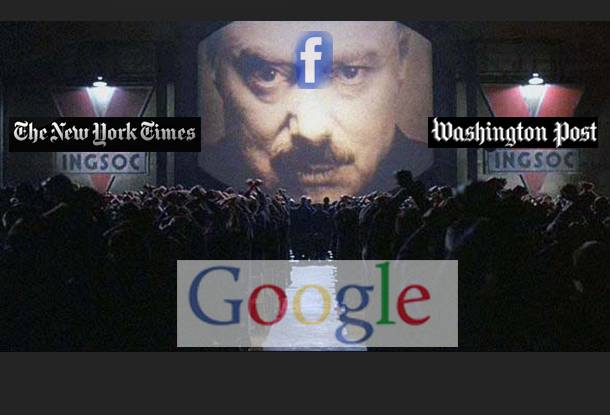
George Orwell’s 1984 Has Become a Blueprint for Our Dystopian Reality

By John W. Whitehead & Nisha Whitehead

Source: The Rutherford Institute

“If you want a picture of the future, imagine a boot stamping on a human face—for ever.” George Orwell, 1984

Tread cautiously: the fiction of George Orwell (Jun. 25, 1903-Jan. 21, 1950) has become an operation manual for the omnipresent, modern-day surveillance state.

It’s been more than 70 years since Orwell—dying, beset by fever and bloody coughing fits, and driven to warn against the rise of a society in which rampant abuse of power and mass manipulation are the norm—depicted the ominous rise of ubiquitous technology, fascism and totalitarianism in 1984.

Who could have predicted that so many years after Orwell typed the final words to his dystopian novel, “He loved Big Brother,” we would come to love Big Brother.

“To the future or to the past, to a time when thought is free, when men are different from one another and do not live alone— to a time when truth exists and what is done cannot be undone: From the age of uniformity, from the age of solitude, from the age of Big Brother, from the age of doublethink — greetings!”—George Orwell

1984 portrays a global society of total control in which people are not allowed to have thoughts that in any way disagree with the corporate state. There is no personal freedom, and advanced technology has become the driving force behind a surveillance-driven society. Snitches and cameras are everywhere. People are subject to the Thought Police, who deal with anyone guilty of thought crimes. The government, or “Party,” is headed by Big Brother who appears on posters everywhere with the words: “Big Brother is watching you.”

We have arrived, way ahead of schedule, into the dystopian future dreamed up by not only Orwell but also such fiction writers as Aldous Huxley, Margaret Atwood and Philip K. Dick.

“If liberty means anything at all, it means the right to tell people what they do not want to hear.”―George Orwell

Much like Orwell’s Big Brother in 1984, the government and its corporate spies now watch our every move. Much like Huxley’s A Brave New World, we are churning out a society of watchers who “have their liberties taken away from them, but … rather enjoy it, because they [are] distracted from any desire to rebel by propaganda or brainwashing.” Much like Atwood’s The Handmaid’s Tale, the populace is now taught to “know their place and their duties, to understand that they have no real rights but will be protected up to a point if they conform, and to think so poorly of themselves that they will accept their assigned fate and not rebel or run away.”

And in keeping with Philip K. Dick’s darkly prophetic vision of a dystopian police state—which became the basis for Steven Spielberg’s futuristic thriller Minority Report—we are now trapped in a world in which the government is all-seeing, all-knowing and all-powerful, and if you dare to step out of line, dark-clad police SWAT teams and pre-crime units will crack a few skulls to bring the populace under control.

What once seemed futuristic no longer occupies the realm of science fiction.

Incredibly, as the various nascent technologies employed and shared by the government and corporations alike—facial recognition, iris scanners, massive databases, behavior prediction software, and so on—are incorporated into a complex, interwoven cyber network aimed at tracking our movements, predicting our thoughts and controlling our behavior, the dystopian visions of past writers is fast becoming our reality.

Our world is characterized by widespread surveillance, behavior prediction technologies, data mining, fusion centers, driverless cars, voice-controlled homes, facial recognition systems, cybugs and drones, and predictive policing (pre-crime) aimed at capturing would-be criminals before they can do any damage.

Surveillance cameras are everywhere. Government agents listen in on our telephone calls and read our emails. Political correctness—a philosophy that discourages diversity—has become a guiding principle of modern society.

“People sleep peaceably in their beds at night only because rough men stand ready to do violence on their behalf.”―George Orwell

The courts have shredded the Fourth Amendment’s protections against unreasonable searches and seizures. In fact, SWAT teams battering down doors without search warrants and FBI agents acting as a secret police that investigate dissenting citizens are common occurrences in contemporary America. And bodily privacy and integrity have been utterly eviscerated by a prevailing view that Americans have no rights over what happens to their bodies during an encounter with government officials, who are allowed to search, seize, strip, scan, spy on, probe, pat down, taser, and arrest any individual at any time and for the slightest provocation.

“The creatures outside looked from pig to man, and from man to pig, and from pig to man again; but already it was impossible to say which was which.”―George Orwell, Animal Farm

We are increasingly ruled by multi-corporations wedded to the police state.

What many fail to realize is that the government is not operating alone. It cannot. The government requires an accomplice. Thus, the increasingly complex security needs of the massive federal government, especially in the areas of defense, surveillance and data management, have been met within the corporate sector, which has shown itself to be a powerful ally that both depends on and feeds the growth of governmental overreach.

In fact, Big Tech wedded to Big Government has become Big Brother, and we are now ruled by the Corporate Elite whose tentacles have spread worldwide. The government now has at its disposal technological arsenals so sophisticated and invasive as to render any constitutional protections null and void. Spearheaded by the NSA, which has shown itself to care little to nothing for constitutional limits or privacy, the “security/industrial complex”—a marriage of government, military and corporate interests aimed at keeping Americans under constant surveillance—has come to dominate the government and our lives.

Money, power, control. There is no shortage of motives fueling the convergence of mega-corporations and government. But who is paying the price? The American people, of course.

Orwell understood what many Americans are still struggling to come to terms with: that there is no such thing as a government organized for the good of the people. Even the best intentions among those in government inevitably give way to the desire to maintain power and control over the citizenry at all costs.

“The further a society drifts from truth the more it will hate those who speak it.” ― George Orwell

Even our ability to speak and think freely is being regulated.

In totalitarian regimes—a.k.a. police states—where conformity and compliance are enforced at the end of a loaded gun, the government dictates what words can and cannot be used. In countries where the police state hides behind a benevolent mask and disguises itself as tolerance, the citizens censor themselves, policing their words and thoughts to conform to the dictates of the mass mind.

Dystopian literature shows what happens when the populace is transformed into mindless automatons.

In Ray Bradbury’s Fahrenheit 451, reading is banned and books are burned in order to suppress dissenting ideas, while televised entertainment is used to anesthetize the populace and render them easily pacified, distracted and controlled.

In Huxley’s Brave New World, serious literature, scientific thinking and experimentation are banned as subversive, while critical thinking is discouraged through the use of conditioning, social taboos and inferior education. Likewise, expressions of individuality, independence and morality are viewed as vulgar and abnormal.

In my debut novel The Erik Blair Diaries, the dystopian future that George Orwell predicted for 1984 has finally arrived, 100 years late and ten times as brutal. In this post-apocalyptic world where everyone marches to the beat of the same drummer and words like “freedom” are taboo, Erik Blair—Orwell’s descendant and unwitting heir to his legacy—isn’t volunteering to be anyone’s hero. Unfortunately, life doesn’t always go according to plan. To save all that he loves, Orwell will have to travel between his future self and the past.

And in Orwell’s 1984, Big Brother does away with all undesirable and unnecessary words and meanings, even going so far as to routinely rewrite history and punish “thoughtcrimes.” Orwell’s Big Brother relies on Newspeak to eliminate undesirable words, strip such words as remained of unorthodox meanings and make independent, non-government-approved thought altogether unnecessary.

Where we stand now is at the juncture of OldSpeak (where words have meanings, and ideas can be dangerous) and Newspeak (where only that which is “safe” and “accepted” by the majority is permitted). The power elite has made their intentions clear: they will pursue and prosecute any and all words, thoughts and expressions that challenge their authority.

This is the final link in the police state chain.

“Until they became conscious they will never rebel, and until after they have rebelled they cannot become conscious.”—George Orwell

Having been reduced to a cowering citizenry—mute in the face of elected officials who refuse to represent us, helpless in the face of police brutality, powerless in the face of militarized tactics and technology that treat us like enemy combatants on a battlefield, and naked in the face of government surveillance that sees and hears all—we have nowhere left to go.

We have, so to speak, gone from being a nation where privacy is king to one where nothing is safe from the prying eyes of government.

“Big Brother is Watching You.”―George Orwell

Wherever you go and whatever you do, you are now being watched, especially if you leave behind an electronic footprint. When you use your cell phone, you leave a record of when the call was placed, who you called, how long it lasted and even where you were at the time. When you use your ATM card, you leave a record of where and when you used the card. There is even a video camera at most locations equipped with facial recognition software. When you use a cell phone or drive a car enabled with GPS, you can be tracked by satellite. Such information is shared with government agents, including local police. And all of this once-private information about your consumer habits, your whereabouts and your activities is now being fed to the government.

The government has nearly inexhaustible resources when it comes to tracking our movements, from electronic wiretapping devices, traffic cameras and biometrics to radio-frequency identification cards, satellites and Internet surveillance.

In such a climate, everyone is a suspect. And you’re guilty until you can prove yourself innocent. To underscore this shift in how the government now views its citizens, the FBI uses its wide-ranging authority to investigate individuals or groups, regardless of whether they are suspected of criminal activity. 

“Nothing was your own except the few cubic centimetres inside your skull.” ― George Orwell

Here’s what a lot of people fail to understand, however: it’s not just what you say or do that is being monitored, but how you think that is being tracked and targeted. We’ve already seen this play out on the state and federal level with hate crime legislation that cracks down on so-called “hateful” thoughts and expression, encourages self-censoring and reduces free debate on various subject matter. 

Say hello to the new Thought Police.

Total Internet surveillance by the Corporate State, as omnipresent as God, is used by the government to predict and, more importantly, control the populace, and it’s not as far-fetched as you might think. For example, the NSA has been working on an artificial intelligence system designed to anticipate your every move. Aquaint (the acronym stands for Advanced QUestion Answering for INTelligence) has been designed to detect patterns and predict behavior.

No information is sacred or spared.

Everything from cell phone recordings and logs, to emails, to text messages, to personal information posted on social networking sites, to credit card statements, to library circulation records, to credit card histories, etc., is collected by the NSA and shared freely with its agents in crime: the CIA, FBI and DHS.

What we are witnessing, in the so-called name of security and efficiency, is the creation of a new class system comprised of the watched (average Americans such as you and me) and the watchers (government bureaucrats, technicians and private corporations).

Clearly, the age of privacy in America is at an end.

So where does that leave us?

We now find ourselves in the unenviable position of being monitored, managed and controlled by our technology, which answers not to us but to our government and corporate rulers. This is the fact-is-stranger-than-fiction lesson that is being pounded into us on a daily basis.

It won’t be long before we find ourselves looking back on the past with longing, back to an age where we could speak to whom we wanted, buy what we wanted, think what we wanted without those thoughts, words and activities being tracked, processed and stored by corporate giants such as Google, sold to government agencies such as the NSA and CIA, and used against us by militarized police with their army of futuristic technologies.

To be an individual today, to not conform, to have even a shred of privacy, and to live beyond the reach of the government’s roaming eyes and technological spies, one must not only be a rebel but rebel.

Even when you rebel and take your stand, there is rarely a happy ending awaiting you. You are rendered an outlaw. Just look at what happened to Julian Assange.

So how do you survive in the American surveillance state?

We’re running out of options.

Whether you’re dealing with fact or fiction, as I make clear in Battlefield America: The War on the American People and in my new novel The Erik Blair Diaries, we’ll soon have to choose between self-indulgence (the bread-and-circus distractions offered up by the news media, politicians, sports conglomerates, entertainment industry, etc.) and self-preservation in the form of renewed vigilance about threats to our freedoms and active engagement in self-governance.

ARCHITECTS OF POWER: HOW THE GLOBAL ELITE PROFIT FROM EXTREME INEQUALITY & PRE-EMPT THE BACKLASH

By Dr. Tim Coles

Source: Waking Times

There is a new, mega-rich global elite consisting of a small number of billionaires and multibillionaires. Many of them made their money in the technology sector. Others play financial markets or inherit fortunes. They are wealthier and more powerful than some entire nation-states.

The British Ministry of Defence (MoD) says:

“Whilst there have always been differences between the wealthier, better educated and the less privileged, these differences appear likely to widen in the coming decades.”

The mega-rich deliberately order the world in ways that guarantee their wealth by institutionalising inequality. Occasionally, this is admitted. In 1997, a book published by the Royal Institute for International Affairs in the UK acknowledged:

“The present international order may not be the best of all possible worlds, but for one of the ‘fat cats of the West’ enjoying a privileged position in an international society that is structured and organised in ways which perpetuate those privileges, there are good reasons for not pursuing radical change.”

This is also true of internal policymaking. The third richest man in the world, Warren Buffett (worth over $80bn), confirmed this: “There’s been class warfare for the last 20 years, and my class has won.” This echoes his statement in 2006, just prior to the global financial crisis: “There’s class warfare all right… but it’s my class, the rich class, that’s making war, and we’re winning.” Around the same time, the liquidity firm Citigroup circulated an investor memo, stating: “Society and governments need to be amenable to disproportionately allow/encourage the few to retain that fatter profit share.” More recently, the UK MoD admitted: “In the coming decades, the very highest earners will almost certainly remain rich, entrenching the power of a small elite. Vested interests could reduce the prospect of economic reforms that would benefit the poorest.”

Consider the enormous concentration of wealth and power that results from this imbalance.

Ever-Increasing Power

Global and national inequality is staggering and getting worse. By 2011, a mere 147 – mainly US and European – corporations owned and controlled 40% of world trade and investment. Just four corporations influence the profitability and power of these 147: McGraw-Hill, which owns Standard & Poor’s ratings agency; Northwestern Mutual, owner of the indexer Russell Investments; the CME Group, which owns 90% of the Dow Jones market index; and Barclay’s bond fund index. Evaluative decisions by analysts at these firms affect the wealth and performance of each of the 147 giants.

That’s corporate wealth concentration. But what about wealth concentration among individuals?

There are 7.7 billion people in the world. Of those, just 2,153 are billionaires. According to Forbes, their combined wealth totals $8.7 trillion. The list of billionaires reflects where power is most concentrated: in the US. While China and Europe’s number of billionaires declined in the previous 12 months, the US and Brazil gained billionaires. The US is home to 607 billionaires or 0.000001% of the population. It is worth noting that President Donald Trump was a billionaire before he came to power. Trump has cut taxes for his fellow billionaires. As an indication of continued wealth concentration, consider the wealth disparity among the billionaire class itself. He Xiangjian, founder of the Midea Group, is the joint-50th richest person, worth over $19.8bn. Jeff Bezos, by comparison, the founder of Amazon, is the richest man in the world, worth over $131bn – more than six times He Xiangjian.

Part of the problem has been the US-led imposition of an economic dogma called “neoliberalism” (which is neither new nor liberal) on much of the rest of the world.

Neoliberalism can be roughly defined as:

1) Financialisation, i.e., allowing investors to make money from money as opposed to tangible things;

2) Deregulating financial services;

3) Taking out government insurance policies so that working people bail out financial institutions;

4) Cutting taxes for the wealthy;

5) Privatising public services to reduce social mobility;

6) Imposing austerity to make markets more attractive to investors.

Neoliberalism has cut taxes for the super-rich, enabling them to hold onto their wealth at the expense of others. According to Oxfam, the average rate of personal income tax for the wealthy was 62% in 1970. In 2013, it was 38%. In the UK, the poorest 10% pay a higher proportion of their income in taxes than the richest 10%. Global GDP, i.e., how much money there is in the world, is $80 trillion. But, of this, $7.6 trillion is untaxed. In the decade since the financial crisis, the number of billionaires doubled. This reveals that the system rewards greed. In 2017, 43 people owned as much wealth as half the world’s poorest. In 2018, the number was 26.

To put all this into perspective, Jeff Bezos owns as much wealth as the poorest fifty countries. When it comes to more ‘developed’ nations, Bezos’s wealth equals the entire GDP of Hungary. Consider how Bezos makes his money. Amazon is a corporation that primarily advertises and delivers products. The innovation, design, and investment in and of those products is the work of others. Amazon treats “workers like robots” by spying on them, discouraging unions, offering insecure contracts, and encouraging long hours. Amazon is also notorious for paying little or no corporation tax. Amazon is an online retailer. The Internet was developed by the US Defense Department in the 1960s as ARPANET, with public money. The satellites that enable online transactions are first and foremost military hardware. Not only did Amazon take advantage of state-funded innovation, but it also rewards government investors by selling the CIA cloud technology and the Pentagon artificial intelligence.

Bezos is far from being the only one. Bill Gates’s Microsoft and the late Steve Jobs’s Apple, which became the first trillion-dollar company, also enjoy low taxes, technologies developed with government grants, and procurement contracts.

Consider also the immoral activities of other hi-tech nouvelle méga riche. Without making it clear to users, Facebook founder Mark Zuckerberg (worth $66bn) has made his money by selling personal data to insurers and advertisers. Scientists have used Facebook in social media experiments without the knowledge or consent of users in an effort to see how memes affect mood.

Other mega-rich, including the hedge fund manager Robert Mercer of Renaissance Technologies, used Facebook to market political candidates. Other tech billionaires include Google founders Larry Page and Sergey Brin. Google technology was funded by the CIA’s venture capital firm In-Q-Tel. Also relying on technologies developed by the Pentagon with workers’ tax dollars, the company cooperates with the National Security Agency to spy on citizens and it has even enabled US assassination programmes.

Consequences

How do the billionaires get away with it, and what are the social and political consequences? The examples below are from the US, but it should be noted that the US exports its mega-wealth model.

A study by Martin Gilens and Benjamin I. Page on plutocracy (government by the rich) notes that the rich buy political parties. Politicians draft and/or vote for laws that help the rich. The authors analysed 1,779 policy issues in the US and conclude that “average citizens and mass-based interest groups have little or no independent influence.” Unlike the public, “economic elites and organised groups representing business interests have substantial independent impacts on US government policy.” Other research into wealth inequality in the US finds that “[c]ertain policies, such as the decreased support for unions and tax cuts favouring the relatively well-off and corporations, have benefitted a small minority of the population at the expense of the majority and have thus contributed to widening income inequality.”

At the turn of the last century, 9% of American families owned 71% of the nation’s wealth. The elite of the day included familiar names: John D. Rockefeller (oil), J.P. Morgan (banking), W. Averell Harriman (industry), and so on. Things balanced out after the Second World War, with the majority of Americans becoming middle class. Gradually, state controls over the economy were removed, and the situation reverted to the inequality of bygone centuries.

Since the 1970s, the US middle class has been shrinking. Until recently, the middle classes of Asia grew, precisely because strong Asian economies (notably China, South Korea, and Singapore) either retained some state controls or refused to adopt the US neoliberal model.

Alan B. Krueger, a labour economist and key Obama advisor, explains that, “since the 1970s income has grown more for families at the top of the income distribution than in the middle, and it has shrunk for those at the bottom.” Between 1979 and 2007, the top 1% ((multi)millionaires and (multi)billionaires) enjoyed a 278% increase in their after-tax incomes. But 60% of Americans saw their incomes rise by just 40%, which when adjusted for rising living costs means stagnation. Krueger notes that during that period, $1.1 trillion of annual income was moved to the top 1%. “Put another way, the increase in the share of income going to the top 1% over this period exceeds the total amount of income that the entire bottom 40 percent of households receives.”

The exportation of this model means that Australia, Britain, and Canada became what the billionaire-dollar liquidity firm Citigroup calls “plutonomies,” economies in which the rich drive luxury goods markets such as jewellery, fashion, cruises, and sports cars: hence the recent entry of celebrity Kylie Jenner into the billionaire class. The Citigroup document also notes that in plutonomies the top 1% owns 40% as much wealth as the bottom 95%. No matter where you live, you can’t escape the institutional structures that create inequality.

The US military exists, in part, to maintain the unjust status quo. Yet, it acknowledges the dangers of dominance: “A global populace that is increasingly attuned and sensitive to disparities in economic resources and the diffusion of social influence,” thanks in part to the very technologies that enrich the rich, “will lead to further challenges to the status quo and lead to system rattling events,” like Brexit or the Yellow Vest protestors in France.

The mega-rich and international think tanks and forums they sponsor are beginning to reluctantly accept that their status quo political puppets might get voted out of office and give way to so-called far-left or far-right parties unless they address wealth inequality.

New Paradigms of Control

The question, then, is how to deal with the restless and disaffected majority while not radically altering the system and taking away the privileges of the elite. In 1961, US President John F Kennedy said: “If a free society cannot help the many who are poor, it cannot save the few who are rich.” In the 1980s, World Economic Forum founder Klaus Schwab said: “Economic globalisation has entered a critical phase. A mounting backlash against its effects… is threatening a very disruptive impact on economic activity and social stability in many countries… This can easily turn into revolt.” More recently, he said: “Today, we face a backlash against that system and the elites who are considered to be its unilateral beneficiaries.” Likewise, the billionaire Johann Rupert of Cartier jewellery (one of the many luxury services driving plutonomies) said: “We are destroying the middle classes at this stage and it will affect us.” Similarly, the British MoD discusses “[m]anagement of societal inequalities,” as opposed to the elimination of social inequality.

Many of the new elites make people redundant by automating the workplace. While Amazon still relies on human shelf-stackers and delivery drivers, it uses an increasing number of physical robots to stack shelves and algorithmic robots to assist online customers. Likewise, Facebook and Google’s content filters rely on heavy automation. This is creating precarious employment conditions. According to the Washington Post (which is owned by Bezos): “…the modern emerging workforce of tech, urbanised professionals, and ‘gig economy’ labourers all represent an entirely new political demographic.” Politicians then “focus more on education, research and entrepreneurship, and less on regulations and the priorities of labour unions.”

But there are many problems. For one thing, the financial services economy, which markets everything, has made “education” a form of unsustainable debt. The quality of US education is notoriously low by world standards, and many young people are “overqualified” for menial jobs, like delivering for Uber or stacking shelves in Amazon warehouses. The UK MoD acknowledges that, “Freelance work is… often low-paid, lacking the benefits and security of formal employment and, therefore, the growth of the gig economy could increase inequality.”

The crisis of what to do with a young, indebted, restless population automated out of steady work by – and competing with – algorithms and physical robots has been considered for at least 50 years.

Traditionally, ‘education’ meant brainwashing children to work in menial jobs for life in adulthood. But as the economy changes and employment becomes less stable, new methods of ‘education’ for re-skilling adults are required. In the late 1960s, future political advisor Zbigniew Brzezinski authored a book in which he advocated for lifelong learning as a way of re-skilling an aging population that finds its employment opportunities diminished, as small-to-medium-sized businesses get overtaken by tech giants. Around the same time, the British Labour Party (when it was a real labour party) introduced the Open University with the aim of providing lifelong learning. Likewise, in the 1980s, futurist Alvin Toffler envisaged an “electronic village” in which flexible working hours and lifelong learning would be required in a hi-tech economy.

To keep the poor from rioting while trapping them in a system that works for those who design it, today’s multibillionaire elites help to privatise public services and education by offering scholarships and infrastructure investments. In doing so, they train poor people to work for their system by developing others’ technology skills while hiding their own taxable wealth in charity foundations.

Howard G. Buffett is the son of Warren. While enjoying largely tax-free wealth that further impoverishes the global poor, the Buffetts, via Howard’s foundation, invest in dams and irrigation in the poorest nations of Africa. Bezos’s foundation awards scholarships for STEM courses (Science, Technology, Engineering, Mathematics). Zuckerberg’s foundation seeks “to find new ways to leverage technology, community-driven solutions, and collaboration to accelerate progress in Science, Education, and within our Justice & Opportunity work.”

Conclusion

By using free online services, we have allowed ourselves to be the products that tech giants sell to advertisers. By not organising to raise taxes on the mega-wealthy, we have underfunded our public services. By not keeping an eye on who’s funding what, we’ve allowed our political parties to hoover up donations from elites. By failing to understand the economy, we’ve allowed a new normal of instability and political uncertainty to flourish to the advantage of asset managers and hedge fund investors. As the US pursues global domination, this model will continue to be exported. It’s time to wake up.

Silicon Valley Algorithm Manipulation Is The Only Thing Keeping Mainstream Media Alive

By Caitlin Johnstone

Source: CaitlinJohnstone.com

The emergence of the internet was met with hope and enthusiasm by people who understood that the plutocrat-controlled mainstream media were manipulating public opinion to manufacture consent for the status quo. The democratization of information-sharing was going to give rise to a public consciousness that is emancipated from the domination of plutocratic narrative control, thereby opening up the possibility of revolutionary change to our society’s corrupt systems.

But it never happened. Internet use has become commonplace around the world and humanity is able to network and share information like never before, yet we remain firmly under the thumb of the same power structures we’ve been ruled by for generations, both politically and psychologically. Even the dominant media institutions are somehow still the same.

So what went wrong? Nobody’s buying newspapers anymore, and the audiences for television and radio are dwindling. How is it possible that those same imperialist oligarchic institutions are still controlling the way most people think about their world?

The answer is algorithm manipulation.

Last month a very informative interview saw the CEO of YouTube, which is owned by Google, candidly discussing the way the platform uses algorithms to elevate mainstream news outlets and suppress independent content.

At the World Economic Forum’s 2021, YouTube CEO Susan Wojcicki told Atlantic CEO Nicholas Thompson that while the platform still allows arts and entertainment videos an equal shot at going viral and getting lots of views and subscribers, on important areas like news media it artificially elevates “authoritative sources”.

“What we’ve done is really fine-tune our algorithms to be able to make sure that we are still giving the new creators the ability to be found when it comes to music or humor or something funny,” Wojcicki said. “But when we’re dealing with sensitive areas, we really need to take a different approach.”

Wojcicki said in addition to banning content deemed harmful, YouTube has also created a category labeled “borderline content” which it algorithmically de-boosts so that it won’t show up as a recommended video to viewers who are interested in that topic:

“When we deal with information, we want to make sure that the sources that we’re recommending are authoritative news, medical science, et cetera. And we also have created a category of more borderline content where sometimes we’ll see people looking at content that’s lower quality and borderline. And so we want to be careful about not over-recommending that. So that’s a content that stays on the platform but is not something that we’re going to recommend. And so our algorithms have definitely evolved in terms of handling all these different content types.”

Progressive commentator Kyle Kulinski has a good video out reacting to Wojcicki’s comments, saying he believes his (entirely harmless) channel has been grouped in the “borderline” category because his views and new subscribers suddenly took a dramatic and inexplicable plunge. Kulinski reports that overnight he went from getting tens of thousands of new subscriptions per month to maybe a thousand.

“People went to YouTube to escape the mainstream nonsense that they see on cable news and on TV, and now YouTube just wants to become cable news and TV,” Kulinski says. “People are coming here to escape that and you’re gonna force-feed them the stuff they’re escaping like CNN and MSNBC and Fox News.”

It is not terribly surprising to hear Susan Wojcicki admit to elevating the media of the oligarchic empire to the CEO of a neoconservative publication at the World Economic Forum. She comes from the same elite empire management background as all the empire managers who’ve been placed in charge of mainstream media outlets by their plutocratic owners, having gone to Harvard after being literally raised on the campus of Stanford University as a child. Her sister Anne is the founder of the genetic-testing company 23andMe and was married to Google co-founder Sergey Brin.

Google itself also uses algorithms to artificially boost empire media in its searches. In 2017 World Socialist Website (WSWS) began documenting the fact that it, along with other leftist and antiwar outlets, had suddenly experienced a dramatic drop in traffic from Google searches. In 2019 the Wall Street Journal confirmed WSWS claims, reporting that “Despite publicly denying doing so, Google keeps blacklists to remove certain sites or prevent others from surfacing in certain types of results.” In 2020 the CEO of Google’s parent company Alphabet admitted to censoring WSWS at a Senate hearing in response to one senator’s suggestion that Google only censors right wing content.

Google, for the record, has been financially intertwined with US intelligence agencies since its very inception when it received research grants from the CIA and NSA. It pours massive amounts of money into federal lobbying and DC think tanks, has a cozy relationship with the NSA, and has been a military-intelligence contractor from the beginning.

Then you’ve got Facebook, where a third of Americans regularly get their news. Facebook is a bit less evasive about its status quo-enforcing censorship practices, openly enlisting the government-and-plutocrat-funded imperialist narrative management firm The Atlantic Council to help it determine what content to censor and what to boost. Facebook has stated that if its “fact checkers” like The Atlantic Council deem a page or domain guilty of spreading false information, it will “dramatically reduce the distribution of all of their Page-level or domain-level content on Facebook.”

All the algorithm stacking by the dominant news distribution giants Google and Facebook also ensures that mainstream platforms and reporters will have far more followers than indie media on platforms like Twitter, since an article that has been artificially amplified will receive far more views and therefore far more clicks on their social media information. Mass media employees tend to clique up and amplify each other on Twitter, further exacerbating the divide. Meanwhile left and antiwar voices, including myself, have been complaining for years that Twitter artificially throttles their follower count.

If not for these deliberate acts of sabotage and manipulation by Silicon Valley megacorporations, the mainstream media which have deceived us into war after war and which manufacture consent for an oppressive status quo would have been replaced by independent media years ago. These tech giants are the life support system of corporate media propaganda.

Edward Snowden On Big Tech Companies, Like Facebook, Censoring & Controlling Information

By Arjun Walia

Source: Collective Evolution

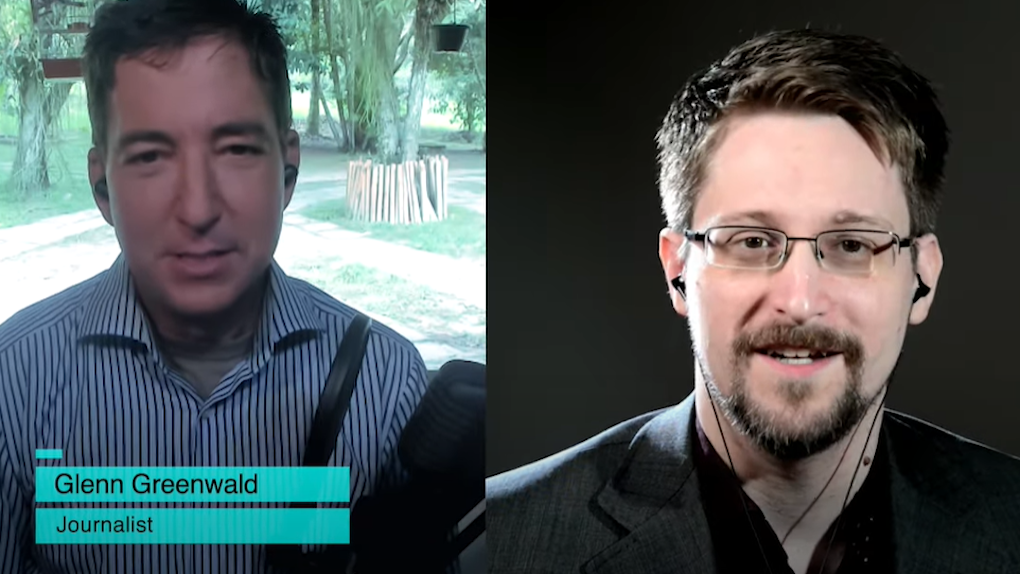
Glenn Greenwald is no stranger to censorship, he’s the journalist who worked with Edward Snowden (NSA mass surveillance whistleblower)  to put together his story and release it to the world while working for the Guardian. He eventually left the Guardian and co-founded his own media company, The Intercept, an organization that would be free from censorship and free to report on government corruption and wrong-doings of powerful people and corporations. He recently resigned from The Intercept as well due to the fact that they’ve now censored him, and is now completely independent. You can find his work here.Glenn Greenwald is no stranger to censorship, he’s the journalist who worked with Edward Snowden (NSA mass surveillance whistleblower)  to put together his story and release it to the world while working for the Guardian. He eventually left the Guardian and co-founded his own media company, The Intercept, an organization that would be free from censorship and free to report on government corruption and wrong-doings of powerful people and corporations. He recently resigned from The Intercept as well due to the fact that they’ve now censored him, and is now completely independent. You can find his work here.Glenn Greenwald is no stranger to censorship, he’s the journalist who worked with Edward Snowden (NSA mass surveillance whistleblower)  to put together his story and release it to the world while working for the Guardian. He eventually left the Guardian and co-founded his own media company, The Intercept, an organization that would be free from censorship and free to report on government corruption and wrong-doings of powerful people and corporations. He recently resigned from The Intercept as well due to the fact that they’ve now censored him, and is now completely independent. You can find his work here.

Anybody who reports on or sheds a bright light onto immoral and unethical actions taken by governments and the powerful corporations they work with has been subjected to extreme censorship. In the case of Edward Snowden, he’s been exiled, and Julian Assange of Wikileaks is currently clinging to his life for exposing war crimes and other unethical actions by multiple governments and corporations. There are many other examples. What does it say about our civilization when we prosecute those who expose harm, corruption, immoral/unethical actions by governments and war crimes?

Greenwald recently interviewed Snowden about internet censorship and the role big tech companies and governments are playing. Greenwald explains that in one of his earliest meetings with Snowden, he (Snowden) explained that he was driven in large part by the vital role the early internet played in his life, “one that was free of corporate and state control, that permitted anonymity and exploration free of monitoring, and, most of all, fostered unrestrained communication and dissemination of information by and among citizens of the world without corporate and state overlords regulating and controlling what they were saying.

This is what he and Snowden go into in the interview posted below. Prior to that I provide a brief summary of Snowden’s key thoughts.

Snowden starts off by mentioning government surveillance programs and the companies they contracted to do this work and compares them to modern day Big Tech giants censoring information on a wide range of topics. We see this today with elections/politics, to medical information dealing with coronavirus and vaccines, for example.

“In secret, these companies had all agreed to work with the U.S. Government far beyond what the law required of them, and that’s what we’re seeing with this new censorship push is really a new direction in the same dynamic. These companies are not obligated by the law to do almost any of what they’re actually doing but they’re going above and beyond, to, in many cases, to increase the depth of their relationship (with the government) and the government’s willingness to avoid trying to regulate them in the context of their desired activities, which is ultimately to dominate the conversation and information space of global society in different ways…They’re trying to make you change your behaviour… – Snowden

So basically, these Big Tech companies have become slaves, if you will, to the governments will, or at least powerful people situated in high places within the government. Snowden brings up the fact that many of these companies are hiring people from the CIA, who come from the Pentagon, who come from the NSA, who have top secret clearances…The government is a customer of all the major cloud service providers. They are also a major regulator of these companies, which gives these companies the incentive to do whatever they want.

This is quite clear if you look at Facebook, Google and Amazon employees. There are many who have come from very high positions within the Department of Defense.

In no case is this more clear than Amazon – Snowden

Amazon appointed Keith Alexander, director of the NSA under Barack Obama.

He was one of the senior architects of the mass surveillance program that courts have repeatedly now declared to be unlawful and unconstitutional….When you have this kind of incentive from a private industry to maintain the warmest possible relationship with the people in government, who not just buy from you but also have the possibility to end your business or change the way you do business…You now see this kind of soft corruption that happens in a constant way. – Snowden

Snowden goes on to explain how people get upset when government, especially the Trump government, tries to set the boundaries of what appropriate speech is by attempting to stop big tech censorship, he then says,

If you’re not comfortable letting the government determine the boundaries of appropriate political speech, why are you begging Mark Zuckerberg to do it?

I think the reality here is…it’s not really about freedom of speech, and it’s not really about protecting people from harm…I think what you see is the internet has become the de facto means of mass communication. That represents influence which represents power, and what we see is we see a whole number of different tribes basically squabbling to try to gain control over this instrument of power.

What we see is an increasing tendency to silence journalists who say things that are in the minority.

You can watch the full conversation between Greenwald and Snowden below, the conversation is about 40 minutes long.

Closing Comments: This kind of information almost begs the question, are we ready as a society to truly create and disseminate journalism that is honest, integral and bi-partisan? Why is it that these types of organizations fail or struggle? How do some media companies fail? Well, they no longer stay true to their mission. They fall to the pressure of politics and fall into ideology. How many other times did ideology change what media outlets reported? Yes, it’s almost impossible to have zero bias, but how close can we get to zero? How can we achieve this when media outlets who do not fit within the accepted framework and disseminate information that challenges the popular opinion are constantly being punished for simply putting out information?

As Snowden mentioned above, these Big Tech companies in collusion with governments are literally attempting to not only censor information, but change the behaviour of people as well, especially journalists. When you take away one’s business or livelihood as a result of non-compliance, you are in a way forcing them to comply and do/say things you they way you want them done/said. We’ve experienced massive amounts of censorship and demonetization here at Collective Evolution, but we haven’t changed as a results of it. We simply created CETV, a platform that helps support our work as a result of censorship.

First Comes A Rolling Civil War

Biden is on a double precipice of the worst-ever economic depression coupled with imminent explosions of social rage

By Pepe Escobar

Source: The Unz Review

The massive psyops is ongoing. Everyone familiar with the

Transition Integrity Project (TIP) knew how this would imperatively play out. I chose to frame it as a think tank gaming exercise in my Banana Follies column. This is a live exercise. Yet no one knows exactly how it will end.

US intel is very much aware of well-documented instances of election fraud. Among them: NSA software that infiltrates any network, as previously detailed by Edward Snowden, and capable of altering vote counts; the Hammer supercomputer and its Scorecard app that hacks computers at the transfer points of state election computer systems and outside third party election data vaults; the Dominion software system, known to have serious security issues since 2000, but still used in 30 states, including every swing state; those by now famous vertical jumps to Biden in both Michigan and Wisconsin at 4am on November 4 (AFP unconvincingly tried to debunk Wisconsin and didn’t even try with Michigan); multiple instances of Dead Men Do Vote.

The key actor is the Deep State, which decides what happens next. They have weighed the pros and cons of placing as candidate a senile, stage 2 dementia, neocon warmonger and possible extorsionist (along with son) as “leader of the free world”, campaigning from a basement, incapable of filling a parking lot in his rallies, and seconded by someone with so little support in the Dem primaries that she was the first to drop out.

The optics, especially seen from vast swathes of the imperial-interfered Global South, may be somewhat terrible. Dodgy elections are a prerogative of Bolivia and Belarus. Yet only the Empire is able to legitimize a dodgy election – especially in its own backyard.

Welcome to the New Resistance

The GOP is in a very comfortable position. They hold the Senate and may end up picking up as may as 12 seats in the House. They also know that any attempt by Biden-Harris to legislate via Executive Orders will have…consequences.

The Fox News/ New York Post angle is particularly enticing. Why are they suddenly supporting Biden? Way beyond internal family squabbles worthy of the Successionsaga, Rupert Murdoch made it very clear, via the laptop from hell caper, that he has all sorts of kompromat on the Biden family. So they will do whatever he wants. Murdoch does not need Trump anymore.

Nor, in theory, does the GOP. Former CIA insiders assure of serious backroom shenanigans going on between GOP honchos and the Biden-Harris gang. Trade-offs bypassing Trump – which most of the GOP hates with a vengeance. The most important man in Washington will be in fact GOP Senate majority leader Mitch McConnell.

Still, to clear any lingering doubts, a vote recount would be absolutely necessary in all 6 contested states – WI, MI, PA, GA, NV and AZ. Through hand counting. One by one. The DoJ would need to act on it, immediately. Not gonna happen. Recounts cost a ton of money. There’s no evidence Team Trump – on top of it short of funds and manpower – will be able to convince Daddy Bush asset William Barr to go for it.

While relentlessly demonizing Trump for spreading “a torrent of misinformation” and “trying to undermine the legitimacy of the US election”, mainstream media and Big Tech have declared a winner – a classic case of pre-programming the sheep multitudes.

Yet what really matters is the letter of the law. State legislatures decide whose electors go to the Electoral College to appoint the President.

Here it is – Article II, Section 1, Clause 2: Each state shall appoint electors “in such Manner as the Legislature Thereof May Direct.”

So this has nothing to do with governors, not to mention the media. It’s up to GOP state legislatures to act accordingly. The drama may roll out for weeks. The first step of the Electoral College procedure takes place on December 14. The final determination will only happen in early January.

Meanwhile, talk of a New Resistance is spreading like wildfire.

Trumpism, with 71 million + votes, is firmly established as a mass movement. No one in the GOP commands this kind of popular appeal. By sidelining Trumpism, the GOP may be committing seppuku.

So what will Deplorables do?

The always indispensable Alastair Crooke hits the nail on the head in a powerful essay: Trump is the President of Red America. And depending on how the scripted (s)election tragicomedy develops next, the Deplorables are bound to become The Ungovernables.

Crooke references a crucial parallel evoked by historian Mike Vlahos, who shows how the current American saga mirrors Ancient Rome in the last century of the Republic, pitting the Roman elite against the Populares – which today are represented by Red (Trumpist) America:

“This was a new world, in which the great landowners, with their latifundia [the slave-land source of wealth], who had been the ‘Big Men’ leading the various factions in the civil wars, became the senatorial archons that dominated Roman life for the next five centuries — while the People, the Populares, were ground into a passive — not helpless — but generally dependent and non-participating element of Roman governance: This sapped away at the creative life of Rome, and eventually led to its coming apart.”

So as much as the Dem machine had wanted it, Trump is not yet Imperator Caesar Augustus, whom the Greeks called Autokrator (autocrat), but was a de facto monarch. The American Augustus, Tiberius and most of all Caligula is still further on down the road. He will definitely be a benign, humanitarian imperialist.

In the meantime, what will imperial Big Capital do?

The West, and especially the American Rome, is on the edge of a double precipice: the worst economic depression ever, coupled with imminent, myriad, uncontrollable explosions of social rage.

So the Deep State is reasoning that with Biden – or, sooner rather than later, Supreme shakti and Commander-in-Chief Maa Durga Kamala – the path gets smoother towards the Davos Great Reset. After all, to reset the chess pieces, first the chessboard must be knocked over. This will be one step beyond Dark Winter – which not accidentally was evoked by teleprompter-reading Biden himself on the final presidential debate. The script gets ominously closer to the Rockefelller Foundation’s 2010 Lock Step.

Meanwhile, Plan B is kept in ready, steady, go mode: the lineaments of a global rampage, focused on “malign” Russia’s sphere of influence to satisfy a “revived” NATO and the military-industrial complex, which selected the now media-appointed President-Elect in the first place because he’s no more than a pliant cardboard figure.

The Maxwell Family Business: Espionage

Ghislaine Maxwell is hardly the only Maxwell sibling to continue their father’s controversial work for intelligence, with other siblings carrying the torch specifically for Robert Maxwell’s sizable role in the PROMIS software scandal and subsequent yet related hi-tech espionage operations.

By Whitney Webb

Source: Unlimited Hangout

Many were surprised to learn earlier this month that the key co-conspirator in Jeffrey Epstein’s intelligence-linked sexual blackmail operation, Ghislaine Maxwell, had been in hiding in New England since Epstein’s arrest and subsequent “suicide” last summer. Her recent arrest, of course, has returned attention to the Epstein scandal and to Ghislaine’s ties to the entire operation, in which she played a central and crucial role, arguably more so than Epstein himself.

Ghislaine was first reported to be living in New England at the mansion of her alleged boyfriend Scott Borgeson on August 14th of last year. Though Maxwell is believed to have stayed there until purchasing the nearby New Hampshire home where she was arrested, attention from her presence on the East Coast was immediately and sensationally re-directed to the West Coast when, a day later on August 15ththe New York Post published a picture allegedly depicting Maxwell reading a book on “CIA operatives” at an In-N-Out Burger in Los Angeles, California. The photo was later revealed to have been photoshopped and a fake, but ultimately served its purpose in distracting from her actual location in New England.

While the media frenziedly covered the fake In-N-Out Burger photo, the appearance of an unexpected visitor nearby Borgeson’s mansion succeeded in largely slipping under the radar. On August 18th, Ghislaine’s sister Christine was spotted “packing up a number of bags” into a SUV just a few miles from Borgeson’s “secluded beachfront” home. Christine, who currently lives and works in Dallas, Texas, declined to comment on why she was visiting the exact area where Ghislaine was allegedly hiding at the time.

Out of the seven Maxwell siblings, Ghislaine Maxwell has undoubtedly received the bulk of media scrutiny both in recent years and arguably ever since the suspected homicide of the family patriarch, Robert Maxwell, in 1991. In the years since his death, Robert Maxwell’s close ties to Israeli intelligence and links to other intelligence agencies have been documented by respected journalists and investigators including Seymour Hersh and Gordon Thomas, among others.

While Ghislaine’s own ties to intelligence have since come to light in relation to her critical role in facilitating the Jeffrey Epstein sexual blackmail operation. Little, if any attention, has been paid to her siblings, particularly Christine and her twin sister Isabel, despite them having held senior roles at the Israeli intelligence front company that facilitated their father’s greatest act of espionage on Israel’s behalf, the sale of the bugged PROMIS software to the U.S. national laboratories at the heart of the country’s nuclear weapons system.

Not only that, but Christine and Isabel later became directly involved with technology-based business ventures that directly involved Ghislaine during the very period she worked with Epstein on behalf of Israeli and U.S. intelligence to ensnare powerful U.S. political and public figures in a sexual blackmail scheme involving minors. At the time, Ghislaine described her profession to a number of newspapers as “an internet operator.” Then, after this venture’s multi-million dollar sale to a competitor, Christine and Isabel became involved with successors to the PROMIS software scandal that were closely tied to U.S. intelligence and Israeli intelligence, respectively.

Ghislaine herself also became involved in these affairs, as did Jeffrey Epstein following his first arrest, as they began courting the biggest names in the U.S. tech scene, from Silicon Valley’s most powerful venture capital firms to its most well-known titans. This also dovetailed with Epstein’s investments in Israeli intelligence-linked tech firms and his claims of having troves of blackmail on prominent tech company CEOs during this same period.

With Ghislaine’s name and her ties to intelligence now inking their way back into the media sphere, detailing the decades-long course of these technology-focused espionage operations and their persistent ties to the Maxwell sisters demands the attention it deserves, as the need to air out the real Maxwell family business – espionage – is now greater than ever before.

Trap doors and Treason

One of the most brazen and successful operations conducted by Israeli intelligence on a global scale is undeniably its sale of a bugged software program to governments, corporations and major financial and scientific institutions around the world. That software program, known as the Prosecutor’s Information Management System or by its acronym PROMIS, was orginally created and marketed by Inslaw Inc., a company created by former NSA official Bill Hamilton and his wife Nancy.

In 1982, Inslaw leased its revolutionary PROMIS software to the U.S. Justice Department, then headed by arch neocon Edwin Meese III, Ronald Reagan’s most trusted advisor and who would later go on to advise Donald Trump following the 2016 election. The success of the software, which allowed integration of separate databases and information analysis on a previously unimaginable scale, eventually caught the attention of Rafi Eitan, the notorious and legendary Israeli spymaster and handler of the “most damaging spy” in American history, Jonathan Pollard. Eitan, at the time, was serving as the then-head of the now defunct Israel intelligence service known as Lekem, which focused specifically on espionage related to scientific and technical information and discoveries.

Eitan had first learned of PROMIS from Earl Brian. Brian was a long-time associate of Ronald Reagan who had previously worked for the CIA in covert operations and had been in charge of Reagan’s healthcare program when Reagan was governor of California. Brian often bragged of the nickname he had acquired in overseeing that health care initiative – “the man who walked over the dead.” In 1982, however, Brian was attempting to build a business empire, in which then-AG Ed Meese’s wife was a major investor, and he had first met Eitan while attempting to sell a healthcare system in Iran.

Brian divulged the efficacy of PROMIS, but – instead of praising its revolutionary approach to data analysis – expressed his frustration that the software enabled U.S. federal investigators to successfully track and target money laundering and other financial crimes. He also expressed frustration that he had been left out of the profits on PROMIS, the development of which he had followed closely for several years.

As their conversation wore on, Eitan and Brian hatched a plan to install a “trapdoor”, today more often referred to as a back door, into the software. They would then market PROMIS throughout the world, providing Israeli intelligence and allied elements of U.S. intelligence with a direct window into the operations of its enemies and allies while also netting Eitan and Brian massive profits for the sale of the software. Brian, of course, would also be able to use PROMIS to circumvent authorities investigating financial crimes.

According to the testimony of ex-Mossad official Ari Ben-Menashe, after a copy of PROMIS was obtained by Israeli military intelligence (via direct collusion with the U.S. Department of Justice), Ben-Menashe contacted an Israeli American programmer living in California on Eitan’s orders. That programmer then planted a “trapdoor” or back door into the software that would allow Lekem covert access to any database connected to a device on which the software was installed.

Once the back door was present, Brian attempted to use his company Hadron Inc to market the bugged PROMIS software around the world, though he first had tried to buy out Inslaw to do so. Unsuccessful, Brian turned to his close friend, then-Attorney General Ed Meese, and the Justice Department then abruptly refused to make the payments to Inslaw that had been stipulated by the contract, essentially using the software for free, which Inslaw claimed to be theft.

Meese’s actions would force Inslaw into bankruptcy and Inslaw subsequently sued the Justice Department, with a US court later finding that the Meese-led department “took, converted, stole” the software through “trickery, fraud and deceit.” With Inslaw out of the way, Brian sold the bugged software to Jordan’s and Iraq’s intelligence services, a major boon for Israel, and to a handful of companies. Despite this, Eitan was unsatisfied with Brian and Hadron and he quickly turned to the person he thought could most effectively market and sell PROMIS to governments of interest all over the world, Robert Maxwell.

First recruited as an asset of Israeli intelligence in the early 1960s, Maxwell’s standing with Israeli intelligence would strengthen considerably beginning in the early 1980s, when he purchased a web of Israeli companies, many of which were official “service providers” for the Mossad. One of these companies, a computer firm called Degem, had been used for years to provide cover to Mossad assassins that conducted kidnappings and murders in Latin America and Africa.

Through Degem and other Maxwell-owned companies based in Israel and elsewhere, Maxwell marketed PROMIS so successfully that Israeli intelligence soon had access to the innermost workings of innumerable governments, corporations, banks and intelligence services around the world. Many of Maxwell’s biggest successes came in selling PROMIS to dictators in Eastern Europe, Africa and Latin America. Following the sale and after Maxwell collected a handsome paycheck, PROMIS’ unparalleled ability to track and surveil anything – from cash flows to human movement – were used by these governments to commit financial crimes with greater finesse and used to hunt down and disappear dissidents. Israeli intelligence, of course, watched it all play out in real time.

In Latin America, for instance, Maxwell sold PROMIS to military dictatorships in Chile and Argentina, which were used to facilitate the mass murder that characterized Operation Condor as the friends and families of dissidents and so-called subversives were easily identified using PROMIS. PROMIS was so effective for this purpose that, just days after Maxwell sold the software to Guatemala, its US-backed dictatorship rounded up 20,000 “subversives” who were never heard from again. Of course, thanks to the back door in PROMIS, Israeli intelligence knew the identities of Guatemala’s disappeared before the victim’s own families. Israel was also intimately involved in the arming and training of many of the same Latin American dictatorships that had been sold the bugged PROMIS software.

Though Israeli intelligence found obvious use for the steady stream of sensitive and classified information, their biggest prize was yet to come – top secret government laboratories in the United States. Eitan tasked Maxwell with selling PROMIS to US labs in the Los Alamos complex, including Sandia National Laboratory, which was and is at the core of the US nuclear weapons system. Notably, the eventual sale of PROMIS to these laboratories by Maxwell occurred during the same period in 1984 when Eitan tasked one of Israel’s top experts in nuclear targeting with supervising Jonathan Pollard’s espionage of U.S. nuclear secrets on Israel’s behalf.

In order to plot how he would accomplish such a feat, Maxwell would meet with none other than Henry Kissinger, who told him that – in order to sell PROMIS to these sensitive laboratories – he needed to enlist the services of then-Senator for Texas John Tower, who was the head of the Senates’ Armed Services Committee at the time. Maxwell quickly struck a deal with Tower and then, using Mossad money, paid Tower $200,000 for his services, which included opening doors – not just to the Los Alamos complex, but also to the Reagan White House. Tower would arrange a trip for Maxwell to travel to Sandia National Laboratory, where he would market PROMIS. Unlike most other PROMIS sales, this one would not be handled by Degem, but a US-based company called Information on Demand.

It is worth noting that, despite Tower’s obvious and treasonous actions with respect to U.S. national security, another long-time “source” of Robert Maxwell, George H.W. Bush, would attempt to nominate Tower to serve as U.S. Secretary of Defense. When the Senate refused to confirm Tower, only then did Bush nominate Dick Cheney, who would then head the Pentagon and oversee the U.S.’ role in the First Gulf War. Not long after his failure to secure the nomination as Pentagon chief, Tower died in a suspicious plane crash soon after the equally suspicious death of Robert Maxwell.

Front Companies and FBI Cover-ups

Robert Maxwell purchased Information on Demand from its founder, Sue Rugge – a former librarian, through the Pergamon Group in 1982 – the very year plans were made by Rafi Eitan and Earl Brian to subvert PROMIS. Its offices were just a few doors down from the home of Isabel Maxwell and her first husband Dale Djerassi, son of the scientist credited with creating the birth control pill.

According to FBI files obtained by Inslaw Inc. via a FOIA request in the 1990s, San Francisco’s FBI opened an investigation into Information on Demand a year later in October 1983 and subsequently interviewed Rugge about the business and its activities. She told the FBI that the company’s sources “include over 250 computer data bases” and that company uses these to “locate single facts as well as provide answers to complex questions dealing with such areas as comprehensive marketing research, custom data summaries, sophisticated literature searching, current awareness service and global information capability.

One of these databases included Lockheed’s Dialog database and “the Defense Technical Center which is connected to the Department of Defense (DOD) which contains classified information. ” She asserted, however, that the company “has no password for access and further no need for access.” Elsewhere in the document, it notes that Information on Demand claimed not have any access to classified information “to the best of their knowledge” and “includes information concerning government and various available means of tapping government information databases.”

The FBI asked Rugge about one client of the company in particular, whose name and identifying information is redacted in its entirety, but notes that this mysterious client had worked with Information on Demand since at least 1973. Subsequent efforts by Inslaw Inc. and others to learn the identity of the redacted client have been unsuccessful since 1994.

Notably, just one month before the FBI opened an investigation into Information on Demand and interviewed Sue Rugge, another related Maxwell-owned firm, Pergamon International Information Corporation, had sent a letter to then-CIA Director Bill Casey, offering to provide the agency with access to patent databases. The only redacted portion of the letter is the identity of PIIC’s Executive Vice President, who had written the letter to Casey.

After Rugge had been interviewed, FBI interest in Information on Demand peaked soon after in June 1984, when a formal investigation was opened. This took place after two employees of Sandia National Laboratory who worked in technology transfer approached the Bureau over Information on Demand’s efforts to sell PROMIS to the laboratory. Those employees were compelled to contact the FBI after obtaining information from employees of the National Security Agency (NSA) regarding “the purchase of Information on Demand Inc. by one Robert Maxwell, the owner of Pergamon International.” The specific information on this purchase from the NSA is included in the report but redacted in its entirety. Two months later, one of the Sandia employees followed up with the Bureau, suggesting that the NSA and FBI jointly investigate Information on Demand, but was essentially stonewalled and told to take it up with FBI headquarters.

The FBI case file is coded as a foreign counter-intelligence investigation specifically, suggesting that the case was opened because the FBI was made aware of the alleged involvement of a foreign intelligence service in some aspect of Information on Demand’s activities that related specifically to the “dissemination, marketing or sale of computer software systems, including but not limited to the PROMIS computer software product.” It also noted that Maxwell himself had previously been the subject of a “security investigation” conducted by the FBI from 1953 until 1961, the year Maxwell was formally recruited as an Israeli intelligence asset.

In early August 1984, FBI headquarters and other higher-ups in the Ed Meese-led Department of Justice, which itself was complicit in the whole sordid PROMIS affair, ordered the New Mexico office to halt its investigation into Information on Demand, Maxwell and PROMIS. The cover-up, oddly enough, continues today, with the FBI still refusing to release documents pertaining to Robert Maxwell and his role in the PROMIS scandal.

Several months following the shuttering of the FBI investigation into Information on Demand, Robert Maxwell again returned to Sandia National Laboratories in February 1985, signing the contract for the sale of PROMIS and listing himself as President and CEO of Information on Demand. A few months later, he passed that role on to his daughter Christine, who served as the company’s president and CEO up until her father’s death in 1991, according to her résumé. Upon the collapse of his business empire shortly after his demise, which also resulted in the closure of Information on Demand, Christine created a company called Research on Demand that offered similar services and specialized “in Internet- and Big Data analytics-related market studies for companies in the Telecoms.”

In addition, Isabel Maxwell, who lived in close proximity to the company’s offices in Berkely, CA, told Haaretz that she had also worked for Information on Demand, which she refers to as “her sister’s company,” following her 1989 divorce from Dale Djerassi.

Recreating their Father’s Legacy

After the death of Robert Maxwell, in what most of his family and many of his biographers regard as a murder conducted by Israeli intelligence, his children began to pick up the pieces and sought to rebuild their father’s empire. Of his seven children, five took on different aspects of their father’s vast portfolio.

Kevin and Ian Maxwell took over much of his businesses (and the associated fall-out) and his murky network of interlocking companies, trusts and foundations spread throughout the world. Ghislaine, having already positioned herself in New York at her father’s behest to anchor his efforts to expand his empire and operations into Manhattan, began a sexual blackmail operation on behalf of Israeli intelligence alongside Jeffrey Epstein. Christine and Isabel, however, would take off where Maxwell’s intelligence-linked work with PROMIS and in technology had left off by cashing in on a new revolutionary technology, the Internet.

“We literally were trying to think about how to restart this whole business” that had collapsed after their father’s death, Christine Maxwell would later say of her decision to found, along with her husband Roger Malina, Isabel and Isabel’s then-husband David Hayden, their internet services company – the McKinley Group – in January 1992. Isabel would remember the decision similarly, telling Wired in 1999, that she and her sister had “wanted to circle the wagons and rebuild,” seeing McKinley as “a chance to recreate a bit of their father’s legacy.” In 2000, Isabel would tell The Guardian that her father would “love it [the internet] if he was still here.” “He was very prescient….He’d be in his element, he’d be having a blast, I’m sure he’d be thrilled to know what I’m doing now,” she told the UK-based publication while “throwing back her head and laughing loudly.” Notably, at that time, Isabel was leading Israeli software company with ties to Israeli military intelligence and powerful Israeli political players, including some who had previously worked directly under her father.

It’s not hard to see why Christine and Isabel saw the internet as their chance to expand upon and rebuild upon Robert Maxwell’s “legacy.” As previously mentioned, Christine, right up until her father’s death, had been president and CEO of the Robert Maxwell-owned Israeli intelligence front company, Information on Demand, where Isabel had also worked. Upon his death, Christine had founded a related company called Research on Demand, which specialized in “internet and big data analytics” for telecommunications firms, and would later overlap with the McKinley Group’s work. McKinley began as a directory with a rating system for websites, later transitioning into the Magellan search engine, all of which Isabel Maxwell told Cnet in 1997 were all Christine’s idea.

McKinley created what became known as the Magellan online directory, remembered as “the first site to publish lengthy reviews and ratings of websites.” Magellan’s “value-added content” approach attracted several large corporations, resulting in “major alliances” with AT&T, Time Warner, IBM, Netcom and the Microsoft Network [MSN] that were negotiated by Isabel Maxwell. Microsoft’s major alliance with McKinley came in late 1995, when Microsoft announced that Magellan would power the search option for the company’s MSN service. Time Warner first chose Magellan for its early web portal called Pathfinder and Magellan was on the homepage of the internet browser Netscape for much of the 1990s.

However, McKinley’s fortunes were troubled as its efforts to be the first search engine to go public fell through, igniting a stand-off between Christine Maxwell and Isabel’s husband that also resulted in the company’s essentially falling behind other market leaders both missing the window for a second IPO attempt and lagging behind in adding ad revenue to their business model. Excite, which was later acquired by AskJeeves, ultimately bought the McKinley Group and Magellan for 1.2 million shares of Excite stock in 1996, which was then valued at $18 million. It was allegedly Isabel Maxwell who made the deal possible, with Excite’s CEO at the time, George Bell, claiming she alone salvaged their purchase of McKinley.

Despite the company’s lackluster end, the Maxwell sisters and other stakeholders in the company, Ghislaine Maxwell among them, not only obtained a multi-million dollar payout from the deal, but also forged close connections with Silicon Valley high-rollers. Upon McKinley/Magellan’s sale, the overt ties of Christine and Isabel Maxwell to intelligence in both the U.S. and Israel would grow considerably.

A Family Affair

While the company is often framed as being a venture between Christine and Isabel Maxwell, McKinley Group and Magellan were much more than just the twin sisters’ business. For instance, a November 2003 article in The Evening Standard notes that Christine and Isabel launched the company with considerable help from their brother, Kevin Maxwell who the article described as being “consumed by an overwhelming desire to be his ‘dad reincorporated’” according to confidants. Another Evening Standard article from March 2001 cited report that “Kevin played a major role” in the company’s affairs.

In addition, at the time, The Sunday Times noted in November 2000 that Ghislaine Maxwell “had a substantial interest in Magellan” and netted a considerable sum following its sale to Excite in 1996. It also noted that Ghislaine, throughout the 1990s, had “been discreetly building up a business empire as opaque as her father’s” and that “she is secretive to the point of paranoia and her business affairs are deeply mysterious.” However, she would nonetheless describe “herself as an ‘internet operator’” even though “her office in Manhattan refuses to confirm even the name or the nature of her business.” A separate article in The Scotsman from 2001 also notes that Ghislaine “is extremely secretive about her affairs and describes herself as an internet operator.”

Exactly how involved Ghislaine Maxwell was involved in the McKinley Group and Magellan is unclear, though her decision to describe herself as an “internet operator” and her documented “substantial interest” in the company suggest that it was more than superficial. What is notable, however, is that Ghislaine’s time as an “internet operator” and her business interests in Magellan overlap directly with her time working alongside Jeffrey Epstein in an Israeli intelligence-linked sexual blackmail operation.

During this period of time, Ghislaine Maxwell and Jeffrey Epstein frequently had considerable overlap in their finances, with press reports from the time often asking whether Ghislaine’s expenses were paid by Epstein or through her access to the “lost Maxwell millions” that had been hidden in a web of murky, untraceable financial entities and allegedly “disappeared” following his 1991 death.

The latter is certainly a possibility as it was Ghislaine who was the first to walk into her late father’s office on the Lady Ghislaine following his death, where she “shredded all incriminating documents onboard,” according to journalist John Jackson who witnessed the scene. This would likely mean that she was quickly able to distinguish which documents were “incriminating” and was intimately aware of his more unsavory business activities. In addition, prior to his death, Robert Maxwell had provided Ghislaine with a “tailor-made” New York corporation called Maxwell Corporate Gifts, of which little is known. The corporation was reportedly intended to aid her in establishing a foothold in New York’s power base for Robert Maxwell’s planned expansion into New York society, a plan first set into motion following his purchase of the New York Daily News.

Notably, an article from The Evening Standard in 2001 makes an odd comment about a major source of income from Epstein during the 1990s, stating that “has made many millions out of his business links with the likes of Bill Gates, Donald Trump and Ohio billionaire Leslie Wexner, whose trust he runs.”  In addition, Epstein victim Maria Farmer noted in an interview that she overheard Ghislaine and Epstein discuss Bill Gates as though they knew him well in 1995. However, these mentions of Bill Gates here defies the official narrative about the Epstein-Gates relationship, which claims they first met in 2011.Given the “major alliance” between McKinley/Magellan and Microsoft that was forged in 1995-1996, it is certainly possible that Epstein’s pre-2001 “business links” with Bill Gates were, in fact, related to Ghislaine’s involvement and stake in Magellan. This is also supported by the fact that, as will be shown in Part 2 of this report, Magellan co-founder Isabel Maxwell had a personal relationship with Bill Gates and that he put her subsequent company, Israel-based CommTouch, “on the map” after a major investment that had been brokered between Gates and Isabel personally. Part 2 will also show how both Isabel and Christine’s overt involvement, with Israeli and U.S. intelligence, respectively, deepened after Magellan was sold to Excite in 1996.

Alleged Salas Family Assailant Previously Worked for US/Israeli Intelligence-Linked Firm

The alleged gunmen who killed the son of Esther Salas, the judge recently assigned to the Epstein-Deutsche Bank case, worked for a company of corporate spies and mercenaries with ties to intelligence and also to Deutsche Bank.

By Whitney Webb

Source: Unlimited Hangout

The news of the shooting of the husband and son of Esther Salas, the judge recently assigned to oversee the Jeffrey Epstein – Deutsche Bank case, caused shock and confusion while also bringing renewed scrutiny to the Epstein scandal just a week after Epstein’s main co-conspirator, Ghislaine Maxwell, was denied bail in a separate case.

The case Salas is set to oversee is a class action lawsuit brought by Deutsche Bank investors who allege that Deutsche Bank “failed to properly monitor customers that the Bank itself deemed to be high risk, including, among others, the convicted sex offender Jeffrey Epstein.” The case came after the New York state Department of Financial Services had settled with Deutsche Bank over the bank’s failure to cut ties with Epstein-linked accounts, resulting in Deutsche Bank paying a $150 million fine. Deutsche Bank, unlike other financial institutions, failed to close all of its accounts linked to Epstein until less than a month prior to his arrest last year, even though the bank had identified him as “high risk” years before.

Beyond the tragedy of Sunday’s shooting, which claimed the life of Salas’ only child, the quick discovery of the death of the main suspect, Roy Den Hollander, of a “self-inflicted” gunshot to the head before he could be arrested or questioned by authorities has led to speculation that there is more to the official narrative of the crime than meets the eye.

With law enforcement sources now claiming that Esther Salas was not the intended target of the attack and some media reports now suggesting that Den Hollander’s motive was related to his dislike of feminism, it appears there are efforts underway to distance Sunday’s tragic shooting from Salas’ recent assignment to the Epstein case, which occurred just four days before the tragic shooting.

The most likely reason for any such “damage control” effort lies in the fact that both U.S. law enforcement investigations and mainstream media reports have consistently downplayed the connections of Jeffrey Epstein’s sexual trafficking and financial crimes to intelligence agencies in the U.S. and Israel. Similarly, Roy Den Hollander previously worked for a New York firm has been described as a “private CIA” with ties to those countries’ intelligence agencies and, also, ties to Deutsche Bank.

A Private CIA

According to his website, Den Hollander once worked for Kroll Associates Moscow Office, where he “managed and upgraded Kroll’s delivery of intelligence and security in the former Soviet Union” from 1999 to 2000. A few years prior, Kroll had won a considerable bid from the Russian government to locate money allegedly “spirited out of the country by the directors of state enterprises when they realized that privatization was inevitable.” The Kroll executives in charge of the Russian portfolio prior to Den Hollander were E. Norbett Garrett, a former CIA station chief in Cairo and Kuwait, and Joseph Rosetti, former chief of security for IBM. During that period and prior to his hiring at Kroll, Den Hollender worked as a lawyer in Russia regarding “legal and business issues, including international financing and marketing” and married a Russian woman he met during his time there that he subsequently claimed was part of the “Russian mafia.”

Founded by Jules Kroll in 1972, Kroll Associates would later become known as the “CIA of Wall Street” and “Wall Street’s Private Eye” and was alleged to be an actual front for the CIA by French intelligence agencies, according to theWashington Post. Part of the reason for this nickname, which was once a boasting point for top Kroll executives, owes to the fact that the firm frequently hired former CIA and FBI officers, as well as former members of MI6 and Mossad. K2 Intelligence, the successor to Kroll Associates founded by Jules Kroll and his son Jeremy in 2009, has similar hiring practices, counting former FBI and NSA officials among its ranks alongside former high-ranking members of the Israel Defense Forces (IDF) and Shin Bet, Israel’s domestic intelligence agency. Kroll also boasted ties to the Bush family, with Jonathan Bush (George Bush Sr.’s brother) serving on its corporate advisory board, and Kroll was also employed by Bill Clinton’s first presidential campaign.

Though it is mainly involved in corporate security and investigations, Kroll has also frequently investigated targets of Washington foreign policy, including Saddam Hussein, and was also the company tapped to “reorganize” Enron in 2002. Kroll Associates also has long been a subject of scrutiny for those that question the official narrative on the attacks of September 11, 2001, given that the company was put in charge of security for the World Trade Center complex from 1993 bombing up through the 2001 attacks and has no shortage of ties to companies and individuals that profited from the attacks. Kroll itself experienced a “surge in business” following the events of 9/11, a day when its top executives all avoided going to work despite ostensibly providing security for the complex.

A similar “surge in business” for Kroll followed the 2003 U.S. invasion of Iraq after the company’s investigations into Saddam Hussein’s and the Bath Party’s finances had been used as partial justification for the military incursion. Kroll became a major provider of mercenaries along with companies like Blackwater and DynCorp to the U.S. invasion and subsequent occupation through its subsidiary Kroll Security International. Its clients included the United States Agency for International Development (USAID), which has long fronted for the CIA, and also provided mercenaries for the war in Afghanistan.

Kroll executives over the years have commented to the press on their reputation as a “private CIA” and have also noted the advantages of being a “private” as opposed to “public” intelligence agency. For instance, E. Norbett Garrett, the former CIA official turned Kroll executive, told The New Yorker in 2009 the following:

“Garrett explained the disparity between what Kroll could do and what the C.I.A. could in a place like Sudan. “They have to rely on public and covert sources,” he said. “But we can go straight to Salah Idris. He’s our client, after all. We can go straight to his friends. We can be manipulated, of course, shown incomplete information, and sometimes we have to walk away from a case if we don’t trust somebody. But we definitely have some advantages.”

Kroll Associates and the Epstein Network

Aside from Kroll Associates’ own role as a private intelligence firm, it is also worth pointing out that Jules Kroll had an odd meeting with Robert Maxwell, Ghislaine Maxwell’s father, shortly before his death, alleged by most Maxwell biographers and his family to have been a homicide. Roughly two weeks before his death, Kroll met with Maxwell at New York’s Helmsley Palace Hotel. According to a 1992 article in Vanity Fair, “Maxwell had ushered Kroll and two other men out onto the patio so that their conversation could not be overheard or bugged,” with Maxwell allegedly seeking to hire Kroll to uncover “people out to get him, to destroy his empire, to cripple him financially, and to destroy his life and business in any way they could.”

The article further notes that “the meeting broke up with Maxwell’s promising that he would send Kroll what he called “a memorandum of suspicions and unexplained events.” “Maxwell was working on this compendium,” said the  [anonymous] participant [in the meeting], “when he met his death.” Kroll Associates was never formally hired.”

Much more recently Kroll came under scrutiny after being hired by disgraced media mogul Harvey Weinstein alongside the “private Mossad for hire” firm Black Cube. Weinstein had been instructed to hire Black Cube by Ehud Barak, the former Israeli military intelligence head and Israeli Prime Minister with close ties to Jeffrey Epstein and a frequent visitor of Epstein’s residences. Weinstein hired Kroll to harass and cyberstalk women who had accused him of sexual assault. Weinstein was a one-time business partner of Jeffrey Epstein’s and the testimony of Epstein victim Maria Farmer strongly implies that Ghislaine Maxwell and Epstein “shared” women, and potentially underage girls, with the film producer. The Daily Beast later reported that Epstein had used his ties to Weinstein to impress and recruit potential victims and at least one of those victims landed a role in a film produced by a Weinstein-owned company due to Epstein’s ties to Weinstein.

In addition, Kroll’s long-time executive Vice President for Operations, James Bucknam, was previously chief adviser to former FBI director Louis Freeh and is now CEO of the Freeh Group. Freeh has since become notorious for having been hired by Epstein associate, lawyer Alan Dershowitz, to “investigate” the Epstein scandal, and was also involved in the cover-up of the Penn State child molestation and abuse scandal. Freeh was also director of the FBI when the Bureau declined to investigate accusations regarding Leslie Wexner, Ghislaine Maxwell and Jeffrey Epstein and their involvement in the sex trafficking of minors, first reported to the FBI in 1996 by Maria Farmer.

The Kroll – Deutsche Bank “Revolving Door”

After “retiring” from Kroll associates, Jules Kroll created a credit-rating agency, a field he had called just years earlier “a heck of a racket.” Named the Kroll Bond Rating Agency (KBRA), the firm was envisioned by Kroll as a “credit-rating agency on steroids,” but has failed to make a dent in the market shares of the so-called “Big Three” credit-rating agencies: Standard & Poor’s, Moody’s Investors Service, and Fitch Ratings.

Though it hasn’t managed to become a dominant force in credit ratings, KBRA has managed to be profitable and to have produced something of a “revolving door” between its senior management and Deutsche Bank executives. For instance, KBRA’s top executive in Europe, Mauricio Noé, had previously been a Managing Director of Deutsche Bank’s London branch. In another example, Vice President for Credit Structuring at Deutsche Bank in New York, Ian Ross, was previously employed by KBRA and Yee Cent Wong, managing director of KBRA for CMBS, was previously Vice President of the Credit Solutions Group at Deutsche Bank Securities. Another managing director of KBRA, Bill Baneky, had previously served as Deutsche Bank’s Vice President and National Relationship Manager. One of KBRA’s senior managing directors, Rosemary Kelley, is also a former Deutsche Bank Vice President, while another, Ken Kockenmeister, was Deutsche Bank’s Director for Large Loan Securitization and Underwriting.

While they may not be the “biggest” credit-rating agency, KBRA analysts and executives frequently speak to media outlets where they comment on the state of various businesses, Deutsche Bank among them. Given the amount of overlap between Deutsche Bank and KBRA, it is unsurprising that KBRA has lobbied in the press on Deutsche’s behalf. For instance, KBRA analyst Christopher Whalen told Business Insider in 2016 that “The problem with Deutsche Bank may be the end of Merkel’s career,” adding that “The question is does she want to be remembered for doing the right thing — which is to provide support for the bank and diffuse the situation — or does she want to be remembered for standing by when one of the largest banks in Europe failed?”

Jeffrey Epstein’s ties to Deutsche Bank go back decades, and potentially earlier. After working for Bear Stearns earlier in his career and then as a so-called “financial bounty hunter” with ties to intelligence-linked arms dealers and Wall Street, Epstein set up a Ponzi scheme with Steve Hoffenberg called Tower Financial, which collapsed in 1993 and subsequently landed Hoffenberg 20 years in prison. Epstein’s name, despite being a clear co-conspiractor, was suspiciously dropped from the case during the trial. Hoffenberg subsequently alleged that Epstein used his ill-gotten gains from Tower Financial alongside a series of suspect loans from Deutsche Bank to create his investment company.

Hoffenberg subsequently told The Observer the following:

“His lead bank is Deutsche Bank, Germany, that runs the lead on his financial trust company. They run the platform in the trading of the currencies for Epstein and with Epstein. He’s never disclosed to the investors that provide the money to Deutsche Bank his true legacy, that’s securities fraud.”

Following that point, Epstein’s financial activities, aside from his Deutsche Bank-enabled investment vehicle, were publicly conducted through Bear Stearns (until its 2008 collapse) and J.P. Morgan. When J.P. Morgan dropped Epstein as a client, he again turned to Deutsche Bank in 2013, becoming a client of the bank’s private wealth division in New York. Anti-money laundering compliance officers at the bank’s branches in New York and Florida subsequently flaggedEpstein’s accounts in 2015, in 2016 and again in 2019, creating suspicious activity reports regarding the movements of large amounts of funds tied to Epstein-linked accounts outside of the U.S.

However, the bank did not fully terminate their relationship with Epstein until June 2019, just a few weeks prior to his arrest last year. Epstein was believed to have dozens of accounts with the bank at one point and those accounts were shut down slowly over a period of several months beginning in late 2018.

Ties that Bind

The narrative emerging that Den Hollander was motivated to kill Esther Salas’ husband and sons due to his hatred of feminism is a rapid attempt to explain away a story that clearly warrants further investigation, albeit into avenues that mainstream media and powerful individuals in the public and private sectors prefer remain untouched.

As the heinous act targeting the Salas family has shown, individuals with a lot to lose are willing to go to the farthest extremes to keep the ties of Epstein to the financial sector and to intelligence out of sight and out of mind. Indeed, just last December, Epstein’s personal banker at Deutsche Bank, Thomas Bowers, the chief of Deutsche Bank’s Private Wealth Management division in New York from 2012 to 2015, was found dead in his home. His death was quickly ruled a suicide by hanging. Bowers had also signed off on “unorthodox” loans, not just for Epstein, but Donald Trump, who has his own ties to the Epstein scandal.

While some have been quick to point out that Trump (as well as his son-in-law Jared Kushner) could stand to lose from potential revelations in the Epstein-Deutsche Bank trial, there are other key power-brokers tied to both Epstein and Deutsche Bank who could also be feeling the heat. For instance, Lynn Forester de Rothschild, who became close to Epstein in the early 1990s and subsequently connected him to the Clinton White House and later to Alan Dershowitz, is intimately involved in the Deutsche Bank Microfinance Consortium.

Aside from Epstein’s use of the money, Deutsche Bank has been notorious for years as a cesspool of money launderingfor organized crime networks, paying $14.5 billion in fines in just seven years for official action taken against the bank by several governments. It is highly likely that the brutality of what happened outside the Salas family home on Sunday is more related to Deutsche Bank than Epstein, as numerous powerful individuals have ties to the embattled bank.

Even the recent move by Attorney General William Barr to remove SDNY District Attorney Geoffrey Berman from his post appears to be more related to Berman’s efforts to investigate Deutsche Bank than the Epstein scandal, as some have alleged. This is because Barr’s new pick for Berman’s old job counts Deutsche Bank among his former clients and notably defended the bank in a recent anti-money laundering probe, whereas Berman was investigating the bank (albeit for political reasons that took aim at the bank’s dealings with Trump).

While Epstein’s egregious and criminal actions targeting minors have now become public knowledge, in role in facilitating white collar crime, money laundering and financial frauds on behalf of corporations, governments and oligarchs remains sorely under-covered, despite his role in such activities preceding and continuing after his involvement in an intelligence-linked sexual blackmail operation.

It arguably remains one of the key components of the Epstein scandal, yet the most poorly understood and most under-investigated. If anything, the tragic events at the Salas family home on Sunday, and what appears to be a rapid yet shoddy cover-up of the shooter’s ties to Kroll Associates and actual motives, reveal that Epstein’s financial ties are more frightening to certain powerful individuals and institutions than his trove of sexual blackmail.