The US financial sector has long looted other countries. A number of participants have described the process. First a country is enticed with bribes to the leaders to take out loans that cannot be serviced or repaid. Then in comes the IMF. Austerity is imposed on the population. Public services and employment are cut to free resources for debt service, and public assets are sold to repay the loan. Living standards fall, and US corporations take over the country’s economy.
As foreign governments, having experienced or witnessed the economic carnage and fearing accountability, are less willing to be bribed into indebting their countries, American finance is now applying this technique to Americans. Contrary to the narrative in the financial press, the Federal Reserve is not raising interest rates in order to fight inflation. It is ludicrous to think that a three-quarters of one percent rise in a very low interest rate is going to have any impact on a 9.1% rate of consumer inflation or that speculation that the Federal Reserve has in mind another three-quarters of one percent possibly followed by one half of one percent comprise an anti-inflation policy. If all these increases occur, it still leaves the interest rate below the inflation rate.
Moreover, as I have previously explained, the inflation is not monetary. The higher prices are the result of supply disruptions caused by Washington’s Covid lockdowns and Russian sanctions. Production was stopped and supply chains are broken.
The Federal Reserve’s rise in interest rates is just a continuation of its policy of concentrating income and wealth in the hands of the One Percent. Quantitative Easing was the cloak for the Federal Reserve to print $8.2 trillion in new money which was directed or found its way into the prices of stocks and bonds, thus enriching the small number who own most of these financial instruments. Having maxed out this avenue of wealth concentration, the Federal Reserve is now raising interest rates in order to drive up mortgage costs to aspiring home owners. The Federal Reserve is driving individuals out of the housing market in order to free up properties for “private equity” firms to purchase homes for their rental values. That private equity firms see rental income from the existing stock of houses as the best investment opportunity tells us that the US economy has played out. When investment goes into existing assets, not into producing new assets, the economy ceases to grow.
The Obama regimes policy of bailing out the financial fraudsters responsible for the 2008 crash while foreclosing on their victims, reduced American homeownership from 70% to 63 percent. The Urban Institute predicts further declines. Today homeowners’ equity has declined from 85% after World War II to one-third, leaving two-thirds of homeowner equity in the hands of creditors. This makes it completely clear that a financialized economy indebts the people for the sake of rentier income to the One Percent. Indeed, the financialized economy created by the Federal Reserve has reimposed a class system akin to the landed British aristocracy that was overthrown. Indeed, we have an economically far worst class system. The landed British aristocrats produced food that fed the nation. The American class system produces interest and fees for the financial system.
As Michael Hudson has shown us, a no-growth economy is the end result of a financialized economy. A financialized economy is one in which consumer income is diverted by debt expansion away from the purchase of new goods and services into debt service and fees–interest on mortgages, car loans, credit card debt, student loan debt. With such a large share of household income spent on debt service, little is left for driving the economy forward.
If American economists were capable of escaping from their neoliberal junk economics, they would realize that “the world’s largest economy” they attribute to the United States is total fiction. The fact is that the United States does not have an economy. Corporations driven by Wall Street located American manufacturing in Asia so that the One Percent could benefit from higher profits from lower labor costs, while the deserted city and states had to sell their income streams, such as Chicago’s parking meter revenues for 75 years, to foreigners for one lump sum payment to solve one year’s budget crisis.
The offshoring of American production, carried out under the cloak of “globalism,” destroyed the American economy and the tax bases of cities and states. While the real economy declines, the Democrat Party, seeking permanent power, has imposed a policy of open borders for immigrant-invaders. How are these millions of peoples to support themselves in an economy whose manufacturing has been moved abroad? How can a population, deserted by American corporations, that is experiencing debt deflation absorb the costs of support and social infrastructure for tens of millions of third world immigrant-invaders?
You will never hear it from the whores in the financial press, but the United States is on the precipice of economic and social collapse. And what are the fools in Washington doing? The idiots are ginning up wars with Russia, China, and Iran.
One thing I haven’t seen people point out anywhere else is how much the current atmosphere of “wokeness” is an outcome of neoliberalism.
Let me explain.
There was a lot of analysis written about neoliberalism back in the 1990s when it was still a relatively new phenomenon, having only been enshrined as the dominant economic paradigm in the 1980s. Now that neoliberalism has become simply the water in which we swim and the horizon upon which we gaze, we don’t even notice it anymore. The idea that there could be other ways to organize the economy and society has completely vanished from the discourse even on the nominal “Left”—so utterly complete has been its intellectual victory.
I can’t recall all the books and articles I read during that time, but a couple of standouts were One Market Under God by Thomas Frank and No Logo by Naomi Klein. Frank’s The Baffler magazine published a lot of good articles about neoliberalism back in those days, and Klein’s subsequent The Shock Doctrine is indispensable for understanding how neoliberalism took over the world.
One of the things that those analyses pointed out was the fact that neoliberalism derided governments as universally incompetent and inefficient and argued that only market competition could distribute goods and services effectively.
Furthermore, those markets had to be global in scope and free from “interference,” which was broadly defined as anything that hindered profit maximization including worker and environmental protections. This, in theory, would lead to ideal outcomes—or at least as close to ideal as they could be in a world of inherent scarcity.
As a corollary of this, neoliberals argued that democratic politics—the idea that citizens could express their wishes and desires via their elected representatives—was a hopelessly naive and outdated notion in the age of globalism. Rather, they argued that people’s preferences and desires would be more accurately reflected by how people spent their money in “free and open” markets. People’s spending patterns—aggregated and allocated by markets—would therefore be a better agent of social change than ineffective political action according to neoliberal theory1.
The One Big Market under neoliberalism, therefore, was seen not just a method for coordinating economic activities and allocating goods and services, but as the highest expression of people’s fundamental values. We were now expected to change the world thru shopping. As a result of this, you were expected to be an “ethical consumer.” You were exhorted to “spend your values.” Markets, neoliberals argued—and not popularly elected governments—were the true expression of the democratic will. As our choices at the voting booth began to narrow and seem more and more alike, we were told to vote with your dollar!
Here’s a concrete, real-world example. If you were concerned about dolphins being ensnared and killed in fishing nets used to dredge the ocean for tuna, the solution was not to ban the practice. No, the solution was to spend ethically on products labeled “dolphin safe.” Since consumers would express their preferences via buying dolphin safe tuna instead of the ones not so labeled, eventually the Invisible Hand of the Market would cause this practice to die out without a single government regulation. Similarly, if you wanted to support sustainable farming practices, you would spend preferentially on products labeled “organic” rather than the alternatives.
So in the neoliberal world view, the best way to bring about positive social change was by individuals spending their money in markets. That’s why in a modern shopping center you see all kinds of labels festooned on every conceivable product proclaiming how it is “responsibly sourced,” or how environmentally-friendly it is, or how the package is biodegradable, or how the farmers were fairly compensated, or whatever. You never saw that in the 1960s or 1970s—this change was ushered in by neoliberalism.
Now when you went to the grocery store it was no longer just to buy groceries—you had the obligation to save the world! (As if your life wasn’t stressful enough with the ever-longer working hours that were also the result of neoliberalism). A recurring theme of those analyses I read back in the day was the replacement of citizens with consumers.
(Of course, what’s to stop corporations from slapping any old claim onto their products? How can shoppers evaluate these claims? How can they possibly know what’s accurate and what’s not? Into this void stepped literally hundreds of different (private) certification agencies to try and make sure that these labels accurately reflected what they claimed. Thus, in the effort to avoid regulating markets, neoliberalism actually caused a proliferation of far more regulations and regulatory agencies than ever before. And often these privatized agencies have nonexistent oversight, poor standards and lax enforcement).
Another fundamental aspect of neoliberalism was the notion that competition would bring about ideal social outcomes. Therefore competition, neoliberals argued, had to be introduced into absolutely every aspect of human affairs. In this regard, neoliberalism a was really not just about economics, but was rather a radical totalitarian vision for remaking human society.
This extended even to social issues. For example, the philosophy behind “school choice” came from the notion that the problem with public schools was the lack of free market competition because schools were a state-owned monopoly. State-owned monopolies are the greatest possible evil under neoliberalism because they are not subject to market competition. By unleashing “choice,” schools would be forced to compete for students just like businesses compete for customers. This would make public education better, the thinking went, by eliminating bad schools and teachers and creating “lean and mean” educational institutions.
Even environmentalism has been colonized by neoliberalism. Instead of limiting the emission of fossil fuels, for example, new and exotic markets would be established so that polluters could trade opaque “carbon credits” in order to theoretically allocate pollution the same way we allocate any other resource under neoliberalism. This also demonstrates how neoliberalism is not anti-regulation or “small government” as is often portrayed, since creating these kinds of artificial markets takes massive amounts of government regulation and bureaucracy.
As this all-encompassing philosophy gradually took over the world, social protections were dismantled, regulations were abolished, and untrammeled, cutthroat competition was unleashed in every arena of life.
But it was Karl Polanyi who pointed out that such a vision of turning over society to anarchic markets with no protections and no refuge from its capricious dictates would lead to the “demolition of society.” No one could long withstand the never-ending whipsaws and bullwhips of “pure”relentless market competition—not consumers, not workers, and not even the businesses themselves! That’s why its has never existed, he said, and cannot exist.
So what actually happened in the real world due to unleashing this radical philosophy was an unprecedented wave of mergers, acquisitions, and consolidations in every sector of the economy, enabled by high finance (which was also “unleashed” thanks to neoliberalism).
You see, competition is expensive. It is also highly inefficient. It’s much more effective for parties to cooperate than to compete. That’s just game theory 101. It’s true of human affairs just as it is in nature. That’s why you see cooperation everywhere throughout the animal kingdom as Peter Kropotkin pointed out long ago. Any species where every single member was perennially locked in existential competition with every other member of the species would quickly die out, he said. Even where competition does exist in nature, it is in very limited in scope and in circumscribed contexts like mate choice.
Competition is also inherently unstable. You can’t just have an endless tournament going on forever and ever as free market theory depicts. Eventually there has to be a winner. Again, this is simply game theory 101. You can observe this everywhere you look.
So the current wave of consolidations and mergers in every sector of the economy can be seen as the logical outcome of neoliberal philosophy when applied to the real world as opposed to the world depicted in economic textbooks and think-tank policy papers. Want to know why the entire economy is dominated by a handful of mega-monopolies these days? That’s the reason why.
But getting back to our initial topic, here’s the point that’s absolutely critical: as a result of this neoliberal transformation, corporations had to portray themselves as agents of positive social change.
Read that again. And again and again and again until it sinks in.
This is what has lead to the rise of the modern “socially conscious” corporation and to so-called “woke capitalism.”
Think about it. Back in the pre-neoliberal 1960s, did any company bend over backwards to convey what it believed about absolutely anything? About any social issue whatsoever? No, because corporations weren’t expected to do that. Corporations were widely seen as anonymous entities devoid of values designed to make money by producing the goods and services consumers wanted. Back in the 1960’s—an era of rapid social change—no one cared about what IBM, Boeing, McDonalds, DuPont, General Electric, Coca Cola, General Motors, Prudential, Chevron, or any other big corporation thought about anything, much less the prevailing social issues of the day. That’s what politics was for! Businesses were expected to make money, full stop. Besides, how could a corporation really “think” anything? A corporation is a faceless bureaucratic enterprise composed of hundreds, or even thousands of individuals, each with their own personal set of values and beliefs. The very idea that a corporation could “believe” anything would have been seen as preposterous and absurd back then.
Spending money in “free” markets has subsequently become the only acceptable form of social protest or fomenting change under globalized neoliberalism—and not, for example, people banding together in popular movements to advocate for a better world. Government and politics have become passé and irrelevant—or so we’re told by those in charge. The sole option you have as a lone individual in the face of this relentless onslaught is to become an ethical consumer—in other words, to “spend your values.” Therefore, in order to meet this solemn obligation, you have to be sure that when you hand your money over to a corporation, that corporation reflects your values! That is a fundamental tenet of neoliberalism and its emphasis on markets—and not governments—as the highest arbiter of social values and preferences.
Yet very few commentators on the (fake) Left and the (pseudo) populist Right seem to grasp this. Instead they just shake their fists and rage.
So in order to get their hands on those precious “ethical” dollars, faceless bureaucratic corporations have to fashion themselves as “socially responsible.” As “ethical.” As being “positive change agents.” To that end they have launched wave after wave of PR campaigns designed to proclaim just how ethical and virtuous they are, from Amazon to Dove to Gillette, and every other big business has to follow suit.
Consider, for instance, those Dove advertisements that promised to let plus-size women believe they were beautiful—and publicly paraded them in their bras and panties in a commercial for cellulite-reducing cream. Or the Heineken “Worlds Apart” ad that showed people of disparate backgrounds and races coming together (eventually) over the beer. Or—to bring things back to the strategic positioning of carbonated sugar water as a proto-revolutionary product—the (thankfully short-lived) Kendall Jenner Pepsi spot that portrayed the soda as the means to bring Occupy-style protesters back into a grateful posture of consumer-abundance connoisseurship…
This also ties in with the “doing well by doing good” ethos of philanthropic capitalism as described by Anand Giridharadas in his book, Winners Take All. Once again, elected governments and politicians are portrayed as hopelessly inept and incompetent (sense a pattern?). In place of governments installed by the will of the people, therefore, “social entrepreneurs” will step into the void and solve the most pressing social problems of the day—and make a killing $$$ by doing so. This is portrayed as a “win-win” scenario in the media, which is owned and controlled by those same rich people (the fact that every single social problem seems to be getting exponentially worse has not deterred this policy approach in the slightest).
So if you wonder where all that cloying, patronizing Silicon Valley bullshit about “changing the world” and “making the world a better place” comes from—that’s where it comes from. It’s basically a form of neofeudalism in practice.
So the end result of all this is that under neoliberalism corporations are now obligated to portray themselves as ethical and moral in order to attract precious consumer dollars. Hence the rise of the modern “woke” corporation expressing it’s opinion on absolutely every hot-button issue of the day—from Black Lives Matter, to gay marriage, to the abortion debate, to transgender rights, to sexual harassment, to gun control, to multiculturalism, to whatever contentious wedge issue the political Right will dream up next.
And whether you like it or not, the people who tend to earn the most under globalized, technocratic monopoly capitalism really do strongly support cosmopolitan values like diversity, tolerance and inclusiveness. And since we are obligated to “spend our values” under neoliberalism, corporations have to cater to them—and to make sure that everyone knows about it. Thus they have to “officially” support things like Black Lives Matter. They have to speak out against discrimination against gay and transgender people. They have to be “antiracist.” They have to extol “empowering women and girls.” All because they need to attract the kinds of people who “spend their values,” and those values are more likely to be socially liberal for the kinds of people that corporations want to attract both as employees and consumers. That’s just the reality, and it’s not likely to change anytime soon.
And even though conservatives may not like it, socially regressive people and reactionaries tend to be poorer and less educated overall—and hence are less desirable as workers and consumers. That’s also just how it is. Therefore, corporations are “woke” based on a cynical, self-interested calculation of what will net them the most consumer dollars under neoliberal capitalism, and no amount of conservative grousing is going to change that. As a result, reactionaries and authoritarians are increasingly turning to politics to force their values upon people which they can’t enforce via the kinds of free market choices that they believe should dictate every other aspect of life.
When it became clear that the NFL supporters—largely white, male, and older—were outnumbered by the corporation’s brand loyalists—more diverse and younger—Nike went ahead and now even claims that it inaugurated the campaign because it believes that Kaepernick “is one of the most inspirational athletes of his generation.”
Of course, if we had a healthy and functioning political system none of this would be necessary. And it follows that if neoliberalism had not become the dominant social and economic paradigm of the twenty-first century there would be no such thing as “woke” capitalism in the first place.
So it’s truly amusing to watch the political Right rage to the heavens at the result of their own economic philosophy being applied in practice.
It’s also funny that, to my knowledge, no one appears to have made this connection. After all, why did corporations only relatively recently (i.e. after the 1990s) begin virtue signalling at every opportunity? It’s not just because everyone suddenly became “based” at approximately the same time. It’s the economic system, stupid!
Of course, it’s a win-win situation for political conservatives since they now have something to permanently complain about to rally people to their side, even though they are still just as pro-wealth and anti-worker as ever, and even though they still fervently believe in the most toxic tenets of neoliberalism (such as its contempt for democratically elected governments and its antipathy toward regulations and constraining the rich in any way). That’s the natural result of gutting civil society in favor of apotheosizing an all-powerful Market.
Of course, the bad news is that the end result of neoliberalism will probably be the rise of a twenty-first century form of fascist authoritarianism based on what I’m seeing in the media and across the political spectrum these days.
In conclusion, I find all of these “culture war” topics utterly inane and ridiculous (despite all the money you can make by endlessly bellyaching about them on Sub$tack). In a country where many citizens can’t even access basic health care, homelessness is endemic and rising, higher education is unaffordable, crime and suicide are rampant, people are mired in debt, wages have stagnated and mass shootings occur on a weekly basis2, I find it hard to get worked up over “wokeness” and “cancel culture.” And, as many besides me have pointed out, the idea that this cynical virtue signalling by mega-corporations means that they are in any way “left-of-center” by any reasonable definition of that term is absurd. After all, we’re talking about some of the most vile, sociopathic billionaires since the Gilded Age and some of the most brutal working conditions since the era of George Pullman. And the saddest thing is, we’ll never be able to unite to stop them since—thanks to neoliberalism—we will be kept perennially at each other’s throats while they continue to Tweet from their luxury yachts, penthouses, villas, and private jets about diversity and inclusiveness for ever and ever.
The world watched in varying states of mind as the Davos set enjoyed its annual turn on the world stage, supping on sumptuous Atlantic crab and fresh Iberian pork, sustainable Norweigian cod, and the best Italian coffee.
When not tucking into a lavish feast, they bandied about their ideas for how the world ought to exploited (the key euphemisms here are “sustainable,” “stakeholder,” and “impossible beef.”)
Some revile and protest the annual ruling class summit, but many millions more embrace it, even gaze admirably at the mandarins of the new world order as they flit across mobile screens and offer uplifting quotes to curious media attendees.
Indeed, few seem to care as the cabal of monied interests chat amiably about centrally managed digital currencies, consolidating global health authority in unelected bodies, collapsing the world economy, generating needless food shortages, unpopular fake meat, and other new market opportunities. Fewer still see the implicit threat of globalist agendas to the rule of sovereign states.
There is such little resistance largely because billions of people believe what they read and what they are told by the news media. A healthy dose of distrust would serve the global populace well, if only it could release itself from the grip of mainstream corporate news.
In this respect, it’s worth remembering two quotes from the incomparable muckraker Upton Sinclair–author of the startling expose The Jungle.
In his book The Brass Check, Sinclair betrays the great lie of modern media, namely that it is independent. This easy falsehood is widely accepted. Millions of Americans believe that the truly deceitful media are the ones that YouTube labels as “state-affiliated media,” a damning modifier that instantly discredits every outlet so identified.
But Sinclair reminds us that “[Media] represents private interests, not public interests.” He could have gone farther and said mainstream media represents the private interests of elite capital. Marx said that every state serves a particular class. So does corporate media.
Sinclair later writes that, “It is difficult to get a man to understand something when his salary depends on his not understanding it.”
This second quote explains why so much of the MSM go along quite happily with the prescribed narrative from Washington. Their livelihoods depend on it. Occasionally a pious mainstream journalist will fiercely declare his independence from any malign editorial influence.
But as Michael Parenti responds,
“They like what you write because you write what they like.”
The principles of American exceptionalism are a prerequisite for any journalist hoping to earn a slot at a high-paying MSM outlet. They have long internalized the values of power. Put together, these quotes tell us that we are subjected to an official narrative that serves the interests of elite capital and is dutifully disseminated by a cabal of right-thinking stenographers.
The same elite interests that own the government own the media. Hence the narrative consistency.
ALTERNATE REALITY
Given that elite interests are largely out of step with the interests of the vast majority of Americans, we often find ourselves living in an alternate reality. The war in Ukraine is just the latest iteration. Most of the reality of the conflict has been obscured from view, sins of omission that ensure the public is largely misled. Fierce and ‘principled’ op-eds reinforce the bias. For instance, little attention is paid to:
Economic motivations underlying the conflict: arms sales for American defense contractors; oil and grain profits by crisis-oriented commodity monopolies; and broader agricultural profiteering by Monsanto and Dupont via a post-coup IMF agreement; the foreclosure of the Nord Stream 2 gas pipeline from the Baltic Sea into Germany, which opens the door to western consortiums supplying the shortfall.
Ukrainian academic Olga Baysha gave a telling interview to The Gray Zone. She noted how Volodymyr Zelensky’s neoliberal policies were sold as “westernization” and “modernization” to the Ukrainian public. But these were camouflage for privatization, deregulation, and downsizing of the public sphere, all commonplace neoliberal prescriptions for wealth extraction by global corporations. To secure this narrative, Zelensky shuttered opposition media channels and political parties, including sanctions and repression before the final step.
Zelensky was following the post-coup government’s deployment of ultranationalist battalions to violently extinguish the anti-coup resistance in Donbas. That “anti-terrorist operation” was really the beginning of a civil war by Kiev against its own population, including tanks and artillery, gunships and warplanes. The subsequent Minsk peace agreements were likewise largely ignored by the aggressive Kiev action against the East.
All of these political and national conflicts seem to evolve from—and devolve into—imperial economic relations. West against East, with Ukraine as a battleground. War is a revenue stream in capitalism. War is a profit center for the elites that own the media; it is only carnage for the lower classes. This distinction is rarely made.
WHY SOCIAL MEDIA HAS ABDICATED ITS ROLE
What is relatively unique in the propaganda about the Ukraine war is the degree to which social media has advanced its repressive apparatus in line with state directives. Social media became a serious thorn in the side of state power and corporate media when it consistently exposed falsehoods about the 2016 election, Russiagate, and the pandemic.
Though much war propaganda has been uncovered by scrupulous independent journalists (with a working class bias), the success of the Ukrainian narrative has been stupendous. Social media is falling in line, censoring or discrediting wrongthink whenever it appears.
What Google and YouTube and others are doing at the behest of the federal government is as Brett Weinstein said of the pandemic narrative, “They are infantilizing a huge fraction of the population. They are making certain discussions off limits.” We must “…adhere to certain pre-digested conclusions and we pretend that they emerged from evidence, which they do not.”
What we need is rational discussion. The answer to bad speech is more speech, not less. One would expect Google and YouTube and Facebook and Twitter to know this. In fact, it is very likely they do know this. As the venerable linguist politico Noam Chomsky once derisively commented, there’s no point in speaking truth to power: they already know the truth, and don’t care.
What has happened is what happens to all new media in a corporate fascist state: it is threatened until it complies with the official narrative being disseminated by the government, which is effectively owned by elite capital. Congress may have a word with Justice, and Justice may on a quiet Tuesday open the preliminaries of an antitrust investigation.
Suddenly the bright horizons of the Silicon giants are considerably dimmed. It is similar with the news media. The MSM rely too heavily on the gossip and good favor of well-placed officials; they bend too easily to the unspoken preferences of the advertisers who line their coffers; they keel too readily at the unctuous general who cavils over the soft treatment of a geopolitical rival. These perverse incentives are nicely modeled in Manufacturing Consent.
Elite capital may be loosely defined as those groups that are making enormous amounts of money off the status quo, even as many more millions are harmed by the same status quo. Elite capital used to be called “special interests.”
They are the rich and powerful billionaires who can be seen at Davos, on the boards and membership lists of the Rockefeller and Ford Foundations, the Bill and Melinda Gates Foundation and the Clinton Foundation; the Trilateral Commission and the Council on Foreign Relations; and in important think tanks like the Heritage Foundation, the American Enterprise Institute, the Brookings Institute, RAND Corporation, Cato, Hoover, CSIS, and Center for American Progress, among a proliferation of others.
They are thus not a monolithic or discrete coalition of individuals, but rather intertwined interests that share a common desire to uphold the existing establishment, by force or fraud.
MASTERS OF MYTH
Our current experience—in which we are terrifically afraid of a mild seasonal respiratory virus and terrifically xenophobic toward Russians—is reminiscent of the heyday of the Bush administration, when the neoconservative believers were riding high on a surfeit of manufactured intelligence.
Abetted by the ghoulish founder of Blairism, who claimed kindly London burghers might be liquidated by Arab WMDs in just 45 minutes. From launch to impact. From Baghdad missile shed to Kensington glade in less than an hour. Around that frightful time, George Bush’s svengali Karl Rove, educated a stunned reporter about what reality truly meant at the Metropole, in the imperium itself,
We’re an empire now, and when we act, we create our own reality. And while you’re studying that reality — judiciously, as you will — we’ll act again, creating other new realities, which you can study too, and that’s how things will sort out. We’re history’s actors … and you, all of you, will be left to just study what we do.”
That reality is what Henry Giroux called, “…the deadening unity and totalizing narratives that now marks dominant neoliberal and instrumental ideologies of the West.”
More than any moment in recent American history, we find ourselves under the spell of these reality makers, who have over the past five years produced a breathtaking array of crises that have utterly enthralled the population.
From the stunning election of a reeling madman, to chilling revelations of foreign influence, feckless investigations, failed impeachments, lethal pathogens launched from fog-draped bio labs in polluted Sino capitals, and finally to the good news of a redemptive election, only to be circumscribed by fatal new “variants” spread by pathologically stupid Trumpists.
And finally, the plague is swept from the marquee by Russian imperialism on the march in Europe. The masses automatically swap their masks for Ukrainian flags. The fear and anger remain, but are merely redirected.
WAGE SLAVERY AND PUBLIC CONSCIOUSNESS
The indoctrination of individuals into the doctrinal system of American exceptionalism is driven not only by media consolidation but also economic enslavement. First a couple of figures—as if we need more—from a John Steppling’s essay on his Aesthetic Resistance blog. He notes that in 1870 some 67 percent of Americans were self-employed, probably artisans or farmers of some kind.
Once industrial capitalism particularly in urban areas grew, that number plummeted. Today it stands at 6 percent. The point being that the independence of millions of Americans has been compromised. Now they work—millions of them—not for themselves but for vast faceless corporations.
Companies that are essentially fascist constructs, whose decisions are inscrutable to most employees, and which typically sweep the scythe of cost cutting through the ranks every few years, and increasingly turn to automated processes that are merely overseen by an incrementally deskilled workforce.
This alienation from our own work was not unaccompanied by attendent catastrophes. Alongside the vast migration of men and women into wage labor came first a rise and then a fierce destruction of union representation. That too stands at around 7 percent today, once as high as 35 percent in the early to mid 20th century, when there were socialists roaming the untamed streets and word of a Bolshevik Revolution rippled through bourgeois mansions.
The currents of the time were not overlooked by the managers of the economy. The bankers bought the papers. The president created a commission for public information. The business roundtable sketched anti-labor plot lines. Sigmund Freud’s nephew invented the dark arts of public relations.
A similar phenomenon occurred after the cultural explosion of the Sixties. The neoliberal rollback of the so-called welfare state on one hand (happily embraced by hippies as they tossed aside their tasseled suede for wide lapels and polyester pantsuits) and the co-optation of counterculture on the other.
As hippies reproduced, they found themselves suddenly needing the money on offer from the corporate monoliths they once defaced the logos of. No longer able to sustain themselves as village artisans or independent producers, they succumbed to the economic pressures and joined the rat race.
Madison Avenue, a Cyclopean beast capable of the most astonishing mimetic performances, quickly absorbed the counterculture and regurgitated rebellion as offbeat consumerism.
Everything became a style code. Facing down a lynch mob or jackbooted police cordon was replaced with wearing Chuck Conners sneakers, running marathons in ‘Just Do It’ Nikes, or donning a Coca-Cola tee shirt with a sardonic grin. At the radical end of the spectrum, burning draft cards were replaced with ‘buy nothing’ anti-consumer holidays.
Irony supplants resistance, a concession of the educated classes to the diminished prospects for revolution.
And so, having been alienated from their work, having had their counterculture killed, gutted, dressed, and stuffed, the average person has little recourse for independent thinking. At work, he is conditioned by a corporate culture that esteems ‘yes men’, pathologizes optimism, and encourages virtue signaling on behalf of the corporate charter, the values of which one is welcome to adopt as one’s own.
Away from the office, he encounters an ersatz ‘culture’ of media news and entertainment that reifies the values of the corporate state, which ostensibly include diversity, multiculturalism, and inclusion. The news instantiates the tropes of the corporate news hour, which feature the sly demonization of other societies under the guise of national security and the banner of freedom.
Then entertainment reinforces them. One reads of new sanctions levied against a rogue regime in Caracas, and then watches a new action series on Netflix in which an earnest American thwarts a diabolical scheme by the brown Venezuelan with an unquenchable thirst for yanquee blood.
IDEOLOGIES AND SUB-IDEOLOGIES
But should one spy the troubling contradictions between our professed values of inclusion and our foreign policy of exclusion, there is nowhere to turn. Unless one knows about marginalized progressive websites, Noam Chomsky primers, or a nearby Communist Meet Up, one is left with the cardboard caricatures of corporate media, which go to great lengths to convince you those contradictions are all a misunderstanding—your own, to be sure.
Without ‘comrades’ to confirm your natural mistrust, it will tend to fade as the omnipresent corporate conditioning takes over.
Louis Althusser, the French Marxist philosopher, wrote that we are all conditioned by the Ideological State Apparatuses (ISAs) and repressed by Repressive State Apparatuses (RSAs). He said we are ‘interpellated’ by the ISAs into the helpful groupthink that sustains the status quo. Perhaps to keep his readers from guzzling Drano, he did concede that ‘interventions’ were possible in which a sub-ideology breaks through a crack in the dominant ideology.
What this intervention produces, though, is indeterminate. A riotous uprising that is brutally put down by some frightful caudillo general? Whose leaders are liquidated in the bowels of some rusting soccer stadium held over from the Pan Am Games? Or perhaps the glorious, dreamed of Revolution (capital ‘R’) that guts the capitalist oligarchy, assumes its productive forces, and achieves a breathtaking synthesis of revolutionary theory and worker power? The pipe-puffing Althusser declined to say.
REALITY REPEATS ITSELF: AMOR FATI?
It is no surprise when we see such little resistance in the population to the supplying of $40 billion in lethal aid to Ukraine, or to aggressive authoritarian mandates of the government regarding the pandemic. For all of the aforementioned reasons, the dominant response is unquestioning compliance and even gratitude.
After all, having never been taught the past, or having deliberately compartmentalized those troubling histories, we digest the official narrative like a child accepts the spoonfuls of baby food from a doting mother. Tens of millions of doses of soma shoveled down the hatch at daybreak or dusk, or both, do their numbing best to aid and abet digestion of those sometimes thorny narratives, so thick with intrigue and, not occasionally, senselessness. The reward of the incurious is consensus.
Within the official narratives themselves, there is at least one constant: the demonization of the other. We can easily see parallels in the gross caricature of unvaccinated individuals as pathogenic threats in need of the needle and the demonization of Russians as barbaric hordes in need of European refinements.
These depictions are not far from the efforts of German National Socialists to segregate non-Aryans, mostly of Jewish origin, from the righteous population of pure-blood Volk. Yet one needn’t leave one’s own history to see this blatant segregationist behavior. The dark era of Jim Crow, and the modern version of the carceral state, evince the deep hostility of society for the other, those that differ in skin color, sex, gender, sexual preference, religion, ideology, economic model, or worldview.
Edward Said notes in Orientalism how the western Orientalist needed to whittle down Islam to the caricature of “tent and tribe” in order to fit it into his orderly cosmology, in which the rationalism of the European Enlightenment prevailed. Today the West performs the same reductionist act on Eurasia.
Reclining in his sumptuous country estate, the elitist Marquis tells Charles Darnay in A Tale of Two Cities, “Repression is the only lasting philosophy. The dark deference of fear and slavery…will keep the dogs obedient to the whip, as long as this roof shuts out the sky.”
Like Sinclair, Charles Dickens historicized his novels, and it might be noted that the Marquis’ venerable roof would soon fall with the collapsing scenery of the French Revolution. Whenever we are sold those confident, end-of-history tales from the corridors of elite power—be it a French chateau or a chalet in the Swiss Alps—we’d do well to recall the timeless warning of every marketplace and bazaar: caveat emptor.
Are we heading into another real estate bubble / crash? Those who say “no” see the housing shortage as real, while those who say “yes” see the demand as a reflection of the Federal Reserve’s artificial goosing of the housing market via its unprecedented purchases of mortgage-backed securities and “easy money” financial conditions.
My colleague CH at econimica.blogspot.com recently posted charts calling this assumption into question. The first chart (below) shows the U.S. population growth rate plummeting as housing starts soar, and the second chart shows housing unit per capita, which has just reached the same extreme as the 2008 housing bubble.
Demographics and housing do not reflect a housing shortage nationally, though there could be scarcities locally, of course, and other factors such as thousands of units being held off the market as short-term rentals or investments by overseas buyers who have no interest in renting their investment dwellings.
On a per capita basis, housing has reached previous bubble levels. That suggests housing shortages are artificial or local, not structural.
Next, let’s consider how the current housing bubble differs from previous bubbles in the late 1970s and 2000s. In my view, the previous bubbles were driven by demographics, inflation and monetary policy: in the late 70s, the 65 million-strong Baby Boom generation began buying their first homes, pushing demand higher while inflation soared, making real-world assets such as housing more desirable.
Once the Federal Reserve pushed interest rates to 18%, mortgage rates rose in lockstep and housing crashed as few could afford sky-high housing prices at sky-high mortgage rates.
The housing bubble of 2007-08 was largely driven by declines in mortgage rates (as the Fed pursued an “easy money” policy to escape the negative effects of the Dot-Com stock market bubble crash) and a loosening of credit/mortgage standards. These fueled a bubble that morphed into a speculative free-for-all of no-down payment and no-document loans.
This decline in the cost of borrowing money (mortgage rates) enabled a sharp rise in the price of housing, a speculative boom that was greatly accelerated by “innovations” in the mortgage market such as zero down payments loans, interest-only loans, home equity loans, and no-document “liar loans”–mortgages underwritten without the usual documentation of income and net worth.
These forces generated a speculative frenzy of house-flipping, leveraging the equity in the family home to buy two or three homes under construction and selling them before they were even completed for fat profits, and so on.
Needless to say, the pool of potential buyers expanded tremendously when people earning $25,000 a year could buy $500,000 houses on speculation.
Once the bubble popped, the pool of buyers shrank along with the home equity.
If we study this chart below of new home prices (courtesy of Mac10), we can see that the 21st century’s Bubble #2 rose as the Federal Reserve pushed mortgage rates far below historic norms. Once rates reached a bottom, the 7-year inflation of home prices (from 2011 to 2018) began rolling over.
This deflation of home prices was reversed by the pandemic recession, as the Fed’s vast expansion of credit and mortgage-buying, which pushed mortgage rates to new lows. Trillions of dollars in new credit and cash stimulus ignited a speculative frenzy in stocks, bonds and real estate, a frenzy which drove bubble #3 to extraordinary heights.
All this unprecedented fiscal and monetary stimulus also ignited inflation, and so rates are rising in response. Bubble #3 is already deflating, at least by the measure of new home prices.
But the current bubble has a number of dynamics that weren’t big factors in previous bubbles.
One is the rise of remote work. Many people have been working remotely since the late 1990s enabled Internet-based work, but the pandemic greatly increased the pool of employers willing to accept remote work as a permanent feature of employment.
This trend has been well documented, but the consequences are still unfolding: remote workers are no longer trapped in unaffordable, congested cities and suburbs.
Several other trends have attracted much less attention, but I see them as equally consequential.
1. Housing in many urban zones are out of reach of all but the top 10% without extraordinary sacrifice, and now that employment isn’t necessarily tied to urban zones, the bottom 90% of young people without family wealth or high incomes are coming to realize the benefits of urban living are not worth the extreme sacrifices needed to buy an overvalued house.
A middle-class life–home ownership, financial security, leisure and surplus income to invest in one’s family and well-being–is no longer affordable for the majority of young Americans.
Few are willing to concede this because it reveals the neofeudal nature of American life. Those who bought homes in coastal urban zones 20+ years ago are wealthy due to soaring housing valuations while young people can’t even afford the rent, much less buying a house.
If you’re not making $250,000 or more a year as a couple, the only hope for a middle-class life that includes leisure and some surplus income to invest is top move to some place with much lower housing and other costs. That place is rural America.
2. The benefits of urban living are deteriorating while the sacrifices and downsides are increasing. Urban living is fun if you’re wealthy, not so fun if you don’t have plenty of surplus income to spend.
Urban problems such as homelessness, traffic congestion and crime are endemic and unresolvable, though few are willing to state the obvious. Americans are expected to be optimistic and to count on some new whiz-bang technology to solve all problems.
Unfortunately, problems generated by dysfunctional, overly complex institutions, corruption and unaffordable costs can’t be solved by some new technology, and so the decay of cities will only gather momentum.
The hope that billions of federal stimulus funding would solve these problems is about to encounter reality as the funds dry up and all the problems remain or have actually expanded despite massive “investments” in solutions.
Few analysts have looked at the finances of high-cost cities. The decline in bricks-and-mortar retail, rising crime, soaring junk fees, rents and property taxes have all made urban small business insanely costly and therefore risky.
Small businesses are the core sources of employment and taxes. As high costs, crime, etc. choke small businesses, employment and tax revenues drop and commercial real estate sits empty, generating decay and defaults.
Once office and retail space is no longer affordable or necessary, commercial real estate crashes in value as owners who bought at the top default and go bankrupt.
People need shelter but they don’t need office space or to start a bricks-and-mortar retail business.
As urban finances unravel, cities won’t have the funding to run their bloated, inefficient, overly complex and unaccountable bureaucracies.
3. In geopolitics, we speak of the core and the periphery. Empires have a core (Rome and central Italy in the Roman Empire) and a periphery (Britain, North Africa, Egypt, the Levant).
As finances and trade decay and costs soar, the periphery is surrendered to maintain the core.
In urban zones, the same dynamic will become increasingly visible: the peripheral neighborhoods will be underfunded to continue protecting the wealthy enclaves.
Crime will skyrocket in the periphery even as residents of the wealthy enclaves see little decay in their neighborhoods.
This asymmetry–already extreme–will drive social unrest and disorder. This is a self-reinforcing feedback: as the periphery neighborhoods deteriorate, the remaining businesses flee and the smart money sells and moves away.
Tax revenues plummet and city services decay even further, persuading hangers-on to move before it gets even worse. Cities compensate for the lower revenues by increasing taxes on the remaining residents and cutting services.
Each turn of the screw triggers more closures and selling and fewer tax revenues.
4. Dependency chains will become increasingly consequential: the greater a city’s dependency on essentials trucked/shipped from hundreds or thousands of of kilometers/miles away, the more prone that city will be to disruptions of essentials: food, energy, materials and infrastructure.
Though few are willing to dwell on such vulnerabilities, most cities are totally dependent on diesel fueled fleets of trucks, rail and jet fuel for luxuries flown in from afar for virtually all goods. Cities produce very little in the way of essentials such as food and energy.
The past reliability of long supply chains has instilled a confidence that these supply chains stretching thousands of kilometers and miles are unbreakable and forever. They aren’t, and the initial disruptions will be a great shock to Americans who believe full gas tanks and fully stocked store shelves are their birthright.
5. As I’ve explained in my new book Global Crisis, National Renewal, the era of cheap, reliable abundance has drawn to a close and now we are entering an era of scarcity in essentials.
Another reality few discuss is the relative stability of global weather over the past 40 years. As weather becomes less reliable, so too do crop yields and food supplies.
Globalization has poured capital into expanding acreage under cultivation to the point that the planet’s forests are being decimated to grow more soy to feed animals to be slaughtered for human consumption.
On the margins, land that was once productive has been lost to desertification. Fresh water aquifers have been drained and glaciers feeding rivers are melting away. Soil fertility has declined even as fertilizer use has expanded.
The low-hanging fruit of GMO seeds, fertilizers, insecticides, herbicides and Green Revolution hybrids have all been plucked. The gains have been reaped but now the downsides of these dependencies are becoming increasingly consequential: fertilizer costs are rising fast, insects and diseases are evading chemicals and vaccines, and the vulnerabilities of mono-crop, industrialized agriculture and animal husbandry threaten to cascade into crop failures, soaring prices and shortages.
6. This will have two consequences: rural incomes which have been falling for decades due to globalization (i.e. bringing in cheap food from places with no environmental standards, cheap labor and few taxes / social costs) will start rising sharply, fueling a reversal in the long decline of rural communities based on agricultural income.
The soaring costs of essentials will reduce the disposable income of the bottom 90%, reducing the money they’ll have to spend on eating out, retail shopping, etc.–all the surplus spending that drives cities’ economies and tax revenues.
Few (if any) commentators forecast a cyclical reversal of the demographic trend of people moving from rural locales to cities. I think this trend has already reversed and will gather momentum as cities become increasingly unlivable, disposable incomes decline as scarcities push prices higher and people flee for lower cost, more secure environs.
7. As I often note, following what the super-wealthy are doing is a pretty sound investment strategy because the super-wealthy spend freely to buy the best advice and are highly motivated to protect their wealth.
People who live in well-known, highly desirable rural towns (Telluride, Jackson Hole, Lake Tahoe, etc.) are describing a feeding frenzy of wealthy urbanites buying multi-million dollar homes. Small cities such as Bozeman, MT and Ashville, NC are experiencing a flood of new residents that is straining infrastructure and pushing housing prices out of reach for local residents with average wages.
8. Rural towns in the U.S., Italy, Japan and even Switzerland are trying to attract new residents with offers of free land, subsidized rent, low cost homes, etc. This shows that the trends are global and not limited to any one nation. Would you take free land in rural America?
The decay of urban life isn’t yet consequential enough to push people into making a major move, but once someone has been robbed, repeatedly found human feces on their doorstep or experienced scarcities that trigger the madness of crowds, the decision to leave becomes much, much easier.
Some cities will manage the decline of employment and tax revenues more gracefully than others. Most will suffer from the dynamic I’ve often described on the blog: the Ratchet Effect. Costs move effortlessly higher as tax revenues have increased in one speculative bubble after another, but once revenues drop, cities have no mechanisms or political constituency to manage a sharp, long-term decline in revenues.
They then become prone to the other dynamic I’ve described, the Rising Wedge Breakdown (see chart below): as agencies and institutions become sclerotic, unaccountable and self-serving, even a relatively modest cut in revenues triggers institutional collapse, as the system requires 100% funding to function. A 10% reduction doesn’t cause a 10% decline in service, it causes an 50% decline in service, on the way to complete dysfunction.
Few believe cities can unravel, but remote work, geographic arbitrage (discussed below), tightening credit, rising crime, the decline of commercial real estate, end of massive stimulus, scarcities, the madness of crowds, the decline of civic services and amenities and an insanely high cost of living all have consequences and second-order effects.
What were beneficial synergies become fatal synergies as dynamics reverse and begin reinforcing each other.
So let’s put all this together.
A. The cycle of declining interest rates and inflation has ended and a cycle of much higher interest and mortgage rates and inflation is beginning. Higher mortgages rates will depress housing prices as only the highest income households will be able to afford today’s prices once mortgage rates rise.
B. The decay of urban finances and quality of life will accelerate as stimulus ends, credit dries up and inflation decimates disposable income.
C. The stress of trying to make enough money to afford the high costs of city/suburban living as the real estate bubble pops and the benefits of city living decline will burn out increasing numbers of people who will have no choice but to find more affordable, more secure and more livable places.
D. While the wealthy have already secured second or third homes in the toniest desirable towns, there are still opportunities for lower cost, more secure residences in rural areas.
E. This migration, even at the margins, will further depress urban housing prices and push prices in desirable rural locales higher.
F. This migration will have regional, ethnic and cultural variations. For example, some African-Americans leaving the upper Midwest are finding favor with communities in the South where family, church and cultural ties beckon.
G. Correspondent John F. used the phrase geographic arbitrage which means earning money remotely in high-wage sectors while living some place that’s low cost and secure.
I wrote about this many years ago in my post about young Japanese maintaining a part-time remote-work gig while pursuing farming in rural communities: Degrowth Solutions: Half-Farmer, Half-X (July 19, 2014).
H. Though monetary / inflationary forces will pop housing prices based solely on low mortgage rates, this doesn’t mean housing everywhere will decline: as burned out urbanites seek lower cost, more secure and livable places in rural locales, homes in desirable towns and small cities could rise sharply because they’re starting from such low levels.
I. If urban areas decay rapidly, housing prices could plummet much faster than most people think possible.
When cities lose employment, tax revenues and desirability, they can go down fast. Property values can fall in half and then by 90%.
How is this possible? Supply and demand: if demand falls off a cliff, there won’t be buyers for thousands of homes that come on the market all at once. This is just like a stock market in which buyers disappear, as no one wants to buy an asset that’s rapidly losing value.
As I’ve noted many times, prices for assets are set on the margins: the last sale of a house resets the price for the entire neighborhood.
The stock market is easily manipulated by the big players, who can stop a slide in prices by buying huge chunks of stocks and call options. There are no equivalent forces which can stop a decline in housing prices.
And since rates will rise regardless of what the Federal Reserve does because global capital is demanding a real return above inflation, then the hope for lower mortgage rates to support bubble-level housing prices will be in vain.
How low could housing go? As explained above, there will likely be very asymmetric declines and increases in housing valuations going forward. But on a technical-analysis level, we can anticipate a general decline to previous lows, first to the 2019 lows and then to the 2011 lows.
Some analysts believe inflation will funnel capital into housing as investors seek assets that will go up with inflation, but this is a murky forecast: the bottom 90% of American households are already priced out of coastal housing, so inflation only robs their wages of purchasing power. They don’t have any hope of buying a house anywhere near current prices.
Corporations are buying thousands of houses for the rental income, but once all the stimulus runs out and the excesses of speculation reverse, they’ll find few renters can afford their sky-high rents. At that point corporate buyers become corporate sellers, but they won’t find buyers willing or able to pay their asking prices, which are based on bubble pricing, not reality.
All these swirling currents will affect housing valuations in different places differently. Some areas could see 50% declines while others see 50% increases, regardless of mortgage rates or Fed policy.
What will become most desirable is a low cost of living, security and livability, which includes community, reduced dependency on long supply chains and local production of essentials.
We are all prone to believing the recent past is a reliable guide to the future. But in times of dynamic reversals, the past is an anchor thwarting our progress, not a forecast.
But nobody thought that it would happen this fast.
Empires often follow the course of a Greek tragedy, bringing about precisely the fate that they sought to avoid. That certainly is the case with the American Empire as it dismantles itself in not-so-slow motion.
The basic assumption of economic and diplomatic forecasting is that every country will act in its own self-interest. Such reasoning is of no help in today’s world. Observers across the political spectrum are using phrases like “shooting themselves in their own foot” to describe U.S. diplomatic confrontation with Russia and allies alike.
For more than a generation the most prominent U.S. diplomats have warned about what they thought would represent the ultimate external threat: an alliance of Russia and China dominating Eurasia. America’s economic sanctions and military confrontation has driven them together, and is driving other countries into their emerging Eurasian orbit.
American economic and financial power was expected to avert this fate. During the half-century since the United States went off gold in 1971, the world’s central banks have operated on the Dollar Standard, holding their international monetary reserves in the form of U.S. Treasury securities, U.S. bank deposits and U.S. stocks and bonds. The resulting Treasury-bill Standard has enabled America to finance its foreign military spending and investment takeover of other countries simply by creating dollar IOUs. U.S. balance-of-payments deficits end up in the central banks of payments-surplus countries as their reserves, while Global South debtors need dollars to pay their bondholders and conduct their foreign trade.
This monetary privilege – dollar seignorage – has enabled U.S. diplomacy to impose neoliberal policies on the rest of the world, without having to use much military force of its own except to grab Near Eastern oil.
The recent escalation U.S. sanctions blocking Europe, Asia and other countries from trade and investment with Russia, Iran and China has imposed enormous opportunity costs – the cost of lost opportunities – on U.S. allies. And the recent confiscation of the gold and foreign reserves of Venezuela, Afghanistan and now Russia, along the targeted grabbing of bank accounts of wealthy foreigners (hoping to win their hearts and minds, along with recovery of their sequestered accounts), has ended the idea that dollar holdings or those in its sterling and euro NATO satellites are a safe investment haven when world economic conditions become shaky.
So I am somewhat chagrined as I watch the speed at which this U.S.-centered financialized system has de-dollarized over the span of just a year or two. The basic theme of my Super Imperialism has been how, for the past fifty years, the U.S. Treasury-bill standard has channeled foreign savings to U.S. financial markets and banks, giving Dollar Diplomacy a free ride. I thought that de-dollarization would be led by China and Russia moving to take control of their economies to avoid the kind of financial polarization that is imposing austerity on the United States. But U.S. officials are forcing them to overcome whatever hesitancy they had to de-dollarize.
I had expected that the end of the dollarized imperial economy would come about by other countries breaking away. But that is not what has happened. U.S. diplomats have chosen to end international dollarization themselves, while helping Russia build up its own means of self-reliant agricultural and industrial production. This global fracture process actually has been going on for some years now, starting with the sanctions blocking America’s NATO allies and other economic satellites from trading with Russia.For Russia, these sanctions had the same effect that protective tariffs would have had.
Russia had remained too enthralled by free-market ideology to take steps to protect its own agriculture or industry. The United States provided the help that was needed by imposing domestic self-reliance on Russia (via sanctions). When the Baltic states lost the Russian market for cheese and other farm products, Russia quickly created its own cheese and dairy sector – while becoming the world’s leading grain exporter.
Russia is discovering (or is on the verge of discovering) that it does not need U.S. dollars as backing for the ruble’s exchange rate. Its central bank can create the rubles needed to pay domestic wages and finance capital formation. The U.S. confiscations thus may finally lead Russia to end neoliberal monetary philosophy, as Sergei Glaziev has long been advocating in favor of MMT.
The same dynamic undercutting ostensible U.S aims has occurred with U.S. sanctions against the leading Russian billionaires. The neoliberal shock therapy and privatizations of the 1990s left Russian kleptocrats with only one way to cash out on the assets they had grabbed from the public domain. That was to incorporate their takings and sell their shares in London and New York. Domestic savings had been wiped out, and U.S. advisors persuaded Russia’s central bank not to create its own ruble money.
The result was that Russia’s national oil, gas and mineral patrimony was not used to finance a rationalization of Russian industry and housing. Instead of the revenue from privatization being invested to create new Russian means of protection, it was burned up on nouveau-riche acquisitions of luxury British real estate, yachts and other global flight-capital assets. But the effect of making the Russian dollar, sterling and euro holdings hostage has been to make the City of London too risky a venue in which to hold their assets. By imposing sanctions on the richest Russians closest to Putin, U.S. officials hoped to induce them to oppose his breakaway from the West, and thus to serve effectively as NATO agents-of-influence. But for Russian billionaires, their own country is starting to look safest.
For many decades now, the Federal Reserve and Treasury have fought against gold recovering its role in international reserves. But how will India and Saudi Arabia view their dollar holdings as Biden and Blinken try to strong-arm them into following the U.S. “rules-based order” instead of their own national self-interest? The recent U.S. dictates have left little alternative but to start protecting their own political autonomy by converting dollar and euro holdings into gold as an asset free of political liability of being held hostage to the increasingly costly and disruptive U.S. demands.
U.S. diplomacy has rubbed Europe’s nose in its abject subservience by telling its governments to have their companies dump the Russian assets for pennies on the dollar after Russia’s foreign reserves were blocked and the ruble’s exchange rate plunged. Blackstone, Goldman Sachs and other U.S. investors moved quickly to buy up what Shell Oil and other foreign companies were unloading.
Nobody thought that the postwar 1945-2020 world order would give way this fast. A truly new international economic order is emerging, although it is not yet clear just what form it will take. But “prodding the Bear” with the U.S./NATO confrontation with Russia has passed critical-mass level. It no longer is just about Ukraine. That is merely the trigger, a catalyst for driving much of the world away from the US/NATO orbit.
The next showdown may come within Europe itself. Nationalist politicians could seek to lead a break-away from the over-reaching U.S. power-grab over its European and other Allies, trying in vain to keep them dependent on U.S.-based trade and investment. The price of their continuing obedience is to impose cost-inflation on their industry while relinquishing their democratic electoral politics in subordination to America’s NATO proconsuls.
These consequences cannot really be deemed “unintended.” Too many observers have pointed out exactly what would happen – headed by President Putin and Foreign Secretary Lavrov explaining just what their response would be if NATO insisted in backing them into a corner while attacking Eastern Ukrainian Russian-speakers and moving heavy weaponry to Russia’s Western border. The consequences were anticipated. The neocons in control of U.S. foreign policy simply didn’t care. Recognizing its concerns was deemed to make one a Putinversteher.
European officials did not feel uncomfortable in telling the world about their worries that Donald Trump was crazy and upsetting the apple cart of international diplomacy. But they seem to have been blindsided at the Biden Administration’s resurgence of visceral Russia-hatred by Secretary of State Blinken and Victoria Nuland-Kagan. Trump’s mode of expression and mannerisms may have been uncouth, but America’s neocon gang has much more globally threatening confrontation obsessions. For them, it was a question of whose reality would emerge victorious: the “reality” that they believed they could make, or economic reality outside of U.S. control.
What foreign countries have not done for themselves – replacing the IMF, World Bank and other arms of U.S. diplomacy – American politicians are forcing them to do. Instead of European, Near Eastern and Global South countries breaking away out of their own calculation of their long-term economic interests, America is driving them away, as it has done with Russia and China. More politicians are seeking voter support by asking whether they would be better served by new monetary arrangements to replace dollarized trade, investment and even foreign debt service.
The energy and food price squeeze is hitting Global South countries especially hard, coinciding with their own Covid-19 problems and the looming dollarized debt service coming due. Something must give. How long will these countries impose austerity to pay foreign bondholders?
How will the U.S. and European economies cope in the face of their sanctions against imports of Russian gas and oil, cobalt, aluminum, palladium and other basic materials? American diplomats have made a list of raw materials that their economy desperately needs and which therefore are exempt from the trade sanctions being imposed. This provides Mr. Putin a handy list of pressure points to use in reshaping world diplomacy, in the process helping European and other countries break away from the Iron Curtain that America has imposed to lock its satellites into dependence on high-priced U.S. supplies.
But the final breakaway from NATO’s adventurism must come from within the United States itself. As this year’s midterm elections approach, politicians will find a fertile ground in showing U.S. voters that the price inflation led by gasoline and energy is a policy byproduct of the Biden administration blocking Russian oil and gas exports. Gas is needed not only for heating and energy production, but to make fertilizer, of which there already is a world shortage. This is exacerbated by blocking Russian and Ukrainian grain exports, sending U.S. and European food prices soaring.
Trying to force Russia to respond militarily and thereby looking bad to the rest of the world is turning out to be a stunt aimed simply at demonstrating Europe’s need to contribute more to NATO, buy more U.S. military hardware and lock itself deeper into trade and monetary dependence on the United States. The instability that this has caused is turning out to have the effect of making the United States look as threatening as Russia.
The Global Public-Private Partnership (GPPP) is a world-wide network of stakeholder capitalists and their partners.
This collective of stakeholders (the capitalists and their partners) comprises global corporations (including central banks), philanthropic foundations (multi-billionaire philanthropists), policy think-tanks, governments (and their agencies), non-governmental organisations, selected academic & scientific institutions, global charities, the labour unions and other chosen “thought leaders.”
The GPPP controls global finance and the world’s economy. It sets world, national and local policy (via global governance) and then promotes those policies using the mainstream media (MSM) corporations who are also “partners” within the GPPP.
Often those policies are devised by the think-tanks before being adopted by governments, who are also GPPP partners. Government is the process of transforming GPPP global governance into hard policy, legislation and law.
Under our current model of Westphalian national sovereignty, the government of one nation cannot make legislation or law in another. However, through global governance, the GPPP create policy initiatives at the global level which then cascade down to people in every nation. This typically occurs via an intermediary policy distributor, such as the IMF or IPCC, and national government then enact the recommended policies.
The policy trajectory is set internationally by the authorised definition of problems and their prescribed solutions. Once the GPPP enforce the consensus internationally, the policy framework is set. The GPPP stakeholder partners then collaborate to ensure the desired policies are developed, implemented and enforced. This is the oft quoted “international rules based system.”
In this way the GPPP control many nations at once without having to resort to legislation. This has the added advantage of making any legal challenge to the decisions made by the most senior partners in the GPPP (it is an authoritarian hierarchy) extremely difficult.
The GPPP has traditionally been referenced in the context of public health and specifically in a number of United Nation’s (UN) documents, including those from their agencies such as the World Health Organisation (WHO).
In their 2005 document Connecting For Health, the WHO, in noting what the Millennium Development Goals meant for global health, revealed the emerging GPPP:
These changes occurred in a world of revised expectations about the role of government: that the public sector has neither the financial nor the institutional resources to meet their challenges, and that a mix of public and private resources is required……Building a global culture of security and cooperation is vital….The beginnings of a global health infrastructure are already in place. Information and communication technologies have opened opportunities for change in health, with or without policy-makers leading the way…….Governments can create an enabling environment, and invest in equity, access and innovation.”
The revised role of governments meant that they were no longer leading the way. The traditional policymakers weren’t making policy anymore, other GPPP partners were. National government had been relegated to creating the GPPP’s enabling environment by taxing the public and increasing government borrowing debt.
This is a debt owed to the senior partners in the GPPP. They are also the beneficiaries of the loans and use this comically misnamed “public investment” to create markets for themselves and the wider the GPPP.
The researchers Buse & Walt 2000 offers a good official history of the development of the GPPP concept. They suggest it was a response to the growing disillusionment in the UN project as a whole and the emerging realisation that global corporations were increasingly key to policy implementation. This correlates to the development of the stakeholder capitalism concept, first popularised in the 1970s.
Buse & Walt outlined how GPPP’s were designed to facilitate the participation of new breed of corporations. These entities had recognised the folly of their previously destructive business practices. They were ready to own their mistakes and make amends. They decided they would achieve this by partnering with government to solve global problems. These existential threats were defined by the GPPP and the selected scientists, academics and economists they funded.
The two researchers identified a key Davos address, delivered by then UN Secretary General Kofi Annan to the WEF in 1998, as marking the transition to a GPPP based global governance model:
The United Nations has been transformed since we last met here in Davos. The Organization has undergone a complete overhaul that I have described as a ‘quiet revolution’…A fundamental shift has occurred. The United Nations once dealt only with governments. By now we know that peace and prosperity cannot be achieved without partnerships involving governments, international organizations, the business community and civil society…The business of the United Nations involves the businesses of the world.”
Buse & Walt claimed that this signified the arrival of a new type of responsible global capitalism. As we shall see, that is not how the corporations viewed this arrangement. Indeed, Buse and Walt acknowledged why the GPPP was such an enticing prospect for the global giants of banking, industry, finance and commerce:
Shifting ideologies and trends in globalization have highlighted the need for closer global governance, an issue for both private and public sectors. We suggest that at least some of the support for GPPPs stems from this recognition, and a desire on the part of the private sector to be part of global regulatory decision-making processes.”
The conflict of interest is obvious. We are simply expected to accept, without question, that global corporations are committed to putting humanitarian and environmental causes before profit. Supposedly, a GPPP led system of global governance is somehow beneficial for us.
Believing this requires a considerable degree of naivety. Many of the stakeholder corporations have been convicted, or publicly held accountable, for the crimes they have commited. These include war crimes. The apparent passive agreement of the political class that these “partners” should effectively set global policy, regulations and spending priorities seems like infantile credulity.
This naivety is, in itself, a charade. As many academics, economists, historians and researchers have pointed out, corporate influence, even dominance of the political system had been increasing for generations. Elected politicians have long-been the junior partners in this arrangement.
With the arrival of GPPP’s we were witnessing the birth of the process to formalise this relationship, the creation of a cohesive world order. The politicians have simply stuck to the script ever since. They didn’t write it.
It is important to understand the difference between government and governance in the global context. Government claims the right, perhaps through a quasi-democratic mandate, to set policy and decree legislation (law.)
The alleged western representative democracies, which aren’t democracies at all, are a model of national government where elected representatives form the executive who enact legislation. For example, in the UK this is achieved through the parliamentary process.
Perhaps the closest thing to this form of national government on an international scale is the United Nations General Assembly. It has a tenuous claim to democratic accountability and can pass resolutions which, while they don’t bind member states, can create “new principles” which may become international law when later applied by the International Court of Justice.
However, this isn’t really world “government.” The UN lacks the authority to decree legislation and form law. The only way its “principles” can become law is via judicial ruling. The non-judicial power to create law is reserved for governments and their legislative reach only extends to their own national borders.
Due to the often fraught relationships between national governments, world government starts to become impractical. With both the non-binding nature of UN resolutions and the international jockeying for geopolitical and economic advantage, there isn’t currently anything we could call a world government.
There is the additional problem of national and cultural identity. Most populations aren’t ready for a distant, unelected world government. People generally want the political class to have more democratic accountability, not less.
The GPPP would certainly like to run a world government, but imposition by overt force is beyond their capability. Therefore, they have employed other means, such as deception and propaganda, to promote the notion of global governance.
Former Carter administration advisor and Trilateral Commission founder Zbigniew Brzezinski recognised how this approach would be easier to implement. In his 1970 book Between Two Ages: Americas Role In The Technetronic Era, he wrote:
Though the objective of shaping a community of the developed nations is less ambitious than the goal of world government, it is more attainable.”
The last 30 years have seen numerous GPPP’s form as the concept of global governance has evolved. A major turning point was the WEF’s conspectus of multistakeholder governance. With their 2010 publication of Everybody’s Business: Strengthening International Cooperation in a More Interdependent World, the WEF outlined the elements of GPPP stakeholder’s form of global governance.
They established their Global Agenda Councils to deliberate and suggest policy covering practically every aspect of our existence. The WEF created a corresponding global governance body for every aspect of our society. From our values and economy, through to our security and public health, our welfare systems, consumption, access to water, food security, crime, our rights, sustainable development and the global financial and monetary system, nothing was left untouched.
The executive chairman of the WEF, Klaus Schwab, spelled out what the objective of global governance was:
Our purpose has been to stimulate a strategic thought process among all stakeholders about ways in which international institutions and arrangements should be adapted to contemporary challenges…the world’s leading authorities have been working in interdisciplinary, multistakeholder Global Agenda Councils to identify gaps and deficiencies in international cooperation and to formulate specific proposals for improvement…
These discussions have run through the Forum’s Regional Summits during 2009 as well as the Forum’s recent Annual Meeting 2010 in Davos-Klosters, where many of the emerging proposals were tested with ministers, CEOs, heads of NGOs and trade unions, leading academics and other members of the Davos community…
The Global Redesign process has provided an informal working laboratory or marketplace for a number of good policy ideas and partnership opportunities…We have sought to expand international governance discussions…to take more pre-emptive and coordinated action on the full range of risks that have been accumulating in the international system.
By 2010 the WEF had taken it upon themselves to begin the Global Redesign process. They defined the international challenges and they proposed the solutions. Fortunately for the GPPP, their proposals meant more control and partnership opportunities for them. The WEF sought to spearhead the expansion of this international governance.
In just one example, in 2019 the UK Government announced its partnership with the WEF to develop future business, economic and industrial regulations. The UK government were committed to supporting a regulatory environment created by the global corporations who would then be regulated by the same regulations they had designed.
The WEF do not have an electoral mandate of any kind. None of us have any opportunity to influence or even question their judgments and yet they are working in partnership with our supposedly democratically elected governments, and other GPPP stakeholders, to redesign the planet we all live on.
Stakeholder capitalism lies at the heart of the GPPP. Essentially it usurps democratic government (or indeed government of any kind) by placing global corporations at the centre of decision making. Despite deriving authority from no one but themselves, the leaders of the GPPP assume their own modern interpretation of the “divine right of kings” and rule absolutely.
The most important characteristic of the stakeholder model today is that the stakes of our system are now more clearly global.. What was once seen as externalities in national economic policy making and individual corporate decision making will now need to be incorporated or internalized in the operations of every government, company, community, and individual. The planet is.. the center of the global economic system, and its health should be optimized in the decisions made by all other stakeholders.”
The GPPP will oversee everything. Every government, all business, our so-called communities (where we live) and each of us individually. We are not the priority. The priority is the planet. Or so the WEF claim.
Centralised control of the entire planet, all its resources and everyone that lives on it is the core ethos of the GPPP. There is no need to interpret GPPP intentions, we don’t have to read between the lines. It is stated plainly in the introduction to the WEF’s Great Reset initiative:
To improve the state of the world, the World Economic Forum is starting The Great Reset initiative.. The Covid-19 crisis.. is fundamentally changing the traditional context for decision-making. The inconsistencies, inadequacies and contradictions of multiple systems –from health and financial to energy and education – are more exposed than ever.. Leaders find themselves at a historic crossroads.. As we enter a unique window of opportunity to shape the recovery, this initiative will offer insights to help inform all those determining the future state of global relations, the direction of national economies, the priorities of societies, the nature of business models and the management of a global commons.”
It should be noted that the WEF are just one partner organisation among many in the GPPP. However, they have been perhaps the most influential in terms of public relations throughout the pseudopandemic. Contrary to the hopes of Buse & Walt, we see an emergent global, corporate dictatorship, not caring stewardship of the planet.
The GPPP will determine the future state of global relations, the direction of national economies, the priorities of societies, the nature of business models and the management of a global commons. There is no opportunity for any of us to participate in either their project or the subsequent formation of policy.
While, in theory, governments do not have to implement GPPP policy, the reality is that they do. Global policies have been an increasing facet of our lives in the post WW2 era. The mechanism of translating GPPP policy initiatives, first into national and then regional and eventually local policy, can be clearly identified by looking at sustainable development.
In 1972 the privately funded, independent policy think-tank the Club of Rome (CoR) published the Limits of Growth. As we saw with the roll-out out of the pseudopandemic, the CoR used computer models to predict what they decreed were the complex problems faced by the entire planet: the “world problematique.”
Their offered opinions derived from the commissioned work of the Massachusetts Institute of Technology’s (MIT’s) system dynamic “World3 model.” This assumed global population would deplete natural resources and pollute the environment to the point where “overshoot and collapse” would inevitably occur.
This is not a scientific “fact” but rather a suggested scenario. So far, none of the predictions made have come to pass.
The scientific and statistical to-and-fro on the claims made in the Limits to Growth has been prolific. However, ignoring all doubts, the World3 model was firmly planted at the centre of the sustainable development policy environment.
In 1983 the Brundtland Commission was convened by former Norwegian Prime Minister Gro Harland Brundlandt and then Secretary General of the UN Javier Pérez de Cuéllar. Both were Club of Rome members. Based upon the highly questionable assumptions in the World3 model, they set about uniting governments from around the world to pursue sustainable development policies.
In 1987 the Commission published the Brundtland Report, also known as Our Common Future. Central to the idea of sustainable development, outlined in the report, was population control (reduction.) This policy decision, to get rid of people, won international acclaim and awards for the authors.
The underlying assumptions for these policy proposals weren’t publicly challenged at all. The academic and scientific debate raged but remained almost completely unreported. As far as the public knew, scientific assumption and speculation was a proven fact. It is now impossible to question these unproven assumptions and obviously inaccurate models without being accused of “climate denial.”
This resulted in the Millenium Development Goals and eventually, in 2015, they gave way to the United Nation’s full adoption of Sustainable Development Goals (SDGs), In turn, these have been translated into government policy. For example, the UK government proudly announced their Net Zero policy commitment to sustainable development goals in 2019.
SDGs were already making an impact at the regional and local level in counties, cities, towns and boroughs across the UK. Nearly every council across the country has a “sustainable development plan.”
Regardless of what you think about the global threats we may or may not face, the origin and the distribution pathway of the resultant policy is clear. A privately funded, globalist think-tank was the driver of a policy agenda which led to the creation of a global policy framework, adopted by governments the world over, which has impacted communities in nearly every corner of the Earth.
SDGs are just one among numerous examples of GPPP global governance in action. The elected politician’s role in this process is negligible. They merely serve to implement and sell the policy to the public.
It doesn’t matter who you elect, the policy trajectory is set at the global governance level. This is the dictatorial nature of the GPPP and nothing could be less democratic.
Congresswoman Alexandria Ocasio-Cortez and other so-called progressives exemplify the dangers of depending on the Democratic Party to enact any meaningful change.
Since the election of Barack Obama in 2008, Black Agenda Report has been the most consistent voice on the Left sounding the alarm about Democratic Party bankruptcy. The late founder and executive editor of the publication, Glen Ford, rightly called the Democratic Party the more effective evil serving the Lords of Capital in their reign of terror against the working class and oppressed masses. Late managing editor of BAR, Bruce Dixon, routinely pointed out that the Democratic Party made tepid promises to get elected but refused to enact a progressive policy agenda once in possession of majorities in Congress.
It was impossible to predict, however, that the reign of Barack Obama would precipitate a crisis of legitimacy in the two-party duopoly after his diligent service to the Lords of Capital had reduced much of the Left in the United States to a state of political stagnation. The economic discontent expressed in the Occupy Wall Street movement gave rise to Bernie Sanders’s presidential campaign in 2016. Thus began the ongoing split within the Democratic Party between an ever-consolidating establishment and a growing cohort of left-ish “democratic socialists.” The Democratic National Committee’s deliberate takedown of Bernie Sanders’ initial bid for the Democratic Party nomination gave rise to “the Squad,” a group of four women of color who adopted the Sanders agenda and successfully won Congressional seats in 2018.
One member of the Squad who has ripped whatever mask was left hanging on the Democratic Party is Alexandria Ocasio-Cortez (AOC). AOC has done a masterful job bursting asunder whatever illusions existed that the Democratic Party can operate as anything other than an engine for war and austerity. AOC attended the $30,000 per ticket Met Gala event in mid-September wearing a dress draped with the message, “tax the rich.” This eye-grabbing moment prompted a good number of liberals to applaud AOC for bringing a progressive message on taxation into an elite space. However, others on the Left questioned why the self-described “democratic socialist” would tout a message already popular with majorities of the country instead of expressing solidarity with Black Lives Matter activists protesting outside of the Gala or, better yet, taking more meaningful action to pressure Medicare for All and the rest of the Squad’s so-called progressive agenda.
AOC followed up this act by changing her vote on $1 billion in additional U.S. funding for Israel’s Iron Dome from “nay” to “present.” The sudden decision appeared to be encouraged by House speaker Nancy Pelosi. Photos went viral of AOC visibly in tears following an encounter with Pelosi on the floor of the House. AOC has routinely coined herself a champion of human rights for the Palestinian people yet abdicated her responsibility to oppose additional funding to the settler colonial regime currently colonizing Palestine. To make matters worse, AOC painted herself as the victim in her response to the backlash by insinuating that a climate of “volatility” forced her to make a decision in haste. She did not, however, apologize to the Palestinian people and their allies for the vote.
While AOC has received her fair share of bad-faith criticism from the political right, she has yet to answer any of her good-faith critics from the left. It is thus quite easy to dismiss her most recent errors as worthy of criticism but not total condemnation. However, history is a stubborn thing. History says that AOC is not an innocent bystander in the establishment’s ongoing effort to sheep-dog the Left into the Democratic Party on the one hand and satisfy the interests of the rich on the other. In 2018, AOC called the deceased warmongering Republican John McCain an “unparalleled example of human decency” and expressed admiration for Nancy Pelosi’s activist credentials . She then collaborated with Republican Senator Ted Cruz in 2019 on a letter demanding that the National Basketball Association (NBA) pledge support for the U.S. color revolution in Hong Kong.
AOC has tacitly supported imperialism by regurgitating the State Department’s narrative of humanitarian imperialism on nearly every major instance of U.S. aggression. She has labeled Venezuela a “failed state” but has yet to demand an end to U.S. sanctions under Joe Biden. On Palestine, AOC has offered a variety of word salads when questioned on her opposition to Israeli colonialism . She has also professed her loyalty to the CIA-backed Dalai Lama . These instances of capitulation to imperialism have only aggravated frustrations held by progressives and leftists who rebuke her tendency to privilege spectacle over meaningful political action in the fight for a so-called “progressive” agenda.
AOC has recently been thrown praise by supporters for standing up to establishment Democrats seeking to tank Biden’s “Build Back Better” spending plan. Yet neither AOC, the Squad, nor the rest of the Progressive Caucus has been willing to take the political action necessary to meet the moment of crisis. AOC refused to force a vote on Medicare for All in exchange for Nancy Pelosi’s House Speaker vote and even suggested that Jimmy Dore and others who demanded that she do so were engaging in violence . AOC and the Squad’s so-called protest against the removal of the eviction moratorium did not include demands for universal housing, healthcare, or income during a deadly pandemic. Furthermore, AOC and the rest of the Democratic Party has been unwilling to take the streets to oppose the Biden administration’s mass deportation of undocumented immigrants , privatization of the Postal Service , and abandonment of police reform but has been more than willing to call Joe Biden a “good faith” partner in the Democratic Party.
AOC offers a particularly difficult but useful lesson on the need to dump the duopoly. In the final analysis, no member of the Democratic Party is equipped to lead the United States out of the abyss of its systemic decline. For successive administrations, progressives and leftists across the political spectrum have allowed the Democratic Party’s massive escalation of war and austerity to go unchallenged. While support for progressive policies has risen among the impoverished majority in tandem with a new wave of “left” sounding politicians, none of this has changed the overall character of the Democratic Party. The Democratic Party remains the more effective evil of U.S. imperialism—a system which only independent, grassroots political organization can defeat.
In October 2019, in a speech at an International Monetary Fund conference, former Bank of England governor Mervyn King warned that the world was sleepwalking towards a fresh economic and financial crisis that would have devastating consequences for what he called the “democratic market system”.
According to King, the global economy was stuck in a low growth trap and recovery from the crisis of 2008 was weaker than that after the Great Depression. He concluded that it was time for the Federal Reserve and other central banks to begin talks behind closed doors with politicians.
In the repurchase agreement (repo) market, interest rates soared on 16 September. The Federal Reserve stepped in by intervening to the tune of $75 billion per day over four days, a sum not seen since the 2008 crisis.
At that time, according to Fabio Vighi, professor of critical theory at Cardiff University, the Fed began an emergency monetary programme that saw hundreds of billions of dollars per week pumped into Wall Street.
Over the last 18 months or so, under the guise of a ‘pandemic’, we have seen economies closed down, small businesses being crushed, workers being made unemployed and people’s rights being destroyed. Lockdowns and restrictions have facilitated this process. The purpose of these so-called ‘public health measures’ has little to do with public health and much to do with managing a crisis of capitalism and ultimately the restructuring of the economy.
Neoliberalism has squeezed workers income and benefits, offshored key sectors of economies and has used every tool at its disposal to maintain demand and create financial Ponzi schemes in which the rich can still invest in and profit from. The bailouts to the banking sector following the 2008 crash provided only temporary respite. The crash returned with a much bigger bang pre-Covid along with multi-billion-dollar bailouts.
The dystopian ‘great reset’ that we are currently witnessing is a response to this crisis. This reset envisages a transformation of capitalism.
Fabio Vighi sheds light on the role of the ‘pandemic’ in all of this:
“… some may have started wondering why the usually unscrupulous ruling elites decided to freeze the global profit-making machine in the face of a pathogen that targets almost exclusively the unproductive (over 80s).”
Vighi describes how, in pre-Covid times, the world economy was on the verge of another colossal meltdown and chronicles how the Swiss Bank of International Settlements, BlackRock (the world’s most powerful investment fund), G7 central bankers and others worked to avert a massive impending financial meltdown.
The world economy was suffocating under an unsustainable mountain of debt. Many companies could not generate enough profit to cover interest payments on their own debts and were staying afloat only by taking on new loans. Falling turnover, squeezed margins, limited cashflows and highly leveraged balance sheets were rising everywhere.
Lockdowns and the global suspension of economic transactions were intended to allow the Fed to flood the ailing financial markets (under the guise of COVID) with freshly printed money while shutting down the real economy to avoid hyperinflation.
Vighi says:
“… the stock market did not collapse (in March 2020) because lockdowns had to be imposed; rather, lockdowns had to be imposed because financial markets were collapsing. With lockdowns came the suspension of business transactions, which drained the demand for credit and stopped the contagion. In other words, restructuring the financial architecture through extraordinary monetary policy was contingent on the economy’s engine being turned off.”
It all amounted to a multi-trillion bailout for Wall Street under the guise of COVID ‘relief’ followed by an ongoing plan to fundamentally restructure capitalism that involves smaller enterprises being driven to bankruptcy or bought up by monopolies and global chains, thereby ensuring continued viable profits for these predatory corporations, and the eradication of millions of jobs resulting from lockdowns and accelerated automation.
“It retains all the cruelties of the free market for those who live and work in the real world, but turns the paper economy into a state protectorate, surrounded by a kind of Trumpian Money Wall that is designed to keep the investor class safe from fear of loss. This financial economy is a fantasy casino, where the winnings are real but free chips cover the losses. For a rarefied segment of society, failure is being written out of the capitalist bargain.”
The World Economic Forum says that by 2030 the public will ‘rent’ everything they require. This means undermining the right of ownership (or possibly seizing personal assets) and restricting consumer choice underpinned by the rhetoric of reducing public debt or ‘sustainable consumption’, which will be used to legitimise impending austerity as a result of the economic meltdown. Ordinary people will foot the bill for the ‘COVID relief’ packages.
If the financial bailouts do not go according to plan, we could see further lockdowns imposed, perhaps justified under the pretext of ‘the virus’ but also ‘climate emergency’.
It is not only Big Finance that has been saved. A previously ailing pharmaceuticals industry has also received a massive bailout (public funds to develop and purchase the vaccines) and lifeline thanks to the money-making COVID jabs.
The lockdowns and restrictions we have seen since March 2020 have helped boost the bottom line of global chains and the e-commerce giants as well and have cemented their dominance. At the same time, fundamental rights have been eradicated under COVID government measures.
Capitalism and labour
Essential to this ‘new normal’ is the compulsion to remove individual liberties and personal freedoms. A significant part of the working class has long been deemed ‘surplus to requirements’ – such people were sacrificed on the altar of neo-liberalism. They lost their jobs due to automation and offshoring. Since then, this section of the population has had to rely on meagre state welfare and run-down public services or, if ‘lucky’, insecure low-paid service sector jobs.
What we saw following the 2008 crash was ordinary people being pushed further to the edge. After a decade of ‘austerity’ in the UK – a neoliberal assault on the living conditions of ordinary people carried out under the guise of reining in public debt following the bank bail outs – a leading UN poverty expert compared Conservative welfare policies to the creation of 19th-century workhouses and warned that, unless austerity is ended, the UK’s poorest people face lives that are “solitary, poor, nasty, brutish, and short”.
Philip Alston, the UN rapporteur on extreme poverty, accused ministers of being in a state of denial about the impact of policies. He accused them of the “systematic immiseration of a significant part of the British population”.
In another 2019 report, the Institute for Public Policy Research think tank laid the blame for more than 130,000 deaths in the UK since 2012 at the door of government policies. It claimed that these deaths could have been prevented if improvements in public health policy had not stalled as a direct result of austerity cuts.
Over the past 10 years in the UK, according to the Trussell Group, there has been rising food poverty and increasing reliance on food banks.
And in a damning report on poverty in the UK by Professor David Gordon of the University of Bristol, it was found that almost 18 million cannot afford adequate housing conditions, 12 million are too poor to engage in common social activities, one in three cannot afford to heat their homes adequately in winter and four million children and adults are not properly fed (Britain’s population is estimated at around 66 million).
Moreover, a 2015 report by the New Policy Institute noted that the total number of people in poverty in the UK had increased by 800,000, from 13.2 to 14.0 million in just two to three years.
Meanwhile, The Equality Trust in 2018 reported that the ‘austerity’ years were anything but austere for the richest 1,000 people in the UK. They had increased their wealth by £66 billion in one year alone (2017-2018), by £274 billion in five years (2013-2018) and had increased their total wealth to £724 billion – significantly more than the poorest 40% of households combined (£567 billion).
Just some of the cruelties of the ‘free market’ for those who live and work in the real world. And all of this hardship prior to lockdowns that have subsequently devastated lives, livelihoods and health, with cancer diagnoses and treatments and other conditions having been neglected due to the shutdown of health services.
During the current economic crisis, what we are seeing is many millions around the world being robbed of their livelihoods. With AI and advanced automation of production, distribution and service provision on the immediate horizon, a mass labour force will no longer be required.
It raises fundamental questions about the need for and the future of mass education, welfare and healthcare provision and systems that have traditionally served to reproduce and maintain labour that capitalist economic activity has required.
As the economic is restructured, labour’s relationship to capital is being transformed. If work is a condition of the existence of the labouring classes, then, in the eyes of capitalists, why maintain a pool of (surplus) labour that is no longer needed?
A concentration of wealth power and ownership is taking place as a result of COVID-related policies: according to research by Oxfam, the world’s billionaires gained $3.9 trillion while working people lost $3.7 trillion in 2020. At the same time, as large sections of the population head into a state of permanent unemployment, the rulers are weary of mass dissent and resistance. We are witnessing an emerging biosecurity surveillance state designed to curtail liberties ranging from freedom of movement and assembly to political protest and free speech.
In 2020, World Bank Group President David Malpass stated that poorer countries will be ‘helped’ to get back on their feet after the various lockdowns but such ‘help’ would be on condition that neoliberal reforms become further embedded. In other words, the de facto privatisation of states (affecting all nations, rich and poor alike), the (complete) erosion of national sovereignty and dollar-denominated debt leading to a further strengthening of US leverage and power.
In a system of top-down surveillance capitalism with an increasing section of the population deemed ‘unproductive’ and ‘useless eaters’, notions of individualism, liberal democracy and the ideology of free choice and consumerism are regarded by the elite as ‘unnecessary luxuries’ along with political and civil rights and freedoms.
We need only look at the ongoing tyranny in Australia to see where other countries could be heading. How quickly Australia was transformed from a ‘liberal democracy’ to a brutal totalitarian police state of endless lockdowns where gathering and protests are not to be tolerated.
Being beaten and thrown to the ground and fired at with rubber bullets in the name of protecting health makes as much sense as devastating entire societies through socially and economically destructive lockdowns to ‘save lives’.
It makes as much sense as mask-wearing and social-distancing mandates unsupported by science, misused and flawed PCR tests, perfectly healthy people being labelled as ‘cases’, deliberately inflated COVID death figures, pushing dangerous experimental vaccines in the name of health, ramping up fear, relying on Neil Ferguson’s bogus modelling, censoring debate about any of this and the WHO declaring a worldwide ‘pandemic’ based on a very low number of global ‘cases’ back in early 2020 (44,279 ‘cases’ and 1,440 supposed COVID deaths outside China out of a population of 6.4 billion).
There is little if any logic to this. But of course, If we view what is happening in terms of a crisis of capitalism, it might begin to make a lot more sense.
The austerity measures that followed the 2008 crash were bad enough for ordinary people who were still reeling from the impacts when the first lockdown was imposed.
The authorities are aware that deeper, harsher impacts as well as much more wide-ranging changes will be experienced this time around and seem adamant that the masses must become more tightly controlled and conditioned to their coming servitude.

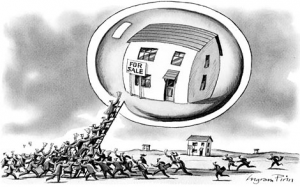
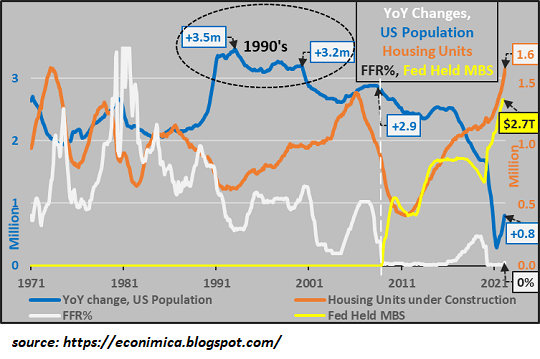
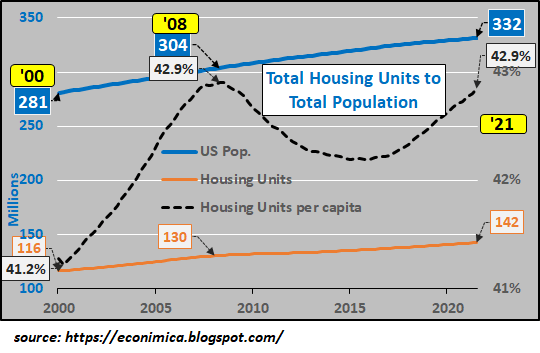
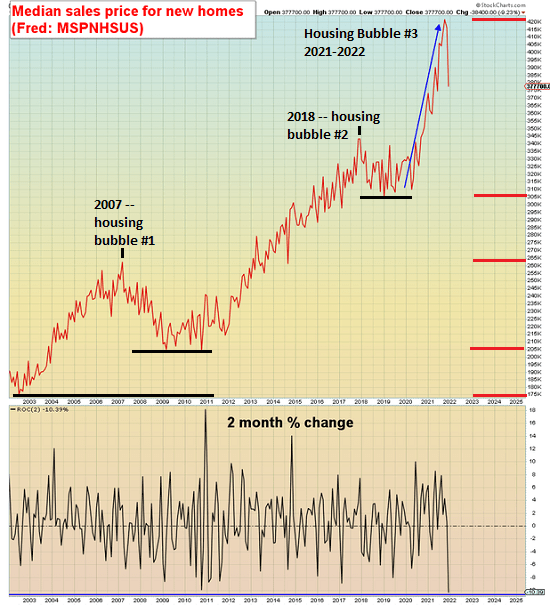
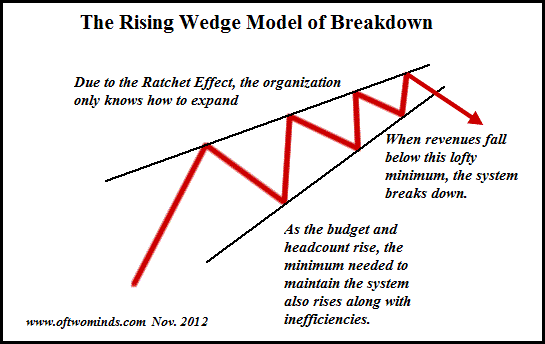
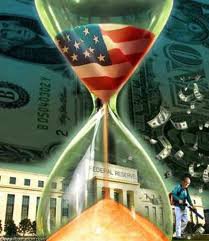
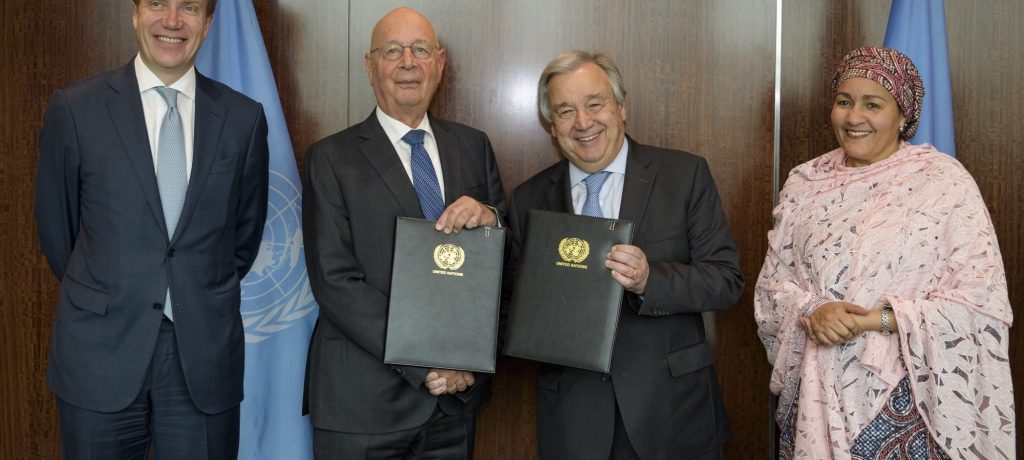
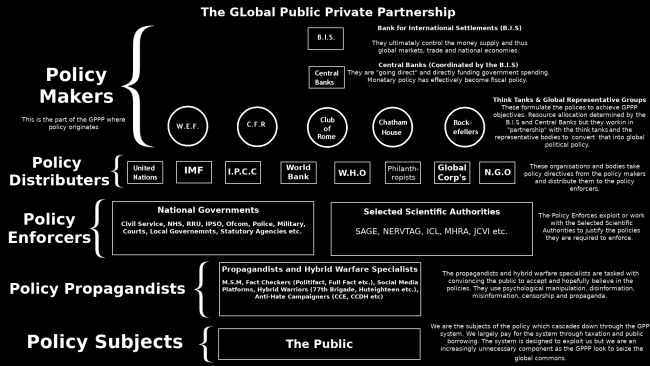
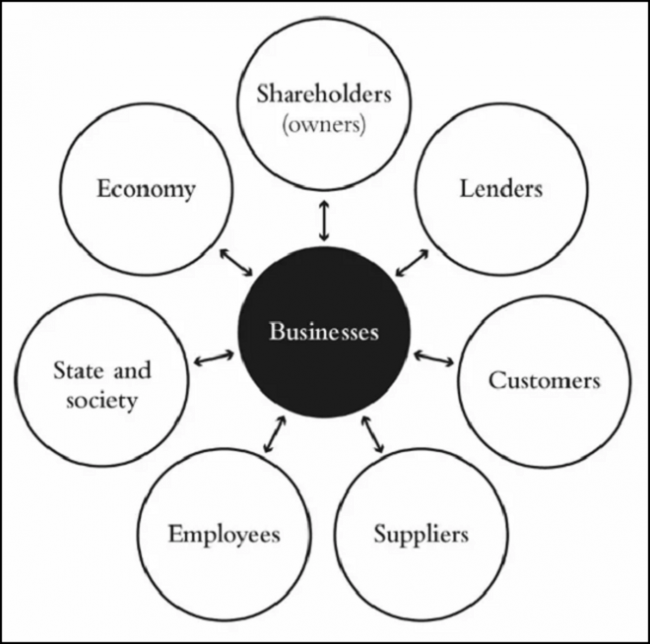

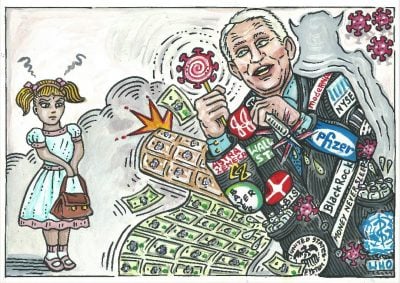
 After the Crash