Moscow blames downing of Russian plane near Syria on Israeli “provocation”

By Bill Van Auken

Source: WSWS.org

Tensions remain high in Syria after the downing of a Russian Il-20 electronic intelligence plane and the killing of all 15 crew members aboard during a major Israeli airstrike against the Syrian port city of Latakia Monday night.

The attack on Latakia, a government stronghold and the site of Russia’s major military base in the country, represented a dangerous escalation of the war in Syria, which the Israelis almost certainly carried out in consultation with Washington.

Tel Aviv claimed that its strike was motivated by intelligence that weapons located there were being transferred from Iran to the Lebanese Shia movement Hezbollah. A more powerful underlying motive, however, is the frustration of US imperialism and its allies, Israel and the NATO powers, over the increasing consolidation of control over Syria by the Russian-backed government of President Bashar al-Assad and the failure of the Al Qaeda-linked militias that they backed in a proxy war for regime change.

The Russian Ministry of Defense Tuesday acknowledged that its plane had been hit by Syrian anti-aircraft fire, but placed blame for the incident squarely on what it termed a “provocation” and “hostile” act on the part of Israel.

The Russian turboprop plane was returning to the Russian-run Hmeymim airbase, when it went off the radar screens in the midst of an attack by four Israeli F-16 fighter jets against Syrian defense industry facilities in Latakia.

“The Israeli pilots were using the Russian aircraft as a shield and pushed it into the line of fire of the Syrian defense,” Igor Konashenkov, the Russian defense ministry spokesperson, said on Tuesday.

Russia’s Interfax news agency quoted Konashenkov as describing Israel’s military strike as “hostile” and “an act of provocation,” warning, “We reserve the right to take commensurate measures in response.”

This response was echoed by Russian Defense Minister Sergey Shoigu, who declared that the “blame for the downing of the Russian plane and the deaths of its crew members lies squarely on the Israeli side.” He added, “The actions of the Israeli military were not in keeping with the spirit of the Russian-Israeli partnership, so we reserve the right to respond.”

Later the same day, Russian President Vladimir Putin demonstratively backed away from this sharp response and implicit threat of military retaliation.

Speaking in Moscow at a joint press conference with Hungarian Prime Minister Viktor Orban, Putin drew a distinction between Latakia and the 2015 incident in which a Turkish warplane had shot down a Russian S24 jet, after which Moscow imposed severe sanctions against Ankara.

The Turkish military, he said, had “deliberately downed” the Russian plane, while the Latakia incident “looks like a chain of tragic circumstances, because the Israeli plane didn’t shoot down our jet.”

Subsequently, Putin took a telephone conversation from Israeli Prime Minister Benjamin Netanyahu, who reportedly expressed condolences over the deaths of the Russian plane crewmembers, while reiterating Tel Aviv’s determination to continue carrying out strikes against targets in Syria that it claims are linked to Iran and Hezbollah.

Israeli government officials had placed the entire blame for the downing of the plane on Iran and Hezbollah, while stating that its immediate cause was “extensive and inaccurate Syrian anti-aircraft (surface-to-air missile) fire.”

The Kremlin’s readout of the phone conversation had Putin adopting a somewhat tougher line, reportedly telling Netanyahu that Israeli operations like the one in Latakia “violated Syrian sovereignty” and “agreements around the prevention of dangerous incidents.” The Kremlin added, “The president of Russia urged the Israeli side not to allow such situations from now on.”

Israel earlier this month acknowledged that it has carried out at least 200 airstrikes against Syria over the past 18 months, dropping some 800 munitions on targets across the country. Each of these was also a violation of “Syrian sovereignty.” They have been carried out, however, with the tacit permission of Moscow, which has received advance notice of these operations on an Israeli-Russian “deconfliction” line set up three years ago, and has thus far refrained from using its advanced antiaircraft systems deployed in Syria against Israeli warplanes.

Whether Russia will now deny Israel a green light for airstrikes in Syria, and for how long, remains to be seen.

The shifting tone in the response from Moscow to the deaths of its military personnel may reflect divisions within the Kremlin, or between Putin’s administration and the Russian military command. It almost certainly also expresses fears that the situation in Syria could quickly spill over into a wider military confrontation, including one involving the world’s two major nuclear powers, the US and Russia, as well as the region’s only nuclear-armed state, Israel. Washington would almost certainly respond militarily to any Russian retaliation against the Israeli action in Latakia.

Putin’s government represents the interests of the Russian oligarchs who consolidated their power in the wake of the Moscow Stalinist bureaucracy’s dissolution of the Soviet Union. It has sought to promote Russian interests in the oil-rich Middle East, not only through backing the Assad government—alongside Iran—against the Western-backed Islamist militias employed as proxies in a war for regime change, but also by forging close ties with Israel, with which Russia has established military, trade and investment links.

This complex and conflicting set of relations also includes the attempt by Moscow to cement closer ties with Turkey, which has backed a range of Islamist militias in Syria, while joining the Astana talks together with Moscow and Tehran in search of a ceasefire in the Syrian conflict.

The attack on Latakia came within hours of the announcement Monday by Putin and Turkish President Recep Tayyip Erdogan of an agreement reached in the Russian Black Sea resort city of Sochi to establish a jointly patrolled “demilitarized zone” between Syrian government troops and the Western-backed “rebels” concentrated in Syria’s northwestern Idlib province.

For weeks there had been predictions that a Russian-backed Syrian government offensive in Idlib was imminent, along with mounting threats by Washington and its allies, including Britain, France and Germany, to carry out a sustained military retaliation against an advance on the last major redoubt of the Al Qaeda-linked “rebels.”

The deal reached between Moscow and Ankara calls for the DMZ separating Syrian government forces from the Islamist militias to consist of a 15 to 20-kilometer buffer around the province. All “radical”, i.e., Al Qaeda-affiliated, militias are supposed to be removed from the area.

Turkey’s Foreign Minister Mevlüt Çavuşoğlu told reporters Tuesday that Ankara will deploy more troops to Idlib in the coming days to patrol the border areas. Turkish tanks and other military vehicles had already been dispatched to the south of the province, an area where Russian and Syrian airplanes had carried out strikes.

Asked where the Al Qaeda-affiliated militias would go, Çavuşoğlu said that Ankara and Moscow were still working on the issue.

The US has signaled that the more than 2,000 American troops presently deployed in Syria will remain indefinitely, not merely to complete their supposed mission of combating the Islamic State of Iraq and Syria (ISIS), but to roll back Iranian and Russian influence in both the country and the region and to deny Damascus control of the economically vital oil fields now under US control.

Washington has no interest in seeing the agreement between Moscow and Ankara over Idlib succeed. At a UN Security Council meeting Tuesday on Syria, where UN Special Envoy on Syria Staffan de Mistura called for a speedy implementation of the Russian-Turkish agreement, the US Special Representative for Syria Engagement, James Jeffrey, insisted that, “The only way forward is a genuine and inclusive political solution,” Washington’s euphemism for regime change. To this end, the US and its allies, Israel chief among them, are prepared to push the country and the region into a potentially world catastrophic war.

ThinkProgress Censored By Facebook After Cheerleading Facebook Censorship

By Caitlin Johnstone

Source: CaitlinJohnstone.com

In an article last month titled “Facebook announces that fake accounts are now coming not just from Russia”, fauxgressive establishment apologia firm ThinkProgress falsely reported that I have been writing for an outlet that is alleged to be part of an Iranian propaganda campaign. I repeatedly brought this false claim to the attention of Casey Michel, the article’s author, telling him that ten seconds of research or any attempt to contact me would have shown him that the articles published by the outlet in question were just reblogs of earlier publications from my platform, but Michel ignored the many notifications he received from myself and my Twitter followers and went on merrily interacting with other posters. As of this writing, the article remains uncorrected.

In the article, Michel documented Facebook’s heroic efforts to shut down alleged Iranian propaganda outlets, ominously warning his readers that “Russia is by no means the only foreign adversary exploiting social media’s inherent openness.” In other articles for ThinkProgress, Michel is repeatedly seen wagging his finger at Facebook and Twitter for not doing more to censor “Russian propaganda”, and in a July article titled “Facebook says both sides share fake news, defends Infowars’ presence on its platform — Mark Zuckerberg has an interesting way of prioritizing ‘high quality news’” another ThinkProgress author criticized Facebook for not censoring Alex Jones. Jones was censored by Facebook the following month.

So I think it’s understandable that those of us who have been warning of the dangers of internet censorship find it a bit funny to see ThinkProgress now complaining that it has been censored by Facebook.

ThinkProgress reports that its traffic from Facebook has been slashed by eighty percent due to a “fact check” by the Weekly Standard which, through a series of moronic mental contortions, found ThinkProgress guilty of reporting fake news about Brett Kavanaugh of all things. In a twist of irony which would be delicious if it weren’t so disgusting, the Weekly Standard is one of Facebook’s authorized “fact checkers”, and happens to be the brainchild of none other than bloodthirsty psychopath and rehabilitated #Resistance hero Bill Kristol.

ThinkProgress is part of a very large and diverse branch of progressive punditry whose ultimate job is to help centrist empire loyalists feel like leftist revolutionaries, and since 2016 one of the many appalling consequences of this bizarre environment has been the embracing of Iraq-raping neoconservatives like Kristol and Max Boot by Democratic Party loyalists. In a bid to stay relevant despite having been consistently wrong about literally everything in foreign policy for the last two decades, these murderous ghouls have repackaged themselves as a woke, cuddly alternative to the Trumpian faction of the Republican Party, and have been rewarded for their efforts with regular platforms on MSNBC and the Washington Post.

So with ThinkProgress getting censored by Facebook, you really couldn’t ask for a more clear-cut case of reaping what you sow. Nevertheless, it is wrong for anyone to be deprived of political speech, even if much of their political speech consists of attempts to silence the political speech of others. And if there is anything more gross than political speech being regulated by Silicon Valley plutocrats and a NATO psyop factory, it’s political speech being regulated by Silicon Valley plutocrats, a NATO psyop factory, and Bill Kristol. ThinkProgress should not have its audience restricted.

All the “let me help you cheer for the establishment while pretending to oppose it” pundits who celebrated Alex Jones’ coordinated de-platforming last month are falling all over themselves to spin this new development in a way that allows them to feel as though they aren’t being proven wrong day after day after day, but of course they are. Facilitating the censorship of anyone’s speech is facilitating the censorship of your own speech in the long run, and we’re not even having to wait long to see it this time around. In a corporatist system of government, corporate censorship is state censorship; the massive new media corporations being implored to regulate which political speech gets an audience and which doesn’t have extensive ties to secretive government agenciesand a vested interest in maintaining the status quo.

I do not expect ThinkProgress to remain on Facebook’s restricted list for long; the real targets of internet censorship are not partisan outlets which prop up establishment politics and help legitimize America’s two-headed one party system. But that isn’t the point. The point is that Silicon Valley plutocrats, the NATO propaganda firm Atlantic Council, and the Weekly Standard should not be determining who gets an audience in the new media environment and who doesn’t. Nothing that has anything to do with Bill Kristol should ever have any power over anyone. If our choices are between letting people think for themselves and letting the guy who’s always wrong about everything determine what shows up in people’s news feed, the choice is obviously the one which doesn’t involve placing faith in the man who helped deceive America into butchering a million Iraqis.

A diabolic false flag empire

A review of David Ray Griffin’s “The American Trajectory: Divine or Demonic?”

By Edward Curtin

Source: Intrepid Report

The past is not dead; it is people who are sleeping. The current night and daymares that we are having arise out of murders lodged deep in our past that have continued into the present. No amount of feigned amnesia will erase the bloody truth of American history, the cheap grace we bestow upon ourselves. We have, as Harold Pinter said in his Nobel address, been feeding on “a vast tapestry of lies” that surrounds us, lies uttered by nihilistic leaders and their media mouthpieces for a very long time. We have, or should have, bad consciences for not acknowledging being active or silent accomplices in the suppression of truth and the vicious murdering of millions at home and abroad.

But, as Pinter said, “I believe that despite the enormous odds which exist, unflinching, unswerving, fierce intellectual determination, as citizens, to define the real truth of our lives and our societies is a crucial obligation which devolves upon us all. It is in fact mandatory.”

No one is more emblematic of this noble effort than David Ray Griffin, who, in book after book since the attacks of 11 September 2001, has meticulously exposed the underside of the American empire and its evil masters. His persistence in trying to reach people and to warn them of the horrors that have resulted is extraordinary. Excluding his philosophical and theological works, this is his fifteenth book since 2004 on these grave issues of life and death and the future of the world.

In this masterful book, he provides a powerful historical argument that right from the start with the arrival of the first European settlers, this country, despite all the rhetoric about it having been divinely founded and guided, has been “more malign that benign, more demonic than divine.” He chronologically presents this history, supported by meticulous documentation, to prove his thesis. In his previous book, Bush and Cheney: How They Ruined America and the World, Griffin cataloged the evil actions that flowed from the inside job/false flag attacks of September 11, while in this one—a prequel—he offers a lesson in American history going back centuries, and he shows that one would be correct in calling the United States a “false flag empire.”

The attacks of 11 September 2001 are the false flag fulcrum upon which his two books pivot. Their importance cannot be overestimated, not just for their inherent cruelty that resulted in thousands of innocent American deaths, but since they became the justification for the United States’ ongoing murderous campaigns termed “the war on terror” that have brought death to millions of people around the world. An international array of expendable people. Terrifying as they were, and were meant to be, they have many precedents, although much of this history is hidden in the shadows. Griffin shines a bright light on them, with most of his analysis focused on the years 1850-2018.

As a theological and philosophical scholar, he is well aware of the great importance of society’s need for religious legitimation for its secular authority, a way to offer its people a shield against terror and life’s myriad fears through a protective myth that has been used successfully by the United States to terrorize others. He shows how the terms by which the U.S. has been legitimated as God’s “chosen nation” and Americans as God’s “chosen people” have changed over the years as secularization and pluralism have made inroads. The names have changed, but the meaning has not. God is on our side, and when that is so, the other side is cursed and can be killed by God’s people, who are always battling el diabalo.

He exemplifies this by opening with a quote from George Washington’s first Inaugural Address where Washington speaks of “the Invisible Hand” and “Providential agency” guiding the country, and by ending with Obama saying “I believe in American exceptionalism with every fiber of my being.” In between we hear Andrew Jackson say that “Providence has showered on this favored land blessings without number” and Henry Cabot Lodge in 1900 characterize America’s divine mission as “manifest destiny.” The American religion today is American Exceptionalism, an updated euphemism for the old-fashioned “God’s New Israel” or the “Redeemer Nation.”

At the core of this verbiage lies the delusion that the United States, as a blessed and good country, has a divine mission to spread “democracy” and “freedom” throughout the world, as Hilary Clinton declared during the 2016 presidential campaign when she said that “we are great because we are good,” and in 2004 when George W. Bush said, “Like generations before us, we have a calling from beyond the stars to stand for freedom.” Such sentiments could only be received with sardonic laughter by the countless victims made “free” by America’s violent leaders, now and then, as Griffin documents.

Having established the fact of America’s claim to divine status, he then walks the reader through various thinkers who have taken sides on the issue of the United States being benign or malign. This is all preliminary to the heart of the book, which is a history lesson documenting the malignancy at the core of the American trajectory.

“American imperialism is often said to have begun in 1898, when Cuba and the Philippines were the main prizes,” he begins. “What was new at this time, however, was only that America took control of countries beyond the North American continent.” The “divine right” to seize others’ lands and kill them started long before, and although no seas were crossed in the usual understanding of imperialism, the genocide of Native Americans long preceded 1898. So too did the “manifest destiny” that impelled war with Mexico and the seizure of its land and the expansion west to the Pacific. This period of empire building depended heavily on the “other great crime against humanity” that was the slave trade, wherein it is estimated that 10 million Africans died, in addition to the sick brutality of slavery itself. “No matter how brutal the methods, Americans were instruments of divine purposes,” writes Griffin. And, he correctly adds, it is not even true that America’s overseas imperialistic ventures only started in 1898, for in the 1850s Commodore Perry forced “the haughty Japanese” to open their ports to American commerce through gunboat diplomacy.

Then in 1898 the pace of overseas imperial expansion picked up dramatically with what has been called “The Spanish-American War” that resulted in the seizure of Cuba and the Philippines and the annexing of Hawaii. Griffin says these wars could more accurately be termed “the wars to take Spanish colonies.” His analysis of the brutality and arrogance of these actions makes the reader realize that My Lai and other more recent atrocities have a long pedigree that is part of an institutional structure, and while Filipinos and Cubans and so many others were being slaughtered, Griffin writes, “Anticipating Secretary of Defense Donald Rumsfeld’s declaration that ‘we don’t do empire,’ [President] McKinley said that imperialism is ‘foreign to the temper and genius of this free and generous people.’”

Then as now, perhaps mad laughter is the only response to such unadulterated bullshit, as Griffin quotes Mark Twain saying that it would be easy creating a flag for the Philippines:

We can have just our usual flag, with the white stripes painted black and the stars replaced by the skull and cross-bones.

That would have also worked for Colombia, Panama, Puerto Rico, the Dominican Republic, Haiti, Nicaragua, and other countries subjugated under the ideology of the Monroe Doctrine; wherever freedom and national independence raised its ugly head, the United States was quick to intervene with its powerful anti-revolutionary military and its financial bullying. In the Far East the “Open Door” policy was used to loot China, Japan, and other countries.

But all this was just the beginning. Griffin shows how Woodrow Wilson, the quintessentially devious and treacherous liberal Democrat, who claimed he wanted to keep America out of WW I, did just the opposite to make sure the U.S. would come to dominate the foreign markets his capitalist masters demanded. Thus Griffin explores how Wilson conspired with Winston Churchill to use the sinking of the Lusitania as a casus belli and how the Treaty of Versailles’s harsh treatment of Germany set the stage for WW II.

He tells us how in the intervening years between the world wars the demonization of Russia and the new Soviet Union was started. This deprecation of Russia, which is roaring at full-throttle today, is a theme that recurs throughout The American Trajectory. Its importance cannot be overemphasizedWilson called the Bolshevik government “a government by terror,” and in 1918 “sent thousands of troops into northern and eastern Russia, leaving them there until 1920.”

That the U. S. invaded Russia is a fact rarely mentioned and even barely known to Americans. Perhaps awareness of it and the century-long demonizing of the U.S.S.R./Russia would enlighten those who buy the current anti-Russia propaganda called “Russiagate.”

To match that “divine” act of imperial intervention abroad, Wilson fomented the Red Scare at home, which, as Griffin says, had lasting and incalculable importance because it created the American fear of radical thought and revolution that exists to this very day and serves as a justification for supporting brutal dictators around the world and crackdowns on freedom at home (as is happening today).

He gives us brief summaries of some dictators the U.S has supported, and reminds us of the saying of that other liberal Democrat, Franklin Roosevelt, who famously said of the brutal Nicaraguan dictator Anastasio Somoza, that “he may be a son-of-a-bitch, but he’s our son-of-a-bitch.” And thus Somoza would terrorize his own people for 43 years. The same took place in Cuba, Chile, Iran, Guatemala, the Dominican Republic, Haiti, etc. The U.S. also supported Mussolini, did nothing to prevent Franco’s fascist toppling of the Spanish Republic, and supported the right-wing government of Chiang-Kai Shek in its efforts to dominate China.

It is a very dark and ugly history that confirms the demonic nature of American actions around the world.

Then Griffin explodes the many myths about the so-called “Good War”—WW II. He explains the lies told about the Japanese “surprise” attack on Pearl Harbor; how Roosevelt wished to get the U.S. into the war, both in the Pacific and in Europe; and how much American economic self-interest lay behind it. He critiques the myth that America selflessly wished to defend freedom loving people in their battles with brutal, fascist regimes. That, he tells us, is but a small part of the story:

This, however, is not an accurate picture of American policies during the Second World War. Many people were, to be sure, liberated from terrible tyrannies by the Allied victories. But the fact that these people benefited was an incidental outcome, not a motive of American policies. These policies, as [Andrew] Bacevich discovered, were based on ‘unflagging self-interest.’

Then there are the conventional and atomic bombings of Hiroshima and Nagasaki. Nothing could be more demonic, as Griffin shows. If these cold-blooded mass massacres of civilians and the lies told to justify them don’t convince a reader that there has long been something radically evil at the heart of American history, nothing will. Griffin shows how Truman and his advisers and top generals, including Dwight Eisenhower and Admiral William D. Leahy, Truman’s chief of staff, knew the dropping of the atomic bombs were unnecessary to end the war, but they did so anyway.

He reminds us of Clinton’s Secretary of State Madeline Albright’s response to the question whether she thought the deaths of more than 500,000 Iraqi children as a result of Clinton’s crippling economic sanctions were worth it: “But, yes, we think the price is worth it.” (Notice the “is,” the ongoing nature of these war crimes, as she spoke.) But this is the woman who also said, “We are the indispensable nation. We stand tall . . .”

Griffin devotes other chapters to the creation of the Cold War, American imperialism during the Cold War, Post-Cold War interventions, the Vietnam War, the drive for global dominance, and false flag operations, among other topics.

As for false flag operations, he says, “Indeed, the trajectory of the American Empire has relied so heavily on these types of attacks that one could describe it as a false flag empire.” In the false flag chapter and throughout the book, he discusses many of the false flags the U.S. has engaged in, including Operation Gladio, the U.S./NATO terrorist operation throughout Europe that Swiss historian Daniele Ganser has extensively documented, an operation meant to discredit communists and socialists. Such operations were directly connected to the OSS, the CIA and its director, Allen Dulles, his henchman James Jesus Angleton, and their Nazi accomplices, such as General Reinhard Gehlen. In one such attack in 1980 at the Bologna, Italy, railway station, these U.S. terrorists killed 85 people and wounded 20 others. As with the bombs dropped by Saudi Arabia today on Yemeni school children, the explosive used was made for the U.S. military. About these documented U.S. atrocities, Griffin says:

These revelations show the falsity of an assumption widely held by Americans. While recognizing that the US military sometimes does terrible things to their enemies, most Americans have assumed that US military leaders would not order the killing of innocent civilians in allied countries for political purposes. Operation Gladio showed this assumption to be false.

He is right, but I would add that the leaders behind this were civilian, as much as, or more than military.

In the case of “Operation Northwoods,” it was the Joint Chiefs of Staff who presented to President Kennedy this false flag proposal that would provide justification for a U.S. invasion of Cuba. It would have involved the killing of American citizens on American soil, bombings, plane hijacking, etc. President Kennedy considered such people and such plans insane, and he rejected it as such. His doing so tells us much, for many other presidents would have approved it. And again, how many Americans are aware of this depraved proposal that is documented and easily available? How many even want to contemplate it? For the need to remain in denial of the facts of history and believe in the essential goodness of America’s rulers is a very hard nut to crack. Griffin has written a dozen books about 11 September 2001, trying to do exactly that.

If one is willing to embrace historical facts, however, then this outstanding book will open one’s eyes to the long-standing demonic nature of the actions of America’s rulers. A reader cannot come away from its lucidly presented history unaffected, unless one lives in a self-imposed fantasy world. The record is clear, and Griffin lays it out in all its graphic horror. Which is not to say that the U.S. has not “done both good and bad things, so it could not sensibly be called purely divine or purely demonic.” Questions of purity are meant to obfuscate basic truths. And the question he asks in his subtitle—Divine or Demonic?—is really a rhetorical question, and when it comes to the “trajectory” of American history, the demonic wins hands down.

I would be remiss if I didn’t point out one place where Griffin fails the reader. In his long chapter on Vietnam, which is replete with excellent facts and analyses, he makes a crucial mistake, which is unusual for him. This mistake appears in a four page section on President Kennedy’s policies on Vietnam. In those pages, Griffin relies on Noam Chomsky’s terrible book—Rethinking Camelot: JFK, the Vietnam War, and US Political Culture (1993), a book wherein Chomsky shows no regard for evidence or facts—to paint Kennedy as being in accord with his advisers, the CIA, and the military regarding Vietnam. This is factually false. Griffin should have been more careful and have understood this. The truth is that Kennedy was besieged and surrounded by these demonic people, who were intent on isolating him, disregarding his instructions, and murdering him to achieve their goals in Vietnam. In the last year of his life, JFK had taken a radical turn toward peace-making, not only in Vietnam, but with the Soviet Union, Cuba, and around the globe. Such a turn was anathema to the war lovers. Thus he had to die. Contrary to Chomsky’s deceptions, motivated by his hatred of Kennedy and perhaps something more sinister (he also backs the Warren Commission, thinks JFK’s assassination was no big deal, and accepts the patently false official version of the attacks of 11 September 2001), Griffin should have emphatically asserted that Kennedy had issued NSAM 263 on October 11, 1963, calling for the withdrawal of American troops from Vietnam, and that after he was assassinated a month later, Lyndon Johnson reversed that withdrawal order with NSAM 273. Chomsky notwithstanding, all the best scholarship and documentary evidence proves this. And for Griffin, a wonderful scholar, to write that with the change from Kennedy to Johnson that “this change of presidents would bring no basic change in policy” is so shockingly wrong that I imagine Griffin, a man passionate about truth, simply slipped up and got sloppy here. For nothing could be further from the truth.

Ironically, Griffin makes a masterful case for his thesis, while forgetting the one pivotal man, President John Kennedy, who sacrificed his life in an effort to change the trajectory of American history from its demonic course.

It is one mistake in an otherwise very important and excellent book that should be required reading for anyone who doubts the evil nature of this country’s continuing foreign policy. Those who are already convinced should also read it, for it provides a needed historical resource and impetus to help change the trajectory that is transporting the world toward nuclear oblivion, if continued.

If—a fantastic wish!—The American Trajectory: Divine or Demonic? were required reading in American schools and colleges, perhaps a new generation would arise to change our devils into angels, the arc of America’s future moral universe toward justice, and away from being the greatest purveyor of violence in the world today, as it has been for so very long.


Edward Curtin is a sociologist and writer who teaches at Massachusetts College of Liberal Arts and has published widely.

Facebook Censorship, Mad Ben Nimmo and the Atlantic Council

By Craig Murray

Source: CraigMurray.org

Facebook has deleted all of my posts from July 2017 to last week because I am, apparently, a Russian Bot. For a while I could not add any new posts either, but we recently found a way around that, at least for now. To those of you tempted to say “So what?”, I would point out that over two thirds of visitors to my website arrive via my posting of the articles to Facebook and Twitter. Social media outlets like this blog, which offer an alternative to MSM propaganda, are hugely at the mercy of these corporate gatekeepers.

Facebook’s plunge into censorship is completely open and admitted, as is the fact it is operated for Facebook by the Atlantic Council – the extreme neo-con group part funded by NATO and whose board includes serial war criminal Henry Kissinger, Former CIA Heads Michael Hayden and Michael Morrell, and George Bush’s chief of Homeland Security Michael Chertoff, among a whole list of horrors.

The staff are worse than the Board. Their lead expert on Russian bot detection is an obsessed nutter named Ben Nimmo, whose fragile grip on reality has been completely broken by his elevation to be the internet’s Witchfinder-General. Nimmo, grandly titled “Senior Fellow for Information Defense at the Atlantic Council’s Digital Forensic Research Lab”, is the go-to man for Establishment rubbishing of citizen journalists, and as with Joseph McCarthy or Matthew Clarke, one day society will sufficiently recover its balance for it to be generally acknowledged that this kind of witch-hunt nonsense was not just an aberration, but a manifestation of the evil it claimed to fight.

There is no Establishment cause Nimmo will not aid by labeling its opponents as Bots. This from the Herald newspaper two days ago, where Nimmo uncovers the secret web of Scottish Nationalist bots that dominate the internet, and had the temerity to question the stitch-up of Alex Salmond.

Nimmo’s proof? 2,000 people had used the hashtag #Dissolvetheunion on a total of 10,000 tweets in a week. That’s five tweets per person on average. In a week. Obviously a massive bot-plot, eh?

When Ben’s great expose for the Herald was met with widespread ridicule, he doubled down on it by producing his evidence – a list of the top ten bots he had uncovered in this research. Except that they are almost all, to my certain knowledge, not bots but people. But do not decry Ben’s fantastic forensic skills, for which NATO and the CIA fund the Atlantic Council. Ben’s number one suspect was definitely a bot. He had got the evil kingpin. He had seen through its identity despite its cunning disguise. That disguise included its name, IsthisAB0T, and its profile, where it called itself a bot for retweets on Independence. Thank goodness for Ben Nimmo, or nobody would ever have seen through that evil, presumably Kremlin-hatched, plan.

No wonder the Atlantic Council advertise Nimmo and his team as “Digital Sherlocks

Nimmo’s track record is simply appalling. In this report for the Atlantic Council website, he falsely identified British pensioner @Ian56789 as a “Russian troll farm”, which led to Ian being named as such by the British government, and to perhaps the most surreal Sky News interview of all time. Perhaps still more remarkably, Nimmo searches for use of the phrase “cui bono?” in reference to the Skripal and fake Douma chemical weapons attacks. Nimmo characterises use of the phrase cui bono as evidence of pro-Assad and pro-Kremlin bots and trolls – he really does. Most people would think to consider cui bono indicates a smattering more commonsense than Nimmo himself displays.

It is at least obvious cui bono from Nimmo’s witchfinding – the capacious, NATO and CIA stuffed pockets of Ben Nimmo himself. That Facebook allows this utterly discredited neo-conservative charlatan the run of its censorship operations needs, given Facebook’s pivotal role in social media intercourse, to concern everybody. The freedom of the internet is under fundamental attack.

Exposing the Giants: The Global Power Elite

Diego Rivera, Man at the Crossroads/Man, Controller of the Universe, 1933

By Robert J. Burrowes

Developing the tradition charted by C. Wright Mills in his 1956 classic The Power Elite, in his latest book, Professor Peter Phillips starts by reviewing the transition from the nation state power elites described by authors such as Mills to a transnational power elite centralized on the control of global capital.

Thus, in his just-released study Giants: The Global Power Elite, Phillips, a professor of political sociology at Sonoma State University in the USA, identifies the world’s top seventeen asset management firms, such as BlackRock and J.P Morgan Chase, each with more than one trillion dollars of investment capital under management, as the ‘Giants’ of world capitalism. The seventeen firms collectively manage more than $US41.1 trillion in a self-invested network of interlocking capital that spans the globe.

This $41 trillion represents the wealth invested for profit by thousands of millionaires, billionaires and corporations. The seventeen Giants operate in nearly every country in the world and are ‘the central institutions of the financial capital that powers the global economic system’. They invest in anything considered profitable, ranging from ‘agricultural lands on which indigenous farmers are replaced by power elite investors’ to public assets (such as energy and water utilities) to war.

In addition, Phillips identifies the most important networks of the Global Power Elite and the individuals therein. He names 389 individuals (a small number of whom are women and a token number of whom are from countries other than the United States and the wealthier countries of Western Europe) at the core of the policy planning nongovernmental networks that manage, facilitate and defend the continued concentration of global capital. The Global Power Elite perform two key uniting functions, he argues: they provide ideological justifications for their shared interests (promulgated through their corporate media), and define the parameters of action for transnational governmental organizations and capitalist nation-states.

More precisely, Phillips identifies the 199 directors of the seventeen global financial Giants and offers short biographies and public information on their individual net wealth. These individuals are closely interconnected through numerous networks of association including the World Economic Forum, the International Monetary Conference, university affiliations, various policy councils, social clubs, and cultural enterprises. For a taste of one of these clubs, see this account of The Links in New York. As Phillips observes: ‘It is certainly safe to conclude they all know each other personally or know of each other in the shared context of their positions of power.’

The Giants, Phillips documents, invest in each other but also in many hundreds of investment management firms, many of which are near-Giants. This results in tens of trillions of dollars coordinated in a single vast network of global capital controlled by a very small number of people. ‘Their constant objective is to find enough safe investment opportunities for a return on capital that allows for continued growth. Inadequate capital-placement opportunities lead to dangerous speculative investments, buying up of public assets, and permanent war spending.’

Because the directors of these seventeen asset management firms represent the central core of international capital, ‘Individuals can retire or pass away, and other similar people will move into their place, making the overall structure a self-perpetuating network of global capital control. As such, these 199 people share a common goal of maximum return on investments for themselves and their clients, and they may seek to achieve returns by any means necessary – legal or not…. the institutional and structural arrangements within the money management systems of global capital relentlessly seek ways to achieve maximum return on investment, and … the conditions for manipulations – legal or not – are always present.’

Like some researchers before him, Phillips identifies the importance of those transnational institutions that serve a unifying function. The World Bank, International Monetary Fund, G20, G7, World Trade Organization (WTO), World Economic Forum (WEF), Trilateral Commission, Bilderberg Group, Bank for International Settlements, Group of 30 (G30), the Council on Foreign Relations and the International Monetary Conference serve as institutional mechanisms for consensus building within the transnational capitalist class, and power elite policy formulation and implementation. ‘These international institutions serve the interests of the global financial Giants by supporting policies and regulations that seek to protect the free, unrestricted flow of capital and debt collection worldwide.’

But within this network of transnational institutions, Phillips identifies two very important global elite policy-planning organizations: the Group of Thirty (which has 32 members) and the extended executive committee of the Trilateral Commission (which has 55 members). These nonprofit corporations, which each have a research and support staff, formulate elite policy and issue instructions for their implementation by the transnational governmental institutions like the G7, G20, IMF, WTO, and World Bank. Elite policies are also implemented following instruction of the relevant agent, including governments, in the context. These agents then do as they are instructed. Thus, these 85 members (because two overlap) of the Group of Thirty and the Trilateral Commission comprise a central group of facilitators of global capitalism, ensuring that ‘global capital remains safe, secure, and growing’.

So, while many of the major international institutions are controlled by nation-state representatives and central bankers (with proportional power exercised by dominant financial supporters such as the United States and European Union countries), Phillips is more concerned with the transnational policy groups that are nongovernmental because these organizations ‘help to unite TCC power elites as a class’ and the individuals involved in these organizations facilitate world capitalism. ‘They serve as policy elites who seek the continued growth of capital in the world.’

Developing this list of 199 directors of the largest money management firms in the world, Phillips argues, is an important step toward understanding how capitalism works globally today. These global power elite directors make the decisions regarding the investment of trillions of dollars. Supposedly in competition, the concentrated wealth they share requires them to cooperate for their greater good by identifying investment opportunities and shared risk agreements, and working collectively for political arrangements that create advantages for their profit-generating system as a whole.

Their fundamental priority is to secure an average return on investment of 3 to 10 percent, or even more. The nature of any investment is less important than what it yields: continuous returns that support growth in the overall market. Hence, capital investment in tobacco products, weapons of war, toxic chemicals, pollution, and other socially destructive goods and services are judged purely by their profitability. Concern for the social and environmental costs of the investment are non-existent. In other words, inflicting death and destruction are fine because they are profitable.

So what is the global elite’s purpose? In a few sentences Phillips characterizes it thus: The elite is largely united in support of the US/NATO military empire that prosecutes a repressive war against resisting groups – typically labeled ‘terrorists’ – around the world. The real purpose of ‘the war on terror’ is defense of transnational globalization, the unimpeded flow of financial capital around the world, dollar hegemony and access to oil; it has nothing to do with repressing terrorism which it generates, perpetuates and finances to provide cover for its real agenda. This is why the United States has a long history of CIA and military interventions around the world ostensibly in defense of ‘national interests’.


Wealth and Power

An interesting point that emerges for me from reading Phillips thoughtful analysis is that there is a clear distinction between those individuals and families who have wealth and those individuals who have (sometimes significantly) less wealth (which, nevertheless, is still considerable) but, through their positions and connections, wield a great deal of power. As Phillips explains this distinction, ‘the sociology of elites is more important than particular elite individuals and their families’. Just 199 individuals decide how more than $40 trillion will be invested. And this is his central point. Let me briefly elaborate.

There are some really wealthy families in the world, notably including the families Rothschild (France and the United Kingdom), Rockefeller (USA), Goldman-Sachs (USA), Warburgs (Germany), Lehmann (USA), Lazards (France), Kuhn Loebs (USA), Israel Moses Seifs (Italy), Al-Saud (Saudi Arabia), Walton (USA), Koch (USA), Mars (USA), Cargill-MacMillan (USA) and Cox (USA). However, not all of these families overtly seek power to shape the world as they wish.

Similarly, the world’s extremely wealthy individuals such as Jeff Bezos (USA), Bill Gates (USA), Warren Buffett (USA), Bernard Arnault (France), Carlos Slim Helu (Mexico) and Francoise Bettencourt Meyers (France) are not necessarily connected in such a way that they exercise enormous power. In fact, they may have little interest in power as such, despite their obvious interest in wealth.

In essence, some individuals and families are content to simply take advantage of how capitalism and its ancilliary governmental and transnational instruments function while others are more politically engaged in seeking to manipulate major institutions to achieve outcomes that not only maximize their own profit and hence wealth but also shape the world itself.

So if you look at the list of 199 individuals that Phillips identifies at the centre of global capital, it does not include names such as Bezos, Gates, Buffett, Koch, Walton or even Rothschild, Rockefeller or Windsor (the Queen of England) despite their well-known and extraordinary wealth. As an aside, many of these names are also missing from the lists compiled by groups such as Forbes and Bloomberg, but their absence from these lists is for a very different reason given the penchant for many really wealthy individuals and families to avoid certain types of publicity and their power to ensure that they do.

In contrast to the names just listed, in Phillips’ analysis names like Laurence (Larry) Fink (Chairman and CEO of BlackRock), James (Jamie) Dimon (Chairman and CEO of JPMorgan Chase) and John McFarlane (Chairman of Barclays Bank), while not as wealthy as those listed immediately above, wield far more power because of their positions and connections within the global elite network of 199 individuals.

Predictably then, Phillips observes, these three individuals have similar lifestyles and ideological orientations. They believe capitalism is beneficial for the world and while inequality and poverty are important issues, they believe that capital growth will eventually solve these problems. They are relatively non-expressive about environmental issues, but recognize that investment opportunities may change in response to climate ‘modifications’. As millionaires they own multiple homes. They attended elite universities and rose quickly in international finance to reach their current status as giants of the global power elite. ‘The institutions they manage have been shown to engage in illegal collusions with others, but the regulatory fines by governments are essentially seen as just part of doing business.’

In short, as I would characterize this description: They are devoid of a legal or moral framework to guide their actions, whether in relation to business, fellow human beings, war or the environment and climate. They are obviously typical of the elite.

Any apparent concern for people, such as that expressed by Fink and Dimon in response to the racist violence in Charlottesville, USA in August 2017, is simply designed to promote ‘stability’ or more precisely, a stable (that is, profitable) investment and consumer climate.

The lack of concern for people and issues that might concern many of us is also evident from a consideration of the agenda at elite gatherings. Consider the International Monetary Conference. Founded in 1956, it is a private yearly meeting of the top few hundred bankers in the world. The American Bankers Association (ABA) serves as the secretariat for the conference. But, as Phillips notes: ‘Nothing on the agenda seems to address the socioeconomic consequences of investments to determine the impacts on people and the environment.’ A casual perusal of the agenda at any elite gathering reveals that this comment applies equally to any elite forum. See, for example, the agenda of the recent WEF meeting in Davos. Any talk of ‘concern’ is misleading rhetoric.

Hence, in the words of Phillips: The 199 directors of the global Giants are ‘a very select set of people. They all know each other personally or know of each other. At least 69 have attended the annual World Economic Forum, where they often serve on panels or give public presentations. They mostly attended the same elite universities, and interact in upperclass social setting[s] in the major cities of the world. They all are wealthy and have significant stock holdings in one or more of the financial Giants. They are all deeply invested in the importance of maintaining capital growth in the world. Some are sensitive to environmental and social justice issues, but they seem to be unable to link these issues to global capital concentration.’

Of course, the global elite cannot manage the world system alone: the elite requires agents to perform many of the functions necessary to control national societies and the individuals within them. ‘The interests of the Global Power Elite and the TCC are fully recognized by major institutions in society. Governments, intelligence services, policymakers, universities, police forces, military, and corporate media all work in support of their vital interests.’

In other words, to elaborate Phillips’ point and extend it a little, through their economic power, the Giants control all of the instruments through which their policies are implemented. Whether it be governments, national military forces, ‘military contractors’ or mercenaries (with at least $200 billion spent on private security globally, the industry currently employs some fifteen million people worldwide) used both in ‘foreign’ wars but also likely deployed in future for domestic control, key ‘intelligence’ agencies, legal systems and police forces, major nongovernment organizations, or the academic, educational, ‘public relations propaganda’, corporate media, medical, psychiatric and pharmaceutical industries, all instruments are fully responsive to elite control and are designed to misinform, deceive, disempower, intimidate, repress, imprison (in a jail or psychiatric ward), exploit and/or kill (depending on the constituency) the rest of us, as is readily evident.


Defending Elite Power

Phillips observes that the power elite continually worries about rebellion by the ‘unruly exploited masses’ against their structure of concentrated wealth. This is why the US military empire has long played the role of defender of global capitalism. As a result, the United States has more than 800 military bases (with some scholars suggesting 1,000) in 70 countries and territories. In comparison, the United Kingdom, France, and Russia have about 30 foreign bases. In addition, US military forces are now deployed in 70 percent of the world’s nations with US Special Operations Command (SOCOM) having troops in 147 countries, an increase of 80 percent since 2010. These forces conduct counterterrorism strikes regularly, including drone assassinations and kill/capture raids.

‘The US military empire stands on hundreds of years of colonial exploitation and continues to support repressive, exploitative governments that cooperate with global capital’s imperial agenda. Governments that accept external capital investment, whereby a small segment of a country’s elite benefits, do so knowing that capital inevitably requires a return on investment that entails using up resources and people for economic gain. The whole system continues wealth concentration for elites and expanded wretched inequality for the masses….

‘Understanding permanent war as an economic relief valve for surplus capital is a vital part of comprehending capitalism in the world today. War provides investment opportunity for the Giants and TCC elites and a guaranteed return on capital. War also serves a repressive function of keeping the suffering masses of humanity afraid and compliant.’

As Phillips elaborates: This is why defense of global capital is the prime reason that NATO countries now account for 85 percent of the world’s military spending; the United States spends more on the military than the rest of the world combined.

In essence, ‘the Global Power Elite uses NATO and the US military empire for its worldwide security. This is part of an expanding strategy of US military domination around the world, whereby the US/ NATO military empire, advised by the power elite’s Atlantic Council, operates in service to the Transnational Corporate Class for the protection of international capital everywhere in the world’.

This entails ‘further pauperization of the bottom half of the world’s population and an unrelenting downward spiral of wages for 80 percent of the world. The world is facing economic crisis, and the neoliberal solution is to spend less on human needs and more on security. It is a world of financial institutions run amok, where the answer to economic collapse is to print more money through quantitative easing, flooding the population with trillions of new inflation-producing dollars. It is a world of permanent war, whereby spending for destruction requires further spending to rebuild, a cycle that profits the Giants and global networks of economic power. It is a world of drone killings, extrajudicial assassinations, death, and destruction, at home and abroad.’


Where is this all heading?

So what are the implications of this state of affairs? Phillips responds unequivocally: ‘This concentration of protected wealth leads to a crisis of humanity, whereby poverty, war, starvation, mass alienation, media propaganda, and environmental devastation are reaching a species-level threat. We realize that humankind is in danger of possible extinction’.

He goes on to state that the Global Power Elite is probably the only entity ‘capable of correcting this condition without major civil unrest, war, and chaos’ and elaborates an important aim of his book: to raise awareness of the importance of systemic change and the redistribution of wealth among both the book’s general readers but also the elite, ‘in the hope that they can begin the process of saving humanity.’ The book’s postscript is a ‘A Letter to the Global Power Elite’, co-signed by Phillips and 90 others, beseeching the elite to act accordingly.

‘It is no longer acceptable for you to believe that you can manage capitalism to grow its way out of the gross inequalities we all now face. The environment cannot accept more pollution and waste, and civil unrest is everywhere inevitable at some point. Humanity needs you to step up and insure that trickle-down becomes a river of resources that reaches every child, every family, and all human beings. We urge you to use your power and make the needed changes for humanity’s survival.’

But he also emphasizes that nonviolent social movements, using the Universal Declaration of Human Rights as a moral code, can accelerate the process of redistributing wealth by pressuring the elite into action.


Conclusion

Peter Phillips has written an important book. For those of us interested in understanding elite control of the world, this book is a vital addition to the bookshelf. And like any good book, as you will see from my comments both above and below, it raised more questions for me even while it answered many.

As I read Phillips’ insightful and candid account of elite behavior in this regard, I am reminded, yet again, that the global power elite is extraordinarily violent and utterly insane: content to kill people in vast numbers (whether through starvation or military violence) and destroy the biosphere for profit, with zero sense of humanity’s now limited future. See ‘The Global Elite is Insane Revisited’ and ‘Human Extinction by 2026? A Last Ditch Strategy to Fight for Human Survival’ with more detailed explanations for the violence and insanity here: Why Violence? and Fearless Psychology and Fearful Psychology: Principles and Practice.

For this reason I do not share his faith in moral appeals to the elite, as articulated in the letter in his postscript. It is fine to make the appeal but history offers no evidence to suggest that there will be any significant response. The death and destruction inflicted by elites is highly profitable, centuries-old and ongoing. It will take powerful, strategically-focused nonviolent campaigns (or societal collapse) to compel the necessary changes in elite behavior. Hence, I fully endorse his call for nonviolent social movements to compel elite action where we cannot make the necessary changes without their involvement. See ‘A Nonviolent Strategy to End Violence and Avert Human Extinction’ and Nonviolent Campaign Strategy.

I would also encourage independent action, in one or more of several ways, by those individuals and communities powerful enough to do so. This includes nurturing more powerful individuals by making ‘My Promise to Children’, participating in ‘The Flame Tree Project to Save Life on Earth’ and signing the online pledge of ‘The People’s Charter to Create a Nonviolent World’.

Fundamentally, Giants: The Global Power Elite is a call to action. Professor Peter Phillips is highly aware of our predicament – politically, socially, economically, environmentally and climatically – and the critical role played by the global power elite in generating that predicament.

If we cannot persuade the global power elite to respond sensibly to that predicament, or nonviolently compel it to do so, humanity’s time on Earth is indeed limited.


Biodata: Robert J. Burrowes has a lifetime commitment to understanding and ending human violence. He has done extensive research since 1966 in an effort to understand why human beings are violent and has been a nonviolent activist since 1981. He is the author of ‘Why Violence?’ http://tinyurl.com/whyviolence His email address is flametree@riseup.net and his website is here. http://robertjburrowes.wordpress.com

Robert J. Burrowes
P.O. Box 68
Daylesford, Victoria 3460
Australia

Email: flametree@riseup.net

Websites:
Nonviolence Charter
Flame Tree Project to Save Life on Earth
‘Why Violence?’
Feelings First
Nonviolent Campaign Strategy
Nonviolent Defense/Liberation Strategy
Anita: Songs of Nonviolence
Robert Burrowes
Global Nonviolence Network

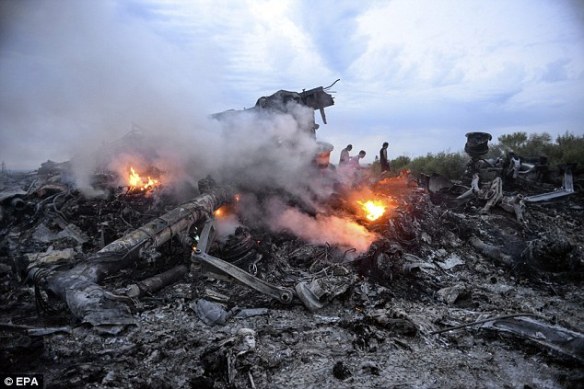
Facebook is Filtering Out News That Doesn’t Bolster US Foreign Policy

Facebook has shed any pretense of neutrality in handling political information concerning the foreign affairs of the U.S. government.

By WT Whitney

Source: Mint Press News

Facebook has its admirers. Shareholders are enamored of its profits – $15.9 billion in 2017 – and hordes of the world’s population – 1.47 billion people – look at Facebook every day.  Individually on their Facebook pages they are communicating with, on average, 338 so-called “friends.” Editors, the media, and political commentators are similarly entranced. One unpretentious website receiving the present writer’s contributions claims 89,834 Facebook friends and another, 125,060 of them.

But now anyone dealing with political news and analyses of a progressive nature has reason to re-evaluate, even to draw back. Facebook apparently is now primed to censor that kind of information and discussion.

Facebook, for example, has its sights on Venezuela.  Revolutionary currents there have rankled the U.S. government and dominant U.S. media. The latter has frequently referred to the failed violent anti-government coup of August 4 as an “apparent” or “alleged” coup while identifying it as a future pretext for repression by Venezuela’s government.

Venezuelanalysis.com, almost alone, has provided English-language news and views that “challenge the corporate mainstream media narrative on Venezuela” Recently that platform has reported on “the growing international campaign to End US and Canadian Sanctions against Venezuela.” On August 9 Facebook removed the website’s account from its rolls; it was restored two days later. There were no explanations.

In 2005, the government of former Venezuelan president Hugo Chavez, vilified by the U.S. government, took the lead in forming TeleSUR news service which has provided information on resistance and integration movements throughout Latin America and the Caribbean. TeleSUR’s English-language page briefly disappeared from Facebook in January, 2018 and again on August 13 – for two days on that occasion.

These disruptions of two Facebook accounts are, by themselves, of no great moment.  But in Facebook’s hands, the flow of English-language political information on Latin America now seems generally precarious, the more so when it deviates from U.S. official doctrine.

At a press briefing July 31, Facebook’s chief operating officer, Sheryl Sandberg, indicated that “32 pages and accounts from Facebook and Instagram” had been removed because they “involve and coordinate inauthentic behavior.” TeleSUR English and the Venezuelanalysis may have been among the offenders.

The social media giant on May 17 announced that, “We’re doubling the number of people who work on safety and security and using technology like artificial intelligence to more effectively block fake accounts. [Additionally] we’re more actively working with outside experts, governments and other companies because we know that we can’t solve these challenges on our own … Today, we’re excited to launch a new partnership with the Atlantic Council.”

The new alliance bolsters suspicions that Facebook has shed any pretense of neutrality in handling political information concerning the foreign affairs of the U.S. government.

The context is a Facebook damage-control mission undertaken presumably to shore up profitability.  The social media giant came under criticism in Washington for allowing private information to fall into the hands of Cambridge Analytica. That British firm used it to provide data to Donald Trump’s 2016 presidential campaign viewed as injurious to contender Hillary Clinton.

Testifying April 10 before the Senate commerce and judiciary committees, Facebook CEO and founder Mark Zuckerberg declared, “It was my mistake.” He apologized for Facebook’s tolerance of “fake news, foreign interference in elections, and hate speech.” The office of influential Republican Sen. Mark Warner in July issued a draft white paper titled, in part, “Proposals for Regulation of Social Media.”

Facebook outlined a plan to “outsource many of the most sensitive political decisions” and henceforth to rely upon the Atlantic Council and its Digital Forensic Research Lab. According to Reutersthe Lab uses “its own software and other tools [and] sorts through social media postings for patterns.” Facebook’s recent donation to the Lab, Reuters said, was substantial enough, “to vault the company to the top of the Atlantic Council’s donor list, alongside the British government.”

The Washington-based Atlantic Council, founded in 1961, takes in $21million in revenue annually. By means of “galvanizing its uniquely influential network of global leaders,” the Council claims to foster “co­op­er­a­tion be­tween North Amer­ica and Europe that be­gan af­ter World War II.” Drawing together “political leaders, academics, military officials, journalists and diplomats in an effort to further the values set forth in the North Atlantic Treaty,” the Council is supposedly  a “network facilitator” that, according to the New York Times, offers “access to United States and foreign government officials in exchange for contributions.”

Contributors include NATO member governments, defense contractors, oil companies, aerospace companies, U.S. military services, the State Department, and multiple banks and fi­nan­cial or­ga­ni­za­tions. High U.S. military, intelligence, and diplomatic officials, both retired and on their way to top jobs, serve the Atlantic Council as leaders.

For one critic, the Council is “a leading geopolitical strategy think-tank seen as a de facto PR agency for the U.S. government and NATO military alliance.” Another, writing for alternet.org, is blunt: journalist Max Blumenthal characterizes the Council “as a pro-regime change think tank that is funded by Western governments and their allies.”

The Atlantic Council is most certainly aligned with the objectives of U.S foreign policies. Now Facebook is using the Council as authenticator-in-chief of international news and views flowing through its portals.  On both accounts, therefore, Facebook may have already lost any claim to promoting the free flow of political information.

The Suicidal Empire

By Dmitry Orlov

Source: Club Orlov

There are a lot of behaviors being exhibited by those in positions of power in the US that seem disparate and odd. We watch Trump who is imposing sanctions on country after country, dreaming of eradicating his country’s structural trade deficit with the rest of the world. We watch pretty much all of US Congress falling over each other in their attempt to impose the harshest possible sanctions on Russia. People in Turkey, a key NATO country, are literally burning US dollars and smashing iPhones in a fit of pique. Confronted with a new suite of Russian and Chinese weapons systems that largely neutralize the ability of the US to dominate the world militarily, the US is setting new records in the size of its already outrageously bloated yet manifestly ineffectual defense spending. As a backdrop to this military contractor feeding frenzy, the Taliban are making steady gains in Afghanistan, now control over half the territory, and are getting ready to stamp “null and void,” in a repeat of Vietnam, on America’s longest war. A lengthening list of countries are set to ignore or compensate for US sanctions, especially sanctions against Iranian oil exports. In a signal moment, Russia’s finance minister has recently pronounced the US dollar “unreliable.” Meanwhile, US debt keeps galloping upwards, with its largest buyer being reported as a mysterious, possibly entirely nonexistent “Other.”

Although these may seem like manifestations of many different trends in the world, I believe that a case can be made that these are all one thing: the US—the world’s imperial overlord—standing on a ledge and threatening to jump, while its imperial vassals—too many to mention—are standing down below and shouting “Please, don’t jump!” To be sure, most of them would be perfectly happy to watch the overlord plummet and jelly up the sidewalk. But here is the key point: if this were to happen today, it would cause unacceptable levels of political and economic collateral damage around the world. Does this mean that the US is indispensable? No, of course not, nobody is. But dispensing with it will take time and energy, and while that process runs its course the rest of the world is forced to keep it on life support no matter how counterproductive, stupid and demeaning that feels.

What the world needs to do, as quickly as possible, is to dismantle the imperial center, which is in Washington politically and militarily and in New York and London financially, while somehow salvaging the principle of empire. “What?!” you might exclaim, “Isn’t imperialism evil.” Well, sure it is, whatever, but empires make possible efficient, specialized production and efficient, unhindered trade over large distances. Empires do all sorts of evil things—up to and including genocide—but they also provide a level playing field and a method for preventing petty grievances from escalating into tribal conflicts.

The Roman Empire, then Byzantium, then the Tatar/Mongol Golden Horde, then the Ottoman Sublime Porte all provided these two essential services—unhindered trade and security—in exchange for some amount of constant rapine and plunder and a few memorable incidents of genocide. The Tatar/Mongol Empire was by far the most streamlined: it simply demanded “yarlyk”—tribute—and smashed anyone who attempted to rise above a level at which they were easy to smash. The American empire is a bit more nuanced: it uses the US dollar as a weapon for periodically expropriating savings from around the world by exporting inflation while annihilating anyone who tries to wiggle out from under the US dollar system.

All empires follow a certain trajectory. Over time they become corrupt, decadent and enfeebled, and then they collapse. When they collapse, there are two ways to go. One is to slog through a millennium-long dark age—as Western Europe did after the Western Roman Empire collapsed. Another is for a different empire, or a cooperating set of empires, to take over, as happened after the Ottoman Empire collapsed. You may think that a third way exists: of small nations cooperating sweetly and collaborating successfully on international infrastructure projects that serve the common good. Such a scheme may be possible, but I tend to take a jaundiced view of our simian natures.

We come equipped with MonkeyBrain 2.0, which has some very useful built-in functions for imperialism, along with some ancillary support for nationalism and organized religion. These we can rely on; everything else would be either a repeat of a failed experiment or an untested innovation. Sure, let’s innovate, but innovation takes time and resources, and those are the exact two things that are currently lacking. What we have in permanent surplus is revolutionaries: if they have their way, look out for a Reign of Terror, followed by the rise of a Bonaparte. That’s what happens every time.

Lest you think that the US isn’t an empire—a collapsing one—consider the following. The US defense budget is larger than that of the next ten countries combined, yet the US can’t prevail even in militarily puny Afghanistan. (That’s because much of its defense budget is trivially stolen.) The US has something like a thousand military bases, essentially garrisoning the entire planet, but to unknown effect. It claims the entire planet as its dominion: no matter where you go, you still have to pay US income taxes and are still subject to US laws. It controls and manipulates governments in numerous countries around the world, always aiming to turn them into satrapies governed from the US embassy compound, but with results that range from unprofitable to embarrassing to lethal. It is now failing at virtually all of these things, threatening the entire planet with its untimely demise.

What we are observing, at every level, is a sort of blackmail: “Do as we say, or no more empire for you!” The US dollar will vanish, international trade will stop and a dark age will descend, forcing everyone to toil in the dirt for a millennium while mired in futile, interminable conflicts with neighboring tribes. None of the old methods of maintaining imperial dominance are working; all that remains is the threat of falling down and leaving a huge mess for the rest of the world to deal with. The rest of the world is now tasked with rapidly creating a situation where the US empire can be dealt a coup de grâce safely, without causing any collateral damage—and that’s a huge task, so everyone is forced to play for time.

There is a lot of military posturing and there are political provocations happening all the time, but these are sideshows that are becoming an unaffordable luxury: there is nothing to be won through these methods and plenty to be lost. Essentially, all the arguments are over money. There is a lot of money to be lost. The total trade surplus of the BRICS countries with the West (US+EU, essentially) is over a trillion dollars a year. SCO—another grouping of non-Western countries—comes up with almost the same numbers. That’s the amount of products these countries produce for which they currently have no internal market. Should the West evaporate overnight, nobody will buy these products. Russia alone had a 2017 trade surplus of $116 billion, and in 2018 so far it grew by 28.5%. China alone, in its trade just with the US, generated $275 billion in surplus. Throw in another $16 billion for its trade with the EU.

Those are big numbers, but they are nowhere near enough if the project is to build a turnkey global empire to replace US+EU in a timely manner. Also, there are no takers. Russia is rather happy to have shed its former Soviet dependents and is currently invested in building a multilateral, international system of governance based on international institutions such as SCO, BRICS and EAEU. Numerous other countries are very interested in joining together in such organizations: most recently, Turkey has expressed interest in turning BRICS into BRICTS. Essentially, all of the post-colonial nations around the world are now forced to trade away some measure of their recently won independence, essentially snatching defeat from the jaws of victory. The job vacancy of Supreme Global Overlord is unlikely to attract any qualified candidates.

What everyone seems to want is a humble, low-budget, cooperative global empire, without all of the corruption and with a lot less life-threatening militarism. It will take time to build, and the resources to build it can only come from one place: from gradually bleeding US+EU dry. In order to do this, the wheels of international commerce must continue to spin. But this is exactly what all of the new tariffs and sanctions, the saber-rattling and the political provocations, are attempting to prevent: a ship laden with soya is now doing circles in the Pacific off the coast of China; steel I-beams are rusting at the dock in Turkey…

But it is doubtful that these attempts will work. The EU has been too slow in recognizing just how pernicious its dependence on Washington has become, and will take even more time to find ways to free itself, but the process has clearly started. For its part, Washington runs on money, and since its current antics will tend to make money grow scarce even faster than it otherwise would, those who stand to lose the most will make the Washingtonians feel their pain and will force a change of course. As a result, everyone will be pushing in the same direction: toward a slow, steady, controllable imperial collapse. All we can hope for is that the rest of the world manages to come together and build at least the scaffolding of a functional imperial replacement in time to avoid collapsing into a new post-imperial dark age.

In A Corporatist System Of Government, Corporate Censorship Is State Censorship

By Caitlin Johnstone

Source: CaitlinJohnstone.com

Last year, representatives of Facebook, Twitter, and Google were instructed on the US Senate floor that it is their responsibility to “quell information rebellions” and adopt a “mission statement” expressing their commitment to “prevent the fomenting of discord.”

“Civil wars don’t start with gunshots, they start with words,” the representatives were told. “America’s war with itself has already begun. We all must act now on the social media battlefield to quell information rebellions that can quickly lead to violent confrontations and easily transform us into the Divided States of America.”

Yes, this really happened.

Today [8/7] Twitter has silenced three important anti-war voices on its platform: it has suspended Daniel McAdams, the executive director of the Ron Paul Institute, suspended Scott Horton of the Scott Horton Show, and completely removed the account of prominent Antiwar.com writer Peter Van Buren.

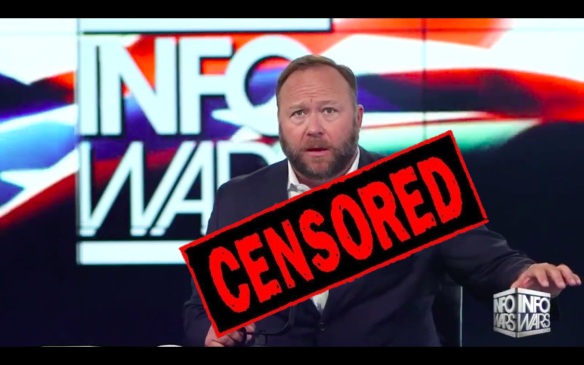
I’m about to talk about the censorship of Alex Jones and Infowars now, so let me get the “blah blah I don’t like Alex Jones” thing out of the way so that my social media notifications aren’t inundated with people saying “Caitlin didn’t say the ‘blah blah I don’t like Alex Jones’ thing!” I shouldn’t have to, because this isn’t actually about Alex Jones, but here it is:

I don’t like Alex Jones. He’s made millions saying the things disgruntled right-wingers want to hear instead of telling the truth; he throws in disinfo with his info, which is the same as lying all the time. He’s made countless false predictions and his sudden sycophantic support for a US president has helped lull the populist right into complacency when they should be holding Trump to his non-interventionist campaign pledges, making him even more worthless than he was prior to 2016.

But this isn’t about defending Alex Jones. He just happens to be the thinnest edge of the wedge.

As of this writing, Infowars has been censored from Facebook, Youtube (which is part of Google), Apple, Spotify, and now even Pinterest, all within hours of each other. This happens to have occurred at the same time Infowars was circulating a petition with tens of thousands of signatures calling on President Trump to pardon WikiLeaks editor-in-chief Julian Assange, who poses a much greater threat to establishment narratives than Alex Jones ever has. Assange’s mother also reports that this mass removal of Infowars’ audience occurred less than 48 hours after she was approached to do an interview by an Infowars producer.

In a corporatist system of government, wherein there is no meaningful separation between corporate power and state power, corporate censorship is state censorship. Because legalized bribery in the form of corporate lobbying and campaign donations has given wealthy Americans the ability to control the US government’s policy and behavior while ordinary Americans have no effective influence whatsoever, the US unquestionably has a corporatist system of government. Large, influential corporations are inseparable from the state, so their use of censorship is inseparable from state censorship.

This is especially true of the vast megacorporations of Silicon Valley, whose extensive ties to US intelligence agencies are well-documented. Once you’re assisting with the construction of the US military’s drone program, receiving grants from the CIA and NSA for mass surveillance, or having your site’s content regulated by NATO’s propaganda arm, you don’t get to pretend you’re a private, independent corporation that is separate from government power. It is possible in the current system to have a normal business worth a few million dollars, but if you want to get to billions of dollars in wealth control in a system where money translates directly to political power, you need to work with existing power structures like the CIA and the Pentagon, or else they’ll work with your competitors instead of you.

And yet every time I point to the dangers of a few Silicon Valley plutocrats controlling all new media political discourse with an iron fist, Democratic Party loyalists all turn into a bunch of hardline free market Ayn Rands. “It’s not censorship!” they exclaim. “It’s a private company and can do whatever it wants with its property!”

They do this because they know their mainstream, plutocrat-friendly “centrist” views will never be censored. Everyone else is on the chopping block, however. Leftist sites have already had their views slashed by a manipulation of Google’s algorithms, and it won’t be long before movements like BDS and Antifa and skeptics of the establishment Syria and Russia narratives can be made to face mass de-platforming on the same exact pretext as Infowars.

This is a setup. Hit the soft target so your oligarch-friendly censorship doesn’t look like what it is, then once you’ve manufactured consent, go on to shut down the rest of dissenting media bit by bit.

Don’t believe that’s the plan? Let’s ask sitting US Senator Chris Murphy:

“Infowars is the tip of a giant iceberg of hate and lies that uses sites like Facebook and YouTube to tear our nation apart,” Murphy tweeted in response to the news. “These companies must do more than take down one website. The survival of our democracy depends on it.”

That sure sounds an awful lot like the warnings issued to the Silicon Valley representatives on the Senate floor at the beginning of this article, no? This is headed somewhere dark.

We’re going to have to find a way to keep the oligarchs from having their cake and eating it too. Either (A) corporations are indeed private organizations separate from the government, in which case the people need to get money out of politics and government agencies out of Silicon Valley so they can start acting like it, and insist that their owners can’t be dragged out on to the Senate floor and instructed on what they can and can’t do with their business, or (B) these new media platforms get treated like the government agencies they function as, and the people get all the First Amendment protection that comes with it. Right now the social engineers are double-dipping in a way that will eventually give the alliance of corporate plutocrats and secretive government agencies the ability to fully control the public’s access to ideas and information.

If they accomplish that, it’s game over for humanity. Any hope of the public empowering itself over the will of a few sociopathic, ecocidal, omnicidal oligarchs will have been successfully quashed. We are playing for all the chips right now. We have to fight this. We have no choice.