Who’s to Blame for Losing Afghanistan?

By Peter Van Buren

Source: We Meant Well

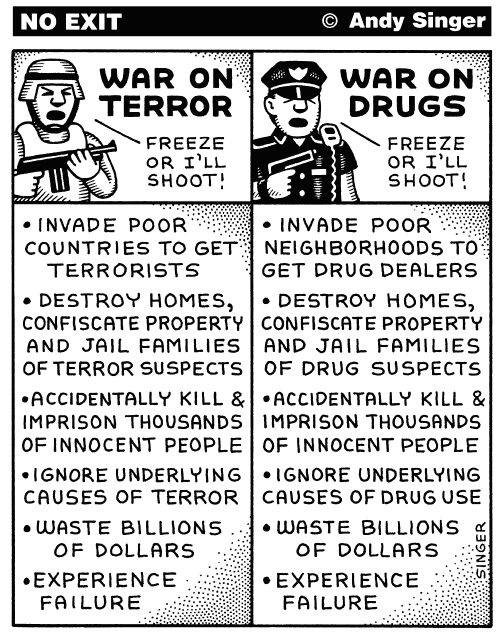
Who should we blame for losing Afghanistan? Why blame anyone?

Did anyone expect the U.S. war in Afghanistan to end cleanly? If so, you bought the lies all along and the cold water now is hitting sharp. While the actual ending is particularly harsh and clearly spliced together from old clips of Saigon 1975, those are simply details.

Why blame Biden? He played his part as a Senator and VP keeping the war going, but his role today is just being the last guy in a long line of people to blame, a pawn in the game. That Biden is willing to be the “president who lost Afghanistan” is all the proof you need he does not intend to run again for anything. Kind of an ironic version of a young John Kerry’s take on Vietnam “how do you ask the last man to die for a mistake?” Turns out, it’s easy: call Joe.

Blame Trump for the deal? One of the saddest things about the brutal ending of the U.S.-Afghan war is we would have gotten the same deal — just leave it to the Taliban and go home — at basically any point during the last 20 years. That makes every death and every dollar a waste. Afghanistan is simply reverting, quickly, to more or less status quo 9/10/01 and everything between then and now, including lost opportunities, will have been wasted.

Blame the NeoCons? No one in Washington who supported this war was ever called out, with the possible exception of Donald Rumsfeld who, if there is a hell, now cleans truck stop toilets there. Dick Cheney walks free. The generals and diplomats who ran the war have nice think tank or university jobs, if they are not still in government making equally bad decisions. No one has been legally, financially, or professionally disadvantaged by the blood on their hands. Some of the era’s senior leaders — Blinken, Rice, Power, Nuland — are now working in better jobs for Biden. I’d like to hope they have trouble sleeping at night, but I doubt it.

George Bush is a cuddly grandpa today, not the man who drove the United States into building a global prison archipelago to torture people. Barack Obama, who kept much of that system in place and added the drone killing of American citizens to his resume, remains a Democratic rock god. Neither man nor any of his significant underlings has expressed any regret or remorse.

For example, I just listened to Ryan Crocker, our former ambassador to Iraq and Afghanistan, on CNN. Making myself listen to him was about as fun as sticking my tongue in a wood chipper. Same for former general David Petraeus and the usual gang of idiots. None of them, the ones who made the decisions, accept any blame. Instead. they seem settled on blaming Trump because, well, everything bad is Trump’s fault even if he came into all this in the middle of the movie.

In the end the only people punished were the whistleblowers.

No one in the who is to blame community seems willing to take the story back to its beginning, at least the beginning for America’s latest round in the Graveyard of Empires (talk about missing an early clue.) This is what makes Blame Trump and Blame Biden so absurd. America’s modern involvement in this war began in 1979 when Jimmy Carter, overreacting to the Soviet invasion of Afghanistan to prop up what was already a pro-Soviet puppet government, began arming and organizing Islamic warriors we now collectively know as “The Taliban.”

People who want to only see trees they can chop down and purposely want to miss the vastness of the forest ahead at this point try to sideline things by claiming there never was a single entity called “The Taliban” and the young Saudis who flocked to jihad to kill Russians technically weren’t funded by the U.S. (it was indirectly through Pakistan) or that the turning point was the 1991 Gulf War, etc. Quibbles and distractions.

If Carter’s baby steps to pay for Islamic warriors to fight the Red Army was playing with matches, Ronald Reagan poured gas, then jet fuel, on the fire. Under the Reagan administration the U.S. funded the warriors (called mujaheddin if not freedom fighters back then), armed them, invited their ilk to the White House, helped lead them, worked with the Saudis to send in even more money, and fanned the flames of jihad to ensure a steady stream of new recruits.

When we “won” it was hailed as the beginning of the real end of the Evil Empire. The U.S. defeated the mighty Red Army by sending over some covert operators to fight alongside stooge Islam warriors for whom a washing machine was high technology. Pundits saw it as a new low-cost model for executing American imperial will.

We paid little attention to events as we broke up the band and cut off the warriors post-Soviet withdrawal (soon enough some bozo at the State Department declared “the end of history.” He teaches at Stanford now) until the blowback from this all nipped us in the largely unsuccessful World Trade Center bombing of 1993, followed by the very successful World Trade Center bombing on September 11, 2001. Seems like there was still some history left to go.

How did U.S. intelligence know who the 9/11 culprits were so quickly? Several of them had been on our payroll, or received financing via proxies in Pakistan and Saudi Arabia, or were inspired by what had happened in Afghanistan, the defeat of the infidels (again; check Alexander the Great, Genghis Khan, the Mughal Empire, various Persian Empires, the Sikhs, the British, et al.)

If post-9/11 the U.S. had limited itself to a vengeful hissy fit in Afghanistan, ending with Bush’s 2003 declaration of “Mission Accomplished,” things would have been different. If the U.S. had used the assassination of Osama bin Laden, living “undiscovered” in the shadow of Pakistan’s military academy, as an excuse of sorts to call it a day in Afghanistan, things would have been different.

Instead Afghanistan became a petri dish to try out the worst NeoCon wet dream, nation-building across the Middle East. Our best and brightest would not just bomb Afghanistan into the stone age, they would then phoenix-it from the rubble as a functioning democracy. There was something for everyone: a military task to displace post-Cold War budget cuts, a pork-laden reconstruction program for contractors and diplomats, even a plan to empower Afghan women to placate the left.

Though many claim Bush pulling resources away from Afghanistan for Iraq doomed the big plans, it was never just a matter of not enough resources. Afghanistan was never a country in any modern sense to begin with, just an association of tribal entities who hated each other almost as much as they hated the west. The underpinnings of the society were a virulent strain of Islam, about as far away from any western political and social ideas as possible. Absent a few turbaned Uncle Toms, nobody in Afghanistan was asking to be freed by the United States anyway.

Pakistan, America’s “ally” in all this, was a principal funder and friend of the Taliban, always more focused on the perceived threat from India, seeing a failed state in Afghanistan as a buffer zone. Afghanistan was a narco-state with its only real export heroin. Not only did this mean the U.S. wanted to build a modern economy on a base of crime, the U.S. in different periods actually encouraged/ignored the drug trade into American cities in favor of the cash flow.

The Afghan puppet government and military the U.S. formed were uniformly corrupt, and encouraged by the endless inflow of American money to get more corrupt all the time. They had no support from the people and could care less. The Afghans in general and the Afghan military in particular did not fail to hold up their end of the fighting; they never signed up for the fight in the first place. No Afghan wanted to be the last man to die in service to American foreign policy.

There was no way to win. The “turning point” was starting the war at all. Afghanistan had to fail. There was no other path for it, other than being propped up at ever-higher costs. That was American policy for two decades: prop up things and hope something might change. It was like sending more money to a Nigerian cyber-scammer hoping to recoup your original loss.

Everything significant our government, the military, and the MSM told us about Afghanistan was a lie. They filled and refilled the bag with bullhockey and Americans bought it every time expecting candy canes. Keep that in mind when you decide who to listen to next time, because of course there will be a next time. Who has not by now realized that? We just passively watched 20 years of Vietnam all over again, including the sad ending. So really, who’s to blame?

OCTOPUS PROMIS: The Rise Of Thought Crime Technology — We’re Living In Orwell’s 1984

By Aaron Kesel

Source: Activist Post

I don’t know if you have been paying attention or not, but a lot of police organizations across the U.S. have been using what are known as “heat lists” or pre-crime databases for years. What is a “heat list,” you may ask?

Well, “heat lists” are basically databases compiled by algorithms of people that police suspect may commit a crime. Yes, you read that right a person who “may” commit a crime. How these lists are generated and what factors determine an individual “may commit a crime” is unknown. A recent article by Tampa Bay Times highlights how this program in Florida terrorized and monitored residents of Pasco County and how the Pasco County Sheriff Department’s program operates.

According to the Times, the Sheriff’s office generates lists of people it considers likely to break the law, based on arrest histories, unspecified intelligence, and arbitrary decisions by police analysts. Then it sends deputies to find and interrogate anyone whose name appears, often without probable cause, a search warrant, or evidence of a specific crime.

This program according to the Times has been operating since at least 2011. The program introduces a social credit system. It gives people scores based on their criminal records. People get points each time they’re arrested, even when the charges are dropped, and they even get points for just being a suspect of a crime.

The deputies then make frequent – potentially even daily – visits to those with higher scores in the heavily flawed pre-criminal system.

Activists and journalists sued the Chicago Police Department in 2017 for failing to disclose how these programs operate, as Activist Post reported.

Chicago wasn’t the only major police department exposed using predictive crime algorithms. The Los Angeles Police Department was also caught one year later in 2018 by activists from the Stop LA Spying Coalition, as Activist Post reported.

This heat list idea in local law enforcement actually originated in Miami then was rolled out in Chicago. However, Activist Post may have missed other cities that gained less media attention; and as this writer will discuss shortly, the idea comes from a federal database.

A paper released last year by MIT entitled “Technical Flaws of Pretrial Risk Assessments Raise Grave Concerns” has been signed by some of the highest level university experts in the field of A.I. and law who warn about the “technical flaws” of these pre-crime based systems, Activist Post reported.

Fortunately for us, as Nicholas West noted, the pushback has already started in several cities, and a few police departments have dropped their programs after becoming aware of the inaccuracies. In 2018, for example, New Orleans suspended its 6-year running pre-crime program after its secret predictive policing software was exposed.

The scariest part of all this is that the New Orleans and LA police departments were actually both linked to Palantir Technologies, which directly works with the CIA and is suspected of being the current fork of PROMIS Main Core software. PROMIS pre-dates all of these local police heat lists, with algorithms that put suspected “domestic terrorists” into their own round-up lists, created at first by Oliver North for President Ronald Reagan and Vice President George H.W. Bush under FEMA’s Readiness Exercise — 1984 (REX-1984.)

The use of Palantir’s pre-crime algorithm software posits that other police departments may be utilizing the same software for their own pre-crime programs. Palantir is also the same company working with the U.S. Immigration and Customs Enforcement agency on its own lists to catch illegal immigrants, as Activist Post and investigative journalist Barrett Brown originally reported.

You may remember Palantir from journalist Barrett Brown, Anonymous’ hack of HBGary, or accusations that the company provided the technology that enables NSA’s mass surveillance PRISM which is the successor to PROMIS. Palantir’s software in many ways is similar to the Prosecutor’s Management Information System (PROMIS) stolen software Main Core and may be the next evolution in that code, which allegedly predated PRISM. In 2008, Salon.com published details about a top-secret government database that might have been at the heart of the Bush administration’s domestic spying operations. The database known as “Main Core” reportedly collected and stored vast amounts of personal and financial data about millions of Americans in the event of an emergency like Martial Law.

PROMIS was forked into many reported use-cases for the U.S. government, including an intelligence application on board nuclear submarines of the United States and Great Britain, and the use by both the U.S. government and certain allied governments for inventory tracking of nuclear materials and long-range ballistic missiles. But the most bizarre and frightening use was to keep track of dissident Americans under Main Core.

Trump’s administration has now expanded that effort for local police and federal officials with a national security watchlist that includes Americans who have no connection to terrorism. The new TOC (Transnational Organized Crime) watchlist, was authorized through a classified Attorney General order and launched in 2017, as Activist Post reported.

The TOC database allows the government to track and monitor Americans without a warrant, even when there is no evidence they’re breaking the law. Also, anyone who is considered to be an “authority”  – be it police to state and federal agencies, and even some allied foreign governments – can nominate any single person to the list.

The Main Core database isn’t just a rumor or conspiracy theory; PROMIS software was used by Iran-Contra fall guy then-National Security Council, Lt. Col. Oliver North to create the dissidents list for Rex-84 that would later evolve to Main Core. North used PROMIS software in 1982 in the Department of Justice, and at the White House, to compile a list of American dissidents to invoke if the government ever needed to do so under Ronald Reagan’s Continuity of Government (COG) program as a liaison to FEMA.

In 1993, Wired described North’s use of PROMIS in compiling the Main Core database:

Using PROMIS, sources point out, North could have drawn up lists of anyone ever arrested for a political protest, for example, or anyone who had ever refused to pay their taxes. Compared to PROMIS, Richard Nixon’s enemies list or Sen. Joe McCarthy’s blacklist look downright crude.

This Main Core database of individuals was given to a handful of individuals, meaning most government officials had no knowledge of the program ever existing. The database was passed off from administration to administration through National Security channels, according to sources.

This writer wrote extensively on Main Core and PROMIS in an investigation on the cover-up of stolen Inslaw software and murders of journalists Danny Casolaro and Anson NG Yonc, CIA intelligence operative Ian Spiro and NSA employee Alan Standorf. See: “Octopus PROMIS: The Conspiracy Against INSLAW Software, And The Murders To Cover Up A Scandal Bigger Than Watergate.”

The TOC list includes — “Insider threats,” which is relevant to leakers like Chelsea Manning and Edward Snowden, and journalists leaking these secrets like Julian Assange. In fact, last February, FBI Director Wray told the House Judiciary Committee that the Bureau had expanded initiatives “to focus on insider threats partnering with TCO [transnational criminal organization] actors.” This is a statement that is being re-echoed from 2017, when Wray stated a similar comment mentioning TCOs during a House meeting.

While presidents change, the leadership under them inside agencies only sees a shift by the replacing of the heads of the agencies. However, policies and stigmas inside stick with those in the intelligence community. In fact, Trump’s government, U.S. National Counterintelligence, and Security Center (NCSC) stressed in its latest report that hacktivists “Anonymous” and “public disclosure organizations” like WikiLeaks pose a “significant threat” similar to that of the Islamic State and Al-Qaeda terrorists, as well as Russia, Iran, and China.

Obama’s DHS didn’t hesitate to call those who believe in conspiracy theories potential right-wing terrorists, stating that the following points might make someone a terrorist in a study by the University of Maryland, which was funded in part by the Department of Homeland Security.

  • Americans who “are fiercely nationalistic, as opposed to universal and international in orientation”
  • Americans considering themselves “anti-global”
  • Americans who are “suspicious of centralized federal authority”
  • Americans who are “reverent of individual liberty (especially their right to own guns and be free of taxes)”
  • Americans exhibiting a belief in “conspiracy theories that involve grave threat to national sovereignty and/or personal liberty and a belief that one’s personal and/or national way of life is under attack”

Palantir was founded with early investment from the CIA and heavily used by the military, and Palantir is a subcontracting company in its own right. The company has even been featured in the Senate’s grilling of Facebook, when Washington State Senator Maria Cantwell asked CEO Mark Zuckerberg, “Do you know who Palantir is?” due to Peter Thiel sitting on Facebook’s board.

Palantir’s Gotham software allows Fusion Center police to track citizens beyond social media and online web accounts with people record searches, vehicle record searches, a Histogram tool, a Map tool, and an Object Explorer tool.

According to DHS, “Fusion centers operate as state and major urban area focal points for the receipt, analysis, gathering, and sharing of threat-related information between federal; state, local, tribal, territorial (SLTT); and private sector partners” like Palantir. Further, Fusion Centers are locally owned and operated, arms of the “intelligence community,” i.e. the 17 intelligence agencies coordinated by the National Counterterrorism Center (NCTC). However, sometimes the buildings are staffed by trained NSA personnel like what happened in Mexico City, according to a 2010 Defense Department (DOD) memorandum.

This is only the beginning of the fight, and it’s going to be a long battle drawn out to prevent the use of this technology, not just here in the U.S. but worldwide as well. There’s no telling how long these projects have been active, and trusting police to honestly tell us is like trusting the wolf guarding the henhouse. For more articles on artificial intelligence predicting criminals, see Uri Gal’s hilarious and honestly titled article: “Predictive Algorithms Are No Better At Telling The Future Than A Crystal Ball.”

The Military Must be De-Funded Along with the Police

By Dan Kovalik

Source: CounterPuch

As Vijay Prashad explains in his book, Red Star Over The Third World, domestic fascism in the West has reflected the West’s pre-existing colonial practices abroad. Citing Martinique communist Aimé Césaire, Prashad explains: “What had come to define fascism inside Europe through the experience of the Nazis – the jackboots and the gas chambers – were familiar already in the colonies. . . . [F]ascism was a political form of bourgeois rule in times when democracy threatened capitalism; colonialism, on the other hand, was naked power justified by racism to seize resources from people who were not willing to hand them over. Their form was different but their manners were identical.”

As Prashad and Césaire teach us, the fascist tactics used by our Western governments in the Global South will inevitably be brought home to be used against us. In the case of the US, these tactics have surely been introduced here, and we are now seeing this clearly as our police, sometimes backed by the military itself, are battling protestors in the streets in the same manner that a military force does as a foreign occupying power. Indeed, as a number of commentators have pointed out, the very tactic which killed George Floyd – the knee on the neck – was imported by the Israeli Defense Forces (themselves bankrolled by the US) who use this tactic against the Palestinian people in the Occupied Territories and who are now training US police units, including the Minneapolis police force, to use it as well.

Moreover, the police are using not only the cruel military tactics used to oppress people abroad, they are also using the military’s very equipment to do so.

Democratic President Bill Clinton opened the door wide for this police militarization in the 1990s with the National Defense Authorization Act which created a program, the 1033 program, through which police departments are given surplus military equipment. As recently explained by Michael Shank in an article in The New York Review of Books, entitled “How Police Became Paramilitaries,” pursuant to this program, “local law enforcement began to adopt the type of military equipment more frequently used in a war zone: everything from armored personnel carriers and tanks, with 360-degree rotating machine gun turrets, to grenade launchers, drones, assault weapons, and more. Today, billions of dollars’ worth of military equipment—most used, some new—has been transferred to civilian police departments.”

And, once the police receive this equipment, they must use it. As Shank explains, the 1033 program “requires that law enforcement agencies make use of such equipment within a year of acquisition, effectively mandating that police put it into practice in the public space.”  In other words, the police are actually required to turn the military’s high-tech guns against their own people.

The militarization of the police, moreover, can be seen as a by-product of the US’s over-reliance on the use of military force and war to solve all of its problems, to the near exclusion of all other alternatives. Indeed, the US has given up on trying to lead the world through economic and technological prowess, or through moral suasion. Instead, our leaders have decided that brute military force alone will allow the US to dominate the planet, and our nation’s coffers are being looted to the tune of over $1 trillion a year to do so. The result is the starving of our educational system, our social safety net and our nation’s vital infrastructure. This, of course, then leads to mass deprivation and despair which then leads to mass unrest. And, just as it deals with the rest of the world, our rulers have decided to deal with the unrest at home, not by solving the social ills plaguing this nation, or by fixing a few bridges or dams, but by beating us down with military-style violence.

Military force, indeed, has become the only instrument in our government’s toolbox, as quite starkly illustrated recently by the White House’s decision to give our valuable medical workers military flyovers costing $60,000 an hour instead of providing these workers with the protective equipment they have been desperately demanding. As with all things, our government has money and resources for instruments of violence, but none for human needs. This is literally killing us, just as surely as it is killing hundreds of thousands of people – nearly all people of color, not coincidentally – in foreign lands. The fight against police brutality and racism must therefore be linked to the fight to de-fund our military and to the broader fight to de-militarize our very society and culture.

The Martyrdom of Julian Assange

By Chris Hedges

Source: Truthdig

The arrest Thursday of Julian Assange eviscerates all pretense of the rule of law and the rights of a free press. The illegalities, embraced by the Ecuadorian, British and U.S. governments, in the seizure of Assange are ominous. They presage a world where the internal workings, abuses, corruption, lies and crimes, especially war crimes, carried out by corporate states and the global ruling elite will be masked from the public. They presage a world where those with the courage and integrity to expose the misuse of power will be hunted down, tortured, subjected to sham trials and given lifetime prison terms in solitary confinement. They presage an Orwellian dystopia where news is replaced with propaganda, trivia and entertainment. The arrest of Assange, I fear, marks the official beginning of the corporate totalitarianism that will define our lives.

Under what law did Ecuadorian President Lenin Moreno capriciously terminate Julian Assange’s rights of asylum as a political refugee? Under what law did Moreno authorize British police to enter the Ecuadorian Embassy—diplomatically sanctioned sovereign territory—to arrest a naturalized citizen of Ecuador? Under what law did Prime Minister Theresa May order the British police to grab Assange, who has never committed a crime? Under what law did President Donald Trump demand the extradition of Assange, who is not a U.S. citizen and whose news organization is not based in the United States?

I am sure government attorneys are skillfully doing what has become de rigueur for the corporate state, using specious legal arguments to eviscerate enshrined rights by judicial fiat. This is how we have the right to privacy with no privacy. This is how we have “free” elections funded by corporate money, covered by a compliant corporate media and under iron corporate control. This is how we have a legislative process in which corporate lobbyists write the legislation and corporate-indentured politicians vote it into law. This is how we have the right to due process with no due process. This is how we have a government—whose fundamental responsibility is to protect citizens—that orders and carries out the assassination of its own citizens such as the radical cleric Anwar al-Awlaki and his 16-year-old son. This is how we have a press legally permitted to publish classified information and a publisher sitting in jail in Britain awaiting extradition to the United States and a whistleblower, Chelsea Manning, in a jail cell in the United States.

Britain will use as its legal cover for the arrest the extradition request from Washington based on conspiracy charges. This legal argument, in a functioning judiciary, would be thrown out of court. Unfortunately, we no longer have a functioning judiciary. We will soon know if Britain as well lacks one.

Assange was granted asylum in the embassy in 2012 to avoid extradition to Sweden to answer questions about sexual offense allegations that were eventually dropped. Assange and his lawyers always argued that if he was put in Swedish custody he would be extradited to the United States. Once he was granted asylum and Ecuadorian citizenship the British government refused to grant Assange safe passage to the London airport, trapping him in the embassy for seven years as his health steadily deteriorated.

The Trump administration will seek to try Assange on charges that he conspired with Manning in 2010 to steal the Iraq and Afghanistan war logs obtained by WikiLeaks. The half a million internal documents leaked by Manning from the Pentagon and the State Department, along with the 2007 video of U.S. helicopter pilots nonchalantly gunning down Iraqi civilians, including children, and two Reuters journalists, provided copious evidence of the hypocrisy, indiscriminate violence, and routine use of torture, lies, bribery and crude tactics of intimidation by the U.S. government in its foreign relations and wars in the Middle East. Assange and WikiLeaks allowed us to see the inner workings of empire—the most important role of a press—and for this they became empire’s prey.

U.S. government lawyers will attempt to separate WikiLeaks and Assange from The New York Times and the British newspaper The Guardian, both of which also published the leaked material from Manning, by implicating Assange in the theft of the documents. Manning was repeatedly and often brutally pressured during her detention and trial to implicate Assange in the seizure of the material, something she steadfastly refused to do. She is currently in jail because of her refusal to testify, without her lawyer, in front of the grand jury assembled for the Assange case. President Barack Obama granted Manning, who was given a 35-year sentence, clemency after she served seven years in a military prison.

Once the documents and videos provided by Manning to Assange and WikiLeaks were published and disseminated by news organizations such as The New York Times and The Guardian, the press callously, and foolishly, turned on Assange. News organizations that had run WikiLeaks material over several days soon served as conduits in a black propaganda campaign to discredit Assange and WikiLeaks. This coordinated smear campaign was detailed in a leaked Pentagon document prepared by the Cyber Counterintelligence Assessments Branch and dated March 8, 2008. The document called on the U.S. to eradicate the “feeling of trust” that is WikiLeaks’ “center of gravity” and destroy Assange’s reputation.

Assange, who with the Manning leaks had exposed the war crimes, lies and criminal manipulations of the George W. Bush administration, soon earned the ire of the Democratic Party establishment by publishing 70,000 hacked emails belonging to the Democratic National Committee (DNC) and senior Democratic officials. The emails were copied from the accounts of John Podesta, Hillary Clinton’s campaign chairman. The Podesta emails exposed the donation of millions of dollars from Saudi Arabia and Qatar, two of the major funders of Islamic State, to the Clinton Foundation. It exposed the $657,000 that Goldman Sachs paid to Hillary Clinton to give talks, a sum so large it can only be considered a bribe. It exposed Clinton’s repeated mendacity. She was caught in the emails, for example, telling the financial elites that she wanted “open trade and open borders” and believed Wall Street executives were best positioned to manage the economy, a statement that contradicted her campaign statements. It exposed the Clinton campaign’s efforts to influence the Republican primaries to ensure that Trump was the Republican nominee. It exposed Clinton’s advance knowledge of questions in a primary debate. It exposed Clinton as the primary architect of the war in Libya, a war she believed would burnish her credentials as a presidential candidate. Journalists can argue that this information, like the war logs, should have remained hidden, but they can’t then call themselves journalists.

The Democratic leadership, intent on blaming Russia for its election loss, charges that the Podesta emails were obtained by Russian government hackers, although James Comey, the former FBI director, has conceded that the emails were probably delivered to WikiLeaks by an intermediary. Assange has said the emails were not provided by “state actors.”

WikiLeaks has done more to expose the abuses of power and crimes of the American Empire than any other news organization. In addition to the war logs and the Podesta emails, it made public the hacking tools used by the CIA and the National Security Agency and their interference in foreign elections, including in the French elections. It disclosed the internal conspiracy against British Labour Party leader Jeremy Corbyn by Labour members of Parliament. It intervened to save Edward Snowden, who made public the wholesale surveillance of the American public by our intelligence agencies, from extradition to the United States by helping him flee from Hong Kong to Moscow. The Snowden leaks also revealed that Assange was on a U.S. “manhunt target list.”

A haggard-looking Assange, as he was dragged out of the embassy by British police, shook his finger and shouted: “The U.K. must resist this attempt by the Trump administration. … The U.K. must resist!”

We all must resist. We must, in every way possible, put pressure on the British government to halt the judicial lynching of Assange. If Assange is extradited and tried, it will create a legal precedent that will terminate the ability of the press, which Trump repeatedly has called “the enemy of the people,” to hold power accountable. The crimes of war and finance, the persecution of dissidents, minorities and immigrants, the pillaging by corporations of the nation and the ecosystem and the ruthless impoverishment of working men and women to swell the bank accounts of the rich and consolidate the global oligarchs’ total grip on power will not only expand, but will no longer be part of public debate. First Assange. Then us.


Conflict Theory and Biosphere Annihilation

By Robert J. Burrowes

In a recent article titled Challenges for Resolving Complex Conflicts’, I pointed out that existing conflict theory pays little attention to the extinction-causing conflict being ongoingly generated by human over-consumption in the finite planetary biosphere (and, among other outcomes, currently resulting in 200 species extinctions daily). I also mentioned that this conflict is sometimes inadequately identified as a conflict caused by capitalism’s drive for unending economic growth in a finite environment.

I would like to explain the psychological origin of this biosphere-annihilating conflict and how this origin has nurtured the incredibly destructive aspects of capitalism (and socialism, for that matter) from the beginning. I would also like to explain what we can do about it.

Before I do, however, let me briefly illustrate why this particular conflict configuration is so important by offering you a taste of the most recent research evidence in relation to the climate catastrophe and biosphere annihilation and why the time to resolve this conflict is rapidly running out (assuming, problematically, that we can avert nuclear war in the meantime).

In an article reporting a recent speech by Professor James G. Anderson of Harvard University, whose research led to the Montreal Protocol in 1987 to mitigate CFC damage to the Ozone Layer, environmental journalist Robert Hunizker summarizes Anderson’s position as follows: ‘the chance of permanent ice remaining in the Arctic after 2022 is zero. Already, 80% is gone. The problem: Without an ice shield to protect frozen methane hydrates in place for millennia, the Arctic turns into a methane nightmare.’ See ‘There Is No Time Left’.

But if you think that sounds drastic, other recent research has drawn attention to the fact that the ‘alarming loss of insects will likely take down humanity before global warming hits maximum velocity…. The worldwide loss of insects is simply staggering with some reports of 75% up to 90%, happening much faster than the paleoclimate record rate of the past five major extinction events’. Without insects ‘burrowing, forming new soil, aerating soil, pollinating food crops…’ and providing food for many bird species, the biosphere simply collapses. See Insect Decimation Upstages Global Warming’.

So, if we are in the process of annihilating Earth’s biosphere, which will precipitate human extinction in the near term, why aren’t we paying much more attention to the origin of this fundamental conflict? And then developing a precisely focused strategy for transcending it?

The answer to these two questions is simply this: the origin of this conflict is particularly unpalatable and, from my careful observation, most people, including conflict theorists, aren’t anxious to focus on it.

So why are human beings over-consuming in the finite planetary biosphere? Or more accurately, why are human beings who have the opportunity to do so (which doesn’t include those impoverished people living in Africa, Asia, Central/South America or anywhere else) over-consuming in the finite planetary biosphere?

They are doing so because they were terrorized into unconsciously equating consumption with a meaningful life by parents and other adults who had already internalized this same ‘learning’.

Let me explain how this happens.

At the moment of birth, a baby is genetically programmed to feel and express their feelings in response to the stimuli, both internal and external, that the baby registers. For example, as soon after birth as a baby feels hungry, they will signal that need, usually by crying or screaming. An attentive parent (or other suitable adult) will usually respond to this need by feeding the baby and the baby will express their satisfaction with this outcome, perhaps with a facial expression, in a way that most aware parents and adults will have no difficulty identifying. Similarly, if the baby is cold, in pain or experiencing any other stimulus, the baby will express their need, probably by making a loud noise. Given that babies cannot immediately use a cultural language, they use the language that was given to them by evolution: particularly audibly expressed noise of various types that an aware adult will quickly learn to interpret.

Of course, from the initial moments after birth and throughout the next few months, a baby will experience an increasing range of stimuli – including internal stimuli such as the needs for listening, understanding and love, as well as external stimuli ranging from a wet nappy to a diverse set of parental, social, climate and environmental stimuli – and will develop a diverse and expanding range of ways, now including a wider range of emotional expression but eventually starting to include spoken language, of expressing their responses, including satisfaction and enjoyment if appropriate, to these stimuli.

At some vital point, however, and certainly within the child’s first eighteen months, the child’s parents and the other significant adults in the child’s life, will start to routinely and actively interfere with the child’s emotional expression (and thus deny them satisfaction of the unique needs being expressed in each case) in order to compel the child to do as the parent/adult wishes. Of course, this is essential if you want the child to be obedient – a socially compliant slave – rather than to follow their own Self-will.

One of the critically important ways in which this denial of emotional expression occurs seems benign enough: Children who are crying, angry or frightened are scared into not expressing their feelings and offered material items – such as food or a toy – to distract them instead. Unfortunately, the distractive items become addictive drugs. Unable to have their emotional needs met, the child learns to seek relief by acquiring the material substitutes offered by the parent. But as this emotional deprivation endlessly expands because the child has been denied the listening, understanding and love to develop the capacity to listen to, love and understand themself, so too does the ‘need’ for material acquisition endlessly expand.

As an aside, this explains why most violence is overtly directed at gaining control of material, rather than emotional, resources. The material resource becomes a dysfunctional and quite inadequate replacement for satisfaction of the emotional need. And, because the material resource cannot ‘work’ to meet an emotional need, the individual is most likely to keep using direct and/or structural violence to gain control of more material resources in an unconscious and utterly futile attempt to meet unidentified emotional needs. In essence, no amount of money and other assets can replace the love denied a child that would allow them to feel and act on their feelings.

Of course, the individual who consumes more than they need and uses direct violence, or simply takes advantage of structural violence, to do so is never aware of their deeply suppressed emotional needs and of the functional ways of having these needs met. Although, I admit, this is not easy to do given that listening, understanding and love are not readily available from others who have themselves been denied these needs. Consequently, with their emotional needs now unconsciously ‘hidden’ from the individual, they will endlessly project that the needs they want met are, in fact, material.

This is the reason why members of the Rothschild family, Jeff Bezos, Bill Gates, Warren Buffett, Amancio Ortega, Mark Zuckerberg, Carlos Slim, the Walton family and the Koch brothers, as well as the world’s other billionaires and millionaires, seek material wealth and are willing to do so by taking advantage of structures of exploitation held in place by the US military. They are certainly wealthy in the material sense; unfortunately, they are emotional voids who were never loved and do not know how to love themself or others now.

Tragically, however, this fate is not exclusive to the world’s wealthy even if they illustrate the point most graphically. As indicated above, virtually all people who live in material cultures have suffered this fate and this is readily illustrated by their ongoing excessive consumption – especially their meat-eating, fossil-fueled travel and acquisition of an endless stream of assets – in a planetary biosphere that has long been signaling ‘Enough!’

As an aside, governments that use military violence to gain control of material resources are simply governments composed of many individuals with this dysfunctionality, which is very common in industrialized countries that promote materialism. Thus, cultures that unconsciously allow and encourage this dysfunctional projection (that an emotional need is met by material acquisition) are the most violent both domestically and internationally. This also explains why industrialized (material) countries use military violence to maintain political and economic structures that allow ongoing exploitation of non-industrialized countries in Africa, Asia and Central/South America.

In summary, the individual who has all of their emotional needs met requires only the intellectual and few material resources necessary to maintain this fulfilling life: anything beyond this is not only useless, it is a burden.

If you want to read (a great deal) more detail of the explanation presented above, you will find it in Why Violence?’ and Fearless Psychology and Fearful Psychology: Principles and Practice.

So what can we do?

Well, I would start by profoundly changing our conception of sound parenting by emphasizing the importance of nisteling to children – see Nisteling: The Art of Deep Listening’ – and making ‘My Promise to Children’.

For those adults who feel incapable of nisteling or living out such a promise, I encourage you to consider doing the emotional healing necessary by ‘Putting Feelings First’.

If you already feel capable of responding powerfully to this extinction-threatening conflict between human consumption and the Earth’s biosphere, you are welcome to consider joining those who are participating in the fifteen-year strategy to reduce consumption and achieve self-reliance explained in ‘The Flame Tree Project to Save Life on Earth’ and/or to consider using sound nonviolent strategy to conduct your climate or environment campaign. See Nonviolent Campaign Strategy.

You are also welcome to consider signing the online pledge of The Peoples Charter to Create a Nonviolent World.

As the material simplicity of Mohandas K. Gandhi demonstrated: Consumption is not life.

If you are not able to emulate Gandhi (at least ‘in spirit’) by living modestly, it is your own emotional dysfunctionality – particularly unconscious fear – that is the problem that needs to be addressed.

Biodata: Robert J. Burrowes has a lifetime commitment to understanding and ending human violence. He has done extensive research since 1966 in an effort to understand why human beings are violent and has been a nonviolent activist since 1981. He is the author of ‘Why Violence?’ http://tinyurl.com/whyviolence His email address is flametree@riseup.net and his website is here. http://robertjburrowes.wordpress.com

Robert J. Burrowes
P.O. Box 68
Daylesford, Victoria 3460
Australia

Email: flametree@riseup.net

Websites:
Nonviolence Charter
Flame Tree Project to Save Life on Earth
‘Why Violence?’
Feelings First
Nonviolent Campaign Strategy
Nonviolent Defense/Liberation Strategy
Anita: Songs of Nonviolence
Robert Burrowes
Global Nonviolence Network

Enough Is Enough: If You Really Want to Save Lives, Take Aim at Government Violence

By John W. Whitehead

Source: The Rutherford Institute

“It is often the case that police shootings, incidents where law enforcement officers pull the trigger on civilians, are left out of the conversation on gun violence. But a police officer shooting a civilian counts as gun violence. Every time an officer uses a gun against an innocent or an unarmed person contributes to the culture of gun violence in this country.”—Journalist Celisa Calacal

Enough is enough.

That was the refrain chanted over and over by the thousands of demonstrators who gathered to protest gun violence in America.

Enough is enough.

We need to do something about the violence that is plaguing our nation and our world.

Enough is enough.

The world would be a better place if there were fewer weapons that could kill, maim, destroy and debilitate.

Enough is enough.

On March 24, 2018, more than 200,000 young people took the time to march on Washington DC and other cities across the country to demand that their concerns about gun violence be heard.

More power to them.

I’m all for activism, especially if it motivates people who have been sitting silently on the sidelines for too long to get up and try to reclaim control over a runaway government.

Curiously, however, although these young activists were vocal in calling for gun control legislation that requires stricter background checks and limits the kinds of weapons being bought and sold by members of the public, they were remarkably silent about the gun violence perpetrated by their own government.

Enough is enough.

Why is no one taking aim at the U.S. government as the greatest purveyor of violence in American society and around the world?

The systemic violence being perpetrated by agents of the government has done more collective harm to the American people and our liberties than any single act of terror or mass shooting.

Violence has become our government’s calling card, starting at the top and trickling down, from the more than 80,000 SWAT team raids carried out every year on unsuspecting Americans by heavily armed, black-garbed commandos and the increasingly rapid militarization of local police forces across the country to the drone killings used to target insurgents.

Enough is enough.

The government even exports violence worldwide, with weapons being America’s most profitable export.

Indeed, the day before thousands of demonstrators descended on Washington DC to protest mass shootings such as the one that took place at Stoneman Douglas High School, President Trump signed into law a colossal $1.3 trillion spending bill that gives the military the biggest boost in spending in more than a decade.

Ironic, isn’t it?

Here we have thousands of passionate protesters raging, crying and shouting about the need to restrict average Americans from being able to purchase and own military-style weapons, all the while the U.S. government—the same government under Trump, Obama, Bush, Clinton and beyond that continues to act as a shill and a shield for the military industrial complex—embarks on a taxpayer-funded death march that will put even more guns into circulation, and no one says a thing about it.

Why is that?

Why does the government get a free pass?

With more than $700 billion earmarked for the military, including $144.3 billion for new military equipment, you can expect a whole lot more endless wars, drone strikes, bombing campaigns, civilian deaths, costly military installations, and fat paychecks for private military contractors who know exactly how to inflate invoices and take the American taxpayers for a ride.

Enough is enough.

You can be sure this financial windfall for America’s military empire will be used to expand the police state here at home, putting more militarized guns and weapons into the hands of local police and government bureaucrats who have been trained to shoot first and ask questions later.

There are now reportedly more bureaucratic (non-military) government civilians armed with high-tech, deadly weapons than U.S. Marines.

While Americans have to jump through an increasing number of hoops in order to own a gun, the government is arming its own civilian employees to the hilt with guns, ammunition and military-style equipment, authorizing them to make arrests, and training them in military tactics.

Among the agencies being supplied with night-vision equipment, body armor, hollow-point bullets, shotguns, drones, assault rifles and LP gas cannons are the Smithsonian, U.S. Mint, Health and Human Services, IRS, FDA, Small Business Administration, Social Security Administration, National Oceanic and Atmospheric Administration, Education Department, Energy Department, Bureau of Engraving and Printing and an assortment of public universities.

Seriously, why do IRS agents need AR-15 rifles?

Enough is enough.

Remember, it was just a few months ago that President Trump, aided and abetted by his trusty Department of Justice henchman Jeff Sessions, rolled back restrictions on the government’s military recycling program to the delight of the nation’s powerful police unions.

Under the auspices of this military “recycling” program, which was instituted decades ago and allows local police agencies to acquire military-grade weaponry and equipment, more than $4.2 billion worth of equipment has been transferred from the Defense Department to domestic police agencies since 1990.

Ironically, while gun critics continue to clamor for bans on military-style assault weapons, high-capacity magazines and armor-piercing bullets, expanded background checks, and tougher gun-trafficking laws, the U.S. military boasts all of these and more, including some weapons the rest of the world doesn’t have.

In the hands of government agents, whether they are members of the military, law enforcement or some other government agency, these weapons have become routine parts of America’s day-to-day life, a byproduct of the rapid militarization of law enforcement over the past several decades.

Over the course of 30 years, police officers in jack boots holding assault rifles have become fairly common in small town communities across the country. As investigative journalists Andrew Becker and G.W. Schulz reveal, “Many police, including beat cops, now routinely carry assault rifles. Combined with body armor and other apparel, many officers look more and more like combat troops serving in Iraq and Afghanistan.”

Although these federal programs that allow the military to “gift” battlefield-appropriate weapons, vehicles and equipment to domestic police departments at taxpayer expense are being sold to communities as a benefit, the real purpose is to keep the defense industry churning out profits, bring police departments in line with the military, and establish a standing army.

It’s a militarized approach to make-work programs, except in this case, instead of unnecessary busy work to keep people employed, communities across America are being inundated with unnecessary drones, tanks, grenade launchers and other military equipment better suited to the battlefield in order to fatten the bank accounts of the military industrial complex.

Thanks to Trump, this transformation of America into a battlefield is only going to get worse.

Get ready for more militarized police.

More police shootings.

More SWAT team raids.

More violence in a culture already drenched with violence.

Enough is enough.

You want to talk about gun violence?

According to the Washington Post, “1 in 13 people killed by guns are killed by police.”

While it still technically remains legal for the average citizen to own a firearm in America, possessing one can now get you pulled over, searched, arrested, subjected to all manner of surveillance, treated as a suspect without ever having committed a crime, shot at and killed by police.

You don’t even have to have a gun or a look-alike gun, such as a BB gun, in your possession to be singled out and killed by police.

There are countless incidents that happen every day in which Americans are shot, stripped, searched, choked, beaten and tasered by police for little more than daring to frown, smile, question, or challenge an order.

Growing numbers of unarmed people are being shot and killed for just standing a certain way, or moving a certain way, or holding something—anything—that police could misinterpret to be a gun, or igniting some trigger-centric fear in a police officer’s mind that has nothing to do with an actual threat to their safety.

Enough is enough.

With alarming regularity, unarmed men, women, children and even pets are being gunned down by twitchy, hyper-sensitive, easily-spooked police officers who shoot first and ask questions later, and all the government does is shrug and promise to do better.

Killed for standing in a “shooting stance.” In California, police opened fire on and killed a mentally challenged—unarmed—black man within minutes of arriving on the scene, allegedly because he removed a vape smoking device from his pocket and took a “shooting stance.”

Killed for holding a cell phone. Police in Arizona shot a man who was running away from U.S. Marshals after he refused to drop an object that turned out to be a cellphone. Similarly, police in Sacramento fired 20 shots at an unarmed, 22-year-old black man who was standing in his grandparents’ backyard after mistaking his cellphone for a gun.

Killed for carrying a baseball bat. Responding to a domestic disturbance call, Chicago police shot and killed 19-year-old college student Quintonio LeGrier who had reportedly been experiencing mental health problems and was carrying a baseball bat around the apartment where he and his father lived.

Killed for opening the front door. Bettie Jones, who lived on the floor below LeGrier, was also fatally shot—this time, accidentally—when she attempted to open the front door for police.

Killed for running towards police with a metal spoon. In Alabama, police shot and killed a 50-year-old man who reportedly charged a police officer while holding “a large metal spoon in a threatening manner.”

Killed for running while holding a tree branch. Georgia police shot and killed a 47-year-old man wearing only shorts and tennis shoes who, when first encountered, was sitting in the woods against a tree, only to start running towards police holding a stick in an “aggressive manner.

Killed for crawling around naked. Atlanta police shot and killed an unarmed man who was reported to have been “acting deranged, knocking on doors, crawling around on the ground naked.” Police fired two shots at the man after he reportedly started running towards them.

Killed for wearing dark pants and a basketball jersey. Donnell Thompson, a mentally disabled 27-year-old described as gentle and shy, was shot and killed after police—searching for a carjacking suspect reportedly wearing similar clothing—encountered him lying motionless in a neighborhood yard. Police “only” opened fire with an M4 rifle after Thompson first failed to respond to their flash bang grenades and then started running after being hit by foam bullets.

Killed for driving while deaf. In North Carolina, a state trooper shot and killed 29-year-old Daniel K. Harris—who was deaf—after Harris initially failed to pull over during a traffic stop.

Killed for being homeless. Los Angeles police shot an unarmed homeless man after he failed to stop riding his bicycle and then proceeded to run from police.

Killed for brandishing a shoehorn. John Wrana, a 95-year-old World War II veteran, lived in an assisted living center, used a walker to get around, and was shot and killed by police who mistook the shoehorn in his hand for a 2-foot-long machete and fired multiple beanbag rounds from a shotgun at close range.

Killed for having your car break down on the road. Terence Crutcher, unarmed and black, was shot and killed by Oklahoma police after his car broke down on the side of the road. Crutcher was shot in the back while walking towards his car with his hands up.

Killed for holding a garden hose. California police were ordered to pay $6.5 million after they opened fire on a man holding a garden hose, believing it to be a gun. Douglas Zerby was shot 12 times and pronounced dead on the scene.

Killed for calling 911. Justine Damond, a 40-year-old yoga instructor, was shot and killed by Minneapolis police, allegedly because they were startled by a loud noise in the vicinity just as she approached their patrol car. Damond, clad in pajamas, had called 911 to report a possible assault in her neighborhood.

Killed for looking for a parking spot. Richard Ferretti, a 52-year-old chef, was shot and killed by Philadelphia police who had been alerted to investigate a purple Dodge Caravan that was driving “suspiciously” through the neighborhood.

Shot seven times for peeing outdoors. Eighteen-year- old Keivon Young was shot seven times by police from behind while urinating outdoors. Young was just zipping up his pants when he heard a commotion behind him and then found himself struck by a hail of bullets from two undercover cops. Allegedly officers mistook Young—5’4,” 135 lbs., and guilty of nothing more than taking a leak outdoors—for a 6’ tall, 200 lb. murder suspect whom they later apprehended. Young was charged with felony resisting arrest and two counts of assaulting a peace officer.

This is what passes for policing in America today, folks, and it’s only getting worse.

In every one of these scenarios, police could have resorted to less lethal tactics.

They could have acted with reason and calculation instead of reacting with a killer instinct.

They could have attempted to de-escalate and defuse whatever perceived “threat” caused them to fear for their lives enough to react with lethal force.

That police instead chose to fatally resolve these encounters by using their guns on fellow citizens speaks volumes about what is wrong with policing in America today, where police officers are being dressed in the trappings of war, drilled in the deadly art of combat, and trained to look upon “every individual they interact with as an armed threat and every situation as a deadly force encounter in the making.”

Remember, to a hammer, all the world looks like a nail.

We’re not just getting hammered, however.

We’re getting killed, execution-style.

Enough is enough.

When you train police to shoot first and ask questions later—whether it’s a family pet, a child with a toy gun, or an old man with a cane—they’re going to shoot to kill.

This is the fallout from teaching police to assume the worst-case scenario and react with fear to anything that poses the slightest threat (imagined or real).

This is what comes from teaching police to view themselves as soldiers on a battlefield and those they’re supposed to serve as enemy combatants.

This is the end result of a lopsided criminal justice system that fails to hold the government and its agents accountable for misconduct.

You want to save lives?

Start by doing something to save the lives of your fellow citizens who are being gunned down every day by police who are trained to shoot first and ask questions later.

You want to cry about the lives lost during mass shootings?

Cry about the lives lost as a result of the violence being perpetrated by the U.S. government here at home and abroad.

If gun control activists really want the country to reconsider its relationship with guns and violence, then it needs to start with a serious discussion about the role our government has played and continues to play in contributing to the culture of violence.

If the American people are being called on to scale back on their weapons, then as I make clear in my book Battlefield America: The War on the American People, the government and its cohorts—the police, the various government agencies that are now armed to the hilt, the military, the defense contractors, etc.—need to do the same.

It’s time to put an end to the government’s reign of terror.

Enough is enough.

Junk Planet: Is Earth the Largest Garbage Dump in the Universe?

By Robert J. Burrowes

Is Earth the largest garbage dump in the Universe? I don’t know. But it’s a safe bet that Earth would be a contender were such a competition to be held. Let me explain why.

To start, just listing the types of rubbish generated by humans or the locations into which each of these is dumped is a staggering task beyond the scope of one article. Nevertheless, I will give you a reasonably comprehensive summary of the types of garbage being generated (focusing particularly on those that are less well known), the locations into which the garbage is being dumped and some indication of what is being done about it and what you can do too.

But before doing so, it is worth highlighting just why this is such a problem, prompting the United Nations Environment Programme to publish this recent report: ‘Towards a pollution-free planet’.

As noted by Baher Kamal in his commentary on this study: ‘Though some forms of pollution have been reduced as technologies and management strategies have advanced, approximately 19 million premature deaths are estimated to occur annually as a result of the way societies use natural resources and impact the environment to support production and consumption.’ See ‘Desperate Need to Halt “World’s Largest Killer” – Pollution’ and ‘Once Upon a Time a Planet… First part. Pollution, the world’s largest killer’.

And that is just the cost in human lives.

So what are the main types of pollution and where do they end up?


Atmospheric Pollution

The garbage, otherwise labelled ‘pollution’, that we dump into our atmosphere obviously includes the waste products from our burning of fossil fuels and our farming of animals. Primarily this means carbon dioxide, methane and nitrous oxide generated by driving motor vehicles and burning coal, oil and gas to generate electricity, and agriculture based on the exploitation of animals. This is having a devastating impact on Earth’s climate and environment with a vast array of manifestations adversely impacting all life on Earth. See, for example, ‘The World Is Burning’ and ‘The True Environmental Cost of Eating Meat’.

But these well-known pollutants are not the only garbage we dump into the atmosphere. Airline fuel pollutants from both civil and military aircraft have a shocking impact too, with significant adverse public health outcomes. Jet emissions, particularly the highly carcinogenic benzpyrene, can cause various cancers, lymphoma, leukemia, asthma, and birth defects. Jet emissions affect a 25 mile area around an airport; this means that adults, children, animals and plants are ‘crop dusted’ by toxic jet emissions for 12 miles from a runway end. ‘A typical commercial airport spews hundreds of tons of toxic pollutants into our atmosphere every day. These drift over heavily populated areas and settle onto water bodies and crops.’ Despite efforts to inform relevant authorities of the dangers in the USA, for example, they ‘continue to ignore the problem and allow aviation emissions to remain unregulated, uncontrolled and unreported’. See Aviation Justice. It is no better in other countries.

Another category of atmospheric pollutants of which you might not be aware is the particulate aerosol emitted into the atmosphere by the progressive wear of vehicle parts, especially synthetic rubber tyres, during their service life. Separately from this, however, there are also heavier pollutants from wearing vehicle tyres and parts, as well as from the wearing away of road surfaces, that accumulate temporarily on roads before being washed off into waterways where they accumulate.

While this substantial pollution and health problem has attracted little research attention, some researchers in a variety of countries have been investigating the problem.

In the USA as early as 1974, ‘tire industry scientists estimated that 600,000 metric tonnes of tire dust were released by tire wear in the U.S., or about 3 kilograms of dust released from each tire each year’. In 1994, careful measurement of air near roadways with moderate traffic ‘revealed the presence of 3800 to 6900 individual tire fragments in each cubic meter of air’ with more than 58.5% of them in the fully-breathable size range and shown to produce allergic reactions. See ‘Tire Dust’.

A study in Japan reported similar adverse environmental and health impacts. See ‘Dust Resulting from Tire Wear and the Risk of Health Hazards’.

Even worse, a study conducted in Moscow reported that the core pollutant of city air (up to 60% of hazardous matter) was the rubber of automobile tyres worn off and emitted as a small dust. The study found that the average car tyre discarded 1.6 kilograms of fine tyre dust as an aerosol during its service life while the tyre from a commercial vehicle discarded about 15 kilograms. Interestingly, passenger tyre dust emissions during the tyre’s service life significantly exceeded (by 6-7 times) emissions of particulate matters with vehicle exhaust gases. The research also determined that ‘tyre wear dust contains more than 140 different chemicals with different toxicity but the biggest threat to human health is poly-aromatic hydrocarbons and volatile carcinogens’. The study concluded that, in the European Union: ‘Despite tightening the requirements for vehicle tyres in terms of noise emission, wet grip and rolling resistance stipulated by the UN Regulation No. 117, the problem of reduction of tyre dust and its carcinogenic substance emissions due to tyre wear remains unaddressed.’ See ‘Particulate Matter Emissions by Tyres’.

As one toxicologist has concluded: ‘Tire rubber pollution is just one of many environmental problems in which the research is lagging far behind the damage we may have done.’ See ‘Road Rubber’.

Another pollution problem low on the public radar results from environmental modification techniques involving geoengineering particulates being secretly dumped into the atmosphere by the US military for more than half a century, based on research beginning in the 1940s. This geoengineering has been used to wage war on the climate, environment and ultimately ourselves. See, for example, ‘Engineered Climate Cataclysm: Hurricane Harvey’, ‘Planetary Weapons and Military Weather Modification: Chemtrails, Atmospheric Geoengineering and Environmental Warfare’, ‘Chemtrails: Aerosol and Electromagnetic Weapons in the Age of Nuclear War’ and ‘The Ultimate Weapon of Mass Destruction: “Owning the Weather” for Military Use’.

With ongoing official denials about the practice, it has fallen to the ongoing campaigning of committed groups such as GeoEngineering Watch to draw attention to and work to end this problem.

Despite the enormous and accelerating problems already being generated by the above atmospheric pollutants, it is worth pausing briefly to highlight the potentially catastrophic nature of the methane discharges now being released by the warming that has already taken place and is still taking place. A recent scientific study published by the prestigious journal Palaeoworld noted that ‘Global warming triggered by the massive release of carbon dioxide may be catastrophic, but the release of methane from hydrate may be apocalyptic.’ This refers to the methane stored in permafrost and shelf sediment. Warning of the staggering risk, the study highlights the fact that the most significant variable in the Permian Mass Extinction event, which occurred 250 million years ago and annihilated 90 percent of all the species on Earth, was methane hydrate. See Methane Hydrate: Killer cause of Earth’s greatest mass extinction’ and Release of Arctic Methane “May Be Apocalyptic,” Study Warns’.

How long have we got? Not long, with a recent Russian study identifying 7,000 underground [methane] gas bubbles poised to “explode” in Arctic’.

Is much being done about this atmospheric pollution including the ongoing apocalyptic release of methane? Well, there is considerable ‘push’ to switch to renewable (solar, wind, wave, geothermal) energy in some places and to produce electric cars in others. But these worthwhile initiatives aside, and if you ignore the mountain of tokenistic measures that are sometimes officially promised, the answer is ‘not really’ with many issues that critically impact this problem (including rainforest destruction, vehicle emissions, geoengineering, jet aircraft emissions and methane releases from animal agriculture) still being largely ignored.

If you want to make a difference on this biosphere-threatening issue of atmospheric pollution, you have three obvious choices to consider. Do not travel by air, do not travel by car and do not eat meat (and perhaps other animal products). This will no doubt require considerable commitment on your part. But without your commitment in these regards, there is no realistic hope of averting near-term human extinction. So your choices are critical.


Ocean Garbage

Many people will have heard of the problem of plastic rubbish being dumped into the ocean. Few people, however, have any idea of the vast scale of the problem, the virtual impossibility of cleaning it up and the monumental ongoing cost of it, whether measured in terms of (nonhuman) lives lost, ecological services or financially. And, unfortunately, plastic is not the worst pollutant we are dumping into the ocean but I will discuss it first.

In a major scientific study involving 24 expeditions conducted between 2007 and 2013, which was designed to estimate ‘the total number of plastic particles and their weight floating in the world’s oceans’ the team of scientists estimated that there was ‘a minimum of 5.25 trillion particles weighing 268,940 tons’. See ‘Plastic Pollution in the World’s Oceans: More than 5 Trillion Plastic Pieces Weighing over 250,000 Tons Afloat at Sea’ and ‘Full scale of plastic in the world’s oceans revealed for first time’.

Since then, of course, the problem has become progressively worse. See Plastic Garbage Patch Bigger Than Mexico Found in Pacific’ and ‘Plastic Chokes the Seas’.

‘Does it matter?’ you might ask. According to this report, it matters a great deal. See New UN report finds marine debris harming more than 800 species, costing countries millions’.

Can we remove the plastic to clean up the ocean? Not easily. The US National Oceanic and Atmospheric Adminstration has calculated that ‘if you tried to clean up less than one percent of the North Pacific Ocean it would take 67 ships one year’. See ‘The Great Pacific Garbage Patch’. Nevertheless, and despite the monumental nature of the problem – see ‘“Great Pacific garbage patch” far bigger than imagined, aerial survey shows’ – organizations like the Algalita Research Foundation, Ocean Cleanup and Positive Change for Marine Life have programs in place to investigate the nature and extent of the problem and remove some of the rubbish, while emphasizing that preventing plastic from entering the ocean is the key.

In addition, the UN Convention on Biological Diversity outlined a series of measures to tackle the problem in its 2016 report ‘Marine Debris Understanding, Preventing and Mitigating the Significant Adverse Impacts on Marine and Coastal Biodiversity’. In February 2017, the UN launched its Clean Seas Campaign inviting governments, corporations, NGOs and individuals to sign the pledge to reduce their plastic consumption. See #CleanSeas Campaign and ‘World Campaign to Clean Torrents of Plastic Dumped in the Oceans’.

Sadly, of course, it is not just plastic that is destroying the oceans. They absorb carbon dioxide as one manifestation of the climate catastrophe and, among other outcomes, this accelerates ocean acidification, adversely impacting coral reefs and the species that depend on these reefs.

In addition, a vast runoff of agricultural poisons, fossil fuels and other wastes is discharged into the ocean, adversely impacting life at all ocean depths – see Staggering level of toxic chemicals found in creatures at the bottom of the sea, scientists say’ – and generating ocean ‘dead zones’: regions that have too little oxygen to support marine organisms. See Our Planet Is Exploding With Marine “Dead Zones”’.

Since the Fukushima nuclear reactor disaster in 2011, and despite the ongoing official coverup, vast quantities of radioactive materials are being ongoingly discharged into the Pacific Ocean, irradiating everything within its path. See ‘Fukushima: A Nuclear War without a War: The Unspoken Crisis of Worldwide Nuclear Radiation’.

Finally, you may not be aware that there are up to 70 ‘still functional’ nuclear weapons as well as nine nuclear reactors lying on the ocean floor as a result of accidents involving nuclear warships and submarines. See ‘Naval Nuclear Accidents: The Secret Story’ and ‘A Nuclear Needle in a Haystack The Cold War’s Missing Atom Bombs’.

Virtually nothing is being done to stem the toxic discharges, contain the Fukushima radiation releases or find the nuclear weapons and nuclear reactors on the ocean floor.


Waterways and Groundwater Contamination

Many people would be familiar with the contaminants that find their way into Earth’s wetlands, rivers, creeks and lakes. Given corporate negligence, this includes all of the chemical poisons and heavy metals used in corporate farming and mining operations, as well as, in many cases around the world where rubbish removal is poorly organised, the sewage and all other forms of ‘domestic’ waste discharged from households. Contamination of the world’s creeks, rivers, lakes and wetlands is now so advanced that many are no longer able to fully support marine life. For brief summaries of the problem, see ‘Pollution in Our Waterways is Harming People and Animals – How Can You Stop This!’, ‘Wasting Our Waterways: Toxic Industrial Pollution and the Unfulfilled Promise of the Clean Water Act’ and ‘China’s new weapon against water pollution: its people’.

Beyond this, however, Earth’s groundwater supplies (located in many underground acquifers such as the Ogallala Aquifer in the United States) are also being progressively contaminated by gasoline, oil and chemicals from leaking storage tanks; bacteria, viruses and household chemicals from faulty septic systems; hazardous wastes from abandoned and uncontrolled hazardous waste sites (of which there are over 20,000 in the USA alone); leaks from landfill items such as car battery acid, paint and household cleaners; and the pesticides, herbicides and other poisons used on farms and home gardens. See ‘Groundwater contamination’.

However, while notably absent from the list above, these contaminants also include radioactive waste from nuclear tests – see ‘Groundwater drunk by BILLIONS of people may be contaminated by radioactive material spread across the world by nuclear testing in the 1950s’ – and the chemical contamination caused by hydraulic fracturing (fracking) in search of shale gas, for which about 750 chemicals and components, some extremely toxic and carcinogenic like lead and benzene, have been used. See ‘Fracking chemicals’.

There are local campaigns to clean up rivers, creeks, lakes and wetlands in many places around the world, focusing on the primary problems – ranging from campaigning to end poison runoffs from mines and farms to physically removing plastic and other trash – in that area. But a great deal more needs to be done and they could use your help.


Soil Contamination

Our unsustainable commercial farming and soil management practices are depleting the soil of nutrients and poisoning it with synthetic fertilisers, herbicides, pesticides and antibiotics (the latter contained in animal manure) at such a prodigious rate that even if there were no other adverse impacts on the soil, it will be unable to sustain farming within 60 years. See ‘Only 60 Years of Farming Left If Soil Degradation Continues’.

But not content to simply destroy the soil through farming, we also contaminate it with heavy metal wastes from industrial activity, as well as sewer mismanagement – see ‘“Black Soils” Excessive Use of Arsenic, Cadmium, Lead, Mercury…’ – the waste discharges from corporate mining – see, for example, ‘The $100bn gold mine and the West Papuans who say they are counting the cost’ – and the radioactive and many other toxic wastes from military violence, discussed below.

We also lose vast quantities of soil by extensive clearfelling of pristine forests to plant commercially valuable but ecologically inappropriate ‘garbage species’ (such as palm oil trees – see ‘The Great Palm Oil Scandal’ – soya beans – see ‘Soy Changes Map of Brazil, Set to Become World’s Leading Producer’ – and biofuel crops). This leaves the soil vulnerable to rainfall which carries it into local creeks and rivers and deposits it downstream or into the ocean.

Staggering though it may sound, we are losing tens of billions of tonnes of soil each year, much of it irreversibly.

Is anything being done? A little. In response to the decades-long push by some visionary individuals and community organizations to convert all farming to organic, biodynamic and/or permaculture principles, some impact is being made in some places to halt the damage caused by commercial farming. You can support these efforts by buying organically or biodynamically-certified food (that is, food that hasn’t been poisoned) or creating a permaculture garden in your own backyard. Any of these initiatives will also benefit your own health.

Of course, there is still a long way to go with the big agricultural corporations such as Monsanto more interested in profits than your health. See ‘Killing Us Softly – Glyphosate Herbicide or Genocide?’, Top 10 Poisons that are the legacy of Monsanto’ and Monsanto Has Knowingly Been Poisoning People for (at Least) 35 Years’.

One other noteworthy progressive change occurred in 2017 when the UN finally adopted the Minimata Convention, to curb mercury use. See ‘Landmark UN-backed treaty on mercury takes effect’ and ‘Minamata Convention, Curbing Mercury Use, is Now Legally Binding’.

As for the other issues mentioned above, there is nothing to celebrate with mining and logging corporations committed to their profits at the expense of the local environments of indigenous peoples all over the world and governments showing little effective interest in curbing this or taking more than token interest in cleaning up toxic military waste sites. As always, local indigenous and activist groups often work on these issues against enormous odds. See, for example, ‘Ecuador Endangered’.

Apart from supporting the work of the many activist groups that work on these issues, one thing that each of us can do is to put aside the food scraps left during meal preparation (or after our meal) and compost them. Food scraps and waste are an invaluable resource: nature composts this material to create soil and your simple arrangement to compost your food scraps will help to generate more of that invaluable soil we are losing.


Antibiotic Waste

One form of garbage we have been producing, ‘under the radar’, in vast quantities for decades is antiobiotic and antifungal drug residue. See ‘Environmental pollution with antimicrobial agents from bulk drug manufacturing industries… associated with dissemination of… pathogens’.

However, given that the bulk of this waste is secretly discharged untreated into waterways by the big pharmaceutical companies – see ‘Big Pharma fails to disclose antibiotic waste leaked from factories’ – the microbes are able to ‘build up resistance to the ingredients in the medicines that are supposed to kill them’ thus ‘fueling the creation of deadly superbugs’. Moreover, because the resistant microbes travel easily and have multiplied in huge numbers all over the world, they have created ‘a grave public health emergency that is already thought to kill hundreds of thousands of people a year.’

Are governments acting to end this practice? According to the recent and most comprehensive study of the problem ‘international regulators are allowing dirty drug production methods to continue unchecked’. See ‘Big Pharma’s pollution is creating deadly superbugs while the world looks the other way’.

Given the enormous power of the pharmaceutical industry, which effectively controls the medical industry in many countries, the most effective response we can make as individuals is to join the rush to natural health practitioners (such as practitioners of homeopathy, ostepathy, naturopathy, Ayurvedic medicine, herbal medicine and Chinese medicine) which do not prescribe pharmaceutical drugs. For further ideas, see ‘Defeating the Violence in Our Food and Medicine’.


Genetic Engineering and Gene Drives

Perhaps the most frightening pollutant that we now risk releasing into the environment goes beyond the genetic mutilation of organisms (GMOs) which has been widely practiced by some corporations, such as Monsanto, for several decades. See, for example, ‘GM Food Crops Illegally Growing in India: The Criminal Plan to Change the Genetic Core of the Nation’s Food System’.

Given that genetic engineering’s catastrophic outcomes are well documented – see, for example, ‘10 Reasons to Oppose Genetic Engineering’ – what are gene drives? ‘Imagine that by releasing a single fly into the wild you could genetically alter all the flies on the planet – causing them all to turn yellow, carry a toxin, or go extinct. This is the terrifyingly powerful premise behind gene drives: a new and controversial genetic engineering technology that can permanently alter an entire species by releasing one bioengineered individual.’

How effective are they? ‘Gene drives can entirely re-engineer ecosystems, create fast spreading extinctions, and intervene in living systems at a scale far beyond anything ever imagined.’ For example, if gene drives are engineered into a fast-reproducing species ‘they could alter their populations within short timeframes, from months to a few years, and rapidly cause extinction.’ This radical new technology, also called a ‘mutagenic chain reaction’, combines the extreme genetic engineering of synthetic biology and new gene editing techniques with the idea ‘that humans can and should use such powerful unlimited tools to control nature. Gene drives will change the fundamental relationship between humanity and the natural world forever.’

The implications for the environment, food security, peace, and even social stability are breathtaking, particularly given that existing ‘government regulations for the use of genetic engineering in agriculture have allowed widespread genetic contamination of the food supply and the environment.’ See ‘Reckless Driving: Gene drives and the end of nature’.

Consistent with their track records of sponsoring, promoting and using hi-tech atrocities against life, the recently released (27 October 2017) ‘Gene Drive Files’ reveal that the US military and individuals such as Bill Gates have been heavily involved in financing research, development and promotion of this grotesque technology. See ‘Military Revealed as Top Funder of Gene Drives; Gates Foundation paid $1.6 million to influence UN on gene drives’ and the ‘Gene Drive Files’.

‘Why would the US military be interested?’ you might ask. Well, imagine what could be done to an ‘enemy’ race with an extinction gene drive.

As always, while genuinely life-enhancing grassroots initiatives struggle for funding, any project that offers the prospect of huge profits – usually at enormous cost to life – gets all the funding it needs. If you haven’t realised yet that the global elite is insane, it might be worth pondering it now. See ‘The Global Elite is Insane’.

Is anything being done about these life-destroying technologies? A number of groups campaign against genetic engineering and SynBioWatch works to raise awareness of gene drives, to carefully explain the range of possible uses for them and to expose the extraordinary risks and dangers of the technology. You are welcome to participate in their efforts too.


Nanowaste

A nanoparticle is a microscopic particle whose size is measured in nanometers. One nanometer is one billionth of a meter. In simple English: Nanoparticles are extraordinarily tiny.

Nanoparticles are already being widely used including during the manufacture of cosmetics, pharmacology products, scratchproof eyeglasses, crack- resistant paints, anti-graffiti coatings for walls, transparent sunscreens, stain-repellent fabrics, self-cleaning windows and ceramic coatings for solar cells. ‘Nanoparticles can contribute to stronger, lighter, cleaner and “smarter” surfaces and systems.’ See ‘What are the uses of nanoparticles in consumer products?’

Some researchers are so enamored with nanoparticles that they cannot even conceal their own delusions. According to one recent report: ‘Researchers want to achieve a microscopic autonomous robot that measures no more than six nanometers across and can be controlled by remote. Swarms of these nanobots could clean your house, and since they’re invisible to the naked eye, their effects would appear to be magical. They could also swim easily and harmlessly through your bloodstream, which is what medical scientists find exciting.’ See ‘What are Nanoparticles?’

Unfortunately, however, nanoparticle contamination of medicines is already well documented. See ‘New Quality-Control Investigations on Vaccines: Micro- and Nanocontamination’.

Another report indicates that ‘Some nanomaterials may also induce cytotoxic or genotoxic responses’. See ‘Toxicity of particulate matter from incineration of nanowaste’. What does this mean? Well ‘cytotoxic’ means that something is toxic to the cells and ‘genotoxic’ describes the property of chemical agents that damage the genetic information within a cell, thus causing mutations which may lead to cancer.

Beyond the toxic problems with the nanoparticles themselves, those taking a wider view report the extraordinary difficulties of managing nanowaste. In fact, according to one recent report prepared for the UN: ‘Nanowaste is notoriously difficult to contain and monitor; due to its small size, it can spread in water systems or become airborne, causing harm to human health and the environment.’ Moreover ‘Nanotechnology is growing at an exponential rate, but it is clear that issues related to the disposal and recycling of nanowaste will grow at an even faster rate if left unchecked.’ See ‘Nanotechnology, Nanowaste and Their Effects on Ecosystems: A Need for Efficient Monitoring, Disposal and Recycling’.

Despite this apparent nonchanlance about the health impacts of nanowaste, one recent report reiterates that ‘Studies on the toxicity of nanoparticles… are abundant in the literature’. See ‘Toxicity of particulate matter from incineration of nanowaste’.

Moreover, in January, European Union agencies published three documents concerning government oversight of nanotechnology and new genetic engineering techniques. ‘Together, the documents put in doubt the scientific capacity and political will of the European Commission to provide any effective oversight of the consumer, agricultural and industrial products derived from these emerging technologies’. See ‘European Commission: Following the Trump Administration’s Retreat from Science-Based Regulation?’

So, as these recent reports makes clear, little is being done to monitor, measure or control these technologies or monitor, measure and control the harmful effects of discharging nanowaste.

Fortunately, with the usual absence of government interest in acting genuinely on our behalf, activist groups such as the Institute for Agriculture and Trade Policy and the Organic Consumers Association campaign against nanotechnology as part of their briefs. Needless to say, however, a lot more needs to be done.


Space Junk

Not content to dump our garbage in, on or under the Earth, we also dump our junk in Space too.

‘How do we do this?’ you may well ask. Quite simply, in fact. We routinely launch a variety of spacecraft into Space to either orbit the Earth (especially satellites designed to perform military functions such as spying, target identification and detection of missile launches but also satellites to perform some civilian functions such as weather monitoring, navigation and communication) or we send spacecraft into Space on exploratory missions (such as the Mars Exploration Rover Opportunity).

However, getting spacecraft into Space requires the expenditure of vast amounts of energy (which adds to pollution of the atmosphere) and the progressive discarding of rocket propulsion sections of the launch craft. Some of these fall back to Earth as junk but much of it ends up orbiting the Earth as junk. So what form does this junk take? It includes inactive satellites, the upper stages of launch vehicles, discarded bits left over from separation, frozen clouds of water and tiny flecks of paint. All orbiting high above Earth’s atmosphere. With Space junk now a significant problem, the impact of junk on satellites is regularly causing damage and generating even more junk.

Is it much of a problem? Yes, indeed. The problem is so big, in fact, that NASA in the USA keeps track of the bigger items, which travel at speeds of up to 17,500 mph, which is ‘fast enough for a relatively small piece of orbital debris to damage a satellite or a spacecraft’. How many pieces does it track? By 2013, it was tracking 500,000 pieces of space junk as they orbited the Earth. See ‘Space Debris and Human Spacecraft’. Of course, these items are big enough to track. But not all junk is that big.

In fact, a recent estimate indicates that the number of Space junk items could be in excess of 100 trillion. See ‘Space Junk: Tracking & Removing Orbital Debris’.

Is anything being done about Space junk? No government involved in Space is really interested: It’s too expensive for that to be seriously considered.

But given the ongoing government and military interest in weaponizing Space, as again reflected in the recent US ‘Nuclear Posture Review 2018’, which would add a particularly dangerous type of junk to Space, the Global Network Against Weapons and Nuclear Power in Space has been conducting an effective worldwide campaign since 1992 to mobilize resistance to weapons and nuclear power being deployed and used in Space.


Military Waste

The carnage and waste produced by preparation for and the conduct of military violence is so vast that it almost defies description and calculation. In its most basic sense, every single item produced to perform a military function – from part of a uniform to a weapon – is garbage: an item that has no functional purpose (unless you believe that killing people is functional). To barely touch on it here then, military violence generates a vast amount of pollution, which contaminates the atmosphere, oceans, all fresh water sources, and the soil with everything from the waste generated by producing military uniforms to the radioactive waste which contaminates environments indefinitely.

For just a taste of this pollution, see the Toxic Remnants of War Project, the film ‘Scarred Lands & Wounded Lives’, ‘U.S. Military World’s Largest Polluter – Hundreds of Bases Gravely Contaminated’, ‘Depleted Uranium and Radioactive Contamination in Iraq: An Overview’ and ‘The Long History of War’s Environmental Costs’.

Many individuals, groups and networks around the world campaign to end war. See, for example, War Resisters’ International, the International Peace Bureau and World Beyond War.

You can participate in these efforts.


Nuclear Waste

Partly related to military violence but also a product of using nuclear power, humans generate vast amounts of waste from exploitation of the nuclear fuel cycle. This ranges from the pollution generated by mining uranium to the radioactive waste generated by producing nuclear power or using a nuclear weapon. But it also includes the nuclear waste generated by accidents such as that at Chernobyl and Fukushima.

Again, for just a taste of the monumental nature of this problem, see Emergency Declared at Nuclear Waste Site in Washington State, ‘Disposing of Nuclear Waste is a Challenge for Humanity’ and ‘Three Years Since the Kitty Litter Disaster at Waste Isolation Pilot Plant’.

While the London Dumping Convention permanently bans the dumping of radioactive and industrial waste at sea (which means nothing in the face of the out-of-control discharges from Fukushima, of course) – see ‘1993 – Dumping of radioactive waste at sea gets banned’ – groups such as Friends of the Earth and Greenpeace continue to campaign against the nuclear industry (including radioactive waste dumping) and to promote renewable energy.

They would be happy to have your involvement.


Our Bodies

Some of the garbage that ends up being dumped is done via our bodies. Apart from the junk food produced at direct cost to the environment, the cost of these poisoned, processed and nutritionally depleted food-like substances also manifests as ill-health in our bodies and discharges of contaminated waste. Rather than eating food that is organically or biodynamically grown and healthily prepared, most of us eat processed food-like substances that are poisoned (that is, grown with large doses of synthetic fertilizers, herbicides and pesticides that also destroy the soil and kill vast numbers of insects – see ‘Death and Extinction of the Bees’ and ‘Insectageddon: farming is more catastrophic than climate breakdown’ – and then cook this food in rancid oils and perhaps even irradiate (microwave) it before eating. Although microwave ovens were outlawed in the Soviet Union in 1976, they remain legal elsewhere. See ‘The Hidden Hazards of Microwave Cooking’, ‘How Your Microwave Oven Damages Your Health In Multiple Ways’ and ‘Microwave Cooking is Killing People’.

Unfortunately, however, considerable official effort still goes into developing new ways to nuclearize (contaminate) our food – see ‘Seven examples of nuclear technology improving food and agriculture’ – despite long-established natural practices that are effective and have no damaging side effects or polluting outcomes.

But apart from poisoned, processed and unhealthily prepared food, we also inject our bodies with contaminated vaccines – see ‘New Quality-Control Investigations on Vaccines: Micro- and Nanocontamination’, ‘Dirty Vaccines: New Study Reveals Prevalence of Contaminants’ and ‘Aluminum, Autoimmunity, Autism and Alzheimer’s’ – consume medically-prescribed antibiotics (see section above) and other drugs – see ‘The Spoils of War: Afghanistan’s Multibillion Dollar Heroin Trade. Washington’s Hidden Agenda: Restore the Drug Trade’ – and leave the environment to deal with the contaminated waste generated by their production and the discharges from our body.

Many individuals and organizations all over the world work to draw attention to these and related issues, including the ‘death-dealing’ of doctors, but the onslaught of corporate media promotion and scare campaigns means that much of this effort is suppressed. Maintaining an unhealthy and medically-dependent human population is just too profitable.

If you want to genuinely care for your health and spare the environment the toxic junk dumped though your body, the ideas above in relation to growing and eating organic/biodynamic food and consulting natural health practitioners are a good place to start.


‘Ordinary’ Rubbish

For many people, of course, dealing with their daily garbage requires nothing more than putting it into a rubbish bin. But does this solve the problem?

Well, for a start, even recycled rubbish is not always recycled, and even when it is, the environmental cost is usually high.

In fact, the various costs of dealing with rubbish is now so severe that China, a long-time recipient of waste from various parts of the world, no longer wants it. See ‘China No Longer Wants Your Trash. Here’s Why That’s Potentially Disastrous’.

Of course there are also special events that encourage us to dump extra rubbish into the Earth’s biosphere. Ever thought about what happens following special celebrations like Christmas – see ‘The Environmental Christmas Hangover’ – or the waste discharged from cruise ships? See ‘16 Things Cruise Lines Never Tell You’.

Does all this pollution really matter? Well, as mentioned at the beginning, we pay an enormous cost for it both in terms of human life but in other ways too. See ‘The Lancet Commission on pollution and health’.


Junk information

One category of junk, which is easily overlooked and on which I will not elaborate, is the endless stream of junk information with which we are bombarded. Whether it is corporate ‘news’ (devoid of important news about our world and any truthful analysis of what is causing it) on television, the radio or in newspapers, letterbox advertising, telephone marketing or spam emails, our attention is endlessly distracted from what matters leaving most humans ill-informed and too disempowered to resist the onslaught that is destroying our world.


So what can we do about all of the junk identified above?

Well, unless you want to continue deluding yourself that some token measures taken by you, governments, international organizations (such as the United Nations) or industry are going to fix all of this, I encourage you to consider taking personal action that involves making a serious commitment.

This is because, at the most fundamental level, it is individuals who consume and then discharge the waste products of their consumption. And if you choose what you consume with greater care and consume less, no one is going to produce what you don’t buy or discharge the waste products of that production on your behalf.

Remember Gandhi? He was not just the great Indian independence leader. His personal possessions at his death numbered his few items of self-made clothing and his spectacles. We can’t all be like Gandhi but he can be a symbol to remind us that our possessions and our consumption are not the measure of our value. To ourselves or anyone else.

If the many itemized suggestions made above sound daunting, how does this option sound?

Do you think that you could reduce your consumption by 10% this year? And, ideally, do it in each of seven categories: water, household energy, vehicle fuel, paper, plastic, metals and meat? Could you do it progressively, reducing your consumption by 10% each year for 15 consecutive years? See ‘The Flame Tree Project to Save Life on Earth’.

I am well aware of the emotional void that makes many people use ‘shopping therapy’ to feel better or to otherwise consume, perhaps by traveling, to distract themselves. If you are in this category, then perhaps you could tackle this problem at its source by ‘Putting Feelings First’.

No consumer item or material event can ever fill the void in your Selfhood. But you can fill this void by traveling the journey to become the powerful individual that evolution gave you the potential to be. If you want to understand how you lost your Selfhood, see Why Violence?’ and Fearless Psychology and Fearful Psychology: Principles and Practice.

You might also help ensure that children do not acquire the consumption/pollution addiction by making ‘My Promise to Children’.

If you want to campaign against one of the issues threatening human survival discussed briefly above, consider planning a Nonviolent Campaign Strategy.

And if you wish to commit to resisting violence of all kinds, you can do so by signing the online pledge of The Peoples Charter to Create a Nonviolent World.

In the final analysis, each of us has a choice. We can contribute to the ongoing creation of Earth as the planet of junk. Or we can use our conscience, intelligence and determination to guide us in resisting the destruction of our world.


Biodata: Robert J. Burrowes has a lifetime commitment to understanding and ending human violence. He has done extensive research since 1966 in an effort to understand why human beings are violent and has been a nonviolent activist since 1981. He is the author of Why Violence? His email address is flametree@riseup.net and his website is here.


Robert J. Burrowes
P.O. Box 68
Daylesford, Victoria 3460
Australia

Email: flametree@riseup.net

Websites:
Nonviolence Charter
Flame Tree Project to Save Life on Earth
‘Why Violence?’
Feelings First
Nonviolent Campaign Strategy
Nonviolent Defense/Liberation Strategy
Anita: Songs of Nonviolence
Robert Burrowes
Global Nonviolence Network

FIGHTING FOR OKINAWA — MY HOME, NOT A MILITARY BASE

By Moé Yonamine

Source: Rethinking Schools

My family moved to the United States from Okinawa when I was 7. But Okinawa is still home — and I’m hurt and angered at how the United States and Japan continue to treat Okinawa as little more than a colonial outpost. As a teacher, I’m even more dismayed at how the conventional school curriculum keeps young people in this country ignorant about the abuse, but also about the resistance, in my home islands.

“They are burying our beautiful ocean,” read the recent message from my mother in Okinawa, as though she was grieving the loss of a loved one. After decades of protest by Okinawan people to completely get rid of all U.S. military bases that occupy a fifth of the Ryukyu Island chain, the United States and Japan signed a treaty to evacuate one of the most contested bases located in the center of the main island, Futenma Marine Corps (MCAS) base. In exchange for the removal, both governments announced that they would construct a floating military base off the northeast coast of Henoko. Okinawans expressed vehement opposition, with a majority voting in a referendum for the complete removal of all bases. Still the construction continued and the people persisted in protest — marching for miles down main streets, creating human chains for peace, linking arms around military bases, elders repeatedly lying down in front of bulldozers. Governor Takeshi Onaga demanded the Japanese government terminate the heliport construction and city mayors prevented access of U.S. military construction vehicles through their districts — later overturned by federal court order last December sought by the Japanese federal government.

Today, the concrete seawalls are finished, and soon, rocks will be crushed and sand will pile high, burying the tropical, clear waters. The Japanese government and U.S. military continue to pursue the construction of the runway, despite community complaints of environmental damage and pollution, endangerment to sea life, harm to the fishing and tourism industry, as well as the ongoing threat to cultural survival and island sovereignty. On July 6th the Ryukyu Shimpo announced that the Japanese government would not return the land occupied by MCAS Futenma to the Okinawan people. The U.S. and Japan added a condition to the promise for Futenma’s removal: The Naha International Airport must be made available for the U.S. military any time they declare an emergency. When Governor Onaga rejected this demand, the U.S. military withdrew its promise to remove Futenma. Japanese Defense Minister Tomomi Inada stated, “If the requisite conditions for the return of Futenma are not met, it will not be returned.” In a surge of anger, pain and frustration, word spread quickly in Okinawa across social media.

Devastated at the sacrifice of my home, I turned to the news here in the United States, and there was not one story about Okinawa on any major network. Frustrated, I recalled my conversation with an elderly grandmother I met at a peace rally in my neighborhood when I went home last summer. When I told her I was a teacher in the United States, she told me that the best thing we as teachers can do is to teach kids about what’s happening in Okinawa and how we want a world without war. She said, “They need to know our story so they can stand up with us.”

But when I turn to a typical U.S. textbook, I see how students are ill-equipped to understand what’s happening in Okinawa. For example, in Holt McDougal’s widely used The Americans, there are a mere three paragraphs about Okinawa under the section, “The Atomic Bomb Ends the War.”

Discussion of Okinawa begins and ends with a skewed description of the Battle of Okinawa during WWII: “In April 1945, U.S. Marines invaded Okinawa,” it begins. “By the time the fighting ended on June 21, 1945, more than 7,600 Americans had died. But the Japanese paid an even greater price — 110,000 lives — in defending Okinawa.” Okinawans are completely invisible in this account of the war, the bloodiest battle in the history of the Pacific, where our islands were used as a battleground between the United States and Japan. The highest cost was in Okinawan lives, where more than a third of the population was killed within three months — almost 150,000 — and more than 92 percent were left homeless. The majority of today’s families — including mine — have experienced grief and loss of loved ones.What The Americans does not teach is that Okinawa was once an independent kingdom, was colonized by Japan, then controlled by the United States for 27 years, and finally became a Japanese prefecture. At the end of the war, the U.S. military stripped Japan of its constitution and replaced it with one that took away Japan’s right to have an offensive military. Henceforth, the United States would “protect” Japan, and create bases throughout Japanese territory. However, three-quarters of all U.S. bases on Japanese territory are on Okinawa, even though Okinawa makes up only .6 percent of Japan’s total landmass. Okinawa’s main island is just 62 miles long; and its width averages one mile.

MCAS Futenma was constructed in the middle of our skinny island — creating environmental destruction, air pollution and noise pollution, blocking direct access to roads in a densely populated community, and exposing survivors and families to the sights and sounds of war. Frequent violent crimes against women and children continue to bring hundreds of thousands of protesters together demanding justice and humanity — and the complete removal of U.S. military bases.

Not only do commercial textbooks fail to equip students to understand what’s happening in Okinawa, the mainstream school curriculum does not help students understand issues affecting island people more broadly. I have seen time and time again the shock when my high school students in Portland, Oregon, learn about the U.S. military’s long-standing nuclear testing in the Marshall Islands, the environmental damage to Vieques in Puerto Rico, or the history of U.S. military trainings on indigenous Hawaiian soil. Many of my students are confused when they learn that Guam is a “U.S. territory,” has the highest per capita U.S. military enlistment, has a huge U.S. base presence, but its people have no right to vote in U.S. elections. When I talk about the International Women’s Network Against Militarism, students wonder why women from places with high U.S. military presence — the Philippines, South Korea, Hawai’i, Puerto Rico, Guam and Okinawa — gather regularly to talk and organize.

When people say to me, “Why are Okinawans complaining? We’re there to protect you,” I want them to learn our whole history and to know our colonized story. When people ask, “Why don’t Okinawans complain to the Japanese government?” I want them to know about the history of our people’s movements to demand our rights. When people say, “So what? It’s just one little island,” I want them to know this is my home; it’s sacred — these are my loved ones. What’s more, our story of struggle today represents issues affecting so many island people.

The elderly grandmother from the peace rally told me that we must teach the children “that we have been fighting because we have always wanted peace but now we need the world to fight with us. Go back and tell our story.” Our story though, is much more than three short paragraphs in a textbook. It is a story about a people’s determination for sovereignty in the face of imperialism, resilience in midst of colonization, and perseverance for peace as survivors of war. Our story is urgent and it is a call for global action in the name of peace and justice. The history of Okinawa is a story of resistance but also a call to the world.


Moé Yonamine (moe@rethinkingschools.org) teaches at Roosevelt High School in Portland, Oregon, and is an editor of Rethinking Schools magazine. Yonamine is part of a network of Zinn Education Project teachers developing original people’s history curriculum. She is the author of “The Other Internment: Teaching the Hidden Story of Japanese Latin Americans During WWII,” “‘ANPO: Art X War’: A Film Tackles the U.S. Occupation of Japan,” a film review with teaching activities of “ANPO: Art X War,” a documentary about visual resistance to U.S. military bases in Japan, and “Uchinaaguchi: The Language of My Heart.”