The Scourge of US Hostility to World Peace and Stability

By Stephen Lendman

Source: StephenLendman.org

The US is a warrior state, a global menace hostile to peace, stability, equity, justice, and the rule of law.

Its agenda is all about advancing its imperium by achieving control over nations and resources, especially their oil and gas.

Dollar hegemony is key. Maintaining it as the world’s reserve currency facilitates corporate takeovers, finances militarism, endless wars, and America’s global empire of bases.

Large dollar inflows into US Treasuries finance the nation’s budget deficit.

As long as world central banks buy US dollars and they dominate international trade, its hegemony is preserved.

De-dollarization, nations increasingly trading more in their own currencies, could undermine US imperial aims if the trend continues.

“Without the dollar’s function as the vehicle for world saving – in effect, without the Pentagon’s role in creating the Treasury debt that is the vehicle for world central bank reserves – the US would find itself constrained militarily and hence diplomatically constrained,” economist Michael Hudson explained.

Russia, China, Iran and other nations the US doesn’t control threaten dollar hegemony, the source of its strength on the world stage.

Soleimani was assassinated because of his success in combatting US-supported ISIS and other terrorists, undermining its regional imperial aims.

In Iraq on a peace mission, according to its PM Mahdi, not plotting imminent attacks on US regional interests as Trump falsely claimed, Hudson explained the following:

“(E)very indication is that he was in Iraq to work with that government seeking to regain control of the oil fields that President Trump has bragged so loudly about grabbing.”

Along with maintaining dollar hegemony, controlling Middle East and global energy resources are key US imperial objectives.

Without them, its hegemonic aims are undermined — furthered by endless wars and other hostile actions, its key strategies.

Independent nations controlling their own hydrocarbon resources are targeted by the US for regime change, including Russia, China and Iran.

For the Islamic Republic, wanting its government replaced by pro-Western puppet rule is also about eliminating Israel’s main regional rival.

Netanyahu, other regime hardliners, and their Jewish state counterparts need the US to wage its wars. Achieving Israeli regional hegemony depends on it.

Trump overstepped by assassinating Soleimani and Iraqi deputy PMU head Muhandis, connected to the country’s military.

His action backfired, uniting tens of millions of Iranians, Iraqis, others in the region and elsewhere against the menace that the US poses.

US troops occupy Iraq to control the country and its oil. Expelling them, if things turn out this way, would eliminate this lever of control.

It’s why policymakers in Washington are resisting Baghdad’s demand to leave, things uncertain so far whether they’ll stay or go.

By letter on Monday, US Task Force Iraq commander General William Seely discussed “measures to ensure that the movement (of US forces) out of Iraq is conducted in a safe and efficient manner,” adding:

They’ll “be reposition(ed) over the course of the coming days and weeks to prepare for onward movement.”

Not so, according to US war secretary Mark Esper, indicating no preparations for “movement out of Iraq…no decision whatsoever to leave” the country, adding:

Seely’s letter is “inconsistent with where we are right now.” Joint Chiefs Chairman Mark Milley said “(i)t shouldn’t have been sent.”

Trump warned Baghdad of sanctions “like they’ve never seen before” if US forces are expelled from the country — what Iraqi parliamentarians voted for, PM Mahdi supporting their demand.

According to the CIA-connected Washington Post, the Trump regime began drafting possible sanctions on Iraq, citing anonymous sources.

Separately on Monday, Russia and China blocked a US sponsored Security Council statement to condemn last week’s storming of Baghdad’s heavily fortified Green Zone by angry Iraqis in response to the Trump regime’s assassination of Soleimani and Muhandis.

This action more greatly destabilized the region already embroiled in multiple US wars of aggression.

Do its hardliners have another one in mind against Iran? Will the Trump regime strike a nation able to retaliate strongly against US regional interests and its allies?

Year 2020 began with a bang. It’s an ominous sign for what may lie ahead in the new year and beyond.

About Those Dancing Israelis

By Kurt Nimmo

Source: Another Day in the Empire

On Friday Whitney Webb of Mint Press News wrote about new information on the 9/11 “Dancing Israelis” and their connection to Israeli intelligence. 

You may not remember the Dancing Israelis incident. It didn’t fit the larger narrative concocted in the days, months, and years that followed that tragic event. 

That narrative dwelt exclusively on Osama bin Laden and Islamic evil-doers in Afghan caves plotting a major terror attack because “they hate our (sic) freedoms,” while ignoring or omitting information that contradicted that narrow and obviously absurd conclusion. There is a wealth of information demonstrating how the attacks could not have occurred as the government and its corporate media insist.

Webb’s post adds damning new information to the now largely forgotten Dancing Israelis incident. Documents released through a Freedom of Information request reveals at least two members of the group were Mossad agents, others members of the IDF; the moving company they supposedly worked for was an intelligence front; the moving company van the Israelis used tested positive for explosives. Other suspicious items were found in this cut-out business van, including boxcutters and cash-stuffed socks. 

For more damning evidence in direct conflict with the official narrative and its conclusions, read Webb’s article. It’s an eye-opener. 

For the last decade and a half, I have argued that the official narrative is a rather clumsy cover-up designed to protect the real perpetrators of 9/11—the triumvirate of terror: the US, Israel, and Saudi Arabia. 

As we know, the invasions of Afghanistan and Iraq were planned before September 11, 2001 (seeNew Documents Show Bush Administration Planned War In Iraq Well Before 9/11/2001 and Bush team ‘agreed plan to attack the Taliban the day before September 11’). 

These invasions required a “new Pearl Harbor,” as pointed out by the neocons in a paper titled Rebuilding America’s Defenses. 

In 2002, months before the illegal invasion of Iraq, investigative journalist and filmmaker John Pilger wrote:

The attacks of 11 September 2001 provided the “new Pearl Harbor”, described as “the opportunity of ages”. The extremists who have since exploited 11 September come from the era of Ronald Reagan, when far-right groups and “think-tanks” were established to avenge the American “defeat” in Vietnam. In the 1990s, there was an added agenda: to justify the denial of a “peace dividend” following the cold war. The Project for the New American Century was formed, along with the American Enterprise Institute, the Hudson Institute and others that have since merged the ambitions of the Reagan administration with those of the current Bush regime.

I don’t believe this “opportunity” simply fell in the lap of the neocons by happenstance. It was manufactured and has multiple goals—a hegemonic drive in the Middle East (in the name of neoliberalism masquerading as democracy), bolstering the racist Zionists with weapons and stolen taxpayer money, and protecting the vile and psychopathic Wahhabi regime in Saudi Arabia and selling them weapons to kill Yemeni civilians. 

It is also a tool to create a massive surveillance apparatus, feed more obscene billions into the “defense” (war) budget, and basically harden the edges of a soft “public-private” fascism (corporatism, as Mussolini knew) that has ruled since the establishment of the national security state directly following the Second World War.

As Webb points out, Zionist Israelis are the ones who “hate us for our freedoms,” and they consider the American people a passel of naive chumps easily tricked into sacrificing their lives and treasure in wars that benefit Israel and Saudi Arabia. 

“Indeed, it goes without saying that the aftermath of 9/11—which involved the U.S. leading a destructive effort throughout the Middle East—has indeed benefited Israel. Many of the U.S.’ post-9/11 ‘nation-building’ efforts have notably mirrored the policy paper ‘A Clean Break: A New Strategy for Securing the Realm,’ which was authored by American neoconservatives—PNAC members among them—for Netanyahu’s first term as prime minister,” writes Webb. 

Webb’s incisive report on these recently released FBI documents should be read by all Americans. 

If you decide to read it, however, be forewarned: you will be denounced as a crazy American-hating conspiracy theorist—thus calling into question anything you say thereafter. In the months ahead, it is possible you will be tarred and feathered as an antisemite, an extremist, a terrorist.

The US will eventually adopt harsh measures like France and Germany to deal with critics of Israel and its apartheid system and slow-motion ethnic cleansing. US states are passing laws making it a crime to boycott Israel. 

This is the emergent “New Antisemitism” criminalizing all who dare criticize the Zionist state. This includes not only Holocaust denial, but also “ideological antisemitism,” that is arguing Israel’s race laws and its treatment of the Palestinians amounts to apartheid. 

“The further a society drifts from truth the more it will hate those who speak it,” said George Orwell. 

As for an easily blindsided and brainwashed public, Orwell wrote: “A people that elect corrupt politicians, imposters, thieves, and traitors are not victims, but accomplices.” 

The Martyrdom of Julian Assange

By Chris Hedges

Source: Truthdig

The arrest Thursday of Julian Assange eviscerates all pretense of the rule of law and the rights of a free press. The illegalities, embraced by the Ecuadorian, British and U.S. governments, in the seizure of Assange are ominous. They presage a world where the internal workings, abuses, corruption, lies and crimes, especially war crimes, carried out by corporate states and the global ruling elite will be masked from the public. They presage a world where those with the courage and integrity to expose the misuse of power will be hunted down, tortured, subjected to sham trials and given lifetime prison terms in solitary confinement. They presage an Orwellian dystopia where news is replaced with propaganda, trivia and entertainment. The arrest of Assange, I fear, marks the official beginning of the corporate totalitarianism that will define our lives.

Under what law did Ecuadorian President Lenin Moreno capriciously terminate Julian Assange’s rights of asylum as a political refugee? Under what law did Moreno authorize British police to enter the Ecuadorian Embassy—diplomatically sanctioned sovereign territory—to arrest a naturalized citizen of Ecuador? Under what law did Prime Minister Theresa May order the British police to grab Assange, who has never committed a crime? Under what law did President Donald Trump demand the extradition of Assange, who is not a U.S. citizen and whose news organization is not based in the United States?

I am sure government attorneys are skillfully doing what has become de rigueur for the corporate state, using specious legal arguments to eviscerate enshrined rights by judicial fiat. This is how we have the right to privacy with no privacy. This is how we have “free” elections funded by corporate money, covered by a compliant corporate media and under iron corporate control. This is how we have a legislative process in which corporate lobbyists write the legislation and corporate-indentured politicians vote it into law. This is how we have the right to due process with no due process. This is how we have a government—whose fundamental responsibility is to protect citizens—that orders and carries out the assassination of its own citizens such as the radical cleric Anwar al-Awlaki and his 16-year-old son. This is how we have a press legally permitted to publish classified information and a publisher sitting in jail in Britain awaiting extradition to the United States and a whistleblower, Chelsea Manning, in a jail cell in the United States.

Britain will use as its legal cover for the arrest the extradition request from Washington based on conspiracy charges. This legal argument, in a functioning judiciary, would be thrown out of court. Unfortunately, we no longer have a functioning judiciary. We will soon know if Britain as well lacks one.

Assange was granted asylum in the embassy in 2012 to avoid extradition to Sweden to answer questions about sexual offense allegations that were eventually dropped. Assange and his lawyers always argued that if he was put in Swedish custody he would be extradited to the United States. Once he was granted asylum and Ecuadorian citizenship the British government refused to grant Assange safe passage to the London airport, trapping him in the embassy for seven years as his health steadily deteriorated.

The Trump administration will seek to try Assange on charges that he conspired with Manning in 2010 to steal the Iraq and Afghanistan war logs obtained by WikiLeaks. The half a million internal documents leaked by Manning from the Pentagon and the State Department, along with the 2007 video of U.S. helicopter pilots nonchalantly gunning down Iraqi civilians, including children, and two Reuters journalists, provided copious evidence of the hypocrisy, indiscriminate violence, and routine use of torture, lies, bribery and crude tactics of intimidation by the U.S. government in its foreign relations and wars in the Middle East. Assange and WikiLeaks allowed us to see the inner workings of empire—the most important role of a press—and for this they became empire’s prey.

U.S. government lawyers will attempt to separate WikiLeaks and Assange from The New York Times and the British newspaper The Guardian, both of which also published the leaked material from Manning, by implicating Assange in the theft of the documents. Manning was repeatedly and often brutally pressured during her detention and trial to implicate Assange in the seizure of the material, something she steadfastly refused to do. She is currently in jail because of her refusal to testify, without her lawyer, in front of the grand jury assembled for the Assange case. President Barack Obama granted Manning, who was given a 35-year sentence, clemency after she served seven years in a military prison.

Once the documents and videos provided by Manning to Assange and WikiLeaks were published and disseminated by news organizations such as The New York Times and The Guardian, the press callously, and foolishly, turned on Assange. News organizations that had run WikiLeaks material over several days soon served as conduits in a black propaganda campaign to discredit Assange and WikiLeaks. This coordinated smear campaign was detailed in a leaked Pentagon document prepared by the Cyber Counterintelligence Assessments Branch and dated March 8, 2008. The document called on the U.S. to eradicate the “feeling of trust” that is WikiLeaks’ “center of gravity” and destroy Assange’s reputation.

Assange, who with the Manning leaks had exposed the war crimes, lies and criminal manipulations of the George W. Bush administration, soon earned the ire of the Democratic Party establishment by publishing 70,000 hacked emails belonging to the Democratic National Committee (DNC) and senior Democratic officials. The emails were copied from the accounts of John Podesta, Hillary Clinton’s campaign chairman. The Podesta emails exposed the donation of millions of dollars from Saudi Arabia and Qatar, two of the major funders of Islamic State, to the Clinton Foundation. It exposed the $657,000 that Goldman Sachs paid to Hillary Clinton to give talks, a sum so large it can only be considered a bribe. It exposed Clinton’s repeated mendacity. She was caught in the emails, for example, telling the financial elites that she wanted “open trade and open borders” and believed Wall Street executives were best positioned to manage the economy, a statement that contradicted her campaign statements. It exposed the Clinton campaign’s efforts to influence the Republican primaries to ensure that Trump was the Republican nominee. It exposed Clinton’s advance knowledge of questions in a primary debate. It exposed Clinton as the primary architect of the war in Libya, a war she believed would burnish her credentials as a presidential candidate. Journalists can argue that this information, like the war logs, should have remained hidden, but they can’t then call themselves journalists.

The Democratic leadership, intent on blaming Russia for its election loss, charges that the Podesta emails were obtained by Russian government hackers, although James Comey, the former FBI director, has conceded that the emails were probably delivered to WikiLeaks by an intermediary. Assange has said the emails were not provided by “state actors.”

WikiLeaks has done more to expose the abuses of power and crimes of the American Empire than any other news organization. In addition to the war logs and the Podesta emails, it made public the hacking tools used by the CIA and the National Security Agency and their interference in foreign elections, including in the French elections. It disclosed the internal conspiracy against British Labour Party leader Jeremy Corbyn by Labour members of Parliament. It intervened to save Edward Snowden, who made public the wholesale surveillance of the American public by our intelligence agencies, from extradition to the United States by helping him flee from Hong Kong to Moscow. The Snowden leaks also revealed that Assange was on a U.S. “manhunt target list.”

A haggard-looking Assange, as he was dragged out of the embassy by British police, shook his finger and shouted: “The U.K. must resist this attempt by the Trump administration. … The U.K. must resist!”

We all must resist. We must, in every way possible, put pressure on the British government to halt the judicial lynching of Assange. If Assange is extradited and tried, it will create a legal precedent that will terminate the ability of the press, which Trump repeatedly has called “the enemy of the people,” to hold power accountable. The crimes of war and finance, the persecution of dissidents, minorities and immigrants, the pillaging by corporations of the nation and the ecosystem and the ruthless impoverishment of working men and women to swell the bank accounts of the rich and consolidate the global oligarchs’ total grip on power will not only expand, but will no longer be part of public debate. First Assange. Then us.


The Global Pivot Away From America

By Graham Vanbergen

Source: TruePublica

There was a day when the world realised they’d had enough of America. It wasn’t when America turned it back on the Herculean effort to sign the world up to the Paris Climate Agreement or TTIP or America’s continuous support for Israel’s murderous actions in Gaza or various other deals that took years to iron out and negotiate that have since been trashed. It was a moment we knew was going to happen but least expected to prove so important.

This was a deal that took the combined effort of the European Union, the United Kingdom, Germany, France, China and Russia. It took twelve years to negotiate. America was a key player and the deal signed, sealed and delivered on October 18th 2015. It was the Iran nuclear deal.

That landmark agreement stopped the escalation of nuclear weapons programs, not just in Iran, but actually in the Mid-East more widely.

With no evidence from any source of Iran breaching its nuclear deal, Iran now has many trading partners. However, America was not one of them. Rightly, the Iranians did not trust their old foe. And so it came to pass that Donald Trump withdrew from the deal, as expected last month.

Palpable European anger to protect the deal and keep it on track spawned a completely new global confidence to move in the same direction. The EU had prepared banking and trading systems to support EU companies doing business with Iran. China was committed having signed a huge joint oil pipeline deal and then launched the petroyuan. Russia has many reasons to protect this deal – obviously and also trades not USDs but Rubles and through a bartering system. Then India announced a few days ago a trade deal with Iran, again bypassing USDs. Then EU diplomats, working on a collaborative agreement in Cuba since 2016 announce that deal to be done and dusted just a few days ago. Last week, 14 African countries announced their intention to switch from USDs to China’s Yuan. All have dumped trading predominantly in US dollars for one reason or another.

On the 10th May, the EU declared that America had just become Europe’s number one threat to its economy.

The EU Commissioner for Economic Affairs, Pierre Moscovici warned Trump’s protectionism represented a “dangerous nexus.”

To that end, the European Union continues to retract from the USA. EuActiv reports that: “The EU and China announced on Friday (1 June) that they would expand trade and investment cooperation amid the global trade dispute triggered by US tariffs.”

Wang Yi, state councillor and minister of foreign affairs of China confirms: “In the context of growing uncertainties in the world, it is even more important for China and the EU to deepen our strategic partnership.”

What has really happened here is a global pivot. Leaders are striking whilst ‘the iron is hot’. Wang’s visit to Brussels, in the framework of the annual EU-China high-level strategic dialogue, came hot on the heels of US President Donald Trump’s confirmation of additional tariffs against Europe and other nations’ steel and aluminium exports. Trump has, to all intents, ended up galvanising other world leaders into real action.

This pivotal moment may take some time to be made fully functional, maybe decades.

In the meantime, China’s One Belt One Road or Belt Road Initiative (BRI) costing nearly $1trillion is well underway and cannot be ignored. A modern Silk Road that links China, Russia, Europe and Africa in trading routes across land and sea.

Foreign minister Wang Yi has described the initiative as a “symphony of all relevant parties”.

Beijing believes it will kick start “a new era of globalisation”.

One party not included in this symphony is America.

According to the global consultancy McKinsey, the BRI has the potential to massively overshadow the US’ post-war Marshall reconstruction plan, involving about 65% of the world’s population, one-third of its GDP and helping to move about a quarter of all its goods and services.

The ‘belt’ is a series of overland corridors connecting China with Europe, via Central Asia and the Middle East.

One year ago last May, China hoped to put some meat on the bones at an international forum in Beijing but the initiative was greeted with a mix of excitement and suspicion. Beijing saw 28 heads of state and government leaders but German Chancellor Angela Merkel turned down an invitation as did US president Donald Trump.

Today, that initiative now looks like a go. Europe has all but given China the green light. Merkel included.

America has just proven itself to be the new bogeyman on the international geopolitical block. It is headed up by an unstable administration whose warped worldview, beset with paranoia sees nothing but enemies hiding in the dark. It wants a destabilised world because that’s what America does best and profits from most. In the meantime, everyone else just wants to trade, get on and make some money.

Reality and its enemies

By Lawrence Davidson

Source: Intrepid Report

There is an ongoing reality that is destroying hundreds of thousands of lives in the Middle East. And though most Americans are ignorant of the fact, and many of those who should be in the know would deny it, the suffering flows directly from decisions taken by Washington over the last 27 years.

Some of the facts of the matter have just been presented by the first Global Conflict Medicine Congress held at the American University of Beirut (AUB) earlier this month (11–14 May 2017). It has drawn attention to two dire consequences of the war policies Americans have carried on in the region: cancer-causing munition material and drug-resistant bacteria.

Cancer-causing munition material: Materials such as tungsten and mercury are found in the casing of penetrating bombs used in the first and second Gulf wars. These have had long-term effects on survivors, especially those who have been wounded by these munitions. Iraqi-trained and Harvard-educated Dr. Omar Dewachi, a medical anthropologist at AUB fears that “the base line of cancers [appearing in those exposed to these materials] has become very aggressive. . . . When a young woman of 30, with no family history of cancer, has two different primary cancers—in the breast and in the oesophagus—you have to ask what is happening.” To this can be added that doctors are now “overwhelmed by the sheer number of [war] wounded patients in the Middle East.”

Drug-resistant bacteria: According to Glasgow-trained Professor Ghassan Abu-Sittah, head of plastic and reconstructive surgery at AUB Medical Center, drug resistance was not a problem during the Iran-Iraq War of 1980–1988. However, after the fiasco of Iraq’s invasion of Kuwait, things began to change. In the period after 1990, Iraq suffered under a vicious sanctions regime imposed by the United Nations at U.S. insistence. During the next 12 years “Iraqis were allowed to use only three antibiotics” and bacterial resistance quickly evolved.

Those resistant bacteria spread throughout the region, particularly after the American invasion of the country in 2003. Today, according to a Medecins Sans Frontieres analysis, “multidrug resistant [MDR] bacteria now accounts for most war wound infections across the Middle East, yet most medical facilities in the region do not even have the laboratory capacity to diagnose MDR, leading to significant delays and clinical mismanagement of festering wounds.”

Insofar as these developments go, it is not that there aren’t contributing factors stemming from local causes such as factual fighting. However, the major triggers for these horrors were set in motion in Washington. As far as I know, no American holding a senior official post has ever accepted any responsibility for this ongoing suffering.

Hiding reality

As the cancers and untreatable infections grow in number in the Middle East, there is here in the United States a distressing effort to rehabilitate George W. Bush—the American president whose decisions and policies contributed mightily to this ongoing disaster. It is this Bush who launched the unjustified 2003 invasion of Iraq and thereby—to use the words of the Arab League—“opened the gates of hell.” His rehabilitation effort began in earnest in April 2013, and coincided with the opening of his presidential library.

In an interview given at that time, Bush set the stage for his second coming with an act of self-exoneration. He said he remained “comfortable with the decision making process” that led to the invasion of Iraq—the one that saw him fudging the intelligence when it did not tell him what he wanted to hear—and so also “comfortable” with the ultimate determination to launch the invasion. “There’s no need to defend myself. I did what I did and ultimately history will judge.”

The frivolous assertion that “history will judge” is often used by people of suspect character. “History” stands for a vague future time. Its alleged inevitable coming allows the protagonist to fantasize about achieving personal glory unchallenged by present, usually significant, ethical concerns.

Those seeking George W. Bush’s rehabilitation now like to contrast him to Donald Trump. One imagines they thereby hope to present him as a “moderate” Republican. They claim that Bush was and is really a very smart and analytical fellow rather than the simpleton most of us suspect him to be. In other words, despite launching an unnecessary and subsequently catastrophic war, he was never as ignorant and dangerous as Trump. He and his supporters also depict him as a great defender of a free press, again in contrast to Donald Trump. However, when he was president, Bush described the media as an aider and abettor of the nation’s enemies. This certainly can be read as a position that parallels Trump’s description of the media as the “enemy of the American people.”

But all of this is part of a public relations campaign and speaks to the power of reputation remodeling—the creation of a facade that hides reality. In order to do this you have to “control the evidence”—in this case by ignoring it. In this endeavor George W. Bush and his boosters have the cooperation of much of the mainstream media.

No sweat here: the press has done this before. Except for the odd editorial the mainstream media also contributed to Richard Nixon’s rehabilitation back in the mid-1980s. These sorts of sleights-of-hand are only possible against the background of pervasive public ignorance.

Closed information environments

Local happenings are open to relatively close investigation. We usually have a more or less accurate understanding of the local context in which events play out, and this allows for the possibility of making a critical judgment. As we move further away, both in space and time, information becomes less reliable, if for no other reason than it comes to us through the auspices of others who may or may not know what they are talking about.

As a society, we have little or no knowledge of the context for foreign events, and thus it is easy for those reporting on them to apply filters according to any number of criteria. What we are left with is news that is customized—stories designed to fit pre-existing political or ideological biases. In this way millions upon millions of minds are restricted to closed information environments on subjects which often touch on, among other important topics, war and its consequences.

So what is likely to be more influential with the locally oriented American public: George W. Bush’s rehabilitated image reported on repeatedly in the nation’s mainstream media, or the foreign-based, horror-strewn consequences of his deeds reported upon infrequently?

This dilemma is not uniquely American, nor is it original to our time. However, its dangerous consequences are a very good argument against the ubiquitous ignorance that allows political criminals to be rehabilitated even as their crimes condemn others to continuing suffering. If reputation remodelers can do this for George W. Bush, then there is little doubt that someday it will be done for Donald Trump. Life, so full of suffering, is also full of such absurdities.


Dr. Davidson has done extensive research and published in the areas of American perceptions of the Middle East, and Islamic Fundamentalism. His two latest publications are “Islamic Fundamentalism” (Greenwood Press, 1998) and “America’s Palestine: Popular and Official Perceptions from Balfour to Israeli Statehood” (University Press of Florida, 2001). He has published thirteen articles on various aspects of American perceptions of the Middle East. Dr. Davidson holds a BA from Rutgers, an MA from Georgetown University and a Ph.D. in history from the University of Alberta.

The Age of Disintegration

images

Neoliberalism, Interventionism, the Resource Curse, and a Fragmenting World

By Patrick Cockburn

Source: TomDispatch.com

We live in an age of disintegration. Nowhere is this more evident than in the Greater Middle East and Africa. Across the vast swath of territory between Pakistan and Nigeria, there are at least seven ongoing wars — in Afghanistan, Iraq, Syria, Yemen, Libya, Somalia, and South Sudan. These conflicts are extraordinarily destructive. They are tearing apart the countries in which they are taking place in ways that make it doubtful they will ever recover. Cities like Aleppo in Syria, Ramadi in Iraq, Taiz in Yemen, and Benghazi in Libya have been partly or entirely reduced to ruins. There are also at least three other serious insurgencies: in southeast Turkey, where Kurdish guerrillas are fighting the Turkish army, in Egypt’s Sinai Peninsula where a little-reported but ferocious guerrilla conflict is underway, and in northeast Nigeria and neighboring countries where Boko Haram continues to launch murderous attacks.

All of these have a number of things in common: they are endless and seem never to produce definitive winners or losers. (Afghanistan has effectively been at war since 1979, Somalia since 1991.) They involve the destruction or dismemberment of unified nations, their de facto partition amid mass population movements and upheavals — well publicized in the case of Syria and Iraq, less so in places like South Sudan where more than 2.4 million people have been displaced in recent years.

Add in one more similarity, no less crucial for being obvious: in most of these countries, where Islam is the dominant religion, extreme Salafi-Jihadi movements, including the Islamic State (IS), al-Qaeda, and the Taliban are essentially the only available vehicles for protest and rebellion. By now, they have completely replaced the socialist and nationalist movements that predominated in the twentieth century; these years have, that is, seen a remarkable reversion to religious, ethnic, and tribal identity, to movements that seek to establish their own exclusive territory by the persecution and expulsion of minorities.

In the process and under the pressure of outside military intervention, a vast region of the planet seems to be cracking open. Yet there is very little understanding of these processes in Washington. This was recently well illustrated by the protest of 51 State Department diplomats against President Obama’s Syrian policy and their suggestion that air strikes be launched targeting Syrian regime forces in the belief that President Bashar al-Assad would then abide by a ceasefire. The diplomats’ approach remains typically simpleminded in this most complex of conflicts, assuming as it does that the Syrian government’s barrel-bombing of civilians and other grim acts are the “root cause of the instability that continues to grip Syria and the broader region.”

It is as if the minds of these diplomats were still in the Cold War era, as if they were still fighting the Soviet Union and its allies. Against all the evidence of the last five years, there is an assumption that a barely extant moderate Syrian opposition would benefit from the fall of Assad, and a lack of understanding that the armed opposition in Syria is entirely dominated by the Islamic State and al-Qaeda clones.

Though the invasion of Iraq in 2003 is now widely admitted to have been a mistake (even by those who supported it at the time), no real lessons have been learned about why direct or indirect military interventions by the U.S. and its allies in the Middle East over the last quarter century have all only exacerbated violence and accelerated state failure.

A Mass Extinction of Independent States

The Islamic State, just celebrating its second anniversary, is the grotesque outcome of this era of chaos and conflict. That such a monstrous cult exists at all is a symptom of the deep dislocation societies throughout that region, ruled by corrupt and discredited elites, have suffered. Its rise — and that of various Taliban and al-Qaeda-style clones — is a measure of the weakness of its opponents.

The Iraqi army and security forces, for example, had 350,000 soldiers and 660,000 police on the books in June 2014 when a few thousand Islamic State fighters captured Mosul, the country’s second largest city, which they still hold. Today the Iraqi army, security services, and about 20,000 Shia paramilitaries backed by the massive firepower of the United States and allied air forces have fought their way into the city of Fallujah, 40 miles west of Baghdad, against the resistance of IS fighters who may have numbered as few as 900. In Afghanistan, the resurgence of the Taliban, supposedly decisively defeated in 2001, came about less because of the popularity of that movement than the contempt with which Afghans came to regard their corrupt government in Kabul.

Everywhere nation states are enfeebled or collapsing, as authoritarian leaders battle for survival in the face of mounting external and internal pressures. This is hardly the way the region was expected to develop. Countries that had escaped from colonial rule in the second half of the twentieth century were supposed to become more, not less, unified as time passed.

Between 1950 and 1975, nationalist leaders came to power in much of the previously colonized world. They promised to achieve national self-determination by creating powerful independent states through the concentration of whatever political, military, and economic resources were at hand. Instead, over the decades, many of these regimes transmuted into police states controlled by small numbers of staggeringly wealthy families and a coterie of businessmen dependent on their connections to such leaders as Hosni Mubarak in Egypt or Bashar al-Assad in Syria.

In recent years, such countries were also opened up to the economic whirlwind of neoliberalism, which destroyed any crude social contract that existed between rulers and ruled. Take Syria. There, rural towns and villages that had once supported the Baathist regime of the al-Assad family because it provided jobs and kept the prices of necessities low were, after 2000, abandoned to market forces skewed in favor of those in power. These places would become the backbone of the post-2011 uprising. At the same time, institutions like the Organization of Petroleum Exporting Countries (OPEC) that had done so much to enhance the wealth and power of regional oil producers in the 1970s have lost their capacity for united action.

The question for our moment: Why is a “mass extinction” of independent states taking place in the Middle East, North Africa, and beyond? Western politicians and media often refer to such countries as “failed states.” The implication embedded in that term is that the process is a self-destructive one. But several of the states now labeled “failed” like Libya only became so after Western-backed opposition movements seized power with the support and military intervention of Washington and NATO, and proved too weak to impose their own central governments and so a monopoly of violence within the national territory.

In many ways, this process began with the intervention of a U.S.-led coalition in Iraq in 2003 leading to the overthrow of Saddam Hussein, the shutting down of his Baathist Party, and the disbanding of his military. Whatever their faults, Saddam and Libya’s autocratic ruler Muammar Gaddafi were clearly demonized and blamed for all ethnic, sectarian, and regional differences in the countries they ruled, forces that were, in fact, set loose in grim ways upon their deaths.

A question remains, however: Why did the opposition to autocracy and to Western intervention take on an Islamic form and why were the Islamic movements that came to dominate the armed resistance in Iraq and Syria in particular so violent, regressive, and sectarian? Put another way, how could such groups find so many people willing to die for their causes, while their opponents found so few? When IS battle groups were sweeping through northern Iraq in the summer of 2014, soldiers who had thrown aside their uniforms and weapons and deserted that country’s northern cities would justify their flight by saying derisively: “Die for [then-Prime Minister Nouri] al-Maliki? Never!”

A common explanation for the rise of Islamic resistance movements is that the socialist, secularist, and nationalist opposition had been crushed by the old regimes’ security forces, while the Islamists were not. In countries like Libya and Syria, however, Islamists were savagely persecuted, too, and they still came to dominate the opposition. And yet, while these religious movements were strong enough to oppose governments, they generally have not proven strong enough to replace them.

Too Weak to Win, But Too Strong to Lose

Though there are clearly many reasons for the present disintegration of states and they differ somewhat from place to place, one thing is beyond question: the phenomenon itself is becoming the norm across vast reaches of the planet.

If you’re looking for the causes of state failure in our time, the place to start is undoubtedly with the end of the Cold War a quarter-century ago. Once it was over, neither the U.S. nor the new Russia that emerged from the Soviet Union’s implosion had a significant interest in continuing to prop up “failed states,” as each had for so long, fearing that the rival superpower and its local proxies would otherwise take over. Previously, national leaders in places like the Greater Middle East had been able to maintain a degree of independence for their countries by balancing between Moscow and Washington. With the break-up of the Soviet Union, this was no longer feasible.

In addition, the triumph of neoliberal free-market economics in the wake of the Soviet Union’s collapse added a critical element to the mix. It would prove far more destabilizing than it looked at the time.

Again, consider Syria. The expansion of the free market in a country where there was neither democratic accountability nor the rule of law meant one thing above all: plutocrats linked to the nation’s ruling family took anything that seemed potentially profitable. In the process, they grew staggeringly wealthy, while the denizens of Syria’s impoverished villages, country towns, and city slums, who had once looked to the state for jobs and cheap food, suffered. It should have surprised no one that those places became the strongholds of the Syrian uprising after 2011. In the capital, Damascus, as the reign of neoliberalism spread, even the lesser members of the mukhabarat, or secret police, found themselves living on only $200 to $300 a month, while the state became a machine for thievery.

This sort of thievery and the auctioning off of the nation’s patrimony spread across the region in these years. The new Egyptian ruler, General Abdel Fattah al-Sisi, merciless toward any sign of domestic dissent, was typical. In a country that once had been a standard bearer for nationalist regimes the world over, he didn’t hesitate this April to try to hand over two islands in the Red Sea to Saudi Arabia on whose funding and aid his regime is dependent. (To the surprise of everyone, an Egyptian court recently overruled Sisi’s decision.)

That gesture, deeply unpopular among increasingly impoverished Egyptians, was symbolic of a larger change in the balance of power in the Middle East: once the most powerful states in the region — Egypt, Syria, and Iraq — had been secular nationalists and a genuine counterbalance to Saudi Arabia and the Persian Gulf monarchies. As those secular autocracies weakened, however, the power and influence of the Sunni fundamentalist monarchies only increased. If 2011 saw rebellion and revolution spread across the Greater Middle East as the Arab Spring briefly blossomed, it also saw counterrevolution spread, funded by those oil-rich absolute Gulf monarchies, which were never going to tolerate democratic secular regime change in Syria or Libya.

Add in one more process at work making such states ever more fragile: the production and sale of natural resources — oil, gas, and minerals — and the kleptomania that goes with it. Such countries often suffer from what has become known as “the resources curse”: states increasingly dependent for revenues on the sale of their natural resources — enough to theoretically provide the whole population with a reasonably decent standard of living — turn instead into grotesquely corrupt dictatorships. In them, the yachts of local billionaires with crucial connections to the regime of the moment bob in harbors surrounded by slums running with raw sewage. In such nations, politics tends to focus on elites battling and maneuvering to steal state revenues and transfer them as rapidly as possible out of the country.

This has been the pattern of economic and political life in much of sub-Saharan Africa from Angola to Nigeria. In the Middle East and North Africa, however, a somewhat different system exists, one usually misunderstood by the outside world. There is similarly great inequality in Iraq or Saudi Arabia with similarly kleptocratic elites. They have, however, ruled over patronage states in which a significant part of the population is offered jobs in the public sector in return for political passivity or support for the kleptocrats.

In Iraq with a population of 33 million people, for instance, no less than seven million of them are on the government payroll, thanks to salaries or pensions that cost the government $4 billion a month. This crude way of distributing oil revenues to the people has often been denounced by Western commentators and economists as corruption. They, in turn, generally recommend cutting the number of these jobs, but this would mean that all, rather than just part, of the state’s resource revenues would be stolen by the elite. This, in fact, is increasingly the case in such lands as oil prices bottom out and even the Saudi royals begin to cut back on state support for the populace.

Neoliberalism was once believed to be the path to secular democracy and free-market economies. In practice, it has been anything but. Instead, in conjunction with the resource curse, as well as repeated military interventions by Washington and its allies, free-market economics has profoundly destabilized the Greater Middle East. Encouraged by Washington and Brussels, twenty-first-century neoliberalism has made unequal societies ever more unequal and helped transform already corrupt regimes into looting machines. This is also, of course, a formula for the success of the Islamic State or any other radical alternative to the status quo. Such movements are bound to find support in impoverished or neglected regions like eastern Syria or eastern Libya.

Note, however, that this process of destabilization is by no means confined to the Greater Middle East and North Africa. We are indeed in the age of destabilization, a phenomenon that is on the rise globally and at present spreading into the Balkans and Eastern Europe (with the European Union ever less able to influence events there). People no longer speak of European integration, but of how to prevent the complete break-up of the European Union in the wake of the British vote to leave.

The reasons why a narrow majority of Britons voted for Brexit have parallels with the Middle East: the free-market economic policies pursued by governments since Margaret Thatcher was prime minister have widened the gap between rich and poor and between wealthy cities and much of the rest of the country. Britain might be doing well, but millions of Britons did not share in the prosperity. The referendum about continued membership in the European Union, the option almost universally advocated by the British establishment, became the catalyst for protest against the status quo. The anger of the “Leave” voters has much in common with that of Donald Trump supporters in the United States.

The U.S. remains a superpower, but is no longer as powerful as it once was. It, too, is feeling the strains of this global moment, in which it and its local allies are powerful enough to imagine they can get rid of regimes they do not like, but either they do not quite succeed, as in Syria, or succeed but cannot replace what they have destroyed, as in Libya. An Iraqi politician once said that the problem in his country was that parties and movements were “too weak to win, but too strong to lose.” This is increasingly the pattern for the whole region and is spreading elsewhere. It carries with it the possibility of an endless cycle of indecisive wars and an era of instability that has already begun.


Patrick Cockburn is a Middle East correspondent for the Independent of London and the author of five books on the Middle East, the latest of which isChaos and Caliphate: Jihadis and the West in the Struggle for the Middle East(OR Books).

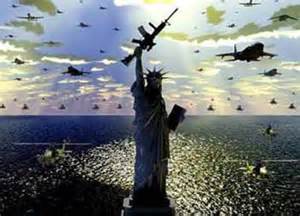
It’s a $cam! The American Way of War in the Twenty-First Century

war-is-money

By Tom Engelhardt

Source: TomDispatch.com

Let’s begin with the $12 billion in shrink-wrapped $100 bills, Iraqi oil money held in the U.S.  The Bush administration began flying it into Baghdad on C-130s soon after U.S. troops entered that city in April 2003.  Essentially dumped into the void that had once been the Iraqi state, at least $1.2 to $1.6 billion of it was stolen and ended up years later in a mysterious bunker in Lebanon.  And that’s just what happened as the starting gun went off.

It’s never ended.  In 2011, the final report of the congressionally mandated Commission on Wartime Contracting estimated that somewhere between $31 billion and $60 billion taxpayer dollars had been lost to fraud and waste in the American “reconstruction” of Iraq and Afghanistan.  In Iraq, for instance, there was that $75 million police academy, initially hailed “as crucial to U.S. efforts to prepare Iraqis to take control of the country’s security.”  It was, however, so poorly constructed that it proved a health hazard.  In 2006, “feces and urine rained from the ceilings in [its] student barracks” and that was only the beginning of its problems.

When the bad press started, Parsons Corporation, the private contractor that built it, agreed to fix it for nothing more than the princely sum already paid.  A year later, a New York Timesreporter visited and found that “the ceilings are still stained with excrement, parts of the structures are crumbling, and sections of the buildings are unusable because the toilets are filthy and nonfunctioning.”  This seems to have been par for the course.  Typically enough, the Khan Bani Saad Correctional Facility, a $40 million prison Parsons also contracted to build, was never even finished.

And these were hardly isolated cases or problems specific to Iraq.  Consider, for instance, those police stations in Afghanistan believed to be crucial to “standing up” a new security force in that country.  Despite the money poured into them and endless cost overruns, many were either never completed or never built, leaving new Afghan police recruits camping out.  And the police were hardly alone.  Take the $3.4 million unfinished teacher-training center in Sheberghan, Afghanistan, that an Iraqi company was contracted to build (using, of course, American dollars) and from which it walked away, money in hand.

And why stick to buildings, when there were those Iraqi roads to nowhere paid for by American dollars? At least one of them did at least prove useful to insurgent groups moving their guerrillas around (like the $37 million bridge the U.S. Army Corps of Engineers built between Afghanistan and Tajikistan that helped facilitate the region’s booming drug trade in opium and heroin).  In Afghanistan, Highway 1 between the capital Kabul and the southern city of Kandahar, unofficially dubbed the “highway to nowhere,” was so poorly constructed that it began crumbling in its first Afghan winter.

And don’t think that this was an aberration.  The U.S. Agency for International Development (USAID) hired an American nonprofit, International Relief and Development (IRD), to oversee an ambitious road-building program meant to gain the support of rural villagers.  Almost $300 million later, it could point to “less than 100 miles of gravel road completed.” Each mile of road had, by then, cost U.S. taxpayers $2.8 million, instead of the expected $290,000, while a quarter of the road-building funds reportedly went directly to IRD for administrative and staff costs.  Needless to say, as the road program failed, USAID hired IRD to oversee other non-transportation projects.

In these years, the cost of reconstruction never stopped growing.  In 2011, McClatchy Newsreported that “U.S. government funding for at least 15 large-scale programs and projects grew from just over $1 billion to nearly $3 billion despite the government’s questions about their effectiveness or cost.”

The Gas Station to Nowhere

So much construction and reconstruction — and so many failures.  There was the chicken-processing plant built in Iraq for $2.58 million that, except in a few Potemkin-Village-like moments, never plucked a chicken and sent it to market.  There was the sparkling new, 64,000-square-foot, state-of-the-art, $25 million headquarters for the U.S. military in Helmand Province, Afghanistan, that doubled in cost as it was being built and that three generals tried to stop.  They were overruled because Congress had already allotted the money for it, so why not spend it, even though it would never be used?  And don’t forget the $20 million that went into constructing roads and utilities for the base that was to hold it, or the$8.4 billion that went into Afghan opium-poppy-suppression and anti-drug programs and resulted in… bumper poppy crops and record opium yields, or the aid funds that somehow made their way directly into the hands of the Taliban (reputedly its second-largest funding source after those poppies).

There were the billions of dollars in aid that no one could account for, and a significant percentage of the 465,000 small arms (rifles, machine guns, grenade launchers, and the like) that the U.S. shipped to Afghanistan and simply lost track of.  Most recently, there was the Task Force for Business Stability Operations, an $800-million Pentagon project to help jump-start the Afghan economy.  It was shut down only six months ago and yet, in response to requests from the Special Inspector General for Afghanistan Reconstruction, the Pentagon swears that there are “no Defense Department personnel who can answer questions about” what the task force did with its money.  As ProPublica’s Megan McCloskey writes, “The Pentagon’s claims are particularly surprising since Joseph Catalino, the former acting director of the task force who was with the program for two years, is still employed by the Pentagon as Senior Advisor for Special Operations and Combating Terrorism.”

Still, from that pile of unaccountable taxpayer dollars, one nearly $43 million chunk did prove traceable to a single project: the building of a compressed natural gas station.  (The cost of constructing a similar gas station in neighboring Pakistan: $300,000.)  Located in an area that seems to have had no infrastructure for delivering natural gas and no cars converted for the use of such fuel, it represented the only example on record in those years of a gas station to nowhere.

All of this just scratches the surface when it comes to the piles of money that were poured into an increasingly privatized version of the American way of war and, in the form ofovercharges and abuses of every sort, often simply disappeared into the pockets of the warrior corporations that entered America’s war zones.  In a sense, a surprising amount of the money that the Pentagon and U.S. civilian agencies “invested” in Iraq and Afghanistan never left the United States, since it went directly into the coffers of those companies.

Clearly, Washington had gone to war like a drunk on a bender, while the domestic infrastructure began to fray.  At $109 billion by 2014, the American reconstruction program in Afghanistan was already, in today’s dollars, larger than the Marshall Plan (which helped put all of devastated Western Europe back on its feet after World War II) and still the country was a shambles. In Iraq, a mere $60 billion was squandered on the failed rebuilding of the country.  Keep in mind that none of this takes into account the staggering billions spent by the Pentagon in both countries to build strings of bases, ranging in size from American towns (with all the amenities of home) to tiny outposts.  There would be 505 of them in Iraq and at least 550 in Afghanistan.  Most were, in the end, abandoned, dismantled, or sometimes simply looted.  And don’t forget the vast quantities of fuel imported into Afghanistan to run the U.S. military machine in those years, some of which was siphoned off by American soldiers, to the tune of at least $15 million, and sold to local Afghans on the sly.

In other words, in the post-9/11 years, “reconstruction” and “war” have really been euphemisms for what, in other countries, we would recognize as a massive system of corruption.

And let’s not forget another kind of “reconstruction” then underway. In both countries, the U.S. was creating enormous militaries and police forces essentially from scratch to the tune of at least $25 billion in Iraq and $65 billion in Afghanistan.  What’s striking about both of these security forces, once constructed, is how similar they turned out to be to those police academies, the unfinished schools, and that natural gas station.  It can’t be purely coincidental that both of the forces Americans proudly “stood up” have turned out to be the definition of corrupt: that is, they were filled not just with genuine recruits but with serried ranks of “ghost personnel.”

In June 2014, after whole divisions of the Iraqi army collapsed and fled before modest numbers of Islamic State militants, abandoning much of their weaponry and equipment, it became clear that they had been significantly smaller in reality than on paper.  And no wonder, as that army had enlisted 50,000 “ghost soldiers” (who existed only on paper and whose salaries were lining the pockets of commanders and others).  In Afghanistan, the U.S. is still evidently helping to pay for similarly stunning numbers of phantom personnel, though no specific figures are available.  (In 2009, an estimated more than 25% of the police force consisted of such ghosts.)  As John Sopko, the U.S. inspector general for Afghanistan,warned last June: “We are paying a lot of money for ghosts in Afghanistan… whether they are ghost teachers, ghost doctors or ghost policeman or ghost soldiers.”

And lest you imagine that the U.S. military has learned its lesson, rest assured that it’s still quite capable of producing nonexistent proxy forces.  Take the Pentagon-CIA program to train thousands of carefully vetted “moderate” Syrian rebels, equip them, arm them, and put them in the field to fight the Islamic State.  Congress ponied up $500 million for it, $384 million of which was spent before that project was shut down as an abject failure.  By then, less than 200 American-backed rebels had been trained and even less put into the field in Syria — and they were almost instantly kidnapped or killed, or they simply handed over their equipment to the al-Qaeda-linked al-Nusra Front.  At one point, according to the congressional testimony of the top American commander in the Middle East, only four or five American-produced rebels were left “in the field.”  The cost-per-rebel sent into Syria, by the way, is now estimated at approximately $2 million.

A final footnote: the general who oversaw this program is, according to the New York Times, still a “rising star” in the Pentagon and in line for a promotion.

Profli-gate

You’ve just revisited the privatized, twenty-first-century version of the American way of war, which proved to be a smorgasbord of scandal, mismanagement, and corruption as far as the eye could see.  In the tradition of Watergate, perhaps the whole system could be dubbed Profli-gate, since American war making across the Greater Middle East has represented perhaps the most profligate and least effective use of funds in the history of modern warfare.  In fact, here’s a word not usually associated with the U.S. military: the war system of this era seems to function remarkably like a monumental scam, a swindle, a fraud.

The evidence is in: the U.S. military can win battles, but not a war, not even against minimally armed minority insurgencies; it can “stand up” foreign militaries, but only if they are filled with phantom feet and if the forces themselves are as hollow as tombs; it can pour funds into the reconstruction of countries, a process guaranteed to leave them more prostrate than before; it can bomb, missile, and drone-kill significant numbers of terrorists and other enemies, even as their terror outfits and insurgent movements continue to grow stronger under the shadow of American air power.  Fourteen years and five failed states later in the Greater Middle East, all of that seems irrefutable.

And here’s something else irrefutable: amid the defeats, corruption, and disappointments, there lurks a kind of success.  After all, every disaster in which the U.S. military takes part only brings more bounty to the Pentagon.  Domestically, every failure results in calls for yet more military interventions around the world.  As a result, the military is so much bigger and better funded than it was on September 10, 2001.  The commanders who led our forces into such failures have repeatedly been rewarded and much of the top brass, civilian and military, though they should have retired in shame, have taken ever more golden parachutes into the lucrative worlds of defense contractors, lobbyists, and consultancies.

All of this couldn’t be more obvious, though it’s seldom said.  In short, there turns out to be much good fortune in the disaster business, a fact which gives the whole process the look of a classic swindle in which the patsies lose their shirts but the scam artists make out like bandits.

Add in one more thing: these days, the only part of the state held in great esteem by conservatives and the present batch of Republican presidential candidates is the U.S. military.  All of them, with the exception of Rand Paul, swear that on entering the Oval Office they will let that military loose, sending in more troops, or special ops forces, or air power, and funding the various services even more lavishly; all of this despite overwhelming evidence that the U.S. military is incapable of spending a dollar responsibly or effectively monitoring what it’s done with the taxpayer funds in its possession.  (If you don’t believe me, forget everything in this piece and just check out the finances of the most expensive weapons system in history, the F-35 Lightning II, which should really be redubbed the F-35 Overrun for its madly spiraling costs.)

But no matter. If a system works (particularly for those in it), why change it?  And by the way, in case you’re looking for a genuine steal, I have a fabulous gas station in Afghanistan to sell you…


Tom Engelhardt is a co-founder of the American Empire Project and the author of The United States of Fear as well as a history of the Cold War, The End of Victory Culture. He is a fellow of the Nation Institute and runs TomDispatch.com. His latest book is Shadow Government: Surveillance, Secret Wars, and a Global Security State in a Single-Superpower World.

The Upheaval Dialogues: 2012 Reconsidered

2012_1

By Christopher Knowles

Source: The Secret Sun

Before my trip to New Hampshire I was working on a post arguing that the 2012 prophecies were not incorrect but simply premature. That 2012 seemed to mark a turning point of a sort, a distinct change in the worldwide weather, if you will. You can point to to 2012 and see a number of trends that have metastasized since then, in the geopolitical situation, but also in our politics, in the economy, in social relations.

A lot of this is cynical manipulation, a reaction to the legitimate threat once posed by the Occupy movement. We’re seeing a lot of gamesmanship at work, a lot of people being given the rope with which to hang themselves. That will become more apparent by this time next year. Politics at every level is all smoke and mirrors today- believe nothing you see.

But there’s something much deeper at work. We’re seeing mass die-offs of wildlife, particularly that of sealife, all over the world. Most troubling are the mass die-offs of bees, animals that our food supply is so dependent on. Whether through carbon emissions or through geoengineering, we’re also seeing dangerous levels of pollen on the increase and the attendant increase in respiratory illness.

And there have been attendant signs in the sky- the Sun seems to have gone quiet, perhaps presaging a long and difficult period of solar inactivity, one that could presage a mini-ice age. After years of mocking “believers,” scientists are once again recognizing that there are two giants beyond Pluto (one may be a brown dwarf)*.

What effect they might have on our planet is debatable (some claim they are the source of all the invaders we’ve come to worry so much about; asteroids, meteors, etc), there’s no shortage of “Nibiru” scare mongers on the Internet preaching apocalypse one minute, then selling “survival” trinkets and gimcracks in order to stave off your doom the next.

We’ve also seen strange signs on the earth- a rise in earthquake and volcanic activity (a major volcano could block out the Sun for many parts of the world, causing famine), an increase in gigantic sinkholes (massive hollowing out of the surface layer of the earth) and in the Pacific, violent typhoons. Hurricane season in the Atlantic has been relatively quiet since 2012’s Superstorm, but that might be the literal calm before the storm.

And of course, there is the endless drumbeat of war. There is the endless slaughter and massive displacement in the Middle East (with ancient Gnostic sects such as the Druze, Yazidi and Alawites targeted for genocide by Jihadists) and the growing tension in Eastern Europe. There’s also the uptick in terrorism in Europe (Charlie Hebdo, the attack in France today), although intolerable is not even a speck of the carnage people elsewhere in the world suffer on a daily basis, especially as struggles between Sunni and Shi’a Muslims escalate to global proportions. Syria, Yemen, Pakistan…the list of sectarian carnage is mind-numbing.

Toothless NATO protectorates like Sweden are easy targets for the Sino-Russian ascendancy, which is why the US is moving heavy artillery in the area. But the state of constant war is such that drone pilots are reporting record levels of stress and burn-out.

Poltical and social tensions have increased in this country, though in comparison to what’s going on in the rest of the world it seems like a footnote (certainly the endless political bickering on the ‘Net does). On a personal level, I’m seeing so many people I care about under serious stress. It’s as if the entire solar system is in convulsions, from the macrocosm to the microcosm.

As many of us warned about, the corporate Christianity of the 80s and 90s has sparked an enormous backlash, with many young people walking away from religion (and pretty much everything else) entirely. Church leaders are now realizing the error of their shotgun wedding to partisan politics, even as Christianity rises in ways once unimagined in Africa, Russia and China.

But the collapse of religious faith especially among vulnerable working class populations has left a huge void, one which pandemic drug abuse is filling.

A deep and abiding nihilism has gripped the entire world– not just the West– and all of the chaos and upheaval we are seeing now is a symptom of that. 

What is going to heal that?

Science is increasingly proving itself to be corrupt and compromised. Transhumanism (now just a fading dream, despite some of the hysteria you still see) won’t fill the void, virtual reality (which never has and probably never will live up to its hype) won’t fill the void, forcing the world in a Borghive will just make magnify the problem, just as the Internet can turn a quiet, Type B “nice guy” or “nice girl” into a raging, misanthropic troll.

So was 2012 the turning point? The beginning of a period of upheaval? Hollywood sells us the myth of overnight apocalypse (“The Day After Tomorrow”) but history teaches us that periods of upheaval are slow in getting started, so much so that they are hardly recognized as such until it’s too late.

History also teaches us that chaos has its own genius and often turns on the men who seek to unleash it for their own benefit. We’re not seeing true chaos on a worldwide scale yet, but the beast is straining at its leash, that’s for certain.

And you can also bet the farm that we’ll see what Jacques Vallee calls the “Control System” awake from its slumber. It already has, though that too has largely gone unnoticed. But not for much longer.

You will live in interesting times…

UPDATE: Speaking of which, are you watching what’s going on in the Chinese Stock Market?

UPDATE: The weaponization of space is proceeding apace, ostensibly to counter threats from China and Russia. There are strange linguistic undertones in the press release, however….


*The reason I don’t pay any attention to astronomers’ bold claims of distant solar systems is that they have no friggin’ idea what’s floating around in ours. Or they do and are lying about it. Either way.