Mental Health Round-Ups: The Next Phase of the Government’s War on Thought Crimes

By John & Nisha Whitehead

Source: The Rutherford Institute

“There are no dangerous thoughts; thinking itself is a dangerous activity.”—Hannah Arendt

Get ready for the next phase of the government’s war on thought crimes: mental health round-ups and involuntary detentions.

Under the guise of public health and safety, the government could use mental health care as a pretext for targeting and locking up dissidents, activists and anyone unfortunate enough to be placed on a government watch list.

If we don’t nip this in the bud, and soon, this will become yet another pretext by which government officials can violate the First and Fourth Amendments at will.

This is how it begins.

In communities across the nation, police are being empowered to forcibly detain individuals they believe might be mentally ill, based solely on their own judgment, even if those individuals pose no danger to others.

In New York City, for example, you could find yourself forcibly hospitalized for suspected mental illness if you carry “firmly held beliefs not congruent with cultural ideas,” exhibit a “willingness to engage in meaningful discussion,” have “excessive fears of specific stimuli,” or refuse “voluntary treatment recommendations.”

While these programs are ostensibly aimed at getting the homeless off the streets, when combined with advances in mass surveillance technologies, artificial intelligence-powered programs that can track people by their biometrics and behavior, mental health sensor data (tracked by wearable data and monitored by government agencies such as HARPA), threat assessments, behavioral sensing warnings, precrime initiatives, red flag gun laws, and mental health first-aid programs aimed at training gatekeepers to identify who might pose a threat to public safety, they could well signal a tipping point in the government’s efforts to penalize those engaging in so-called “thought crimes.”

As the AP reports, federal officials are already looking into how to add “‘identifiable patient data,’ such as mental health, substance use and behavioral health information from group homes, shelters, jails, detox facilities and schools,” to its surveillance toolkit.

Make no mistake: these are the building blocks for an American gulag no less sinister than that of the gulags of the Cold War-era Soviet Union.

The word “gulag” refers to a labor or concentration camp where prisoners (oftentimes political prisoners or so-called “enemies of the state,” real or imagined) were imprisoned as punishment for their crimes against the state.

The gulag, according to historian Anne Applebaum, used as a form of “administrative exile—which required no trial and no sentencing procedure—was an ideal punishment not only for troublemakers as such, but also for political opponents of the regime.”

Totalitarian regimes such as the Soviet Union also declared dissidents mentally ill and consigned political prisoners to prisons disguised as psychiatric hospitals, where they could be isolated from the rest of society, their ideas discredited, and subjected to electric shocks, drugs and various medical procedures to break them physically and mentally.

In addition to declaring political dissidents mentally unsound, government officials in the Cold War-era Soviet Union also made use of an administrative process for dealing with individuals who were considered a bad influence on others or troublemakers. Author George Kennan describes a process in which:

The obnoxious person may not be guilty of any crime . . . but if, in the opinion of the local authorities, his presence in a particular place is “prejudicial to public order” or “incompatible with public tranquility,” he may be arrested without warrant, may be held from two weeks to two years in prison, and may then be removed by force to any other place within the limits of the empire and there be put under police surveillance for a period of from one to ten years.

Warrantless seizures, surveillance, indefinite detention, isolation, exile… sound familiar?

It should.

The age-old practice by which despotic regimes eliminate their critics or potential adversaries by making them disappear—or forcing them to flee—or exiling them literally or figuratively or virtually from their fellow citizens—is happening with increasing frequency in America.

Now, through the use of red flag lawsbehavioral threat assessments, and pre-crime policing prevention programs, the groundwork is being laid that would allow the government to weaponize the label of mental illness as a means of exiling those whistleblowers, dissidents and freedom fighters who refuse to march in lockstep with its dictates.

That the government is using the charge of mental illness as the means by which to immobilize (and disarm) its critics is diabolical. With one stroke of a magistrate’s pen, these individuals are declared mentally ill, locked away against their will, and stripped of their constitutional rights.

These developments are merely the realization of various U.S. government initiatives dating back to 2009, including one dubbed Operation Vigilant Eagle which calls for surveillance of military veterans returning from Iraq and Afghanistan, characterizing them as extremists and potential domestic terrorist threats because they may be “disgruntled, disillusioned or suffering from the psychological effects of war.”

Coupled with the report on “Rightwing Extremism: Current Economic and Political Climate Fueling Resurgence in Radicalization and Recruitment” issued by the Department of Homeland Security (curiously enough, a Soviet term), which broadly defines rightwing extremists as individuals and groups “that are mainly antigovernment, rejecting federal authority in favor of state or local authority, or rejecting government authority entirely,” these tactics bode ill for anyone seen as opposing the government.

Thus, what began as a blueprint under the Bush administration has since become an operation manual for exiling those who challenge the government’s authority.

An important point to consider, however, is that the government is not merely targeting individuals who are voicing their discontent so much as it is locking up individuals trained in military warfare who are voicing feelings of discontent.

Under the guise of mental health treatment and with the complicity of government psychiatrists and law enforcement officials, these veterans are increasingly being portrayed as ticking time bombs in need of intervention.

For instance, the Justice Department launched a pilot program aimed at training SWAT teams to deal with confrontations involving highly trained and often heavily armed combat veterans.

One tactic being used to deal with so-called “mentally ill suspects who also happen to be trained in modern warfare” is through the use of civil commitment laws, found in all states and employed throughout American history to not only silence but cause dissidents to disappear.

For example, NSA officials attempted to label former employee Russ Tice, who was willing to testify in Congress about the NSA’s warrantless wiretapping program, as “mentally unbalanced” based upon two psychiatric evaluations ordered by his superiors.

NYPD Officer Adrian Schoolcraft had his home raided, and he was handcuffed to a gurney and taken into emergency custody for an alleged psychiatric episode. It was later discovered by way of an internal investigation that his superiors were retaliating against him for reporting police misconduct. Schoolcraft spent six days in the mental facility, and as a further indignity, was presented with a bill for $7,185 upon his release.

Marine Brandon Raub—a 9/11 truther—was arrested and detained in a psychiatric ward under Virginia’s civil commitment law based on posts he had made on his Facebook page that were critical of the government.

Each state has its own set of civil, or involuntary, commitment laws. These laws are extensions of two legal principlesparens patriae Parens patriae (Latin for “parent of the country”), which allows the government to intervene on behalf of citizens who cannot act in their own best interest, and police power, which requires a state to protect the interests of its citizens.

The fusion of these two principles, coupled with a shift towards a dangerousness standard, has resulted in a Nanny State mindset carried out with the militant force of the Police State.

The problem, of course, is that the diagnosis of mental illness, while a legitimate concern for some Americans, has over time become a convenient means by which the government and its corporate partners can penalize certain “unacceptable” social behaviors.

In fact, in recent years, we have witnessed the pathologizing of individuals who resist authority as suffering from oppositional defiant disorder (ODD), defined as “a pattern of disobedient, hostile, and defiant behavior toward authority figures.” Under such a definition, every activist of note throughout our history—from Mahatma Gandhi to Martin Luther King Jr.—could be classified as suffering from an ODD mental disorder.

Of course, this is all part of a larger trend in American governance whereby dissent is criminalized and pathologized, and dissenters are censored, silenced, declared unfit for society, labelled dangerous or extremist, or turned into outcasts and exiled.

Red flag gun laws (which authorize government officials to seize guns from individuals viewed as a danger to themselves or others), are a perfect example of this mindset at work and the ramifications of where this could lead.

As The Washington Post reports, these red flag gun laws “allow a family member, roommate, beau, law enforcement officer or any type of medical professional to file a petition [with a court] asking that a person’s home be temporarily cleared of firearms. It doesn’t require a mental-health diagnosis or an arrest.

With these red flag gun laws, the stated intention is to disarm individuals who are potential threats.

While in theory it appears perfectly reasonable to want to disarm individuals who are clearly suicidal and/or pose an “immediate danger” to themselves or others, where the problem arises is when you put the power to determine who is a potential danger in the hands of government agencies, the courts and the police.

Remember, this is the same government that uses the words “anti-government,” “extremist” and “terrorist” interchangeably.

This is the same government whose agents are spinning a sticky spider-web of threat assessments, behavioral sensing warnings, flagged “words,” and “suspicious” activity reports using automated eyes and ears, social media, behavior sensing software, and citizen spies to identify potential threats.

This is the same government that keeps re-upping the National Defense Authorization Act (NDAA), which allows the military to detain American citizens with no access to friends, family or the courts if the government believes them to be a threat.

This is the same government that has a growing list—shared with fusion centers and law enforcement agencies—of ideologies, behaviors, affiliations and other characteristics that could flag someone as suspicious and result in their being labeled potential enemies of the state.

For instance, if you believe in and exercise your rights under the Constitution (namely, your right to speak freely, worship freely, associate with like-minded individuals who share your political views, criticize the government, own a weapon, demand a warrant before being questioned or searched, or any other activity viewed as potentially anti-government, racist, bigoted, anarchic or sovereign), you could be at the top of the government’s terrorism watch list.

Moreover, as a New York Times editorial warns, you may be an anti-government extremist (a.k.a. domestic terrorist) in the eyes of the police if you are afraid that the government is plotting to confiscate your firearms, if you believe the economy is about to collapse and the government will soon declare martial law, or if you display an unusual number of political and/or ideological bumper stickers on your car.

Let that sink in a moment.

Now consider the ramifications of giving police that kind of authority in order to preemptively neutralize a potential threat, and you’ll understand why some might view these mental health round-ups with trepidation.

No matter how well-meaning the politicians make these encroachments on our rights appear, in the right (or wrong) hands, benevolent plans can easily be put to malevolent purposes.

Even the most well-intentioned government law or program can be—and has been—perverted, corrupted and used to advance illegitimate purposes once profit and power are added to the equation.

The war on terror, the war on drugs, the war on illegal immigration, the war on COVID-19: all of these programs started out as legitimate responses to pressing concerns and have since become weapons of compliance and control in the government’s hands. For instance, the very same mass surveillance technologies that were supposedly so necessary to fight the spread of COVID-19 are now being used to stifle dissent, persecute activists, harass marginalized communities, and link people’s health information to other surveillance and law enforcement tools.

As I make clear in my book Battlefield America: The War on the American People and in its fictional counterpart The Erik Blair Diaries, we are moving fast down that slippery slope to an authoritarian society in which the only opinions, ideas and speech expressed are the ones permitted by the government and its corporate cohorts.

We stand at a crossroads.

As author Erich Fromm warned, “At this point in history, the capacity to doubt, to criticize and to disobey may be all that stands between a future for mankind and the end of civilization.”

Another Reason Young Americans Don’t Revolt Against Being Screwed

By

Source: CounterPunch

8 Reasons Young Americans Don’t Fight Back: How the US Crushed Youth Resistance” was originally published in 2011, then republished on several Internet sites, and has become one of my most viewed articles. The eight reasons include: student-loan debt; various pacifying effects of standard schooling; the psychopathologizing and medicating of noncompliance; surveillance; television; and fundamentalist religion and fundamentalist consumerism. Over the last seven years, many young people have told me that they appreciate that article, but they have urged me to detail a hugely important pacifying source which I had not included.

First, to be clear, not all young people are completely broken. The general state of acquiescence by young people was recently interrupted by their short-lived burst of dissent in the form of large rallies for gun control, in reaction to fears of being murdered in their classrooms. But that was an exception to the general rule of resignation to eating shit.

A longer period of dissent occurred during Occupy, in which many young people protested against their financial subjugation by the 1%. However, one lesson that young people learned from Occupy is that their rulers only pay lip service to democracy—and so mere dissent has little impact. Young people today are correct to recognize the impotence of mere dissent if it is unaccompanied by a withdrawal of cooperation with the ruling class’s capacity to turn a profit. But because young people have been broken in so many ways, decreasing numbers of them have the individual strength, class consciousness, and group cohesiveness that is required to move beyond dissent to the kind of constructive disobedience (for example, a labor strike) that can create greater justice for them.

It’s not that young people in the United States are ignorant of the reality that they are being financially screwed; they know they have been screwed, they expect to be screwed even worse, and most of them passively accept this reality.

Young people are not ignorant of their increasingly crippling student-loan debt. At last look, 70% of college students graduate with significant debt; the average student-loan debt at $37,172, and the average monthly payment at $393 (and this doesn’t include their credit card debt). Add this to the reality that many young people with student-loan debt never even graduate college; and even among those who do graduate, many of them find only low-paying jobs.

The majority of young people feel so beaten down that they have also passively accepted that they will get screwed out of Social Security benefits. A 2015 Gallup poll asked “Do you think the Social Security system will be able to pay you a benefit when you retire?” Among those 18 to 29 years of age, 64% said no. Yet, most are resigned to having money deducted from their paychecks for benefits that they believe they will never receive.

Since my 2011 article was published, many millennials have informed me that they are being broken by something that I hadn’t originally included: the Internet, which many of them tell me is the most important aspect of their lives. From these young people, I have learned how the Internet creates fears, lowers self-esteem, and divides them—all of which weakens their capacity to resist injustices.

Fear is a great way to break people, and the Internet—similar to other areas that I had previously detailed—creates fear. Facebook, Twitter, Instagram, Tumblr, Snapchat, and other so-called “social media” create the fear of permanent shame and shunning. Millennials repeatedly see how a single error in judgment on social media will not be forgotten and can haunt forever—and destroy lives. While many young students voice concern about a shooting in their school, my experience is that they are more viscerally terrified of something being posted on social media by them or about them that can damage their attractiveness to their peers or to future employers. For young people, denial over their life being ruined on social media is impossible—most never unplug from it.

The Internet heightens a fear-based consciousness. People have different private fears and, as George Orwell detailed, their greatest fears can be exploited to break them. For many young people, their greatest fear is being “doxxed”—having private information about them published on the Internet so as to hurt them. For other young people, their greatest fear is “FoMo”—the fear of missing out—which is intensified on social media where they are constantly bombarded with images of others doing “cool” stuff. One young woman recently told me, “You don’t know how crazy we are. I saw a party on Instagram that looked really cool, and I had FoMo over it, even though I know the guy who posted it always makes parties look cooler than they really are.”

Many young people tell me that the constant barrage of their peers’ self-promotions on social media makes them feel inferior; and low self-esteem—like fear—debilitates the strength to resist. One young man recently explained to me that millennials are always aware of their “digital selves” which can be measured in metrics such as “likes”; and that comparing themselves to others routinely results in low self-esteem. Of course, some young people do attempt rebellion, but effective rebellion, they tell me, requires completely extricating from social media, which would be an extremely radical action.

Not only does the Internet create fear and low self-esteem but also divides, which of course allows the 1% to more easily conquer the 99%. The Gilded Age robber barron Jay Gould reportedly bragged, “I can hire one half of the working class to kill the other half.” Millenials have educated me on the various divides among the 99% that have been created and perpetuated on the Internet.

Every millennial young man tells be about the Internet war between “social justice warriors” and “red pillers.” Young people who care about justice for historically oppressed groups (such as women, people of color, and LGBT folks) are mocked as social justice warriors by those who call themselves red pillers who feel that, today, white males are the oppressed group. In an Internet world absent of face-to-face contact, there is only mutual venom. Absent is a mutual grasping that each side is in the 99%, that each side cares about injustice, and that the financial hell for all of them has been created by the 1%—not by each other.

Screen addiction subverts the in-person contact necessary for face-to-face dialogue and solidarity, and the Internet is even more addictive than television, as young people are virtually never away from their smart phones, laptops, or other screens. Walk into any coffee shop, and you’ll often see many young people in close proximity with one another but locked into their own screens and not looking at each other.

Several of my millennial young male informants tell me that they are afraid to risk face-to-face contact, afraid to be seen as violating a woman’s privacy, afraid to be viewed as a creep. I joked with one young guy, “Are you afraid that if you walk over to some pretty young woman in a coffee shop and tell her that you like her shoes, then you’ll be accused of ‘rape-staring’ and have your life ruined on the Internet, and end up being falsely labeled all over the Internet as a sex offender?” The young man laughed and said, “I know that you are exaggerating, but that’s the kind of shit that many of us millennial guys think about, as we have become pathetic.”

Having young men and young women in the 99% being afraid of one another may be even more of a coup for the 1% than their historical successes at getting ethnic and racial groups to hate one another. With this fear and hate among the 99%, it is impossible to have the solidarity and strength necessary to effectively revolt in an organized way against the 1%.

The Internet technology need not necessarily be a pacifying force as, for example, the Internet was effectively utilized during the Arab spring to foment rebellion and organize resistance. Similarly, some of the other pacifying forces that I originally detailed need not be pacifying. Teachers could inspire resistance against illegitimate authorities rather than indoctrinate compliance to any and all authorities. And my fellow mental health professionals could embrace liberation psychology rather than pathologize and medicate rebellion.

My experience is that young people, in general, are becoming increasingly pained and weakened by multiple oppressive forces, and older people who give a damn about them can help. The 1% will always attempt to seize powerful technologies and institutions to pacify all of us—especially young people. To manage these technologies and institutions, the 1% needs technocrats, administrators, and guards; thus, what would help is what Howard Zinn called a “revolt of the guards.” However, if technicians, teachers, mental health professionals, and other guards never even admit to ourselves our societal role—as guards who maintain the status quo—then we guards will never consider a revolt. Many older people are guards, and they can choose to revolt and help young people gain the strength necessary to resist injustices.


Bruce E. Levine, a practicing clinical psychologist often at odds with the mainstream of his profession, writes and speaks about how society, culture, politics and psychology intersect. His most recent book is Resisting Illegitimate Authority: A Thinking Person’s Guide to Being an Anti-Authoritarian―Strategies, Tools, and Models(AK Press, September, 2018). His Web site is brucelevine.net

First Do No Harm

By Emmy Bee

Source: Dissident Voice

Let me preface what I am about to say by stating that I have the utmost esteem for mainstream medicine’s skill in emergency situations — the do or die surgeries, the dispensing of powerful life-saving drugs necessary in that setting are second to none; and its mastery of cosmetic surgery in cases of deformities and the advances made in prosthetics are nothing less than spectacular. These are what make mainstream medicine great.

I would also like to add that I am not an expert of any kind. I hold no degrees or certifications, and neither do I represent, belong to, or work for any party, organization or corporation. I speak for myself, a sixty-two year old woman, and from my experiences with, and extensive research of, a topic I find fascinating, intriguing and bothersome — mainstream medicine and how the belief in its infallibility harms us in so many ways.

The pompous certainty of mainstream medicine’s powerful proponents — be they multi-billion dollar pharmaceutical companies, medical associations, disease-specific charities, government agencies, Madison Avenue selling the diseases and the pills, TV or magazines, the news media parroting its cash cow’s every claim — combined have most people, hook, line and sinker, believing in the impeccable record of mainstream medicine. No questions asked.

Here, I would like to throw out some alarming statistics — ones that can be easily found in a variety of journals from Forbes to JAMA to CounterPunch, etc.

The estimated annual mortality rate for adverse drug reactions to “correctly” prescribed drugs is the 5th leading cause of death in the U.S.1 Over the counter (OTC) cold medications are among the top twenty substances causing death in children.2 Used according to direction, NSAIDs (Non-Steroidal Anti-inflammatory Drugs) are responsible for more than 20,000 deaths every year.3 There are over 400,000 deaths each year from drug and medical errors and tens of thousands more deaths from unnecessary procedures.4 Add those together and mainstream medicine is the third leading cause of death in the U.S.

So, why is it that most people trust, without question, the omnipotence of mainstream medicine in the same way religious zealots believe in their chosen religion or atheists in theirs? When well over 200,000 people die in the U.S. each year from prescription drug use alone — not abuse, but use; when we spend more, per capita than any other nation on earth and yet our health indices and life expectancy are near the bottom of all other developed nations5 why is there no sense of outrage (except for price gouging!) or, at the very least, a sense that something is not right, that something is terribly wrong?

Yet, as has happened many times, should a doctor, a scientist, a researcher or a curious layperson question conventional medical creed the herald is quickly battered down with jeers of derision, and swiftly “discredited” and shunned by the medical community. The media then parrots what they are told and soon everyone is asking, “How dare they question science? Haven’t they heard of collateral damage? Every war (and they are constantly reminding us of the war we are fighting against diseases) has collateral damage”. Yet when a few people die from dirty spinach, improper use of some herbal product, or a handful of people (some even vaccinated) catch the measles (and live to tell about it!) panic overruns the media.

Does anyone remember or know of the ad campaigns telling us that “nine out of ten doctors smoke Camel cigarettes” or that DDT pesticide spray is “good for you!”? We may laugh now but what about the more recent debacles such as HRT (hormone replacement therapy), Vioxx, swine flu vaccines and GMOs — all of which received the seal of approval from industry scientists, government agencies and all were pushed by Madison Ave. — just like the cigarettes given to my father for heart disease and the DDT sprayed on everything in sight, including children.

The number of TV commercials for drugs, medical clinics, hospitals, and doctor-related reality TV shows is mind blowing. It is a constant barrage of “a pill for every ill” and “don’t forget to ask your doctor about it”, while people with vapid eyes move in slow motion through white rooms or a meadow filmed through gauze, while a voice, soft and soothing, tells you of the pill’s benefits and then the same voice, just as soft but at breakneck speed, spews a partial list of possible side effects and a series of unwanted symptoms, some of which sound, and are (such as death) worse than the “disease” itself.

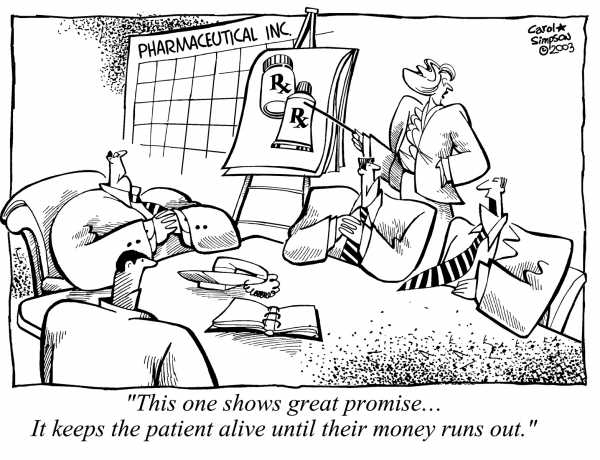
And interspersed between the ad for an over-the-counter (OTC) medication that had not long ago been given “by prescription only” and another ad for the new six story billion dollar specialty clinic are yet more commercials inviting us to join in what has become a celebration of you fill in the blank disease. There’s a “walk” or a “run”, even a paddle! for this disease and a different colored “ribbon” for that disease. It is almost as if having a disease has become the new “in” thing — fashionable, admirable, heroic even.  Are we being groomed to embrace our diseases, while at the same time being told to give, give, give to find a “cure”? According to Dr. Robert Sharpe, author of The Cruel Deception, a book about animal testing in medical research,” . . . in our culture treating disease is enormously profitable, preventing it is not.”

We have been told we are living longer but the sad fact is that the trend has reversed and now for the first time in decades life expectancy has dropped in the U.S.6 Even more alarming is that, along with adults, the number of children with chronic diseases has risen sharply. Think about it. How many of us make it past seventy (hell, even sixty!) without some major medical catastrophe (or two) requiring surgery and/or special apparatuses to help us do what used to come naturally and/or prescribed no less than three or four drugs? And how many “new” (iatrogenic) diseases do we then acquire from taking those drugs or undergoing those procedures that require even more drugs and/or more procedures?

And just what is conventional medicine’s track record for curing disease — any disease — not palliation or suppression or masking (all of which suppress and weaken the immune system) — but curing?  Forty years ago I knew one woman with breast cancer while today I know dozens, all of who underwent tortuous procedures, surgeries and drugging, and yes, some of them died. And why is it that when people die after making use of conventional medicine — surgery, chemotherapy, drugs, etc. — there are no cries of foul against their choice of healthcare? Instead they are hailed as heroes who fought a courageous battle, but when someone dies after trying an alternative medicine the cries against their choice are nothing less than vitriolic, as if no one ever dies using mainstream medicine, when in actuality many thousands die each year from mishaps alone, never mind the many hundreds of thousands who die from the diseases that have remained rampant — heart disease, cancer and diabetes, etc.7

Despite unprecedented technical and scientific advances, mainstream medicine’s only answer to disease is to destroy—with toxic substances, ingested or injected, with life-threatening procedures and with the removal of diseased (and often times healthy) body parts.  Kill germs, fight cancer, destroy cells, kick (name a disease)’s ass, crush, terminate, rub out, blast; never build up, heal, cure. Are we, as a society, even capable of imagining alternatives to mainstream medicine? I once told an MD I knew that a friend’s kidney stone passed with relative ease after drinking a herbal tea prescribed by an Acupuncturist. “If there was something out there that can do that,” he told me, “we would know about it”.  Not with that attitude!

When contemplating all that led up to the economic debacle of 2008, I would venture to guess that most people would be leery now (if they weren’t already!) of any advise given by the banking industry and Wall Street concerning, let’s say, home loans. And the same wariness would prevail when listening to the oil or coal industries’ take on environmental issues, or the weapons makers’ spin on whether to go to war or sell arms, or the pesticide- producing conglomerates on the safety of their products. The conflict of interest in each case should be obvious because when one considers that the very ones who profit by limiting the field of allowable research, who selectively choose among research papers to discredit alternative theories or boost their own are the very ones who control the message, it becomes obvious that we are seeing conflict of interest on a massive scale.

And, what of the research done by pharmaceutical companies that tell us a certain drug, or procedure, or vaccine is safe and effective? Does it make you comfortable to know that President Obama’s pick for FDA (Food and Drug Administration) Commissioner, Robert Califf, had received research funds from twenty-five drug companies while director of Duke University clinical research department where a major research fraud scandal had erupted under his watch8 or that Julie Gerderding, former head of the CDC (Center for Disease Control) concealed and then destroyed evidence of a link between the MMR vaccine and autism in African-American boys9, and yet congress refuses to subpoena her and the whistleblower from the CDC and the media never mentions it, and that this same Julie Gerderding left the CDC to become the president of Merck’s vaccine division and then executive VP of Merck, the sole manufacturer of the MMR vaccine? These examples are just two of many that are not only about a colossal conflict of interest but also about a dangerous threat to true scientific discovery affecting millions of lives.

So, why is it that pharmaceutical companies (which, by the way, have more lobbyists than there are members of congress and the senate combined) and which have a woeful track record when it comes to conflict of interest in medical research, drug research and alternative medicine viability research, are given a pass, a green light, a pat on the back of confidence and, besides, are vehemently defended and vociferously cheered on? What marketing magic do they spin that makes people overlook their complicity in fraudulent research, their over-the-top demonizing of opposing viewpoints, and above all their abhorrent safety record?

Why can’t we question the effectiveness, the safety or the necessity of some vaccines without being rudely shouted down?  I wonder if those who shout the, “Shut up! They are safe!” mantra have ever taken the time to study the long history of infectious disease and the history of vaccine use? Do they know there are no long-term studies on the effects of vaccines, or that vaccinated people are not necessarily protected from the diseases they are vaccinated against, or that the pharmaceutical companies and the government agencies refuse to do a vaccinated vs. unvaccinated population study as to their overall health indices, that vaccines, unlike other drugs are not tested against a placebo but against another vaccine, or that childhood infectious diseases had been on a downward trend for many years (measles deaths had declined by almost 100 percent!) well before vaccines were introduced as had many of the other infectious diseases — running their course, improving as our sanitary conditions and treatment of the illness improved?  So, why not let them continue to decline until they naturally disappear? Why introduce crude disease substances and a mixture of lethal chemicals (of which no one knows or bothers to test their long-term effects) into our bodies in an attempt to eradicate diseases that seemed to be doing a fine job of doing just that naturally?

Could there be a connection between the plethora of “new” or increasing diseases and the crude drugs (including vaccines) we have been putting into our bodies for decades now? If we stop to think about it does it make sense to inject ourselves with hazardous material we know nothing about to prevent diseases like the measles, mumps and the flu and others that are now so simple to treat?

But we are told, ad nauseam, to, “Shut up and just get your shots! All your questions have already been answered!”  However, when you look behind the scenes of medical research and find the pharmaceutical companies paying the bills, writing the reports and working closely with government agencies, research colleges, medical journals and the media to get their message out, it should raise a red flag.

What is the great harm brought about by this absolutism of the proponents of mainstream medicine? There are many but two are outstanding. One is that freedom of choice in one’s healthcare decisions can and will be taken away — it has begun already and is picking up momentum. I do not use conventional medicine except in some emergency situations, but that doesn’t mean I wouldn’t fight for the right of others to choose to use it exclusively if they believe it to be their best or only option. Being comfortable with one’s healthcare choice is, I firmly believe, of utmost importance. Yet if it were up to many people I should not be allowed to choose the kind of healthcare I want for my family and me.

And secondly, that same vitriolic certainty and insular thinking is truly harmful to the very essence of scientific inquiry. Great discoveries could be ignored simply because of a refusal to look beyond what we are told is scientifically acceptable today, the realm of inquiry having been limited by the greed of those in power and their manipulation of the masses by way of the fear factor.

  1. To Err is Human: Building a Safer Healthcare System: Institute of Medicine, Committee on Quality of Health Care in America, 2000.
  2. 2009 annual report of the American Association of Poison Control Centers’ National Poison Data System (27th report).
  3. Healing the NSAID Nation, E. Goldman, 2012.
  4. Leah Binder, Stunning News on Preventable Deaths in Hospitals, September 23, 2013; see also: Gary Null, PhD; Carolyn Dean MD, ND; Martin Feldman, MD; Debora Rasio, MD; and Dorothy Smith, PhD. Death by Medicine, Integral Options Cafe, January 12, 2010.
  5. Numbeo. Health Care Index for Country 2016.
  6. Public Health, Life Expectany in the U.S. drops for First Time in Decades, Report Finds, Health News from NPR, December 8, 2016.
  7. The Marshall Protocol Knowledge Base, Autoimmunity Research Foundation.
  8. Martha Rosenberg, Obama’s Latest FDA Nominee: No Hidden Big Pharma Links, They are all in Plain Sight, Counterpunch, November 19, 2015.
  9. Sharyl Attkisson, CDC Scientist:  “We scheduled Meeting to Destroy Vaccine Autism Study Documents“, March 23, 2016.

Breaking the chains: precarity in the Age of Anxiety

breaking-the-chainsBy Joseph Todd

Source: RoarMag.org

In our Age of Anxiety, society assaults us from every possible angle with an avalanche of uncertainty. How do we fight back under conditions of precarity?

­An Age of Anxiety is upon us, one where society assaults us from every possible angle with an avalanche of uncertainty, fear and alienation. We live with neither liberty nor security but instead precariousness. Our housing, our income and our play are temporary and contingent, forever at the whim of the landlord, policeman, bureaucrat or market. The only constant is that of insecurity itself. We are gifted the guarantee of perpetual flux, the knowledge that we will forever be flailing from one abyss to another, that true relaxation is a bourgeois luxury beyond our means.

Our very beings come to absorb this anxiety. We internalize society’s cruelty and contradiction and transform them into a problem of brain chemistry, one that is diagnosed and medicated away instead of being obliterated at root. All hope is blotted out. Authentic experience, unmediated conversation, distraction-free affection and truly relaxed association feel like relics of a bygone era, a sepia dream that perhaps never existed.

Instead we have the frenetic social arenas of late capitalism: the commodified hedonism of clubs and festivals, express lunches, binge culture and the escapist, dislocating experience of online video games, all underlined by either our desperate need to numb our anxieties or to create effective, time-efficient units of fun so we are available for work and worry.

This is assuming we have work, of course. Many of us are unemployed, or are instead held in constant precarity. Stuck on zero-hour contracts or wading through as jobbing freelancers in industries that used to employ but don’t anymore, we are unable to plan our lives any further than next week’s rota, unable to ever switch off as the search for work is sprawling and continuous.

And if we do have traditional employment, what then? We are imprisoned and surveilled in the office, coffee shop or back room, subject to constant assessment, re-assessment and self-assessment, tracked, monitored and looped in a perpetual performance review, one which even our managers think is worthless, but has to be done anyway because, hey, company policy.

Continuous is the effective probationary period and we are forever teetering on the edge of unemployment. We internalize the implications of our constant assessment, the knowledge that we’re always potentially being surveilled. We censor ourselves. We second-guess ourselves. We quash ourselves.

And thanks to the effective abolition of the traditional working day, work becomes unbearable and endless. The security of having delineated time — at work and then at play — has been eradicated. Often this is because individuals have to supplement their atrocious wages with work on the side. But it is also because traditional 9-to-5 jobs have suffered a continuous extension of working hours into out-of-office time, enabled and mediated by our laptops and smartphones. These gadgets demand immediacy and, when coupled with the knowledge that you are always reachable and thus available, they instill in us a frantic need to forever reply in the now.

And with this expectation comes obligation. Hyper-networked technologies gift our bosses the ability to demand action from us at any moment. Things that had to wait before become doable — and thus are done — in the now. If you are unwilling, then someone is ready to take your place. You must always be at their beck and call. From this, our only refuge is sleep, perhaps the last bastion of delineated time against frenetic capitalism, and one that is being gradually eroded and replaced.

For those that are out of work the situation is no better. They face the cruel bureaucracy of the Job Centre or the Atos assessment, institutions that have no interest in linking up job seekers with fulfilling employment but instead attempt only to lower the benefits bill through punitive, arbitrary sanctions and forcing the sick back to work. Insider accounts of these programs betray the mix of anxiety inducing micro-assessment and surveillance they employ.

Disabled claimants — always claimants, never patients, insists Atos — are assessed from the moment they enter the waiting room, noted as to whether they arrive alone, whether they can stand unassisted and whether they can hear their name when called. Compounding this is the hegemonic demonization of those that society has failed: if you are out of work, you are a scrounger, a benefit cheat and a liar. Utterly guilty of your failure, a situation individualized in its totality and attributable to no system, institution or individual but yourself.

We are surveilled, monitored and assessed from cradle to grave, fashioned by the demand that we must be empirical, computable and trackable, our souls transformed into a series of ones and zeros. This happens in the workplace, on the street and in various government institutions. But its ideological groundwork is laid in the nursery and the school.

These institutions bracket our imaginations while still in formation, normalizing a regime of continuous surveillance and assessment that is to last for the rest of our lives. Staff are increasingly taken away from educating and nurturing and instead are made to roam nurseries taking pictures and recording quotes, all to be computed and amalgamated so authorities can track, assess and predict a child’s trajectory.

It is true that this does not trouble the child in the same way traditional high intensity rote examination does. But what it instead achieves is the internalization of the surveillance/assessment nexus in our minds; laying the groundwork for an acquiescence to panoptical monitoring, a resignation to a private-less life and a buckling to regimes of continuous assessment.

Britain is particularly bad in this respect. Not only does our government have a fetish for closed-circuit television like no other, but also, GCHQ was at the heart of the Snowden revelations. Revelation, however, is slightly misleading — as what was most telling about the leaks wasn’t the brazen overstep by government institutions, but that few people were surprised. Although we didn’t know the details, we suspected such activity was going on. We acted as if we were being watched, tracked and monitored anyhow.

In this we see the paranoid fugitive of countless films, books and television dramas extrapolated to society writ large. We are all, to some extent, that person. Our growing distrust of governments, the knowledge that our technologically-integrated lives leave a heavy trace and the collection of “big” data for both commercial and authoritarian purposes contributes to our destabilized, anxious existence. An existence that impels us towards self-policing and control. One where we do the authority’s job for them.

Many individuals offer the amount of choice we have, or the amount of knowledge we can access at the click of a button, as the glorious consequences of late capitalist society. But our rampant choice society, one where we have to make an overwhelming number of choices — about the cereal we eat, the beer we drink, or the clothes we wear — is entirely one sided. While we have an incredible amount of choice over issues of little importance, we are utterly excluded from any choice about the things that matter; what we do with the majority of our time, how we relate to others or how society functions as a whole. Nearly always these choices are constricted by the market, the necessity of work, cultures of overwork and neoliberal ideology.

Again we find this ideology laid down in primary education. Over the years more and more “continuous” learning has been introduced whereby children, over a two week period or so, have to complete a set of tasks for which they can choose the order. This is an almost perfect example of how choice functions in our society, ubiquitous when insignificant but absent when important. The children can choose when they do an activity, which matters little as they will have to do it at some point anyway, but cannot choose not to do it, or to substitute one kind of activity with another.

Why does this matter? Because meaningful choices about our lives give us a sense of certainty and control. Avalanches of bullshit choices that still have to be made, as study after study has shown, make us incredibly anxious. Each of them takes mental effort. Each contains, implicitly, the multitude of choices that we didn’t make; all those denied experiences for every actual experience. This is fine if there are only one or two. But if there are hundreds, every act is riddled with disappointment, every decision shot with anxiety.

Compounding this orgy of choice, and in itself another root cause of anxiety, is the staggering amount of information that assaults us every day. Social media, 24-hour news, the encroachment of advertising into every crack — both spatially and temporally — and our cultures of efficiency that advocate consuming or working at every possible moment all combine to cause intense sensory overload. This world, for many, is just too much.

Although we’ve talked mostly about work, surveillance, assessment and choice, there are a multitude of factors one could add. The desolation of community due to the geographical dislocation of work, the increased transiency of populations and the growing privatization of previously public acts — drinking, eating and consuming entertainment are increasingly consigned to the home — shrinks our world to just our immediate families.

Camaraderie, extended community and solidarity are eroded in favor of mistrust, suspicion and competition. Outside of work our lives become little more than a series of privatized moments, tending to our property and ourselves rather than each other, flitting between the television shows, video games, home DIY and an incredible fetish for gardening with no hint towards the thought that perhaps these experiences would be better if they were held in common, if they appealed to the social and looked outward rather than in.

In the same way we could mention the ubiquity of debt — be it the mortgage, the credit card or the student loans — and the implicit moral judgment suffered by the debtor coupled with the anxiety-inducing knowledge that they could lose everything at any moment. Or we could consider the near-existential crises humanity faces, be it climate change, ISIS or the death throes of capitalism; all too abstract and total to comprehend, all contributing to a sense that there is no future, only a grainy, distant image of lawless brutality, flickering resolutely in our heads.

But the crux, and the reason anxiety could become a revolutionary battleground, is that neoliberal ideology has individualized our suffering, attributing it to imbalances in our brain chemistry, constructing it as a problem of the self, rather than an understandable human reaction to a myriad of cruel systemic causes. Instead of changing society the problem is medicalized and we change ourselves, popping pills to mold our subjectivities to late-capitalist structures, accepting the primacy of capitalism over humanity.

This is why “We Are All Very Anxious”, a pamphlet released by the Institute of Precarious Consciousness, is so explosively brilliant. Not only does it narrate the systemic causes of anxiety, but it situates the struggle within a revolutionary strategy, constructing a theory that is at once broad and personal, incorporating one’s own subjective experience into an explanatory framework, positing anxiety as a novel, contemporary revolutionary battleground, ripe for occupation.

It is, they claim, one of three eras spanning the last two-hundred years where we have progressed between different dominant societal affects. Until the postwar settlement we suffered from misery. The dominant narrative was that capitalism benefited everybody; while at the same time overcrowding, malnourishment and slum dwelling were rife. In response to this appropriate tactics such as strikes, mutual aid, cooperatives and formal political organization were adopted.

After the postwar settlement, until around the 1980s, a period of Fordist boredom ensued. Compared to the last era, most people had stable jobs, guaranteed welfare and access to mass consumerism and culture. But much of the work was boring, simple and repetitive. Life in the suburbs was beige and predictable. Capitalism, as they put it, “gave everything needed for survival, but no opportunities for life.” Again movements arose in opposition, positioned specifically against the boredom of the age. The Situationists and radical feminism can be mentioned, but also the counter-culture surrounding the anti-war movement in America and the flourishing DIY punk scene in the UK.

This period is now finished. Capitalism has co-opted the demand for excitement and stimulation both by appropriating formerly subversive avenues of entertainment — the festival, club and rave — while dramatically increasing both the amount and intensity of distractions and amusements.

In one sense we live in an age of sprawling consumerism that avoids superficial conformity by allowing you to ornament and construct your identity via hyper-customized, but still mass-produced products. But technological development also mean that entertainment is now more total, immersive and interactive; be it the video game or the full-color film watched on a widescreen, high-definition television.

Key to this linear conception is the idea of the public secret, the notion that anxiety, misery or boredom in these periods are ubiquitous but also hidden, excluded from public discourse, individualized and transformed into something unmentionable, a condition believed to be isolated and few because nobody really talked about it. Thus to even broach the subject in a public, systematic manner becomes not just an individual revelation but also a collective revolutionary act.

I’ve seen this first-hand when running workshops on the topic. Sessions, which were often argumentative and confrontational, became, when the subject was capitalism and anxiety, genuinely inquisitive and exploratory. Groups endeavored to broaden their knowledge of the subject, make theoretical links and root out its kernel rather than manning their usual academic ramparts and launching argument after rebuttal back and forth across the battlefield.

But more than this, there was a distinct edge of excitement, the feeling that we were onto something, a theory ripe with explosive newness, one that managed to combine our subjective experiences and situate them in a coherent theoretical framework.

However, we must be critical. To posit anxiety as a specifically modern affect, unique to our age, is contentious. What about the 1950s housewife, someone mentioned in one of the sessions, with her subjectivity rigidly dictated by the misogyny and overbearing cultural norms of the time? Didn’t this make her feel anxious?

Well, perhaps. But if we take anxiety to mean a general feeling of nervousness or unease about an uncertain outcome — with chronic anxiety being an actively debilitating form — then we can draw distinct differences. Although the housewife was oppressed, her oppression was codified and linear, her life depressingly mapped out with little room for choice or maneuver. Similarly with the slave — surely the universal symbol of oppression — hierarchies aren’t nebulous but explicit, domination is ensured by the whip and the gun, the master individualized and present.

This is in stark contrast to the current moment. While it is obvious that oppressions are distinct and incomparable, we can nevertheless see that the fug of the 21st century youth is of a different nature. Our only certainty is that of uncertainty. Our oppressor is not an individual but a diffuse and multiplicitous network of bureaucrats, institutions and global capital, hidden in its omnipotence and impossible to grasp.

We aren’t depressed by the inevitability of our oppression, but instead are baffled by its apparent (but unreal) absence, forever teetering on the brink, not knowing why, nor knowing who we should blame.

Similarly it is bold to claim that anxiety is the dominant affect of Western capitalism, tantamount to pitching it as the revolutionary issue of our age. Yet if we analyze the popular struggles of our time — housing, wages, work/life balance and welfare — they are often geared, in one way or another, towards promoting security over anxiety.

Housing for many is not about having a roof over their heads, but about security of tenure, be it via longer fixed-term tenancies or the guarantee that they won’t be priced out by rent rises that their precarious employment can’t possibly cover. In the same way struggles over welfare are often about material conditions, but what particularly strikes a chord is the cruel insecurity of a life on benefits, forever at the whim of sanction-wielding bureaucrats who are mandated to use any possible excuse to remove your only means of support.

Anxiety is also a struggle that unites diverse social strata, emanating from institutions such as the job center, loan shark, university, job market, landlord and mortgage lender, affecting the unemployed, precariously employed, office worker, indebted student and even the comparatively well-off. Again we find this unification in the near-universal adoption of the smartphone and other hyper-networked technologies. All of us, and especially our children, are beholden to a myriad of glowing screens, flitting between one identity and another, alienated and disconnected from our surroundings and each other.

This is not to say a movement against anxiety itself will ever arise. Such a rallying cry would be too abstract and fail to inspire. Instead, anxiety must be conceptualized both as an affect which underlies various different struggles, and a schema within which they can be assembled into a revolutionary strategy.

So, what is our tangible aim here? In part it must be to reduce the level of general anxiety so as to increase quality of life. Yet if we are to take a revolutionary rather than a mere humanitarian approach, this drop in anxiety must in some way translate into a rise in revolutionary disposition. In certain ways it obviously will. If there is a public realization that large swathes of the mentally ill are not as such because of their unfortunate brain chemistry but instead because of a misconfiguration of society, people are already thinking on an inherently challenging, systemic level.

Similarly, conflict with the state or capital — be it on the street, in the workplace or inside one’s own head — tends to be high-impact and anxiety-inducing. A drop in general anxiety will make it more likely that individuals will engage in such moments of conflict and, crucially, experience the intense radicalization and realization of hegemonic power that can only be achieved through such visceral moments. But a second part to this, hinted at already and integral to giving the struggle a revolutionary edge, is to emphasize that there is a public secret to be aired. As well as combating the sources of anxiety, we must say we are doing so; we must situate these struggles within larger frameworks and provide education on its systemic nature.

Thus, any strategy would need to be both abstract and practical. On one hand we must explode the public secret by raising consciousness. This would require a general onslaught of education, including, but not limited to, consciousness-raising sessions, participatory workshops, articles, books, pamphlets, leaflets, posters, YouTube videos and “subvertised” adverts. The emphasis would be to educate but also to listen, to intermingle theoretical understanding with subjective experience.

The second part would be to strategically support campaigns and make demands of politicians that specifically combat anxiety in its various different guises. When it comes to work, the abolition of zero-hour contracts, the raising of the minimum wage in line with the actual cost of living, and the tightening of laws on overwork as part of a broader campaign to assert the primacy of life over work, of love over pay, would be a good start.

For those out of work, underpaid or precarious, the introduction of a basic citizen’s income would represent a revolutionizing of the job market. In one move it would alleviate the cultural and practical anxieties of worklessness — ending the bureaucratic cruelty of the job center while removing the anxiety-inducing stigma associated with claiming benefits — while simultaneously allowing individuals to pursue culturally important and revolutionary activities such as art, music, writing or (dare I say it?) activism, without the crushing impossibility of trying to make them pay. When we look to housing obvious solutions include mandatory, secured five-year tenancies, capped rent increases and a guarantee of stable, suitable social housing for those who need it.

There are many more reforms I could list. You will notice, however, that these are indeed reforms; bread and butter social democracy. Does that mean such a program is counter-revolutionary? A mere placatory settlement between capital and the working class? No, it does not. Revolution does not emerge from the systematic subjection of individuals to increased misery, anxiety and hardship as accelerationist logic demands. Instead it flourishes when populations become aware of their chains, are given radical visions for the future and the means to achieve them. It is when leftists critique but also offer hope. It is when the population writ large are included in and are masters of their own liberation; not when they are viewed as a lumpen, otherly mass, of only instrumental importance in achieving the glorious revolution.

Look at the practicalities and this becomes obvious. How can we expect individuals to launch themselves into high-tension anxiety-inducing conflicts if the mere thought of such a situation causes them to have a panic attack? How can individuals, in the face of near panoptical surveillance and monitoring, combat the overwhelming desire to conform if they aren’t awarded some freedom from the practical anxieties of life? How are we to think and act in a revolutionary, and often abstract, manner if the very real and immediate anxieties of work, home and play fog our minds so totally?

This is not to say freedom will be given to us. It must always be taken, and we must not rely on electoral politics to hand us the revolution down from above. Nor will true struggle ever be an anxiety-free leisure pursuit. Genuine conflict with the state and capital will always entail danger, stress and the possibility of intensified precariousness.

Nevertheless, the dismissal of electoral politics in its totality represents abysmal revolutionary theory. The pursuit of reforms by progressive governments being bitten at the heels by sharp, vibrant social movements can produce real, tangible change.

It was what should have happened with Syriza, and it is what will hopefully happen with the new Labour leadership in the UK. And if, as individuals and communities, we are to puncture the distress, precariousness and general sense of cruel unknowing so particular to the moment in which we live, if we are to overcome the avalanche of bullshit and reclaim our confidence, if we to construct and disseminate a distinctly communal, hopeful revolutionary fervor, such changes are imminently needed.


Joseph Todd is a writer and an activist. Find more of his writings here or follow him on twitter.

Politics as therapy: they want us to be just sick enough not to fight back

freedom-mental-slavery2

By Michael Richmond

Source: Transformation

On 10 October it is World Mental Health Day. I used to be outgoing, but a descent into crushing depression left me housebound. After Occupy I started asking: how does social environment shape our psychology?

I used to buy the Sun newspaper. Not just to fit in with mates at secondary school but right into my first year at university. I knew there was something to be ashamed of in this filthy habit, armed as I was with my oft-deployed excuse: “I only buy it for the crossword and the football transfers.”

This was true. I never read the news. In general, I lived a remarkably apolitical existence. This was some feat considering I have a Jewish communist great grandfather, socialist grandparents, a union lawyer dad and an older brother who went through his Che Guevara phase at around fifteen.

I dropped out of university in early 2007, five months before Northern Rock bank hit the skids. Who knows whether the student experience would have politicised me? Perhaps the process would have been helped along by the backdrop of the approaching financial crisis?

But something else politicised me instead: a crushing, rapid descent into depression, social wilderness and personal crisis.

I experienced anxiety and depression as a hostile takeover of my life and sense of self. I went from being outgoing and sociable to being unable to talk to people or leave the house. This was within the space of a few days. There was no discernible cause.

It was quickly clear that I couldn’t continue at university and so I moved back into my parents’ house, where I have lived ever since.

Several years of isolation, suicidal thoughts and internal struggle followed. I remained unable to escape the confines of my bullying psyche, let alone my house.

Unable to work or study, have friendships, or experience joy, reading became my true love, my source of meaning, my attempt to make sense of what had happened to me. I obsessively read classic literature, history, philosophy, political economy – I had felt a profound sense of loss at not being able to finish university. I became determined that I would instead educate myself.

But an impenetrable sense of terror and despair continued to accompany me through my every waking and sleeping hour. I began to work my way through an impressive list of psychotropic medications and psychotherapies and eventually attended an NHS psychiatric day hospital for six months.

A “service user” within the psychiatric system gains a unique insight and practical education in state discipline as well as the lengths gone to in enforcing normativity. Having grown up white, straight, male and middle class, I was privileged to rarely, if ever, be told that I had to be something other than what I was.

I seldom encountered gross injustice or violence, blatant discrimination or the kind of treatment faced from the earliest ages if you happen to be a person of colour, don’t fit a gender binary or adhere to accepted ideals of sexual behaviour.

Apart from being a non-religious Jew and encountering minimal levels of playground anti-Semitism, this was the first time I found myself in a situation of social and political ostracism (as well as a self-ostracism that proved just as powerful). I discovered for myself that the experience of the personal deeply informs the political.

Leaving the psychiatric day hospital to instead attend the asylum of Occupy the London Stock Exchange at St Paul’s Cathedral was in many ways a descent into further madness. Many “occupiers” were well acquainted with psychiatric services and medications – as well as using drugs not sanctioned by the state, but often taken for similar reasons.

Chaotic, naïve, and ultimately politically problematic and ineffectual, the initial occupied space did nevertheless open up the possibility for social and political interaction that is elsewhere absent from society.

I felt that I was in crisis, but also that the crisis was much bigger than just me. Getting involved in political praxis seemed to be the best way to channel what I was experiencing.

There is a lot to be said for the practice of “politics as therapy.”

The personal account or “journey” format often proves insufficient when attempting to understand what we do and why we do it. An analysis of political subjectivity is crucial. Shifts in capitalist expansion, social environment and class composition, technological development and the onset of crises tend to precipitate political transformation on an individual and collective basis.

The advent of the printing press or the collapse of the automotive industry in mid-west America, for example, are not external factors to people’s lives or isolated moments in history. Indeed, any such upheaval is bound to lead to transformative changes in the lives and political ideation of those experiencing it.

Our social environment shapes our psychology. We must consider how the policy, ideology and debate that surrounds “mental health” or madness is framed.

The individualisation of suffering is key to the prevailing ideology and discourse surrounding mental illness. This will often focus on a supposed misfiring of brain chemicals, a “cure” to which can be found in the form of pharmaceuticals – often prescribed by your GP before any contact with mental health services.

Attention may also turn to an individual’s lack of positive attitude, but this problem can be “fixed” by a six-week course of cognitive behavioural therapy. So much human suffering is pathologised and medicated when it is either “natural” (i.e grief or the general variety of mental experience) or is directly or indirectly linked to social, political and economic factors that remain absent from debate, let alone actively contested on this terrain.

Psychologist and author Bruce E Levine suggests that much of today’s intervention under the auspices of “mental health” is all too political.

“What better way to maintain the status quo,” Levine asks, “than to view inattention, anger, anxiety, and depression as biochemical problems of those who are mentally ill rather than normal reactions to an increasingly authoritarian society?”

He also argues that many potential activists and “natural anti-authoritarians” are prevented from opposing power: “Some activists lament how few anti-authoritarians there appear to be in the US. One reason could be that many natural anti-authoritarians are now psychopathologised and medicated before they achieve political consciousness of society’s most oppressive authorities.”

The historical origins of madness within western culture and how it became increasingly medicalised should not be forgotten. Michel Foucault exposed how the origins of “confinement” of the “insane” in asylums and workhouses were an integral part of the violent replacement of the feudal commons way of life with capitalist work discipline during the 16th and 17th centuries.

This process is in keeping with continual “primitive accumulation” akin to and contemporary with the conquest of the “New World” and the persecution of heretics and witches. Their land and means of reproduction were stolen and appropriated, while authorities continually oppressed and attempted to proletarianise them.

Initially, the “Great Confinement” saw the imprisonment of the old, the unemployed, the “criminal”, the “insane.”

As Foucault explains: “Before having the medical meaning we give it, or that at least we like to suppose it has, confinement was required by something quite different from any concern with curing the sick. What made it necessary was an imperative of labour. Our philanthropy prefers to recognise the signs of a benevolence toward sickness where there is only a condemnation of idleness.”

The conflation of pejoratives like lazy, sick, unemployed, idle are more than familiar to us in today’s discourse surrounding welfare benefits and the imperatives of labour. And it is not just the DWP and Atos who pressure people back into work, NHS psychiatric services also seem to believe that it is work that sets you free.

The capitalist class would like us to be just sick enough not to fight back, but not so sick that we cannot work. The challenge for us is to find ways of organising and helping each other so that we can find adequate levels of social reproduction, care and support to give us a platform to engage in the therapy of class struggle.