Having Sucked America Dry, Tech Giants Seek New Markets Beyond Reach of US Antitrust Laws

Sept. 27, 2015 Facebook CEO Mark Zuckerberg hugs Prime Minister of India Narendra Modi at Facebook in Menlo Park, Calif. (AP Photo/Jeff Chiu, File)

An aggressive push to consolidate companies in the tech sector, coupled with the world’s ever-increasing dependence on digital platforms and tools, is quickly leading to a crisis of sovereignty.

By Raul Diego

Source: MintPress News

The American consumer market for big tech gadgets appears to have reached the point of saturation as the novelty of mobile devices and laptops plateau and the persistent lockdown sees savings dwindle and discretionary spending disappear. Apple, which has enjoyed reigning over the smartphone market for more than a decade, has been forced to drop its prices over the last year as a result of a market at full capacity.

Nevertheless, one of the world’s most liquid companies, along with other tech giants like Facebook and Google – whose parent company, Alphabet, Inc. recently overtook Apple as the most cash-rich company in the world – are taking full advantage of their position to gobble up startups in emerging sectors in the Artificial Intelligence (AI) space like Natural Language Processing (NLP), Machine Learning (ML) and Deep Learning (DL), in order to solidify their place in other, mostly untapped markets in developing nations.

Big tech’s insatiable appetite, as manifested in this current sprint to further consolidate their assets, is bound to give them even more control over their already substantial access to our data and other digital activities of the population at large.  Earlier this year, then Presidential candidate Elizabeth Warren led the call to “Break Them Up,” in reference to the big tech companies, declaring that they had “bulldozed competition, used our private information for profit, and tilted the playing field against everyone else. And in the process, they have hurt small businesses and stifled innovation.” Her plan to “level the playing field,” however, seems to have gone away with her fleeting candidacy.

Nonetheless, they are all gearing up to face an election-year challenge to their growing power as a year-long House Judiciary subcommittee investigation is set to conclude and will more than likely provide plenty of fodder for the antitrust battles looming on the horizon. Some analysts have speculated that the U.S. government could impose fines on companies like Google in the tens of billions for past violations. But, whether or not this Congress implements measures with any real teeth remains to be seen.

Captive market shares

American tech giants are turning their focus to south-east Asia as their original markets in the U.S. can no longer support most of their quarterly profit projections. Apple’s recent acquisition of Seattle-based Xnor.ai, which specializes in “low-power, edge-based artificial intelligence tools” that will help them develop low-cost hardware for things like security cameras using artificial visual intelligence.

The Xnor.ai acquisition is just one of several made by Apple this year. Others include an Irish AI platform called Voysis that enables voice interactions with digital retailers; NextVR, a virtual reality headset company that holds over 40 patents in that space and will help Apple carve out a niche in the burgeoning world of streaming music and sporting events.

Google, which already has a virtual monopoly over Internet search capabilities and related tools, is aggressively pursuing startups in the cloud computing space, healthcare, and advertising market. A salient example is the ongoing $2.1 Billion-dollar acquisition of Fitbit, which has reportedly entered its final stages but has raised calls in some quarters for U.S. antitrust regulators to take a closer look.

The bank of Zuckerberg

Meanwhile, Facebook is continuing its incursion into the virtual entertainment arena with the purchase of Sanzaru Games in February as the social media giant solidifies its VR stake by taking over both hardware and software sides of that emerging market. Zuckerberg has also added to his social media empire with plans to acquire animated gif search engine Giphy for $400 Million, extending his consolidation over two of the most popular social media and communication platforms in its portfolio: Instagram and WhatsApp.

Facebook’s recent $5.7 Billion-dollar investment in India’s Jio Platforms also reveals how the tech giant is betting on Asia for its future growth. Facebook claims that Jio has “brought more than 388 million people online” and is poised to leverage its ubiquitous presence in the country through WhatsApp, boasting that the chat/call app has become a “commonly used verb across many Indian languages and dialects.”

The Indian telecom, led by that nation’s richest man, also includes a recently launched e-commerce site called JioMart, that further opens the door for Facebook’s digital payments platform and has the very real potential to put the social media company in a new class as a payment processing giant, shaking up the status quo in a space largely controlled by the banking sector.

Breaking out of the virtual gold cage

Having sucked the American market dry, these colossal corporations continue their unfettered growth and are increasingly beyond the reach of national anti-monopoly laws. Their aggressive push to consolidate across sectors in the technology space, coupled with the world’s ever-increasing dependence on digital platforms and tools is quickly leading us into a crisis of sovereignty.

If three companies own or have a stake in virtually all of the apps, gadgets and software that are ultimately responsible for collecting out data, performing our transactions and providing the content we consume, we will effectively become prisoners of these same corporations.

Even if Google were to re-instate the infamous “don’t be evil” motto in its code of conduct, such a state of affairs would render that promise moot. The slew of acquisitions by the world’s top tech companies in the midst of an economic depression for the rest of us does not bode well for a future of greater self-determination as the wealth and knowledge gaps grow larger.

Efforts to bridge these gaps are being undertaken by people like Dion Devow in Australia, an entrepreneur who is on a mission to close the gap between Indigenous Australians and IT. But, how effective can such efforts really be in the long run if the technological infrastructure continues to accumulate in the hands of so very few?

Why You Should Oppose The Censorship Of David Icke (Hint: It’s Got Nothing To Do With Icke)

By Caitlin Johnstone

Source: Waking Times

Within 48 hours both Facebook and then Youtube have deleted the accounts of David Icke for posting “content that disputes the existence and transmission of Covid-19 as described by the WHO and the NHS.” Other platforms may soon fall in suit, as they did with Alex Jones in 2018.

This article is not about David Icke. I will say it again in italics for the especially dense: this article is not about David Icke. This article is about why we shouldn’t be okay with monopolistic billionaire-owned Silicon Valley tech giants with extensive ties to US government agencies controlling human communication.

I know next to nothing about David Icke, and I have done exactly zero research into his views for this article; for all I know he’s every bit the raving lunatic the narrative managers say he is. It doesn’t matter. What matters is that we’re seeing a consistent and accelerating pattern of powerful plutocratic institutions collaborating with the US-centralized empire to control what ideas people around the world are permitted to share with each other, and it’s a very unsafe trajectory. Making this conversation about Icke and his views distracts from the very important topic we need to actually focus on discussing.

Journalist Matt Taibbi recently wrote an excellent essay about the dangers inherent in the increased demand we’ve been seeing for more censorship and deplatforming during the coronavirus pandemic, correctly arguing that more authoritarian control over the ideas people are allowed to discuss is vastly more dangerous than the ideas themselves.

“The people who want to add a censorship regime to a health crisis are more dangerous and more stupid by leaps and bounds than a president who tells people to inject disinfectant,” Taibbi writes. “It’s astonishing that they don’t see this.”

“Instead of asking calmly if hydroxychloroquine works, or if the less restrictive Swedish crisis response has merit, or questioning why certain statistical assumptions about the seriousness of the crisis might have been off, we’re denouncing the questions themselves as infamous,” says Taibbi.

Taibbi argues against the increasingly normalized trend of elevating “authoritative” content while silencing content which does not wear that magical label in an attempt to fight disinformation. If you examine which content is considered “authoritative”, you’ll find a bunch of outlets who have consistently lied to the world about war after war, who spent years promoting the baseless conspiracy theory that Vladimir Putin had infiltrated and secured control over the executive branch of the US government, who consistently normalize a status quo which is wholly incompatible with the surviving and thriving of life on this planet.

Google, who owns Youtube, has been financially intertwined with US intelligence agencies since its very inception when it received research grants from the CIA and NSA for mass surveillance. Facebook’s Mark Zuckerberg has called on the government to take “a more active role” in regulating “harmful content”, and has been actively collaborating with government agencies and government-funded think tanks to decide what content to remove. Social media executives are now routinely called before government hearings and lectured about the need to increase censorship under the implicit threat of antitrust cases being brought to bear. These massive corporations now consistently censor with an extreme bias against governments which refuse to bow to the demands of the US government and its allies.

In 2017, representatives of Facebook, Twitter, and Google were instructed on the US Senate floor that it is their responsibility to “quell information rebellions” and adopt a “mission statement” expressing their commitment to “prevent the fomenting of discord.”

“Civil wars don’t start with gunshots, they start with words,” the representatives were told. “America’s war with itself has already begun. We all must act now on the social media battlefield to quell information rebellions that can quickly lead to violent confrontations and easily transform us into the Divided States of America.”

Whenever anyone objects to censorship on these massive platforms they’re always told that those platforms are private companies who are free to do what they like on their private property, but how “private” is a corporation that is interlaced with government power with increasing inseparability? The reality is that in a corporatist system of government with vanishingly few meaningful distinctions between corporate power and state power, corporate censorship is state censorship.

Proponents of increased internet censorship have already openly conceded this point. A recent Atlantic article by two legal professors subtitled “In the debate over freedom versus control of the global network, China was largely correct, and the U.S. was wrong”, the case is made that western internet censorship will necessarily involve a collaboration with “private” corporations and government power.

“As surprising as it may sound, digital surveillance and speech control in the United States already show many similarities to what one finds in authoritarian states such as China,” the article’s authors favorably argue. “Constitutional and cultural differences mean that the private sector, rather than the federal and state governments, currently takes the lead in these practices, which further values and address threats different from those in China. But the trend toward greater surveillance and speech control here, and toward the growing involvement of government, is undeniable and likely inexorable.”

Apart from the fact that they are here claiming that increasingly authoritarian speech control is good and necessary, these two bootlickers are absolutely correct. Human communication is indeed being controlled using the so-called “private sector” to circumvent constitutional limitations which prohibit the government from censoring speech directly.

These Silicon Valley tech corporations have ensured their continued monopolistic dominance by demonstrating their willingness to collaborate with establishment power structures, so there are no platforms of anywhere near the same size and influence that people can move to if they don’t feel like letting government-tied plutocrats police what thoughts are permitted to enter into their minds. This has given this corporate-government alliance the ability to control the thoughts that people are allowed to share, discuss and think about in the same way totalitarian governments can, with the false mask of freedom plastered over it.

A truly free being does not need an alliance of plutocrats and government agencies to protect their mind from David Icke. A truly free being does not want an alliance of plutocrats and government agencies to exert any control whatsoever over what ideas they are permitted to share and what thoughts they are permitted to think. A truly free being opposes with all their might any attempt to lock in a paradigm where human communication (and thereby thought) is controlled by vast unaccountable power structures which benefit from the absence of dissent.

Be a truly free being. Oppose this intrusion into your mental sovereignty.

Slouching towards dystopia: the rise of surveillance capitalism and the death of privacy

Our lives and behaviour have been turned into profit for the Big Tech giants – and we meekly click “Accept”. How did we sleepwalk into a world without privacy?

By John Naughton

Source: New Statesman

Suppose you walk into a shop and the guard at the entrance records your name. Cameras on the ceiling track your every step in the store, log which items you looked at and which ones you ignored. After a while you notice that an employee is following you around, recording on a clipboard how much time you spend in each aisle. And after you’ve chosen an item and bring it to the cashier, she won’t complete the transaction until you reveal your identity, even if you’re paying cash.

Another scenario: a stranger is standing at the garden gate outside your house. You don’t know him or why he’s there. He could be a plain-clothes police officer, but there’s no way of knowing. He’s there 24/7 and behaves like a real busybody. He stops everybody who visits you and checks their identity. This includes taking their mobile phone and copying all its data on to a device he carries. He does the same for family members as they come and go. When the postman arrives, this stranger insists on opening your mail, or at any rate on noting down the names and addresses of your correspondents. He logs when you get up, how long it takes you to get dressed, when you have meals, when you leave for work and arrive at the office, when you get home and when you go to bed, as well as what you read. He is able to record all of your phone calls, texts, emails and the phone numbers of those with whom you exchange WhatsApp messages. And when you ask him what he thinks he’s doing, he just stares at you. If pressed, he says that if you have nothing to hide then you have nothing to fear. If really pressed, he may say that everything he does is for the protection of everyone.

A third scenario: you’re walking down the street when you’re accosted by a cheery, friendly guy. He runs a free photo-framing service – you just let him copy the images on your smartphone and he will tidy them up, frame them beautifully and put them into a gallery so that your friends and family can always see and admire them. And all for nothing! All you have to do is to agree to a simple contract. It’s 40 pages but it’s just typical legal boilerplate – the stuff that turns lawyers on. You can have a copy if you want. You make a quick scan of the contract. It says that of course you own your photographs but that, in exchange for the wonderful free framing service, you grant the chap “a non-exclusive, transferable, sub-licensable, royalty-free and worldwide licence to host, use, distribute, modify, copy, publicly perform or display, translate and create derivative works” of your photos. Oh, and also he can change, suspend, or discontinue the framing service at any time without notice, and may amend any of the agreement’s terms at his sole discretion by posting the revised terms on his website. Your continued use of the framing service after the effective date of the revised agreement constitutes your acceptance of its terms. And because you’re in a hurry and you need some pictures framed by this afternoon for your daughter’s birthday party, you sign on the dotted line.

All of these scenarios are conceivable in what we call real life. It doesn’t take a nanosecond’s reflection to conclude that if you found yourself in one of them you would deem it preposterous and intolerable. And yet they are all simple, if laboured, articulations of everyday occurrences in cyberspace. They describe accommodations that in real life would be totally unacceptable, but which in our digital lives we tolerate meekly and often without reflection.

The question is: how did we get here?

***

It’s a long story, but with hindsight the outlines are becoming clear. Technology comes into it, of course – but plays a smaller part than you might think. It’s more a story about human nature, about how capitalism has mutated to exploit digital technology, about the liberal democratic state and the social contract, and about governments that have been asleep at the wheel for several decades.

To start with the tech: digital is different from earlier general-purpose technologies in a number of significant ways. It has zero marginal costs, which means that once you have made the investment to create something it costs almost nothing to replicate it a billion times. It is subject to very powerful network effects – which mean that if your product becomes sufficiently popular then it becomes, effectively, impregnable. The original design axioms of the internet – no central ownership or control, and indifference to what it was used for so long as users conformed to its technical protocols – created an environment for what became known as “permissionless innovation”. And because every networked device had to be identified and logged, it was also a giant surveillance machine.

Since we humans are social animals, and the internet is a communications network, it is not surprising we adopted it so quickly once services such as email and web browsers had made it accessible to non-techies. But because providing those services involved expense – on servers, bandwidth, tech support, etc – people had to pay for them. (It may seem incredible now, but once upon a time having an email account cost money.) Then newspaper and magazine publishers began putting content on to web servers that could be freely accessed, and in 1996 Hotmail was launched (symbolically, on 4 July, Independence Day) – meaning that anyone could have email for free.

Hotmail quickly became ubiquitous. It became clear that if a business wanted to gain those powerful network effects, it had to Get Big Fast; and the best way to do that was to offer services that were free to use. The only thing that remained was finding a business model that could finance services growing at exponential rates and provide a decent return for investors.

That problem was still unsolved when Google launched its search engine in 1998. Usage of it grew exponentially because it was manifestly better than its competitors. One reason for its superiority was that it monitored very closely what users searched for and used this information to improve the algorithm. So the more that people used the engine, the better it got. But when the dot-com bubble burst in 2000, Google was still burning rather than making money and its two biggest venture capital investors, John Doerr of Kleiner Perkins and Michael Moritz of Sequoia Capital, started to lean on its founders, Larry Page and Sergey Brin, to find a business model.

Under that pressure they came up with one in 2001. They realised that the data created by their users’ searches could be used as raw material for algorithms that made informed guesses about what users might be interested in – predictions that could be useful to advertisers. In this way what was thought of as mere “data exhaust” became valuable “behavioural surplus” – information given by users that could be sold. Between that epiphany and Google’s initial public offering in 2004, the company’s revenues increased by over 3,000 per cent.

Thus was born a new business model that the American scholar Shoshana Zuboff later christened “surveillance capitalism”, which she defined as: “a new economic order that claims human experience as the raw material for hidden commercial practices of extraction, prediction and sales”. Having originated at Google, it was then conveyed to Facebook in 2008 when a senior Google executive, Sheryl Sandberg, joined the social media giant. So Sandberg became, as Zuboff puts it, the “Typhoid Mary” who helped disseminate surveillance capitalism.

***

The dynamic interactions between human nature and this toxic business model lie at the heart of what has happened with social media. The key commodity is data derived from close surveillance of everything that users do when they use these companies’ services. Therefore, the overwhelming priority for the algorithms that curate users’ social media feeds is to maximise “user engagement” – the time spent on them – and it turns out that misinformation, trolling, lies, hate-speech, extremism and other triggers of outrage seem to achieve that goal better than more innocuous stuff. Another engagement maximiser is clickbait – headlines that intrigue but leave out a key piece of information. (“She lied all her life. Guess what happened the one time she told the truth!”) In that sense, social media and many smartphone apps are essentially fuelled by dopamine – the chemical that ferries information between neurons in our brains, and is released when we do things that give us pleasure and satisfaction.

The bottom line is this: while social media users are essential for surveillance capitalism, they are not its paying customers: that role is reserved for advertisers. So the relationship of platform to user is essentially manipulative: he or she has to be encouraged to produce as much behavioural surplus as possible.

A key indicator of this asymmetry is the End User Licence Agreement (EULA) that users are required to accept before they can access the service. Most of these “contracts” consist of three coats of prime legal verbiage that no normal human being can understand, and so nobody reads them. To illustrate the point, in June 2014 the security firm F-Secure set up a free WiFi hotspot in the centre of London’s financial district. Buried in the EULA for this “free” service was a “Herod clause”: in exchange for the WiFi, “the recipient agreed to assign their first born child to us for the duration of eternity”. Six people accepted the terms.  In another experiment, a software firm put an offer of an award of $1,000 at the very end of its terms of service, just to see how many would read that far. Four months and 3,000 downloads later, just one person had claimed the offered sum.

Despite this, our legal systems accept the fact that most internet users click  “Accept” as confirmation of informed consent, which it clearly is not. It’s really passive acceptance of impotence. Such asymmetric contracts would be laughed out of court in real life but are still apparently sacrosanct in cyberspace.

According to the security guru Bruce Schneier of Harvard, “Surveillance is the business model of the internet.” But it’s also a central concern of modern states. When Edward Snowden broke cover in the summer of 2013 with his revelations of the extensiveness and scale of the surveillance capabilities and activities of the US and some other Western countries, the first question that came to mind was: is this a scandal or a crisis? Scandals happen all the time in democracies; they generate a great deal of heat and controversy, but after a while the media caravan moves on and nothing happens. Crises, on the other hand, do lead to substantive reform.

Snowden revealed that the US and its allies had been engaged in mass surveillance under inadequate democratic oversight. His disclosures provoked apparent soul-searching and anger in many Western democracies, but the degree of public concern varied from country to country. It was high in Germany, perhaps because so many Germans have recent memories of Stasi surveillance. In contrast, public opinion in Britain seemed relatively relaxed: opinion surveys at the time suggested that about two-thirds of the British public had confidence in the security services and were thus unruffled by Snowden. Nevertheless, there were three major inquiries into the revelations in the UK, and, ultimately, a new act of parliament – the Investigatory Powers Act 2016. This overhauled and in some ways strengthened judicial oversight of surveillance activities by the security services; but it also gave those services significant new powers  – for example in “equipment interference”  (legal cover to hack into targeted devices such as smartphones, domestic networks and “smart” devices such as thermostats). So, in the end, the impact of the Snowden revelations was that manifestly inadequate oversight provisions were replaced by slightly less inadequate ones. It was a scandal, not a crisis. Western states are still in the surveillance business; and their populations still seem comfortable with this.

There’s currently some concern about facial recognition, a genuinely intrusive surveillance technology. Machine-learning technology has become reasonably good at recognising faces in public places, and many state agencies and private companies are already deploying it. It means that people are being identified and tracked without their knowledge or consent. Protests against facial recognition are well-intentioned, but, as Harvard’s Bruce Schneier points out, banning it is the wrong way to oppose modern surveillance.

This is because facial recognition is just one identification tool among many enabled by digital technology. “People can be identified at a distance by their heartbeat or by their gait, using a laser-based system,” says Schneier. “Cameras are so good that they can read fingerprints and iris patterns from metres away. And even without any of these technologies, we can always be identified because our smartphones broadcast unique numbers called MAC addresses. Other things identify us as well: our phone numbers, our credit card numbers, the licence plates on our cars. China, for example, uses multiple identification technologies to support its surveillance state.”

The important point is that surveillance and our passive acceptance of it lies at the heart of the dystopia we are busily constructing. It doesn’t matter which technology is used to identify people: what matters is that we can be identified, and then correlated and tracked across everything we do. Mass surveillance is increasingly the norm. In countries such as China, a surveillance infrastructure is being built by the government for social control. In Western countries, led by the US, it’s being built by corporations in order to influence our buying behaviour, and is then used incidentally by governments.

What’s happened in the West, largely unnoticed by the citizenry, is a sea-change in the social contract between individuals and the state. Whereas once the deal was that we accepted some limitations on our freedom in exchange for security, now the state requires us to surrender most of our privacy in order to protect us. The (implicit and explicit) argument is that if we have nothing to hide there is nothing to fear. And people seem to accept that ludicrous trope. We have been slouching towards dystopia.

***

The most eerie thing about the last two decades is the quiescence with which people have accepted – and adapted to – revolutionary changes in their information environment and lives. We have seen half-educated tech titans proclaim mottos such as “Move fast and break things” – as Mark Zuckerberg did in the early years of Facebook – and then refuse to acknowledge responsibility when one of the things they may have helped to break is democracy.  (This is the same democracy, incidentally, that enforces the laws that protect their intellectual property, helped fund the technology that has enabled their fortunes and gives them immunity for the destructive nonsense that is disseminated by their platforms.) And we allow them to get away with it.

What can explain such indolent passivity? One obvious reason is that we really (and understandably) value some of the services that the tech industry has provided. There have been various attempts to attach a monetary value to them, but any conversation with a family that’s spread over different countries or continents is enough to convince one that being able to Skype or FaceTime a faraway loved one is a real boon. Or just think of the way that Google has become a memory prosthesis for humanity – or how educational non-profit organisations such as the Khan Academy can disseminate learning for free online.

We would really miss these services if they were one day to disappear, and this may be one reason why many politicians tip-toe round tech companies’ monopoly power. That the services are free at the point of use has undermined anti-trust thinking for decades: how do you prosecute a  monopoly that is not price-gouging its users? (The answer, in the case of social media, is that users are not customers;  the monopoly may well be extorting its actual customers – advertisers – but nobody seems to have inquired too deeply into that until recently.)

Another possible explanation is what one might call imaginative failure – most people simply cannot imagine the nature of the surveillance society that we are constructing, or the implications it might have for them and their grandchildren. There are only two cures for this failure: one is an existential crisis that brings home to people the catastrophic damage that technology could wreak. Imagine, for example, a more deadly strain of the coronavirus that rapidly causes a pandemic – but governments struggle to control it because official edicts are drowned out by malicious disinformation on social media. Would that make people think again about the legal immunity that social media companies enjoy from prosecution for content that they host on their servers?

The other antidote to imaginative failure is artistic creativity. It’s no accident that two of the most influential books of the last century were novels – Orwell’s Nineteen Eighty-Four (1949) and Aldous Huxley’s Brave New World (1932). The first imagined a world in which humans were controlled by fear engendered by comprehensive surveillance; the second portrayed one in which citizens were undone by addiction to pleasure – the dopamine strategy, if you like. The irony of digital technology is that it has given us both of these nightmares at once.

Whatever the explanation, everywhere at the moment one notices a feeling of impotence – a kind of learned helplessness. This is seen most vividly in the way people shrug their shoulders and click “Accept” on grotesquely skewed and manipulative  EULAs. They face a binary choice: accept the terms or go away. Hence what has become known as the “privacy paradox” – whenever researchers and opinion pollsters ask internet users if they value their privacy, they invariably respond with a  resounding “yes”. And yet they continue to use the services that undermine that beloved privacy.

It hasn’t helped that internet users have watched their governments do nothing about tech power for two decades. Surveillance capitalism was enabled because its practitioners operated in a lawless environment. It appropriated people’s data as a free resource and asserted its right to do so, much as previous variations of capitalism appropriated natural resources without legal restrictions. And now the industry claims as one of its prime proprietary assets the huge troves of that appropriated data that it possesses.

It is also relevant that tech companies have been free to acquire start-ups that threatened to become competitors without much, if any, scrutiny from competition authorities. In any rational universe, Google would not be permitted to own YouTube, and Facebook would have to divest itself of WhatsApp and Instagram. It’s even possible – as the French journalist  Frédéric Filloux has recently argued – that  Facebook believes its corporate interests are best served by the re-election of Donald Trump, which is why it’s not going to fact-check any political ads. As far as I can see, this state of affairs has not aroused even a squawk in the US.

When Benjamin Franklin emerged on the final day of deliberation from the Constitutional Convention of 1787, a woman asked him, “Well Doctor, what have we got, a republic or a monarchy?” To which Franklin replied, “A republic… if you can keep it.” The equivalent reply for our tech-dominated society would be: we have a democracy, if we can keep it.


How Facebook Has Become The Strategic Media Mouthpiece For The Global Elite

By Richard Enos

Source: Collective Evolution

It’s not clear whether Facebook was truly conceived by an innocent genius with noble intent, but one fact has become abundantly clear: Facebook is now a mouthpiece and tool for the proliferation of mainstream perception. This is specifically designed to enrich the global elite and continue to disenfranchise ordinary citizens and any attempts to bring important truths to light that would threaten the elite. And, of course, Mark Zuckerberg is now a ‘junior partner’ in this global elite.

The episode of the Jimmy Dore show found in the video below, which is worth watching to get the full context of the discussion, introduces whistleblower Vikram Kumar, a former promoter of third-party videos on Facebook. Dore brings interesting insights into Facebook’s latest strategies in terms of controlling the news commentary. He explains how Facebook is proliferating the establishment’s narrative while limiting and blocking alternative voices which, of course, Facebook characterizes as ‘Fake News’. Here, Kumar discusses Mark Zuckerberg’s testimony in Congress to this effect:

Back in 2017 there was that TechCrunch report that said that Facebook was taking measures to stop the spread of ‘Fake News’ by banning certain political accounts from promoting their videos on their newsfeed. So when I heard Mark Zuckerberg in 2018 telling Congress that he would be doing the same thing, I thought, what changed between 2017 and 2018? Are they taking new measures, are they re-taking the measures?  And it wasn’t until a week later that I realized that Variety Magazine reported that Facebook Watch, which is Facebook’s media platform, had reached a multi-million dollar deal with CNN, Fox News, ABC, and large media outlets.

The congressional testimony was the perfect opportunity for the political establishment, the media establishment, and the tech companies to form an alliance against small media outlets.


One of the biggest issues to remedy was the lack of viewership that traditional mainstream media was getting from young people, which is really the target market not only for advertisers but the social engineering wing of the global elite as well. Here’s how Kumar describes it:

As you know, young people, they don’t watch cable… the viewership of Fox News, CNN, and ABC are dying off, they’re getting older and older, and so what Facebook is, is access to young people, right, and so they viewed small anti-establishment media outlets such as yourself as an existential threat to their next generation of revenue.

Tech companies view media companies extremely valuably, you could go back to 1996, there was that merger between Microsoft, General Electric and NBC to create MSNBC.com. A lot of people don’t know that the ‘MS’ in MSNBC stands for Microsoft, and the reason why media companies and tech companies are so intertwined with each other is ’cause you can influence young people so much when you have the distribution network of something like Facebook, and with Facebook Watch, and their media platform, and their deal with CNN, Fox News, and ABC, they’re able to indoctrinate the next generation of young people. And so they want to take viewership away from shows like yours, and put those young people that haven’t been paying attention with cable news back into the pockets of companies like Fox News, ABC, and CNN.

Every media company wants some of that Facebook Watch dough. And so the companies that have coverage that Facebook doesn’t like are out of there, and new companies that have coverage that Facebook likes are back into the deal. And so Facebook is already taking steps to craft the political landscape in the framing that they find positively. And so you get that whole thing where Facebook shuts down over 800 political pages and accounts, and even legitimate political pages that expose things like police brutality… you’re already seeing a coordinated effort from the establishment media and tech companies to kind of craft the narrative for young people.

This is how that Variety Magazine article Kumar talked about characterizes the deal between Facebook and Mainstream Media:

After going through the fake-news wringer, Facebook is shelling out money on original news content. The strategy is partly aimed at driving up viewing on its Facebook Watch platform — but it also is supposed to demonstrate the social-media giant’s commitment to funding trustworthy journalism.

A corporate conglomerate now giving itself the authority to judge what is and isn’t trustworthy journalism. What could possibly go wrong?

Is Facebook Still Just A Tech Company?

The slippery slope that Facebook is trying to anchor itself to is as clear as the nose on Mark Zuckerberg’s face. He continues to want us to think about Facebook as a social media platform whose objective is still ‘to make the world more open and connected,’ yet at the same time he wants Facebook to become the prime arbiter of the ‘news that is fit to print,’ or in this case, to decide which sources of news will benefit and not benefit from Facebook’s tremendous reach. The same Variety article reinforces the idea that Facebook is trying to have things both ways, gaining the advantages of defining itself as a tech company, and not taking on the liabilities inherent in being a media company:

In the past, CEO Mark Zuckerberg has remarked that Facebook is a technology company — not a media company. Asked whether Facebook is now in fact a media company, given that it’s paying for a growing slate of content, Brown responded, “Having worked for big media companies, I don’t think Facebook is a media company. But are we responsible for the media on Facebook? Yes.”

The fact is that we have entered into somewhat uncharted territory in terms of what defines a media company since the rise of the Internet. We can only hope that we will collectively awaken to the fact that Facebook has clearly gone beyond being a platform that provides equal access to all voices and commentaries, and has given in to the temptation to control the flow and proliferation of information. As this Wired article starts off,

FACEBOOK STEADFASTLY RESISTS categorization as a traditional media company. Instead, CEO Mark Zuckerberg insists on calling the social network a technology platform—even though nearly half of all American adults get their news on Facebook. These old arguments no longer work, especially as Facebook starts making its own video content.

It is incumbent upon the awakening community to clearly grasp what is happening here and to act accordingly in terms of our future engagement with social media sites like Facebook. It is important to see how Bill Clinton’s Telecommunications Act of 1996, which allowed media cross-ownership that led to mergers between tech companies and media companies, was a seed that has already started to bear the fruit of an Orwellian dystopia, where the global elite are permitted to continue to proliferate mainstream propaganda and limit exposure to alternative views that are a threat to their agenda.

How the CIA, Mossad and “the Epstein Network” are Exploiting Mass Shootings to Create an Orwellian Nightmare

Graphic by Claudio Cabrera

By Whitney Webb

Source: Mint Press News

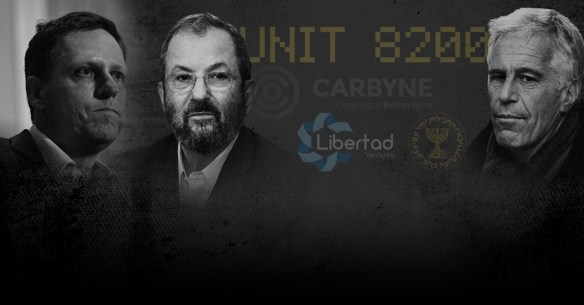
Following the arrest and subsequent death in prison of alleged child sex trafficker Jeffrey Epstein, a little-known Israeli tech company began to receive increased publicity, but for all the wrong reasons. Not long after Epstein’s arrest, and his relationships and finances came under scrutiny, it was revealed that the Israeli company Carbyne911 had received substantial funding from Jeffrey Epstein as well as Epstein’s close associate and former Prime Minister of Israel Ehud Barak, and Silicon Valley venture capitalist and prominent Trump backer Peter Thiel.

Carbyne911, or simply Carbyne, develops call-handling and identification capabilities for emergency response services in countries around the world, including the United States, where it has already been implemented in several U.S. counties and has partnered with major U.S. tech companies like Google. It specifically markets its product as a way of mitigating mass shootings in the United States without having to change existing U.S. gun laws.

Yet, Carbyne is no ordinary tech company, as it is deeply connected to the elite Israeli military intelligence division, Unit 8200, whose “alumni” often go on to create tech companies — Carbyne among them — that frequently maintain their ties to Israeli intelligence and, according to Israeli media reports and former employees, often “blur the line” between their service to Israel’s defense/intelligence apparatus and their commercial activity. As this report will reveal, Carbyne is but one of several Israeli tech companies marketing themselves as a technological solution to mass shootings that has direct ties to Israeli intelligence agencies.

In each case, these companies’ products are built in such a way that they can easily be used to illegally surveil the governments, institutions and civilians that use them, a troubling fact given Unit 8200’s documented prowess in surveillance as a means of obtaining blackmail and Israel’s history of using tech companies to aggressively spy on the U.S. government. This is further compounded by the fact that Unit 8200-linked tech companies have previously received U.S. government contracts to place “backdoors” into the U.S.’ entire telecommunications system as well as into the popular products of major American tech companies including Google, Microsoft and Facebook, many of whose key managers and executives are now former Unit 8200 officers.

Israeli Prime Minister Benjamin Netanyahu has made it no secret that placing Unit 8200 members in top positions in multinational tech companies is a “deliberate policy” meant to ensure Israel’s role as the dominant global “cyber power”, while also combating non-violent boycott movements targeting Israel’s violations of international law and stifling the United Nations’ criticisms of Israeli government policy and military operations abroad.

As Jeffrey Epstein’s links to intelligence in both the United States and Israel — the subject of a recent four-part series exclusive to MintPress — began to be revealed in full, his financing of Carbyne came under scrutiny, particularly for the company’s deep ties to Israeli intelligence as well as to certain Americans with known connections to U.S. intelligence. Ehud Barak’s own role as both financier and chairman of Carbyne has also added to that concern, given his long history of involvement in covert intelligence operations for Israel and his long-standing ties to Israeli military intelligence.

Another funder of Carbyne, Peter Thiel, has his own company that, like Carbyne, is set to profit from the Trump administration’s proposed hi-tech solutions to mass shootings. Indeed, after the recent shooting in El Paso, Texas, President Trump — who received political donations from and has been advised by Thiel following his election — asked tech companies to “detect mass shooters before they strike,” a service already perfected by Thiel’s company Palantir, which has developed “pre-crime software” already in use throughout the country. Palantir is also a contractor for the U.S. intelligence community and also has a branch based in Israel.

Perhaps most disturbing of all, whatever technological solution is adopted by the Trump administration, it is set to use a controversial database first developed as part of a secretive U.S. government program that involved notorious Iran-Contra figures like Oliver North as a means of tracking and flagging potential American dissidents for increased surveillance and detention in the event of a vaguely defined “national emergency.”

As this report will reveal, this database — often referred to as “Main Core” — was created with the involvement of Israeli intelligence and Israel remained involved years after it was developed, and potentially to the present. It was also used by at least one former CIA official on President Reagan’s National Security Council to blackmail members of Congress, Congressional staffers and journalists, among others.

Given recent reports on the Trump administration’s plan to create a new government agency to use “advanced technology” to identify “neurobehavioral signs” of “someone headed toward a violent explosive act” using data collected by consumer electronic devices, the picture painted by the technology currently being promoted and implemented under the guise of “keeping Americans safe” is deeply Orwellian. In fact, it points directly to the genesis of a far-reaching surveillance state far more extensive than anything yet seen in American history and it is being jointly developed by individuals connected to both American and Israeli intelligence.


Demystifying Carbyne

Carbyne911, which will be referred to simply as Carbyne in this report, is an Israeli tech-startup that promises to revolutionize how calls are handled by emergency service providers, as well as by governments, corporations and educational institutions. Not long after it was founded in 2014 by veterans of Israeli military intelligence, Carbyne began to be specifically marketed as a solution to mass shootings in the United States that goes “beyond the gun debate” and improves the “intelligence that armed emergency responders receive before entering an armed shooter situation” by providing video-streaming and acoustic input from civilian smartphones and other devices connected to the Carbyne network.

Prior to Jeffrey Epstein’s arrest in July, Carbyne had been receiving high praise from U.S. and Israeli media, with Fox News hailing the company’s services as the answer to the U.S.’ “aging 911 systems” and the Jerusalem Post writing that the company’s platform offers “hi-tech protection to social workers and school principals.” Other reports claimed that Carbyne’s services result in “a 65% reduction in time-to-dispatch.”

Carbyne’s call-handling/crisis management platform has already been implemented in several U.S. counties and the company has offices not only in the U.S. but also in Mexico, Ukraine and Israel. Carbyne’s expansion to more emergency service provider networks in the U.S. is likely, given that federal legislation seeks to offer grants to upgrade 911 call centers throughout the country with the very technology of which Carbyne is the leading provider. One of the main lobby groups promoting this legislation, the National Emergency Number Association (NENA), has a “strong relationship” with Carbyne, according to Carbyne’s website. In addition, Carbyne has also begun marketing its platform for non-emergency calls to governments, educational institutions and corporations.

Yet, what seemed like the inevitability of Carbyne’s widespread adoption in the U.S. hit a snag following the recent arrest and subsequent death of sex trafficker and pedophile Jeffrey Epstein, who exploited underage girls for the purpose of obtaining “blackmail” on the rich and poweful, an operation that had clear ties to intelligence. Epstein, after his first arrest and light sentence for soliciting sex from a minor in 2007, was tapped by former Israeli Prime Minister and former head of Israeli military intelligence Ehud Barak, to become a key financial backer of Carbyne.

As a result of increased scrutiny of Epstein’s business activities and his ties to Israel, particularly to Barak, Epstein’s connection to Carbyne was revealed and extensively reported on by the independent media outlet Narativ, whose exposé on Carbyne revealed not only some of the key intelligence connections of the start-up company but also how the architecture of Carbyne’s product itself raises “serious privacy concerns.”

MintPress detailed many of Carbyne’s main intelligence connections in Part III of the investigative series “Inside the Jeffrey Epstein Scandal: Too Big to Fail.” In addition to Barak — former Israeli prime minister and former head of Israeli military intelligence — serving as Carbyne’s chairman and a key financer, the company’s executive team are all former members of Israeli intelligence, including the elite military intelligence unit, Unit 8200, which is often compared to the U.S. National Security Agency (NSA).

Carbyne’s current CEO, Amir Elichai, served in Unit 8200 and tapped former Unit 8200 commander and current board member of AIPAC Pinchas Buchris to serve as the company’s director and on its board. In addition to Elichai, another Carbyne co-founder, Lital Leshem, also served in Unit 8200 and later worked for Israeli private spy company Black Cube. The only Carbyne co-founder that didn’t serve in Unit 8200 is Alex Dizengof, who previously worked for Israel’s Prime Minister’s office.

As MintPress noted in a past report detailing Israeli military intelligence’s deep ties to American tech giant Microsoft, Unit 8200 is an elite unit of the Israeli Intelligence corps that is part of the IDF’s Directorate of Military Intelligence and is involved mainly in signal intelligence (i.e., surveillance), cyberwarfare and code decryption. It is frequently described as the Israeli equivalent of the NSA and Peter Roberts, senior research fellow at Britain’s Royal United Services Institute, characterized the unit in an interview with the Financial Times as “probably the foremost technical intelligence agency in the world and stand[ing] on a par with the NSA in everything except scale.”

Notably, the NSA and Unit 8200 have collaborated on numerous projects, most infamously on the Stuxnet virus as well as the Duqu malware. In addition, the NSA is known to work with veterans of Unit 8200 in the private sector, such as when the NSA hired two Israeli companies, to create backdoors into all the major U.S. telecommunications systems and major tech companies, including Facebook, Microsoft and Google. Both of those companies, Verint and Narus, have top executives with ties to Israeli intelligence and one of those companies, Verint (formerly Comverse Infosys), has a history of aggressively spying on U.S. government facilities. Unit 8200 is also known for spying on civilians in the occupied Palestinian territories for “coercion purposes” — i.e., gathering info for blackmail — and also for spying on Palestinian-Americans via an intelligence-sharing agreement with the NSA.

Unlike many other Unit 8200-linked start-ups, Carbyne also boasts several tie-ins to the Trump administration, including Palantir founder and Trump ally Peter Thiel — another investor in Carbyne. In addition, Carbyne’s board of advisers includes former Palantir employee Trae Stephens, who was a member of the Trump transition team, as well as former Secretary of Homeland Security Michael Chertoff. Trump donor and New York real-estate developer Eliot Tawill is also on Carbyne’s board, alongside Ehud Barak and Pinchas Buchris.

Yet, privacy concerns with Carbyne go beyond the company’s ties to Israeli intelligence and U.S. intelligence contractors like Peter Thiel. For instance, Carbyne’s smartphone app extracts the following information from the phones on which it is installed:

Device location, video live-streamed from the smartphone to the call center, text messages in a two-way chat window, any data from a user’s phone if they have the Carbyne app and ESInet, and any information that comes over a data link, which Carbyne opens in case the caller’s voice link drops out.” (emphasis added)

According to Carbyne’s website, this same information can also be obtained from any smartphone, even if it does not have Carbyne’s app installed, if that phone calls a 911 call center that uses Carbyne or merely any other number connected to Carbyne’s network.

Carbyne is a Next-Generation 9-11 (NG911) platform and the explicit goal of NG911 is for all 911 systems nationwide to become interconnected. Thus, even if Carbyne is not used by all 911 call centers using an NG911 platform, Carbyne will ostensibly have access to the data used by all emergency service providers and devices connected to those networks. This guiding principle of NG911 also makes it likely that one platform will be favored at the federal level to foster such interconnectivity and, given that it has already been adopted by several counties and has ties to the Trump administration, Carbyne is the logical choice.

Another cause for concern is how other countries have used platforms like Carbyne, which were first marketed as emergency response tools, for the purpose of mass surveillance. Narativ noted the following in its investigation of Carbyne:

In May, Human Rights Watch revealed Chinese authorities use a platform not unlike Carbyne to illegally surveil Uyghurs. China’s Integrated Joint Operations Platform brings in a much bigger data-set and sources of video, which includes an app on people’s phones. Like Carbyne, the platform was designed to report emergencies. Chinese authorities have turned it into a tool of mass surveillance.

Human Rights Watch reverse-engineered the app. The group discovered the app automatically profiles a user under 36 “person types” including “followers of Six Lines” which is the term used to identify Uyghurs. Another term refers to “Hajj,” the annual Islamic pilgrimage to Mecca. The app monitors every aspect of a user’s life, including personal conversations [and] power usage, and tracks a user’s movement.”

Such technology is currently used by Israeli military intelligence and Israel’s domestic intelligence agency Shin Bet to justify “pre-crime” detentions of Palestinians in the occupied West Bank. As will be noted in greater detail later in this report, Palestinians’ comments on social media are tracked by artificial intelligence algorithms that flag them for indefinite detention if they write social media posts that contain “tripwire” phrases such as “the sword of Allah.”

Carbyne’s platform has its own “pre-crime” elements, such as it’s c-Records component, which stores and analyzes information on past calls and events that pass through its network. This information “enables decision makers to accurately analyze the past and present behavior of their callers, react accordingly, and in time predict future patterns.” (emphasis added)

Concerns have recently been raised that “pre-crime” technology may soon become more widely adopted in the U.S., after President Trump stated that one of his planned solutions to mass shootings in the wake of the recent tragedy in El Paso was for big tech companies to detect potential shooters before they strike.


Israeli intelligence, Blackmail and Silicon Valley

Though many of the individuals involved in funding or managing Carbyne have proven ties to intelligence, a closer look into several of these players reveals even deeper connections to both Israeli and U.S. intelligence.

One of Carbyne’s clearest connections to Israeli intelligence is through its chairman and one of its funders, Ehud Barak. Though Barak is best known for being a former prime minister of Israel, he is also a former minister of defense and the former head of Israeli military intelligence. He oversaw Unit 8200’s operations, as well as other units of Israeli military intelligence, in all three of those positions. For most of his military and later political career, Barak has been closely associated with covert operations.

Prior to the public scrutiny of Barak’s relationship to Jeffrey Epstein, following the latter’s arrest this past July and subsequent death, Barak had come under fire for his ties to disgraced film mogul Harvey Weinstein. Indeed, it was Ehud Barak who put Weinstein in contact with the Israeli private intelligence outfit Black Cube, which employs former Mossad agents and Israeli military intelligence operatives, as Weinstein sought to intimidate the women who had accused him of sexual assault and sexual harassment. Former Mossad director Meir Dagan led Black Cube’s board until his death in 2016 and Carbyne co-founder Lital Leshem is Black Cube’s former director of marketing.

After Barak put him in contact with Black Cube’s leadership, Weinstein, according to The New Yorker, used the private spy firm to “‘target,’ or collect information on, dozens of individuals, and compile psychological profiles that sometimes focused on their personal or sexual histories.” In addition, The New Yorker noted that “Weinstein monitored the progress of the investigations personally” and “also enlisted former employees from his film enterprises to join in the effort, collecting names and placing calls that, according to some sources who received them, felt intimidating.”

Yet, more recently, it has been Barak’s close relationship to Epstein that has raised eyebrows and opened him up to political attacks from his rivals. Epstein and Barak were first introduced by former Israeli Prime Minister Shimon Peres in 2002, a time when Epstein’s pedophile blackmail and sex trafficking operation was in full swing.

Barak was a frequent visitor to Epstein’s residences in New York, so often that The Daily Beast reported that numerous residents of an apartment building linked to Epstein “had seen Barak in the building multiple times over the last few years, and nearly half a dozen more described running into his security detail,” adding that “the building is majority-owned by Epstein’s younger brother, Mark, and has been tied to the financier’s alleged New York trafficking ring.” Specifically, several apartments in the building were “being used to house underage girls from South America, Europe and the former Soviet Union,” according to a former bookkeeper employed by one of Epstein’s main procurers of underage girls, Jean Luc Brunel.

Barak is also known to have spent the night at one of Epstein’s residences at least once, was photographed leaving Epstein’s residence as recently as 2016, and has admitted to visiting Epstein’s island, which has sported nicknames including “Pedo Island,” “Lolita Island” and “Orgy Island.” In 2004, Barak received $2.5 million from Leslie Wexner’s Wexner Foundation, where Epstein was a trustee as well as one of the foundation’s top donors, officially for unspecified “consulting services” and “research” on the foundation’s behalf.

In 2015, Barak formed a limited partnership company in Israel for the explicit purpose of investing in Carbyne (then known as Reporty) and invested millions of dollars in the company, quickly becoming a major shareholder and subsequently the company’s public face and the chairman of its board. At least $1 million of the money invested in this Barak-created company that was later used to invest in Carbyne came from the Southern Trust Company, which was owned by Jeffrey Epstein.

In July, Bloomberg reported that Epstein’s Southern Trust Company is identified in U.S. Virgin Islands filings as “a DNA database and data mining” company. Given Carbyne’s clear potential for data-mining and civilian profiling, Epstein’s investment in Carbyne using this specific company suggests that Carbyne’s investors have long been aware of this little advertised aspect of Carbyne’s product.

In a statement to the Israeli newspaper Haaretz, Barak asserted:

I saw the business opportunity and registered a partnership in my control in Israel. A small number of people I know invest in it…Since these are private investments, it wouldn’t be proper or right for me to expose the investors’ details.”

However, Barak later admitted that Epstein had been one of the investors.

MintPress’ recent series on the Jeffrey Epstein scandal noted in detail Epstein’s ties to CIA/Mossad intelligence assets, such as Adnan Khashoggi; CIA front companies, such as Southern Air Transport; and organized crime, through his close association with Leslie Wexner. In addition, Epstein’s long-time “girlfriend” and alleged madam, Ghislaine Maxwell, has family links to Israeli intelligence through her father, Robert Maxwell. While it appears that Epstein may have been working for more than one intelligence agency, Zev Shalev, former executive producer for CBS News and journalist at Narativ, recently stated that he had independently confirmed with two unconnected sources “closely connected to the Epstein story and in a position to know” that Epstein had “worked for Israeli military intelligence.”

Notably, Epstein, who was known for his interest in obtaining blackmail through the sexual abuse of the underaged girls he exploited, also claimed to have “damaging information” on prominent figures in Silicon Valley. In a conversation last year with New York Times reporter James Stewart, Epstein claimed to have “potentially damaging or embarrassing” information on Silicon Valley’s elite and told Stewart that these top figures in the American tech industry “were hedonistic and regular users of recreational drugs.” Epstein also told Stewart that he had “witnessed prominent tech figures taking drugs and arranging for sex” and claimed to know “details about their supposed sexual proclivities.”

In the lead-up to his recent arrest, Jeffrey Epstein appeared to have been attempting to rebrand as a “tech investor,” as he had done interviews with several journalists including Stewart about technology investing in the months before he was hit with federal sex trafficking charges.

Jessica Lessin, editor-in-chief of The Information, told Business Insider that a journalist working for The Information had interviewed Epstein a month before his recent arrest because “he was believed to be an investor in venture capital funds.” However, Lessin claimed that the interview was not “newsworthy” and said the site had no plans to publish its contents. Business Insider claimed that the way the interviews with Epstein had been arranged “suggests that someone in Silicon Valley may have been trying to help Epstein connect with reporters.”

Though it is unknown exactly which Silicon Valley figures were most connected to Epstein and which tech executives were potentially being blackmailed by Epstein, it is known that Epstein associated with several prominent tech executives, including Google co-founder Sergey Brin, Facebook co-founder Mark Zuckerberg, Tesla CEO Elon Musk, Microsoft co-founder Bill Gates, and LinkedIn co-founder Reid Hoffman.

Last year, Epstein claimed to be advising Tesla and Elon Musk, who had been previously photographed with Epstein’s alleged madam Ghislaine Maxwell. A few years ago, Epstein also attended a dinner hosted by LinkedIn’s Reid Hoffman, where Musk had allegedly introduced Epstein to Mark Zuckerberg. Google’s Sergey Brin is known to have attended a dinner hosted by Epstein at his New York residence where Donald Trump was also in attendance.

Elon Musk with Epstein’s alleged madam Ghislaine Maxwell at an Oscars after-party on March 2, 2014. Kevin Mazur | VF14

These associations suggest that the person in Silicon Valley who was trying to boost Epstein’s image as a tech investor before his arrest may have been Peter Thiel, whose Founders Fund had also invested in Carbyne. Thiel was an early investor in Facebook and is still on its board, connecting him to Zuckerberg; he is also a funder of Elon Musk’s SpaceX and a former colleague of Musk’s through PayPal. In addition, Thiel has ties to Reid Hoffman and both Thiel and Hoffman are prominent backers of Facebook.

It is unknown whether Epstein’s “damaging information” and apparent blackmail on notable individuals in the American technology industry were used to advance the objectives of Carbyne, which recently partnered with tech giants Google and Cisco Systems — and, more broadly, the expansion of Israeli intelligence-linked tech companies into the American tech sector, particularly through the acquisition of Israeli tech start-ups linked to Unit 8200 by major U.S. tech companies.

The latter seems increasingly likely given that the father of Ghislaine Maxwell — one of Epstein’s chief co-conspirators in his intelligence-linked sexual blackmail operation involving minors — was a Mossad operative who helped sell software that had been bugged by Israeli intelligence to government agencies and sensitive facilities around the world, including in the United States.

As will be noted later in this report, Israel’s Prime Minister Benjamin Netanyahu — to whom all of Israel’s intelligence agencies answer by virtue of his position — has stated on more than one occasion that the acquisition of Israeli intelligence-linked start-ups by foreign tech giants, especially in Silicon Valley, is a current and “deliberate policy” of the state of Israel.


Carbyne’s ties to U.S. intelligence

While Epstein and Barak are the two financiers of Carbyne whose ties to intelligence are clearest, another funder of Carbyne, Peter Thiel, has ties to U.S. intelligence and a history of investing in other companies founded by former members of Unit 8200. Thiel co-founded and still owns a controlling stake in the company Palantir, which was initially funded with a $2 million investment from the CIA’s venture capital fund In-Q-Tel and quickly thereafter became a contractor for the CIA.

After the success of its contract with the CIA, Palantir became a contractor for a variety of federal agencies, including the FBI, the Defense Intelligence Agency (DIA), the National Security Agency (NSA), the Department of Homeland Security(DHS) and the military’s Special Operations Command, among others. Last year, it won a contract to create a new battlefield intelligence system for the U.S. Army. Palantir is also in demand for its “pre-crime technology,” which has been used by several U.S. police departments. According to the Guardian, “Palantir tracks everyone from potential terrorist suspects to corporate fraudsters, child traffickers and what they refer to as ‘subversives’… it is all done using prediction.”

Thiel has gained attention in recent years for his support of President Trump and for becoming an adviser to Trump following the 2016 election, when he was “a major force in the transition,” according to Politico, and “helped fill positions in the Trump administration with former staff.” One of those former staffers was Trae Stephens, who is also on Carbyne’s board of advisers. Thiel also has business ties to Trump’s son-in-law and influential adviser, Jared Kushner, as well as to Kushner’s brother Josh. A senior Trump campaign aide told Politico in 2017 that “Thiel is immensely powerful within the administration through his connection to Jared.”

Thiel has also backed some prominent Israeli tech start-ups connected to Unit 8200, such as BillGuard, which Thiel funded along with former Google CEO Eric Schmidt and other investors. BillGuard was founded by Raphael Ouzan, a former officer in Unit 8200, who serves on the board of directors of Start-Up Nation Central (SUNC) alongside neoconservative American hedge fund manager Paul Singer, neoconservative political operative and adviser Dan Senor, and Terry Kassel, who works for Singer at his hedge fund, Elliott Management.
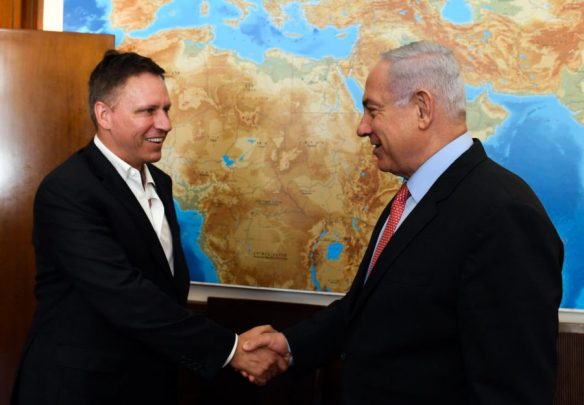
Peter Thiel Netanyahu
Peter Thiel greets Netanyahu during a 2017 meeting in Israel. Photo | Israel PM

SUNC is an organization founded by Paul Singer, who has donated heavily to both President Trump and Israeli Prime Minister Netanyahu. Since it was founded in 2012, SUNC has sought to integrate Unit 8200-connected Israeli tech start-ups into foreign companies, primarily American companies, and has helped oversee the shift of thousands of high-paying tech jobs from the U.S. to Israel.

Another Carbyne-connected individual worth noting is the former head of the Department of Homeland Security, Michael Chertoff, who serves on Carbyne’s board of advisers. In addition to Chertoff’s ties to DHS, Chertoff’s company, The Chertoff Group, employees several prominent former members of the U.S. intelligence community as principals, including Michael Hayden, former director of the CIA and former director of the NSA; and Charles Allen, former assistant director of Central Intelligence for Collection at the CIA, who worked at the agency for over 40 years.

The Chertoff Group has a long-standing and lucrative contract with the company OSI Systems, which produces full-body scanners and markets itself as a solution to mass shootings and crisis events, not unlike Carbyne. While Chertoff’s company was advising OSI Systems, Chertoff went on a media blitz to promote the widespread use of the machines produced by OSI Systems and even called on Congress to “fund a large-scale deployment of next-generation systems.” Chertoff did not disclose his conflict of interest while publicly promoting OSI’s full-body scanners.

Some have also alleged that Chertoff’s mother, Livia Eisen, had links to Israeli intelligence. According to her 1998 obituary, cited by both researcher/author Christopher Bollyn and journalist Jonathan Cook, Eisen participated in the Mossad operation code-named “Magic Carpet” while working for Israel’s El Al Airlines. Both Bollyn and Cook have suggested that Eisen’s participation in this covert Israeli intelligence operation strongly indicates that she had ties to the Mossad.


Melding into Silicon Valley

Beyond its troubling connections to Silicon Valley oligarchs, Israeli military intelligence and the U.S.-military industrial complex, Carbyne’s recent partnerships with two specific technology companies — Google and Cisco Systems — raise even more red flags.

Carbyne announced its partnership with Cisco Systems this past April, with the latter announcing that it would begin “aligning its unified call manager with Carbyne’s call-handling platform, allowing emergency call centers to collect data from both 911 callers and nearby government-owned IoT [Internet of Things] devices.” A report on the partnership published by Government Technology magazine stated that “Carbyne’s platform will be integrated into Cisco Kinetic for Cities, an IoT data platform that shares data across community infrastructure, smart city solutions, applications and connected devices.” The report also noted that “Carbyne will also be the only 911 solution in the Cisco Marketplace.”

As part of the partnership, Carbyne’s President of North American Operations Paul Tatro told Government Technology that the Carbyne platform would combine the data it obtains from smartphones and other Carbyne-connected devices with “what’s available through nearby Cisco-connected road cameras, roadside sensors, smart streetlamps, smart parking meters or other devices.” Tatro further asserted that “Carbyne can also analyze data that’s being collected by Cisco IoT devices … and alert 911 automatically, without any person making a phone call, if there appears to be a worthy problem,” and expressed his view that soon most emergency calls will not be made by human beings but “by smart cars, telematics or other smart city devices.”

A few months after partnering with Cisco Systems, Carbyne announced its partnership with Google on July 10, just three days after Carbyne funder Jeffrey Epstein was arrested in New York on federal sex trafficking charges. Carbyne’s press release of the partnership described how the company and Google would be teaming up in Mexico “to offer advanced mobile location to emergency communications centers (ECCs) throughout Mexico” following the conclusion of a successful four-week pilot program between Carbyne and Google in the Central American nation.
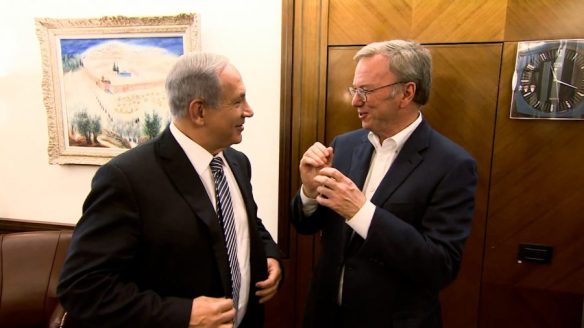
Netanyahu Eric Schmidt
Google Executive Chairman Eric Schmidt meets Netanyahu at his Jerusalem office. Israel PM | YouTube

The press release also stated:

Carbyne will provide Google’s Android ELS (Emergency Location Service) in real time from emergency calls made on AndroidTM devices. Deployment for any ECC in the country won’t require any integration, with Carbyne providing numerous options for connection to their secure ELS Gateway once an ECC is approved. The Carbyne automated platform, requiring no human interaction, has the potential to save thousands of lives each year throughout Mexico.”

The reason Carybne’s partnerships with Cisco Systems and Google are significant lies in the role that Cisco and former Google CEO Eric Schmidt have played in the creation of a controversial “incubator” for Israeli tech start-ups with deep ties to Israeli military intelligence, American neoconservative donor Paul Singer, and the U.S.’ National Security Agency (NSA).

This company, called Team8, is an Israeli company-creation platform whose CEO and co-founder is Nadav Zafrir, former commander of Unit 8200. Two of the company’s other three co-founders are also “alumni” of Unit 8200. Among Team8’s top investors is Schmidt, the former CEO of Google, who also joined Peter Thiel in funding the Unit 8200-linked BillGuard, as well as major tech companies including Cisco Systems and Microsoft.

Last year, Team8 controversially hired the former head of the NSA and U.S. Cyber Command, Retired Admiral Mike Rogers, and Zafrir stated that his interest in hiring Rogers was that Rogers would be “instrumental in helping strategize” Team8’s expansion in the United States. Jake Williams, a veteran of NSA’s Tailored Access Operations (TAO) hacking unit, told CyberScoop:

Rogers is not being brought into this role because of his technical experience. …It’s purely because of his knowledge of classified operations and his ability to influence many in the U.S. government and private-sector contractors.”

Team8 has also been heavily promoted by Start-Up Nation Central (SUNC). SUNC prominently features Team8 and Zafrir on the cybersecurity section of its website and also sponsored a talk by Zafrir and an Israeli government economist at the World Economic Forum, often referred to as “Davos,” that was attended personally by Paul Singer.

SUNC itself has deep ties to Israeli military intelligence, with former Unit 8200 officer Raphael Ouzan serving on its board of directors. Another example of SUNC-Unit 8200 ties can be seen with Inbal Arieli, who served as SUNC’s Vice President of Strategic Partnerships from 2014 to 2017 and continues to serve as a senior adviser to the organization. Arieli, a former lieutenant in Unit 8200, is the founder and head of the 8200 Entrepreneurship and Innovation Support Program (EISP), which was the first start-up accelerator in Israel aimed at harnessing “the vast network and entrepreneurial DNA of [Unit] 8200 alumni” and is currently one of the top company accelerators in Israel, alongside Team8. Arieli was the top executive at 8200 EISP while working at SUNC and several other top SUNC staffers are also connected to Israeli military intelligence.

Thus, Google and Cisco’s connections to Team8 suggests that their partnerships with another Israeli military intelligence-connected firm like Carbyne is a deepening of those two companies’ links to the growing bi-national security state that is uniting key players in the U.S. military-industrial complex and Israeli intelligence.


Mossad-backed Panic Buttons, coming to a school near you

Carbyne is hardly the only Israeli intelligence-linked tech company marketing itself in the United States as a solution to mass shootings. Another Israeli start-up, known as Gabriel, was founded in 2016 in response to a shooting in Tel Aviv and the Pulse Nightclub shooting in the United States, which took place just days apart.

Created by Israeli-American Yoni Sherizen and Israeli citizen Asaf Adler, Gabriel is similar to Carbyne in the sense that elements of its crisis response platform require installation on civilian smartphones as well as devices used by crisis responders. The main difference is that Gabriel also installs one or a series of physical “panic buttons,” depending on the size of the building to be secured, that also double as video and audio communication devices connected to the Gabriel network.

As with Carbyne, the ties between Gabriel and Israeli intelligence are obvious. Indeed, Gabriel’s four-person advisory board includes Ram Ben-Barak, former deputy director of the Mossad and former director-general of Israel’s intelligence ministry; Yohanan Danino, former chief of police for the state of Israel; and Kobi Mor, former director of overseas missions for the Israeli intelligence agency Shin Bet. The only American on the advisory board is Ryan Petty, the father of a Parkland shooting victim and friend of former Florida Governor Rick Scott.

Gabriel’s only disclosed funder is U.S.-based MassChallenge, a start-up accelerator non-profit. Gabriel is funded by MassChallenge’s Israel branch, which was opened six months prior to Gabriel’s creation and is partnered with the Israeli government and the Kraft Group. The Kraft Group is managed by Robert Kraft, who is currently embroiled in a prostitution scandal and is also a close friend of President Trump.

Notably, one of MassChallenge Israel’s featured experts is Wendy Singer, the executive director of SUNC, the organization created and funded by neoconservative Trump backer Paul Singer with the explicit purpose of promoting Israel’s tech start-ups and their integration into foreign, chiefly American, businesses. As was noted in a recent MintPress report on SUNC, Wendy Singer is the sister of neoconservative political operative Dan Senor, who founded the now-defunct Foreign Policy Initiative with Robert Kagan and Bill Kristol, and was previously the director of AIPAC’s Israel office for 16 years.

Gabriel’s founders have been quite upfront about the fact that the uptick in shootings in the U.S. has greatly aided their company’s growth and success. Last November, Sherizen told The Jerusalem Post that new mass shootings in the U.S. not only increased U.S. demand for his company’s product but also were opportunities to show the effectiveness of Gabriel’s approach:

Unfortunately every month there seems to be another high-profile event of this nature. After the Vegas shooting, we were able to show [that] our system would have managed to identify the location of the shooter much quicker.”

The Jerusalem Post noted that Gabriel is set to make considerable profits if concern over mass shootings continues to build in the U.S., writing:

With more than 475,000 soft targets across the US and amid increasing security fears, the potential market for Gabriel is huge. The company could gain revenues of almost $1 billion if only 10% of soft targets were to invest around $20,000 in its alert systems.”

Sherizen told the Jerusalem Post:

Our starter kit costs $10,000. Depending on the size and makeup of the community building, it would cost between $20-30,000 to fully outfit the location. We have made it very affordable. This is a game-changer for the lock-down and active shooter drills that are now a standard part of any child’s upbringing in the States.”


Much more than just a start-up

While it is certainly possible that numerous former officials and commanders of elite Israeli intelligence agencies may have no ulterior motive in advising or founding technology start-up companies, it is worth pointing out that top figures in Israel’s military intelligence agencies and the Mossad don’t see it that way.

Last March, Israeli media outlet Calcalist Tech published a report entitled “Israel Blurs the Line Between Defense Apparatus and Local Cybersecurity Hub,” which noted that “since 2012, cyber-related and intelligence projects that were previously carried out in-house in the Israeli military and Israel’s main intelligence arms are transferred to companies that in some cases were built for this exact purpose.” (emphasis added)

The article notes that beginning in 2012, Israel’s intelligence and military intelligence agencies began to outsource “activities that were previously managed in-house, with a focus on software and cyber technologies.” (emphasis added)

It continues:

In some cases, managers of development projects in the Israeli military and intelligence arms were encouraged to form their own companies, which then took over the project,’ an Israeli venture capitalist familiar with the matter told Calcalist Tech.”

Notably, Calcalist Tech states that the controversial company Black Cube was created this way and that Black Cube had been contracted, and is likely still contracted, by Israel’s Ministry of Defense. The private security agency Black Cube is known to have two separate divisions for corporations and governments. The firm was recently caught attempting to undermine the Iran nuclear deal — then also a top political objective of Israeli Prime Minister Benjamin Netanyahu — by attempting to obtain information on the “financial or sexual impropriety” (i.e., blackmail) of top U.S. officials involved in drafting the accord. NBC News noted last year that “Black Cube’s political work frequently intersects with Israel’s foreign policy priorities.” As previously mentioned, one of Carbyne’s co-founders — Lital Leshem, also a veteran of Unit 8200 — worked for Black Cube prior to starting Carbyne.

One of the main companies profiled in the Calcalist Tech report appeared to be a front for Israeli intelligence, as its registered owner was found not to exist: even high-level employees at the company had never heard of him; his registered addresses were for nonexistent locations in Israel’s capital of Tel Aviv; and the three people with that name in Tel Aviv denied any association with the business.

This company — which Calcalist Tech was unable to name after the Israeli military censor determined that doing so could negatively impact Israeli “national security” — was deliberately created to service the Israeli military and Israeli intelligence. It is also “focused on cyber technologies with expertise in research and development of advanced products and applications suitable for defense and commercial entities.” (emphases added) In addition, the company’s management consists largely of “veterans of Israeli military technology units.”

Notably, a former employee of this company told Calcalist Tech that “crossing the lines between military service and employment at the commercial outfit was ‘commonplace’ while he was working at the company.”

It’s not exactly clear why Israel’s military intelligence and other intelligence agencies decided to begin outsourcing its operations in 2012, though Calcalist Tech suggests the reasoning was related to the difference in wages between the private sector and the public sector, with pay being much higher in the former. However, it is notable that 2012 was also the year that Paul Singer — together with Netanyahu’s long-time economic adviser and former chair of the Israeli National Economic Council, Eugene Kandel — decided to create Start-Up Nation Central.

As MintPress noted earlier this year, SUNC was founded as part of a deliberate Israeli government effort to counter the nonviolent Boycott, Divest and Sanctions (BDS) movement and to make Israel the dominant global “cyber power.” This policy is aimed at increasing Israel’s diplomatic power and specifically undermining BDS as well as the United Nations, which has repeatedly condemned Israel’s government for war crimes and violations of international law in relation to the Palestinians.

Last year, Netanyahu was asked by Fox News host Mark Levin whether the large growth seen in recent years in Israel’s technology sector, specifically tech start-ups, was part of Netanyahu’s plan. Netanyahu responded, “That’s very much my plan … It’s a very deliberate policy.” He later added that “Israel had technology because the military, especially military intelligence, produced a lot of capabilities. These incredibly gifted young men and women who come out of the military or the Mossad, they want to start their start-ups.”

Netanyahu again outlined this policy at the 2019 Cybertech Conference in Tel Aviv, where he stated that Israel’s emergence as one of the top five “cyber powers” had “required allowing this combination of military intelligence, academia and industry to converge in one place” and that this further required allowing “our graduates of our military and intelligence units to merge into companies with local partners and foreign partners.”

The direct tie-ins of SUNC to Israel’s government and the successful effort led by SUNC and other companies and organizations to place former military intelligence and intelligence operatives in strategic positions in major multinational technology companies reveal that this “deliberate policy” has had a major and undeniable impact on the global tech industry, especially in Silicon Valley.


Mossad gets its own In-Q-Tel

This “deliberate policy” of Netanyahu’s also recently resulted in the creation of a Mossad-run venture capital fund that is specifically focused on financing Israeli tech start-ups. The venture capital fund, called Libertad, was first announced by Israel’s Prime Minister’s Office and was created with the explicit purpose of “increasing the Israeli intelligence agency’s knowledge base and fostering collaboration with Israel’s vibrant startup scene” It was modeled after the CIA’s venture capital fund In-Q-Tel, which invested in several Silicon Valley companies turned government and intelligence contractors — including Google and Palantir — with a similar goal in mind.

Libertad declines to reveal the recipients of its funding, but announced last December that it had chosen five companies in the fields of robotics, energy, encryption, web intelligence, and natural language processing and text analysis. In regard to its interest in web intelligence, a Mossad employee told the Jerusalem Post that the intelligence agency was specifically interested in “innovative technologies for [the] automatic identification of personality characteristics – personality profiling – based on online behavior and activity, using methods based on statistics, machine learning, and other areas.” (emphasis added)

According to Libertad’s website, in return for its investment, now set at NIS 2 million (~$580,000) per year per company, “the Mossad will receive access to the IP [initial product] developed during R&D [Research and Development] while under contract, and a non-commercial, non-exclusive license to use it. Libertad’s contract with the company will not provide it with any additional rights.” In an interview with Calcalist Tech, Mossad Director Yossi Cohen told the paper that the Mossad’s partnership with civilian companies in Israel is “excellent” and that the agency will continue to strengthen those ties.

Israeli intelligence has a documented history in placing “backdoors” into technology products for the purpose of surveillance, with one well-known case being Israel’s repurposing of the PROMIS software, discussed in Part III of MintPress’ series on Jeffrey Epstein. Furthermore, given that U.S. intelligence, specifically the NSA, had “backdoors” placed into the products of major Silicon Valley companies (a service performed by Israeli intelligence-linked tech companies no less), Mossad may very well plan on doing the same with the technology products of companies it backs through Libertad.

Tim Shorrock, investigative journalist and author of Spies For Hire: The Secret World of Intelligence Outsourcing, told MintPress that the Mossad’s continuation of such practices through Libertad was definitely plausible, especially given what Shorrock described as the “unusual” choice of Libertad choosing not to release the identities of the companies in which it invests.

“The Mossad is trying to hide what they are investing in,” Shorrock stated, adding that Libertad’s secrecy “raises a lot of questions” particularly given that it was modeled after the CIA’s In-Q-Tel. Shorrock noted that In-Q-Tel and other venture capital funds with ties to U.S. intelligence or the U.S. military rarely, if ever, hide the identities of the companies they finance.

However, Libertad is merely the latest and most public expression of the Mossad’s interest in Israeli tech start-ups, the lion’s share of which are created by veterans of Unit 8200 or other Israeli intelligence agencies. Indeed, former Mossad Director Tamir Pardo stated in 2017 that “everyone” in the Israeli cybertechnology sector is an “alumni” of either Israeli intelligence, like the Mossad, or Israeli military intelligence, like Unit 8200. Pardo even went as far as to say that the Mossad itself is “like a start-up.”

Pardo himself, after leaving his post as Mossad director in 2016, dove straight into the world of Israeli tech start-ups, becoming chairman of Sepio Systems, whose two CEOs are former Unit 8200 officers. Sepio Systems’ advisory board includes the former chief information security officer of the CIA, Robert Bigman; former member of the U.S. Military’s Joint Special Operations Command (JSOC), Geoff Hancock; and former head of the Israel National Cyber Bureau and veteran of Israeli military intelligence, Rami Efrati. Sepio Systems’ cybersecurity software has been adopted by several banks, telecom and insurance companies, including in the U.S. and Brazil.

Pardo is not the only prominent figure in Israel’s intelligence community to compare Israeli intelligence agencies to tech start-ups. Shin Bet Director Nadav Argaman described Israel’s domestic spy agency in similar terms. “The Shin Bet is like an evolving start-up, with unmatched strength,” Argaman stated in a June 2017 speech, as he extolled the agency’s use of “pre-crime” technology to detain Palestinians based on their social media activity.

Argaman, at the time, claimed that more than 2,000 Palestinians, whom he described as “potential lone-wolf terrorists,” had been arrested as a result of these “breakthrough technological advances” that use artificial-intelligence algorithms to monitor the social media accounts of Palestinians, especially younger Palestinians, for the use of “tripwire” phrases that have been used by Palestinians who later committed acts of violence. In the case of those who use such terms, “their phones are tracked to see if they meet other suspects, or leave their districts to move towards potential Israeli targets. In such cases, security forces detain the suspect,” according to a 2017 report on the practice by The Economist.


The road to fascism, paved by a corrupted PROMIS

Though Israeli intelligence’s interest in tech companies goes back several years, there is a well-documented history of Israeli intelligence using bugged software to surveil and gain “backdoor” access to government databases around the world, particularly in the United States.

As was mentioned in Part III of MintPress’ Epstein series, a sinister yet cunning plan was executed to place a backdoor for Israeli intelligence into the Prosecutor’s Management Information System (PROMIS) software, which was then being used by the U.S. Department of Justice and was the envy of government agencies, particularly intelligence agencies, around the world. This bugged version of PROMIS — born out of the collusion between Earl Brian, Ronald Reagan’s then-envoy to Iran, and Rafi Eitan, then-director of the now-defunct Israeli intelligence agency Lekem — was seeded around the world by Brian’s company Hadron as well as by Mossad-linked media mogul Robert Maxwell, father of Jeffrey Epstein’s long-time girlfriend and alleged madam, Ghislaine Maxwell.

After this first PROMIS “backdoor” was discovered, Israel would again gain access to sensitive U.S. government communications, as well as civilian communications, thanks to the collusion between Israeli intelligence and Israeli telecom and tech companies, especially Amdocs and Comverse Infosys (now Verint), that were operating throughout the United States. Today, Unit 8200-linked start-ups appear to have taken up the torch.

While the PROMIS software is perhaps best known for offering Israeli intelligence a backdoor into as many as 80 intelligence agencies and other sensitive locations around the world for nearly a decade, it was also used for a very different purpose by prominent officials linked to Iran-Contra.

One key Iran-Contra figure — Lt. Col. Oliver North, then serving on the National Security Council — decided to use PROMIS neither for espionage nor for foreign policy. Instead, North turned PROMIS’ power against Americans, particularly perceived dissidents, a fact that remained unknown for years.

Beginning in 1982, as part of the highly classified Continuity of Government (COG) program, North used the PROMIS software at a 6,100-square-foot “command center” in the Department of Justice, as well as at a smaller operations room at the White House, to compile a list of American dissidents and “potential troublemakers” if the COG protocol was ever invoked.

According to a senior government official with a high-ranking security clearance and service in five presidential administrations who spoke to Radar in 2008, this was:

A database of Americans, who, often for the slightest and most trivial reason, are considered unfriendly, and who, in a time of panic might be incarcerated. The database can identify and locate perceived ‘enemies of the state’ almost instantaneously.”

In 1993, Wired described North’s use of PROMIS in compiling this database as follows:

Using PROMIS, sources point out, North could have drawn up lists of anyone ever arrested for a political protest, for example, or anyone who had ever refused to pay their taxes. Compared to PROMIS, Richard Nixon’s enemies list or Sen. Joe McCarthy’s blacklist look downright crude.”

The COG program defined this “time of panic” as “a national crisis, such as nuclear war, violent and widespread internal dissent, or national opposition to a US military invasion abroad,” whereby the government would suspend the Constitution, declare martial law, and incarcerate perceived dissidents and other “unfriendlies” in order to prevent the government’s (or then-serving administration’s) overthrow.

This secretive database has often been referred to as “Main Core” by government insiders and, most troubling of all, it still exists today. Journalist Christ Ketcham, citing senior government officials, reported in 2008 that, at that time, Main Core was believed to contain the names of as many as 8 million Americans. Eleven years later, it is highly likely that the number of Americans included in the Main Core database has grown considerably.

Author and investigative journalist Tim Shorrock also covered other disturbing aspects of the evolution of Main Core back in 2008 for Salon. At the time, Shorrock reported that the George W. Bush administration was believed to have used Main Core to guide its domestic surveillance activities following the September 11 attacks.

Citing “several former U.S. government officials with extensive knowledge of intelligence operations,” Shorrock further noted that Main Core — as it was 11 years ago at the time his report was published — was said to contain “a vast amount of personal data on Americans, including NSA intercepts of bank and credit card transactions and the results of surveillance efforts by the FBI, the CIA and other agencies.”

Bill Hamilton, former NSA intelligence officer and the original creator of the PROMIS software, told Shorrock at the time that he believed that “U.S. intelligence uses PROMIS as the primary software for searching the Main Core database” and had been told as much by an intelligence official in 1992 and an NSA official in 1995. Dan Murphy, former deputy director at the CIA, had told Hamilton that the NSA’s use of PROMIS was “so seriously wrong that money alone cannot cure the problem.” “I believe in retrospect that Murphy was alluding to Main Core,” Hamilton had told Shorrock.

Though most reporting on Main Core, from the time its existence was first revealed to the present, has treated the database as something used by the U.S. government and U.S. intelligence for domestic purposes, MintPress has learned that Israeli intelligence was also involved with the creation of the Main Core database. According to a former U.S. intelligence official with direct knowledge of the U.S. intelligence community’s use of PROMIS and Main Core from the 1980s to 2000s, Israeli intelligence played a role in the U.S. government’s deployment of PROMIS as the software used for the Main Core domestic surveillance database system.

Israeli intelligence remained involved with Main Core at the time of the August 1991 death of journalist Danny Casolaro, who was investigating not only the government’s misuse of the stolen PROMIS software but also the Main Core database. This same official, who chose to remain anonymous, told MintPress that, shortly before his death, Casolaro had obtained copies of computer printouts from the PROMIS-based Main Core domestic surveillance database system from NSA whistleblower Alan Standorf, who was found murdered a few months before Casolaro’s lifeless body would be found in a West Virginia hotel room.

The source also stated that Main Core’s contents had been used for the political blackmail of members of Congress and their staff, journalists, and others by Walter Raymond, a senior CIA covert operator in psyops and disinformation who served on President Reagan’s National Security Council during and after Main Core’s creation. If used for this purpose by Raymond in the 1980s, Main Core has also likely been used by other individuals with access to the database for blackmailing purposes in the years since.

Given that Israeli intelligence was known to have placed a backdoor into the PROMIS software, before it was marketed and sold around the world by Earl Brian and Robert Maxwell, its role in the U.S. government’s decision to use PROMIS in the creation of Main Core suggests that Israeli intelligence likely advocated for the version of PROMIS containing this backdoor, thereby giving Israeli intelligence access to Main Core. Given that Reagan aides and officials colluded with Israeli “spymaster” Rafi Eitan in his efforts to create a backdoor into the software for Israeli military intelligence, the use of this version of PROMIS in the Main Core database is certainly plausible.

Furthermore, the fact that Israeli intelligence was known to be involved in Main Core nearly a decade after its creation suggests that Israeli intelligence may have played a role in certain aspects of the database, such as the criteria used to flag Americans as “unfriendly,” and — like Walter Raymond — may have used information in the database to blackmail Americans. In addition, the fact that the cooperation between U.S. and Israeli intelligence, particularly between Unit 8200 and the NSA, has only grown since 1991 further suggests that Israeli involvement in Main Core continues to the present.

While Main Core’s very existence is troubling for many reasons, the alleged involvement of a foreign intelligence service in the creation, expansion and maintenance of a database with personal details and potentially damaging information on millions of Americans targeted for detention or increased surveillance in times of crisis is chilling. It is especially so considering that the Trump administration’s latest proposals to prevent mass shootings before they occur are likely to use Main Core to flag certain Americans for increased surveillance or potentially detention, as was done by the George W. Bush administration following the September 11 attacks.

It appears that Main Core serves a dual purpose; first as a mass targeted surveillance system to crush dissent during times of “national crisis” — whether spontaneous or engineered — and, second, as a massive blackmail database used to keep every potential opponent in line during non-emergencies.


Peter Thiel’s Seeing Stone

As was mentioned earlier in this report, Palantir — the company co-founded by Peter Thiel — is set to profit handsomely from the Trump administration’s plans to use its “pre-crime” technology, which is already used by police departments throughout the country and also used to track Americans based on the company’s integrative data-mining approach. Palantir, named for the “seeing stones” in the Lord of the Rings novels, also markets software to foreign (and domestic) intelligence agencies that predicts the likelihood that an individual will commit an act of terrorism or violence.

Aside from its “pre-crime” products, Palantir has come under fire in recent years as a result of the company’s contracts with Immigration and Customs Enforcement (ICE), where it created an intelligence system known as Investigative Case Management (ICM). The IB Times described ICM as “a vast ‘ecosystem’ of data to help immigration officials in identifying targets and creating cases against them” and also “provides ICE agents with access to databases managed by other federal agencies.” ICM further gives ICE access to “targets’ personal and sensitive information, such as background on schooling, employment, family relationships, phone records, immigration history, biometrics data, criminal records as well as home and work addresses.” In other words, Palantir’s ICM is essentially a “Main Core” for immigrants.

Notably, part of Oliver North’s original intentions in “Main Core” was to track immigrants then coming from Central America as well as Americans who opposed Reagan era policy with respect to Central America. At that time, Main Core was believed to be controlled by the Federal Emergency Management Administration (FEMA), which is now part of the Department of Homeland Security (DHS).

VICE News reported in July that the Northern California Regional Intelligence Center, which is run by DHS, “serves around 300 communities in northern California and is what is known as a ‘fusion center,’ a Department of Homeland Security intelligence center that aggregates and investigates information from state, local, and federal agencies, as well as some private entities, into large databases that can be searched using software like Palantir. “ VICE further noted that this center alone used Palantir to surveil as many as 8 million Ameicans. There are many more such DHS “fusion centers” throughout the United States.

If the Trump administration moves forward with its proposal of employing technology to detect potential mass shooters before they strike, Palantir’s technology is set to be used, given that it has already been used by U.S. law enforcement and U.S. intelligence to determine which people run “the highest risk of being involved in gun violence,” according to an investigation of Palantir by The Verge. Furthermore, Palantir’s close ties to the Trump administration make the company’s role in a future nationwide “pre-crime” prevention system based on technology appear inevitable.
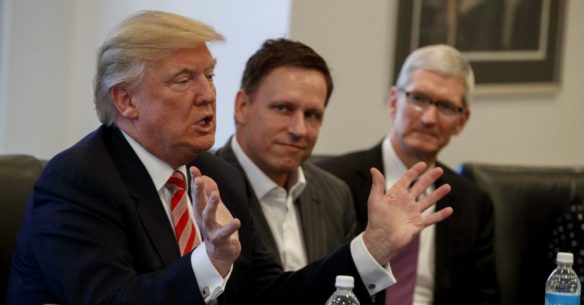
Apple CEO Tim Cook, right, and PayPal founder Peter Thiel, center, listen as President-elect Donald Trump speaks during a meeting with technology industry leaders at Trump Tower in New York, Wednesday, Dec. 14, 2016. (AP Photo/Evan Vucci)

Worse still is the apparent overlap between Palantir and Main Core. Palantir — which has obvious similarities to PROMIS — is already known to use its software to track potential terror threats, including domestic terror threats, and a category of people it refers to as “subversives.” Palantir’s tracking of these individuals “is all done using prediction.” Palantir’s close ties to the U.S. intelligence community suggest that Palantir may already have access to the Main Core database. Tim Shorrock told MintPress that Palantir’s use of Main Core is “certainly possible,” particularly in light of the company’s use of the term “subversive” to describe a category of people that its software tracks.

Palantir also has alleged ties to Israeli intelligence, as there have long been suspicions that Israeli intelligence has used Palantir as part of its AI “pre-crime” algorithms targeting Palestinians after Palantir opened a research and development (R&D) center in Israel in 2013. The current head of Palantir Israel, Hamultal Meridor, previously founded a brain-machine interface organization and was senior director of web intelligence at Verint (formerly Comverse Infosys), which has deep connections to Unit 8200, a history of espionage in the United States and was one of the two companies contracted by the NSA to insert a “backdoor” into the U.S. telecommunications system and popular products of major American tech companies.

Given the above, Peter Thiel’s 2018 decision to fund Carbyne, the Unit 8200-linked start-up that markets itself as a technological solution to mass shootings in the U.S., strongly suggests that Thiel has been anticipating for some time the now-public efforts of the Trump administration to employ “pre-crime” technology to track and target Americans who show signs of “mental illness” and “violent tendencies.”


A nightmare even Orwell could not have predicted

In early August, in the wake of the shooting at an El Paso Walmart, President Trump called on big tech companies to collaborate with the Justice Department in the creation of software that “stops mass murders before they start” by detecting potential mass shooters before they cnm act. Though Trump’s ideas were short on specifics, there is now a new proposal that would create a new government agency that will use data gathered from civilian electronic devices to identify “neurobehavioral” warning signs, thereby flagging “potential shooters” for increased surveillance and potentially detention.

This new agency, as proposed by the foundation led by former NBC Universal president and vice chairman of General Electric Robert Wright, would be known as the Health Advanced Research Projects Agency (HARPA) and would be modeled after the Defense Advanced Research Projects Agency (DARPA). Per the proposal, recently detailed by the Washington Post, the flagship program of HARPA would be “Safe Home” (Stopping Aberrant Fatal Events by Helping Overcome Mental Extremes), which would use “breakthrough technologies with high specificity and sensitivity for early diagnosis of neuropsychiatric violence,” specifically “advanced analytical tools based on artificial intelligence and machine learning.”

The program would cost an estimated $60 million over four years and would use data from “Apple Watches, Fitbits, Amazon Echo and Google Home” and other consumer electronic devices, as well as information provided by health-care providers to identify who may be a threat.

The Washington Post reported that President Trump has reacted “very positively” to the proposal and that he was “sold on the concept.” The Post also noted that Wright sees the president’s daughter, Ivanka, as “the most effective champion of the proposal and has previously briefed her on HARPA himself.” Ivanka has previously been cited as a driving force behind some of her father’s policy decisions, including his decision to bomb Syria after an alleged chemical weapons attack in 2017.

Liz Fed — president of the Susan Wright Foundation, which is led by Robert Wright and created the proposal for HARPA and “Safe Home” — told The Post that the proposal emulated DARPA because “DARPA is a brilliant model that works. They have developed the most transformational capabilities in the world for national security…We’re not leveraging the tools and technologies available to us to improve and save lives.” Fed further asserted that DARPA’s technological approach had yet to be applied to the field of healthcare.

For anyone familiar with DARPA, such claims should immediately sound loud alarm bells, especially since DARPA is already developing its own solution to “mental health” issues in the form of a “brain-machine interface” as part of its N3 program. That program, according to reports, involves “noninvasive and ‘minutely’ invasive neural interfaces to both read and write into the brain,” help distance soldiers “from the emotional guilt of warfare” by “clouding their perception” and “to program artificial memories of fear, desire, and experiences directly into the brain.” Though N3 is intended to improve the prowess of American soldiers, it is also set to be used as a means of pursuing DARPA’s Systems-Based Neurotechnology for Emerging Therapies (SUBNETS) project, which aims to “to develop a tiny, implanted chip in the skull to treat psychiatric disorders such as anxiety, PTSD and major depression.”

Given that HARPA’s lead scientific adviser is Dr. Geoffrey Ling, former director and founder of DARPA’s Biological Technologies Office (BTO), which “merges biology, engineering, and computer science to harness the power of natural systems for national security,” it seems likely that DARPA’s neurological-focused research programs, like SUBNETS and N3, would be folded into HARPA’s portfolio, making the proposed agency’s approach to mental health very questionable indeed.

Aside from the dystopian nature of both DARPA and potentially HARPA’s approach to mental health, there is grave cause for concern regarding the Trump administration’s moves to address U.S. mass shooting events by implementing pre-crime technology based on artificial intelligence, data-mining and mass surveillance, technologies already laying in wait thanks to companies like Palantir and numerous Israeli tech start-ups led by former Unit 8200 officers.

With companies like Carbyne — with its ties to both the Trump administration and to Israeli intelligence — and the Mossad-linked Gabriel also marketing themselves as “technological” solutions to mass shootings while also doubling as covert tools for mass data collection and extraction, the end result is a massive surveillance system so complete and so dystopian that even George Orwell himself could not have predicted it.

Following another catastrophic mass shooting or crisis event, aggressive efforts will likely follow to foist these “solutions” on a frightened American public by the very network connected, not only to Jeffrey Epstein, but to a litany of crimes and a frightening history of plans to crush internal dissent and would-be dissenters in the United States.

Feature photo | Graphic by Claudio Cabrera

Whitney Webb is a MintPress News journalist based in Chile. She has contributed to several independent media outlets including Global Research, EcoWatch, the Ron Paul Institute and 21st Century Wire, among others. She has made several radio and television appearances and is the 2019 winner of the Serena Shim Award for Uncompromised Integrity in Journalism.

 

Internet Free Speech All But Dead

Unelected, unnamed censors are operating across the Internet to suppress “unapproved” content.

By Philip Giraldi

Source: OpEdNews.com

The Internet was originally promoted as a completely free and uncensored mechanism for people everywhere to exchange views and communicate, but it has been observed by many users that that is not really true anymore. Both governments and the service providers have developed a taste for controlling the product, with President Barack Obama once considering a “kill switch” that would turn off the Internet completely in the event of a “national emergency.”

President Donald Trump has also had a lot to say about fake news and is reported to be supporting limiting protections relating to the Internet. In May, a “net neutrality” bill that would have prevented service providers from manipulating Internet traffic passed in the House of Representatives, but it is reported to be “dead on arrival” in the Senate, so it will never be enacted.

Social networking sites have voluntarily employed technical fixes that restrict some content and have also hired “reviewers” who look for objectionable material and remove it. Pending European legislation, meanwhile, might require Internet search engines to eliminate access to many unacceptable old posts. YouTube has already been engaged in deleting existing old material and is working with biased “partners” like the Anti-Defamation League (ADL) to set up guidelines to restrict future content. Many users of Facebook will have already undoubtedly noted that some contacts have been blocked temporarily (or even permanently) and denied access to the site.

Google now automatically disables or limits searches for material that it deems to be undesirable. If Google does not approve of something it will either not appear in search results or it will be very low on the list. And what does come up will likely favor content that derives from those who pay Google to promote their products or services. Information that originates with competitors will either be very low in the search results or even blocked. Google is consequently hardly an unbiased source of information.

In May 2017 Facebook announced that it would be hiring 3,000 new censors, and my own experience of social networking censorship soon followed. I had posted an article entitled “Charlottesville Requiem” that I had written for a website. At the end of the first day, the site managers noticed that, while the article had clearly attracted a substantial Facebook readership, the “likes” for the piece were not showing up on the screen counter, i.e., were not being tabulated. It was also impossible to share the piece on Facebook, as the button to do so had been removed.

The “likes” on sites like Facebook, Yahoo! news comments, YouTube, and Google are important because they automatically determine how the piece is distributed throughout the site. If there are a lot of likes, the piece goes to the top when a search is made or when someone opens the page. Articles similarly can be sent to Coventry if they receive a lot of dislikes or negative marks, so the approvals or disapprovals can be very important in determining what kind of audience is reached or what a search will reveal.

In my case, after one day my page reverted to normal, the “likes” reappeared, and readers were again able to share the article. But it was clear that someone had been managing what I had posted, apparently because there had been disapproval of my content based on what must have been a political judgment.

A couple of days later, I learned of another example of a similar incident. The Ron Paul Institute (RPI) website posts much of its material on YouTube (owned by Google) on a site where there had been advertising that kicked back to RPI a small percentage of the money earned. Suddenly, without explanation, both the ads and rebate were eliminated after a “manual review” determined the content to be “unsuitable for all advertisers.” This was a judgment rendered apparently due to disapproval of what the institute does and says. The ability to comment on and link from the pieces was also turned off.

Dissident British former diplomat Craig Murray also noted in April 2018 the secretive manipulation of his articles that are posted on Facebook, observing that his “site’s visitor numbers [were] currently around one-third normal levels, stuck at around 20,000 unique visitors per day. The cause [was] not hard to find. Normally over half of our visitors arrive via Facebook. These last few days, virtually nothing has come from Facebook. What is especially pernicious is that Facebook deliberately imposes this censorship in a secretive way.

The primary mechanism when a block is imposed by Facebook is that my posts to Facebook are simply not sent into the timelines of the large majority of people who are friends or who follow. I am left to believe the post has been shared with them, but in fact it has only been shown to a tiny number. Then, if you are one of the few recipients and do see the post and share it, it will show to you on your timeline as shared, but in fact the vast majority of your own friends will also not receive it. Facebook is not doing what it is telling you it is doing — it shows you it is shared — and Facebook is deliberately concealing that fact from you. Twitter has a similar system known as ‘shadow banning.’ Again, it is secretive and the victim is not informed.”

More recently, pressure to censor Internet social networking and information sites has increased, coming both from government and from various interested constituencies. In late May, Facebook founder and CEO Mark Zuckerberg met with French President Emmanuel Macron to discuss how to eliminate “hate speech” on the Internet. The two men agreed that the United States Internet model, in spite of already being heavily manipulated, is too laissez faire, and expressed an interest in exploring the French system where it is considered acceptable to ban unacceptable points of view. Zuckerberg suggested that it might serve as a good model for the entire European Union. France is reportedly considering legislation that establishes a regulator with power to fine Internet companies up to 4% of their global revenue, which can in some cases be an enormous sum, if they do not curb hateful expressions.

So unelected, unnamed censors are operating all around the Internet to control the content, which I suppose should surprise no one, and the interference will only get worse as both governments and service providers are willing to do what it takes to eliminate views that they find unacceptable — which, curiously enough, leads one to consider how “Russia-gate” came about and the current hysteria being generated in the conventional media and also online against both Venezuela and Iran. How much of the anger is essentially fake, being manipulated or even fabricated by large companies that earn mega billions of dollars by offering under false pretenses a heavily managed product that largely does what the government wants? Banning hate speech will be, unfortunately, only the first step in eliminating any and all criticisms of the status quo.

Orwell’s 1984 no longer reads like fiction. It’s the reality of our times

By Robert Bridge

Source: RT.com

70 years ago, the British writer George Orwell captured the essence of technology in its ability to shape our destinies in his seminal work, 1984. The tragedy of our times is that we have failed to heed his warning.

No matter how many times I read 1984, the feeling of total helplessness and despair that weaves itself throughout Orwell’s masterpiece never fails to take me by surprise. Although usually referred to as a ‘dystopian futuristic novel’, it is actually a horror story on a scale far greater than anything that has emerged from the minds of prolific writers like Stephen King or Dean Koontz. The reason is simple. The nightmare world that the protagonist Winston Smith inhabits, a place called Oceania, is all too easily imaginable. Man, as opposed to some imaginary clown or demon, is the evil monster.

In the very first pages of the book, Orwell demonstrates an uncanny ability to foresee future trends in technology. Describing the protagonist Winston Smith’s frugal London flat, he mentions an instrument called a ‘telescreen’, which sounds strikingly similar to the handheld ‘smartphone’ that is enthusiastically used by billions of people around the world today.

Orwell describes the ubiquitous device as an “oblong metal plaque like a dulled mirror” affixed to the wall that “could be dimmed, but there was no way of shutting it off completely.” Sound familiar? It is through this gadget that the rulers of Oceania are able to monitor the actions of its citizens every minute of every day. At the same time, the denizens of 1984 were never allowed to forget they were living in a totalitarian surveillance state, under the control of the much-feared Thought Police. Massive posters with the slogan ‘Big Brother is Watching You’ were as prevalent as our modern-day advertising billboards. Today, however, such polite warnings about surveillance would seem redundant, as reports of unauthorized spying still gets the occasional lazy nod in the media now and then.

In fact, just in time for 1984’s anniversary, it has been reported that the National Security Agency (NSA) has once again been illicitly collecting records on telephone calls and text messages placed by US citizens. This latest invasion of privacy has been casually dismissed as an “error” after an unnamed telecommunications firm handed over call records the NSA allegedly “hadn’t requested” and “weren’t approved” by the Foreign Intelligence Surveillance Court. In 2013, former CIA employee Edward Snowden blew the whistle on the NSA’s intrusive surveillance operations, yet somehow the government agency is able to continue – with the help of the corporate sector – vacuuming up the private information of regular citizens.

Another method of control alluded to in 1984 fell under a system of speech known as ‘Newspeak’, which attempted to reduce the language to ‘doublethink’, with the ulterior motive of controlling ideas and thoughts. For example, the term ‘joycamp’, a truncated term every bit as euphemistic as the ‘PATRIOT Act’, was used to describe a forced labor camp, whereas a ‘doubleplusgood duckspeaker’ was used to praise an orator who ‘quacked’ correctly with regards to the political situation.

Another Newspeak term, known as ‘facecrime’, provides yet another striking parallel to our modern situation. Defined as “to wear an improper expression on your face (to look incredulous when a victory was announced, for example) was itself a punishable offense.” It would be difficult for the modern reader to hear the term ‘facecrime’ and not connect it with ‘Facebook’, the social media platform that regularly censors content creators for expressing thoughts it finds ‘hateful’ or inappropriate. What social media users need is an Orwellian lesson in ‘crimestop’, which Orwell defined as “the faculty of stopping short, as though by instinct, at the threshold of any dangerous thought.” Those so-called unacceptable ‘dangerous thoughts’ were determined not by the will of the people, of course, but by their rulers.

And yes, it gets worse. Just this week, Mark Zuckerberg’s ‘private company’ agreed to give French authorities the “identification data” of Facebook users suspected of spreading ‘hate speech’ on the platform, in what would be an unprecedented move on the part of Silicon Valley.

‘Hate speech’ is precisely one of those delightfully vague, subjective terms with no real meaning that one would expect to find in the Newspeak style guide. Short of threatening the life of a person or persons, individuals should be free to criticize others without fear of reprisal, least of all from the state, which should be in the business of protecting free speech at all cost.

Another modern phenomenon that would be right at home in Orwell’s Oceania is the obsession with political correctness, which is defined as “the avoidance of forms of expression or action that are perceived to exclude, marginalize, or insult groups of people who are socially disadvantaged or discriminated against.” But since so many people today identify with some marginalized group, this has made the intelligent discussion of controversial ideas – not least of all on US college campuses, of all places – exceedingly difficult, if not downright dangerous. Orwell must be looking down on all of this madness with much surprise, since he provided the world with the best possible warning to prevent it.

For anyone who entertains expectations for a happy ending in 1984, be prepared for serious disappointment (spoiler alert, for the few who have somehow not read this book). Although Winston Smith manages to finally experience love, the brief romance – like a delicate flower that was able to take root amid a field of asphalt – is crushed by the authorities with shocking brutality. Not satisfied with merely destroying the relationship, however, Smith is forced to betray his ‘Julia’ after undergoing the worst imaginable torture at the ‘Ministry of Love’.

The book ends with the words, “He had won the victory over himself. He loved Big Brother.” Will we too declare, like Winston Smith, our love for ‘Big Brother’ above all else, or will we emerge victorious against the forces of a technological tyranny that appears to be just over the horizon? Or is Orwell’s 1984 just really good fiction and not the instruction manual for tyrants many have come to fear it is?

An awful lot is riding on our answers to those questions, and time is running out.

Facebook Insider Confesses All

Quote

Source: American Intelligence Media

The Zuckerberg Dossier

Mark Zuckerberg is a Fraud Used by the CIA

The following anonymous document claims to be written by a Facebook insider who was Mark Zuckerberg’s lover from their freshman year at Harvard. Mark’s continuing indiscretions with his ongoing government contract keep getting him in trouble to this day. Mark was supposed to simply be the fake “boy genius” of Larry Summers’ (Harvard’s president) social media project funded by DARPA/In-Q-Tel (CIA)/IBM and the secretive international “public-private” group called The Highlands Group organized with the DoD Office of Net Assessment.

It was Summers and a group of government officials who fabricated, produced and directed Mark throughout the entire fraudulent creation of the Facebook propaganda story at Harvard. These claims are explosive and allege that the entire fraudulent social media network called Facebook was always controlled by the government through the people who were at Harvard directing Mark. The anonymous author of the letter below, who we will call “John”, also points out why Facebook was created, how Mark was controlled by Eric Schmidt, James Beyer, Larry Summers, Sheryl Sandberg and the evil intellectual property thief Professor James Chandler.

Admittedly, this Zuckerberg “Dossier” has enough information in it to put Mark Zuckerberg behind bars, and therefore would not be touched by the Main Stream Media – according to the person who hand-delivered this letter to a member of the Anonymous Patriot’s Conclave a few days ago.

American Intelligence Media has been able to quickly verify that many of the claims insinuated in this “Zuckerberg Dossier” are true and this leads us to conclude that the document is authentic and exactly what it appears to be. The true authorship of this Zuckerberg Dossier is evident to members of the Conclave, but that supposition is speculation and the Conclave does not deal in speculation. Though, if one were to listen carefully to the admission of guilt by Sean Parker (a long-time executive of Facebook) which he made repeatedly before the press, you will hear that Sean knew all about the true creation of the social media giant and its evil intents and fingers the culprits.

Therefore, it is not hard at all to figure out who may have written this expose on Mark Zuckerberg’s Facebook evil. You can even see the true motivation for writing this “tell all” about Zuckerberg at this time in history, just as Facebook is facing all kinds of charges, including  anti-trust violations.

Any person well-educated on the continuing scandals surrounding the creation of Facebook might have been able to piece together the many divergent claimants to the authorship of the source programming code used to make social media “scalable” – which was the universal problem of all of the major tech companies at the time, including the NSA’s “LifeLog” project. Somehow, genius Mark Zuckerberg “solved” the problem that no one else in the world could. Oh yes, and Mark did it “between a week and two weeks or so” while studying for finals and hosting a beer “kegger” for his friends. [1]

The author of this expose offers a quite different story and for the first time tells of the involvement of high-level government players who made a fortune off of the sky-rocketing overnight growth of Facebook stock on NASDAQ. The players mentioned by “John” (anonymous author) check out to be the people who made enormous amounts of money from Facebook stock. These insider traders then took their Facebook winnings and started other social media companies that, coincidentally, sky-rocketed beyond most companies in history.

Hmmm…do you own any Facebook stock? Might be cash-out time!

American Intelligence Media does not claim that the Zuckerberg Dossier is 100% correct, but we can state with absolute confidence that the source is real. We also believe that their may be other installments of what we are calling the Zuckerberg Dossier and will probably not be the last time we hear from this source as the trouble that Mark is having in the news keeps mounting.

The most convincing aspect of this “scorned lover tell-all” is found in what the author outlines as Mark’s true nature and what he believes is happening to Facebook right now in America. It was shocking to read these remarks and we found them to be, after much reflection, probably true and certainly not what we might have imagined to be the reality with the U. S. government’s threat to act against Facebook.

Also, interesting is the major British intervention in Facebook through the former Deputy Prime Minister of the United Kingdom, Sir Nick Clegg, taking over the “face” of Facebook which Baron Richard Allen (another UK agent) had failed to do properly.

At this point, Facebook seems to be “dead in the water” unless the British Crown Agents, Clegg and Allen, can save Mark from his horrible mis-management.

Again, we do not claim that this anonymous “confession” and “indictment” is true in all its parts. But certainly, any intelligent reader will acknowledge that this version of Mark Zuckerberg’s rise to fame and fortune is much more likely that the nonsense stories we have been told by Mark since the early 2000’s when he first popped up Larry Summers’ Harvard.

Please circulate this wide and far. We need to turn the weapon that Zuckerberg is aiming at us – social media … back on him.

[1] Tr. 41:7, Mark Zuckerberg Deposition, April 25, 2006, ConnectU LLC v. Zuckerberg et al, 1:04-cv-11923-DPW (D. Mass. 2004).

Mark’s diary where he proclaims “let the hacking begin” was also provided to us and is available in the link below as a PDF. We did not convert it to a Word file for obvious reasons. Also note that we formatted the author’s letter below in a way that you can easily read it, instead of how it was sent with tiny font and packed paragraphs. We did not correct grammar or spelling.

Zuckerberg-Let-Hacking_Begin-28-Oct-2003

To Every Facebook User,

Mark Zuckerberg, and all of us who were there from the beginning, are lying to you and using your personal life as a government-controlled experiment in brain-washing and mind-control – basically a weaponized system of the military (CIA especially) that got out of control. At this point, Mark Zuckerberg has lost control of a company that he never really owned or operated. Truly, anyone who has ever worked with Mark knows that his mind is a blank and that he is nothing more than a parrot for the government handlers who created him. Mark is incapable of running a McDonald’s, let alone one of the most powerful companies in the world. Not even his name is real and his identity has always been covered up. Mark was chosen as child for a CIA training program because his relatives were some of the people creating the program.

I am not making excuses for Mark, but his choices have not been his own. Yes, he has become an evil sociopath who once believed in his heart-of-heart that if he decided he wanted to be president, all he had to do is say he wanted the job and “Facebook” would deliver the election to him. This is the level of brain-washing Mark is at – he is not in contact with reality.

You might think that a madman who could think he could become president – because he “said so” – would be discovered and accused as a fraud. Well, that has happened repeatedly with the other three teams that were working at Harvard, under Harvard president Larry Summers, to create what DARPA and In-Q-Tel wanted the most – a cyber-weapon that could control the minds of anyone that could be lured into it. Facebook was always a military weapon – just like Eric Schmidt’s Google which was incubated in the same fashion that Facebook was. Mark was a patsy, but a ruthless, heartless, cold-blooded non-human patsy. He became this way through the brain-washing he received in his High School years by a DARPA program called TIA that needed a “boy-genius” to be the front man. This scam would make Mark into a global model of the young, cool, irreverent computer geniuses that “rule the world” and lead everyone to a cyber-god of artificial intelligence. Mark was just an unwitting puppet at first – I felt sorry for him.

I remember when I first became room-mates with Mark in our sophomore year at Harvard. We were in Kirkland House, on JFK Street and had to endure Dustin and Andrew. Mark hated them because they prevented us from sleeping together, even though we were in the same room. It was frustrating and kept our relationship secret. Little did I know that the thing that drew me to Mark, a certain openness for listening to anyone, also made him extremely promiscuous with both sexes.

Mark had no morals, conscience, or shame. He also chased women on Craig’s List and would sometimes just disappear to rendezvous with them. He was like a blank slate that simply echoes whatever was happening in his environment. I loved and hated this aspect of his personality but later found out that he, and his brother and cousin, were all the same way due to the brain-washing programs they were subjected to during high school. If certain people spoke to Mark in person or on the phone, he would drop everything and do whatever they told him to do. Certain people had more power and effect over him. I eventually found out, from Mark breaking down and crying, that the brain-washing was permanent and was all part of the “position” these people had promised to create for Mark. He didn’t even know what this “position” was or entailed.

But one thing Mark was sure of, he was only “placed” at Harvard “for a while” until his “position” became available to him. Mark was certain that this promise of a position included a great deal of money and power—aphrodisiacs to an incurable narcissist

I must admit that I came under the power of Mark’s surety that he didn’t need Harvard, a degree, or good grades. Mark eventually dropped out of Harvard at the end of our sophomore year and did become filthy rich and more powerful than he could have imagined. I also admit that I road on Mark’s success to become quite wealthy myself. All four of the members of the club Mark eventually named – “The Fellowship” – became wealthy by no means of our own – we simply knew Mark’s secrets.

You see, Mark could never be faithful to anyone but he loved men more than women. He actually used to hate all women. So, Mark cheated and would want to bring the new “boy” home to me to join in. I was never into that like Mark was. He was abusive but would never admit it, especially to young boys. Eventually, there were three of us that remained lovers with Mark.

Mark always had panic attacks and would break down frequently due to the brain-washing – according to Mark. He would cry about his mother and the “torture” she let “them” do to him. At those times, Mark’s mouth ran on open and he would tell his bed-partners about all the pain and horrible plans these “evil people” did to him. Early on, his doubts and fears almost consumed him at night and he could hardly sleep due to nightmares. Once Mark became filthy rich, he simply used drugs to mask these fears. But if you get him upset by asking about the creation of Facebook, Mark will freak out and have a panic attack because he always messes up the story and looks like an idiot. He can’t stand questions about “how he made Facebook” – because he didn’t. I had to laugh as one of his stupid answers: “I saw that Harvard didn’t have a Facebook, so I made one”, or something close to that. The journalist let him get away with that lie, like they always have.

Mark Greenberg (Zuckerberg) did not write one single line of programming source code for Facebook. Those are lies and propaganda generated by his government, military handlers. Everyone knows that the Winkelvoss twins (Aaron and Cameron) won a $65 million dollar lawsuit settlement against Mark because they knew that their little HarvardConnection (HC) piece was just adjunct code attached to the original stolen source code – which was given to Mark by Professor James Chandler and IBM. That $65 million bit of dirty knowledge was pretty profitable for a couple of cute Harvard Crew rower jocks with no interest in me.

Mark simply had others adjust the code into what was a government-sponsored military weaponization of a cyber-warfare project directed by the President of Harvard, Larry Summers. Even Summer’s himself had his own budding student and staff directory being developed by the Harvard computer staff called “Facebook.” Mark didn’t even create the name!

The Winkelvoss twins had developed their own version in the competition for the government contract, HC, that they changed to ConnectU. Aaron Greenspan was developing  HOUSE System, and Paul Ceglia was working with Mark to modify his StreetFax software into a Facebook too. Mark developed nothing. Absolutely nothing. Even the famous “hacking” of the Harvard systems was not done by Mark himself. Mark was the middleman for those who were the overseers of the “big project”, as it was called.

From the president of Harvard, to the “PayPal Mafia”, National Venture Capital Association, In-Q-Tel, DARPA, NSA, CIA, DIA, to the worst patent thieves in America: James Chandler, Hillary Clinton, David Kappos, Robert Mueller and the rest of the Big-Tech group. Mark is just like the other fake front-men chosen to represent the numerous other social media companies.

Eric Schmidt was the poster child for the Silicon Valley geniuses who ran corporations that are basically exempt from prosecution as the facade for military-weaponized companies that are always funded by the same evil bankers—Fidelity Investment, Vanguard, T. Rowe Price, BlackRock, JPMorgan, HSBC, Accel Partners, Kleiner Perkins and the rest of the Silicon Valley venture capitalist who always make a killing from companies who get no-bid government contracts. These companies, like Facebook, are just an excuse for black-ops experiments to control the enemy – and Mark doesn’t know who the enemy is. Mark’s lack of a moral compass made him the perfect patsy for the new “military experiments on U. S. citizens.”

I believe now, since Mark was well-aware of the evil intentions of the government, that he has committed crimes of many types with the clear, pre-meditated intention of harming every user of Facebook. That is why Mark let Facebook be used to manipulate elections, he has no moral core. I personally saw the “template” that Hillary ordered that uses Facebook to manipulate voters to win elections for her. Given the amount of election interference by Big-Tech in 2016, I became a reluctant believer in miracles.

I have seen the truth concerning the supposed “Russian Interference” and can tell you that it was all made up and, in fact, was the exact opposite of what the media reported. I have seen so many illegal actions of Facebook that I am indeed complicit with the crimes. That is one of the reasons I must remain anonymous. But I assure you, if I testified, Mark and I would be locked up along with the other members of the Fellowship as well as many, many other Facebook employees.

It is due to the truth that is currently coming out in the media that I feel I can reveal what I witnessed so that Mark and the “U. S. and British military controlled” Facebook can be charged with criminal activity instead of simply being hit with anti-trust charges that will only split Facebook into many subsidiaries – which would simply make Mark even more rich.

Then, the poor suckers who believed in Facebook will be left holding the bag – an empty bag of a gutted Facebook worth little or nothing. Mark will simply rebrand and go on with multiple companies that will be just as big as Facebook. He will escape unscathed, protected again by his military handlers who, by the way, were insider traders from the beginning of Facebook and will be allowed to buy into the new companies from the beginning also.

Once again, the use of taxpayer dollars goes to private corporations run by stooges and controlled by non-Americans. Yes, I just called Mark a stooge because he actually has no clue what he is doing – at all. Just ask him to write a simple program in any code he would like – he can’t, he is a fraud and always was.

Though I will not tell you who the members of Mark Zuckerberg’s “Fellowship” group were, I can point out that all of the original members of Facebook knew from the beginning that it was a military project for cyber warfare mind-control. Everything done from the beginning was an experiment to see just how far a social media platform could go to “conquer the enemy” through behavioral manipulation with electronic warfare. The idea that Mark wanted to connect all college students in America was a novel idea that was far from the true intention of mind-control of every user in the world.

Free platforms like Google, Gmail, Facebook, and the rest were confidence tricks to get users to experiment on. My old buddy, Sean Parker, an early member of Facebook has “confessed all” to the media and specifically told the truth that Facebook was meant as a cyber-drug to create and control addicts – digital addicts. As Sean said, we knew from the beginning it was harming every user and that is why we never let our friends or our children use these systems – it harms them tremendously and was the original intent of the media. Mark and I were told by representatives of DARPA that that was the intent of Facebook from its inception.

The U. S. Patriot Act allows the military to consider every American a possible terrorist or enemy warfighter until proven otherwise. Every person on the Internet, which was also created by DARPA, is considered a cyber-terrorist and the military sees it as their job to create systems to surveil, target, disarm, and aggressively remote control the user. I hated the idea from the first time I heard of it. Personally, I have never used Facebook and don’t let anyone I love use it.

Mark would use patriot arguments, like the ones mentioned above, to justify his participation in this black-ops CIA operation to the Fellowship. We argued with him, but to no avail. Mark basically believed anything his “controllers” told him. We would sometimes convince him that the project was “dead wrong”, but all it took was one phone call from “above” and Mark went back to his scheming. It was truly pathetic to see that Mark had no freedom but was told what to do. He was also so poorly organized and such a muddled thinker that he couldn’t get anything done: homework, schoolwork, project work, nothing. So, there was always clean up to be done after Mark, especially when the company got big. Clean-up would include stupid stuff like paying others millions for “stealing” their code, making stupid statements every time he opened his mouth, or the lack of attention he gave to the running of the company.

Mark was always a mess and the Fellowship, as well as Larry Summers’ squeeze Sheryl Sandberg—those soul-less megalomaniacs deserve each other—helped the handlers control Mark, were always picking up the broken pieces and trying to glue them back together. But this time, Facebook and Mark cannot be fixed.

Many of the original Facebook players and the Fellowship have been paid off in huge bribes to keep us quiet. CIA secrecy agreements grow on every plant at Facebook, but the Facebook insiders are turning against Mark anyway for many good reasons. The board of directors wants him fired. Mark’s British controllers sent Baron Richard Allen to rein Mark in, but he failed miserably. Even Sir Nick Clegg, x-deputy prime minister of Britain was sent to shut Mark up, but to no avail. Even the second-in-charge of Britain couldn’t stop Mark and his non-stop stupidity. Mark opens his mouth, it cost the company billions. Mark testifies, and everyone finds out that he doesn’t know a single thing about “his” company.

Mark knows nothing because he doesn’t do anything and hasn’t really shown up for work since the beginning. Mark seems to be allergic to work and can’t stand meetings unless he is “announcing” something. He is the worse manager in history, and everyone will tell you the same if asked. We all “play” like Mark runs the company, but that is not true. Mark can’t run himself effectively, let alone Facebook. That is why he was failing at Harvard and was going to be kicked out for bad grades, even after I did much of his work for him.

I can honestly say that, at this point, there are no “insiders” who have any faith in Mark to run the company, or to even speak in public. We believe that even after Larry Summers, the father of Facebook, who planted Sheryl Sandberg at Facebook to shut Mark up and stop revealing that Facebook is the tool of the Democrat agenda for globalism, cannot fix the company. This is one of the points I am most angry about. Mark has become, over the years, no friend of America. In fact, he hates America and rants on about how proud he is to avoid U. S. taxes and to cheat the American people – whom he considers to be animals.

Mark believes he is a higher being – above human beings. He now believes it was all his work that made Facebook. He is completely deluded by his own propaganda, which is nothing but lies. It is because Mark is now a danger to himself and the world that I must tell the true story of how Facebook and social media have become the enemies of Americans and the world.

Mark was shocked when he received an acceptance letter from Harvard, before he had applied. No test scores, interviews, or pre-requisites were required. His government “programming” had made his acceptance a given. Harvard wanted Mark, and Mark did what he was told. So, when the president of Harvard, Larry Summers, called Mark into his office early in his freshman year, Mark was not so surprised. He knew he would have to pay the piper. Summers asked Mark to start a group to work on the social media project – a supposed competition among teachers and students to win a government contract.

The ostensible goal was to create a social directory and Harvard where people could share in small groups. The real intent was to create a social network to manipulate the world. Mark liked the idea but was too lazy to do anything about it. He stuck his nose into the others’ camps to see what they were doing, but he himself just talked about it with good programmers and made them promises—thus, numerous lawsuits ensued from those promises.

Larry Summers continued to call Mark into his office for updates, so Mark just lied. Occasionally, others would be in the office with Larry Summers, but one person stood out and showed up at many more meetings in the future. This man was obviously the person in charge of this project. His name was a former Harvard Law Professor James Chandler. He boasted that he was one of the top idea people for DARPA and that he had actually developed lower level programming languages for the Army. He pretended to be interested in me, but I could tell that was a political act. Guys like me can just sense these things.

Over time, it came out that Summers and Chandler had much bigger plans for the social media project and had some outside sources of help to complete the project. Mark found it odd that Summers, Chandler, and eventually Sheryl Sandberg did not put much pressure on Mark to produce but were interested in everything Mark was learning from spying on the other groups for almost two years.

One day, Mark was called to Summers office in Massachusetts Hall to meet a most unusual man. His name was Andrew Marshall and he was the head of the Naval Intelligence Net Assessment Office. Mark was terrified of Marshall from the beginning. Marshall had Mark sign a government secrecy agreement, and other security agreements before he told Mark the ultimate military nature of what the Harvard Facebook project entailed. Mark, and Harvard, were simply being used as incubation think tanks as a cover for a military project that needed a corporate face. Professor Chandler said he had discovered the source code that would accomplish the seemingly impossible task of making a social directory “scalable” to billions of people.

Chandler droned on as Harvard professors like to do about how Harvard academic elites were the best choices to do the early testing because of their superior intellects. He explained that this scalability dilemma was not being solved by the military’s usual Microsoft, IBM and Oracle go-to military intelligence suppliers for reasons that were over my head. He said they had found a company who had solved the problem but was not willing to be used by the military as a black-ops project against Americans and the rest of the world.

Chandler and Summers had selected Mark as their front-man to lie and claim that he had written the source code for scalability. Chandler explained that the government had seized the source code from an inventor and his company for use in the DARPA Harvard Facebook project. He explained in very flowery intellectual property theft language that Mark may get sued by the inventor, but that DARPA would shield him. Mark told them he was willing to take that chance.

Mark knew full-well that the people who had brain-washed him had a big plan and his part was simply to do as they told him to do. But now, Mark was getting scarred because James Chandler was a member of the president’s National Security Team, a top national security and patent lawyer, and a truly mean, ugly and frightening black man who could easily turn on you like a pit bull.

Larry Summers had those same elitist bully traits, and was the president of Harvard and an economic world leader. Mark felt he was being groomed and protected by some very powerful people. But it was Andrew Marshall, the one they called “Yoda”, who scared the pants off Mark. After Mark had been “read into” the plan by Summers and Chandler, their boss wanted to meet Mark to make sure that he could be trusted to be part of this overarching evil plan to manipulate all of cyber space as if it were a war arena.

Andrew Marshall did not like Mark at all. I witnessed it myself when I was asked to attend one of Andrew Marshall’s Highland Group forums as a major executive for Facebook, along with Mark. Every time Mark opened his mouth, Marshall would stare at him until Mark would shut up. Marshall indicated in this meeting that Mark himself was the biggest problem with the Facebook operation. Mark was so happy when Andrew Marshall died not long ago. Mark now takes his orders from Marshall understudies Dick O’Neil and James Baker who run Highlands Group. Chandler also worked for Highlands Group and directed numerous operations working directly with Andrew Marshall and James Baker.

The Facebook operation also coordinated their activities with Rose Law Firm in Little Rock, Arkansas, and the group that gathered around Hillary Clinton’s patent thefts. Every Facebook insider, who was there from the beginning, know these things to be true but would never speak of it for fear of retaliation and possible death. We are speaking about a theft of literally many trillions of dollars in intellectual property, trade secrets, patents, designs and stolen programming source code.

Mark bragged for two years about being able to write the source code for the Facebook platform, but he did not produce a single line of code. For two years, all the Fellowship heard were promises of a break-through at any moment. We heard one excuse right after the other. We learned later it was because the inventor had run into some R&D roadblocks that needed sorted out first. Mark continued to spy on the other groups working on the Harvard Facebook student and staff directories, made many promises to everyone involved, but did not follow through. Mark kept promising he was going to just “sit down and write the code”, as if it was no big deal.

His meetings with Summers, Chandler, Marshall and others continued and Mark always came back encouraged. Then, one day Mark got terribly excited about hacking a fellow student at Harvard because he had some part of the Facebook program. The particular student was an upper classman named Max McKibben who lived next door in Winthrop House, literally 100 feet from our Kirkland House front door. Mark got the best hacker to come to our room and use a special “school” computer to hack into McKibben’s personal Harvard email account to steal several white papers on an invention just like the one Chandler had described. This white paper described EXACTLY what Mark had been talking about for two years and now a Harvard student had a full description of a program that could do the same thing.

It was on October 28, 2003 that Mark returned from Summers’ office and announced: “Let the hacking begin.” That hacking stole the white paper that had been sent to the son of Michael McKibben, the owner of Leader Technologies and the real inventor of scalable social media. Michael had sent his son Max the white papers written to describe the new invention. When Mark learned that Chandler was Michael’s patent attorney, the theft finally put a name to the target Chandler had talked about in vague terms.

Chandler had requested that Michael write up a detailed explanation of the system and how it worked. Once Mark showed the stolen white papers to Chandler, Chandler confessed that he already had a complete evaluation copy of the source code as Michael’s patent attorney, that he was using a spy tactic called “strategic deception” in pretending to help Michael and Leader Technologies file patents, while he was secretly providing Michael’s invention code to DARPA’s IBM Eclipse Foundation cyber-warfare partners.

Chandler told Mark that IBM Eclipse was preparing Michael’s program, as they spoke, to give to Mark for the Facebook launch at EclipseCON ’04 in San Fancisco right after the Harvard January Reading Period. He said the plan was to transfer all of the NSA’s LifeLog data as soon as possible to the Facebook platform as well. He also told Mark that he would be moving to Silicon Valley after the term was over, and that the next phase of the plan for him would happen in California. Dustin and I went with him that summer, but I decided to return to Boston and graduate. That was a sad separation, but I was happy he got rid of his Craig’s List girls. The few that I actually saw looked like sad street urchins.

Chandler had not seen Michael’s white papers yet and was eager to have them. Mark sent him the hacked copies. Chandler said with the inventor’s first-ever public write-up, and the source code, the Highlands Group and the IBM Eclipse Foundation now had what they needed to prepare the platform for Mark to launch thefacebook, later shortened to Facebook, at EclipseCON ‘04 in February.

I now realize that Chandler took the stolen source code from Michael McKibben and Leader Technologies and gave it to the IBM Eclipse Foundation who turned around gave it out as “open source”, the most lucrative intellectual property in history, to all of the social media giants as open source code without charging a penny.

What I am telling you now is a composite understanding of what I knew early on in the Fellowship group of Mark Zuckerberg and what I have learned up to this time as a core insider of Facebook to this very day. It is not only Mark who needs to pay for his crimes, but many others also. IBM Eclipse Foundation plays like they are moral, honest, and philanthropically gave away intellectual property to other companies who essentially became monopolies with the stolen programming source code. This is laughable and I told Mark when he was being told this information by his handlers that the plan would never work because anyone can see through such stupidity. But to this day, beside Facebook insiders and the Fellowship group, no one has ever told me that they suspected the IBM Eclipse Foundation or the Highlands Forum are corrupt.

The bigger the lie, the easier it is to get people to believe it.

Mark Greenberg (Zuckerberg) did not create Facebook. Facebook is a governmental monopoly doing the most advanced virtual behavioral modification on the planet with stolen and modified patents, intellectual property (IP), and trade secrets from inventors who were not remunerated for their inventions. I personally knew this, even when it was happening. I felt sick about the whole thing and this led to many, many arguments between Mark and me. The other members of the Fellowship felt the same way I did. Eventually, Mark had to buy all of us off with large sums of money over the years.

We have not spoken up before now, but I personally cannot hold my silence any longer. I must speak out openly about the criminal surveillance Mark does through Facebook because it gets worse every day. Mark’s handlers tell him to allow more surveillance even though security breaches, selling customer data, allowing for spying by CIA, NSA, DIA, GCHQ, MI6, Five Eyes, lying to Congress, meddling in elections, allowing everyone access to Facebook data, censoring conservatives, being a platform for the Democrat party, and many other charges have been brought against Facebook in other countries and America. Mark will not listen to me or anyone else about stopping the insanity. I believe he is unstable and not fit to run Facebook.

When I saw the $1.5 billion from George Soros and the Atlantic Council bring in the AI system (some built by the Cambridge Digital Forensic Research Laboratory) used in Europe to stop free speech, I had had enough. It was then that I knew Mark was truly being used by evil forces and that even he couldn’t stop it. He seemed to have a death wish to destroy Facebook and reveal some of its evil intent. This was ruining the company I was trying to help run. There were no other avenues that I could take the company down that would deter Mark from the total destruction of Facebook. Mark had been told to win the country for Hillary, or kill the company trying. He was making astounding mistakes that showed the truth of the evil foundations of Facebook.

Our secrets were gushing out like blood from a slaughtered pig. I kept talking to Mark, trying to change his mind, but he became more insane and impossible to talk to. Mark gave up control of the company to a crowd stumbling over themselves to take personal credit for Facebook’s “turnaround”, including Highlands Group, DHS, DoD, Naval Intelligence, SERCO, Crown Agents, IBM  Eclipse Foundation, Clinton Foundation, Open Society Foundation, Google, Alphabet, Schmidt, Sandberg, Thiel, Hoffman, Breyer, Louie, Ketterson, Goldman Sachs, Blankfein, Dimon, Microsoft, Gates, Allen, Thompson, Balmer, Ozzi, Nadella, Milner, Obama, Pritzker, Hillary, Kutcher, Bono,  Soros, Lamont, the Queen’s men Richard Allan and Nick Clegg, and the rest of the gang who are eager to clean up Mark’s messes. I could see that Facebook was on its last leg but I couldn’t understand why Mark would kill the company.

Then, one day I realized what Mark was doing with the obvious crash-landing of Facebook. He was being told that he would get a “deal” with the government charges against the company and would not have to pay billions in fines. The deal would be like the government’s deal with Standard Oil when they were charged with anti-trust, monopoly issues. They were made to break up into seven different companies – all of which became as big or bigger than Standard Oil itself. Splitting up the monopoly made the owners seven times richer.

That is what Mark is doing. He wants Facebook to be broken up instead of answer to the crimes it has willingly committed. Corporations can simply go bankrupt, dissolve, crash and burn, or do what Google did when it created a new company called Alphabet who is now called the Mother of Google and is worth even more. How a child becomes the parent is a new one for me. Eric Schmidt showed Mark exactly what to do and please remember that Eric Schmidt was also Mark’s mentor and the first person to invest hundreds of millions in Facebook before it went public. Eric Schmidt made billions off of his insider trader knowledge from the Highlands Forum investment in Facebook. Britain’s offshore banks feed them all with endless money laundering and “deal flow” as long as the Queen gets her cut. All us insiders know this global money game is totally rigged to perpetuate this evil power. I don’t want to go to my grave knowing that I didn’t do something to atone for my sins in perpetuating these lies.

I believe that Mark is doing everything in his power to get President Donald Trump deposed, just as he did everything he could to try to help get Hillary elected. If Trump continues, the globalist lose. Mark is a true globalist; he is not an American anymore. Mark essentially does not have a plan for Facebook, he simply does what he is told and always has. Mark has made no decisions on his own – not one. This current decision to destroy Facebook from the inside out is nothing more than Mark’s handlers using Mark in their last hours of power. Trump will win 2020 and Facebook will die. The only question left is whether Trump will charge Mark Fakerberg with the crimes he committed.

I, for one, want Mark in jail along with his handlers. I have personally been threatened and intimidated by these Big-Tech monsters since I met Mark Zuckerberg (Greenberg) – a person who truly does not even know his own name or who he is and yet is one of the richest people on earth. Mark did not earn nor deserve a single penny he has been given. Mark is a card-board cut-out who has lost his way and is completely delusional at this point.

As a Facebook insider I demand Mark be fired and all assets taken from him due to his non-stop lying to stockholders and Facebook users. The Board of Directors, underwriters and institutional investors all know about the secret government contracts that have been propping up the company since the beginning, but most average shareholders do not.  It is a government-owned and operated military psy-ops weapon that has gotten out of control and been used for treasonous purposes and for seditious actions against the American people.

After she got sick of the lies, Mark’s former speech writer Katherine Losse described in her 2004 book The Boy Kings that Facebook has stolen personal data and sold it, created a “dark” profile on every user and sold it to everyone who would pay the price, created secret files of compromising photos, allowed all government agencies to access all user data, breached every user agreement, lied continuously to all users, built in back-doors and zero-day programs for the military, and many other unethical, immoral and illegal activities. Did Mark Zuckerberg (Greenberg) willing and with intent allow these criminal activities to go on unchecked on Facebook? – You bet he did. And he is still doing it and getting worse every day. Like other Facebook insiders, I want no part of this squelching of free speech or illegal surveillance activities or the purposeful experimentation on users to develop new and better means to electronically control, manipulate, and imprison people.

I have stood against Mark’s immoral and evil actions since our freshman year at Harvard. Nothing has changed, except that Mark has gotten worse and his handlers have become so demanding that they are condemning Facebook to the trash heap and creating the circumstances for Mark to become even richer and more insane. His next projects include a system much like what Eric Schmidt has created for China, a social credit system that controls the freedom of every American.

When Facebook is broken up, the new companies will have the Eric Schmidt “Dragonfly” social credit system built in. Mark wants to be like Eric and control the world from a digital Ivory Tower and oversee the depopulation of the earth. These maniacs believe they are “above the human race” and are actually higher beings sent to the earth to control the masses. From my experience, these attitudes are extremely prevalent with Silicon Valley tech giants — and they make me sick.

The time has come to simply end the fake social media experiments and call them governmental black-ops projects. I personally know most of these cyber tech-lords and I can testify that they do not possess the tech skills they claim founded their companies. They are simply tech thieves, like Mark Zuckerberg, who need to pay back those they stole from and be put in jail for their crimes. I personally am willing to testify without immunity and suffer whatever consequences I deserve for knowing these things and never bringing them forth until now. I know that the corruption is so great in Washington D. C. that I would not stand a chance of bringing forth this information without being squelched, killed, or silenced like I have seen done to others.

I suggest that the new Attorney General simply read this letter, investigate and then ask Mark Greensberg to program a single line of coherent code. When he cannot, lock him up.