U.S. Interventionism in Latin America is to Blame for Ecuadorian Civil War

Deteriorating social conditions, dollarization and lack of punishment for criminals have been key aspects of Ecuadorian politics since the U.S.-led regime change in the country.

By Lucas Leiroz

Source: Strategic Culture Foundation

In South America, a new scenario of hostilities is emerging. A civil war began in Ecuador, with the local government declaring martial law and a state of “internal armed conflict” in response to several terrorist attacks carried out by drug trafficking groups. At first, this seems like a simple domestic security issue, with no major geopolitical relevance. However, analyzing the case in depth, it is possible to see that the conflict situation is a direct result of U.S. interventionist actions in Latin America.

Ecuador has been going through an extremely turbulent political and economic period over the last seven years. In 2017, Lenin Moreno was elected president in the country as an ally of Rafael Correa. Combining elements of the socialist left with Catholic conservatism, Correa was the leader of the so-called “Citizen Revolution”, having promoted important social reforms over ten years, making the country one of the most prosperous and safe in South America.

Moreno was elected with the promise of continuing Correa’s legacy, having broad popular approval due to the endorsement given to him by his predecessor. However, once coming to power, Moreno undid the legacy of the Citizen Revolution, breaking with Correa and launching a radical neoliberal wave strongly supported by the U.S. Not only that, Moreno was also a key factor in consolidating a reactionary wave across South America, having even sent weapons and war equipment to Bolivia in 2019 in order to support Jeanine Añez’s coup d’état.

The neoliberal shock policy implemented by Moreno and his successor Guillermo Lasso had a brutal social impact in Ecuador. In addition to poverty, unemployment, inflation and other problems in the economic sphere, neoliberal measures also brought with them an exponential increase in crime. The country’s safety indexes quickly dropped. The number of homicides jumped from 970 in 2017 to 4800 in 2022. The country went from being the safest in South America to becoming the most dangerous one, consolidating a drastic social change with catastrophic impacts.

During his years in government, Rafael Correa had implemented both economic measures to reduce social inequalities and strong punitive actions against criminals, halting the growth of the organized crime in the country. He, however, failed to reverse Ecuador’s economic dollarization, which had been implemented before his rise to power. Correa had plans to change Ecuador’s monetary policy, but Moreno’s “soft coup d’état” prevented such a project from being advanced.

It is known that dollarized economies are preferred by drug trafficking cartels and criminal organizations since the absence of exchange mechanisms makes it easier for illegal money to circulate in society, mainly through money laundering schemes. In this sense, since dollarization in 2000, the Ecuadorian authorities have had many difficulties in controlling the illegal economic flow in the country, and this has only gotten worse as criminal networks have gained even more power in the country since Moreno’s neoliberal shock.

Regarding the criminal scenario, Ecuador is known for being a region disputed by Colombian and Mexican cartels. Several gangs operate in Ecuador as proxies for foreign cartels. The country’s location is strategic for the drug market in the southern direction of the continent, which is why Mexican and Colombian traffickers (who control the illegal Latin American market) compete for Ecuadorian territory and back local armed militias to achieve their objectives. In addition, Ecuador is located between Peru and Colombia, which are the two largest global producers of cocaine, further increasing the strategic interest of the Ecuadorian territory for drug trafficking.

Neoliberalism in Ecuador has made the state incapable of controlling the activities of foreign groups in the country, as well as preventing local citizens – increasingly poor and vulnerable – from being co-opted by illegal networks. The result was the emergence of a brutal conflict, with the authorities completely losing control of the situation.

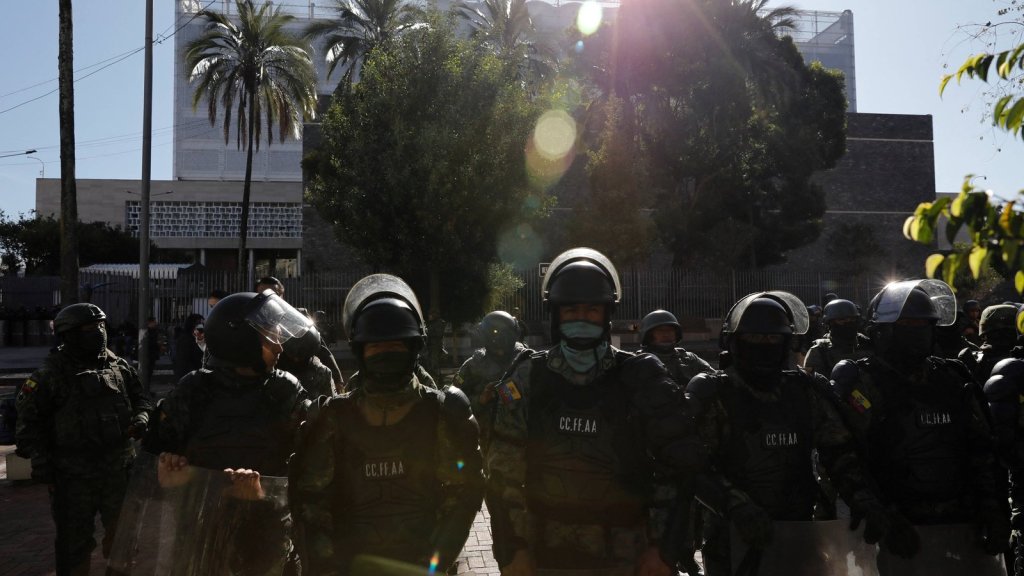
The current outbreak of violence began after the state reacted to the escape from prison of Adolfo Macías — known as “El Fito” — leader of the “Los Choneros” gang. The government declared a state of emergency and tried to impose a siege on the criminals, but suffered several brutal retaliations, with members of Fito’s gang capturing the University of Guayaquil, invading a live TV studio, and even bombing hospitals and public facilities. Furthermore, prisons were captured by criminals, with officers being held hostage, tortured and even hanged. The barbaric scenario led President Daniel Noboa to declare war on the “domestic enemy”, calling on the armed forces to act.

Currently, the streets of Ecuador are the scene of brutal urban warfare, with soldiers facing heavily armed narco-terrorists in intense attrition. The power acquired by criminal groups in the country is impressive, which shows how the impotence of a neoliberal state can have devastating consequences for national security.

It is important to emphasize that U.S.-born Daniel Noboa does not appear to be a skilled politician to reverse this situation completely. He came to power in a tense electoral scenario, in which gangs actively participated in political disputes, even being involved in the murder of a candidate. Noboa is a liberal politician who is extremely aligned with the U.S., and is not interested in resuming Correa’s policies, in addition to suffering a lot of pressure from criminal groups – which have a broad institutional infiltration.

However, it is desirable that at least the public situation in the country returns to normal in some way. The use of military force is the correct way to neutralize gang violence, but it is not the key to solving the drug trafficking problem. To truly undermine the power of criminal networks, it is necessary to implement illiberal policies that reduce poverty, removing ordinary citizens from the sphere of influence of drug trafficking in the country’s periphery. Furthermore, it is necessary to de-dollarize the economy and establish a sovereign currency and exchange rate policy, which make the work of drug trafficking more difficult through strict control of financial flows.

Noboa will certainly not be able to end the drug trafficking problem, as he is not willing to follow the illiberal path, but there is hope that, with the use of force, he will be able to return to normality at some point in the future. After suffering losses on the battlefield, gangs may agree to secretly negotiate a peace agreement with the government to end hostilities on both sides. This will have a positive aspect, as it will put an end to fighting, but it will also have a catastrophic characteristic, as it will definitely turn Ecuador into a Narco-State, where criminal gangs negotiate with the government and act in an institutional manner.

If the U.S. had not intervened in Correa’s Citizen Revolution, perhaps the situation in Ecuador would be different today. But, with neoliberalism and dollarization, the only possible result is a scenario like the current one.

The Thought Police Are Coming

By Chris Hedges

Source: TruthDig

Chris Hedges gave this talk Tuesday, June 11, at an event held in London in support of Julian Assange.

Ask the Iraqi parents of Sabiha Hamed Salih, aged 15, and Ashwaq Hamed Salih, aged 16, who were killed by shrapnel in Baghdad on July 31, 2004, what they think of Julian Assange.

Ask the man and his two young daughters who saw their wife and mother shot to death and were themselves wounded in a car fired upon by U.S. Marines in Fallujah on July 22, 2005, what they think of Julian Assange.

Ask the parents of Huda Haleem, an 18-year-old girl, and Raghad Muhamad Haleem, a 5-year-old boy, shot dead by U.S. soldiers on June 2, 2006, in Iraq’s Diyala province what they think of Julian Assange.

Ask the parents of the 15-year-old boy choked with a wire and then shot to death by U.S. Marines in Ramadi on Aug. 10, 2006, what they think of Julian Assange.

Ask the relatives of Ahmed Salam Mohammad, who was shot dead on Nov. 27, 2006, when U.S. troops attacked a wedding party near Mosul, an attack that also left four wounded, what they think of Julian Assange.

Ask the families of the over one dozen people shot to death with .50-caliber machine guns by bantering U.S. Apache helicopter crews in east Baghdad in July 2007—the crew members can be heard laughing at the “dead bastards” and saying “light ’em up” and “keep shooting, keep shooting”—a massacre that included two journalists for Reuters—Namir Noor-Eldeen and Saeed Chmagh—what they think of Julian Assange. Ask the then 10-year-old Sajad Mutashar and his 5-year-old sister, Doaha, both wounded, whose 43-year-old father, Saleh, was shot to death from the air as he attempted to assist one of the wounded men in the Baghdad street what they think of Julian Assange.

There is nothing like the boot of the oppressor on your neck to give you moral clarity.

None of these war crimes, and hundreds more reported to the U.S. military but never investigated, would have been made public without Julian, Chelsea Manning and WikiLeaks. That is the role of journalists—to give a voice to those who without us would have no voice, to hold the powerful to account, to give the forgotten and the demonized justice, to speak the truth.

We have watched over the last decade as freedom of the press and legal protection for those who expose government abuses and lies have been obliterated by wholesale government surveillance and the criminalizing of the leaking and, with Julian’s persecution, publication of these secrets. The press has been largely emasculated in the United States. The repeated use of the Espionage Act, especially under the Obama administration, to charge and sentence whistleblowers has shut down our ability to shine a light into the inner workings of power and empire. Governmental officials with a conscience, knowing all of their communications are monitored, captured and stored by intelligence agencies, are too frightened to reach out to reporters. The last line of defense lies with those with the skills that allow them to burrow into the records of the security and surveillance state and with the courage to make them public, such as Edward Snowden, Chelsea Manning and Jeremy Hammond, now serving a 10-year prison term in the United States for hacking into the Texas-based private security firm Strategic Forecasting Inc., or Stratfor. The price of resistance is high not only for them, but for those such as Julian willing to publish this information. As Sarah Harrison has pointed out: “This is our data, our information, our history. We must fight to own it.”

Even if Julian were odious, which he is not, even if he carried out a sexual offense, which he did not, even if he was a poor houseguest—a bizarre term for a man trapped in a small room for nearly seven years under house arrest—which he was not, it would make no difference. Julian is not being persecuted for his vices. He is being persecuted for his virtues.

His arrest eviscerates all pretense of the rule of law and the rights of a free press. The illegalities carried by the Ecuadorian, British and U.S. governments in the seizure of Julian two months ago from the Ecuadorian Embassy in London are ominous. They presage a world where the internal workings, abuses, corruption, lies and crimes, especially war crimes, carried out by the global ruling elite will be masked from the public. They presage a world where those with the courage and integrity to expose the misuse of power, no matter what their nationality, will be hunted down around the globe and seized, tortured, subjected to sham trials and given lifetime prison terms. They presage an Orwellian dystopia where journalism is outlawed and replaced with propaganda, trivia, entertainment and indoctrination to make us hate those demonized by the state as our enemies.

The arrest of Julian marks the official beginning of the corporate totalitarianism and constant state surveillance, now far advanced in China, that will soon define our lives. The destruction of all protection of the rule of law, which is what we are witnessing, is essential to establishing an authoritarian or totalitarian state.

The BBC China correspondent Stephen McDonell was locked out of WeChatin China a few days ago after posting photos of the candlelight vigil in Hong Kong marking 30 years since student protesters in Beijing’s Tiananmen Square were gunned down by Chinese soldiers in June 1989.

“Chinese friends started asking on WeChat what the event was?” he wrote. “Why were people gathering? Where was it? That such questions were coming from young professionals here shows the extent to which knowledge of Tiananmen 1989 has been made to disappear in China. I answered a few of them, rather cryptically, then suddenly I was locked out of WeChat.”

In order to get back on WeChat he had to agree that he was responsible for spreading “malicious rumors” and provide what is called a faceprint.

“I was instructed to hold my phone up—to ‘face front camera straight on’—looking directly at the image of a human head. Then told to ‘Read numbers aloud in Mandarin Chinese.’ My voice was captured by the App at the same time it scanned my face.”

Governmental abuse of WeChat, he wrote, “could deliver to the Communist Party a life map of pretty much everybody in this country, citizens and foreigners alike. Capturing the face and voice image of everyone who was suspended for mentioning the Tiananmen crackdown anniversary in recent days would be considered very useful for those who want to monitor anyone who might potentially cause problems.”

This is almost certainly our future, and it is a future that Julian has fought courageously to prevent.

In another sign the noose is tightening, the offices of the Australian Broadcasting Corp., the country’s national broadcaster, were raided by federal police last Wednesday. The raid was carried out because the broadcaster had disclosed detailed accounts of Australian special forces in Afghanistan killing unarmed people, including children. That story was generated, in part, by a leak of hundreds of classified military documents. The police raid and search through raw footage and thousands of files, emails and internal documents appear to be part of a hunt for the source, who will, no doubt, be arrested and imprisoned.

Under what law did Ecuadorian President Lenín Moreno capriciously terminate Julian’s rights of asylum as a political refugee? Under what law did Moreno authorize British police to enter the Ecuadorian Embassy—diplomatically sanctioned sovereign territory—to arrest a nationalized citizen of Ecuador? Under what law did Prime Minister Theresa May order the British police to grab Julian, who has never committed a crime? Under what law did Donald Trump demand the extradition of Julian, who is not a U.S. citizen and whose news organization is not based in the United States?

The psychological torture of Julian—documented by the United Nations special rapporteur on torture and ill treatment, Nils Melzer—mirrors the breaking of the dissident Winston Smith at the end of the novel “1984.” It is said the Gestapo broke bones and the East German Stasi secret police broke souls. Today, we too have refined the cruder forms of torture of the Gestapo. We break souls as well as bodies. It is more effective. This is why Julian, his physical and psychological health in serious decline, has been moved to a prison hospital. We can all be taken to George Orwell’s dreaded Room 101 to be made compliant and harmless. These “special administrative measures”—and you can be sure there are American intelligence operatives here assisting the British in the psychological torture of Julian—have destroyed thousands of detainees in black sites around the globe. These techniques, including prolonged solitary confinement, are the staple form of control in maximum-security prisons in the United States, where the corporate state makes war on its most oppressed and politically astute underclass—African Americans.

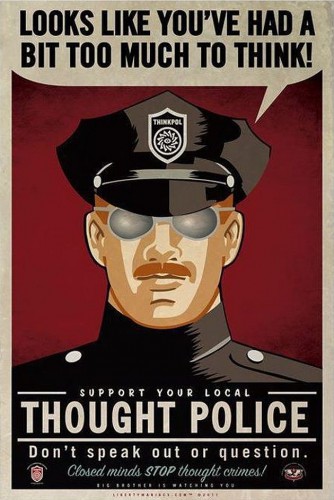
There has been a coordinated smear campaign against Julian by our Thought Police, one that is amplified by the very media organizations that published WikiLeaks material. The campaign was detailed in a leaked Pentagon document prepared by the Cyber Counterintelligence Assessments Branch and dated March 8, 2008. The document called for eradicating the “feeling of trust” that is WikiLeaks’ “center of gravity” and destroying Julian’s reputation.

This character assassination was championed by the Democratic Party establishment after WikiLeaks published 70,000 hacked emails copied from the accounts of John Podesta, Hillary Clinton’s campaign chairman. The Podesta emails exposed the donation of millions of dollars from Saudi Arabia and Qatar, two of the major funders of Islamic State, to the Clinton Foundation. It exposed the $657,000 that Goldman Sachs paid to Hillary Clinton to give talks, a sum so large it can only be considered a bribe. It exposed Clinton’s repeated mendacity. She was caught in the emails, for example, telling the financial elites that she wanted “open trade and open borders” and believed Wall Street executives were best positioned to manage the economy, a statement that contradicted her campaign statements. It exposed the Clinton campaign’s efforts to influence the Republican primaries to ensure that Trump was the Republican nominee. It exposed Clinton’s advance knowledge of questions in a primary debate. It exposed Clinton as the principal architect of the war in Libya, a war she believed would burnish her credentials as a presidential candidate. Journalists can argue that this information, like the war logs provided to WikiLeaks by Chelsea Manning, should have remained hidden, that the public did not have a right to know, but they can’t then call themselves journalists.

WikiLeaks has done more to expose the abuses of power and crimes of the American Empire than any other news organization. In addition to the war logs and the Podesta emails, it made public the hacking tools used by the CIA and the National Security Agency and their interference in foreign elections, including in the French elections. It disclosed the internal conspiracy against British Labour Party leader Jeremy Corbyn by Labour members of Parliament. It intervened to save Snowden from extradition to the United States by helping him flee from Hong Kong to Moscow after he made public the wholesale surveillance of the American public by our intelligence agencies. The Snowden leaks also revealed that Julian was on a U.S. “manhunt target list.”

We must build popular movements to force the British government to halt the extradition and judicial lynching of Julian. We must build popular movements to force the Australian government to intervene on behalf of Julian. We must build popular movements to reclaim democracy and the rule of law. If Julian is extradited and tried, it will create a legal precedent that will terminate the ability of the press, which Donald Trump has attacked as “the enemy of the people,” to hold power accountable. The crimes of war and finance, the persecution of dissidents, minorities and immigrants, the pillaging of the ecosystem and the ruthless impoverishment of working men and women to swell the profits of corporations and consolidate the global oligarchs’ total grip on power will no longer be part of public debate. First Julian. Then us.


Ecuador Has Been Hit by 40 Million Cyber Attacks Since Assange’s Arrest

By Elias Marat

Source: The Mind Unleashed

The government of Ecuador claims that the country has come under a broad and concerted cyber attack, with approximately 40 million attempts to compromise web portals connected to public institutions ever since the controversial decision to allow UK police to forcibly remove Wikileaks founder Julian Assange from their London Embassy.

Deputy Minister of Information and Communication Technologies Patricio Real told reporters that the wave of attacks began shortly after last Thursday’s arrest of Assange by British authorities. Real said that the attacks “principally come from the United States, Brazil, Holland, Germany, Romania, France, Austria and the United Kingdom, and also from here, from our territory.”

On April 11, Ecuadorian President Lenin Moreno revoked the diplomatic asylum extended to Asange by the South American nation in 2012. In a legally dubious move, Quito also revoked the Ecuadorian nationality granted to Assange in 2017.

Ecuador’s El Comercio reported that the telecommunications ministry’s undersecretary of electronic government, Javier Jara, claimed that following “threats received by these groups related to Julian Assange”–such as the shadowy network Anonymous–the country began suffering “volumetric attacks.

Volumetric attacks are a type of distributed denial of service (DDoS) attack in which servers are flooded with requests in an attempt to overload them with traffic, thus preventing users from accessing the network.

According to AFP, the targets included the foreign ministry, central bank, tax authorities, the office of the president, and a number of other government agencies’ websites. None of the attacks succeeded in destroying or stealing data.

The attacks also come amid the Ecuadorian government’s detention of Ola Bini, a Swedish national and software developer allegedly tied to Wikileaks who was detained last Thursday as he attempted to attend a martial arts event in Japan. Bini, as well as two unidentified Russian “hackers,” are being held for their alleged role in a “hackers’ network” based in the country. Bini, who is accused of having met with Assange 12 times, has also just been accused of playing a role in blackmail attempts targeting President Moreno.

Since 2017, Assange’s relationship with his Ecuadorean hosts sharply deteriorated amid President Lenin Moreno’s attempts to curry favor with international creditors and wealthy governments in the north such as the United States, the United Kingdom and Spain. Moreno began referring to Assange on various occasions as a “miserable hacker,” an “irritant,” and a “stone in the shoe” of his government.

Last year, the London embassy cut off his access to the internet for alleged political meddling following requests by Quito that he stop commenting on affairs in other countries.

Relations took a strong turn for the worse in March following the release of a batch of documents known as the “INA Papers,” which implicated the president in alleged corruption, including money-laundering, offshore bank accounts and a shell company named INA Investment Corporation that is based in Panama and was used by President Moreno’s family to procure furniture, property, and luxury goods.

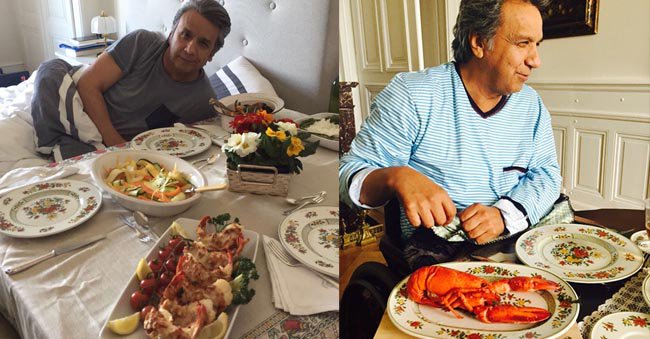
It is widely speculated that while Wikileaks has still not been directly tied to the release of the INA Papers, President Moreno was enraged after personal photographs were released showing his opulent private life, including photos of the president enjoying lavish lobster breakfast-in-bed and lobster dinners–imagery considered damning by Ecuador’s electorate especially given Moreno’s prior boasting of a poverty diet of eggs and white rice, which he claimed to regularly eat as he rammed through austerity measures that led to thousands of layoffs in the poor yet resource-rich South American country.

Within Ecuador, opinions have been evenly split about Assange, with the country’s right-wing and centrists supporting the decision to end his asylum while the left and supporters of former President Rafael Correa have considered the move a scandalous act of outright prostration before the “imperialists” of the Global North.

As such, social media reactions to the government’s complaints of “cyber attacks” have provoked both outrage and mockery from the Ecuadorian public, with some social media users thanking Assange for releasing the INA Papers and others claiming that the attacks will serve as a convenient smokescreen for the country’s authorities to further plunder the public coffers of the South American country.

What the arrest of Assange means for human rights of all


By Prof Marcello Ferrada de Noli, chairman of Swedish Doctors for Human Rights, SWEDHR

Source: The Indicter

We have repeatedly expounded the issue of right to existence as the primary of all human rights, and of human rights for all. War and its willfully killing is thus N° 1 enemy of such humanity’s essential right.

Hence, we have warmly supported the denounce of preparations, propaganda and perpetration of occupation-wars, illegal wars, war-abuses, crimes perpetrated under the name of one power’s ‘national security’ against the international security of many nations, the widespread killing of civilians, the using of prohibited chemical weapons, etc. All that denouncing has been a leit motif in the endeavors of WikiLeaks. Julian Assange, the founder of that organization, has established an example of civil courage, a behaviour  which has been followed by important other exposures at different latitudes.

This movement, which also perfectioned the mechanisms of modern alternative media to counter arrest the disinformation routine that has characterized MSM,  have provided free information, and thus education, as to how deal with the alienation pursued by the messages of those in power that are transmitted by the media at their service.

The arresting of the WikiLeaks publisher Mr Julian Assange signifies not only a hard blow for Western democratic principles referred to freedom of speech and freedom of the press. It also entails a further threat to all honest journalists, public and private officials which have undertaken the honourable mission of  denouncing war crimes allegedly perpetrated by NATO and its aligned forces in various scenarios of illegal wars.

On the other hand, amidst the dramatic circumstances in the now unpredictable fate of Mr Julian Assange, emerges another truth. This is, the Western media  in consensus, invariably dismissed the risk of extradition of Assange as the invention of “conspiracy theorists” –referring to the NGOs that defended Assange’s human rights. Instead, the first news arising after the arrest of Assange was known, is the public acknowledgement of an extradition request from the part of the US government. Hence, it was not “Assange’s paranoia”. And our analyses were accurate.

Let’s began by clarifying that Julian Assange has never been charged with any crime, neither in Sweden nor elsewhere. Instead, he has been made responsible for the legendary exposures in “Collateral Murder”, the documentary which denounced atrocities in the Iraq war, including the killing of civilian journalists ­–and already viewed by over 16 million people.

Due to WikiLeaks exposures on alleged US war crimes in the Iraq and Afghanistan wars,  the US has been after the extradition of Assange since 2010. After the publication of WikiLeaks of over 70,000 classified documents covering the war in Afghanistan, the US urged nations participating in the US-led coalition in Afghanistan to initiate prosecution against Julian Assange. This is documented in the ‘Snowden papers”, which text relevant to this issue  was republished in The Indicter Magazine in 2016. Of the countries then consulted, only Sweden complied with the US request and subsequently they opened an investigation against Assange on alleged sexual offences to permit a warrant for his arrest. Those accusations probed to be unsustainable, and the case had to be dropped afters years of Assange being held under the Swedish arrest warrant.

The real reason for the arrest was, according to open investigations SWEDHR has access to and which we earliest denounced, the extradition of Assange to the US.  A sealed process against Assange had been opened in Virginia –also negated by the authorities at that time– and which only recently has been confirmed by the U.S. Department of Justice.

While in house arrest, and in order to avoid the impending rendition to Sweden from the part of the London authorities, Julian Assange sought asylum at the Embassy of Ecuador in London.  The government of Ecuador under the presidency of Rafael Correa granted political asylum to him due to the risk of his extradition to the US from Sweden.

The UK then instructed Sweden to protract the ‘investigation’ on Assange, to which the Swedish authorities docilely complied. Meanwhile the process against Chelsea Manning continued.

But after Sweden dropped the investigations on Assange, The UK has said that it will arrest Assange anyway in case he leaves the embassy’s premises. This on the argument that Assange would have violated the conditions of his house arrest by seeking instead asylum at the Ecuador embassy.

In the meantime the United Nations Working Group on Arbitrary Detention (UNWGAD), had requested the immediate freedom of Mr Assange.

When I met Julian Assange at the embassy in London in August 2017, his situation had been substantially changed. Although efforts deployed by the outgoing ambassador, Assange’s health was deteriorating after years of isolation, sun deprivation, etc. He also told me about the unjustified accusations of involvement with Russian interests around the US presidential election narrative, which he categorically denied.  But the change of government in Ecuador had started to show consequences for his juridical, and physical safety at the Embassy.

President Moreno had another stance on issues of Ecuador’s national sovereignty – read, relationships with the US government. which openly consider South America as “our backyard”–  and in pursuing better terms for financial deals for his country with the US, president Moreno was said to include the fate if Assange in those negotiations. At east, according to WikiLeaks reports.

One first complaint against Assange was his use of Internet connections, provided to him at the Embassy, to embarrass “friendly governments”, such the US. But the real reason turn out being another “embarrassing”. Which was President Moreno’s own.

And so we arrive to the “INAPapers” affair, which was appartently used by Moreno as a pretext to justify his decision of rendering Julian Assange to the UK authorities (and subsequently to the US). Here is the “INAPapers affair in summary:

According to reports published in Ecuador local media, Ina Investment Corporation is an offshore company related to Xavier Macías Carmigniani, his wife María Auxiliadora Patiño Herdoiza, and the Ecuador president Lenin Moreno’s family.

Between 2012-2016 the company had a bank account in the  Balboa Bank de Panamá. WikiLeaks mentioned in a tweet some of the information that has been already published in Ecuador. Also an investigation in Ecuador’s National Assembly was opened. One issue that I could read is that that several furniture items were acquired and stored at Lenin Moreno’s apartment in Geneva, Switzerland, in 2015. The published source that I am using here (Periodismo de Investigación),  also reported that from such account departed transfers to purchase  an apartment in the Mediterranean coast, in 2016.

The transfer pertaining the furniture deal, is alleged to consist in $19 342, and the recipient firm was described as  “Moinat S.A. Atiquities” en Suiza. And regarding the apartment of Moreno in Switzerland, this would have correspond to the residence he has at the time he served as UN Special Envoy on Disability and Accessibility –an appointment he received from Secretary-General Ban Ki-moon. All according to what has been described by  Periodismo de Investigación.

Already on April 4, WikiLeaks tweeted that “A high level source within the Ecuadorian state has told WikiLeaks that Julian Assange will be expelled within “hours to days” using the INAPapers offshore scandal as a pretext–and that it already has an agreement with the UK for his arrest.”

This was immediately denied by Ecuador’s Foreign minister José Valencia:

In the morning of April 5, 2019,  Ecuador Foreign Minister José Valencia tweeted (he later did withdraw it) in response to the above mentioned post by WikiLeaks:

“Diplomatic asylum is a sovereign privilege of a state, which has the right to grant it or withdraw it unilaterally when deemed necessary”

Ensuing, SWEDHR produced the following statement:

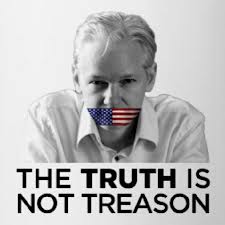
Defending Julian Assange; Defending the Truth

By Robert J. Burrowes

On 11 April 2019, WikiLeaks editor Julian Assange was dragged from the Ecuadorian Embassy in London by UK police and arrested for breaching a bail condition. See ‘Arrest update – SW1’. Upon arrival at a London police station, Julian was ‘further arrested’ on behalf of the United States government to satisfy an extradition warrant under Section 73 of the UK Extradition Act. See ‘UPDATE: Arrest of Julian Assange’.

Following a brief court hearing in which the extraordinary prejudice of the district judge was on clear display – see ‘Chelsea and Julian Are in Jail. History Trembles’ – Julian is now imprisoned in south London’s maximum security Belmarsh Prison. He will appear in custody at Westminster Magistrates’ Court for a preliminary extradition hearing on 2 May and the US must produce its case for requesting Julian’s extradition from the UK by 12 June but, as Nicholas Weaver reports, Julian could be in UK custody for years as the extradition is contested in court. See ‘The Wikileaks Case Is Just Beginning’.

Prior to his arrest, Julian had been living in the Ecuadorian Embassy since 2012, having been granted citizenship of Ecuador and asylum by that country because many people were well aware of the risk he faced if he was tried in a kangaroo court in the United States. This asylum, to which Julian was entitled under long-standing provisions of international law, had been granted by previous Ecuadorian President Rafael Correa, who clearly understood this law (and the moral principles on which it is based).

As a result of his recent arrest however, Julian is under threat of extradition to the United States so that he can face criminal prosecution/persecution – see the US indictment of Julian Assange or ‘Read the Julian Assange indictment’ – for his role in exposing the truth about US war crimes in Afghanistan (the Afghan War Diary) and Iraq (the Iraq War Logs), as did The Guardian and The New York Times, by publishing leaked evidence of these crimes – including the ‘Collateral Murder’ video – as well as publishing evidence of widespread government corruption on the WikiLeaks website. It was this threat of persecution by US authorities that led Julian to seek asylum in the Ecuadorian Embassy in the first place.

However, since the election in Ecuador on 24 May 2017 of the criminal and cowardly president Lenín Moreno, Julian’s asylum has been under threat and the conditions of his stay in the Embassy have rapidly deteriorated. This is because Moreno has been anxious to divert public attention from the spotlight of corruption currently shining directly on him – see ‘Ecuador National Assembly to Start Corruption Probe of Moreno’ – and to secure the loans offered as bribes by US officials while capitulating to US government pressure to illegally terminate Julian’s political asylum. See ‘Ecuador Bowed to US Pressure, Violated Law – Assange’s Associate’ and ‘WikiLeaks Founder Julian Assange Arrested, Activists Rally to Stop US Extradition’.

Of course, the criminal and cowardly nature of Moreno’s action is highlighted by the fact that the decision of the Ecuadorian government to terminate Julian’s asylum was done in violation of article 79 of Ecuador’s constitution which forbids extradition of its own citizens. See ‘Republic of Ecuador Constitution of 2008’. As Moreno’s predecessor, Rafael Correa noted simply in one Facebook post: ‘Moreno is a corrupt man’. See ‘Facebook Removes Page of Ecuador’s Former President on Same Day as Assange’s Arrest’.

Unfortunately, as further evidence of its function as an elite agent, rather than facilitating free speech, Facebook promptly ‘unpublished’ Correa’s Facebook page. Clearly, Moreno’s corruption is not a subject that Facebook wants advertised. See ‘Facebook Removes Page of Ecuador’s Former President on Same Day as Assange’s Arrest’. Still, it should be pointed out, Twitter’s function as an elite agent is no different. See ‘Twitter Restricts Account of Julian Assange’s Mother’.

Naturally enough, despite elite efforts to control the narrative, many people and organizations around the world have been outraged at the treatment of Julian (as well as other truthful journalists and whistleblowers such as Chelsea Manning, who has recently been imprisoned yet again, and Edward Snowden) who act courageously on the basis that the public has a right to know about the criminality of their governments as well as to know the truth generally.

As long ago as 5 February 2016, the Office of the High Commissioner for Human Rights (OHCHR) at the United Nations issued a statement in which they ‘called on the Swedish and British authorities to end Mr. Assange’s deprivation of liberty, respect his physical integrity and freedom of movement, and afford him the right to compensation’ noting that its opinions are ‘legally-binding to the extent that they are based on binding international human rights law, such as the International Covenant on Civil and Political Rights (ICCPR)’. See Julian Assange arbitrarily detained by Sweden and the UK, UN expert panel finds.

Moreover, in recent days, UN officials have spoken openly of their serious concern if Julian’s asylum was illegally revoked. See ‘UN expert on privacy plans to visit Julian Assange’ and ‘Two UN Rapporteurs Are Concerned About Julian Assanges’ Situation’.

And just recently, on 11 April 2019, the American Civil Liberties Union issued its response to Julian’s arrest, noting that ‘Criminally prosecuting a publisher for the publication of truthful information would be a first in American history, and unconstitutional.’ The report added that ‘Any prosecution by the United States of Mr. Assange for Wikileaks’ publishing operations would be unprecedented and unconstitutional, and would open the door to criminal investigations of other news organizations. Moreover, prosecuting a foreign publisher for violating U.S. secrecy laws would set an especially dangerous precedent for U.S. journalists, who routinely violate foreign secrecy laws to deliver information vital to the public’s interest.’ See ACLU Comment on Julian Assange Arrest’.

So once extradited, would Julian have any chance of defending himself with the truth? As US attorney Bill Simpich explains, Julian will be prevented from presenting the essential elements of his defense because ‘The [US] government doesn’t want a fair fight. In a fair fight, the government will lose.’ See ‘The Julian Assange Case: Revealing War Crimes Is Not a Crime’.

More bluntly, Jonathan Turley points out:

‘[T]he Justice Department is likely to move aggressively to strip Assange of his core defenses. Through what is called a motion in limine, the government will ask the court to declare that the disclosure of intelligence controversies is immaterial. This would leave Assange with only the ability to challenge whether he helped with passwords and little or no opportunity to present evidence of his motivations or the threat to privacy.

‘The key to prosecuting Assange has always been to punish him without again embarrassing the powerful figures made mockeries by his disclosures. That means to keep him from discussing how the U.S. government concealed attacks and huge civilian losses, the type of disclosures that were made in the famous Pentagon Papers case. He cannot discuss how Democratic and Republican members either were complicit or incompetent in their oversight. He cannot discuss how the public was lied to about the program.’ See ‘Julian Assange Will Be Punished for Embarrassing the DC Establishment’.

Hence, while the Ecuadorian, British and US governments are flagrantly violating the law in persecuting Julian, it is being left to individuals and civil society organizations to defend him and many are mobilizing to do so already.

As a result, people have signed petitions – see Don’t extradite Assange!’ and Block Extradition & Prosecution of Julian Assange for First Amendment-Protected Journalism’ – some have participated in demonstrations at UK embassies and consulates around the world – see, for example, ‘Protesters Call on UK to #FreeAssange Outside British Embassy in DC’ – and others have engaged in other acts of solidarity as suggested, for example, by Julian’s mother Christine or on the website ‘Defend WikiLeaks’ and in this article: ‘Julian Assange Arrested, Take Action Now’.

Given the importance of defending our access to accurate information about our world, rather than the propaganda marketed as ‘news’ by the corporate media, it is worth reflecting on how best we can do this and, in doing so, defend people like Julian and Chelsea (who play such a vital role in giving us access to the truth in particular contexts) at the same time.

Hence, because of my own longstanding interest in developing thoughtfully-designed nonviolent strategies in our struggle to make our world one of peace, justice and ecological sustainability, let me suggest a strategic way forward that will honor the courage of Julian and Chelsea by maximizing the impact of their truth-telling on the longer-term struggles just mentioned while also taking separate action to provide some additional pressure to assist them in the short and medium terms.

In order to design this strategy well, let us first analyze the issue of why those who tell the truth are persecuted. If we do not understand, precisely, why this happens, we cannot respond powerfully.

Accurate Strategic Analysis Depends on Knowing the Truth

If we are to understand, accurately, the context and structural dimensions of a conflict (that is, the ‘big picture’ in which it is contained) so that we can identify and analyze the underlying drivers of the conflict in order to develop a coherent strategy to address these drivers, then the very first prerequisite is that we have truthful information. Without this truthful information, activists have zero prospect of accurately understanding and analyzing what is happening in the world (such as in relation to war and the climate catastrophe, for example).

Because the global elite is highly aware of the importance of the truth, it goes to enormous effort to make it difficult, if not impossible, to access the truth, particularly in certain critical contexts. And there are some classic historical examples, among many others, where not knowing the truth has allowed elites to inflict monumental atrocities in our name while crippling efforts to strategically mobilize opposition to these atrocities.

The most obvious examples of this phenomenon include ‘false flag’ attacks such as those conducted by US authorities and their allies on 9/11 as the prelude to launching their ‘war on terror’ which has caused immeasurable damage to, if not virtually destroyed, entire countries across west Asia and north Africa. If the truth about those behind the 9/11 attacks had been immediately available, rather than still ‘dribbling out’ nearly 20 years later, then it would have been far easier to mobilize resistance to the US-led wars on other countries and to campaign, strategically, for the profound changes needed to ensure that our world is spared the scourge of such atrocities in future. To access the definitive account of the overwhelming evidence in relation to 9/11 as a false flag attack, see 9/11 Unmasked: An International Review Panel Investigation which is reviewed in ‘The Fakest Fake News: The U.S. Government’s 9/11 Conspiracy Theory’. For a long but incomplete list of false flag attacks, see ‘The Ever-Growing List of ADMITTED False Flag Attacks’.

So if we ask the question ‘Who played the primary role in deceiving us about 9/11 and molding the desired public response?’, the answer is that it was some key government, corporate, military and bureaucratic spokespeople and, particularly, the corporate media projecting the words of these official spokespeople far and wide. But if we ask the question ‘Who was controlling these spokespeople and the corporate media?’ the answer is ‘the global elite’.

This is because a primary function of the global elite, which it has long understood, is to create (using individuals employed within its think tanks as well as compliant academics) and maintain (through education systems, the entertainment industry and the corporate media) the dominant narrative in society so that the information available to the public is the information that the elite needs to shape public perception in favor of elite interests, such as perpetual war and chronic over-consumption, which ensure perpetuation of elite power, profit and privilege.

Hence, as you can see, people like Julian Assange and Chelsea Manning and organizations like WikiLeaks represent a fundamental threat to elite power, profit and privilege precisely because their truth-telling functionally undermines the elite narrative, for example, that our ‘enemy’ is a bunch of terrorists somewhere rather than the global elite itself.

While the false flag examples offered above highlight how suppression of the truth disempowers activists and populations thus helping to minimize any effective mobilization in response, there are also a great many examples where the truth was critical to informing and helping to mobilize activists to resist injustice, in one form or another. For example, Kevin Zeese superbly illustrates the crucial importance of WikiLeaks in facilitating awareness of the truth during the uprisings in 2011 across north Africa and west Asia. See ‘Julian Assange: At the Forefront of 21st Century Journalism’.

In essence then, it is individuals like Julian and Chelsea, rather than the sycophantic editors, reporters and journalists working for the corporate media, who give us the information we need to know so that we can better understand how our dysfunctional and violent world works and campaign effectively to change it.

And so they are enemies of the elite who must be silenced and discredited, legally or otherwise.

If you would like to read other accounts by individuals who astutely warn us of the deeper implications of what is happening to Julian, see the recent articles by Chris Hedges The Martyrdom of Julian Assange’ and John Pilger The Assange Arrest Is a Warning from History’.

So what do we do?

Well, I believe we honor individuals like Julian and Chelsea by using the truths they reveal to us to develop and implement thoughtfully-designed nonviolent strategies to make our world one of peace, justice and ecological sustainability. This is why they risk paying (and are now paying) such a high personal price to get us the truth that must inform these struggles. But we can also assist courageous individuals like Julian and Chelsea in the short-term too. So let me also add to the suggestions made by others mentioned above.

If we are to make the most use of the truth that Julian and Chelsea have risked (and paid) so much to get to us, then we must campaign strategically. By doing this, as I just mentioned, we truly honor their efforts and sacrifice. So, for example, if you want to campaign to end the elite’s wars and destruction of our climate from which it profits so enormously, then consider doing it strategically. See Nonviolent Campaign Strategy. This site identifies, among other key elements of strategy, the two strategic aims and the basic list of strategic goals necessary to achieve these outcomes. See ‘Campaign Strategic Aims’.

Irrespective of whether or not you are keen on campaigning in this way, there is a fifteen-year strategy for tackling all elements of our environmental crisis in The Flame Tree Project to Save Life on Earth.

If you would like to tackle the problem at its core, consider making ‘My Promise to Children’ so that your children grow up with the conscience and courage of Julian and Chelsea. Unfortunately, individuals of their conscience and courage are incredibly rare in our world: not a powerful place to start in tackling a global elite that is utterly insane.

‘Insane?’ you might ask. Remember this: the global elite and many of its political, corporate, bureaucratic, military and academic agents, spend their time planning and implementing strategies to kill people (using military violence and economic exploitation) to make a profit. Do you really believe that this is something that a sane person would spend their time doing? I know you have been inundated with propaganda throughout your life to make you accept (or ignore) the violence in our world without question but pause and ponder it now: is it really sane? Are we not capable, as a species, of organizing our world to achieve peace, justice and ecological sustainability? See ‘The Global Elite is Insane Revisited’ with a lot more detail in Why Violence?’ and Fearless Psychology and Fearful Psychology: Principles and Practice.

Moreover, individuals who are not incredibly psychologically damaged do not manipulate elite institutions – such as the legal system: see ‘The Rule of Law: Unjust and Violent’ – to persecute powerful individuals like Julian and Chelsea. The conscience and courage of Julian and Chelsea are readily recognized by those who are not psychologically damaged: they are qualities of exceptional individuals whom we should honor.

If you would like to join the worldwide movement to end all violence, you are welcome to sign the online pledge of The Peoples Charter to Create a Nonviolent World.

But we do not need to confine our acts of solidarity with Julian and Chelsea to those regarding strategies for profound change or the others mentioned above either. If you want to act powerfully in their support, consider the following five options as well and do as many as you can:

  1. Boycott The Guardian and The New York Times (because they were two of the original outlets that published material sourced from WikiLeaks but now hypocritically engage in the persecution of Julian and Chelsea). And suggest to others that they also boycott these media outlets.
  2. Boycott all media outlets (anywhere in the world) that advocate or support the arrest, trial and/or imprisonment of Julian and/or Chelsea. And suggest to others that they boycott these media outlets too. If you want the truth about our world, get it from news outlets like the one you are reading now.
  3. Boycott Facebook. And suggest to others that they boycott this medium too.
  4. Boycott Twitter. And suggest to others that they boycott this medium too.
  5. Write letters of solidarity to Julian and Chelsea. Tell them what you are doing to make best use of the truths they have revealed.

Given elite control of all political, economic, commercial, legal, social and media institutions of any consequence in our world, it will not be easy to liberate Julian (and, perhaps, even Chelsea) in the short term. UK and US elites may even conspire to secretly put Julian on a rendition flight to the US or simply be content with a protracted legal struggle which distracts many of us from the issues that Julian and Chelsea so courageously put in the spotlight.

For that reason, while we struggle to liberate them we can also struggle to liberate the vast number of other people who suffer the elite’s military violence and economic exploitation so that the efforts of Julian and Chelsea are not in vain.


Biodata: Robert J. Burrowes has a lifetime commitment to understanding and ending human violence. He has done extensive research since 1966 in an effort to understand why human beings are violent and has been a nonviolent activist since 1981. He is the author of Why Violence? His email address is flametree@riseup.net and his website is here.

 

The Martyrdom of Julian Assange

By Chris Hedges

Source: Truthdig

The arrest Thursday of Julian Assange eviscerates all pretense of the rule of law and the rights of a free press. The illegalities, embraced by the Ecuadorian, British and U.S. governments, in the seizure of Assange are ominous. They presage a world where the internal workings, abuses, corruption, lies and crimes, especially war crimes, carried out by corporate states and the global ruling elite will be masked from the public. They presage a world where those with the courage and integrity to expose the misuse of power will be hunted down, tortured, subjected to sham trials and given lifetime prison terms in solitary confinement. They presage an Orwellian dystopia where news is replaced with propaganda, trivia and entertainment. The arrest of Assange, I fear, marks the official beginning of the corporate totalitarianism that will define our lives.

Under what law did Ecuadorian President Lenin Moreno capriciously terminate Julian Assange’s rights of asylum as a political refugee? Under what law did Moreno authorize British police to enter the Ecuadorian Embassy—diplomatically sanctioned sovereign territory—to arrest a naturalized citizen of Ecuador? Under what law did Prime Minister Theresa May order the British police to grab Assange, who has never committed a crime? Under what law did President Donald Trump demand the extradition of Assange, who is not a U.S. citizen and whose news organization is not based in the United States?

I am sure government attorneys are skillfully doing what has become de rigueur for the corporate state, using specious legal arguments to eviscerate enshrined rights by judicial fiat. This is how we have the right to privacy with no privacy. This is how we have “free” elections funded by corporate money, covered by a compliant corporate media and under iron corporate control. This is how we have a legislative process in which corporate lobbyists write the legislation and corporate-indentured politicians vote it into law. This is how we have the right to due process with no due process. This is how we have a government—whose fundamental responsibility is to protect citizens—that orders and carries out the assassination of its own citizens such as the radical cleric Anwar al-Awlaki and his 16-year-old son. This is how we have a press legally permitted to publish classified information and a publisher sitting in jail in Britain awaiting extradition to the United States and a whistleblower, Chelsea Manning, in a jail cell in the United States.

Britain will use as its legal cover for the arrest the extradition request from Washington based on conspiracy charges. This legal argument, in a functioning judiciary, would be thrown out of court. Unfortunately, we no longer have a functioning judiciary. We will soon know if Britain as well lacks one.

Assange was granted asylum in the embassy in 2012 to avoid extradition to Sweden to answer questions about sexual offense allegations that were eventually dropped. Assange and his lawyers always argued that if he was put in Swedish custody he would be extradited to the United States. Once he was granted asylum and Ecuadorian citizenship the British government refused to grant Assange safe passage to the London airport, trapping him in the embassy for seven years as his health steadily deteriorated.

The Trump administration will seek to try Assange on charges that he conspired with Manning in 2010 to steal the Iraq and Afghanistan war logs obtained by WikiLeaks. The half a million internal documents leaked by Manning from the Pentagon and the State Department, along with the 2007 video of U.S. helicopter pilots nonchalantly gunning down Iraqi civilians, including children, and two Reuters journalists, provided copious evidence of the hypocrisy, indiscriminate violence, and routine use of torture, lies, bribery and crude tactics of intimidation by the U.S. government in its foreign relations and wars in the Middle East. Assange and WikiLeaks allowed us to see the inner workings of empire—the most important role of a press—and for this they became empire’s prey.

U.S. government lawyers will attempt to separate WikiLeaks and Assange from The New York Times and the British newspaper The Guardian, both of which also published the leaked material from Manning, by implicating Assange in the theft of the documents. Manning was repeatedly and often brutally pressured during her detention and trial to implicate Assange in the seizure of the material, something she steadfastly refused to do. She is currently in jail because of her refusal to testify, without her lawyer, in front of the grand jury assembled for the Assange case. President Barack Obama granted Manning, who was given a 35-year sentence, clemency after she served seven years in a military prison.

Once the documents and videos provided by Manning to Assange and WikiLeaks were published and disseminated by news organizations such as The New York Times and The Guardian, the press callously, and foolishly, turned on Assange. News organizations that had run WikiLeaks material over several days soon served as conduits in a black propaganda campaign to discredit Assange and WikiLeaks. This coordinated smear campaign was detailed in a leaked Pentagon document prepared by the Cyber Counterintelligence Assessments Branch and dated March 8, 2008. The document called on the U.S. to eradicate the “feeling of trust” that is WikiLeaks’ “center of gravity” and destroy Assange’s reputation.

Assange, who with the Manning leaks had exposed the war crimes, lies and criminal manipulations of the George W. Bush administration, soon earned the ire of the Democratic Party establishment by publishing 70,000 hacked emails belonging to the Democratic National Committee (DNC) and senior Democratic officials. The emails were copied from the accounts of John Podesta, Hillary Clinton’s campaign chairman. The Podesta emails exposed the donation of millions of dollars from Saudi Arabia and Qatar, two of the major funders of Islamic State, to the Clinton Foundation. It exposed the $657,000 that Goldman Sachs paid to Hillary Clinton to give talks, a sum so large it can only be considered a bribe. It exposed Clinton’s repeated mendacity. She was caught in the emails, for example, telling the financial elites that she wanted “open trade and open borders” and believed Wall Street executives were best positioned to manage the economy, a statement that contradicted her campaign statements. It exposed the Clinton campaign’s efforts to influence the Republican primaries to ensure that Trump was the Republican nominee. It exposed Clinton’s advance knowledge of questions in a primary debate. It exposed Clinton as the primary architect of the war in Libya, a war she believed would burnish her credentials as a presidential candidate. Journalists can argue that this information, like the war logs, should have remained hidden, but they can’t then call themselves journalists.

The Democratic leadership, intent on blaming Russia for its election loss, charges that the Podesta emails were obtained by Russian government hackers, although James Comey, the former FBI director, has conceded that the emails were probably delivered to WikiLeaks by an intermediary. Assange has said the emails were not provided by “state actors.”

WikiLeaks has done more to expose the abuses of power and crimes of the American Empire than any other news organization. In addition to the war logs and the Podesta emails, it made public the hacking tools used by the CIA and the National Security Agency and their interference in foreign elections, including in the French elections. It disclosed the internal conspiracy against British Labour Party leader Jeremy Corbyn by Labour members of Parliament. It intervened to save Edward Snowden, who made public the wholesale surveillance of the American public by our intelligence agencies, from extradition to the United States by helping him flee from Hong Kong to Moscow. The Snowden leaks also revealed that Assange was on a U.S. “manhunt target list.”

A haggard-looking Assange, as he was dragged out of the embassy by British police, shook his finger and shouted: “The U.K. must resist this attempt by the Trump administration. … The U.K. must resist!”

We all must resist. We must, in every way possible, put pressure on the British government to halt the judicial lynching of Assange. If Assange is extradited and tried, it will create a legal precedent that will terminate the ability of the press, which Trump repeatedly has called “the enemy of the people,” to hold power accountable. The crimes of war and finance, the persecution of dissidents, minorities and immigrants, the pillaging by corporations of the nation and the ecosystem and the ruthless impoverishment of working men and women to swell the bank accounts of the rich and consolidate the global oligarchs’ total grip on power will not only expand, but will no longer be part of public debate. First Assange. Then us.


WikiLeaks and whistleblowers condemn new allegations against Julian Assange

By James Cogan

Source: WSWS.org

WikiLeaks has announced it will sue the British Guardian over the scurrilous allegations it made on May 15 that Julian Assange “hacked” the communication system of the Ecuadorian embassy in London where he has been confined since he sought political asylum in June 2012.

The only and obvious motive behind the unsubstantiated, “anonymous” allegations is to provide the Ecuadorian government with a pretext to renege on Assange’s asylum and force him out of the embassy. Upon doing so, he would be arrested by waiting British police for breaching bail conditions. Once in British custody, the WikiLeaks editor would face the prospect of extradition to the US to stand trial on charges of espionage, which could lead to his protracted imprisonment or, potentially, even his execution (see: “Conspiracy emerges to push Julian Assange into British and US hands”).

In a tweet issued shortly after the publication of the Guardian articles, WikiLeaks denounced the assertions as an “anonymous libel” made on behalf of the “current UK-US government onslaught against Mr Assange’s asylum—while he can’t respond. You’ve gone too far this time. We’re suing.”

Assange cannot respond because on March 28, more than seven weeks ago, the Ecuadorian government of President Lenín Moreno cut off all his communications with the outside world and has blocked him from even receiving visitors. Ample indications exist that Ecuador did so on the demand of Washington, as part of the price for improved relations with the US.

WikiLeaks ended its tweet with a link to the scathing review that Assange wrote of the Guardian-published 2014 book, The Snowden Files: The Inside Story of the World’s Most Wanted Man. The author of the book was Luke Harding, the same Guardian journalist who co-wrote the May 15 attack on Assange and WikiLeaks.

In the first sentence of his review, Assange described Harding’s work as a “hack job in the purest sense of the word” and more than substantiated that characterisation. He condemned the Guardian for having “caved to government pressure” over the publication of leaked material and for leaving Edward Snowden “in the lurch” when the NSA whistleblower fled to Hong Kong in June 2013. It was a representative of WikiLeaks who organised for Snowden to escape to Russia, where he was eventually granted political asylum.

Harding and the Guardian did not have credibility in 2014 and they do not today.

Beside WikiLeaks and the World Socialist Web Site, only a handful of other websites and individuals have stepped forward to denounce the Guardian for serving as the conduit for the anti-Assange vendetta of the US government and intelligence agencies. In the main, there is a complicit silence on the part of the pro-imperialist establishment media and no less pro-imperialist pseudo-left organisations.

Former British whistleblower Craig Murray, who has vocally defended Assange from the outset, wrote on his blog yesterday that the Guardian articles included “outright lies.” Murray exposed, for example, the false claim by the newspaper that Sweden was “unable to question Assange” over allegations he may have committed sexual offences in 2010. The reprehensible attempt to slander Assange as a “rapist” has been relentlessly used to try and undermine the immense international support for WikiLeaks and its editor.

In fact, Assange was questioned before he left Sweden for Britain and a prosecutor deemed he had no case to answer. A second prosecutor, however, reopened the case and pursued it aggressively, gaining an arrest warrant to force Assange to return to Sweden to answer “questions.” The warrant was issued under conditions in which US and allied governments were baying for Assange’s blood because WikiLeaks had published vast amounts of damning evidence of war crimes and intrigues that had been courageously leaked by then Private Bradley [now Chelsea] Manning.

Assange correctly refused to submit to the politically-motivated warrant and challenged it in the British courts. He sought asylum in June 2012 only when his legal avenues ran out to prevent his extradition to Sweden, and likely rendition on to the US.

When Swedish authorities finally agreed to Assange’s longstanding offer to answer any questions, from Britain, he was interviewed by prosecutors and police for two days in November 2016. In May 2017, Sweden completely dropped the case. After more than six years of persecution, Assange was never charged with any crime.

Craig Murray characterised the May 15 Guardian articles as a “new low… in a collaboration between long term MI6 mouthpiece Luke Harding and the CIA financed neo-con propagandists of Focus Ecuador”—the right-wing Spanish-language site which was also provided the “anonymous” information that Assange “hacked” the embassy.

Murray opined: “I would bet any money that these anonymous ‘sources’ are as always Harding’s mates in the British security services.”

The Intercept website featured today an interview conducted by Glenn Greenwald, its editor and former whistleblower, with previous Ecuadorian President Rafael Correa, whose administration granted Assange asylum in 2012.

Correa denounced his protégé and successor Lenín Moreno for cutting off Assange’s communications and visitors, labelling it as “basically torture and “a clear violation of his rights.” He declared the Ecuadorian government “is attacking Julian’s mental health.” He reviewed the closer relations between Moreno’s administration and Washington that had been developed immediately prior to the attack on Assange

Correa stated that the Guardian allegations that Assange hacked the embassy were “absurd” and that it had “presented no evidence for this, just an anonymous source.”

The ex-president stated that if Moreno allowed the WikiLeaks’ editor to be forced out of the London embassy without an iron-clad guarantee he would not be extradited to the US, it would be a “terrible betrayal, a violation of the rules of asylum and a breach of Ecuador’s responsibility to protect the safety and welfare of Julian Assange.”

The almost universal hostility towards Assange and indifference to his fate on the part of the establishment press and self-styled “left” is in stark contrast to mass popular sentiment. On Facebook, Twitter and other social media, every defence of Assange is being responded to with a stream of supportive comments, retweets and shares, and sharp and informed rebuttals of all those who attempt to attack Assange and WikiLeaks with pro-state propaganda and lies.

The social force that must be politically mobilised in defence of democratic rights is the international working class. It must be alerted and educated as to the tremendous dangers posed by the steadily escalating efforts to censor the Internet, suppress free speech and railroad whistleblowers and principled journalists like Julian Assange into prison or worse.


The author also recommends:

Ecuador hints it may hand over Julian Assange to Britain and the US
[12 May 2018]

Freedom for Julian Assange!
[11 January 2018]