Duplicitous Biden Regime Mission to Venezuela

By Stephen Lendman

Source: StephenLendman.org

Last weekend, a Biden regime delegation met with 

Venezuelan President Nicolas Maduro and other Bolivarian officials in Caracas.

The aim of the first diplomatic contact between both nations since the Trump regime closed the US Caracas embassy in 2019, officially broke with Venezuela’s legitimate government, and illegally designed Juan Guido as president flopped.

More on this below.

Hegemon USA has been a mortal enemy of Bolivarian social democracy since Hugo Chavez took office as president in February 1999, following his December 1998 election — a near-generation ago.

Count the ways.

1. The aborted two-day April 2002 attempt to oust Chavez. Failure to get Venezuelan military support and popular resistance foiled it.

2. The 2002 – 03 general strike and oil management lockout, causing severe economic disruption and billions of dollars in losses.

3. The August 2004 national recall referendum, Hugo Chavez winning overwhelmingly with a 59% majority, thwarting the US-orchestrated attempt to remove him.

4. US sanctions war on Venezuela, begun by the Bush/Cheney regime in 2006 — for so-called non-cooperation in combatting international terrorism that hegemon USA fosters. 

War on the Bolivarian Republic by other means continued under the Obama/Biden regime.

Greatly escalated by Trump regime hardliners, high-level Venezuelan officials and the country’s enterprises were targeted.

US policy tried to block Venezuelan access to financial markets, as well as maximally reduce its oil exports.

Annually since 2006, the State Department falsely accused Venezuela of not “cooperating fully with US anti-terrorism efforts” – pursuant to Section 40A of the Arms Export Control Act (22 USC 2781).

5. In 2005, the Bush/Cheney regime falsely accused the Bolivarian Republic of non-cooperation against narco-trafficking that the US actively supports worldwide, notably the CIA.

Annually since then, Washington falsely claimed Venezuela hadn’t fulfilled its obligations under international narcotics agreements. 

6. In 2008, the Bush/Cheney regime imposed asset freezes and prohibitions on financial transactions, targeting designated Venezuelan nationals and enterprises.

7. The Obama/Biden regime killed Hugo Chavez.

US dark forces poisoned or infected him with deadly cancer causing substances, a coup by other means, eliminating him — while Chavismo has remained resilient.

8. The Obama/Biden regime’s March 2015 executive order falsely declared Venezuela to be an “unusual and extraordinary threat to the national security and foreign policy of the US.” 

At the time, a fake ‘national emergency’ was declared to “confront” a nonexistent threat.

9. Violent made-in-the-USA street protests staged to destabilize the country with regime change in mind were responsible for scores of deaths and hundreds of injuries.

10. The August 2017 CIA-orchestrated terrorist attack on Fort Paramacay in Carabobo state was another foiled coup attempt.

11. The August 2018 attack on Maduro by drones armed with C-4 explosives attempted to kill him.

12. Trump regime hardliners waged war on Venezuela by other means, including propaganda, economic, financial, and electricity war, along with other attacks on the country’s infrastructure.

The aim was to inflict maximum harm on ordinary Venezuelans, falsely believing they’d blame Maduro for US criminal actions.

Chavez knew that the US marked him for elimination. Fidel Castro warned him to be wary and careful. 

Maduro is targeted in similar fashion. He and other senior Venezuelan officials remain vulnerable to removal by coup d’etat or assassination.

It’s just a matter of time before another regime change attempt occurs — to replace Venezuelan social democracy with US-controlled fascist tyranny. 

Biden regime officials showing up in Caracas last weekend made unacceptable demands.

Reportedly they unacceptably called for a new presidential election.

There’s none scheduled until 2024 for a six-year term beginning on January 10, 2025.

In 2018, Maduro won another six-year term overwhelmingly by a two-thirds majority.

His main adversary, Chavista turncoat Henri Falcon, fared much poorer than predicted with around 21% of the vote. 

Other unacceptable Biden regime demands reportedly included the following:

Greater US/Western foreign private investment in Venezuela — mainly for maximum control of the country’s vast oil reserves, the world’s largest, including its heavy oil.

Maduro splitting from Russia by siding with the US-dominated West against Vladimir Putin’s demilitarization and deNazification of Ukraine.

In return, Biden regime official offered hollow promises to be breached at hegemon USA’s discretion.

Maduro and Vice President Delcy Rodriguez demanded sanctions relief and return of confiscated Venezuelan assets, mainly oil related.

For most of the past 23 years, US regimes waged war on Venezuela by other means — because of its independence and democratic governance the way it should be.

Venezuelans have the real thing — in stark contrast to fantasy versions throughout the West.

Russia is a valued Venezuelan ally.

According to Russia’s Foreign Ministry, Vladimir Putin and Maduro spoke by phone last week.

Venezuela’s leader expressed “firm support” for the Russian Federation.

Condemning US-dominated NATO’s destabilization activities, Maduro stressed his intention to maintain political and economic relations with Russia.

The American Exceptionalism of Secretary of State Antony Blinken

By Kevin Gosztola

Source: Shadowproof

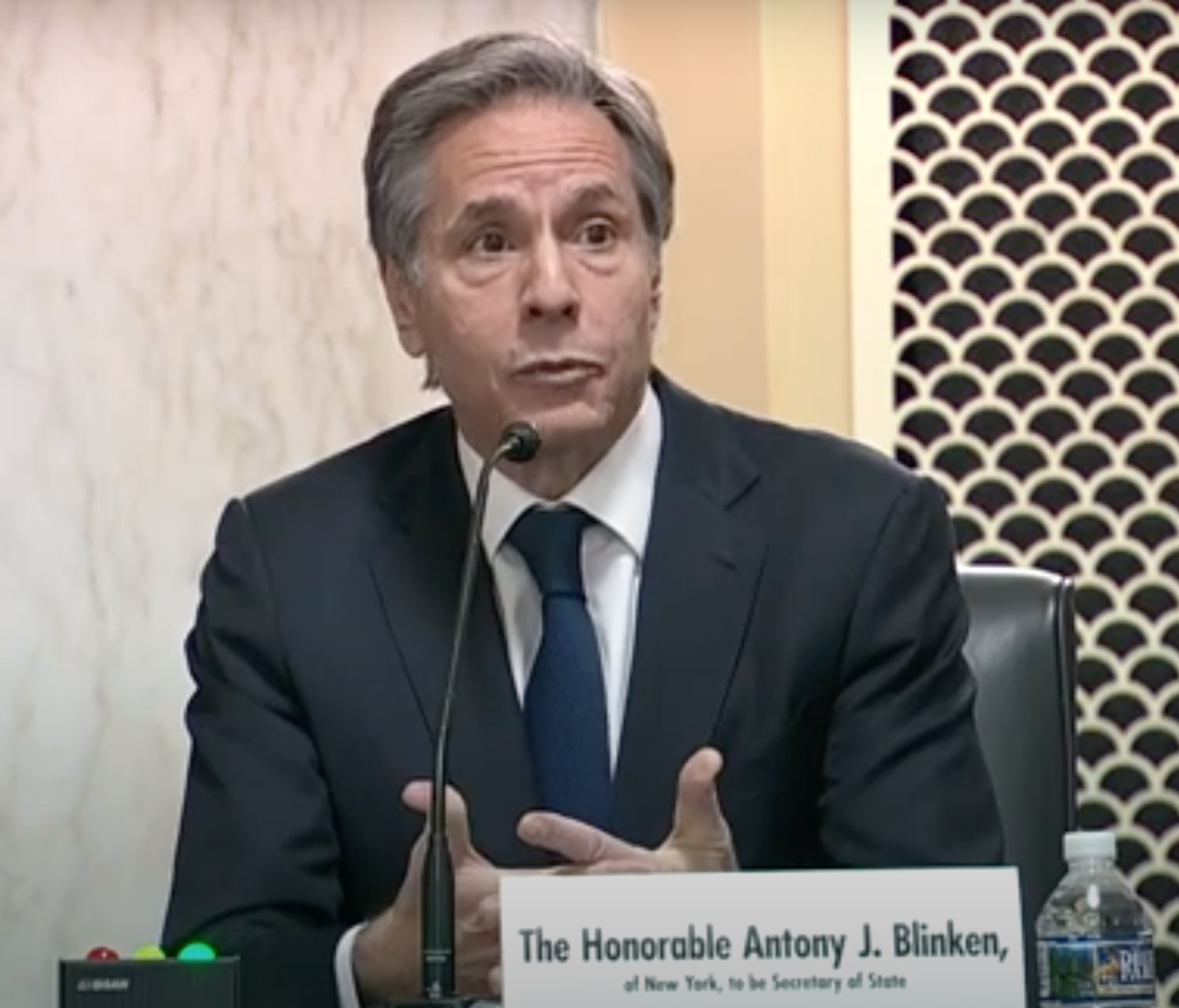
“American leadership still matters. The reality is the world simply does not organize itself,” Secretary of State Antony Blinken proclaimed at his confirmation hearing. “When we are not engaged, when we are not leading, then one of two things is likely to happen. Either some other country tries to take our place but not in a way that is likely to advance our interests and values, or maybe, just as bad, no one does and then you have chaos.”

Much like President Joe Biden, Blinken is a neoliberal Democrat who believes in the doctrine of “Manifest Destiny.” He thinks if the United States does not impose its will and shape the world then there will be no law and order. He cannot fathom how countries could survive on their own. At least, that is how he argues for greater American intervention in global regions.

Blinken was confirmed as secretary of state in a vote on January 26. Not a single Democrat in the Senate voted against Blinken.

He is a longtime ally of Biden, and during Biden’s first term as vice president, he was his national security adviser.

During President Barack Obama’s second term, Blinken was deputy secretary of state. He was also a part of President Bill Clinton’s National Security Council from 1994 to 2001.

Making Venezuela’s ‘Regime Enablers’ Finally Feel The Pain Of Sanctions

Blinken’s predecessor Mike Pompeo, a right-wing Christian reconstructionist, was involved in President Donald Trump administration’s failed regime change operation against Nicolas Maduro’s government in Venezuela. Yet, despite its failure, Blinken told Republican Senator Marco Rubio he thought the Biden administration should keep recognizing Juan Guaido as the one and only true “leader.”

“We need an effective policy that can restore democracy to Venezuela, free and fair elections,” Blinken declared. He even embraced sanctions, despite the fact that they have hampered the country’s ability to respond to the COVID-19 pandemic and resulted in the deaths of tens of thousands of Venezuelans.

“Maybe we need to look at how we more effectively target the sanctions that we have so that regime enablers finally feel the pain of those sanctions,” Blinken added.

However, a report [PDF] from the Congressional Research Service (CRS) dated January 22, 2021, indicates the sanctions by both the Obama and Trump administrations were targeted pretty well and imposed to inflict “pain” against 113 Venezuelans and 13 entities.

…President Maduro, his wife, Cecilia Flores, and son, Nicolás Maduro Guerra; Executive Vice President Delcy Rodriguez; Diosdado Cabello (Socialist party president); eight supreme court judges; the leaders of Venezuela’s army, national guard, and national police; governors; the director of the central bank; and the foreign minister…

Trump imposed sanctions to prohibit Venezuela from participating in U.S. financial markets and block the government’s ability to issue digital currency. Treasury Department officials prohibited corporations from purchasing Venezuelan debt. Venezuela’s state oil company, PdVSA, was aggressively targeted for seeking to evade U.S. sanctions and Venezuela’s central bank was sanctioned too.

Blinken Defends Being Wrong On War In Libya

Obama flouted the War Powers Act and launched a war in Libya against Muammar Gaddafi’s regime without the approval of Congress. It created a power vacuum filled by extremist militia groups and transformed the country into a failed state. Migrants are captured and sold in what the United Nations has referred to as “open slave markets.”

Despite the catastrophe sparked by war, Blinken defended his support for a regime change war. “I think it’s been written about. I — I was the president-elect’s national security adviser at the time. And he did not agree with that course of action.”

Biden was opposed to war in Libya. “My question was, okay, tell me what happens? [Gaddafi’s] gone. What happens? Doesn’t the country disintegrate? What happens then? Doesn’t it become a place where it becomes a petri dish for the growth of extremism? Tell me. Tell me what we’re gonna do.”

Rather than concede President Biden was right and he was wrong, Blinken signaled to Senate Republicans that he would be their hawk when Biden was too dovish.

Blinken bafflingly blamed Gaddafi, who was summarily executed, for what happened in Libya after his death.

“We didn’t fully appreciate the fact that one of the things Gaddafi had done over the years was to make sure that there was no possible rival to his power. And as a result, there was no effective bureaucracy, no effective administration in Libya with which to work when he was gone,” Blinken argued.

The Bothsidesism Of Blinken’s View Toward War In Yemen

Sarah Lazare recalled for In These Times the horrors unleashed on the people of Yemen, as a result of the Obama administration’s support for Saudi Arabia’s war against the Houthis.

“The coalition bombed a center for the blind, a funeral, a wedding, a factory and countless homes and residential areas, and blockaded Yemen’s ports, cutting off vital food and medical shipments — all while the Obama-Biden administration was in power,” Lazare wrote.

“Indeed, the Obama White House was so complicit in war crimes in Yemen in that its own State Department internally warned key U.S. military personnel could be subject to war crimes prosecution, according to a Reuters investigation published in October 2016. By July 2015, a United Nations official was already warning that Yemen was on the verge of a famine, a premonition that horrifically came true.”

One of Pompeo’s final actions was to sanction Houthis, which caused a disruption to aid groups delivering humanitarian assistance. Biden froze the sanctions for one month the same day the Senate confirmed Blinken.

Asked about the intense humanitarian crisis in Yemen, Blinken drew a false equivalency between the actions of the Houthis and the Saudis.

“We need to be clear-eyed about the Houthis. They overthrew a government in Yemen. They engaged in a path of aggression through the country. They directed aggression toward Saudi Arabia,” Blinken contended. “They’ve committed atrocities and human rights abuses and that is a fact. What’s also a fact though is that the Saudi-led campaign in Yemen to push back against

the Houthi aggression has contributed to what is, by most accounts, the worst humanitarian situation that we face anywhere in the world.”

The Houthis were part of the Arab Spring uprising in Yemen against the corrupt government of Ali Abdullah Saleh. State Department officials generally backed these rebellions against autocratic rulers.

According to a 2017 post from Bruce Riedel of the Brookings Institution, “American intelligence officials said that Iran was actually trying to discourage the Houthis from seizing Sanaa and openly toppling Hadi. Iran preferred a less radical course, but the Houthi leadership was drunk with success. Moreover, Undersecretary of Defense Michael Vickers said on the record in January that Washington had a productive informal intelligence relationship with the Houthis against al-Qaida. He suggested that the cooperation could continue.”

The Obama administration, which included Blinken, did not want to jeopardize a 70-year-plus alliance with Saudi Arabia and backed the monarchy’s intervention.

‘Very Much’ Supporting U.S. Arms Shipments To Ukraine

Blinken expressed his support for arming Ukrainian groups a total of three times. He even reminded Republican Senator Ron Johnson he had the opportunity in 2018 to write an op-ed for the New York Times promoting what senators euphemistically describe as “lethal defensive assistance.”

He told Republican Senator Rob Portman, “I very much support the continued provision to Ukraine of lethal defensive assistance and, and indeed, of the training program as well.”

“To the extent that across a couple of administrations, we’ve been able to effectively train and as well as assist in different ways the Ukrainians, that has made a material difference in their ability to withstand the aggression they’ve been on the receiving end of from Russia,” Blinken asserted.

It is difficult to gauge whether the policy has been effective or helped Ukrainians withstand battles with pro-Russian separatist groups. There is not a whole lot of reporting.

But Lieutenant General Ben Hodges, who was the commander of the U.S. Army in Europe, stated in 2015, “If the U.S. policy changed to provide, say, Javelins, for example, that would probably lead to increased lethality on the battlefield for the Ukrainians. It would not change the situation strategically in a positive way, because the Russians would double down. They would dramatically increase more violence, more death, more destruction.”

“The conflict in Ukraine’s mostly Russian-speaking industrial east, called Donbass, erupted in April 2014, weeks after Russia’s annexation of the Crimean Peninsula,” according to the Associated Press. “More than 14,000 people have been killed in fighting between Ukrainian forces and Russia-backed separatists.”

Professor Stephen Cohen called attention to the role of neo-Nazi forces in Ukraine. The overthrow of Viktor Yanukovych was a “violent coup” led by fascist conspirators opposed to Russia. They conducted exterminations of ethnic Russians. The Azov Battalion, part of Kiev’s armed forces, is pro-Nazi and was banned from receiving U.S. military aid, but it almost certainly obtained weapons shipped by the Trump administration from the black market.

“We are left then not with Putin’s responsibility for the resurgence of fascism in a major European country but with America’s shame, and possible indelible stain, on its historical reputation for tolerating it, even if only through silence,” Cohen concluded.

US Return To Iran Nuclear Deal Not Happening Soon

It was the United States under Trump that ditched the Iran nuclear deal, not Iran. Still, it is the Biden’s administration position that Iran should first “comply” with U.S. demands before the U.S. rejoins the deal.

“If Iran returns to compliance with the JCPOA [nuclear deal], we would do the same thing and then use that as a platform working with our allies and partners to build longer and stronger agreements — also capture some of the other issues that need to be dealt with, with regard to missiles, with regard to Iran’s activities and destabilizing activities in the region,” Blinken said.

“There is a lot that Iran will need to do to come back into compliance. We would then have to evaluate whether it actually [did] so. So, I don’t think that’s anything that’s happening tomorrow or the next day.”

Meanwhile, as CBS News described in November, Iran has endured a “harrowing, sanctions-fueled coronavirus catastrophe.”

Doctors experience shortages of every supply necessary for fighting the pandemic. “U.S.-led sanctions have choked off Iran’s access to foreign-made chemicals and equipment.”

Iran has begged Biden to lift sanctions that prevent Iran from accessing COVID-19 vaccines.

***

Melodramatically, Senator Marco Rubio feverishly asked Blinken has any doubt that the Chinese Communist Party’s goal is to be the “world’s predominant political, geopolitical, military, and economic power and for the United States to decline in relation.”

“I do not,” Blinken replied.

“You have no doubt?” Rubio chimed.

“I have no doubt,” Blinken restated.

From Obama to Trump, U.S. empire has prepared its forces for what it calls “great power competition” between China and Russia. It fears China will take the place of the U.S., leading to one of Blinken’s nightmare futures.

Much of the public is wary over military interventions in the Middle East. The threat of terrorism is no longer enough to justify expenditures toward an ever-gargantuan military-industrial complex. Countering China, however, is an easier sell.

“Forcing men, women, and children into concentration camps, trying to, in effect, reeducate them to be adherents to the ideology of the Chinese Communist Party, all of that speaks to an effort to commit genocide,” Blinken remarked.

Human rights abuses under Biden will increasingly be weaponized to defend policies and operations that ramp up tensions with China. Whether descriptions of China’s acts are accurate or not, the point will be to silence anyone who questions whether the violations are enough to warrant increased conflict. (Of course, how dare anyone raise the matter of U.S. deportation camps and their horrors or America’s mass incarceration of 1–2 million people to point out any sort of hypocrisy.)

After the House of Representatives voted to arm so-called rebel groups in Syria in 2014, MSNBC’s Joe Scarborough asked Blinken about concerns that arms “could end up in wrong hands.” Blinken brushed aside concerns and maintained the U.S. would vet and give arms to “the right people.”

In March 2016, the Los Angeles Times reported “CIA-armed units and Pentagon-armed [militias had] repeatedly shot at each other while maneuvering through contested territory on the northern outskirts of Aleppo” in Syria.

Blinken may not be rapture ready like his predecessor, Mike Pompeo. He may be more willing to wave the LGBTQIA+ rainbow flag when arming proxy forces or backing regime change operations. However, they are both devout believers in American exceptionalism.

He views Biden as a president who will put the “globe back on its axis” after Trump. He will spend his time at the State Department working to “restore democracy” and “renew” America’s “leadership” in the world. Which means Blinken will continue the many callous, cold, and calculating traditions of U.S. imperialism, promote hubris over humility, and commit himself to cloaking ignoble acts in the rhetoric of human rights.

Biden and the Democrats will Sow Chaos in Latin America

By Timothy Alexander Guzman

Source: Silent Crow News

Election Interference, Regime Change and a Possible Humanitarian Intervention is on Washington’s Agenda 

US President Joseph Biden, a relic from Washington’s old political establishment will continue the same imperialist policies in Latin America as did his predecessors including that of Donald Trump.  There is a clear indication that Washington’s hostilities towards Venezuela’s President Nicolas Maduro will continue under a Biden administration.  The day before Biden’s inauguration, Reuters’ had published a report on what we can expect from the new administration when it comes to Venezuela, ‘Biden will recognize Guaido as Venezuela’s leader, top diplomat says.’ which means that Washington will continue to support the opposition leader, Juan Guaido as Venezuela’s “legitimate” president.  According to the report, Anthony Blinken said “U.S. President-elect Joe Biden’s administration will continue to recognize Venezuelan opposition leader Juan Guaido as the South American country’s president.” Not only Washington would recognize a political figure who was selected by Washington, it would continue to use targeted sanctions on the Latin American country coinciding with humanitarian aid:

Blinken told members of the U.S. Senate that Biden would seek to “more effectively target” sanctions on the country, which aim to oust President Nicolas Maduro – who retains control of the country. Blinken said the new administration would look at more humanitarian assistance to the country

US hostilities towards Venezuela did not start with Trump, there were tensions between Washington and Caracas with the Obama and Bush regimes.  An article from the Associated Press (AP) in 2015 ‘Venezuela’s President Accuses Vice President Biden of Plotting to Overthrow Him’ said that Washington had imposed “new visa restrictions on Venezuelan officials and their families.”  The former White House Communications Director under Obama, Jen Psaki who is now on Biden’s team as the White House Press Secretary said that “the U.S. was showing clearly that human rights violators and their families “are not welcome in the United States.” Washington’s actions earned condemnation from Maduro who said that “he would write a letter to Obama over what he called an attempt to violate Venezuela’s national sovereignty” and that Washington’s long-time policies which are basically strong-arm tactics used on Venezuela and its close allies in the region will lead to failure “U.S. policy toward Venezuela has been kidnapped by “irresponsible, imperial forces that are putting the United States on a dead-end.”  Maduro’s response towards Washington’s sanctions at the time was on a televised national address which he criticized Obama’s Vice-President, Joe Biden:

In a televised address over the weekend, Maduro claimed that Biden sought to foment the overthrow of his socialist government during a Caribbean energy summit Biden hosted last month in Washington. According to Maduro, Biden told Caribbean heads of state that the Venezuelan government’s days were numbered and it was time they abandon their support.  “What Vice President Jose Biden did is unspeakable,” Maduro said

And of course, Washington dismissed Maduro’s claims as “ludicrous.”  With Joe Biden in charge, expect more of the same bi-partisanship actions including more sanctions, regime change operations and even the possibility of an assassination attempt on  Maduro’s life.  With a number of war hawks appointed under this new administration including humanitarian interventionist, Samantha Power who will lead the United States Agency for International Development (USAID) tweeted “What’s happening in Venezuela is flying under the radar in the US, but it is incredibly serious” shows what direction Washington will move towards.  “In the past week, the opposition banned from competing in April presidential elections, UNICEF warns of child malnutrition crisis, IMF predicts 13,000% inflation in 2018” meaning that Power will push for a humanitarian intervention in some form or another.  Power has supported military interventions in Syria and was a cheerleader for the war in Afghanistan and Libya.  There will be bi-partisan support from both the democrats and republicans for regime change in Venezuela.  But a war against Venezuela under Biden is also quite possible since they have the world’s largest oil reserves on the planet.  Tensions between Washington and Caracas will only escalate in the upcoming months.

Nicaragua will be also on Washington’s radar as they are scheduled to have Presidential elections in November.  Expect some sort of election interference to oust long-time enemy of Washington, Nicaraguan President, Daniel Ortega.  In a September 5th tweet, Biden said “Nicaraguan asylum seekers fleeing oppression deserve to have their cases heard.  Instead, they’re being deported back into the tyrannical grip of Daniel Ortega without a chance to pursue their claims.  President Trump’s cruelty truly knows no bounds.”  Venezuela and Nicaragua will experience hostilities from the Biden team, a continuation of policies from previous US regimes is assured.

Obama’s 2009 Coup in Honduras is a Warning to Anti-Imperialists in Latin America 

Joe Biden’s history with Latin America as vice-President to Obama should be considered a warning sign of things to come.  As soon as Obama was selected for office, they went to work on their backyard with a shovel in hand and set their sights on the small nation of Honduras.  Before, the US approved the coup against its Democratic leader, Manuel Zelaya because he wanted to rewrite the constitution. Zelaya administered an opinion poll for a referendum so that a constitutional assembly can legally reform the constitution that would allow Honduran citizens to have a legitimate voice in the political process.  Honduran officials, members of the Supreme Court and even members of his own party who are under Washington’s control declared Zelaya’s plans as unconstitutional.  Officials from the Obama regime including Hillary Clinton who was the Secretary of State at the time, all agreed Zelaya had to be removed from power.  Zelaya was also too friendly with Washington’s enemies in the region including Bolivia, Ecuador, Nicaragua and Venezuela.  Zelaya had also helped people in need as he raised the hourly minimum-wage, funded scholarships for students, authorized the distribution of milk and basic food necessities for children and even helped distribute energy-saving light bulbs among others for the Honduran people. Washington also considered Zelaya a threat to its interests concerning the Central American Free Trade Agreement (CAFTA) and its US troops stationed at the Palmerola military base if Zelaya decided to cancel the CAFTA deal or stop US troops from entering Honduras.  For decades, Washington has trained soldiers and officers in the Honduran military through the former U.S. Army School of the Americas (SOA) which is now called the Western Hemisphere Institute for Security Cooperation (WHINSEC).

On June 28th, 2009, with permission from the Supreme Court of Honduras issued an order for the military to arrest and detain President Zelaya  who was taken to the Hernan Acosta Mejia Air Base located in Tegucigalpa, Honduras and was exiled to Costa Rica.  The aftermath of the coup resulted in Honduras becoming one of the most dangerous countries on the planet with one of the highest murder-rates in Central America. Roberto Micheletti became the interim-president following the coup.  Under his leadership, the Honduras government became a repressive force that lead to an increase of Hondurans deciding to immigrate to the US.  Human rights groups and activists lives were threatened.  In 2016, one of the death threats became a reality for a well-known Indigenous rights and environmental activist by the name of Bertha Caceres who was assassinated in her home.  Caceres was known for preventing one of the world’s largest corporations that builds dams from completing the Agua Zarca Dam at the Río Gualcarque.  Life in Honduras became worst after Washington’s intervention to oust a democratically elected leader who wanted to make things a little better for his people which constitutes a criminal act under Washington’s political establishment.

What Does An Imperialist Power Under Joseph Biden Mean for Latin America?

The gloves will come off.  Joe Biden wants to get the job done for the Military-Industrial Complex.  The Biden regime will be more aggressive and dangerous to left-wing Latin American leaders who have disobeyed Washington’s political establishment.  That’s why they are all on the hit-list to be removed from power so that Washington’s preferred candidates can regain control to benefit their corporate and military interests that has plunged Latin America into a cycle of civil wars, debt and poverty since the end of the Spanish-American war.  Biden and the Democrats will try to prove to the Republicans who can be more “tough” on Latin American leaders and others around the world who defy Washington’s policies.  Biden’s presidency might prove that his administration will be more hawkish than the Republicans on Venezuela and the rest of Latin America’s anti-imperialist governments.

Biden’s transition team is filled with war profiteers, Beltway chickenhawks, and corporate consultants

A glance at the Biden-Harris agency review teams should provide a rude awakening to anyone who believed a Biden administration could be “pushed to the left.”

By Kevin Gosztola

Source: The Gray Zone

An eye-popping array of corporate consultants, war profiteers, and national security hawks have been appointed by President-elect Joe Biden to agency review teams that will set the agenda for his administration. A substantial percentage of them worked in the United States government when Barack Obama was president.

The appointments should provide a rude awakening to anyone who believed a Biden administration could be pressured to move in a progressive direction, especially on foreign policy.

If the agency teams are any indication, Biden will be firmly insulated from any pressure to depart from the neoliberal status quo, which the former vice president has pledged to restore. Instead, he is likely to be pushed in an opposite direction, towards an interventionist foreign policy dictated by elite Beltway interests and consumed by Cold War fever.

Regime change addicts and revolving doors

A prime example of the interventionist-minded establishment-oriented figures filling the Biden-Harris Defense Department agency team is Lisa Sawyer. She served as director for NATO and European strategic affairs for the National Security Council from 2014 to 2015, and worked for Wall Street’s JPMorgan Chase as a foreign policy adviser. Sawyer was part of the Center for a New American Security’s “Task Force on the Future of US Coercive Economic Statecraft,” which essentially means she participated in meetings that focused on methods of economic warfare that could be used to destabilize countries that refused to bow to American empire.

Sawyer believes the US government is not doing enough to deter Russian “aggression,” US troop levels in Europe should return to the levels they were at in 2012, and offensive weapons shipments to Ukraine should continue and increase in violation of the Minsk Agreements.

“Instead of saying we will lift sanctions when Russia decides to comply with the next agreement, say that we will raise them until they do. Instead of kowtowing to Russia’s supposed spears of influence, provide Ukraine the lethal assistance it so desperately needs and increase US support to vulnerable nations in the gray zone,” Sawyer declared when testifying before the Senate Armed Services Committee in 2017.

US assistant secretary of state for African affairs Linda Thomas-Greenfield was appointed leader of the Biden-Harris State Department team. She is a stalwart ally of former US national security adviser Susan Rice, who pushed for war in Libya, supported the invasion of Iraq, and was involved in the decision to remove peacekeepers from the United Nations which enabled Rwanda genocide.

As a developer and manager for US policy toward sub-Saharan Africa, she cheered President George W. Bush’s Millennium Challenge Account, a neocolonialist policy designed to privilege US corporations and facilitate the economic exploitation of so-called emerging African economies.

Thomas-Greenfield has been a part of the Albright Stonebridge Group, a global consulting firm chaired by former Secretary of State Madeleine Albright that lobbies for the defense industry.

Albright Stonebridge’s client list has included the management firm of vulture capitalist GOP mega-donor Paul Singer. When the Beltway insiders teamed up to suck Argentina’s economy dry during the country’s last debt crisis, then-President Cristina Kirchner accused Albright of threatening to fund her opponents unless she ceded to her demands.

The State Department group also includes Dana Stroul, a fellow at the neoconservative Washington Institute for Near East Policy (WINEP), which was originally founded by the American Israel Public Affairs Committee (AIPAC).

As The Grayzone’s Ben Norton reported, Stroul was enlisted by Senate Democrats in 2019 to join the “Syria Study Group” to help map out the next phase of the US dirty war in Syria. The recommendations included maintaining a military occupation of one-third of the country, the “resource rich part of Syria” in order to give the US leverage to “influence a political outcome.”

Stroul urged further economic sanctions against Damascus and the obstruction of reconstruction aid, which has already led to shortages of oil and bread.

Ali Abunimah of the Electronic Intifada noted that Farooq Mitha, a former Pentagon official in the Obama administration, has been appointed to Biden’s Pentagon transition team. Mitha was a board member of Emgage, a Muslim American PAC which has fostered ties to the Israel lobby, provoking angry condemnation from Palestine solidarity advocates. Mitha has reportedly attended AIPAC conferences.

Multiple Biden-Harris appointees back regime change in Venezuela. Paula Garcia Tufro was a member of Obama’s National Security Council and is on the NSC team. She was at the NSC when Obama declared Venezuela a “national security threat” and has consorted with a D.C. group that represents failed coup plotter Juan Guaido.

Kelly Magsamen, the vice president of national security and international policy at the Center for American Progress and a former Pentagon and State Department official, is on the Biden-Harris NSC team. When Representative Ilhan Omar grilled Elliott Abrams, the special envoy to Venezuela, Magsamen rushed to the defense of her former boss, calling Abrams a “fierce advocate for human rights.” (Abrams supported death squads in Central America in the 1980s.)

Former US ambassador to Mexico Roberta Jacobson is a member of the State Department transition team. Marketing herself as an expert on “Latin American business politics,” Jacobson has also worked for the Albright Stonebridge Group consulting firm.

Jacobson helped devise the Obama administration’s designation of Venezuela as a national security threat, setting the stage for the economic blockade imposed under Trump.

“In a rude and petulant manner, Mrs. Jacobson tells us what to do,” Venezuela’s then-Foreign Minister Delcy Rodriguez complained at the time. “I know her very well because I have seen her personally, her way of walking, chewing. You need manners to deal with people and with countries.”

Derek Chollet and Ellison Laskowski, both senior staffers at the German Marshall Fund (GMF), are also on the Biden-Harris State Department group. GMF has pushed for a more belligerent US and European posture toward Russia while supporting a dubious information war project called Hamilton 68. This website claimed to be able to identify “Russian influence operations” while fueling social media censorship of accounts that promoted anti-imperialist narratives, misidentifying real people as “Russian bots,” and orchestrating smears against Black Lives Matter protests by branding them as instruments of covert Russian influence.

The Biden-Harris intelligence team features Greg Vogle, the former CIA head of station in Afghanistan and a former partner at the McChrystal Group consulting firm founded by former commander of Joint Special Operations Command (JSOC) Stanley McChrystal. Both JSOC and the CIA, as well as the paramilitary forces they trained, have committed war crimes in Afghanistan.

Vogle also found time to work for a US military contractor named DGC International that provides construction, fueling, oxygen, liquid nitrogen, and other logistical support to US military forces, cashing in on wars across the Middle East.

As Sarah Lazare reported for In These Times, “Of the 23 peo­ple who com­prise the Depart­ment of Defense agency review team, eight of them — or just over a third — list their ​“most recent employ­ment” as orga­ni­za­tions, think tanks or com­pa­nies that either direct­ly receive mon­ey from the weapons indus­try, or are part of this indus­try.” Those companies include Raytheon, Northrop Grumman, General Dynamics, and Lockheed Martin.

Vogle is joined on the intelligence team by Matt Olsen, the former National Counterterrorism Center director for Obama and briefly, the general counsel for the National Security Agency (NSA).

From 2006-2009, Olsen served as deputy attorney general for the Justice Department’s National Security Division. There, he broke down barriers that prevented prosecutors from being able to use information collected through clandestine operations and warrantless surveillance in criminal cases. He also helped craft the FISA Amendments Act, which granted telecommunications companies immunity for their role in the NSA’s warrantless wiretapping program established after the 9/11 attacks.

Olsen is a defender of backdoor searches of Americans’ internet communications, having argued that the Fourth Amendment right to privacy is too cumbersome for the FBI to follow. He spent the months after NSA whistleblower Edward Snowden exposed mass surveillance programs working to discredit Snowden by accusing the whistleblower of aiding terrorists.

Another Snowden opponent on the Biden-Harris intelligence team is Bob Litt, who was the Office of Director of National Intelligence’s top lawyer. When any media organization ran a story on some new aspect of the US surveillance apparatus, Litt was the national security state’s spokesperson deployed to downplay or dismiss the revelation.

When Director of National Intelligence James Clapper was skewered for lying to Congress about the collection of Americans’ phone metadata, for example, Litt rose to Clapper’s defense, absurdly arguing the director was “surprised by the question and focused his mind on the collection of the content of Americans’ communications.”

In fact, the Biden-Harris agency review teams are packed with figures likely to enshrine lawlessness and disdain for civil liberties if they enter the administration.

Agents of injustice

They include Department of Justice review team member Marty Lederman. A Georgetown Law professor, Lederman was the deputy assistant attorney general in the Justice Department’s Office of Legal Counsel from 2009 to 2010. He helped draft the “drone memo” that outlined the supposed “legal basis” for executing Anwar al-Awlaki, an Al Qaeda affiliated terrorism suspect without charge or trial, despite the fact that Al-Awlaki was an American citizen.

Joining Lederman is Barbara McQuade, an ex-MSNBC contributor and former US attorney in the Eastern District of Michigan, which has jurisdiction over Dearborn, Detroit, and Flint. During her time as the government’s top prosecutor in Flint, McQuade had the power to bring charges against Michigan officials responsible for contaminating the city’s water and lying to the public about it, but she waited out her tenure without doing anything of substance to hold them accountable.

McQuade’s office was complicit in the racial profiling and intrusive surveillance of Arab, Muslim, and Sikh communities in Dearborn. She pursued the political prosecution of Rasmea Odeh, a prominent Palestinian American civil rights activist in Chicago, resulting in Odeh’s deportation to Jordan.

Odeh was tortured by Israeli forces, the State Department knew she was accused of violence by the Israeli government, yet she was allowed to immigrate to the US in the 1990s. Nonetheless, Odeh was convicted of immigration fraud and deported to Jordan as part of an effort to salvage a larger FBI counterintelligence operation against antiwar and international solidarity activists.

Neil MacBride, the former US Attorney in the Eastern District of Virginia, is on the Biden-Harris Justice Department team too. Although his office did not indict WikiLeaks founder Julian Assange, MacBride oversaw the grand jury that was empaneled to aid the US government in its efforts to destroy the media organization.

MacBride presided over the prosecution of CIA whistleblowers John Kiriakou and Jeffrey Sterling, enabling Obama to claim the dishonorable record of more prosecutions under the Espionage Act than all previous presidential administrations combined. MacBride also fought in federal court for the authority to force New York Times reporter James Risen to divulge his confidential sources in the Sterling case, threatening the correspondent with jail time if he refused.

At an Aspen Security Forum event in July 2013, MacBride was asked by Michael Isikoff, “Have you gone overboard, Neil?” MacBride replied, “No, I don’t believe we have.”

The Biden-Harris team leader for the Labor Department team is Chris Lu, a cheerleader for the Trans-Pacific Partnership corporate free trade deal as Obama’s Deputy Secretary of Labor.

Half dozen or so of the appointees have links to Big Tech companies. Perhaps the most significant figure is Seth Harris, a lobbyist and former Obama Labor Department official who wrote a policy paper for the neoliberal Hamilton Project.

This paper provided the framework for the passage of Proposition 22 in California. Uber, Doordash, and Lyft spent around $200 million to campaign for the passage of this bill, which exempted them and other corporations from paying their employees benefits and blocked Uber and Lyft drivers from organizing a union.

Max Moran of The American Prospect contended Proposition 22 was Harris’ audition for Labor Secretary in a Biden administration. Given its smashing success in duping supposedly progressive Californians of all demographics into supporting corporate oppression of workers, Harris has earned himself the job.

And like the interventionists that dominate the foreign policy review teams, Seth Harris embodies Biden’s pledge to big money donors: “Nothing will fundamentally change.”

Era of US Domination of Latin America Coming to an End

Marcha en Venezuela contra las sanciones de Trump (Reuters)

By Kevin Zeese and Margaret Flowers

Source: Dissident Voice

Despite its failings at home, the United States intervenes in countries across multiple continents seeking to control their governments and resources.

This week, we look at the US’ latest efforts in Nicaragua, Venezuela, and Bolivia to undermine their independence and force them to serve the interests of the US government and transnational corporations.

In all three countries, the US has displayed a lack of understanding of the people and their support for their revolutionary processes, and as a result, is failing. As US empire fades, so might the Monroe Doctrine come to an end.

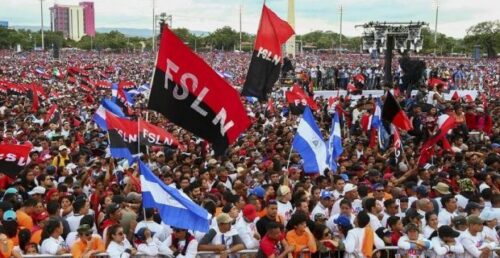
Sandanista- FSLN rally in Nicaragua

Nicaragua: USAID Multi-Year Destabilization Plan Exposed

A US Agency for International Development (USAID) document revealed by reporter William Grigsby describes covert plans to overthrow the democratically-elected Nicaraguan government in the next two years. USAID seeks to hire mercenaries “to take charge of the plan . . . to disrupt public order and carry out other [violent] actions before, during, and/or after the 2021 elections.”

USAID is creating Responsive Assistance In Nicaragua (RAIN), allotting $540,000 in grants to remove the Sandinista government in what it calls “Nicaragua’s transition to democracy.” Daniel Ortega won the 2016 election with 72 percent of the vote in what election observers from the Organization of American States (OAS), a US tool, described as taking “place in a calm, smooth and pacific manner, with no large incidents.”

Brian Willson, who has opposed US efforts to dominate Nicaragua since the 1980s Contra war, concludes the US realizes Ortega will win the 2021 election. In fact, this week, a poll showed support for Ortega’s party, FSLN, at 50% and for the opposition at 10%. One of USAID plans, as they tried in Venezuela in 2018, is for the opposition to boycott the election since they know they will lose, then call it illegitimate and create a political and economic crisis.

The real goal is not a democracy but domination so US transnational corporations can profit from the second poorest country in the hemisphere by putting in place a neoliberal economy to privatize public services, cut social services, and purge all traces of the Sandinistas. USAID also plans to “reestablish” the police and military to enforce their rule. Another goal is to stop Nicaragua from being the “threat of a good example” for its economic growth, reduction of inequality, poverty, illiteracy and crime.

Ben Norton points out in the Grayzone that “the 14-page USAID document employed the word ‘transition’ 102 times” making clear the intent is regime change.  A “sudden transition without elections,” a euphemism for a coup, is one of three possible regime change scenarios.

John Perry writes about “US interference in Nicaragua, going back at least as far as William Walker’s assault on its capital and usurpation of the presidency in 1856.” Since the 1979 Sandinista Revolution, the US has sought to take back control of Nicaragua.

USAID and its National Endowment for Democracy (NED) have been funding the opposition. NED financed 54 projects from 2014-17 to lay the groundwork for a 2018 coup attempt, which  also involved USAIDWiston Lopez writes the US has provided “more than 31 million dollars between the end of 2017 and May 1, 2020.” When the attempted coup in 2018 failed, the US also put in place illegal unilateral coercive measures, known as economic sanctions, supported by both Democrats and Republicans, to try to weaken the country.

The USAID’s RAIN program outlines the usual regime change steps; e.g., remake the police and military as enforcers of the new neoliberal order, move “quickly to dismantle parallel institutions”; i.e., the Sandinista Front, the Sandinista Youth, and other grassroots institutions, and implement “transitional justice measures”; i.e., the prosecution of current government officials and movement leaders.

A new area of attack is a disinformation campaign against Nicaragua’s handling of COVID-19. The opposition misrepresents the government’s response and puts forward false death statistics in an attempt to create chaos. As Wiston López points out, “Since March the US-directed opposition has focused 95% of their actions on attempting to discredit Nicaragua’s prevention, contention, and Covid treatment. However, this only had some success in the international media and is now backfiring since Nicaragua is the country with one of the lowest mortality rates in the continent.”

The US media fails to report on the success of Nicaragua in combating the virus using a community-based health system. Nicaragua has been building its health system for the last 12 years and took rapid action to prepare for the virus. Nicaragua did not impose a lock down because it is a poor country where 80 percent of people are in the informal economy and 40 percent live in rural areas. People must work in order to eat.

Stephen Sefton puts the failure of the United States so far in context. At its root, the US does not understand the people of Nicaragua, their history of fighting US domination, and their ability to overcome right-wing puppets. It also misunderstands what the Sandinista government is doing to better the lives of the people in every sector of the economy. Sefton concludes, “The US government has failed notoriously to meet the needs of its own people during the current pandemic but can still find money to try and destroy a small country whose success makes US social, economic and environmental policy look arbitrary, negligent and criminal.”

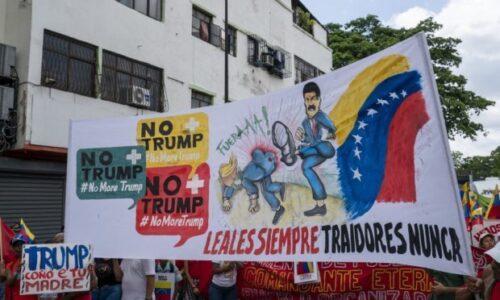
Nicolas Maduro kicks out Donald Trump (Photo by Ben Norton

Venezuela: Bipartisan Failed Regime Change

Ever since the 1998 election of Hugo Chavez, successive US administrations have tried and failed to dominate Venezuela. The bipartisan nature of this policy was on display on August 4, when Elliot Abrams, the notorious coup-monger for multiple presidents, testified in Congress. Not a single Senator criticized the attempt to illegally overthrow a democratically-elected government.

Abrams was criticized by both Democrats and Republicans for his inability to remove President Maduro from power. Senator Chris Murphy (D-CT) was most open about the coup attempt describing it as “a case study in diplomatic malpractice” and claiming Trump botched a winning play in a comedy of errors that strengthened Maduro. After the hearing, Murphy posted a series of Tweets admitting the coup and how it could have been done better.

clip from Murphy’s embarrassing comments was shared widely including by the Venezuelan Vice President Delcy Rodríguez and Foreign Minister Jorge Arreaza. When Vijay Prashad asked Arreaza his reaction, he described the US openly admitting crimes and said the “confessions” of Murphy, Gen. John Kelly, John Bolton, and Elliot Abrams “are priceless evidence for the complaint we raised at the International Criminal Court.”

Elliot Abrams testified that he would continue to work very hard to remove Maduro hopefully by the end of the year.  This echoed a statement by President Trump at SouthCom headquarters in Florida. Sen. Murphy’s comments are consistent with those made by Joe Biden who says he would be more effective at removing Maduro than Trump. Biden described Trump as soft on Maduro because he considered talking to him.

Elliot Abrams announced the US will be starting a media war against Venezuela. The reality is the US has been conducting a media war against Venezuela for more than 20 years.

Venezuela is moving ahead with elections for the National Assembly on December 6, 2020. Unlike 2018, more parties are agreeing to participate including the larger Democratic Action and Justice First parties, as well as a new Communist Party alliance and the hard-right Popular Will party, which was US puppet Juan Guaidó’s former party. There will be 105 political parties contesting for 277 National Assembly seats, 110 more than the current term. Venezuela uses a combination of majority winners and proportional representation. Venezuela also requires half the candidates to be female, and they use electronic voting confirmed by paper ballots with a public citizen audit on Election Day.

Juan Guaidó and others allied with the United States said they would boycott the election. Guaidó cannot risk running because he is likely to be defeated. The US is encouraging a boycott and then will claim the election was not legitimate as it did in the last presidential election. After December, Guaidó will not hold any elected office making his fraudulent claim to the presidency even weaker.

These events come after two major embarrassments for the US in Venezuela. Operation Gideonan attempt by mercenaries to invade Venezuela was foiled on May 4, leading to their arrests and the arrests of their co-conspirators. The State Department abandoned the mercenaries, and this week two former Green Berets were sentenced to 20 years in prison after admitting their guilt. It was evident that Guaidó was heavily involved in this failure adding to his failed presidential takeover and tainting him beyond repair.

The second defeat was Iran and Venezuela working together to deliver oil and equipment for Venezuelan refineries. Five Iranian oil tankers passed by the largest US armada in the Caribbean since the invasion of Panama. Southcom has been repeatedly sending warships into Venezuelan waters. The solidarity of Iran and Venezuela overcame the naval blockade, undermined US sanctions, and sent a shudder through the US by showing other nations they can defy the United States.

Venezuela has a strong history of struggle against imperialism but the US’ economic war is costing their economy hundreds of billions of dollars and leading to the premature death of Venezuelans. In addition, the United Kingdom is refusing to release more than a billion dollars of Venezuelan gold held in the Bank of England that was to be used for food and medicine. The UK court ruled against Venezuela but they are appealing the decision.

Bolivians protest the postponement of the election

Bolivia: US Dictator Fears Democratic Vote

On November 12 2019, a US-backed coup in Bolivia removed President Evo Morales who had just won re-election. The self-proclaimed President Jeanine Añez, a right-wing Christian, leads a de facto government involved in massacres, persecution and imprisonment of political leaders. It is destroying the social and economic model and achievements of the Movement Towards Socialism (MAS Party) led by Morales.

The OAS played a crucial role in the coup with their false analysis of Morales’ re-election. The western media reported the false OAS analysis without criticism. Now, studies by MIT and the Center for Economic and Policy Analysis have shown that Morales clearly won the election and should have remained in power. For months the Washington Post claimed Morales’ re-election was a fraud, but finally, in March, it acknowledged the election was legitimate. Similarly, the New York Times admitted in July that Morales won the election.

Many have called this a lithium coup because the element is plentiful in Bolivia and critical for batteries. This was made evident when Elon Musk, the head of Tesla, said on Twitter “We will coup whoever we want! Deal with it.” Tesla would benefit from cheap and plentiful lithium for electric car batteries.

The people of Bolivia are struggling to restore democracy. The fraudulent report by the OAS led to a three-week conflict between right-wing Bolivians protesting alleged fraud and pro-government, mostly indigenous, demonstrators defending Morales. The military and police sided with the right-wing coup. The coup government threatened legislators and their families while repressing the people. There were racist attacks against the majority Indigenous population and the Wiphala, the indigenous flag, was burned in the streets. When she took power, Áñez, surrounded by right-wing legislators, held up a large leather bible and declared, “The Bible has returned to the palace.”

The US recognized the coup government, similar to its recognition of the failed coup leader, Juan Guaidó in Venezuela. Añez claimed she’d be transitory until the next election, but at the direction of the US, she is putting in place deep roots and has delayed elections.

The repression has galvanized the MAS party, as well as peasant unions and grassroots organizations who continue their struggle to restore Bolivian democracy. The pressure led to elections being scheduled. Initially, Áñez said she would not run but reversed herself and is now a candidate while she is trying to outlaw the MAS party and its candidates.

Elections were scheduled for May 3, but have been postponed twice allegedly due to the pandemic, but really because this is an ongoing coup.

It is true that the COVID-19 pandemic is hitting Bolivia hard with horror stories about people unable to get medical treatment. Immediately after the coup, the Añez government expelled the Cuban doctors. The coup-government is unable to manage the health system. Corruption is rampant in the purchase of medical equipment. The health ministry has had three ministers during the crisis. The situation is dire with overcrowded hospitals, lack of basic supplies, and corpses in the streets and in their homes with nowhere to be buried.

The coup-government is using the virus to try to delay elections because polls show the MAS candidate, Luis Arce, is far ahead and likely to win in the first round of elections with Áñez coming in a distant third. Áñez has sought to prosecute Arce to keep him from running, so far unsuccessfully.  On July 6, the Attorney General of Bolivia charged Evo Morales with terrorism and financing of terrorism from exile and is seeking preventive detention.

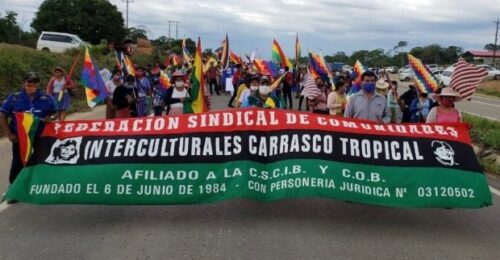
Since mid-July, thousands of Bolivians have been protesting the postponement of elections. They are holding sustained protests throughout the country and blocking many roads. Indigenous and peasant groups, agricultural groups, along with women and unions are joining together calling for elections.  Morales, Arce, and the MAS Party have denounced the delay.

Domination Will Not Reverse Decline

Evo Morales said in a recent interview:

The United States is trying to make Latin America its backyard forever. We know about the hard resistance of the peoples of Cuba, Venezuela, Nicaragua. The struggle of our peoples is very important. The United States wants to divide us in order to plunder our natural resources. The peoples no longer accept domination and plunder. The United States is in decline, and yet it lashes out.

The US is weakening as a global power and its failures in Latin America are both a symptom of this and are causing further decline. The US’ violations of international law are obvious and are being challenged. But the US is an empire and it will not give up the Monroe Doctrine easily.

As citizens of Empire, we have a particular responsibility to demand the US stop its sanctions and illegal interference in Latin America and elsewhere around the world. In this time of multiple global crises, we must demand the US become a cooperative member of the world community and work peacefully to address the pandemic, recession and climate crisis.

Structures to do this exist to help with this such as the global ceasefire and the Paris Climate agreement. And on the anniversary of the US bombing of Hiroshima and Nagasaki, Japan, we must add the Nuclear Ban Treaty as another effort the US must join.

US government drops case against Max Blumenthal after jailing journalist on false charges

As the mysterious disappearance of Secret Service records and complete absence of evidence supporting its case came to light, the US government dropped its bogus charges against journalist Max Blumenthal.

By Ben Norton

Source: Grayzone

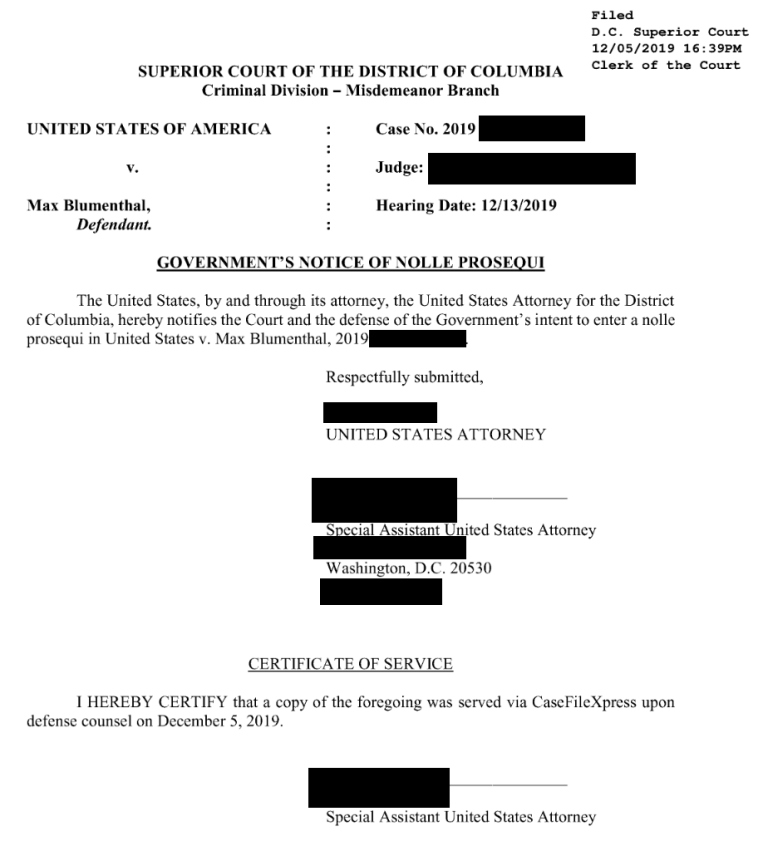
The US government has dropped its bogus charge of “simple assault” against journalist Max Blumenthal, after having him arrested on a 5-month-old warrant and jailed for nearly two days.

The Grayzone has learned that Secret Service call logs recorded during the alleged incident were either not kept or destroyed. The mysteriously missing evidence included print documents and radio recordings that may have exposed collusion between Secret Service officers operating under the auspices of the US State Department and violent right-wing hooligans in an operation to besiege peace activists stationed inside Venezuela’s embassy in Washington, DC.

Blumenthal, who is the editor of The Grayzone, was arrested at his home on October 25 by a team of DC cops who had threatened to break down his door. He later learned that he was listed in his arrest warrant as “armed and dangerous,” a rare and completely unfounded designation that placed Blumenthal at risk of severe harm by the police.

The government’s case rested entirely on a false accusation by a right-wing Venezuelan opposition activist, Naylet Pacheco, that Blumenthal and Benjamin Rubinstein had assaulted her while they were delivering food to Venezuela’s embassy in Washington, DC in the early morning on May 8. (Rubinstein is the brother of journalist and Grayzone contributor Alexander Rubinstein, who was reporting from inside the embassy at the time.)

The Grayzone has reported extensively on the corruption of coup leader Juan Guaidó, whom Washington recognizes as “interim president” of Venezuela, as well as the scandals plaguing Guaidó’s “ambassador” to the United States, Carlos Vecchio.

Vecchio personally presided over the weeks-long siege of Venezuela’s embassy in Washington, DC, stage-managing efforts by a mob of rabid right-wing activists to prevent peace activists from receiving deliveries of food and sanitary supplies.

As The Grayzone reported, the Donald Trump administration has diverted USAID funding originally intended to assist Central American migrants to pay the salaries of Vecchio and his team in Washington.

The US Department of Justice dismissed its case against Blumenthal on December 6. On the same day, it also dropped charges against Rubinstein, who had been arrested on May 8, hours after the food delivery.

“I’m relieved the government has finally decided to drop these phony charges against me. But I’m also disgusted,” Max Blumenthal said, “because I should never have been hauled out of my house and thrown in jail for an obviously politically motivated, false allegation that the police failed to investigate.”

Disappeared Secret Service call logs ‘highly unusual’

Lawyers representing Blumenthal and Rubinstein placed multiple and highly specified discovery requests to the prosecutor for Secret Service call recordings and reports logged on May 8 at the location of the embassy food delivery. The US prosecutor was unable to satisfy the request, verbally confirming that if the documents had existed, they no longer did.

“This is highly unusual and highly notable, almost inexplicable in the ordinary course of operations that these records were not maintained and preserved,” said Carl Messineo, the counsel to Rubinstein and a co-founder of the Partnership for Civil Justice Fund. “Given the false nature of allegations and that they advanced a prosecution based on these it is really questionable that this information was not produced.”

Beyond the mysterious disappearance of the call logs, there was a complete dearth of evidence on the prosecution’s side.

William Moran, who served as Blumenthal’s attorney, wondered why law enforcement trusted Pacheco, an accuser with such clear credibility issues. “The local police advanced a fraudulent case against a journalist on the word of a complainant who told at least six different, increasingly exaggerated stories and made identical accusations that night about at least three other individuals,” he said.

One Venezuelan opposition member whose identity remains under a protective order provided testimony to police attempting to corroborate Pacheco’s claims about Blumenthal and Rubinstein. According to Moran, that person had been convicted for the impeachable offense of writing fraudulent checks.

“The DC police wholly failed to conduct a proper investigation before calling for the arrest and imprisonment of a dissident journalist that they labeled without any cause whatsoever as ‘armed and dangerous,’ placing him in mortal danger,” Moran stated.

A pattern of false assault allegations and police collusion

The arrest of Blumenthal was part of a wider pattern of political persecution of those who resisted the seizure of the Venezuelan embassy by a US-backed coup administration.

On November 13, police appeared at the home of Medea Benjamin to threaten her with arrest, after she too was falsely accused of assault. Benjamin, a co-founder and leader of the anti-war group CODEPINK, had been a prominent figure in the Venezuelan Embassy Protection Collective.

Benjamin was accused by members of the Venezuelan opposition of assaulting Representative Debbie Wasserman-Schultz, who had joined Carlos Vecchio for a press conference on Capitol Hill. The police eventually left without arresting Benjamin, because they did not have a warrant.

Video of the incident revealed that it was, in fact, Benjamin who was assaulted by Vecchio’s notoriously violent minions.

During the same press conference, a member of the Venezuelan opposition seized the phone of journalist Wyatt Reed. When Reed complained to a Secret Service officer on site, the officer brushed him off.

Diliana Bustillos, a Venezuelan opposition lobbyist who participated in a May 8 press conference falsely accusing peace activists of violence, threatened Reed after the incident, warning that he would “end up like [Max Blumenthal] and Ben [Rubinstein].”

Mara Verheyden-Hilliard, a civil liberties lawyer with the Partnership for Civil Justice Fund, was present throughout much of the embassy siege. She noticed clear collusion between the right-wing opposition mob outside and the Secret Service, who were operating at the time under the watch of the State Department.

“Throughout the siege of the peace activists at the Venezuelan embassy,” Verheyden-Hillard said, “it was apparent to those on the scene that there was what looked like a facilitated effort between the government and the mob besieging the embassy.”

Mainstream media silence, demonization by regime change activists

The Washington Post reported extensively on the siege of the Venezuelan embassy, presenting the situation largely from the opposition’s perspective. The paper’s correspondent, Marissa Lang, uncritically conveyed Pacheco’s false charges, writing that “she said she was pushed against a wall and kicked by several men, then spent hours at a hospital being treated.”

However, the Washington Post did not report on Blumenthal’s arrest and imprisonment five months later or any of his public comments about the high-profile incident.

Meanwhile, an assortment of malicious regime-change cheerleaders seized on Blumenthal’s arrest to defame him with false and now-discredited claims on social media:

  • Bellingcat founder Elliot Higgins promoted a Medium post by an anonymous author who has routinely smeared Blumenthal, which featured his arrest warrant and a video of the complainant’s false testimony. He then repeatedly criticized skeptics who expressed doubts about the completely unfounded allegations against Blumenthal. Higgins’ website Bellingcat is funded by the National Endowment for Democracy, a regime change arm of the US government, and the UK Foreign Office via the Zinc Network, among other entities.
  • Foreign Policy senior editor and anti-China hawk James Palmer declared without a scintilla of evidence that Blumenthal “assault[ed] people freely.”
  • Freelance journalist and longtime Syria regime-change activist Danny Gold claimed falsely and without proof that Blumenthal “kicked an old woman in the stomach.”
  • Idrees Ahmad, a Stirling University professor of journalism who has obsessively denigrated Blumenthal and even phoned him to threaten him against publishing a factual investigative report on the Syrian White Helmets, falsely accused Blumenthal of “manhandling an elderly woman.”
  • Istanbul-based TRT World contributor Wilson Dizard suggested that Blumenthal was guilty before being proven innocent, insisting that a Grayzone account of his arrest “does not actually provide an alternative version of events.”
  • Oz Katerji, the notorious regime change fanatic who was recently fired from the Daily Mail for denigrating its columnist Peter Hitchens on social media, declared that he would “probably buy the guys who shackled pro-Assad war crimes denier Max Blumenthal to the floor for assaulting a Venezuelan protester a beer or two.” Katerji later insisted without any basis that “there’s video evidence” to support the false charge against Blumenthal.
  • Dutch regime-change activist Thomas van Linge, who fancied himself a Syria expert before moving on to advocate for Western-backed right-wing opposition groups in Iran, Bolivia, Hong Kong, and beyond, denied that Blumenthal’s arrest was political and instead outrageously claimed he was “arrested for kicking a pregnant woman.” Even in the totally fabricated accusations against Blumenthal, no one ever claimed that the alleged victim, right-wing Venezuelan activist Naylet Pacheco, who is 58 years old, was pregnant. As of the publication of this article, van Linge still has not deleted this patently false, defamatory claim.
  • Neil Hauer, a self-described “freelance analyst” who has previously consulted for the European Union and US Marines, called journalist Jeet Heer a “moron” for publicly advocating for Blumenthal.
  • UK liberal interventionist Sunny Hundal also attacked Heer for defending Blumenthal, asserting that “given the person in question I think you should exercise some judgement before accepting his story at face value.”
  • The anonymous right-wing Reagan Battalion Twitter account falsely claimed that Blumenthal was “arrested for kicking a pregnant woman,” misrepresenting the identity of the complainant while not even bothering to frame the non-existent incident as an alleged assault. In a previous spasm of mendacity, the Reagan Battalion declared that Blumenthal “works for” foreign socialist governments and smeared him as “a puppet for every dictator around the globe.”
  • Liberal feminist Mona Eltahawy falsely smeared Blumenthal as a supposed abuser of women and a “piece of shit.”
  • Right-wing pro-Israel lobby group StopAntisemitism.org defamed Blumenthal, who is Jewish, as an “antisemite,” cheered his arrest, and falsely asserted he “assault[ed] a Venezuelan opposition figure.” This pro-Israel organization has also smeared left-wing Jewish activist Ariel Gold and Muslim American progressives Ilhan Omar, Rashida Tlaib, and Linda Sarsour as supposed “antisemites.”
  • Joshua Holland, a liberal contributor to The Nation, publicly lashed out at media critic Joe Emersberger and implied the false, totally unsubstantiated allegations could be true.
  • Joshua Frank, an editor of the former-muckraking website CounterPunch, downplayed the attack on Blumenthal, whitewashed the state repression, and called on people “to not blow this all out of proportion, as Max is likely to do for his own gain.” Frank, who has viciously maligned journalists and activists who opposed the international proxy war on Syria, also derided this present reporter, Ben Norton, with superficial ad hominem insults.
  • Sean Davis, a co-founder of the hard-right website The Federalist and a longtime conservative activist who has worked for numerous Republican politicians, spread the fake accusations. Davis’ website The Federalist has been widely criticized for blatant racism (it once had a tag devoted specifically to “black crime“), and it published an article defending far-right Alabama judge Roy Moore after he was accused of dating teenage girls as young as 14.

Asked about the wave of libelous attacks spurred by his arrest on false charges, Blumenthal commented, “The outpouring of support I’ve received from around the world has been more profound and meaningful than any of the smears from the usual suspects. But that does not mean that I will let this campaign of lies go unanswered. This whole episode began with a false, defamatory accusation, and I plan to take the necessary actions to see it ends with a sense of justice.


EMPIRES ARE A SECRET UNTIL THEY START FALLING

By Margaret Flowers and Kevin Zeese

Source: Popular Resistance

In the past, we have written about the 2020s as a decade when the United States Empire will end. This is based on Alfred McCoy’s predictions (listen to our interview with him on Clearing the FOG). Sociologist and peace scholar John Galtung believes US Empire will fall much faster, losing world dominance by 2020. Much of what he predicted when he said this in 2016 is happening now. In particular, there is a rise in “reactionary fascism” or a desire to go back to the “good old days,” the cost of maintaining the empire is taking an increasing economic toll and other countries are starting to rebuke the US, both its requests for military assistance and its unfair economic demands.

What this means for people in the United States and around the world depends on whether we can build a mass popular movement with the clarity of vision, skills, and solidarity necessary to navigate what is and will surely be a turbulent period. There are no guarantees as to the outcome. Failure to act could result in a disastrous scenario – at best, that the US will continue to try to hold onto power by waging economic and military warfare abroad weakening the economy at home and undermining necessities such as housing, healthcare, education and the transition to a Green economy. At worst, as Galtung describes, there could be “an inevitable and final war” involving nuclear weapons.

When Empire Is In Decline

Alfred McCoy says that it is only when empires are in decline that people begin to recognize they live in an empire and start to talk about it. While discussion of empire hasn’t broken into the corporate media, it is certainly happening in the independent media. A concerted effort by a popular movement could bring it to the fore, just as Occupy changed the political dialogue about wealth inequality and the power of money. People in the US need to face some stark realities when it comes to declining US global power.

For starters, the United States does not currently have the capacity to wage a “Great Power Conflict” even though that is the goal of the national security strategy. The loss of its manufacturing base and lack of access to minerals necessary for producing weapons and electronics means the US does not have the resources to fight a great war. Much of the US’ manufacturing has been outsourced to other countries, including those targeted by US foreign policy. Resources necessary for weapons and electronics are in China, Afghanistan, the Democratic Republic of the Congo and Venezuela. It’s no surprise that the US is maintaining a military presence in Afghanistan, has increased its presence in Africa through AFRICOM and is struggling to wrest control of Venezuela.

Despite these attempts, the US is not having success. There is no military solution for the US in Afghanistan. As Moon of Alabama explains, the Taliban has taken control of more territory than it has had since the US started the war and has no reason to negotiate with the US. He advises, “The U.S. should just leave as long as it can. There will come a point when the only way out will be by helicopter from the embassy roof.”

Alexander Rubinstein writes the failures in Afghanistan can be attributed to Zalmay Khalilzad, currently the US Special Representative for Afghanistan Reconciliation. Khalilzad has led US foreign policy in Afganistan and Iraq since the presidency of George W. Bush, and before that worked with Carter’s National Security Advisor Zbigniew Brzezinski, who provided crucial support for the Mujahideen to draw the Soviet Union into a quagmire. The writing is on the wall that the US must leave Afghanistan, but that is unlikely to happen as long as people such as Khalilzad and Elliott Abrams, who has a similar ideology, are in charge.

As the US-led coup in Venezuela continues to fail due to a lack of support for it within the country, resilience to the effects of the unilateral coercive economic measures (sanctions) and exposure of attempts to create chaos and terror by paramilitary mercenaries, the US grows increasingly desperate in its tactics. There has already been a failed assassination attempt against President Maduro, a US freight company tied to the CIA has been caught smuggling weapons and the US and its Puppet Guaido have been implicated in a terrorist plot as the failed coup enters a more dangerous phase. This week, the Organization of American States voted to invoke a treaty, the Inter-American Treaty of Reciprocal Assistance (TIAR), which would allow military intervention. Mexico strongly opposed that possibility. This comes as Venezuela has strengthened troops at the Colombian border after discovering terrorist training camps on the Colombian side. With allies such as Russia and China, an attack on Venezuela would not only hurt the region but could go global.

Despite the Asian Pivot under President Obama during his first administration and Secretary of Defense Mark Esper’s comment this week that the US is directing a lot of energy toward China, analysts predict the US will fail to achieve dominance in the Asia-Pacific. China is purchasing weapons from Russia that are superior to US systems, is strengthening its military coordination with Russia through drills and is expanding its global ties through the Belt and Road Initiative. Matthew Ehret writes in Strategic Culture, “Those American military officials promoting the obsolete doctrine of Full Spectrum dominance are dancing to the tune of a song that stopped playing some time ago. Both Russia and China have changed the rules of the game on a multitude of levels….”

Protests in Hong Kong, as we described in a recent newsletter, are being used to stoke greater anti-China sentiment in the US. As often occurs, the sophisticated propaganda arm of US-backed color revolutions excites leftist activists, but each day it becomes clearer just how deep the US’ influence is. K. J. Noh provides a helpful guide – a list of seven signs a protest is not a popular progressive uprising. One sign is Hong Kong protesters are supporting a bill in the US Congress, the so-called “Hong Kong Human Rights and Democracy Act.” The bill would allow the United States to sanction Hong Kong officials.

Andre Vltchek attended a recent protest and interviewed some of the participants. He found the democracy protesters have little grasp on the oppression Hong Kongers faced under British colonization, they attack anyone who disagrees with them and they are destroying public infrastructure. One of the protest leaders, Joshua Wong, is openly meeting with figures connected to US regime change efforts, and NED-backed organizations are planning an anti-China protest in Washington, DC on September 29. Their new propaganda symbol is a Chinese flag with a Swastika on it. No surprise that was evident at the protests in Hong Kong this weekend.

The US is already at war with China with battlefronts on trade and the Asian Pacific. The propaganda around Hong Kong showing prejudice against China is part of manufacturing consent for the conflict between the US and China, which will define the 21st Century. US militarism is also escalating to involve space. This week, the US conducted its first space war game and Putin warned of a space arms race.

Our Tasks as Activists

It was good news this past week that President Trump asked John Bolton, a white supremacist neocon who disrupted any attempts at negotiation, to resign from his position as National Security Adviser. Glen Ford of Black Agenda Report writes, “Every sane person on the planet should be glad to see Bolton go.” But, even with Bolton gone, the US War Machine will rage on with bi-partisan support. Whether Trump starts to live up to his campaign rhetoric of non-intervention remains to be seen. The appointment of Michael Kozak as the new US envoy to Latin America is a bad sign.

Almost two centuries of Manifest Destiny that went beyond North America to spread US Empire across the globe will not end overnight. It will take a concerted effort to build a national consensus against the dominant ideologies of white supremacy and US exceptionalism to change the course of US foreign policy. Fundamental tasks of that effort include education, organizing and mobilizing. Below are some examples of each.

Education:

The Palestinian Great March of Return, a weekly nonviolent protest in Gaza demanding the right of return granted by the United Nations, continues and each week Israelis injure and murder unarmed Palestinians. Abby Martin and Mike Prysner of The Empire Files produced an excellent documentary about it, “Gaza Fights For Freedom,” and are touring the country to raise awareness. Listen to our interview with Abby Martin on Clearing the FOG. Find a showing near you or organize one.

The United States uses unilateral coercive measures (sanctions) that are illegal under international law to wage war on other countries. The Treasury Department currently lists 20 countries sanctioned by the US, but the US also uses threats of sanctions to wield power. Sanctions are warfare, even though they are not commonly viewed that way. They result in the suffering and death of mostly civilians. Kevin Cashman and Cavan Kharrazian explain how sanctions work, why they violate international law and how they threaten global stability.

Organizing:

Alison Bodine and Ali Yerevani encourage activists to avoid the organizing pitfall of getting caught up in debates about the internal politics of countries targeted by US imperialism. Our tasks, as citizens of imperialist countries, are to stop our governments from intervening in the affairs of other countries and demand they respect international law. We also have a task of building solidarity with civilians of other countries. It will require a global mass movement to address major issues such as the climate crisis, wealth inequality, colonization, and violence.

Citizen to citizen diplomacy is critical in building this mass movement and solidarity. Ann Wright, retired from the military and State Department, writes about the challenges of citizen to citizen diplomacy as she tours Russia. Ajamu Baraka, national organizer of Black Alliance for Peace, reminds us that war and militarism are class issues in his address to an international meeting of trade unions held in Syria.

We are strong believers in breaking out of the confines of the narrative presented by corporate media about countries outside the US. Our trips to Iran and Venezuela this year were invaluable learning experiences. We hope to visit more targeted countries. An effort that came out of these trips is the new Global Appeal for Peace, first steps toward creating an international network to complement the more than 120 non-aligned movement countries that are resolved to respect international law and sovereignty and take action to create peace and prevent the catastrophic climate crisis. Sign on to this effort at GlobalAppeal4Peace.net.

Mobilizing:

The People’s Mobilization to Stop the US War Machine and Save the Planet starts next weekend. On Saturday night, Black Alliance for Peace is sponsoring a discussion, “Race, Militarism and Black Resistance in the ‘Americas’” in the Bronx. On Sunday we will rally and march to the UN with Embassy Protectors, Roger Waters and many more. On Monday night, we have a special solidarity night at Community Church of New York. Registration is required as there will be high-level representatives of impacted countries speaking about the challenges they face. Click here to register.

Rage Against the US War Machine will take place October 11 and 12 in Washington, DC. This is the second annual event organized by March on the Pentagon. Click here for details.

We also ask you to join the Embassy Protectors Defense Committee. Sign the petition to drop the Trump administration’s charges against us for protecting the Venezuelan Embassy this spring. We are facing up to a year in prison and exorbitant fines even though it was the US State Department that violated the Vienna Convention by raiding the embassy in May. We will tour Northern California in October and are planning more tours to raise awareness that the struggle to end the US  coup and interventions in Venezuela continues.

John Galtung predicts that the fall of the US Empire could have a devastating impact on domestic cohesion in the United States. As the US loses its position of global supremacy, we have an opportunity to fundamentally reshape what we as a nation represent. We can become cooperative global citizens in a world free of oppression, violence, and poverty if we do the work of joining in international solidarity for these goals.

How GMO Seeds and Monsanto/Bayer’s “RoundUp” are Driving US Policy in Venezuela

Hugo Chavez and Luiz Inacio Lula da Silva visit a soy farm in El Tigre in Venezuela’s Anzoategui state, Oct. 30, 2009. Ariana Cubillos | AP

With Juan Guaidó’s parallel government attempting to take power with the backing of the U.S., it is telling that the top political donors of those in the U.S. most fervently pushing regime change in Venezuela have close ties to Monsanto and major financial stakes in Bayer.

By Whitney Webb

Source: MintPress News

As the political crisis in Venezuela has unfolded, much has been said about the Trump administration’s clear interest in the privatization and exploitation of Venezuela’s oil reserves, the largest in the world, by American oil giants like Chevron and ExxonMobil.

Yet the influence of another notorious American company, Monsanto — now a subsidiary of Bayer — has gone largely unmentioned.

While numerous other Latin American nations have become a “free for all” for the biotech company and its affiliates, Venezuela has been one of the few countries to fight Monsanto and other international agrochemical giants and win. However, since that victory — which was won under Chavista rule — the U.S.-backed Venezuelan opposition has been working to undo it.

Now, with Juan Guaidó’s parallel government attempting to take power with the backing of the U.S., it is telling that the top political donors of those in the U.S. most fervently pushing regime change in Venezuela have close ties to Monsanto and major financial stakes in Bayer.

In recent months, Monsanto’s most controversial and notorious product — the pesticide glyphosate, branded as Roundup, and linked to cancer in recent U.S. court rulings — has threatened Bayer’s financial future as never before, with a litany of new court cases barking at Bayer’s door. It appears that many of the forces in the U.S. now seeking to overthrow the Venezuelan government are hoping that a new Guaidó-led government will provide Bayer with a fresh, much-needed market for its agrochemicals and transgenic seeds, particularly those products that now face bans in countries all over the world, including once-defoliated and still-poisoned Vietnam.


U.S.-Backed Venezuelan opposition seeks to reverse Chavista seed law and GMO ban

In 2004, then-president of Venezuela, Hugo Chávez, surprised many when he announced the cancellation of Monsanto’s plans to plant 500,000 acres of Venezuelan agricultural land in genetically modified (GM) soybeans. The cancellation of Monsanto’s Venezuela contract led to what became an ad hoc ban on all GM seeds in the entire country, a move that was praised by local farmer groups and environmental activists. In contrast to anti-GM movements that have sprung up in other countries, Venezuela’s resistance to GM crops was based more on concerns about the country’s food sovereignty and protecting the livelihoods of farmers.

Although the ban has failed to keep GM products out of Venezuela — as Venezuela has long imported a majority of its food, much of it originating in countries that are among the world’s largest producers of genetically modified foods — one clear effect has been preventing companies like Monsanto and other major agrochemical and seed companies from gaining any significant foothold in the Venezuelan market.

In 2013, a new seed law was nearly passed that would have allowed GM seeds to be sold in Venezuela through a legal loophole. That law, which was authored by a member of the Chavista United Socialist Party of Venezuela (PSUV), was widely protested by farmers, indigenous activists, environmentalists, and eco-socialist groups, which led to the law’s transformation into what has been nicknamed the “People’s Seed Law.” That law, passed in 2015, went even farther than the original 2004 ban by banning not just GM seeds but several toxic agrochemicals, while also strengthening heirloom seed varieties through the creation of the National Seed Institute.

Soon after the new seed law was passed in 2015, the U.S.-backed Venezuelan opposition led by the Roundtable of Democratic Unity (MUD) — a group comprised of numerous U.S.-funded political parties, including Guaidó’s Popular Will — took control of the country’s National Assembly. Until Venezuela’s Supreme Court dissolved the assembly in 2017, the MUD-legislature attempted to repeal the seed law on several occasions. Those in favor of the repeal called the seed bill “anti-scientific” and damaging to the economy.

Despite the 2017 Supreme Court decision, the National Assembly has continued to meet, but the body holds no real power in the current Venezuelan government. However, if the current government is overthrown and Guaidó  — the “interim president” who is also president of the dissolved National Assembly — comes to power, it seems almost certain that the “People’s Seed Law” will be one of the first pieces of legislation on the chopping block.


The AEI axis

Some of the key figures and loudest voices supporting the efforts of the Trump administration to overthrow the Venezuelan government in the United States are well-connected to one particular think-tank, the American Enterprise Institute (AEI). For instance, John Bolton — now Trump’s national security advisor and a major player in the administration’s aggressive Venezuela policy — was a senior fellow at AEI until he became Trump’s top national security official. As national security adviser, Bolton advises the president on foreign policy and issues of national security while also advising both the Secretary of State and the Secretary of Defense. As of late, he has been pushing for military action in Venezuela, according to media reports.

Another key figure in Trump’s Venezuela policy — Elliott Abrams, the State Department’s Special Representative for Venezuela — has been regularly featured at AEI summits and as a guest on its panels and podcasts. According to Secretary of State Mike Pompeo, Abrams’ current role gives him the “responsibility for all things related to our efforts to restore democracy” in Venezuela. Other top figures in the administration, including Vice President Mike Pence and Secretary of State Mike Pompeo, were featured guests at the AEI’s “secretive” gathering in early March. As MintPress and other outlets have reported, Guaidó declared himself “interim president” of Venezuela at Pence’s behest. Pompeo is also intimately involved in directing Trump’s Venezuela policy as the president’s main adviser on foreign affairs.

Other connections to the Trump administration include Secretary of Education Betsy DeVos who was previously on AEI’s board of trustees.

AEI has long been a key part of the “neoconservative” establishment and employs well-known neoconservatives such as Fred Kagan — the architect of the Iraq “troop surge” — and Paul Wolfowitz, the architect of the Iraq War. Its connections to the George W. Bush administration were particularly notable and controversial, as more than 20 AEI employees were given top positions under Bush. Several of them, such as Bolton, have enjoyed new prominence in Trump’s administration.

Other key Bush officials joined the AEI soon after leaving their posts in the administration. One such was Roger Noriega, who was the U.S. representative to the Organization of American States (OAS) during the failed, U.S.-backed 2002 coup and went on to be assistant secretary of state for Western Hemisphere affairs from 2003 to 2005, where he was extremely influential in the administration’s policies towards Venezuela and Cuba.

Since leaving the Bush administration and promptly joining the AEI, Noriega has been instrumental in pushing claims that lack evidence but aim to paint Venezuela’s current President Nicolas Maduro-led government as a national security threat, such as claiming that Venezuela is helping Iran acquire nuclear weapons and hosts soldiers from Lebanon’s Hezbollah. He also lobbied Congress to support Venezuelan opposition leader Leopoldo López, Guaidó’s political mentor and leader of his political party, Popular Will.

Not only that, but Noreiga teamed up with Martin Rodil, a Venezuelan exile formerly employed by the IMF, and José Cardenas, who served in the Bush administration, to found Visión Américas, a private risk-assessment and lobbying firm that was hired to “support the efforts of the Honduran private sector to help consolidate the democratic transition in their country” after the U.S.-backed Honduran coup in 2009. In recent months, Noriega and his associates have been very focused on Venezuela, with Cardenas offering Trump public advice about how “to hasten Maduro’s exit,” while Rodil has publicly offered “to get you a deal” if you have dirt on Venezuela’s government.

While the AEI is best known for its hawkishness, it is also a promoter of big agricultural interests. Since 2000, It has hosted several conferences on the promise of “biotechnology” and genetically modified seeds and has heavily promoted the work of former Monsanto lobbyist Jon Entine, who was an AEI visiting fellow for several years. The AEI also has long-time connections to Dow Chemical.

The most likely reason for the AEI’s interest in promoting biotech, however, can be found in its links to Monsanto. In 2013, The Nation acquired a 2009 AEI document, obtained through a filing error and not intended for public disclosure, that revealed the think tank’s top donors. The form, known as the “schedule of contributors,” revealed that the AEI’s top two donors at the time were the Donors Capital Fund and billionaire Paul Singer.

The Donors Capital Fund, which remains a major contributor to the AEI, is linked to Monsanto interests through the vice chairman of its board, Kimberly O. Dennis, who is also currently a member of the AEI’s National Council. According to AEI, the National Council is composed of “business and community leaders from across the country who are committed to AEI’s success and serve as ambassadors for AEI, providing us with advice, insight, and guidance.”

Dennis is the long-time executive chairwoman of the Searle Freedom Trust, which was founded in 1988 by Daniel Searle after he oversaw the sale of his family pharmaceutical company — G.D. Searle and Company — to Monsanto in 1985 for $2.7 billion. The money Searle had made from that merger was used to fund the trust that now funds the AEI and other right-wing think tanks. Searle was also close to Donald Rumsfeld, who led G.D. Searle and Co. for years and was Secretary of Defense under Gerald Ford and George W. Bush. Searle was also a trustee of the Hudson Institute, which once employed Elliott Abrams.

After the family company — which gained notoriety for faking research about the safety of its sweetener, aspartame or NutraSweet — was sold to Monsanto, G.D. Searle executives close to Daniel Searle rose to prominence within the company. Robert Shapiro, who was G.D. Searle’s long-time attorney and head of its NutraSweet division, would go on to become Monsanto’s vice president, president and later CEO. Notably, Daniel Searle’s grandson, D. Gideon Searle, was an AEI trustee until relatively recently.


Why is a top to Marco Rubio increasing his stake in Bayer while others flee?

Yet, it is AEI’s top individual donor noted in the accidental “schedule of contributors” disclosure who is most telling about the private biotech interests guiding the Trump administration’s Venezuela policy. Paul Singer, the controversial billionaire hedge fund manager, has long been a major donor to neoconservative and Zionist causes — helping fund the Foreign Policy Initiative (FPI), the successor to the Project for a New American Century (PNAC); and the neoconservative and islamophobic Foundation for the Defense of Democracies (FDD), in addition to the AEI.

Singer is notably one of the top political donors to Senator Marco Rubio (R-FL) and has been intimately involved in the recent chaos in Venezuela. He has been called one of the architects of the administration’s current regime-change policy, and was the top donor to Rubio’s presidential campaign, as well as a key figure behind the controversial “dossier” on Donald Trump that was compiled by Fusion GPS. Indeed, Singer had been the first person to hire Fusion GPS to do “opposition research” on Trump. However, Singer has largely since evaded much scrutiny for his role in the dossier’s creation, likely because he became a key donor to Trump following his election win in 2016, giving $1 million to Trump’s inauguration fund.

Singer has a storied history in South America, though he has been relatively quiet about Venezuela. However, a long-time manager of Singer’s hedge fund, Jay Newman, recently told Bloomberg that a Guaidó-led government would recognize that foreign creditors “aren’t the enemy,” and hinted that Newman himself was weighing whether to join a growing “list of bond veterans [that have] already begun staking out positions, anticipating a $60 billion debt restructuring once the U.S.-backed Guaidó manages to oust President Nicolas Maduro and take control.” In addition, the Washington Free Beacon, which is largely funded by Singer, has been a vocal advocate for the Trump administration’s regime-change policy in Venezuela.

Beyond that, Singer’s Elliott Management Corporation gave Roger Noriega, the former assistant secretary of state for Western Hemisphere affairs under Bush, $60,000 in 2007 to lobby on the issue of sovereign debt and for “federal advocacy on behalf of U.S. investors in Latin America.” During the time Noriega was on Singer’s payroll, he wrote articles linking Argentina and Venezuela to Iran’s nonexistent nuclear program. At the time, Singer was aggressively pursuing the government of Argentina in an effort to obtain more money from the country’s prior default on its sovereign debt.

While Singer has been mum himself on Venezuela, he has been making business decisions that have raised eyebrows, such as significantly increasing his stake in Bayer. This move seems at odds with Bayer’s financial troubles, a direct result of the slew of court cases regarding the link between Monsanto’s glyphosate and cancer. The first ruling that signaled trouble for Monsanto and its new parent company Bayer took place last August, but Singer increased his stake in the company starting last December, even though it was already clear by then that Bayer’s financial troubles in relation to the glyphosate court cases were only beginning.

Since the year began, Bayer’s problems with the Monsanto merger have only worsened, with Bayer’s CEO recently stating that the lawsuits had “massively affected” the company’s stock prices and financial performance.


Forcing open a new market for RoundUp

Part of Singer’s interest in Bayer may relate to Venezuela, given that Juan Guaido’s “Plan País” to “rescue” the Venezuelan economy includes a focus on the country’s agricultural sector. Notably, prior to and under Chavismo, agricultural productivity and investment in the agricultural sector took a backseat to oil production, resulting in under 25 percent of Venezuelan land being used for agricultural purposes despite the fact that the nation has a wealth of arable land. The result has been that Venezuela needs to import much of its food from abroad, most of which originate in Colombia or the United States.

Under Chávez and his successor, Maduro, there has been a renewed focus on small-scale farming, food sovereignty and organic agriculture. However, if Maduro is ousted and Guaidó moves to implement his “Plan País,” the opposition’s coziness with foreign corporations, the interests of U.S. coup architects in Bayer/Monsanto, and the opposition’s past efforts to overturn the GM seed ban all suggest that a new market for Bayer/Monsanto products — particularly glyphosate — will open up.

South America has long been a key market for Monsanto and — as the company’s problems began to mount prior to the merger with Bayer — it became a lifeline for the company due to less stringent environmental and consumer regulations that many Western countries. In recent years, when South American governments have opened their countries to more “market-friendly” policies in their agricultural sectors, Monsanto has made millions.

For instance, when Brazil sought to expand biotechnology (i.e. GM seed) investment in 2012, Monsanto saw a 21% increase in its sales of GM corn seed alone, generating an additional $1 billion in profits for the company. A similar comeback scenario is needed more than every by Bayer/Monsanto, as Monsanto’s legal troubles saw the company’s profits plunge late last year.

With countries around the world now weighing glyphosate bans as a result of increased litigation over the chemical’s links to cancer, Bayer needs a new market for the chemical to avoid financial ruin. As Singer now has a significant stake in the company, he — along with the politicians and think tanks he funds — may see promise in the end of the anti-GM seed ban that a Guaidó-led government would bring.

Furthermore, given that Guaidó’s top adviser wants the Trump administration to have a direct role in governing Venezuela if Maduro is ousted, it seems likely that Singer would leverage his connections to keep Bayer/Monsanto afloat amid the growing controversy surrounding glyphosate. Such behavior on the part of Singer would hardly be surprising in light of the fact that international financial media have characterized him as a “ruthless opportunist” and “overly aggressive.”

Such an outcome would be in keeping with the increased profit margins for Monsanto and related companies that have followed its expansion into countries following U.S.-backed coups. For instance, after the U.S.-backed coup in Ukraine in 2014, the loans given to Ukraine by the International Monetary Fund and the World Bank forced the country to open up and expand the use of “biotechnology” and GM crops in its agricultural sector, and Monsanto, in particular, made millions as the prior government’s ban on GM seeds and their associated agrochemicals was reversed. If Maduro is ousted, a similar scenario is likely to play out in Venezuela, given that the Guaidó-led government made known its intention to borrow heavily from these institutions just days after Guaidó declared himself “interim president.”


Whitney Webb is a MintPress News journalist based in Chile. She has contributed to several independent media outlets including Global Research, EcoWatch, the Ron Paul Institute and 21st Century Wire, among others. She has made several radio and television appearances and is the 2019 winner of the Serena Shim Award for Uncompromised Integrity in Journalism.

Kieran Barr contributed to the research used in this report.