The Fear Pandemic and the Crisis of Capitalism. Sleepwalking Towards A Global Economic Crisis?

By Colin Todhunter

Source: Global Research

In October 2019, in a speech at an International Monetary Fund conference, former Bank of England governor Mervyn King warned that the world was sleepwalking towards a fresh economic and financial crisis that would have devastating consequences for what he called the “democratic market system”.

According to King, the global economy was stuck in a low growth trap and recovery from the crisis of 2008 was weaker than that after the Great Depression. He concluded that it was time for the Federal Reserve and other central banks to begin talks behind closed doors with politicians.

In the repurchase agreement (repo) market, interest rates soared on 16 September. The Federal Reserve stepped in by intervening to the tune of $75 billion per day over four days, a sum not seen since the 2008 crisis.

At that time, according to Fabio Vighi, professor of critical theory at Cardiff University, the Fed began an emergency monetary programme that saw hundreds of billions of dollars per week pumped into Wall Street.

Over the last 18 months or so, under the guise of a ‘pandemic’, we have seen economies closed down, small businesses being crushed, workers being made unemployed and people’s rights being destroyed. Lockdowns and restrictions have facilitated this process. The purpose of these so-called ‘public health measures’ has little to do with public health and much to do with managing a crisis of capitalism and ultimately the restructuring of the economy.

Neoliberalism has squeezed workers income and benefits, offshored key sectors of economies and has used every tool at its disposal to maintain demand and create financial Ponzi schemes in which the rich can still invest in and profit from. The bailouts to the banking sector following the 2008 crash provided only temporary respite. The crash returned with a much bigger bang pre-Covid along with multi-billion-dollar bailouts.

The dystopian ‘great reset’ that we are currently witnessing is a response to this crisis. This reset envisages a transformation of capitalism.

Fabio Vighi sheds light on the role of the ‘pandemic’ in all of this:

“… some may have started wondering why the usually unscrupulous ruling elites decided to freeze the global profit-making machine in the face of a pathogen that targets almost exclusively the unproductive (over 80s).”

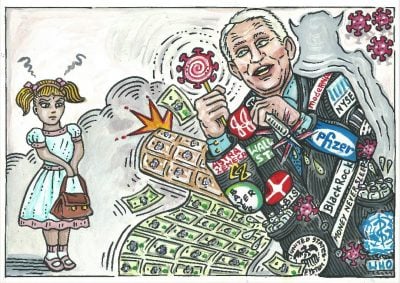
Vighi describes how, in pre-Covid times, the world economy was on the verge of another colossal meltdown and chronicles how the Swiss Bank of International Settlements, BlackRock (the world’s most powerful investment fund), G7 central bankers and others worked to avert a massive impending financial meltdown.

The world economy was suffocating under an unsustainable mountain of debt. Many companies could not generate enough profit to cover interest payments on their own debts and were staying afloat only by taking on new loans. Falling turnover, squeezed margins, limited cashflows and highly leveraged balance sheets were rising everywhere.

Lockdowns and the global suspension of economic transactions were intended to allow the Fed to flood the ailing financial markets (under the guise of COVID) with freshly printed money while shutting down the real economy to avoid hyperinflation.

Vighi says:

“… the stock market did not collapse (in March 2020) because lockdowns had to be imposed; rather, lockdowns had to be imposed because financial markets were collapsing. With lockdowns came the suspension of business transactions, which drained the demand for credit and stopped the contagion. In other words, restructuring the financial architecture through extraordinary monetary policy was contingent on the economy’s engine being turned off.”

It all amounted to a multi-trillion bailout for Wall Street under the guise of COVID ‘relief’ followed by an ongoing plan to fundamentally restructure capitalism that involves smaller enterprises being driven to bankruptcy or bought up by monopolies and global chains, thereby ensuring continued viable profits for these predatory corporations, and the eradication of millions of jobs resulting from lockdowns and accelerated automation.

Author and journalist Matt Taibbi noted in 2020:

“It retains all the cruelties of the free market for those who live and work in the real world, but turns the paper economy into a state protectorate, surrounded by a kind of Trumpian Money Wall that is designed to keep the investor class safe from fear of loss. This financial economy is a fantasy casino, where the winnings are real but free chips cover the losses. For a rarefied segment of society, failure is being written out of the capitalist bargain.”

The World Economic Forum says that by 2030 the public will ‘rent’ everything they require. This means undermining the right of ownership (or possibly seizing personal assets) and restricting consumer choice underpinned by the rhetoric of reducing public debt or ‘sustainable consumption’, which will be used to legitimise impending austerity as a result of the economic meltdown. Ordinary people will foot the bill for the ‘COVID relief’ packages.

If the financial bailouts do not go according to plan, we could see further lockdowns imposed, perhaps justified under the pretext of  ‘the virus’ but also ‘climate emergency’.

It is not only Big Finance that has been saved. A previously ailing pharmaceuticals industry has also received a massive bailout (public funds to develop and purchase the vaccines) and lifeline thanks to the money-making COVID jabs.

The lockdowns and restrictions we have seen since March 2020 have helped boost the bottom line of global chains and the e-commerce giants as well and have cemented their dominance. At the same time, fundamental rights have been eradicated under COVID government measures.

Capitalism and labour

Essential to this ‘new normal’ is the compulsion to remove individual liberties and personal freedoms. A significant part of the working class has long been deemed ‘surplus to requirements’ – such people were sacrificed on the altar of neo-liberalism. They lost their jobs due to automation and offshoring. Since then, this section of the population has had to rely on meagre state welfare and run-down public services or, if ‘lucky’, insecure low-paid service sector jobs.

What we saw following the 2008 crash was ordinary people being pushed further to the edge. After a decade of ‘austerity’ in the UK – a neoliberal assault on the living conditions of ordinary people carried out under the guise of reining in public debt following the bank bail outs – a leading UN poverty expert compared Conservative welfare policies to the creation of 19th-century workhouses and warned that, unless austerity is ended, the UK’s poorest people face lives that are “solitary, poor, nasty, brutish, and short”.

Philip Alston, the UN rapporteur on extreme poverty, accused ministers of being in a state of denial about the impact of policies. He accused them of the “systematic immiseration of a significant part of the British population”.

In another 2019 report, the Institute for Public Policy Research think tank laid the blame for more than 130,000 deaths in the UK since 2012 at the door of government policies. It claimed that these deaths could have been prevented if improvements in public health policy had not stalled as a direct result of austerity cuts.

Over the past 10 years in the UK, according to the Trussell Group, there has been rising food poverty and increasing reliance on food banks.

And in a damning report on poverty in the UK by Professor David Gordon of the University of Bristol, it was found that almost 18 million cannot afford adequate housing conditions, 12 million are too poor to engage in common social activities, one in three cannot afford to heat their homes adequately in winter and four million children and adults are not properly fed (Britain’s population is estimated at around 66 million).

Moreover, a 2015 report by the New Policy Institute noted that the total number of people in poverty in the UK had increased by 800,000, from 13.2 to 14.0 million in just two to three years.

Meanwhile, The Equality Trust in 2018 reported that the ‘austerity’ years were anything but austere for the richest 1,000 people in the UK. They had increased their wealth by £66 billion in one year alone (2017-2018), by £274 billion in five years (2013-2018) and had increased their total wealth to £724 billion – significantly more than the poorest 40% of households combined (£567 billion).

Just some of the cruelties of the ‘free market’ for those who live and work in the real world. And all of this hardship prior to lockdowns that have subsequently devastated lives, livelihoods and health, with cancer diagnoses and treatments and other conditions having been neglected due to the shutdown of health services.

During the current economic crisis, what we are seeing is many millions around the world being robbed of their livelihoods. With AI and advanced automation of production, distribution and service provision on the immediate horizon, a mass labour force will no longer be required.

It raises fundamental questions about the need for and the future of mass education, welfare and healthcare provision and systems that have traditionally served to reproduce and maintain labour that capitalist economic activity has required.

As the economic is restructured, labour’s relationship to capital is being transformed. If work is a condition of the existence of the labouring classes, then, in the eyes of capitalists, why maintain a pool of (surplus) labour that is no longer needed?

A concentration of wealth power and ownership is taking place as a result of COVID-related policies: according to research by Oxfam, the world’s billionaires gained $3.9 trillion while working people lost $3.7 trillion in 2020. At the same time, as large sections of the population head into a state of permanent unemployment, the rulers are weary of mass dissent and resistance. We are witnessing an emerging biosecurity surveillance state designed to curtail liberties ranging from freedom of movement and assembly to political protest and free speech.

The global implications are immense too. Barely a month into the COVID agenda, the IMF and World Bank were already facing a deluge of aid requests from developing countries that were asking for bailouts and loans. Ideal cover for rebooting the global economy via a massive debt crisis and the subsequent privatisation of national assets.

In 2020, World Bank Group President David Malpass stated that poorer countries will be ‘helped’ to get back on their feet after the various lockdowns but such ‘help’ would be on condition that neoliberal reforms become further embedded. In other words, the de facto privatisation of states (affecting all nations, rich and poor alike), the (complete) erosion of national sovereignty and dollar-denominated debt leading to a further strengthening of US leverage and power.

In a system of top-down surveillance capitalism with an increasing section of the population deemed ‘unproductive’ and ‘useless eaters’, notions of individualism, liberal democracy and the ideology of free choice and consumerism are regarded by the elite as ‘unnecessary luxuries’ along with political and civil rights and freedoms.

We need only look at the ongoing tyranny in Australia to see where other countries could be heading. How quickly Australia was transformed from a ‘liberal democracy’ to a brutal totalitarian police state of endless lockdowns where gathering and protests are not to be tolerated.

Being beaten and thrown to the ground and fired at with rubber bullets in the name of protecting health makes as much sense as devastating entire societies through socially and economically destructive lockdowns to ‘save lives’.

It makes as much sense as mask-wearing and social-distancing mandates unsupported by science, misused and flawed PCR tests, perfectly healthy people being labelled as ‘cases’, deliberately inflated COVID death figures, pushing dangerous experimental vaccines in the name of health, ramping up fear, relying on Neil Ferguson’s bogus modelling, censoring debate about any of this and the WHO declaring a worldwide ‘pandemic’ based on a very low number of global ‘cases’ back in early 2020 (44,279 ‘cases’ and 1,440 supposed COVID deaths outside China out of a population of 6.4 billion).

There is little if any logic to this. But of course, If we view what is happening in terms of a crisis of capitalism, it might begin to make a lot more sense.

The austerity measures that followed the 2008 crash were bad enough for ordinary people who were still reeling from the impacts when the first lockdown was imposed.

The authorities are aware that deeper, harsher impacts as well as much more wide-ranging changes will be experienced this time around and seem adamant that the masses must become more tightly controlled and conditioned to their coming servitude.

Manufacturing War With Russia

By Chris Hedges

Source: Information Clearing House

Despite the Robert Mueller report’s conclusion that Donald Trump and his campaign did not collude with Russia during the 2016 presidential race, the new Cold War with Moscow shows little sign of abating. It is used to justify the expansion of NATO to Russia’s borders, a move that has made billions in profits for U.S. arms manufacturers. It is used to demonize domestic critics and alternative media outlets as agents of a foreign power. It is used to paper over the Democratic Party’s betrayal of the working class and the party’s subservience to corporate power. It is used to discredit détente between the world’s two largest nuclear powers. It is used to justify both the curtailment of civil liberties in the United States and U.S. interventions overseas—including in countries such as Syria and Venezuela. This new Cold War predates the Trump presidential campaign. It was manufactured over a decade ago by a war industry and intelligence community that understood that, by fueling a conflict with Russia, they could consolidate their power and increase their profits. (Seventy percent of intelligence is carried out by private corporations such as Booz Allen Hamilton, which has been called the world’s most profitable spy operation.)

“This began long before Trump and ‘Russiagate,’ ” Stephen F. Cohen said when I interviewed him for my television show, “On Contact.” Cohen is professor emeritus of politics at Princeton University, where he was the director of the Russian studies program, and professor emeritus of Russian studies and history at New York University. “You have to ask yourself, why is it that Washington had no problem doing productive diplomacy with Soviet communist leaders. Remember Richard Nixon and Leonid Brezhnev? It was a love fest. They went hunting together [in the Soviet Union]. Yet along comes a post-Soviet leader, Vladimir Putin, who is not only not a communist but a professed anti-communist. Washington has been hating on him ever since 2003, 2004. It requires some explanation. Why do we like communist leaders in Russia better than we like Russia’s anti-communist leader? It’s a riddle.”

“If you’re trying to explain how the Washington establishment has dealt with Putin in a hateful and demonizing way, you have to go back to the 1990s before Putin,” said Cohen, whose new book is “War With Russia? From Putin & Ukraine to Trump & Russiagate.” The first post-Soviet leader is Boris Yeltsin. Clinton is president. And they have this fake, pseudo-partnership and friendship, whereas essentially the Clinton administration took advantage of the fact that Russia was in collapse. It almost lost its sovereignty. I lived there in the ’90s. Middle-class people lost their professions. Elderly people lost their pensions. I think it’s correct to say that industrial production fell more in the Russian 1990s than it did during our own Great Depression. It was the worst economic and social depression ever in peacetime. It was a catastrophe for Russia.”

In September 1993 Russians took to the streets to protest the collapse of the economy—the gross domestic product had fallen by 50% and the country was convulsed by hyperinflation—along with the rampant corruption that saw state enterprises sold for paltry fees to Russian oligarchs and foreign corporations in exchange for lavish kickbacks and bribes; food and fuel shortages; the nonpayment of wages and pensions; the lack of basic services, including medical services; falling life expectancy; the explosion of violent crime; and Yeltsin’s increasing authoritarianism and his unpopular war with Chechnya.

In October 1993 Yeltsin, after dissolving the parliament, ordered army tanks to shell the Russian parliament building, which was being occupied by democratic protesters. The assault left 2,000 dead. Yet during his presidency Yeltsin was effusively praised and supported by Washington. This included U.S. support for a $10.2 billion International Monetary Fund loan to Russia during his 1996 re-election campaign. The loan enabled the Yeltsin government to pay huge sums in back wages and pensions to millions of Russians, with checks often arriving on the eve of the election. Also, an estimated $1.5 billion from the loan was used to directly fund the Yeltsin presidential campaign. But by the time Yeltsin was forced out of office in December 1999 his approval rating had sunk to 2%. Washington, losing Yeltsin, went in search of another malleable Russian leader and, at first, thought it had found one in Putin.

“Putin went to Texas,” Cohen said. “He had a barbecue with Bush, second Bush. Bush said he ‘looked into his eyes and saw a good soul.’ There was this honeymoon. Why did they turn against Putin? He turned out not to be Yeltsin. We have a very interesting comment about this from Nicholas Kristof, the New York Times columnist, who wrote, I think in 2003, that his own disillusion with Putin was that he had turned out not to be ‘a sober Yeltsin.’ What Washington was hoping for was a submissive, supplicant, post-Soviet Russian leader, but one who was younger, healthier and not a drinker. They thought they had that in Putin. Yeltsin had put Putin in power, or at least the people around Yeltsin did.”

“When Putin began talking about Russia’s sovereignty, Russia’s independent course in world affairs, they’re aghast,” Cohen said of the Washington elites. “This is not what they expected. Since then, my own thinking is we were pretty lucky after the 1990s to get Putin because there were worst contenders in the wings. I knew some of them. I don’t want to name names. But some of these guys were really harsh people. Putin was kind of the right person for the right time, both for Russia and for Russian world affairs.”

“We have had three years of this,” Cohen said of Russiagate. “We lost sight of the essence of what this allegation is. The people who created Russiagate are literally saying, and have been for almost three years, that the president of the United States is a Russian agent, or he has been compromised by the Kremlin. We grin because it’s so fantastic. But the Washington establishment, mainly the Democrats but not only, have taken this seriously.”

“I don’t know if there has ever been anything like this in American history,” Cohen said. “That accusation does such damage to our own institutions, to the presidency, to our electoral system, to Congress, to the American mainstream media, not to mention the damage it’s done to American-Russian relations, the damage it has done to the way Russians, both elite Russians and young Russians, look at America today. This whole Russiagate has not only been fraudulent, it’s been a catastrophe.”

“There were three major episodes of détente in the 20th century,” Cohen said. “The first was after Stalin died, when the Cold War was very dangerous. That was carried out by Dwight Eisenhower, a Republican president. The second was by Richard Nixon, advised by Henry Kissinger—it was called ‘the Nixon détente with Brezhnev.’ The third, and we thought most successful, was Ronald Reagan with Mikhail Gorbachev. It was such a successful détente Reagan and Gorbachev, and Reagan’s successor, the first Bush, said the Cold War was over forever.”

“The wall had come down,” Cohen said of the 1989 collapse of East Germany and the fall of the Berlin Wall. “Germany was reunifying. The question became ‘where would a united Germany be?’ The West wanted Germany in NATO. For Gorbachev, this was an impossible sell. Twenty-seven point five million Soviet citizens had died in the war against Germany in the Second World War on the eastern front. Contrary to the bunk we’re told, the United States didn’t land on Normandy and defeat Nazi Germany. The defeat of Nazi Germany was done primarily by the Soviet army. How could Gorbachev go home and say, ‘Germany is reunited. Great. And it’s going to be in NATO.’ It was impossible. They told Gorbachev, ‘We promise if you agree to a reunited Germany in NATO, NATO will not move—this was Secretary of State James Baker—one inch to the east. In other words, NATO would not move from Germany toward Russia. And it did.”

“As we speak today, NATO is on Russia’s borders,” Cohen said. “From the Baltics to Ukraine to the former Soviet Republic of Georgia. So, what happened? Later, they said Gorbachev lied or he misunderstood. [That] the promise was never made. But the National Security Archive in Washington has produced all the documents of the discussion in 1990. It was not only [President George H.W.] Bush, it was the French leader François Mitterrand, it was Margaret Thatcher of England. Every Western leader promised Gorbachev NATO would not move eastward.”

“What do you end up with today?” he asked. “Betrayal. Any kind of discussion about Russian-American relations today, an informed Russian is going to say, ‘We worry you will betray us again.’… Putin said he had illusions about the West when he came to power.”

“Trump comes out of nowhere in 2016 and says, ‘I think we should cooperate with Russia,’ ” Cohen said. “This is a statement of détente. It’s what drew my attention to him. It’s then that this talk of Trump being an agent of the Kremlin begins. One has to wonder—I can’t prove it—but you have to think logically. Was this [allegation] begun somewhere high up in America by people who didn’t want a pro-détente president? And [they] thought that Trump, however small it seemed at the time that he could win—they really didn’t like this talk of cooperation with Russia. It set in motion these things we call Russiagate.”

“The forefathers of détente were Republicans,” Cohen said. “How the Democrats behaved during this period of détente was mixed. There was what used to be called the Henry Jackson wing. This was a very hard-line, ideological wing of the Democratic Party that didn’t believe in détente. Some Democrats did. I lived many years in Moscow, both Soviet and post-Soviet times. If you talk to Russian, Soviet policymakers, they generally prefer Republican candidates for the presidency.”

Democrats are perceived by Russian rulers as more ideological, Cohen said.

“Republicans tend to be businessmen who want to do business in Russia,” he said. “The most important pro-détente lobby group, created in the 1970s, was called the American Committee for East-West Accord. It was created by American CEOs who wanted to do business in Soviet Russia.”

“The single most important relationship the United States has is with Russia,” Cohen went on, “not only because of the nuclear weapons. It remains the largest territorial country in the world. It abuts every region we are concerned about. Détente with Russia—not friendship, not partnership, not alliance—but reducing conflict is essential. Yet something happened in 2016.”

The accusations made repeatedly by James Clapper, the former director of the National Security Agency, and John Brennan, the former director of the Central Intelligence Agency, concerning the Kremlin’s supposed control of Trump and Russia’s alleged theft of our elections are deeply disturbing, Cohen said. Clapper and Brennan have described Trump as a Kremlin “asset.” Brennan called Trump’s performance at a news conference with the Russian president in Finland “nothing short of treasonous.”

Clapper in his memoir, “Facts and Fears: Hard Truths From a Life in Intelligence,” claims Putin’s interference in the 2016 presidential election on behalf of Trump was “staggering.”

“Of course, the Russian efforts affected the outcome,” writes Clapper. “Surprising even themselves, they swung the election to a Trump win. To conclude otherwise stretches logic, common sense and credulity to the breaking point. Less than eighty thousand votes in three key states swung the election. I have no doubt that more votes than that were influenced by this massive effort by the Russians.”

Brennan and Clapper have on numerous occasions been caught lying to the public. Brennan, for example, denied, falsely, that the CIA was monitoring the computers that Senate staff members were using to prepare a report on torture. The chairwoman of the Senate Intelligence Committee, Dianne Feinstein, took to the Senate floor to accuse Brennan and the CIA of potentially violating the U.S. Constitution and of criminal activity in its attempts to spy on and thwart her committee’s investigations into the agency’s use of torture. She described the situation as a “defining moment” for political oversight. Brennan also claimed there was not a “single collateral death” in the drone assassination program, that Osama bin Laden used his wife as a human shield before being gunned down in a U.S. raid in Pakistan, and insisted that torture, or what is euphemistically called “enhanced interrogation,” has produced valuable intelligence. None of these statements are true.

Clapper, who at the time of the U.S. invasion of Iraq was the head of the National Geospatial-Intelligence Agency, the Pentagon unit responsible for interpreting spy-satellite photos and intelligence such as air particles and soil samples, concocted a story about Saddam Hussein spiriting his nonexistent weapons of mass destruction and the documents that verified his program to Syria on the eve of the invasion. He blatantly committed perjury before the Senate when being questioned about domestic surveillance programs of the American public. He was asked, “Does the NSA [National Security Agency] collect any type of data at all on millions, or hundreds of millions of Americans?” Clapper responded, “No, sir. … Not wittingly.” It was, as Clapper knew very well, a lie.

Our inability to oversee or control senior intelligence officials and their agencies, which fabricate information to push through agendas embraced by the shadow state, signals the death of democracy. Intelligence officials seemingly empowered to lie—Brennan and Clapper have been among them—ominously have in their hands instruments of surveillance, intimidation and coercion that effectively silence their critics, blunt investigations into their activities, even within the government, and make them and their agencies unaccountable.

“We have the Steele dossier that was spookily floating around American media,” Cohen said of the report compiled by Christopher Steele.

The report was commissioned by Fusion GPS and paid for by the Hillary Clinton presidential campaign and the Democratic National Committee. Bob Woodward reported that Brennan pushed to include the Steele dossier in the intelligence community assessment of Russian election interference.

“He [Steele] got it from newspapers,” Cohen said. “I don’t think he had a single source in Russia. Steele comes forward with this dossier and says, ‘I’ve got information from high-level sources.’ The Clinton campaign is funding this operation. But Steele is very important. He’s a former U.K. intelligence officer, if he’s really former, who had served in Russia and ran Russian cases. He says he has this information in the dossier about Trump frolicking with prostitutes. About Trump having been corrupted decades ago. He got it from ‘high-level’ Kremlin sources. This is preposterous. It’s illogical.”

“The theory is Putin desperately wanted to make Trump president,” Cohen said. “Yet, guys in the Kremlin, around Putin, were feeding Trump dirt to a guy called Steele. Even though the boss wants—does it make any sense to you?”

“Why is this important?” Cohen asked. “Right-wing American media outlets today, in particularly Fox News, are blaming Russia for this whole Russiagate thing. They’re saying that Russia provided this false information to Steele, who pumped it into our system, which led to Russiagate. This is untrue.”

“Who is behind all this? Including the Steele operation?” Cohen asked. “I prefer a good question to an orthodox answer. I’m not dogmatic. I don’t have the evidence. But all the surface information suggests that this originated with Brennan and the CIA. Long before it hit America—maybe as early as late 2015. One of the problems we have today is everybody is hitting on the FBI. Lovers who sent emails. But the FBI is a squishy organization, nobody is afraid of the FBI. It’s not what it used to be under J. Edgar Hoover. Look at James Comey, for God’s sake. He’s a patsy. Brennan and Clapper played Comey. They dumped this stuff on him. Comey couldn’t even handle Mrs. Clinton’s emails. He made a mess of everything. Who were the cunning guys? They were Brennan and Clapper. [Brennan,] the head of the CIA. Clapper, the head of the Office of [the Director of] National Intelligence, who is supposed to oversee these agencies.”

“Is there any reality to these Russiagate allegations against Trump and Putin?” he asked. “Was this dreamed up by our intelligence services? Today investigations are being promised, including by the attorney general of the United States. They all want to investigate the FBI. But they need to investigate what Brennan and the CIA did. This is the worst scandal in American history. It’s the worst, at least since the Civil War. We need to know how this began. If our intelligence services are way off the reservation, to the point that they can try to first destroy a presidential candidate and then a president, and I don’t care that it’s Trump, it may be Harry Smith next time, or a woman; if they can do this, we need to know it.”

“The second Bush left the Anti-Ballistic Missile Treaty in 2002,” Cohen said. “It was a very important treaty. It prevented the deployment of missile defense. If anybody got missile defense that worked, they might think they had a first strike [option]. Russia or the United States could strike the other without retaliation. Once Bush left the treaty, we began to deploy missile defense around Russia. It was very dangerous.”

“The Russians began a new missile program which we learned about last year,” he said. Hypersonic missiles. Russia now has nuclear missiles that can evade and elude any missile defense system. We are in a new and more perilous point in a 50-year nuclear arms race. Putin says, ‘We’ve developed these because of what you did. We can destroy each other.’ Now is the time for a serious, new arms control agreement. What do we get? Russiagate. Russiagate is one of the greatest threats to national security. I have five listed in the book. Russia and China aren’t on there. Russiagate is number one.”


Exposing the Giants: The Global Power Elite

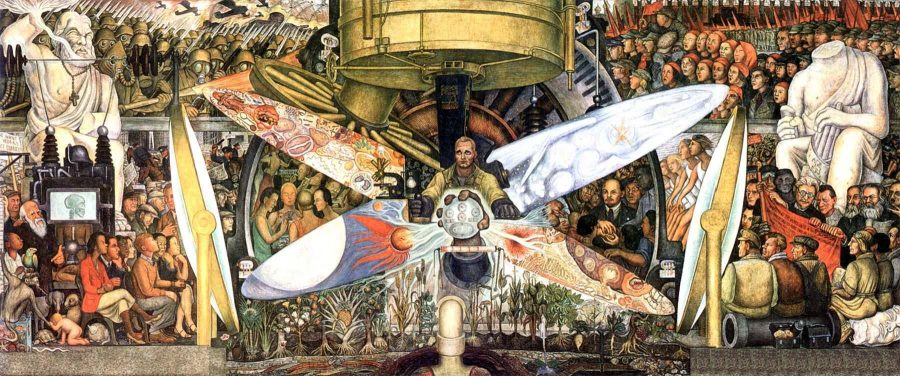
Diego Rivera, Man at the Crossroads/Man, Controller of the Universe, 1933

By Robert J. Burrowes

Developing the tradition charted by C. Wright Mills in his 1956 classic The Power Elite, in his latest book, Professor Peter Phillips starts by reviewing the transition from the nation state power elites described by authors such as Mills to a transnational power elite centralized on the control of global capital.

Thus, in his just-released study Giants: The Global Power Elite, Phillips, a professor of political sociology at Sonoma State University in the USA, identifies the world’s top seventeen asset management firms, such as BlackRock and J.P Morgan Chase, each with more than one trillion dollars of investment capital under management, as the ‘Giants’ of world capitalism. The seventeen firms collectively manage more than $US41.1 trillion in a self-invested network of interlocking capital that spans the globe.

This $41 trillion represents the wealth invested for profit by thousands of millionaires, billionaires and corporations. The seventeen Giants operate in nearly every country in the world and are ‘the central institutions of the financial capital that powers the global economic system’. They invest in anything considered profitable, ranging from ‘agricultural lands on which indigenous farmers are replaced by power elite investors’ to public assets (such as energy and water utilities) to war.

In addition, Phillips identifies the most important networks of the Global Power Elite and the individuals therein. He names 389 individuals (a small number of whom are women and a token number of whom are from countries other than the United States and the wealthier countries of Western Europe) at the core of the policy planning nongovernmental networks that manage, facilitate and defend the continued concentration of global capital. The Global Power Elite perform two key uniting functions, he argues: they provide ideological justifications for their shared interests (promulgated through their corporate media), and define the parameters of action for transnational governmental organizations and capitalist nation-states.

More precisely, Phillips identifies the 199 directors of the seventeen global financial Giants and offers short biographies and public information on their individual net wealth. These individuals are closely interconnected through numerous networks of association including the World Economic Forum, the International Monetary Conference, university affiliations, various policy councils, social clubs, and cultural enterprises. For a taste of one of these clubs, see this account of The Links in New York. As Phillips observes: ‘It is certainly safe to conclude they all know each other personally or know of each other in the shared context of their positions of power.’

The Giants, Phillips documents, invest in each other but also in many hundreds of investment management firms, many of which are near-Giants. This results in tens of trillions of dollars coordinated in a single vast network of global capital controlled by a very small number of people. ‘Their constant objective is to find enough safe investment opportunities for a return on capital that allows for continued growth. Inadequate capital-placement opportunities lead to dangerous speculative investments, buying up of public assets, and permanent war spending.’

Because the directors of these seventeen asset management firms represent the central core of international capital, ‘Individuals can retire or pass away, and other similar people will move into their place, making the overall structure a self-perpetuating network of global capital control. As such, these 199 people share a common goal of maximum return on investments for themselves and their clients, and they may seek to achieve returns by any means necessary – legal or not…. the institutional and structural arrangements within the money management systems of global capital relentlessly seek ways to achieve maximum return on investment, and … the conditions for manipulations – legal or not – are always present.’

Like some researchers before him, Phillips identifies the importance of those transnational institutions that serve a unifying function. The World Bank, International Monetary Fund, G20, G7, World Trade Organization (WTO), World Economic Forum (WEF), Trilateral Commission, Bilderberg Group, Bank for International Settlements, Group of 30 (G30), the Council on Foreign Relations and the International Monetary Conference serve as institutional mechanisms for consensus building within the transnational capitalist class, and power elite policy formulation and implementation. ‘These international institutions serve the interests of the global financial Giants by supporting policies and regulations that seek to protect the free, unrestricted flow of capital and debt collection worldwide.’

But within this network of transnational institutions, Phillips identifies two very important global elite policy-planning organizations: the Group of Thirty (which has 32 members) and the extended executive committee of the Trilateral Commission (which has 55 members). These nonprofit corporations, which each have a research and support staff, formulate elite policy and issue instructions for their implementation by the transnational governmental institutions like the G7, G20, IMF, WTO, and World Bank. Elite policies are also implemented following instruction of the relevant agent, including governments, in the context. These agents then do as they are instructed. Thus, these 85 members (because two overlap) of the Group of Thirty and the Trilateral Commission comprise a central group of facilitators of global capitalism, ensuring that ‘global capital remains safe, secure, and growing’.

So, while many of the major international institutions are controlled by nation-state representatives and central bankers (with proportional power exercised by dominant financial supporters such as the United States and European Union countries), Phillips is more concerned with the transnational policy groups that are nongovernmental because these organizations ‘help to unite TCC power elites as a class’ and the individuals involved in these organizations facilitate world capitalism. ‘They serve as policy elites who seek the continued growth of capital in the world.’

Developing this list of 199 directors of the largest money management firms in the world, Phillips argues, is an important step toward understanding how capitalism works globally today. These global power elite directors make the decisions regarding the investment of trillions of dollars. Supposedly in competition, the concentrated wealth they share requires them to cooperate for their greater good by identifying investment opportunities and shared risk agreements, and working collectively for political arrangements that create advantages for their profit-generating system as a whole.

Their fundamental priority is to secure an average return on investment of 3 to 10 percent, or even more. The nature of any investment is less important than what it yields: continuous returns that support growth in the overall market. Hence, capital investment in tobacco products, weapons of war, toxic chemicals, pollution, and other socially destructive goods and services are judged purely by their profitability. Concern for the social and environmental costs of the investment are non-existent. In other words, inflicting death and destruction are fine because they are profitable.

So what is the global elite’s purpose? In a few sentences Phillips characterizes it thus: The elite is largely united in support of the US/NATO military empire that prosecutes a repressive war against resisting groups – typically labeled ‘terrorists’ – around the world. The real purpose of ‘the war on terror’ is defense of transnational globalization, the unimpeded flow of financial capital around the world, dollar hegemony and access to oil; it has nothing to do with repressing terrorism which it generates, perpetuates and finances to provide cover for its real agenda. This is why the United States has a long history of CIA and military interventions around the world ostensibly in defense of ‘national interests’.


Wealth and Power

An interesting point that emerges for me from reading Phillips thoughtful analysis is that there is a clear distinction between those individuals and families who have wealth and those individuals who have (sometimes significantly) less wealth (which, nevertheless, is still considerable) but, through their positions and connections, wield a great deal of power. As Phillips explains this distinction, ‘the sociology of elites is more important than particular elite individuals and their families’. Just 199 individuals decide how more than $40 trillion will be invested. And this is his central point. Let me briefly elaborate.

There are some really wealthy families in the world, notably including the families Rothschild (France and the United Kingdom), Rockefeller (USA), Goldman-Sachs (USA), Warburgs (Germany), Lehmann (USA), Lazards (France), Kuhn Loebs (USA), Israel Moses Seifs (Italy), Al-Saud (Saudi Arabia), Walton (USA), Koch (USA), Mars (USA), Cargill-MacMillan (USA) and Cox (USA). However, not all of these families overtly seek power to shape the world as they wish.

Similarly, the world’s extremely wealthy individuals such as Jeff Bezos (USA), Bill Gates (USA), Warren Buffett (USA), Bernard Arnault (France), Carlos Slim Helu (Mexico) and Francoise Bettencourt Meyers (France) are not necessarily connected in such a way that they exercise enormous power. In fact, they may have little interest in power as such, despite their obvious interest in wealth.

In essence, some individuals and families are content to simply take advantage of how capitalism and its ancilliary governmental and transnational instruments function while others are more politically engaged in seeking to manipulate major institutions to achieve outcomes that not only maximize their own profit and hence wealth but also shape the world itself.

So if you look at the list of 199 individuals that Phillips identifies at the centre of global capital, it does not include names such as Bezos, Gates, Buffett, Koch, Walton or even Rothschild, Rockefeller or Windsor (the Queen of England) despite their well-known and extraordinary wealth. As an aside, many of these names are also missing from the lists compiled by groups such as Forbes and Bloomberg, but their absence from these lists is for a very different reason given the penchant for many really wealthy individuals and families to avoid certain types of publicity and their power to ensure that they do.

In contrast to the names just listed, in Phillips’ analysis names like Laurence (Larry) Fink (Chairman and CEO of BlackRock), James (Jamie) Dimon (Chairman and CEO of JPMorgan Chase) and John McFarlane (Chairman of Barclays Bank), while not as wealthy as those listed immediately above, wield far more power because of their positions and connections within the global elite network of 199 individuals.

Predictably then, Phillips observes, these three individuals have similar lifestyles and ideological orientations. They believe capitalism is beneficial for the world and while inequality and poverty are important issues, they believe that capital growth will eventually solve these problems. They are relatively non-expressive about environmental issues, but recognize that investment opportunities may change in response to climate ‘modifications’. As millionaires they own multiple homes. They attended elite universities and rose quickly in international finance to reach their current status as giants of the global power elite. ‘The institutions they manage have been shown to engage in illegal collusions with others, but the regulatory fines by governments are essentially seen as just part of doing business.’

In short, as I would characterize this description: They are devoid of a legal or moral framework to guide their actions, whether in relation to business, fellow human beings, war or the environment and climate. They are obviously typical of the elite.

Any apparent concern for people, such as that expressed by Fink and Dimon in response to the racist violence in Charlottesville, USA in August 2017, is simply designed to promote ‘stability’ or more precisely, a stable (that is, profitable) investment and consumer climate.

The lack of concern for people and issues that might concern many of us is also evident from a consideration of the agenda at elite gatherings. Consider the International Monetary Conference. Founded in 1956, it is a private yearly meeting of the top few hundred bankers in the world. The American Bankers Association (ABA) serves as the secretariat for the conference. But, as Phillips notes: ‘Nothing on the agenda seems to address the socioeconomic consequences of investments to determine the impacts on people and the environment.’ A casual perusal of the agenda at any elite gathering reveals that this comment applies equally to any elite forum. See, for example, the agenda of the recent WEF meeting in Davos. Any talk of ‘concern’ is misleading rhetoric.

Hence, in the words of Phillips: The 199 directors of the global Giants are ‘a very select set of people. They all know each other personally or know of each other. At least 69 have attended the annual World Economic Forum, where they often serve on panels or give public presentations. They mostly attended the same elite universities, and interact in upperclass social setting[s] in the major cities of the world. They all are wealthy and have significant stock holdings in one or more of the financial Giants. They are all deeply invested in the importance of maintaining capital growth in the world. Some are sensitive to environmental and social justice issues, but they seem to be unable to link these issues to global capital concentration.’

Of course, the global elite cannot manage the world system alone: the elite requires agents to perform many of the functions necessary to control national societies and the individuals within them. ‘The interests of the Global Power Elite and the TCC are fully recognized by major institutions in society. Governments, intelligence services, policymakers, universities, police forces, military, and corporate media all work in support of their vital interests.’

In other words, to elaborate Phillips’ point and extend it a little, through their economic power, the Giants control all of the instruments through which their policies are implemented. Whether it be governments, national military forces, ‘military contractors’ or mercenaries (with at least $200 billion spent on private security globally, the industry currently employs some fifteen million people worldwide) used both in ‘foreign’ wars but also likely deployed in future for domestic control, key ‘intelligence’ agencies, legal systems and police forces, major nongovernment organizations, or the academic, educational, ‘public relations propaganda’, corporate media, medical, psychiatric and pharmaceutical industries, all instruments are fully responsive to elite control and are designed to misinform, deceive, disempower, intimidate, repress, imprison (in a jail or psychiatric ward), exploit and/or kill (depending on the constituency) the rest of us, as is readily evident.


Defending Elite Power

Phillips observes that the power elite continually worries about rebellion by the ‘unruly exploited masses’ against their structure of concentrated wealth. This is why the US military empire has long played the role of defender of global capitalism. As a result, the United States has more than 800 military bases (with some scholars suggesting 1,000) in 70 countries and territories. In comparison, the United Kingdom, France, and Russia have about 30 foreign bases. In addition, US military forces are now deployed in 70 percent of the world’s nations with US Special Operations Command (SOCOM) having troops in 147 countries, an increase of 80 percent since 2010. These forces conduct counterterrorism strikes regularly, including drone assassinations and kill/capture raids.

‘The US military empire stands on hundreds of years of colonial exploitation and continues to support repressive, exploitative governments that cooperate with global capital’s imperial agenda. Governments that accept external capital investment, whereby a small segment of a country’s elite benefits, do so knowing that capital inevitably requires a return on investment that entails using up resources and people for economic gain. The whole system continues wealth concentration for elites and expanded wretched inequality for the masses….

‘Understanding permanent war as an economic relief valve for surplus capital is a vital part of comprehending capitalism in the world today. War provides investment opportunity for the Giants and TCC elites and a guaranteed return on capital. War also serves a repressive function of keeping the suffering masses of humanity afraid and compliant.’

As Phillips elaborates: This is why defense of global capital is the prime reason that NATO countries now account for 85 percent of the world’s military spending; the United States spends more on the military than the rest of the world combined.

In essence, ‘the Global Power Elite uses NATO and the US military empire for its worldwide security. This is part of an expanding strategy of US military domination around the world, whereby the US/ NATO military empire, advised by the power elite’s Atlantic Council, operates in service to the Transnational Corporate Class for the protection of international capital everywhere in the world’.

This entails ‘further pauperization of the bottom half of the world’s population and an unrelenting downward spiral of wages for 80 percent of the world. The world is facing economic crisis, and the neoliberal solution is to spend less on human needs and more on security. It is a world of financial institutions run amok, where the answer to economic collapse is to print more money through quantitative easing, flooding the population with trillions of new inflation-producing dollars. It is a world of permanent war, whereby spending for destruction requires further spending to rebuild, a cycle that profits the Giants and global networks of economic power. It is a world of drone killings, extrajudicial assassinations, death, and destruction, at home and abroad.’


Where is this all heading?

So what are the implications of this state of affairs? Phillips responds unequivocally: ‘This concentration of protected wealth leads to a crisis of humanity, whereby poverty, war, starvation, mass alienation, media propaganda, and environmental devastation are reaching a species-level threat. We realize that humankind is in danger of possible extinction’.

He goes on to state that the Global Power Elite is probably the only entity ‘capable of correcting this condition without major civil unrest, war, and chaos’ and elaborates an important aim of his book: to raise awareness of the importance of systemic change and the redistribution of wealth among both the book’s general readers but also the elite, ‘in the hope that they can begin the process of saving humanity.’ The book’s postscript is a ‘A Letter to the Global Power Elite’, co-signed by Phillips and 90 others, beseeching the elite to act accordingly.

‘It is no longer acceptable for you to believe that you can manage capitalism to grow its way out of the gross inequalities we all now face. The environment cannot accept more pollution and waste, and civil unrest is everywhere inevitable at some point. Humanity needs you to step up and insure that trickle-down becomes a river of resources that reaches every child, every family, and all human beings. We urge you to use your power and make the needed changes for humanity’s survival.’

But he also emphasizes that nonviolent social movements, using the Universal Declaration of Human Rights as a moral code, can accelerate the process of redistributing wealth by pressuring the elite into action.


Conclusion

Peter Phillips has written an important book. For those of us interested in understanding elite control of the world, this book is a vital addition to the bookshelf. And like any good book, as you will see from my comments both above and below, it raised more questions for me even while it answered many.

As I read Phillips’ insightful and candid account of elite behavior in this regard, I am reminded, yet again, that the global power elite is extraordinarily violent and utterly insane: content to kill people in vast numbers (whether through starvation or military violence) and destroy the biosphere for profit, with zero sense of humanity’s now limited future. See ‘The Global Elite is Insane Revisited’ and ‘Human Extinction by 2026? A Last Ditch Strategy to Fight for Human Survival’ with more detailed explanations for the violence and insanity here: Why Violence? and Fearless Psychology and Fearful Psychology: Principles and Practice.

For this reason I do not share his faith in moral appeals to the elite, as articulated in the letter in his postscript. It is fine to make the appeal but history offers no evidence to suggest that there will be any significant response. The death and destruction inflicted by elites is highly profitable, centuries-old and ongoing. It will take powerful, strategically-focused nonviolent campaigns (or societal collapse) to compel the necessary changes in elite behavior. Hence, I fully endorse his call for nonviolent social movements to compel elite action where we cannot make the necessary changes without their involvement. See ‘A Nonviolent Strategy to End Violence and Avert Human Extinction’ and Nonviolent Campaign Strategy.

I would also encourage independent action, in one or more of several ways, by those individuals and communities powerful enough to do so. This includes nurturing more powerful individuals by making ‘My Promise to Children’, participating in ‘The Flame Tree Project to Save Life on Earth’ and signing the online pledge of ‘The People’s Charter to Create a Nonviolent World’.

Fundamentally, Giants: The Global Power Elite is a call to action. Professor Peter Phillips is highly aware of our predicament – politically, socially, economically, environmentally and climatically – and the critical role played by the global power elite in generating that predicament.

If we cannot persuade the global power elite to respond sensibly to that predicament, or nonviolently compel it to do so, humanity’s time on Earth is indeed limited.


Biodata: Robert J. Burrowes has a lifetime commitment to understanding and ending human violence. He has done extensive research since 1966 in an effort to understand why human beings are violent and has been a nonviolent activist since 1981. He is the author of ‘Why Violence?’ http://tinyurl.com/whyviolence His email address is flametree@riseup.net and his website is here. http://robertjburrowes.wordpress.com

Robert J. Burrowes
P.O. Box 68
Daylesford, Victoria 3460
Australia

Email: flametree@riseup.net

Websites:
Nonviolence Charter
Flame Tree Project to Save Life on Earth
‘Why Violence?’
Feelings First
Nonviolent Campaign Strategy
Nonviolent Defense/Liberation Strategy
Anita: Songs of Nonviolence
Robert Burrowes
Global Nonviolence Network

What You May Not Know About Today’s Economic War

By Phil Butler

Source: New Eastern Outlook

Many people believe the world is spiraling in a downward freefall toward Armageddon. At the same time billions on Earth feel the sting of crippling poverty, sanctions, and austerity imposed by the elites – the numbers of billionaires have risen geometrically. And so have those billionaire’s profits. It’s time we took a closer look at where we stand as of 2018, if we are to be left anything at all to cling to. From the steppes of Russia to the ancient lands of the Minoans, economic terror now reigns.

When I left Germany for Greece several months ago, the common belief there was that the “lazy Greeks” were part of the cause of Deutsche banker discomfort. My neighbors in Germany’s oldest city of Trier honestly believe the bailout of Greece is because Greeks unwilling to work hard. The bitter irony of this believe lies in the fact the average German would melt under the workload of the average citizen here in Heraklion on Crete. As an American what I witnessed in Germany can only be considered a “part-time” employment state. But here in Greece the average person works seven days a week, and usually at more than one job. This microeconomic perception is one that has been implanted by state and corporate controlled media in Germany. There’s a very good reason for this, which I will now explain.

A New Secret Economic Weapon – Organized Failures

The International Monetary Fund, the German and American bankers, the globalist elites who control financial systems in the so-called “west” – they’ve been on a mission since 2008. The “meltdown” of markets when Barack Obama first took office as American president was not some random and chaotic economic mistake. Wall Street and the global markets were turned upside down on purpose. In his book “Secret Weapon”, the CEO of Freeman Global Holdings and a New York Times bestselling author Kevin Freeman presents a persuasive chain of evidence pointing to the fact the crash of September 2008 was the result of a deliberate and well-prepared act of sabotage. Even though the author blames competing governments like China and Iran for what he terms “economic terrorism”, his proofs and theories are correct in so far as the “meltdown” being on purpose. The fact Freeman is founder and chairman of the NSIC Institute, and a Senior Fellow of the Center for Security Policy suggests his work may be a double dealing by the financial community to obscure the real perpetrators. But for my report it’s more important to follow the trail of financial chaos to our financial reality.

Freeman is not alone in his suggestion the economic crisis was a conspiracy. The financial disaster of 2008 costs Americans nearly $20 trillion dollars, as framed in this Forbes piece by investment banker and former Forbes editor, Robert Lenzner. In the report the financial guru inadvertently points the finger at Goldman Sachs and Citigroup, claiming the Greenspan Treasury allowed them to “master their own appetite for profits,” which in turn led to the various collapses that forced the American people to bail out the banks. Lenzner, to his great credit, goes on to describe the lurking dangers for total collapse we still face. But what about Greece, the rest of Eastern Europe, the Germans and the rest of the indebted world? Who can we blame for destroying the futures of a billion people? When I’m done your come to realize the Nazis never lost World War II. Read on.

Win-Win or Lose-Lose for Ukraine

Ukraine was turned into a “scorched Earth” when Hitler’s operation Barbarossa threatened Russia. When the armies commanded by Joseph Stalin during the German Army’s invasion of the Soviet Union in the Second World War destroyed crops and goods in their path, the invaders found nothing to fuel their advance. Today Ukraine is laid waste by an economic Barbarossa where the Russians had no opportunity to defend the steppes. Some will remember Vice President Joe Biden’s son taking a position to reap Ukrainian energy benefits. Other readers may recall when a Franklin Templton investment fund, one controlled by the Rothschild bankers, bought up 20% of Ukraine’s debts at junk bond prices. You see, the US orchestrated situation in Ukraine is not simply about events on the Maidan and the ongoing war in the Donbass as a byproduct of the geopolitics of the United States seeking to cut off Ukraine from Russia. Agri-giant Monsanto and other GMO companies had targeted Ukraine long before the events on Maidan Square, and the fact Ukraine is a Central hub in the supply of Russian gas to Europe cannot be under-stressed. Where foreign profiteering in Ukraine is concerned, this story on my blog tells of an Oakland Institute report where more than 1.6 million hectares of land in Ukraine went under the control of foreign-based corporations. This quote from the report makes my case for economic terrorism by the west for me:

“International financial institutions swooped in on the heels of the political upheaval in Ukraine to deregulate and throw open the nation’s vast agricultural sector to foreign corporations….Monsanto, Cargill, and DuPont, and how corporations are taking over all aspects of Ukraine’s agricultural system.”

These stories were more than two years ago. Today we see the catastrophic effects of the Euromaidan far from the battle front and the Donbass region’s pro-Russian separatists.

When I first learned that the forests in the Ukrainian Carpathians were being chopped to the ground back in 2016, the impending ecological disaster perpetrated by these globalist blood suckers hit home hard. This Counterpunch story tells the tale of a brand of liberty and democracy no Ukrainian can afford. Despite the aerial photos and other proofs Ukraine’s forests were being stolen from under the people, the Lviv Regional Forestry and Hunting Agency denied all such reports in customary Eastern European mafia form. The fact is, the Petro Poroshenko assisted in selling out Carpathian forests. Ecologists now predict an ecological Armageddon for western Ukraine. These photos from Censor.net prove the disaster in progress. This RT story on the firesale by the Poroshenko regime of 22 out of 34 state assets being put up for sale at a 60 percent discount leads us into the Greece situation, where the legacy of a people is up for grabs.

Those lazy Greeks! Funny, I just walked around the corner to the bakery here in Heraklion to get a coffee from the same lady I get coffee from every day. She was there Christmas, and I am sure she’ll be there behind the counter New Year’s Eve and New Year’s Day. The shopkeeper across the street, he sees Alexis Tsipras on TV and shoves an open hand toward Greece’s Prime Minister shouting; “Malaka!”, which can only be translated coldly as “jerk-off”. Also in the hotel lobby, at the donut house in the city center, and at each-and-every shop along Heraklion’s many retail districts, Greece officials are all Malakas (in ancient Greek – mentally ill) or worse. I’ll bet most Germans don’t know or care to know that the VAT in Greece is now 24%, and that the average shopkeeper pays 37% – 45% in income tax on top of the VAT for the goods they purchase. As crazy as it sounds though, Cretans are still especially friendly toward foreigners like me. If they only know what the German and American bankers did to them.

The Greece Fire Sale – A Tsipras Sellout

I just made a report about the great Greek sellout of privatization on my travel news site Argophilia Travel News this morning. Researching it prompted me to do this piece for NEO. The long and short of the Greek economic crash that was assisted by none other than Goldman Sachs, is that the same privatization the globalists had in store for Russia during the Yeltsin years is being exacted on Greeks. The latest sellout by Tsipras, who swore he’d end privatization, the Germans and Americans snapping up the Thessaloniki Port and the future of LNG shipments to Europe through Greece. I found it interesting that one of the principals in this sale, South Europe Gateway Thessaloniki (SEFT) Limited Director, Alexander von Mellenthin Has a distinguished German name. I’m not certain, but I believe he is a close relative of both General of the artillery, Horst Alexander, Alfred Paul von Mellenthin, and his brother, Major General Friedrich Wilhelm von Mellenthin, who served as Hitler’s chief of staff of the XXXXVIII Panzer Corps in the occupied Soviet Union, including the Battle of Kursk, the Battle of Kiev, and the spring 1944 retreat through the western Ukraine. The term “irony” will simply not do if Mellenthin is the son or grandson of a key Nazi general. Financial Blitzkrieg, Financial Armageddon, and the Fourth Reich finalizing the rape of Greece! Wow.

Regardless of whether or not the kin of old Nazis are expanding the Fourth Reich or not, the fact the European Commission, the International Monetary Fund and the European Central Bank have insisted on Greek and other privatization schemes as a condition for much-needed loans for bailouts is a smoking gun held by the same elites who always fuel wars. The fallacy of the “lazy Greek” lives on because of those who would reap the vast financial rewards of yet another deconstructed economy. It’s no coincidence that the Greek privatization plan’s administrator — the Hellenic Republic Asset Development Fund (TAIPED) — so closely resembles Germany’s Treuhandanstalt, or the agency charged with the privatization of East Germany’s state-owned enterprises following unification. Few readers will recall Treuhandanstalt being accused of turning over to West German big business hundreds of billions of Deutsche Marks in national property for little or nothing. And, though a number of Treuhandanstalt managers were ultimately indicted for corruption and embezzlement, this brand of pillaging has escalated in the Greece situation. There was even a plan back in 2014 to convert much of Greece’s protected coastal areas into “composite tourist villages,” a move which would essentially privatize every inch of valuable Greek seaside. Former Greek Finance Minister, Yanis Varoufakis called the Treuhandanstalt-like plan for Greece “an abomination” in this Huff Post piece. Varoufakis, who resigned on principle from the Tsipras administration, goes on to frame the Greek debt debauchery, describing the real IMF scheme:

“The plan is politically toxic, because the fund, though domiciled in Greece, will effectively be managed by the troika. It is also financially noxious, because the proceeds will go toward servicing what even the IMF now admits is an unpayable debt. And it fails economically, because it wastes a wonderful opportunity to create homegrown investments to help counter the recessionary impact…”

Yanis Varoufakis proposed to the Germans and the Rothschild bankers of Luxembourg and Frankfurt a Greek plan for repayment of the staggering debt the Goldman Sachs bankers helped usher into Greece. But the IMF and the new Reich refused, of course. His plan was for Greece to cooperate via its own newly formed central holding company for some Greek assets. The IMF and the banksters would have nothing of it, they needed complete control of what, and for how much Greece was to be auctioned off. Tsipras betrayed his country, and the only decent politician the Greeks have had in decades stepped down.

8 Critical Factors Behind Every Food Crisis

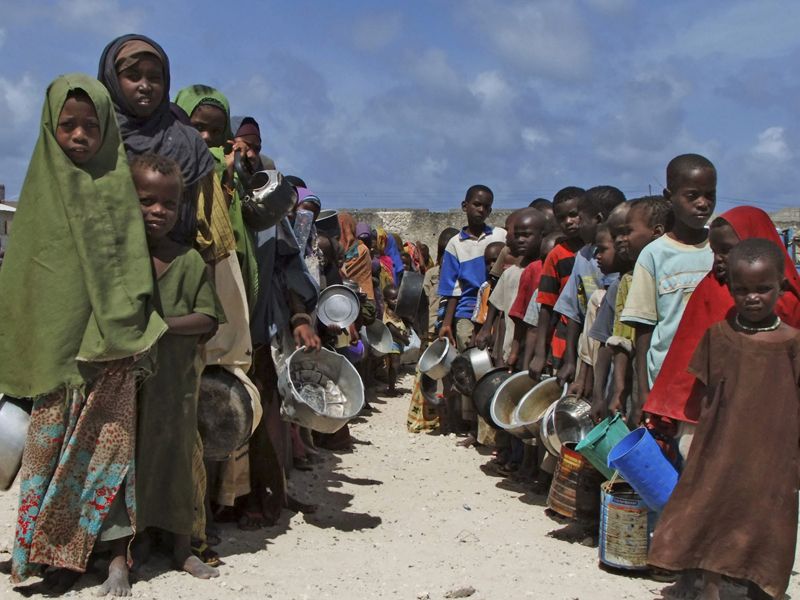
FILE – In this Monday, Aug. 15, 2011 file photo, children from southern Somalia hold their pots as they line up to receive cooked food in Mogadishu, Somalia. A report by two U.S. government-funded famine and food agencies gives the highest death toll yet, estimating that 260,000 people died – more than double previous estimates. (AP Photo/Farah Abdi Warsameh, File)

By John Hawthorne

Source: Business Connect

From the beginning of time, their have been food crises in one form or another. Ancient books such as the Bible have records of various famines devastating portions of the world.

And while it’s easy to attribute these crises to a single cause, such as war or drought, the causes are usually much deeper and much more complex.

Nelson Mandela said, “Overcoming poverty is not an act of charity, it is an act of justice.”

In order for us to achieve the kind of justice envisioned by Mandela, it’s essential that we first understand the underlying causes of food crises. Only after we have understood can we then begin creating meaningful solutions.

With that in mind, here are 8 primary factors behind almost every global food crisis. While not all 8 of these will be present at a time, you will almost always find several of these at work.

Factor #1 – Poverty

One of the greatest factors in every food crisis is stark and abject poverty. This isn’t surprising. With enough money, anyone can ensure they have enough food. But with many developing nations sitting well below the poverty line, the population simply can’t afford the food they so desperately need.

Additionally, poverty has a distinct effect on food output. In Africa, for example, many farmers can’t afford proper irrigation and fertilizer. This, in turn, leads to lower yields, which then reduces the overall amount of food available to the population.

The population of the Sub-Saharan region of Africa is expected to grow at an astronomical rate, topping out at 2.4 billion by 2050. This will continue to exacerbate the poverty issue, which will then continue to drive the lack of sufficient food in the area.

Factor #2 – Drought and Desertification

Widespread droughts, leading to the desertification of particular locations also causes huge disruptions to food production. For example, leading up to and during the global food crisis of 2008, 110 countries experienced significant droughts. This caused even the most well-irrigated, fertile areas to become arid deserts, making it impossible to grow crops.

As Mark Hughes noted:

Australia is normally the second largest exporter of grain, after the U.S. The continent, though, is experiencing an ongoing drought that has been described as the worst in a century. Grain yields have shrunk and many silos remain empty. Australia’s drought is a major factor in global wheat stocks being at their lowest since 1979. In fact, many wheat and rice farmers are switching to crops that demand less water, such as wine grapes.

Additionally, farmers often let animals over-graze on their land, reducing the amount of vegetation and increasing desertification. If the soil becomes dry enough, it is ruined and unable to support any crops at all.

Finally, as populations grow, deforestation occurs at an increased rate, which then leads to less vegetation and more desertification.

Factor #3 – Political Pressure

In the past, the International Monetary Fund has pressured small farmers, particularly in impoverished African countries, to abandon agricultural farming in favor of industrial work. The money generated from this practice would be used to pay off debt and import food.

While it may sound like a working strategy, it has created catastrophic results.

As Eric Holt-Giménez noted:

The urban population increased seven-fold, swelling from 18% to 33% of the population. Millions of poor and unemployed workers have swelled the cities—with two-thirds of them living in slums. The manufacturing and industrial sector did not “take off” in African countries; the percent of the GDP coming from industry was 30% in 1961 and 32% in 2000. In the countryside, as plantations for agro-exports expanded, food production plummeted and poverty grew. Though the rural population, density increased by 180% as more farmers were crowded onto smaller plots.

Factor #4 – Increased Consumption of Meat and Dairy

Many countries have begun adopting a more Western diet, which includes eating significantly more meat and dairy. To make this happen, farmers have been forced to raise more cattle, and more cattle means more grain being consumed.

The problem, however, is that this causes a significant deficiency in terms of calories consumed versus calories available. A cow consumes approximately 700 calories worth of grain to produce a piece of meat containing only 100 calories. When this happens on a massive scale, an enormous shortage of food is the end result. The longer this deficit continues, the greater the imbalance will become.

Factor #5 – Increased Oil and Transportation Costs

When the price of oil goes up, the energy cost for planting and transporting foods goes through the roof. When food costs more to grow, it then costs more to sell. These rising costs then make it more difficult for the local population to purchase crops as well as for farmers to export their crops to industrialized nations.

Additionally, increased oil costs has led many countries to invest heavily in the development of agro-fuels. More agro-fuels always means less food available.

As Esther Vivas helpfully puts it:

The increase in the price of oil, which doubled in 2007 and 2008 and caused a big rise in the price of fertilizers and transport related to the food system, has resulted in increasing investment in the production of alternative fuels such as those of plant origin. Governments in the United States, the European Union, Brazil and others have subsidized production of agro-fuels in response to the scarcity of oil and global warming. But this green fuel production comes into direct competition with the production of food. To give just one example, in 2007 in the United States 20% of the total cereal harvest was used to produce ethanol and it is calculated in the next decade that this figure will reach 33%. We can imagine the situation in the countries of the South.

Factor #6 – Falling World Aid

At the peak of the 2007-2008 food crisis, food aid was at it’s lowest point since 1961. This is one of the oddities about the national food market. When cereal prices are low, countries look to sell their food through international aid. However, when food prices are high, they prefer to sell them on the open market for increased profits.

In other words, during food crises, when food is scarcest and at it’s highest prices, it isn’t available for international aid. When the bottom falls out of world aid, food crises grow in magnitude.

Factor #7 – International Conflicts

International conflicts are a particularly visible factor behind many food crises. During conflicts, it’s common for one country to restrict exports to another country, which then reduces the amount of food available to the general population.

Or, even worse, dictators will intentionally isolate their countries, refusing foreign aid that is desperately needed. Aid workers may be blocked from entering the country, making it difficult for the citizens to receive needed help. If foreign aid does come, they seize it for themselves, depriving the population of desperately needed sustenance.

Factor #8 – Disease

If a country experiences a particularly violent outbreak of a disease, it can completely disrupt the overall food supply. For example, the HIV/AIDS crisis in Africa has killed farmers, which in turn pushes families deep into poverty.

When a population is undernourished, drugs become less effective and can at times create intense hunger pains. These two factors combined create a vicious cycle of death, poverty, and hunger.

Additionally, certain highly contagious diseases can restrict the amount of aid available to a country. For example, during the 2014 Ebola epidemic in West Africa, aid workers were restricted from traveling to the region due to fear of spreading the disease.

Perfect Storms

Most food crises aren’t the result of a single factor. Rather, they are caused by a perfect storm of events that coalesce into a deadly storm.

For example, in 2011, Somalia was devastated by a drought that caused widespread crop failure. The food crisis was made even worse by a non-functioning government as well as a national conflict. All these forces combined to make it difficult for aid workers to reach those who so desperately needed help.

The result was that approximately 260,000 people died.

Because the problems are almost always complex and multi-layered, the solutions must be equally multi-faceted. Simple solutions typically exacerbate the problem at the expense of the local population.

The best solutions are those that involve numerous parties working together to create a tangible, workable solution.

There will always be food crises to one degree or another. But as we grow in our understanding of what causes them, we can also grow in our ability to bring them to an end.

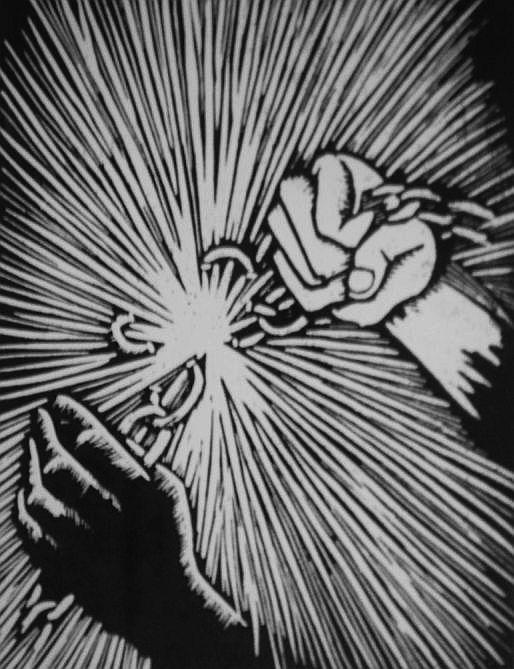
Freedom Is Not Necessarily The Absence Of Tyranny

By Brandon Smith

Source: Alt-Market

Is it true that freedom is an overly idealized concept? Perhaps, but it is one of the few concepts worthy of idealization. It is so worthy, that it is worth dying for.

Since the dawn of recorded history human beings have fought and sacrificed to attain freedom. It is an inherent psychological construct. It is a principle that is rooted not only in the mind of man, but his spirit or soul. Scientists in the realm of the mind have struggled for generations to understand where it comes from — others have sought to dismiss it as a fanciful notion or societal construct. Nihilists claim it doesn’t really exist, while other people center their entire lives on the proliferation of it. The concept of freedom, love it or hate it, is central to all cultures and all civilizations. The most common dismissal of the idea of freedom that I have seen is the argument that none of us is really free because “tyranny exists”. Tyranny is a constant, therefore, in the view of the nihilists, freedom cannot exist. I believe this dim way of thinking stems from a misconception of what freedom is and where it comes from.

Freedom, first and foremost, begins in the mind, or the heart; whatever you are inclined to put more stock in. To think critically or to imagine wildly is indeed to be free. Tyranny, by extension, rises from the mire and muck in the physical world around us and ends in the mind and the heart. If one is free of mind, then one is never truly enslaved.

I have heard so many times the ignorant accusation that freedom requires action before consequence. That is to say, if you have suffered the consequences of a tyrannical system, then you have already failed to prevent your own enslavement. This is not how freedom functions. It has never worked this way.

There is no such thing as a world without the consequences of tyranny. Tyrants are everywhere, always. There are little tyrants in our everyday lives, and big tyrants that pull strings from behind the curtains and from the darker places. There are people reading this article right now that think they are liberty-minded, but act like tyrants towards those around them. There are people who think they are slaves when one simple choice or action could easily make them free. There are people who see private property as tyranny and seek to supplant it….with an even greater tyranny of entitlement and socialism. And, there are people who think freedom means freedom for them, but not for others. Each tyrant takes time to understand and remove from our lives. Some we simply need to walk away from; others need to be destroyed.

The point is, we are forever dealing with tyranny, and many of us are forever working to topple it. As long as we are able to pursue that goal, we are still free. The true slaves are those that have given up completely out of laziness or fear. Tyranny is always present, after all; why take a bath today when you are just going to end up soiled again tomorrow?

The idea that one can do nothing in the face of the machine is an old idea proven wrong time and time again, yet, it is also a very easy and comfortable lie to live in. Struggle is difficult. Sacrifice is foreboding and ugly. There are a million-and-one excuses and rationalizations as to why it is better to “accept fate” or circumstances. There is always another excuse that can be used to paper over cowardice.

Tyrants can, in fact, win and keep winning for the length of an epoch, exactly because of the logical fallacy that they cannot be resisted or be beaten. It is the self-fulfilling prophecy of nihilism that makes tyranny possible. Without it, tyrants inevitably fail and fall.

The great monster of our time that must be slayed is the monster of organized conspiracy. Past generations have confronted and defeated appendages of this monster, but they never beheaded it, and this is why our particular brand of tyranny persists. It is not enough for us to fight the tentacles of the beast anymore — it is the job of the freedom fighters of our era to stab at the brains of the wretched thing.

I am of course speaking of the banking cabal, the cult of financiers and elites that make up the globalist hierarchy. They pervade the halls of numerous institutions and think tanks, from the Federal Reserve and the Council on Foreign Relations to the International Monetary Fund and the Bank for International Settlements. They sit in positions of great political influence and hold council (and some would say considerable sway) over world leaders. They write “theoretical” policies which are quickly adopted by governments and made into law. They are primary stockholders and owners of our mainstream media. Their slithering fingers are wrapped around academia and many scientific communities. They insinuate themselves into every foundation of thought, because thought is what they most wish to control.

They prefer to divide and conquer, to pit one group against another, or to give their ideological enemies enough rope to hang themselves with. If they can’t rule the psyche of a society or succeed in 4th generation warfare, they will fall back to the old standard of brute force. In fact, they might just do that anyway, because what tyrant doesn’t love instilling abject terror every once in a while?

And yet, these “elites” stand on a razor’s edge. Despite all their supposed power, despite all their wealth, despite the vast spiderwebs they weave, all of it can be turned to ash in an instant and they know it. Empires like this rely on anonymity, and they are anonymous no longer. The cabal is out in the open; they have to be.

To shift the world into true globalism and true centralization requires actions which can be masked from some people but not all people. They believe the intricate digital networks they have funded will buy them total information awareness, but these same networks also provide us with the tools to understand who they are and what they want. This double-edged sword of full spectrum data creates a Catch-22 timeline. The longer the globalists wait to implement the one world system they desire, the more time we have to educate millions of people. The faster they implement their one-world system, the more likely they are to make a mistake.

Time is running out. Time is working against them. Time is the master here, and the globalists are nothing but paper boats on a tidal wave.

This organized conspiracy increases its odds of success through psychological manipulation. There will come a time, perhaps sooner rather than later, when banking elites and their political allies can no longer stand outside the game unscathed. Risk is coming. So, they must encourage as much self-defeat in the minds of freedom champions as possible.

They will conjure crisis and catastrophe, they will conjure puppet enemy after puppet enemy, they will exploit useful idiots with collectivist views as cannon fodder, they will engineer conflicts between East and West. They will try to grind us down and break the legs of our resolve.

However, as long as there are people who know who the globalists are that are willing to hunt them down, the globalists cannot win. For what they desperately want is to stand out in the sun with criminal impunity, and without fear. They want to be untouchable. They want to be gods.

Real gods do not suffer consequences, and these people will suffer consequences.

The nihilists will cry, “When?! How?! Never!” But this is the nature of freedom. Freedom is in the fighting; winning is transitory. Tyranny can be subtle and it can be blunt, freedom is the same way. If you think because there is no shooting going on yet that a war is not happening, then you do not understand the nature of warfare.

Yes, it is possible that the fall of one globalist cabal might give rise to another, and another. But we are free to be there and to fight again. As long as we fight, we prevail. When we abandon the fight completely, that is when true slavery begins. Today, we fight using information versus propaganda, and we must be adept at this. We also must be adept at other forms of combat as the conflict escalates.

There will never be total absence of tyranny. The naysayers against the principle of freedom are delusional, or maybe they know such a standard is unattainable and this will make them forever “right.” When will the fight begin? It already has. It has been going on since time immemorial and we are merely here to continue it. This might seem like a task for Sisyphus – an endless circular nightmare. I look at it another way: We are a changing of the guard. We have inherited a responsibility beyond all responsibilities. In this age, we are the freedom fighters, and if we fail now then we pass an even more difficult horror on to some other generation down the line.

In my view this is unacceptable. The opportunity to end one longstanding tyranny is now. We must counter using information as long as is needed, and we must wake up as many people as possible, so when the time comes to storm the castle, the shared sacrifice is that much easier to bear. If you have taken up this fight in one form or another never let anyone tell you you are not free. Your ability to think and to act is concrete proof otherwise.

Former World Bank Staffer Explains How Neoliberalism Is Destroying The World

neoliberal

By Dylan Charles

Source: Waking Times

More destructive than bombs, money has become the weapon of choice for the global elite, for the hidden hand of finance can plunder and conquer entire nations, assimilate whole cultures, exploit resources and rape the earth while forcing billions into poverty, all with the surprising stealth of pen-strokes and business contracts.

Neoliberalism is the economic and political philosophic driving force in the world today. It suggests that human progress is the result of competition, best expressed by an extremist version of unfettered capitalism, where privatization of profits and socialization of losses are acceptable ethics, regardless of human and environmental costs incurred along the way.

Neoliberalism is the killer plague of the 21st century. Neoliberalism is economic fascism. It is a criminal doctrine. Globalized neoliberalism privatizes public goods for private profit. Neoliberalism led by Washington with the shameful complicity of Europe has in the last fifteen years killed between 12 and 15 million people by wars, famine, deprived health services… forced refugees. Today a small world elite of corporate and Wall Street CEOs and selected politicians call the shots. ~Peter Koenig

First defined in 1938, its global implementation today is the product of the Washington Consensus of 1989 which describes a set of economic prescriptions for developing and crisis-wracked nations created by the World Bank, the International Monetary Fund and the U.S. Treasury Department. It is a policy which relies on the creation of social and financial crises to distract and soften target nations and peoples, creating problems while providing the ‘solutions.’

At present, Mexico is on the brink of revolution, a direct result of the fallout of three decades of neoliberal policy.

It [Neoliberalism] finds that representative democracy has been perverted through fear, putting central political decisions in the hands of power groups with special interests.The social impact of this process has been devastating, with a polarized income distribution, falling wages, increased precarious jobs, rising inequality, and extreme violence. Health conditions have also deteriorated and disorders associated with violence, chronic stress, and a changing nutritional culture have become dominating. [Source]

Journalist George Monbiot describes neoliberalism as follows:

Neoliberalism sees competition as the defining characteristic of human relations. It redefines citizens as consumers, whose democratic choices are best exercised by buying and selling, a process that rewards merit and punishes inefficiency. It maintains that “the market” delivers benefits that could never be achieved by planning.

Attempts to limit competition are treated as inimical to liberty. Tax and regulation should be minimised, public services should be privatised. The organisation of labour and collective bargaining by trade unions are portrayed as market distortions that impede the formation of a natural hierarchy of winners and losers. Inequality is recast as virtuous: a reward for utility and a generator of wealth, which trickles down to enrich everyone. Efforts to create a more equal society are both counterproductive and morally corrosive. The market ensures that everyone gets what they deserve. ~[Source]

Economic hitman turned whistleblower, John Perkins, wrote in detail of his ‘boots-on-the-ground’ experiences in conquering third-world nations through economic aid and infrastructure financing in his seminal classic, Confessions of an Economic Hitman. He’s since been on a world crusade to expose the madness of neoliberalism, seeking redemption by connecting with many of the indigenous cultures he previously had worked to enslave and oppress.

In recent years, Greece has become a more visible victim of this policy as the IMF and the European Union have forced the people of this ancient culture into austerity and starvation as part of a plan of economic restructuring to force repayment of illegitimate debts to international bankers.

Speaking at The Delphi Initiative in 2015, economist, geopolitical analyst, and former World Bank staffer, Peter Koenig, explained the scourge of this political and economic philosophy and how it is destroying our world today.

What we are confronted with today is the globalization, and the globalization basically that we are living is like a fetish of the neoliberals. The neoliberals who want to reduce the world to one culture, to one set of values, all based on greed consumption and maximizing profits. ~Peter Koenig

Koenig also speaks of neoliberalism as the root of the type of endless global conflict we see today, including wars of occupation and their resulting terrorism, noting that the U.S. economy is now so dependent on military spending that if peace were to break out, our economy would collapse.

Although from 2015, Koenig’s message is critically important today as the world continues to wake up to the reality that our lives are in the hands of a small exploitative group of inhumane corporations and governments who will stop at nothing to control the resources which make life possible, including water, destroying any civilization that stands in its way.


Putin Leads BRICS Uprising

0-6-brics-staaten-wollen-in-ufa-engere-partnerschaft-vereinbaren.bffa6cfe

By Mike Whitney

Source: Counterpunch

There’s been a virtual blackout of news from this year’s seventh annual BRICS summit in Ufa, Russia.  None of the mainstream media organizations are covering the meetings or making any attempt to explain what’s going on.  As a result, the American people remain largely in the dark about a powerful coalition of nations that are putting in place an alternate system that will greatly reduce US influence in the world and end the current era of superpower rule.

Let’s cut to the chase: Leaders of the BRICS (Brazil, Russia, India, China and South Africa) realize that global security cannot be entrusted to a country that sees war as a acceptable means for achieving its geopolitical objectives.  They also realize that they won’t be able to achieve financial stability as long as Washington dictates the rules, issues the de facto “international” currency, and controls the main levers of global financial power. This is why the BRICS have decided to chart a different course, to gradually break free from the existing Bretton Woods system, and to create parallel system that better serves their own interests. Logically, they have focused on the foundation blocks which support the current US-led system, that is, the institutions from which the United States derives its extraordinary power; the dollar, the US Treasury market, and the IMF. Replace these, the thinking goes, and the indispensable nation becomes just another country struggling to get by.  This is from the Asia Times:

“Leaders of the BRICS… launched the  New Development Bank, which has taken three years of negotiations to bring to fruition. With about $50 billion in starting capital, the bank is expected to start issuing debt to fund infrastructure projects next year. They also launched a foreign-exchange currency fund of $100 billion.

The two new endeavors are statements that the five largest emerging markets are both looking out for each other and, simultaneously, moving away from the western financing institutions of the World Bank and International Monetary Fund.

“The BRICS states intend to actively use their own resources and internal resources for development,” Putin said, according to Reuters. “The New (Development) Bank will help finance joint, large-scale projects in transport and energy infrastructure, industrial development.”…..Birthing the two initiatives in Russia had been Putin’s top priorities.”

(“Russia’s Putin scores points at Ufa BRICS summit“, Asia Times)

Can you see what’s going on? Putin has figured out the empire’s vulnerabilities and he’s going straight for the jugular.  He’s saying: ‘We’re going to issue our own debt, we’re going to run our own system, we’re going to fund our own projects, and we’re going to do it all in our own currency. Kaboom. The only thing you’re going to be doing, is managing your own accelerating economic decline. Have a good day.’ Isn’t that the gist of what he’s saying?

So can you see, dear reader, why none of this is appearing on the pages of US newspapers or on US television.   Washington would rather you didn’t know how they’ve bungled everything by alienating the fastest growing countries in the world.

The Ufa conference is a watershed moment. While the Pentagon is rapidly moving troops and military hardware to Russia’s borders, and one bigwig after another is bloviating about the “Russian threat”; the BRICS have moved out of Washington’s orbit altogether.  They are following the leadership of men who, frankly speaking, are acting exactly like US leaders acted when the US was on the upswing. These are guys who “think big”; who want to connect continents with high-speed rail, lift living standards across the board, and transform themselves into manufacturing dynamos. What do America’s leaders dream about: Drone warfare? Balancing the budget? Banning the Confederate flag?

It’s a joke. No one in Washington has a plan for the future. It’s all just political opportunism and posturing.  Check this out from The Hindu:

“China and Russia have described BRICS, the Shanghai Cooperation Organisation (SCO) and the Eurasian Economic Union (EAEU) as the core of a new international order…

Russian President Vladimir Putin said… “There is no doubt — we have all necessary premises to expand the horizons of mutually beneficial cooperation, to join together our raw material resources, human capital and huge consumer markets for a powerful economic spurt.”

Russia’s Tass news agency also quoted Mr. Putin as saying that the Eurasian continent had vast transit potential. He pointed to “the construction of new efficient transport and logistics chains, in particular, the implementation of the initiative of the Silk Road economic belt and the development of transportation in the eastern part of Russia and Siberia. This may link the rapidly growing markets in Asia and Europe’s economies, mature, rich in industrial and technological achievements. At the same time, this will allow our countries to become more commercially viable in the competition for investors, for creating new jobs, for advanced enterprises,” he observed.”….

The summit also acknowledged “the potential for expanding the use of our national currencies in transactions between the BRICS countries.”   (“BRICS, SCO, EAEU can define new world order: China, Russia“, The Hindu)

The dollar is toast. The IMF is toast. The US debt market (US Treasuries) is toast.  The institutions that support US power are crumbling before our very eyes. The BRICS have had enough; enough war, enough Wall Street, enough meddling and hypocrisy and austerity and lecturing. This is farewell. Sure, it will take time, but Ufa marks a fundamental change in thinking, a fundamental change in approach, and a fundamental change in strategic orientation.

The BRICS are not coming back,  they’re gone for good, just as Washington’s “pivot to Asia” is gone for good. There’s just too much resistance. Washington has simply overplayed its hand, worn out its welcome. People are sick of us.

Can you blame them?

MIKE WHITNEY lives in Washington state. He is a contributor to Hopeless: Barack Obama and the Politics of Illusion (AK Press). Hopeless is also available in a Kindle edition. He can be reached at fergiewhitney@msn.com.