8 Critical Factors Behind Every Food Crisis

FILE – In this Monday, Aug. 15, 2011 file photo, children from southern Somalia hold their pots as they line up to receive cooked food in Mogadishu, Somalia. A report by two U.S. government-funded famine and food agencies gives the highest death toll yet, estimating that 260,000 people died – more than double previous estimates. (AP Photo/Farah Abdi Warsameh, File)

By John Hawthorne

Source: Business Connect

From the beginning of time, their have been food crises in one form or another. Ancient books such as the Bible have records of various famines devastating portions of the world.

And while it’s easy to attribute these crises to a single cause, such as war or drought, the causes are usually much deeper and much more complex.

Nelson Mandela said, “Overcoming poverty is not an act of charity, it is an act of justice.”

In order for us to achieve the kind of justice envisioned by Mandela, it’s essential that we first understand the underlying causes of food crises. Only after we have understood can we then begin creating meaningful solutions.

With that in mind, here are 8 primary factors behind almost every global food crisis. While not all 8 of these will be present at a time, you will almost always find several of these at work.

Factor #1 – Poverty

One of the greatest factors in every food crisis is stark and abject poverty. This isn’t surprising. With enough money, anyone can ensure they have enough food. But with many developing nations sitting well below the poverty line, the population simply can’t afford the food they so desperately need.

Additionally, poverty has a distinct effect on food output. In Africa, for example, many farmers can’t afford proper irrigation and fertilizer. This, in turn, leads to lower yields, which then reduces the overall amount of food available to the population.

The population of the Sub-Saharan region of Africa is expected to grow at an astronomical rate, topping out at 2.4 billion by 2050. This will continue to exacerbate the poverty issue, which will then continue to drive the lack of sufficient food in the area.

Factor #2 – Drought and Desertification

Widespread droughts, leading to the desertification of particular locations also causes huge disruptions to food production. For example, leading up to and during the global food crisis of 2008, 110 countries experienced significant droughts. This caused even the most well-irrigated, fertile areas to become arid deserts, making it impossible to grow crops.

As Mark Hughes noted:

Australia is normally the second largest exporter of grain, after the U.S. The continent, though, is experiencing an ongoing drought that has been described as the worst in a century. Grain yields have shrunk and many silos remain empty. Australia’s drought is a major factor in global wheat stocks being at their lowest since 1979. In fact, many wheat and rice farmers are switching to crops that demand less water, such as wine grapes.

Additionally, farmers often let animals over-graze on their land, reducing the amount of vegetation and increasing desertification. If the soil becomes dry enough, it is ruined and unable to support any crops at all.

Finally, as populations grow, deforestation occurs at an increased rate, which then leads to less vegetation and more desertification.

Factor #3 – Political Pressure

In the past, the International Monetary Fund has pressured small farmers, particularly in impoverished African countries, to abandon agricultural farming in favor of industrial work. The money generated from this practice would be used to pay off debt and import food.

While it may sound like a working strategy, it has created catastrophic results.

As Eric Holt-Giménez noted:

The urban population increased seven-fold, swelling from 18% to 33% of the population. Millions of poor and unemployed workers have swelled the cities—with two-thirds of them living in slums. The manufacturing and industrial sector did not “take off” in African countries; the percent of the GDP coming from industry was 30% in 1961 and 32% in 2000. In the countryside, as plantations for agro-exports expanded, food production plummeted and poverty grew. Though the rural population, density increased by 180% as more farmers were crowded onto smaller plots.

Factor #4 – Increased Consumption of Meat and Dairy

Many countries have begun adopting a more Western diet, which includes eating significantly more meat and dairy. To make this happen, farmers have been forced to raise more cattle, and more cattle means more grain being consumed.

The problem, however, is that this causes a significant deficiency in terms of calories consumed versus calories available. A cow consumes approximately 700 calories worth of grain to produce a piece of meat containing only 100 calories. When this happens on a massive scale, an enormous shortage of food is the end result. The longer this deficit continues, the greater the imbalance will become.

Factor #5 – Increased Oil and Transportation Costs

When the price of oil goes up, the energy cost for planting and transporting foods goes through the roof. When food costs more to grow, it then costs more to sell. These rising costs then make it more difficult for the local population to purchase crops as well as for farmers to export their crops to industrialized nations.

Additionally, increased oil costs has led many countries to invest heavily in the development of agro-fuels. More agro-fuels always means less food available.

As Esther Vivas helpfully puts it:

The increase in the price of oil, which doubled in 2007 and 2008 and caused a big rise in the price of fertilizers and transport related to the food system, has resulted in increasing investment in the production of alternative fuels such as those of plant origin. Governments in the United States, the European Union, Brazil and others have subsidized production of agro-fuels in response to the scarcity of oil and global warming. But this green fuel production comes into direct competition with the production of food. To give just one example, in 2007 in the United States 20% of the total cereal harvest was used to produce ethanol and it is calculated in the next decade that this figure will reach 33%. We can imagine the situation in the countries of the South.

Factor #6 – Falling World Aid

At the peak of the 2007-2008 food crisis, food aid was at it’s lowest point since 1961. This is one of the oddities about the national food market. When cereal prices are low, countries look to sell their food through international aid. However, when food prices are high, they prefer to sell them on the open market for increased profits.

In other words, during food crises, when food is scarcest and at it’s highest prices, it isn’t available for international aid. When the bottom falls out of world aid, food crises grow in magnitude.

Factor #7 – International Conflicts

International conflicts are a particularly visible factor behind many food crises. During conflicts, it’s common for one country to restrict exports to another country, which then reduces the amount of food available to the general population.

Or, even worse, dictators will intentionally isolate their countries, refusing foreign aid that is desperately needed. Aid workers may be blocked from entering the country, making it difficult for the citizens to receive needed help. If foreign aid does come, they seize it for themselves, depriving the population of desperately needed sustenance.

Factor #8 – Disease

If a country experiences a particularly violent outbreak of a disease, it can completely disrupt the overall food supply. For example, the HIV/AIDS crisis in Africa has killed farmers, which in turn pushes families deep into poverty.

When a population is undernourished, drugs become less effective and can at times create intense hunger pains. These two factors combined create a vicious cycle of death, poverty, and hunger.

Additionally, certain highly contagious diseases can restrict the amount of aid available to a country. For example, during the 2014 Ebola epidemic in West Africa, aid workers were restricted from traveling to the region due to fear of spreading the disease.

Perfect Storms

Most food crises aren’t the result of a single factor. Rather, they are caused by a perfect storm of events that coalesce into a deadly storm.

For example, in 2011, Somalia was devastated by a drought that caused widespread crop failure. The food crisis was made even worse by a non-functioning government as well as a national conflict. All these forces combined to make it difficult for aid workers to reach those who so desperately needed help.

The result was that approximately 260,000 people died.

Because the problems are almost always complex and multi-layered, the solutions must be equally multi-faceted. Simple solutions typically exacerbate the problem at the expense of the local population.

The best solutions are those that involve numerous parties working together to create a tangible, workable solution.

There will always be food crises to one degree or another. But as we grow in our understanding of what causes them, we can also grow in our ability to bring them to an end.

Former World Bank Staffer Explains How Neoliberalism Is Destroying The World

neoliberal

By Dylan Charles

Source: Waking Times

More destructive than bombs, money has become the weapon of choice for the global elite, for the hidden hand of finance can plunder and conquer entire nations, assimilate whole cultures, exploit resources and rape the earth while forcing billions into poverty, all with the surprising stealth of pen-strokes and business contracts.

Neoliberalism is the economic and political philosophic driving force in the world today. It suggests that human progress is the result of competition, best expressed by an extremist version of unfettered capitalism, where privatization of profits and socialization of losses are acceptable ethics, regardless of human and environmental costs incurred along the way.

Neoliberalism is the killer plague of the 21st century. Neoliberalism is economic fascism. It is a criminal doctrine. Globalized neoliberalism privatizes public goods for private profit. Neoliberalism led by Washington with the shameful complicity of Europe has in the last fifteen years killed between 12 and 15 million people by wars, famine, deprived health services… forced refugees. Today a small world elite of corporate and Wall Street CEOs and selected politicians call the shots. ~Peter Koenig

First defined in 1938, its global implementation today is the product of the Washington Consensus of 1989 which describes a set of economic prescriptions for developing and crisis-wracked nations created by the World Bank, the International Monetary Fund and the U.S. Treasury Department. It is a policy which relies on the creation of social and financial crises to distract and soften target nations and peoples, creating problems while providing the ‘solutions.’

At present, Mexico is on the brink of revolution, a direct result of the fallout of three decades of neoliberal policy.

It [Neoliberalism] finds that representative democracy has been perverted through fear, putting central political decisions in the hands of power groups with special interests.The social impact of this process has been devastating, with a polarized income distribution, falling wages, increased precarious jobs, rising inequality, and extreme violence. Health conditions have also deteriorated and disorders associated with violence, chronic stress, and a changing nutritional culture have become dominating. [Source]

Journalist George Monbiot describes neoliberalism as follows:

Neoliberalism sees competition as the defining characteristic of human relations. It redefines citizens as consumers, whose democratic choices are best exercised by buying and selling, a process that rewards merit and punishes inefficiency. It maintains that “the market” delivers benefits that could never be achieved by planning.

Attempts to limit competition are treated as inimical to liberty. Tax and regulation should be minimised, public services should be privatised. The organisation of labour and collective bargaining by trade unions are portrayed as market distortions that impede the formation of a natural hierarchy of winners and losers. Inequality is recast as virtuous: a reward for utility and a generator of wealth, which trickles down to enrich everyone. Efforts to create a more equal society are both counterproductive and morally corrosive. The market ensures that everyone gets what they deserve. ~[Source]

Economic hitman turned whistleblower, John Perkins, wrote in detail of his ‘boots-on-the-ground’ experiences in conquering third-world nations through economic aid and infrastructure financing in his seminal classic, Confessions of an Economic Hitman. He’s since been on a world crusade to expose the madness of neoliberalism, seeking redemption by connecting with many of the indigenous cultures he previously had worked to enslave and oppress.

In recent years, Greece has become a more visible victim of this policy as the IMF and the European Union have forced the people of this ancient culture into austerity and starvation as part of a plan of economic restructuring to force repayment of illegitimate debts to international bankers.

Speaking at The Delphi Initiative in 2015, economist, geopolitical analyst, and former World Bank staffer, Peter Koenig, explained the scourge of this political and economic philosophy and how it is destroying our world today.

What we are confronted with today is the globalization, and the globalization basically that we are living is like a fetish of the neoliberals. The neoliberals who want to reduce the world to one culture, to one set of values, all based on greed consumption and maximizing profits. ~Peter Koenig

Koenig also speaks of neoliberalism as the root of the type of endless global conflict we see today, including wars of occupation and their resulting terrorism, noting that the U.S. economy is now so dependent on military spending that if peace were to break out, our economy would collapse.

Although from 2015, Koenig’s message is critically important today as the world continues to wake up to the reality that our lives are in the hands of a small exploitative group of inhumane corporations and governments who will stop at nothing to control the resources which make life possible, including water, destroying any civilization that stands in its way.


In a highly indebted world, austerity is a permanent state of affairs

images

By Mark Blyth

Source: Aeon

By 2010, everyone had heard the ‘austerity’ rallying cry. Immediately following the 2008 financial crisis, especially in Europe, it resounded: ‘Stimulate no more, now is the time for all to tighten!’ And tighten governments did, cutting public expenditure across continental Europe, and in the United Kingdom and the United States.

The logic behind ‘austerity’ holds that ‘the market’ – which the public had just bailed out – did not like the debt incurred when states everywhere rescued and recapitalised their banking systems. Unsurprisingly, tax revenues fell as the economy slowed and state expenditures rose. And what were once private debts on the balance sheets of banks became public debt on the balance sheet of states. Given this sorry state of affairs, states (policymakers and business leaders argued) had to take action to restore ‘business confidence’ – which is apparently always and everywhere created by cutting government spending. So governments cut.

Public debt, however, grew, because economies got smaller and grew slower the more they cut. The ‘confidence fairy’ as Paul Krugman named the expected effect, simply failed to show up. Why?

The reason is simple – and it is surprising anyone thought that anything else would happen. Imagine an economy as a sum, with a numerator and a denominator. Make total debt 100 and stick that on the top (the numerator). Make Gross Domestic Product (GDP) 100 and stick that on the bottom (the denominator) to give us a 100 per cent debt-to-GDP ratio. If you cut total spending by 20 per cent to restore ‘confidence’, the economy is ‘balanced’ at 100/80. That means the debt-to-GDP ratio of the country just went up to 120 per cent, all without the government issuing a single cent of new debt.

In short, cuts to spending in a recession make the underlying economy contract. After all, government workers have lost jobs or income, and government workers not shopping has the same effect as private sector workers not shopping. So the debt goes up as the economy shrinks further. States respond by cutting spending further. The pattern continues.

Having a common currency among different countries actually aggravates the problem because cuts in one state reverberate through many states, depressing them all. In 2008, euro area government debt as a share of the economy, including the already profligate Greeks, averaged around 65 per cent of GDP. Following budget cuts and monetary tightening (the European Central Bank twice pushed up interest rates in 2011) Euro Area government debt, by 2014, had risen to 92 per cent of GDP.

Greece is the poster child for this ‘denominator effect’. Under the auspices of ‘bailouts’ from the IMF and the EU, Greece cut more than 20 per cent of GDP in spending. It lost nearly 30 per cent in final consumption. Yet its debt increased from 103 per cent in 2006 to more than 180 per cent by 2014. That’s a 57 per cent increase in debt while spending is being cut.

Let’s look at the originating question again: how is destroying a third of the economy supposed to inspire consumer and business confidence? It won’t – unless you are a creditor – and that’s where the politics comes in.

If you are a holder of government debt (a creditor), three things hurt the value of your asset: if the inflation rate goes above the interest rate on your bond; if the exchange rate moves against you so that what the bond is worth vis-à-vis other currencies falls; and, of course, default – if the government takes the money and runs.

In the post-crisis world, despite major central banks putting trillions of dollars into the global money supply, there is almost no inflation anywhere in the developed world. Exchange rates (Brexit effects apart) are comparatively stable and ultimately move against each other relatively, so that’s not a huge worry. If the country whose debt you hold can have elections, and the public dares to vote against more budget cuts, the European Central Bank will shut down their banking system to make them revisit their choices. That’s what they did to Greece in the summer of 2015.

In this world, our present world, creditors will get paid and debtors will get squeezed. Budgets will be cut to make sure that bondholders get their money. And, in a highly indebted world, austerity – introduced as an ‘emergency’ measure to save the economy, to right the fiscal ship – becomes a permanent state of affairs.

As Britain’s former prime minister David Cameron said (standing beside a throne in a white bow-tie and tails) in 2013: ‘We need to do more with less. Not just now, but permanently.’ But here’s the question hidden in that blithe statement – are you and me part of the ‘we’ here?

Let’s go back to the huge jump in public debt that occurred when governments, ie the people, bailed out the banks. That debt was not, and is not, a liability. As difficult as it can be to make this reality part of the political conversation, public debt is an asset. Even at today’s low rates, it earns interest and retains value. No one is forced to invest in public debt, but every time bonds are issued investors show up and buy them by the truckload. By market criteria, public debt is a great investment.

But who pays for it? That would be the taxpayer. More generally, those who contribute to the payment of debts by not consuming government-produced services that have been cut. Basically, in most countries, this means that the bottom 70 per cent of the income distribution bears the cost of paying for public debt.

Over the past 25 years, to make up for chronically low wage growth, that same 70 per cent of the population has increased its personal indebtedness. Massively. Which means that in an economy deformed by austerity, they are the ones paying out – twice. With stagnant or declining wages, they have to service both the massive private debt they have accumulated to live and the public debt issued in their name.

Meanwhile, those whose assets the public bailed out – those with investible wealth, those who hold ‘all that debt’ and make money from it – do not suffer from the decline in public spending. Since they are net lenders, the hike in personal indebtedness does not trouble them either.

The result, and the situation in which we find ourselves, is a classic bad equilibrium. Those who can’t pay, and don’t earn enough, are being asked to pay the most to service debt, from which they do not and will not benefit. Those who can pay, and earn almost all the income, both contribute the least and benefit the most from ‘all that debt’.

Strip away all the electoral politics at the moment in the US, the UK, Italy, Spain and elsewhere, and that’s the underlying political economy. It’s a creditor/debtor stand-off where the creditors have the whip hand.

And yet, the more they crack the whip, the more the backlash against austerity, in all its forms, gains strength. Donald Trump, Jeremy Corbyn, Marine Le Pen, Pablo Iglesias: Left or Right, they are all riding debtor anger against creditor strength. It might be expressed as anger against, variously, ‘trade’ or ‘the elite’ or the ‘EU’. But what’s underneath all that is the politics of debt.

This is the ‘new normal’. It’s not about flat interest rates or anaemic growth rates. They are the consequences of austerity, not its causes. The new normal is the new politics of debtors versus creditors. It’s here to stay. As we already can see, it’s going to be anything but normal.

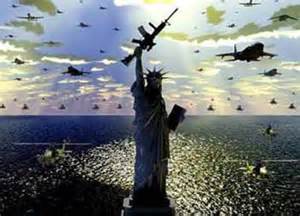
Neoliberalism and The Globalization of War: America’s Hegemonic Project

aa-American-Empire-statue-of-liberty-and-military

By Prof Michel Chossudovsky

Source: GlobalResearch.ca

The world is at a dangerous crossroads.  The United States and its allies have launched a military adventure which threatens the future of humanity. Major military and covert intelligence operations are being undertaken simultaneously in the Middle East, Eastern Europe, sub-Saharan Africa, Central Asia and the Far East. The US-NATO military agenda combines both major theater operations as well as covert actions geared towards destabilizing sovereign states.

America’s hegemonic project is to destabilize and destroy countries through acts of war, covert operations in support of terrorist organizations, regime change and economic warfare. The latter includes the imposition of deadly macro-economic reforms on indebted countries as well the manipulation of financial markets, the engineered  collapse of national currencies, the privatization of State property, the imposition of economic sanctions, the triggering of inflation and black markets.

The economic dimensions of  this military agenda must be clearly understood. War and Globalization are intimately related. These military and intelligence operations are implemented alongside a process of economic and political destabilization targeting specific countries in all major regions of World.

Neoliberalism is an integral part of this foreign policy agenda. It constitutes an all encompassing mechanism of  economic destabilization. Since the 1997 Asian crisis, the IMF-World Bank structural adjustment program (SAP) has evolved towards a broader framework which consists in ultimately undermining national governments’ ability to formulate and implement national economic and social policies.

In turn, the demise of national sovereignty was also facilitated by the instatement of the World Trade Organization (WTO) in 1995, evolving towards the global trading agreements (TTIP and TPP) which (if adopted) would essentially transfer state policy entirely into the hands of corporations. In recent years, neoliberalism has extend its grip from the so-called developing countries to the developed countries of both Eastern and Western Europe. Bankruptcy programs have been set in motion. Island, Portugal, Greece, Ireland, etc, have been the target of  sweeping austerity measures coupled with the privatization of key sectors of the national economy.

The global economic crisis is intimately related to America’s hegemonic agenda. In the US and the EU, a  spiralling defense budget backlashes on the civilian sectors of economic activity. “War is Good for Business”: the powerful financial groups which routinely manipulate stock markets, currency and commodity markets, are also promoting the continuation and escalation of the Middle East war. A worldwide process of impoverishment is an integral part of the New World Order agenda.

Beyond the Globalization of Poverty 

Historically, impoverishment of large sectors of the World population has been engineered through the imposition of IMF-style macro-economic reforms. Yet, in the course of the last 15 years, a new destructive phase has been set in motion. The World has moved beyond the “globalization of poverty”: countries are transformed in open territories,

State institutions collapse, schools and hospitals are closed down, the legal system disintegrates, borders are redefined, broad sectors of economic activity including agriculture and manufacturing are precipitated into bankruptcy,  all of which ultimately leads to a process of social collapse, exclusion and destruction of human life including the outbreak of famines, the displacement of entire populations (refugee crisis).

This “second stage” goes beyond the process of impoverishment instigated in the early 1980s by creditors and international financial institutions. In this regard, mass poverty resulting from macro-economic reform sets the stage of  a process of outright destruction of human life.

In turn, under conditions of widespread unemployment, the costs of labor in developing countries has plummeted. The driving force of the global economy is luxury consumption and the weapons industry.

The New World Order

Broadly speaking, the main corporate actors of the New World Order are

• Wall Street and the Western banking conglomerates including its offshore money laundering facilities, tax havens, hedge funds and secret accounts,

• the Military Industrial Complex regrouping major “defense contractors”, security and mercenary companies, intelligence outfits, on contract to the Pentagon;

• the Anglo-American Oil and Energy Giants,

• The Biotech Conglomerates, which increasingly control agriculture and the food chain;

• Big Pharma,

• The Communication Giants  and Media conglomerates, which constitute the propaganda arm of the New World Order.

There is of course overlap, between Big Pharma and the Weapons industry, the oil conglomerates and Wall Street, etc.

These various corporate entities interact with government bodies, international financial institutions, US intelligence.  The state structure has evolved towards what Peter Dale Scott calls the “Deep State”, integrated by covert intelligence bodies, think tanks, secret councils and consultative bodies, where important New World Order decisions are ultimately reached on behalf of powerful corporate interests.

In turn, intelligence operatives increasingly permeate the United Nations including its specialized agencies, nongovernmental organizations, trade unions, political parties.

What this means is that the executive and legislature constitute a smokescreen, a mechanism for providing political legitimacy to decisions taken by the corporate establishment behind closed doors.

Media Propaganda

The corporate  media, which constitutes the propaganda arm of the New World Order, has a long history whereby intelligence ops oversee the news chain. In turn, the corporate media serves the useful purpose of obfuscating war crimes, of presenting a humanitarian narrative which upholds the legitimacy of politicians in high office.

Acts of war and economic destabilization are granted legitimacy. War is presented as a peace-keeping undertaking.

Both the global economy as well as the political fabric of Western capitalism have become criminalized. The judicial apparatus at a national level as well the various international human rights tribunals and criminal courts serve the useful function of upholding the legitimacy of US-NATO led wars and human rights violations.

Destabilizing Competing Poles of Capitalist Development

There are of course significant divisions and capitalist rivalry within the corporate establishment. In the post Cold War era, the US hegemonic project consists in destabilizing competing poles of capitalist development including China, Russia and Iran as well as countries such as India, Brazil and Argentina.

In recent developments, the US has also exerted pressure on the capitalist structures of the member states of the European Union. Washington exerts influence in the election of heads of State including Germany and France, which are increasingly aligned with Washington.

The monetary dimensions are crucial. The international financial system established under Bretton Woods prevails. The global financial apparatus is dollarized. The powers of money creation are used as a mechanism to appropriate real economy assets. Speculative financial trade has become an instrument of enrichment at the expense of the real economy. Excess corporate profits and multibillion dollar speculative earnings (deposited in tax free corporate charities) are also recycled towards the corporate control of politicians, civil society organizations, not to mention scientists and intellectuals. It’s called corruption, co-optation, fraud.

Latin America: The Transition towards a “Democratic Dictatorship”

In Latin America, the military dictatorships of the 1960s and 1970s have in large part been replaced by US proxy regimes, i.e. a democratic dictatorship has been installed which ensures continuity. At the same time the ruling elites in Latin America have remoulded. They have become increasingly integrated into the logic of global capitalism, requiring an acceptance of the US hegemonic project.

Macro-economic reform has been conducive to the impoverishment of  the entire Latin america region.

In the course of the last 40 years, impoverishment has been triggered by hyperinflation, starting with the 1973 military coup in Chile and the devastating reforms of the 1980s and early 1990s.

The implementation of these deadly economic reforms including sweeping privatization, trade deregulation, etc. is coordinated in liaison with US intelligence ops, including the “Dirty war” and Operation Condor, the Contra insurrection in Nicaragua, etc.

The development of a new and privileged elite integrated into the structures of Western investment and consumerism has emerged. Regime change has been launched against a number of Latin American countries.

Any attempt to introduce reforms which departs from the neoliberal consensus is the object of “dirty tricks” including acts of infiltration, smear campaigns, political assassinations, interference in national elections and covert operations to foment social divisions. This process inevitably requires corruption and cooptation at the highest levels of government as well as within the corporate and financial establishment. In some countries of the region it hinges on the criminalization of the state, the legitimacy of money laundering and the protection of the drug trade.


The above text is an English summary of Prof. Michel Chossudovsky’s Presentation, National Autonomous University of Nicaragua, May 17, 2016. This presentation took place following the granting of a Doctor Honoris Causa in Humanities to Professor Chossudovsky by the National Autonomous University of Nicaragua (UNAN)

Neoliberalism: Serving the Interests of the International Business Elitists

41rnwuTZinL._SX332_BO1204203200_-201x300

By Edward S. Herman

Source: Dissident Voice

Mark Weisbrot, a co-director with Dean Baker of the Center for Economic and Policy Research (CEPR), has written an enlightening book that pulls together many of the analyses that CEPR has been producing over the past several decades. The book, Failed: What the “Experts” Got Wrong about the Global Economy, is important and useful because it provides an alternative framework of analysis to the one used by establishment experts, media and policy-makers. What is more, this alternative framework and description of reality is well supported by empirical evidence and is convincing. It is marginalized in the mainstream because it runs counter to the interests of the powerful, who over the past three decades, have successfully pushed for a neoliberal world order that scales back the earlier welfare state advances and pursues trickle-down economics and the well-being of the affluent.

In fact, an important feature of Weisbrot’s analysis is his recognition of the extent to which policy failures have flowed from biased analyses that serve a small elite and punish the majority, and that policy successes have often followed the loss of power by those serving elite interests. His first chapter is entitled “Troubles in Euroland: When the Cures Worsen the Disease,” whose central theme is that the long crisis and malperformance of Europe’s economies, and especially the weaker ones of Greece, Portugal, Spain and to a lesser extent, Italy, were in large measure the result of poor policy choices. The crisis, which dates back to 2008, was not due to high sovereign debt, which was only threateningly high in Greece, but rather the refusal of the policy-making “troika,” the European Central Bank (ECB), European Community and IMF, to carry out expansionary policies that would allow the poor countries to grow out of their deficit position.

The Fed met the U.S. crisis with an easy money program which, when combined with modest fiscal expansion efforts, quickly mitigated this crisis (although the fiscal actions fell short of what was needed for a full recovery). But the ECB refused to carry out a comparable expansion policy, and there was no Europe-wide fiscal program in the EU system. So the poor countries were forced to depend for recovery on an “internal devaluation” of cutbacks in mainly social budgets, given that external devaluations for individual countries were ruled out by the use of a common currency, the euro. This didn’t do the job, so the eurozone remained in a depressed state, even up to the present.

Weisbrot shows that this policy failure was deliberate, with the troika leaders–mainly the ECB–taking advantage of the weaker countries’ vulnerability to force on them structural and policy changes that served the interests of the international business elite. These changes, including cutbacks on public outlays for education, health care, social security, and poverty alleviation, mainly harmed ordinary citizens. So did the enforced pro-cyclical monetary and fiscal policies themselves, which produced a eurozone crisis of unemployment and foregone output that extended for six years and is still ongoing. Weisbrot points out that this policy and process was a notable application of Naomi Klein’s “shock doctrine,” according to which elites take advantage of painful developments (here macro-distress) to force policy changes that could not be obtained through a democratic process like a national political vote of approval. Weisbrot shows that the troika leaders were quite conscious of the fact that they were pursuing “reforms” that the public wouldn’t support outside of shock conditions.

This process rested on the undemocratic structure of macro-policy-making in the European community. One of neoliberalism’s instruments is an “independent” central bank, where independent means not subject to democratic control. The ECB meets that standard well, more so than the Fed; and in its statute the ECB is only required to meet a price stability objective, so it is free to ignore unemployment and even deliberately increase it. Neoliberal practice is also encouraged by the 1992 Maastricht Treaty, which placed ceilings on the size of budget deficits and total public debt (3 and 60 percent respectively). These unnecessary ceilings are often breached, but provide levers to put pressure on weaker countries.

The countries victimized by the ECB’s pressure for painful internal devaluation could in theory exit from the euro and rely on expansion via currency devaluation and newly feasible monetary and fiscal expansion. But the risks in the cutoff of aid and money market access and the turmoil in any transition are severe, and although Syriza was voted into power in Greece on an anti-austerity program and pledge, it did not see fit to exit. In this connection Weisbrot discusses the case of Argentina, which, in the midst of a calamitous recession in 2001-2002 did default on its large external debt, ended its peg of the peso to the dollar, froze bank deposit accounts, and installed controls over capital movements. This caused immediate chaos and a worsened crisis, but as Weisbrot stresses, after only a single quarter of further GDP decline (5 percent), freed of its externally imposed constraints, Argentina began its recovery, taking three and a half years to regain its pre-recession level of output, but with real growth of some 100 percent over the next 11 years. Greece, which had a peak GDP loss of 25 percent, and which is still mired in a badly depressed economy, could hardly have fared worse than Argentina if it had exited years ago. Whether that option should still be taken is debatable, and Weisbrot discusses the pros and cons without coming to a definite conclusion, but that an exit might well have a positive result is suggested by the Argentinian experience.

A major theme of Failed is the negative impact of neoliberalism on the growth of low and middle-income countries and the welfare of their people. A major chapter on “The Latin American Spring” features evidence that the triumph of neoliberalism in the years from 1980 to the end of the 1990s was a dismal economic and welfare failure, Per capita GDP growth fell from 3.3. percent per year, 1960-1980 to 0.4 percent 1980-2000, rising again to 1.8 percent in the years 2000-2014. The earlier period (1960-1980) was one of widespread government intervention in the interest of rapid economic development; the middle years were dominated by the triumph of neoliberalism, with widespread imposition of structural adjustment programs under IMF and World Bank auspices, lowering trade and investment barriers, and ruthlessly cutting back development and welfare state programs. The years 2000-2014 saw a resurgence of economic growth, but not up to the pre-Reagan years.

Weisbrot shows that the new spurt in economic growth was closely associated with the victory of leftist governments in quite a few Latin American states, starting in 1998, He also presents a great deal of evidence showing that the growth spurt resulted in major improvements in a range of human welfare indicators, like reduced infant mortality, poverty reduction, more widepread schooling, enlarged pensions, and greater income equality. Thus, for example, the Brazilian poverty rate, which had remained virtually unchanged in the eight neoliberal years before the victory of the Workers Party, saw a 55 percent drop in that rate during the years 2002-2013. Similar changes in this and other welfare measures took place in Ecuador, Bolivia and other Latin states that escaped the neoliberal trap. Although these changes brought improved lives and prospects to millions, Weisbrot points out that the U.S. mainstream has played dumb, refusing to feature and reflect on the significance of this widespread improvement in human welfare and its strange efflorescence associated with the decline in U.S. and IMF-World Bank influence in Latin America.

Weisbrot stresses the importance of democratization and policy space in these growth and welfare improvements. The ECB narrowed that policy space in the eurozone, making it difficult for national leaders to expand or otherwise help improve social conditions. This reflected the weakening of democracy in the eurozone, with the ECB, EC and IMF able to make decisions that local democratic governments would not be able to make. Similarly, the loss of power over Latin governments by the U.S. and IMF following the left political triumphs from 1998, and their record of anti-people actions and other policy failures, made for policy space. So also did the rise of China as an economic power, providing a market for Latin products and loans without political conditions. Weisbrot notes that the common orthodox position that the democratic West would be more likely to help poorer countries develop democracies as compared with what authoritarian China would likely do is fallacious. China lends widely without intervening politically. The United States has a long record of support of undemocratic regimes that will serve as its political instruments and/or provide a “favorable climate of investment.” (This writer’s The Real Terror Network was a dossier of U.S. support of National Security States in Latin America and of its active involvement in many counter-revolutionary “regime changes.”)

It is arguable that an unrecognized benefit of the Iraq and Afghanistan wars was their distracting U.S. officials from major efforts to halt the trend toward democratic government in Latin America, although their participation in the attempts at regime change in Venezuela and their successful support of an undemocratic coup in Honduras in 2009 shows that the longstanding anti-democratic policy thrust of the U.S. leadership is not dead. (Mrs. Clinton, of course, fully supported the Honduras coup. So we may see a more energetic pursuit of the traditional U.S. policy of hostility to democracy in Latin America with her election.)

Weisbrot stresses throughout the importance of per capita growth for improving the human condition. A problem with this premise is that the human race may be growing too fast for ecological survival. Weisbrot confronts this issue, arguing that while population growth is a definite negative productivity growth may on balance be a means of coping by increasing food output and lowering the cost of wind turbines, solar panels and other improvements. However, increases in incomes tend to increase the preference for meat, larger houses, and other resource depleters, so that productivity improvements may, on balance, place even more pressure on the environment.

Weisbrot is possibly over-optimistic on this front. But his book is rich in compelling analyses and data that show how the mainstream live in an Alice-In-Wonderland economic world and the important things we may do to escape that Wonderland.


Edward S. Herman is an economist and media analyst with a specialty in corporate and regulatory issues as well as political economy and the media. Read other articles by Edward.

Oligarchs, Bankers, and Swindlers

us-imperialism-latin-america-racism12

Washington’s “New Managers” in Latin America

By James Petras

Source: Dissident Voice

Amid raging corruption, social pathologies and outright political thuggery, a new gang of vassal regimes has taken-over Latin America. The new rulers are strictly recruited as the protégé’s of US financial and banking institutions. Hence the financial press refers to them as the “new managers” – of Wall Street.

The US financial media has once again provided a political cover for the vilest crimes committed by the ‘new managers’ as they launch their offensive against labor and in favor of the foreign and domestic financiers.

To understand the dynamics of the empire’s new vassal managers we will proceed by identifying (1) the illicit power grab (2) the neo-liberal policies they have pursued (3) the impact of their program on the class structure (4) their economic performance and future socio-political perspectives.

Vassals as Managers of Empire

Latin America’s current vassalage elite is of longer and shorter duration.

The regimes of longer duration with a historical legacy of submission, corruption and criminality include Mexico and Colombia where oligarchs , government officials and death squads cohabitate in close association with the US military, business and banking elites.

Over the past decades 100,000 citizens were murdered in Mexico and over 4 million peasants were dispossessed in Colombia. In both regimes over ten million acres of farmland and mining terrain were transferred to US and EU multinationals.

Hundreds of billions of illicit narco earnings were laundered by the Colombian and Mexican oligarchy to their US accounts via private banks.

The current political managers, Peña in Mexico and Santos in Colombia are rapidly de-nationalizing strategic oil and energy sectors, while savaging dynamic social movements – hundreds of students and teachers in Mexico and thousands of peasants and human rights activists in Colombia have been murdered.

The new wave of imperial vassals has seized power throughout most of Latin America with the direct and indirect intervention of the US. In 2009, Honduras President Manuel Zelaya was ousted by a military coup backed by Secretary of State Hillary Clinton. Zelaya’s program of agrarian reform, regional integration (with Venezuela) and constitutional elections was abolished. Zelaya was replaced by a US vassal, Roberto Micheletti who proceeded to murder several hundred landless rural workers and indigenous activists.

Washington moved to organize a constitutional cover by promoting a highly malleable landowner, Porfirio Lobo Sosa to the presidency.

The State Department next ousted Paraguyan President Francisco Lugo who governed between 2008-2012. Lugo promoted a moderate agrarian reform and a centrist regional integration agenda.

With the backing of Secretary of State Clinton, the Paraguayan oligarchy in Congress seized power, fabricated an impeachment decree and ousted President Lugo. He was briefly replaced by Vice President Federico Franco (2012-2013).

In 2013, Washington backed the capital Asuncion’s, notorious crime boss for President, one Horacio Castes – convicted for currency fraud in 1989, drug running in 1990, and most recently (2010) money laundering.

The Honduras and Paraguayan coups established (in miniature) the precedent for a new wave of ‘big country’ political vassals. The State Department moved toward the acceleration of banking takeovers in Brazil, Argentina and Peru.

In rapid succession, between December 2015 and April 2016 vassal managers seized power in Argentina and Brazil. In Argentina millionaire Mauricio Macri ruled by decree, by-passing constitutional legality. Macri fired scores of thousands of public service workers, closed social agencies and appointed judges and prosecutors without Congressional vote. He arbitrarily arrested social movement leaders – violating democratic procedures.

Macri’s Economic and Finance Ministers gained millions of dollars by ‘buying into’ multinational oil companies just prior to handing over private options on public enterprises.

The all-encompassing swindles and fraud carried out by the ‘new managers’ were covered up by the US media,who praised Macri’s professional team.

Moreover, Macri’s economic performance was a disaster. Exorbitant user fees on utilities and transport for consumers and business enterprises, increased three to ten-fold, forcing bankruptcy rates to soar and households to suffer light and gas closures.

Wall Street vulture funds received seven billion dollar payment from Macri’s managers, for defaulted loans purchased for pennies over a dollar, twenty-fold greater then the original lenders.

Data based on standard economic indicators,highlights the worst economic performance in a decade and a half.

Price inflation exceeds 40%; public debt increased by twenty percent in six months. Living standards and employment sharply declined. Growth and investment data was negative. Mismanagement, official corruption, and arbitrary governance did not induce confidence among local small and medium size businesses.

The respectable media, led by the New York Times, the Financial Times, the Wall Street Journal, and the Washington Post falsified every aspect of Macri’s regime. Failed economic policies implemented by bankers turned cabinet ministers were dubbed long-term successes; crude ideologically driven policies promoting foreign investor profiteering were re-invented as business incentives.

Political thugs dismantled and replaced civil service agencies were labelled ‘a new management team’ by the vulgar propaganda scribes of the financial press.

In Brazil, a phony political power grab by Congressional opportunists ousted elected President Dilma Rousseff. She was replaced by a Washinton approved serial swindler and notorious bribe taker, Michel Temer.

The new economic managers were predictably controlled by Wall Street, World Bank and IMF bankers. They rushed measures to slash wages, pensions and other social expenditures, to lower business taxes and privatize the most lucrative public enterprises in transport, infrastructure, landholdings, oil and scores of other activities.

Even as the prostitute press lauded Brazil’s new managers’, prosecutors and judges arrested three newly appointed cabinet ministers for fraud and money laundering. ‘President’ Temer is next in line for prosecution for his role in the mega Petrobras oil contracts scandal for bribes and payola.

The economic agenda by the new managers are not designed to attract new productive investments. Most inflows are short-term speculative ventures. Markets, especially in commodities, show no upward growth, much to the chagrin of the free market technocrats. Industry and commerce are depressed as a result of the decline in consumer credit, employment, and public spending induced by ‘the managers’ austerity policies.

Even as the US and Europe embrace free market austerity, it evokes a continent wide revolt. Nevertheless, Latin America’s wave of vassal regimes remain deeply embedded in decimating the welfare state and pillaging public treasuries led by a narrow elite of bankers and serial swindlers.

Conclusion

As Washington and the prostitute press hail their ‘new managers’ in Latin America, the celebration is abruptly given way to mass rage over corruption and demands for a shift to the political left.

In Brazil, “President” Temer rushes to implement big business measures, as his time in office is limited to weeks not months. His time out of jail is nearing a deadline. His cabinet of ‘technocrats’ prepare their luggage to follow.

Maurico Macri may survive a wave of strikes and protests and finish the year in office. But the plunging economy and pillage of the treasury is leading business to bankruptcy, the middle class to empty bank accounts and the dispossessed to spontaneous mass upheavals.

Washington’s new managers in Latin America cannot cope with an unruly citizenry and a failing free market economy.

Coups have been tried and work for grabbing power but do not establish effective rulership. Political shift to the right are gyrating out of Washington’s orbit and find no new counter-balance in the break-up of the European Union.

Vassal capitalist takeovers in Latin America generated publicist anesthesia and Wall Street euphoria; only to be rudely shocked to reality by economic pathologies.

Washington and Wall Street and their Latin America managers sought a false reality of unrestrained profits and pillaged wealth. The reality principle now forces them to recognize that their failures are inducing rage today and uprisings tomorrow.


James Petras is author of The End of the Republic and the Delusion of Empire, Extractive Imperialism in the Americas: Capitalism’s New Frontier (with Henry Veltmeyer), and The Politics of Empire: The US, Israel and the Middle East. Read other articles by James, or visit James’s website.

After Empowering the 1% and Impoverishing Millions, IMF Admits Neoliberalism a Failure

neoliberalizam

By

Source: CounterPunch

Last week a research wing of the International Monetary Fund came out with a report admitting that neoliberalism has been a failure. The report, entitled, “Neoliberalism: Oversold?” is hopefully a sign of the ideology’s death. They were only about 40 years late. As Naomi Klein tweeted about the report, “So all the billionaires it created are going to give back their money, right?”

Many of the report’s findings which strike to the core of the ideology echo what critics and victims of neoliberalism have been saying for decades.

“Instead of delivering growth,” the report explains that neoliberal policies of austerity and lowered regulation for capital movement have in fact “increased inequality.” This inequality “might itself undercut growth…” As a result, the report states that “policymakers should be more open to redistribution than they are.”

However, the report leaves out a few notable items on neoliberalism’s history and impact.

The IMF suggests neoliberalism has been a failure. But it has worked very well for the global 1%, which was always the IMF and World Bank’s intent. As Oxfam reported earlier this year, the wealthiest 1% in the world now has as much wealth as the rest of the planet’s population combined. (Similarly, investigative journalist Dawn Paley has proven in her book Drug War Capitalism that far from being a failure, the Drug War has been a huge success for Washington and multinational corporations.)

The IMF report cites Chile as a case study for neoliberalism, but never mentions once that the economic vision was applied in the country through the US-backed Augusto Pinochet dictatorship – a major omission which was no casual oversight on the part of the researchers. Across Latin America, neoliberalism and state terror typically went hand in hand.

The fearless Argentine journalist Rodolfo Walsh, in a 1977 Open Letter to the Argentine Military Junta, denounced the oppression of that regime, a dictatorship which orchestrated the murder and disappearance of over 30,000 people.

“These events, which stir the conscience of the civilized world, are not, however, the greatest suffering inflicted on the Argentinean people, nor the worst violation for human rights which you have committed,” Walsh wrote of the torture and killing. “It is in the economic policy of this government where one discovers not only the explanation for the crimes, but a greater atrocity which punishes millions of human beings through planned misery. . . . You only have to walk around greater Buenos Aires for a few hours to check the speed with which such a policy transforms the city into a ‘shantytown’ of ten million people.”

This “planned misery,” as Naomi Klein’s Shock Doctrine vividly demonstrates, was the neoliberal agenda the IMF has pushed for decades.

The day after Walsh mailed the letter to the Junta he was captured by the regime, killed, burned, and dumped into a river, one of neoliberalism’s millions of casualties.


Benjamin Dangl has worked as a journalist throughout Latin America, covering social movements and politics in the region for over a decade. He is the author of the books Dancing with Dynamite: Social Movements and States in Latin America, and The Price of Fire: Resource Wars and Social Movements in Bolivia. Dangl is currently a doctoral candidate in Latin American History at McGill University, and edits UpsideDownWorld.org, a website on activism and politics in Latin America, and TowardFreedom.com, a progressive perspective on world events. Twitter: https://twitter.com/bendangl Email: BenDangl(at)gmail(dot)com

Hillary’s email revelation: France and US killed Qaddafi for his gold and oil

hilary_clinton_laughs_gaddafi_

By Bob Fitrakis

Source: FreePress.org

With the recent release of Hillary Clinton’s emails by Wikileaks, the public now knows exactly how the North Atlantic Treaty Organization (NATO) went from a collective defense organization to the new Barbary Coast Pirates of imperialism.

During the 2011 Libyan uprising, the United Nations Security Council passed Resolution 1973 which called for a ceasefire and authorized military action to protect civilian lives. A coalition formed, centered around NATO with the March 17, 2011 passing of the Resolution. Its purpose — a so-called “no-fly zone” over Libya.

The irony that the U.S.-dominated NATO military organization would be concerned with “protecting” Arab civilians is all too obvious since the United States is the nation most responsible for killing Arab civilians.

The real reasons for the attack have been dealt with most directly by America’s famous reformed “economic hitman,” John Perkins.

Perkins points out that the attack on Libya, like the attack on Iraq, has to do with power and control of resources, not only oil, but gold. Libya has the highest standard of living in Africa. “According to the IMF, Libya’s Central Bank is 100% state owned. The IMF estimates that the bank has nearly 144 tons of gold in its vaults,” Perkins wrote.

NATO went there like modern Barbary Coast Pirates — to loot Libya’s gold. The Russian media, in addition to Perkins, reported that the Pan-Africanist Qaddafi, the former President of the African Union, had been advocating that Africa use the gold so plentiful in Libya and South Africa to create an African currency based on a gold dinar.

“It is significant that in the months running up to the UN resolution that allowed the U.S. and its allies to send troops into Libya, Muammar al-Qaddafi was openly advocating the creation of a new currency that would rival the dollar and the euro. In fact, he called upon African and Muslim nations to join an alliance that would make this new currency, the gold dinar, their primary form of money and foreign exchange. They would sell oil and other resources to the US and the rest of the world only for gold dinars,” Perkins explained.

Revelation in Email to Hillary Clinton

Wikileaks released an unclassified U.S. Department of State document emailed to Hillary dated April 2, 2011, key Clinton aide Sidney Blumenthal confirmed that the Perkins was right and the attack on Libya had nothing to do with Qaddafi being a threat to the United States and NATO and everything to do with looting his gold.

“Qaddafi’s government holds 143 tons of gold, and a similar amount in silver. During late March, 2011, these stocks were moved to Sabha (south west in the direction of the Libyan border with Niger and Chad); taken from the vaults of the Libyan Central Bank in Tripoli,” Blumenthal reported to Clinton.

Blumenthal pointed out the purpose of Qaddafi’s precious metal: “This gold was accumulated prior to the current rebellion and was intended to be used to establish a pan-African currency based on the Libyan golden Dinar. This plan was designed to provide the Francophone African Countries with an alternative to the French franc (CFA).”

Blumenthal spells out the reason for NATO’s attack and France’s imperial plunder, “French intelligence officers discovered this plan shortly after the current rebellion began, and this was one of the factors that influenced President Nicholas Sarkozy’s decision to commit France to the attack on Libya.”

There were five reasons for France’s illegal war with NATO against Libya. Sarkozy sought, according to Blumenthal, “a. A desire to gain a greater share of Libyan oil production, b. Increase French influence in North Africa, c. Improve his internal situation in France, d. Provide the French military with an opportunity to assert its position in the world, e. Address the concern of his advisors over Qaddafi’s long term plans to supplant France as the dominant power in Francophone Africa.”

Under the neo-colonialism favored after World War II during the period of the Cold War, we preferred to bribe various African leaders to help us loot their nation’s resources. The U.S., of course, killed any Pan-African aspirations as well as potential leaders like Patrice Lumumba.

This highjacking of Arab and African resources and slaughtering of Arab civilians is a long-standing plan put forth by neo-conservatives in the United States. The Project for a New American Century (PNAC) has had a “hit list” of Arab nations and little regard for Arab casualties.

General Wesley Clark wrote in “Winning Modern Wars” that “As I went back through the Pentagon in November 2001, one of the senior military staff officers had time for a chat. Yes, we are still on track for going against Iraq, he said. But there was more. This was being discussed as part of a five-year campaign plan, he said, and there was a total of seven countries beginning with Iraq, then Syria, Lebanon, Libya, Iran, Somalia, and Sudan.

What we witnessed in Libya was old-fashioned 19th century imperialism — the deliberate plundering of a sovereign nation-state’s resources by more powerful Western conquistadors.

Link to Wikileaks article