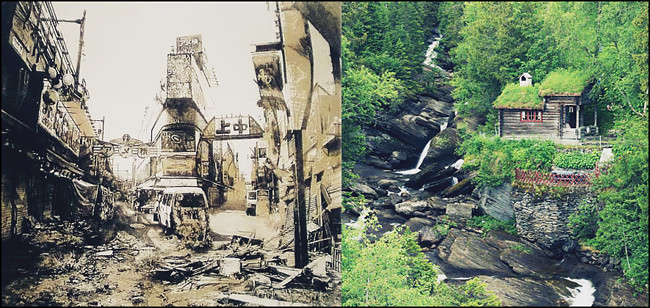
TEMPLATE FOR A TRANSFORMATION OF HUMAN SOCIETY

By Julian Rose

Source: Waking Times

There are many thousands of groups that have formed themselves around the need to stand against the globalist attack on life on earth. There are thousands more presenting alternative vision/suggestions for a better future. And there are a small number who are doing both; declaring that one must commit to stopping the worst while simultaneously nurturing into life a new template for human and ecological emancipation.

It is the latter action which I subscribe to, because it strikes me that we have no choice other than to fight-off the most immediate threats to our fundamental life values; yet equally have no choice other than to recognise the obvious shortcomings of the day to day way of life that constitutes the accepted norm of most post industrial societies today.

Given this state of affairs, one finds oneself committed to taking a deeper look into both the causal factors behind the degradation of human values and what will form the key ingredients of a new society. That which emerges out of the darkness and leads the way beyond repetitions of the divisive trends destroying humanity’s integrity.

Quite recently I came across the term ‘Truth Movement’ and discovered that it stands for a broadly connected body of individuals all having a similar goal: the defeat of the globalists. This seemed to hark back to the term ‘truthers’ as applied to those ready to expose the 9/11 fraud.

What, I asked myself, would this ‘Truth Movement’ do if it were to actually succeed in fulfilling its ambition?

What would ensure that such a movement did not implode once faced by the responsibility for building a future purged of the ‘rotten apple’ factors that so often bring-down otherwise promising movements and visions?

By ‘rotten apple’ factor, I mean the tendency for jealousy, excessive ego, lack of importance given to trust, power complexes, political ambition and – I would add – the group psychology of demanding ‘consensus’ in decision making, thereby pulling down individual aspirations and ending-up with abdication to the lowest common denominator as the only way ‘to keep the peace’.

Within socio-economic structures which largely reject the notion of ‘leadership by the wise’, a palpable void opens-up when important/controversial decisions have to be taken which require more than a superficial five sense appraisal of the way forward.

When our Truth Movement is confronted by the need to decide the composition of ‘the new template for the new society’ it is to usher into reality, many different convictions are likely to be put forward.

For example: an end to racial discrimination; the common ownership of land; the dissolution of the banking industry and widespread redistribution of wealth; no more ‘government’; the rise of ‘rule by the people’; free green energy for all; organic food and farming being adopted as the prime means of food production.

So as to bring the dilemma presented by this situation to life in a ‘real time’ way, I’m going to paint my envisioned picture of how events might unfold.

As ideas pour in, a committee is established to find a pragmatic way to turn these ideals into political reality. A reality which reflects the broad banner heading ‘Truth Movement’, whose idealistic rhetoric has finally garnered enough support to overcome the long dominant globalist control system.

On this committee are the leading proponents of the various ideals deemed most essential for laying the foundation of the promised New Society.

However, the daunting task of turning this pool of individual potential into a unified body of pragmatic ground-breakers,  leads to the realisation that some critically important ingredients have been neglected. Internal frictions start to come to the surface causing fractures in the once seeming unity.

Disagreements eventually come to a head and in a highly revealing and heated exchange, it emerges that the deeper significance of the word ‘truth’ has never been explored or even debated. Never understood as primarily a spiritual value, an inner commitment to the evolution of higher values, not just to outer changes in the functioning of society.

In an attempt to prevent the situation deteriorating into chaos, a respected analyst is brought to the table to put a few fundamental questions to the committee leaders:

How aligned are you in your personal lives with what you call upon others to do in order to solve the crisis in values you see around you?

How truthful are you to yourselves and to others, if you don’t consider it important to lead by example – but nevertheless expect others to live the changes you claim must be brought-about?

How committed are you to raising your own levels of consciousness? To gaining a higher level of awareness concerning your own ambitions and shortcomings?

Are you actually committed to ‘a path of truth’ in your own lives? To following disciplines that quieten the ego and develop your relationship with the deeper spiritual values that are, in practice, the only real expression of truth?

How determined are you not to be a hypocrite? To avoid turning-out like the very politicians you so readily condemn?

As leaders of ‘the truth movement’ can you honestly say that you are committed to uphold the highest standards of responsibility, integrity and trust in your dealings with others?

What specific qualities are necessary in order to lead your supporters wisely, honestly and effectively?

Faced by this penetrating examination, the room became strangely quiet.

Being asked to address an inner commitment to truth, as opposed to its relatively surface oriented outer manifestation, has led to the need for a traumatic reappraisal of ‘the order of values’. And has called for a new level of consciousness to be put at the very top of the agenda of what is most essential for the building of the new society.

I tell this tale so as to highlight the task which stands in front of all of us, as ‘activists’ and campaigners for a better world. For should the neo-liberal control system collapse or even be finally defeated, we will find ourselves at the forefront of a global situation in which the great majority are subjected to an uncharted sense of insecurity and loss of direction.

A life of slavery to task masters carries with it a kind of insurance policy of not having to deal with – or be responsible to – the wider world or one’s own inner quest for liberation.

Suddenly, or relatively suddenly, being placed in a position where the expectation of the majority is for those most vocal in exposing the wrong – to now step forward and establish ‘the right’- presents a formidable challenge.

At the centre of this challenge is a burning question which we should all be addressing now rather than waiting until the hour of need is thrust upon us.

The question centres around a very fundamental precept: is the decision making process – essential to establishing the new desired template – to be based on ‘leadership by the wise’ or by ‘group consensus’?

By a ‘committee of the wise and the good’ or by a continuation of ‘democratic representative governance’ and quasi-consensus decision making?

To put it a little more bluntly: a benign, wise dictatorship or an elected common denominator form of governance which has no base in wisdom or vision and which is very easily exploited by the power hungry?

Within the constitution of the British Isles and many other countries, there exists something called Natural Law/Common Law, which goes back a long way.

It states that there is only one indomitable law and that is the law of God. God’s law. A form of decree based upon universal truth and justice, founded upon the supreme wisdom of our Creator.

In a world overcome by rank injustice, the complete absence of truth, and no sign of wisdom, Common/Natural Law shines out as the light at the end of a very dark tunnel.

The emergence of an earthly law that reflects universal law can only be brought forward by a committee of the wise and true. Indeed, God’s laws can be described as emanating from ‘the Supreme Benign Dictator.’

At the most basic level, they are reflected in the laws of nature and the predilection for an ever expanding biodiversity of plant, animal and insect life.

At the human level, they represent the (age old) quest for truth, love and full emancipation of the soul of man. Even when individuals do not consciously know it,  this is what all are longing for – and now is the time to go public about it.

We have passed the point of no return for ‘democracy’ or anything resembling it, so we may choose to call what will really open our minds and hearts: a ‘Veritocracy’.

Veritocracy from ‘veritas’ the Latin for truth. ‘Way of Truth’.

Going face to face with a cult regime based on darkness and division, demands a steadfast commitment to the opposite. Truth, as the unrestrained manifestation of the call of our souls.

This is the one force that will disintegrate the forces of darkness and disempower the globalist control system, once and for all.

It is the one force that can unite all of humanity and provide the dynamic foundation for true leadership and true trusteeship of the planet.

Let us commit now. Let us be properly prepared to lead the world beyond ruination and into rebirth.

QUESTIONS OF OUR TIME – TIME NOW TO GET BACK TO OURSELVES?

By Kingsley L. Dennis

Source: Waking Times

‘And the Old Ones say:

look outward seriously
look inward intently
look outward carefully
look inward diligently
look outward respectfully
look inward humbly’

Jack Forbes

As human beings we seek the beautiful, and this gives us joy. But our lives have made everything complicated. We make ourselves complicated – life is being played around us like a game. This may not sound comfortable, or even correct, to some people. If it’s a game, then why is there so much sorrow and pain? This is the perennial question. Yet like a game, we have choices, and we make our moves. And there are players and gameplays going on all around us. And it seems that the game is rigged. One person who knew this well was Alan Watts. He often spoke about how life should not be lived as a fast journey and that existence in the universe should be recognized as being basically playful. Life is more like music, Watts used to say. And we play music – we don’t ‘work’ music. And in music, the end of the composition is not the point of the composition; otherwise, all conductors would play fast; or some composers would choose only to write the finales. We don’t go to concerts just to hear the final chord being played. We don’t engage in a dance in order to end it (unless we got tricked into it!). And yet, as Alan Watts was so keen in observing, our social systems condition us into grading our lives. Our schooling compels us into chasing grades and making our quotas and then paying our bills. And we keep believing, hoping, wishing, for the ‘great thing’ in life to come whilst we are rushing through our lives with hardly a notice of what we’re leaving behind in our rear-view mirrors. We end up living to retire. And when we retire, we imagine we have ‘finally arrived.’ And yet to where? Do we feel any different? We have a small pot of savings and almost no energy. And then we are told to wait it out. Until what? When? The final curtain? Perhaps only when it is too late do we realize that we were cheated down the whole line. And yet we followed it. We kept racing along in order to keep up or to hold onto what we were told was success. And yet – was it ever ‘our’ success? Did we miss the whole point?

Being human is about trying to create meaning for ourselves – and to enjoy it as much as possible along the way. The life we have is where we have arrived by ourselves and the steps and choices we made. We should not let ‘another mind’ make those choices for us. And most of all, we should not allow ourselves to be played for victims. We may be under the sway of other forces, yet only to the point that we are ignorant of them. Our power comes through recognizing and identifying those other forces that seek to influence and control our thoughts and actions. We need to optimize our lives by optimizing our perspective and understanding. Ignorance may seem to be a social requirement yet knowledge, understanding, creativity, and wisdom are the truer imperatives. Despite what may appear to the contrary at times, there is incredible capacity for goodness within the human race.

The majority of people in the world are good people. They wish for peace and to not do harm to others. There are many sympathetic, caring, and courageous people in the world. Unfortunately, our systems are run by the minority, and these systems are largely corrupt; and the decent people within these systems become corrupted by association or exposure. The main issue is that most of us do not look after our minds. We don’t think it is necessary. We are not aware of the malicious impacts that infiltrate and influence us on an almost daily basis. This unawareness – or ignorance – leaves people open and vulnerable. Many people have become alienated from their own minds. This is where manipulations creep in, such as mob mentality and crowd behavior. Only a large body of people with ‘alienated minds’ can become so influenced by political propaganda, consumerist advertising, and social management. Mass psychosis is only possible through a collective mindset that has become alienated from a transcendental source. In this state, we are prisoners to the impulses that steer our unconscious. We are susceptible to neuroses and psychic illness. We may believe we have freedom when we do not. The forces of bondage are subtle and often insidious. It is a necessity that human civilization returns to the fundamental recognition of the person as a human being.

Being human is about being simple. Or rather, it is about recognizing the essential things. Yet this is no simple thing to do. We are needing to get back to ourselves in so many ways. To begin, we must learn not to take things personally. There are so many ways that life attempts to get us to engage with external strife. It tries to pull us out of ourselves. When, for example, we are criticized or insulted we tend to lash out. We are conditioned to attack in order to defend. Is not a well-known aphorism, ‘Attack is the best line of defense?’ Sometimes this is phrased as – the best defense is a good offense. Yet long before these catchy phrases got circulated through our systems there was a better truism: turn the other cheek. Retaliation feeds the psychosis within the individual and the collective. If we give away our emotional and psychic energy, then we also give away our freedom. The ego must be reined in, yet not abolished. It is through the form of the ego that we can find the realm of the essential self. The ego exists as a signpost that the essential inner self is also there. As Buddhist monk Thich Nhat Hanh says – ‘If love exists, there are other things that exist also. There is ignorance, there is violence, there is craving.’ These external ‘other things’ – the violence and the suffering – can be, and are, manipulated and exacerbated. Yet the essential inner self remains as a pure, undiluted and uncorrupted form. We should allow it to speak to us and manifest in our lives. This is the human question.

Morality and meaning only have significance when they come from a genuine source. Otherwise it is a ‘projected’ form, created from social mores and cultural biases. We are the ultimate touchstone for our sense of reality. We need to have a clean lens and clear vision. And we should begin from the basics – the simple human things. There is a story which tells of a spiritual seeker who after some time comes upon a spiritual master that she feels is genuine and whom she wishes to learn from. The seeker asks the master if he will accept her as a pupil.

‘Why do you seek a spiritual path?’ asks the teacher.

‘Because I wish to be a generous and virtuous person; I wish to be balanced, mindful, caring, and to be in service for humanity. This is my goal’ said the seeker.

‘Well,’ replied the teacher, ‘these are not goals on the spiritual path; these are the very basics of being human which we need before we even begin to learn.’

What people may consider to be ‘spiritual’ is often none other than necessary human nutrition – a daily requirement for living. Yet like our other nutrition, eating, it has to be correctly integrated into our lives without making a song and dance about it. And, of course, not forgetting the saying that goes – ‘If you insist on buying poor food, you must be prepared to dislike it at the serving.’

It often feels like we spend our days trying to grasp at life, trying to understand it, with ways that are not adequate. It is like trying to capture the ocean with a bucket. The ocean stands magnificently before us, and yet our modern societies teach us to run through our lives anxiously as if with empty buckets in our hands. Personal fulfilment is not only about accomplishment; it is also a question of what we can give through each of our individual imperfections.

Here is a story that helps to illustrate this:

A man had two large pots, each hung on an end of a pole which he carried across his neck. One of the pots had a crack in it, and while the other pot was perfect and always delivered a full portion of water at the end of the long walk from the stream to his house, the cracked pot arrived only half full.

For a full two years this went on daily, with the man delivering only one and a half pots full of water to his house. Of course, the perfect pot was proud of its accomplishments, feeling accepted and appreciated. But the poor cracked pot was ashamed of its own imperfection, and miserable that it was able to accomplish only half of what it had been made to do. After two years of what it perceived to be a bitter failure, it spoke to the man one day by the stream.

“I am ashamed of myself, and I want to apologize to you.”

“Why?” asked the man. “What are you ashamed of?”

“I have been able, for these past two years, to deliver only half my load because this crack in my side causes water to leak out all the way back to your house. Because of my flaws, you have to do all of this work, and you don’t get full value from your efforts,” the pot said.

The man felt sorry for the old cracked pot, and in his compassion, he said, “As we return to my house, I want you to look at the beautiful flowers along the path. It will make you feel better.”

Indeed, as they went up the hill, the old cracked pot took notice of the sun warming the beautiful wild flowers on the side of the path, and this made it feel a little happier. But at the end of the path, it still felt bad because it had leaked out half its load, and so again the Pot apologized to the man for its failure.

The man said to the pot, “Did you notice that there were flowers only on your side of your path, but not on the other pot’s side? That’s because I have always known about your flaw, and I took advantage of it. I planted flower seeds on your side of the path, and every day while we walk back from the stream, you’ve been watering them. For two years I have been able to pick these beautiful flowers to take home to my wife. With you being just the way you are, you have given beauty and meaning to me every day.”

Philosophy cannot resolve the question ‘How should we live?’

By Dave Ellis

Source: aeon

The question How should we live? is one that many ask in a crisis, jolted out of normal patterns of life. But that question is not always a simple request for a straightforward answer, as if we could somehow read off the ‘correct’ answer from the world.

This sort of question can be like a pain that requires a response that soothes as much as it resolves. It is not obvious that academic philosophy can address such a question adequately. As the Australian philosopher Raimond Gaita has suggested, such a question emerges from deep within us all, from our humanity, and, as such, we share a common calling in coming to an answer. Academia often misses the point here, ignoring the depth, and responding as if problems about the meaning of life were logical puzzles, to be dissolved or dismissed as not real problems, or solved in a single way for all time. True, at various times philosophers such as Gilbert Ryle and more recently Mikel Burley have called for a revision of academia’s approach towards these sorts of questions, for a ‘thickened’ or expanded conception. But, while improving our awareness of their complexity and diversity, such approaches still fail to address the depth that their human origin provides.

The presence of a humanness, or a depth, to these sorts of questions comes not just from the context in which they’re asked, but also from their origin, their speaker. They are real questions for real people, and shouldn’t be dismissed with a logical flourish or treated like an interesting topic for a seminar. I would laugh if I heard a computer ask How should we live? after beating it at chess, but I would cry to hear a wife ask her husband, on the death of their son, How should we live? Although the same words have been uttered, these questions have a different form: the mother’s question contains a qualitative depth, a humanness that isn’t there in the computer’s question. We must acknowledge this if we want to find an answer to the specific question she asked with such poignancy.

The computer is a thing that cannot meaningfully ask those sorts of questions; in contrast, it’s offensive to call a person a ‘thing’. Only a human can ask that sort of question within this sort of context. We would hear the mother’s words and say that they contain a depth that’s revealing something perhaps previously hidden about herself; the computer’s question isn’t even said to be shallow. It seems to have nothing of that sort to reveal about itself whatsoever, like a parrot repeating the words it has been taught without the complexity of the human context that gives them their usual meaning. This isn’t to say that computers won’t one day be intelligent, ‘conscious’ or ‘sentient’, or that human language is ‘private’; it’s closer to the Wittgensteinian remark that: ‘If a lion could talk, we could not understand him.’

This means that the form that a language takes reflects the complex social context of the life of the speaker, and the degree to which I share a similar form of life with the speaker is the same degree to which I can meaningfully understand the utterance. The ‘life’ of the computer, we suppose, is either one-dimensional due to it lacking depth or, even if it has depth, it would be uncommunicable through human language, because, simply put, we and they differ so much. The humanness that provides the depth to our language is simply inaccessible to silicon chips and copper wires, and vice versa.

This depth to the human condition is part of what we mean when we speak of our humanity, spirit or soul, and anyone who wishes to question or explore this aspect of the human condition must do so in a form of language that can access and replicate its depth. We call those sorts of languages spiritual. But this way of speaking shouldn’t be taken literally. It doesn’t mean that spirits, souls and God exist, or that we must believe in their literal existence in order to use this sort of language.

Questions about the meaning of life and others of a similar kind are often misconstrued by those too ready to think of them as straightforward requests for an objective true answer.

Consider, for example, what atheists mean by ‘soul’ when they refute the cognitive proposition that asserts the literal existence of souls, in comparison with what I mean when I describe slavery as soul-destroying. If atheists were to argue that slavery cannot be soul-destroying because souls don’t exist, then I would say that there’s a meaning here that’s lost on them by being overly literal. If the statement ‘Slavery is soul-destroying’ is forced into a purely cognitive form, then not only does it misrepresent what I mean to say, it actively prevents me from ever saying it. I want to express something that represents the depth of the sort of experience I’m having: this isn’t a matter of making an implied statement about whether or not souls exist – it’s not affected by the literal existence or non-existence of souls. This sort of meaning to spiritual language is found at a different dimension to where cognitivists look, irrespective of their atheism, and this is achieved through our capacity to embed a dimension of depth to the form of our language through the non-cognitive process of expressing, describing and evoking our sense of humanity within one another.

When considering how to answer the question How should we live?, we should first reflect on how it is being asked – is it a cognitive question looking for a literal matter-of-fact answer, or is it also in part a non-cognitive spiritual remark in answer to a particular human, and particularly human, situation? This question, so often asked by us in times of crisis and despair, or love and joy, expresses and indeed defines our sense of humanity.

The Elite’s COVID-19 Coup: Fighting for our Humanity, Our Liberty and Our Future

By Robert J. Burrowes

We are being utterly transformed. And the world is being utterly transformed around us.

Ostensibly, this is to tackle a simple virus. In reality, it is to achieve an elite design at staggering cost to humanity and to life generally.

If you have not been carefully following what is taking place, let me highlight some recent developments and what we can do about them.

On 26 March 2020, the World Intellectual Property Organisation (WIPO) granted Microsoft a world patent. Titled ‘1. WO2020060606 – Cryptocurrency System Using Body Activity Data’, this patent gives Microsoft (that is, Bill Gates) extraordinary power over our lives.

As Professor Vandana Shiva evocatively explains in her latest article, ‘My Earth Journey in defence of Biodiversity, Life and Freedom over 5 decades’, this development is ‘robbing us of our deep humanity’:

The patent is dramatically changing the meaning of being human.

Firstly, it is redefining us as ‘mines’ for data – robbing us of our autonomy, our sovereignty, and control over our bodies and minds…. And just being connected through their ‘server’ is giving consent….

Secondly, it is erasing our humanity – as sovereign, living beings, spiritual, conscious, intelligent beings, making our decisions and choices with wisdom and ethical values about the impacts of our actions on the natural and social world of which we are a part; and to which we are inextricably related. We are being reduced to being ‘users’ of tasks assigned to us by the extractive digital mega machine. A ‘user’ is a consumer without choice in the digital empire. Human creativity and consciousness disappear in the world imagined in #patent060606.

Thirdly, the patent is redefining human values, and the value of being human. Human values include ethical, ecological, spiritual values….

Patent 060606 is aimed at robbing us of our deep humanity. We are being transformed from self organised, conscious, creative, autopoetic beings, into external input “users” whose value will be assigned in cryptocurrency through algorithms, by the very machine that gave us the task in the first place.

But it is not just our humanity that is at stake, horrific though this may be. The world, too, is being transformed so that the humanoids who are not killed off or marginalized into extreme poverty and desperation will perform their assigned roles to serve the global elite within the new techno tyranny that is being created around us.

For just a taste of the evidence in this regard, see ‘Global Capitalism, “World Government” and the Corona Crisis’, The Farce and Diabolical Agenda of A “Universal Lockdown” and Techno-Tyranny: How The US National Security State Is Using Coronavirus To Fulfill An Orwellian Vision.

And if you would like greater insight into the role that individuals like Bill Gates are playing in all of this, see these three recent documentaries produced by James Corbett: ‘How Bill Gates Monopolized Global Health’, ‘Bill Gates’ Plan to Vaccinate the World’ and ‘Bill Gates and the Population Control Grid’. In addition, this article by Robert F. Kennedy Jr. is instructive: ‘Gates’ Globalist Vaccine Agenda: A Win-Win for Pharma and Mandatory Vaccination’.

Given the monumental undertaking for global control that this represents, you might wonder how this transformation can be achieved. And, unfortunately, the answer is ‘very simply’. This is because the bulk of the human population has been terrorized into a state of being submissively obedient. And this state is effectively permanent. As a result, mobilizing strategic resistance to what is happening is very difficult.

Why do I write this?

Because the evidence that COVID-19 is a minor health risk, particularly if dealt with appropriately, is overwhelming and extensively documented: ‘According to data from the best-studied countries and regions, the lethality of Covid19 is on average about 0.2%, which is in the range of a severe influenza (flu) and about twenty times lower than originally assumed by the WHO.’ See ‘A Swiss Doctor on Covid-19’.

Having noted that, however, if you want to watch a thoughtful and detailed explanation of why COVID-19 is a ‘fake virus’, try watching molecular biologist Dr Andrew Kaufman’s two hour interview by Brian Rose: ‘Unmasking the Lies Around COVID-19: Facts vs Fiction of the Coronavirus Pandemic’. In this interview, Dr Kaufman carefully explains:

The scientific procedures that have been utilized in all of these scientific studies… it wouldn’t be possible using those techniques to isolate the virus and purify it and prove that it exists…. Taking into account all of the evidence I have looked at which has been almost entirely from peer-reviewed scientific papers and official government websites, my opinion is that this entire pandemic is a completely manufactured crisis. In other words there is no evidence of anyone dying from any novel illness…. And so what I think is going on… is in line with what might be known as a globalist agenda…. All of these things seem to be moving towards control of the people. 

There is not very much about vaccines that makes a lot of sense because if you actually go back and look for the evidence that vaccines have prevented disease you are not going to find any…. Smallpox is an interesting example…. In the mainstream history books the smallpox vaccine has been touted as a major success but that’s not really accurate. If you go back and look at data from the Royal Academy of Sciences what you will see is that the mortality increased substantially while these vaccines were widely used and then when they stopped being used the numbers went back down again. 

So it is really difficult to trust what is in a general textbook or mainstream history book without going and looking at the actual data yourself because all of the textbooks that were in medical schools say that vaccines are responsible for preventing many of these major illnesses that people were suffering from and worried about in the first part of the twentieth century. But if you look at some of the same diseases that did not have a vaccine, such as scarlet fever for example, you will find that scarlet fever also went away with all of the other diseases even though there was no vaccine for it. 

And when you look at the number of cases of the various illnesses like polio or measles or diphtheria, you’ll see that the prevalence or incidence of those diseases and mortality from those diseases, which in some was substantial, went down almost to the current levels before a vaccine was even available for use so you couldn’t possibly attribute a vaccine for causing that reduction in the illness if it wasn’t even around at the time that the illness was reduced….

If you create a vaccine for an illness [such as COVID-19] that has not been proven to even exist, then the vaccine couldn’t possibly work. But if you do a clinical study and have an imaginary disease and give the vaccine to people and then they never get the imaginary disease it would give the appearance that its very successful.

So this is a real win-win strategy for anyone making these vaccines and which is why there have been companies all over the world racing to be the first one to have a vaccine that’s been proven to be safe or effective using the limited criteria that they require. Because whoever gets there first, according to the plans or proposed policies, they’re going to be selling billions of vaccines. Billions! So they’re going to make billions of dollars as a result of this. So there is such a strong financial incentive.

Some of the technological strategies that they are using to make these vaccines are quite scary and unprecedented…. But obviously it couldn’t prevent a disease that doesn’t exist so there must be some other purpose for it.

Remember, the words quoted above are taken from a two hour interview. If any of these words leave you wondering, watch the interview to consider the evidence that Dr Kaufman cites or check his website: Dr Andrew Kaufman.

In another video Dr Kaufman explains how early scientific papers on the subject suggested an association (not causation) between a novel coronavirus ‘with human to human transmission and severe human infection’ whereas a subsequent key ‘scientific’ paper that made a claim which helped drive the global response to COVID-19 ‘flat out lied’ about their results: ‘Following the first outbreaks of unexplained pneumonia in Wuhan, China, in late 2019, a new coronavirus was identified as the causative agent in January 2020.’ See ‘Identification of Coronavirus Isolated from a Patient in Korea with COVID-19’. In fact, Dr Kaufman points out: ‘they cannot reference any science to back that up whatsoever’. Moreover, subsequently to this paper, another article – see ‘I study viruses: How our team isolated the new coronavirus to fight the global pandemic’ – declared ‘The emergence of a new coronavirus in a market in Wuhan, China, in December 2019 set in motion the pandemic we are now witnessing in 160 countries around the world’. But again, Dr Kaufman counters, ‘no evidence was provided at all’ to support this claim: ‘just flat out lies’. For the details and citation of all the scientific sources for this explanation of how the COVID-19 ‘rumour mill’ got started, see ‘The Rooster in the River of Rats’.

If you wish to watch a more scientifically-oriented lecture, explaining more of the technical detail of what Dr Kaufman argues ‘is really going on’ and which is consistent with the evidence, then you can view it here: ‘Special Report: Humanity is NOT a virus!’

So while the evidence that there is neither a virus nor a pandemic is grounded firmly in the science, the evidence that the global elite is using COVID-19 as ‘cover’ to implement its coup against humanity is rather overwhelming. In addition to the articles cited above, see these two articles which cite many other extensively-documented sources as well: ‘The Elite’s COVID-19 Coup Against a Terrified Humanity: Resisting Powerfully’ and ‘COVID-19: Breaking the Lockdown, Defeating the Coup, Averting Extinction’.

But while this evidence is readily available, it requires someone who has not lost the capacity to investigate and think for themself. And that is a huge problem.

Of course, little of the evidence in these regards is available through education systems or the corporate media, given that the purpose of these institutions is to serve elite interests. And controlling access to, and manipulating perception of, the evidence is vital in both regards.

So if, for example, you believe that the corporate media is reporting the ‘news’, you might like to reflect on these words of David Rockefeller spoken at the highly secretive elite Bilderberg meeting held in Germany in 1991 but subsequently leaked:

‘We are grateful to The Washington Post, The New York Times, Time Magazine and other publications whose directors have attended our meetings and respected their promises of discretion for almost 40 years. It would have been impossible for us to develop our plan for the world if we had been subject to the bright lights of publicity. But the world is now more sophisticated and prepared to march towards a world government…. The supranational sovereignty of an intellectual elite and world bankers is surely preferable to the national auto-determination practiced in past centuries.’ See ‘David Rockefeller at Bilderberg meeting in Baden 1991’ and ‘David Rockefeller’s Chilling 1991 Speech at a Bilderberg Meeting’.

The motto of The Washington Post is ‘Democracy Dies in Darkness’. What it does not proclaim is that the Post, along with the other corporate media outlets, has long played its part in the global elite’s program to ensure that democracy – and hence any meaningful role in how we are governed – cannot flourish. But for a detailed critique of the corporate media exposing its role in perpetrating elite power by distributing elite propaganda as ‘news’, see Manufacturing Consent: The Political Economy of the Mass Media.

Hence, while increasing numbers of people are lamenting the submissive response to elite initiatives to imprison us in our own homes (and strip us of rights and freedoms that it took centuries to win) – see, for example, ‘A Nation of Sheep’ and ‘To All Cowards Who Meekly Succumbed To the Unlawful Lockdown… Hang Your Heads In Shame’ – and some authors have written commentaries illustrating and explaining the ways in which people’s fear is manifesting in response to a simple virus – see Dr. Rudolf Hänsel’s explanation in ‘The Diabolical “Game” with Fear as an Instrument of Domination. The Reflex of Obedience’ and Dr. Pascal Sacré’s thoughts in ‘COVID-19: An Ocean of Fears and Lies’my own interest lies in explaining why people are fearfully and submissively obedient in the first place and how we can go about restoring agency to the individual’s life so that they can use their own investigatory and analytical capacities to track down and consider the evidence, and to then act sensibly and powerfully in response.

While, regrettably, this cannot be done quickly, it is an essential component of any strategy to effectively resist elite encroachments on our rights, freedoms and economic security while also acting powerfully to deal with the genuine threats to human survival such as those posed by war, the environmental and climate catastrophes, biodiversity loss and the deployment of 5G, among others. See ‘Human Extinction Now Imminent and Inevitable? A Report on the State of Planet Earth’ and, for astute insight into the disastrous impact that the global industrial shutdown is having on the aerosol masking effect and hence the global climate, see ‘Will COVID-19 Trigger Extinction of All Life on Earth?’

This is because fear suppresses (other) emotional responses (including the anger that would mobilize resistance), distorts sensory perception (so that people disbelieve, rather than consider carefully, evidence that contradicts the elite-driven narrative), inhibits analytical capacity, falsifies memory (to conform with explanations that are less frightening) and thwarts powerful behavioural responses. As a consequence of being victims of their own fear, most people live in a world of delusion and projection and are quite incapable of being anything but submissively obedient.

In brief, fear makes people want to believe, and hence to actually believe, that there is ‘nothing wrong’ with elite directives distributed by international organizations (such as the World Health Organisation), governments, the medical industry, education systems and the corporate media. This means that they do not have to feel and think for themselves, consult their conscience or change their own behaviour, each of which is particularly frightening when their fear and the (unconscious) imperative to obey already have them paralyzed.

So how have we ended up with a population of ‘individuals’ who are so devoid of any sense of Selfhood that they are submissively obedient as Drs Hänsel and Sacré discussed above and which we are now witnessing on a global scale as people are imprisoned in their own homes?

Fundamentally, this has occurred because our parenting and education models are based on terrorizing children into obedience using a combination of ‘visible’, ‘invisible’ and ‘utterly invisible’ violence. For the details of how we do this, see ‘Why Violence?’, ‘Fearless Psychology and Fearful Psychology: Principles and Practice’ and ‘Do We Want School or Education?’

Hence, while we pay lip service to the notion of ‘the individual’, the reality is that we prefer ‘individuals’ who follow the orders of ‘the authorities’, whether at home, school, work, in the military, at a religious gathering or as ‘citizens’ in society generally. After all, our definition of ‘individuality’ long ago ceased to mean any more than that the person clothes themself differently and has their own combination of interests to while away their spare time.

The genuine individual who has an integrated mind, trusts their own (emotional and intellectual) judgment, articulates the truth and behaves powerfully in accord with their conscience, whatever the cost, is only supposed to appear as a fictional character in novels or films. We certainly do not want them in real life. Just ask Mahatma Gandhi, Dr Martin Luther King Jr, Julian Assange and Chelsea Manning, for example. Shot dead or imprisoned for having the qualities of a genuine individual.

For further explanations of how we systematically destroy the individuality in our children, see ‘The Disintegrated Mind: The Greatest Threat to Human Survival on Earth’, ‘Most Attitudes and Beliefs are Outcomes of Fear’ and ‘The Psychology of Projection in Conflict’.

So here we are at the most important moment in human history. At the brink of precipitating our own extinction – again, see ‘Human Extinction Now Imminent and Inevitable? A Report on the State of Planet Earth’ and ‘Will COVID-19 Trigger Extinction of All Life on Earth?’ – and now imprisoned in our own homes (for those who have them) while the global elite implements more of its plan to reduce us from human individuals to digital identities that are readily tracked and controlled while playing our robotic role in the techno tyranny that is almost upon us.

Even those two writers of the classic dystopian novels of the twentieth century, Aldous Huxley and George Orwell, would be horrified that we participated so obediently, so submissively, in the destruction of our ‘free’ world (whatever its limitations). And I doubt they would get any solace from knowing just how well they truly understood the terrified and submissive nature of the human condition.

So with virtually everyone ‘distracted’ from the ‘main game’ – the coup in which the global elite is taking vastly greater control of our lives and even dramatically increasing the risk of imminent human extinction – while we sit back, or even ask for, greater restrictions on our rights and freedoms, the only important question remaining is this:

Can we mobilize sufficient people, even at this late moment, to strategically defend our humanity, defeat the elite coup and avert the imminent threats to human survival?

Unfortunately, as recent evidence clearly indicates, with even most activists obviously deceived by the use of COVID-19 as ‘cover’ for the coup and oblivious to its catastrophic environmental consequences, this is proving far more difficult than I originally hoped.

Nevertheless, in the hope that we can build on the existing resistance, such as that being documented by Professor Chenoweth and her colleagues – see ‘The global pandemic has spawned new forms of activism – and they’re flourishing’ – while sharpening its focus for greater strategic impact, let me reiterate a previously outlined strategy below, particularly taking into account the insanity of the global elite – see ‘The Global Elite is Insane Revisited’ – and the emotional health issues (including anxiety and depression) that are arising during the lockdown that are now complicating people’s existing compulsion to be obedient in the belief that compliance with COVID-19 (that is, coup) measures will make them ‘safe’.

A Nonviolent Strategy to Fight for our Humanity, Liberty and Future

So, if you wish to address your own emotional health issues arising during the COVID-19 coup, consider ‘Putting Feelings First’ and/or, if you wish to support others, including children, to do so effectively, see ‘Nisteling: The Art of Deep Listening’.

In relation to the coup itself, I have identified the appropriate political purpose – obviously ‘To defend humanity against a political/military coup conducted by the global elite’ – and set out a basic list of (now) 28 strategic goals for achieving this purpose (which will also play a vital role in tackling key threats to human survival). The first thirteen of these strategic goals are as follows:

(1) To cause people and groups all around the world to join the resistance strategy by wearing a global symbol of human solidarity, such as an image of several people of different genders/races/religions/abilities/classes holding hands.

(2) To cause people and groups all around the world to join the resistance strategy by boycotting all corporate media outlets (television, radio, newspapers, Google, Facebook, Twitter…) and by seeking news from progressive news outlets committed to telling the truth.

(3) To cause people and groups all around the world to join the resistance strategy by refusing to download the COVID-19 ‘contact tracing’ surveillance app.

(4) To cause people and groups all around the world to join the resistance strategy by ending their ownership and use of a mobile (cell) phone. See ‘EchoEarth: End Cell Phones on Earth’ and ‘Cancel Your Cellphone Account Day, 20-21 June 2020’.

(5) To cause people and groups all around the world to join the resistance strategy by withdrawing all funds from the corporate banks that are supporting the coup and to deposit their money in local community banks or credit unions.

(6) To cause people and groups all around the world to join the resistance strategy by boycotting the medical and pharmaceutical industries – including by conscientiously refusing to submit to vaccination – and by seeking health advice and treatment from natural therapists. (If you are unfamiliar with the different philosophies underpinning these approaches, and hence why many natural therapies are so much more effective, there is a straightforward explanation here: ‘Pasteur vs. Bechamp: An Alternative View of Infectious Disease’.)

(7) To cause people and groups all around the world to join the resistance strategy by boycotting corporate supermarkets and by supporting small and family businesses, and local markets.

(8) To cause people and groups all around the world to join the resistance strategy by participating in other locally relevant nonviolent action(s)/campaign(s) and/or constructive program activities. For this item and many subsequent, see the list of possible nonviolent actions in the document ‘198 Tactics of Nonviolent Action’.

(9) To cause the workers [in trade unions or labor organizations T1, T2, T…] all around the world to join the resistance strategy by participating in locally relevant nonviolent action(s)/campaign(s) and/or constructive program activities. For example, this might include withdrawing labor from an elite-controlled bank, media, pharmaceutical or other corporation operating in your country.

(10) To cause the small farmers and farmworkers [in organizations F1, F2, F…] all around the world to join the resistance strategy by participating in locally relevant nonviolent action(s)/campaign(s) and/or constructive program activities. For example, this might include distributing farm produce through (existing or created) grassroots networks to small and family businesses as well as local markets rather than through corporate supply chains.

(11) To cause the indigenous peoples [in organizations IP1,IP2, IP…] all around the world to join the resistance strategy by participating in locally relevant nonviolent action(s)/campaign(s) and/or constructive program activities. For example, this might include utilizing indigenous knowledge to improve local self-reliance in food production and in other ways.

(12) To cause the soldiers and military police [in army units AU1, AU2, AU… and MP1, MP2, MP…], wherever stationed around the world, to refuse to obey orders from the global elite and its agents to arrest, assault, torture and shoot nonviolent activists and the other citizens of [your country].

(13) To cause the police [in police units P1, P2, P…], wherever stationed around the world, to refuse to obey orders from the global elite and its agents to arrest, assault, torture and shoot nonviolent activists and the other citizens of [your country].

You can read all 28 of the ‘Strategic goals for defeating a political/military coup conducted by the global elite against humanity’ by scrolling down the page at ‘Strategic Aims’.

Remaining pages on the website fully explain the twelve components of the strategy, as illustrated by the Nonviolent Strategy Wheel, as well as articles and videos explaining all of the vital points of strategy and tactics, such as those to help you understand ‘Nonviolent Action: Why and How it Works’.

Given the complexity of the configuration of this conflict, however, which involves the need to fight simultaneously to retain our ‘deep humanity’, defeat the elite coup and avert near-term human extinction, it is important that our tactical choices are strategically-oriented (as the examples I cite in the thirteen strategic goals above illustrate). Hence, three further considerations assume importance.

First, choose/design tactics that have strategic impact, that is, they fundamentally and permanently alter, in our favor, the power relationship between the elite and us.

Second, when tactical choices are made, focus them on undermining the elite coup, not just features of it, such as ‘social distancing’ or the lockdowns. At its most basic, this can be achieved by using tactical choices that mobilize people to act initially, as is happening, but then inviting them to consider taking further, more focused, action as well (such as those nominated in the 28 strategic goals listed or referenced above). This is important because existing actions will have little impact on key underlying measures, such as those being taken by the elite to advance the fourth industrial revolution, which includes reducing us to a ‘digital identity’.

Third, I would choose/design tactics that also have strategic impact on the greatest threats to human survival, including the collapsing biodiversity on Earth, the threat of nuclear war, the climate catastrophe and the deployment of 5G. Given the incredibly short timeframe in which we are now working to avert human extinction, while people are mobilizing it is important to use this opportunity to give them the chance to perceive the ‘big picture’ of what is taking place – beyond lockdowns and other measures supposedly being used to tackle COVID-19 – and to act powerfully in response.

Equally importantly, the Nonviolent Strategy website explains how to prepare, frame and conduct any nonviolent action to minimize the risk of violent repression and, as some nonviolent activists are concerned, to contain any risk of damage to their cause by association with, or disruption by, those groups and provocateurs with a very different and possibly violent agenda. See ‘Nonviolent Action: Minimizing the Risk of Violent Repression’.

Fortunately, as more people become aware of the deeper strands of what is taking place, the energy to break the lockdowns and resist the coup will gather pace. As I have previously outlined, using a locally relevant focus, or perhaps several, for which many people would traditionally be together – a cultural or sporting event, a community activity such as working to establish a community garden to increase local self-reliance, a birthday celebration and/or a return to work – we can mobilize people to collectively resist.

In addition, as I mentioned above, given the pressing (and, possibly, now uncontainable) threat of human extinction but also because becoming more self-reliant is vital to our ongoing capacity to resist elite encroachments on our rights, freedom and economic security, consider accelerated participation in ‘The Flame Tree Project to Save Life on Earth’.

And for those nonviolent activists concerned about tackling the climate and/or other threats to human survival – including those in relation to the environment and war – you can read about nonviolent strategy, including strategic goals to focus your campaigns, from here: Strategic Aims.

Or, if you want something simpler, consider committing to:

The Earth Pledge

Out of love for the Earth and all of its creatures, and my respect for their needs, from this day onwards I pledge that:

  1. I will listen deeply to children. See ‘Nisteling: The Art of Deep Listening’.
  2. I will not travel by plane
  3. I will not travel by car
  4. I will not eat meat and fish
  5. I will only eat organically/biodynamically grown food
  6. I will minimize the amount of fresh water I use, including by minimizing my ownership and use of electronic devices
  7. I will not own or use a mobile (cell) phone
  8. I will not buy rainforest timber
  9. I will not buy or use single-use plastic, such as bags, bottles, containers, cups and straws
  10. I will not use banks, superannuation (pension) funds or insurance companies that provide any service to corporations involved in fossil fuels, nuclear power and/or weapons
  11. I will not accept employment from, or invest in, any organization that supports or participates in the exploitation of fellow human beings or profits from killing and/or destruction of the biosphere
  12. I will not get news from the corporate media (mainstream newspapers, television, radio, Google, Facebook, Twitter…)
  13. I will make the effort to learn a skill, such as food gardening or sewing, that makes me more self-reliant
  14. I will gently encourage my family and friends to consider signing this pledge.

Conclusion

Using COVID-19 as ‘cover’, the global elite is conducting a coup to take vastly greater control of our lives and, in fact, to neutralize our humanity. This is being made very easy by the compulsion to obey that most people acquire in response to the ‘socialization’ experience they suffered as a child.

As a result, there is very little resistance to the coup, and none of which I am aware that is strategically focused. Consequently, the coup is readily measured by the destruction of our rights, freedoms, emotional health, political participation and economic security as well as its devastating impact on the Earth, further complicating the already grave series of interrelated threats to our survival and that of vast numbers of other species with which we share this planet.

As you ponder your response to this coup and the vastly increased threat to our survival, it might be worth remembering the words of David Rockefeller in his autobiography Memoirs, published in 2003:

Some even believe [the Rockefeller family is] part of a secret cabal working against the best interests of the United States, characterizing my family and me as “internationalists” and of conspiring with others around the world to build a more integrated global political and economic structure – one world, if you will. If that’s the charge, I stand guilty, and I am proud of it.

If you believe that Rockefeller’s vision is benign from the viewpoint of people like you and me, it might be worth reading more about the Rockefeller family’s interests in our well-being, starting with the report from 2010 titled ‘Scenarios for the Future of Technology and International Development’ which discusses four scenarios for the human future in which one is based on ‘Lock Step’ following a pandemic: ‘A world of tighter top-down government control and more authoritarian leadership, with limited innovation and growing citizen pushback’.

Hence, if you share my concern that the time to act powerfully in defence of our humanity, to defeat this elite coup and to fight vigorously and strategically on the many interrelated crises that threaten human extinction, then you are welcome to become involved in one or more of the ways suggested above.

Whatever we do, however, it is vitally important that we do not submissively obey the global elite and its agents such as international organizations, governments, corporations and the mainstream media. The elite and its agents might wear a benign smile at times but their loyalty is not to us or to the Earth. They are too insane to have loyalty to either; their loyalty is to themselves exclusively and we are expendable.

So I gently encourage you to have a good look at the evidence for yourself and to act while we still have some personal autonomy and political space to do so. If we do not act now, we will not have this autonomy and space for much longer and human extinction will follow imminently.


Biodata: Robert J. Burrowes has a lifetime commitment to understanding and ending human violence. He has done extensive research since 1966 in an effort to understand why human beings are violent and has been a nonviolent activist since 1981. He is the author of ‘Why Violence?’ His email address is flametree@riseup.net and his website is here.


As the Spiritual Tsunami Arrives, How Will You Be?

By Open

Source: Wake Up World

When people reach the end of their lives and look back, it’s not the things they did do that they regret. It’s the things they didn’t. You have a dream in your heart, that wasn’t realised, or a gift or a skill that wasn’t fully explored. That’s the real tragedy. Right now humanity is as a ship, sailing into tumultuous seas. It’s not in this kind of energy that you sit back and dither. It calls for positive action, expression of being, excitement and adventure. These are the energies that will carry you through, and light up your life.

Coming into Your Element

Recently I’ve been bowled over by the strength of character some people come forwards with when something dramatic happens, like the bushfires in Australia, the mountains of snow in North America or the floods, earthquakes and volcanoes activating around the world. Plenty go into fear and panic, whereas others settle into their element and come into their own. Why is that?

Perhaps it’s because the second group have realised something fundamental – that you cannot control reality. You cannot prescribe or insure the future. When you get up in the morning, you cannot even be sure that you’ll make it to the end of the day.

If you live this way long enough, there comes a point where you move into complete acceptance of yourself and the mortality of life. Why not then be spurred on by it? When you know in your heart there is nothing to lose, in the same beat, paradoxically, you may realise there is everything to gain. Whatever you feel to do or express, what point is there in holding back?

Propagating Fear?

When I speak of the tremendous transformation the earth is going into, when I speak of the immanent galactic superwave, the escalating impact of cosmic rays or how Solar Forcing and the Pole Shift are taking us into climate crisis, I know some accuse me of ‘propagating fear’. In a seminar I once recall someone challenging if my approach was safe? My response was, ‘is the universe safe?’ Is enlightenment safe? In a self-realised being there is no fear, because it has been confronted and resolved out. Since plenty are working towards self realisation, then fear becomes an invaluable tool – a gateway through which to let go and expand.

The real propagation of fear is encouraging people to avoid, to deny, to distract, to go back into their shell. This also includes painting a ‘rosy’, ‘love and light spiritual’ gloss. It is what it is!

Humanity has been suppressed, blocked and pushed down for aeons – enslaved into a limiting reality construct for the benefit of just a few. It’s a sophisticated donkey and carrot delusion – offering ever greater complexity of gadgets and widgets and soft comforts that you strive ever harder to acquire ‘out there’.  It’s a game of smoke and mirrors to distract people from the true source of their contentment, empowerment and fulfillment – the unleashing and expression of their own soul from within.

For what else is the Universe about, if not the expression of Self?

The Path to Riches

When people come to the tumultuous realisation that it’s not about what we can acquire or attain out there, but rather that the revelation of Self is the real path to ‘riches’, then life takes off. There’s always an abundance of possibility in this moment to express something new about yourself. And when the proverbial Tsunami rolls in, that’s when the opportunity and the encouragement is at its greatest.

And neither does this mean that somehow you should now disengage from society or your job or from being in relationship. Far from it. Engage like you never have before – in a new way, a vibrant way, an honest and authentic way, and above all, without fear of the outcome.

You will make mistakes for sure. You will push buttons (‘big red ones’ as I describe in the film below), you’ll find yourself at times in emotional minefields. That’s okay, there’s no other way to truly learn, to evolve and grow, to become ever more sophisticated in your beingness. Go for it, and you’ll become rich beyond measure.

Breaking out of Poverty Consciousness

Neither is it about ‘not having’ either. It’s not about living in forced renunciation. When you unleash the authentic beingness of the soul, then the energy of this transforming reality will shape around you in ways you could never have imagined.

Someone whose truly wealthy where resources are concerned, is not governed by the resources, not attached to them. They ask only one question, “do I have enough to take the step that I’m being invited to take now?” Assuming you do, take the step, letting go of the worry if you’ll have enough ten steps down the path. Let the future take care of itself.

We need to break out of this old poverty consciousness. There’s a whole Universe of energy moving through this transformational moment!

Gateways of Possibility

Every so often, either on the journey of the soul or else in the wider movement of the field, window’s of opportunity open – gateways of possibility. These are where reality is transforming strongly, where it’s transmuting into something else, something new. We are in such a window right now, and it offers those prepared to be courageous enormous opportunity for realisation and growth – to strip off the layers and reveal more of their True Self. There can be nothing more rewarding.  And most importantly, you’ll find there will always be enough resources to be You – the authentic expression of You.

Expect this transformation to be a ‘transmutation’. Meaning that the new emerges through the breakdown of the old. So if you’re truely embarking through this corridor, then you’ll witness both at the same time.

Therefore don’t fear the breakdown. See it as an opportunity to embody something new, something that the emergence in you is beckoning.

Don’t expect either to know the answer. Don’t expect that you’ll know the path forwards. Mostly you only see the purpose as you look back and everything suddenly clicks in with that “aha” moment: “yes, this is why that happened. Yes, this is what I learned and gained from it.”

Cultivate the Spirit of Excitement and Adventure

Excitement and adventure are vibrant and powerful energies to carry you successfully through these times. But think about it, there can’t be adventure and excitement in a construct where everything is pre-planned and known, where everything is insured and assured. It’s in the very moment of not knowing that the vibrancy and excitement of adventure are activated.

That’s why I ask the question, ‘As the Spiritual Tsunami arrives, how will you be?’ Whether you’ve realised it or not, we are ALREADY in the Tsunami. It’s already happening and unfolding. Great transformation is in full swing. And therefore great opportunity to reveal and know yourself. The possibility of great adventure and excitement is shaping a path, step by step, in front of us. How does that encourage you now to be? In all those limiting circumstances you’ve found yourself boxed in by, what does it encourage you now to do?

Finally, I ask the question, in this great transformation happening all around us, what on earth is the point of playing it small?


The Power of Vulnerability

By Milan Karmeli

Source: Collective Evolution

Vulnerability is about being honest, and this includes embracing our dark side. No matter whether we find ourselves on the conservative spectrum or liberal, we often abuse morals and ideals in order to avoid our own shadow. In this turbulent ‘Trump era,’  where values fly high for all sides, vulnerability could become the currency that returns our sanity. My intention here is not political, but recent events coinciding with personal ones have created some urgency around the issue.

In the name of righteousness and higher ideals — personal, social, or political — we often establish a perimeter of comforting beliefs around us. This way we don’t need to face our own fear and insecurity. Instead of taking responsibility for our insufficiencies, we respond with judgment and morality. Fearing to face our simplicity and delicate humanity, we try proving our sophistication through how good, spiritual, or moral we are. Survival at any cost justifies the means to an end, but is basic survival what we really want?

If you’re interested in understanding how comfortable you are with your own vulnerability, take a moment to sense how you respond to abandonment, rejection, judgment, or betrayal. 

Vulnerability Wasn’t Top Priority Growing Up

For most of us, childhood experiences left lasting imprints. When we got out of line, according to the values and needs of others, judgment or ridicule often followed. It became unsafe to express feelings and fears. Almost as a natural consequence, we began pretending that we don’t need anything and can do it ourselves. Hiding our true needs became the best strategy and we embarked on a journey of manipulating our way through life. To say the least, we became creative in coming up with ways to keep our true needs hidden — even from ourselves. 

We learned to trust that suffering shown through sadness, crying, or pain point to or represent our vulnerability, though even these seemingly obvious markers may not really be signs of such at all. Often they are more representative of (un)conscious of manipulation of our partners. It’s safer to express needs through suffering. Not from bad intentions, but because it’s not as exposing.

What we call a ‘need’ easily turns into ‘demand.’ And what we often call ‘vulnerability’ becomes our personal way of blackmail and punishment. Even waiting silently and lonely for a response after an argument can ‘look and feel’ vulnerable. However, deep down hides a righteous expectation to be seen or heard. If we look close, we can discover pain buried beneath.

Practicing Vulnerability With Those Close to Us Makes Us More Human

When we’re truly vulnerable, we don’t use morality as a weapon in judging who’s right or wrong. What we do is recognize and acknowledge our feelings, fears, and needs. We do not generalize or base our arguments on past events, but respond to the feelings stirred through a specific event. We take off our masks and become available to ourselves and others. In many ways, we actually choose to become choice-less.

Betrayal, sacrifice, and other patterns that result in disappointment become central themes in our close relationships, but this is mainly because we enter those connections protected and guarded in the first place. Sacrifice, for example, is a tricky form of manipulation. We feel pain and righteousness at the same time. Sacrifice always leaves us with anger in our belly and the sense of missed opportunities.

I remember the deep pain I felt when my partner rejected my attempts to ‘help’ her time and time again. My response was to shut down and give her the silent treatment, while at times also throwing some moral judgment her way, such as “I give you everything I have, and what about you?”. But was I open when I gave so much, or rather feeling morally superior by loving ‘more’? I placed myself in an untouchable place and at the same time lost my vulnerability.

In relationships with those close to us we have a rare opportunity to exit the spiral of survival that gives us the illusion of staying on top of our game. That place which makes us believe we’re protected by high ideals, values, and other virtues — and sometimes also by self-judgment that we’re evil beyond repair. 

Search for truth is a delicate process and doesn’t follow any defined path other than facing the complexity of our human existence as honestly, responsibly, and sincerely as we can. So long as we choose our personal safety and false importance, we prevent the power of vulnerability to guide us back to our hearts.

Vulnerability Can Be One of Our Greatest Teachers

There’s a big difference between saying and feeling things, and so a sentence like “I don’t need anything and can do it alone” can easily slip off our tongue. Nevertheless, the pain of loneliness and abandonment remains. There is no doubt that we can and could do many things by ourselves, like raising children, being without close friends, a lover, touch, recognition and the list goes on. 

But what we really want is to learn to express our fears, and needs. Our demand for acknowledgment, the requirement to have our needs satisfied, or maintaining moral high ground, all leave us in a state of fight, in which receiving becomes impossible. Vulnerability forms the basis for our receptivity.

In expressing true vulnerability we hold the ground for our feelings and needs. We sense it as a state of integrity in which we accept the totality and complexity of our human imperfection. It’s a place of power, in which we accept that we need and thereby acknowledge our dependency on each other. It’s empowering when we connect with our humility and simplicity.

Where to begin being vulnerable?

Vulnerability is best expressed in the “I” form. We take responsibility for our own state of mind and feelings, and don’t hold our partners prisoners to our moral standards and ideals. We don’t use sacrifice, guilt, shame, or judgment to drive our point across.

It’s challenging, since it leaves us with little or no protection other than the acceptance of who we are. The “I” form takes the guessing game out of the relationship, where we expect our partners to ‘know’ what we fear, feel, or need. 

This way those close to us can decide to satisfy our needs or not. Everything else turns into an expectations game in which there are no winners, and this triggers resistance. They feel manipulated. And for us, vulnerability holds the key to accepting more parts in ourselves, which forms the basis of coming out of hiding and denial, and into our light.

Automatons – Life Inside the Unreal Machine

By Kingsley L. Dennis

Source: Waking Times

ɔːˈtɒmət(ə)n/

noun

a moving mechanical device made in imitation of a human being.

a machine which performs a range of functions according to a predetermined set of coded instructions.

used in similes and comparisons to refer to a person who seems to act in a mechanical or unemotional way.

“Don’t you wish you were free, Lenina?”

“I don’t know what you mean. I am free. Free to have the most wonderful time. Everybody’s happy nowadays.”

He laughed. “Yes, ‘Everybody’s happy nowadays.’ We have been giving the children that at five. But wouldn’t you like to be free to be happy in some other way, Lenina? In your own way, for example; not in everybody else’s way.”

“I don’t know what you mean,” she repeated.

Aldous Huxley, Brave New World

Are we turning into a mass of unaware sleepwalkers? Our eyes are seemingly open and yet we are living as if asleep and the dream becomes our waking lives. It seems that more and more people, in the highly technologized nations at least, are in danger of succumbing to the epidemic of uniformity. People follow cycles of fashions and wear stupid clothes when they think it is the ‘in thing;’ and hyper-budget films take marketing to a whole new level forcing parents to rush out to buy the merchandise because their kids are screaming for it. And if one child in the class doesn’t have the latest toy like all their classmates then they are ostracized for this lack. Which means that poor mummy and daddy have to make sure they get their hands on these gadgets. Put the two items together – zombies and uniformity – and what do you get? Welcome to the phenomenon of Black Fridays, which have become the latest manifestation of national Zombie Days.

Unless you’ve been living in a cave somewhere (or living a normal, peaceful existence) then you will know what this event is – but let me remind you anyway of what a Black Friday is. It is a day when members of the public are infected with the ‘must buy’ and ‘act like an idiot’ virus that turns them into screaming, raging hordes banging on the doors of hyper-market retailers hours before they open. Many of these hordes sleep outside all night to get early entry. Then when the doors are finally opened they go rushing in fighting and screaming as if re-enacting a scene from Games of Thrones. Those that do survive the fisticuffs come away with trolleys full of boxes too big to carry. This display of cultural psychosis, generally named as idiocracy, is also a condition nurtured by societies based on high-consumption with even higher inequalities of wealth distribution. In other words, a culture conditioned to commodity accumulation will buy with fervour when things are cheap. This is because although conditioned to buy, they lack the financial means to satiate this desire. Many people suffer from a condition which psychologists have named as ‘miswanting,’ which means that we desire things we don’t like and like things we don’t desire. What this is really saying is that we tend to ‘want badly’ rather than having genuine need. What we are witnessing in these years is an epidemic of idiocracy and its propagating faster than post-war pregnancies. And yet we are programmed by our democratic societies to not think differently. In this respect, many people also suffer from a condition known as ‘confirmation bias.’

Confirmation bias is our conditioned tendency to pick and choose that information which confirms our pre-existing beliefs or ideas. Two people may be able to look at the same evidence and yet they will interpret it according to how it fits into and validates their own thinking. That’s why so many debates go nowhere as people generally don’t wish to be deviated away from those ideas they have invested so much time and effort in upholding. It’s too much of a shock to realize that what we thought was true, or valid, is not the case. To lose the safety and security of our ideas would be too much for many people. It is now well understood in psychology that we like to confirm our existing beliefs; after all, it makes us feel right!

Many of our online social media platforms are adhering to this principle by picking and choosing those items of news, events, etc that their algorithms have deemed we are most likely to want to see. As convenient as it may seem, it is unlikely to be in our best interests in the long term. The increasing automation of the world around us is set to establish a new ecology in our hyperreality. We will be forced to acknowledge that algorithms and intelligent software will soon, if it isn’t already, be running nearly everything in our daily lives. Historian Yuval Harari believes that ‘the twenty-first century will be dominated by algorithms. “Algorithm” is arguably the single most important concept in our world. If we want to understand our life and our future, we should make every effort to understand what an algorithm is.’1 Algorithms already follow our shopping habits, recommend products for us, pattern recognize our online behavior, help us drive our cars, fly our planes, trade our economies, coordinate our public transport, organize our energy distribution, and a lot, lot more that we are just not really aware of. One of the signs of living in a hyperreality is that we are surrounded by an invisible coded environment, written in languages we don’t understand, making our lives more abstracted from reality.

Modern societies are adapting to universal computing infrastructures that will usher in new arrangements and relations. Of course, these are only the early years, although there is already a lot of uncertainty and unpredictability. As it is said, industrialization didn’t turn us into machines and automation isn’t going to turn us into automatons. Which is more or less correct; after all, being human is not that simple. Yet there will be new dependencies and relations forming as algorithms continue to create and establish what can be called ‘pervasive assistance.’ Again, it is a question of being alert so that we don’t feel compelled just to give ourselves over to our algorithms. The last thing we want is for a bunch of psychologists trying to earn yet more money from a new disease of ‘algorithmic dependency syndrome’ or something similar.

It needs stating that by automating the world we also run the risk of being distanced from our own responsibilities. And this also implies, importantly, the responsibility we have to ourselves – to transcend our own limitations and to develop our human societies for the better. We should not forget that we are here to mature as a species and we should not allow the world of automation to distract us from this. Already literature and film have portrayed such possibilities. Examples are David Brin’s science-fiction novel Kiln People (2002 – also adapted into the film Surrogates, 2009), which clearly showed how automation may provide a smokescreen for people to disappear behind their surrogate substitutes.

Algorithms are the new signals that code an unseen territory all around us. In a world of rapidly increasing automation and digital identities we’ll have to keep our wits about us in order to retain what little of our identities we have left. We want to make sure that we don’t get lost in our emoji messages, our smilies of flirtation; or, even worse, loose our life in the ‘death cult’ of the selfies. Identities by their very nature are constructs; in fact, we can go so far as to call them fake. They are constructed from layers of ongoing conditioning which a person identifies with. This identity functions as a filter to interpret incoming perceptions. The limited degree of perceptions available to us almost guarantees that identities fall into a knowable range of archetypes. We would be wise to remember that who we are is not always the same as what we project. And yet some people on social media are unable to distinguish their public image from their personal identity, which starts to sound a bit scary. Philosopher Jean Baudrillard, not opposed to saying what he thought, stated it in another way:

We are in a social trance: vacant, withdrawn, lacking meaning in our own eyes. Abstracted, irresponsible, enervated. They have left us the optic nerve, but all the others have been disabled…All that is left is the mental screen of indifference, which matches the technical in-difference of the images.2

Baudrillard would probably be the first to agree that breathing is often a disguise to make us think that someone is alive. After all, don’t we breathe automatically without thinking about it?

We must not make the human spirit obsolete just because our technological elites are dreaming of a trans-human future. Speaking of such futures, inventor and futurist Ray Kurzweil predicts that in the 2030s human brains will be able to connect to the cloud and to use it just like we use cloud computing today. That is, we will be able to transfer emails and photos directly from the cloud to our brain as well as backing up our thoughts and memories. How will this futuristic scenario be possible? Well, Kurzweil says that nanobots – tiny robots constructed from DNA strands – will be swimming around in our brains. And the result? According to Kurzweil we’re going to be funnier, sexier, and better at expressing our loving sentiments. Well, that’s okay then – nanobot my brain up! Not only will being connected to the computing cloud make us sexier and funnier humans, it will even take us closer to our gods says Kurzweil – ‘So as we evolve, we become closer to God. Evolution is a spiritual process. There is beauty and love and creativity and intelligence in the world – it all comes from the neocortex. So we’re going to expand the brain’s neocortex and become more godlike.’It’s hard to argue with such a bargain – a few nanobots in our brain to become godlike? I can imagine a lot of people will be signing up for this. There may even be a hefty monthly charge for those wanting more than 15GB of back-up headspace. Personally, I prefer the headspace that’s ad infinitum and priceless. I hope I’m not in the minority.

Looking at the choices on offer so far it seems that there is the zombie option, which comes with add-on idiocracy (basic model), and the trans-human nanobot sexy-god upgrade (pricy). But then let’s not forget that in an automated world it may be the sentient robots that come out on top. Now, that would be an almost perfect demonstration of a simulation reality.

Life in Imitation

There are those who believe that self-awareness is going to be the end game of artificial intelligence – the explosive ‘wow factor’ that really throws everything into high gear. The new trend now is deep machine-learning to the point where machines will program not only themselves but also other machines. Cognitive computer scientists are attempting to recapture the essence of human consciousness in the hope of back-engineering this complexity into machine code. It’s a noble endeavor, if not at least for their persistence. The concern here is that if machines do finally achieve sentience then the next thing that we’ll need to roll out will be machine psychologists. Consciousness, after all, comes at a price. There is no free lunch when it comes to possessing a wide-awake brain. With conscious awareness comes responsibilities, such as values, ethics, morality, compassion, forgiveness, empathy, goodness, and good old-fashioned love. And I personally like the love part (gives me a squishy feeling every time).

It may not actually be the sentient robots we need to worry about; it’s the mindless ones we need to be cautious of (of course, we could say the same thing about ourselves). One of the methods used in training such robots is, in the words of their trainers, to provide them with enough ‘intrinsic motivation.’ Not only will this help the robots to learn their environments, it is also hoped that it will foster attention in them to acquire sufficient situational awareness. If I were to write a science-fiction scenario on this I would make it so that the sentient robots end up being more human than we are, and humans turn into their automated counterparts. Funny, maybe – but more so in the funny-bone hurting sort of way rather than the laugh-out-loud variety. Or perhaps it’s already been done. It appears that we are attempting to imbue our devices with qualities we are also striving to possess for ourselves. Humans are naturally vulnerable; it is part of our organic make-up. Whatever we create may inherit those vulnerabilities. However, this here is not a discussion on the pros and cons of smart machines and artificial intelligence (there are many more qualified discussions on that huge topic).

While we are creating, testing, worrying, or arguing over machines and their like we are taking our attention away from the center – ourselves. The trick of surviving in the ‘unreal machine’ of life is by becoming more human, the very antithesis of the robotic. Technology can assist us in interacting and participating to a better degree with our environments. The question, as always, is the uses to which such tools are put – and by whom. Such tools can help us realize our dreams, or they can entrap us in theirs. Algorithms, smart machines, intelligent infrastructure, and automated processes: these are all going to come about and be a part of our transforming world. And in many respects, they will make life more comfortable for us. Yet within this comfort zone we still need to strive and seek for our betterment. We should not allow an automated environment to deprive us of our responsibility, and need, to find meaning and significance in our world. Our technologies should force us to acknowledge our human qualities and to uplift them, and not to turn us into an imitation of them.

Another metaphor for the simulated ‘robotic’ creature is the golem. The golem legend speaks of a creature fashioned from clay, a Cabbalistic motif which has appeared frequently in literary and cinematic form (such as Frankenstein). The Cabbalistic automaton that is the golem, which means ‘unformed,’ has often been used to show the struggle between mechanical limitation and human feelings. This struggle depicts the tension that combines cogs and consciousness; the entrapment in matter and the spirit of redemption and liberation. This is a myth that speaks of the hubris in humanity fashioning its own creatures and ‘magically’ bestowing life upon them. It is the act of creating a ‘sacred machine’ from the parts and pieces of a material world and then to imbue them with human traits. And through this human likeness they are required to fulfil human chores and work as slaves. Sounds familiar? The Cabbalistic humanoid – the sentient robot – is forever doomed, almost like the divine nature of Man trapped within the confines and limitations of a material reality. They represent the conflict of being torn between a fixed fate and freedom.

Our material reality may be the ultimate unreal machine. We are the cogs, the clay golem, the imperfect creature fashioned by another. Our fears of automation may only be a reflection of our own automation. We struggle to express some form of release whilst unaware that the binds that mechanize us are forever tightening.

We have now shifted through the zombie-idiocracy model (basic), the trans-human nanobot sexy-god model (pricy), to arrive at the realization that it is us – and not our sentient robots – that are likely to be the automaton (tragic). And this is the biblical fall from grace; the disconnection from our god(s). We have come loose from Central Source and we have lost our way.

We are now living in the hyperreal realm where zombies, cyborgs, and golem robots all reside – but it is not the place for the genuine human. Things are going to have to change. Not only do we have to retain our humanity, we also must remain sane. With our continuing modern technologies, our augmented reality and bioengineering, the difference between fiction and reality will blur even further. And this blurring is likely to become more prominent as people increasingly try to reshape reality to fit around their own imaginative fictions. Staying sane, grounded, and balanced is going to be a very, very good option for the days to come.

We are going to be sharing our planetary space with the new smart machines. I am reminded of the Dr. Seuss book Horton Hears a Who! that has the refrain, ‘a person’s a person no matter how small.’ Size doesn’t count – but being human does. And staying human in these years will be the hard task allotted to us.

Me, Me, Me – The Neurotic Satisfactions of the Selfie Generation

By Julian Rose

Source: Waking Times

We humans are rather curious creatures, I’ll admit. So many sides to our nature, so many colours to our emotions, so many journeys of our imaginations. But the question must arise, do we learn any more about these traits by making ourselves the perpetual object of our own fascination?

One would certainly assume so based upon the cult of the ‘selfie’ which rages around the world at this particular juncture of human evolution. I am tempted to say ‘devolution’, but going backwards would at least stand the chance of putting us in touch with something tangible, earthy even – whereas to live life as a virtual reality experience with one’s own photographic image as the central point of attraction – fails to provoke my sense of admiration for the human race.

The cult of the selfie has gone so far that reports are now emerging that addicts often put themselves in positions of real danger in order to get the perfect shot. A number have already died as a result of the dare-devil approach to getting the perfect selfie.

If I was to take a relaxed and laid-back view of all this, I might say, “OK, sure, we all need to get our kicks in some form or other, just let it be – let people have fun with their cameras on poles; apart from the excesses we hear about it’s pretty harmless fun isn’t it?”

It would be simple enough to go along with such a prognosis were it not for the fact that the whole thing is surely telling us something more than just what the crazy craze of the moment is. It is telling us something quite profound about an advanced preoccupation with superficiality per se. A kind of ego flattering sport whose popularity has presently reached the point of pandemic.

Is this just a kick-back against a sense of loneliness and sense of insignificance in a world that appears indifferent to the fate of the individual? Is it a wish to be noticed in an age of hyper inflated promotion of the engineered stars of stage, screen, video, social media et al? A range of elevated self-importance that runs from TV chef to porn star to political poser?

Whatever the cause, its ubiquitous nature is undeniable and has added yet more techno baggage to the 21st century tourist’s arsenal of seemingly indispensable smart gizmos. If one isn’t squinting into the illuminated screen of a smart phone while walking through a beautiful landscape, one is posing against the same background smiling cheesily for a selfie. While a discourse with nature herself, the source of all our deepest and most practical needs, is shunned. Left out of the picture, except to the extent that she forms the backdrop to the vanity inflated self.

Here lies a clue to this infliction. Modern day living has contrived to be a virtual reality form of existence, one which has alienated human beings from their roots. The ability to find a deep appreciation for beauty, quiet and the actual power of landscape has been smothered by an electro-smog of self satisfying surface pursuits; the sum total of which have formed a veritable barrier against true instincts, perceptions and genuinely life satisfying experiences.

This is a dangerous state of affairs, because we need these qualities to be at the forefront of our daily lives in order to gain/regain a true sense of equilibrium and balance. To find in ourselves that which gives us the courage and vision we need to negotiate and ultimately to vanquish the miasma of deceptions, twisted truths and outright lies legion at this time.

Those who feel the necessity to surround themselves with stimulants for the nourishment of their superficial selves cannot resist slavery to the controlling powers that be. Cannot resist becoming pawns to the carefully planned sales promotions that make such people feel they ‘must have’ the latest, most advance, most essential addition to the range. It is an addiction which includes uncritical acceptance of the disinformation that forms the great majority of what appears on mainstream television, newspapers, glossy journals and all channels of communication that maintain a wall of conscious-blocking visual and printed fake news and views 24/7.

It’s only a small step from here to open armed acceptance of life in a ‘Smart City’. A life where electromagnetic microwaves come with the very air you breathe. No choice. A place where ‘being monitored’ and ‘monitoring’ form a framework around the chief activities of the day – and no doubt night. A place designed and built for technology addicts, one might surmise. But actually a sinister prison camp for the imposition of a cyborgian programme of control.

It’s a place where no trees will be present because they interrupt the 5G signals which are the controlling motor of everything that happens in this arid world of concrete, glass and microwave radiation. Woe betide you if you should lose your personal chip which gives access to everything you need including your own self autonomous self driving car and the ability to unlock the front door of your home. In a smart city, should you lose or destroy your chip, permission will have to be sought from Big Brother to get back into your house, turn on the lights and open the refrigerator.

The ‘internet of everything’ which is to be the techno-hub of the 5G Smart City, ensures citizens cannot act outside the authority of the centralised computer master control.

Orwellian fantasy? No, already existing reality in its first stages.

But all this will, I presume be a source of frisson to those who willingly accept a fate controlled by anyone other than themselves. Who find such a techno-psychotic existence a direct extension of their fascination with all that comes under the word ‘superficial’. And that brings us full circle back to the exponents of narcissistic selfies, who roam the world camera triggered extension pods so as to photograph themselves against exotic backgrounds and famous works of architecture as though they were just empty cut-outs for a theatre set. After all, for selfie exponents, the only thing of real importance is themselves.

It is a remarkable seductive trait that leads to the entrapment of the spirit and soul of man. The master stroke in all this is that it all appears to be oh so normal – and those who do not conform are regarded with incredulity and relegated to the old pastures rare breeds museum for special research into their strange individualistic traits.

The rare breeds, however, turn out to have strong genes and resistant immune systems. They never abandoned nature in favour of the arid virtual 5G powered smartscape. Instead they organised resistance and were supported by energies that were not recognised or understood by adherents of the smartscape.

They kept alive the torch of justice and truth and they grew in number in spite of the dystopian landscape around them. They retained the collective name ‘humanity’ and the warm feelings that underpin that name – the state we call ‘human’. And in the course of time, they came to nurture back to health the planet that nourished them and to rescue those drowning in the narcissistic electro- magnetic soup of their naive choosing. They heeded the cries of desperation of these prisoners – to find a way back out of their oh so ordinary self-imposed toxic prison. It was only the irredeemable selfie who never made it back to real life. The rest experienced the flowering of a self they never knew existed. An unselfish self.

How successfully this unselfish self had been kept at bay by the distractions and fakery of the now defunct soulless smartscapes of yesteryear. As has been noted many times over the millennia, the only real learning is learning by experience.