The Transition

Many institutions have no convincing justification for their own existence.
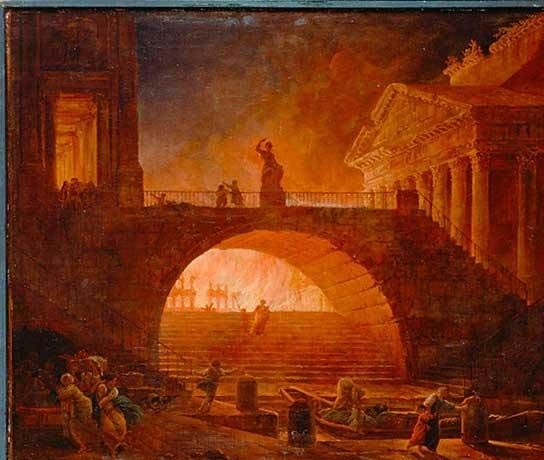
By Robert Gore

Source: Straight Line Logic

Western civilization is characterized by its institutions. Its foundations have been government, organized religion, the military, science, technology, business, academia, media, art, and entertainment. Institutions have been bulwarks of order and have enabled Western civilization to reach unprecedented plateaus of achievement and prosperity. Now, they’re under assault and crumbling, which has been often noted and decried but usually not analyzed or understood as the outcome of an epochal transition.

Institutions have been the victim of their own success. The Industrial and Information Revolutions have put goods, services, wealth, data, and choices in billions of hands in what amounts to an historical blink of an eye, less than two centuries. The average American lives better and longer than royalty did back in monarchy’s heyday and has more personal power. Kings and emperors of yore could order people around and toss them in dungeons, but they couldn’t hop on the Internet and communicate with someone on the other side of the planet or hop on a freeway and journey five hundred miles in a day.

Institutions’ loss has been individuals’ gain, and many of the latter are questioning the necessity of the former. Institutions are staring into an abyss. Many, including governments, do not have convincing justifications for their own existence. They offer little to average people and in many cases they’re a net negative, imposing nothing but burdens. Their leaders are solely devoted to furthering their own prerogatives and power. Now, institutions are fighting a rearguard action to halt or slow a transition that at best will dramatically reduce their power and could mean their extinction.

COVID, climate change, foreign wars, censorship, woke, open borders, surveillance, and digital passports and currencies are Last Gasp efforts to preserve institutional status, wealth, and power. The institutions have responded to their own drum roll with what vigor they can muster, but those causes inspire vapid virtue signaling, not authentic passion. Their only wellspring of true passion is hatred for anyone who believes differently, who challenges their science, propaganda, and mendacity, and, more broadly, their right to dictate and coerce, and to cancel, punish or execute anyone not toeing their line.

Their objective failures—many of which count in their corrupt reckonings as successes—are manifest. The COVID response, particularly vaccines’ deaths and adverse events, completely discredited governments, public health, institutional medicine, the pharmaceutical companies, and social and mainstream media, while inflicting severe collateral damage on official “science,” big business, and central banks. The institutions are regrouping under the banner of climate change, but it’s clear from the pushback they’re already receiving that their agenda can only be implemented through violence and high-tech totalitarianism.

Repeated failures and ever-mounting resistance would seem to be enough to doom their totalitarian designs. Unfortunately, in their desperation and hatred, the willingness of the elite to wage actual, kinetic war on the rest of us shouldn’t be underestimated. While the COVID vaccine death toll numbers in the millions, war still has no rival for murderous effectiveness. However, offensive violence is no solution.

Nuclear weapons changed warfare in a way that’s not generally recognized. The threat that a global nuclear conflagration could eliminate humanity rendered their use a high-risk proposition. The Hiroshima and Nagasaki bombings in 1945 remain the only wartime use of nuclear weapons. Under the umbrella created by nuclear weapons’ unemployability, technological advances have fueled the development of a staggering array of armaments that has decisively shifted the military balance from offensive to defensive warfare.

World War II was the last major war in which an offensive, or, more correctly, a counter-offensive, won. The allied powers repelled the axis powers, but at huge cost. Industrial-scale, mechanized warfare’s awesome destructive power left all the major participants except the U.S. in ruins, their populations decimated.

Offensive military power has become enormously expensive relative to the defensive technologies and strategies that can be employed against it. Since World War II, there have been few successful invasions. Both sides were stymied in the Korean War. U.S. invasions have been a string of disasters since Vietnam. Afghan goat herders defeated both the Soviets and the U.S.

On the cusp of victory in Ukraine, the Russian Special Military Operation would seem to belie the trend of offensive failures. However, the Russians have actually won by playing defense. They moved through their major objective, the Donbass region of Eastern Ukraine, where the majority of the population speak Russian. Many of them want to be part of Russia and hate the Ukrainian government, which has waged war on them since the 2014 coup. Consequently, the Russians were supported by the local population.

This past year featured a Ukrainian counteroffensive that was supposed to drive the Russians back from Donbass and retake the Crimean peninsula. NATO and Ukrainian strategists refused to recognize that their offensive was akin to sending cavalry units against machine-gun and artillery emplacements. They were up against an opponent well-armed with land mines, state-of-the-art field artillery and long-range missiles, air cover, and surveillance and attack drones. The Russian military, which has a long tradition of waging defensive warfare, employed a complex three-layer defense. The Ukrainians rarely progressed through even the first layer, impaling themselves on the tip of the Russian spear and taking massive losses.

The successful Russian strategies and tactics will be, or should be, studied by military analysts in the U.S. However, what’s most important is that those tactics implicitly acknowledge a truism central to the transition in progress. High-cost offensive warfare can be stymied and often defeated with relatively low-cost defensive weaponry and asymmetric warfare.

It can be argued that an offensive against the world’s most powerful military was obviously doomed, although nobody in the Western brain trust made that argument before the Ukrainians attacked. What truly signals the dawning of a new age have been the repeated successes since World War II of guerrilla or insurgent warfare against ostensibly much more powerful forces.

The Russians learned their lesson from the Soviet failure in Afghanistan. The U.S. government hasn’t learned anything from its string of failures. In Washington, nothing succeeds like failure. Its unconditional backing of Israel’s attempted elimination of Palestinians in Gaza finds it doubling down on what hasn’t worked.

The Israelis recognize a grim reality of fighting an insurgency on insurgent territory: To win, it’s not enough to kill the guerrillas; the guerrilla-friendly local population must be eliminated as well. The Israelis’ campaign has been merciless: destroying structures, killing Palestinian civilians, and making life intolerable for the survivors. The Israeli aim is to drive the Palestinians from Gaza and Israel for good. This meets international-law definitions of genocide and has been rightly decried around the world.

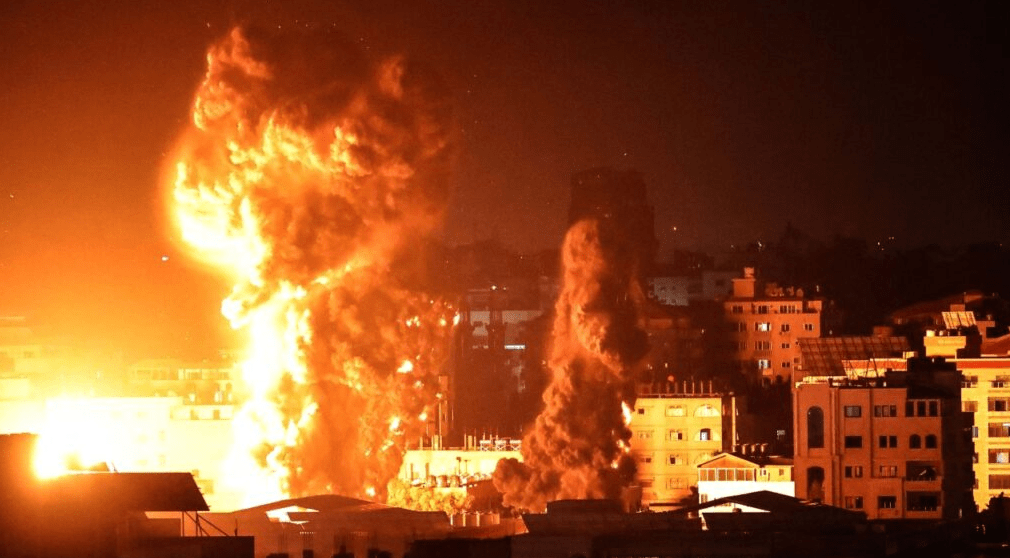
What will it mean if Israel fails? The Israelis may well reduce Gaza to rubble, but that would not be mission accomplished. Rubble provides excellent cover for guerrilla strikes. Hamas’ extensive tunnels indicate that it has prepared for this war for years. In all probability, it launched the October 7 attack to get things going. Israel’s negligence detecting and responding to that attack may have been intentional, indicating that it, too, wanted the war it now has.

Hamas has a network of allies across the Middle East. Israeli and U.S. forces and maritime commerce are under attack in Iraq, Syria, Lebanon, Yemen, the Red Sea, the Indian Ocean, and the Mediterranean. Yemen’s Houthis have already bottled up the Red Sea. It would be an easy matter for Iran to do the same in the Persian Gulf. Control of maritime commerce at important choke points calls into question a plank as central to the American Empire as it was to the British Empire before it: control of the world’s seas and oceans.

What happens if an American-led flotilla tasked with keeping the Red Sea or the Persian Gulf open comes under a swarming missile and drone attack, plus electronic warfare that disrupts its command and control capabilities, and destroyers or aircraft carriers are sunk? Missiles, drones, and cyber disruption cost a pittance compared to battleships, and it would then be apparent that they make conventional surface naval power a paper shark. The vessels in their watery grave would send the same message as the tanks smoldering on Ukraine’s battlefields.

The power of governments rests on their ability to use violence to control populations. Yawning cost disparities, decentralized technologies, and asymmetric warfare have rendered much of conventional offensive power vulnerable or obsolete, marking an historic, tectonic transition in the relationships between governments and governed. This is no secret, particularly in the non-Western world.

Across the globe, insurgents are taking the measure of governments and finding them wanting. Governments that are not feared cannot govern. As they confront their limitations, they will, being governments, make their situations worse.

The American government has a problem not shared by many others. Its potential insurgents—urban, suburban, and rural—are armed to the teeth. They already control many of the cities (see “Ants at the Picnic, Part Two”). Heavily indebted Washington cannot command the resources necessary to subjugate the population. It gets stretched thinner with each new dollar of debt, each new tax, each new institutionalized corruption, each new illegal migrant, each new substitution of gobbledygook ideology for rationality, and each new foreign intervention. Recognition of Washington’s weakness is behind the talk of secession and some states’ defiance of its dictates.

Washington’s weakness is shared by many Western governments, although most of them don’t have to contend with armed opposition. They do have to contend with increasingly restive populations, which by sheer force of numbers can upend existing political arrangements. It is delusional to think that these beleaguered national governments can be replaced by a confederated or unitary global government that could then exercise effective control.

The imposition of global government would entail an invasion by an outside force of millions of globally dispersed localities. The global force would encounter the same problem Israel faces in Gaza. Overt and covert opposition could number in the billions.

The globalists would have to contend with organized insurrection, guerrilla warfare, sabotage, and terrorism, as well as random riots, criminality, and widespread disorder. They would have to resort to the Israeli “solution” in Gaza—mass extermination. While they are relying on propaganda, subversion, electronic control, and biological warfare, perhaps only nuclear weapons could achieve genocide at the necessary scale. Don’t put it past them. Don’t put it past the insurgents to acquire their own nukes.

Short of nuclear conflagration, the world will continue to devolve towards institutional failure, popular disillusionment, mounting rage, and chaotic fragmentation and balkanization. Today’s dinosaur governments are unable to exercise control, and many of them are slated for extinction. They will not be replaced by an even larger and more unwieldy dinosaur—global government—which is only the last, desperate hope of the fading regime. Instead, the vacuum created by failed governments will be filled by those proficient in decentralized violence. Those who have relied on centralized authority for their livelihoods, power, and status will find their worlds turned upside down. Many will not survive the transition.

Assume crash positions.

Could America Have a French-Style Revolution?

By Charles Hugh Smith

Source: Of Two Minds

Combine all these factors and the result is a potentially volatile mixture awaiting a catalyst.

In the past, I reckoned the odds of America experiencing a revolution akin to France 1789 were low due to the different political, economic and cultural conditions present then and now, but recently I’ve considered the possibility that America’s extremes of wealth, income and power inequality are a powder keg awaiting ignition.

By French-Style Revolution I don’t mean a violent overthrow of the ruling elite as much as a tumultuous reset of how resources and power are distributed. Systems become vulnerable to such resets when they become highly asymmetrical in how they distribute resources and power, and rigid in their defense of the extreme inequality of the distribution.

The fundamental source of democracy’s stability is the dynamic competition of various interests and the dynamic equilibrium of the three branches of the state each balancing the others by restraining the dominance of any one branch or interest.

But extremes of inequality undermine this stability, as the wealthiest elites now bring such a preponderance of wealth to bear that each of the three branches of the state are now beholden to the interests of the few, leaving little recourse to the many.

When the agenda and narratives have been shaped by the wealthiest elites’ foundations, think tanks, corporate PR and lobbyists, then electing different representatives has little effect on the power structure.

The masses can still influence cultural / social policies by voting in a liberal or conservative slate, but the distribution of wealth, power and resources remains unchanged.

As wealth and power are concentrated into ever fewer hands, the mythology of broad-based access to prosperity has vastly expanded the pool of second-tier elites who feel entitled (via implicit promises made by the system) to their fair share of income, wealth and power–financial security and political agency, i.e. a say in public decisions.

These second-tier elites are primarily university graduates and the offspring of upper-middle class households who have been led to expect a secure slot in the upper reaches of the economy or state is a birthright gained by their education and class.

That there are no longer enough slots for this class means those left out constitute the raw material of a potently dissatisfied and potentially angry political class. Historian Peter Turchin presents this as the result of the overproduction of elites, a dynamic he has traced back to previous eras of tumultuous upheaval.

Another common factor driving the masses to revolt is when the essentials of life are no longer affordable or available in sufficient quantity. Historian David Hackett Fischer has documented the perilous impact of inflation, i.e. the collapse of the purchasing power of wages.

Yet another potentially explosive factor is the supreme confidence of the wealthiest elites that the system they rule could ever turn against them or crumble beneath their feet–in a word, a hubris as extreme as their wealth and power. The resignation of the masses and the ease of distracting them with ginned-up controversies and crises and consumerist novelties has fed elite confidence that their supremacy is unassailable.

This hubris leads to the elite becoming tone-deaf to their own excesses and the instability their excesses are generating within the system, an instability that’s currently hidden beneath the resignation and distraction of the masses and the mute frustration of the second-tier elites facing lifetimes of insecurity.

Another factor is the promises made by the state generations ago can no longer be met without creating new money on a scale that guarantees destabilizing inflation. This new money is issued as Treasury bonds which are purchased for income by the wealthy, further exacerbating wealth and income inequality.

The power elite are incapable of demanding sacrifices of the wealthy as the prime directive of the status quo is to defend the current asymmetry of wealth and power. This undermines the collective consensus needed to take the collective action needed to reset the system.

Combine all these factors and the result is a potentially volatile mixture awaiting a catalyst. The confidence of the status quo that it is essentially omnipotent (the Federal Reserve will always save us, etc.) and eternal is itself a factor in the mix.

The key factor is the rigidity or flexibility of the power structure. If the structure is incapable of resetting to a more flexible, symmetric distribution of power as resources, it will come apart as pressures mount.

It’s A Trap! The Wave Of Repercussions As The Middle East Fights “The Last War”

By Brandon Smith

Source: Activist Post

Few people are familiar with a little event around 1200 BC called the Bronze Age Collapse in the region known as the Levant (now known as the Middle East). Most folks are taught that history and progress travel in a straight line and that each generation improves upon the culture and innovations of previous generations. This delusion is constructed around a Smithsonian-influenced view of the past. In reality, history tends to go in a circle, or a spiral, with innovation leading to ease, ease leading to laziness and corruption, and corruption leading to weakness and collapse.

Over and over again, humanity reaches for Elysium on Earth only to be slapped back down. The survivors then build grass huts on top of the ruins of the old empires and they start over from scratch.  Why does the Bronze Age catastrophe matter?  Obviously, because history tends to rhyme.

The Levant at this time was rich with civilization and trade, composed of a host of kingdoms that represented the known world including the Egyptians, Babylonians, Minoans, Mycenaeans, Hittites, etc.  They had vast economic networks, agriculture, industry and written libraries. The proximity of the kingdoms allowed for such extensive trade relations that this period is often referred to by modern historians as the first “globalized economy” (sound familiar?).

What took centuries to build was destroyed in a single generation by a series of disasters. A “mega-drought” caused kingdoms without consistent water resources to lose agricultural production leading to widespread famine and disease (yes, the climate can and does change dramatically regardless of human carbon footprint). Trade was disrupted by internal disputes, and a mysterious invasion of a group of roaming raiders called the “sea people” is documented as a primary factor in collapse.

The Sea People attacked numerous kingdoms, but many of them were also refugees flooding into the region. They disrupted cultures and economies and dragged a number of empires into the dust. This all happened in less than 30 years. Sadly, because only the elites of these civilizations were able to read and write, languages and historical documentation were lost.

This initiated a dark age which lasted for centuries. Humanity was set back, essentially to zero, while scratching and surviving among temples and pyramids of past generations. They must have looked up at those decaying marvels of architecture from hundreds of years ago and wondered “What the hell happened to us?”

Not everything perished, of course. The Egyptian dynasties were in decline, but they managed to hold together far better than their counterparts across the Levant.  However, the event represented a setback to human knowledge that was detrimental. One might suggest that if the Bronze Age Collapse never occurred we might be a space borne species traveling the stars by now.

Then again, maybe these cultures were so corrupt that they needed to fail so that something better could be built in their place?

What does any of this have to do with the state of the Middle East today? The smart readers out there surely see what I’m getting at. The intricate relationships and trade mechanisms of the Bronze Age led to great wealth and prosperity, but they were terribly fragile. That same interdependency resulted in their demise as they tumbled like dominoes on top of each other.

The globalization and collectivist war mongering of today is leading to a similar worldwide implosion. Our irrational ties to foreign entanglements and economies could very well destroy civilization again. Consider what are we about to see as the Israel/Palestine war unfolds…

Multiple Nations Dragged Into The Conflict

If you were wondering what the “October surprise” was going to be, well, now you know.  I will make my position on this situation clear – I don’t care about either side.  I care about innocent civilians, but other than that the war is irrelevant.  I am an American and I care about America. The same goes for Ukraine and Russia. Their wars are not our wars, and I am highly suspicious every time our political leaders try to lure us into choosing a side when foreigners start shooting each other. To summarize:  All wars are banker wars.

The Israelis enjoy our money but they have a history of proven elicit operations to lure us into war (USS Liberty, anyone?). The Palestinians and most of the Muslim world despise the West and Christianity in general (and I don’t really care who started it, the fact remains that our cultures are completely incompatible and this will never change).  Just because we happen to find common ground on fighting back against the insane trans agenda does not mean I’m willing to accept draconian Sharia Law in my community.

Both sides use tactics that deliberately target civilians. I’m not talking about collateral damage like we saw in Iraq and Afghanistan, I’m talking about groups that are consciously and brazenly engaged in plans for genocide. Bottom line? There are no “good guys” to join with. It’s a complete sh*t show of ancient tribal nonsense that Westerners should stay away from.

For those who disagree, ask yourselves this – Are you truly willing to go pick up a rifle and fly to Israel or Gaza to fight and die for either side?  If so, then go do it and stop demanding others do it for you.  If not, then shut up.

But here’s what’s going to happen:  the establishment will seek to force Americans and Europeans into these wars regardless.  The corporate media and some political leaders are already suggesting that the recent full-scale attack on Israel was planned by governments outside of Gaza. Some are accusing Iran, and others accuse Lebanon. From the extensive amount of footage of the attack that I have examined, I have no doubt that someone other than the Palestinians orchestrated the event. The tactics were far too advanced and far too coordinated; the Palestinians have never been all that smart when it comes to military strategy.

Who drafted the attack is another question entirely. So far there are a lot of rumors but no hard evidence leading to any specific governments. Another big question is, how did the Palestinians manage to organize all of this and execute the invasion WITHOUT Israeli intel services knowing about it? Mossad is known to be one of the most intrusive and pervasive covert agencies in the world, yet they were caught completely off guard by this unprecedented attack?  I think not.

I’m reminded of the events of 9/11 and the strange series of intelligence failures that preceded it. I’m also reminded of the lies, propaganda and the reactionary response which led to two decades of meaningless war.

I’m going to call it here – in a couple of weeks we will hear reports that many of the soldiers involved in the incursion were NOT Palestinian. They will claim some of them are from Iran, Syria, Lebanon, etc. There will be intel that says Iran was a major backer of the plan (The Wall Street Journal already claims this is the case, but they have not provided any compelling proof, yet).

A US carrier strike group is on the way to the region now, and this is just the beginning. Europeans will be pressured to go to war, American conservatives in particular will be waterboarded with propaganda telling us that an “attack on Israel is an attack on the US.” It will be a lot like the rhetoric Neo-cons and leftists used during the initial invasion of Ukraine, but multiplied by a thousand. To be clear, both Biden and Trump have been rattling sabers and testing the waters of war, so don’t think that we can avoid this simply by voting.

Multiple Fronts

Israel is going to pound Gaza into gravel, there’s no doubt about that.  A ground invasion will meet far more resistance than the Israelis seem to expect, but Israel controls the air and Gaza is a fixed target with limited territory.  The problem for them is not the Palestinians, but the multiple war fronts that will open up if they do what I think they are about to do (attempted sanitization).  Lebanon, Iran and Syria will all immediately engage and Israel will not be able to fight them all – Hell, the Israelis got their asses handed to them by Lebanon alone in 2006.

This will result in inevitable demands for US/EU intervention.

East vs West

Depending on the extent of the Western reaction, the BRICS nations may be compelled to get involved. This may not be on a kinetic level, but there is a chance. Russia has strategic security treaties with Iran and Syria. China has numerous economic interests and influence in the region as the world’s largest importer/exporter.

These nations might retaliate with the same kind of financial warfare that the West used against Russia – with China and the BRICS cutting off the dollar as the world reserve currency. This would add to the crippling inflation we are already experiencing.

Terror Attacks And False Flags

If you thought things might be eerily quiet on the terrorism front lately, that’s now over. I would be shocked if we made it another six months without multiple attacks tied back to Islamic groups. Some of them will be real and some of them will be staged, and telling which is which will be difficult.

The thing is, wide open borders in the West have made this far more likely and the establishment knows it. In my opinion they WELCOMED IT. If they can get at least one crazy Muslim to shoot up a strip mall or blow up a football stadium, they will have all the leverage they need to con Americans into another ground war in the Middle East.  Do we need to “fight them over there so we don’t have to fight them here?”  That’s garbage thinking.  We should not be letting them over here in the first place.

Europe in particular is playing with fire. National governments and the EU have invited tens-of-millions of these people to their doorsteps and now they face a serious conundrum. There are Sharia Law communities all over Europe, there are millions of military-age Muslim men with every opportunity to do great harm. And, there are millions of woke leftists currently cheering them on, thinking that this is some form of “decolonization.”

Closure Of The Strait Of Hormuz, Skyrocketing Oil Prices

I have been warning about this scenario for many years; it was only a matter of time before tensions with Iran gave them a rationale to close the Strait Of Hormuz and shut down 30% of all oil exports from the Middle East to the rest of the world. Keep in mind, Europe is suffering from extensive energy inflation, in part because of the economic crisis and also because of sanctions against Russia.

Biden has been trying to hide inflation by dumping oil from the strategic reserves onto the market, but now those reserves are the lowest they have been since 1983.  Conveniently, this happened right before the strike on Israel. Our reserves are depleted as we go to war. Oil prices and gasoline prices will explode if Iran is implicated in the Israel attack. Iran will run a few giant oil tankers into the Hormuz, sink them, and make the strait impassable for months. Don’t be surprised of we see $200 per barrel oil next year, which will translate to around $7 per gallon gas or higher for much of the US.

A Push For A New Draft

Let’s be honest, current US recruitment numbers are a joke and the wokification of our military is making it weaker by the month. No American citizen with a legit warrior mindset or combat aptitude is going to join that circus freak show voluntarily. The establishment will try to regale conservatives and patriots with visions of “fighting the good fight for family and country” but most will not buy in. With attempts to ignite multiple fronts against Russia, China and the Middle East, they will start talking about a new draft system.

My belief is that this will fail miserably and would start a civil war rather than fill the ranks of the Army or Marines, but they may have a scheme to deal with this outcome…

Is This The Real Reason Why US Officials Are Encouraging The Migrant Invasion?

The reality is, America has its own invasion to deal with.  During the Bronze Age Collapse certain empires (like Egypt) survived using an odd tactic – instead of fighting off the invading hordes of refugees, nomads and sea people, they HIRED them and inducted them into important positions within their military. Corrupt authoritarian rulers ultimately found that they faced more of a threat from their own starving peasants than they did from the outsiders, so they joined with them to put down local rebellions.

This might not be as useful in Europe, but in America I wonder if this was the intention all along; to bring in millions of military-age foreigners with little sympathy for the existing culture, then in the midst of collapse and conflict offer them automatic citizenship and benefits if they join the military. Not on the small scale the federal government has going today, but on an enormous scale the likes of which we have never seen.

Maybe the plan was always to leave the gates open and allow illegals to stroll in so that they could act as a mercenary contingent to fight in foreign wars or fight against American citizens should rebellion arise…

Plan C

The timing of the conflict in Israel is incredibly beneficial to globalists, and this might explain Israel’s bizarre intel failure. Just as US and British leaders had prior knowledge of a potential Japanese attack on Pearl Harbor in 1941 but warned no one because they WANTED to compel Americans to fight in WWII, the Palestinian incursion serves a similar purpose.

The covid pandemic and mandates failed to get the desired result of a global medical tyranny. The war in Ukraine failed to get desired results as the warhawks’ demands for boots on the ground against Russia fell apart. Perhaps this is just Plan C?

The establishment seems particularly obsessed with convincing US conservatives and patriots to participate in the chaos; there are a number of Neo-cons and even a few supposed liberty media personalities calling for Americans to answer the call of blood in Israel. Some have described the coming conflagration as “the war to end all wars.”

I believe that the real war is yet to truly start, and that is the war to erase the globalists from existence. They want us to fight overseas in endless quagmires in the hopes we will die out. And when we do, there will be no one left to oppose them. It’s a predictable strategy, but its success is doubtful. Another interesting fact about the Bronze Age Collapse – the elites were some of the first groups to be wiped out after the system broke down.

A Bonfire of the Vanities

By Alastair Crooke

Source: Strategic Culture Foundation

Hubris consists in believing that a contrived narrative can, in and of itself, bring victory. It is a fantasy that has swept through the West – most emphatically since the 17th century. Recently, the Daily Telegraph published a ridiculous nine minute video purporting to show that ‘narratives win wars’, and that set-backs in the battlespace are incidentals: What matters is to have a thread of unitary narrative articulated, both vertically and horizontally, throughout the spectrum – from the special forces’ soldier in the field through to the pinnacle of the political apex.

The gist of it is that ‘we’ (the West) have compelling a narrative, whilst Russia’s is ‘clunky’ – ‘Us winning therefore, is inevitable’.

It is easy to scoff, but nonetheless we can recognise in it a certain substance (even if that substance is an invention). Narrative is now how western élites imagine the world. Whether it is the pandemic emergency, the climate or Ukraine ‘emergencies’ – all are re-defined as ‘wars’. All are ‘wars’ that are to be fought with a unitary imposed narrative of ‘winning’, against which all contrarian opinion is forbidden.

The obvious flaw to this hubris is that it requires you to be at war with reality. At first, the public are confused, but as the lies proliferate, and lie is layered upon lie, the narrative separates further and further from touched reality, even as mists of dishonesty continue to swathe themselves loosely around it. Public scepticism sets in. Narratives about the ‘why’ of inflation; whether the economy be healthy or not; or why we must go to war with Russia, begin to fray.

Western élites have ‘bet their shirts’ on maximum control of ‘media platforms’, absolute messaging conformity and ruthless repression of protest as their blueprint for a continued hold in power.

Yet, against the odds, the MSM is losing its hold over the U.S. audience. Polls show growing distrust of the U.S. MSM. When Tucker Carlson’s first ‘anti-message’ Twitter show appeared, the noise of tectonic plates grinding against each other was unmissable, as more than 100 million (one in three) Americans listened to iconoclasm.

The weakness to this new ‘liberal’ authoritarianism is that its key narrative myths can get busted. One just has; slowly, people begin to speak reality.

Ukraine: How do you win an unwinnable war? Well, the élite answer has been through narrative. By insisting against reality that Ukraine is winning, and Russia is ‘cracking’. But such hubris eventually is busted by facts on the ground. Even the western ruling classes can see their demand for a successful Ukrainian offensive has flopped. At the end, military facts are more powerful than political waffle: One side is destroyed, its many dead become the tragic ‘agency’ to upending dogma.

“We will be in a position to extend an invitation to Ukraine to join the Alliance when Allies agree and conditions are met … [however] unless Ukraine wins this war, there’s no membership issue to be discussed at all” – Jens Stoltenberg’s statement at Vilnius. Thus, after urging Kiev to throw more (hundreds of thousands) of its men into the jaws of death to justify NATO membership, the latter turns its back on its protégé. It was, after all, an unwinnable war from the beginning.

The hubris, at one level, lay in NATO’s pitting of its alleged ‘superior’ military doctrine and weapons versus that of a deprecated, Soviet-style, hide-bound, Russian military rigidity – and ‘incompetence’.

But military facts on the ground have exposed the western doctrine as hubris – with Ukrainian forces decimated, and its NATO weaponry lying in smoking ruins. It was NATO that insisted on re-enacting the Battle of 73 Easting (from the Iraqi desert, but now translated into Ukraine).

In Iraq, the ‘armoured fist’ punched easily into Iraqi tank formations: It was indeed a thrusting ‘fist’ that knocked the Iraqi opposition ‘for six’. But, as the U.S. commander at that tank battle (Colonel Macgregor), frankly admits, its outcome against a de-motivated opposition largely was fortuitous.

Nonetheless ‘73 Easting’ is a NATO myth, turned into the general doctrine for the Ukrainian forces – a doctrine structured around Iraq’s unique circumstance.

The hubris – in line with the Daily Telegraph video – however, ascends vertically to impose the unitary narrative of a coming western ‘win’ onto the Russian political sphere too. It is an old, old story that Russia is military weak, politically fragile, and prone to fissure. Conor Gallagher has shown with ample quotes that it was exactly the same story in World War 2, reflecting a similar western underestimation of Russia – combined with a gross overestimation of their own capabilities.

The fundamental problem with ‘delusion’ is that the exit from it (if it occurs at all) moves at a much slower pace than events. The mismatch can define future outcomes.

It may be in the Team Biden interest now to oversee an orderly NATO withdrawal from Ukraine – such that it avoids becoming another Kabul debacle.

For that to happen, Team Biden needs Russia to accept a ceasefire. And here lies the (the largely overlooked) flaw to that strategy: It simply is not in the Russian interest to ‘freeze’ the situation. Again, the assumption that Putin would ‘jump’ at the western offer of a ceasefire is hubristic thinking: The two adversaries are not frozen in the basic meaning of the term – as in a conflict in which neither side has been able to prevail over the other, and are stuck.

Put simply, whereas Ukraine structurally hovers at the brink of implosion, Russia, by contrast, is fully plenipotent: It has large, fresh forces; it dominates the airspace; and has near domination of the electromagnetic airspace. But the more fundamental objection to a ceasefire is that Moscow wants the present Kiev collective gone, and NATO’s weapons off the battle field.

So, here is the rub: Biden has an election, and so it would suit the Democratic campaign needs to have an ‘orderly wind-down’. The Ukraine war has exposed too many wider American logistic deficiencies. But Russia has its’ interests, too.

Europe is the party most trapped by ‘delusion’ – starting from the point at which they threw themselves unreservedly into the Biden ‘camp’. The Ukraine narrative broke at Vilnius. But the amour propre of certain EU leaders puts them at war with reality. They want to continue to feed Ukraine into the grinder – to persist in the fantasy of ‘total win’: “There is no other way than a total win – and to get rid of Putin … We have to take all risks for that. No compromise is possible, no compromise”.

The EU Political Class have made so many disastrous decisions in deference to U.S. strategy – decisions that go directly against Europeans’ own economic and security interests – that they are very afraid.

If the reaction of some of these leaders seems disproportionate and unrealistic (“There is no other way than a total win – and to get rid of Putin”) – it is because this ‘war’ touches on a deeper motivations. It reflects existential fears of an unravelling of the western meta-narrative that will take down both its hegemony, and the western financial structure with it.

The western meta-narrative “from Plato to NATO, is one of superior ideas and practices whose origins lie in ancient Greece, and have since been refined, extended, and transmitted down the ages (through the Renaissance, the scientific revolution and other supposedly uniquely western developments), so that we in the west today are the lucky inheritors of a superior cultural DNA”.

This is what the narrators of the Daily Telegraph video probably had at the back of their minds when they insist that ‘Our narrative wins wars’. Their hubris resides in the implicit presumption: that the West somehow always wins – is destined to prevail – because it is the recipient of this privileged genealogy.

Of course, outside of general understanding, it is accepted that notions of ‘a coherent West’ has been invented, repurposed and put to use in different times and places. In her new book, The West, classical archaeologist Naoíse Mac Sweeney takes issue with the ‘master myth’ by pointing out that it was only “with the expansion of European overseas imperialism over the seventeenth century, that a more coherent idea of the West began to emerge – one being deployed as a conceptual tool to draw the distinction between the type of people who could legitimately be colonised, and those who could legitimately be colonizers”.

With the invention of the West came the invention of Western history – an elevated and exclusive lineage that provided an historical justification for the Western domination. According to the English jurist and philosopher Francis Bacon, there were only three periods of learning and civilization in human history: “one among the Greeks, the second among the Romans, and the last among us, that is to say, the nations of Western Europe”.

The deeper fear of western political leaders therefore – complicit in the knowledge that the ‘Narrative’ is a fiction that we tell ourselves, despite knowing that it is factually false – is that our era has been made increasingly and dangerously contingent on this meta-myth.

They quake, not just at a ‘Russia empowered’, but rather at the prospect the new multi-polar order led by Putin and Xi that is sweeping the globe will tear down the myth of Western Civilisation.

The Two Causes of the Coming Great Depression

By Charles Hugh Smith

Source: Of Two Minds

There are two approaches to analyzing a situation:

1. Choose the desired outcome–generally the one that doesn’t require any major changes, sacrifices or downward mobility
2. Identify the initial conditions and systemic dynamics and then follow these to a conclusion back-tested by comparisons with historical outcomes.

Our default setting as humans is 1: select the outcome we want and then find whatever bits and pieces supports that conclusion. Cherry-pick data, draw false analogies–the field is wide open.

This is why we get so upset when our “analysis” is challenged: we’re forced to ask what happens to us if our desired outcome doesn’t transpire, and since the answer might be something less than optimal, we violently reject any data or analogies that conflict with our carefully curated “analysis.”

A great deal of what passes for analysis today is cherry-picked bits and pieces that support a happy story of endlessly expanding prosperity–AI, fusion, etc.–with no mention of limits, constraints, costs or worst-case outcomes rather than best-case outcomes.

Let’s start with an historical analogy most reject: the Great Depression of 1929 to 1942. The conventional account claims that the Depression was the result of a “Federal Reserve policy error”: the Fed tightened credit when it should have loosened it.

This is nonsense. What actually happened was credit expanded rapidly in the Roaring 1920s, which is why they were Roaring. Farmers could borrow money to buy prairie land to put under the plow, speculators could borrow $9 on margin to play the stock market with $1 in cash, and so on.

In other words, what happened was a gigantic credit bubble inflated that pushed stocks and other assets to unsustainable heights of over-valuation, valuations based on the Roaring 20s expansion of credit and consumption continuing forever.

But all bubbles pop, and so the weather changed for the worse and newly plowed prairie turned into a Dust Bowl, wiping out heavily leveraged farmers. Since there was no federal bank deposit guarantee (no FDIC), the bankruptcies of overleveraged borrowers wiped out thousands of small banks, wiping out the savings of prudent depositors.

So even prudent savers got wiped out in the crash of the credit bubble.

Stock speculators gambling on margin (i.e. borrowed money) were quickly wiped out, and the selling became self-reinforcing, accelerating the cascading crash.

The real policy error was protecting the wealthy who owned the debt from a debt-clearing write-down. The wealthy own debt, the non-wealthy owe debt. When the debt is defaulted on, the lender / owner of the debt has to absorb the loss. The debtor is freed of the burden. In a debt-clearing event driven by defaults, insolvencies and bankruptcies, the wealthy are the losers and the debtors are freed of the burden of debt.

Various programs were implemented to stave off the consequences of default, as if pushing losses into the future would somehow enable the credit bubble to reinflate. That’s not how it works: the financial system is like a forest, and if the dead wood of bad debt piles up and isn’t allowed to burn, then the forest cannot foster new growth.

Economies that refuse to accept the wealth destruction that results from credit bubbles popping stagnate. This is the story of Japan from 1990 to the present: the status quo in Japan refused to accept the losses, hiding bad debt (i.e. non-performing loans) behind artifices such as new loans that covered the interest due, listing the non-performing loans in “zombie” categories, i.e. as assets that were still on the books at full value even though they were essentially worthless, and so on.

The net result was 33 years of stagnation and social decay as young people gave up on owning homes and having families.

Now the US has inflated another “debt super-cycle” credit bubble that has pushed assets into over-valuation. Once again the goal is to avoid handing the wealthy owners of all this debt the enormous losses that must be accepted to clear the dead wood of bad debt, money lent to borrowers and projects that were not creditworthy except in a bubble.

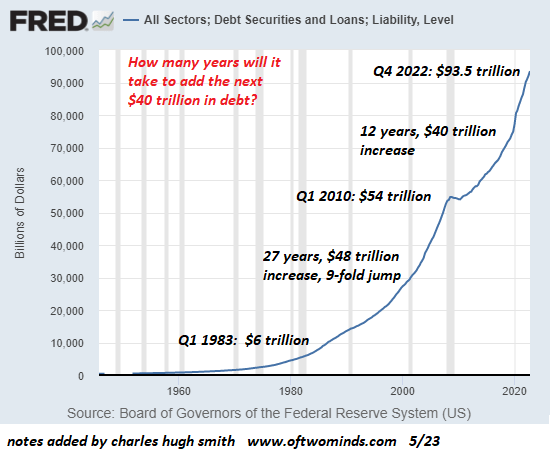
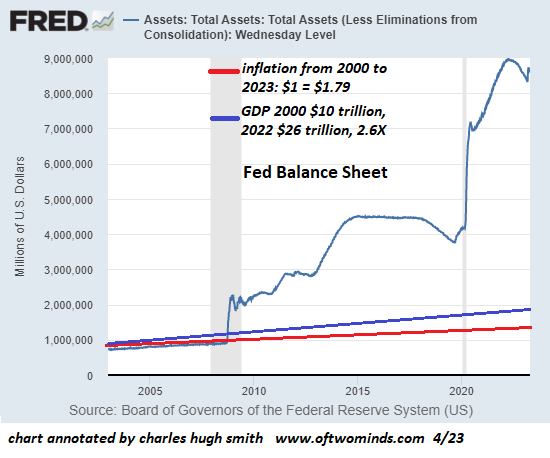
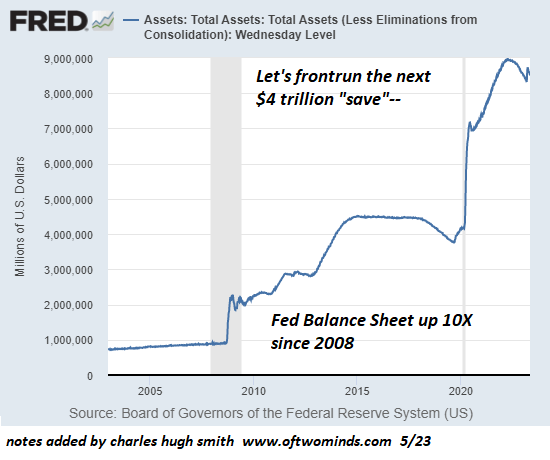
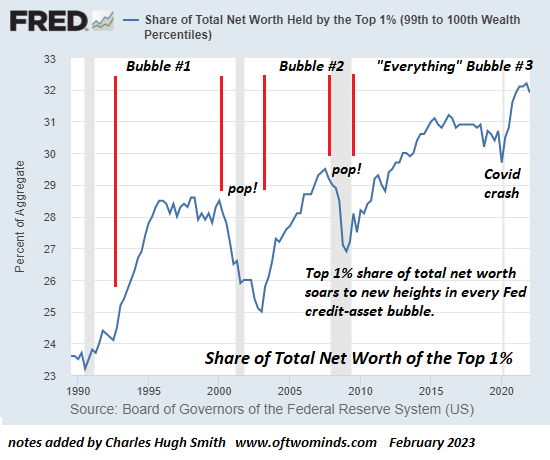
The lesson the status quo took from the Great Depression is to cover up private-sector over-valuations and bad debts with vast expansions of credit via the Federal Reserve and the federal government. Please look at these four charts below:
1. total credit (TCMDO)
2. the Federal Reserve balance sheet (2 charts)
3. federal debt

All are in visibly unsustainable parabolic ascents.

Predictably, the status quo will refuse to accept the necessity of clearing the dead wood and accepting the trillions of dollars in losses that will accrue to those who own the unpayable debts.

Consider CRE, commercial real estate. Office towers are now worth one-third of their pre-pandemic valuations, the valuations on which their mortgages were based. There is no way these properties can be magically restored to their previous over-valuation. Massive losses must be accepted by the owners of the debt. If those losses make them insolvent, so be it. That is unacceptable in a system geared to protect the wealthy at all costs.

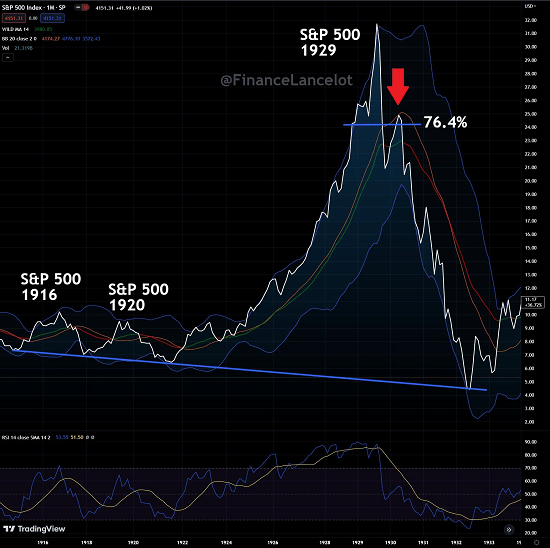
But bubbles pop anyway, regardless of policy tweaks. Consider these stock market charts of the Roaring 20s and the Great Depression and the present (below). The similarity is remarkable–possibly even eerie.

The big difference between the Great Depression of the 1930s and the Depression we’re entering is the world still had enormous reserves of resources to tap and a (by today’s standards) modest population in the resource-consuming developed nations.

Recall that a developed-world consumer uses up to 100 times more energy and resources than a poor person in a rural undeveloped nation. Recycling a few bottles doesn’t change this.

This means the planet’s “savings account” of abundant, cheap-to-access resources has been depleted. Yes, there is still oil and copper, etc., but it’s of far lower quality and much harder to get now. The rich ores have been mined and the shallow super-giant oil fields have all been tapped long ago. Now the Saudis must pump stupendous quantities of seawater into their oil wells to maintain production. All these technologies consume vast quantities of energy.

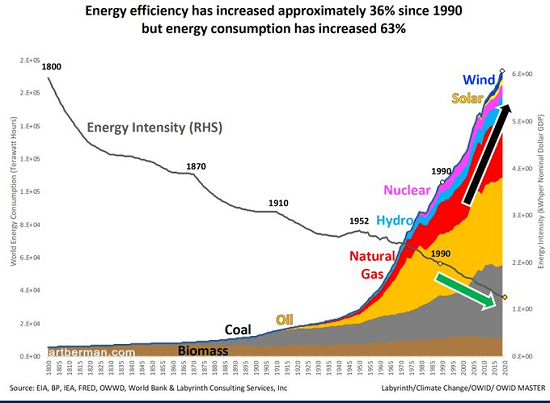
The inevitable result is the energy efficiency–how much energy is required to access, process and transport the energy–has plummeted even as consumption has soared.

The outcome many hope for is some new miraculously cheap and abundant sources of energy such as fusion. But fusion is far more complicated and tricky than pumping oil, and oil is a high-energy-density fuel that can be stored rather easily. All the electricity generated by various technologies can’t be stored easily or cheaply, and so the happy story is that a new miraculous battery technology is just around the corner.

But batteries are also complicated and resource-dense, so they’ll always be as expensive as the materials needed to fabricate them. There will never be “low-cost” batteries if the materials needed to make them are scarce and expensive to dig out of the ground, process and transport.

So the policy choices are simple: either protect the wealthy from write-downs of bad debt and the collapse of asset bubbles and usher in decades of stagnation, or force the wealthy to take the losses and clear away the dead wood.

But either choice will be constrained by the reality that humanity has already drained the easy-to-get “savings account” of global resources.

I get emails from readers who say things like “mining techniques are far more efficient now.” That’s fine, but most of these new mines are often thousands of kilometers away from railways or seaports, and thousands of kilometers away from the processing plants that turn the ore into useful metals.

Recall the enormity of the cost and effort required to build a single two-lane highway thousands of kilometers to a new mine, and the oceans of diesel fuel needed to power the mining equipment and trucks hauling the ore to railways or seaports. Recall the immense amounts of energy required to smelt / process these ores, and the near-zero percentage of lithium-ion batteries that are currently being recycled.

Batteries are difficult to recycle because they’re not manufactured to be recycled, and they’re not manufactured to be recycled because that would raise costs considerably, reducing profits.

So on the present course, the idea is to manufacture billions of batteries, throw them all in the landfill in 10 years, and then mine enough minerals to build another couple billion batteries and then repeat the cycle of throwing them away in 10 years forever.

That isn’t realistic, so the status quo will have to adjust to this unwelcome reality.

This is why I keep writing books about relocalizing, degrowth, using less rather than more to yield a higher level of well-being. The resource “savings account” won’t support fantasies of endlessly expanding consumption of hard-to-get resources.

But the status quo has much to unlearn, and it seems the only pathway to a new understanding is a Great Depression that won’t end with a new expansion of credit because the resources required for that new expansion simply won’t be available or affordable.

Reducing our exposure to avoidable risks is a key strategy of Self-Reliance.

Is Sleepy Joe Biden Trying to Outdo Hitler and History?

By Phil Butler

Source: New Eastern Outlook

History is the most interesting subject for many reasons. Not the least of which is the fact it tends to repeat itself. And the fact that some are doomed by ignorance of this is an important lesson for today. Take German tanks, for instance. First, let’s rehash a little history about the steppes of Russia and Eastern Ukraine and unlearned lessons.

From the 5th of July 1943 until the 23rd of August 1943, the largest tank battle in history took place in what became known as the “Kursk Salient,” an area that stretched from the tiny town of Kirov on the Bolva River in the north, through Belgorod in Russia, Kharkiv, which Ukraine currently controls. The line reached deep into the Donbas region, the focal point of Ukraine’s Nazi hostilities since 2014.

Hitler’s Operation Zitadelle (“Citadel”) was carried out over a 700-mile-long front, where the best Germans tried to outgun and outmaneuver the advancing Soviet forces. It became the largest tank battle in history, pitting the most advanced weaponry Nazi Germany had against prepared and dug-in, superior Soviet resistance. The reader will find it interesting that the German high command chose Belgorod as one of the first key objectives.

Numerous parallels exist between the battle of Kursk and the current proxy war in Ukraine. First, I’d like to deal with tanks. In 1943, Germany manufactured what can be argued as the finest medium and heavy armor of World War II. Though not numerous at Kursk, the deadly Tiger played a big role. The all-new Panther and the giant Ferdinand tank destroyer were supposed to blast the Soviets off the battlefield.

Ironically, many of their burning hulks littered the countryside once the battle ended. The battle raged for months, with neither side gaining a clear advantage. The Soviets, not unlike their modern-day counterparts on the Russian lines, created massive defensive works to sap the German offensive until a counterattack would gain a decisive effect.

When I read the other day about almost all of the highly touted German Leopards sent to Zelensky having been destroyed, this seemed like Deja Vu as a student of history. An article in the Berliner Zeitung cited Alexander Sosnowski, who used data from pro-Ukraine media channels to determine that 41 Leopard-2s, 49 T72 tanks, 31 Bradlys, 7 German Marders, 23 howitzers, and 40 MRAP infantry fighting vehicles have already been turned to scrap by the Russians. In 1943, the great Nazi war machine faced similar despair.

But what other parallels can we draw? What is going to happen next? If you ask most experts, Europe is out of ammo, tanks, and guts. The Germans cannot even crank up and run half their remaining Leopard 2s for lack of repair, Paris is on fire, Germans are ready for any Chancellor but Scholz, Hungary seems about ready to leave the NATO alliance, the dollar may crumble toon, and even Americans grow weary of cheering a losing team.

We can understand how idiotic Joe Biden’s war on Russia will end if we recollect what happened after the Kursk failure. The Germans had been progressing in fighting through the defensive layers the Soviets had built. The northern front of the pincer bogged down, and the southern one was halted by bitter Soviet resistance. Hitler, who the legendary Heinz Guderian had warned against Operation Citadel, lost heart when decisive victory was not at hand and focused elsewhere. Meanwhile, the Soviets had gained momentum in the ground war and never relinquished it after Kursk.

As we know, once the Axis began its retreat from Kursk, the Soviets, and their allies from the West marched into the heart of Europe, taking Berlin and destroying the dream of Leibensraum, at least for the moment. Today, we find Germany’s best tanks strewn all over the battle lines in the regions reclaimed by Russia. Of course, they are not the Tigers or Panthers of legend. Four Tiger tanks held off tank brigades at Kursk. Now a lightweight drone seemed capable of knocking one out. The same seems true for NATO, a military alliance that has never shown it could beat its way out of a wet paper bag, let alone conquer Russia.

Whoever devised this genius plan to create Operation Barbarossa 2 is not even as clever as a drugged Hitler on his worst day. All that has happened is that the Russians are preparing again. Factories are shifting to creating T-14 Armata tanks instead of luxury Lada 4x4s. Far from the front, the Russians ramp up their military complex as before. For Westerners, we can only hope they do so for defensive rather than offensive operations. For certain, as the fires of discontent burning in Paris, there is nothing behind the Donetsk River to stop the Russians if they choose to widen their breathing space.

Funny, isn’t it, how history repeats itself and does so in the same places with the same idiotic mistakes being made?

High Stakes as Uncle Sam’s Days of Impunity Are Finally Over

By Finian Cunningham

Source: Strategic Culture Foundation

The edifice of American imperial power has never been challenged at its foundation. It is now.

Russia and China are determined to hold the American perpetrators of the Nord Stream sabotage to account. Uncle Sam’s days – indeed decades – of wanton criminality are over. There’s going to be hell to pay as the imperialist tyranny in Washington hits a wall of reality.

Several weeks have gone by with the United States and its Western lackeys stonewalling at the United Nations Security Council, squirming and resisting calls from Moscow and Beijing for an international criminal investigation into the sabotage of the Baltic Sea pipelines that were blown up in September.

A swathe of independent observers, such as American economics professor Jeffrey Sachs and former CIA analyst Ray McGovern, have concurred with the investigative report published on February 8 by renowned journalist Seymour Hersh which claims that U.S. President Joe Biden and his senior White House staff ordered the Pentagon to take out the natural gas pipeline that runs along the Baltic Sea bed from Russia to Germany.

Russia and China are adamant about not letting this vital subject be ignored. They want a proper investigation, international accountability and criminal prosecution. Moscow and Beijing are right to insist on this. Washington and its Western allies’ presumption of impunity has gone on for too many decades. The buck stops here and both Russia and China are strong enough to ensure that the United States cannot threaten, blackmail, or arm-twist its way out of scrutiny.

The Nord Stream project is a major international civilian infrastructure, costing in excess of $20 billion to construct over more than a decade. At 1,200 kilometres in length under the Baltic Sea, it is an impressive feat of engineering, symbolizing the mutual benefits of good neighborliness and cooperative trading.

For the United States to blow this pipeline up in order to knock Russia out of the European energy market so that it could muscle in with its own more expensive gas supplies is a shocking act of state terrorism and criminality. It is also potentially an act of war against Russia and callous sabotage against supposed European allies whose citizens are now suffering economic misery from soaring energy bills. German workers have this week shut down the entire economy from industrial protests over collapsing businesses and unbearable cost of living.

Of course, the Nord Stream sabotage is an urgent matter of basic justice, accountability for an atrocious crime, as well as massive international financial reparations. It’s almost hilarious how the self-proclaimed American protagonist of “rules-based global order” is desperately procrastinating over a glaring incident of dereliction and chaos.

But more than the essential obligation of justice is the legacy of impunity. For the perpetrators of such a wanton terrorist act not to be held accountable sets a perilous precedent. Otherwise, what is stopping the state terrorists from repeating equally brazen acts of sabotage and warmongering? The very concept of international law and the United Nations Charter is demolished, not simply undermined.

The Nord Stream incident potentially opens an era of rampant lawlessness and state banditry – by a nuclear superpower, the United States, using its Western minions for cover. The Western news media, in their reluctance to investigate, are also exposed as nothing more than propaganda channels in the service of imperial masters.

The present is reminiscent of the 1930s during a time of fascist expansionism by Nazi Germany and other imperialist nations, including the United States, Britain, France, Italy, Spain and Japan, and others. Nazi Germany was not the unique culprit during that earlier time of barbarism, notwithstanding the official Western revisionism of history to absolve itself.

After the Second World War amid the ashes of international destruction and up to 85 million deaths, the United Nations and its Charter were founded to ostensibly enshrine the stricture that there would be no repetition of the 1930s-style lawlessness and state terrorism.

That lofty aspiration was always a pathetic illusion. The decades after WWII saw no halt to the imperialist warmongering and subterfuges carried out primarily by the United States and its Western allies, in particular Britain. What a mockery that the U.S. and Britain were afforded permanent member states of the UN Security Council given that these two rogue powers have been largely responsible for countless wars post-1945. The decades-long wars in Vietnam, Iraq and Afghanistan are but the most notorious war crimes of the Anglo-American “special relationship”.

During the Cold War decades, the Soviet Union provided a limited check on the worst depredations by Western imperialists. The People’s Republic of China was not strong enough to act as a deterrent force.

For about two decades after the Cold War officially ended in 1991 following the dissolution of the Soviet Union, the United States rulers perceived a license for “full-spectrum dominance”. Washington embarked on a frenzy of endless wars that up till recently have prevailed.

The first reality check on the unbridled violence of the U.S. imperialists and their NATO henchmen was Russia’s military intervention in Syria in late 2015 to put an end to the Western machinations for yet another regime-change operation. Washington and its accomplices failed in their nefarious goals in Syria, albeit the Americans persist in illegally occupying part of the Arab country and stealing its oil resources.

Ukraine is the full manifestation of the end to impunity for the United States.

Russia under Vladimir Putin has recovered the military strength that was lost with the dissolution of the Soviet Union. In some ways, present-day Russia is even more formidable owing to the development of new forms of weapons, such as hypersonic missiles and S-500 air defenses. Also, Russia’s economy is on a sounder footing than the Soviet Union which relied excessively on militarism. Hence, Moscow has been able to withstand the economic assault that Washington and its allies have tried to mount over the Ukraine conflict.

Just as important, too, China has risen to economic and military superpower status. Together, Russia and China now present an invulnerable countervailing force to the United States and its Western allies.

For nearly eight decades after World War Two, the United States was relatively free to run amok, trashing international law and nations’ sovereignty, racking up death tolls by the millions, and terrorizing the planet with its “benign”, narcissistic tyranny.

The conflict in Ukraine, where Russia has said “enough is enough” to years of U.S.-led NATO aggression, is demonstrating that the days of impunity are finally over for the would-be American hegemon.

Washington has recklessly raised the stakes to an unsustainable height in Ukraine. It has bet the house – and farm – on subjugating Russia for its next insatiable imperial move against China. But Moscow and Beijing are calling Uncle Sam’s bluff. The buck stops here.

The edifice of American imperial power has never been challenged at its foundation. It is now.