FBI Whitewashes Serious Hillary Criminality

After President Bill Clinton met with Attorney General Loretta Lynch in a secret meeting, Lynch's Justuce Department announced that it would not indict Hillary Clinton for her private email server and destruction of public dcuments, because she had no obvious intent to break the law, just extreme carelessness for it. Whatever happened to "ignorance of the law is no excuse"?

After President Bill Clinton met with Attorney General Loretta Lynch in a secret meeting, Lynch’s Justice Department announced that it would not indict Hillary Clinton for her private email server and destruction of public documents, because she had no obvious intent to break the law, just extreme carelessness for it. Whatever happened to “ignorance of the law is no excuse”?

By Stephen Lendman

Source: SteveLendmanBlog

Reacting to FBI director James Comey whitewashing Hillary’s criminality serious enough to send ordinary people to prison, Trump was right calling the system “rigged.”

In a Tuesday afternoon statement, he said she “compromised the safety of the American people by storing highly classified information on a private email server with no security.”

“Our adversaries almost certainly have a blackmail file on (her), and this fact alone disqualified her from service.”

She lied saying she didn’t use her home server to maintain or send classified information. Comey confirmed over 100 emails classified when sent, including top secret ones.

Deleting thousands of emails compounded her criminality, ordinary Americans held to one standard, figures like Hillary and husband Bill another.

The system isn’t just rigged. It’s too debauched to fix. So far, Bernie Sanders remains noticeably silent on Comey’s whitewash. He acknowledged support for Clinton earlier, saying through a spokesperson the FBI’s decision won’t affect his campaign.

House Speaker Paul Ryan indicated Comey may be called before Congress to testify, saying “(w)e’re going to have hearings. There are a lot of unanswered questions here…”

“What really just mystifies me is the case he makes and then the conclusion he draws. This certainly does underscore the belief that the Clintons live above the law.”

“He shredded the case she had been making all year long. I think we need to know more…” She should be “block(ed) from access to classified material” as a tainted candidate.

“Based on (Comey’s) own statement…damage (was) done to the rule of law.” On the same day, Obama campaigned with Hillary in North Carolina, stumping for her for the first time – leading the crowd in chanting “Hill-a-ry,” adding he’s “fired up! Ready to go for her!”

“I’m here today because I believe in Hillary Clinton, and I want you to help elect her to be the next president of the United States of America,” he ranted, ignoring Comey’s whitewash.

Instead he lied, saying “there has never been any man or woman more qualified for this office than Hillary Clinton. Ever.”

One unindicted war criminal endorsed another. As secretary of state, she orchestrated naked aggression on Libya and Syria, raping and destroying both countries – responsible for mass slaughter, destruction and unspeakable human misery.

Her deplorable rap sheet includes numerous other high crimes, including involvement in toppling foreign leaders, rigging Haiti’s election to install a US-controlled puppet, and racketeering – the Clinton Foundation a self-enrichment, influence peddling, money-laundering scheme masquerading as a charitable NGO.

Her record in office and since leaving government shows support for imperial lawlessness, indifference to human suffering, and addiction to self-aggrandizement, along with using her high office to accumulate great wealth.

She’s the only presidential aspirant in US history responsible for multiple high crimes demanding prosecution, yet favored to succeed Obama, things likely rigged to assure it.

With Democrats meeting later in July to nominate her their standard bearer, there was virtually no chance of Comey throwing party politics into disarray by recommending she be charged and prosecuted.

A loyal soldier, he’ll likely be asked to remain FBI director in a Clinton administration if she’s elected. Reportedly so will ethics-challenged Attorney General Loretta Lynch, longtime close Bill and Hillary ally – virtually certain not to indict her on other major charges.

Her non-recusal recusal gives her final say, Bill and Hillary free from prosecution despite committing high crimes too serious to ignore.

Stephen Lendman lives in Chicago. He can be reached at lendmanstephen@sbcglobal.net. 
His new book as editor and contributor is titled “Flashpoint in Ukraine: US Drive for Hegemony Risks WW III.”

Was Super Tuesday Rigged?

secret-win-V2-060416c_02_png__800×593_

By Jerry Kroth

Source: The Hampton Institute

Social scientists have long known that releasing poll information early, before polls have closed, has two effects: first it decreases voter turnout by about 12 percent,[1] and it increases the bandwagon effect, where people hop on and vote for the winner, by about 8 percent. [2]

On the morning of Super Tuesday, before anyone had voted, the Associated Press released a story that Hillary Clinton had already won. She was the “presumptive presidential nominee” and the victor. AP had made that announcement because of a super delegate count and decided she already beat Sanders.

Other media outlets then piggy-backed on this story, and virtually every American woke up that morning to headlines that Hillary had won-and remember, that is before anyone voted on Super Tuesday.

What a surprise! By the time you had your morning coffee and went off to the polls, you already knew Mrs. Clinton was the winner. Did that bias the election? Did it discourage people from voting? Did it create a “bandwagon effect?”

If one looks carefully at the percentage totals for Clinton versus Sanders totals for those primary states, it is clear the so-called “landslide” victory of Clinton on that day was fully within this margin of bias created by the bandwagon and voter turnout effects.

In other words, the AP story determined the outcome of this election.

Strong words? Well, let’s look at the data.

Three days before the election, a Yougov poll showed Clinton leading Sanders by two points in California. But after the Associated Press released its story, Clinton beat Sanders not by two points but by 13! Hillary got an 11 point “bump.”

From somewhere.

The same effect happened in New Mexico. Sanders was ahead of Clinton by a wide margin 54 to 40 percent. [3] By Super Tuesday, the situation reversed and Clinton beat Sanders 51.5 to 48.5. That surprising result gave Hillary an additional 13 points. Surprise! A 13 point “bump.”

In New Jersey, poll results just before Super Tuesday showed Clinton leading sanders 54 to 40 percent [4] but on election day she beat him 63 to 36, another unexpected 9 point “bump” in Hillary’s favor.

In South Dakota, a poll showed Sanders ahead of Clinton by 6 percentage points [5] just a few weeks before the primary, but on Super Tuesday Hillary pulled another rabbit out of her hat and beat Sanders by two points; an 8 point “bump” for Clinton.

Those are the only states where we can calculate pre-post results. Hillary got an unexpected 9 points in New Jersey, 8 points in South Dakota, 13 points in New Mexico, and 11 points in California. All unexpected. All unpredicted. All quite different from polls held just days before Super Tuesday.

And all very suspicious!

If one tries to rebut these findings alleging they all are within the margin of error for polls, then Sanders should have had just as many spurious bumps as Clinton. Didn’t happen! All went to Hillary. The skewing is not random! The statistical anomalies are consistently prejudiced toward Hillary.

Sixteen European countries ban reporting election results before voting occurs, and in the UK, reporting poll data on the day of the election is forbidden. [6]

All for good reason.

Serious attention should be paid to declaring these primaries invalid. Furthermore, the possibility of investigating media entities, in particular Gary Pruitt, CEO of the Associated Press, for any alleged collusion with the Clinton campaign should be aggressively pursued. Even if there is no corporate media complicity, it can still be argued that the AP’s desire for an early morning scoop determined, biased and corrupted this entire election.
Jerry Kroth, Ph.D. is Associate Professor Emeritus Santa Clara University. He may be contacted through his website, collectivepsych.com

Notes


Related Videos:

What is the Big Lesson of the UK ‘Brexit’ Vote for Americans? It Was Done With Paper Ballots

UKandUSvoting.preview

Voting in the UK is done on paper ballots, as her in the ‘Brexit’ referendum. In the US many vote on easily hacked computers that leave no paper trail.

By Dave Lindorff

Source: This Can’t Be Happening

The decision by a majority of UK voters to reject membership in the European Union in Wednesday’s hotly-contested referendum has been a devastating defeat for the corporatist domination of the European political and economic scene. It throws the corporate duopoly in the UK into turmoil, and also has the EU bureaucrats and the banking elite in Brussels and the financial capitals of Europe in a panic, lest other countries’ voters, as in Spain and Italy, or even France and the Netherlands, decide to follow suit. (Spain has a national election tomorrow which could be heavily influenced by the British referendum outcome, since if the united left wins, it could eventually lead to Spain’s exit from the EU.)

But for the US, which is not a party to the EU, there is also a huge lesson: ‘Brexit,’ despite being opposed by the political establishment — Conservative and Labor — and by the corporate elite of London’s City, the financial capital of Europe, won this vote. And the reason the opponents of UK membership in the EU were able to win against all that powerful opposition, has, in no small part, to do with the fact that all the voting was done on paper ballots.

Compare that to the US, where voting, for the vast majority of people, is done on machines, in many cases electronic machines that leave no paper trail of individual votes, or even of vote totals per machine. We are always hearing reports of faulty — or hacked — machines that are “flipping” votes, so that someone can cast a vote for a Democratic candidate or party slate and see it switched to Republican, reports of entire tallies for a day’s voting being simply lost, machines that don’t work, forcing would be voters to wait for hours to vote on a limited number of machines that supposedly are working, limited polling places because county or city governments claim they can’s afford to buy an adequate number of machines, a shortage of paper ballots when machines fail, etc.

The list of excuses goes on and on. And why, one might ask, does America vote by electronic machines instead of on readily verifiable paper ballots? The only possible reason is pressure from the corporate media, whose sole interest in our elections is the “horse race” leading to a meaningless competition to get the results out first. Why should it matter though, if you think about it, whether we learn the results of an election an hour or two after the voting ends, or the next day, or even several days after the voting? Why, in fact, do we allow news organizations like AP or the New York Times to “call” elections based on faulty algorithms that are based on extrapolations of early counts in specific targeted voting districts?

Most recently, we witnessed the outrage of AP calling the Democratic national presidential primary for Hillary Clinton the morning that California and six other states totaling 15% of the total delegate count in the nation were holding primaries and then announcing the victory in California that evening when less than half of the votes cast had actually been counted (the rest were paper ballots — both mailed-in ones, and over a million “provisional” ballots that were given to voters who had registered close to election day, and whose registrations had not been provided in time to local voting district officials. As those votes are counted — and they are still being counted today, some two and a half weeks after the voting! — it is becoming clear that far from a rout by Hillary Clinton, the vote between Clinton and Sanders was very close, as will be the delegate count for each candidate.

A number of analysts have pointed out that there is serious evidence of vote rigging in the Democratic primary in favor of Clinton, with most of the states that she won outside of the deep South which had electronic voting machines having exit polls that showed Sanders should have won. There is no way to check those votes, however, because the machines don’t have a paper trail.

And that’s not all. The primary, like elections in prior years, has been rife with other examples of interfering with the right of Americans to cast their votes. There was massive voter suppression in New York’s Democratic primary, for example, with entire neighborhoods in Brooklyn and other jurisdictions — all of them likely to have favored Bernie Sanders — finding that their voter registration records had been wiped, making them ineligible to vote. Other venues, in New York and other states, found that people who had registered as Democrats were recorded as “independents,” making them, in closed-primary states, ineligible to vote in the primaries.

The list of such abuses and frauds goes on and on and, like the many examples of voter suppression by both Republican and Democratic governments in the past, make it clear that voting in the US is as corrupted as it is in many third-world countries where elections are understood to be only for show.

The lesson of Britain’s ‘Brexit’ referendum, like the hotly contested presidential election I witnessed and covered in Taiwan in 2004, both of which contests were conducted using paper ballots, and the latter which was subjected to a recount that returned an almost identical result after tons of paper and millions of ballots were painstakingly inspected and hand-counted all over again, is that democracy can only work if voting is scrupulously honest and absolutely verifiable. On both those counts the US fails miserably, meaning that besides all the other problems that make American democracy a joke — the grotesquely biased (and inane) media coverage, the widespread voter apathy and ignorance, a stultifying two-party political system that limits candidate choices to two virtually identical candidates and to two political positions that only differ in meaningless, but emotionally powerful ways, and a campaign-funding system that in reality is nothing but legalized bribery — American voters cannot really expect their votes to be honestly counted in the end.

If a referendum like ‘Brexit’ were to be held in a US-type electoral system, involving a major issue affecting powerful economic interests, it would have predictably failed. Of this there is little or no doubt. What in the ’60s we called “The System” would simply not have allowed opponents of EU membership to win.


Related Article: Freedom Rider: The Good News of Brexit

Washington’s Military Addiction

bloody_us_flag_sized__large

And The Ruins Still to Come

By Tom Engelhardt

Source: TomDispatch.com

There are the news stories that genuinely surprise you, and then there are the ones that you could write in your sleep before they happen. Let me concoct an example for you:

“Top American and European military leaders are weighing options to step up the fight against the Islamic State in the Mideast, including possibly sending more U.S. forces into Iraq, Syria, and Libya, just as Washington confirmed the second American combat casualty in Iraq in as many months.”

Oh wait, that was actually the lead sentence in a May 3rd Washington Times piece by Carlo Muñoz.  Honestly, though, it could have been written anytime in the last few months by just about anyone paying any attention whatsoever, and it surely will prove reusable in the months to come (with casualty figures altered, of course).  The sad truth is that across the Greater Middle East and expanding parts of Africa, a similar set of lines could be written ahead of time about the use of Special Operations forces, drones, advisers, whatever, as could the sorry results of making such moves in [add the name of your country of choice here].

Put another way, in a Washington that seems incapable of doing anything but worshiping at the temple of the U.S. military, global policymaking has become a remarkably mindless military-first process of repetition.  It’s as if, as problems built up in your life, you looked in the closet marked “solutions” and the only thing you could ever see was one hulking, over-armed soldier, whom you obsessively let loose, causing yet more damage.

How Much, How Many, How Often, and How Destructively 

In Iraq and Syria, it’s been mission creep all the way.  The B-52s barely made it to the battle zone for the first time and were almost instantaneously in the air, attacking Islamic State militants.  U.S. firebases are built ever closer to the front lines.  The number of special ops forces continues to edge up.  American weapons flow in (ending up in god knows whose hands).  American trainers and advisers follow in ever increasing numbers, and those numbers are repeatedly fiddled with to deemphasize how many of them are actually there.  The private contractors begin to arrive in numbers never to be counted.  The local forces being trained or retrained have their usual problems in battle.  American troops and advisers who were never, never going to be “in combat” or “boots on the ground” themselves now have their boots distinctly on the ground in combat situations.  The first American casualties are dribbling in.  Meanwhile, conditions in tottering Iraq and the former nation of Syria grow ever murkier, more chaotic, and less amenable by the week to any solution American officials might care for.

And the response to all this in present-day Washington?

You know perfectly well what the sole imaginable response can be: sending in yet more weapons, boots, air power, special ops types, trainers, advisers, private contractors, drones, and funds to increasingly chaotic conflict zones across significant swaths of the planet.  Above all, there can be no serious thought, discussion, or debate about how such a militarized approach to our world might have contributed to, and continues to contribute to, the very problems it was meant to solve. Not in our nation’s capital, anyway.

The only questions to be argued about are how much, how many, how often, and how destructively.  In other words, the only “antiwar” position imaginable in Washington, where accusations of weakness or wimpishness are a dime a dozen and considered lethal to a political career, is how much less of more we can afford, militarily speaking, or how much more of somewhat less we can settle for when it comes to militarized death and destruction.  Never, of course, is a genuine version of less or a none-at-all option really on that “table” where, it’s said, all policy options are kept.

Think of this as Washington’s military addiction in action.  We’ve been watching it for almost 15 years without drawing any of the obvious conclusions.  And lest you imagine that “addiction” is just a figure of speech, it isn’t.  Washington’s attachment — financial, tactical, and strategic — to the U.S. military and its supposed solutions to more or less all problems in what used to be called “foreign policy” should by now be categorized as addictive.  Otherwise, how can you explain the last decade and a half in which no military action from Afghanistan to Iraq, Yemen to Libya worked out half-well in the long run (or even, often enough, in the short run), and yet the U.S. military remains the option of first, not last, resort in just about any imaginable situation?  All this in a vast region in which failed states are piling up, nations are disintegrating, terror insurgencies are spreading, humongous population upheavals are becoming the norm, and there are refugee flows of a sort not seen since significant parts of the planet were destroyed during World War II.

Either we’re talking addictive behavior or failure is the new success.

Keep in mind, for instance, that the president who came into office swearing he would end a disastrous war and occupation in Iraq is now overseeing a new war in an even wider region that includes Iraq, a country that is no longer quite a country, and Syria, a country that is now officially kaput.  Meanwhile, in the other war he inherited, Barack Obama almost immediately launched a military-backed “surge” of U.S. forces, the only real argument being over whether 40,000 (or even as many as 80,000) new U.S. troops would be sent into Afghanistan or, as the “antiwar” president finally decided, a mere 30,000 (which made him an absolute wimp to his opponents).  That was 2009.  Part of that surge involved an announcement that the withdrawal of American combat forces would begin in 2011.  Seven years later, that withdrawal has once again been halted in favor of what the military has taken to privately calling a “generational approach” — that is, U.S. forces remaining in Afghanistan into at least the 2020s.

The military term “withdrawal” may, however, still be appropriate even if the troops are staying in place.  After all, as with addicts of any sort, the military ones in Washington can’t go cold turkey without experiencing painful symptoms of withdrawal.  In American political culture, these manifest themselves in charges of “weakness” when it comes to “national security” that could prove devastating in the next election.  That’s why those running for office compete with one another in over-the-top descriptions of what they will do to enemies and terrorists (from acts of torture to carpet-bombing) and in even more over-the-top promises of “rebuilding” or “strengthening” what’s already the largest, most expensive military on the planet, a force better funded at present than those of at least the next seven nations combined.

Such promises, the bigger the better, are now a necessity if you happen to be a Republican candidate for president.  The Democrats have a lesser but similar set of options available, which is why even Bernie Sanders only calls for holding the Pentagon budget at its present staggering level or for the most modest of cuts, not for reducing it significantly.  And even when, for instance, the urge to rein in military expenses did sweep Washington as part of an overall urge to cut back government expenses, it only resulted in a half-secret slush fund or “war budget” that kept the goodies flowing in.

These should all be taken as symptoms of Washington’s military addiction and of what happens when the slightest signs of withdrawal set in.  The U.S. military is visibly the drug of choice in the American political arena and, as is only appropriate for the force that has, since 2002, funded, armed, and propped up the planet’s largest supplier of opium, once you’re hooked, there’s no shaking it.

Hawkish Washington

Recently, in the New York Times Magazine, journalist Mark Landler offered a political portrait entitled “How Hillary Clinton Became a Hawk.”  He laid out just how the senator and later secretary of state remade herself as, essentially, a military groupie, fawning over commanders or former commanders ranging from then-General David Petraeus to Fox analyst and retired general Jack Keane; how, that is, she became a figure, even on the present political landscape, notable for her “appetite for military engagement abroad” (and as a consequence, well-defended against Republican charges of “weakness”).

There’s no reason, however, to pin the war-lover or “last true hawk” label on her alone, not in present-day Washington.  After all, just about everyone there wants a piece of the action.  During their primary season debates, for instance, a number of the Republican candidates spoke repeatedly about building up the U.S. Sixth Fleet in the Mediterranean, while making that already growing force sound like a set of decrepit barges.

To offer another example, no presidential candidate these days could afford to reject the White House-run drone assassination program.  To be assassin-in-chief is now considered as much a part of the presidential job description as commander-in-chief, even though the drone program, like so many other militarized foreign policy operations these days, shows little sign of reining in terrorism despite the number of “bad guys” and terror “leaders” it kills (along with significant numbers of civilian bystanders).  To take Bernie Sanders as an example — because he’s as close to an antiwar candidate as you’ll find in the present election season — he recently put something like his stamp of approval on the White House drone assassination project and the “kill list” that goes with it.

Mind you, there is simply no compelling evidence that the usual military solutions have worked or are likely to work in any imaginable sense in the present conflicts across the Greater Middle East and Africa.  They have clearly, in fact, played a major role in the creation of the present disaster, and yet there is no place at all in our political system for genuinely antiwar figures (as there was in the Vietnam era, when a massive antiwar movement created space for such politics).  Antiwar opinions and activities have now been driven to the peripheries of the political system along with a word like, say, “peace,” which you will be hard-pressed to find, even rhetorically, in the language of “wartime” Washington.

The Look of “Victory”

If a history were to be written of how the U.S. military became Washington’s drug of choice, it would undoubtedly have to begin in the Cold War era.  It was, however, in the prolonged moment of triumphalism that followed the Soviet Union’s implosion in 1991 that the military gained its present position of unquestioned dominance.

In those days, people were still speculating about whether the country would reap a “peace dividend” from the end of the Cold War. If there was ever a moment when the diversion of money from the U.S. military and the national security state to domestic concerns might have seemed like a no-brainer, that was it.  After all, except for a couple of rickety “rogue states” like North Korea or Saddam Hussein’s Iraq, where exactly were this country’s enemies to be found?  And why should such a muscle-bound military continue to gobble up tax dollars at such a staggering rate in a reasonably peaceable world?

In the decade or so that followed, however, Washington’s dreams turned out to run in a very different direction — toward a “war dividend” at a moment when the U.S. had, by more or less universal agreement, become the planet’s “sole superpower.”  The crew who entered the White House with George W. Bush in a deeply contested election in 2000 had already been mainlining the military drug for years.  To them, this seemed a planet ripe for the taking.  When 9/11 hit, it loosed their dreams of conquest and control, and their faith in a military that they believed to be unstoppable.  Of course, given the previous century of successful anti-imperial and national independence movements, anyone should have known that, no matter the armaments at hand, resistance was an inescapable reality on Planet Earth.

Thanks to such predictable resistance, the drug-induced imperial dreamscape of the Busheviks would prove a fantasy of the first order, even if, in that post-9/11 moment, it passed for bedrock (neo)realism.  If you remember, the U.S. was to “take the gloves off” and release a military machine so beyond compare that nothing would be capable of standing in its path.  So the dream went, so the drug spoke.  Don’t forget that the greatest military blunder (and crime) of this century, the invasion of Iraq, wasn’t supposed to be the end of something, but merely its beginning.  With Iraq in hand and garrisoned, Washington was to take down Iran and sweep up what Russian property from the Cold War era still remained in the Middle East.  (Think: Syria.)

A decade and a half later, those dreams have been shattered, and yet the drug still courses through the bloodstream, the military bands play on, and the march to… well, who knows where… continues.  In a way, of course, we do know where (to the extent that we humans, with our limited sense of the future, can know anything).  In a way, we’ve already been shown a spectacle of what “victory” might look like once the Greater Middle East is finally “liberated” from the Islamic State.

The descriptions of one widely hailed victory over that brutal crew in Iraq — the liberation of the city of Ramadi by a U.S.-trained elite Iraqi counterterrorism force backed by artillery and American air power — are devastating.  Aided and abetted by Islamic State militants igniting or demolishing whole neighborhoods of that city, the look of Ramadi retaken should give us a grim sense of where the region is heading. Here’s how the Associated Press recently described the scene, four months after the city fell:

“This is what victory looks like…: in the once thriving Haji Ziad Square, not a single structure still stands. Turning in every direction yields a picture of devastation. A building that housed a pool hall and ice cream shops — reduced to rubble. A row of money changers and motorcycle repair garages — obliterated, a giant bomb crater in its place. The square’s Haji Ziad Restaurant, beloved for years by Ramadi residents for its grilled meats — flattened. The restaurant was so popular its owner built a larger, fancier branch across the street three years ago. That, too, is now a pile of concrete and twisted iron rods.

“The destruction extends to nearly every part of Ramadi, once home to 1 million people and now virtually empty.”

Keep in mind that, with oil prices still deeply depressed, Iraq essentially has no money to rebuild Ramadi or anyplace else. Now imagine, as such “victories” multiply, versions of similar devastation spreading across the region.

In other words, one likely end result of the thoroughly militarized process that began with the invasion of Iraq (if not of Afghanistan) is already visible: a region shattered and in ruins, filled with uprooted and impoverished people.  In such circumstances, it may not even matter if the Islamic State is defeated.  Just imagine what Mosul, Iraq’s second largest city and still in the Islamic State’s hands, will be like if, someday, the long-promised offensive to liberate it is ever truly launched.  Now, try to imagine that movement itself destroyed, with its “capital,” Raqqa, turned into another set of ruins, and remind me: What exactly is likely to emerge from such a future nightmare?  Nothing, I suspect, that is likely to cheer up anyone in Washington.

And what should be done about all this?  You already know Washington’s solution — more of the same — and breaking such a cycle of addiction is difficult even under the best of circumstances.  Unfortunately, at the moment there is no force, no movement on the American scene that could open up space for such a possibility.  No matter who is elected president, you already know more or less what American “policy” is going to be.

But don’t bother to blame the politicians and national security nabobs in Washington for this.  They’re addicts.  They can’t help themselves.  What they need is rehab.  Instead, they continue to run our world.  Be suitably scared for the ruins still to come.


Tom Engelhardt is a co-founder of the American Empire Project and the author of The United States of Fear as well as a history of the Cold War, The End of Victory Culture. He is a fellow of the Nation Institute and runs TomDispatch.com. His latest book is Shadow Government: Surveillance, Secret Wars, and a Global Security State in a Single-Superpower World.

Hacker Leaks Secret DNC Master Files on Hillary Clinton & Foundation

shutterstock_251313145-650

Long before Clinton declared candidacy, the DNC researched her “vulnerabilities”—including speaking fees, private jets, and high-rolling Clinton Foundation donors

By Nika Knight

Source: CommonDreams.org

The anonymous hacker calling themselves Guccifer 2.0 released a second trove of internal documents from Democratic National Committee (DNC) servers on Tuesday, including a hefty 113-page file titled “Hillary Clinton Master Doc” that includes research the party performed on behalf of Clinton’s candidacy—months before she declared an intention to run.

The documents reveal that the DNC was particularly worried about Clinton’s speaking fees, her book advance, and her somewhat exacting luxury travel requirements for appearances.

As the Daily Beast summarized:

Several documents leaked […] show that DNC researchers, whose annotated notes can still be seen in the electronic files, looked for the tiniest potential infraction or questionable item in Clinton’s travel expenses, for instance, asking why one trip from New York to Washington, D.C., aboard a Bank of America jet cost just $45.75, an amount that a researcher called “weirdly low.”

A whole section in the “Master Doc” is devoted to questions and criticism about the money Clinton made from her book advance, book tour, and her public speeches, which generally ran around $250,000 per appearance and required the host to provide first-class travel and accommodations. In Clinton’s defense, the DNC cites articles stressing that fees went to the Clinton Foundation, and characterizing the work that the former secretary did in her private life not as an attempt to enrich herself, but to benefit her and her husband’s charitable work.

Also in the dossier were documents gathered by the DNC related to Clinton’s sky-high speaking fees, including an email from her booking agency that contradicts Clinton’s defense that she merely accepted “what they offered” when she was paid over $200,000 per speech—a claim that reporters have previously critiqued.

As journalist Shaun King observed on Twitter:

[tweet https://twitter.com/ShaunKing/status/745444019556081664 ]

The Smoking Gun notes the other amenities Clinton required in her speaking contracts:

In addition to a “standard” $225,000 fee, Clinton required a “chartered roundtrip private jet” that needed to be a Gulfstream 450 or a larger aircraft. Depending on its outfitting, the Gulfstream jet, which costs upwards of $40 million, can seat 19 passengers and “sleeps up to six.” Clinton’s contract also stipulated that speech hosts had to pay for separate first class or business airfare for three of her aides.

As for lodging, Clinton required “a presidential suite” and up to “three (3) adjoining or contiguous rooms for her travel aides” and up to two extra rooms for advance staff. The host was also responsible for the Clinton travel party’s ground transportation, meals, and “phone charges/cell phones.”

Additionally, the host also had to pay “a flat fee of $1000” for a stenographer to create “an immediate transcript of Secretary Clinton’s remarks.” The contract adds, however, “We will be unable to share a copy of the transcript following the event.”

Moreover, the DNC appeared particularly worried about the “vulnerabilities” of the Clinton Foundation, such as its acceptance of million-dollar plus donations from private corporations and foreign governments, its veiled finances, and its record in Haiti.

One file (pdf) titled “Clinton Foundation Donors $25K+” documents the high-rolling donors to the Clinton Foundation, including the Kingdom of Saudi Arabia (in the $10-$25 million column), the Saudi Arabian construction magnate Sheikh Mohammed H. Al-Amoudi ($5-$10 million), Barclays Capital ($1-$5 million), ExxonMobil ($1-$5 million), and Chevron ($500,000-$1 million), among many other private corporations—including healthcare, oil and gas, and media giants—and foreign governments.

In a master file called “Clinton Foundation Master Doc,” DNC researchers appear to have gathered reporting spanning years on the “vulnerabilities” of the Clinton Foundation’s record and finances, revealing a particular point of anxiety for the party:

The documents, most of which appear to be dated from the spring of 2015, reveal a party entirely focused on propping up its establishment candidate, critics contend, while failing to support or even predict the success of outsider candidate Bernie Sanders.

Indeed, much of the “opposition research” on other Democratic candidates focused on Lincoln Chafee, Martin O’Malley, Jim Webb, and even Vice President Joe Biden, who never declared an intention to run.

Some argue that these leaks lend more weight to accusations that the primary was “rigged” in favor of the former secretary of state.

And whoever Guccifer 2.0 may be, they appear to be taking a more active role in the leaks—saying they’re now willing to speak to the press via Twitter—supporting whistleblower Edward Snowden’s statement that such hacktivists are “now demonstrating intent—and capability—to influence elections.”

Related Article: Judicial Watch: New Clinton Emails Produced by State Department; Clinton Email Shows She Was Concerned About Records (6.27.16)

Did the Clinton Foundation Steal from the Poor?

clinton-foundation

By Dady Chery

Source: News Junkie Post

Introduction

The Clintons have many problems these days, but the worst of them is probably the information that Charles Ortel started to release from his website and Twitter account (@charlesortel) in early May 2016. Ortel is the financial analyst who exposed General Electric’s stock as being overvalued before it took a dive in 2008. After 15 months’ examination of the public records of the Clinton Foundation entities, he finds that huge sums of money cannot be accounted for, and he believes that it is a family affair for Bill, Hillary and Chelsea Clinton to harm the victims of disasters and the desperately poor throughout the planet. Educated and privileged people like the Clintons should know better, yet they preen, even now, believing we will fall for the hype manufactured by their handlers. The true, damning facts, however, are out there for each of us to see. There is a special revulsion against charity fraud that we did not cover in an earlier interview. We discuss this with Charles Ortel.

Dady Chery: For you, this is a moral issue.

Charles Ortel: It is reprehensible to operate a supposed charity in gross violation of applicable laws and simultaneously seek adulation and the highest political office in the most powerful nation on earth. Such conduct needs to be fully exposed and then punished to set an example.

Charity, the notion of actually helping less fortunate and deserving souls, is an ancient practice prevalent in most cultures. In the United States, it happens that the poorest among us are also the most generous, if you measure their annual donations relative to their annual incomes. Much great work is done by the charitable sector and this important, generally selfless conduct, should be encouraged and admired.

That said, to corrupt a presidential charity under the glare of the publicity that surrounds celebrity followers of the Clinton Foundation is gross, indefensible conduct by educated persons who seem to have no moral compass and no shame.

DC: In your discussions of the Clinton Foundation on your website and elsewhere, Charles, you often bring up the absence of tax audits by the Clinton entities. What is the problem there?

CO: By audits, I mean detailed income statements, balance sheets, cash-flow statements, and footnotes that are double-checked, that is “audited,” by competent, informed and licensed accounting firms. Accounting firms understand the numerous detailed requirements that must be followed as these audits are completed. Furthermore, the management and trustees of large entities, like those of the Clintons, are required to certify that the information contained in these audits is true, accurate, and complete. This is different from the process by which the IRS might decide to audit a given tax return. All financial information provided to the IRS by charities whose revenues are above a low threshold must procure financial statements and supporting information that are audited and must make this work available to taxing authorities and to the general public.

The Clinton entities have repeatedly failed to get their financial statements properly audited. This is an ongoing abuse. I believe they got away with this probably because Lois Lerner was a key person in the IRS who oversaw tax-exempt charities, including the Clinton entities, from 2001 through 2013. She left her post in disgrace. She is alleged to have used the IRS to target conservative and Tea Party groups, and she might also have used her influence with regulators not to target charities of politically allies.

DC: A lot of funds were collected by Clinton entities for recovery from natural disasters.

CO: Shortly after leaving the White House in January 2001, Bill Clinton teamed with Rajat Gupta, then managing partner of consulting giant McKinsey, and since convicted of criminal misconduct, to, in theory, aid victims of an earthquake that struck on January 26, 2001 in Gujarat, India. Records available in the public domain for this charity, American India Foundation, show clearly that it was organized on the basis of a false and materially misleading application to the IRS, that it failed to provide compliant financial audits, and that it failed to make complete, truthful and regular filings in numerous US states where it continues to solicit donations using the mails, telephones, and digital media, in stark violation of applicable laws. Bill Clinton has served as Honorary Chairman for this entity since inception, a fact that is used prominently in fundraising campaigns. Nevertheless, his role with this illegally operated charity is not disclosed in Clinton Foundation filings with state, federal and foreign authorities.

Starting in January 2001, Bill Clinton became involved in international activities that he pursued invoking the name of the Clinton Foundation; these included disaster relief in India and fighting HIV/AIDS in many nations, including in Haiti starting in 2003. None of these international activities were validly authorized in advance by the IRS, US state governments, or foreign governments, as is legally required. Especially in the early period, Bill Clinton and the Clinton Foundation did not have adequate and sufficiently trained staff to exercise tight and effective controls over these international activities. As a result, it appears that substandard and even adulterated drugs manufactured by an Indian supplier then called Ranbaxy may have been distributed in numerous countries under the auspices of the Clinton Foundation.

Later, Bill Clinton became involved with George H. W. Bush, starting in 2005, in fundraising efforts to, in theory, aid victims of the Tsunami that devastated many Asian nations in the December 2004. Fundraising efforts in this case were also not documented properly or organized in full compliance with applicable state, federal, and foreign laws.

Beginning in August 2005, former presidents Clinton and George H.W. Bush mounted additional illegal and improperly organized efforts to, in theory, aid victims of Hurricane Katrina. Defective forms and filings related to this effort are available, following persistent digging, but omitted from the Clinton Foundation website, though some of the purported financial effects and other supposed accomplishments are covered in various materials found there, including press releases, annual reports and tax filings, that are riddled with accounting errors for 2005, in particular.

DC: What do you perceive as being the most serious problem with fund collection for disaster relief?

CO: When natural disasters strike, many of us are motivated to help however we may be able to do so. As we became more connected on the internet and more comfortable sending money using internet services, larger and larger sums started flowing towards those who represented they might be capable to aid victims of natural disasters. Unfortunately, this incoming money flow, in tiny bites is a perfect opportunity for fraud. Fraudsters realize that portions of this money might be picked off operating unregistered charities with names and websites that seem legitimate. This is why the FBI warns donors to be wary when it comes to making contributions after natural disasters.

DC: I often say: “What happens in Haiti doesn’t stay in Haiti.” Given the real prospect of another Clinton presidency, should Americans worry?

CO: It is more than ironic that the United Homeless Organization, which used to have seemingly poor people at tables all over New York with glass jars to collect money, was revealed as a fraud back in November 2009.

As it happens, the Clinton family was homeless and in severe financial distress back in 1998. Since then, public reports suggest they have acquired vast wealth during a period when most in America have struggled. It seems more than fair to ask exactly how one squares reaping massive financial gains with efforts supposedly led by the Clintons to engage in “charitable” work, particularly given rampant and material defects in all public filings of Clinton-related charities from inception to date.

When the Clintons last occupied the White House they were destitute, according to published reports, and America was in a far stronger position strategically and economically, compared to other nations, than now.

Absent controls, and a US president is difficult to stop, an enriched Hillary Clinton and her extended family are likely to run roughshod over political enemies and competitors in ways that are terrifying to contemplate.

DC: Could some good come from this?

CO: It is certainly possible that Hillary Clinton may win the presidency before the whole truth becomes known regarding operation of and fundraising for the Clinton Foundation and all its related entities.

Alternatively, if the general public digs into the facts and goes to the public record, justice may be administered to all those centrally involved in perpetrating what seems to be the largest and most far-reaching charity fraud ever attempted anywhere on earth.

The downfall of Hillary Clinton and of her family  for having, in my view, illegally used a charity to derive personal financial gains might then become an example not to follow: a cautionary tale useful, in future, to constrain others from even daring to consider such pursuits.

DC: Thank you Charles.

Related Podcast:

The Opperman Report – 5/27/16

This Is Our Neoliberal Nightmare: Hillary Clinton, Donald Trump, and Why the Market and the Wealthy Win Every Time

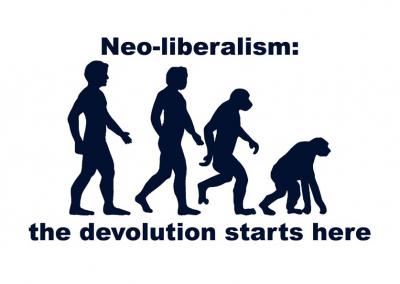
neo_liberalism_devolution_via_permanentculturenow.com_

The rage driving our politics stems from cruelty of capitalism. So why do we vote for those who worship the market?

By Anis Shivani

Source: AlterNet

Over the last fifteen years, editors often asked me not to mention the word “neoliberalism,” because I was told readers wouldn’t comprehend the “jargon.” This has begun to change recently, as the terminology has come into wider usage, though it remains shrouded in great mystery.

People throw the term around loosely, as they do with “fascism,” with the same confounding results. Imagine living under fascism or communism, or earlier, classical liberalism, and not being allowed to acknowledge that particular frame of reference to understand economic and social issues. Imagine living under Stalin and never using the communist framework but focusing only on personality clashes between his lieutenants, or likewise for Hitler or Mussolini or Mao or Franco and their ideological systems! But this curious silence, this looking away from ideology, is exactly what has been happening for a quarter century, since neoliberalism, already under way since the early 1970s, got turbocharged by the Democratic party under the Democratic Leadership Council (DLC) and Bill Clinton. We live under an ideology that has not been widely named or defined!

Absent the neoliberal framework, we simply cannot grasp what is good or bad for citizens under Cruz versus Trump, or Clinton versus Sanders, or Clinton versus Trump, away from the distraction of personalities. To what extent does each of them agree or disagree with neoliberalism? Are there important differences? How much is Sanders a deviation? Can we still rely on conventional distinctions like liberal versus conservative, or Democrat versus Republican, to understand what is going on? How do we grasp movements like the Tea Party, Occupy, and now the Trump and Sanders insurgencies?

Neoliberalism has been more successful than most past ideologies in redefining subjectivity, in making people alter their sense of themselves, their personhood, their identities, their hopes and expectations and dreams and idealizations. Classical liberalism was successful too, for two and a half centuries, in people’s self-definition, although communism and fascism succeeded less well in realizing the “new man.”

It cannot be emphasized enough that neoliberalism is not classical liberalism, or a return to a purer version of it, as is commonly misunderstood; it is a new thing, because the market, for one thing, is not at all free and untethered and dynamic in the sense that classical liberalism idealized it. Neoliberalism presumes a strong state, working only for the benefit of the wealthy, and as such it has little pretence to neutrality and universality, unlike the classical liberal state.

I would go so far as to say that neoliberalism is the final completion of capitalism’s long-nascent project, in that the desire to transform everything—every object, every living thing, every fact on the planet—in its image had not been realized to the same extent by any preceding ideology. Neoliberalism happens to be the ideology—unlike the three major forerunners in the last 250 years—that has the fortune of coinciding with technological change on a scale that makes its complete penetration into every realm of being a possibility for the first time in human history.

From the early 1930s, when the Great Depression threatened the classical liberal consensus (the idea that markets were self-regulating, and the state should play no more than a night-watchman role), until the early 1970s, when global instability including currency chaos unraveled it, the democratic world lived under the Keynesian paradigm: markets were understood to be inherently unstable, and the interventionist hand of government, in the form of countercyclical policy, was necessary to make capitalism work, otherwise the economy had a tendency to get out of whack and crash.

It’s an interesting question if it was the stagflation of the 1970s, following the unhitching of the United States from the gold standard and the arrival of the oil embargo, that brought on the neoliberal revolution, with Milton Friedman discrediting fiscal policy and advocating a by-the-numbers monetarist policy, or if it was neoliberalism itself, in the form of Friedmanite ideas that the Nixon administration was already pursuing, that made stagflation and the end of Keynesianism inevitable.

It should be said that neoliberalism thrives on prompting crisis after crisis, and has proven more adept than previous ideologies at exploiting these crises to its benefit, which then makes the situation worse, so that each succeeding crisis only erodes the power of the working class and makes the wealthy wealthier. There is a certain self-fulfilling aura to neoliberalism, couched in the jargon of economic orthodoxy, that has remained immune from political criticism, because of the dogma that was perpetuated—by Margaret Thatcher and her acolytes—that There Is No Alternative (TINA).

Neoliberalism is excused for the crises it repeatedly brings on—one can think of a regular cycle of debt and speculation-fueled emergencies in the last forty years, such as the developing country debt overhang of the 1970s, the savings and loan crisis of the 1980s, the Asian currency crisis of the 1990s, and the subprime mortgage crisis of the 2000s—better than any ideology I know of. This is partly because its very existence as ruling ideology is not even noted by the population at large, which continues to derive some residual benefits from the welfare state inaugurated by Keynesianism but has been led to believe by neoliberal ideologues to think of their reliance on government as worthy of provoking guilt, shame, and melancholy, rather than something to which they have legitimate claim.

It is not surprising to find neoliberal multiculturalists—comfortably established in the academy—likewise demonizing, or othering, not Muslims, Mexicans, or African Americans, but working-class whites (the quintessential Trump proletariat) who have a difficult time accepting the fluidity of self-definition that goes well with neoliberalism, something that we might call the market capitalization of the self.

George W. Bush’s useful function was to introduce necessary crisis into a system that had grown too stable for its own good; he injected desirable panic, which served as fuel to the fire of the neoliberal revolution. Trump is an apostate—at least until now—in desiring chaos on terms that do not sound neoliberal, which is unacceptable; hence Jeb Bush’s characterization of him as the “candidate of chaos.” Neoliberalism loves chaos, that has been its modus operandi since the early 1970s, but only the kind of chaos it can direct and control.

To go back to origins, the Great Depression only ended conclusively with the onset of the second world war, after which Keynesianism had the upper hand for thirty-five years. But just as the global institutions of Keynesianism, specifically the IMF and the World Bank, were being founded at the New Hampshire resort of Bretton Woods in 1944, the founders of the neoliberal revolution, namely Friedrich Hayek, Ludwig von Mises, Milton Friedman, and others were forming the Mount Pelerin Society (MPS) at the eponymous Swiss resort in 1947, creating the ideology which eventually defeated Keynesianism and gained the upper hand during the 1970s.

So what exactly is neoliberalism, and how is it different from classical liberalism, whose final manifestation came under Keynesianism?

Neoliberalism believes that markets are self-sufficient unto themselves, that they do not need regulation, and that they are the best guarantors of human welfare. Everything that promotes the market, i.e., privatization, deregulation, mobility of finance and capital, abandonment of government-provided social welfare, and the reconception of human beings as human capital, needs to be encouraged, while everything that supposedly diminishes the market, i.e., government services, regulation, restrictions on finance and capital, and conceptualization of human beings in transcendent terms, is to be discouraged.

When Hillary Clinton frequently retorts—in response to demands for reregulation of finance, for instance—that we have to abide by “the rule of law,” this reflects a particular understanding of the law, the law as embodying the sense of the market, the law after it has undergone a revolution of reinterpretation in purely economic terms. In this revolution of the law persons have no status compared to corporations, nation-states are on their way out, and everything in turn dissolves before the abstraction called the market.

One way to sum up neoliberalism is to say that everything—everything—is to be made over in the image of the market, including the state, civil society, and of course human beings. Democracy becomes reinterpreted as the market, and politics succumbs to neoliberal economic theory, so we are speaking of the end of democratic politics as we have known it for two and a half centuries. As the market becomes an abstraction, so does democracy, but the real playing field is somewhere else, in the realm of actual economic exchange—which isnot, however, the market. We may say that all exchange takes place on the neoliberal surface.

Neoliberalism is often described—and this creates a lot of confusion—as “market fundamentalism,” and while this may be true for neoliberal’s self-promotion and self-presentation, i.e., the market as the ultimate and only myth, as were the gods of the past, I would argue that in neoliberalism there is no such thing as the market as we have understood it from previous ideologies.

The neoliberal state—actually, to utter the word state seems insufficient here, I would claim that a new entity is being created, which is not the state as we have known it, but an existence that incorporates potentially all the states in the world and is something that exceeds their sum—is all-powerful, it seeks to leave no space for individual self-conception in the way that classical liberalism, and even communism and fascism to some degree, were willing to allow.

There are competing understandings of neoliberal globalization, when it comes to the question of whether the state is strong or weak compared to the primary agent of globalization, i.e., the corporation, but I am taking this logic further, I am suggesting that the issue is not how strong the state is in the service of neoliberalism, but whether there is anything left over beyond the new definition of the state. Another way to say it is that the state has become the market, the market has become the state, and therefore both have ceased to exist in the form we have classically understood them.

Of course the word hasn’t gotten around to the people yet, hence all the confusion about whether Hillary Clinton is more neoliberal than Barack Obama, or whether Donald Trump will be less neoliberal than Hillary Clinton. The project of neoliberalism—i.e., the redefinition of the state, the institutions of society, and the self—has come so far along that neoliberalism is almost beyond the need of individual entities to make or break its case. Its penetration has gone too deep, and none of the democratic figureheads that come forward can fundamentally question its efficacy.

I said almost. The reason why Bernie Sanders, self-declared democratic socialist, is so threatening to neoliberalism is that he has articulated a conception of the state, civil society, and the self that is not founded in the efficacy and rationality of the market. He does not believe—unlike Hillary Clinton—that the market can tackle climate change or income inequality or unfair health and education outcomes or racial injustice, all of which Clinton propagates. Clinton’s impending “victory” (whatever machinations were involved in engineering it) will only strengthen neoliberalism, as the force that couldn’t be defeated even when the movement was as large and transcendent as Sanders’s. Although Sanders doesn’t specify “neoliberalism” as the antagonist, his entire discourse presumes it.

Likewise, while Trump supporters want to take their rebellion in a fascist direction, their discomfort with the logic of the market is as pervasive as the Sanders camp, and is an advance, I believe, over the debt and unemployment melancholy of the Tea Party, the shame that was associated with that movement’s loss of identity as bourgeois capitalists in an age of neoliberal globalization. The Trump supporters, I believe, are no longer driven by shame, as was true of the Tea Party, and as has been true of the various dissenting movements within the Republican party, evangelical or otherwise, in the recent past. Rather, they have taken the shackles off and are ready for a no-holds barred “politically incorrect” fight with all others: they want to be “winners,” even at the cost of exterminating others, and that is not the neoliberal way, which doesn’t acknowledge that there can be winners and losers in the neoliberal hyperspace.

In the current election campaign, Hillary Clinton has been the most perfect embodiment of neoliberalism among all the candidates, she is almost its all-time ideal avatar, and I believe this explains, even if not articulated this way, the widespread discomfort among the populace toward her ascendancy. People can perceive that her ideology is founded on a conception of human beings striving relentlessly to become human capital (as her opening campaign commercialso overtly depicted), which means that those who fail to come within the purview of neoliberalism should be rigorously ostracized, punished, and excluded.

This is the dark side of neoliberalism’s ideological arm (a multiculturalism founded on human beings as capital), which is why this project has become increasingly associated with suppression of free speech and intolerance of those who refuse to go along with the kind of identity politics neoliberalism promotes.

And this explains why the 1990s saw the simultaneous and absolutely parallel rise, under the Clintons, of both neoliberal globalization and various regimes of neoliberal disciplining, such as the shaming and exclusion of former welfare recipients (every able-bodied person should be able to find work, therefore under TANF welfare was converted to a performance management system designed to enroll everyone in the workforce, even if it meant below-subsistence wages or the loss of parental responsibilities, all of it couched in the jargon of marketplace incentives).

The actual cost to the state of the AFDC program was minimal, but its symbolism was incalculable. The end of welfare went hand in hand with the disciplinary “crime bill” pushed by the Clintons, leading to an epidemic of mass incarceration. Neoliberalism, unlike classical liberalism, does not permit a fluidity of self-expression as an occasional participant in the market, and posits prison as the only available alternative for anyone not willing to conceive of themselves as being present fully and always in the market.

I believe that the generation of people—in their forties or older—supporting Hillary have already internalized neoliberal subjectivity, which they like to frame as realism or pragmatism, refusing for instance to accept that free college or health care are even theoretical possibilities. After all, they have maintained a measure of success in the past three or four decades after conceptualizing themselves as marketplace agents. Just as the Tea Party supporters found it intolerable that government should help irresponsible homeowners by bailing them out of unsustainable debt, the Clinton supporters hold essentially the same set of beliefs toward those who dare to think of themselves outside the discipline of the market.

I spoke of the myth of the market, as something that has no existence in reality, because none of the elements that would have to exist for a market to work are actually in place; this is even more true for neoliberalism than it was for the self-conscious annihilation of the market by communism, because at least in that system the market, surreptitiously, as in various Eastern European countries, kept making an appearance. But when the market takes neoliberal shape, i.e., the classical conceptions of the buyer and seller as free agents are gone, then radical inequality is the natural outcome. And inequality in the last four decades, as statistics for the U.S. and everywhere neoliberalism has made inroads prove beyond a doubt, has exploded, thereby invalidating neoliberalism’s greatest claim to legitimacy, that it brings about a general increase in welfare. So neoliberalism, to the extent that the inequality discourse has made itself manifest recently, must insist all the more vocally on forms of social recognition, what Clinton, for example, likes to call the “fall of barriers.”

Neoliberalism likes to focus on public debt—in the Clinton years debt reduction became a mania, though George W. Bush promptly spent all the accumulated surpluses on tax cuts for the wealthy and on wars of choice—rather than inequality, because the only way to address inequality is through a different understanding of public debt; inequality can only be addressed through higher taxation, which has by now been excluded from the realm of acceptable discourse—except when Sanders, Trump, or Jeremy Corbyn in England go off script.

So to recapitulate neoliberalism’s comprehensive success, let us note that we have gone from a liberal, Keynesian, welfare state to a neoliberal, market-compliant, disciplinary state.

Neoliberalism expects—and education at every level has been redesigned to promote this—that economic decision-making will be applied to all areas of life (parenthood, intimacy, sexuality, and identity in any of its forms), and that those who do not do so will be subject to discipline. Everyone must invest in their own future, and not pose a burden to the state or anyone else, otherwise they will be refused recognition as human beings.

This supposed economic “rationality” (though it is the greatest form of irrationality) applies to civil society as much as the state, so that none of the ideals of classical liberalism, or previous ideologies rooted in humanism, are valid any longer, the only value is the iteration of the market (as myth, not reality); in other words, neoliberalism, unlike the elevation of the individual in classical liberalism or the state in fascism or the collectivity in communism, has erected something, the market, that has no real existence, as the only god to serve! And it is just like a god, with an ethereal, unchallengeable, irrefutable, ubiquitous presence. Whatever in state policy does not serve market-conformity is to be banned and banished from memory (the secular scriptures are to be rewritten), which explains neoliberalism’s radical narrowing of public discourse, including the severance of identity politics from any class foundation.

Neoliberalism will continue to perpetuate reduced opportunity, because one of its characteristics—as in any system that wants to thrive on the world stage—is to constantly refine the field upon which the human subject can operate.

As such, those displaced workers who have suffered the most from the erosion of the old industries in the former manufacturing centers of the world are not even factors to contend with, they are invisible and cannot be part of the policy equation. To the extent that their actual presence is reckoned with, the economy can be said to have crashed; but the problem doesn’t arise because of the management of unemployment or underemployment statistics, unlike a housing crash which is palpable and cannot escape statistical definition.

The danger for neoliberalism—as is clear from the support of millions of displaced human beings for Trump—is that with each crisis neoliberalism sheds more workers, makes individuals and firms more “disciplined,” narrows the scope of opportunity even further. At times, the disciplining of the non-neoliberal other—as with the killing of Michael Brown or Eric Garner—explodes to surface consciousness in an unsavory way, so an expert manager like Clinton or Obama is required to tamp down the emotions of such unruly entities as Black Lives Matter which arise in response. If climate change, according to Clinton and her cohort, can and should have market solutions, then surely racial disparity, or police violence, should also have market solutions and no others; it is here that neoliberal multiculturalism, operating in the academy, is so insidious, because at the elite level it functions to validate market discourse, it does not step outside it.

The present breakdown of both major political parties can be explained by the frustration that has built up in the body politic over the past decade, because after the crash there was no sustained intellectual movement to question the myth of the market. The substitution of economic justice with identity politics is something Ralph Nader, Howard Dean, and now Bernie Sanders have contested in a humane manner, while the same process is at work, admittedly in an inhumane way, in the Trump phenomenon.

Thus, also, Hillary Clinton’s animus against free college education; that form of expansion of opportunity, which was a reality from the 1950s to the 1980s, cannot be allowed to return, human beings are supposed to invest in their own future earnings potential, they are not entitled to a transcendent experience without barriers manifesting in discipline and self-correction. Education, like everything else, including one’s own health, becomes an expensive consumer good, not a right, no longer an experience that might lead to a consciousness beyond the market but something that should be fully encapsulated by the market. If one is a capable market player, education as we have classically understood it becomes redundant.

Unlike the interregnum between 1945-1973, the rising tide—no matter the befuddlements Arthur Laffer and his fellow Reaganite ideologues proffered—does not lift all boats today, it is outside the logic of neoliberalism that it do so, so the idea of reforming neoliberalism, or what is often called “globalization with a human face,” is a rhetorical distraction. All of the policy innovations—interpreted as “socialism” by the Tea Partiers—offered by Barack Obama fall within the purview of neoliberalism, above all the Affordable Care Act, whose genesis was hatched in neoliberal think tanks decades ago.

It is important to note that neoliberal economic restructuring necessarily means social restructuring, i.e., a movement toward disciplinarity and away from liberalism; the disciplinarity can take a Bushian, Clintonian, or Trumpian form, but these are manifestations of the same tendency.

When wage growth is decoupled from economic growth (as it has been since Friedman and others inaugurated the revolution in the early 1970s), this means that the human subject is ripe for discipline. Furthermore, wage fairness cannot be rationally discussed (hence the obfuscation surrounding the $15 minimum wage orchestrated by Clinton and others) because the concept of the market has been disembedded from society; the market as abstraction, not a concrete reality, makes any notion of reform or restructuring impossible. Like the minimum wage, something like free child care also remains outside the bounds of discourse, because public policy cannot accommodate discussions that do not take the self-regulating market as unassailable myth.

What neoliberalism can accommodate is relentless tax cuts (Trump has already offered his huge tax cut plan, as Bush did as his first order of business), which only exacerbate the problem, leading to increasing concentrations of wealth. It has to be said, though, that Ted Cruz more comfortably fit the neoliberal paradigm, with his familiar calls for lower taxes along with reduced regulation and further limits on social welfare, whereas Trump shows, for now, some elements of apostasy. If neoliberalism were to get a Cruz, it would have no problem working with him, or rather, Cruz would have had no problem executing neoliberalism, beyond the surface dissimilarities from Hillary Clinton.

As Sanders has consistently noted, economic inequality leads to political inequality, which means that democracy, after a certain point, becomes only theoretical (viz. Citizens United and the electoral influence of such powerful entities as the Koch brothers). Both processes—economic inequality and political inequality—have accelerated after each downturn in the forty-five-year history of neoliberalism, therefore a downturn is always exciting, and even preordained, for a Bush, a Trump, or a Clinton. Again, economic inequality and political polarity (polarity is simply a manifestation of democracy having become dysfunctional) strongly correlate, and both have come to a head in this election.

Neoliberalism’s task, from this point on, is to mask and manage the increasing inequalities that are likely to befall humanity, especially as the planet reaches a crisis point in its health. In a way, George W. Bush threw a wrench—he was a perverted Keynesian in a way, believing in war to prime the pump, or inflating unsustainable bubbles, or spending exorbitantly on grandiose gestures—into the process of neoliberal globalization that was going very smoothly indeed under Bill Clinton and would likely have flourished under Al Gore as well. With Hillary Clinton, the movement will be toward further privatization of social welfare, “reforming” it along market principles, as has been true of every neoliberal avatar, whether it was Bill Clinton’s incentives to work in the performance management makeover of welfare, George Bush’s proposed private social security accounts, Mitt Romney’s proposed private health care accounts, or the school vouchers that tempt all of them from time to time.

What remains to be seen is the extent to which the millennial generation might be capable of thinking outside the neoliberal paradigm, i.e., they don’t just want more of what neoliberal promises to give them yet fails to deliver, but want things that neoliberalism does not or cannot promise. On this rests the near-term future of the neoliberal project.

Beyond Sanders himself, the key question is the ability of the millennial generation to conceive of themselves outside the neoliberal subjectivity they have been pushed to internalize. They have been encouraged to think of themselves as capital producers, turning their intellectuality into social media popularity for the benefit of capital, in the service of the same abstract market that has no place, no role, no definition beyond the fallen liberal calculus. Does the millennial generation believe, even about its most intimate core, that everything has been privatized?

I am not necessarily making a pessimistic prediction. I am merely outlining the strength of an opponent that has refused to be named for forty-five years, although it has been the ruling ideology that long! In defining neoliberalism, I have sought to distance myself from the distraction of personalities, and tried to expose the dark side of our politics which we can only see when we name and understand the ideology as such. We are up against a system that is so strong that it has survived, for the most part, the last crash, as citizens couldn’t get their heads around the idea of nationalizing banks or health care.

It is existentially imperative to ponder what happens beyond Sanders, because neoliberalism has its end-game in sight, letting inequality continue to escalate past the crash point (meaning the point where the economy works for most people), past any tolerable degradation of the planet (which is being reconceptualized in the shape of the market).

What, indeed, does happen beyond Sanders, because as we have seen Hillary Clinton is one of the founders of neoliberal globalization, one of its central historical figures (having accelerated the warehousing of the poor, the attack on trade unions, and the end of welfare and of regulatory prowess), while Trump is an authoritarian figure whose conceptions of the state and of human beings within the state are inconsistent with the surface frictionlessness neoliberalism desires? To go back to Hillary Clinton’s opening campaign commercial, to what extent will Americans continue to believe that the self must be entrepreneurially leveraged toward maximum market gains, molded into mobile human capital ever ready to serve the highest bidder?

As to whether a non-neoliberal globalization is possible and what that might look like on the international stage after a quarter-century of Clinton, Bush, and Obama—which is essentially the frustration Trump is tapping into—I’ll take that up in a follow-up essay, which will further clarify the differences between Sanders versus Clinton, and Trump versus Clinton.

I would suggest that it is not that globalization causes or has caused neoliberalism, but that neoliberalism has pushed a certain form of globalization that suits its interests. This is a crucial distinction, on which everything else hinges. The neoliberal market doesn’t actually exist; at the moment it is pure abstraction; what is actually filling up economic and political space can only be discussed when we step away from this abstraction, as Sanders has so ably done, and as the Occupy and Black Lives Matter movements tentatively set in motion.

 

Anis Shivani is the author of several books of fiction, poetry, and criticism, including, most recently, My Tranquil War and Other Poems. His novel Karachi Raj (HarperCollins/Fourth Estate) was released this summer. His next book is the poetry collection Whatever Speaks on Behalf of Hashish, out in October.

A ‘Brexit’ Blow to the Establishment

Brexit_Run_620x350

By Robert Parry

Source: Consortium News

The United Kingdom’s “Brexit” vote may cause short-term economic pain and present long-term geopolitical risks, but it is a splash of ice water in the face of the West’s Establishment, which has grown more and more insular, elitist and unaccountable over recent decades.

The West’s powers-that-be, in both the United States and the European Union, too often display contempt for real democracy, maintaining only the façade of respecting the popular will, manipulating voters at election time with red-meat politics and empty promises – before getting back to the business of comforting the comfortable and letting the comfortable afflict the afflicted.

That has been the grim and tiresome reality with America’s two parties and with the E.U.’s bureaucrats. The average American and the average European have every reason to see themselves as a lesser concern to the politicians and the pundits than the special interests which pay the money and call the tune.

In the stunning “Brexit” vote – with 52 percent wanting to abandon the 28-nation European Union – U.K. voters rejected the West’s politics-as-usual despite dire warnings about the downsides of leaving. They voted, in effect, to assert their own nationalistic needs and aspirations over a commitment to continental unity and its more universal goals.

But, in the vote, there was also a recognition that the West’s Establishment has grown corrupt and arrogant, routinely imposing on the people “experts” who claim to be neutral technocrats or objective scholars but whose pockets are lined with fat pay checks from “prestigious” think tanks funded by the Military-Industrial Complex or by lucrative revolving-door trips to investment banks on Wall Street or The City.

Despite the Establishment’s self-image as a “meritocracy,” its corrupted experts and haughty bureaucrats don’t even demonstrate basic competence anymore. They have led Europe and the United States into catastrophe after catastrophe, both economically and geopolitically. And, there is another troubling feature of this Establishment: its lack of accountability.

In the United States, the rewards and punishments have been turned upside-down, with the benighted politicians and pundits who pushed for the Iraq War in 2003 still dominating the government and the media, from Hillary Clinton’s impending Democratic presidential nomination to the editorial pages of The New York Times and The Washington Post.

And, the Iraq War disaster was not a one-off affair. The neocons and their liberal interventionist sidekicks have their fingerprints on other “regime change” messes, from Libya to Ukraine to Syria (still in the works), with their predictable recommendations for more violence and more belligerence. Yet, they have impunity for their crimes and incompetence. They fail up.

Establishment Doesn’t Know Best

So, the West’s Establishment can’t even argue that it knows best anymore, which always had been its ace in the hole. The various insurgents could be painted as the dangerous option – and that is sometimes true as we’ve seen with Donald Trump – but it is arguably a toss-up as to whether Clinton or Trump would be the bigger risk to the world’s future.

Trump may be a blustering buffoon but he challenges the neocon “group thinks” about the wisdom of expanding the West’s war in Syria and launching a costly and existentially risky New Cold War against nuclear-armed Russia and China. Clinton surrounds herself with neocons and liberal hawks and shares their obsession with overthrowing the government of Syria and provoking Russia and China with military operations near their borders.

Trump and “Brexit” advocates also reject the Establishment’s neoliberal consensus on “free trade,” which has depressed (or eliminated) the wages of American and European workers while the benefits accrue mostly to financial and political elites. The Establishment’s embrace of the “winners” and its disdain for the “losers” have further enflamed today’s populism.

Yet, there are undeniably ugly features in the populist sentiment sweeping the U.S. and Europe. Some of it is driven by bigotry toward non-whites, especially immigrants. Some is inspired by wild conspiracy theories from a population that has understandably lost all faith in what it hears from Washington, Brussels and other capitals. Trump has espoused the scary know-nothing notion that the scientific evidence of global warming is “a hoax.”

There is always something unsettling when an incipient revolution takes shape and starts tearing down the old order. What follows is not always better.

In the end, the American election – like the “Brexit” referendum – may come down to whether voters feel more comfortable sticking with the status quo at least for a while longer or whether they want to blow up the Establishment and gamble on the consequences.

Right now, Clinton and the Democrats are carrying the banner of the Establishment, while Trump and his Republican insurgents fly the Jolly Roger. In a political year when the anti-establishment wave seems to be cresting, the Democrats may regret their choice of a legacy, status-quo candidate.


[For more on this topic, see Consortiumnews.com’s “Two Corrupt Establishments”; “Democrats – Too Clever by Half on Clinton”; “The Coming Democratic Crack-up”; “Neocons and Neolibs: How Dead Ideas Kill“; and “The State Department’s Collective Madness.”]

Investigative reporter Robert Parry broke many of the Iran-Contra stories for The Associated Press and Newsweek in the 1980s. You can buy his latest book, America’s Stolen Narrative, either in print here or as an e-book (from Amazon and barnesandnoble.com).

Related Articles:

¡Basta Ya, Brussels! British Voters Reject EU Corporate Slavestate

Global Elite Makes Good on Threats to “Make All of You Poorer” After Britain Independence

Where is the UK Heading Now Due to Cameron’s Policies?

Related Videos: