
Social Media and the Society of the Spectacle

By Kenn Orphan

Source: CounterPunch

“The reigning economic system is a vicious circle of isolation. Its technologies are based on isolation, and they contribute to that same isolation. From automobiles to television, the goods that the spectacular system chooses to produce also serve it as weapons for constantly reinforcing the conditions that engender “lonely crowds.”

― Guy Debord, The Society of the Spectacle

“The conscious and intelligent manipulation of the organized habits and opinions of the masses is an important element in democratic society. Those who manipulate this unseen mechanism of society constitute an invisible government which is the true ruling power of our country. We are governed, our minds are molded, our tastes formed, our ideas suggested, largely by men we have never heard of. This is a logical result of the way in which our democratic society is organized. Vast numbers of human beings must cooperate in this manner if they are to live together as a smoothly functioning society.”

― Edward Bernays, Propaganda

“We think we’re searching Google; Google is actually searching us. We think that these companies have privacy policies; those policies are actually surveillance policies. We’re told that if we have nothing to hide, then we have nothing to fear. The fact is, what they don’t tell us and what we are forgetting, that if you have nothing to hide, then you are nothing, because everything about us that makes us our unique identities, that gives us our individual spirit, our personality, our sense of freedom of will, freedom of action, our sense of our right to our own futures, that’s what comes from within. Those are our inner resources. That’s our private realm. And it’s intended to be private for a reason, because that is how it grows and flourishes and turns us into people who assert moral autonomy—an essential element of a flourishing, democratic society.”

― Shoshana Zuboff, author of Master or Slave: The Fight for the Soul of Our Information Civilization 

“Under observation, we act less free, which means we effectively are less free.”

― Edward Snowden

Recently I was rereading some of Guy Debord’s The Society of the Spectacle. I was reminded of how essential this work by the late French Marxist philosopher is to today’s age of social media. Debord’s understanding of how the forces of capital shape our collective experiences and thoughts speaks to our time where algorithms dominate the trajectory of the psyche against a craven backdrop of what political philosopher Sheldon Wolin has described as “inverted totalitarianism.”

Every day we are bombarded with the imagery of empire and capital. It is relentless. Our minds have become both a marketplace and a commodity to be traded. And it is a lucrative industry with Facebook and Google as prime examples. Their data collection and surveillance typify a conjoining of the state and capitalist economy; and they have carved out insidious new spaces in the human brain to coerce self-imposed censorship and conformity to the prevailing consumerist global order.

This social conditioning is a process which requires mass compliance. The infamous propagandist for industry and vaunted “father of public relations” Edward Bernays understood that. It takes time to manipulate the multilayered strata of the human psyche, especially in regard to large populations of people. But history is replete with tragic examples of its successful implementation by powerful interests. Today those interests lie squarely with capital and empire; but the effects are the same, distraction, censorship, alienation, coerced, compliance with the norms of the status quo and the numbing of the critical mind.

Debord said, “Such a perfect democracy constructs its own inconceivable foe, terrorism. Its wish is to be judged by its enemies rather than by its results. The story of terrorism is written by the state and it is therefore highly instructive. The spectating populations must certainly never know everything about terrorism, but they must always know enough to convince them that, compared with terrorism, everything else seems rather acceptable, or in any case more rational and democratic.” This profound observation is even more important today. The state, via mass media, informs us of the villains and phantoms they believe we should fear. Other, far more destructive, deadly and oppressive threats such as the continued proliferation of nuclear arms, catastrophic climate change, collapse of ecosystems, dangers to public health from industrial pollutants, vastly unequal, racist and brutal economic and legal systems, militarism or plutocratic tyranny can then be relegated as non-issues, or at least lesser ones.

Most people on the planet will not suffer or die from a terrorist attack, but they are very likely to be severely affected by the other issues mentioned above. Imagery on portable screens that virtually everyone in the West and around the world has access to communicates messages that may speak to some of these dire or existential problems, but they do so in an abstract manner that divorces the observer from the subject.

As Debord observed, this kind of culture of spectacle informs our personal relationships as well. Whether one is “present” on social media or not has become a sort of litmus test of ones presence in life itself. “Likes” or emojis have replaced and truncated language to such an extent that now older forms of communication are often looked at with novelty, suspicion, or even disgust. What’s more is that emojis in social media, particularly Facebook, have been employed all too often as tools of ridicule or even harassment of weak or vulnerable people. But what is perhaps the most striking about the current social media age is its repetitive narrative of self-aggrandizement. One so repetitive and hypnotic that it almost appears invisible. The “selfie” and “status update” are examples of the unending drive of social media to create a false sense of self to present to the world. Of course this self must conform and be well adjusted to consumerist society in one form or another lest it be tagged for “mental health issues,” subversive thought or behavior, or simply be rendered unnoticed or unimportant by society in general.

Indeed, I am certain Debord would be horrified at the age of social media. At no other time in human history has there been a greater confluence of authoritarian dominance or social control implemented in such an intimate and ubiquitous manner. Unlike Debord’s time, social media provides a new medium to not only socially condition the masses but for the corporate state to gather what was once private information about those masses via their personally owned devices and apps.

That it masquerades as a form of democracy is equally disturbing, especially since at its core it represents the policing of thought and dampening of dissent. He wrote as if penning a prophecy: “The spectator’s consciousness, imprisoned in a flattened universe, bound by the screen of the spectacle behind which his life has been deported, knows only the fictional speakers who unilaterally surround him with their commodities and the politics of their commodities. The spectacle, in its entirety, is his “mirror image.””

This spectacle reigns supreme in today’s social media culture. It is essential to its formulation and operating guidelines. Under such a paradigm history must be sterilized of analysis and ultimately atomized into unrelated instances to make an eternal present, divorced from any transformative potential. Therefore corporations and industries which have long records of polluting the environment or lying to the public about the safety of their products can continue to expand and even be celebrated by the corporate owned media. Religious institutions with long histories of abuse, patriarchy and repression can maintain their status as trusted institutions. The military can repeat the lie over and over that it is noble despite a history drenched in the blood of well documented atrocities and ongoing crimes. The United States and many other nations can keep calling themselves democracies despite quite obvious facts that strongly refute that designation. The mere notion of revolution then is made to be farcical or even dangerous. After all, how could revolution ever be seen as necessary within a democracy?

Social media does not necessarily signal the death of democratic freedom, but in its current form and under the aegis of capital it is certainly a nail in its coffin. This is because under such circumstances it is incapable of being anything other than a means for capital accumulation for the corporate state and a platform for its narrative, and it will do this through ever more invasive, censorial and repressive means. As Edward Snowden pointed out, people are less free when they feel that they are being observed. This is especially so when the observer is the state. Several studies have indicated that there is a sharp decline in certain online searches among the general public following any indication that government agencies are logging those searches, even if those citizens have not committed any crime. And the chilling effect is not unfounded. One incident involved an innocent couple who were visited by counter-terrorism police after searching Google for pressure cookers and backpacks. Since the internet has become the world’s public library, the implications for democracy are as dire as they are clear.

Unplugging from any of this isn’t easy, nor is it necessarily virtuous, but there are ways to divest from its social control personally and collectively. There are also ways to use it which defy its dominant algorithms. Détournement, which merely means rerouting or hijacking in French, is one of those ways. This involves inverting the imagery or messages of capital and empire to illustrate and even amplify their mendacity. It has a long history of effective use in bending the dominant narrative to one which reflects reality.

All of this is not to say that technology or social media are inherently bad, but to recognize that much of it has become a vehicle for a rather pernicious authoritarianism. And its danger lies in the fallacy of its benign appearance. Whether it be Google maps or one of countless other “helpful” apps one uses on a daily basis, surveillance capital becomes a means of controlling behavior, transactions, choices, as well as determining which members of society present a threat to the order. In other words, conformity is strongly reinforced while any form of dissent is rendered dangerously subversive. But although the algorithmic maps to our collective psyche are being endlessly drawn by programmers and their corporate and state masters, we still have the agency to navigate these landscapes with our eyes open. And indeed, the best tool we possess will always be that critically informed dissent the powerful so fear the most.
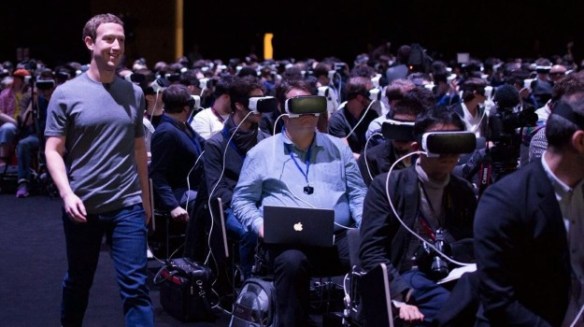
Algorithmic Control and the Revolution of Desire

zuckerberg_VR_people-625x350

By Alfie Brown

Source: ROAR Magazine

Last year, Stanford University published a study confirming what many of us may long have suspected: that your computer can predict what you want with more accuracy than your spouse or your friends. Your digital footprint betrays the truth not only about what you “like” but about what you really like — or so the argument goes. But what if our digital footprints, besides revealing our desires, are also responsible for the very construction of these desires? If that were the case, we would need to display a far deeper level of suspicion towards the complex patterns of corporate and state control found in contemporary cyberspace.

There is little doubt that innovations in mobile technologies are part of emerging methodologies of social control. In particular, games and applications that make use of the Google Maps back-end system — including Uber, Grindr, Pokémon Go and hundreds of others — which should be seen as one of the most important technological developments of the last decade or so, are particularly complicit in these new regulatory practices. Putting the well-publicized data collection issue aside, such applications have two powerful ideological functions. First, they construct the new “geographical contours” of the city, regulating the paths we take and mapping the city in the service of both corporate interest and the prevention of uprisings. Second, and more unconsciously, they enact what Jean-Francois Lyotard once called the “desirevolution” — an evolution and revolution of desire, in which that what we want is itself now determined by the digital paths we tread.

The Psycho-Geographical Contours of the City 

In 1981, the French theorist Guy Debord famously wrote of the “psycho-geographical contours” of the city that govern the routes we take, even when we may feel we are wandering freely around the physical space. At that time, it was Debord’s topic — architecture — that was the dominant force in re-organizing our routes through the city. Today, however, that role is increasingly taken up by the mobile phone. It is Uber that dictates the path of your taxi, Maps that dictates the route of your walks and drives, and Pokémon Go that (for a summer at least) determined where the next crowd would gather.

Other similar map-based application programing interfaces, or APIs, dictate our jogging routes (MapMyRun), our recreational hikes (LiveTrekker) and our tourist activities (TripAdvisor Guides). Pokémon Go attracted some publicity because it accidentally and humorously gathered crowds in weird places, but this should only alert us to its potential ability to gather crowds in the right places (to serve corporate interest) or to prevent the gathering of crowds in the wrong ones (to prevent organized uprisings, for instance). Such applications should be seen as a testing phase in the project of Google and its affiliated corporations as they work out how best to regulate the movements of large populations via their phones. Pokémon Go players were the early cyborgs, complete with hiccups and malfunctions — a beta version of Google’s future human. These future humans will go where instructed.

On a smaller scale, this point can be seen in concrete terms with a case study of London. A recent Transport for London talk discussed the possibility of “gamifying” commuting. In order to facilitate this possibility, Transport for London have made the internet API and data streams used to monitor all London Transport vehicles open source and open access, in the hope that developers will build London-focused apps based around the public transport system, thus maximizing profit. One idea is that if a particular tube station is at risk of becoming clogged up due to other delays, TfL could give “in-game rewards” for people willing to use alternative routes and thus smooth out the jam.

While traffic jam prevention may not seem like evidence that we have arrived in the dystopia of total corporate and state control, it does actually reveal the dangerous potentiality in such technologies. It shows that the UK is not as far away from the “social credit” game system recently implemented in Beijing to rate each citizen’s trustworthiness and give them rewards for their dedication to the Chinese state. While the UK media reacted with shock to these innovations in Chinese app development, a closer look at the electronic structures of mapping and controlling our own movements shows that a similar framework is already in its development phase in London too. In the “smart city” of the future, it won’t just be traffic jams that are smoothed out. Any inefficient misuse or any occupation of public space deemed dangerous by the authorities can be specifically targeted.

The Corporate Surveillance State

When it comes to these developments in technology, state and corporate forces work more closely with each other than ever before — and much more closely than they are willing to admit. Srećko Horvat has pointed out the short distance between the creators of Pokémon Go and Hillary Clinton, despite her odd and unsolicited recent public claim that she didn’t know who made the game. Likewise, Julian Assange’s strangely under-discussed 2014 book When Google Met WikiLeaks showed the shocking proximity of Google chief Eric Schmidt and the Washington state apparatus. In terms of surveillance and the use of big data, it has become impossible to sustain the distinction between state control and the production of wealth, since the two have become so irrevocably intertwined. As such, old arguments that “it’s all just about money” need to be treated with greater suspicion, since major firms today are so closely tied to the state. Various aspects of state organization should likewise be considered equally suspect because of their corporate underpinnings.

Of course, when it comes to the mapping applications that promise to help us access the best quality objects of our desire with the greatest efficiency and the least cost, these tempting forces of joint corporate and state control are entered into willingly by participants. As such, they require something else in order to function in the all-consuming way that they do. Far from simply channeling and transforming our movements, they also need to channel and even transform our desires.

We are now firmly within the world of the electronic object, where the mediation of everything from lovers and friends to meals and activities via our mobile phones and computers makes it virtually impossible to separate physical from electronic objectivity. Whilst the electronic Pokémon or the “in-game rewards” offered by many applications may not yet have the physicality of a lover who can be accessed via Tinder, or a burger that can be located via JustEat, the burger and the lover certainly have the electronic objectivity of the Pokémon. We can therefore see a transformation in the objects of desire taking place by and through our devices, so that we are confronted not only with a change in how we get what we want, but with a change in what we want in the first place.

Italo Calvino once wrote of the “amorous relationship” that “erases the lines between our bodies and sopa de frijoles, huachinango a la vera cruzana, and enchiladas.” While in such a moment food and lover become one in a kind of orgy of physical consumption, in the same novel Calvino warned of a time “when the olfactory alphabet, which made them so many words in a precious lexicon, is forgotten,” and in which “perfumes will be left speechless, inarticulate, illegible.”

It is this world that we find ourselves desiring in, where an orgy of electronic objects with no olfactory physicality blurs the distinction between lovers, meals and “in-game” rewards. The purpose of this shift, of course, is to increase the power of technological corporations by giving them a new sort of control over the way we relate to our objects of desire. If the boundaries between the way we search, desire and acquire our burgers, lovers and Pikachus are dissolving, it is not so much the old point that everything has become a commodity, but a new point that this kind of substitutional electronic objectivity endows corporate and state technologists with unprecedented power to distribute and redistribute the objects of the desire around the “smart city.”

Data Centralization in China and the West

There is, moreover, a significant centralization of power underpinning these developments. Like the social credit idea, the Chinese phenomenon of WeChat — developed in 2011 by Tencent, one of the largest internet and mobile media companies in the world — has received concerned media coverage in the West. WeChat is the first truly successful “SuperApp,” the basic premise of which is that all applications like WhatsApp, Facebook, Instagram, OpenRice, Tinder, TripAdvisor and many more, are rolled into one cohesive application. All for our convenience, of course.

As a result, however, there is now a new level of cohesion between the data-collection and movement monitoring going on in the mobile phone as a whole, where all data is now directly collected in a single place. More than half of the 1.1 billion WeChat users access the app over 10 times per day, and many users simply leave it on continuously, using it to map, shop, date and play. This means that the app sets a new precedent for continually monitoring the movements of a whole nation of citizens. WeChat’s incredibly strange “heat map” feature actually lets users — and authorities — see where crowds are forming. The claim is that this has nothing to do with crowd control: the objective is simply to help us access the least crowded shopping malls, doing nothing more than helping us get what we want.

WeChat is already the most popular social media application in China, but it will soon have huge significance worldwide, with an international version now available and many replica “SuperApps” in production. What the Western media finds to be so concerning about WeChat is once again something that already exists here in the West, at least in beta form, without us knowing it. WeChat actually offers us a glimpse into an Orwellian future in which companies and governments can track every movement we make. While in China the blocking of Google means that WeChat uses Baidu Maps as its API, the international version of WeChat simply taps into Google Maps, showing just how deeply integrated these corporate technologies already are.

What emerges from Western media coverage of these developments is the continued insistence on an apparent division between the public and the private sphere in the United States and Europe. When it comes to digital surveillance and the monitoring of movement, the situation is almost certainly better in the West than it is in China at this moment. Yet from an analysis of recent developments in China we learn not only that we need to be attentive to similar dangers here in the West, but also that there are powerful ideological mechanisms at play to obscure these developments by presenting China and the US as fundamentally opposed to one another. Whilst in China the links between the new SuperApps and the state are commonly accepted, in the US the illusion of privacy remains paramount. Although data is often shared between different corporations and between the public and the private sectors, this fact is generally obscured. The continued expressions of shock at the more openly centralized state control visible in China serve only to further consolidate the impression that these things are not happening in the US and Europe.

Furthermore, WeChat reveals more than the dangers of mass data collection and new levels of technological surveillance. It also embodies the power of the phone over the objects of desire. Since one single app can successfully market us food, lovers, holidays, events, blogs and even charities, the connections between such “objects” become more important than the differences. While the structural similarities between Grindr, Pokémon Go and OpenRice become apparent via analysis of both their surfaces and back systems, WeChat makes the connections plain to see. The various forms and objects of each individual’s desire no longer represent discreet and separable elements of a subject’s life. Instead we enter a fully cohesive libidinal economy in which we are increasingly regulated and mapped via the organization of what and how we desire.

The Desirevolution

So what do we do when faced with this revolution — a technological revolution that is not overthrowing any existing power structures but rather transforming the world in the service of private corporations and the state? Often, the response of those concerned by such developments is to express hostility or distrust towards technology itself. Yet to break this corporate organization of desire, we need not nostalgically yearn for a desire that is free of politics and technology, for no such desire is possible. On the contrary, what we need is to recognize that desire is necessarily and always controlled by both politics and technology.

This awareness would be the first step towards ensuring that the centralized corporate and state organization of desire malfunctions — and, ultimately, it would be the first step towards its potential reprogramming. The corporate desirevolution depends on our blindness to the politics of its technologies, asking us to experience our desires as spontaneous yearning and our mobile phone and its powerful apps as just tools for our convenience, helping us get what we want in the easiest way possible. We need to recognize that this is far from the case. The principal concern of those who own the apps — perhaps even more powerful than data collection — is to transform desire itself. At the very least, we can make visible the complicity of such technologies in producing the perfect conformist modern citizen.

Counterculture: The Rebel Commodity

Screen-Shot-2013-09-23-at-2.48.39-PM

By James Curcio

Source: Rebel News

Let’s talk about being a rebel.

Everyone seems to want to be one. But it’s not entirely clear what it means. Does it take camo- pants? A Che T-shirt? A guitar? Is it just doing the opposite of whatever your parents did? “Be an individual, a rebel, innovate,” so many advertisements whisper. They’d have us believe that True Revolutionaries think different. They use Apple, or drink Coke. We signal our dissent to one another with the music we listen to and the cars we drive.

There’s something very peculiar going on here, something elusive and deeply contentious.

In the 1997 book, Commodify Your Dissent, Thomas Frank laid out a thesis that may appear common sense to those that have watched or lived in the commodified subcultures of the 90s, 00s, and beyond. A New York Times review comments,

… business culture and the counterculture today are essentially one and the same thing. Corporations cleverly employ the slogans and imagery of rebellion to market their products, thereby (a) seizing a language that ever connotes “new” and “different,” two key words in marketing, and (b) coaxing the young effortlessly into the capitalist order, where they will be so content with the stylishly packaged and annually updated goods signifying nonconformity they’ll never so much as consider real dissent — dissent against what Frank sees as the concentrated economic power of the “Culture Trust,” those telecommunications and entertainment giants who, he believes, “fabricate the materials with which the world thinks.” To have suffered the calculated pseudo-transgressions of Madonna or Calvin Klein, to have winced at the Nike commercial in which the Beatles’ “Revolution” serves as a jingle, is to sense Frank is on to something. (After reading Frank, in fact, you’ll have a hard time using words like “revolution” or “rebel” ever again, at least without quotation marks.)

The urge to rebel fuels the same system they ostensibly oppose. Whether it’s in arms trade, or far less ominously, manners of dress and behavior, there are dollars to be made fighting “The Man.” And maybe making money isn’t always an altogether bad thing. But it is certainly a complication, especially for those espousing neo-Marxists ideals.

As Guy Debord observed, “revolutionary theory is now the enemy of all revolutionary ideology and knows it.” Rebel movements are a counterculture, regardless of what they call themselves.

Rebellion is Cool

We’ll begin with a quintessential icon of the branded, shiny counterculture. The Matrix. We’ve probably all seen it. Even as an example it’s a cliché, and that’s part of the point. Here’s a framed sketch of the first movie, for those that haven’t: when it first ran, it was a slick take on the alienation most suburban American youth feel, packaged within the context of the epistemological skepticism Descartes wrestled with in the 17th century. Taken out of the cubicle and into the underworld, we witness the protagonist “keeping it real” by eating mush, donning co-opted fetish fashion, and fighting an army of identical men in business suits in slow motion. The movie superimposes the oligarchic and imperialist powers-that-be atop Neo’s quest of adolescent self-mastery. A successful piece of marketing — you can be sure no one collecting profits or licensing deals let their misgivings about “the Man” keep them from paying the rent.

This is not to point an accusatory finger, but rather to show the essential dependence of the counterculture upon the mainstream, because counter-cultures are not self-sustaining, and every culture produces a counter-culture in its shadow, just as every self produces an other. Any counterculture. Punk, mod, beatnik, romantic, hippy, psychedelic, straight edge, or occult. Even the early adopters of Internet culture started a group of outsiders that shared a collective vision,

The computer enthusiasts who could only dream of an open, global network in 1990 would go on to staff the dot-coms of the next decade. The closed networks that once guarded forbidden knowledge quickly fell by the wayside, and curiosity about computers could no longer be imagined a crime.

Our cyberspace today has its share of problems, but it is no dystopia — and for that, we must acknowledge the key part played by the messy collision of table-top games, computer hacking, law enforcement overreach and cyberpunk science fiction in 1990.

This article explores the strange history of Peter Jackson games, TSR, and the FBI. But it wasn’t the only one. Shadow Run, another popular cyberpunk RPGs of the 1990s, presented one of the more seemingly-improbable of cyberpunk futures, where you could play a freelancing mutant scrambling to survive in an ecosystem of headless corporations connected through cyberspace. Sound familiar? The Matrix just represented the final translation of these and similar fringe narratives into the mainstream.

Future vision has some effect on future reality, both in the identities we imagine for ourselves and the technologies we choose to explore. They almost always have unexpected consequences. Now we carry the networked planet in our palms, granting near instant communication with anyone, anywhere and anytime, and your intended subject isn’t always the only one listening.

We shouldn’t be surprised by this feedback loop. Without laying the material, mythic, and social groundwork for a new society, counterculture cannot be a bridge; it almost invariably leads back to the mainstream, though not necessarily without first making its mark and pushing some new envelope.

This even presents something of a false dichotomy — that old models of business can’t themselves be co-opted by countercultural myths. Yesterday’s counterculture is today’s mainstream. What better way to understand the so-called revolution of iPads or social media?

Our cultural symbols and signifiers are never static. Psychedelic and straight edge can share the same rack in a store if the store owner can co-brand the fashions, and people can brand themselves “green” through their purchasing power without ever leaving those boxes or worrying about the big picture. AdBuster’s Buy Nothing Day still capitalizes on the “rebel dollar.”

Rebellion is cool.  “Cool” is what customers pay a premium for, along with the comfort of a world with easy definitions and pre-packaged cultural rebellions. This process itself isn’t new. The rebel or nonconformist is probably a constitutive feature of the American imagination: original colonies were religious non-conformist, the country was founded by rebellion, the frontier, the civil war, the swinging 20s, Jazz, James Dean, John Wayne, Elvis, the list goes on. The non-conformist imagination is as paradoxically and problematically American as cowboys and indians, apple pie and racism.

The territory between aesthetic, ideals, and social movement is blurry at best. But the most well-known expression of this trend in recent history is the now somewhat idealized 1960s, a clear view of which has been obscured through a haze of pot-smoke and partisan politics. Though this revolution certainly didn’t start in the 1960s, there we have one of the clearest instances of what good bed-fellows mass advertising and manufacturing make when branded under the zeitgeist of the counterculture.

When people bought those hip clothes to make a statement, whose pockets were they lining? It’s a revolving door of product tie-ins, and it all feeds on the needs of the individual, embodied in a sub-culture. The moment that psychedelic culture gained a certain momentum, Madison Avenue chewed it up and spit it back out in 7up ads. That interpretation of what it meant to be a hippie, a revolutionary, became an influence on the next generation. The rise of Rolling Stone magazine could also be seen as an example of this — a counterculture upstart turned mainstream institution.

While advertising and counterculture get along just fine, authenticity and profit often make strange bedfellows. But they aren’t necessarily diametric opposites, either. As movements gain momentum, they present a market, and markets are essentially agnostic when it comes to ideals.

There are many examples of how troubled that relationship can be. The Grunge movement in the 90s, before it was discovered, was just a bunch of poor ass kids playing broken ass instruments in the Pacific Northwest. This was the very reason it struck disenfranchised youth — the relationship between those acts and the aging record industry in many ways seemed to reflect the relationship of adolescent Gen Xers with their Boomer parents. They retained the desire to “drop out,” as Timothy Leary had preached to the previous counterculture generation of Laguna Beach and Haight Ashbury, but without the mystical optimism of “tuning in.” Hunter S Thompson maybe presaged this transition in the quotation from Fear and Loathing In Las Vegas that’s now rendered famous to the kids of 90s thanks to Terry Gilliam’s film adaptation,

We are all wired into a survival trip now. No more of the speed that fueled that 60’s. That was the fatal flaw in Tim Leary’s trip. He crashed around America selling “consciousness expansion” without ever giving a thought to the grim meat-hook realities that were lying in wait for all the people who took him seriously… All those pathetically eager acid freaks who thought they could buy Peace and Understanding for three bucks a hit. But their loss and failure is ours too. What Leary took down with him was the central illusion of a whole life-style that he helped create… a generation of permanent cripples, failed seekers, who never understood the essential old-mystic fallacy of the Acid Culture: the desperate assumption that somebody… or at least some force – is tending the light at the end of the tunnel.

I don’t think it’s a great stretch to imagine the suddenly-famous bands of the Grunge era as a part of this same legacy. Alice In Chains or Nirvana songs about dying drugged out and alone weren’t oracular prophecy, they were journal entry. And it became part of the allure, because it too was “authentic.” The greatest irony of all was that the tragic meltdowns and burn outs that followed on fame’s heels became part of the commodity. (Not that this vulture economy is new to tabloids).

Our narratives about authentic moments of aesthetic expression or innovation often depict them like volcanic eruptions: they build up and acquire force in subterranean and occluded environments, before erupting in a momentary and spectacular public display of creativity. It is telling that this quote from On The Road has become so popular, very likely cited in the papers and journals of more rebellion-minded American teens than any other from that book, “… The only people for me are the mad ones, the ones who are mad to live, mad to talk, mad to be saved, desirous of everything at the same time, the ones who never yawn or say a commonplace thing, but burn, burn, burn like fabulous yellow roman candles exploding like spiders across the stars.”

Hendrix, Joplin, Morrison, Cobain… the 27 Club is big. And quite a few more could be added if it was “the 20-something club.” Are the public self destructions of so many young, creative minds informed by this myth, or do they create it?

Maybe a bit of both. The Spectacle, in the sense Guy Debord uses it, disseminates its sensibilities, styles — a version of the truth. The particular moves ever toward the general, as facts gradually turn to legend and, eventually, myth. Mainstream appropriation is the process in which aesthetic movements affect broader society and culture. The ideals need a pulpit to reach the people, even if invariably it is fitted with guillotines for the early adopters once that message has been heard.

YOUR FATASS DIRTY DOLLAR

A message is a commodity, or it is obscure. Capitalism survives so well, in part, because it adapts to any message. If we instead think counterculture is an ideal that exists somehow apart from plebeian needs like making money, then countercultures will forever hobble itself. It doesn’t matter that these ideologies have little in common. It is the fashion or mystique that gets sold. Anti-corporate ideology sells as well as pro-. When all an ideology really boils down to is an easy to replicate aesthetic, how could they not?

Where do we draw the line between idealism and profit? The question is how individuals utilize or leverage the potential energy represented by that currency, and what ends it is applied to. Hard nosed books on business by the old guard, such as Drucker’s Management: Tasks, Responsibilities, Practices say exactly the same thing, in a less epigrammatic, Yoda-like way: profit is not a motive, it is a means. This much, at least, doesn’t change with the changing of the (sub)cultural tides. Within our present economic paradigm, without profit, nothing happens. Game over.

Those who position themselves as extreme radicals within the counterculture framework just  disenfranchise themselves through an act of inept transference, finding anything with a dollar sign on it questionable. To this view, anyone that’s made a red cent off of their work is somehow morally bankrupt. This mentality generally ends one way: howling after the piece of meat on the end of someone else’s string, working by day for a major corporation, covering their self-loathing at night in tattoos, and body-modifications they can hide. That is, unless they lock themselves in a cave or try to start an agrarian commune. None of this posturing is in any way necessary, since business rhetoric itself has long since co-opted the countercultural message. For instance, this passage from Commodify your Dissent,

Dropping Naked Lunch and picking up Thriving on Chaos, the groundbreaking 1987 management text by Tom Peters, the most popular business writer of the past decade, one finds more philosophical similarities than one would expect from two manifestos of, respectively, dissident culture and business culture. If anything, Peters’ celebration of disorder is, by virtue of its hard statistics, bleaker and more nightmarish than Burroughs’. For this popular lecturer on such once-blithe topics as competitiveness and pop psychology there is nothing, absolutely nothing, that is certain. His world is one in which the corporate wisdom of the past is meaningless, established customs are ridiculous, and “rules” are some sort of curse, a remnant of the foolish fifties that exist to be defied, not obeyed. We live in what Peters calls “A World Turned Upside Down,” in which whirl is king and, in order to survive, businesses must eventually embrace Peters’ universal solution: “Revolution!”

“To meet the demands of the fast-changing competitive scene,” he counsels, “we must simply learn to love change as much as we have hated it in the past.” He advises businessmen to become Robespierres of routine, to demand of their underlings, “‘What have you changed lately?’ ‘How fast are you changing?’ and ‘Are you pursuing bold enough change goals?’” “Revolution,” of course, means for Peters the same thing it did to Burroughs and Ginsberg, Presley and the Stones in their heyday: breaking rules, pissing off the suits, shocking the bean-counters: “Actively and publicly hail defiance of the rules, many of which you doubtless labored mightily to construct in the first place.”

Growth on its own is never a clear indicator that the underlying ideals of a movement will remain preserved. If history has shown anything, it is that successful movements spread until core message becomes an empty, parroted aesthetic, as with most musical scenes and their transition from content to fashion; or that core is otherwise so emphasized that the meaning within is lost through literalism, as we can see in the history of the world’s major religions. One version of early Christian Gnostic history — of “love thy neighbor,” “all is one,” and scurrilous rumors of agape orgies — were replaced by the Roman Orthodoxy and the authority provided through the ultimate union of State and Religion. The hippies traded in their sandals and beat up VWs for SUVs and overpriced Birkenstocks. The relationship between ideology and act is far to complicated to enter into here, but the counter-history of Communism when viewed against the backdrop of Marxist ideals is perhaps equally insightful.

Enantiodromia, the tendency of things to turn into their opposites, is as much social observation as psychological. It oftentimes seems that succeeding too well can be the greatest curse to befall a movement. When the pendulum swings far in one direction, it often turns into its opposite without having the common decency to wait to swing back the other way.

As we’ve seen, this was part of the supposed downfall of counterculture in capitalism: “suits” decided they could deconstruct an organic process and manufacture it. They could own it from the ground up.

But this isn’t necessarily so. The branding of Cirque Du Soleil points toward a third option — arts movements will be dissected in the jargon of marketing, and they must succeed on those grounds to be taken seriously or accomplish anything.

Burning Man isn’t suddenly opening its gates to the wealthy. Yacht Communism has been a part of that movement ever since it gained some mainstream appeal, likely before. Seen as an arts and cultural movement, it has been vastly successful. Seen as an example of how to create a true egalitarian society, it would be an utter failure. But that was never the point.

Two weeks at Burning Man might be fun, even transformative, but spend two years there and you’d find out what hell is like.