And the Beat Goes On: Mega-rich get richer. Society Crumbles

FollowTheMoney-Bank-Pyramid

By Robert De Filippis

(OpEdNews.com)

While most of us have been taking our kids to Little League games, betting on the Super Bowl, taking an occasional vacation and waiting for the American Dream to become a reality, we haven’t noticed something important happening all around us. Society has been crumbling at the edges for the last several decades.

This is not to say that lots of human beings haven’t already experienced the early stages of this societal disintegration. But they tend to be the people at the margins. People without a voice. People whose interests are not understood, let alone represented in the great debates of our times.

Think of the Mideast. Think ISIS here. Think of terrorism. Terrorists don’t attack us because of our freedoms. They attack out of desperation. Out of a frustration that comes with no future, and a feeling of impotence in the face of the continued economic violence committed in the name of corporate profits and greed. Corporations protected by the most powerful military in the history of the world. Ours!

Is it any mystery why we have over six hundred military installations in other countries around the world? We’re not under threat from anyone, but our corporation’s interests in those countries must be protected while they rape them of their labor and natural resources.

History is written by the victors and the popular public narratives are circumscribed by those whose interests they serve and not those who suffer. At the core of this phenomenon is complicity. A subconscious complicity made up of an ultra-resistant trifecta of human thinking — greed, ignorance, and certainty.

Greed now normalized has made the great American dream indistinguishable from having basic financial security to making everyone a billionaire-in-waiting. An inability to distinguish fact from opinion leads the wave of ignorance that engulfs us. Our arrogance disguised as fervent patriotism defends our ignorance and allows us to reject the knowledge we need to save ourselves.

Our generalized confusion of what constitutes a fact allows an individual’s certainty to form a resistance similar to the bacterial infections that threaten to make modern antibiotics useless. It continues to evolve. “If I can’t figure out who’s lying, I’ll believe the one who confirms my point of view. Of that I’m certain.”

Until we learn that having our beliefs validated by a media being paid to manipulate us for political gain, society will continue to disintegrate for larger and larger groups of people.

Seems like a stretch, I know. But think about how we’ve become polarized. How we are so sure of our positions that we just can’t have a conversation with those from the other side. The very conversation we need to have to figure out how we’re being duped. Then think about how our politicians use the greed, ignorance and certainty on both sides to work us up into an emotional lather. And finally, how they ignore our interests while they do the bidding of their owners keeping us distracted with our petty differences with each other.

This will come to an end. There will either be a major social revolution at the least or outright raw violence at the worst. As the authority structures lose the willing conformance of the masses, all that’s left to police them is force. And at some point – like is beginning now — the response will be violence in return. Think of the proliferation of guns in America. Think of people shooting police.

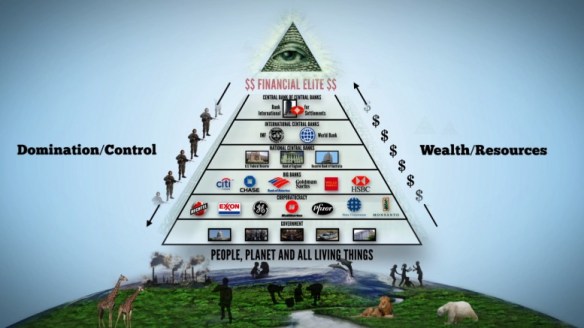
It doesn’t take much discernment to see that corporate structures are highly sophisticated mechanisms for funneling money upwards. That government collusion protects the interests of the owners of capital at the expense of the employees, customers, the general public. And the military protects their international interests.

The largest wealth producer in the world is the financial industry that simply makes money from money and produces nothing. It serves no interests but its own. Yes, some of us fortunate to have salvaged what’s left of our life savings after repeated financial crashes still enjoy the crumbs from the tables of the elite. I do mean crumbs.

Do the math. At the current rate of the upward movement of wealth, there is no other outcome but final disaster. The top 1/10th of 1 percent — not 1 percent — but 1/10th of 1 percent in America owns almost as much wealth as the bottom 90 percent in America, and it gets worse as you leave our shores.

At this rate, the world will eventually consist of gated enclaves of the mega-wealthy guarded by elite corps of paid mercenaries surrounded by billions of impoverished people.

This trajectory has increased dramatically for the last several decades. More and more of the world’s wealth is pouring into the coffers of the mega-rich. This is a zero sum game. When the masses have no wealth left, the game will be over. No matter how powerful the wealthy are, no matter how much wealth they possess, the game will be over.

The Psychopathy of Greed

psychos_in_power

By Zen Gardner

Source: ZenGardner.com

I always find it interesting that people blame corporate greed for our overall condition. Sure it’s a major factor at one level, but it’s just an obvious outcropping of something much, much deeper. Sadly not that many are willing to go there.

That the entire world system is built on a capitalist system in one form or another is mind boggling. Defying our innate conscious awareness to the contrary, the signal has been given and repeatedly endorsed as well as crassly promoted that we need to gain off of each other, in each and every transaction, every exchange, in a no holds barred, dog eat dog environment.

One look at the marketing world and you get the picture. And the supposed “fittest” come out on top.

This is how and why the populace acquiesces to domination by the few. “They’re just good at what they do. They’re smarter and more motivated than the rest of us so surely they deserve to be winners in the game.”

Humanity’s being told how the game works and that this is your only option. “It’s just the way it is, so get to work and earn your salary, then invest in the game and try to get ahead and make a name and lots of money for yourself.” At which point the sharks devour the unsuspecting guppy.

Group absolved endemic greed doesn’t make it right, however justified, by any stretch of the imagination.

The Corporate “Growth” Model

It’s fully accepted that corporations need to grow. For their good, for our good, or so we’re told. It’s a fear based econo-survivalist psychological scam. Who says they need to constantly make more, for their investors’ interests or otherwise? Yet this is considered healthy in a capitalistic system, under the guise of increased jobs and benefits and a prosperous economy.

Do the employees really benefit? Do the consumers who go increasingly into debt trying to catch the materialist carrot benefit? Who really benefits?

Yet this model is accepted carte blanche as a driving force for a healthy economy. If you stand back to think about it outside of all this financial gibberish it’s completely destructive, enslaving insanity for the good of the few. And yet this model is mimicked as if it’s the paradigm of truth through every level of Pavlovian entrained economic and interpersonal commerce engagement.

Getting to the Root of the Problem

The entire system is built on a background of assumed scarcity, that there’s not enough to go around so unless you push and shove your way into a place where you “earn” your keep and beat those around you you’ll be hung out to dry.

Clever bastards. All while they sit at the top of the food chain devouring their prey.

What’s even more surreal is how those who “succeed” in making a lot of money are then considered authorities on any and every subject. Just look the Rockefeller family, one such clusterfuck among many, screwing their way up the capitalist ladder who then set up think tanks, foundations and whatnot to influence the course of humanity according to their whims.

What or who made them the “wise ones” to rule over us? Guess what: Endorsed greed, abject avarice and the resultant intoxicating money and power in the hands of a few.

Look at creeps like George Soros or Bill Gates and a plethora of other unelected plutocrats, inserted intellectuals and accepted moral and geopolitical authorities like the Pope, lap dog Kissinger or voice pet Brzezinski and the panorama of puppet heads of state. It’s insane. Never mind the Rothchilds, Carnegies, Morgans, the so-called royal families of Europe such as the Windsors and House of Orange-Nassau of the Netherlands, the Vatican or whomever is hoarding the really big bucks.

The message is the same: in their minds we and our world are owned. And they ain’t sharing nothing with the rest of us. Why? Apparently we don’t deserve it. Do you like that fate and outcome? “Everyone else is accepting it, so it must be OK”…reasons the stilted servant.

Greed – A Name You Can Trust

You’ve all heard the outlandish statistics about how few have so much in this world. Yet it is by and large accepted by quiet submission, incredible as that may seem. The problem is humanity’s acquiescence to a rigged system. While the wealth of some of these bloodline families, banking moguls and mega rich corporate thugs could feed the poor of the earth many times over, they sit on their booty and only get more oppressive.

This brings us to the psychopathy of greed, amongst many other issues. Greed is insatiable. It is a vampiristic dynamic. It only sucks and is never satisfied. Wealth soon takes a back seat to power and control, their ultimate aphrodisiac. This is what it all leads to. And this reptilian, archontic urge is never satisfied, it always wants more. At any cost to the hosts of these parasites.

The issue is that psychopathy, especially in positions of power, is not just rampant but so readily accepted. That’s where the problem exponentially compounds.

This is the heartbreaking aspect to all of this, how humanity has bought into their program and replicates these unnatural urges at every level of society, which of course their system is designed to do. And while the masses abuse each other in this same lower vibrational parasitic frequency, no one is conscious enough to realize their oppressive trendsetters are feeding off of all of humanity by the very meme they’ve put into place.

If people woke up to that one fact we’d have an overnight revolution of disengagement causing a massive resetting of how society should and could cooperate.

Conclusion – The 5 Step Program

Parasitic forces build parasitic institutions, and encourage the same in others while maintaining their dominance. Be it corporatism, capitalism, communism and socialism, fractional banking or base line competition for resources and day to day needs, this system is rigged to the core.

Agreeing to help foment this dog eat dog mentality under the guise of survival or “rightful competition” only perpetrates the problem.

To become free and help build the better world we know exists requires conscious disconnection with this systemic disease. It begins in both small and big steps. But the underlying propellant towards change is identifying the problem for what it is. A parasitic disease, promulgated by those who stand to gain, and realizing their mindset is a pathological, direly destructive one that seeks to exert its twisted idea of oligarchical as well as personal control at any expense.

Step Up

First, do your part. Realize what is transpiring before your eyes, no matter how horrid it may first appear.

Second, disengage. In any and every way possible. Just take steps in that direction and the mounting freedom it engenders will empower you to take the next step.

Third, tell others – like a house afire. Use wisdom but never hold back. The hour is late as they are entering their last phases of implementable programs and are getting desperate to throttle humanity’s awakening.

Fourth – stand strong in your convictions. Feed those convictions, strengthen them, and encourage the same in others, as the mainstream of society is a nasty polluted river we must avoid, resist, oppose and most of all penetrate and reverse with everything in us.

Fifth – Stand fast in your convictions. Live a life committed to your newfound awakened understanding….fearlessly. This presence of awakened individuals does more than we’ll ever know.

See greed for what it is, but most of all don’t comply with their fabricated hierarchical world of abuse. It’s fraudulent, manipulative, destructive and a de facto form of voluntary enslavement.

See the world for what it has become. But more importantly, see the world as it should be and operate within that paradigm. Their fabricated world of lies will then crumble at our feet.

Much love, Zen

ZenGardner.com

The Dying Americans

1365203033_2628_auschwitz

By Chad Hill

Source: The Hipcrime Vocab

I’ve often used the term “the final solution for the working class,” in reference to the current American policy towards its vast intercoastal peasantry who, for reasons of circumstance or inclination, do not subject themselves to the decade or so of wildly expensive education that qualifies them for the remaining jobs on offer. It may be a reflection of my readership that I haven’t received any pushback. As someone who is in that same working class, I can clearly see what is happening around me, and I’m not alone. David J. Blacker, in his book, The Falling Rate of Learning and the Neoliberal Endgame, also broached the subject of eliminationism, going so far as to study the German holocaust literature of the 1930’s which calmly and rationally discussed how to deal with the problem of getting rid of the millions of excess people whom the elites determined were “undesirable” in the brave new world they were creating.

After last week, it’s hard to argue that this is hyperbole. The news that America’s white working class between the ages of 45-65 has dramatically falling life expectancy, alone against nearly the entire world, received a surprising (to me) bit of coverage. When I first read it, I assumed it would be just another footnote story that I would write about here, but would be ignored everywhere else. But it received a surprising amount of coverage: even Paul Krugman wrote about it. I suspect a large part of that was due to the fact that it was research by the most recent economics “Nobel” laureate Angus Deaton and his wife, so it was harder to ignore than if it had been from some unknown researcher.

Often times you hear about a “dieoff” due to our situation. I think this study confirms beyond a doubt that the dieoff is already happening. Yet, consider that, before this study became popularized, you would have never heard about it in the mainstream press. Still doubt the collapse is real?

It’s not people dying in the streets, though, unlike some of the more feverish TEOTWAKI peak oil predictions. From the research, elevated levels of suicide and drug abuse are the prime culprits. It’s the million little deaths that go unnoticed in the obituary columns of decaying communities all across this formerly prosperous nation. Someone overdosed in a back alley. Or a meth lab exploded. Or maybe they were killed in a car accident, or decapitated while driving their motorcycle too fast. Or they were shot by police. Or they are dying of liver failure by age 40. Or, increasingly, they are ground down slowly by the many chronic diseases such as diabetes that are symptomatic of the chronic stress and horrid (yet highly profitable) junk food diet of most Americans. It’s a dieoff all right, but it’s never framed as such. You can see it all around you: the overcrowded jails filled with unemployed people, the overcrowded hospitals filled with sick, obese people, the folks standing on the medians and freeway offramps with cardboard signs and living their cars, all while the media just goes on reporting about spectator sports and celebrity gossip as though nothing bad is happening. Ignorance really is bliss.

The obvious analogy here is Russia after the fall of the Soviet Union, as many people writing about the study have pointed out: The Dying Russians (New York Review of Books). But there was no “collapse” of the United States. Or was there? Instead, we’re told by the media and politicians that everything in every way is getting better and better for everyone. Just look at the latest iPhone! Television screens are huge! Even the very poor have indoor plumbing! And you can Google anything you like, so what are you complaining about, loser?

Everything is famed as personal failure, thus the dieoff is just a million stories of individual failure with no overall pattern. Nothing to see here, more along. Study and “work hard” (whatever that means), and you’ll be okay. Certainly that fear is behind the epidemic of overwork, presenteeism and grinding hours of unpaid overtime Americans are putting in at work in the hope of not being next. It’s like being the model prisoner in a concentration camp, though. Ask the turkeys this month if being a good turkey had any effect on their ultimate fate. The Parable of the Happy Turkey (Global Guerrillas)

Up until now, Americans have been happy turkeys. Thus, they cannot comprehend what is happening to them. In America it is taken for granted that the ultimate locus of control is on the individual, and that there is no such thing as society. That belief has been heavily promoted over the past thirty years, along with the “create your own reality” and other assorted positive thinking nonsense (thanks Oprah!), and I think we can see why.

And since we see this always as personal failure and are not allowed to see it as systemic failure, the poor and formerly middle classes take it out on themselves instead of the system. After all, America is the land of opportunity; if you don’t “make it’ (whatever that means), you have no one to blame but yourself! Of course it is not true; the musical chairs job market and winner-take-all economy means that only a tiny number of people even have a shot at the middle class anymore, and a lot of that is due to geography, pre-existing social connections and luck.

They don’t have to kill you if they can get you to kill yourself.

And although framed as a tragedy, I wonder if to some extent this behavior on the part of working class males is a logical response to living in the kind of society that the United States has become. In a society that has no use for them anymore and where they have no sense of purpose and no hope for the future, it seems like suicide is a rational response. After a certain age, you realize that you have been sorted to the “losers” pile. If you live in the vast suburban flatland of Middle America, you likely live in a decrepit house somewhere in the anonymous miasma of strip-mall suburbia, buy disposable plastic crap made in China from baleful fluorescent-lit Dollar Stores, drive an older model pickup truck or SUV with a bad muffler and bad brakes over potholed streets and under rusty bridges, while all the jobs around you aside from the hospital and the university (which are mainly female-staffed) are minimum wage, dead-end jobs where you have to smile and wear a uniform. You realize you’re never going to meet the girl of your dreams since hypergamy is still baked into female mating choice, despite what some feminists claim. You realize you will never get that that great job that will allow you to be upwardly mobile and live in relative ease and comfort, and life is a bitter, hard struggle relieved only by the occasional joint and video games. Or you’re divorced and paying child support to your former wife who’s managed to keep herself presentable enough to hook up with one of the few remaining alpha-males, and half your income goes to support the kids you never see. Or your deadbeat loser children have been working multiple McJobs and living in the basement for years with no hope of even affording a one-bedroom apartment, and between them and the wife you never speak to anymore, you can’t even get into your own damn bathroom. You realize that, like most Americans, you will never afford to retire and will have to work your boring, dead-end job under your asshole supervisor until you literally drop dead. So why wait?

I mean, who wouldn’t kill themselves or anesthetize themselves with drugs and booze in an environment like this?

I once read an online commenter say that the rich are the beta testers for the lifestyles we will all be living in the future (and thus no restraints must be put on their wealth accumulation if we are to experience that future). But that commenter had it wrong. Rather, it is the poor–those living on less than a few dollars a day; those who live in ghettos marred by gangs and drug abuse; those with their heat, water, and streetlights turned off, who are the beta testers for the lifestyles that most of us will be “enjoying” in the near future. As William Gibson said, the future is already here, just not evenly distributed.

Given the above, I can’t help but think of the “Rat Park” experiment. Rats in a cage, when given  a choice between water and drugs, would overdose themselves to death on the drugs, neglecting even basic self-maintenance. But a cage is a boring, repetitive, stressful environment for a rat, so you might expect the animals to anesthetize themselves with whatever was on offer. But rats living in an environment specifically designed to be pleasant and give the rats what they needed to thrive did not overdose themselves to death; they preferred healthier behaviors instead. It’s worth noting that most of the drugs we use today have been known for hundreds or even thousands of years, but were not abused by the native peoples who discovered them. That is reserved for modern, “advanced” societies. The Rat Park experiment (io9)

I once wrote that if you wanted to intentionally design a social environment to drive a primate insane, you would develop something pretty much identical to modern-day America (advertising, chronic stress, inequality, separation from nature and each other, boring, repetitive work, constant surveillance, and on and on…). It’s pretty obvious how Rat Park parallels life in twenty-first century America with its ubiquitous television, concentration-camp schools complete with metal detectors, freeways and cul-de-sacs and landscapes of Applebees™ and Walmarts; along with a steady diet of Pizza Hut and Taco Bell. It’s hardly an environment designed for human flourishing, is it? Rather, it is designed to maximize “economic growth” at all costs. The results of that experiment are as plain to see as they are predictable.

Most people who are still relatively comfortable are content to write off the people who are living in deprived circumstances among them right now, especially in the United States where so many of those poor are African-American. But more and more, whites are experiencing what they had previously dismissed as “black problems” due to their racist attitudes: the hopelessness and despair, the unemployment, the sociological pathologies; the drug abuse, divorces, domestic violence, youth gangs and so on. It’s not race, it’s environment, as Rat Park showed. Given a certain environment, an animal–any animal–will behave a certain way. Its totally predictable. We know this, but why do we pretend it is not true? Instead we reliably chalk it all up to “the Cult of Personal Failure.”

But this leads to an even larger question, one that gets to the heart of our modern predicament. We have to ask ourselves, what kind of society are we creating where so many people see death as preferable to living in such a society? In what kind of a society do people see life as so miserable that they prefer to kill themsleves, either slowly or immediately?  That is, why is this the end result of hundreds of years of supposed “progress?”

Fundamentally, how do you feel about this society? Do you feel good about this society? Do you feel good about the school-to-prison pipeline? Do you feel good that there are more prisoners than small yeoman farmers? Do you feel good that it is a felony to show us how our food is produced? Do you feel good about students mortgaging their future for jobs that won’t exist by the time the bill comes due? Do you feel good about hospitals treating chronic diseases taking the place of farming and making things as basis of the America’s rural economies? Do you feel good about police armed with body armor and and tear gas? Do you feel good about wall-to-wall advertising preying on our weakness and insecurities? Do you feel good about the atmosphere of incessant adversarial competition against everyone else for the shrinking pool of jobs on offer which pay enough to afford rent?

If so, why?

This puts a crimp on the Panglossian “everything in every way is getting better for everyone,” rhetoric that you hear so often in the media. What I find amusing is that this rhetoric used to come from the Left–that the welfare state would eliminate poverty, racism, that everything was under control and circles of cooperation would get larger and larger, and so on. But now, I mostly hear the Panglossian rhetoric coming primarily from the Right, whose preferred God is the unregulated “free” market. It’s in the Right-wing propaganda now that I constantly hear how wonderful everything is, and that those who are complaining are either delusional misfits or just jealous. Here is a prime example from the Right-wing National Review:

Good news abroad, and good news at home: In 1990, there were 2,245 murders in New York City. That number has fallen by 85 percent. Murders are down, often dramatically, in cities across the country. The overall rate of violent crime has fallen by about half in recent decades. U.S. manufacturing output per worker trebled from 1975 to 2005, and our total manufacturing output continues to climb. Despite the no-knowthings [sic] who go around complaining that “we don’t make things here anymore,” the United States continues to make the very best of almost everything and, thanks to our relatively free-trading ways, to consume the best of everything, too. General-price inflation, the bane of the U.S. economy for some decades, is hardly to be seen. Flexible and effective institutions helped ensure that we weathered one of the worst financial crises of modern times with surprisingly little disruption in the wider economy. Despite politicians who would usurp our rights, our courts keep reliably saying that the First Amendment and the Second Amendment pretty much mean what they say. I just filled up my car for $1.78 a gallon.

 The world isn’t ending.

The world is healthier, wealthier, and less hungry mainly because of the efforts of millions of unknown investors, entrepreneurs, farmers, workers, bankers, etc., all working without any central coordinating authority….There is much left to do: We have unsustainable fiscal situations in the Western welfare states, irreconcilable Islamist fanatics originating in points east but spread around the world, environmental challenges, and that tenth of the human race that still needs lifting out of hardcore poverty. But we have achieved a remarkable thing in that unless we mess things up really badly, in 50 years we’ll be having to explain to our grandchildren what a famine was, how it came to be that millions of people died every year for want of clean water — and they will look at us incredulously, wondering what it must have been like to live in the caveman times of the early 21st century.

Liberal Democracy and Free Markets, Take a Bow (National Review) Or better yet, strap on flight suit and hang up a “Mission Accomplished” banner.

Yes, for the folks on the Right, it truly is a Golden Age. There are a few flaws in the ointment like those pesky welfare states and all that but, hey, gas is cheap! Can’t you just feel the bright, shiny future ahead? Here’s a another sampling from The Wall Street Journal:

The trajectory of the world doesn’t justify this pessimism. People are living longer on every continent. They’re doing less arduous, backbreaking work. Natural disasters are killing fewer people. Fewer crops are failing. Some 100,000 people are being lifted out of poverty every day, according to World Bank data.

Life is also getting better in the U.S., on multiple measures, but the survey found that 55% of Americans think the “rich get richer” and the “poor get poorer” under capitalism. Sixty-five percent agree that most big businesses have “dodged taxes, damaged the environment or bought special favors from politicians,” and 58% want restrictions on the import of manufactured goods.

Has the World Lost Faith in Capitalism? (WSJ) Silly people, how dare they “lose faith!” Once we stamp out every last vestige of “socialism” we can restore that faith.

So what’s going on here? Listening to the Right, one gets the appearance that things have never been better, and that people are just totally irrational and determined to complain no matter how good they have it, despite voluminous scientific literature portraying optimism bias as the default cognitive condition for most people.

I think it stems from two areas – the Neoliberal experiment has clearly been an unmitigated disaster, so the literature constantly has to portray a rosy picture for those still living in the elite ideological bubble by cherry-picking data: Cheer – Inequality is Falling Globally!! (and similar nonsense) (Pieria). It’s much like the “happy peasant” literature that prevailed on the eve of the French Revolution and during early Industrialism to convince upper-class readers that their efforts were actually for the good of all, not just themselves; it’s just that the feckless peasants were too short-sighted to realize it. The elites, for some reason, have a need to believe, despite all the evidence to the contrary, that the free-market fundamentalism they subscribe to is making everyone–not just them–better off. Perhaps it is a remedy for cognitive dissonance and a guilty conscience.

The second agenda might be to cover up the agenda of eliminationism referred to above.
Going back to the original topic, it’s fairly clear that getting rid of the lower classes is, as The Joker put it in The Dark Knight, “all part of the plan.”

Now that might seem a bit paranoid, but consider this – the governors of many states are withdrawing basic social protections for their poorest citizens, and actually paying for the priviliege! Here’ Kevin Drum:

…the states that refuse to expand Medicaid are denying health care to the needy and paying about $2 billion for the privilege. Try to comprehend the kind of people who do this. 

The residents of every state pay taxes to fund Obamacare, whether they like it or not. Residents of the states that refuse to expand Medicaid are paying about $50 billion in Obamacare taxes each year, and about $20 billion of that is for Medicaid expansion. Instead of flowing back into their states, this money is going straight to Washington DC, never to be seen again. So they’re willing to let $20 billion go down a black hole and pay $2 billion extra in order to prevent Obamacare from helping the needy. It’s hard to fathom, isn’t it?

Red States Spent $2 Billion in 2015 to Screw the Poor (Mother Jones)

Last week, McClatchy documented the unnecessary pain being inflicted on red state residents by their elected Republican representatives…Roughly 260 million Americans (roughly 85 percent) already have health insurance provided by their employers, the government or through individual policies they purchased. In places like Oregon, Colorado, New York, California and other, mostly Democratic states, governors and state legislators accepted the expansion of Medicaid to provide free health insurance for those earning up to 138 percent of the federal poverty (FPL). For those earning between 138 and 400 percent of the FPL, the Affordable Care Act’s subsidies will help them purchase insurance in the private market. But in the states where Republicans said “no” to the expansion of Medicaid, the picture is much different. As the AP explained the coverage gap:

Nearly 2 in 3 uninsured people who would qualify for health coverage under an expansion of Medicaid live in states which won’t broaden the program or have not yet decided on expansion.

The resulting Republican body count is staggering. Thanks to the GOP’s rejection of Medicaid expansion, 1.3 million people in Texas, 1 million in Florida, 534,000 in Georgia and 267,000 in Missouri will be ensnared in the coverage gap.

Health Insurance “Coverage Gap” Coming To A Red State Near You (Crooks and Liars)

That’s right, Republican governors are blowing a hole in their budget just to remove social protections for the poor. Often times, “unaffordability” is cited as a justification, but clearly this is not at work here. It’s pure ideology. But what is that ideology? Here’s more detail:

American conservatives for the past several decades have shown a remarkable hostility to poor people in our country. The recent effort to slash the SNAP food stamp program in the House; the astounding refusal of 26 Republican governors to expand Medicaid coverage in their states — depriving millions of poor people from access to Medicaid health coverage; and the general legislative indifference to a rising poverty rate in the United States — all this suggests something beyond ideology or neglect.

The indifference to low-income and uninsured people in their states of conservative governors and legislators in Texas, Florida, and other states is almost incomprehensible. Here is a piece in Bustle that reviews some of the facts about expanding Medicaid coverage:

In total, 26 states have rejected the expansion, including the state of Mississippi, which has the highest rate of uninsured poor people in the country. Sixty-eight percent of uninsured single mothers live in the states that rejected the expansion, as do 60 percent of the nation’s uninsured working poor.

These attitudes and legislative efforts didn’t begin yesterday. They extend back at least to the Reagan administration in the early 1980s…

Most shameful, many would feel, is the attempt to reduce food assistance in a time of rising poverty and deprivation. It’s hard to see how a government or party could justify taking food assistance away from hungry adults and children, especially in a time of rising poverty. And yet this is precisely the effort we have witnessed in the past several months in revisions to the farm bill in the House of Representatives. In a recent post Dave Johnson debunks the myths and falsehoods underlying conservative attacks on the food stamp program in the House revision of the farm bill.

This tenor of our politics indicates an overt hostility and animus towards poor people. How is it possible to explain this part of contemporary politics on the right? What can account for this persistent and unblinking hostility towards poor people?

Why a war on poor people? (Understanding Society)

Let’s restate this to be clear to make sure the point is not lost: these states are willing to lose money in order to make sure their poor die quicker. Clear enough? And we’re not even talking about things like the outright cold-blooded murder of the homeless by police, the breaking up of homeless encampments, the mass incarceration, and return of debtors’ prisons, and so on. It’s expensive to be poor in  America. We do everything by the Matthew Effect from jobs to education, and wonder why class mobility is nonexistent. Yet we’re still told that everyone wants to be an American, that it’s the land of opportunity, and that things have literally never been better.

Thrown in jail for being poor: the booming for-profit probation industry (Guardian)

Much of the well-funded efforts of plutocrats and their allies has been to repeal the Affordable Care Act (which was designed by Right-wing think tanks), not to reform it or replace it with something more effective, but to return to the predatory status quo ante. Now, businessmen may be greedy, short-sighted and sociopathic, but they are not stupid. They surely know that the American System is wildly more expensive than any other place on earth, but they are willing to lose billions of dollars in profit just to make sure people don’t get health care! Think about that. A European friend said to me once that he didn’t understand why American businesses seemed to want sick, insecure employees who either don’t have access to health care, or are worried about going broke trying to pay for it. It seemed totally irrational to him. But it’s only irrational if you don’t understand the underlying ideology of eliminationism. Some societies actually want to kill off their own people, as Nazi Germany and other tragic examples have shown.

And it’s of a piece with the withdrawal of mass education that Blacker documents in his book. The elites are disinvesting from society in every way because they just don’t need us anymore. And their propaganda mills are dedicated to making sure the blame is squarely placed on individuals so that we will internalize learned helplessness which has prevented any effective resistance. Or their mills are insisting that it’s just not happening, and everybody is really better off, as we saw above, except for a few churlish losers who have no one to blame but themselves (and are probably looking for a handout).

Who turned my blue state red? (NYT). A great explanation of America’s crab mentality.

I’ve featured the analogy of horses that some economists use before. Human beings may have found other jobs (which is debatable), but the population of horses just went down in line with the work that was available for them to do. I think it’s obvious that this is a good analogy for what’s happening.

…Similarly, one could just as easily have said, a century ago, that: “Fundamental economic principles will continue to operate. Scarcities will still be with us…. Most horses will still have useful tasks to perform, even in an economy where the capacities of power sources and automation have increased considerably…”

Yet demand for the labor of horses today is vastly less than it was a century ago, even though horses are extremely strong, fast, capable and intelligent animals. “Peak horse” in the U.S. came in the 1910s, I believe. After that there was no economic incentive to keep the horse population of America from declining sharply, as at the margin the horse was not worth its feed and care. And in a marginal-cost pricing world, in which humans are no longer the only plausible source of Turing-level cybernetic control mechanisms, what will happen to those who do not own property should the same come to be true, at the margin, of the human? What would “peak human” look like? Or–a related but somewhat different possibility–even “peak male”?

Technological Progress Anxiety: Thinking About “Peak Horse” and the Possibility of “Peak Human” (Brad DeLong)

Off to the glue factory with the middle class, then. As long as it’s kept diffuse enough, it will never be picked up on; “Work Makes You Free” hangs in the air over our heads instead of over the entry gates. Perhaps we should just inscribe it on the Gateway Arch.

So, all told, the self-destructive habits of the middle-aged white poor are hardly irrational. Rather, it seems to be to be the most rational response to the type of world we’ve created. The only question is, why do so many of us apparently want to stay on this path?

Inside the Psyche of the 1%

na50_3514938_1_px_470_

Don Fitz, editor of Synthesis/Regeneration, recently wrote an illuminating overview of what current scientific studies can tell us about psychopaths in positions of power. In the following passage he examines why the psychiatric establishment has focused less on “successful psychopathy” than on other anti-social personality disorders:

The concept of “successful psychopath” is not new. An early text described “complex psychopaths” who were very intelligent and included unscrupulous politicians and businessmen. [6] By the 1970s it was more widely recognized that “this category includes some successful businessmen, politicians, administrators.” [7] In other words, the unsuccessful psychopath might go to jail for swindling dozens of people with home improvement scams while successful psychopaths might swindle millions with bank deals, get bailed out by friends in government, and never spend a day in jail.

Perhaps the most fascinating aspect of the medicalization of the disorder is how the psychiatric establishment departed from science in order to grant partial exemption from being characterized as psychopaths to the wealthy. According to the Diagnostic and Statistical Manual of the American Psychiatric Association, in order to receive a diagnosis of “anti-social personality disorder” (i.e., psychopathy) a person must exhibit at least 3 of 7 listed behavior patterns. These include “arrest,” “physical fights or assaults,” and “failure to sustain consistent work behavior.” [8] This means that those who can pay off cops (or never have charges pressed against them due to their social status), or pay someone else to commit violence on their behalf, or own companies instead of having to work for a living are all less likely to receive an official label of “psychopath.”

An increasing number of psychologists are becoming aware that traditional research was limited by the bias of only looking at people in jail. One wrote that subjects in psychopathy research “were usually institutionalized at the time of testing, and consequently our research may not accurately capture the internal structure and dynamics of the successful antisocial or psychopathic individual.” [9]

Support for the concept of successful and unsuccessful psychopaths is provided by the discovery that the “Psychopathic Personality Disorder” syndrome actually has two factors. [10] Statistical analyses have revealed an “emotional detachment” factor, which includes superficial charm and skill at manipulating others, as well as an “anti-social behavior” factor, which includes poor impulse control and the tendency to engage in activities that are illegal.

Multiple studies have confirmed that run-of-the-mill psychopaths (often studied while in jail) score particularly high on anti-social behavior while successful psychopaths score higher on emotional detachment factors. For example, Babiak [11] looked at “industrial psychopaths” and found that they scored higher on “emotional” factors than “deviant life style” factors. Functioning smoothly in the corporate world, they had a “charming façade” that allowed them to easily manipulate others.

In a study of “disordered personalities at work” other researchers [12] were able to give personality tests to business managers and chief executives. They contrasted their personality scores to psychiatric patients and “mentally disordered offenders.” Compared to the mental patients, the corporate executives showed greater “emotional” components of personality disorder and less “acting out” (such as aggressiveness).

There were no clear-cut differences between “psychopaths” and “normals.”
The authors concluded that “participants drawn from the non-clinical population [i.e., business managers] had scores that merged indiscernibly with clinical distributions.” There were no clear-cut differences between “psychopaths” and “normals.” The most likely explanation of psychopathy is that, like any other personality dimension, it has a bell-shaped curve: a few people have almost none of the characteristics, most people have some characteristics of psychopathy, and a few people have a lot. The most visible outlets for people high on psychopathy scales are petty con artists and corporate conniving. Operating in different worlds, their psychopathy expresses itself in different ways.

Now that it is clear that a streak of psychopathy runs through the 1%, it would be worthwhile to go back to those who espouse that “there is no ethic which requires we treat him [the psychopath] as we treat other adults” and ask if that would apply to corporate psychopaths as well. Will editors of scholarly volumes seek out articles heaping abuse on the 1% with the same vigor with which they find articles despising prison inmates? Will academics proclaim that “public health needs” dictate that we suspend civil liberties of corporate executives even if they “have not been convicted of any crime?” Will professors compare the “needed treatment” of the 1% to the “necessary slaughter” of animals?

Since academics know very well where funding for their research comes from, my guess is that they will be a wee bit less harsh on the corporate class than the jailed burglar who provides no grant money. We can be confident that the Tea Party will not be proposing that, if corporate psychopaths who blast the tops off of mountains wreak a thousand times the havoc of petty thieves who steal copper wire from air conditioners, then their punishments should be 1000 times as great.

Yet, it is important not to overstate the evidence and suggest that every capitalist is a psychopath. Not all corporate executives score high on scales of psychopathy. This is likely because many actually believe their ideology of greed makes for a better world.

Fitz also offers plausible explanations for various studies indicating that, on average, test subjects of a higher income have lower levels of empathy while test subjects of a lower income have higher levels of empathy:

Compassion reflects the opposite of psychopathy. When those with wealth and power plan to strangle social security, they never say they intend to hurt people, but rather they want to help them stand on their own. When corporations drive native people from forests, they tell us it is part of their grand scheme to stop climate change. Are we to believe that they are just as compassionate as everyone else…but that they reveal their compassion in their own way? There is now good evidence that there are, in fact, class differences in levels of compassion.

Social class could be linked to compassion more than to any other emotion.
By definition, the rich and powerful have more material resources and spend more of their time telling others what to do. Those with fewer material resources get told what to do. As a result, the rich value independence and autonomy while those with less money think of themselves as more interdependent with others. [13] In other words, the rich prize the image of the “rugged individual” while the rest of us focus on what group we belong to.

How do people explain the extremely unequal distribution of wealth? Those with more money attribute it to “dispositional” causes—they believe that people get rich because their personality leads them to work harder and get what they deserve. Those with less money more often attribute inequality to “external” factors—people’s wealth is due largely to events beyond their control, such as being born into a rich family or having good breaks in life. [14]

People with fewer financial resources live in more threatening environments, whether from potential violence, being unable to pay medical bills, or fearing the possibility of being evicted from their homes. This means that social classes differ in the way that they view the world from an early age. Children from less financially secure homes respond to descriptions of threatening and ambiguous social scenarios with higher blood pressure and heart rate. [15] Adults with lower incomes are also more reactive to emotional situations than are those with more money.

This means that people with fewer financial resources are more attentive to others’ emotions. Since low income people are more sensitive to emotional signals, they might pay more attention to the needs of others and show more altruism in response to suffering.

This was the thinking behind research linking higher income to less compassion. In one study people either watched a neutral video or one depicting a child suffering from cancer. People with lower income had more change in their heart rate and reported feeling more compassion. But they did not rate other emotions as higher. Social class could be linked to compassion more than to any other emotion. [16]

In another study, people reported their emotions toward a partner when the two of them went through a hypothetical job interview. Lower income people perceived more distress in their partners and expressed more compassion toward them. Again, they did not report more intense feelings of other emotions. Nor did participants show more compassion toward people with the same income level as their own. [17]

Like most psychological research, these findings are limited by their use of university students. This makes it hard to conclude that their findings apply to those not in school. Of course, it is quite possible that effects would be even stronger in situations that are far more intense than the somewhat mild experiences that occur in psychological laboratories. A greater problem is interpreting psychological findings as showing absolute differences between groups rather than shades of grey.

It would not be accurate to claim that research proves that the 1% have no compassion while all of the 99% do. But it strongly implies that the 1% feel less compassion, whether watching a videotape of suffering or participating in a live social interaction. Also, lab studies are consistent with findings that people with fewer financial resources give a higher proportion of what they do have to charity. In economic game research, they give more to others. [18]

The greatest reason is the huge jump in happiness as people move out of poverty …
This line of research confirms that (1) people with fewer financial resources identify with a larger “in-group;” (2) “attention to and recognition of suffering is a prerequisite step before compassion can take place;” and (3) “moral emotion is not randomly distributed across social classes…” [19] Compassion toward the suffering of others is less likely among the 1%.

He follows this with a recap of studies indicating how once the accumulation of wealth and material possessions get people above poverty level, it generally doesn’t correlate to increased levels of happiness. There tends to be a “tolerance” effect for happiness derived from wealth while social connection and altruism are more important for sustained happiness for most non-psychopaths. In his conclusion, Fitz argues that for corporate psychopaths, obtaining wealth and power is an addiction with harmful consequences for everyone and the entire planet, and it’s a societal problem requiring nothing less than a cultural transformation to solve:

The 1% could easily find compassion getting in their way as their actions affect an increasing number of lives. Gaining enough wealth to move out of poverty makes a significant difference in the life satisfaction of a person who has little. Gaining the same amount of wealth has no effect on the happiness of the very rich. They must grab the wealth of many impoverished people in order to have a perceptible increase in happiness. As for a drug addict, the rush from an increase in material possessions of those who already have more than enough is merely a temporary fix.

Soon they will have to prevent even more from rising out of poverty if they are to get another short-term happiness rush. Whether the rush is from the actual possessions or the power that they manifest, it still won’t be enough. They must increase the rate of wealth accumulation that they push through their veins. If those with spectacular quantities of obscene wealth are to get their next high, they cannot merely snort enough happiness objects to prevent masses of people from rising out of poverty—they have to manipulate markets to grind an ever-increasing number into poverty.

The petty psychopath and the grand corporate psychopath seek happiness through the act of obtaining material possessions as much as having them. A major difference between them is that the grand psychopath has the ability to cause so much harm. Even more important, the amount of harm that corporate psychopaths cause grows at an exponential rate. Their financial schemes are no longer millions or billions, but now trillions. Not content to drive individual farmers off their land, they design trade deals that force entire countries to plow under the ability to feed their own people and replace it with cash crops to feed animals or produce biofuels.

Finding that the pollution of small communities generates insufficient funds, they blow off the tops of mountain ranges for coal, raze boreal forests for tar sands, attack aquatic ecosystems with deep sea drilling, and contaminate massive natural water systems by mining gold or fracking for gas. While the petty psychopath may become proficient enough to become a godfather, the grand psychopath is driven not merely to planetary destruction but to a frenetic increase in the rate of destruction at precisely the moment when the tipping point of climate change is most haunting. A natural question might seem to follow: Would getting rid of the current batch of corporate psychopaths benefit the world greatly? Actually, no. It would do no good whatsoever because what psychologists call the “reward contingencies” of the corporate world would still exist. The fact that capitalism prizes accumulation of wealth by the few at the expense of the many would mean that, even if the worst corporate criminals disappeared, they would soon be replaced by marketplace clones.

Progressives should avoid using the same “categorical” model so adored by right wing theorists for its utility in hating the poor. A much better explanation for psychopathy among the 1% is that the corporate drive to put profits before all else encourages norms of manipulating people without compassion. The more readily corporate leaders succumb to this mind set, the more likely they will be to climb the ladder. As the corporate mentality dominates society, it reproduces its attitudes and expectations of behavior throughout every organization, institution and individual it touches.

In challenging what the market does to our souls, Alan Nasser said it so well:

A certain kind of society tends to produce a certain kind of person. More precisely, it discourages the development of certain human capacities and fosters the development of others. Aristotle, Rousseau, Marx and Dewey were the philosophers who were most illuminating on this. They argued that the postures required by successful functioning in a market economy tend to insinuate themselves into those areas of social intercourse which take place outside of the realm of the market proper. The result, they claimed, was that the arena for potentially altruistic and sympathetic behavior shrinks over time as society is gradually transformed into a huge marketplace. [35]As mentioned, there are differences in compassion and types of psychopathy between high and low income people. But the differences are not large. Perhaps, even in the corporate board room, many feel the old norms of group loyalty. It is also possible that differences are small, not because of the unwillingness of corporate executives to be ultra-manipulative, but because capitalism pushes everyone toward a “use people” mode.

Thus, building a new society involves going beyond equalizing material wealth. It means changing the core nature of interpersonal relationships. This requires vastly reducing the emphasis on material possessions. Relationships of people to people can never flourish as long as relationships of people to objects reign supreme.

As long as society continues to be deeply divided between those who tell others what to do and those who get told, it will not be possible to establish the emotional sharing that is the basis of widespread altruism. If the 1% are to develop the same level of understanding of others that the 99% has, they will need to walk in their shoes. If they continue to be the ones who live their lives telling others what to do while the rest of us continue being told what to do, they will not develop levels of compassion typical of the 99%.

This means that in office jobs, they should be able to share the joys of typing letters rather than ordering others to type for them. If we decide mining is necessary, those who are now the 1% should get to know that work life. In work at home, they should not be excluded from washing toilets but should participate in the same human activities as the rest of society. Creating a world of universal compassion requires a world of shared experiences.

Read the full article here: http://www.greens.org/s-r/60/60-06.html