The Road to Totalitarianism

By CJ Hopkins

Source: Consent Factory, Inc.

People can tell themselves that they didn’t see where things have been heading for the last 17 months, but they did. They saw all the signs along the way. The signs were all written in big, bold letters, some of them in scary-looking Germanic script. They read …

“THIS IS THE ROAD TO TOTALITARIANISM.”

I’m not going to show you all those signs out again. People like me have been pointing them out, and reading them out loud, for 17 months now. Anyone who knows anything about the history of totalitarianism, how it incrementally transforms society into a monstrous mirror image of itself, has known since the beginning what the “New Normal” is, and we have been shouting from the rooftops about it.

We have watched as the New Normal transformed our societies into paranoid, pathologized, authoritarian dystopias where people now have to show their “papers” to see a movie or get a cup of coffee and publicly display their ideological conformity to enter a supermarket and buy their groceries.

We have watched as the New Normal transformed the majority of the masses into hate-drunk, hysterical mobs that are openly persecuting “the Unvaccinated,” the official “Untermenschen” of the New Normal ideology.

We have watched as the New Normal has done precisely what every totalitarian movement in history has done before it, right by the numbers. We pointed all this out, each step of the way. I’m not going to reiterate all that again.

I am, however, going to document where we are at the moment, and how we got here … for the record, so that the people who will tell you later that they “had no clue where the trains were going” will understand why we no longer trust them, and why we regard them as cowards and collaborators, or worse.

Yes, that’s harsh, but this is not a game. It isn’t a difference of opinion. The global-capitalist ruling establishment is implementing a new, more openly totalitarian structure of society and method of rule. They are revoking our constitutional and human rights, transferring power out of sovereign governments and democratic institutions into unaccountable global entities that have no allegiance to any nation or its people.

That is what is happening … right now. It isn’t a TV show. It’s actually happening.

The time for people to “wake up” is over. At this point, you either join the fight to preserve what is left of those rights, and that sovereignty, or you surrender to the “New Normal,” to global-capitalist totalitarianism. I couldn’t care less what you believe about the virus, or its mutant variants, or the experimental “vaccines.” This isn’t an abstract argument over “the science.” It is a fight … a political, ideological fight. On one side is democracy, on the other is totalitarianism. Pick a fucking side, and live with it.

Anyway, here’s where we are at the moment, and how we got here, just the broad strokes.

It’s August 2021, and Germany has officially banned demonstrations against the “New Normal” official ideology. Other public assemblies, like the Christopher Street Day demo (pictured below), one week ago, are still allowed. The outlawing of political opposition is a classic hallmark of totalitarian systems. It’s also a classic move by the German authorities, which will give them the pretext they need to unleash the New Normal goon squads on the demonstrators tomorrow.

In Australia, the military has been deployed to enforce total compliance with government decrees … lockdowns, mandatory public obedience rituals, etc. In other words, it is de facto martial law. This is another classic hallmark of totalitarian systems.

In France, restaurant and other business owners who serve “the Unvaccinated” will now be imprisoned, as will, of course, “the Unvaccinated.” The scapegoating, demonizing, and segregating of “the Unvaccinated” is happening in countries all over the world. France is just an extreme example. The scapegoating, dehumanizing, and segregating of minorities — particularly the regime’s political opponents — is another classic hallmark of totalitarian systems.

In the UK, Italy, Greece, and numerous other countries throughout the world, this pseudo-medical social-segregation system is also being introduced, in order to divide societies into “good people” (i.e., compliant) and “bad” (i.e., non-compliant). The “good people” are being given license and encouraged by the authorities and the corporate media to unleash their rage on the “the Unvaccinated,” to demand our segregation in internment camps, to openly threaten to viciously murder us. This is also a hallmark of totalitarian systems.

And that, my friends, is where we are.

We didn’t get here overnight. Here are just a few of the unmistakable signs along the road to totalitarianism that I have pointed out over the last 17 months.

June 2020 … The New (Pathologized) Totalitarianism.

August 2020 … The Invasion of the New Normals.

October 2020 … The Covidian Cult.

November 2020 … The Germans Are Back!

March 2021 … The New Normal (Phase 2).

March 2021 … The “Unvaccinated” Question.

May 2021 … The Criminalization of Dissent.

June 2021 … Manufacturing New Normal “Reality.

And now, here we are, where we have been heading all along, clearly, unmistakably heading … directly into The Approaching Storm, or possibly global civil war. This isn’t the end of the road to totalitarianism, but I’m pretty sure we are in the home stretch. It feels like things are about to get ugly. Very ugly. Extremely ugly. Those of us who are fighting to preserve our rights, and some basic semblance of democracy, are outnumbered, but we haven’t had our final say yet … and there are millions of us, and we are wide awake.

So pick a side, if you haven’t already. But, before you do, maybe look back at the history of totalitarian systems, which, for some reason, never seem to work out for the totalitarians, at least not in the long run. I’m not a professional philosopher or anything, but I suspect that might have something to do with some people’s inextinguishable desire for freedom, and our willingness to fight for it, sometimes to the death.

This kind of feels like one of those times.

Sorry for going all “Braveheart” on you, but I’m psyching myself up to go get the snot beat out of me by the New Normal goon squads tomorrow, so I’m a little … you know, overly emotional.

Seriously, though, pick a side … now … or a side will be picked for you.

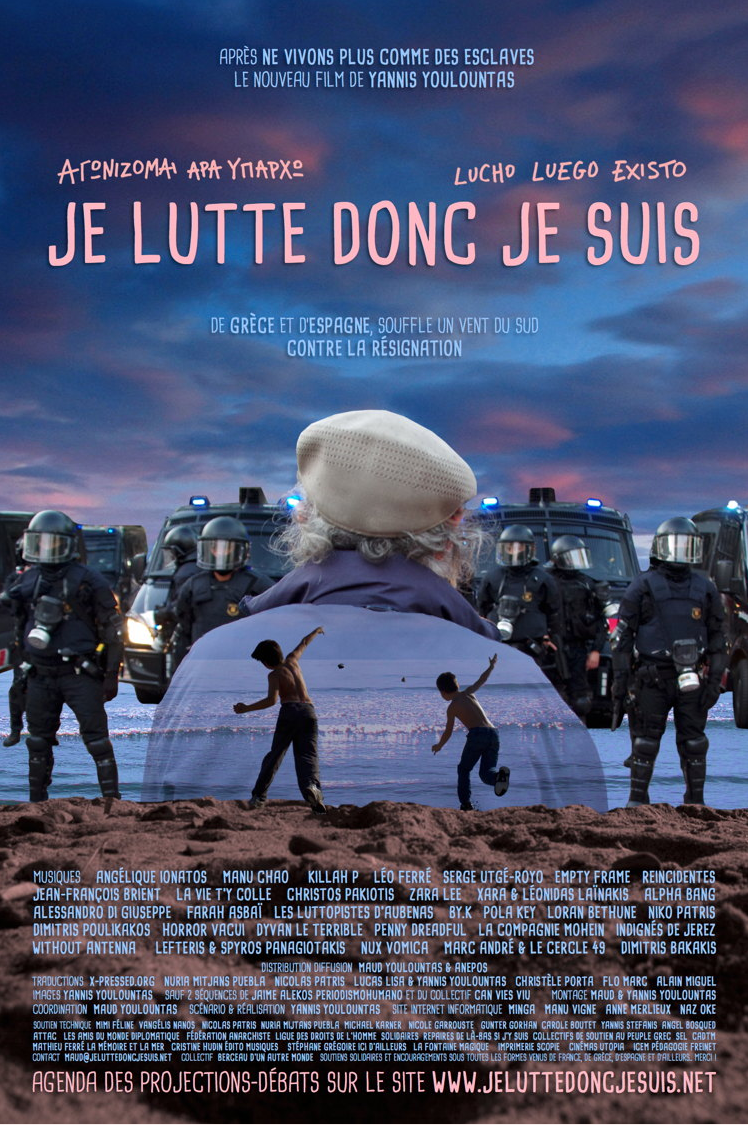
Saturday Matinee: I fight, therefore I am

I fight therefore I am (in french: Je lutte donc je suis) is a documentary film about social and political struggles in Greece and Spain which provides an overview of the struggles in Europe against austerity, capitalism and fascism. A musical journey celebrating Resistance from one end of the Mediterranean to the other. The title is made from the aphorism of the philosopher René Descartes Cogito Ergo Sum (I think therefore I am). Although it hasn’t been distributed by any mainstream company, it has enjoyed great success, and has been shown to numerous theaters, festivals, in France and in Europe.

What You May Not Know About Today’s Economic War

By Phil Butler

Source: New Eastern Outlook

Many people believe the world is spiraling in a downward freefall toward Armageddon. At the same time billions on Earth feel the sting of crippling poverty, sanctions, and austerity imposed by the elites – the numbers of billionaires have risen geometrically. And so have those billionaire’s profits. It’s time we took a closer look at where we stand as of 2018, if we are to be left anything at all to cling to. From the steppes of Russia to the ancient lands of the Minoans, economic terror now reigns.

When I left Germany for Greece several months ago, the common belief there was that the “lazy Greeks” were part of the cause of Deutsche banker discomfort. My neighbors in Germany’s oldest city of Trier honestly believe the bailout of Greece is because Greeks unwilling to work hard. The bitter irony of this believe lies in the fact the average German would melt under the workload of the average citizen here in Heraklion on Crete. As an American what I witnessed in Germany can only be considered a “part-time” employment state. But here in Greece the average person works seven days a week, and usually at more than one job. This microeconomic perception is one that has been implanted by state and corporate controlled media in Germany. There’s a very good reason for this, which I will now explain.

A New Secret Economic Weapon – Organized Failures

The International Monetary Fund, the German and American bankers, the globalist elites who control financial systems in the so-called “west” – they’ve been on a mission since 2008. The “meltdown” of markets when Barack Obama first took office as American president was not some random and chaotic economic mistake. Wall Street and the global markets were turned upside down on purpose. In his book “Secret Weapon”, the CEO of Freeman Global Holdings and a New York Times bestselling author Kevin Freeman presents a persuasive chain of evidence pointing to the fact the crash of September 2008 was the result of a deliberate and well-prepared act of sabotage. Even though the author blames competing governments like China and Iran for what he terms “economic terrorism”, his proofs and theories are correct in so far as the “meltdown” being on purpose. The fact Freeman is founder and chairman of the NSIC Institute, and a Senior Fellow of the Center for Security Policy suggests his work may be a double dealing by the financial community to obscure the real perpetrators. But for my report it’s more important to follow the trail of financial chaos to our financial reality.

Freeman is not alone in his suggestion the economic crisis was a conspiracy. The financial disaster of 2008 costs Americans nearly $20 trillion dollars, as framed in this Forbes piece by investment banker and former Forbes editor, Robert Lenzner. In the report the financial guru inadvertently points the finger at Goldman Sachs and Citigroup, claiming the Greenspan Treasury allowed them to “master their own appetite for profits,” which in turn led to the various collapses that forced the American people to bail out the banks. Lenzner, to his great credit, goes on to describe the lurking dangers for total collapse we still face. But what about Greece, the rest of Eastern Europe, the Germans and the rest of the indebted world? Who can we blame for destroying the futures of a billion people? When I’m done your come to realize the Nazis never lost World War II. Read on.

Win-Win or Lose-Lose for Ukraine

Ukraine was turned into a “scorched Earth” when Hitler’s operation Barbarossa threatened Russia. When the armies commanded by Joseph Stalin during the German Army’s invasion of the Soviet Union in the Second World War destroyed crops and goods in their path, the invaders found nothing to fuel their advance. Today Ukraine is laid waste by an economic Barbarossa where the Russians had no opportunity to defend the steppes. Some will remember Vice President Joe Biden’s son taking a position to reap Ukrainian energy benefits. Other readers may recall when a Franklin Templton investment fund, one controlled by the Rothschild bankers, bought up 20% of Ukraine’s debts at junk bond prices. You see, the US orchestrated situation in Ukraine is not simply about events on the Maidan and the ongoing war in the Donbass as a byproduct of the geopolitics of the United States seeking to cut off Ukraine from Russia. Agri-giant Monsanto and other GMO companies had targeted Ukraine long before the events on Maidan Square, and the fact Ukraine is a Central hub in the supply of Russian gas to Europe cannot be under-stressed. Where foreign profiteering in Ukraine is concerned, this story on my blog tells of an Oakland Institute report where more than 1.6 million hectares of land in Ukraine went under the control of foreign-based corporations. This quote from the report makes my case for economic terrorism by the west for me:

“International financial institutions swooped in on the heels of the political upheaval in Ukraine to deregulate and throw open the nation’s vast agricultural sector to foreign corporations….Monsanto, Cargill, and DuPont, and how corporations are taking over all aspects of Ukraine’s agricultural system.”

These stories were more than two years ago. Today we see the catastrophic effects of the Euromaidan far from the battle front and the Donbass region’s pro-Russian separatists.

When I first learned that the forests in the Ukrainian Carpathians were being chopped to the ground back in 2016, the impending ecological disaster perpetrated by these globalist blood suckers hit home hard. This Counterpunch story tells the tale of a brand of liberty and democracy no Ukrainian can afford. Despite the aerial photos and other proofs Ukraine’s forests were being stolen from under the people, the Lviv Regional Forestry and Hunting Agency denied all such reports in customary Eastern European mafia form. The fact is, the Petro Poroshenko assisted in selling out Carpathian forests. Ecologists now predict an ecological Armageddon for western Ukraine. These photos from Censor.net prove the disaster in progress. This RT story on the firesale by the Poroshenko regime of 22 out of 34 state assets being put up for sale at a 60 percent discount leads us into the Greece situation, where the legacy of a people is up for grabs.

Those lazy Greeks! Funny, I just walked around the corner to the bakery here in Heraklion to get a coffee from the same lady I get coffee from every day. She was there Christmas, and I am sure she’ll be there behind the counter New Year’s Eve and New Year’s Day. The shopkeeper across the street, he sees Alexis Tsipras on TV and shoves an open hand toward Greece’s Prime Minister shouting; “Malaka!”, which can only be translated coldly as “jerk-off”. Also in the hotel lobby, at the donut house in the city center, and at each-and-every shop along Heraklion’s many retail districts, Greece officials are all Malakas (in ancient Greek – mentally ill) or worse. I’ll bet most Germans don’t know or care to know that the VAT in Greece is now 24%, and that the average shopkeeper pays 37% – 45% in income tax on top of the VAT for the goods they purchase. As crazy as it sounds though, Cretans are still especially friendly toward foreigners like me. If they only know what the German and American bankers did to them.

The Greece Fire Sale – A Tsipras Sellout

I just made a report about the great Greek sellout of privatization on my travel news site Argophilia Travel News this morning. Researching it prompted me to do this piece for NEO. The long and short of the Greek economic crash that was assisted by none other than Goldman Sachs, is that the same privatization the globalists had in store for Russia during the Yeltsin years is being exacted on Greeks. The latest sellout by Tsipras, who swore he’d end privatization, the Germans and Americans snapping up the Thessaloniki Port and the future of LNG shipments to Europe through Greece. I found it interesting that one of the principals in this sale, South Europe Gateway Thessaloniki (SEFT) Limited Director, Alexander von Mellenthin Has a distinguished German name. I’m not certain, but I believe he is a close relative of both General of the artillery, Horst Alexander, Alfred Paul von Mellenthin, and his brother, Major General Friedrich Wilhelm von Mellenthin, who served as Hitler’s chief of staff of the XXXXVIII Panzer Corps in the occupied Soviet Union, including the Battle of Kursk, the Battle of Kiev, and the spring 1944 retreat through the western Ukraine. The term “irony” will simply not do if Mellenthin is the son or grandson of a key Nazi general. Financial Blitzkrieg, Financial Armageddon, and the Fourth Reich finalizing the rape of Greece! Wow.

Regardless of whether or not the kin of old Nazis are expanding the Fourth Reich or not, the fact the European Commission, the International Monetary Fund and the European Central Bank have insisted on Greek and other privatization schemes as a condition for much-needed loans for bailouts is a smoking gun held by the same elites who always fuel wars. The fallacy of the “lazy Greek” lives on because of those who would reap the vast financial rewards of yet another deconstructed economy. It’s no coincidence that the Greek privatization plan’s administrator — the Hellenic Republic Asset Development Fund (TAIPED) — so closely resembles Germany’s Treuhandanstalt, or the agency charged with the privatization of East Germany’s state-owned enterprises following unification. Few readers will recall Treuhandanstalt being accused of turning over to West German big business hundreds of billions of Deutsche Marks in national property for little or nothing. And, though a number of Treuhandanstalt managers were ultimately indicted for corruption and embezzlement, this brand of pillaging has escalated in the Greece situation. There was even a plan back in 2014 to convert much of Greece’s protected coastal areas into “composite tourist villages,” a move which would essentially privatize every inch of valuable Greek seaside. Former Greek Finance Minister, Yanis Varoufakis called the Treuhandanstalt-like plan for Greece “an abomination” in this Huff Post piece. Varoufakis, who resigned on principle from the Tsipras administration, goes on to frame the Greek debt debauchery, describing the real IMF scheme:

“The plan is politically toxic, because the fund, though domiciled in Greece, will effectively be managed by the troika. It is also financially noxious, because the proceeds will go toward servicing what even the IMF now admits is an unpayable debt. And it fails economically, because it wastes a wonderful opportunity to create homegrown investments to help counter the recessionary impact…”

Yanis Varoufakis proposed to the Germans and the Rothschild bankers of Luxembourg and Frankfurt a Greek plan for repayment of the staggering debt the Goldman Sachs bankers helped usher into Greece. But the IMF and the new Reich refused, of course. His plan was for Greece to cooperate via its own newly formed central holding company for some Greek assets. The IMF and the banksters would have nothing of it, they needed complete control of what, and for how much Greece was to be auctioned off. Tsipras betrayed his country, and the only decent politician the Greeks have had in decades stepped down.

In a highly indebted world, austerity is a permanent state of affairs

images

By Mark Blyth

Source: Aeon

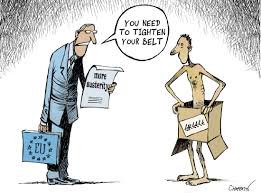
By 2010, everyone had heard the ‘austerity’ rallying cry. Immediately following the 2008 financial crisis, especially in Europe, it resounded: ‘Stimulate no more, now is the time for all to tighten!’ And tighten governments did, cutting public expenditure across continental Europe, and in the United Kingdom and the United States.

The logic behind ‘austerity’ holds that ‘the market’ – which the public had just bailed out – did not like the debt incurred when states everywhere rescued and recapitalised their banking systems. Unsurprisingly, tax revenues fell as the economy slowed and state expenditures rose. And what were once private debts on the balance sheets of banks became public debt on the balance sheet of states. Given this sorry state of affairs, states (policymakers and business leaders argued) had to take action to restore ‘business confidence’ – which is apparently always and everywhere created by cutting government spending. So governments cut.

Public debt, however, grew, because economies got smaller and grew slower the more they cut. The ‘confidence fairy’ as Paul Krugman named the expected effect, simply failed to show up. Why?

The reason is simple – and it is surprising anyone thought that anything else would happen. Imagine an economy as a sum, with a numerator and a denominator. Make total debt 100 and stick that on the top (the numerator). Make Gross Domestic Product (GDP) 100 and stick that on the bottom (the denominator) to give us a 100 per cent debt-to-GDP ratio. If you cut total spending by 20 per cent to restore ‘confidence’, the economy is ‘balanced’ at 100/80. That means the debt-to-GDP ratio of the country just went up to 120 per cent, all without the government issuing a single cent of new debt.

In short, cuts to spending in a recession make the underlying economy contract. After all, government workers have lost jobs or income, and government workers not shopping has the same effect as private sector workers not shopping. So the debt goes up as the economy shrinks further. States respond by cutting spending further. The pattern continues.

Having a common currency among different countries actually aggravates the problem because cuts in one state reverberate through many states, depressing them all. In 2008, euro area government debt as a share of the economy, including the already profligate Greeks, averaged around 65 per cent of GDP. Following budget cuts and monetary tightening (the European Central Bank twice pushed up interest rates in 2011) Euro Area government debt, by 2014, had risen to 92 per cent of GDP.

Greece is the poster child for this ‘denominator effect’. Under the auspices of ‘bailouts’ from the IMF and the EU, Greece cut more than 20 per cent of GDP in spending. It lost nearly 30 per cent in final consumption. Yet its debt increased from 103 per cent in 2006 to more than 180 per cent by 2014. That’s a 57 per cent increase in debt while spending is being cut.

Let’s look at the originating question again: how is destroying a third of the economy supposed to inspire consumer and business confidence? It won’t – unless you are a creditor – and that’s where the politics comes in.

If you are a holder of government debt (a creditor), three things hurt the value of your asset: if the inflation rate goes above the interest rate on your bond; if the exchange rate moves against you so that what the bond is worth vis-à-vis other currencies falls; and, of course, default – if the government takes the money and runs.

In the post-crisis world, despite major central banks putting trillions of dollars into the global money supply, there is almost no inflation anywhere in the developed world. Exchange rates (Brexit effects apart) are comparatively stable and ultimately move against each other relatively, so that’s not a huge worry. If the country whose debt you hold can have elections, and the public dares to vote against more budget cuts, the European Central Bank will shut down their banking system to make them revisit their choices. That’s what they did to Greece in the summer of 2015.

In this world, our present world, creditors will get paid and debtors will get squeezed. Budgets will be cut to make sure that bondholders get their money. And, in a highly indebted world, austerity – introduced as an ‘emergency’ measure to save the economy, to right the fiscal ship – becomes a permanent state of affairs.

As Britain’s former prime minister David Cameron said (standing beside a throne in a white bow-tie and tails) in 2013: ‘We need to do more with less. Not just now, but permanently.’ But here’s the question hidden in that blithe statement – are you and me part of the ‘we’ here?

Let’s go back to the huge jump in public debt that occurred when governments, ie the people, bailed out the banks. That debt was not, and is not, a liability. As difficult as it can be to make this reality part of the political conversation, public debt is an asset. Even at today’s low rates, it earns interest and retains value. No one is forced to invest in public debt, but every time bonds are issued investors show up and buy them by the truckload. By market criteria, public debt is a great investment.

But who pays for it? That would be the taxpayer. More generally, those who contribute to the payment of debts by not consuming government-produced services that have been cut. Basically, in most countries, this means that the bottom 70 per cent of the income distribution bears the cost of paying for public debt.

Over the past 25 years, to make up for chronically low wage growth, that same 70 per cent of the population has increased its personal indebtedness. Massively. Which means that in an economy deformed by austerity, they are the ones paying out – twice. With stagnant or declining wages, they have to service both the massive private debt they have accumulated to live and the public debt issued in their name.

Meanwhile, those whose assets the public bailed out – those with investible wealth, those who hold ‘all that debt’ and make money from it – do not suffer from the decline in public spending. Since they are net lenders, the hike in personal indebtedness does not trouble them either.

The result, and the situation in which we find ourselves, is a classic bad equilibrium. Those who can’t pay, and don’t earn enough, are being asked to pay the most to service debt, from which they do not and will not benefit. Those who can pay, and earn almost all the income, both contribute the least and benefit the most from ‘all that debt’.

Strip away all the electoral politics at the moment in the US, the UK, Italy, Spain and elsewhere, and that’s the underlying political economy. It’s a creditor/debtor stand-off where the creditors have the whip hand.

And yet, the more they crack the whip, the more the backlash against austerity, in all its forms, gains strength. Donald Trump, Jeremy Corbyn, Marine Le Pen, Pablo Iglesias: Left or Right, they are all riding debtor anger against creditor strength. It might be expressed as anger against, variously, ‘trade’ or ‘the elite’ or the ‘EU’. But what’s underneath all that is the politics of debt.

This is the ‘new normal’. It’s not about flat interest rates or anaemic growth rates. They are the consequences of austerity, not its causes. The new normal is the new politics of debtors versus creditors. It’s here to stay. As we already can see, it’s going to be anything but normal.

Neoliberalism: Serving the Interests of the International Business Elitists

41rnwuTZinL._SX332_BO1204203200_-201x300

By Edward S. Herman

Source: Dissident Voice

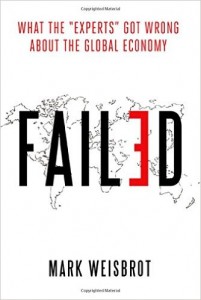
Mark Weisbrot, a co-director with Dean Baker of the Center for Economic and Policy Research (CEPR), has written an enlightening book that pulls together many of the analyses that CEPR has been producing over the past several decades. The book, Failed: What the “Experts” Got Wrong about the Global Economy, is important and useful because it provides an alternative framework of analysis to the one used by establishment experts, media and policy-makers. What is more, this alternative framework and description of reality is well supported by empirical evidence and is convincing. It is marginalized in the mainstream because it runs counter to the interests of the powerful, who over the past three decades, have successfully pushed for a neoliberal world order that scales back the earlier welfare state advances and pursues trickle-down economics and the well-being of the affluent.

In fact, an important feature of Weisbrot’s analysis is his recognition of the extent to which policy failures have flowed from biased analyses that serve a small elite and punish the majority, and that policy successes have often followed the loss of power by those serving elite interests. His first chapter is entitled “Troubles in Euroland: When the Cures Worsen the Disease,” whose central theme is that the long crisis and malperformance of Europe’s economies, and especially the weaker ones of Greece, Portugal, Spain and to a lesser extent, Italy, were in large measure the result of poor policy choices. The crisis, which dates back to 2008, was not due to high sovereign debt, which was only threateningly high in Greece, but rather the refusal of the policy-making “troika,” the European Central Bank (ECB), European Community and IMF, to carry out expansionary policies that would allow the poor countries to grow out of their deficit position.

The Fed met the U.S. crisis with an easy money program which, when combined with modest fiscal expansion efforts, quickly mitigated this crisis (although the fiscal actions fell short of what was needed for a full recovery). But the ECB refused to carry out a comparable expansion policy, and there was no Europe-wide fiscal program in the EU system. So the poor countries were forced to depend for recovery on an “internal devaluation” of cutbacks in mainly social budgets, given that external devaluations for individual countries were ruled out by the use of a common currency, the euro. This didn’t do the job, so the eurozone remained in a depressed state, even up to the present.

Weisbrot shows that this policy failure was deliberate, with the troika leaders–mainly the ECB–taking advantage of the weaker countries’ vulnerability to force on them structural and policy changes that served the interests of the international business elite. These changes, including cutbacks on public outlays for education, health care, social security, and poverty alleviation, mainly harmed ordinary citizens. So did the enforced pro-cyclical monetary and fiscal policies themselves, which produced a eurozone crisis of unemployment and foregone output that extended for six years and is still ongoing. Weisbrot points out that this policy and process was a notable application of Naomi Klein’s “shock doctrine,” according to which elites take advantage of painful developments (here macro-distress) to force policy changes that could not be obtained through a democratic process like a national political vote of approval. Weisbrot shows that the troika leaders were quite conscious of the fact that they were pursuing “reforms” that the public wouldn’t support outside of shock conditions.

This process rested on the undemocratic structure of macro-policy-making in the European community. One of neoliberalism’s instruments is an “independent” central bank, where independent means not subject to democratic control. The ECB meets that standard well, more so than the Fed; and in its statute the ECB is only required to meet a price stability objective, so it is free to ignore unemployment and even deliberately increase it. Neoliberal practice is also encouraged by the 1992 Maastricht Treaty, which placed ceilings on the size of budget deficits and total public debt (3 and 60 percent respectively). These unnecessary ceilings are often breached, but provide levers to put pressure on weaker countries.

The countries victimized by the ECB’s pressure for painful internal devaluation could in theory exit from the euro and rely on expansion via currency devaluation and newly feasible monetary and fiscal expansion. But the risks in the cutoff of aid and money market access and the turmoil in any transition are severe, and although Syriza was voted into power in Greece on an anti-austerity program and pledge, it did not see fit to exit. In this connection Weisbrot discusses the case of Argentina, which, in the midst of a calamitous recession in 2001-2002 did default on its large external debt, ended its peg of the peso to the dollar, froze bank deposit accounts, and installed controls over capital movements. This caused immediate chaos and a worsened crisis, but as Weisbrot stresses, after only a single quarter of further GDP decline (5 percent), freed of its externally imposed constraints, Argentina began its recovery, taking three and a half years to regain its pre-recession level of output, but with real growth of some 100 percent over the next 11 years. Greece, which had a peak GDP loss of 25 percent, and which is still mired in a badly depressed economy, could hardly have fared worse than Argentina if it had exited years ago. Whether that option should still be taken is debatable, and Weisbrot discusses the pros and cons without coming to a definite conclusion, but that an exit might well have a positive result is suggested by the Argentinian experience.

A major theme of Failed is the negative impact of neoliberalism on the growth of low and middle-income countries and the welfare of their people. A major chapter on “The Latin American Spring” features evidence that the triumph of neoliberalism in the years from 1980 to the end of the 1990s was a dismal economic and welfare failure, Per capita GDP growth fell from 3.3. percent per year, 1960-1980 to 0.4 percent 1980-2000, rising again to 1.8 percent in the years 2000-2014. The earlier period (1960-1980) was one of widespread government intervention in the interest of rapid economic development; the middle years were dominated by the triumph of neoliberalism, with widespread imposition of structural adjustment programs under IMF and World Bank auspices, lowering trade and investment barriers, and ruthlessly cutting back development and welfare state programs. The years 2000-2014 saw a resurgence of economic growth, but not up to the pre-Reagan years.

Weisbrot shows that the new spurt in economic growth was closely associated with the victory of leftist governments in quite a few Latin American states, starting in 1998, He also presents a great deal of evidence showing that the growth spurt resulted in major improvements in a range of human welfare indicators, like reduced infant mortality, poverty reduction, more widepread schooling, enlarged pensions, and greater income equality. Thus, for example, the Brazilian poverty rate, which had remained virtually unchanged in the eight neoliberal years before the victory of the Workers Party, saw a 55 percent drop in that rate during the years 2002-2013. Similar changes in this and other welfare measures took place in Ecuador, Bolivia and other Latin states that escaped the neoliberal trap. Although these changes brought improved lives and prospects to millions, Weisbrot points out that the U.S. mainstream has played dumb, refusing to feature and reflect on the significance of this widespread improvement in human welfare and its strange efflorescence associated with the decline in U.S. and IMF-World Bank influence in Latin America.

Weisbrot stresses the importance of democratization and policy space in these growth and welfare improvements. The ECB narrowed that policy space in the eurozone, making it difficult for national leaders to expand or otherwise help improve social conditions. This reflected the weakening of democracy in the eurozone, with the ECB, EC and IMF able to make decisions that local democratic governments would not be able to make. Similarly, the loss of power over Latin governments by the U.S. and IMF following the left political triumphs from 1998, and their record of anti-people actions and other policy failures, made for policy space. So also did the rise of China as an economic power, providing a market for Latin products and loans without political conditions. Weisbrot notes that the common orthodox position that the democratic West would be more likely to help poorer countries develop democracies as compared with what authoritarian China would likely do is fallacious. China lends widely without intervening politically. The United States has a long record of support of undemocratic regimes that will serve as its political instruments and/or provide a “favorable climate of investment.” (This writer’s The Real Terror Network was a dossier of U.S. support of National Security States in Latin America and of its active involvement in many counter-revolutionary “regime changes.”)

It is arguable that an unrecognized benefit of the Iraq and Afghanistan wars was their distracting U.S. officials from major efforts to halt the trend toward democratic government in Latin America, although their participation in the attempts at regime change in Venezuela and their successful support of an undemocratic coup in Honduras in 2009 shows that the longstanding anti-democratic policy thrust of the U.S. leadership is not dead. (Mrs. Clinton, of course, fully supported the Honduras coup. So we may see a more energetic pursuit of the traditional U.S. policy of hostility to democracy in Latin America with her election.)

Weisbrot stresses throughout the importance of per capita growth for improving the human condition. A problem with this premise is that the human race may be growing too fast for ecological survival. Weisbrot confronts this issue, arguing that while population growth is a definite negative productivity growth may on balance be a means of coping by increasing food output and lowering the cost of wind turbines, solar panels and other improvements. However, increases in incomes tend to increase the preference for meat, larger houses, and other resource depleters, so that productivity improvements may, on balance, place even more pressure on the environment.

Weisbrot is possibly over-optimistic on this front. But his book is rich in compelling analyses and data that show how the mainstream live in an Alice-In-Wonderland economic world and the important things we may do to escape that Wonderland.


Edward S. Herman is an economist and media analyst with a specialty in corporate and regulatory issues as well as political economy and the media. Read other articles by Edward.

A New Lost Generation: Student Loans, Wage Slavery, and Debt Peonage

Dr. Nicholas Partyka

Source: The Hampton Institute

In literature, the term “lost generation” refers to a cohort of authors whose work defines the post-First World War era. This group includes literary notables like Ernest Hemingway and F. Scott Fitzgerald, among others. According to the dominant understanding, what made this group of expatriate writers, centered in Paris, ‘lost’ was not a sense of geographic dislocation, but rather one of spiritual or moral dislocation. Their experiences in or with the war led them to question, even to abandon, the systems of values that they had held prior to the war. This kind of sentiment, and experience, was not uncommon in society at large. This is likely part of why these authors’ work achieved such prominence in this period. Many people felt lost in this era, even before the onset of the Great Depression.

The project of liberalism had been brought into serious question by the First World War. According to liberals, as society embraces the philosophical tenets, the economic and political institutions, the social and economic practices, as well as political values of liberalism, greater social peace and stability would arise. This would occur both nationally, as society came more and more to resemble the liberal ideal, and internationally, as liberal states cooperated and traded rather than fought with each other. Up to the time of the First World War liberals retained their faith in the idea, rooted in the Enlightenment, of ‘Progress’. The reality of the war shattered these comforting illusions. Indeed, since the Napoleonic defeat, with some exceptions largely in their colonial possessions, liberal states had not gone to war with each other. This made it easy for some, based on an argument from Kant, to believe in an idea like the liberal, or democratic, peace.

Being ‘lost’ in this fashion was to experience a form of social disorientation resulting from a sense of, what Durkheim called, anomie. Having lost the easy faith in liberalism, many in this generation found themselves without the traditional moral framework, or social guidelines around which most people construct their lives, and their life trajectories. The fact that war occurred; that the introduction of modern industrial technology on an unprecedented scale caused such unfathomable carnage; that modern communications technology was advanced enough for the people on the home front to see, and to understand the reality of the war; the ever increasing heights of wealth and opulence enjoyed alongside crushing poverty; the continuing rapid pace of industrial and technological, as well as social change. All these contributed to the feeling of anomie, and even ennui, that made so many in this generation feel ‘lost’, or disoriented.

The term “lost generation” also has a usage in political-economy. There are some interesting similarities in the experience of being ‘lost’, of social disorientation, between the two different usages here. In political-economy, the notion of a ‘lost generation’ refers to a cohort of workers adversely impacted by a persistently weak labor market. A generation of workers can be lost to the impact of poor macro-economic conditions in several ways. From the point of view of society, this generations’ labor is lost, and the material progress of society delayed, in that it is never deployed in its most productive use, or at its full potential. This generation, and the next, can be lost in that their progress on the ladder of social mobility, assuming that such a thing existed, can be slowed by the practical limitations imposed by economic constraints. Most mainstream capitalist economists understand the notion of a “lost generation” as a cohort of workers whose lifetime earnings are likely to be less than they otherwise would have likely been, due to the poor performance of the macro-economy.

A lost generation is a serious matter, because it will have a significant, widespread, and multifaceted impact on society. A potential lost generation will impact not only the individual workers, but also their families and their communities. Workers who make less are not able to invest in important resources and opportunities for themselves, and for their families, especially their children. The diminished capacity of the majority of workers to invest in the personal development of themselves, and importantly, of their children, will have important consequences for the health of workers’ democracy. In a heavily stratified form of society, such as capitalism, the effects of a potential lost generation will be different in specific segments of the labor market, and income spectrum. Those higher up may be able to avoid to worst of the negative effects of the kind of poor economic climate that produces a lost generation. Those lower down may end up being crushed under the weight of the forces causing the disruption. Suicide, lack of adequate medical attention, lack of adequate housing, lack of sufficient food, all take the lives of people forced onto the margins of a commercial, capitalist society. Workers are also ‘lost’ in these latter ways during periods of economic turbulence and distress.

It is the specter of exactly such a lost generation of students and workers that haunts many economies in the Euro-Atlantic world, especially including the US. The dominance of neo-liberal austerity policies only further exacerbates this problem of a potential lost generation. As social programs are increasingly defunded, or even privatized, workers and the poor face increasing pressure to make ends meet, that is, to obtain basic subsistence goods. And when crisis is combined with austerity these pressures only multiply, causing many on the margins to crack under the pressure. The neo-liberal response to the crisis in the US, and even the job-less recovery, further increased these pressures on the most vulnerable, which has caused widespread social dislocation in many countries. Though every country has a unique experience, some of the main symptoms are the same; higher unemployment and underemployment, especially among youth; increases in the ranks of the long-term unemployed; increases in homelessness; increases in suicides; increases in premature deaths due to inadequate medical care, shelter, and nutrition; increases in drug and alcohol abuse. The social dislocation resulting from the fallout of the 2008 global financial crisis, and its aftermath, has so disrupted the pre-crisis status quo that many, especially young people, increasingly feel a kind of anomie, like that which animated the literary Lost Generation of the 1920s.
Austerity & Social Dislocation in Greece

To see what a lost generation can look like, and what its social consequences can be, Greece offers a striking case study. Since the 2008 global financial crisis, and the Euro crisis which followed, Greece has been at the center of the action. Indeed, it was exposure to Greek debt which was, and still is, the major fault-line of the Eurozone crisis. In order to save the Eurozone, creditor nations, and international financial institutions, have intervened on more than one occasion to provide Greece with “bailouts” and rescue loans to prevent a default on their debt; which many fear would trigger a collapse of the entire Eurozone. The unrelenting austerity measures imposed on Greece since 2010 have taken a massive toll on the Greek population. As the drama of the negations between the new SYRIZA-led Greek government and its creditors unfolds, it continues to be the Greek people, especially the most vulnerable, who bear the costs of neo-liberal prescribed austerity policies.

Right now, Greece is in the process of being the victim of what gangsters of another era would call a “shake-down”. That is ultimately what the negotiations with its creditors are. And, in light of how the creditors have acted toward Greece, this appearance has hardly been dispelled . Those to whom the Greeks owe money are insisting on full repayment, and have a clear policy agenda for how to get it, and have thus far steadfastly refused to engage in any discussion of a pro-growth policy programme. Greece is begin held-up by European financial elites by using access to credit and bond markets -indispensible tools for all modern governments- to coerce Greece into compliance. Being cut-off from these markets would make it harder for Greek businesses to do business with the rest of the world, it would also hamper the efforts of the Greek government to achieve its political and economic objectives. In order to pay back what they owe, creditors are and have been demanding the Greeks “privatize”, i.e. sell to the highest bidder, state assets, raise more tax revenue, and spend less on social programs. This is the general policy prescription the troika has consistently applied to Greece. The international creditors, just like Shakespeare’s famous Shylock, are in essence demanding their pound of flesh from Greece.

The affects of these policies has been utterly devastating on Greek society. By 2012, the enormous scale of the economic and social crisis brought on by neo-liberal austerity policies was abundantly clear. The main results of austerity for Greek workers and families have been; around 25% unemployment, and the rate for youth under twenty-four is double the overall rate; near 20% decline in wages across the board; about 30% of the population living below the poverty line, and have no access to affordable healthcare; the average family income in Greece has fallen back to its 2003 level; 40% of Greek children are growing up below the poverty line; 45% of Greek pensioners living below the poverty line; 58% of the unemployed live below the 2009 poverty line; a 25% increase in homelessness just between 2009 and 2011; a dramatic rise in personal bankruptcy filings. Meanwhile the tax increases, as well as wage and pension cuts, in addition to cuts to social services, demanded by the troika have resulted, according to one study, in the poorest households in Greece losing 86% of their pre-crisis income. The wealthiest by contrast have lost an estimated 20%, and this is at the upper end of estimates.

Steep declines in wages, deep cuts to social services, rises in unemployment, and tax increases, have all combined to put brutal pressure on 3 million Greeks living on or close to the edges of subsistence. The tumult created by the economic fallout of the austerity agenda imposed on Greece has resulted in a humanitarian crisis of immense scale. As Greece has been forced to spend less on hospitals, for example, the social effects have been dire . Greece has seen rises in infant mortality, a return of malaria, rising rates of HIV among drug users, limited access to important pharmaceuticals, and a dramatic spike in suicides and incidents of major depression. These are the results of Greece now spending less on healthcare than any pre- 2004 EU member state. With the severe wage and pension cuts, food insecurity has also exploded, as nearly three million Greeks do not have enough food to eat.

One of the major trends to emerge from this social catastrophe is the large-scale emigration of Greek youth. Given the unemployment picture, the continued recession, the deterioration or privatization of social welfare programs, many young Greeks see no option but to leave their home country to seek work abroad. This unfortunate trend is leading to what some call a “brain drain” effect as the most educated, the most talented young Greeks leave the country, thus depriving the nation of the type of talent necessary to lift it out of its economic malaise. This growing Greek austerity-fueled diaspora, lack of investment in social programs like health and education, increasing poverty and desperation, all combine to produce the conditions for a lost generation. After more than a half-decade of recession and austerity, the costs of the Eurozone crisis have been largely foisted upon the Greek people, and especially the most vulnerable among them.

The continued imposition of economic austerity policies on Greece will only produce more of what we have already seen, it will only deepen the social and humanitarian crisis in Greece. This brain-drain from a large-scale emigration of Greek youth would only compound Greece’s financial problems, as it shifts the composition of the population, skewing it much older. This youth diaspora issue is a problem that Cuba, for example, is now confronting, as the economic effects of the US blockade continue to fuel the emigration of young Cubans for employment opportunities. Austerity and recession are choking the life out of the Greek economy, and the Greek people, just as the US blockade is meant to do to Cuba. Austerity is a political choice, it is a policy programme, and it is thus that a lost generation is being imposed on Greeks by the creditors, by the troika.

The other major trend to emerge from the crisis is a flourishing of truly grass-roots solidarity movements and projects. Soup-kitchens, free schools, and clinics, among other social-welfare and relief-oriented initiatives, have proliferated in Greece as communities and activist groups- especially anarchists- organizes themselves to help provide for those being deprived, those being starved, so that European banks and other creditors can be repaid on the terms they demand. This amazing social solidarity response is an optimistic sign of a flourishing anti-austerity, anti-neoliberal, anti-capitalist resistance movement in Greece. Indeed, the many protest marches, strikes, and occupations of public spaces and buildings shows this movement is very healthy, and has widespread support. The repeated and deep wage and pension cuts, the draconian cuts to social programs, the continued recession, and the loss of labor rights and even collective bargaining rights have severely affected so many people in Greece that radical (from the point of view of mainstream capitalist political parties) SYRIZA party won snap-elections earlier this year.

Despite the July 5th referendum, Greece’s situation remained highly precarious. By returning a decisive victory for the anti-austerity “no” option, the Greeks not only displayed their pride and independence, but also gave some indication of the depth and breadth of the anti-austerity, and anti-troika sentiment in Greece. On the other hand, the results of the referendum have seemed to have embolden the creditors, and indeed, they appeared to dig in their heels even before the ballots were cast; that is, if one is to judge from the public pronouncements in the days preceding the referendum. The situation in Greece is dire, and deteriorating. As financial panic and bank runs became more intense, they compounded Greece’s already significant social woes. It appears that fears of a much worse social and economic crisis, should Greece exit the Eurozone and re-institute the Drachma, are what led Prime Minister Tsipras and his government to capitulate to the creditor’s demands. And also what led him to accept a new bailout agreement, with even more draconian austerity conditions than the agreement the Greeks ostensibly rejected in the July 5th referendum. The creditors decided they were prepared to financially strangle Greece, and allow its banks to collapse, if their terms were not accepted. In essence, the Greek government was forced to choose between being strangled and slowly suffocated, and in the end they chose the latter.
The Student-Loan Debt Crisis: The Making of a Lost Generation in the US ?

The main outlines of a potential lost generation are already becoming clear. A great many young workers today find themselves over-educated , over-qualified, un- or under-employed, living with roommates or back with parents, working jobs well beneath their educational level, and in debt for the education they hoped would lead them out of the lower ends of the labor market. One finds that this group has been delaying family formation, and delaying major purchases like houses, automobiles, and other “consumer durables”. This is often attributed to this group typically paying off their loans over a much longer period of time than previous cohorts, which is itself attributed to the poor economic situation of the cohort of graduates that came into the labor market in and around the time of the financial crisis and the onset of the Great Recession. The unemployment rate among youth, as well as among college graduates, and the large increase in the rates of default on student loans gives some measure of the troubled economic situation many recent graduates face. The rise in forbearances, and Income-Based Repayment ( IBR) enrollments, because they deflate the default rate, offers an important insight into the poor situation recent graduate face after they leave school.

Many factors contribute to creating this student loan crisis and a potential lost generation. The first factor to notice is the increasing democratization of college and the college culture beginning with the mid-20th century middle class. Following Thomas Piketty’s analysis, one should see the period after the World Wars and the Great Depression as a historically unique, and unprecedented epoch. In Piketty’s terms, this was the first epoch in which the rate of return to labor was higher than the rate of return to capital. That is, for Piketty, this was a period in which the fundamental law of capital, as had been observed for several centuries, was reversed. This happened, Piketty argued, because of the dramatic, indeed unprecedented, social, political, and economic changes made necessary or expedient by the upheavals of the 1914-1945 period. In order to win the wars and combat the depression, governments across the capitalist world made concession to the workers movements which had been gathering momentum since the late 19th century. These accommodations, and the government intervention needed to achieve them, resulted in the reversal of Piketty’s historical law of capital.

In practical terms, these policies left workers, especially those in the US with much more disposable income than ever before. The Baby Boom generation was thus able to go to college in record numbers, and achieve extraordinary social mobility because of a fortuitous confluence of historical circumstances. The parents of the Baby Boomers enjoyed the kinds of economic conditions that allowed them to afford the things which came to characterize the American middle class lifestyle; suburban houses, multiple automobiles, family summer vacations, college educations for children, retirement savings, et cetera. Because the Baby Boom generation was able to go to college, and as a result, attain professional success, and therewith social mobility, they quite naturally passed on these lived experiences as expectations for their children.

And for a generation or so this pattern worked. Young middle class-ish people graduated from high school, went to college, got jobs, moved out on their own, got married, bought houses, had children, and reinforced for those children the importance of going to college. Yet, as macro-economic change occurred, driven by neo-liberalism, and as the labor market came to contain more and more workers with college degrees, the pecuniary advantages attached to college degrees began to erode. Yet, as the economic advantages of a college education diminish, the dominant cultural narrative, at least for the “middle class” and those who aspire to it, is that the path to a good life runs through a good job with a high salary, and one gets this by having the right skills, and these one acquires in college. So, whether it is necessarily a good idea or not, millions of young Americans aspire to, apply to, and enroll in American colleges. Most do this in the hope of being able to get a job which will pay them enough to live a comfortable life.

Also contributing to this crisis is the rapidly rising costs of college. As more and more students were able to muster the financial means, largely due to continued access to “easy money”, that is an excess of cheap credit in the financial system, to register effective demand on the market college became a big business. As enrollments continued to grow, this business grew. There emerged an arms-race dynamic among colleges, which has only intensified, and spread over time. This arms race is based on the need for colleges to attract students, and involves spending money on buildings, facilities, amenities, technologies, events, and more to attract students. At the same time as this arms race drives up costs, so too do the ever inflating salaries of the typically expanding ranks of college administrators. Making the situation even worse is the fact that concurrently with the latter two sources of cost inflation, is the fact that state financial support for public education, on all levels, not just higher education, has deceased markedly over recent decades. Thus, as a result of neoliberal efforts to decrease taxes on the wealthy, the costs of education are being born more and more by students and families, driving many of them into debt, or deeper into debt, in search of the prospect of the social mobility they think a college education can provide.

The reality of the present situation is that the labor market that many post-crisis graduates have found themselves in is decidedly not favorable. The macro-economic shift in employment in the US predominantly to the service sector, and systemic forces inherent in capitalism that produce persistent pressures toward automation, have combined to create a labor market in which job growth is concentrated in the high and low end segments. Computer and internet technologies have facilitated a great deal of further redundancy of human labor in the production process for many manufactured goods. They have also rendered large amounts of human labor unnecessary in other sectors by automating via digitization, various customer service operations or routine business functions. Globalization has also helped hollow out the old middle class by moving out of the country the kinds of skilled and semi-skilled manufacturing jobs that did not require college education.

In 2011 the Occupy Wall-Street movement burst dramatically onto the scene in America. This movement gave voice to the first stirrings of large-scale anti-austerity sentiment in the US. Many graduates who entered the labor market at the time of the crisis and its immediate aftermath, had by 2011 experienced the effects of the economic crunch. This movement brought many of these people together through their shared experience of disillusionment, and social as well as economic dislocation. The recent emergence of the Corintian15, which very quickly became the Corinthian100, and the student-loan debt-strike movement, shows that this movement is not dead. Instead, this movement is gaining momentum as the economic situation for more and more young workers becomes more and more desperate. As the student loan crisis continues to build, and as austerity and neo-liberalism dominate the policy response, the resistance movement will only spread. Though capitalist elites, through municipal governments nation-wide, were able to suppress the initial incarnation of the Occupy Wall-Street movement, the basic social, political, and economic conditions that created it remain.

If the austerity-driven response continues, a lost generation is exactly what could emerge in the US. The impact of the most recent crisis is still being felt, and little in the way of recovery has trickled down to many of those displaced by the crisis, or the Great Recession which followed it. And there are other groups besides young graduates who face uncertain economic futures. Older workers pushed into early retirements despite smaller pensions and rising costs. Pensioners and the elderly, who are already largely marginalized in society, also suffer. Middle-aged workers displaced from their jobs during this past crisis have had a quite difficult time finding new employment, at least at the level of their previous job. This is exactly the broad base of suffering that unites many in Greece against neo-liberalism. The young, and recent graduates, are not the only ones to suffer, nor are they the ones who suffer the most, just as in Greece.

However, the current cohort of young Americans is the most well-educated in the nation’s history, indeed, college degrees are more abundant than ever. Every social group seems to be experiencing growth in the rate of college degrees; though disparities between racial groups persist, and indeed increase. The current narrative in the dominant culture about how to achieve “middle class” social mobility, is still to get and education, i.e. go to college. Throughout the post-war period, in order to facilitate economic growth, by way of personal development through education, the US government increasingly helped make money available to help more and more people attend college; this, of course, began to change with the rise of the ideological hegemony of neo-liberalism. There is thus a sinister bait and switch at play between the narrative about college and mobility, and the social reality of these. Students are encouraged to take out increasingly more in loans, so as to afford to go to college, in the hopes of getting a job that pays enough to live on. When graduates emerge from colleges, what they find is a labor market overflowing with college graduates all seeking employment in the fewer and fewer good jobs, for which they are all qualified, as well as for the growing number of low-paying jobs for which they are all over-qualified. Stultified by low wages, abusive scheduling, and a polarized labor market, this lost generation is already delaying family formation, and may in the future be marked by the kinds of increases in depression and suicide that we have already seen in Greece.

This post-crisis generation of graduates, which is still emerging into fuller maturity, has been set up to become a lost generation. They are likely, unless drastic policy changes occur, to endure economic lives in which they make less money on average over their working lives, have less secure employment, less secure access to healthcare for their families, less access to or lower quality of education for their children, less ability to afford to retire, and many other of the same forms of social and economic dislocation being experienced by workers in Greece. The social realty this post-crisis generation confronts can only serve to disillusion and disenchant, as it disenfranchises through poverty, austerity, and inequality. This post-crisis generation is well placed by socio-economic circumstance to experience the social, moral, economic, and political confusion and disorientation that characterizes a lost generation.

Bound to jobs that don’t engage the talents cultivated by education, and that impose abusive workplace practices, in order to pay back student loans, this post-crisis generation is being groomed to become a dependent, and hence docile one politically. Given the poor state of the labor market, the rising costs of a college education, and the diminishing return on a college education, student loans are taking longer and longer to pay off. In many cases this process can stretch out for decades, becoming in essence life-long debts; or, at least, debts that will require the bulk of one’s working life to discharge. These student loan obligations thus keep young workers feeling insecure, and beholden to their employers, if they’re lucky enough to have jobs.

From the point of view of elites, of entrenched powers, education has always been a double-edged sword. On the one hand, one wants the fruits of scientific, philosophical, and artistic discovery and achievement. For, indeed, these are the hallmarks of civilization, of progress, and of enlightenment. On the other hand, the more education is allowed to be received by more and more “lower” ranks of society, the more questions start being asked about the nature of the social order, and about potential changes. Education is a pandora’s box in this way. Once people acquire education, it can’t be repossessed, and there is little way to stop people from passing it on to others. For example, once a person learns to read, there is often little authorities can do to stop people from reading subversive material. The long history of underground, or samizdat, literature, especially of a political nature, in most Euro-Atlantic societies evidences this. Thus, while the increased access to education, especially higher education, for the Baby Boomers, and their children, is great for those individuals, from the point of view of elites, this educational democratization was lamentable. Indeed, the revolutionary 1960s and 1970s were to some degree enabled by high levels of access to higher education, but on affordable terms, that is, without high levels of debt. Even though this was the tail end, this was still an era of social investment in education.

With the rise of neo-liberalism beginning in the mid-1970s, came continuing waves social dis-investment in education on all levels. Along with rising costs, shifts in the tax burden and stagnant wages led many working-class and poor families to bear more and of more the costs of education, particularly higher education. This served to price some out of the market, however the decline in government support for education was replaced by the increased availability of loans. This is in some measure due to the re-rise to dominance of finance capital, and the need for monopoly capitalism to generate bubbles in order to spark growth. In any event, more and more working-class and poor individuals and families took on increasing amounts of debt in order to acquire college educations.

However, rather than achieving the same kind of easy mobility their parents did, this first generation under neo-liberalism was marked by the effects of stagflation and austerity, multiple recessions and stock market collapses, and the Savings & Loan Crisis. Thus, in the early 1990s, one sees this generation become “Gen X”, the cultural emblem of which became the un – or under-employed, aimless and cynical, “slacker”. Before the unbridled optimism and euphoria of the Dot Com Bubble set in, Gen X was a potential lost generation. The apathy, dislocation, disillusionment that characterize the artistic and cultural products of this generation showcase the sense of being lost, of lacking grounding and guidelines that mark the experience of lost generations. By the mid-1990s however, the economy began to pick up, eventually becoming the tech, or dot com, bubble, and many former slackers and “grunge” kids became successful professionals in a suddenly more hospitable labor market.

Between the mid-1990s and 2007-2008 the US economy was buoyed by a succession of asset prices bubbles, or episodes of speculative mania. These bubbles prevented a lost generation from emerging beyond the early 1990s. Moreover, the effects of neo-liberalism had a beneficial effect on working-class and poor households in the form of cheap goods, particularly textiles, from Asia. Cheaper basic goods, like food and clothing, imported from the Third World had a wealth effect on many American households. A rising stock market also contributed to this feeling as well, for those who owned stock, which was increasingly many. This continued to allow many working-class families to send their children to college, and with a booming economy many were able to get good jobs and achieve social mobility. However, a lingering specter of the potential lost generation of the early 1990s was the emergence in the late 1990s of the anti-globalization movement, announced forcefully by the 1999 anti-WTO protests in Seattle.

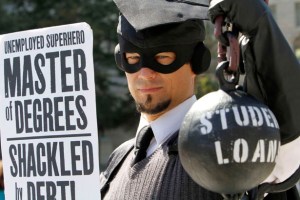
When the economy was rising, young workers could be bribed into being politically neutral through jobs that pay enough to afford “middle class” luxuries. Individuals become bound to their jobs in order to pay for the things that they own. The price of material comfort and convenience is thus obedience and passivity, it is the faux choice to be a consumer rather than a citizen. In a rising economy, debt, especially for education, can be seen as an investment in oneself, in one’s own future. Since an expanding labor market is likely to provide one with a salary that enables one to repay the loans in a reasonable period of time, this investment can often be a good one. When, however, the economy turns from boom to bust, debt serves as a set of financial shackles. Whether in boom or bust, capitalism requires that workers be bound to their jobs, i.e. be dependent on their employer and the wages he or she pays. Thus, either preparing the way for entrance into a gilded cage, or confining one to an only quasi-metaphorical chain-gang, student debt serves the interests of capital. Some, capitalism rewards with high salaries, their obedience and loyalty is bought and paid for, since the employees material position is dependent on the employers’ wages. Others capitalism condemns to various forms of forced labor in order to enforce obedience to its regime of surplus-extraction, and to stifle much revolutionary activity.
Slavery, Debt, & Peonage

Debt has been used by societies throughout history in order to coerce some people into performing coerced, that is, un-free, forms of labor for others. This is the history of class society, debt is the mechanism by which workers are incorporated into the apparatus of exploitation, that is, of forced labor. This is something which David Graeber is keen to point out throughout his book, “Debt: The First 5,000 Years”. The basic point of debt is to control the labor of others. Once one controls the labor of others, one can use it to one’s own advantage, to increase one’s own position. This fundamental tenet remains true today, debt is used as leverage to achieve control of others’ labor, and therewith their lives and their futures. Young people today, who want to go to college, are being forced to mortgage their future betting that their college degree will help them secure a job with a high, or perhaps just stable, income. Coming out of school in debt ensures that graduates must seek wage employment to repay their loans, that is they must remain politically neutral; or at least confine their activism to the bourgeois-approved, “democratic” methods of protest.

The reliance of class society on un-free labor can be seen even in its most liberal moments, for example, the various times when slavery has been “abolished”. The formal abolition of chattel slavery, or simply its disappearance, may seem to evidence a rising tide of liberalization, however, in most cases slavery is simply replaced by a new form un-free labor. Class society is a mechanism for extracting un-free labor from some for the benefit of others. So, for example, upon the abolition of slavery one very commonly sees the institution of various forms of serfdom, share-cropping, and tenancy relations between former slaves and former masters. In practice these systems perpetuate the social, political, and economic dominance of the former elites, as well as the subjugation and servility of the former slaves. One sees this process unfold time and time again. From the disappearance of slavery after the collapse of the Western Roman Empire, to the abolition of slavery by British in early 19th century, or to the abolition of slavery by the Americans in the middle of the same century, the ostensible rise in social status by former slaves was undercut by the imposition of new forms of coerced labor.

Central to this process is debt, that is, the creation of debts, which once acquired will serve to bind former slaves or serfs to their former owners, and former occupations. Since salves come into the society with no possessions, or at least little to no savings, they quickly find the need to take on debt to get by, and thus become locked into a cycle of debt and dependence whereby their labor and lives are largely controlled by the obligation to repay the debt. Necessities like food must be bought, and once slavery was abolished former slaves were no longer provided with food, however meager and putrid it often was. Former owners readily offered employment to their former slaves, because they were already familiar with the routines of the particular labor process, not to mention already physically present. Cash advances on the wages employers were now required to pay legally free workers was a very common way of creating initial debts, which would routinely spiral into large debts; debts of a size that turned formerly free persons, even if only nominally so, into debt-peons, i.e. un-free, or bonded, laborers.

In America, the transition from slavery to share-cropping in the post-Civil War period is a very clear example of this process of creating debt-peons. After the war, and even after the so-called Reconstruction era, former slaves were returned to a condition not much different from that which they suffered under slavery.[1] This was done by imposing on former slaves a vicious cycle of debt, poverty and dependence, which economically and politically disenfranchised them. For example, see the ubiquitous “black codes” that arose during Reconstruction. These were as much about enforcing social norms, but also, and equally importantly, they regulated labor in the post-war South. [2] Since, due to the economic effects of the war and of emancipation, most southern farmers could not afford to re-employ their former slaves as wage-workers because they lacked sufficient capital; that is, even if the recently freed slaves were willing to go back to work, which many were not. Thus, sharecropping was the expedient that was resorted to most often. Through the law, and other legal devices, white southerners shifted all, or the proverbial lion’s share of the risk, onto what were, ostensibly, their new business partners. The black codes, also, through criminalization of vagrancy, always disproportionately enforced on blacks, forced many former slaves back into their old jobs.

This latter leaves out the effects of the rampant, naked, and direct white-supremacist violence perpetrated against the newly liberated African-American population. Thus it was, through debt and violence, that the newly freed African-Americans were bound to their former masters, and thus forced to continue to work at their former occupation, cotton farming. The historical experience of many coal miners, and other industrial workers, especially those having lived in company towns in America, also very clearly displays the process whereby workers’ debt are used to entrap workers, and force them into a condition very much like slavery. Most newly freed slaves ended up facing a choice, especially after the end of Reconstruction, between working their old jobs as sharecroppers, or being arrested for vagrancy and being sentenced to forced labor. In either case, the newly liberated slaves were forced back to work, often for their former masters.

The same process of creating debt-peons observed in the American South after the Civil War, in the main outlines, occurred earlier in the 19th century after the British abolished slavery. Outside of those in the actual slave trade itself, this policy change primarily affected the British sugar industry in the Caribbean.[3] Former slaves were very commonly re-employed as wage laborers on sugar plantations, typically for very low wages. After cheap African slaves could no longer be acquired, plantation owners began to import cheap laborers from other parts of the world, primarily East Asia and the Sub-Continent. These laborers were routinely entrapped after arrival in the Caribbean owing the company, or perhaps some type of agent or broker, for transport and provision, as well as the very common cash advance. Cash advances were very often quickly spent, either through consuming necessaries like food, through dissipation, or through being hoodwinked. In many cases cash advances would be handed over to family in the locality where the laborer was recruited. This process of controlling cheap foreign workers through debt, and draconian repayment conditions, can be seen clearly in Qatar, particularly with regard to the building programme related to the World Cup tournament it will host in 2022.

Wage labor is also a form of slave labor, though more similar to debt-peonage than chattel slavery. If a rose by any other name would smell as sweet, then slavery by any name is always odious, and the opposite of liberty. Wage laborers in liberal-democratic regimes may have more social and political privileges than serfs or slaves, but they are in no wise the free laborers economic theory posits them to be. Wage labor is just another form of un-free labor. Workers, i.e. former serfs and peasants, were coerced into adopting the forms and routines of industrial life because they were forcibly deprived of, eventually, all means of sustaining themselves without recourse to wage-paying employment. The social, economic, and political transition from feudalism and mercantilism, to commercial and industrial capitalism created an industrial proletariat, a working-class, where none existed previously. This was a violent, disruptive, and often chaotic experience for these people, who in this fashion bore the brunt of the costs of the process of creating liberal-democratic, capitalist regimes.

Just as it was thousands of years ago, debt works to keep poor people working for rich people, who can then accumulate great wealth as a result, which is the ultimate goal. David Graeber describes how debt functioned in ancient Sumer to bring poor farmers, and their produce, under the control of the temple-industrial complex. The fastest and easiest way to create debts would be, of course, to levy a tax, which could be paid in kind rather than in coin; the requirement to pay in coin was related, as Graeber shows to the desire of early states to equip and provision armies. Thus, debt, along with military force, allowed the palace-temple complexes to accumulate the provisions that sustained its inhabitants and the raw materials its artisans required. So it is still today, debt continues to work to bind the working-classes to occupations that further the accumulation of wealth by the elites, social, political, and economic, of a society.

Young people across the US, and around the developed world, have been sold a narrative, for more than one generation now, that led them to believe that higher education was the path to social mobility and economic prosperity. In order to roll the dice and take their chance, a great many working-class and poor families and individuals have take on more and more debt so as to pursue education, higher education in particular. Now, in a post-crisis, recessionary environment, what was years ago an investment, is now increasingly an economic albatross. Left largely to fend for themselves in a confusing, and unfavorable labor market, wherein they are often over-qualified for the kinds of jobs which are available, young people across the US, and indeed across the industrialized world, are at grave risk of becoming a lost generation by way of becoming, in essence, debt-peons as a result of their getting an education in attempt to better themselves.

This latter fate excludes those graduates who are lucky enough, through circumstance or planning, to be educated in highly in-demand and thus highly remunerated subject areas. If one, either by personal proclivity or cunning strategy, desires to be an investment banker, and one is good at it, then the rewards can be unfathomably large. If one can do well something the market highly rewards, then one can find their pursuit of an education in this subject profitable indeed. And if one is unfortunate enough to be interested in a subject, for which there is not great demand by capitalists, or the state, then one’s pursuit of an education will likely be unprofitable, and result in a condition essentially the same as debt-peonage. Of course, in capitalism, the structure of outcomes in the labor market in regards to pecuniary rewards is colored to a great extent by personal connections, nepotism, cronyism, “inside baseball”, “old-boys clubs”, et cetera. Social class matters very much in the real-world sorting process in the labor market after college. Who gets what position, and for how much salary, is in many ways a heavily rigged game, especially now, as more and more, years and years of un-paid, or lowly paid, internships stand between new graduates and entrance into the professions they desire.
Avoiding a Lost Generation

The macro-level indicators, and general economic and social statistics at present are not positive, and the initial outlines of a crisis in the US are only now beginning to emerge. We are very much still in the early stages of this unfolding crisis, and there are still many possible lines of development, depending on the actions of various actors, e.g. labor, capital, and the state. On one, perhaps extremely pessimistic view, this potential lost generation could end up being a multi-generational crisis, that has a wide array of effects that form, develop, and blossom over several decades. On a more optimistic view, this “crisis” might amount to no more than a lost decade. Sure the labor market might be bad now, but that could change the next time the economy picks up. The important point to keep in mind is that the shape and scope of the crisis to emerge can be changed by conscious and deliberate action. Though a lost generation is looming, it is by no means inevitable.

One promising line of resistance to a potential lost generation is the debt strike being organized by the Strike Debt! collective around the Corinthian100. These students, defrauded by the predatory practices of the Corinthian for-profit college network, banded together in protest to declare that they would not repay their loans, deeming them to be immorally acquired, and thus illegitimate. Despite a negotiated settlement in March of this year, some former Corinthian students judged, and not unreasonably so, the terms to be insufficient, given the scale and scope of Corinthian’s fraud, of which they were the victims. The rapidity with which the Corinthian15 became the Corinthian100 shows how wide the appeal of the original message was, and how deep is the feeling of betrayal an injustice felt by these students. The highly conscious predatory behavior engaged in by for-profit colleges like Corinthian makes the moral argument for a debt amnesty in this case particularly strong. The debt strike currently being organized may indeed by successful at provoking the state into taking precisely this action.

It is important to note that the amount of privately-held student debts is a small fraction of the total amount of outstanding student debt. Even an unconditional debt forgiveness for all Corinthian students, as well as for all other students at for-profit colleges, would not do very much to avert a lost generation. A debt strike could, however, do much to raise revolutionary consciousness among the strikers. Some who might otherwise never have been radicalized, or even exposed to radical ideas, can engage with them as a result of their personal experience. If the movement is successful in winning total debt forgiveness for Corinthian students, this will undoubtedly be a great boon to those who would be freed from those debts. This is no insignificant achievement. But, since most student debt is owned or backed by the government, and cancelling this debt as yet has no movement behind it, this post-crisis generation may very well end up knowing the experience of being lost.

One potential solution to the crisis would be some variety of Keynesian stimulus plan, or a 21st century New Deal. This would, quite naturally, require a great deal of state intervention in the economy. This latter is heresy to the current orthodoxy in economics, and moreover, there is a lack of political will to enact such a program. Yet, the logic remains as sound as it ever was, money spent on wages will have multiplier effects that work to increase output and employment. When workers get paid, they spend. This spending stimulates the economy by raising aggregate demand. Whether the private sector or public sector, wages are wages to workers, and the workers’ expenditure is the income of the retailers, and their suppliers. America does not lack for significant projects, whether infrastructure, social services, or others, worth spending money on which could improve the quality of public life, and provide the kinds of opportunity and mobility that we saw in the mid-twentieth century.

The bourgeois-democratic state itself can take, and has taken, steps to blunt some of the worst effects of the student loan crisis, and the burgeoning lost generation. In 2013 Congress acted to lower interest rates on student loans, after the rate had risen earlier in the year. While this was no doubt a boon to many, it remained the case that students pay much more to be able to afford to go to school than do the biggest banks to borrow from the federal government. It remained the case that the federal government is attempting to make money from student borrowers. Moreover, it remained the case that US students take on a higher debt burden than students in other countries. Recently, President Obama took action to help ease some of the problems associated with student loans, especially in the repayment of these loans. His action this year follows another step he took last year to help student borrowers by limiting the percentage of their income that creditors could demand as monthly payments. Needless to say, these measure are good for the people they help, to the extent they actually work to reduce the financial burden student borrowers face in the repayment phase of their loans.

However, such measures, by blunting the most severe effects of the student loan crisis, serve to forestall any larger economic or social crisis emerging out of the student loan crisis. These policies also work to forestall the worst, but also potentially most politically radicalizing, effects of the experience of being in a lost generation. Thus, the action of the bourgeois-democratic state is a double-edges sword. While the amelioration of financial hardship is good for those suffering under them, it is also bad in that it forestalls the development of the revolutionary consciousness that is necessary to provoke radical social change. Just as in Greece, as elsewhere today and in numerous historical examples, the hardships and sufferings imposed by economic crisis would generate much solidarity and revolutionary working-class consciousness, and activism. Though this kind of radicalization is still happening because of the student loan crisis, it is at a much slower pace.
Conclusion

In some discussions of the student loan debt crisis the word “bubble” is used to describe the crisis. And, indeed, in the wake of the 2008 financial crisis it was fashionable for a time to attempt to predict the next bubble, especially after two successive bubbles were largely ignored until they popped. The comparison to a speculative “bubble” is an inaccurate characterization of the student loan debt crisis in some respects. It is inaccurate in that the student loan crisis lacks some of the important features of traditional economic crises associated with the collapse of an artificially inflated asset price. Instead, the collapse of the student loan “bubble”, rather than causing an economic crisis akin to the collapse of the housing bubble, is likely to take the form of a lost generation.

The fallout of this crisis will be borne by young graduates and workers in the form of diminished lifetime earnings, chronic under-employment, delayed household formation, and increased dependence on employers and attendant political passivity. In this way, the comparison to speculative bubbles is correct, in that, just as has been the case with bubbles throughout history, it will be the smallest investors, the working-class people who buy into the market at the end of the boom period who bear the bulk of the costs of the collapse.

Despite record high levels of outstanding student debt, the crisis is not likely to cause widespread economic chaos as it erupts. First, historically, bubbles have typically arisen in the asset price of private, as opposed to public, goods. Because the US government and its immense financial resources backs the large majority of student loans, either by originating the loans in a federal agency or by guaranteeing payment to issuing private banks, there is unlikely to be a collapse in the asset price. Asset price bubbles collapse largely because investors lose faith in the future solvency of an enterprise, thus the backing of the government of the world’s largest economy removes this latter fear in the case of inventors in student loan debt.

Even a debt strike by the whole population of student borrowers in the US would not necessarily work to burst this alleged bubble. Moreover, as was seen in the 2008 financial crisis, even when bubbles do burst bourgeois-democratic regimes often bail-out the wealthiest owners of the formerly valuable asset. Second, given that student loan debt totals just about 7% of US GDP, even a collapse of this alleged bubble would be unlikely to cause a large-scale economic crisis like the one seen as a result of the 2007-2008 collapse. While still an important drag on the macro-economy, the student loan crisis is not likely to be the epicenter of a future economic earthquake.

Not mentioned at all yet in this discussion are those students who take on debt to attend college but do not graduate. This group faces the same poor labor that market graduates do, remain saddled with the financial burden of student debt like graduates, however, dropouts lack a degree, that is, the credential that largely governs access to the higher paying segments of the labor market. Though it remains true that college graduate tend to earn more over their lifetime than non-college graduates, college dropouts combine the worst of both worlds; the debt of college attendance, and the diminished economic prospects of non-graduates.

Notes

[1] For an excellent discussion of this see Zinn, Howard. “Slavery Without Submission, Emancipation without Freedom”. A People’s History of the United States: 1492-Present. 1980. Harper Perennial, (2003): 171-210.

[2] See Brands, H.W. “The Conquest of the South”. American Colossus. Anchor Books (2010): 135-166.

[3] For an excellent description of this process see, Abbott, Elizabeth. Sugar: A Bittersweet History. Duckworth Overlook: 2010.

“Breaking the Fear Factor”: Opposing War, Financial Fraud and State Terrorism, Dismantling Propaganda

4501e162f2a86d1f455bb5d8a1814139

By Peter Koenig

Source: Global Research

We are living in a (western) world dominated by neoliberal dictators, criminals and crooks. And many of us, impregnated with the human idiocy, as so well described by  Andre Vltcheck (The West Spreads Intellectual Idiocy) are every day deeper and deeper immersed into fear – fear of action, fear of what’s next – fear of losing our comfort zone. The western propaganda machine paid for by the corporate and financial oligarchy through the presstitute media is constantly indoctrinating the little we have left of our free-thinking brains.

Fear is everywhere. People who are afraid can easily be manipulated. People who are afraid obey. The system needs people who don’t resist. Renegades are potential drone targets. The Big Constant that pervades our western world with ambitions to also infiltrate Asia – is terrorism. Man-made terrorism – or better – elite-made terrorism; George Orwell would have called it Big Brother-made terrorism; terrorism with a particular purpose: spreading fear and submission.

On Friday, 21 August 2015, on a train from Amsterdam to Paris, according to the New York Times, “a heavily armed gunman opened fire aboard a packed high-speed train, traveling from Amsterdam to Paris [….] wounding several passengers before he was tackled and subdued” by two American military servicemen (on leave), who were helped by a third American. According to French officials, they “averted a mass killing.”- The gunman was armed with an automatic pistol, an AK47 and a knife (NYT annotation: AK47 is Al Qaeda’s preferred weapon). The Americans were coincidentally and suitably near to subdue the shooting 26 year-old Moroccan, a convenient Arab, who was taken into custody when the train stopped in Arras, France, just beyond the French-Belgian border. No doubt, he will be squeezed for confession. He may try to escape – and then may be shot death. Amen.

The French anti-terrorist unit took immediately charge of the investigation. The unit is known to work in utmost secrecy. Whatever news comes out of it is most likely ‘cooked’ to suit the system.

The NYT proclaims that the three Americans saved the train from a massacre. Nobody was killed. Just one of the American heroes was injured. Hollande thanked Obama for the brave Americans’ exemplary behavior and for preventing a train carnage. Propaganda all over. In America we trust – is dogma number one; dogma number two is – there is no save place on earth.

Fear everywhere, but America is there to help. Danger lingers at every corner. A terrorist may be just next door. Just give yourself up to Big Brother and he won’t let you down.

The first step towards sub-doing fear is asking yourself: Who invented and fabricated terrorism in the first place? In countries and entire regions ravaged by Washington incited wars and conflicts, terrorism is the expression of hopelessness, of wrath – of fighting back, when there is nothing left to lose. Look at the Middle East. A battlefield of nations destroyed by years of war – people living in ruins, in miserable squalor; some escape – and become the endless and EU loathed stream of refugees. According to the UN High Commissioner, there are more than 50 million refugees worldwide.

People take-up arms in self-defense. The west calls them terrorists. A term popularized by the media. A term that instills fear. – Imagine a world where the Judeo-Christian aggressors would suddenly see the light and stop spreading wars and conflicts and subjugating the world – peace would break out and settle in – terrorism, one of the key reasons for fear, would have no purpose to persist – fear would die, trust and solidarity would grow. The empires worst enemy: solidarity, friendship, and trust among people.

All wars and conflicts are multi-purpose. They boost the elite-dominated war industry; in the US more than 50% of GDP; they help dominate and subjugate people, exploit their resources, and are trailblazing a path towards Full Spectrum Dominance – world hegemony. They also help one of the ‘elite’s’ key objective – depopulating the world, so the elite may live longer with the ever scarcer resources of our gradually depleted planet. Reducing world population is a key objective of the Bilderberg Society – voiced by Henry Kissinger already in the 1960s. Recently I overheard one buddy telling another: I hate wars; but the only good thing about wars is – they reduce world population.

That is the horrendous level of immorality and greed to which humanity has sunk. – We the over-fed west may not get enough in an ‘overpopulated world’ (sic), therefore let’s reduce the human stock by killing off the under-people.

According to FAO – the UN Food and Agriculture Organization – with the current available agricultural technology Mother Earth could aliment at least 12 billion people, almost double of today’s world population. Fear and greed decimate our rational thinking. The me-me-me of abject western consumerism – and the fear of losing it – overwhelms our innate sense of human solidarity.

Remember the infamous Christmas Day 2009 ‘underwear bomber’ on a Northwest Airliner approaching Detroit wanting to detonate a plastic bomb sewed into his undies? He was suitably identified as a Nigerian Al Qaeda fighter and also conveniently and par hazard filmed by a passenger in the back row — This was such an amateurish attempt to spread fear, that after a short while even the media didn’t want to lose their ‘credibility’ (sic) and shut up.

Is there ever a thought among the fearful that such terrorists might be ‘planted’ by those who are served by the fear they cause?

A former CIA official recently admitted that virtually all so-called terror acts in the US and most of those in other parts of the world since (and including – added by me) 9/11 are false flags. With every false flag, the system can tighten its grip on the population under the pretext of ‘protection and security’. The populace literally asks for it – please protect us, please come to our houses, put them upside down and see whether there are terrorists hiding in our closets… that’s how the Boston people reacted after the April 2013 false-flag Marathon bombing.

Since 9/11 US citizens have lost more than 90% of their civil rights; first through the Patriot Act, then by subsequent extensions of police ‘protective measures’. Most US citizens are not even aware of the power they gave up to the police which has now the authority to invade people’s homes at will, without search warrant or explanation and then find anything justifying the arrest and indefinite confinement without trial of an inconvenient person. The ‘suspects’ are mostly Muslims. These days it’s easy selling to the brainwashed western world a Muslim as a criminal or terrorist.

Yet, the Boston Marathon false flag was of such low grade that anybody with a little bit of reason left, could recognize that the bombs were detonated by special forces with the mere purpose of implanting the notion that even a relatively progressive thinking university town like Boston is in danger of terrorism. Therefore let’s control the people, let’s not this ‘intellectual Boston crowd’ choose its own ways, abandoning the sinking ship. All sheep must be kept together in false solidarity, of course.

The two Chechnyan brothers were pre-identified, they had no clue what may eventually happen to them. They conveniently had a police record, maybe fabricated, to also hurt Russia, hitting two flies with the same stone. The Chechnyan ‘malfeasance’ could easily be sold to the public. One of the two alleged suspects was killed – and silenced – in an artificially created ‘shootout’. The other one is in solidarity confinement and is not allowed to talk, not even in court – condemned to die – soon to be silenced too.

Public events henceforth project fear. – People, please stand up against police and state-sponsored violence and terrorism! – Analyze for yourselves! Don’t believe the lies spread by the mainstream media. Yes, it takes a little effort, seeking out the truth and reading the news on internet – Global Research, Information Clearing House, Sputnik News, VNN, RT, TeleSUR, PressTV, CounterPunch, New Easter Outlook, The Saker – and many more – but it is one of the few chances you have to see the light and stand up for your rights – and get rid of fear.

The Boston false flag bombing, was followed by a similar horror event in Paris, in January this year. The Hebdo Charlie and related supermarket assault killed 17 people. It was opportunely planned at a notoriously anti-Muslim cartoon magazine, executed by CIA-Mossad forces in full connivance with the French secret service

(see http://www.globalresearch.ca/paris-charlie-the-shock-doctrine-par-excellence/5424960).

Two plus one ‘suspects’ with previous police records, were pre-identified. One of them ‘forgets or loses’ casually his ID in the get-away car – the only link the police has to the ‘terrorists’ – they find two, kill them at sight – so they won’t talk anymore. – The third related alleged assassin of a Jewish supermarket at the outskirts of Paris awaited the same fate: death by a police barrage of bullets. A blurred amateur video (maybe by now taken off internet) shows how a hand-cuffed individual is thrown before the wolves outside of the supermarket, to be riddled mercilessly with bullets. Nobody to talk. The truth remains ugly propaganda – propaganda for the system – a system that prevails over and feeds on terrorism. Millions of people, dulled by the event, walked the streets of European cities, solemnly parading placards lettered with “I am Charlie” — millions of people submitted – and still do – to a miserable lie – spreading and perpetuating fear.

Hollande had a justification to tighten the grip around France and within Paris – police everywhere, reducing civil liberties just a tad more – orders from the Washington masters. Being a nominal ‘socialist’ (sic), the emperor doesn’t quite trust him – as he may resent having been forced by the White House to abrogate his country’s lucrative sale of two Mistral type amphibious assault ships to Russia. To dampen any lingering sympathy for Russian President Putin, Hollande had to be reined in; and the spineless French leader (sic) did indeed cave in.

Fear is everywhere. European politicians are all afraid they may be in the crosshairs of the CIA or Pentagon or other US mercenary hit men if they don’t behave. A couple of days ago it was reported that Hollande is now also planning preventive drone assassinations, mimicking his brother-in-crime, Peace Nobel Laureate, Barack Obama. Imagine! – How far can you sink to lick – ehhh – the naked toes of the naked emperor. How far has our western civilization sunk in only the last 30 years – the onset of neoliberalism!

Fear commands everyone – almost. Fear is the public enemy number One – but it can be overcome – with courage, an open mind and foremost an awakened consciousness.

People feel reasonably happy. They feel protected. They gladly trade their civil rights for police and military protection. Terrorism is horrible and it is so unpredictable. It lurks everywhere. And nobody dares to question these bloody fabricated horror events. Nobody dares ask: what motivates the terrorists? How come their number has increased exponentially in the last 15 years? Terror sows more terror. Fear disseminates more fear. More fear facilitates more oppression and manipulation of people – and eventually more terrorism.

Take the massive flood of refugees engulfing Europe. The EU laments the ‘refugee crisis; seemingly not realizing that they helped making it. The Eurocrats cannot deal with the overwhelming influx of refugees. They use the bought media to make people afraid of them. The refugees come from these Arab countries the west is fighting for ‘freedom and democracy’. They are dark-skinned, poor and no-good. They steal our jobs, food and women. The human touch and solidarity of westerners has been annihilated long ago – by the neoliberal doctrine – that knows no mercy, only profit and power. Western powers don’t want these poor homeless beggars within their frontiers. What to do with them? They are a costly nuisance. Most of them are Muslims anyway. There is no space for them.

Would it ever occur to one of those high-flying, arrogant never elected Maastricht politicians to ask ‘why is this onslaught of refugees increasing by the day?’ – They may find the answer in front of their nose, in case they still have some left-over ticking brains. We, Europeans, in full complicity with war-mongering hegemonic Washington have helped destroy their countries, their economies, their jobs, torn apart their families, killed their children, have bombed their very homes to ashes – now they come to seek help from us. These poor people have no choice but asking their hangmen for a bit of mercy, for some crumbs of bread, for some rudimentary shelter. The raped seeks alms from the rapist. It’s the Stockholm syndrome. – Its fear from dying. Maybe the criminals who almost killed them have some humanity left, a bit of mercy – please.

What makes them tick – these criminal hegemonic politicians? Why are they so inhumanly selfish, greedy and violent? The public at large is afraid to even ask. Asking could produce answers that may derange one’s comfort zone. Better don’t ask and follow the rules. Let fear continue to rule.

The NYT also reports, “Stock prices around the world continued to plunge on Friday, threatening to end one of the longest bull runs in the history of the United States stock market.” Fear of losing money is spread. Such ‘market’ fluctuations, as most of us know, have little to do with ‘markets’, be it share or money markets. Money is fabricated by a mouse-click of a bank dishing out debt. Markets are manipulated by banks and political powers for monetary profit and political gains – and to sow fear – fear that something horrendously drastic may happen, may affect our fragile economy – and may foremost affect our stolen well-being. Yes, stolen. Our western riches have been stolen during hundreds of years of abject, murderous colonization of the southern hemisphere. And we continue colonizing them with our modern weapon – MONEY. When banks spread fear, it is to steal the money, pension funds, social systems from us, their faithful clients. Stealing from abroad is not enough.

Rather than fearfully shutting up – wake up! Dare stand up fellow citizen – against the white collar onslaught of fraud and exploitation, against corruption of our elitist neoliberal system! Get rid of those deceiving politicians – the scum of greed and power. Expose them. Neutralize them.

The US as well as the European Commission just enacted laws, allowing banks, effective immediately – to ‘rescue’ themselves by so-called ‘bail-ins’ – meaning, a bank that has overstretched and over-speculated itself into bankruptcy may literally save itself by stealing the money from its depositors and shareholders. – Why does such an edict – not really a law because those who designed the rule are unelected Eurocrats – not prompt an immediate run on the banks? – Why does nobody even protest? – Because people don’t know? Maybe. But Fear – sheer fear from being punished for ‘disobedience’ – is a better explanation.

Instead, our fear makes us trust that such ‘bail-ins’ will always happen to others. We so easily forget what happened only two years ago, in March 2013 to the people of Cyprus, when their deposits were decimated by the infamous ‘haircut’, administered by the highly indebted Cypriot banks, by order of the BCE, with full complicity of the Cypriot elites, who first transferred their fortunes abroad. It was like a trial run. How much would the populace swallow without (too much) protesting? – It worked. The rule is now institutionalized – and nobody says beep. – For fear that worse may follow? – Or for sheer comfort of not moving our butts.

The famous late Howard Zinn said civil disobedience is our – as in ‘we the people’ – strongest weapon against corporate and state injustice and abuse. Today’s version of this wisdom might be for the 99.99% of us, the people, to organize and infiltrate the reigning criminal system and breaking it down from within. Much like did and do the State Department funded Washington-based thinktanks (sic) – initiating the deadly and destructive ‘Arab Spring’, intruding and subverting the European Parliament with bought proxies and fake NGOs – and what they attempt to do in Russia and China, albeit unsuccessfully.

Back to the NYT article on the plunge of the US stock exchange. Finger-pointing of the guilty is of the order. The fear factor has to be substantiated and enhanced by fault of an ‘outsider’ – in this case China – which according to the NYT has ‘unexpectedly’ devalued its currency, a sign of a troubled economy and a bleak outlook for the economy of other large ‘developing countries’.

Let’s fear the Evil East. – No good may come from the east. The NYT has of course no explanation of truth. Namely that the Chinese Yuan had been artificially over-valued under pressure of the US, and kept within a 2% band of fluctuation by the Chinese authorities. This was also in line with China’s huge dollar reserves, some 1.6 trillion dollars. Relaxation of the fluctuation – letting the rate slide naturally to an expected 3% margin, would not only make China more competitive, but might enhance the currency’s international standing to eventually becoming a new currency in the IMF’s basket constituting the SDRs, or Special Drawing Rights. The SDR is an international virtual money that may be lent to countries which so desire, hence, better balancing the currency exchange risk of the loan. The current SDR basket is composed of only four ‘world’ currencies; the US dollar, the British Pound, the Euro and the Japanese Yen.

If the Yuan can keep its own by floating against other major currencies, chances are it may be admitted by the west-dominated IMF as the fifth currency to the SDR basket, thereby opening the door for the Chinese Yuan to become a major official world reserve currency. Washington may not like it, but may have little choice preventing the currency of the world’s strongest economy to become an officially admitted reserve currency.

Fear may also be the main reason for the Greek Tsipras Government 180 degree U-turn after the 62% NO vote on July 5 – No to austerity, No to more strangulation by the infamous troika – European Central Bank (ECB), European Commission (EC) and the International Monetary Fund (IMF). Not Germany, not the troika, are Greece’s strongest enemies; fear is. The Syriza government was pressured, blackmailed, coerced – and possibly even corrupted – into accepting an even more nefarious austerity package than the one against which Greeks voted with an overwhelming NO. If indeed enacted, the new debt commitment of € 86 billion will drive Greece’s debt to GDP ratio way above 200 % – and not one euro will flow into Greece’s economy, her social system, fighting unemployment, bringing back public hospitals, schools, water and electricity.

The Syriza Tsipras Government has committed an illegal act against Greece’s own Constitution which puts the people above parliament and above the executive – as a true democracy should. Tsipras’ anti-democratic act could be undone any time by a simple decision of the Supreme Court. According to international standards, Greece’s accumulated debt is fully illegal and could be erased by a mouse click, the same way it was created. Any contract – in this case debt – concluded under duress, coercion, corruption and / or blackmail does not stand up before an international court of law. This must have been known to the Tsipras government. Yet, Tsipras and his inner circle went to Brussels to ‘negotiate’ ignoring this chance. Instead they sold out their country to the banksters, let themselves be humiliated, ridiculed in the face of their own people, let alone the rest of the world.

Fear was most likely the engine for Tsipras’ behavior. Many of his Syriza colleagues left the government coalition. Ministers who didn’t agree with his politics were fired. He preferred succumbing to fear – fear of the potential wrath that might emanate from the corrupt and criminal EU; from greedy Germany whose neoliberalism is rapidly taking on the colors of Nazism. – German supremacy over Europe – again? – Maybe there were death-threats involved, who knows. It is common practice when power and resources are at stake.

However, a true leader has no fear. He or she stands tall with the moral and ethical obligation to defend the interests of the people who elected him or her. As did Hugo Chavez, Fidel Castro, Rafael Correa, Evo Morales, Cristina Kirchner, Lula, Dilma Rousseff and many more.

Traveling recently all over Greece fear was visible everywhere. When asked, why their inaction in the face of this shameful treason of their PM – no protests, the streets remained calm – the answer was almost uniformly – we are afraid. Afraid of what? Of the police; they shoot at us with rubber bullets, with water cannons – and we don’t know when the military will intervene.

In Delphi, the very town where democracy was born some 2,500 years ago, a shop owner confessed, democracy is dead, not only in Greece – but in Europe, in the world. With this backdrop, a new military takeover was according to him not far-fetched. The Tsipras betrayal was a boon for the rightwing, the Nazi-like ‘Golden Dawn’ – a perfect backing for a new military regime.

After the 1967 US-supported so-called Coup of the Colonels, Greece suffered seven years of a most repressive right wing military dictatorship, where full obedience was of the order, where people disappeared, where the communist party was forbidden and communists were prosecuted and killed, where anything resembling left-wing literature was censured, during which miniskirts, pop-music, long hair, the peace sign and the like were prohibited. This repressive regime has deeply marked the Greek population. They are afraid it may return. They are aware of their country’s vulnerability due to its importance for Washington, hosting the southern-most strategic NATO base. Any deviation of the Washington made and EC imposed rule may bring back the military horror – reminiscent of Costa Cavras’ 1969 extraordinary docudrama “Z”.

Now, the Tsipras Government has resigned – for fear of the domestic consequences of its actions? – A new interim government is to be prepared before the announced 20 September election. Will the radical break-away Syriza faction, the new Unity Party, be able to form a viable coalition and gather the necessary trust to win the coming September elections?

Will Greece after all be able to break the paralyzing streak of fear?

Will Greece set the new standard of fearlessness for the rest of Europe to follow? – Will Greece dare to go the only practical way – exit the unviable euro – go back to her drachma and revamp their economy with public banking for the benefit of the Greek people? – I trust Greece will dare take back her sovereignty, breaking the all-permeating Fear Factor and become a flagship of courage for Europe and for the world.

Peter Koenig is an economist and geopolitical analyst. He is also a former World Bank staff and worked extensively around the world in the fields of environment and water resources. He writes regularly for Global Research, ICH, RT, Sputnik News, TeleSur, The Vineyard of The Saker Blog, and other internet sites. He is the author of Implosion – An Economic Thriller about War, Environmental Destruction and Corporate Greed – fiction based on facts and on 30 years of World Bank experience around the globe. He is also a co-author of The World Order and Revolution! – Essays from the Resistance . 

25 Signs That The Global Elite’s Ship Is About To Sink

225473091_Rats_300x231_xlarge

By Lance Schuttler

Source: The Mind Unleashed

Make no mistake about it. The tide has turned on the global elite and there will be no going back. A new day is rising for humanity as those who have planned for complete control are now being exposed, cornered and investigated from many different angles. There is no need to buy into the fear-based propaganda the major media and even several alternative media outlets dispense. Very good things are happening and even better things are coming. Let’s take a look at some of the major stories that have occurred in the last 8 weeks alone. Piecing the puzzle together, we see that the jig is up and the events surrounding it are growing in size and speed.

1. 57 Nations approved as founding members of the China-led Asian Infrastructure Investment Bank. Notable countries who signed on June 29th, 2015 include Russia, India, Iran, Switzerland, Germany, France, Saudi Arabia, Australia, Indonesia, the UK, Italy and Austria. Notables who did not join are the U.S. and Japan.

2. May 12th, 2015: Russia asks Greece to join the BRICS Alliance. Notice the BRICS trend in the stories to follow.

3. May 24th, 2015: The Pentagon released documents to Judicial Watch, a government watchdog law firm,
proving that the US Government played a central role in creating ISIL. Interestingly, the mainstream media failed to cover this story. A few weeks later, ex US Intelligence officials confirm the report.

4. May 31st, 2015: Greece’s Prime Minister Alexis Tsipras writes an open letter, warns European leaders they are “making a grave mistake,” and suggests they re-read Hemingways’s “For Whom The Bell Tolls.”

5. June 2nd, 2015: The U.S. Federal Government was hacked as the personal data of 4 million current, former and prospective employees believed to have been breached. 3 weeks later FBI Director James Comey told US Senators the actual number could be 18 million. Some believe the hack was coordinated to gather further evidence
of crimes by certain government officials. More on that further down.

6. June 2nd, 2015: Kentucky Senator Rand Paul calls for the U.S. Government to declassify 28 pages in the 9/11 attack report that the Bush Administration blacked out.

7. June 3rd, 2015: Famous musician Akon announces his Solar Academy will bring solar power to over 600 million people in Africa. A major victory for clean energy and humanity.

8. June 4th, 2015: Whistle-blower Edward Snowden says a “profound difference” had occurred since releasing the NSA documents and that the balance of power has shifted in our world.  Is he referring to the BRICS Alliance?

9. June 5th, 2015: “There Will Be A Reset of The Financial Industry.” The International Monetary Fund says the Chinese yuan is no longer undervalued. This sets the stage for the yuan to be recognized as a global reserve currency, something the U.S. Dollar (which is backed by war and oil) does not like.

10. June 7, 2015: Deutsche Bank, one of the world’s largest banks, co-CEO’s Jain and Fitschen resign. Two days later, German prosecutors raided the Bank’s headquarters in a criminal tax-fraud probe.

11. June 15, 2015: China says the G-7 Summit in Germany was a “gathering of debtors.” They mean this literally as the Bretton Woods western financial system is based on debt. And in fact, the entire western financial system has been running illegally and is technically bankrupt. For more on the real history of Bretton Woods and its connection to JFK, The Global Collateral Accounts and the gold standard, read here.

12. June 17th, 2015 is quite the day with the next four stories all being reported at that time. First, JP Morgan’s number 2, the Vice Chairman Jimmy Lee, suddenly and unexpectedly passes over. Since late 2013, the list of high-level banking officials to have passed over has grown to 70. Clearly, something is happening.

13. June 17, 2015: Russia and China announced that all natural gas and crude oil sales between
the two countries will now be done in Chinese yuan( formerly the U.S. Dollar) and will be convertible into Russian Rubles. The U.S. Dollar hegemony is waning.

14. June 17, 2015: The State of Texas has signed a bill that calls for the repatriation of their gold from the Federal Government. When asked what would happen if the government tried to steal back the gold, State Representative Giovanni Capriglione said this: There is a motto in the office of almost every state legislator in Texas, and it’s a flag that we have [from the Texas Revolution], it’s below a cannon and what the motto says is, “Come and Take it.”

15. June 17, 2015: Greece’s Hellenic Parliament’s Debt Truth Committee released a report stating that the debt Greece “owes” is illegal, illegitimate and odious, according to international law. Further, they stated the IMF and ECB ( European Central Bank) having illegally and knowingly imposed these illegitimate debts upon Greece and other nations. A direct call out to the global banking cartel.

16. June 18th, 2015: Baron David de Rothschild has been indicted by a French court over financial fraud. French police have been ordered by the court to track down Baron. The Rothschild family has long been viewed as the family sitting atop the global financial ponzi scheme. Lawyer Antonio Flores told reporters, ” it’s a real breakthrough moment for everyone involved.”

17. June 18, 2015: In a 2-1 ruling, the 2nd Circuit U.S. Court of Appeals says Bush era officials can be held liable for detaining innocent people after the 9/11 attack. Will this lead to some major arrests?

18. June 19, 2015: While European leaders try to save face on the debt crisis, Greek PM Alexis Tsipras was in Russia and gave a speech at the St. Petersburg Economic Forum, stating that “the economic center of the planet has already shifted” and that new powers are playing an “important role on an economic and geopolitical level.” * Reread story header number 8…BRICS, anyone? Oh, and Greece and Russia signed a €2 billion gas pipeline deal that day too…a strategic economic and geopolitical game-changer.

19. July 5th, 2015: Greece votes “NO” to the creditors’ bailout offer. This is a massive stance for humanity that Greece just took against the banking elite. As of this writing, a “deal” has been reached but is expected to fall apart in the coming days. Kicking the can down the road does not solve the issue, but rather speeds up the revolution mindset of many frustrated Greek citizens. September/October is when many financial experts are saying that some fireworks are to be expected. 

20. July 7th, 2015: The BRICS Bank officially opens for business.

21. July 8th, 2015: On this day, several strange events occurred. The NYSE was taken down for multiple hours, the Wall Street Journal was taken offline just after the stock exchange went down, United Airlines was forced to ground all of its flights nationwide due to computer “issues,” and 2,500 people losing power in Washington D.C. This whistle-blower journalist just wrote that his Pentagon sources said the Pentagon/BRICS Alliance took it down as a “dry run.”

22. July 7th, 2015: Backing up one day we see that the hacking group Anonymous tweeted this on the evening prior to the stock exchange hack: Wonder if tomorrow is going to be bad for Wall Street….we can only hope. 
David Wilcock has previously written a detailed document stating that Anonymous is working with certain patriotic US Military forces to legally take down the banking elite.. This aligns nicely with what the whistle-blower journalist, Benjamin Fulford, just wrote this week about the Pentagon and BRICS Alliance in the previous story.

23. July 14th, 2015: Iran, China, Russia, France, Germany, the U.K. and the U.S. reach a historic deal on Iran’s nuclear program. Entire books could be written on the geopolitical, financial and technological implications of this move. There are also reports that the reality of this situation is that Iran has free energy technology and will be using this to help bring down the banking/political/oil industry elite. This would make sense as the strongest opponents to this deal have been Israel and its Prime Minister and several American politicians like the Bushes, Marco Rubio and Ted Cruz. 

24. July 15th, 2015: Santa Cruz County votes to stop doing business with 5 major banks, including JP Morgan Chase, Barclays, Citigroup, Royal Bank of Scotland and UBS. Watch this set off a chain reaction in those who will follow suit.

25. Now: You are here on the planet at this time to make a wonderful contribution. Please continue playing your role for the benefit of us all.

It is clear that something big is happening. Use this information to move forward with optimism and hope. Share with your friends. Discuss with your friends. Continue to search and dig for the truth. Two people I strongly suggest the reader looking into are Benjamin Fulford, the whistleblower who was the Asia Pacific Bureau Chief for Forbes Magazine and is listed in stories number 21 and 22, and Neil Keenan, who is working with many well connected sources to open up the global collateral accounts. These accounts are what President Kennedy was assassinated over and are what the banking elite does not want the public to know exists. This revolution WILL NOT be televised.