America’s Bottom 50% Have Nowhere To Go But Down

By Charles Hugh Smith

Source: Of Two Minds

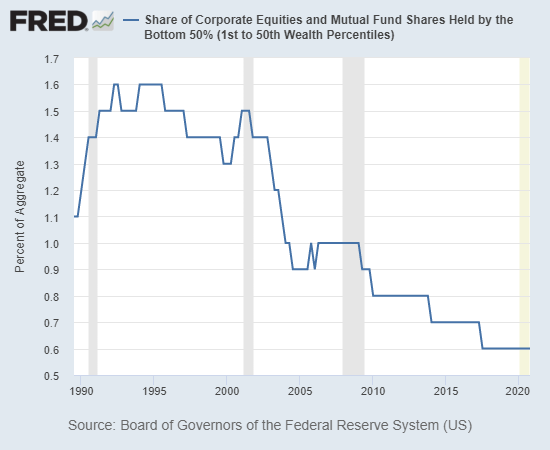
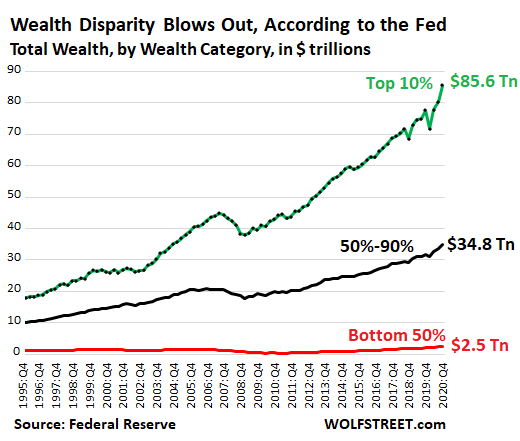
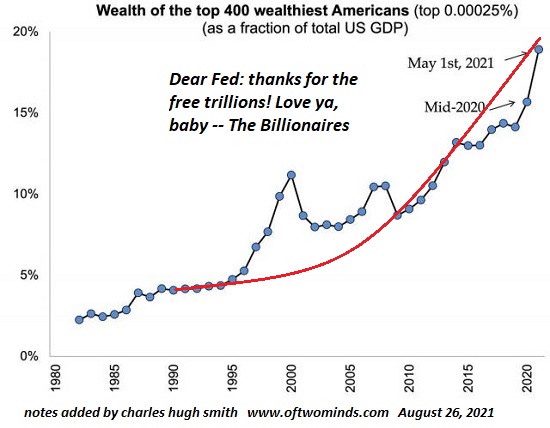
One might anticipate that the bottom 50%’s meager share of the nation’s exploding wealth would have increased as smartly as the wealth of the billionaires, but alas, no.

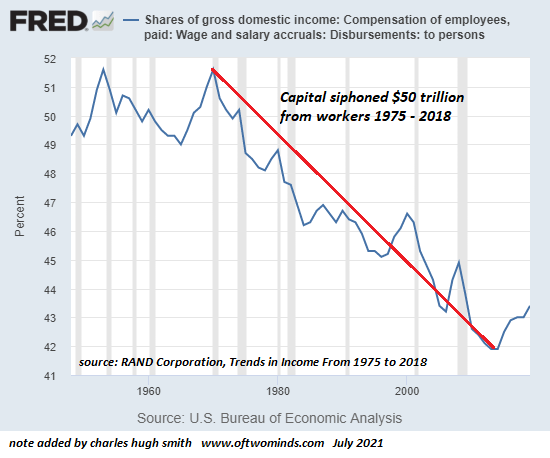
America’s economy has changed in ways few of the winners seem to notice, as they’re too busy cheerleading their own brilliance and success. In the view of the winners, who just so happen to occupy all the seats at the media-punditry-Federal Reserve, etc. table–the rising tide of stock, bond and real estate bubbles are raising all boats. What’s left unsaid is except for the 50% of boats with gaping holes below the waterline, i.e. stagnant wages and a fast-rising cost of living.

The truth the self-satisfied winners don’t include in their self-congratulatory rah-rah is there’s no place for the bottom 50% of American households to go but down. All the winnings flow to those who already owned assets back when they were affordable– the already-wealthy–whose wealth has soared as assets have shot to the moon while the the burdens of inflation and debt service hit the bottom 50% the hardest.

Meanwhile, the Federal Reserve is whining that inflation isn’t high enough yet for their refined tastes. Boo-hoo, how sad for the Fed–inflation isn’t yet high enough. Oh wait–didn’t they each mint millions by front-running their own policies? No wonder they’re not worried about inflation.

The reality few acknowledge is that globalization and financialization have stripped the American economy of low-skilled jobs that don’t demand much of the employee. The reality is that a great many people don’t have what it takes to learn high-level skills and work at a demanding pace under constant pressure–the description of the average job in America.

There were once millions of low-skill, low-pay jobs for people who for whatever mix of reasons were unable to muster the wherewithal to fulfill the fantasy of working extra hard, going to night school, soaking up high-level skills, moving quickly up the ladder to higher pay, buying the starter home and then moving up the food chain to middle class security from there.

The cost of living was low enough that those working these low-skill, low-pay jobs could still have an independent life. There were still low-cost rentals, often derided by the wealthy, in nooks and crannies of even the costliest cities. (I once lived in a room stuffed with old tax records in a poolside shack in an upscale neighborhood. The room had been cleared for a single bed and a path to the decrepit bathroom. Its most important attribute was that I could afford it on my low earnings.)

Affordable housing has vanished, eliminated by the financialization of America’s economy. Once landlords pay double the price for the property, rents have to double to pay their higher expenses. The apartment didn’t double in size or amenities–the rent doubled without any increase in utility to the renter. You get nothing more for double the price–nice.

Yes, people could make better choices, and some do. The point here is the game is rigged against those in the lower tier of the economy who can no longer afford a house or other stake in the only winning game in town–speculative asset bubbles. Go ahead and work a second job and go to night school–you’ll still be left behind the already-rich.

Globalization opened every job in America to global competition via offshoring or the influx of undocumented workers so desperate to support their families back home that no pay was too low and no working condition too wretched to refuse.

Many overindulged pundits who never worked an honest day in their lives sneer about burger flippers without realizing how hard those burger flippers have to work. I doubt the well-dressed pundits, snobbish about their university degrees and general brilliance, could manage to work a single day in a demanding fast-food job.

As the price of housing and other assets have soared, enriching the already rich, they’re out of reach for the bottom 50% who struggle to pay their bills as wages have stagnated and the costs of essentials have skyrocketed.

The rising cost of parking tickets, junk fees, user fees, utilities and food don’t impact the well-paid top 5% technocrat class, whose stake in the Everything Bubble keeps expanding by tens or hundreds of thousands of dollars. But for the bottom 50%, those incremental increases are, when added to higher rents, absolutely crushing.

As for getting high-quality healthcare that includes mental health support–those are reserved for the rich. But no worries, self-medication is always a “choice.”

Getting a boost in pay from $12 an hour to $15 an hour is welcome, but that doesn’t put the worker any closer to affording a house or equivalent stake in the Everything Bubble.

The new feudalism is masked by the glossy SillyCon Valley PR of a gig economy where (per the PR fantasy) bright, shiny and totally independent workers freely choose to serve the winners in the rigged sweepstakes for low pay and zero benefits.

In the SillyCon Valley PR, serfs freely choose to serve their noble masters for nothing but survival because they love the “freedom” and “choice” of kissing the nobility’s plump derrieres. (After all, there were “choices” even back in the good old days of feudalism–one could join the brigands in the forest, or enlist in a poorly paid mercenary army where the odds of dying were high–you know, “choices” of “gigs.”)

One might anticipate that the bottom 50%’s meager share of the nation’s exploding wealth would have increased as smartly as the wealth of the billionaires, but alas, no–the bottom 50%’s share of stocks (equities) actually plummeted in the the glorious decades of Federal Reserve free money for financiers, stock buy-backs and asset bubbles.

All this suits the billionaires and those collecting the crumbs of the Everything Bubble just fine. So what if the bottom 50% have nowhere to go but down? There’s plenty of room in the homeless encampment for another broken down station wagon or an old camper. There’s lots of “choices.”

And no consequences for the winners, of course, because The Fed has our backs.

Saturday Matinee: Sorry We Missed You

“Sorry We Missed You”: Ken Loach Exposes the Holes in the Gig Economy

By Chuck Collins

Source: CounterPunch

Director Ken Loach has done it again.  “Sorry We Missed You” is a family drama infused with a searing look at life in the “gig economy” with a frayed social safety net. Like his previous film, “I, Daniel Blake,” this movie is about working class people maintaining their dignity and humanity in the face of government austerity, privatization, and corporate greed.

“Sorry We Missed You” was just released in the U.S. through affiliated independent theaters, such as our Boston-area Coolidge Corner.  A portion of the ticket price through virtual screenings support these theaters.

In the context of a pandemic, “Sorry” connects us to the frontline workers delivering packages and caring for the elderly and disabled — workers who are grossly underpaid while being at greatest risk.

Set in Newcastle, UK, the film takes its name from the package delivery slip that Ricky, the father in a family of four, leaves when no one is home to sign for a package.

Like most workers in the U.S. and UK, Ricky and his spouse Abbie are still struggling to get out of debt a decade after the 2008 economic meltdown. Abbie works as a home care nurse, hopping buses between visits to up to eight patients a day. Ricky takes a job as a driver with a package delivery service. Both work hard and with integrity. Abbie says she cares for her patients “how she’d like people to treat her own mother.”

Like workers at Uber, DoorDash, and other similar delivery services, Ricky’s employment status is in the limbo between employee and independent contractor.  Maloney, the boss man who manages the package distribution facility, makes it clear: Ricky isn’t an employee, but a “franchisee,” a self-employed delivery driver. This status requires him to take on all the risks, including purchasing a van, leasing a delivery scanner, and toiling unlimited hours. The scanner serves as the symbol of the surveillance economy that enables the company to monitor Ricky’s every turn. Yet the company also fines him for late deliveries and, when robbers smash Ricky’s delivery scanner, they assess him a £1,000 charge.

Ricky and Abbie attempt to mind their two children, Seb and Lisa Jane, often via phone and text. The children absorb the stresses of their parents, who work 12 to 16 hour days to survive.

Director Loach balances a family story while dramatizing the structural forces that drive the gig economy and pit workers against each other. When one delivery driver struggles with family issues, the boss Maloney offers his route up to other drivers. Breaching the thin whisper of solidarity between the drivers, Ricky takes the other driver’s more lucrative route. Meanwhile, one of Abbie’s nursing patients shares photos and stories from her struggles as a labor union activist, a reminder of the past solidarity that existed among workers. “What happened to the eight-hour day?” she asks.

Maloney celebrates his own tough-guy unwillingness to bend to meet Ricky’s need for an emergency day off, saying the “shareholders of the trucking depot should build a [expletive] statue of me here.”  Maloney also blames the customers, saying to Ricky, “do any of them ask you how you are? They just want their package delivered on time for as cheap as possible.” We have met the enemy, and it is in part the consumer who expects to pay less and get it now, with no understanding of the social costs of convenience.

In the midst of the Covid-19 pandemic, we are more dependent than ever on those who drive the delivery trucks, who bring the packages, who stock the shelves, and attend to those in need.

“Sorry We Missed You” dramatizes why we need a system where all workers have universal health insurance, living wages, and paid family leave. And we need stronger protections against employers who restructure their enterprises to extract more wealth, while shifting costs on to workers and the rest of us.

Watch the full film on Kanopy.

Kushner-Linked Firm and Gig Economy Set to Reap Huge Profits as Mass Evictions Begin

By Raul Diego

Source: Mint Press News

In 2014, former Blackstone and Goldman Sachs investment banker Ryan Williams got together with his “college buddy,” Joshua Kushner – Jared’s brother – to form a real estate investment platform they called Cadre. Cadre sought to disrupt the real estate industry in the wake of the 2008 subprime mortgage crisis by tinderizing property deals through a tech platform that brought investors and sellers together. According to Williams, whose other investors include George Soros and Peter Theil, Cadre’s mission is “to level the playing field in an industry that is often tilted toward the biggest players” by taking an “offline” industry online and making it “transparent.”

A pre-Covid initiative to capitalize on its platform came in the form of the so-called “opportunity zones,” that Jared Kushner directly lobbied for inclusion in Trump’s 2017 Tax Cut and Jobs Act, billed as a funding mechanism to help poor and distressed communities, which turned into a multi-billion-dollar land heist by the wealthiest Americans, like the Kushner family. The pandemic lockdown protocols forced Cadre to downsize, laying off 25 percent of its workforce in March.

But now, the company is restarting its predatory engines as the home eviction wave forming on the horizon signals potential windfalls for companies like Cadre, that are in a position to profit. It is doing so by launching a pop-up banking operation called “Cadre Cash,” which will try to lure deposits from “investors” by offering a three percent annualized “reward” to finance a new round of land-grabs as millions of Americans teeter on the edge of homelessness and landlords look to unload un-rentable properties.

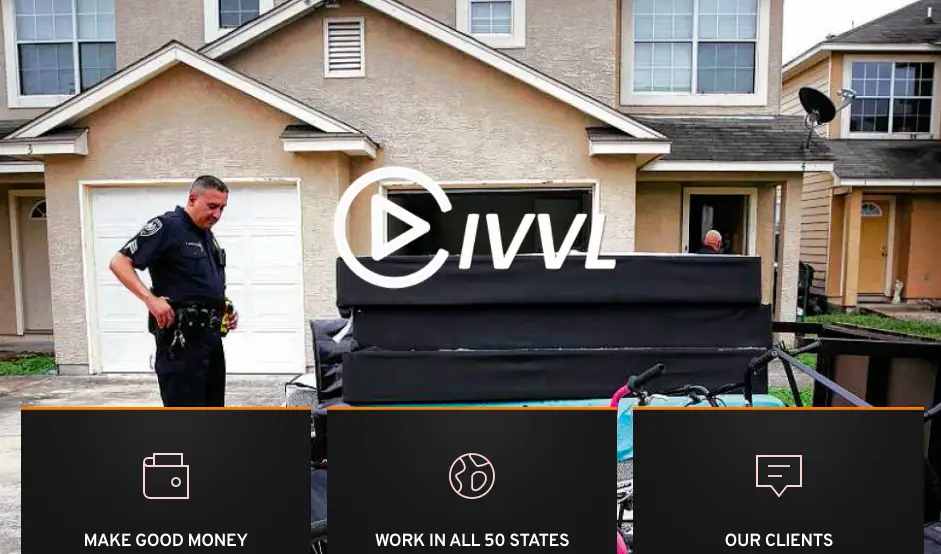
Another company, Civvl, is tackling a different side of the burgeoning housing crisis in America with its on-demand service model for eviction crews. Just like Uber, the Civvl app lets “frustrated property owners and banks secure foreclosed residential properties” by connecting haulers and the rentier class.

Civvl’s parent company, OnQall, specializes in mobile app platforms that monetize side-hustles like moving, cleaning and lawn care services. The eviction crew app has, predictably, drawn a storm of criticism since Motherboard‘s article on Civvl this past Monday.

“It’s fucked up that there will be struggling working-class people who will be drawn to gigs like furniture-hauling or process-serving,” exclaimed housing activist Helena Duncan, who also pointed out the clear dystopian contours evident in a scenario where working class people are paid to wage economic warfare on fellow working class people. Civvl puts up a disingenuous defense against the earned invectives, comparing itself to Monster.com. “They’re not evicting anyone,” a Civvl spokesperson told Motherboard, “they’re just the help.”

Both Cadre and Civvl are poised to make a killing as eviction moratoriums abate across the country and millions find themselves on one side or another of evictions – tenants forced onto the streets by small landlords who will have little choice but to sell in a depressed market. Only the CDC’s national eviction moratorium, issued three weeks ago, stands in the way of the avalanche of displacement and dispossession at our doorstep. But, even the risks of fines and jail time doesn’t seem to be discouraging companies like OnQall or landlords, in general.


Ridiculous loopholes

Cadre, in particular, is at the head of the pack of “disruptive” real estate tech platforms mostly due to the favor it enjoys in the halls of the Trump administration. “Jared was one of the key people early on. And his contributions were critical,” says Cadre CEO Ryan Williams of Jared Kushner, whose stake is worth over $50 Million, according to 2018 SEC filings.

Despite claims that Kushner sold a “substantial portion” of his shares in the company and that the president’s son-in-law has no role in the business endeavor, recent history surrounding the so-called “opportunity zones” of Trump’s Tax bill revealed Cadre’s and Kushner’s central role in a multi-billion dollar land heist by the wealthiest Americans, like the Kushner family.

Paying lip service to the same “diversity” principles Cadre’s African American founder asserts underlie his company’s vision, the more than 200 federally-designated “opportunity zones” for disadvantaged communities that resulted from the legislation, Cadre’s machine-learning and processed census data was simply serving to make a “ridiculous loophole” available to wealthy investors to buy up land at a serious discount.

The bulk of the opportunity zone funding, some of which was set up by William’s former employer and Cadre investor, Goldman Sachs, went to high-end real estate development projects in affluent areas, retail developments and luxury hotels, such as Richard Branson’s 225-room hotel in William’s home state of Louisiana, less than two miles away from one of the poorest parts of New Orleans. The project had been announced by Branson a year before the tax-cut legislation was signed into law, but nevertheless qualified to participate in the opportunity zone program.


Picking up the bodies

The housing catastrophe in the United States is barley gathering steam, and while many landlords and property owners still face legal challenges in cases where eviction moratoriums remain in place, the loose patchwork of laws governing property rights across the nation – not to mention foundational ideology – gives companies like Civvl and Cadre the chance to circumvent these and rely on naked power to drive people away from their homes or convince them to sell it to massive real estate concerns, like CBRE or Kushner’s rich buddies.

Civvl is confident that they can take advantage of people’s lack of knowledge about their rights to make money as the eviction middle man. Indeed, the company is betting that municipal and federal authorities will see things their way. “This is something that has to be done,” says a company spokesman. “Listen,” he continued, “if someone is killed on the street, someone needs to go pick their body up.”


Related Video:

Reimagining the Middle Class

In her new book, Alissa Quart chronicles what happens when capitalism and families collide

By Ann Neumann

Source: The Baffler

AS THE ECONOMIC STATUS OF MANY in the United States has declined over the past several decades, journalists have often focused on the challenges faced by the working poor. In her new book, Squeezed: Why Our Families Can’t Afford America, Alissa Quart writes about how economic inequality has also drastically changed the middle class, destabilizing what was once considered a secure class and sending families into the tailspin of debt, overwork, underemployment, and precarious financial states. Squeezed demonstrates that inequality is not just a problem of those left behind in the lowest financial brackets, but a feature of our current economic system characterized by working professionals who are unable to pay for child care, declining job salaries, shifting work hours, and unaffordable housing. Families too often wrestle with “penalizing” factors, like women’s depressed salaries and unaffordable health care, making success unattainable for a formerly comfortable, educated, and skilled demographic of society.

The book challenges us to reimagine our prior understanding of what it means to be middle class, even as legislators champion “traditional values” that contradict the needs and responsibilities of families—and erode a safety net that once supported U.S. workers. Some of the factors that have upended the middle class are obvious—declining salaries, for instance—but others remain masked by corporate and social portrayal of them as a benefit to today’s workers. The gig economy, which, we’re told, gives workers young and old more flexibility and independence, turns out to be a contributor to what Quart calls the forever clock, a twenty-four-hour schedule that has usurped family and free time by keeping workers on constant call. Squeezed recounts the lives of the teachers who work second jobs, the professional mothers who struggle to pay for day care, the paralegals and adjuncts who have to moonlight to pay the rent, the well educated who never found a job in their intended profession that provides a livable salary. And the book causes us to ask why so many suffer in isolation, too ashamed to acknowledge their economic plight and too belabored to politically address it.

Quart is executive editor of the Economic Hardship Reporting Project, a nonprofit organization founded by Barbara Ehrenreich (a contributing editor for The Baffler) that supports journalism examining economic inequality, its causes and solutions (EHRP has funded my own work and that of others published at The Baffler). Quart is the author of four previous books: BrandedRepublic of OutsidersHothouse Kids, and the poetry book Monetized. She also co-writes, with Maia Szalavitz, a column for The Guardian titled “Outclassed.”

This month, Quart stopped by The Baffler office to talk to me about Squeezed. We’ve known each other for several years and I read the book in manuscript, so our conversation was casual, touching on individuals in the book, our own squeezed lives, how we can counter economic decline, and a necessary new definition of self-help.

Ann NeumannSqueezed straddles the Trump election and very often people on the left—and the right, to be honest—are using this as a clear demarcation. I think one of the things the book does really well is point out that the mechanisms in place that harm working class families have been long in coming.

Alissa Quart: The reason Sanders and Trump could tap into anger are the numbers of those economically squeezed; it’s what I was seeing anecdotally. And you can feel that. You can feel when you go sit in people’s living rooms, when you talk to them on the phone. I went to a conference called iRelaunch that was all about helping people to start their careers over and the room just rippled with shame and fear. And acidic humor.

AN: How did the election change this book project?

AQ: I think it gave it new urgency for me. Just as it gave urgency to the Economic Hardship Reporting Project, the organization I run. I think everyone in journalism felt like we have to tell these stories. The Trump effect has made me feel like I have to keep a laser focus on the things people are ignoring and try to find a way for readers to pay attention to them. We’re all focusing on Ivanka and whether she’s the c-word or not, which is fine, there are all kinds of things happening around us and in our own lives politically that have nothing directly to do with what Trump is tweeting, but the effects of his administration and long-term trends are real and we just need to keep looking.

We just published an article at EHRP about a journalist who lives in a $17 a night Airbnb, places below what you usually scroll to. But this person was a working journalist who was getting six-figure advances fifteen or twenty years ago. There are all these human examples that constantly show this decline. Fine, maybe the job numbers are up, but how many jobs are people working and are they jobs in the professions? Are they jobs that pay enough for people to live in cities? Or they’re working three different jobs which leads us to things like, as in this book, twenty-four-hour day care.

AN: Day care centers that are open twenty-four hours to accommodate parents with nontraditional work hours or multiple jobs.

AQ: And they are growing in number. I wrote a piece on this; I called it the dystopian social net. I feel like that’s part of my life’s work. I love dystopian fiction and science fiction, probably because it seems a few clicks away from the life we’re leading. It’s a markedly different life and childhood than the one you and I had. It may be horrible, or maybe not, but we’re seeing a palpable transformation in what childhood can be in the course of twenty years.

AN: And that’s really just the decline of income?

AQ: It’s people working different hours, it’s corporations using algorithms to find out what times of day are most profitable—when they’ll have the most foot traffic in retail, for instance—and demanding that employees work those times. It’s increasing nightwork. Nontraditional could mean 11 to 3 or it could mean working in the evening, or working in different jobs, hither and thither. That alone points to a huge transformation in things like time. A lot of the issues I address in the book are really about time, how we spend it. In the twenty-four-hour day care section I use the term the forever clock. But that’s true of the upper middle class too, they feel squeezed because they’re also on a forever clock. They’re working in IT, for instance, and they’re working unusual hours and they have the expectation that they should be better paid for it. 

AN: Your work has been focused on economic inequality for a long time.

AQ: Every single one of my books is in some way about economic inequality. I used to teach at Columbia J-school and I always told my students that every writer has a central question they spend their career trying to answer and your job is to find out what your question is. It’s like a parlor game. So I think mine is: what happens when the family—or childhood—hits capitalism? What are the deformations and the formations? I read so many nineteenth-century novels as a kid that I’m fascinated by that intersection. Naturalism is ascetically but also politically and intellectually appealing to me. I think I just like the texture of family, love, money, and how they all meet.

AN: That comes out in the writing of the book because, I’ll tell you, there are economics books that I have no interest in reading because they’re a slog, a data dump. You also coin terms that give us a way to think about worker’s plights. You just mentioned the forever clock but there’s also the middle precariat.

AQ: I was trying to explain the shift in the middle class as an imaginative category. The middle class used to equal solid, fixed, stable. Temporally it was about gratification later, but your life wasn’t miserable while you were waiting for it. It wasn’t like OK, total slog, but you’re going to get that pension. We have to now think of it as a shaken category, an unstable category, and that’s a big shift. When we visualize the middle class, we’re visualizing the white picket fence, like the blue sky on the cover of the book. But it’s really this truck being squeezed between two houses.

It’s an unsettled identity, and you can fall out of it, you can barely get into it, you certainly can’t rise above it very easily. Guy Standing coined the term precariat in 2011 to describe the proletariat, which is a Marxist way of understanding the working class, crossed with precariousness. And people get that. Every time they ride an Uber or they have a gig economy Task Rabbit person come to their house they’re like, OK, that’s the precariat. But I was seeing the same thing among paralegals or those who have law degrees but were still doing temporary work.

AN: Getting a law degree can be like selling your soul to the banks.

AQ: All these people are in debt. Some of it is because they went to for-profit colleges and those colleges were really expensive and they didn’t have a good rate of placement. Which can be traced to for-profit colleges and grad schools that have very little oversight—and are sometimes indeed federally funded. It can also be traced to fewer law jobs overall and too many people imagining that law is a secure profession. This is about reimagining. Once you can reimagine a profession, even if you choose to do it—you choose to be a journalist, you choose be a lawyer—we should understand that we’re choosing something unstable. Awareness is a huge part of survival and I guess part of what I want with this book is to increase awareness. This is your self-help: Don’t blame yourself. We have to come alive to this recognition. You can still do what you love, so long as you know what it can mean.

This is a personal journey for me too. When I was younger, as a freelancer, I had some recognition that journalism was starting to fragment. It was around 2006 or 2007—but it was before that too, the’90s. The word rates used to be consistent and for freelance writers those rates became lower or stayed the same while inflation rose. I remember talking to someone and they said, “just think about us as post modern.” Now you do lots of things, it’s a hustle here and a hustle there. That person was a boomer who had a steady job, who would get social security. I remember feeling an incredible resentment.

AN: So precarious employment has been described to us as a beautiful thing. We’re not chained to a factory job, we get to think and move around, but it doesn’t pan out.

AQ: I personally came from a middle class background. As I describe in the book, my parents were college professors, originally community college professors, and they could afford to send me to a private school. They didn’t have any inheritance or anything. That’s the sort of the world I thought I’d be living in. All of us, our generation, Generation X, had an idea of the world we thought we’d be living in. The generation after us has come to understand some of these things.

AN: That they’re fucked? So do you think this is a moment in capitalism, as we watch continued market decline over the next years, when we either do something about it or devolve into a disordered society?

AQ: Yes, I think so. But this book isn’t depressing because it points to some solutions—not in a pat way, but things that will work. It’s a way to think about what kind of family safety net, federal and local, we need to make sure people aren’t falling through. For instance, a few of the people I write about in the book are on food stamps and other kinds of support, but many of them are a little above that in terms of earning power and they can’t get help. There’s a labor organizer I spoke with who tries to lower her salary to be able to get some sort of subsidized day care, some sort of health insurance program. It’s that edge: people who are middle class in terms of education, but working class in terms of earning. They’re on the edge of being working poor and not being able to access any of those services. That’s most of the people in this book. Once we understand that they’re precarious we need to find a safety net for them.

AN: What this book does is lay out the many ways that people are hurting at the moment and it kind of gives a blueprint as to how precariousness could be addressed. Subsidized day care, for instance. I had no idea about how expensive child care is.

AQ: Child care can be 30 percent of many salaries. Or more. I think for us it was 30 percent of our take-home pay.

AN: How do people do it? In the book you show us. We spend a lot of time with individuals, we get a look at their lives and there’s a revelation for a reader to think, Oh, it’s not just me. There are things that I go without, there are resources that I don’t have access to, there are crises that I lose sleep over or pray will never come my way. There’s something about this book that brings this issue to light and I wonder if that was what you thought you’d get out of the stories? Is that why you used a storytelling approach?

AQ: That’s the chick lit, soap operatic part of me. And there is something of that in these stories. You think, What’s going to happen next? Sometimes I was surprised because they did have the messy amplitude of ordinary life. The people I write about aren’t just symbolic though. Some of them I followed for years.

AN: I think of the co-parenting section where you spend time with families who are trying to come up with creative solutions. In some cases, over time, things were better; in some cases they were worse. But readers still get the sense that nothing is fixed, no one really knows what’s working.

AQ: Or like the nanny who was separated from her son when I first met her and it was one kind of story. It became a story about them reunited, but then it became a story about school choice, and then it became a story about a mixed outcome at the end. She was actually happy, but I think the reader would want her to have a more middle class life given how hard she’s worked and all the effort she’s made to make the right choices.

AN: The anxiety of her life stayed with me. There are so many things that thwart her from getting ahead. She just needs the smallest break, trying to bring her son here, trying to find an affordable place to live. She’s doing everything right and she doesn’t deserve to go through this. That’s what comes out in the story. So when you were doing this reporting, did you get a sense of relief that we’re all going through this at the same time?

AQ: I definitely did. I felt relief. I say that this book is self-help because it makes you realize that it’s not your fault. And that’s how I see self-help. I see it as awareness, really granularly understanding all the ways that systems have made it impossible for you personally to overcome financial challenges—so that you’re no longer blaming yourself.

AN: Thank God someone’s redefining self-help.

AQ: [Laughs] But that’s it. How do you not feel stigmatized, how do you not feel isolated? So many of my friends feel ashamed that they can’t figure out the school system, can’t figure out how to own their home.

AN: The various penalties—for being a woman, for having children, for having debt—stack up. Shaming has abetted this erosion of rights and financial stability.

AQ: Time, day care scheduling, and other demands mean people can’t organize. They’re ashamed of where they are and so that becomes another debilitating factor. The adjunct in one chapter feels ashamed even though she knows politically she shouldn’t. There are people like the teachers who drive for Uber, who feel ashamed even though they know they shouldn’t. And it goes on and on. I don’t want to put it back on individuals, but the personal thing that people can do is start talking openly about their monetary situation. People are startled when you do that. It can erode social norms in a weird way, but I also think it’s important that people stop fronting with one another.

I write in one chapter about the 1 percent media, about the social media where people pretend to live in more expensive places than they do. I call them wealthies, not selfies. So it’s not your imagination when you’re in any of these circumstances and you see people in a sun dappled villa. People are representing themselves in this inflated way and then you feel terrible and isolated. There are so many ways in which the stigma, the isolation, around your class position gets underlined.

AN: Has it always been shameful to be poor?

AQ: Probably.

AN: It’s not a fair question!

AQ: But let’s be clear. A lot of these people are not poor. Most of the people in this book are earning between $45,000 and $125,000. Working class is $35,000. They’re not at the poverty level.

AN: So the shame then comes from not being able to make ends meet.

AQ: The shame comes from having debt for the education that you got in order to be middle class. The shame comes from not doing as well as your peers. The shame comes from not living up to your potential. The shame comes from not owning your home, defaulting on your mortgage. Not giving your kids as good a life as you had. I’m not writing about the working poor. I’m writing about the middle poor.

AN: We still operate under the myth that as a society we can continue to lift people into middle class and lift middle class into other class brackets. We no longer have any of that upward mobility. We cannot anticipate that our children will be better off.

AQ: No, we cannot anticipate that.

AN: But that’s still the American dream, isn’t it? And that American dream has been tied to, say, home ownership or a vehicle or not having debt.

AQ: In New York it’s like what school your kid goes to. What college your kid goes to.

AN: You use the word reimagining; it’s a word that I don’t hear often enough in politics, particularly not applied to class.

AQ: I mean reimagining what it means to be successful, reimagining what it means to be middle class. In a dream scape kind of way, like, This is what we would like to see in this country. But also reimagining middle class in its truth, what it actually means now? Let’s tear the veil and not just say, Oh, it means stability or security. It doesn’t.

This Viral ‘Feel-Good’ Story Is Actually an Indictment of American Labor Hell

By Luke O’Neil

Source: Observer

In what’s quickly become the feel-good story of the week, a young Alabama man named Walter Carr is being lauded across the country for his perseverance and indomitable spirit. It’s the type of story that can instill hope in a divided nation when it’s sorely needed and serve as inspiration for the rest of us that if you work hard enough and keep a positive attitude, good things will come to you. It also happens to be disgusting horse shit and an utter indictment of the brutal, indifferent hell of the nightmare capitalist wasteland we all suffer in. So, a bit of a mixed bag here. 

Carr, a 20-year-old college student, as nearly every news outlet has pointed out in sepia-tinted coverage—from CBS News and USA Today to the BBC—was set to start a new job on Saturday morning with the moving company Bellhops. At the last minute, his car broke down, and he was unable to find a ride from friends to get there. Instead, he decided to walk. He began the trek, which was roughly 20 miles from his home, at midnight, hoping to get there by 8 a.m. the next day to meet the rest of the movers. 

“I didn’t want to defeat myself,” Carr later told ABC News.

Along the way, around 4 a.m. in the morning, Carr, a young person of color, was stopped by local police officers, who, out of the kindness of their hearts, no doubt, asked him where he was headed. When he explained the situation—and after his story checked out—they decided to give him a ride the rest of the way, even going so far as to take him to breakfast.

“He was very polite. It was ‘yes sir’ and ‘no sir,”’ one of the officers later said. I bet he was!

When he arrived at the moving job a few hours later, complete with police escort, they explained the situation to Jenny Lamey, the woman who had hired the movers. Inspired by Carr’s work ethic and apparent decency, she shared the story on Facebook, where it soon went viral. 

The story eventually came to the attention of Bellhops CEO Luke Marklin, who arranged to meet Carr a few days later for a big surprise. 

“This is how you pay it forward… treat your employees with respect and incentivize them and bet you’ll get a much better worker for it,” wrote one commenter on Twitter. “It is awesome to see a young man not make an excuse like it’s too far to go to work, and then see him rewarded for it. Wish the young man and the company all the best in the future,” added another. 

It’s enough to drive you to tears. What kind of tears those are will probably depend on how susceptible you are to the lie at the heart of American capitalism and Horatio Alger nonsense.

Carr who set out the night before with a kitchen knife to protect against stray dogs on the walk, as he explained to The Washington Post, nonetheless floored everyone he encountered along the way. 

“He’s such a humble, kindhearted person,” Lamey said. “He’s really incredible. He said it was the way he was raised.”

“We set a really high bar for heart and grit and… you just blew it away,” Marklin told him, after gifting Carr his 2014 Ford Escape (barely-driven! as alabama.com reported). 

A GoFundMe set up by Lamey to help Carr with his car troubles has since raised almost $40,000. 

“Nothing is impossible unless you say it’s impossible,” she told the Post. 

Nothing except for paying workers an actual salary with benefits, which, you may not be surprised to hear, Bellhops does not do. Essentially Uber for movers, (Marklin came to the company from Uber), Bellhops relies on the labor of young college students, like Carr, who take jobs on a gig-by-gig basis. The company, which operates in dozens of cities around the country, and has raised tens of millions of dollars in rounds of funding since it was founded in 2011, pays movers between $13-16 an hour. 

“It’s a transitional job,” CEO Cameron Doody told BuzzFeed News in a story from 2015. “It’s not a career.”

Alabama, incidentally, is also only one of five states that has traditionally never spent any state money on public transportation. 

Naturally, Bellhops are very proud of themselves, and have been reveling in the attention. You probably didn’t know the company existed before yesterday, and may be thinking about contracting their services in the future now. Win win. 

“I want people to know this—no matter what the challenge is, you can break through the challenge,” Carr, who also wants to become a Marine some day, said of his story. 

“Nothing is impossible unless you make it impossible,” he added. “You can do anything you set your mind to. I’ve got God by my side. I’m really emotional right now trying to hold back the tears.”

It’s a heartwarming reminder that, much like with getting sick or injured in America, which needs to be done in a tragic but endearing enough way to go viral so people will pay your medical bills, all you have to do to make it in this beautiful country is have your life fall apart in such a way that the news wants to write about it, then hope the benign feudal lords will see fit to offer you as an aspirational example to the rest of us so we remain compliant.

The New Economy: Unemployment and the Return of the American Hobo

By Sheldon Greaves

Source: Cogito!

A few years ago I read somewhere about a trend in the “gig economy” in which people who had been reduced to living in their cars or RVs roamed the country by the thousands; homeless, nomadic workers driving from one temporary job to another. It painted a tragic picture; underpaid, overworked, often lacking health insurance, men and women, many of whom ought to be enjoying retirement but were working in warehouses filling orders for Amazon (“Camperforce”) or stocking shelves in a big-box store.

It sharply reminded me of the Great Depression, another time when mobile workers moved from place to place across the country in search of work. Thinking about this I realized that what we were seeing was the return of the migrant worker apart from the seasonal farm worker, i.e., the Hobo. Also called Tramps, Bums and other less charitable names, these men were the displaced detritus of the Great Depression who wandered the country looking for any jobs that would help them survive and, if there was any left over, to send home to their families. It was a dangerous life; travelling by hopping freight trains or hitchhiking on the highways wasn’t the safest way to get around. Many hobos were maimed or killed in accidents travelling this way, or were victims of violence. Loren Eisley’s wonderful memoir All the Strange Hours recalls his days as a young hobo with all of the dangers and troubles that went with being a hobo. They also faced hostility from towns naturally suspicious of outsiders, especially if there wasn’t any work even for the locals.

But the hobos also became a part of American folklore. The music of Woody Guthrie, who spent quite a bit of time on freight trains himself, helped to make the plight of these unemployed workers known to the rest of the country. Government programs found ways to harness this pool of labor and skill, pouring it into vast projects, many of which continue to contribute to national economy today.

There was, however, another side to hobo life. It became a sort of counter-culture, a rebellion of sorts against a social order that had unfairly cast aside decent, hard-working people for the sake of profit. Hobo life in some cases became a form of dropout culture, mainly, I suspect, as a way of embracing what apparently could not be avoided. An old professor of mine, who spent some of his youth as a tramp, recalled how some of his tramping companions actually knew more about science and literature than his college professors, but preferred tramping as a better way to enjoy God’s creations. Dropouts indeed.

I have been fascinated by American dropout culture as a response to moments when society becomes economically, intellectually, morally, and spiritually intolerable and so, like a few Biblical figures, one leaves, going out of bondage, but into the wilderness for whatever it may bring one. Historically, I’ve noticed that from Roanoke to the 1960’s and 70’s, the dropouts generally seemed to have a point, even if it wasn’t clear at the time. Sometimes the dropouts used their unique viewpoint to inform changes for the better, or became part of grander projects as happened with the government work projects of the New Deal.

So it is with some bemusement that I have noticed an interesting trend when it comes to the mobile temp workers, hobos with RVs or living out of their cars. Over the last seven or so years a small body of literature has emerged celebrating the homeless, wandering worker. Getting out of debt is a common reason for ditching less settled living, and as a rejection of consumerism (Ironic, given how many of these mobile temp jobs are serving precisely that consumer economy). The whole thing has a Small is Beautiful/Voluntary Simplicity vibe to it. Three of the six or so book titles of the last few years even reference “living in a van down by the river” in homage to a classic SNL skit.

So which is it? Is the new hobo a national tragedy in slow-motion, or rebellion against consumer culture, a new manifestation of the All-American dropout? I think it’s too early to tell. This may be nothing more or less than trying to make the best of a bad situation. I hope it’s more than that.

Famed American author and philosopher Eric Hoffer, himself a long-time migrant worker, had some remarkable insights into the responsibility of a nation to do right by such men and women. In his essay, “The Role of the Undesirables”, based on his own experience in government work camps in the early 1930’s. He draws some interesting and telling comparisons between the “human junk pile” that made up the bulk of his fellow workers and the early American pioneers–themselves undesirables from Europe–who built the nation. He points out that these pioneers craved change, much like the RV hobos of today. Hoffer writes: “…the quality and destiny of a nation are determined to a considerable extent by the nature and potentialities of its inferior elements.” He further argues that the quality of a nation is likewise manifest by how those at the bottom rise to the top. And that, I submit, is the problem. Is there an endgame to the RV hobo life that involves a chance to settle back down, to enjoy some of the fruits of one’s labor in security and dignity? Certainly a life on the road can be exciting. I find the idea compelling myself. But the other kind of mobility–upward mobility–has all but ceased to exist in this country. I cannot yet say whether these economic rebels of the road are truly making a new way of living, or accepting the unacceptable.