
10 Promising Signs That The Insidious Mind Control Matrix The Elite Have Created Is Starting To Crumble

By Michael Snyder

Source: Activist Post

Are we witnessing the start of some sort of a mass awakening in the Western world? For years, I have been writing about the extremely complex systems that are designed to shape and control what we think. Today, the vast majority of the “news” and “entertainment” that most of us consume is controlled by just a very small handful of immensely powerful corporations. And of course those corporations are ultimately owned and controlled by the elite of the world. To a very large degree, the elite have been able to determine what we focus on, what we think about current events, and how we feel about the world around us. For such a long time, most of the population would take whatever narratives that were pushed upon them by their corporate overlords as the gospel truth, and that always greatly frustrated me. Fortunately, there are indications that times are changing.

In order for any society to function effectively, there must be a high level of trust.

Unfortunately for the elite, we simply do not trust them anymore.

Trust in our politicians has fallen to an all-time low.

Trust in the media has fallen to an all-time low.

Trust in our corporations has fallen to an all-time low.

Trust in our health care system has fallen to an all-time low.

Trust in our education system has fallen to an all-time low.

Trust in the tech industry has fallen to an all-time low.

We no longer are buying into the crap that they keep shoveling our way.

And that is a really, really good thing.

It is morally wrong for them to try to control what we think.  It is absolutely imperative that we all learn to think for ourselves, because that is the only way that we will ever be truly free.

I have been writing about this stuff for years and years, and a number of recent trends have given me hope that people are starting to wake up on a widespread basis.  The following are 10 promising signs that the insidious mind control matrix the elite have created is starting to crumble…

#1 According to a recent Gallup survey, only 16 percent of U.S. adults have “a great deal” or “quite a lot” of confidence in newspapers and only 11 percent of U.S. adults have “a great deal” or “quite a lot” of confidence in television news.

#2 All over the Internet I am seeing article after article speaking out against the World Economic Forum.  That is an incredibly hopeful sign.

#3 In the Netherlands, a new government plan would “cut fertilizer use and reduce livestock numbers so drastically that it will force many farms out of business”.  This plan is deeply evil, but the massive farmer protests that have been sparked as a result are a really beautiful thing.

#4 After being arrested, a British man was told this: “Someone has been caused anxiety based on your social media post. And that is why you’re being arrested”.  But the good news is that there has been a tremendous backlash on social media and so far the video of his arrest has already been viewed more than 2 million times.

#5 As more people on the West Coast wake up, the exodus out of the state of California is rapidly becoming a stampede.

#6 Despite all of the spin from the Biden administration, 66 percent of Americans say that they believe that we are either in a recession or a depression right now.

#7 Joe Biden’s overall approval rating has fallen to an all-time low of 36 percent.

#8 Joe Biden’s economic approval rating has fallen to an all-time low of 30 percent.

#9 A recent CNN poll discovered that a whopping 75 percent of Democratic and Democratic-leaning voters actually want their party to nominate someone other than Biden in 2024.

#10 According to a recent Pew Research survey, only 24 percent of U.S. adults are satisfied with the current state of the country.

Almost all of us can see that our society is on the wrong track, and that is the first step in getting back on the right track.

As time rolls along, I believe that more and more of us will wake up.

And in the end I believe that the current “world order” that the Western elite have tried so hard to establish will fall.

That process will be incredibly chaotic, but the end result will be worth it.

Before I end this article, there is one more thing that I wanted to mention.

According to scientists, we just experienced the shortest day ever recorded

The shortest day on record has been broken by the planet Earth. On June 29, 2022, the planet completed its entire rotation in just 1.59 milliseconds, or slightly more than one thousandth of a second, less time than it typically takes for a 24-hour rotation.

Recently, the Earth has been moving quicker. Since the 1960s, 2020 marked the shortest month on record for the planet. On July 19 of that year, 1.47 milliseconds shorter than a typical 24-hour day, scientists recorded the shortest day so far.

Are the days being shortened?

I often tell people that it feels like the days are going by faster than ever, but I thought that it was just my imagination.

I have been told that as we get older it can seem like time is passing more quickly, and without a doubt 2022 seems like it is the fastest year yet.

It is hard to believe that the beginning of August is already here.

2023 will arrive before we know it, and I believe that 2023 will be a year that changes everything.

I know that there are a lot of bad things that are happening right now, and a lot of my articles tend to focus on those bad things.

But the truth is that there are a lot of good things happening too.

In fact, there is no other time in all of human history that I would have rather lived than right now.

It is when times are the darkest that the greatest heroes are needed, and the years ahead will provide plenty of opportunities for you to be the kind of hero that you were always meant to be.
Offering Choice but Delivering Tyranny: The Corporate Capture of Agriculture

By Colin Todhunter

Source: Off-Guardian

Many lobbyists talk a lot about critics of genetic engineering technology denying choice to farmers. They say that farmers should have access to a range of tools and technologies to maximise choice and options.

At the same time, somewhat ironically, they decry organic agriculture and proven agroecological approaches, presumably because these practices have no need for the proprietary inputs of the global agrochemical/agritech corporations they are in bed with.

And presumably because agroecology represents liberation from the tyranny of these profiteering, environment-damaging global conglomerates.

It is fine to talk about ‘choice’ but we do not want to end up offering a false choice (rolling out technologies that have little value and only serve to benefit those who control the technology), to unleash an innovation that has an adverse impact on others or to manipulate a situation whereby only one option is available because other options have been deliberately removed. And we would certainly not wish to roll out a technology that traps farmers on a treadmill that they find difficult to get off.

Surely, a responsible approach for rolling out important (potentially transformative) technologies would have to consider associated risks, including social, economic and health impacts.

Take the impact of the Green Revolution in India, for instance. Sold on the promise that hybrid seeds and associated chemical inputs would enhance food security on the basis of higher productivity, agriculture was transformed, especially in Punjab. But to gain access to seeds and chemicals many farmers had to take out loans and debt became (and remains) a constant worry.

Many became impoverished and social relations within rural communities were radically altered: previously, farmers would save and exchange seeds but now they became dependent on unscrupulous money lenders, banks and seed manufacturers and suppliers. Vandana Shiva in The Violence of the Green Revolution (1989) describes the social marginalisation and violence that accompanied the process.

On a macro level, the Green Revolution conveniently became tied to an international (neo-colonial) system of trade based on chemical-dependent agro-export mono-cropping linked to loans, sovereign debt repayment and World Bank/IMF structural adjustment (privatisation/deregulation) directives.

Many countries in the Global South were deliberately turned into food deficit regions, dependent on (US) agricultural imports and strings-attached aid.

The process led to the massive displacement of the peasantry and, according to the academics Eric Holt-Giménez et al, (Food rebellions: Crisis and the hunger for Justice, 2009), the consolidation of the global agri-food oligopolies and a shift in the global flow of food: developing countries produced a billion-dollar yearly surplus in the 1970s; they were importing $11 billion a year by 2004.

And it’s not as though the Green Revolution delivered on its promises.

In India, it merely led to more wheat in the diet, while food productivity per capita showed no increased or even actually decreased (see New Histories of the Green Revolution by Glenn Stone). And, as described by Bhaskar Save in his open letter (2006) to officials, it had dire consequences for diets, the environment, farming, health and rural communities.

The ethics of the Green Revolution – at least it was rolled out with little consideration for these impacts – leave much to be desired.

As the push to drive GM crops into India’s fields continues (the second coming of the green revolution – the gene revolution), we should therefore take heed. To date, the track record of GMOs is unimpressive, but the adverse effects on many smallholder farmers are already apparent (see Hybrid Bt cotton: a stranglehold on subsistence farmers in India by A P Gutierrez).

Aside from looking at the consequences of technology roll outs, we should, when discussing choice, also account for the procedures and decisions that were made which resulted in technologies coming to market in the first place.

Steven Druker, in his book Altered Genes, Twisted Truth, argues that the decision to commercialise GM seeds and food in the US amounted to a subversion of processes put in place to serve the public interest.

The result has been a technology roll out which could result (is resulting) in fundamental changes to the genetic core of the world’s food. This decision ultimately benefited Monsanto’s bottom line and helped the US gain further leverage over global agriculture.

We must therefore put glib talk of the denial of technology by critics to one side if we are to engage in a proper discussion of choice. Any such discussion would account for the nature of the global food system and the dynamics and policies that shape it. This would include looking at how global corporations have captured the policy agenda for agriculture, including key national and international policy-making bodies, and the role of the WTO and World Bank.

Choice is also about the options that could be made available, but which have been closed off or are not even considered. In Ethiopia, for example, agroecology has been scaled up across the entire Tigray region, partly due to enlightened political leaders and the commitment of key institutions.

However, in places where global agribusiness/agritech corporations have leveraged themselves into strategic positions, their interests prevail. From the false narrative that industrial agriculture is necessary to feed the world to providing lavish research grants and the capture of important policy-making institutions, these firms have secured a thick legitimacy within policymakers’ mindsets and mainstream discourse.

As a result, agroecological approaches are marginalised and receive scant attention and support.

Monsanto had a leading role in drafting the WTO Agreement on Trade-Related Aspects of Intellectual Property Rights to create seed monopolies. The global food processing industry wrote the WTO Agreement on the Application of Sanitary and Phytosanitary Measures.

Whether it involves Codex or the US-India Knowledge Initiative on Agriculture aimed at restructuring (destroying) Indian agriculture, the powerful agribusiness/food lobby has secured privileged access to policy makers and sets the policy agenda.

From the World Bank’s ‘enabling the business of agriculture’ to the Gates Foundation’s role in opening up African agriculture to global food and agribusiness oligopolies, democratic procedures at sovereign state levels are being bypassed to impose seed monopolies and proprietary inputs on farmers and to incorporate them into a global supply chain dominated by powerful corporations.

We have the destruction of indigenous farming in Africa as well as the ongoing dismantling of Indian agriculture and the deliberate impoverishment of Indian farmers at the behest of transnational agribusiness. Where is the democratic ‘choice’?

It has been usurped by corporate-driven Word Bank bondage (India is its biggest debtor in the bank’s history) and by a trade deal with the US that sacrificed Indian farmers for the sake of developing its nuclear sector.

Similarly, ‘aid’ packages for Ukraine – on the back of a US-supported coup – are contingent on Western corporations taking over strategic aspects of the economy. And agribusiness interests are at the forefront. Something which neoliberal apologists are silent on as they propagandise about choice, and democracy.

Ukraine’s agriculture sector is being opened up to Monsanto/Bayer. Iraq’s seed laws were changed to facilitate the entry of Monsanto.

India’s edible oils sector was undermined to facilitate the entry of Cargill. And Bayer’s hand is possibly behind the ongoing strategy to commercialise GM mustard in India. Whether on the back of militarism, secretive trade deals or strings-attached loans, global food and agribusiness conglomerates secure their interests and have scant regard for choice or democracy.

The ongoing aim is to displace localised, indigenous methods of food production and allow transnational companies to take over, tying farmers and regions to a system of globalised production and supply chains dominated by large agribusiness and retail interests. Global corporations with the backing of their host states, are taking over food and agriculture nation by nation.

Many government officials, the media and opinion leaders take this process as a given. They also accept that (corrupt) profit-driven transnational corporations have a legitimate claim to be owners and custodians of natural assets (the ‘commons’).

There is the premise that water, seeds, food, soil and agriculture should be handed over to these conglomerates to milk for profit, under the pretence these entities are somehow serving the needs of humanity.

Ripping land from peasants and displacing highly diverse and productive smallholder agriculture, rolling out very profitable but damaging technologies, externalising the huge social, environmental and health costs of the prevailing neoliberal food system and entire nations being subjected to the policies outlined above: how is any of it serving the needs of humanity?

It is not. Food is becoming denutrified, unhealthy and poisoned with chemicals and diets are becoming less diverse. There is a loss of plant and insect diversity, which threatens food security, soils are being degraded, water tables polluted and depleted and millions of smallholder farmers, so vital to global food production, are being pushed into debt in places like India and squeezed off their land and out of farming.

It is time to place natural assets under local ownership and to develop them in the public interest according to agroecological principles. This involves looking beyond the industrial yield-output paradigm and adopting a systems approach to food and agriculture that accounts for local food security and sovereignty, cropping patterns to ensure diverse nutrition production per acre, water table stability and good soil structure. It also involves pushing back against the large corporations that hold sway over the global food system and more generally challenging the leverage that private capital has over all our lives.

That’s how you ensure liberation from tyranny and support genuine choice.


Colin Todhunter is an independent journalist who writes on development, environmental issues, politics, food and agriculture. He was named in August 2018 by Transcend Media Services as one of 400 Living Peace and Justice Leaders and Models in recognition of his journalism. 

8 Critical Factors Behind Every Food Crisis

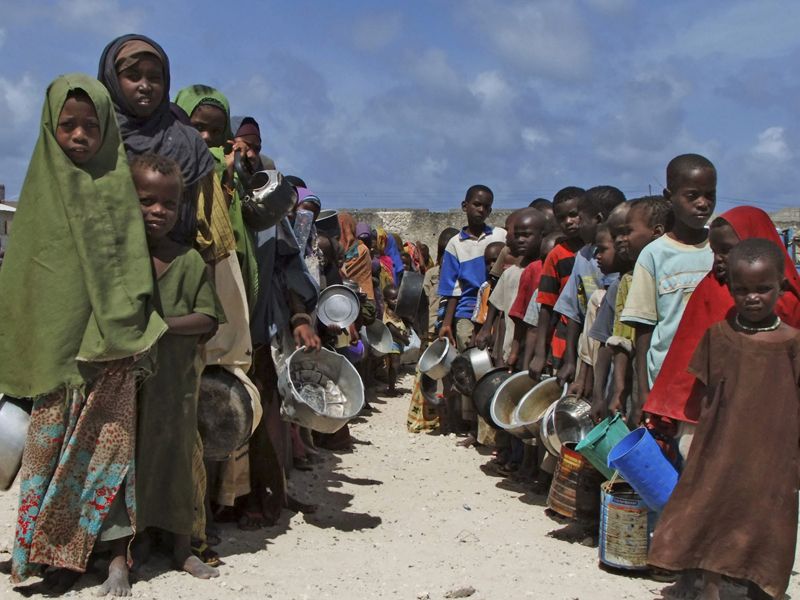
FILE – In this Monday, Aug. 15, 2011 file photo, children from southern Somalia hold their pots as they line up to receive cooked food in Mogadishu, Somalia. A report by two U.S. government-funded famine and food agencies gives the highest death toll yet, estimating that 260,000 people died – more than double previous estimates. (AP Photo/Farah Abdi Warsameh, File)

By John Hawthorne

Source: Business Connect

From the beginning of time, their have been food crises in one form or another. Ancient books such as the Bible have records of various famines devastating portions of the world.

And while it’s easy to attribute these crises to a single cause, such as war or drought, the causes are usually much deeper and much more complex.

Nelson Mandela said, “Overcoming poverty is not an act of charity, it is an act of justice.”

In order for us to achieve the kind of justice envisioned by Mandela, it’s essential that we first understand the underlying causes of food crises. Only after we have understood can we then begin creating meaningful solutions.

With that in mind, here are 8 primary factors behind almost every global food crisis. While not all 8 of these will be present at a time, you will almost always find several of these at work.

Factor #1 – Poverty

One of the greatest factors in every food crisis is stark and abject poverty. This isn’t surprising. With enough money, anyone can ensure they have enough food. But with many developing nations sitting well below the poverty line, the population simply can’t afford the food they so desperately need.

Additionally, poverty has a distinct effect on food output. In Africa, for example, many farmers can’t afford proper irrigation and fertilizer. This, in turn, leads to lower yields, which then reduces the overall amount of food available to the population.

The population of the Sub-Saharan region of Africa is expected to grow at an astronomical rate, topping out at 2.4 billion by 2050. This will continue to exacerbate the poverty issue, which will then continue to drive the lack of sufficient food in the area.

Factor #2 – Drought and Desertification

Widespread droughts, leading to the desertification of particular locations also causes huge disruptions to food production. For example, leading up to and during the global food crisis of 2008, 110 countries experienced significant droughts. This caused even the most well-irrigated, fertile areas to become arid deserts, making it impossible to grow crops.

As Mark Hughes noted:

Australia is normally the second largest exporter of grain, after the U.S. The continent, though, is experiencing an ongoing drought that has been described as the worst in a century. Grain yields have shrunk and many silos remain empty. Australia’s drought is a major factor in global wheat stocks being at their lowest since 1979. In fact, many wheat and rice farmers are switching to crops that demand less water, such as wine grapes.

Additionally, farmers often let animals over-graze on their land, reducing the amount of vegetation and increasing desertification. If the soil becomes dry enough, it is ruined and unable to support any crops at all.

Finally, as populations grow, deforestation occurs at an increased rate, which then leads to less vegetation and more desertification.

Factor #3 – Political Pressure

In the past, the International Monetary Fund has pressured small farmers, particularly in impoverished African countries, to abandon agricultural farming in favor of industrial work. The money generated from this practice would be used to pay off debt and import food.

While it may sound like a working strategy, it has created catastrophic results.

As Eric Holt-Giménez noted:

The urban population increased seven-fold, swelling from 18% to 33% of the population. Millions of poor and unemployed workers have swelled the cities—with two-thirds of them living in slums. The manufacturing and industrial sector did not “take off” in African countries; the percent of the GDP coming from industry was 30% in 1961 and 32% in 2000. In the countryside, as plantations for agro-exports expanded, food production plummeted and poverty grew. Though the rural population, density increased by 180% as more farmers were crowded onto smaller plots.

Factor #4 – Increased Consumption of Meat and Dairy

Many countries have begun adopting a more Western diet, which includes eating significantly more meat and dairy. To make this happen, farmers have been forced to raise more cattle, and more cattle means more grain being consumed.

The problem, however, is that this causes a significant deficiency in terms of calories consumed versus calories available. A cow consumes approximately 700 calories worth of grain to produce a piece of meat containing only 100 calories. When this happens on a massive scale, an enormous shortage of food is the end result. The longer this deficit continues, the greater the imbalance will become.

Factor #5 – Increased Oil and Transportation Costs

When the price of oil goes up, the energy cost for planting and transporting foods goes through the roof. When food costs more to grow, it then costs more to sell. These rising costs then make it more difficult for the local population to purchase crops as well as for farmers to export their crops to industrialized nations.

Additionally, increased oil costs has led many countries to invest heavily in the development of agro-fuels. More agro-fuels always means less food available.

As Esther Vivas helpfully puts it:

The increase in the price of oil, which doubled in 2007 and 2008 and caused a big rise in the price of fertilizers and transport related to the food system, has resulted in increasing investment in the production of alternative fuels such as those of plant origin. Governments in the United States, the European Union, Brazil and others have subsidized production of agro-fuels in response to the scarcity of oil and global warming. But this green fuel production comes into direct competition with the production of food. To give just one example, in 2007 in the United States 20% of the total cereal harvest was used to produce ethanol and it is calculated in the next decade that this figure will reach 33%. We can imagine the situation in the countries of the South.

Factor #6 – Falling World Aid

At the peak of the 2007-2008 food crisis, food aid was at it’s lowest point since 1961. This is one of the oddities about the national food market. When cereal prices are low, countries look to sell their food through international aid. However, when food prices are high, they prefer to sell them on the open market for increased profits.

In other words, during food crises, when food is scarcest and at it’s highest prices, it isn’t available for international aid. When the bottom falls out of world aid, food crises grow in magnitude.

Factor #7 – International Conflicts

International conflicts are a particularly visible factor behind many food crises. During conflicts, it’s common for one country to restrict exports to another country, which then reduces the amount of food available to the general population.

Or, even worse, dictators will intentionally isolate their countries, refusing foreign aid that is desperately needed. Aid workers may be blocked from entering the country, making it difficult for the citizens to receive needed help. If foreign aid does come, they seize it for themselves, depriving the population of desperately needed sustenance.

Factor #8 – Disease

If a country experiences a particularly violent outbreak of a disease, it can completely disrupt the overall food supply. For example, the HIV/AIDS crisis in Africa has killed farmers, which in turn pushes families deep into poverty.

When a population is undernourished, drugs become less effective and can at times create intense hunger pains. These two factors combined create a vicious cycle of death, poverty, and hunger.

Additionally, certain highly contagious diseases can restrict the amount of aid available to a country. For example, during the 2014 Ebola epidemic in West Africa, aid workers were restricted from traveling to the region due to fear of spreading the disease.

Perfect Storms

Most food crises aren’t the result of a single factor. Rather, they are caused by a perfect storm of events that coalesce into a deadly storm.

For example, in 2011, Somalia was devastated by a drought that caused widespread crop failure. The food crisis was made even worse by a non-functioning government as well as a national conflict. All these forces combined to make it difficult for aid workers to reach those who so desperately needed help.

The result was that approximately 260,000 people died.

Because the problems are almost always complex and multi-layered, the solutions must be equally multi-faceted. Simple solutions typically exacerbate the problem at the expense of the local population.

The best solutions are those that involve numerous parties working together to create a tangible, workable solution.

There will always be food crises to one degree or another. But as we grow in our understanding of what causes them, we can also grow in our ability to bring them to an end.