Saturday Matinee: Zeitgeist

Source: Top Documentary Films

Documentary Zeitgeist: The Movie, authored by Peter Joseph, reflects on the the myth of Jesusthe attacks of 9/11, and the Federal Reserve Bank as well as on a number of conspiracy theories related to those three main topics. It was released free online via Google Video in June 2007. A remastered version was presented as a global premiere on November 10, 2007 at the 4th Annual Artivist Film Festival & Artivist Awards. The film has attracted significant public interest.

If you dig deep enough into any one of the issues and resolutions presented in the film you’ll find that there are actual facts to support each one of them. We have been lied to! It’s as simple as that. We need to wake up on a planetary level and work towards a fossil fuel free planet. We can’t afford to wait and debate whether “God” exists or not. Stop nitpicking the particulars and act. We’re running out of time and most importantly resources. If there is a God, I doubt he likes this use of money and the monetary system and how those in power (with money) have used it to benefit only themselves and further destroy the environment and all life on this planet.

Think about it. Six corporations, (mostly made up of families who have married each other for years) are determining the fate of the human race and the planet, through their advertising money spent and blatant misuse and abuse of power. Are we going to stand here like sheep? Or are we going to work together and help change the future of humankind for the betterment of all?

We choose to be greedy, we choose to be hateful, we chose to segregate each other into categories, we chose to twist the rules, omit a word, and judge where none of us has a right to judge. We can only do the best we can. It’s not even about faith really, it’s about being deeply human. How we choose to deal with our humanity is just a choice. We all have the same finish line to look forward to. Faith is what you choose to hope for after you cross it.

Why Does It Feel Like We’re in “Life During Wartime”?

By Charles Hugh Smith

Source: Of Two Minds

The laughably hopeless hope is that by propping up the corpses, the populace will discern some faint flicker of life in the decaying carcasses and return to their free-spending ways.

Call it cultural synchronicity, but it increasingly feels like we’re living in the 1979 Talking Heads song Life During Wartime, which was anchored by the lyric “This Ain’t No Party, This Ain’t No Disco, This Ain’t No Foolin’ Around.” Indeed.

It also feels like Life During Wartime because the propaganda is so blatant and intense: we’re winning the war on Covid-19, and our wars on everything else, too, of course, as war is the favored metaphor and favored policy at the end of the Empire.

The ceaseless propaganda is that “a vaccine is right around the corner.” The inconvenient reality is that Corporate Insiders Pocket $1 Billion in Rush for Coronavirus VaccineWell-timed stock bets have generated big profits for senior executives and board members at companies developing vaccines and treatments.

In other words, wartime profiteering isn’t just allowed, it’s encouraged–yet another sign that we’re in the final decay/collapse phase of Imperial Pretensions.

It’s easy to mix up the propaganda and the counter-propaganda, because they’re both so extreme. There is no middle ground, only pre-packaged positions which dictate which “data” is cherry-picked to support the political partisanship that’s being defended.

Is Data Our New False Religion? (June 23, 2020)

In a world of thousands of unread papers published in hundreds of scientific journals no one even reads and a corrupt culture of “science for sale,” there’s a veritable orchard to cherry-pick.

“Robert Horton, editor in chief of The Lancet, one of the most respected professional peer reviewed publications in the world dealing with biomedical research had this to say in an editorial published by The Lancet in April of 2015:”

“The case against science is straightforward: much of the scientific literature, perhaps half, may simply be untrue. Afflicted by studies with small sample sizes, tiny effects, invalid exploratory analyses, and flagrant conflicts of interest, together with an obsession for pursuing fashionable trends of dubious importance, science has taken a turn towards darkness.”

source: What is medicine’s 5 sigma?

“And this, published in 2009, by Dr. Marcia Angell, former editor of The New England Journal of Medicine, another world leading publication in medical research:”

“It is simply no longer possible to believe much of the clinical research that is published, or to rely on the judgment of trusted physicians or authoritative medical guidelines. I take no pleasure in this conclusion, which I reached slowly and reluctantly over my two decades as an editor of The New England Journal of Medicine.”

Skeptical of medical science reports? (ncbi.nlm.nih.gov)

Metaphorically speaking, the civilian populace believes “we’re winning” until the bombs start dropping on their homes. For some reason, this doesn’t feel like “winning.”

The V-shaped recovery is the propaganda war the status quo must win, for this is the narrative battle for the hearts and minds of the populace. The fear here is that should the populace lose confidence in The V-shaped recovery, they might reduce their borrowing and spending and increase their saving, dooming an economy that depends entirely on marginal spending funded by debt to keep from imploding.

As the chart of the rising wedge model of breakdown below illustrates, when big-ticket costs ratchet higher like clockwork–rent, property taxes, childcare, higher education, debt, healthcare, etc.– while income stagnates for the bottom 90%, any drop in spending, no matter how modest, breaks the system because any reduction in spending reduces tax revenues, corporate profits and debt payments below the critical threshold.

This is why the Federal Reserve is so keen on bailing out bankrupt-in-all-but-name corporations and banks: The laughably hopeless hope is that by propping up the corpses, the populace will discern some faint flicker of life in the decaying carcasses and return to their free-spending ways.

This is also why “stimulus” is being scattered from helicopters: the hope is that by substituting borrowed trillions for earned trillions, people will substitute magical thinking for clear-eyed recognition that the era of “growth” has transitioned into the era of DeGrowth, a state of affairs that signals the demise of all the bloated, sclerotic institutions operated to benefit insiders and Corporate America’s cartels and monopolies: the most protected bastions of the era, colleges and hospitals, are going broke and closing.

As Marx noted, “everything solid melts into air” when it’s no longer financially viable. Helicopter “stimulus” just creates a temporary illusion of solidity.

And then there’s the immense profitability of Big Tech pushing propaganda, partisanship, anger and indignation: If you’re not terrified about Facebook, you haven’t been paying attention.

The foundations are collapsing, but by all means, please keep your eye on the decaying corpses: didn’t an eyelid flicker in that one? I could swear that one moved its foot…

This is “life in wartime,” where the battles are waged in narratives, confidence and magical thinking.

Forget the V, W or L Recovery: Focus on N-P-B (June 29, 2020)

The Fed’s Casino Is In Flames, But Please Continue Gambling (June 18, 2020)

Our Wile E. Coyote Economy: Nothing But Financial Engineering (June 12, 2020)

Unstoppable: The Greatest Depression and the Reverse Wealth Effect (June 10, 2020)

Meet BlackRock, the New Great Vampire Squid

By Ellen Brown

Source: Web of Debt

BlackRock is a global financial giant with customers in 100 countries and its tentacles in major asset classes all over the world; and it now manages the spigots to trillions of bailout dollars from the Federal Reserve. The fate of a large portion of the country’s corporations has been put in the hands of a megalithic private entity with the private capitalist mandate to make as much money as possible for its owners and investors; and that is what it has proceeded to do.

To most people, if they are familiar with it at all, BlackRock is an asset manager that helps pension funds and retirees manage their savings through “passive” investments that track the stock market. But working behind the scenes, it is much more than that. BlackRock has been called “the most powerful institution in the financial system,” “the most powerful company in the world” and the “secret power.” It is the world’s largest asset manager and “shadow bank,” larger than the world’s largest bank (which is in China), with over $7 trillion in assets under direct management  and another $20 trillion managed through its Aladdin risk-monitoring software. BlackRock has also been called “the fourth branch of government” and “almost a shadow government”, but no part of it actually belongs to the government. Despite its size and global power, BlackRock is not even regulated as a “Systemically Important Financial Institution” under the Dodd-Frank Act, thanks to pressure from its CEO Larry Fink, who has long had “cozy” relationships with government officials.

BlackRock’s strategic importance and political weight were evident when four BlackRock executives, led by former Swiss National Bank head Philipp Hildebrand, presented a proposal at the annual meeting of central bankers in Jackson Hole, Wyoming, in August 2019 for an economic reset that was actually put into effect in March 2020. Acknowledging that central bankers were running out of ammunition for controlling the money supply and the economy, the BlackRock group argued that it was time for the central bank to abandon its long-vaunted independence and join monetary policy (the usual province of the central bank) with fiscal policy (the usual province of the legislature). They proposed that the central bank maintain a “Standing Emergency Fiscal Facility” that would be activated when interest rate manipulation was no longer working to avoid deflation. The Facility would be deployed by an “independent expert” appointed by the central bank.

The COVID-19 crisis presented the perfect opportunity to execute this proposal in the US, with BlackRock itself appointed to administer it. In March 2020, it was awarded a no-bid contract under the Coronavirus Aid, Relief, and Economic Security Act (CARES Act) to deploy a $454 billion slush fund established by the Treasury in partnership with the Federal Reserve. This fund in turn could be leveraged to provide over $4 trillion in Federal Reserve credit. While the public was distracted with protests, riots and lockdowns, BlackRock suddenly emerged from the shadows to become the “fourth branch of government,” managing the controls to the central bank’s print-on-demand fiat money. How did that happen and what are the implications?

Rising from the Shadows

BlackRock was founded in 1988 in partnership with the Blackstone Group, a multinational private equity management firm that would become notorious after the 2008-09 banking crisis for snatching up foreclosed homes at firesale prices and renting them at inflated prices. BlackRock first grew its balance sheet in the 1990s and 2000s by promoting the mortgage-backed securities (MBS) that brought down the economy in 2008. Knowing the MBS business from the inside, it was then put in charge of the Federal Reserve’s “Maiden Lane” facilities. Called “special purpose vehicles,” these were used to buy “toxic” assets (largely unmarketable MBS) from Bear Stearns and American Insurance Group (AIG), something the Fed was not legally allowed to do itself.

BlackRock really made its fortunes, however, in “exchange traded funds” (ETFs). It gained trillions in investable assets after it acquired the iShares series of ETFs in a takeover of Barclays Global Investors in 2009. By 2020, the wildly successful iShares series included over 800 funds and $1.9 trillion in assets under management.

Exchange traded funds are bought and sold like shares but operate as index-tracking funds, passively following specific indices such as the S&P 500, the benchmark index of America’s largest corporations and the index in which most people invest. Today the fast-growing ETF sector controls nearly half of all investments in US stocks, and it is highly concentrated. The sector is dominated by just three giant American asset managers – BlackRock, Vanguard and State Street, the “Big Three” – with BlackRock the clear global leader. By 2017, the Big Three together had become the largest shareholder in almost 90% of S&P 500 firms, including Apple, Microsoft, ExxonMobil, General Electric and Coca-Cola. BlackRock also owns major interests in nearly every mega-bank and in major media.

In March 2020, based on its expertise with the Maiden Lane facilities and its sophisticated Aladdin risk-monitoring software, BlackRock got the job of dispensing Federal Reserve funds through eleven “special purpose vehicles” authorized under the CARES Act. Like the Maiden Lane facilities, these vehicles were designed to allow the Fed, which is legally limited to purchasing safe federally-guaranteed assets, to finance the purchase of riskier assets in the market.

Blackrock Bails Itself Out

The national lockdown left states, cities and local businesses in desperate need of federal government aid. But according to David Dayen in The American Prospect, as of May 30 (the Fed’s last monthly report), the only purchases made under the Fed’s new BlackRock-administered SPVs were ETFs, mainly owned by BlackRock itself. Between May 14 and May 20, about $1.58 billion in ETFs were bought through the Secondary Market Corporate Credit Facility (SMCCF), of which $746 million or about 47% came from BlackRock ETFs. The Fed continued to buy more ETFs after May 20, and investors piled in behind, resulting in huge inflows into BlackRock’s corporate bond ETFs.

In fact, these ETFs needed a bailout; and BlackRock used its very favorable position with the government to get one. The complicated mechanisms and risks underlying ETFs are explained in an April 3 article by business law professor Ryan Clements, who begins his post:

Exchange-Traded Funds (ETFs) are at the heart of the COVID-19 financial crisisOver forty percent of the trading volume during the mid-March selloff was in ETFs ….

The ETFs were trading well below the value of their underlying bonds, which were dropping like a rock. Some ETFs were failing altogether. The problem was something critics had long warned of: while ETFs are very liquid, trading on demand like stocks, the assets that make up their portfolios are not. When the market drops and investors flee, the ETFs can have trouble coming up with the funds to settle up without trading at a deep discount; and that is what was happening in March.

According to a May 3 article in The National, “The sector was ultimately saved by the US Federal Reserve’s pledge on March 23 to buy investment-grade credit and certain ETFs. This provided the liquidity needed to rescue bonds that had been floundering in a market with no buyers.”

Prof. Clements states that if the Fed had not stepped in, “a ‘doom loop’ could have materialized where continued selling pressure in the ETF market exacerbated a fire-sale in the underlying [bonds], and again vice-versa, in a procyclical pile-on with devastating consequences.” He observes:

There’s an unsettling form of market alchemy that takes place when illiquid, over-the-counter bonds are transformed into instantly liquid ETFs. ETF “liquidity transformation” is now being supported by the government, just like liquidity transformation in mortgage backed securities and shadow banking was supported in 2008.

Working for Whom?

BlackRock got a bailout with no debate in Congress, no “penalty” interest rate of the sort imposed on states and cities borrowing in the Fed’s Municipal Liquidity Facility, no complicated paperwork or waiting in line for scarce Small Business Administration loans, no strings attached. It just quietly bailed itself out.

It might be argued that this bailout was good and necessary, since the market was saved from a disastrous “doom loop,” and so were the pension funds and the savings of millions of investors. Although BlackRock has a controlling interest in all the major corporations in the S&P 500, it professes not to “own” the funds. It just acts as a kind of “custodian” for its investors — or so it claims. But BlackRock and the other Big 3 ETFs vote the corporations’ shares; so from the point of view of management, they are the owners. And as observed in a 2017 article from the University of Amsterdam titled “These Three Firms Own Corporate America,” they vote 90% of the time in favor of management. That means they tend to vote against shareholder initiatives, against labor, and against the public interest. BlackRock is not actually working for us, although we the American people have now become its largest client base.

In a 2018 review titled “Blackrock – The Company That Owns the World”, a multinational research group called Investigate Europe concluded that BlackRock “undermines competition through owning shares in competing companies, blurs boundaries between private capital and government affairs by working closely with regulators, and advocates for privatization of pension schemes in order to channel savings capital into its own funds.”

Daniela Gabor, Professor of Macroeconomics at the University of Western England in Bristol, concluded after following a number of regulatory debates in Brussels that it was no longer the banks that wielded the financial power; it was the asset managers. She said:

We are often told that a manager is there to invest our money for our old age. But it’s much more than that. In my opinion, BlackRock reflects the renunciation of the welfare state. Its rise in power goes hand-in-hand with ongoing structural changes; in finance, but also in the nature of the social contract that unites the citizen and the state.

That these structural changes are planned and deliberate is evident in BlackRock’s August 2019 white paper laying out an economic reset that has now been implemented with BlackRock at the helm.

Public policy is made today in ways that favor the stock market, which is considered the barometer of the economy, although it has little to do with the strength of the real, productive economy. Giant pension and other investment funds largely control the stock market, and the asset managers control the funds. That effectively puts BlackRock, the largest and most influential asset manager, in the driver’s seat in controlling the economy.

As Peter Ewart notes in a May 14 article on BlackRock titled “Foxes in the Henhouse,” today the economic system “is not classical capitalism but rather state monopoly capitalism, where giant enterprises are regularly backstopped with public funds and the boundaries between the state and the financial oligarchy are virtually non-existent.”

If the corporate oligarchs are too big and strategically important to be broken up under the antitrust laws, rather than bailing them out they should be nationalized and put directly into the service of the public. At the very least, BlackRock should be regulated as a too-big-to-fail Systemically Important Financial Institution. Better yet would be to regulate it as a public utility. No private, unelected entity should have the power over the economy that BlackRock has, without a legally enforceable fiduciary duty to wield it in the public interest.

Globalists Reveal That The “Great Economic Reset” Is Coming In 2021

By Brandon Smith

Source: Alt-Market.com

For those not familiar with the phrase “global economic reset”, it is one that has been used ever increasingly by elitists in the central banking world for several years. I first heard it referenced by Christine Lagarde, the head of the IMF at the time, in 2014. The reset is often mentioned in the same breath as ideas like “the New Multilateralism” or “the Multipolar World Order” or “the New World Order”. All of these phrases mean essentially the same thing.

The reset is promoted as a solution to the ongoing economic crisis which was triggered in 2008. This same financial crash is still with us today, but now, after a decade of central bank money printing and debt creation, the bubble is even bigger than it was before. As always, the central bank “cure” is far worse than the disease, and the renewed crash we face today is far more deadly than what would have happened in 2008 if we had simply taken our medicine and refused to prop up weak parts of the economy artificially.

Many alternative economists often wrongly attribute the Fed’s habit of making things worse to “hubris” or “ignorance”. They think the Fed actually wants to save the financial system or “protect the golden goose”, but this is not reality. The truth is, the Fed is not a bumbling maintenance man, the Fed is a saboteur, a suicide bomber that is willing to destroy even itself as an institution in order to explode the US economy and clear the path for a new globally centralized one world system. Hence, the “Global Reset”.

In 2015 in my article ‘The Global Economic Reset Has Begun’, I stated:

The global reset is not a “response” to the process of collapse we are trapped in today. No, the global reset as implemented by central banks and the BIS/IMF is the cause of the collapse. The collapse is a tool, a flamethrower burning a great hole in the forest to make way for the foundations of the globalist Ziggurat to be built….economic disaster serves the interests of elitists.”

Now in 2020 we see the globalist plan coming to fruition, with the elites revealing what appears to be their intent to launch their reset in 2021. The World Economic Forum officially announced the Great Reset initiative as part of their Covid Action Platform last week, and a summit is scheduled in January 2021 to discuss their plans more openly with the world and the mainstream media.

The WEF also posted a rather bizarre video on the Reset, which consists of a series of images of the world falling apart (and images of factories releasing harmless carbon emission into the air which I suppose is meant to scare us with notions of global warming). The destruction is then “reset” at the push of a button, with everything reversing back to a pristine human-less world of nature and the words “Join Us”.

The reset, according to discussions by the IMF, is basically the next stage in the formation of a one-world economic system and potential global government. This seems to fall in line with the solutions offered during the Event 201 pandemic simulation; a simulation of a coronavirus pandemic that was held by the Bill And Melinda Gates Foundation and the World Economic Forum only two months before the REAL THING happened at the beginning of 2020. Event 201 suggested that one of the top solutions to a pandemic would be the institution of a centralized global economic body that could handle the financial response to the coronavirus.

Is it not convenient that the events of the real coronavirus pandemic fall exactly in line with the Event 201 simulation, as well as directly in line with the global reset plans of the IMF and the World Economic Forum? As they say, let no crisis go to waste, or, as is the motto of the globalists “Order Out Of Chaos”.

With civil unrest about to become a way of life for many parts of the world including the US, and the pandemic set for a resurgence of infections after the “reopening”, creating a rationale for a second wave of lockdowns probably in July, the economy as we know it is being destroyed. The last vestiges of the system, hanging by a thin thread after the crash of 2008, are now being cut.

The goal is rather obvious – Terrify the population with poverty, internal conflicts and a broken supply chain until they lobby the establishment for help.  Then, offer the “solution” of medical tyranny, immunity passports, martial law, a global economic system based on a cashless digital society in which privacy in trade is erased, and then slowly but surely form a faceless “multilateral” global government which answers to no one and does whatever it pleases.

I remember back in 2014 when Christine Lagarde first began talking about the reset. That same year she also made a very strange speech to the National Press Club in which she started rambling gleefully about numerology and the “magic number 7”. Many within the club laughed, as there was apparently an inside joke that the rest of us were not privy to. Well, I would point out that the World Economic Forum meeting on the global reset in 2021 will be held exactly 7 years after Lagarde gave that speech. Just another interesting coincidence I suppose…

The new world order, the global reset, is a long running scheme to centralize power, but in a way that is meant to be sustained for centuries to come. The elites know that it is not enough to achieve global governance by force alone; such an attempt would only lead to resistance and eternal rebellion. No, what the elites want is for the public to ASK, even beg for global governance. If the public is tricked into demanding it as a way to save them from the horrors of global chaos, then they are far less likely to rebel against it later. Problem – reaction – solution.

The pandemic is not going away anytime soon. Everyone should expect that state governments and the federal government will call for renewed lockdowns. With these new lockdowns, the US economy in particular will be finished. With 40 million people losing their jobs during the last lockdowns, many states only partially reopened, and only 13% to 18% of small businesses receiving bailout loans to survive, the next two months are going to be a devastating wake-up call.

The real solution will be for people to form more self reliant communities free of the mainstream economy. The real solution should be decentralization and independence, not centralization and slavery. The globalists will seek to interfere with any effort to break from the program. That said, they can do very little if millions of people enact localization efforts at the same time. If people aren’t reliant on the system, then they cannot be controlled by the system.

The real test will come with the final collapse of the existing economy. When stagflation spikes even harder than it is right now and prices of necessities double or triple yet again, and joblessness skyrockets even further, how many people will clamor for the globalist solution and how many will build their own systems? How many will be bowing in submission and how many will be ready to fight back. It is a question I still don’t have an answer to even after 14 years of analysis on the issue.

What I suspect is that many people will fight back. Not as many as we might hope for, but enough to defend the cause of liberty. Maybe this is overly optimistic, but I believe the globalists are destined to lose this war in the long run.

Another Bank Bailout Under Cover of a Virus

By Ellen Brown

Source: Web of Debt

Insolvent Wall Street banks have been quietly bailed out again. Banks made risk-free by the government should be public utilities.  

When the Dodd Frank Act was passed in 2010, President Obama triumphantly declared, “No more bailouts!” But what the Act actually said was that the next time the banks failed, they would be subject to “bail ins” – the funds of their creditors, including their large depositors, would be tapped to cover their bad loans.

Then bail-ins were tried in Europe. The results were disastrous.

Many economists in the US and Europe argued that the next time the banks failed, they should be nationalized – taken over by the government as public utilities. But that opportunity was lost when, in September 2019 and again in March 2020, Wall Street banks were quietly bailed out from a liquidity crisis in the repo market that could otherwise have bankrupted them. There was no bail-in of private funds, no heated congressional debate, and no public vote. It was all done unilaterally by unelected bureaucrats at the Federal Reserve.

“The justification of private profit,” said President Franklin Roosevelt in a 1938 address, “is private risk.” Banking has now been made virtually risk-free, backed by the full faith and credit of the United States and its people. The American people are therefore entitled to share in the benefits and the profits. Banking needs to be made a public utility.

The Risky Business of Borrowing Short to Lend Long

Individual banks can go bankrupt from too many bad loans, but the crises that can trigger system-wide collapse are “liquidity crises.” Banks “borrow short to lend long.” They borrow from their depositors to make long-term loans or investments while promising the depositors that they can come for their money “on demand.” To pull off this sleight of hand, when the depositors and the borrowers want the money at the same time, the banks have to borrow from somewhere else. If they can’t find lenders on short notice, or if the price of borrowing suddenly becomes prohibitive, the result is a “liquidity crisis.”

Before 1933, when the government stepped in with FDIC deposit insurance, bank panics and bank runs were common. When people suspected a bank was in trouble, they would all rush to withdraw their funds at once, exposing the fact that the banks did not have the money they purported to have. During the Great Depression, more than one-third of all private US banks were closed due to bank runs.

But President Franklin D. Roosevelt, who took office in 1933, was skeptical about insuring bank deposits. He warned, “We do not wish to make the United States Government liable for the mistakes and errors of individual banks, and put a premium on unsound banking in the future.” The government had a viable public alternative, a US postal banking system established in 1911. Postal banks became especially popular during the Depression, because they were backed by the US government. But Roosevelt was pressured into signing the 1933 Banking Act, creating the Federal Deposit Insurance Corporation that insured private banks with public funds.

Congress, however, was unwilling to insure more than $5,000 per depositor (about $100,000 today), a sum raised temporarily in 2008 and permanently in 2010 to $250,000. That meant large institutional investors (pension funds, mutual funds, hedge funds, sovereign wealth funds) had nowhere to park the millions of dollars they held between investments. They wanted a place to put their funds that was secure, provided them with some interest, and was liquid like a traditional deposit account, allowing quick withdrawal. They wanted the same “ironclad moneyback guarantee” provided by FDIC deposit insurance, with the ability to get their money back on demand.

It was largely in response to that need that the private repo market evolved. Repo trades, although technically “sales and repurchases” of collateral, are in effect secured short-term loans, usually repayable the next day or in two weeks. Repo replaces the security of deposit insurance with the security of highly liquid collateral, typically Treasury debt or mortgage-backed securities. Although the repo market evolved chiefly to satisfy the needs of the large institutional investors that were its chief lenders, it also served the interests of the banks, since it allowed them to get around the capital requirements imposed by regulators on the conventional banking system. Borrowing from the repo market became so popular that by 2008, it provided half the credit in the country. By 2020, this massive market had a turnover of $1 trillion a day.

Before 2008, banks also borrowed from each other in the fed funds market, allowing the Fed to manipulate interest rates by controlling the fed funds rate. But after 2008, banks were afraid to lend to each other for fear the borrowing banks might be insolvent and might not pay the loans back. Instead the lenders turned to the repo market, where loans were supposedly secured with collateral. The problem was that the collateral could be “rehypothecated,” or used for several loans at once; and by September 2019, the borrower side of the repo market had been taken over by hedge funds, which were notorious for risky rehypothecation. Many large institutional lenders therefore pulled out, driving the cost of borrowing at one point from 2% to 10%.

Rather than letting the banks fail and forcing a bail-in of private creditors’ funds, the Fed quietly stepped in and saved the banks by becoming the “repo lender of last resort.” But the liquidity crunch did not abate, and by March the Fed was making $1 trillion per day available in overnight loans. The central bank was backstopping the whole repo market, including the hedge funds, an untenable situation.

In March 2020, under cover of a national crisis, the Fed therefore flung the doors open to its discount window, where only banks could borrow. Previously, banks were reluctant to apply there because the interest was at a penalty rate and carried a stigma, signaling that the bank must be in distress. But that concern was eliminated when the Fed announced in a March 15 press release that the interest rate had been dropped to 0.25% (virtually zero). The reserve requirement was also eliminated, the capital requirement was relaxed, and all banks in good standing were offered loans of up to 90 days, “renewable on a daily basis.” The loans could be continually rolled over. And while the alleged intent was “to help meet demands for credit from households and businesses at this time,” no strings were attached to this interest-free money. There was no obligation to lend to small businesses, reduce credit card rates, or write down underwater mortgages.

The Fed’s scheme worked, and demand for repo loans plummeted. Even J.P. Morgan Chase, the largest bank in the country, has acknowledged borrowing at the Fed’s discount window for super cheap loans. But the windfall to Wall Street has not been shared with the public. In Canada, some of the biggest banks slashed their credit card interest rates in half, from 21 percent to 11 percent, to help relieve borrowers during the COVID-19 crisis. But US banks have felt no such compunction. US credit card rates dropped in April only by half a percentage point, to 20.15%. The giant Wall Street banks continue to favor their largest clients, doling out CARES Act benefits to them first, emptying the trough before many smaller businesses could drink there.

In 1969, Prime Minister Indira Gandhi nationalized 14 of India’s largest banks, not because they were bankrupt (the usual justification today) but to ensure that credit would be allocated according to planned priorities, including getting banks into rural areas and making cheap financing available to Indian farmers.  Congress could do the same today, but the odds are it won’t. As Sen. Dick Durbin said in 2009, “the banks … are still the most powerful lobby on Capitol Hill. And they frankly own the place.”

Time for the States to Step In

State and local governments could make cheap credit available to their communities, but today they too are second class citizens when it comes to borrowing. Unlike the banks, which can borrow virtually interest-free with no strings attached, states can sell their bonds to the Fed only at market rates of 3% or 4% or more plus a penalty. Why are elected local governments, which are required to serve the public, penalized for shortfalls in their budgets caused by a mandatory shutdown, when private banks that serve private stockholders are not?

States can borrow from the federal unemployment trust fund, as California just did for $348 million, but these loans too must be paid back with interest, and they must be used to cover soaring claims for state unemployment benefits. States remain desperately short of funds to repair holes in their budgets from lost revenues and increased costs due to the shutdown.

States are excellent credit risks – far better than banks would be without the life-support of the federal government. States have a tax base, they aren’t going anywhere, they are legally required to pay their bills, and they are forbidden to file for bankruptcy. Banks are considered better credit risks than states only because their deposits are insured by the federal government and they are gifted with routine bailouts from the Fed, without which they would have collapsed decades ago.

State and local governments with a mandate to serve the public interest deserve to be treated as well as private Wall Street banks that have repeatedly been found guilty of frauds on the public. How can states get parity with the banks? If Congress won’t address that need, states can borrow interest-free at the Fed’s discount window by forming their own publicly-owned banks. For more on that possibility, see my earlier article here.

As Buckminster Fuller said, “You never change things by fighting the existing reality. To change something, create a new model that makes the old model obsolete.” Post-COVID-19, the world will need to explore new models; and publicly-owned banks should be high on the list.

Mass Distraction And Fake “V-Shaped” Recovery Provide Cover For The Fed Induced Crash

By Brandon Smith

Source: Alt-Market.com

This article, originally titled ‘The Fed Just Got Cover For The Collapse Of The US Economy’, was written by Brandon Smith and first published at Birch Gold Group

The scapegoating has already started. In almost every sector of the economy that is collapsing, the claim is that “everything was fine until the pandemic happened”. From tumbling web news platforms to small businesses to major corporations, the coronavirus outbreak and the national riots will become the excuse for failure. The establishment will try to rewrite history and many people will go along with it because the truth makes them look bad.

And what is the truth? The truth is that the U.S. economy – and in some ways, the global economy – was already collapsing. The system’s dependency on ultra-low interest rates and central bank stimulus created perhaps the largest debt bubble in history – the Everything Bubble. And that bubble began imploding at the end of 2018, triggered primarily by the Federal Reserve raising rates and dumping its balance sheet into economic weakness, just like it did at the start of the Great Depression. Fed Chair Jerome Powell knew what would happen if this policy was initiated; he even warned about it in the minutes of the October 2012 Federal Open Market Committee, and yet once he became the head of the central bank, he did it anyway.

For a year leading up to the pandemic, the Fed was struggling to maintain and suppress a repo market liquidity crisis. National debtcorporate debt and consumer debt were at all-time highs. Companies were desperate for new stimulus, and they were getting crumbs from the Fed, rather than the tens of trillions that they needed just to stay afloat. The central bank had sabotaged the economy, but they had to keep it in a state of living death until they had a perfect cover event for the collapse. The pandemic and inevitable civil unrest do the job nicely.

What many people do not understand is that the Fed does not care about the economy. In fact, every Fed action since its inception in 1913 has led to the downfall of the U.S. The Fed is not a maintenance man trying to stave off collapse; the Fed is a suicide bomber willing to destroy everything including itself in order to serve a greater ideology.

Total global centralization is the goal, and every new disaster is exploited to this end by the establishment. “Order out of chaos” is the motto of the global elites; in other words, in every crisis there is “opportunity”. This crisis has been no different. Suggested solutions have ranged from the creation of a cashless society operating on a digital currency system, to permanent lockdowns in the name of stopping “global warming”, to a surveillance state and medical tyranny utilizing 24/7 tracking of citizens in order to “stop the spread of the virus”. But how does the establishment plan to get people to go along with such freedom-crushing policies?

The pandemic by itself is not enough. The George Floyd riots may be a motivator, but they might fizzle out over time. The real catalyst, as I have said for many years now, will be an ongoing economic crash. This crash, engineered in 2008, has been a long time coming. Everything that is happening today is an extension of what happened over a decade ago. That said, the current phase was set in motion in 2018, as noted above.

The virus and the lockdowns solidified the crash, and while some people including Trump are calling for a V-shaped recovery, this is not going to happen.  Perhaps Trump is referring to stock markets artificially inflated by the Fed stimulus backstop?  Is anyone gullible enough to believe the stock market represents the real economy?  Because today’s jobs report from the BLS, despite all the hype, does not suggest V-shaped recovery to me.  The US lost 40 million jobs in the span of 6 weeks.  The BLS reports a gain of 2.5 million jobs in May as the country “reopened”.  So, we are still down nearly 38 million jobs in the past couple months yet the BLS stats are being called “stunning” and a “sign of recovery”?

The assumption being made here I think is that job gains will now be constant each month from now on.  I think not.  I think the jobs that were gained in May are the peak, and every jobs report after today will disappoint.  Here’s why…

The latest Fed models predict a GDP plunge of 52.8%, and the manner in which the Fed calculates GDP is actually rigged to the upside. It is difficult to predict the REAL fall in data, but we know it will likely be larger than 52%. Keep in mind that this crash is in the 2nd quarter, while the Fed pumped trillions into the system. What exactly did this money printing buy? Well, stock markets stabilized, but the rest of the economy didn’t, and stock market optimism isn’t going to last much longer either is there are renewed lockdowns.

The primary reason we now face a second Great Depression is because the small business sector has been destroyed. Small businesses are vital to the U.S. economy, representing around 50% of the job market. The closures resulted in around 40 million job losses in the past two months. Add that to the 95 million Americans that have been out of work but not counted by the BLS as unemployed – as well as the 11 million people that are counted – and you are looking at nearly 150 million working age people not generating an income.

The latest BLS jobs gains and the way they are being hyped by the media are suspicious to me.  It seems as if the establishment is trying to convince the public that the pandemic will have no affect on the economy and that their jobs will simply be waiting for them after every new shutdown (as long as they adhere to the rules and restriction set up by state and federal governments).

But it’s only going to get worse from here on…

The public doesn’t realize it yet, but many of the businesses that shut down over the past couple months are not coming back. Sure, a lot of them will try to reopen, and there will be a last gasp of activity during the next month or two, but the levels of debt attached to these ventures was already high before the pandemic hit. The recent small business bailouts seemed as if they were designed to give people false hope. According to figures out of JP Morgan, of the 300,000 clients that applied for the small business aid, only 18,000 actually received any. And, of that 18,000, many were larger corporation, not small businesses.

Business sectors most affected include retail and service, which crashed a record 16.4% overall in April. Food service lost approximately 30% of sales. Electronics and appliances lost 60%. Clothing plunged 78%. Auto sales fell 33% in May, and the expected rebound after the reopening has been disappointing.

The businesses most likely to die first are those that had large debt obligations before the lockdowns, as well as those that received no bailout money. Even though companies like General Electric, Verizon, IBM and Tesla all have massive debt issues, they may be kept alive by government bailouts, at least for a time. Small businesses, on the other hand, appear to be slated for destruction.

In particular, I suspect most restaurants besides major chains will go into bankruptcy. Boutique stores and clothing outlets will run out of money fast. Movie theater chains will collapse. Car rental outlets will collapse. Tourism businesses will close en masse and tourism towns will suffer profit losses despite the “reopening” in some states. Larger companies, like airlines, will continue to decline, and they will have to diversify into other areas, such as shipping, in order to survive. The auto industry is not coming back any time soon.

In the case of restaurants, the social distancing requirements reduce the number of customers that they can seat at any given time. Restaurants were already suffering major declines before the pandemic, and while take-out venues might have seen an uptick because of the lockdowns, this will not last as people begin to run out of cash and start cooking at home.

The same goes for small boutique stores, which rely on consumers with expendable cash flows. Such consumers no longer exist, and notions of “extra cash” will disappear along with waning government checks. As for tourism, I think there will be some travel, as lockdown restrictions are partially lifted. Many people in the cities will try to get away for a week or two just to escape and feel normal for a little while. However, I also think mainstream economists are underestimating the number of people who will refuse to travel because of concerns about coming in contact with the coronavirus. Just as retail refuses to rebound, so will tourism profits.

Air travel is unlikely to improve for the same reasons. Social distancing makes airplane flights a losing investment as passenger capacity is reduced. New car sales will remain stagnant because people are traveling less, and the used car market is being stocked with product as average people sell off vehicles to get extra cash to make ends meet.

All of these factors result in long-term job losses and debt defaults for small businesses as well as some larger companies. Which means much higher poverty rates and further dependency on government welfare programs.

The real test for the public will come when lockdowns return. I realize that there is a bit of denial in the population when it comes to this idea. I see many people operating on the assumption that the “reopening” is a long-term situation. I assure you, it is not. As I have noted in many previous articles, the establishment intends to use what I call “wave theory”, or a cycle of shutdowns and openings over the span of a year or longer. There WILL be new lockdowns, if not in the name of a resurgence in COVID infections, it will be in the name of stopping the national riots.

The response from the American people will be critical here. Will we support further lockdowns or martial law, even though the measures would harm us economically? Or will the public resist? Will the political left embrace a second lockdown in the face of further infection spikes? Will conservatives embrace lockdowns in the face of leftist protests and riots? Both sides of the political spectrum are being tempted with the use of a totalitarian government response in order to ensure their personal “safety”.

People must be made to understand the reality of our situation: the economy has already been undermined and this threat is far greater than either the virus or the riots. This is the danger that is being hidden by the pandemic and civil unrest distractions, and it is a threat that the government has no means or intention of saving us from. We must save ourselves, and doing that requires preparation and acceptance that the world is changed.

Why Assets Will Crash

By Charles Hugh Smith

Source: Of Two Minds

This is how it happens that boats that were once worth tens of thousands of dollars are set adrift by owners who can no longer afford to pay slip fees.

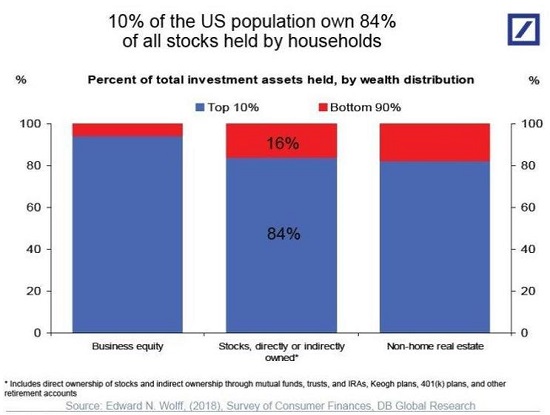
The increasing concentration of the ownership of wealth/assets in the top 10% has an under-appreciated consequence: when only the top 10% can afford to buy assets, that unleashes an almost karmic payback for the narrowing of ownership, a.k.a. soaring wealth and income inequality: assets crash.

Most of you are aware that the bottom 90% own very little other than their labor (tradeable only in full employment) and modest amounts of home equity that are highly vulnerable to a collapse of the housing bubble. (The same can be said of China’s middle class, only more so, as 75% of China’s household wealth is in real estate, more than double the percentage of wealth held in housing in U.S. households.)

As the chart illustrates, the top 10% own 84% of all stocks, over 90% of all business equity and over 80% of all non-home real estate. The concentration of ownership of assets such as vintage autos, collectibles, art, pleasure craft and second homes in the top 10% is likely even greater.

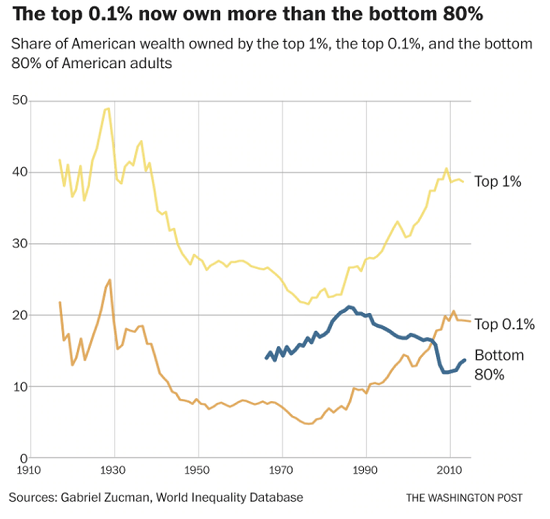
The more expensive the asset, the greater the concentration of ownership, as the top 5% own roughly 2/3 of all wealth, the top 1% own 40% and the top 0.1% own 20%. In other words, the more costly the asset, the narrower the ownership. (Total number of US households is about 128 million, so the top 5% is around 6 million households and the top 1% is 1.2 million households.)

This means the pool of potential buyers is relatively small, even if we include global wealth owners.

Since price is set on the margins, and assets like houses are illiquid, then we can anticipate all the markets for assets owned solely by the wealthy to go bidless–yachts, collectibles, vacation real estate–because the pool of buyers is small, and if that pool gets cautious due to a drop in net worth/unearned income, there won’t be any buyers except at the margins, at incredible discounts.

As we know, in a neighborhood of 100 homes currently valued ar $1 million each, when a desperate seller accepts $500,000, the value of the other 99 homes immediately drops to $500,000.

Since few of the current bubble-era asset valuations are supported by actual income fundamentals, then the sales price boils down to a very small number of potential buyers and what they’re willing to pay.

Houses have a value based on rent, of course, but rents will drop very quickly for the same reason: prices are set on the margins. The most desperate landlords will drop rents and re-set the rental market from the margins. If demand plummets (which it will as people can no longer afford rents in hot urban markets once they lose their jobs), then vacancies will soar and rents will crash as a few desperate landlords will take $1200/month instead of $2500/month.

Due to the multi-year building boom of multi-family buildings in hot job markets (which inevitably leads to an over-supply once the boom ends), there are now hundreds of vacancies where there were once only a few dozen, and thousands where there were previously only hundreds.

As millions of wait staff, bartenders, etc. who made good money in tips find their jobs have vanished, all the urban hotspots will see mass out-migration: Seattle, Portland, the S.F. Bay Area, L.A., NYC, Denver, etc. as demand for rentals will evaporate and rents will be set on the margins by the most desperate landlords. Everyone holding out for the previous bubble-era rent will have $0 income as their units are vacant.

Tech start-ups and Unicorns are melting like ice cubes in Death Valley, and tech-sector layoffs are already in the tens of thousands. This wave of highly paid techies losing their jobs will become a tsunami, further reducing the pool of people who can afford rents of $2,500 to $3,000 for a studio or one-bedroom apartment.)

The concentration of ownership generates a self-reinforcing feedback that further depresses prices: since the top 10% own most of the assets of the nation, they are most prone to a reversal of “the wealth effect.” As their assets soared in value, the top 10% felt wealthier and more confident in future gains, enabling them to borrow and spend freely on second homes, pleasure craft, new vehicles, collectibles, luxury travel, etc.

Once even one class of assets plummets in value–for example, the recent decline in the stock market– the wealth effect reverses and the top 10% feel poorer and less confident about future gains, and thus less enthused about borrowing and spending. The demand for other costly assets quickly evaporates, further reducing the wealth of the “ownership class,” which further reduces their desire and ability to buy bubble-era assets.

The high-priced assets owned by the top 10% will be the assets least in demand due to their high cost and potential for enormous losses: nothing loses value faster in a recession that narrowly owned assets such as vintage cars, art, vacation homes, yachts, etc.

Once assets start sliding in value, the reverse wealth effect quickly dries up demand for all asset classes with narrow ownership. Since these assets are illiquid–that is, the market for them is thin, with buyers few and far between–the prices are set by a very shallow pool of buyers and desperate sellers.

Consider a pleasure craft that retails new for $120,000. In the boom era of rising stocks and housing, a used boat might fetch $65,000. But as the wealth of the small pool of households able to buy and maintain a costly craft evaporates, the number of qualified buyers evaporates, too.

The seller might be aghast by an offer of $35,000 and reject it angrily. Six months later, he’s praying someone will take it off his hands for $15,000, and in another six months, he’ll accept $500 just to get out from underneath the insurance, slip-rental and licencing fees.

This is how it happens that boats that were once worth tens of thousands of dollars are set adrift by owners who can no longer afford to pay slip fees, and vacation homes are abandoned and auctioned off for overdue property taxes: the market for these luxuries dries up and blows away, i.e. goes bidless–there are no buyers at any price.

Once housing and real estate valuations fall, that will trigger a decline in the value of all other costly, narrowly owned assets, which will reinforce the reverse wealth effect.

This is the systemic payback for concentrating ownership of assets in the hands of the few: when their bubble-era priced assets plummet in value, the bottom falls out of all assets with narrow ownership. The price of superfluous assets such as boats, vintage cars, collectibles, art and vacation homes can quickly fall to a fraction of bubble-era valuations, destroying much of what was always fictional capital.

(For more on the intrinsic fragility of a system that concentrates ownership in the hands of the few, please read Our Inevitable Collapse: We Can’t Save a Fragile Economy With Bailouts That Increase Fragility May 1, 2020.)

The Federal Reserve reckons it can “save” the bubble-era valuations of junk bonds by being the “buyer of last resort,” but it will end up being the “only buyer,” effectively making the system even more fragile and prone to collapse.

The public will eventually have to decide if the nation’s central bank should be bailing out assets owned by the financial elite while the upper-middle class watches its assets collapse in value.

Why Post-Coronavirus America Will Have Massive Poverty

By Eric Zuesse

Source: Strategic Culture Foundation

The way that Congress and the President structured America’s coronavirus bailout legislation, the protections that go to the super-wealthy start immediately, but the protections that go to the neediest — the soaring numbers of unemployed, the increasingly endangered medical workers, etc. — require documentation which is creating delays that might soon cause many of these individuals to lose their homes, their cars, even their lives.

On April 17th, Matt Taibbi headlined “The Trickle-Up Bailout” and he noted that:

As we head into the second month of pandemic lockdown, two parallel narratives are developing about the financial rescue.

In one, ordinary people receive aid through programs that are piecemeal, complex, and riddled with conditions.

A law freezing evictions applies to holders of government-backed mortgages only. “Disaster grants” are coming more slowly and in smaller amounts than expected; small businesses were disappointed to learn from the SBA early last week that aid would be limited to $1000 per employee.

That’s typical.

As I had already explained on April 14th:

America’s bailout package to overcome the coronavirus ‘recession’ is twofold:

One part is printing money for employees and consumers, so that they won’t be thrown out onto the streets for non-payment of debts such as mortgages, car-loans, credit cards, and student loans.

Another part is printing money for bondholders and stockholders, so that their investments will still have value and there won’t be panicked selling of them as corporations accumulate soaring losses because consumers are staying home and are cutting way back on expenses.

The top-down part of the bailout (the part for investors) will merely add to the wealth of the already-wealthy, while everybody else sinks financially into oblivion. (On April 9th, the Zero Hedge financial site explained in detail why even bailing out the airlines would hurt the economy more than help the economy.) The top-down part supplies the money to the corporations instead of to their employees and consumers, and is therefore supply-boosting instead of demand-boosting. Supplying money to the corporations that the Government selects to protect will enable those corporations to buy up assets and corporations which during the crisis are being auctioned off by the ones that go out of business, and this will leave the nation’s wealth in even fewer hands than before the epidemic struck.

The bottom-up part (the part for workers and consumers) will be exactly the opposite of that: it will help prevent another Great Depression. By boosting purchases, instead of bailing-out billionaires and such, it will enable the economy to keep functioning, and it will not increase the concentration of wealth.

However, employees and consumers don’t have many lobbyists, but billionaires do, and billionaires also own (through political donations and lobbyists) almost all members of Congress (and also the mainstream press), and they not only own, but are represented by, one inside the White House, who is surrounded there by others, and by representatives of others, so that the concerns of the wealthiest will be very well represented by America’s Government, and will end up dominating the bailouts, so that only the insiders, who are well-connected in Washington, will be protected. (And Joe Biden would be no improvement over Donald Trump, though his rhetoric is different.)

Already, we see, in the ‘news’-reports, that there is ‘chaos’ etc. in the U.S. Government’s response to the crisis, but what’s not being reported in the mainstream ‘news’-media is that there very much is method to this seeming madness, and it is the method of the well-practiced and well-funded takers, definitely not of their victims, from whom they (and their Government) have been, and now increasingly are, taking. The takers own the Deep State, and are protected by it. The vast bulk of the bailouts will go to them. The vast bulk of the bailouts will go to suppliers (investors), not to their workers and consumers.

So, as a general rule: the more that a person’s income depends upon investments, and the less that it depends upon their labor (wages), the more fully that the bailouts will compensate for the losses they’ll be suffering as a result of the coronavirus disruptions.

Here is a breakdown of the incomes that the super-rich receive (mainly from investments), versus the incomes that everybody else receive:

As can easily be seen there, only the super-rich (the top 1%, and most especially the top 0.1%) receive the majority of their incomes from investments (“Business income” and “Capital income”). Everybody else receives it mainly from “compensation” (wages), “retirement income,” and “Transfer income” (welfare).

Most of the benefits to the top 0.1% will be coming by means of monetary policy, via the Federal Reserve, not by means of fiscal policy — such as the payments to the unemployed (which are subject to many delays) and such as the $1,200-per-adult grants (which were the fastest to be paid because it’s the “helicopter money” that buys votes for the political incumbents, all of whom had voted for the bailouts).

The bailouts’ widely publicized part is the $2.2 trillion, since that includes whatever the public gets. However, that part is the smaller portion of the entire program. As CBS News reported on March 24th, “Top White House economic adviser Larry Kudlow said the price tag of economic stimulus amounts to roughly $6 trillion, which includes $2 trillion for direct assistance, and roughly $4 trillion in Federal Reserve lending power. Kudlow said this will be the single-largest such Main Street financial package in the history of the country.” Kudlow said it at a White House press conference. He mentioned there just in passing (at 1:36), that it’s a “six trillion-dollar program, four trillion dollars in lending power from the Fed, that’s a six trillion-dollar package …,” and the reporters in the White House press corps didn’t ask him anything about the Fed’s part, the $4 trillion portion (the program’s part that protects the billionaires); they evidently didn’t care about that, but only about the $2.2 trillion, which is actually the PR decoration on this $6T cake — the $2.2T that the public is interested in, the bait-part of the entire bailout-program. (Its hook won’t sink in until the readers’ children and grandchildren will be paying for it via their taxes in a stripped America.) However, on March 26th, Wall Street on Parade (WSP) — the best investigative-reporting source about Wall Street — headlined “Stimulus Bill Allows Federal Reserve to Conduct Meetings in Secret; Gives Fed $454 Billion Slush Fund for Wall Street Bailouts” and disclosed that even what Kudlow had called “Main Street” (the $2.2T part) included much for Wall Street; and WSP then rhetorically asked, “Why does the Federal Reserve need $454 billion from the U.S. taxpayer to bail out Wall Street when it has the power to create money out of thin air and has already dumped more than $9 trillion cumulatively in revolving loans to prop up Wall Street’s trading houses since September 17, 2019 – long before there was any diagnosis of coronavirus anywhere in the world?” They promptly answered this: “The Fed needs that money to create more Special Purpose Vehicles (SPVs) — the same device used by Enron to hide its toxic debt off its balance sheet before it went belly up.” Furthermore, the $454 billion, which WSP called “the money the Treasury is handing over to the Fed” is what CBS had reported “would result in ‘$4 trillion in Federal Reserve lending power’.” And U.S. taxpayers are guaranteeing 100% of these loans to investors — so, it’s “heads you win, tails we lose,” for taxpayers addressing billionaires, and “heads we win, tails you lose,” for billionaires addressing taxpayers. The billionaires win, the public loses. But the billionaires’ media don’t mention this fact, that investors get the guarantees, while the public takes all of the risks. However, what is an “investment” for, if non-investors are receiving its risks? It’s just legalized crime. And these are huge risks, and all or most of the $454 billion that the U.S. is lending to the Fed to guarantee private investors’ investments could be destroyed in the coronavirus-crisis. This is far more socialism for the super-rich than for the bottom 99%. The billionaires love socialism when they’re the ones who are getting the bailouts — the public taking on the risks that investors are supposed to assume. The issue for billionaires isn’t “socialism versus capitalism,” like they always say; it’s actually “socialism for us, and capitalism for everybody else.” That’s not “survival of the fittest,” for the wealthiest class; it’s instead their ordering their politicians to: protect our wealth, no matter what the cost to the public could turn out to be. And that’s precisely what the President and Congress did. Kudlow, however, said, instead, that the “package” would produce “a good rebound in the second half of the year.” Maybe for the billionaires it would.

Kudlow was simply being consistent with his own prior record. On 10 December 2007, he had headlined in National Review, “Bush Boom Continues: You can call it Goldilocks 2.0. But you can’t call it a recession.” And he closed by saying, “This sort of fiscal and monetary coordination will continue the Bush boom for years to come.” He’s good for the billionaires; and, so, today, he’s President Trump’s top economic advisor. He’s up there, because he’s wrong — not because he’s right. (If he had been right, he wouldn’t be there.)

After the immediate crisis is over, America will have a top 0.1% who are unscathed and whose mega-corporations will be selling not only what they had been selling before, but selling virtually everything that sells in the post-coronavirus world. For examples: what mom-and-pop businesses (including restaurants, B&Bs, etc.) had previously been selling, will, in the future, be supplied (to the extent that it remains being supplied at all) by McDonalds, Starbucks, Marriott, Amazon, Target, Walmart, and other megacorporations (controlled by billionaires), which will have been receiving, from the Fed, and from the Treasury, whatever they needed in order to carry their investors through the crisis-period. (And who are those investors? Look at that chart above, the recipients mainly of “Business income” and “Capital income” — the chief recipients of dividends, interest, and capital gains incomes.)

Furthermore: after the crisis, commercial real estate will be super-cheap, because of all the bankrupted mom-and-pop businesses. Wages also will decline, as the public become increasingly desperate, and the billionaires win increasing market-power. Therefore, not only will the megacorporations be selling a larger percentage of the national output, but their expenses will go down.

Consequently: America will have lots more poor people, and lots wealthier billionaires.

This, however, will be only a temporary situation, because the enormous spread of poverty will result in greatly decreased taxes coming into all levels of the U.S. Government. Bridges will collapse, potholes will proliferate, unendowed colleges will close, nervous breakdowns and heart-attacks will increase, and thus the public won’t be able to spend as much as they were spending before the crisis hit. And, so, although the megacorporations will be selling a larger percentage of national output, that national output will decline, because of the spreading poverty. Therefore, even the billionaires won’t necessarily become richer than they were before the crisis hit.

All of this outcome is unnecessary and results from corruption. The only reason why there is any bailout, at all, for investors (in anything other than pass-through entities), is the pervasive governmental corruption at the very top. If there were no corruption, then the only bailouts would be to individuals and pass-through businesses (which are individuals) — the “bottom-up” bailouts. America is a very corrupt country at the top, and that is the reason why it will collapse in the aftermath of the coronavirus crisis.

Ultimately, when the wealth-inequality is so extreme, the billionaires are selling mainly to each other, and the necessities for the public are less and less profitable to sell at all. The outcome will therefore be economic collapse, and perhaps even revolution.

The basic way to evaluate how well or poorly a nation’s Government is performing in this crisis is the country’s ratio of coronavirus cases to its total population, but if a given country has not yet reached its peak in its daily number of new cases, then that country’s ratio is probably still rising, in which instance, that country’s performance will probably turn out to have been less good than this ratio currently is showing it to be. And, conversely, the lower this ratio is, the better the performance of that country’s Government is shown to be in responding to Covid-19.

Here are the ten nations that have the largest numbers of cases at the present time, and the ratio of that number to their total population; and also shown here is the date when the daily number of new cases peaked (because if it hasn’t yet peaked, then this crucial ratio will probably be rising in that country):

Ratio of total cases divided by total population (the lower this number, the better):

USA = 740,928/330,000,000 = 0.00224523636 not yet peaked

SPAIN = 195,944/46,940,000 = 0.00417435023 peaked March 26th

ITALY = 178,972/60,360,000 = 0.0029650762 peaked March 19th

FRANCE = 152,578/66,990,000 = 0.00227762352 peaked April 3rd

GERMANY = 144,387/83,020,000 = 0.00173918332 peaked March 27th

UK = 120,067/66,650,000 = 0.00180145536 peaked April 10th

TURKEY = 86,306/82,000,000 = 0.00105251219 peaked April 11th

CHINA = 82,735/1,393,000,000 = 0.00005939339 peaked February 12th

IRAN = 82,211/81,800,000 = 0.00100502444 peaked March 30th

RUSSIA = 42,853/144,500,000 = 0.00029656055 not yet peaked

In addition, the following major countries might especially be noted, since the main reason they aren’t on that list is their being outstandingly good performers:

JAPAN = 10,797/126,500,000 = 0.00008535177 peaked April 11th

S. KOREA = 10,661/51,640,000 =0.00020644848 peaked March 3rd

The worst of all these performers appear currently to be, though not yet in any clear order: USA, Spain, and Italy.

The best appear to be, in order: China, Japan, and S. Korea.

The U.S. press has recently been particularly praising Denmark’s performance, and noting that Denmark’s coronavirus emergency legislation is more socialistic than Sweden’s is. However, both of those Scandinavian countries actually have very similar actual performance, thus far, in this crisis. In Denmark, the focus of the emergency legislation was on “saving jobs,” instead of on protecting investors. It’s a democratic socialist country, perhaps the most equalitarian in the world. Of course, that’s the exact opposite of dictatorial capitalism (fascism), which became America’s system after FDR died in 1945, and increasingly thereafter (hyper-imperialistic, military-industrial-complex or “MIC” dominated, like fascist regimes usually are), perpetrating coups and invasions, destroying Iran, Iraq, and many other countries, in order to expand its power and the wealth of its billionaires (like the fascist countries had done going into WW II). No cases of coronavirus-19 were reported in Denmark until February 27th. Denmark unanimously passed its emergency law on March 13th — drastically different bailout legislation from the one that America subsequently passed — in order to deal with the crisis. The daily number of Denmark’s new Covid-19 cases peaked on April 7th, and has been declining since that time. Its neighbor Sweden peaked on April 8th. Sweden’s emergency legislation is less strict about lockdowns, but relies more on individual discretion. However, since Sweden, like Denmark, is a democratic socialist country, individuals needn’t worry about paying medical bills, nor about being paid while on sick-leave. So, employees aren’t desperate to return to their places of work, such as in America; and, therefore, these countries don’t spread the infection as readily as in the U.S. and are thus far less likely to have recurring peaks and delayed terminations of the coronavirus crisis. (By contrast: in America, where losing one’s job can mean losing one’s health care, even sick employees may be inclined to stay on the job and perhaps infect customers.) And there are no corporate bailouts in either Denmark’s or Sweden’s legislation. Denmark’s Finance Minister, the Social Democrat (or democratic socialist) Nicolai Wammen was interviewed for 15 minutes on March 27th, by Christiane Amanpour, and he explained Denmark’s emergency law, which was overwhelmingly bottom-up, not top-down (such as America’s is).

Here, therefore, is the actual performance, thus far, of both of those two countries:

DENMARK = 7,384/5,806,000 = 0.00127178780 peaked April 7th

SWEDEN = 14,385/10,230,000 = 0.00140615835 peaked April 8th

Both of them are reasonably comparable to Germany, UK, Turkey, and Iran, but not as good as S. Korea, and not nearly as good as the two best, China and Japan.

In the final analysis, China and Japan could turn out to have the least-corrupt and best-run Governments; and the most corrupt Governments could turn out to be USA, Spain, and Italy. However, the performances of Brazil and some other nations in the southern hemisphere might yet turn out to be even worse than those of USA, Spain, and Italy, because the winter season has’t yet reached there.

On April 16th, Wall Street on Parade headlined “Here Are the Contracts Showing How $4.5 Trillion in Stimulus Was Outsourced to Wall Street” and described — and documented — what the Wall Street Journal and the rest of the financial press would not, which is the U.S. Government’s legalized money-laundering operation, via the Fed, transferring onto the American public almost all of the losses that America’s billionaires will be suffering from the coronavirus crash. Back on 21 January 2020, WSP described this money-laundering, in its earlier 2008 embodiment, this way: “The epic financial collapse on Wall Street in 2008 was, reduced to its basic terms, simply the end game of Wall Street banks’ efforts to monetize their frauds.” They noted: “On April 9, 2019, the nonprofit Wall Street watchdog, Better Markets, released a study titled: “Wall Street’s Six Biggest Bailed-Out Banks: Their RAP Sheets & Their Ongoing Crime Spree.” It should have made headlines on the front pages of every major newspaper in the U.S. Instead, it was effectively ignored by mainstream media.” (Incidentally: Obama repeatedly promised to prosecute banksters, but secretly protected them and prosecuted none of them, though their crimes had been monstrous. The billionaires’ thefts from the public are entirely bipartisan, supported by over 95% of Congress — the billionaires own the Presidents and members of Congress, and not only own virtually all of the news-media.) On April 20th, America’s National Public Radio (NPR) broadcast “Amid Pandemic, Italian Prosecutors Warn That Mafia Groups Are Cementing Their Power” and reported that Mafia bosses were buying up cheap some of Italy’s suddenly desperate small businesses. If the same thing is being done by America’s billionaires, that’s not yet being reported by their press — perhaps it will instead be reported by Italy’s press.

The Federal Reserve are controlled by and represent the banksters — Wall Street — who not only skim on their own accounts but work with and for the billionaires, some of whom are themselves banksters, but many of whom are operating hedge funds, private equity funds, and all types of FORTUNE 500 companies. Basically, Wall Street works for the billionaires. The billionaires run practically everything in America, except Main Street.

In the upcoming June 2020 issue of the neoconservative (pro-U.S.-imperialist) Democratic Party U.S. magazine, The Atlantic, their George Packer banners “We Are Living in a Failed State: The coronavirus didn’t break America. It revealed what was already broken.” That magazine blames this “failed state” on the (neoconservative) Republican Party, and so Packer’s phrase there “a dysfunctional government” links to an anti-Republican article, by one of the top officials in the liberal neoconserative U.S. Administration of the Democrat Barack Obama, titled “How Trump Designed His White House to Fail.” However, the actual cause of the gradual collapse, since 1945, of what had been U.S. President FDR’s largely democratic U.S.A., is the billionaires who own both Parties — it is bipartisan. This rot comes from both Parties’ billionaires. (The particular propaganda-operation, The Atlantic, happens to be controlled by the same Democratic Party billionaire who controls Apple corporation.) No billionaire will publish the reality. For example, Packer’s article said: “The second crisis, in 2008, intensified it [‘a bitterness toward the political class’]. At the top, the financial crash could almost be considered a success. Congress passed a bipartisan bailout bill that saved the financial system.” The presumption there is that the only way to restore the economy after a crash is to bail out the country’s billionaires. It’s a timely message, at this moment when the billionaires require their Government to bail them out, yet again. (I recently proposed one way to reduce the billionaires’ dictatorship over America.)

On April 17th, WSP headlined “Americans Are Paying a Tragic Price for Allowing Five Banks to Control the U.S. Economy” and closed by urging: “Americans need to use this time at home to call their Senators and Reps in Congress and demand the separation of federally-insured, deposit-taking banks from the casinos on Wall Street. We’re talking about nothing less than the survival of this country.” Needless to say, the ultimate beneficiaries of this public largesse — to America’s billionaires — don’t desire to publicize such writings, any more than they desire to publicize to the public their offshore bank accounts.

Unlike so much that’s in the billionaires’ ‘news’, the facts that are reported here are solidly documented (and linked-to), but the billionaires don’t report these facts. Thus, the masses don’t know these facts, and so the mass-violence, when it comes, won’t be focused against the billionaires. What you’re reading, here, is being kept secret by (not being published by) the billionaires’ media. So — if only to spread word that the cause of this is not “the Chinese” or “foreigners” or “the Jews” or some other amorphous ethnicity, who aren’t actually to blame — please email the URL (the web-address) atop this article, to all of your friends, as “FYI:”. It might stir some interesting conversations, especially if all the ‘news’ that they know comes from America’s billionaires — the same people who fund the country’s successful politicians, each and every election-year. The American Revolution did not come about by misinformed people. It came about by informed people. Misinformed people create only more problems.

So, that’s “FYI.” And thanks for reading here.