Slowly, Then All at Once

imageedit_4850_9701377216

By James Howard Kunstler

Source: Clusterfuck Nation

The staggering incoherence of the election campaign only mirrors the shocking incapacity of the American public, from top to bottom, to process the tendings of our time. The chief tending is permanent worldwide economic contraction. Having hit the resource wall, especially of affordable oil, the global techno-industrial economy has sucked a valve in its engine.

For sure there are ways for human beings to inhabit this planet, perhaps in a civilized mode, but not at the gigantic scale of the current economic regime. The fate of this order has nothing to do with our wishes or preferences. It’s going down whether we like it or not because it was such a violent anomaly in world history and the salient question is: how do we manage our journey to a new disposition of things. Neither Trump or Clinton show that they have a clue about the situation.

The quandary I describe is often labeled the end of growth. The semantic impact of this phrase tends to paralyze even well-educated minds, most particularly the eminent econ professors, the Yale lawyers-turned-politicos, the Wall Street Journal editors, the corporate poobahs of the “C-Suites,” the hedge fund maverick-geniuses, and the bureaucratic errand boys (and girls) of Washington. In the absence of this “growth,” as defined by the employment and productivity statistics extruded like poisoned bratwursts from the sausage grinders of government agencies, this elite can see only the yawning abyss. The poverty of imagination among our elites is really something to behold.

As is usually the case with troubled, over-ripe societies, these elites have begun to resort to magic to prop up failing living arrangements. This is why the Federal Reserve, once an obscure institution deep in the background of normal life, has come downstage front and center, holding the rest of us literally spellbound with its incantations against the intractable ravages of debt deflation. (For a brilliant gloss on this phenomenon, read Ben Hunt’s essay “Magical thinking” at the Epsilon Theory website.)

One way out of this quandary would be to substitute the word “activity” for “growth.” A society of human beings can choose different activities that would produce different effects than the techno-industrial model of behavior. They can organize ten-acre farms instead of cell phone game app companies. They can do physical labor instead of watching television. They can build compact walkable towns instead of suburban wastelands (probably even out of the salvaged detritus of those wastelands). They can put on plays, concerts, sing-alongs, and puppet shows instead of Super Bowl halftime shows and Internet porn videos. They can make things of quality by hand instead of stamping out a million things guaranteed to fall apart next week. None of these alt-activities would be classifiable as “growth” in the current mode. In fact, they are consistent with the reality of contraction. And they could produce a workable and satisfying living arrangement.

The rackets and swindles unleashed in our futile quest to keep up appearances have disabled the financial operating system that the regime depends on. It’s all an illusion sustained by accounting fraud to conceal promises that won’t be kept. All the mighty efforts of central bank authorities to borrow “wealth” from the future in the form of “money” — to “paper over” the absence of growth — will not conceal the impossibility of paying that borrowed money back. The future’s revenge for these empty promises will be the disclosure that the supposed wealth is not really there — especially as represented in currencies, stock shares, bonds, and other ephemeral “instruments” designed to be storage vehicles for wealth. The stocks are not worth what they pretend. The bonds will never be paid off. The currencies will not store value. How did this happen? Slowly, then all at once.

We’re on a collision course with these stark realities. They are coinciding with the sickening vectors of national politics in a great wave of latent consequences built up by the sheer inertia of the scale at which we have been doing things. Trump, convinced of his own brilliance, knows nothing, and wears his incoherence like a medal of honor. Clinton literally personifies the horror of these coiled consequences waiting to spring — and the pretense that everything will continue to be okay with her in the White House (not). When these two gargoyle combatants meet in the debate arena a week from now, you will hear nothing about the journey we’re on to a different way of life.

But there is a clear synergy between the mismanagement of our money and the mismanagement of our politics. They have the ability to amplify each other’s disorders. The awful vibe from this depraved election might be enough to bring down markets and banks. The markets and banks are unstable enough to affect the election.

In history, elites commonly fail spectacularly. Ask yourself: how could these two ancient institutions, the Democratic and Republican parties, cough up such human hairballs? And having done so, do they deserve to continue to exist? And if they go up in a vapor, along with the public’s incomes and savings, what happens next?

Enter the generals.

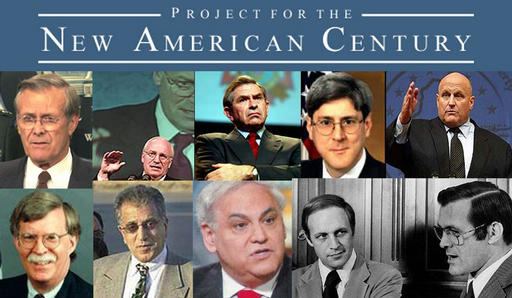
How The American Neoconservatives Destroyed Mankind’s Hopes For Peace

project-new-american-century

By Paul Craig Roberts

Source: TruePublica.org

When Ronald Reagan turned his back on the neoconservatives, fired them, and had some of them prosecuted, his administration was free of their evil influence, and President Reagan negotiated the end of the Cold War with Soviet President Gorbachev. The military/security complex, the CIA, and the neocons were very much against ending the Cold War as their budgets, power, and ideology were threatened by the prospect of peace between the two nuclear superpowers.

I know about this, because I was part of it. I helped Reagan create the economic base for bringing the threat of a new arms race to a failing Soviet economy in order to pressure the Soviets into agreement to end the Cold War, and I was appointed to a secret presidential committee with subpeona power over the CIA. The secret committee was authorized by President Reagan to evaluate the CIA’s claim that the Soviets would prevail in an arms race. The secret committee concluded that this was the CIA’s way of perpetuting the Cold War and the CIA’s importance.

The George H. W. Bush administration and its Secretary of State James Baker kept Reagan’s promises to Gorbachev and achieved the reunification of Germany with promises that NATO would not move one inch to the East.

The corrupt Clintons, for whom the accumulation of riches seems to be their main purpose in life, violated the assurances given by the United States that had ended the Cold War. The two puppet presidents—George W. Bush and Obama—who followed the Clintons lost control of the US government to the neocons, who promptly restarted the Cold War, believing in their hubris and arrogance that History has chosen the US to exercise hegemony over the world.

Thus was mankind’s chance for peace lost along with America’s leadership of the world. Under neocon influence, the United States government threw away its soft power and its ability to lead the world into a harmonious existance over which American influence would have prevailed.

Instead the neocons threatened the world with coercion and violence, attacking eight countries and fomenting “color revolutions” in former Soviet republics.

The consequence of this crazed insanity was to create an economic and military strategic alliance between Russia and China. Without the neocons’ arrogant policy, this alliance would not exist. It was a decade ago that I began writing about the strategic alliance between Russia and China that is a response to the neocon claim of US world hegemony. http://www.rense.com/general77/tus.htm

The strategic alliance between Russia and China is militarily and economically too strong for Washington. China controls the production of the products of many of America’s leading corporations, such as Apple. China has the largest foreign exchange reserves in the world. China can, if the government wishes, cause a massive increase in the American money supply by dumping its trillions of dollars of US financial assets.

To prevent a collapse of US Treasury prices, the Federal Reserve would have to create trillions of new dollars in order to purchase the dumped financial instruments. The rest of the world would see another expansion of dollars without an expansion of real US output and become skeptical of the US dollar. If the world abandoned the US dollar, the US government could no longer pay its bills.

Europe is dependent on Russian energy. Russia can cut off this energy. There are no alternatives in the short-run, and perhaps not in the long run. If Russia shuts off the energy, Germany industry shuts down. Europeans freeze to death in the winter. Despite these facts, the neocons have forced Europe to impose economic sanctions on Russia. What if Russia responded in kind?

NATO, as US military authorities admit, has no chance of invading Russia or withstanding a Russian attack on NATO. NATO is a cover for Washington’s war crimes. It can provide no other service.

Thanks to the greed of US corporations that boosted their profits by offshoring their production to China, China is modernized many decades before the neocons thought possible. China’s military forces are modernized with Russian weapons technology. New Chinese missiles make the vaunted US Navy and its aircraft carriers obsolete.

The neocons boast how they have surrounded Russia, but it is America that is surrounded by Russia and China, thanks to the incompetent leadership that the US has had beginning with the Clintons. Judging from Hillary’s support in the current presidential primaries, many voters seem determined to perpetuate incompetent leadership.

Despite being surrounded, the neocons are pressing for war with Russia which means also with China. If Hillary Clinton makes it to the White House, we could get the neocon’s war.

The neocons have flocked to the support of Hillary. She is their person. Watch the feminized women of America put her in office. Keep in mind that Congress gave its power to start wars to the president.

The United States does not have a highly intelligent or well informed population. The US owes its 20th century dominance to World War I and World War II which destroyed more capable countries and peoples. America became a superpower because of the self-destruction of other countries.

Despite neocon denials that their hubris has created a powerful alliance against the US, a professor at the US Navy War College stresses the reality of the Russian-Chinese strategic alliance. http://sputniknews.com/world/20160414/1037981155/russia-china-cooperation.html

Last August a joint Russian-Chinese sea and air exercise took place in the Sea of Japan, making it clear to America’s Japanese vassal that it was defenceless if Russia and China so decided.

The Russian defense minister Sergey Shoigu said that the joint exercise illustrates the partnership between the two powers and its stabilizing effect on that part of the world.

Chinese Foreign Minister Wang Yi said that Russian-Chinese relations are able to resist any international crises.

The only achievements of the American neoconservatives are to destroy in war crimes millions of peoples in eight countries and to send the remnant populations fleeing into Europe as refugees, thus undermining the American puppet governments there, and to set back the chances of world peace and American leadership by creating a powerful strategic alliance between Russia and China.

This boils down to extraordinary failure. It is time to hold the neoconservatives accountable, not elect another puppet for them to manipulate.

Paul Craig Roberts was Assistant Secretary of the Treasury for Economic Policy from 1975 to 1978. Dr. Roberts served on the congressional staff where he drafted the Kemp-Roth bill and played a leading role in developing bipartisan support for a supply-side economic policy. After leaving the Treasury, he served as a consultant to the U.S. Department of Defense and the U.S. Department of Commerce.

America, the World’s Most Dangerous Dictatorship

american-imperialism-39-638

By Gordon Duff

Source: New Eastern Outlook

Though Russia doesn’t consider herself a superpower, other than the US, and just perhaps China, Russia is as close as we come. A very real problem is that Russia has a very poor understanding of America, how politics work, what Americans think and, more than anything else, Russia still thinks America is a democracy.

You see, at the same time America was tearing the Soviet Union apart, the same thing was being done to America. Neither nation survived, it wasn’t just the Soviet Union that fell to the New World Order, it was America as well. Let me explain as succinctly as possible.

During the Clinton years, powerful Nazi inspired elements in America plotted what has been the successful overthrow of America’s constitution. The movement was led by rogue “industrialist” John Mellon Scaife and lawyers Antonio Scalia and Newt Gingrich. Financing them all was the Rothschild owned and controlled Federal Reserve Corporation.

A secret society hidden in plain sight was set up called the Federalist Society. This Nazi controlled group, backed by the powerful Israel lobby, moved into every law school in America, recruiting top candidates based on skill sets needed.

This program was devised by the CIA and recruited thousands of budding sociopathic personality types, recruiting them into the Federalist Society and channeling them into top law firms or government agencies.

Adding to these recruits were senior lawyers with ties to organized and corporate crime, thousands of them in a major CIA operation.

There, they were pushed forward and after a decade ran the US Department of Justice, nearly every court in the nation, controlled the law schools, controlled the American Bar Association, the FBI and had put over 150 of their members into the Congress of the United States.

They also controlled every regulatory agency, environment, banking and finance, food and drug safety, you can see where this is going.

They also controlled 5 justices of the Supreme Court of the United States.

During the Clinton Administration, they managed to temporarily get control of the US House of Representatives through the help of the Contract with America and Newt Gingrich, financed by Zionist “black propaganda” moneyman Rupert Murdoch. In payment for this, “Newt” gave Murdoch an American broadcast network, Fox, though illegal. You see, non-Americans can’t control networks, or couldn’t. That’s ok, Gingrich eventually gave Murdoch illegal American citizenship as well.

Murdoch only had to publish Newt’s useless books and give his wife, and Newt traded them in with regularity, a highly paid “do nothing job” as a bribe.

Where things really paid off was 2000. During the Clinton administration, Scaife hired lawyer Ken Starr to investigate Clinton and get himself nominated as Special Prosecutor. Scaife paid Starr by naming him President of Pepperdine University, which Scaife controlled, for those who care about facts.

Clinton backer George Soros hired a former CIA agent named Steve Kangas to get dirt on Scaife. Kangas amassed enough evidence on Scaife and his deal with Starr to send them both to the electric chair. Scaife, Scalia and the Federalists had Kangas kidnapped and murdered in order to save Ken Starr who had been promised a seat on the US Supreme Court. Look into it.

The deal really came to life in 2000. The CIA and Diebold Corporation had contracted with a computer guru named Michael Connell who developed software that would simply flip votes done on electronic voting machines. Targeted would be the states of Ohio, Florida and Virginia only, piling up votes in key precincts just enough to guarantee control of the Electoral College.

Without this it is impossible for the Republican Party to get a president elected without staging an international incident such as the kidnapping of US diplomats in Tehran. We aren’t going to say the Ayatollah was an MI6 agent and was sent to Iran for exactly this purpose, even though it is true and we can prove it.

In 2000, even with millions of votes flipped, exit polls support Bush losing by 5 million votes, the election couldn’t be saved. Here, the Federalists stepped in and had their 5 Supreme Court justices step in and overthrow both the areas of equal protection and states’ rights of the US Constitution to place Bush in office.

2000 was important. This was a presidential election that also took place on a census year. You see, the census is a rationale for redistricting the US House of Representatives using State legislatures, which were largely taken over by the Federalist Society. Bribes and payoffs at state level are hard to control and organized crime easily got control of enough states to allow redistricting.

Here, the CIA developed a program for designing odd shaped congressional districts that would pile union workers and minorities into bizarre and often discontiguous shapes, taking districts away from democrats by joining them together and creating new republican only districts, often with almost no people living in them.

Additionally, problem representatives like Ohio’s Dennis Kucinich were eliminated entirely, their districts were simply erased, all of this, and it is called gerrymandering, is illegal.

By 2004 there were no more free elections for the House of Representatives, giving this house free rein to investigate anyone, any time and to quell any investigation as well, such as 9/11.

By 2005, by a 5/4 vote, the Supreme Court in the Citizens United case overturned for all time limitations on foreign and corporate spending on American elections, citing an end to democracy in America.

Mike Connell, GOP “guru” died in a mysterious plane crash in Ohio just before testifying about his role in CIA “vote flipping.”

This is as short and sweet as it could be put. For those who fail to understand the Federalist Society and the hold organized crime through the Republican Party has gained over American government, the new Cold War and the threat of a hot war as well is a total surprise.

For those who pay attention, we saw it coming all along.

Is the US Economy Heading for Recession?

How Do You Know When Your Society Is In The Midst Of Collapse?

boot

By Brandon Smith

Source: Activist Post

As economic turmoil worldwide becomes increasingly apparent, I have been receiving messages from readers expressing some concerns on the public “perception” of collapse. That is to say, there are questions on the average person’s concept of collapse versus the reality of collapse. This is a vital issue that I have discussed briefly in the past, but it deserves a more in-depth analysis.

What is collapse? How do we define it? And, are some of the notions of collapse in the public consciousness completely wrong?

It’s funny, because skeptics opposed to the idea of a U.S. collapse in particular will most often retort with a question they think I cannot or will not answer – “So, Mr. Smith, when specifically is this supposed collapse going to take place? What day and time?”

My response has always been – “We’re in the middle of a collapse right now; you really can’t see it right in front of your sneering face?”

The reason these people are incapable of grasping this kind of answer is in large part due to the popular mainstream conceptions of systemic collapse. These are conceptions that are for the most part delusional and not in line with the facts. The public idea of collapse comes predominantly from Hollywood, and not from personal experience. For the masses (and some preppers, unfortunately), a collapse is an “event” that happens visibly and usually swiftly. You wake up one morning and behold; the television and phones don’t work anymore and zombies are at your doorstep! Yes, it’s childish and cartoonish, but anything less than a Walking Dead/Mad Max scenario and many people act as if all other threats are benign.

This is the driving reason why many Americans are absolutely oblivious to the economic instability that is rampant and blatant within our system the past few months. They might see the same signals that alternative analysts see, but these signals do not register in their brains as dangers.

Look at it this way; say you told a person their whole life that a tiger is a 10-foot tall behemoth with four heads that breathes fire while urinating flesh-rending acid. Say you make movies and TV shows about it and they never have any experience to the contrary. When they finally come across a real tiger, they might try to pet the damn thing instead of running in terror or searching for a means of defense.

To use another vicious animal analogy, when I encounter skeptics with false assumptions of what a collapse actually is, I am often reminded of that woman in Anchorage, Alaska who jumped an enclosure fence at the zoo to get a closer picture of Binky the polar bear. These people have been made so inept when it comes to identifying threats that they will continue arguing with you as the animal takes a football-sized bite out of their meaty thigh.

So what is the root of the problem beyond Hollywood fantasies? Well, the problem is that social and economic collapse is not a singular event, it is a PROCESS. Collapse is a series of events that sometimes span years. Each event increases in volatility over the last event, but as time goes on these events tend to condition the masses. The public develops a normalcy bias towards crisis (like the old “frog in a boiling pot” analogy). They lose all sense of what a healthy system looks like.

It is not uncommon for a society to wade through almost a decade or more of violent decline before finally acknowledging the system is imploding on a fundamental level. It is also not uncommon for societies to endure years of abuse by corrupt governments before either organizing effectively to rebel, or caving in and submitting to totalitarianism.

But how does one recognize a failing system? How does a person know if they are in the middle of a collapse rather than on the “verge” of collapse? Here are some signals I have derived from research of various breakdowns in modern nations and why they indicate we are experiencing collapse right now…

The Criminals Openly Admit To Their Crimes

The surest way to know if your society is in the midst of disintegration is to see if the criminals who created the instability in the first place are openly discussing a collapse scenario or warning that one is imminent.

A year ago, central bankers presented little more than a chorus of recovery propaganda. Today, not so much. The Royal Bank of Scotland is now warning investors to “sell everything” ahead of a “cataclysmic” year in markets.

The Federal Reserve’s Richard Fisher has admitted that the Fed “frontloaded” (manipulated) stock markets into a bubble and that payment is about to come due in the form of severe economic volatility (up to 20% crash in equities).

The Bank for International Settlements, the central bank of central banks, has a track record of warning the public about collapse conditions – right before they happen, leaving little or no time for people to prepare. They have followed their habit by warning in September and December that a Fed rate hike would “shatter” the uneasy calm in markets.

The former Chief Economist of the BIS now says the economy is in worse shape than it was in 2008 and is headed for a larger fall.

What happened between last year and this year and why are these internationalists suddenly so forthcoming about our economic reality? The fact that central bankers are the cause of our current collapse leads me to believe that such admissions are designed to deflect guilt. If they put out a few warnings now, they can then later claim they are prognosticators rather than culprits, and that they were trying to “help us.” Beyond that, the reality is that our situation was just as dire in 2014/2015 as it is today; the difference is that now we are about to enter a new phase in the ongoing collapse, a much more detrimental phase, but still a phase of a breakdown that has been progressing since at least 2008.

The Fundamentals Break Through The Manipulation Barrier

Governments and central banks do not have the capacity to artificially create demand for goods or a supply of well-paying jobs in a crashing economy. What they can do, though, is hide the visible problems in supply and demand with false numbers.

I examined such false economic statistics in great detail last year in a six-part series titled “One Last Look At The Real Economy Before It Implodes.” I will not cover them all again here. I would only point out that recently the fundamentals of supply and demand have begun to break through the deceit of manipulated numbers, and this is a sign that the collapse is about to move from one stage to the next.

With global shipping and trucking freight in steep decline, with retail inventories in stasis and current oil consumption falling to levels not seen since 1997 despite a larger population, the mainstream can no longer deny that consumer demand is crumbling. If demand is falling dramatically, then the financial system is in the middle of falling dramatically; there is simply no way around this truth.

Stocks And Commodities Become Violently Erratic

Let’s be clear, if stock markets represent anything at all, they are merely lagging indicators of economic instability.  Stock markets are NOT predictive indicators of anything useful.  Therefore, any person who does nothing but track equities each day is going to be completely oblivious to the bigger picture behind the economy until it is too late.  They will be so mesmerized by the green numbers and red numbers and lines on minute-to-minute graphs that they will lose all sense of reality.

Violent swings in stocks are a sign of a financial system that is at the middle or end of the collapse process, not the beginning.

It is also important to note that extreme shifts in stocks and commodity values to the upside are just as much a signal of instability as shifts to the downside.  For instance, if you witnessed the recent 9% explosion in oil markets and thought to yourself “Ah, the markets are being stabilized again and nothing is different this time…”, then you are an idiot.

Of course, the next day oil markets lost almost all of the gains they made the day before.  And this is how markets behave when they are about to die; they expand and implode chaotically each day on nothing more that meaningless news headlines rather than hard data.  This heart attack in equities inevitably trends downwards as the weeks and months pass.  Keep in mind, equities are down nearly 10% from their recent highs, and oil is down approximately 50% in the past six months.  Every time there is a dead cat bounce in stocks skeptics come out of the woodwork to call alternative analysts “doomers”, yet they are nowhere to be found when markets come crashing back down.  They are not looking at the overall trend because their short attention spans hinder them.  Again, extreme swings in markets, whether up or down, are a sign of progressing collapse.

Deterioration Of Cultural Values, Heritage And Identity

I have written extensively over the years about the Cloward-Piven strategy; a strategy used by collectivists to destabilize social systems by dumping overt numbers of foreign immigrants into the population without demand for integration. This process has been obvious in the U.S. and Europe for quite some time, but only now is it peaking to the point that collapse is seen as an inevitable result by the public. Europe is worse off than the U.S. in this regard as millions upon millions of Muslim immigrants are injected into the EU’s already dying body; immigrants that intend to transplant their culture from their own failed societies rather than adopting the values and principles of the societies that have invited them in.

Natural-born Americans and legal immigrants with aspiration of integration appear to be fighting back against the Cloward-Piven strategy with some success by holding onto traditional American values despite being labeled “barbarians” and “racists.” Illegal immigration, though, is still completely unchecked.

In the EU, the long campaign of cultural Marxism has made natural-born Europeans perhaps the most self-hating people on the planet as well as the most passive and weak. Organized opposition to massive immigration programs in the EU should have taken place years ago. Now it is far too late, and the European system is finishing a social implosion which should have already been obvious to average citizens.

Open Discussion Of Totalitarian Measures

When corrupt leadership moves from quiet totalitarianism to more open totalitarianism, your society is in the FINAL stages of collapse, not the beginning of a collapse. The U.S. in particular has been slowly strangled with subversive legal directives and political policies ever since the so called “War on Terror” began. However, there are now multiple signals of a much deeper and open tyranny in the works.

A few recent examples stand out, including Barack Obama’s insistence that the office of the president has the legal authority to issues executive orders that affect constitutional protections such as the 2nd Amendment. As many liberty movement activists are aware, there is absolutely no constitutional precedent for the use of executive orders and such powers are not mentioned anywhere in the document. They were simply created out of thin air to be used by the federal government and sometimes state governments to supersede normal checks and balances.

While numerous presidents have issued executive orders, including some that were outright tyrannical, like Franklin Delano Roosevelt’s unconstitutional internment of Japanese Americans into concentration camps, George W. Bush and Barack Obama have been the most subversive in their bypassing of the Constitution. Obama, in particular, has tried to hide the number of executive actions he has taken by issuing hundreds of “presidential memorandums,” which are basically the same dirty play by another name.

These actions have been progressively setting the stage for the removal of checks and balances entirely in the name of crisis management. They are so broad in their nature and vague in their definitions and applications that they could be interpreted by federal authorities to mean just about anything in any given situation.

If executive actions are not scary enough, corrupt politicians are now becoming blunt in their demands for dominance. Two Republican Senators, Mitch McConnel and Lindsay Graham, are calling for unlimited AUMF-style (authorization of use of military force) war powers to be given to the president. Such powers would allow the president to project U.S. military forces anywhere in the world for any reason without review or time limits. This includes the use of military forces on U.S. soil.

The rationale for this is, of course, the threat of ISIS. The same group of terrorists the U.S. government helped to create.

And finally, if you want perhaps the most nonchalant admission of future tyranny in recent days, check out former General Wesley Clark’s call for “disloyal” Americans to be placed in internment camps through the duration of the war on terror, a war that could ostensibly go on forever.

One could argue that all of these measures are meant only to deter “Islamic extremism.” I would point out that government officials could have stemmed that tide at any time by enforcing existing immigration laws, or, by stopping all immigration for a period of years until the problem is handled. Instead, they have allowed open borders to remain, and have even imported potential terrorists while focusing Department of Homeland Security efforts more on evil white guys with guns.

If we accept the violation of the constitutional rights of any group of citizens, if we allow the concept of “thought crime” to become commonplace, then we leave the door open to the violation of our own rights someday. And that is how tyrants trick populations through incremental collapse; by applying despotism to a claimed dangerous minority, then expanding it to everyone else.

America is sitting near the end of the spectrum in terms of economic collapse and in the middle of the spectrum in terms of social collapse.  While more violent events are certainly gestating and are likely to be triggered in the near term, we should not overlook the reality that collapse is happening in stages all around us.  This process gives us at least some time.  All is not lost yet, and the steps we take to organize and prepare today will affect how the collapse process unfolds tomorrow. People who continue to ignore the outright evidence of collapse based on false assumptions of what collapse should look like are only preventing themselves from taking proper action until it is too late. Make no mistake, our system is dying. We cannot allow our false perceptions of this death to cloud the reality of it, or our response to it.


You can read more from Brandon Smith at his site Alt-Market.com. If you would like to support the publishing of articles like the one you have just read, visit our donations page here.  We greatly appreciate your patronage. You can contact Brandon Smith at: brandon@alt-market.com

A Warning From the B.I.S.: the Calm Before the Storm?

banker-thief

By Mike Whitney

Source: CounterPunch

The Bank for International Settlements (BIS) is worried that recent ructions in the equities markets could be a sign that another financial crisis is brewing. In a sobering report titled “Uneasy calm gives way to turbulence”  the BIS states grimly: “We may not be seeing isolated bolts from the blue but the signs of a gathering storm that has been building for a long time.”

The authors of the report are particularly concerned that the plunge in stock prices and the slowdown in global growth are taking place at the same time that investor confidence in central banks is waning. The Bank Of Japan’s announcement that it planned to introduce negative interest rates (aka–NIRP or negative interest rate policy) in late January illustrates this point. The BOJ hoped that by surprising the market, the policy would have greater impact on borrowing thus generating more growth. But, instead, the announcement set off a “second phase of turbulence” in stock and currency markets as nervous investors sold off risk assets and moved into safe haven bonds. The BOJ’s action was seen by many as act of desperation by a policymaker that is rapidly losing control of the system. According to the BIS:

“Underlying some of the turbulence of the past few months was a growing perception in financial markets that central banks might be running out of effective policy options.”

This is a recurrent theme in the BIS report, the notion that global CBs have already used their most powerful weapons and are currently trying to muddle-by with untested, experimental policies like negative rates that slash bank profitability while having little impact on lending.

While the BIS report provides a good rundown of recent events in the financial markets, it fails to blame central banks for any of the problems for which they alone are responsible. The sluggish performance of the global economy, the massive debt overhang, and the erratic behavior of the stock market are all directly attributable to the cheap money policies coordinated and implemented by central banks following the Great Recession in 2008.  It’s hard to believe that the BIS’s failure to insert this fact into its narrative was purely accidental.

But the real problem with the BIS report is not that it refuses to assign blame for the current condition of the markets and the economy,  but that it deliberately misleads its readers about the facts. While it’s true that China is facing slower growth, oil prices are plunging, emerging markets have been battered by capital flight, and yields on junk bonds are relentlessly rising, it’s also true that central bank policy is not primarily designed to address these problems, but to ensure the continued profitability of its main constituents,  the big banks and mega-corporations. Keep in mind, the global economy has been sputtering for the last 6 years, but the BIS has only expressed alarm just recently.  Why? What’s changed?

What’s changed is profits are down, and when profits are down,  Wall Street and its corporate allies lean on the central banks to work the levers to improve conditions. Here’s more on the so called “earnings recession” from an article in the Wall Street Journal titled “S&P 500 Earnings: Far Worse Than Advertised”:

“There’s a big difference between companies’ advertised performance in 2015 and how they actually did.

How big? ….S&P earnings per share fell by 12.7%, according to S&P Dow Jones Indices. That is the sharpest decline since the financial crisis year of 2008. Plus, the reported earnings were 25% lower than the pro forma figures—the widest difference since 2008 when companies took a record amount of charges.

The implication: Even after a brutal start to 2016, stocks may still be more expensive than they seem. Even worse, investors may be paying for earnings and growth that aren’t anywhere near what they think. The result could be that share prices have even further to fall before they entice true value investors.” ( “S&P 500 Earnings: Far Worse Than Advertised“, Wall Street Journal)

Profits are down and stocks are in trouble. Is it any wonder why the BIS is running around with its hair on fire?

Also, corporate earnings have dropped for two straight quarters which is a sign that the economy is headed for a slump. Take a look at this clip from CNBC:

“Recessions have followed consecutive quarters of earnings declines 81 percent of the time, according to an analysis from JPMorgan Chase strategists, who said they combed through 115 years of records for their findings.”(CNBC)

“81 percent” chance of a recession?

Yep.

This is what the BIS is worried about.  They could are less about China or the instability they’ve created with their zero rates and cheap money policies. Those things simply don’t factor into their decision-making. It’s all just fluff for the sheeple. Here’s more from Jim Quinn at Burning Platform:

“The increasing desperation of corporate CEOs is clear, as accounting gimmicks and attempts to manipulate earnings in 2015 has resulted in the 2nd largest discrepancy between reported results and GAAP results in history, only surpassed in 2008…..Based on fake reported earnings per share, the profits of the S&P 500 mega-corporations were essentially flat between 2014 and 2015…..earnings per share plunged by 12.7%, the largest decline since the memorable year of 2008….

With approximately $270 billion of “one time” add-backs to income used to deceive the public, the true valuation of the median S&P 500 stock is now the highest in history – higher than 1929, 2000, and 2007. Wall Street’s latest con game, with the active participation of corporate CEO co-conspirators, is a last ditch effort to fend off the inevitable stock market crash….All economic indicators are flashing red for recession. Stocks are poised for a 40% decline faster than you can say Wall Street criminal banks.” (“The Great Corporate Earnings Fraud“, Burning Platform)

Get it? When the profitability of the world’s biggest corporations are at stake, the central banks will move heaven and earth to lend a hand. This was the basic subtext of the discussions at the recent G-20 summit in Shanghai, China. The finance ministers and central bankers wracked their brains for two days to see if they could settle on new strategies for boosting earnings. In fact, the austerity-minded IMF even called on the G-20 to support a coordinated plan for fiscal stimulus to  boost activity and decrease the risks to the equities markets. Unfortunately, finance ministers balked because fiscal stimulus puts upward pressure on wages and shifts more wealth to working stiffs. That’s why the idea was shelved, because the oligarchs can’t stand the idea that workers are getting a leg-up. What they want is a workforce that scrapes by on minimum wage and lives in constant fear of losing their job.  The class war continues to be a top priority among the nations voracious CEOs and corporate bigwigs.

The “failed” G-20 summit was clearly a turning point for the markets. Now that the central banks are out of ammo, the only hope to keep stock prices artificially high rested on Keynesian fiscal stimulus injected directly into the real economy. That hope was extinguished at the meetings. The prospect that equities can continue to climb higher in the face of shrinking profits, tighter credit, slower growth and bigger corporate debtloads is unrealistic to say the least. Just check out this excerpt from a recent article at Bloomberg:

“Companies still have a little time before they must pay down the bulk of $9.5 trillion of debt maturing in the next five years….But it’s not getting any easier for these corporations to borrow, at least not in the U.S. In fact, many of these obligations are becoming harder and more expensive to repay at a time when companies face a historic pile of bonds and loans coming due.

It’s not terribly surprising that companies have a bigger debt load to pay down. They borrowed trillions of dollars on the heels of unprecedented stimulus efforts started by the Federal Reserve at the end of 2008 during the worst financial crisis since the Depression. They kept piling on the leverage as central banks around the world doubled down on low-rate policies and kept purchasing assets to encourage investors to buy riskier securities….”(“Scaling the $9.5 trillion debt wall, Bloomberg)

DB-US-Corp-leverage-close-to-peak

What the author is saying is that central bank policy seduced corporations into borrowing tons of money that they frittered-away on stock buybacks and dividends, neither of which create the revenue streams necessary to repay their debts. So rather than build their companies for the future, (Business investment is at record lows) corporations have been behaving the same way the Wall Street banks acted before the Crash of ’08. They’ve been borrowing trillions from Mom and Pop investors via the bond market, goosing their share prices through stock buybacks, increasing executive compensation, and dumping the money in offshore accounts. Now the bill is coming due, and they don’t have the money to repay the debt or the earnings-potential to avoid default. Something’s gotta give.

unnamed

Corporate red ink is one of many reasons why the BIS thinks “We may not be seeing isolated bolts from the blue but the signs of a gathering storm that has been building for a long time.” Like the gigantic asset-price bubble in stocks, it’s a sign that the economy and the markets are headed for a long and painful period of adjustment.


MIKE WHITNEY lives in Washington state. He is a contributor to Hopeless: Barack Obama and the Politics of Illusion (AK Press). Hopeless is also available in a Kindle edition. He can be reached at fergiewhitney@msn.com.


The Federal Reserve and the Global Fracture

Octopus 1912

An Interview with Finnish Journalist Antti J. Ronkainen

Michael Hudson

Source: The Unz Review

Antti J. Ronkainen: The Federal Reserve is the most significant central bank in the world. How does it contribute to the domestic policy of the United States?

Michael Hudson: The Federal Reserve supports the status quo. It would not want to create a crisis before the election. Today it is part of the Democratic Party’s re-election campaign, and its job is to serve Hillary Clinton’s campaign contributors on Wall Street. It is trying to spur recovery by resuming its Bubble Economy subsidy for Wall Street, not by supporting the industrial economy. What the economy needs is a debt writedown, not more debt leveraging such as Quantitative Easing has aimed to promote. But the Fed is in a state of denial that the U.S. and European economies are plagued by debt deflation.

The Fed uses only one policy: influencing interest rates by creating bank reserves at low give-away charges. It enables banks too make easy gains simply by borrowing from it and leaving the money on deposit to earn interest (which has been paid since the 2008 crisis to help subsidize the banks, mainly the largest ones). The effect is to fund the asset markets – bonds, stocks and real estate – not the economy at large. Banks also are heavy arbitrage players in foreign exchange markets. But this doesn’t help the economy recover, any more than the ZIRP (Zero Interest-Rate Policy) since 2001 has done for Japan. Financial markets are the liabilities side of the economy’s balance sheet, not the asset side.

The last thing either U.S. party wants is for the election to focus on this policy failure. The Fed, Treasury and Justice Department will be just as pro-Wall Street under Hillary. There would be no prosecutions of bank fraud, there would be another bank-friendly Attorney General, and a willingness to subsidize banks now that the Dodd-Frank bank reform has been diluted from what it originally promised to be.


So let’s go back to beginning. When the Great Financial Crisis escalated in 2008 the Fed’s response was to lower its main interest rate to nearly zero. Why?

The aim of lowering interest rates was to provide banks with cheap credit. The pretense was that banks might lend to help the economy get going again. But the Fed’s idea was simply to re-inflate the Bubble Economy. It aimed at restoring the value of the mortgages that banks had in their loan portfolios. The hope was that easy credit would spur new mortgage lending to bid housing prices back up – as if this would help the economy rather than simply raising the price of home ownership.

But banks weren’t going to make mortgage loans to a housing market that already was over-lent. Instead, homeowners had to start paying down the mortgages they had taken out. Banks also reduced their credit-card exposure by a few hundred billion dollars. So instead of receiving new credit, the economy was saddled with having to repay debts.

Banks did make money, but not by lending into the “real” production and consumption economy. They mainly engaged in arbitrage and speculation, and lending to hedge funds and companies to buy their own stocks yielding higher dividend returns than the low interest rates that were available.


In addition to the near zero interest rates, the Fed bought US Treasury bonds and mortgage backed securities (MBS) with almost $4 trillion during three rounds of Quantitative Easing stimulus. How have these measures affected the real economy and financial markets?

In 2008 the Federal Reserve had a choice: It could save the economy, or it could save the banks. It might have used a fraction of what became the vast QE credit – for example $1 trillion – to pay off the bad mortgages and write them down. That would have helped save the economy from debt deflation. Instead, the Fed simply wanted to re-inflate the bubble, to save banks from having to suffer losses on their junk mortgages and other bad loans.

Keeping these debts on the books, in full, let banks foreclose on defaulting homeowners. This intensified the debt-deflation, pushing the economy into its present post-2008 depression. The debt overhead is keeping it depressed.

One therefore can speak of a financial war waged by Wall Street against the economy. The Fed is a major weapon in this war. Its constituency is Wall Street. Like the Justice and Treasury Departments, it has been captured and taken hostage.

Federal Reserve chairwoman Janet Yellen’s husband, George Akerlof, has written a good article about looting and fraud as ways to make money. But instead of saying that looting and fraud are bad, the Fed has refused to regulate or move against such activities. It evidently recognizes that looting and fraud are what Wall Street is all about – or at least that the financial system would come crashing down if an attempt were made to clean it up!

So neither the Fed nor the Justice Department or other U.S. Government agencies has sanctioned or arrested a single banker for the trillions of dollars of financial fraud. Just the opposite: The big banks where the fraud was concentrated have been made even larger and more dominant. The effect has been to drive out of business the smaller banks not so involved in derivative bets and other speculation.

The bottom line is that banks made much more by getting Alan Greenspan and the Clinton-Bush Treasury officials to deregulate fraud than they could have made by traditional safe lending. But their gains have increased the economy’s overhead.


Do you believe Mike Whitney’s argument that QE was about a tradeoff between the Fed and the government: the Fed pumped the new bubble and saved the banks that the government didn’t need to bail out more banks. The government’s role was to impose austerity so that inflation and employment didn’t rise – which would have forced the Fed to raise interest rates, ending its QE program? source: http://www.counterpunch.org/2016/01/15/the-chart-that-explains-everything/]

That was a great chart that Mike put up from Richard Koo, and you should reproduce it here. It shows that the Fed’s enormous credit creation had zero effect on raising commodity prices or wages. But stock market prices doubled in just six years, 2008-15, and bond prices rose to new peaks. Banks left much of the QE credit on deposit with the Fed, earning an interest giveaway premium.

(Richard Koo: “The struggle between markets and central banks has only just begun,”

http://www.businessinsider.com/richard-koo-struggle-between-markets-and-central-banks-has-only-just-begun-2015-9?r=UK&IR=T

The important point is that the Fed (backed by the Obama Administration) refused to use this $4 trillion to revive the production-and-consumption economy. It claimed that such a policy would be “inflationary,” by which it meant raising employment and wage levels. The Fed thus accepted the neoliberal junk economics proposing austerity as the answer to any problem – austerity for the industrial economy, not the Fed’s own Wall Street constituency.


According to a Fed staff report, QE would lower the exchange rate of dollar to the other currencies causing competitiveness boost for the U.S. firms. Former finance minister of Brazil Guido Mantega, as well as the chairman of Central Bank of India Raghuram Rajan, have described the Fed’s QE as a “currency war.” What’s your take?

The Fed’s aim was simply to provide banks with low-interest credit. Banks lent to hedge funds to buy securities or make financial bets that yielded more than 0.1 percent. They also lent to companies to buy their own stock, and to corporate raiders for debt-financed mergers and acquisitions. But banks didn’t lend to the economy at large, because it already was “loaned up,” and indeed, overburdened with debt.

Lower interest rates did spur the “carry trade,” as they had done in Japan after 1990. Banks and hedge funds bought foreign bonds paying higher rates. The dollar drifted down as bank arbitrageurs could borrow from the Fed at 0.1 percent to lend to Brazil at 9 percent. Buying these foreign bonds pushed up foreign exchange rates against the dollar. That was a side effect of the Fed’s attempt to help Wall Street make financial gains. It simply didn’t give much consideration to how its QE flooding the global economy with surplus dollars would affect U.S. exports – or foreign countries.

Exchange rate shifts don’t affect export trends as much as textbook models claim. U.S. arms exports to the Near East, and many technology exports are non-competitive. However, a looming problem for most countries is what may happen when ending QE increases the dollar’s exchange rate. If U.S. interest rates go back up, the dollar will strengthen. That would increase the cost to foreign countries of paying dollar-denominated debts. Countries that borrowed all dollars at low interest will need to pay more in their own currencies to service these debts. Imagine what would happen if the Federal Reserve let interest rates rise back to a normal level of 4 or 5 percent. The soaring dollar would push debtor economies toward depression on capital account much more than it would help their exports on trade account.


You have said that QE is fracturing the global economy. What do you mean by that?

Part of the flood of dollar credit is used to buy shares of foreign companies yielding 15 to 20 percent, and foreign bonds. These dollars are turned over to foreign central banks for domestic currency. But central banks are only able to use these dollars to buy U.S. Treasury securities, yielding about 1 percent. When the People’s Bank of China buys U.S. Treasury bonds, it’s financing America’s dual budget and balance-of-payment deficits, both of which stem largely from military encirclement of Eurasia – while letting U.S. investors and the U.S. economy get a free ride.

Instead of buying U.S. Treasury securities, China would prefer to buy American companies, just like U.S. investors are buying Chinese industry. But America’s government won’t permit China even to buy gas station companies. The result is a double standard. Americans feel insecure having Chinese ownership in their companies. It is the same attitude that was directed against Japan in the late 1980s.

I wrote about this financial warfare and America’s free lunch via the dollar standard in Super Imperialism (2002) and The Bubble and Beyond (2012), and about how today’s New Cold War is being waged financially in Killing the Host (2015).


The Democrats loudly criticized the Bush administration’s $700 billion TARP-program, but backed the Fed’s QE purchases worth of almost $4 trillion during the Obama administration. How does this relate to the fact that officially, QE purchases were intended to support economic recovery?

I think you’ve got the history wrong. My Killing the Host describes how the Democrats supported TARP, while the Republican Congress opposed it on populist grounds. Republican Treasury Secretary Hank Paulson offered to use some of the money to aid over-indebted homeowners, but President-elect Obama blocked that – and then appointed Tim Geithner as Treasury Secretary. FDIC head Sheila Bair and by SIGTARP head Neil Barofsky have written good books about Geithner’s support for Wall Street (and especially for Citigroup and Goldman Sachs) against the interests of the economy at large.

If you are going to serve Wall Street – your major campaign contributors – you are going to need a cover story pretending that this will help the economy. Politicians start with “Column A”: their agenda to reimburse their campaign contributors – Wall Street and other special interests. Their public relations team and speechwriters then draw up “Column B”: what public voters want. To get votes, a rhetorical cover story is crafted. I describe this in my forthcoming J is for Junk Economics, to be published in March. It’s a dictionary of Orwellian doublethink, political and economic euphemisms to turn the vocabulary around and mean the opposite of what actually is meant.


How do TARP and QE relate to the Federal Reserve’s mandate about price stability?

There are two sets of prices: asset prices and commodity prices and wages. By “price stability” the Fed means keeping wages and commodity prices down. Calling depressed wage levels “price stability” diverts attention from the phenomenon of debt deflation – and also from the asset-price inflation that has increased the advantages of the One Percent over the 99 Percent. From 1980 to the present, the Fed has inflated the largest bond rally in history as a result of driving down interest rates from 20 percent in 1980 to nearly zero today, as you have noted.

Chicago School monetarism ignores asset prices. It pretends that when you increase the money supply, this increases consumer prices, commodity prices and wages proportionally. But that’s not what happens. When banks created credit (money), they don’t lend much to people to buy goods and services or for companies to make capital investments to employ more workers. They lend money mainly to transfer ownership of assets already in place. About 80 percent of bank loans are mortgages, and the rest are largely for stocks and bond purchases, including corporate takeovers and stock buybacks or debt-leveraged purchases. The effect is to bid up asset prices, while loading down the economy with debt in the process. This pushes up the break-even cost of doing business, while imposing debt deflation on the economy at large.

Wall Street isn’t so interested in exploiting wage labour by hiring it to produce goods for sale, as was the case under industrial capitalism in its heyday. It makes its gains by riding the wave of asset inflation. Banks also gain by making labour pay more interest, fees and penalties on mortgages, and for student loans, credit cards and auto loans. That’s the postindustrial financial mode of exploiting labor and the overall economy. The Fed’s QE program increases the price at which stocks, bonds and real estate exchange for labour, and also promotes debt leverage throughout the economy.


Why don’t economists distinguish between asset-price and commodity price inflation?

The economics curriculum has been turned into an exercise for students to pretend that a hypothetical parallel universe exists in which the rentier classes are job creators, necessary to help economies recover. The reality is that financial modes of getting rich by debt leveraging creates a Bubble Economy – a Ponzi scheme leading to austerity and shrinking markets, which always ends in a convulsion of bankruptcy.

The explanation for why this is not central to today’s economic theory is that the discipline has been captured by this neoliberal tunnel vision that overlooks the financial sector’s maneuvering to make quick trading profits in stocks, bonds, mortgages and derivatives, not to take the time and effort to develop long-term markets. Rentiers seek to throw a cloak of invisibility around how they make money. They know that if economists don’t measure their wealth and the public does not see it, voters will be less likely to bring pressure to regulate and tax it.

Today’s central economic problem is that inflating asset prices by debt leveraging extracts more interest and financial charges. When the resulting debt deflation ends up hollowing out the economy, creditors try to blame labour, or government spending (except for bailouts and QE to help Wall Street). It is as if debtors are exploiting their creditors.


If there is a new class war, what is the current growth model?

It’s an austerity model, as you can see from the eurozone and from the neoliberal consensus that cites Latvia as a success story rather than a disaster leading to de-industrialization and emigration. In real democracies, if economies polarize like they are doing today, you would expect the 99 Percent to fight back by electing representatives to enact progressive taxation, regulate finance and monopolies, and make public investment to raise wages and living standards. In the 19th century this drive led parliaments to rewrite the tax rules to fall more on landlords and monopolists.

Industrial capitalism plowed profits back into new means of production to expand the economy. But today’s rentier model is based on austerity and privatization. The main way the financial sector always has obtained wealth has been by privatizing it from the public domain by insider dealing and indebting governments.

The ultimate financial business plan also is to lend with an eye to end up with the debtor’s property, from governments to companies and families. In Greece the European Central Bank, European Commission and IMF demanded that if the nation’s elected representatives did not sell off the nation’s ports, land, islands, roads, schools, sewer systems, water systems, television stations and even museums to reimburse the dreaded austerity troika for its bailout of bondholders and bankers, the country would be isolated from Europe and faced with a crash. That forced Greece to capitulate.

What seems at first glance to be democracy has been hijacked by politicians who accept the financial class war ideology that the way for an economy to get rich is by austerity. That means lowering wages, unemployment, and dismantling government by turning the public domain over to the financial sector.

By supporting the banking sector even in its predatory and outright fraudulent behavior, U.S. and European governments are reversing the trajectory along which 19th-century progressive industrial capitalism and socialism were moving. Today’s rentier class is not concerned with long-term tangible investment to earn profits by hiring workers to produce goods. Under finance capitalism, an emerging financial over-class makes money by stripping income and assets from economies driven deeper into debt. Attacking “big government” when it is democratic, the wealthy are all in favor of government when it is oligarchic and serves their interests by rolling back the past two centuries of democratic reforms.


Does the Fed realize global turbulences what its unconventional policies have caused?

Sure. But the Fed has painted itself in a corner: If it raises interest rates, this will cause the stock and bond markets to go down. That would reverse the debt leveraging that has kept these markets up. Higher interest rates also would bankrupt Third World debtors, which will not be able to pay their dollar debts if dollars become more expensive in their currencies.

But if the Fed keeps interest rates low, pension funds and insurance companies will have difficulty making the paper gains that their plans imagined could continue exponentially ad infinitum. So whatever it does, it will destabilize the global economy.


China’s stock market has crashed, western markets are very volatile, and George Soros has said that the current financial environment reminds him of the 2008 crash. Should we be worried?

News reports make it sound as if debt-ridden capitalist economies will face collapse if the socialist countries don’t rescue them from their shrinking domestic markets. I think Soros means that the current financial environment is fragile and highly debt-leveraged, with heavy losses on bad loans, junk bonds and derivatives about to be recognized. Regulators may permit banks to “extend and pretend” that bad loans will turn good someday. But it is clear that most government reports and central bankers are whistling in the dark. Changes in any direction may pull down derivatives. That will cause a break in the chain of payments when losers can’t pay. The break may spread and this time public opinion is more organized against 2008-type bailouts.

The moral is that debts that can’t be paid, won’t be. The question is, how won’t they be paid? By writing down debts, or by foreclosures and distress sell-offs turning the financial class into a ruling oligarchy? That is the political fight being waged today – and as Warren Buffet has said, his billionaire class is winning it.


That’s all for now. Thank you Michael!

The US economy has not recovered and will not recover

6a00d83451d87169e2014e8c142d89970d

By Paul Craig Roberts

Source: Intrepid Report

The US economy died when middle class jobs were offshored and when the financial system was deregulated.

Jobs offshoring benefitted Wall Street, corporate executives, and shareholders, because lower labor and compliance costs resulted in higher profits. These profits flowed through to shareholders in the form of capital gains and to executives in the form of “performance bonuses.” Wall Street benefitted from the bull market generated by higher profits.

However, jobs offshoring also offshored US GDP and consumer purchasing power. Despite promises of a “New Economy” and better jobs, the replacement jobs have been increasingly part-time, lowly-paid jobs in domestic services, such as retail clerks, waitresses and bartenders.

The offshoring of US manufacturing and professional service jobs to Asia stopped the growth of consumer demand in the US, decimated the middle class, and left insufficient employment for college graduates to be able to service their student loans. The ladders of upward mobility that had made the United States an “opportunity society” were taken down in the interest of higher short-term profits.

Without growth in consumer incomes to drive the economy, the Federal Reserve under Alan Greenspan substituted the growth in consumer debt to take the place of the missing growth in consumer income. Under the Greenspan regime, Americans’ stagnant and declining incomes were augmented with the ability to spend on credit. One source of this credit was the rise in housing prices that the Federal Reserve’s low interest rate policy made possible. Consumers could refinance their now higher-valued home at lower interest rates and take out the “equity” and spend it.

The debt expansion, tied heavily to housing mortgages, came to a halt when the fraud perpetrated by a deregulated financial system crashed the real estate and stock markets. The bailout of the guilty imposed further costs on the very people that the guilty had victimized.

Under Fed Chairman Bernanke, the economy was kept going with Quantitative Easing, a massive increase in the money supply in order to bail out the “banks too big to fail.” Liquidity supplied by the Federal Reserve found its way into stock and bond prices and made those invested in these financial instruments richer. Corporate executives helped to boost the stock market by using the companies’ profits and by taking out loans in order to buy back the companies’ stocks, thus further expanding debt.

Those few benefitting from inflated financial asset prices produced by Quantitative Easing and buy-backs are a much smaller percentage of the population than was affected by the Greenspan consumer credit expansion. A relatively few rich people are an insufficient number to drive the economy.

The Federal Reserve’s zero interest rate policy was designed to support the balance sheets of the mega-banks and denied Americans interest income on their savings. This policy decreased the incomes of retirees and forced the elderly to reduce their consumption and/or draw down their savings more rapidly, leaving no safety net for heirs.

Using the smoke and mirrors of under-reported inflation and unemployment, the US government kept alive the appearance of economic recovery. Foreigners fooled by the deception continue to support the US dollar by holding US financial instruments.

The official inflation measures were “reformed” during the Clinton era in order to dramatically understate inflation. The measures do this in two ways. One way is to discard from the weighted basket of goods that comprises the inflation index those goods whose price rises. In their place, inferior lower-priced goods are substituted.

For example, if the price of New York strip steak rises, round steak is substituted in its place. The former official inflation index measured the cost of a constant standard of living. The “reformed” index measures the cost of a falling standard of living.

The other way the “reformed” measure of inflation understates the cost of living is to discard price rises as “quality improvements.” It is true that quality improvements can result in higher prices. However, it is still a price rise for the consumer as the former product is no longer available. Moreover, not all price rises are quality improvements; yet many prices rises that are not can be misinterpreted as “quality improvements.”

These two “reforms” resulted in no reported inflation and a halt to cost-of-living adjustments for Social Security recipients. The fall in Social Security real incomes also negatively impacted aggregate consumer demand.

The rigged understatement of inflation deceived people into believing that the US economy was in recovery. The lower the measure of inflation, the higher is real GDP when nominal GDP is deflated by the inflation measure. By understating inflation, the US government has overstated GDP growth.

What I have written is easily ascertained and proven; yet the financial press does not question the propaganda that sustains the psychology that the US economy is sound. This carefully cultivated psychology keeps the rest of the world invested in dollars, thus sustaining the House of Cards.

John Maynard Keynes understood that the Great Depression was the product of an insufficiency of consumer demand to take off the shelves the goods produced by industry. The post-WW II macroeconomic policy focused on maintaining the adequacy of aggregate demand in order to avoid high unemployment. The supply-side policy of President Reagan successfully corrected a defect in Keynesian macroeconomic policy and kept the US economy functioning without the “stagflation” from worsening “Philips Curve” trade-offs between inflation and employment. In the 21st century, jobs offshoring has depleted consumer demand’s ability to maintain US full employment.

The unemployment measure that the presstitute press reports is meaningless as it counts no discouraged workers, and discouraged workers are a huge part of American unemployment. The reported unemployment rate is about 5%, which is the U-3 measure that does not count as unemployed workers who are too discouraged to continue searching for jobs.

The US government has a second official unemployment measure, U-6, that counts workers discouraged for less than one-year. This official rate of unemployment is 10%.

When long term (more than one year) discouraged workers are included in the measure of unemployment, as once was done, the US unemployment rate is 23%. (See John Williams, shadowstats.com)

Fiscal and monetary stimulus can pull the unemployed back to work if jobs for them still exist domestically. But if the jobs have been sent offshore, monetary and fiscal policy cannot work.

What jobs offshoring does is to give away US GDP to the countries to which US corporations move the jobs. In other words, with the jobs go American careers, consumer purchasing power and the tax base of state, local, and federal governments. There are only a few American winners, and they are the shareholders of the companies that offshored the jobs and the executives of the companies who receive multi-million dollar “performance bonuses” for raising profits by lowering labor costs. And, of course, the economists, who get grants, speaking engagements, and corporate board memberships for shilling for the offshoring policy that worsens the distribution of income and wealth. An economy run for a few only benefits the few, and the few, no matter how large their incomes, cannot consume enough to keep the economy growing.

In the 21st century US economic policy has destroyed the ability of real aggregate demand in the US to increase. Economists will deny this, because they are shills for globalism and jobs offshoring. They misrepresent jobs offshoring as free trade and, as in their ideology, free trade benefits everyone, claim that America is benefitting from jobs offshoring. Yet, they cannot show any evidence whatsoever of these alleged benefits. (See my book, The Failure of Laissez Faire Capitalism and Economic Dissolution of the West.)

As an economist, it is a mystery to me how any economist can think that a population that does not produce the larger part of the goods that it consumes can afford to purchase the goods that it consumes. Where does the income come from to pay for imports when imports are swollen by the products of offshored production?

We were told that the income would come from better-paid replacement jobs provided by the “New Economy,” but neither the payroll jobs reports nor the US Labor Department’s projections of future jobs show any sign of this mythical “New Economy.”

There is no “New Economy.” The “New Economy” is like the neoconservatives promise that the Iraq war would be a six-week “cake walk” paid for by Iraqi oil revenues, not a $3 trillion dollar expense to American taxpayers (according to Joseph Stiglitz and Linda Bilmes) and a war that has lasted the entirety of the 21st century to date, and is getting more dangerous.

The American “New Economy” is the American Third World economy in which the only jobs created are low productivity, low paid nontradable domestic service jobs incapable of producing export earnings with which to pay for the goods and services produced offshore for US consumption.

The massive debt arising from Washington’s endless wars for neoconservative hegemony now threaten Social Security and the entirety of the social safety net. The presstitute media are blaming not the policy that has devastated Americans, but, instead, the Americans who have been devastated by the policy.

Earlier this month I posted readers’ reports on the dismal job situation in Ohio, Southern Illinois, and Texas. In the March issue of Chronicles, Wayne Allensworth describes America’s declining rural towns and once great industrial cities as consequences of “globalizing capitalism.” A thin layer of very rich people rule over those “who have been left behind”—a shrinking middle class and a growing underclass. According to a poll last autumn, 53 percent of Americans say that they feel like strangers in their own country.

Most certainly these Americans have no political representation. As Republicans and Democrats work to raise the retirement age in order to reduce Social Security outlays, Princeton University experts report that the mortality rates for the white working class are rising. The US government will not be happy until no one lives long enough to collect Social Security.

The United States government has abandoned everyone except the rich.

In the opening sentence of this article, I said that the two murderers of the American economy were jobs offshoring and financial deregulation. Deregulation greatly enhanced the ability of the large banks to financialize the economy. Financialization is the diversion of income streams into debt service. When debt service absorbs a large amount of the available income, the economy experiences debt deflation. The service of debt leaves too little income for purchases of goods and services and prices fall.

Michael Hudson, whom I recently wrote about, is the expert on financialization. His book, Killing the Host, which I recommended to you, tells the complete story. Briefly, financialization is the process by which creditors capitalize an economy’s economic surplus into interest payments to themselves. Perhaps an example would be a corporation that goes into debt in order to buy back its shares. The corporation achieves a temporary boost in its share prices at the cost of years of interest payments that drain the corporation of profits and deflate its share price.

Michael Hudson stresses the conversion of the rental value of real estate into mortgage payments. He emphasizes that classical economists wanted to base taxation not on production, but on economic rent. Economic rent is value due to location or to a monopoly position. For example, beachfront property has a higher price because of location. The difference in value between beachfront and non-beachfront property is economic rent, not a produced value. An unregulated monopoly can charge a price for a service that is higher than the price that would bring that service unto the market.

The proposal to tax economic rent does not mean taxing you on the rent that you pay your landlord or taxing your landlord on the rent that you pay him such that he ceases to provide the housing. By economic rent Hudson means, for example, the rise in land values due to public infrastructure projects such as roads and subway systems. The rise in the value of land opened by a new road and housing and in commercial space along a new subway line is not due to any action of the property owners. This rise in value could be taxed in order to pay for the project instead of taxing the income of the population in general. Instead, the rise in land values raises appraisals and the amount that creditors are willing to lend on the property. New purchasers and existing owners can borrow more on the property, and the larger mortgages divert the increased land valuation into interest payments to creditors. Lenders end up as the major beneficiaries of public projects that raise real estate prices.

Similarly, unless the economy is financialized to such an extent that mortgage debt can no longer be serviced, when central banks lower interest rates property values rise, and this rise can be capitalized into a larger mortgage.

Another example would be property tax reductions and legislation such as California’s Proposition 13 that freeze in whole or part the property tax base. The rise in real estate values that escape taxation are capitalized into larger mortgages. New buyers do not benefit. The beneficiaries are the lenders who capture the rise in real estate prices in interest payments.

Taxing economic rent would prevent the financial system from capitalizing the rent into debt instruments that pay interest to the financial sector. Considering the amount of rents available to be taxed, taxing rents would free production from income and sales taxation, thus lowering consumer prices and freeing labor and productive capital from taxation.

With so much of land rent already capitalized into debt instruments shifting the tax burden to economic rent would be challenging. Nevertheless, Hudson’s analysis shows that financialization, not wage suppression, is the main instrument of exploitation and takes place via the financial system’s conversion of income streams into interest payments on debt.

I remember when mortgage service was restricted to one-quarter of household income. Today mortgage service can eat up half of household income. This extraordinary growth crowds out the production of goods and services as less of household income is available for other purchases.

Michael Hudson and I bring a total indictment of the neoliberal economics profession, “junk economists” as Hudson calls them.