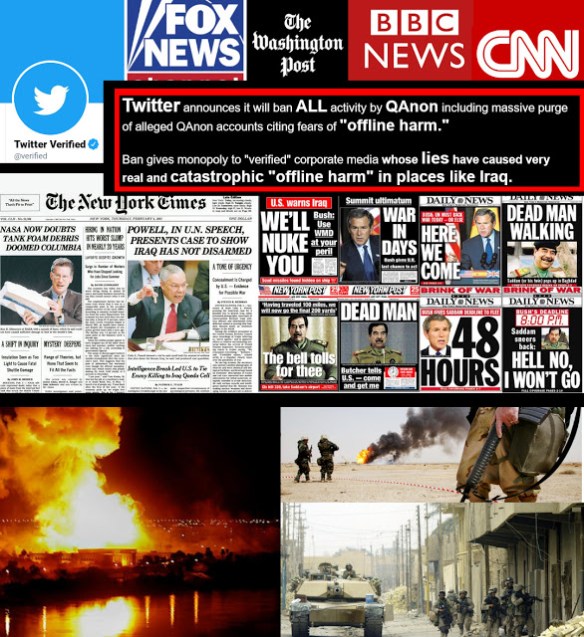
Twitter QAnon Purge Gives Bigger Monopoly to Corporate Media

By Tony Cartalucci

Source: Land Destroyer

News outlets like CNN reported on Twitter’s move to purge the QAnon movement from its platform.

Articles like, “Twitter cracks down on QAnon accounts,” would claim Twitter fears QAnon’s rhetoric online could eventually lead to “offline harm.”

There is no doubt that QAnon has been behind absurd conspiracy theories and verified lies circulating online – suspiciously absurd. Banning it from Twitter because of alleged fears its activity will lead to “offline harm” is even more absurd .
Despite making absurd claims that demonstrably never materialize or providing evidence that is later revealed to be clearly fabricated, nothing QAnon has done differs from what the corporate media does on a daily basis. In many ways they are one in the same – dividing and distracting the public while US special interests advance their agenda unnoticed and unopposed.
QAnon allegedly made false claims that Hillary Clinton’s arrest was imminent – she was never arrested. Conversely, the corporate media regularly claims that various world leaders in nations targeted by Western regime change have “fled,” are “dead,” or otherwise “ousted from power” – with lies spread by the Western media over the alleged “fates” of still incumbent leaders like Syrian President Bashar Al-Assad, Venezuela’s President Nicolás Maduro, and North Korean leader Kim Jong-un coming to immediate mind.
The Western corporate media also helps sell various wars of aggression.

This includes the US invasion of Afghanistan in 2001, the US invasion of Iraq in 2003, US interventions in Libya and Syria from 2011 onward and US-backed regime change in Ukraine in 2013-2014.

Collectively these conflicts have killed over a million people and driven millions more from their homes. This “offline harm” – the direct result of lies told by the Western corporate media – has not only gone completely unaddressed by Twitter – it is enabled by Twitter.
Twitter – along with other US tech giants like Facebook and Google – aided the US government in sowing chaos across North Africa and the Middle East in 2011, precipitating wars that are still raging today, claiming lives, and effecting “offline harm” impacting millions of people.
The banning of the more absurd QAnon movement will pave the way for other purges – eventually eliminating any alternative to the corporate media and its demonstrably dangerous and dishonest narratives. QAnon’s absurdity will make it easy for Twitter to justify its ban, but the momentum toward greater censorship across Western social media will eventually impact accounts and movements previously difficult to justify banning.
US-based “social media” platforms – Twitter, Facebook, YouTube, etc. – are no longer truly social media. They are clearly transforming into centralized programed media where corporate monopolies create content that is consumed, removing the public, independent organizations, and competitors’ role in creating content, contributing to discussions, offering alternative views, and interacting with one another.
It is important that this fact be fully recognized and exposed as well as the creation of alternative platforms – especially overseas where US-based “social media” has been fully weaponized and used to undermine sociopolitical and economic stability.

Having Sucked America Dry, Tech Giants Seek New Markets Beyond Reach of US Antitrust Laws

Sept. 27, 2015 Facebook CEO Mark Zuckerberg hugs Prime Minister of India Narendra Modi at Facebook in Menlo Park, Calif. (AP Photo/Jeff Chiu, File)

An aggressive push to consolidate companies in the tech sector, coupled with the world’s ever-increasing dependence on digital platforms and tools, is quickly leading to a crisis of sovereignty.

By Raul Diego

Source: MintPress News

The American consumer market for big tech gadgets appears to have reached the point of saturation as the novelty of mobile devices and laptops plateau and the persistent lockdown sees savings dwindle and discretionary spending disappear. Apple, which has enjoyed reigning over the smartphone market for more than a decade, has been forced to drop its prices over the last year as a result of a market at full capacity.

Nevertheless, one of the world’s most liquid companies, along with other tech giants like Facebook and Google – whose parent company, Alphabet, Inc. recently overtook Apple as the most cash-rich company in the world – are taking full advantage of their position to gobble up startups in emerging sectors in the Artificial Intelligence (AI) space like Natural Language Processing (NLP), Machine Learning (ML) and Deep Learning (DL), in order to solidify their place in other, mostly untapped markets in developing nations.

Big tech’s insatiable appetite, as manifested in this current sprint to further consolidate their assets, is bound to give them even more control over their already substantial access to our data and other digital activities of the population at large.  Earlier this year, then Presidential candidate Elizabeth Warren led the call to “Break Them Up,” in reference to the big tech companies, declaring that they had “bulldozed competition, used our private information for profit, and tilted the playing field against everyone else. And in the process, they have hurt small businesses and stifled innovation.” Her plan to “level the playing field,” however, seems to have gone away with her fleeting candidacy.

Nonetheless, they are all gearing up to face an election-year challenge to their growing power as a year-long House Judiciary subcommittee investigation is set to conclude and will more than likely provide plenty of fodder for the antitrust battles looming on the horizon. Some analysts have speculated that the U.S. government could impose fines on companies like Google in the tens of billions for past violations. But, whether or not this Congress implements measures with any real teeth remains to be seen.

Captive market shares

American tech giants are turning their focus to south-east Asia as their original markets in the U.S. can no longer support most of their quarterly profit projections. Apple’s recent acquisition of Seattle-based Xnor.ai, which specializes in “low-power, edge-based artificial intelligence tools” that will help them develop low-cost hardware for things like security cameras using artificial visual intelligence.

The Xnor.ai acquisition is just one of several made by Apple this year. Others include an Irish AI platform called Voysis that enables voice interactions with digital retailers; NextVR, a virtual reality headset company that holds over 40 patents in that space and will help Apple carve out a niche in the burgeoning world of streaming music and sporting events.

Google, which already has a virtual monopoly over Internet search capabilities and related tools, is aggressively pursuing startups in the cloud computing space, healthcare, and advertising market. A salient example is the ongoing $2.1 Billion-dollar acquisition of Fitbit, which has reportedly entered its final stages but has raised calls in some quarters for U.S. antitrust regulators to take a closer look.

The bank of Zuckerberg

Meanwhile, Facebook is continuing its incursion into the virtual entertainment arena with the purchase of Sanzaru Games in February as the social media giant solidifies its VR stake by taking over both hardware and software sides of that emerging market. Zuckerberg has also added to his social media empire with plans to acquire animated gif search engine Giphy for $400 Million, extending his consolidation over two of the most popular social media and communication platforms in its portfolio: Instagram and WhatsApp.

Facebook’s recent $5.7 Billion-dollar investment in India’s Jio Platforms also reveals how the tech giant is betting on Asia for its future growth. Facebook claims that Jio has “brought more than 388 million people online” and is poised to leverage its ubiquitous presence in the country through WhatsApp, boasting that the chat/call app has become a “commonly used verb across many Indian languages and dialects.”

The Indian telecom, led by that nation’s richest man, also includes a recently launched e-commerce site called JioMart, that further opens the door for Facebook’s digital payments platform and has the very real potential to put the social media company in a new class as a payment processing giant, shaking up the status quo in a space largely controlled by the banking sector.

Breaking out of the virtual gold cage

Having sucked the American market dry, these colossal corporations continue their unfettered growth and are increasingly beyond the reach of national anti-monopoly laws. Their aggressive push to consolidate across sectors in the technology space, coupled with the world’s ever-increasing dependence on digital platforms and tools is quickly leading us into a crisis of sovereignty.

If three companies own or have a stake in virtually all of the apps, gadgets and software that are ultimately responsible for collecting out data, performing our transactions and providing the content we consume, we will effectively become prisoners of these same corporations.

Even if Google were to re-instate the infamous “don’t be evil” motto in its code of conduct, such a state of affairs would render that promise moot. The slew of acquisitions by the world’s top tech companies in the midst of an economic depression for the rest of us does not bode well for a future of greater self-determination as the wealth and knowledge gaps grow larger.

Efforts to bridge these gaps are being undertaken by people like Dion Devow in Australia, an entrepreneur who is on a mission to close the gap between Indigenous Australians and IT. But, how effective can such efforts really be in the long run if the technological infrastructure continues to accumulate in the hands of so very few?

Facebook using “fact-checkers” to censor dissent on Covid19

Familiar tactics of obfuscation and weasel-words deployed to block access to articles

By Off-Guardian.org

Facebook has flagged our article “It’s all bullshit”: 3 links sinking the Covid narrative” as ‘false information’, based on nothing but a single ‘fact check’ website, which does not even claim the information is ‘false’, but merely quibbles over terminologies to justify claiming the information is ‘misleading.’

This is what you see today if you try to access that article on Facebook:

And if you click on the ‘see why’ button you get taken here, to the website of Health Feedback, an “independent fact-checker”.

Of course, they’re not independent – they’re actually funded by Facebook. They are also funded by the “Credibility Coalition”, an NGO focused on “common standards for information credibility”.

The Credibility Coalition are also funded by Facebook. And twitter. And google. And a whole host of unsavoury sounding NGOs.

So, with the idea that “health feedback” are anywhere close to “independent” firmly debunked, let’s see what they have to say.

Firstly, it’s important to note what is actually being “fact-checked” here.

It is not that the three documents were leaked. It is not the accuracy of the quotes used. It is not the statistics cited. In fact, not a single factual claim is being called “false”.

In short, Facebook is well aware that 90% of the article is perfectly provably true.

In fact, it’s not our article they’re allegedly fact-checking, it’s another article in the publication NewsPunch, which relies on one of the same sources we do.

The “fact-check” is entirely devoted to just one of three leaks we describe – the report from German Interior Ministry employee – and even then focuses solely on its provenance rather than its content. In essence, what is being “fact-checked” is not the report itself, but where it came from.

Nowhere in this ‘rebuttal’ does it claim the ‘German Ministry employee’ was lying or making provably false statements. Neither does it challenge the credentials, competence or honesty of the “independent scientists” who co-authored the report.

Instead, it uses diversionary language claiming the document’s main author, Stephan Kohn, was simply sharing his “private opinion” and was not authorised to speak for the government.

The author of the document is Stephan Kohn, a politologist and employee of Germany’s Interior Ministry in the KM 4 department for the Protection of Critical Infrastructures. However, Kohn’s analysis was not requested by the Interior Ministry, as the article claims. On 10 May, Germany’s Interior Ministry issued a press release stating that the employee had disseminated his “private opinion on the corona crisis management” and that the “elaboration was carried out outside the area of responsibility as well as without assignment and authorization”.

This approach should be hauntingly familiar to anyone who has been following the OPCW whistleblower story. Where expert witnesses contradicting the official narrative on Douma were claimed to merely be “disgruntled ex-employees” who were in Syria of their own accord and “never part of the fact-finding mission”.

All these claims have since been shown to be lies.

In addition to these irrelevant obfuscations, the article uses weasel words to construct a flimsy counter-argument:

According to EuroMOMO, the number of excess deaths coinciding with the COVID-19 pandemic was twice the number that occurred during the unusually deadly flu seasons of 2017, 2018, and 2019 (Figure 1).

Note that they only back three years in time, and not all the way to 2000 or 1998, both of which had very similar excess death numbers.

Note also they say “coinciding with”, and not “caused by”. This allows them to cite all the excess deaths in Europe, despite statistics showing that huge numbers of the excess deaths were due to other causes – including the lockdown limiting access to healthcare and increasing poverty.

They are using excess deaths caused by the lockdown, to argue against the accuracy of a report warning that the lockdown will cause excess deaths.

It is going full Orwell. And it is utterly disgusting.

This article simply does not offer any justification for dismissing our article reporting Kohn’s words as ‘false information’. The information is NOT demonstrably false, it is merely contentious, in that the data is open to multiple interpretations.

In fact, the article admits that itself – only able to label the claim as “misleading” or “unsupported”. Nowhere do they use the word “disinformation” or “misinformation” or “false information”. Not once.

And yet that is the label facebook has stuck on it.

Facebook is not suppressing this article because it contains false information at all, it is censoring it because it offers an interpretation of facts that does not support the current mainstream dogma.

This is censorship, pure and simple.

Technofascism: Digital Book Burning in a Totalitarian Age

By John W. Whitehead

Source: The Rutherford Institute

“Those who created this country chose freedom. With all of its dangers. And do you know the riskiest part of that choice they made? They actually believed that we could be trusted to make up our own minds in the whirl of differing ideas. That we could be trusted to remain free, even when there were very, very seductive voices—taking advantage of our freedom of speech—who were trying to turn this country into the kind of place where the government could tell you what you can and cannot do.”—Nat Hentoff

We are fast becoming a nation—nay, a world—of book burners.

While on paper, we are technically free to speak—at least according to the U.S. Constitution—in reality, however, we are only as free to speak as the government and its corporate partners such as Facebook, Google or YouTube may allow.

That’s not a whole lot of freedom. Especially if you’re inclined to voice opinions that may be construed as conspiratorial or dangerous.

Take David Icke, for example.

Icke, a popular commentator and author often labeled a conspiracy theorist by his detractors, recently had his Facebook page and YouTube channel (owned by Google) deleted for violating site policies by “spreading coronavirus disinformation.”

The Centre for Countering Digital Hate, which has been vocal about calling for Icke’s de-platforming, is also pushing for the removal of all other sites and individuals who promote Icke’s content in an effort to supposedly “save lives.”

Translation: the CCDH evidently believes the public is too dumb to think for itself and must be protected from dangerous ideas.

This is the goosestepping Nanny State trying to protect us from ourselves.

In the long run, this “safety” control (the censorship and shadowbanning of anyone who challenges a mainstream narrative) will be far worse than merely allowing people to think for themselves.

Journalist Matt Taibbi gets its: “The people who want to add a censorship regime to a health crisis are more dangerous and more stupid by leaps and bounds than a president who tells people to inject disinfectant.”

Don’t fall for the propaganda.

These internet censors are not acting in our best interests to protect us from dangerous, disinformation campaigns about COVID-19, a virus whose source and behavior continue to elude medical officials. They’re laying the groundwork now, with Icke as an easy target, to preempt any “dangerous” ideas that might challenge the power elite’s stranglehold over our lives.

This is how freedom dies.

It doesn’t matter what disinformation Icke may or may not have been spreading about COVID-19. That’s not the issue.

As commentator Caitlin Johnstone recognizes, the censorship of David Icke by these internet media giants has nothing to do with Icke: “What matters is that we’re seeing a consistent and accelerating pattern of powerful plutocratic institutions collaborating with the US-centralized empire to control what ideas people around the world are permitted to share with each other, and it’s a very unsafe trajectory.”

Welcome to the age of technofascism.

Technofascism, clothed in tyrannical self-righteousness, is powered by technological behemoths (both corporate and governmental) working in tandem. As journalist Chet Bowers explains, “Technofascism’s level of efficiency and totalitarian potential can easily lead to repressive systems that will not tolerate dissent.”

The internet, hailed as a super-information highway, is increasingly becoming the police state’s secret weapon. This “policing of the mind: is exactly the danger author Jim Keith warned about when he predicted that “information and communication sources are gradually being linked together into a single computerized network, providing an opportunity for unheralded control of hat will be broadcast, what will be said, and ultimately what will be thought.”

It’s a slippery slope from censoring so-called illegitimate ideas to silencing truth.

Eventually, as George Orwell predicted, telling the truth will become a revolutionary act.

We’re almost at that point now.

What you are witnessing is the modern-day equivalent of book burning which involves doing away with dangerous ideas—legitimate or not—and the people who espouse them.

Today, the forces of political correctness, working in conjunction with corporate and government agencies, have managed to replace actual book burning with intellectual book burning.

Free speech for me but not for thee” is how my good friend and free speech purist Nat Hentoff used to sum up this double standard.

This is about much more than free speech, however. This is about repression and control.

With every passing day, we’re being moved further down the road towards a totalitarian society characterized by government censorship, violence, corruption, hypocrisy and intolerance, all packaged for our supposed benefit in the Orwellian doublespeak of national security, tolerance and so-called “government speech.”

The reasons for such censorship vary widely from political correctness, safety concerns and bullying to national security and hate crimes but the end result remains the same: the complete eradication of what Benjamin Franklin referred to as the “principal pillar of a free government.”

The upshot of all of this editing, parsing, banning and silencing is the emergence of a new language, what George Orwell referred to as Newspeak, which places the power to control language in the hands of the totalitarian state.

Under such a system, language becomes a weapon to change the way people think by changing the words they use.

The end result is control.

In totalitarian regimes—a.k.a. police states—where conformity and compliance are enforced at the end of a loaded gun, the government dictates what words can and cannot be used.

In countries where the police state hides behind a benevolent mask and disguises itself as tolerance, the citizens censor themselves, policing their words and thoughts to conform to the dictates of the mass mind lest they find themselves ostracized or placed under surveillance.

Even when the motives behind this rigidly calibrated reorientation of societal language appear well-intentioned—discouraging racism, condemning violence, denouncing discrimination and hatred—inevitably, the end result is the same: intolerance, indoctrination and infantilism.

It’s political correctness disguised as tolerance, civility and love, but what it really amounts to is the chilling of free speech and the demonizing of viewpoints that run counter to the cultural elite.

The police state could not ask for a better citizenry than one that carries out its own censorship, spying and policing: this is how you turn a nation of free people into extensions of the omniscient, omnipotent, omnipresent police state, and in the process turn a citizenry against each other.

Tread cautiously: Orwell’s 1984, which depicts the ominous rise of ubiquitous technology, fascism and totalitarianism, has become an operation manual for the omnipresent, modern-day surveillance state.

1984 portrays a global society of total control in which people are not allowed to have thoughts that in any way disagree with the corporate state. There is no personal freedom, and advanced technology has become the driving force behind a surveillance-driven society. Snitches and cameras are everywhere. People are subject to the Thought Police, who deal with anyone guilty of thought crimes. The government, or “Party,” is headed by Big Brother who appears on posters everywhere with the words: “Big Brother is watching you.”

We have arrived, way ahead of schedule, into the dystopian future dreamed up by not only Orwell but also such fiction writers as Aldous Huxley, Margaret Atwood and Philip K. Dick.

Much like Orwell’s Big Brother in 1984, the government and its corporate spies now watch our every move. Much like Huxley’s A Brave New World, we are churning out a society of watchers who “have their liberties taken away from them, but … rather enjoy it, because they [are] distracted from any desire to rebel by propaganda or brainwashing.” Much like Atwood’s The Handmaid’s Tale, the populace is now taught to “know their place and their duties, to understand that they have no real rights but will be protected up to a point if they conform, and to think so poorly of themselves that they will accept their assigned fate and not rebel or run away.”

And in keeping with Philip K. Dick’s darkly prophetic vision of a dystopian police state—which became the basis for Steven Spielberg’s futuristic thriller Minority Report—we are now trapped in a world in which the government is all-seeing, all-knowing and all-powerful, and if you dare to step out of line, dark-clad police SWAT teams and pre-crime units will crack a few skulls to bring the populace under control.

What once seemed futuristic no longer occupies the realm of science fiction.

Incredibly, as the various nascent technologies employed and shared by the government and corporations alike—facial recognition, iris scanners, massive databases, behavior prediction software, and so on—are incorporated into a complex, interwoven cyber network aimed at tracking our movements, predicting our thoughts and controlling our behavior, the dystopian visions of past writers is fast becoming our reality.

In fact, our world is characterized by widespread surveillance, behavior prediction technologies, data mining, fusion centers, driverless cars, voice-controlled homes, facial recognition systems, cybugs and drones, and predictive policing (pre-crime) aimed at capturing would-be criminals before they can do any damage. Surveillance cameras are everywhere. Government agents listen in on our telephone calls and read our emails. And privacy and bodily integrity have been utterly eviscerated.

We are increasingly ruled by multi-corporations wedded to the police state.

What many fail to realize is that the government is not operating alone. It cannot.

The government requires an accomplice.

Thus, the increasingly complex security needs of the massive federal government, especially in the areas of defense, surveillance and data management, have been met within the corporate sector, which has shown itself to be a powerful ally that both depends on and feeds the growth of governmental overreach.

In fact, Big Tech wedded to Big Government has become Big Brother, and we are now ruled by the Corporate Elite whose tentacles have spread worldwide.

The government now has at its disposal technological arsenals so sophisticated and invasive as to render any constitutional protections null and void. Spearheaded by the NSA, which has shown itself to care little to nothing for constitutional limits or privacy, the “security/industrial complex”—a marriage of government, military and corporate interests aimed at keeping Americans under constant surveillance—has come to dominate the government and our lives.

Money, power, control.

There is no shortage of motives fueling the convergence of mega-corporations and government. But who is paying the price?

“We the people,” of course. Not just we Americans, but people the world over.

We have entered into a global state of tyranny.

Where we stand now is at the juncture of OldSpeak (where words have meanings, and ideas can be dangerous) and Newspeak (where only that which is “safe” and “accepted” by the majority is permitted). The power elite has made their intentions clear: they will pursue and prosecute any and all words, thoughts and expressions that challenge their authority.

This is the final link in the police state chain.

Americans have been conditioned to accept routine incursions on their privacy rights. In fact, the addiction to screen devices—especially cell phones—has created a hive effect where the populace not only watched but is controlled by AI bots. However, at one time, the idea of a total surveillance state tracking one’s every move would have been abhorrent to most Americans. That all changed with the 9/11 attacks. As professor Jeffrey Rosen observes, “Before Sept. 11, the idea that Americans would voluntarily agree to live their lives under the gaze of a network of biometric surveillance cameras, peering at them in government buildings, shopping malls, subways and stadiums, would have seemed unthinkable, a dystopian fantasy of a society that had surrendered privacy and anonymity.”

Having been reduced to a cowering citizenry—mute in the face of elected officials who refuse to represent us, helpless in the face of police brutality, powerless in the face of militarized tactics and technology that treat us like enemy combatants on a battlefield, and naked in the face of government surveillance that sees and hears all—we have nowhere left to go.

We have, so to speak, gone from being a nation where privacy is king to one where nothing is safe from the prying eyes of government.

In search of so-called terrorists and extremists hiding amongst us—the proverbial “needle in a haystack,” as one official termed it—the Corporate State has taken to monitoring all aspects of our lives, from cell phone calls and emails to Internet activity and credit card transactions. This data is being fed through fusion centers across the country, which work with the Department of Homeland Security to make threat assessments on every citizen, including school children.

Wherever you go and whatever you do, you are now being watched, especially if you leave behind an electronic footprint.

When you use your cell phone, you leave a record of when the call was placed, who you called, how long it lasted and even where you were at the time. When you use your ATM card, you leave a record of where and when you used the card. There is even a video camera at most locations equipped with facial recognition software. When you use a cell phone or drive a car enabled with GPS, you can be tracked by satellite. Such information is shared with government agents, including local police. And all of this once-private information about your consumer habits, your whereabouts and your activities is now being fed to the U.S. government.

The government has nearly inexhaustible resources when it comes to tracking our movements, from electronic wiretapping devices, traffic cameras and biometrics to radio-frequency identification cards, satellites and Internet surveillance.

Speech recognition technology now makes it possible for the government to carry out massive eavesdropping by way of sophisticated computer systems. Phone calls can be monitored, the audio converted to text files and stored in computer databases indefinitely. And if any “threatening” words are detected—no matter how inane or silly—the record can be flagged and assigned to a government agent for further investigation. Federal and state governments, again working with private corporations, monitor your Internet content. Users are profiled and tracked in order to identify, target and even prosecute them.

In such a climate, everyone is a suspect. And you’re guilty until you can prove yourself innocent.

Here’s what a lot of people fail to understand, however: it’s not just what you say or do that is being monitored, but how you think that is being tracked and targeted.

We’ve already seen this play out on the state and federal level with hate crime legislation that cracks down on so-called “hateful” thoughts and expression, encourages self-censoring and reduces free debate on various subject matter.

Say hello to the new Thought Police.

Total Internet surveillance by the Corporate State, as omnipresent as God, is used by the government to predict and, more importantly, control the populace, and it’s not as far-fetched as you might think. For example, the NSA has designed an artificial intelligence system that can anticipate your every move. In a nutshell, the NSA feeds vast amounts of the information it collects to a computer system known as Aquaint (the acronym stands for Advanced QUestion Answering for INTelligence), which the computer then uses to detect patterns and predict behavior.

No information is sacred or spared.

Everything from cell phone recordings and logs, to emails, to text messages, to personal information posted on social networking sites, to credit card statements, to library circulation records, to credit card histories, etc., is collected by the NSA and shared freely with its agents.

Thus, what we are witnessing, in the so-called name of security and efficiency, is the creation of a new class system comprised of the watched (average Americans such as you and me) and the watchers (government bureaucrats, technicians and private corporations).

Clearly, the age of privacy is at an end.

So where does that leave us?

We now find ourselves in the unenviable position of being monitored, managed and controlled by our technology, which answers not to us but to our government and corporate rulers. This is the fact-is-stranger-than-fiction lesson that is being pounded into us on a daily basis.

It won’t be long before we find ourselves looking back on the past with longing, back to an age where we could speak to whom we wanted, buy what we wanted, think what we wanted without those thoughts, words and activities being tracked, processed and stored by corporate giants such as Google, sold to government agencies such as the NSA and CIA, and used against us by militarized police with their army of futuristic technologies.

To be an individual today, to not conform, to have even a shred of privacy, and to live beyond the reach of the government’s roaming eyes and technological spies, one must not only be a rebel but rebel.

Even when you rebel and take your stand, there is rarely a happy ending awaiting you. You are rendered an outlaw.

So how do you survive this global surveillance state?

As I make clear in my book Battlefield America: The War on the American People, we’re running out of options.

We’ll soon have to choose between self-indulgence (the bread-and-circus distractions offered up by the news media, politicians, sports conglomerates, entertainment industry, etc.) and self-preservation in the form of renewed vigilance about threats to our freedoms and active engagement in self-governance.

Yet as Aldous Huxley acknowledged in Brave New World Revisited: “Only the vigilant can maintain their liberties, and only those who are constantly and intelligently on the spot can hope to govern themselves effectively by democratic procedures. A society, most of whose members spend a great part of their time, not on the spot, not here and now and in their calculable future, but somewhere else, in the irrelevant other worlds of sport and soap opera, of mythology and metaphysical fantasy, will find it hard to resist the encroachments of those would manipulate and control it.”

Which brings me back to this technofascist tyranny being meted out on David Icke and all those like him who dare to voice ideas that diverge from what the government and its corporate controllers deem to be acceptable.

The problem as I see it is that we’ve allowed ourselves to be persuaded that we need someone else to think and speak for us. And we’ve allowed ourselves to become so timid in the face of offensive words and ideas that we’ve bought into the idea that we need the government to shield us from that which is ugly or upsetting or mean.

The result is a society in which we’ve stopped debating among ourselves, stopped thinking for ourselves, and stopped believing that we can fix our own problems and resolve our own differences.

In short, we have reduced ourselves to a largely silent, passive, polarized populace incapable of working through our own problems and reliant on the government to protect us from our fears.

In this way, we have become our worst enemy.

You want to reclaim some of the ground we’re fast losing to the techno-tyrants?

Start by thinking for yourself. If that means reading the “dangerous” ideas being floated out there by the David Ickes of the world—or the John Whiteheads for that matter—and then deciding for yourself what is true, so be it.

As Orwell concluded, “Freedom is the right to say two plus two make four.”

Why You Should Oppose The Censorship Of David Icke (Hint: It’s Got Nothing To Do With Icke)

By Caitlin Johnstone

Source: Waking Times

Within 48 hours both Facebook and then Youtube have deleted the accounts of David Icke for posting “content that disputes the existence and transmission of Covid-19 as described by the WHO and the NHS.” Other platforms may soon fall in suit, as they did with Alex Jones in 2018.

This article is not about David Icke. I will say it again in italics for the especially dense: this article is not about David Icke. This article is about why we shouldn’t be okay with monopolistic billionaire-owned Silicon Valley tech giants with extensive ties to US government agencies controlling human communication.

I know next to nothing about David Icke, and I have done exactly zero research into his views for this article; for all I know he’s every bit the raving lunatic the narrative managers say he is. It doesn’t matter. What matters is that we’re seeing a consistent and accelerating pattern of powerful plutocratic institutions collaborating with the US-centralized empire to control what ideas people around the world are permitted to share with each other, and it’s a very unsafe trajectory. Making this conversation about Icke and his views distracts from the very important topic we need to actually focus on discussing.

Journalist Matt Taibbi recently wrote an excellent essay about the dangers inherent in the increased demand we’ve been seeing for more censorship and deplatforming during the coronavirus pandemic, correctly arguing that more authoritarian control over the ideas people are allowed to discuss is vastly more dangerous than the ideas themselves.

“The people who want to add a censorship regime to a health crisis are more dangerous and more stupid by leaps and bounds than a president who tells people to inject disinfectant,” Taibbi writes. “It’s astonishing that they don’t see this.”

“Instead of asking calmly if hydroxychloroquine works, or if the less restrictive Swedish crisis response has merit, or questioning why certain statistical assumptions about the seriousness of the crisis might have been off, we’re denouncing the questions themselves as infamous,” says Taibbi.

Taibbi argues against the increasingly normalized trend of elevating “authoritative” content while silencing content which does not wear that magical label in an attempt to fight disinformation. If you examine which content is considered “authoritative”, you’ll find a bunch of outlets who have consistently lied to the world about war after war, who spent years promoting the baseless conspiracy theory that Vladimir Putin had infiltrated and secured control over the executive branch of the US government, who consistently normalize a status quo which is wholly incompatible with the surviving and thriving of life on this planet.

Google, who owns Youtube, has been financially intertwined with US intelligence agencies since its very inception when it received research grants from the CIA and NSA for mass surveillance. Facebook’s Mark Zuckerberg has called on the government to take “a more active role” in regulating “harmful content”, and has been actively collaborating with government agencies and government-funded think tanks to decide what content to remove. Social media executives are now routinely called before government hearings and lectured about the need to increase censorship under the implicit threat of antitrust cases being brought to bear. These massive corporations now consistently censor with an extreme bias against governments which refuse to bow to the demands of the US government and its allies.

In 2017, representatives of Facebook, Twitter, and Google were instructed on the US Senate floor that it is their responsibility to “quell information rebellions” and adopt a “mission statement” expressing their commitment to “prevent the fomenting of discord.”

“Civil wars don’t start with gunshots, they start with words,” the representatives were told. “America’s war with itself has already begun. We all must act now on the social media battlefield to quell information rebellions that can quickly lead to violent confrontations and easily transform us into the Divided States of America.”

Whenever anyone objects to censorship on these massive platforms they’re always told that those platforms are private companies who are free to do what they like on their private property, but how “private” is a corporation that is interlaced with government power with increasing inseparability? The reality is that in a corporatist system of government with vanishingly few meaningful distinctions between corporate power and state power, corporate censorship is state censorship.

Proponents of increased internet censorship have already openly conceded this point. A recent Atlantic article by two legal professors subtitled “In the debate over freedom versus control of the global network, China was largely correct, and the U.S. was wrong”, the case is made that western internet censorship will necessarily involve a collaboration with “private” corporations and government power.

“As surprising as it may sound, digital surveillance and speech control in the United States already show many similarities to what one finds in authoritarian states such as China,” the article’s authors favorably argue. “Constitutional and cultural differences mean that the private sector, rather than the federal and state governments, currently takes the lead in these practices, which further values and address threats different from those in China. But the trend toward greater surveillance and speech control here, and toward the growing involvement of government, is undeniable and likely inexorable.”

Apart from the fact that they are here claiming that increasingly authoritarian speech control is good and necessary, these two bootlickers are absolutely correct. Human communication is indeed being controlled using the so-called “private sector” to circumvent constitutional limitations which prohibit the government from censoring speech directly.

These Silicon Valley tech corporations have ensured their continued monopolistic dominance by demonstrating their willingness to collaborate with establishment power structures, so there are no platforms of anywhere near the same size and influence that people can move to if they don’t feel like letting government-tied plutocrats police what thoughts are permitted to enter into their minds. This has given this corporate-government alliance the ability to control the thoughts that people are allowed to share, discuss and think about in the same way totalitarian governments can, with the false mask of freedom plastered over it.

A truly free being does not need an alliance of plutocrats and government agencies to protect their mind from David Icke. A truly free being does not want an alliance of plutocrats and government agencies to exert any control whatsoever over what ideas they are permitted to share and what thoughts they are permitted to think. A truly free being opposes with all their might any attempt to lock in a paradigm where human communication (and thereby thought) is controlled by vast unaccountable power structures which benefit from the absence of dissent.

Be a truly free being. Oppose this intrusion into your mental sovereignty.

Slouching towards dystopia: the rise of surveillance capitalism and the death of privacy

Our lives and behaviour have been turned into profit for the Big Tech giants – and we meekly click “Accept”. How did we sleepwalk into a world without privacy?

By John Naughton

Source: New Statesman

Suppose you walk into a shop and the guard at the entrance records your name. Cameras on the ceiling track your every step in the store, log which items you looked at and which ones you ignored. After a while you notice that an employee is following you around, recording on a clipboard how much time you spend in each aisle. And after you’ve chosen an item and bring it to the cashier, she won’t complete the transaction until you reveal your identity, even if you’re paying cash.

Another scenario: a stranger is standing at the garden gate outside your house. You don’t know him or why he’s there. He could be a plain-clothes police officer, but there’s no way of knowing. He’s there 24/7 and behaves like a real busybody. He stops everybody who visits you and checks their identity. This includes taking their mobile phone and copying all its data on to a device he carries. He does the same for family members as they come and go. When the postman arrives, this stranger insists on opening your mail, or at any rate on noting down the names and addresses of your correspondents. He logs when you get up, how long it takes you to get dressed, when you have meals, when you leave for work and arrive at the office, when you get home and when you go to bed, as well as what you read. He is able to record all of your phone calls, texts, emails and the phone numbers of those with whom you exchange WhatsApp messages. And when you ask him what he thinks he’s doing, he just stares at you. If pressed, he says that if you have nothing to hide then you have nothing to fear. If really pressed, he may say that everything he does is for the protection of everyone.

A third scenario: you’re walking down the street when you’re accosted by a cheery, friendly guy. He runs a free photo-framing service – you just let him copy the images on your smartphone and he will tidy them up, frame them beautifully and put them into a gallery so that your friends and family can always see and admire them. And all for nothing! All you have to do is to agree to a simple contract. It’s 40 pages but it’s just typical legal boilerplate – the stuff that turns lawyers on. You can have a copy if you want. You make a quick scan of the contract. It says that of course you own your photographs but that, in exchange for the wonderful free framing service, you grant the chap “a non-exclusive, transferable, sub-licensable, royalty-free and worldwide licence to host, use, distribute, modify, copy, publicly perform or display, translate and create derivative works” of your photos. Oh, and also he can change, suspend, or discontinue the framing service at any time without notice, and may amend any of the agreement’s terms at his sole discretion by posting the revised terms on his website. Your continued use of the framing service after the effective date of the revised agreement constitutes your acceptance of its terms. And because you’re in a hurry and you need some pictures framed by this afternoon for your daughter’s birthday party, you sign on the dotted line.

All of these scenarios are conceivable in what we call real life. It doesn’t take a nanosecond’s reflection to conclude that if you found yourself in one of them you would deem it preposterous and intolerable. And yet they are all simple, if laboured, articulations of everyday occurrences in cyberspace. They describe accommodations that in real life would be totally unacceptable, but which in our digital lives we tolerate meekly and often without reflection.

The question is: how did we get here?

***

It’s a long story, but with hindsight the outlines are becoming clear. Technology comes into it, of course – but plays a smaller part than you might think. It’s more a story about human nature, about how capitalism has mutated to exploit digital technology, about the liberal democratic state and the social contract, and about governments that have been asleep at the wheel for several decades.

To start with the tech: digital is different from earlier general-purpose technologies in a number of significant ways. It has zero marginal costs, which means that once you have made the investment to create something it costs almost nothing to replicate it a billion times. It is subject to very powerful network effects – which mean that if your product becomes sufficiently popular then it becomes, effectively, impregnable. The original design axioms of the internet – no central ownership or control, and indifference to what it was used for so long as users conformed to its technical protocols – created an environment for what became known as “permissionless innovation”. And because every networked device had to be identified and logged, it was also a giant surveillance machine.

Since we humans are social animals, and the internet is a communications network, it is not surprising we adopted it so quickly once services such as email and web browsers had made it accessible to non-techies. But because providing those services involved expense – on servers, bandwidth, tech support, etc – people had to pay for them. (It may seem incredible now, but once upon a time having an email account cost money.) Then newspaper and magazine publishers began putting content on to web servers that could be freely accessed, and in 1996 Hotmail was launched (symbolically, on 4 July, Independence Day) – meaning that anyone could have email for free.

Hotmail quickly became ubiquitous. It became clear that if a business wanted to gain those powerful network effects, it had to Get Big Fast; and the best way to do that was to offer services that were free to use. The only thing that remained was finding a business model that could finance services growing at exponential rates and provide a decent return for investors.

That problem was still unsolved when Google launched its search engine in 1998. Usage of it grew exponentially because it was manifestly better than its competitors. One reason for its superiority was that it monitored very closely what users searched for and used this information to improve the algorithm. So the more that people used the engine, the better it got. But when the dot-com bubble burst in 2000, Google was still burning rather than making money and its two biggest venture capital investors, John Doerr of Kleiner Perkins and Michael Moritz of Sequoia Capital, started to lean on its founders, Larry Page and Sergey Brin, to find a business model.

Under that pressure they came up with one in 2001. They realised that the data created by their users’ searches could be used as raw material for algorithms that made informed guesses about what users might be interested in – predictions that could be useful to advertisers. In this way what was thought of as mere “data exhaust” became valuable “behavioural surplus” – information given by users that could be sold. Between that epiphany and Google’s initial public offering in 2004, the company’s revenues increased by over 3,000 per cent.

Thus was born a new business model that the American scholar Shoshana Zuboff later christened “surveillance capitalism”, which she defined as: “a new economic order that claims human experience as the raw material for hidden commercial practices of extraction, prediction and sales”. Having originated at Google, it was then conveyed to Facebook in 2008 when a senior Google executive, Sheryl Sandberg, joined the social media giant. So Sandberg became, as Zuboff puts it, the “Typhoid Mary” who helped disseminate surveillance capitalism.

***

The dynamic interactions between human nature and this toxic business model lie at the heart of what has happened with social media. The key commodity is data derived from close surveillance of everything that users do when they use these companies’ services. Therefore, the overwhelming priority for the algorithms that curate users’ social media feeds is to maximise “user engagement” – the time spent on them – and it turns out that misinformation, trolling, lies, hate-speech, extremism and other triggers of outrage seem to achieve that goal better than more innocuous stuff. Another engagement maximiser is clickbait – headlines that intrigue but leave out a key piece of information. (“She lied all her life. Guess what happened the one time she told the truth!”) In that sense, social media and many smartphone apps are essentially fuelled by dopamine – the chemical that ferries information between neurons in our brains, and is released when we do things that give us pleasure and satisfaction.

The bottom line is this: while social media users are essential for surveillance capitalism, they are not its paying customers: that role is reserved for advertisers. So the relationship of platform to user is essentially manipulative: he or she has to be encouraged to produce as much behavioural surplus as possible.

A key indicator of this asymmetry is the End User Licence Agreement (EULA) that users are required to accept before they can access the service. Most of these “contracts” consist of three coats of prime legal verbiage that no normal human being can understand, and so nobody reads them. To illustrate the point, in June 2014 the security firm F-Secure set up a free WiFi hotspot in the centre of London’s financial district. Buried in the EULA for this “free” service was a “Herod clause”: in exchange for the WiFi, “the recipient agreed to assign their first born child to us for the duration of eternity”. Six people accepted the terms.  In another experiment, a software firm put an offer of an award of $1,000 at the very end of its terms of service, just to see how many would read that far. Four months and 3,000 downloads later, just one person had claimed the offered sum.

Despite this, our legal systems accept the fact that most internet users click  “Accept” as confirmation of informed consent, which it clearly is not. It’s really passive acceptance of impotence. Such asymmetric contracts would be laughed out of court in real life but are still apparently sacrosanct in cyberspace.

According to the security guru Bruce Schneier of Harvard, “Surveillance is the business model of the internet.” But it’s also a central concern of modern states. When Edward Snowden broke cover in the summer of 2013 with his revelations of the extensiveness and scale of the surveillance capabilities and activities of the US and some other Western countries, the first question that came to mind was: is this a scandal or a crisis? Scandals happen all the time in democracies; they generate a great deal of heat and controversy, but after a while the media caravan moves on and nothing happens. Crises, on the other hand, do lead to substantive reform.

Snowden revealed that the US and its allies had been engaged in mass surveillance under inadequate democratic oversight. His disclosures provoked apparent soul-searching and anger in many Western democracies, but the degree of public concern varied from country to country. It was high in Germany, perhaps because so many Germans have recent memories of Stasi surveillance. In contrast, public opinion in Britain seemed relatively relaxed: opinion surveys at the time suggested that about two-thirds of the British public had confidence in the security services and were thus unruffled by Snowden. Nevertheless, there were three major inquiries into the revelations in the UK, and, ultimately, a new act of parliament – the Investigatory Powers Act 2016. This overhauled and in some ways strengthened judicial oversight of surveillance activities by the security services; but it also gave those services significant new powers  – for example in “equipment interference”  (legal cover to hack into targeted devices such as smartphones, domestic networks and “smart” devices such as thermostats). So, in the end, the impact of the Snowden revelations was that manifestly inadequate oversight provisions were replaced by slightly less inadequate ones. It was a scandal, not a crisis. Western states are still in the surveillance business; and their populations still seem comfortable with this.

There’s currently some concern about facial recognition, a genuinely intrusive surveillance technology. Machine-learning technology has become reasonably good at recognising faces in public places, and many state agencies and private companies are already deploying it. It means that people are being identified and tracked without their knowledge or consent. Protests against facial recognition are well-intentioned, but, as Harvard’s Bruce Schneier points out, banning it is the wrong way to oppose modern surveillance.

This is because facial recognition is just one identification tool among many enabled by digital technology. “People can be identified at a distance by their heartbeat or by their gait, using a laser-based system,” says Schneier. “Cameras are so good that they can read fingerprints and iris patterns from metres away. And even without any of these technologies, we can always be identified because our smartphones broadcast unique numbers called MAC addresses. Other things identify us as well: our phone numbers, our credit card numbers, the licence plates on our cars. China, for example, uses multiple identification technologies to support its surveillance state.”

The important point is that surveillance and our passive acceptance of it lies at the heart of the dystopia we are busily constructing. It doesn’t matter which technology is used to identify people: what matters is that we can be identified, and then correlated and tracked across everything we do. Mass surveillance is increasingly the norm. In countries such as China, a surveillance infrastructure is being built by the government for social control. In Western countries, led by the US, it’s being built by corporations in order to influence our buying behaviour, and is then used incidentally by governments.

What’s happened in the West, largely unnoticed by the citizenry, is a sea-change in the social contract between individuals and the state. Whereas once the deal was that we accepted some limitations on our freedom in exchange for security, now the state requires us to surrender most of our privacy in order to protect us. The (implicit and explicit) argument is that if we have nothing to hide there is nothing to fear. And people seem to accept that ludicrous trope. We have been slouching towards dystopia.

***

The most eerie thing about the last two decades is the quiescence with which people have accepted – and adapted to – revolutionary changes in their information environment and lives. We have seen half-educated tech titans proclaim mottos such as “Move fast and break things” – as Mark Zuckerberg did in the early years of Facebook – and then refuse to acknowledge responsibility when one of the things they may have helped to break is democracy.  (This is the same democracy, incidentally, that enforces the laws that protect their intellectual property, helped fund the technology that has enabled their fortunes and gives them immunity for the destructive nonsense that is disseminated by their platforms.) And we allow them to get away with it.

What can explain such indolent passivity? One obvious reason is that we really (and understandably) value some of the services that the tech industry has provided. There have been various attempts to attach a monetary value to them, but any conversation with a family that’s spread over different countries or continents is enough to convince one that being able to Skype or FaceTime a faraway loved one is a real boon. Or just think of the way that Google has become a memory prosthesis for humanity – or how educational non-profit organisations such as the Khan Academy can disseminate learning for free online.

We would really miss these services if they were one day to disappear, and this may be one reason why many politicians tip-toe round tech companies’ monopoly power. That the services are free at the point of use has undermined anti-trust thinking for decades: how do you prosecute a  monopoly that is not price-gouging its users? (The answer, in the case of social media, is that users are not customers;  the monopoly may well be extorting its actual customers – advertisers – but nobody seems to have inquired too deeply into that until recently.)

Another possible explanation is what one might call imaginative failure – most people simply cannot imagine the nature of the surveillance society that we are constructing, or the implications it might have for them and their grandchildren. There are only two cures for this failure: one is an existential crisis that brings home to people the catastrophic damage that technology could wreak. Imagine, for example, a more deadly strain of the coronavirus that rapidly causes a pandemic – but governments struggle to control it because official edicts are drowned out by malicious disinformation on social media. Would that make people think again about the legal immunity that social media companies enjoy from prosecution for content that they host on their servers?

The other antidote to imaginative failure is artistic creativity. It’s no accident that two of the most influential books of the last century were novels – Orwell’s Nineteen Eighty-Four (1949) and Aldous Huxley’s Brave New World (1932). The first imagined a world in which humans were controlled by fear engendered by comprehensive surveillance; the second portrayed one in which citizens were undone by addiction to pleasure – the dopamine strategy, if you like. The irony of digital technology is that it has given us both of these nightmares at once.

Whatever the explanation, everywhere at the moment one notices a feeling of impotence – a kind of learned helplessness. This is seen most vividly in the way people shrug their shoulders and click “Accept” on grotesquely skewed and manipulative  EULAs. They face a binary choice: accept the terms or go away. Hence what has become known as the “privacy paradox” – whenever researchers and opinion pollsters ask internet users if they value their privacy, they invariably respond with a  resounding “yes”. And yet they continue to use the services that undermine that beloved privacy.

It hasn’t helped that internet users have watched their governments do nothing about tech power for two decades. Surveillance capitalism was enabled because its practitioners operated in a lawless environment. It appropriated people’s data as a free resource and asserted its right to do so, much as previous variations of capitalism appropriated natural resources without legal restrictions. And now the industry claims as one of its prime proprietary assets the huge troves of that appropriated data that it possesses.

It is also relevant that tech companies have been free to acquire start-ups that threatened to become competitors without much, if any, scrutiny from competition authorities. In any rational universe, Google would not be permitted to own YouTube, and Facebook would have to divest itself of WhatsApp and Instagram. It’s even possible – as the French journalist  Frédéric Filloux has recently argued – that  Facebook believes its corporate interests are best served by the re-election of Donald Trump, which is why it’s not going to fact-check any political ads. As far as I can see, this state of affairs has not aroused even a squawk in the US.

When Benjamin Franklin emerged on the final day of deliberation from the Constitutional Convention of 1787, a woman asked him, “Well Doctor, what have we got, a republic or a monarchy?” To which Franklin replied, “A republic… if you can keep it.” The equivalent reply for our tech-dominated society would be: we have a democracy, if we can keep it.


Freedom Rider: The Internet Does Washington’s Dirty Work

By Margaret Kimberly

Source: Black Agenda Report

As long as the internet is in private hands it should be seen as a “frenemy” — a useful resource that can also be wielded as a weapon.

“Black people are routinely sent to “facebook jail” if their words anger racist white people.”

In its early days the internet seemed to be an undisputed good, a means of communication open to all. It was hoped that these new platforms would level the playing field and give smaller outlets like Black Agenda Report access to a worldwide audience. The internet has done that but it is also a weapon that is used against the left in this country and against nations and movements declared enemies by this government.

In the rush of enthusiasm one important fact was forgotten. The internet is in the hands of private corporations. They decide who gets service, where they get it and at what speed. The growth of social media only exacerbated the problems of corporate control.

This columnist uses Facebook and Twitter and other platforms by necessity. They are sources of information and important means of communication. But they are controlled by powerful corporate entities who work hand in hand with the government. Ultimately they decide who can be seen and who cannot.

“Private corporations decide who gets service, where they get it and at what speed.”

When the U.S. government speaks, Facebook and Twitter listen and then do as they are told. When foreign governments are declared adversaries their representatives and advocates are censored. In the past year, the Syrian government and the Venezuelan government have been temporarily blocked on Twitter. Sites such as Telesur have been repeatedly removed from Facebook. Numerous Palestinian advocacy sites have been removed from Facebook at the behest of the Israeli government.

Facebook decides if “community standards” have been violated and restrict anyone who violates their opaque rules. Black people are routinely sent to “facebook jail” if their words anger racist white people.

But the loss of access is not the biggest problem. When the United States government killed Iranian general Qassem Soleimani they also wanted to kill off his memory. Facebook posts which spoke of him in any favorable light were removed. Facebook isn’t alone in joining the governmental directive. The Iranian English language service, Presstv, was removed from Youtube, which is owned by Google. Years of reporting and interviews, including some given by this columnist, disappeared into the black hole of cyberspace. When the U.S. began ratcheting up its maximum pressure, the corporate sector went right along and Presstv was sent down the memory hole.

“Presstv was removed from Youtube, which is owned by Google.”

Censorship has gotten worse because of liberals, not conservatives, and they have used the Russiagate fraud to accelerate the deplatforming process. Immediately after the 2016 election we were told that the Russian government was responsible for Trump’s victory and that censorship was the only thing standing between us and living under the control of Vladimir Putin.

The infamous Proporornot  list declared that Black Agenda Report and other sites were under Russian influence. Ever since that list was published in late 2016 many left sites lost visibility on Google and other search engines.

Now Trump administration sanctions are impacting our ability to communicate in a variety of ways. Not only were references to Soleimani removed, but the use of the word “Iran” can result in censorship and the inability to complete financial transactions. The Grayzone project  reported that Paypal restricted donations from anyone who mentioned the word Iran.

It must be repeated that Trump has plenty of help from Democrats and liberals in this regard. Pleas for Facebook “fact checking” will result in more censorship of black people and of anyone who happens to voice opinions that run counter to the imperialist narrative.

“The use of the word “Iran” can result in censorship.”

Already Russia is being blamed for election interference, yet Russia is not the target. The left is the target and Democrats are leading the charge. Their goal is to narrow discourse and to make war propaganda acceptable. It is an irony and a contradiction that while Trump is falsely accused of being under Russian influence, his policy goals are furthered with help from liberals. U.S. imperialism is a thoroughly bipartisan project.

This collusion between the wings of the duopoly must be kept in mind during the farcical impeachment. The Democrats could have added the war crime of the Soleimani assassination to their articles of impeachment. But they are complicit in this regard and will mention nothing of substance. Instead they have only one flimsy charge that is a cynical get out the vote effort and a source of anti-Russian propaganda.

As long as the internet is in private hands it should be seen as a “frenemy,” a useful resource that can also be wielded as a weapon. These platforms cannot be trusted unless or until they are publicly regulated. In the meantime, our reliance on them comes at a price.

New Cambridge Analytica Leaks Reveal Psychological Manipulation of Global Population

“We use the same techniques as Aristotle and Hitler. We appeal to people on an emotional level to get them to agree on a functional level.”

By Derrick Broze

Source: The Mind Unleashed

On New Year’s Day 2020, Twitter account @HindsightFiles began posting documents from data firm Cambridge Analytica (CA) which expose the extensive infrastructure used to manipulate voters on a global scale.

More than 100,000 documents are said to be released in the coming months, revealing Cambridge Analytica’s activity in a shocking 68 countries, including elections in Malaysia, Kenya, and Brazil. The Guardian reported that the documents come from Brittany Kaiser, a former employee of Cambridge Analytica who turned whistleblower and star of the documentary The Great Hack.

Kaiser told the Guardian:

“I’m very fearful about what is going to happen in the U.S. election later this year, and I think one of the few ways of protecting ourselves is to get as much information out there as possible.”

The latest CA whistleblower has said the dumps will contain previously unreleased emails, project plans, case studies, and negotiations. The HindsightFiles twitter account has posted data on the relationship between Cambridge Analytica and John Bolton, former National Security Adviser to the Trump administration. In 2013, the John Bolton Super PAC paid Cambridge Analytica $650,000 for voter data analysis and digital video ad targeting.

The documents provide more details on that relationship, including using psychographics to play on voters hopes and fears. Psychographics is a methodology which focuses on consumers psychological attributes. Research firms attempt to develop a psychographic profile on various segments of the population by studying personality, opinions, interests, attitudes, values, and behaviors.

Cambridge Analytica first made headlines following the 2016 Presidential election after it was revealed the company had gained access to 87 million Facebook profiles. Whistleblower Christopher Wylie exposed how he helped set up CA and obtain the data of millions of Americans. This is when the public began to understand the scope of Cambridge Analytica’s operations.

In 2015, the UK-based political consulting firm, worked on behalf of Ted Cruz’s campaign to help him win the 2016 Republican nomination. Cambridge Analytica was also involved in campaigns to promote Brexit, as well as promoting the 2016 Trump Presidential campaign. Donald Trump would eventually hire Steven Bannon as the chief strategist for his White House. Bannon previously served as CA’s vice president and was the executive chairman of Breitbart News.

It was through Bannon that whistleblower Christopher Wylie and CA CEO Alexander Nix came to know billionaire Robert Mercer. Bannon arranged for Mercer to invest five million dollars into the creation of Cambridge Analytica. Mercer wanted to work with the group to influence the U.S. elections. When the public became aware of the manipulation by CA, Bannon denied having any knowledge of the scheme. Wylie, however, said Cambridge Analytica was Bannon’s psychological warfare mindfuck.”

Cambridge Analyitca itself is a web of shadowy companies invested in behavioral researching and influencing mass behavior. Cambridge was born out of the Strategic Communications Laboratories (SCL), founded by Nigel Oakes and Alexander Nix. SCL claimed to have an expertise in Psychological Operations, and worked as part of military and political operations around the world. An article by the Register noted that SCL provided training to 15 (UK) Psychological Operations Group and had access to secret information.

The Great Hack documentary details how SCL started out as a military contractor called SCL Defense before shifting to using their data to influence elections. According to the New Yorker, SCL was born out of another organization created by Oakes, the Behavioral Dynamics Institute (BDI). Oakes told Marketing in a 1992 interview:

We use the same techniques as Aristotle and Hitler. We appeal to people on an emotional level to get them to agree on a functional level.”

Although Cambridge Analytica has officially shut down, company executives set up a new company in 2017 called Emerdata Limited.  It was also reported that SCL executives joined Emerdata, including Rebekah Mercer, daughter of billionaire Robert Mercer. The Mercer family have been consistent supporters of President Donald Trump.

The latest leaks from Cambridge Analytica seem poised to expose more lurid details of the inner workings of the disturbing relationship between big data and political operatives. Both the history of the company and its executives are a clear example of the growing trend of politicians seeking to use data gathered by social media companies to better understand and manipulate the minds of potential voters. Stay tuned to the Mind Unleashed for updates on this developing story.