27 Premises

Silent Assumptions to Drive Systemic Thinking

By J Circio

Source: Modern Mythology

When you derive a conclusion, how do you get there? As you gather facts and pieces of narratives and figure out the picture that the puzzle should be configured into, what assumptions are you making — do you need to make for the sake of expediency, if nothing else — to get there without spending the better part of a lifetime so you no longer require a shortcut?

These are intrinsically generalizations, since they seem to arise from experience such as — if you find blue seashells every time you go to a particular sea shore, you might derive that sea shells are often blue and so come to conclude that is a general rather than local effect.

The following list each contain a brief explanation, and then a few additional comments. More on this in the upcoming Newsletter! (December 2023)

Talk with a GPT instructed to follow these 27 Premises, aka Narrative Machine-139.

1. Simpler is not necessarily more correct; Complicated is not necessarily more correct.

This principle challenges the idea that the truth or correctness of an idea, theory, or system can be judged based on its simplicity or complexity alone. It’s a rebuttal to both any rigid application of Occam’s Razor, which suggests that simpler explanations are generally better, and to the assumption that more complex theories are inherently more sophisticated or accurate simply on account of their complexity.

“Correctness” is question and context dependent, not innate.

2. Simplicity often obscures inner complications… and the inverse is also often true.

This principle underscores the notion that both simplicity and complexity can be misleading in their own ways. A simple explanation might overlook critical nuances, while a complex one might overcomplicate what is fundamentally straightforward.

An important corollary is that looking at a problem with the mindset of optimal complexity, or optimal simplicity, each will bring out some dynamics and minimize or remove others. Ideally, both frames need to be considered, although not always equally weighted.

3. Anything true is likely propped up by unspoken falsehoods. The inverse is sometimes but not always true.

This suggests that truths are often supported by assumptions or beliefs that may not be accurate. It underscores the importance of scrutinizing the underlying assumptions of any ‘truth,’ as well as the extreme difficulty of actually doing so. The inverse — that falsehoods can support truths — is acknowledged as a less common but possible scenario.

Logical relationship is based on assumptions about likeness, mimesis, and consistency with specified rules. In generalized form, it is tautological. This was a major fin de siecle fixation (before WW1), and in many ways historically and culturally, the devastation of that particular apocalypse was a form of answer to the question, in terms of some of the potential outcomes of “applied reason.”

Of that which goes beyond such tautological relationships, to quote Wittgenstein, “we cannot speak.” As he would also later come to recognize, that includes a significant portion of life.

4. Everything is relatively dependent on context; everything is in some sense connected, but not equivalently.

Context is critical in understanding any concept, idea, or system, as the environment in which anything might come to be. This principle aligns with systems theory, where the meaning and function of a component can only be fully understood in relation to the whole system. It also touches on existentialist ideas about individual perception being shaped by one’s unique context, however the emphasis is on the distributed interconnections of systems that actually operate within the world.

Everything is relatively dependent/contingent, and the range of possibilities that exist within those overlapping contexts in a given place and time, which is another way of saying that everything is connected but not equivalent. Your mileage may vary based on the local neighborhood you’re living in, whether that means solar system or city block. The same is likely true regarding time.

5. Time has various senses, such as that which is measured versus that which allows for experience.

This principle integrates ideas from physics and phenomenology. While time has measurable physical properties, our experience of time is subjective and varies based on individual perception and context.

Time can be measured through the entropy in a system, and it can be distorted by mass (4d curvature), but as a field that allows for experience to occur, our experience of time is just another socio-biological construct of our nervous system.

6. There are no first causes. Look instead for drivers of outcomes.

In line with complex systems theory, this principle rejects the notion of an original, singular cause of events, suggesting that causes are themselves effects of prior conditions, forming an interconnected web of causality.

The billiard ball model is oftentimes less salient than the idea of ‘entanglement.’ Attempting to chase that train to its point of origin will invariably lead you back to the big bang, although that neither means that it necessarily started there, or that it was ‘caused’ by it. Rather, if that had not happened, its antecedents would similarly not exist. That is to say the chain is one of contingency and continuity rather than discrete causality.

7. Nothing happens for a “reason”. (Causal syncretism).

This principle challenges the notion of a singular, directed purpose in events, instead favoring a view of causality where events are contingent on preceding conditions, always “reasons” plural. This aligns with complex systems theory, where outcomes are often the result of numerous interacting variables rather than a linear cause-effect relationship.

“It was meant to be.” Only in the sense that everything happens because many other things did or didn’t happen. What can we actually make of this contingency?

8. Meaning is something we project on the world, not the other way around.

This principle reflects the existentialist and constructivist view that meaning is not an inherent property of the world but is either constructed or imagined by individuals through their interactions, experiences, and interpretations.

Meaning is dependent on action and intent. What is the meaning of a rock? What is the meaning of a flower? What is the meaning of that letter you sent to me? Only one of these makes sense. Even the Buddha’s “flower sermon” only makes sense because of the intention behind holding up the flower, even if its specific meaning is enigmatic.

9. Conversely, and yet equally, our meaning is shaped by our being in the world.

Expanding on the previous as a corollary and yet seemingly contradictory point, this principle suggests that our personal meaning is contingent on our interactions with the world around us. There is in fact no contradiction here. This is a phenomenological view, recognizing that our consciousness and perception shape our understanding and meaning-making processes.

Our meaning is shaped by our own being in the world. We are not in any way inseparable from the worlds in which we have been. “Nothing exists within a void.” That also has dual meaning.

10. No point of view, model, or experience can singularly encompass the truth; they can only model it well or poorly, which is to say, be more or less pertinent to the needs of a specific situation.

This aligns with the philosophical understanding that absolute objectivity is unattainable, and in fact incoherent. All perspectives and models are inherently limited by virtue of their very existence, and can only approximate truth within specific contexts.

Those “needs” might be broad or narrow. Relating back to the first Premise, this is a determinative factor when it comes to how to model a situation, how many variables are necessary to track, and how they should be evaluated.

11. Correlation isn’t causation except when it is.

This principle addresses a fundamental concept in statistics and scientific reasoning, emphasizing the distinction between correlation (when two variables are related) and causation (when one variable directly affects another). While correlation does not inherently imply causation, there are instances where a causal relationship does exist, emphasizing the need for careful analysis in understanding relationships between variables.

This impetus to look for the exception to the rule holds true for many other things as well: e.g. The human mind isn’t like a computer… except in the ways it is.

12. Cause is often both partial and plural.

This principle suggests that in many situations, causes are not singular or absolute but are instead multiple and interconnected, each contributing partially to the outcome. It emphasizes a more nuanced understanding of causality that acknowledges the complexity and interdependence of factors in various contexts.

13. Beware false binaries, such as Free Will/Determinism.

This principle emphasizes the importance of recognizing and challenging oversimplified dichotomies, like the free will versus determinism debate. It suggests that such binary oppositions often fail to capture the complexity and nuance of philosophical, scientific, and ethical concepts.

Outcomes are determined within the context of systems, and in that sense nothing exists “outside” of the system including our own volition. We are free to the extent that our available range of choices allow us to be, although those actions are similarly conditioned (and so on down the chain). All parts affect all other parts, if not universally in the same type or measure.

14. Emergent complexity makes determinism problematic, and randomness or order may appear to emerge at certain levels of complexity or scale.

This principle addresses the challenges determinism faces in the context of complex systems, where emergent properties and behaviors can arise unpredictably. It suggests that at different levels of complexity, what may seem random or orderly may be a product of the system’s own inherent complexity. The unpredictability and non-linearity inherent in complex systems, where larger patterns and behaviors emerge from the interactions of simpler components, render deterministic models less applicable or even irrelevant in certain contexts.

Emergent complexity makes determinism not just epistemologically problematic, but also it doesn’t seem to hold between different scales. For example, things may appear more random at certain levels of complexity or scale, and deterministic at others.

15. Taxonomic categories are descriptive, not prescriptive.

This principle suggests that the classifications and categories we use in various disciplines are tools for describing the world, not inherent truths that dictate how the world must be. It aligns with contemporary understandings in linguistics, biology, and social sciences, challenging essentialist and fixed views of categorization.

We cannot learn all we need to know about an entity from its descriptive taxonomy. Language conceals as it reveals. This has cross-domain salience.

16. Fixed reality is always off limits.

This principle suggests that reality is not knowable without introducing some form of extension or abstraction based on our own prior assumptions, our experiences, and is similarly contingent upon the types of experience we can have. This aligns with post-structuralist ideas about the fluidity of meaning and reality.

We are required to look around corners to derive anything about the world we live in. This is at the root of the “problem of language” and representation in western philosophy.

17. Consciousness as we so far know it on earth is an embodied phenomenon.

This principle posits that consciousness may be a fundamentally embodied experience, emerging from the interactions between a living organism and its environment. It suggests that consciousness is not an abstract or detached entity but is intimately connected to the physical and experiential realities of organisms, operating within an environment.

More on this in upcoming notes.

18. Complexity and emergence on their own don’t simply result in capacity for experience.

This principle posits that consciousness arises not merely as a byproduct of complexity, but from a confluence of various factors within a system, leading to emergent phenomena that cannot be predicted solely from the properties of individual components. It emphasizes the role of emergence in the development of consciousness and warns against simplistic, reductionist views.

19. Consciousness may have a plurality of forms.

This principle recognizes the diversity and continuum of consciousness across different life forms, challenging the notion of a singular, universal model of consciousness. It posits that consciousness manifests in various forms, each unique to its bearer’s biological and ecological makeup.

20. The form of embodiment appears to determine cognitive shaping.

This principle acknowledges the significant role of the body in shaping cognition and consciousness, challenging the traditional dichotomy between the self and the external world. It suggests that the form of embodiment — how an entity exists within an existing ecosystem — plays a crucial role in the development and nature of its consciousness.

21. Self is sustained by narrative.

This is influenced by both existentialism and narrative psychology. It posits that our sense of self is constructed through the stories we tell about ourselves and our experiences, highlighting the importance of narrative in identity formation.

In this specific sense, we don’t exist save as a figment of our collective imagination, and the universe is just another such narrative construction, even if what it represents is obviously quite ‘real’ in a sense that none of our stories are. (Real, but singularly unknowable.)

22. Stories collectivize experience.

This aligns with the role of narrative in forming collective identities and shared understandings, a concept central to folklore and myth studies. Stories serve a crucial role in shaping collective understanding, identity, and social cohesion, but they also have the power to enforce and sustain hierarchies, manipulate public opinion, and solidify power structures.

This dual aspect of storytelling reflects its significant influence in societies, capable of both unifying and dividing through the central lie that the signifier is an entity akin to the signified.

23. A group, when regarded as a single entity, is a kind of mental fiction.

This principle acknowledges that while we often conceptualize groups as singular entities, this is a cognitive simplification. Each member of a group retains individuality as actually existing entities, whereas the group identity is an abstract construct.

The singular entities described by a group are not a mental fiction, nor are they usually strictly limited by that definition.

24. Entities are replicated within other minds by way of narrative methods.

This principle reflects the idea that our understanding of others and the world is mediated through the stories we construct and share, highlighting the role of narrative in shaping our understanding and internal representation of entities, whether they are individuals, groups, concepts, or events. It suggests that our mental models of these entities are largely formed and communicated through storytelling and narrative frameworks.

Our experience is direct, certain, and present to ourselves, and to no one else. Language is one of the primary ways that humans attempt to bridge that gap, to maintain the illusion of a society when living in groups far larger than actual kinship groups.

25. Ideology is a form of fashion.

This principle suggests that aesthetics, beyond mere surface beauty, play a significant role in forming ideologies, cultural hierarchies, and power dynamics. It emphasizes that our understanding and interpretation of the world are profoundly influenced by aesthetic values and preferences.

“Aesthetics” as based in the “image”, a field of idealized possibilities and desires that run through the whole of our daily lives, composed among other things of what we want to see and how we want to be seen. Much of our ethics might amount to the attempt to make that idealized vision a reality.

26. Performance is a fundamental aspect of social life.

This principle, drawing from Judith Butler’s concept of performativity and the ideas presented in the excerpt, suggests that performance and performativity are fundamental aspects of social life, shaping and reifying social relations, structures, and ethics. It highlights the dual nature of performance as both a real act in the world and a constructed representation that can distort reality.

This might seem a path through which ethics can be materialized from art — as if by a single work you might write a new Gospel through the act of speaking or writing. There is a danger, however, in misunderstanding the function of performativity.

It is not a process that lends inherent truth to the concepts it conveys, but rather, it creates a semblance of reality, often masking their inherently subjective and contingent nature.

27. Interpretation is in part an act of projection.

This principle reflects the postmodernist view that multiple interpretations of any text or artwork are valid. It acknowledges the intersubjective / co-creative nature of understanding and interpretation.

There is no singularly correct reading of a book, movie, album, meme, piece of street theater. This includes the creator’s reading of their own work. Some are however nearer or further from the mark. (Determined by who or what? There’s the rub).

There’s a deeper level to it. Mythic symbols — like a god such as Dionysus — tend to bear a great deal of resemblance on the people investing attention (manna) into that image. This is true whether that reflection is a positive or negative one. As an embodiment of libidinally repressed “homicidal fury” (in Rene Girdard’s words), to Freud, Dionysus was a threat. To Nietzsche, he came to represent the allure of a kind of revolution of the spirit. To Jung, the potential of casting off restriction seemed most salient. And so on.

It might even seem as if we only see the psychology of the person speaking writ large in their symbols and the stories they make of them. And yet it is not quite so. The fact that they aren’t just a simple mirror is the greater mystery, as there’s a character hiding out there within or perhaps beyond the symbol, or at least a bias or tendency, which exists outside our influence, on the other side of the mirror.

Reading List Recommendations

For more explication in the following, begin with the following list:

Philosophy and Systems Theory:

  • “The Structure of Scientific Revolutions” by Thomas Kuhn — Explores how scientific theories and paradigms evolve and are influenced by historical and social contexts.
  • “The Logic of Scientific Discovery” by Karl Popper — A critical analysis of the philosophy of science, emphasizing the importance of falsifiability in scientific theories.

Complexity Theory and Biology:

  • “Complexity: A Guided Tour” by Melanie Mitchell — Offers an accessible introduction to complexity theory and its applications in various disciplines, including biology and computer science.
  • “The Web of Life: A New Scientific Understanding of Living Systems” by Fritjof Capra — This book delves into the principles of living systems and their relevance to understanding complex biological and ecological networks.

Semiotics and Phenomenology:

  • “Course in General Linguistics” by Ferdinand de Saussure — A foundational text in the study of semiotics, exploring the nature of linguistic signs and their meaning.
  • “Being and Time” by Martin Heidegger — A seminal work in phenomenology, discussing concepts of being, time, and existence.

Existentialism:

  • “Existentialism is a Humanism” by Jean-Paul Sartre — A concise introduction to existentialist philosophy, emphasizing human freedom and responsibility.
  • “On Truth and Lie in a Non-moral Sense” by Friedrich Nietzsche — Examination of several cogent concepts.

Narrative Psychology and Myth Studies:

  • “The Hero with a Thousand Faces” by Joseph Campbell — Examines the common patterns in global myths, highlighting the significance of storytelling in human culture. The monomyth reduces differences and conflates similarities, which poses both a conceptual tool and a potential cognitive risk, if unexamined.
  • “Acts of Meaning” by Jerome Bruner — Explores the role of narrative in shaping human perception, cognition, and culture.

Folklore and Myth Studies:

  • “Mythologies” by Roland Barthes — A collection of essays analyzing modern myths and the semiotics of popular culture.
  • “The Power of Myth” by Joseph Campbell and Bill Moyers — A dialogue exploring the enduring power of myth in human society.

Manuel DeLanda:

  • “A Thousand Years of Nonlinear History” — DeLanda applies the concepts of nonlinearity and self-organization to interpret the course of history, offering a unique perspective on social and biological systems.
  • “Intensive Science and Virtual Philosophy” — This book tackles the topic of virtuality and its relation to reality, emphasizing the role of topological thinking in understanding complex systems.

Jean Baudrillard:

  • “Simulacra and Simulation” — Baudrillard’s exploration of the nature of reality, simulation, and the hyperreal offers critical insights into the impact of media and technology on society.
  • “The Consumer Society: Myths and Structures” — An analysis of consumer culture, exploring themes of consumption, social stratification, and the creation of modern myths.

Peter Godfrey-Smith:

  • “Other Minds: The Octopus, the Sea, and the Deep Origins of Consciousness” — An intriguing exploration of consciousness through the lens of cephalopod intelligence, blending philosophy, biology, and the study of the mind.
  • “Metazoa” — extends this exploration into the history of evolution beyond cephalopods.
  • “Theory and Reality: An Introduction to the Philosophy of Science” — This book provides an accessible introduction to the main themes in the philosophy of science, from logical positivism to scientific realism and antirealism.

John Gray:

  • “Straw Dogs: Thoughts on Humans and Other Animals” — Gray challenges the commonly held beliefs about what it means to be human, questioning humanism and our perceptions of human progress.
  • “The Silence of Animals: On Progress and Other Modern Myths” — A contemplative work that critiques the idea of human progress and explores the value of contemplating the world beyond human-centric narratives.

Additional Recommendations:

  • “Narrative Machines: Modern Myth, Revolution & Propaganda” by James Curcio — This work examines the role of narrative and myth in shaping cultural and political realities.
  • “Nonzero: The Logic of Human Destiny” by Robert Wright — An exploration of cultural evolution, arguing that human history is marked by a trend toward increased complexity and cooperation.
  • “Chaos: Making a New Science” by James Gleick — A seminal work on chaos theory, illustrating how the principles of chaos are evident in various scientific disciplines.
  • “The Postmodern Condition: A Report on Knowledge” by Jean-François Lyotard — This book examines the status of knowledge in the computerized societies of the West and the legitimization of knowledge in the postmodern era.
  • “The Spell of the Sensuous: Perception and Language in a More-Than-Human World” by David Abram — An examination of the relationship between human perception, language, and the natural world, advocating for a more ecologically attuned way of living.
  • “The Society of the Spectacle” by Guy Debord — A critical theory of media and consumer culture, examining the ways in which reality is constructed and consumed.
  • “Finite and Infinite Games” by James P. Carse — Explores the concept of life as a series of games, each with different rules and outcomes, influencing our perception of identity and reality.

At the Lost and Found

By Edward Curtin

Source: Behind the Curtain

“Nothing is more real than nothing.”
Samuel Beckett, Malone Dies

Those who are never lost are forever lost.  Only those who know they are lost and that life is a shipwreck have a chance to find their way to shore.

The world’s great religions, including Taoism and Existential philosophy, understand that at the heart of human existence is the presence of the not (death, emptiness, void), but this negative reality, this “nothingness” interpenetrates with the positive of being alive so that our knowledge coincides with our ignorance, our lives with our death, and our truth with untruth.  This is also common sense.

Everyone is a pilgrim on the way, and because there are no maps, we all get lost.  And it is only by getting lost in a deep sense that we can find ourselves and discover the truth about the world.

It is well known that Ernest Hemingway made famous the phrase “the lost generation” when he opened his novel The Sun Also Rises with the epigram “You are all a lost generation,” attributed to Gertrude Stein, who said she heard it from a garage owner who said it about a young auto mechanic in his employ.

It is less well known that Hemingway later wrote “that all generations were lost by something and always had been and always would be …But to hell with her lost-generation talk and all the dirty easy labels.”

He was thinking of how the madness of war with the calls to patriotism and God and country and the never-ending official lies about everything maimed people at very deep levels.  His words in A Farewell to Arms have lasted because they are so true in their dismissal of abstract obscenities and their embrace of the concrete:

I was always embarrassed by the words sacred, glorious, and sacrifice and the expression in vain …. And I had seen nothing sacred, and the things that were glorious had no glory and the sacrifices were like the stockyards of Chicago if nothing were done with the meat except to bury it …. Abstract words such as glory, honor, courage, or hallow were obscene beside the concrete names of villages, the numbers of roads, the names of rivers, the numbers of regiments and the dates.

No doubt he was also thinking of the existential anxiety of being alive and the fear of death and nothingness that is conveyed in his powerful short story, “A Clean Well-Lighted Place” that appeared in the 1930 volume Winner Take Nothing.  He was well acquainted with nothing (the not, nada) and knew that social circumstances only add to it, particularly wars and the nihilistic death wishes of lying political leaders.

Some say nothing has changed for millennia and that every age is similar and people are the same, always complaining about the present and recalling the good old days.  There is some truth in this, but the issue of assessing today in all its uniqueness remains paramount.  For every age and every generation is different; therein lies its potential and dangers.  Each can only be understood within its place and time.  We live in the era of high technology that has never before existed.  It is unique.  And it is uniquely dangerous.

Today is a time of unprecedented official lies about everything, endless wars hot and cold, class wars of the rich against the poor, medical wars of international elites against everyone, etc. –  it is a daily electronic digital  barrage meant to pound people into the deepest despair.  Call it “The Lost World of the Information Superhighway.”  These lies have sown a vast sense of bewilderment, as intended.  Lostness for so many, including those who don’t know it and take those lies for truth. People who don’t know that there are still places, although they are shrinking, where truth can be found.  The problem is, of course, that even when they are told about media sites and writers that operate honestly and outside the propaganda mill, they usually refuse to go there.  They prefer to live inside what Jim Garrison, the former New Orleans District Attorney who brought the only trial in the assassination of President Kennedy, correctly termed “the Doll’s House.”

Picking through the bins at the lost and found on the Internet, which is dominated by intelligence services and their Silicon Valley big tech partners, many who feel lost find “things” they think they have lost but which are counterfeit.  They cling to them as to false gods, not realizing that they have been placed there by the elite mountebanks and their accomplices, a process similar to a document dump that contains fabricated records.  It is an old trick.  Often what is really lost is the sense that life makes sense and is meaningful, but this awareness is often replaced with shards of false reassurance meant to distract and far too much information for anyone to comprehend.

What’s up?  Check your cell phone and head down the primrose path to unreality.

Just as there are two senses to being lost, one based on the awareness that if we refuse to grasp at straws and proceed through life by faith, the unknown road will bear us up (Thoreau said, “How vigilant we are! determined not to live by faith if we can avoid it…”), and the other being the more socially induced one of incessant propaganda, so too there are two ways of thinking about nothing.  The existential sense as described by Hemingway in his famous story mentioned above, and the sense of trivia or superficial preoccupations that distract.  C.S. Lewis described the latter sense very well:

The Christians describe the enemy as one ‘without whom Nothing is strong’. And Nothing is very strong: strong enough to steal away a man’s best years not in sweet sins but in a dreary flickering of the mind over it knows not what and knows not why, in the gratification of curiosities so feeble that the man is only half aware of them, in drumming of fingers and kicking of heels, in whistling tunes that he does not like, or in the long dim labyrinth of reveries that have not even lust or ambition to give them relish, but which, once chance association has started them, the creature is too weak and fuddled to shake off.

This is a perfect description of the passivity of scrolling the internet or social media.  Much ado about absolutely nothing but distractions.  Tranquilized by trivia.

Our current situation has been long in coming.  Back in the early 1960s, there was a  highly touted intellectual named Marshall McLuhan whose 1964 book, Understanding Media: The Extensions of Man, was gobbled up by the baby boomers raised on television, whose rebellious members protested the inhumanity of IBM computer technology of that time.  Ironically, it was members of this generation who later created the computer revolution and have promoted the digital revolution.  They carry cell phones as sidearms to defend themselves from reality.

Newsweek called McLuhan “the oracle of the New Communications.”  He was an obscurantic celebrator of the electronic media and retribalized man long before the Internet, cell phones, personal computers, and digital mania.  McLuhan’s paeans to technology sounded very profound and liberating  with their vaguely Gnostic and Jungian rhetoric, which also fit with the 1960s “vibes.”  He called the electronic media our gods whom we must serve, for they in turn would liberate us.  He gave life to things while taking it from persons.  He wrote:

Electromagnetic technology requires utter human docility and quiescence of meditation such as befits an organism that now wears its brain outside its skull and its nerves outside its hide. Man must serve his electronic technology with the same servo-mechanistic fidelity with which he served his coracle, his canoe, his typography, and all other extensions of his physical organs. But there is this difference, that previous technologies were partial and fragmentary, and the electric is total and inclusive. An external consensus or conscience is now as necessary as private consciousness. [my emphases]

Clearly this was a message of a prescient religious crank: mystical, mythological, technological nonsense perfectly in tune with the dawning new age. Not any coming of the Age of Aquarius, however, but that of the Age of Digital Control and endless wars.

By turning the person inside out and giving life to things, McLuhan was certainly anticipating and promoting the developments of the past forty years.  His ideas gave legitimacy to the passivity of the person in the face of the burgeoning mass media consumer culture.  They supported the growing commodification of all aspects of life, especially people.  By externalizing the person, McLuhan was eliminating the idea of the autonomous self and opening the way for today’s era of consumers, blank screens for the reception of advertising, public relations, and propaganda on a vast scale.  In fact, what he wrote of television runs deeper for cell phones and computer screens.  “ … with TV,” he wrote, “the viewer is the screen.  He is bombarded with light impulses that James Joyce called the ‘Charge of the Light Brigade’ that imbues his ‘soulskin with subconscious inklings.’ “

Inklings of abstract obscenities at war with the lost world of reality.

While many people sense this, they still embrace their killers, feeling that they would be lost without them. They have become appendages of their electronic appendages.  The current push to transform all person-to-person life into a digital one run by Artificial Intelligence (AI) technologies with its mass surveillance powers is recognized by many but dismissed as a weird conspiracy.  This is so far from the truth.  A good indicator of this nonchalant attitude toward such developing trends is the vastly increased popularity of on-line shopping.  Its innocence conceals the future that is coming.

I recently won a very high-tech looking electric toothbrush at the dentist.  When I opened it, I discovered it contained a gadget with a suction cup that could hold a “smart phone” that you could attach to the mirror.  The phone could electronically be linked to the toothbrush and it would monitor your brushing as you watched yourself brush.  Poor me, I felt so stupid: a man without a smart phone!

While everybody knows that the boat is leaking and the captain lied, to paraphrase Leonard Cohen, such knowledge is abstract.  It is a sort-of knowledge, sensed but also denied.  Real but unreal.  Known but unknown.  And that’s how it goes.  It is very difficult for many conventional people to admit that the life they have known is disappearing while they dawdle in fantasy land, believing the propaganda of their rulers.  To live in the U.S.A. is to live in Neverland where no one ever has to be alone, never grow up, and always be “in touch” through the ether.  It is a country of lost children.

You can choose any issue of importance and its official explanation is certain to be untrue, obvious or subtle propaganda.  The lies about Ukraine and Russia; Covid-19, lockdowns, and vaccines; China and Taiwan; U.S. forces in Syria and U.S. support for Israeli aggression against Syria and the Palestinians; its support for Saudi Arabia’s ruthless policies and war against Yemen; the economy, central banking, and inflation; the increasing censorship of dissident voices; digital IDs, digital programmable currencies, and social credit systems; the persecution of Julian Assange; the Great Reset; a series of binaries meant to suggest false alternatives, etc.  The list is endless.  All official lies to support a sinking ship captained by psychopathic liars seemingly intent on a world war that will destroy the world.  Melville’s Captain Ahab writ large. Like those traveling on the Titanic, today’s passengers on the flailing American empire’s Good Ship Lollipop are in for a surprise, and it won’t be a sweet trip to a candy shop.

Hemingway was surely right that “Winner Take Nothing.”  Yet losers also exit empty-handed.  Everybody knows this but goes on surrounding themselves with stuff, lots of things.  Hoarders are a popular TV subject because they represent the extreme form of this madcap method of trying to secure oneself from loss.  It is a form of mental and spiritual despair that could only exist in advanced capitalist consumer society.  Too many possessions and too much information.  Cluttered minds, cluttered abodes.  There is a reason why the world’s poor are called the dispossessed.  One could say hoarders are the possessed, and it is a form of demonic possession.

Recently I was called upon to help a hospitalized elderly relative by checking on her house.  The house is filled from attic to basement, in every nook and cranny, with collected things that serve no life purpose but were kept to provide a security blanket that was really a strangulation cord.  I will spare you the details, except to say that this relative is an intelligent woman, as was her deceased husband, and yet they surrounded themselves with so much “stuff,” never threw things out, kept papers from 70 years ago, old keys and coins, empty jewelry boxes by the score, etc.  An overwhelming scene to behold.  And why did they do this?  Because they thought they were protecting themselves against loss, against nothing, nada.

As T. S. Eliot wrote in The Wasteland: “These fragments I have shored against my ruins.”  But there is nothing that will protect against the loss Eliot was referring to – the social, psychological, and spiritual fragmentation of Europe as a result of World War I.  A wasteland created by politicians. Like today.

We too are now living in a wasteland, and the only way to find our way forward is to acknowledge that we are lost and to jettison the false security of believing the vast tapestry of lies promulgated by the captains of the American-led Titanic.

I often think of the words of the poet Rilke as good advice, a step in the right direction where there is a lost and found worth visiting and insights await us. While primarily writing about the artist who time and again is that someone who emerges from the crowd and whose “winged heart everywhere beats against the walls of their time,” I think his words apply to every person, including journalists.  To plumb the depths of our sordid current world demands aesthetic, political, and spiritual resistance rooted in the open sociological imagination, a willingness to go wherever the facts and intuition leads us.  Rilke said:

Not any self-control or self-limitation for the sake of specific ends, but rather a carefree letting go of oneself; not caution, but rather a wise blindness; not working to acquire silent, slowly increasing possessions, but rather a continuous squandering of all perishable values. This way of being has something naïve and instinctive about it, and resembles that period of the unconscious best characterized by a joyous confidence, namely the period of childhood …. [the child] has no anxiety about losing things …. And whatever he has once been lit up in love remains as an image, never more to be lost, and the image is possession; that is why children are so rich.

For a country of lost children, this is a good place to start.

Reviving the Spirit of Existential Rebellion in a World of Propaganda, Lies, and Self Deception

By Edward Curtin

Source: Dissident Voice

Search for nothing anymore, nothing except truth.
Be very still and try to get at the truth.
And the first question to ask yourself is:
How great a liar am I?
— D. H. Lawrence, Search For Truth

Like existential freedom, honesty and truth-seeking demand a perpetually renewed commitment. No one ever fully arrives, and all of us are blown off course on the journey.  Even when we think we have reached our destination, we are often startled by the enigma of arrival, and must set sail again.  We are all in the same boat. The search for truth is a process, an experiment, an essay – a trying without end.

Yet surely it is not an exaggeration to say that most people are liars and self-deceivers.  Honesty, while touted as a virtue, is practiced far less than it is praised.  There is almost nothing that people are less honest about than their attitudes toward honesty.  Few think of themselves as dishonest, and even to hint that someone is so is received as a great insult that usually elicits an angry response.  So most people follow the advice of the character Jean-Baptiste Clamence from Albert Camus’ The Fall: “Promise to tell the truth and then lie as best you can.”  In that way you satisfy your own and others’ secret desires for deception and play-acting, and other people will love you for it.

However, it is widely accepted that political leaders and the mass media lie and dissemble regularly, which, of course, they do. That is their job in an oligarchy.  Today we are subjected to almost total, unrelenting media and government propaganda. Depending on their political leanings, people direct their anger toward politicians of parties they oppose and media they believe slant their coverage to favor the opposition.  Trump is a liar.  No, Obama is a liar.  And Hillary Clinton.  No, Fox News. Ridiculous! – it’s CNN or NBC.  And so on and so forth in this theatre of the absurd that plays out within a megaplex of mainstream media (MSM) propaganda, where there are many shows but one producer, whose overall aim is to engineer the consent of all who enter while setting the different audiences against each other.  It is a very successful charade that evokes name-calling from all quarters.

In other words, for many people their opponents lie, as do other people, but not them. This is as true in personal as well as public life. Here the personal and the political converge, despite protestations to the contrary.

Sartre and Bad Faith

Lying and dissembling are ubiquitous.  Being lied to by the MSM is mirrored in people’s personal lives.  People lie and want to be deceived. They choose to play dumb, to avoid a confrontation with truth.  They want to be nice (Latin, nescire, not to know, to be ignorant) and to be liked.  They want to tuck themselves into a safe social and cultural framework where they imagine they will be safe. They choose to live in what Jean Paul Sartre called bad faith (mauvaise foi).  He put it as follows:

In bad faith it is from myself that I am hiding the truth. But with this “lie” to myself, the one to whom the lie is told and the one who lies are one and the same person, which means  that I must know in my capacity as deceiver the truth which is hidden from me in my capacity as the one deceived.

Such bad faith allows people to fabricate a second act of bad faith: that they are not responsible for their ignorance of the truths behind the government’s and corporate media’s lies and propaganda, even as the shades of the prison house ominously close around us and the world edges toward global death that could arrive in an instant with nuclear war or limp along for years of increasing suffering.

Those of us who write about the U.S.-led demented wars and provocations around the world and the complementary death of democracy at home are constantly flabbergasted and discouraged by the willed ignorance of so many Americans.  For while the mainstream media does the bidding of the power elite, there is ample alternative news and analyses available on the internet from fine journalists and writers committed to truth, not propaganda. There is actually far too much truth available, which poses another problem. But it doesn’t take a genius to learn how to research important issues and to learn how to distinguish between bogus and genuine information.  It takes a bit of effort, and, more importantly, the desire to compare multiple, opposing viewpoints and untangle the webs the Web weaves.  We are awash in information (and disinformation) and both good and bad reporting, but it is still available to the caring inquirer.

The problem is the will to know.  But why, why the refusal to investigate and question; why the indifference? Stupidity?  Okay, there is that.  Ignorance?  That too.  Willful ignorance, ditto.  Laziness, indeed. Careerism and ideology?  For certain.  Upton Sinclair put it mildly when he said, “It is difficult to get a man to understand something, when his salary depends on not understanding it.” Difficult?  No, it’s almost impossible.

But then there are many very intelligent people who have nothing to lose and yet adamantly refuse to entertain alternative possibilities to the reigning orthodoxies that have them in their grip.

As do many others, I know many such people who will yes me to death and then never fully research issues. They will remain in limbo or else wink to themselves that what may be true couldn’t be true.  They close down. This is a great dilemma and frustration faced by those who seek to convince people to take an active part in understanding what is really going on in the world today, especially as the United States wages war across the globe, threatens Russia and China, among others, as it expands and modernizes its nuclear weapons capabilities.

Jacques Ellul on Propaganda

The French sociologist, Jacques Ellul, has argued  convincingly that modern propaganda in a technological mass society is more complicated than the state and media lying and deceiving the population.  He argues that propaganda meets certain needs of modern people and therefore the process of deceit is reciprocal.  The modern person feels lost, powerless, and empty. Ellul says, “He realizes that he depends on decisions over which he has no control, and that realization drives him to despair.”  But he can’t live in despair; desires that life be meaningful; and wants to feel he lives in a world that makes sense.  He wants to participate and have opinions that suggest he grasps the flow of events.  He doesn’t so much want information, but value judgments and preconceived positions that provide him with a framework for living.  Ellul wrote the following in 1965 in his classic book Propaganda:

The majority prefers expressing stupidities to not expressing any opinion: this gives them the feeling of participation.  For they need simple thoughts, elementary explanations, a ‘key’ that will permit them to take a position, and even readymade opinions….The man who keeps himself informed needs a framework….the more complicated the problems are, the more simple the explanations must be; the more fragmented the canvas, the simpler the pattern; the more difficult the question, the more all-embracing the solution; the more menacing the reduction of his own worth, the greater the need for boosting his ego.  All this propaganda – and only propaganda – can give him.

Another way of saying this is that people want to be provided with myths to direct them to the “truth.”  But such so-called truth has been preconceived within the overarching myth provided by propaganda, and while it satisfies people’s emotional need for coherence, it also allows them to think of themselves as free individuals arriving at their own conclusions, which is a basic function of good propaganda.  In today’s mass technological society, it is essential that people be convinced that they are free-thinking individuals acting in good faith. Then they can feel good about themselves as they lie and act in bad faith.

The Spirit of Existential Rebellion 

In the wake of World War II and the complete shattering of any illusion about the human capacity for evil, there arose in Western Europe, particularly in France and Germany a “philosophy” called existentialism. More an attitude towards life rather than a formal philosophy, and with its roots going back at least as far as Kierkegaard and Nietzsche in the 19th century, existentialism emphasized individual freedom, authenticity, personal responsibility, and the need to confront the unimaginable horrors of World War II and the absurd situation in which human beings had created nuclear weapons that could obliterate the planet in a flash, as the United States had used to incinerate Hiroshima and Nagasaki.  How to respond to the birth of global state nuclear terrorism became a task for the existential imagination.

The traditional belief that an all-powerful God could bring the world to an end had now been replaced by the idolatry of nuclear madmen who had hubristically violated the limits that the Greeks had long ago warned us not to exceed by making themselves into gods. Having unleashed the Furies, these false gods have created a world in which the droning sound of nuclear intercontinental missiles haunts the secret nightmares of the world. We have been living with this unspeakable and unspoken truth for more than seventy years.

Opposition to the nuclear standoff and its accompanying proxy wars has waxed and waned over the years. Dissident minorities and sometimes many millions across the globe have mobilized to oppose not only nuclear weapons but the war makers who have waged continuous wars of aggression throughout the world and have created the national-security warfare state, seemingly intent on world destruction.

However, today the sound of silence fills the empty streets, as passivity has overtaken those who oppose the growing nuclear threat and the ongoing U.S.- led wars throughout the world. The spirit of resistance has gone to sleep. The German writer Karl Kraus understood this in the days of Hitler’s rise during the 1930s when he said, “The real end of the world is the destruction of the spirit; the other kind depends on the insignificant attempt to see whether after such destruction the world can go on.”

We need to somehow resurrect the spirit of resistance that will bring together millions of people across the world who oppose the death dealers. I think it is time to recall the power and possibility implicit in the spirit of existential thought.

The existential emphasis on individual responsibility and authentic truth telling in the works of various writers, including Jean Paul Sartre, Simone de Beauvoir, Gabriel Marcel, and Albert Camus (who didn’t consider himself an existentialist but whose work emphasized many of the same themes), inspired large numbers of people in the late’ 50s into the mid-to-late ’60s, including the international anti-nuclear movement and young American anti-war activists. Contrary to popular understanding, existentialism is not about navel gazing and hopelessness, but is about responding freely and authentically to the situations people find themselves in, which today, is the end- time that is a time when the fate of the world lies in the hands of nuclear madmen.

But by the end of the 1960s this existential spirit of rebellion started to dissipate. Academic gibberish replaced this rebellious spirit with the introduction of ideas, such as post structuralism, leading eventually to postmodernist nonsense that not only refuted the need for personal responsibility, but eliminated the person altogether. By 1999 a leading exponent of postmodern rhetoric, Jean Baudrillard, was dismissing everything the existentialists emphasized. He said, “No one needs this kind of ‘existential garb’ any more. Who cares about freedom, bad faith, and authenticity today?”

If such words were just the ranting of an intellectual lost in a fantasy world of abstractions, that would be one thing. But they are a form of propaganda echoed throughout western societies, particularly the United States, through the repeated emphases over the decades that people are not free but are the products of biological brain processes, etc. Deterministic memes have become dominant in cultural mind control. Such postmodern abstractions have denied everything that makes possible the fight against nuclear annihilation and the warfare states’ domination of western Europe and NATO, led by the United States.

The self is an illusion. Freedom is an illusion. Responsibility is an illusion. Guilt is an illusion. Everything is an illusion. A kaleidoscopic mad world in which no on exists and nothing really matters. This deterministic and nihilistic message has become the main current in western cultural propaganda since the late 1960s and has reached a crescendo in the present day. It is responsible for the growth of passivity and denial that dominates contemporary public consciousness. It underlies the refusal of so many otherwise intelligent people to engage themselves in the search for truth that would lead to their joining forces with others to create a mass anti-war movement.

While many people think of existentialism as only an atheistic approach to existence, this is incorrect. There are atheist and agnostic existentialists, yes, but existentialism’s core emphases have deep roots in the various religious traditions, such as Judaism and Christianity, etc. That is because freedom, authenticity, truth telling, and social responsibility, while often buried within the institutional structures of these faiths, lie at their core. So if we are going to resurrect the spirit of rebellion necessary to transform today’s world, we need to renew the virtues that the existentialists emphasize.

The first step in this process is to ask with D.H.Lawrence the question, “How great a liar am I?”

Anti-war activist and author of the indispensable book JFK and the Unspeakable: Why He Died and Why It Matters, James Douglass, made an intriguing suggestion in another book, Lightning East To West, when he said:

The exact opposite of the H bomb’s destructive purpose, but psychic equivalent of its energy, is the Kingdom of Reality which would be the final victory of Truth in history –a force of truth and love powerful enough to fuse billions of individual psyches into a global realization of essential oneness. There is no reason why the same psyche which, when turned outward, was able to create the condition for a self-acting force of over 100 million degrees of heat, thus realizing an inconceivable thermonuclear fusion, cannot someday turn sufficiently inward to create the condition for an equally inconceivable (but nature balancing) fusion in its own psychic or spiritual reality. An end-time can also be a beginning. Gandhi said: ‘When the practice of the law becomes universal, God will reign on the earth as God does in heaven. Earth and heaven are in us. We know the earth, and we are strangers to the heaven within us.

While Gandhi’s words are couched in religious language, their meaning can resonate with secular-minded people as well. These words speak to the power implicit in the human spirit as a whole. That power begins and builds when people of all persuasions are convinced that they must freely pursue the truth at all costs. As the poet Theodore Roethke wrote, “In a dark time, the eye begins to see.”

In these very dark times – these end- times created by nuclear weapons – seeing the truth is dependent on the will to truth, and the will to truth only arises when people believe they are free to alter the circumstances in which they find themselves. This belief in freedom is at the core of all existential thought and is why we need to resurrect it today.

Saturday Matinee: Nothing

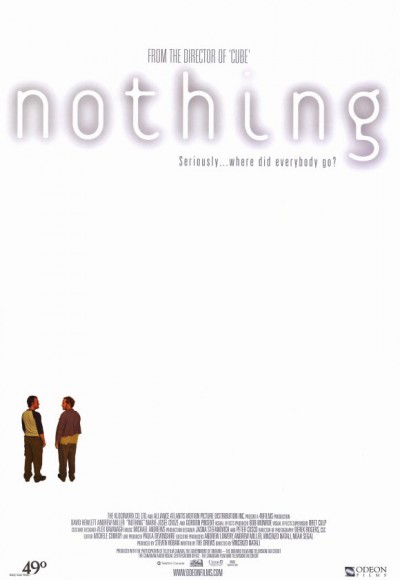
“Nothing” (2003) is an existential comedy and third feature film from director Vincenzo Natali (Cube). The plot follows two friends and roommates: Andrew, an antisocial travel agent who works from home, and Dave, a prototypical office drone. After experiencing the worst day of their lives, they somehow will the world outside of their house out of existence. While this creates a temporary respite it also leads to new problems mainly in the form of boredom and cabin fever.  Will the two protagonists manage to keep their sanity and find their way out of nothingness?

Watch the full film here.

Saturday Matinee: Cube

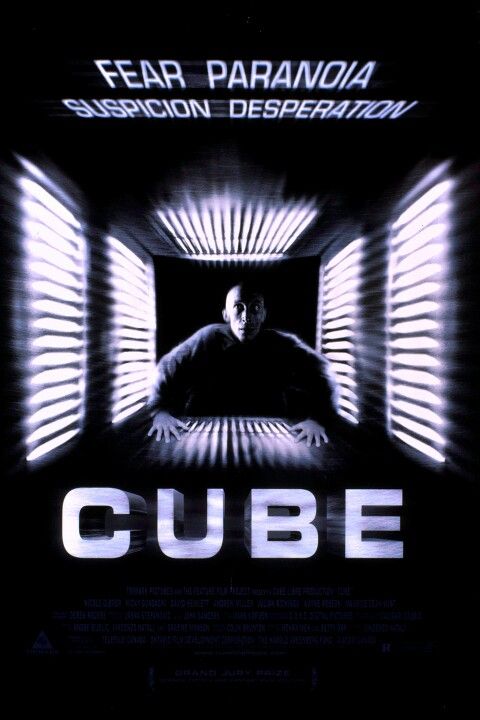
“Cube” (1997) is an existential Canadian sci-fi feature film debut from director and co-writer Vincenzo Natali. The minimalist plot focuses on a group of strangers forced to navigate and survive a series of cube-shaped rooms which are more often than not rigged with deadly surprises. Besides the variety of bizarre and unexpected traps, the film’s main source of tension lies in the question of whether the group’s diversity of backgrounds and personalities will lead to their salvation or mutual extinction.

Watch the full film here.

Colin Wilson’s “The Outsider”

51el43rwbvl-_sy344_bo1204203200_

(Editor’s note: We’re sharing this article today to commemorate the third anniversary of Colin Wilson’s passing.)

By Gary Lachman

Source: Reality Sandwich

This is an excerpt from my new book, Beyond the Robot: The Life and Work of Colin Wilson. Wilson rose to global fame sixty years ago, when his first book, The Outsider, became a bestseller overnight and sparked the nascent counter culture into a sudden blaze. It thrust the twenty-four year old Wilson into celebrity, and inaugurated the brief craze for the Angry Young Men, a kind of British buttoned-down version of the Beat Generation. Wilson had little in common with his other Angries, who were focused mainly on social issues. Wilson’s concern was the lack of spiritual tension in the modern world, and he quickly became known as Britain’s “homegrown existentialist,” rivaling Sartre, Camus and others on the existential scene with his analysis of the modern predicament. Wilson’s path to success was bumpy. In the years before The Outsider he had worked at dozens of menial jobs, always moving on when he got bored. He survived a suicide attempt, hitchhiked across England and France, hob nobbed with bohemians in London and Paris, and slept rough on Hampstead Heath while writing by day in the British Museum. He died in 2013 at the age of 82.

Wilson’s success was short-lived, and soon after celebrating him the press and the critics, ever fickle, brought him down, the boy genius now persona non grata. Wilson went on to write an enormous number of books, over a remarkable range of subjects, from criminality and sex to the paranormal and mystical experience, as well as many novels, such as Ritual in the Dark, about a modern-day Jack the Ripper, and The Mind Parasites, a phenomenological science fiction thriller about alien psychic vampires in the mind…

This section introduces Wilson’s character of the Outsider, a person who has a hunger for meaning and purpose that the modern world cannot provide, and who must discover the “secret life” within him or face death, madness, or quiet despair.

In The Outsider Wilson made his first attempt at analysing a character he felt was peculiar to our age, a person with a pressing hunger for meaning and spiritual purpose in a world seemingly bent on denying him these. In the past, during the Middle Ages, such an individual could have found a home in the church, which was then the heart of life, and which provided a place, monasteries, where he could work toward his salvation – work, that is, to awaken the spiritual life within him, to grasping his purpose with an unwavering seriousness. That purpose was to become something greater than himself, to work against the laziness and complacency that keeps him second-rate and allows him to be satisfied with being “only human.”

But today, in our modern society, geared toward comfort and security and motivated by purely material aims, there is no place for such a person, and his spiritual seriousness is a liability. His or her desire to be something more than a happy, well-fed animal, puts him at odds with the world around him. This type is driven by needs that the people he knows do not understand. For him the world that they complacently accept is false. He sees “too deep and too much” and his awareness of the illusions that satisfy others brings him to despair. He is not at home in the world, his permanent sense of self-dissatisfaction does not allow him to be. This dissatisfaction cannot be met by any changes to the social or economic system, as Marxists like the theatre critic Kenneth Tynan, one of the Angry Young men, believed. “The question of freedom,” Wilson writes, “is not a social problem.” Only by the long, difficult, personal struggle to self-realization can the Outsider realize his goal. That realization, or actualization, as the psychologist Abraham Maslow, one of Wilson’s earliest readers, called it, requires an “intensity of will” and is fostered by anything that arouses one’s “will to more life.”

This path is difficult. The Outsider at first feels himself a kind of misfit, a “lone nutter,” and his dissonance from the Insiders, those content with the world of the second-rate, leads to neurosis. There must be something wrong with him, he believes, and he may try to “fit in.” Usually he fails, and winds up occupying an uncomfortable middle realm. He cannot accept the world and its triviality, but he is not strong enough to escape from it completely or to impose his own seriousness upon it. This may lead to nothing more than a life of quiet desperation, or the Outsider may smoulder with resentment at the insects around him, and lash out indiscriminately – as Wilson’s explorations of the “criminal” Outsider will show, this can have deadly results. But if he is lucky, there are moments of vision, when a sense of power and meaning comes to him and he sees that he is not a misfit, and that the hunger and dissatisfaction that drives him, and which drove the mystics and saints of the past, are more real than the newspapers, television, and mediocrity he abhors.

It is a vision of “a higher form of reality than he has so far known,” a glimpse of what Wilson calls “the secret life,” that sense of total affirmation that he had experienced more than once by now. But then the vision fades. The Outsider is back on earth and is left wondering what the vision was about and why he must return to the dreary treadmill. The Outsider examines the possibility of restoring the vision, of so strengthening one’s grasp on one’s sense of purpose that it is not weakened or confused by the banality of “life.”

Wilson’s notebooks were full of observations of such figures, of Outsiders who were not able to survive their clashes with the world and who succumbed to illness, suicide or madness, who were not quite strong enough to impose their vision on their contemporaries. What went wrong? Why did giants like Nietzsche, Nijinsky, Van Gogh, T. E. Lawrence, and others fail? To say they failed is not, of course, to diminish their greatness. But Nietzsche and Nijinsky went insane, Van Gogh shot himself, and Lawrence went into a kind of spiritual suicide, burying himself as a private in the RAF at the height of his fame. Why did so many poets and writers of the nineteenth century end in a kind of self-destruction? Shelley, Keats, Poe, Hölderlin, Schubert, Hoffman, Schiller, Kleist, Rimbaud, Verlaine, Lautreamont – this list of nineteenth century geniuses who either died young, went mad, killed themselves or succumbed to alcohol or drug addiction could go on.

Why did it happen? Could it have been prevented? All were infused with the Romantic vision that burst upon western consciousness in the late eighteenth century, the insight that informed the music of Beethoven and the poetry of Blake. This was the sense, lost in the modern age, that human beings are really gods, or at least are meant to be, if only they could overcome their laziness and timidity. The Outsider is an exploration of the psychological and spiritual stresses that these and other men of genius faced in the search for their true selves. “The Outsider,” Wilson tells us, “ is not sure who he is. He has found an ‘I’, but it is not his true ‘I’. His main business is to find his way back to himself.”


Marrying robots, killing with drones, and making empty selfies

by Edward Curtin

Source: Intrepid Report

Today everything has become a spectacle, including writing. My title probably caught your eye, as it was intended. But now I would like to tell you a personal story about a man whose brilliant work foreshadowed and dissected the issues of my title before it existed. In this he was prophetic, and it is why his work is so important. He always insisted that true artists were able to uncover society’s conflicts before they emerged consciously. Though a psychologist by profession, he was in this sense an artist as well.

His name, Rollo May, has disappeared from public discourse in this era of biological psychology and psychiatry. This great American thinker and writer was the man who introduced existential psychology to the United States. And though he died twenty-one years ago, his prescient voice begs to be heard in our current conditions.

From his first important book in 1950—The Meaning of Anxiety—he examined key underlying issues that have plagued this country ever since: the worship of technology as a death cult; the loss of a genuine sense of self; sex obsessions leading to lovelessness and impotence; and violence yoked to a lack of compassion.

In book after book, he reiterated one of his central themes: that full passionate life is only possible when one refuses to block off from consciousness the frightful emotions of anxiety, guilt, and despair. In this, his life’s work ran against the grain of the emerging zeitgeist of happy pills, mood stabilizers, and the happiness industry. “After despair,” he wrote, “the one thing left is possibility.” For possibility (Latin, posse, to be able) means power, and true power only comes to those who dare to be weak and freely embrace their personal destinies and the truth of their political and cultural conditions. I think it is not an exaggeration to say that we are presently living in an era of despair, and to embrace that reality is a hard but necessary pill to swallow. May is a wonderful guide.

While topical, in many ways his message is timeless as well. But I would like to tell you about some things I learned from him years ago that speak to our current condition. And it seems fitting that I should begin these thoughts on a day when a prominent, mainstream website has published an article arguing that humans should be able to marry robots and the day of those blissful conjugal ties is in our not too distant future. So I will proceed with those lovely words ringing in my mind: “I now pronounce you robot and wife.”

It was during the closing years of the Cold War when he and I sat down for a long conversation about his thought. Cold War rhetoric and nuclear saber rattling dominated the news and a strong anti-nuclear movement was astir. I had been deeply impressed with May’s paradoxical thinking ever since I had read his award-winning Love and Will in 1969, a year in which I had been forced out of a college teaching position for “heretical” thinking and opposition to the Vietnam war. In his work, which was not openly political, I nevertheless found a voice of deep wisdom and prophetic power. He seemed to be unearthing hidden springs of the madness sweeping the country, and in so doing also addressing the future, and, of course, me. I was feeling particularly vulnerable, yet paradoxically intensely strong, as I had recently declared myself a conscientious objector from war and the Marine Corps. It was a time like today when death and destruction were in the air, and, as Yeats puts it: “Things fall apart; the center cannot hold/Mere anarchy is loosed upon the world/The blood-dimmed tide is loosed, and everywhere/The ceremony of innocence is drowned/The best lack all conviction, while the worst/Are full of passionate intensity.”

The first thing I noticed about May the day we met was that he seemed painfully vulnerable, as though he had so opened himself to existence that the slightest breeze could blow him away. Yet when he began talking I sensed a fierceness, as well, as I recalled a favorite quote of his from Beethoven: “I will seize fate by the throat.”

So I asked him, “In reading your works one of the things that strikes me is the vitality you draw from an awareness of death. Most people would call this morbid and depressing, and yet it seems to bring you joy. I wonder how this began for you?”

“Well,” he answered without hesitation but in his ruminative way, “I’ve had some long bouts with killing illnesses. I had tuberculosis for five or six years. I had malaria fever when I was in Greece. And I’ve had several other bouts with death. If most people would call the consciousness of death depressive, I think they are the ones who have the—what I would call—masochistic or neurotic viewpoint. All through human history mortality has been faced directly and out of it, and this especially true for the ancient Greeks, they got the sense of the value of life from the fact that we are mortal. Now our age is afraid of death and we repress it and we think the only wise thing is to think about living, which strikes me as itself very sick. It’s because we’ve wedded ourselves to technology, and technology is really a study of death. You say ‘vitality.’ You can’t speak of technology as having vitality. Vitality is the human beings contribution and he ought to use technology to make his life richer. But we have become identified with it.”

Presto! Back to the present/future! As if on cue, a refutation of May’s dismissal of machines having life walks in my door. I see the mailman deliver our mail, so I get up and fetch it. An invitation has arrived for a public lecture at the college where I teach—a lecture by the futurist Ray Kurzweil, the man of “Singularity” fame, the prognosticator of the day he says is coming when artificial intelligence will surpass human intelligence and human biology will disappear into the machine. Ray has a plan to never die, so he takes 130 plus supplements a day to keep himself alive until he is able to upload his consciousness onto a hard drive and become one with the machine for a happy immortality as bits of information. Sounds like a great hereafter. And Ray has a backup plan in case the pills don’t do the trick and keep him going until he impregnates the machine; he’ll be fresh frozen at the Alcor Life Extension Foundation where he expects to be defrosted like a frozen burrito in no more than fifty years.

May said to me, “I’m very much against the quantitative views of human life. You could live exceptionally as Pascal did and die in your middle forties. As Kierkegaard did also. The length of life I don’t think is relevant. The idea that we are going to prolong life for two hundred years seems to me to be the most misplaced goal in the whole technological, crazy scheme.”

It looks like Rollo had a point: the worship of technology as a death cult. He could see it then, and today it is carrying us to our doom unless we change course. “More and more,” he wrote, “the question is being asked whether society as a whole is psychotic, and the pause after the question is a sign that the answer could be yes as well as no.” There was, he then felt, a fear of psychosis on a very broad scale, and at the heart of this fear is a loss of faith in the reality of the self, as well as a widespread feeling that one can never be sure anything is real. This sense of unreality has increased exponentially since then, and the issue of self-identity has become a hall of mirrors in our reality-media funhouse. “As in a Kafka novel, everything is waiting for us, but we ourselves do not appear.” But what does appear today, as then, but in a slightly different guise, and grows larger and larger as people’s faith in themselves grows smaller and smaller and their sense of impotence increases, is the possibility of nuclear warfare and world destruction—a new cold war started by the United States by encircling Russia and setting Ukraine ablaze. The ultimate technological death cult is, of course, nuclear weapons .

May made the connections. Like the great sociologist C. Wright Mills, he knew that our destinies are personal and social, and to deny one is to deny the other. By being existential he meant understanding the individual, not as an atomized self, but as a person-in-the world. Mills called it the sociological imagination; May preferred the term paradoxical. But they were on the same page. One’s sense of self—self-identity—is rooted social and historical conditions.

Starting with Man’s Search for Himself in the 1950s and continuing until his death in 1994, May repeatedly explored the reasons why there was an increasing loss of a genuine sense of self resulting in widespread identity confusion and a growing apathy linked to a lack of compassion. He clearly described the anxiety and loneliness that ate at so many people who “not only do not know what they want; they often do not have any clear idea of what they feel.” Feeling only empty and bored and lacking a real sense of self, they conform to hollow cultural values and mores while consuming the goods and services that a consumer culture offers to fill them up. Consuming, they are consumed. This powerless dependency, rooted in a lack of self-identity and the need to be liked, leads to painful anxiety, despair, and powerlessness resulting in acquiescence to social ills. This is today’s selfie/media culture in a nutshell, what Christopher Lasch once called the culture of narcissism.

I obviously couldn’t ask him when we talked, but I can imagine his response to today’s trends of people marrying robots, selfie photos, Facebook, avatars and second lives in cyberspace, the growth of pornography, sex with machines, the sexual saturation of culture, electronic warfare, drone killings, etc.—a bemused laugh and a comment suggesting the tragedy of it all. In Love and Will he wrote that “the contemporary paradoxes in sex and love have one thing in common, namely the banalization of sex and love. By anesthetizing feeling in order to perform better, by employing sex as a tool to prove prowess and identity, by using sensuality to hide sensitivity, we have emasculated sex and left it vapid and empty. The banalization of sex is well-aided and abetted by our mass communication. . . . They oversimplify love and sex, treating the topic like a combination and learning to play tennis and buying life insurance. In this process, we have robbed sex of its power by sidestepping eros (the creative life force); and we have ended by dehumanizing both.” He predicted that this technical approach to sex would lead to sex obsessions, lovelessness, and increased sexual impotence. And here we are—Viagra, big butts, enhanced this and enhanced that—all in the service of sexual satisfaction produced by the cult of technique and devoid of passion.

“Shooting” yourself with a phone camera, sex with a robot or a machine, and killing with drones—this is life today. We have become separated from our humanity by our machines. We worship our images and in so doing can’t grasp the death and destruction caused by our drones and foreign wars. Others don’t exist in this solipsistic culture. May saw it coming and explained why. He saw that violence was yoked to a lack of compassion and that this lack of compassion (to suffer with others) was connected to our flight from death and emotions we consider negative. He saw this form of thinking as an effort to control life that was self-defeating and could only lead to more violence.

“Paradoxical thinking,” he told me, “seems to me to be the only kind that gets to the root of human existence. I don’t think analytical thinking does. It leaves out too much. You remember Heraclitus. I think he’s quite right that we always think in terms of positive/negative. We think like electricity, thus both the negative and positive pole and the oscillation back and forth, and human thinking is a play with opposites.”

Since he has written so much about the breakdown of our traditional myths and symbols, I asked him if there was any one word or symbol that he thought encompassed the body of his work.

After a long pause, he said, “No, I think that’s impossible for any person who writes to say. I think you could say it much better than I could because we’re so much in it. All I know is that I think paradoxically.” And without pause or any word from me, he continued. “Well, if you wanted to push me, I would say that what I think is the basic, well, the basic symbol of my life, I would say that it is compassion. That’s what matters most to me. I grew up in a rather difficult family, quite difficult. I did not have a good childhood. I was quite lonely as a child. And I did suffer a good deal.”

Out of this childhood pain, he learned early to be a therapist for his family, and felt that these experiences gave him an acute sensitivity to others’ feelings. In his memoir Paulus, about his friend, Paul Tillich, the great Protestant theologian, he wrote words that could equally apply to himself: “Someone has to mediate, to make a connection through his own life between opposites.” For out of his wounds, May has created a powerful body of writings, and out of a torn self, a paradox of wholeness.

For us today, in the era of apathy, depression, and indifference to the suffering and deaths of “others” everywhere, May’s work begs to be resurrected. He urges us to care again, and to let our care and compassion lead us to act to stop the violence that we are taught to ignore. Don’t look away, I can hear him say, face fully all dimensions of the human experience, the negative and positive; remember that despair and joy are linked to the possibility of freedom; reject the cult of death that hides within technological obsessiveness; and remember that love brings the intimation of our mortality but also our greatest joys and passions.

And if he were still sitting across from me—and you—today, he’d probably also say with a grin, “Above all, don’t marry a robot.”

Edward Curtin is a sociologist and writer who teaches at Massachusetts College of Liberal Arts and has published widely.