
Internet Censorship, Everywhere All at Once

By Debbie Lerman

Source: Activist Post

It used to be a truth universally acknowledged by citizens of democratic nations that freedom of speech was the basis not just of democracy, but of all human rights.

When a person or group can censor the speech of others, there is – by definition – an imbalance of power. Those exercising the power can decide what information and which opinions are allowed, and which should be suppressed. In order to maintain their power, they will naturally suppress information and views that challenge their position.

Free speech is the only peaceful way to hold those in power accountable, challenge potentially harmful policies, and expose corruption. Those of us privileged to live in democracies instinctively understand this nearly sacred value of free speech in maintaining our free and open societies.

Or do we?

Alarmingly, it seems like many people in what we call democratic nations are losing that understanding. And they seem willing to cede their freedom of speech to governments, organizations, and Big Tech companies who, supposedly, need to control the flow of information to keep everyone “safe.”

The locus for the disturbing shift away from free speech is the 21st-century’s global public square: the Internet. And the proclaimed reasons for allowing those in power to diminish our free speech on the Internet are: “disinformation” and “hate speech.”

In this article, I will review the three-step process by which anti-disinformation laws are introduced. Then, I will review some of the laws being rolled out in multiple countries almost simultaneously, and what such laws entail in terms of vastly increasing the potential for censorship of the global flow of information.

How to Pass Censorship Laws

Step 1: Declare an existential threat to democracy and human rights 

Step 2: Assert that the solution will protect democracy and human rights

Step 3: Enact anti-democratic, anti-human rights censorship fast and in unison

Lies, propaganda, “deep fakes,” and all manner of misleading information have always been present on the Internet. The vast global information hub that is the World Wide Web inevitably provides opportunities for criminals and other nefarious actors, including child sex traffickers and evil dictators.

At the same time, the Internet has become the central locus of open discourse for the world’s population, democratizing access to information and the ability to publish one’s views to a global audience.

The good and bad on the Internet reflect the good and bad in the real world. And when we regulate the flow of information on the Internet, the same careful balance between blocking truly dangerous actors, while retaining maximum freedom and democracy, must apply.

Distressingly, the recent slew of laws governing Internet information are significantly skewed in the direction of limiting free speech and increasing censorship. The reason, the regulators claim, is that fake news, disinformation, and hate speech are existential threats to democracy and human rights.

Here are examples of dire warnings, issued by leading international organizations, about catastrophic threats to our very existence purportedly posed by disinformation:

Propaganda, misinformation and fake news have the potential to polarise public opinion, to promote violent extremism and hate speech and, ultimately, to undermine democracies and reduce trust in the democratic processes. Council of Europe

The world must address the grave global harm caused by the proliferation of hate and lies in the digital space.-United Nations

Online hate speech and disinformation have long incited violence, and sometimes mass atrocities.  –World Economic Forum (WEF)/The New Humanitarian

Considering the existential peril of disinformation and hate speech, these same groups assert that any solution will obviously promote the opposite:

Given such a global threat, we clearly need a global solution. And, of course, such a solution will increase democracy, protect the rights of vulnerable populations, and respect human rights. WEF

Moreover, beyond a mere assertion that increasing democracy and respecting human rights are built into combating disinformation, international law must be invoked.

In its Common Agenda Policy Brief from June 2023, Information Integrity on Digital Platforms, the UN details the international legal framework for efforts to counter hate speech and disinformation.

First, it reminds us that freedom of expression and information are fundamental human rights:

Article 19 of the Universal Declaration of Human Rights and article 19 (2) of the Covenant protect the right to freedom of expression, including the freedom to seek, receive and impart information and ideas of all kinds, regardless of frontiers, and through any media. 

Linked to freedom of expression, freedom of information is itself a right. The General Assembly has stated: “Freedom of information is a fundamental human right and is the touchstone of all the freedoms to which the United Nations is consecrated.” (p. 9)

Then, the UN brief explains that disinformation and hate speech are such colossal, all-encompassing evils that their very existence is antithetical to the enjoyment of any human rights:

Hate speech has been a precursor to atrocity crimes, including genocide. The 1948 Convention on the Prevention and Punishment of the Crime of Genocide prohibits “direct and public incitement to commit genocide”. 

In its resolution 76/227, adopted in 2021, the General Assembly emphasized that all forms of disinformation can negatively impact the enjoyment of human rights and fundamental freedoms, as well as the attainment of the Sustainable Development Goals. Similarly, in its resolution 49/21, adopted in 2022, the Human Rights Council affirmed that disinformation can negatively affect the enjoyment and realization of all human rights.

This convoluted maze of legalese leads to an absurd, self-contradictory sequence of illogic:

  • Everything the UN is supposed to protect is founded on the freedom of information, which along with free speech is a fundamental human right.
  • The UN believes hate speech and disinformation destroy all human rights.
  • THEREFORE, anything we do to combat hate speech and disinformation protects all human rights, even if it abrogates the fundamental human rights of free speech and information, on which all other rights depend.
  • Because: genocide!

In practice, what this means is that, although the UN at one point in its history considered the freedom of speech and information fundamental to all other rights, it now believes the dangers of hate speech and disinformation eclipse the importance of protecting those rights.

The same warping of democratic values, as delineated by our international governing body, is now occurring in democracies the world over.

Censorship Laws and Actions All Happening Now

If hate speech and disinformation are the precursors of inevitable genocidal horrors, the only way to protect the world is through a coordinated international effort. Who should lead this campaign?

According to the WEF, “Governments can provide some of the most significant solutions to the crisis by enacting far-reaching regulations.”

Which is exactly what they’re doing.

United States

In the US, freedom of speech is enshrined in the Constitution, so it’s hard to pass laws that might violate it.

Instead, the government can work with academic and nongovernmental organizations to strong-arm social media companies into censoring disfavored content. The result is the Censorship-Industrial Complex, a vast network of government-adjacent academic and nonprofit “anti-disinformation” outfits, all ostensibly mobilized to control online speech in order to protect us from whatever they consider to be the next civilization-annihilating calamity.

The Twitter Files and recent court cases reveal how the US government uses these groups to pressure online platforms to censor content it doesn’t like:

Google

In some cases, companies may even take it upon themselves to control the narrative according to their own politics and professed values, with no need for government intervention. For example: Google, the most powerful information company in the world, has been reported to fix its algorithms to promote, demote, and disappear content according to undisclosed internal “fairness” guidelines.

This was revealed by a whistleblower named Zach Vorhies in his almost completely ignored book, Google Leaks, and by Project Veritas, in a sting operation against Jen Gennai, Google’s Head of Responsible Innovation.

In their benevolent desire to protect us from hate speech and disinformation, Google/YouTube immediately removed the original Project Veritas video from the Internet.

European Union

The Digital Services Act came into force November 16, 2022. The European Commission rejoiced that “The responsibilities of users, platforms, and public authorities are rebalanced according to European values.” Who decides what the responsibilities and what the “European values” are?

  • very large platforms and very large online search engines [are obligated] to prevent the misuse of their systems by taking risk-based action and by independent audits of their risk management systems
  • EU countries will have the primary [oversight] role, supported by a new European Board for Digital Services

Brownstone contributor David Thunder explains how the act provides an essentially unlimited potential for censorship:

This piece of legislation holds freedom of speech hostage to the ideological proclivities of unelected European officials and their armies of “trusted flaggers.” 

The European Commission is also giving itself the power to declare a Europe-wide emergency that would allow it to demand extra interventions by digital platforms to counter a public threat. 

UK

The Online Safety Bill was passed September 19, 2023. The UK government says “It will make social media companies more responsible for their users’ safety on their platforms.”

According to Internet watchdog Reclaim the Net, this bill constitutes one of the widest sweeping attacks on privacy and free speech in a Western democracy:

The bill imbues the government with tremendous power; the capability to demand that online services employ government-approved software to scan through user content, including photos, files, and messages, to identify illegal content. 

The Electronic Frontier Foundation, a nonprofit dedicated to defending civil liberties in the digital world, warns: “the law would create a blueprint for repression around the world.”

Australia

The Communications Legislation Amendment (Combatting Misinformation and Disinformation) Bill 2023 was released in draft form June 25, 2023 and is expected to pass by the end of 2023. the Australian government says:

The new powers will enable the ACMA [Australian Communications and Media Authority] to monitor efforts and require digital platforms to do more, placing Australia at the forefront in tackling harmful online misinformation and disinformation, while balancing freedom of speech.

Reclaim the Net explains:

This legislation hands over a wide range of new powers to ACMA, which includes the enforcement of an industry-wide “standard” that will obligate digital platforms to remove what they determine as misinformation or disinformation. 

Brownstone contributor Rebekah Barnett elaborates:

Controversially, the government will be exempt from the proposed laws, as will professional news outlets, meaning that ACMA will not compel platforms to police misinformation and disinformation disseminated by official government or news sources. 

The legislation will enable the proliferation of official narratives, whether true, false or misleading, while quashing the opportunity for dissenting narratives to compete. 

Canada

The Online Streaming Act (Bill C-10) became law April 27, 2023. Here’s how the Canadian government describes it, as it relates to the Canadian Radio-television and Telecommunications Commission (CRTC):

The legislation clarifies that online streaming services fall under the Broadcasting Act and ensures that the CRTC has the proper tools to put in place a modern and flexible regulatory framework for broadcasting. These tools include the ability to make rules, gather information, and assign penalties for non-compliance.

According to Open Media, a community-driven digital rights organization,

Bill C-11 gives the CRTC unprecedented regulatory authority to monitor all online audiovisual content. This power extends to penalizing content creators and platforms and through them, content creators that fail to comply. 

World Health Organization

In its proposed new Pandemic Treaty and in the amendments to its International Health Regulations, all of which it hopes to pass in 2024, the WHO seeks to enlist member governments to

Counter and address the negative impacts of health-related misinformation, disinformation, hate speech and stigmatization, especially on social media platforms, on people’s physical and mental health, in order to strengthen pandemic prevention, preparedness and response, and foster trust in public health systems and authorities.

Brownstone contributor David Bell writes that essentially this will give the WHO, an unelected international body,

power to designate opinions or information as ‘mis-information or disinformation, and require country governments to intervene and stop such expression and dissemination. This … is, of course, incompatible with the Universal Declaration of Human Rights, but these seem no longer to be guiding principles for the WHO.

Conclusion

We are at a pivotal moment in the history of Western democracies. Governments, organizations and companies have more power than ever to decide what information and views are expressed on the Internet, the global public square of information and ideas.

It is natural that those in power should want to limit expression of ideas and dissemination of information that might challenge their position. They may believe they are using censorship to protect us from grave harms of disinformation and hate speech, or they may be using those reasons cynically to consolidate their control over the flow of information.

Either way, censorship inevitably entails the suppression of free speech and information, without which democracy cannot exist.

Why are the citizens of democratic nations acquiescing to the usurpation of their fundamental human rights? One reason may be the relatively abstract nature of rights and freedoms in the digital realm.

In the past, when censors burned books or jailed dissidents, citizens could easily recognize these harms and imagine how awful it would be if such negative actions were turned against them. They could also weigh the very personal and imminent negative impact of widespread censorship against much less prevalent dangers, such as child sex trafficking or genocide. Not that those dangers would be ignored or downplayed, but it would be clear that measures to combat such dangers should not include widespread book burning or jailing of regime opponents.

In the virtual world, if it’s not your post that is removed, or your video that is banned, it can be difficult to fathom the wide-ranging harm of massive online information control and censorship. It is also much easier online than in the real world to exaggerate the dangers of relatively rare threats, like pandemics or foreign interference in democratic processes. The same powerful people, governments, and companies that can censor online information can also flood the online space with propaganda, terrifying citizens in the virtual space into giving up their real-world rights.

The conundrum for free and open societies has always been the same: How to protect human rights and democracy from hate speech and disinformation without destroying human rights and democracy in the process.

The answer embodied in the recent coordinated enactment of global censorship laws is not encouraging for the future of free and open societies.

Published under a Creative Commons Attribution 4.0 International License
For reprints, please set the canonical link back to the original Brownstone Institute Article and Author.

The Powder Keg in the Middle East has Exploded: What Israel’s War on Gaza Means for the Rest of the World

By Timothy Alexander Guzman,

Source: Silent Crow News

A new war in the Gaza Strip should not be a surprise to anyone who understands what the Palestinians have been going through for the last 75 years.  Many people in the West, in particularly those in the United States and the European Union are shocked and very angry with the attack on Israeli territory by Hamas.  The US mainstream media obviously has a biased view with mostly pro-Israel viewpoints on Israel’s latest conflict in Gaza especially with FOX news who so far, has not invited a Palestinian or Muslim analyst or academic to explain to its audience what led up to this recent attack in the first place.  However, I do believe that Israeli intelligence namely, Mossad knew what was about to take place so that they can move forward to “wipe Gaza off the map” which has been a long-time strategy for Israeli hardliners. Why do I believe Israel allowed it to happen? because the Gaza Strip is one of the most surveilled areas on the planet, therefore Israeli intelligence had to know beforehand that sooner or later, something was going to happen.

Despite what is happening in Gaza, there is one important fact that needs to be told, its not just about Palestine because if Israel gets its way in this war, it will begin targeting other Arab states including Lebanon and Syria which fits into what Oded Yinon, an Israeli journalist wrote in ‘A Strategy for Israel in the Nineteen Eighties’ suggesting that Israel must “become an imperial regional power” and that it “must effect the division of the whole area into small states by the dissolution of all existing Arab states.” 

The strategy according to Yinon is that “the Zionist hope is that sectarian-based states become Israel’s satellites and, ironically, its source of moral legitimation.”  Although this was written in the 1980’s, all of it is absurd and unrealistic.  Israeli hardliners and Americans especially those in the US bible belt are hoping for a Greater Israel, but that will never happen, the resistance will become stronger throughout the Middle East as more Israeli fighter jets continues to bomb Gaza day after day.  Several Middle Eastern countries and resistance groups have been prepared for the next big war with Israel and the US including Hezbollah in Southern Lebanon, Kataib Hezbollah and other factions in Iraq, Syria, and Iran. 

Government officials, military top brass and intelligence agencies from the US, and NATO know that it will be long and bloody war since Israel is going full force in efforts to take more land in Gaza thus creating more Palestinian refugees in the process. Yinon said create “small states” that will be easier to dominate just like they did in Palestine, they split the territories by turning the Gaza Strip into an open air prison, and at the same-time they created a separate territory in the West Bank, both areas are militarily dominated by Israel Defense Forces (IDF). 

However, for Israel, time is not on their side.  They know that the US is in financial trouble with $33 trillion in debt, so I am sure that many Israeli economists know that without the US and its financial assistance, Israel will not last since they depend on almost every penny that the US government gives them.

In the meantime, Israel is trying to somehow get the US involved in the war. For the Israelis, that’s nothing new.  Remember when Israeli Prime Minister, Benjamin Netanyahu claimed to the US congress in 2002 that Iraq was developing nuclear weapons?  “There is no question whatsoever that Saddam is seeking, is working, is advancing towards to the development of nuclear weapons,” he continued “Once Saddam has nuclear weapons, the terror network will have nuclear weapons,” I would say that Netanyahu was successful in getting the US in a war with Iraq.  Or how about the time when Israel attacked the USS Liberty in 1967 in the Mediterranean sea during the Six-Day War which was meant as a false flag operation to bring in the US in its war against Egypt and the rest of the Middle East.

The war on Palestine was the first step in creating an imperial Israel.  On July 9th, 1947, Rabbi Fischmann, a member of the Jewish Agency declared at a U.N. Special Committee of Enquiry that Israel needs to expand “from the River of Egypt up to the Euphrates, it includes parts of Syria and Lebanon.” It is also important to note that Israel has another important reason for expansion which one of them being the obvious and that is to ultimately control the natural resources including oil and gas throughout the Middle East.  When it comes to Big Oil, Washington and the Pentagon share similar goals with Israel when it comes to natural resources in the region. 

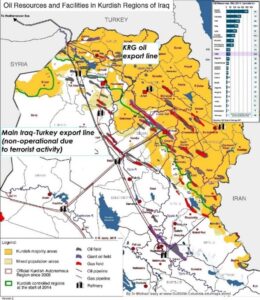
Oil Resources & Facilities in Kurdish Regions of Iraq

Since the Gulf war in the early 1990s, Washington and the Pentagon along with Kurdish leadership tried to create a ‘Free Kurdistan‘ that included areas of Iraq, Iran, Syria and even Turkey to dominant the potential energy markets.  In other words, the US establishment and Israel benefit in numerous ways by Balkanizing the Middle East thus making it easier to control the oil and gas fields.

So for the US-Israel partnership, it’s not only ideological, it’s also about the economic benefits of Zionist expansion that not only benefits Big Oil, it benefits the US arms industry since Israel will need a steady supply of weapons for a very long time to maintain control over a Balkanized Middle East and that’s always a plus for the establishment.  So, it is fair to say that Israel needs the US military and its financial aid just as much as the US and its Big oil enterprises need Israel to continue its illegal occupation.

Meanwhile worldwide protests have taken place as the war hawks, neocons, special interest groups (AIPAC) in Washington and their media mouthpieces are already pushing for US military to ultimately attack Iran. 

The US military is already sending its naval ships to the Eastern Mediterranean in show of support to Israel according to Secretary Lloyd J. Austin III:

I have directed the movement of the USS Gerald R. Ford Carrier Strike Group to the Eastern Mediterranean. This includes the U.S. Navy aircraft carrier USS Gerald R. Ford (CVN-78), the Ticonderoga-class guided missile cruiser USS Normandy (CG 60), as well as the Arleigh-Burke-class guided missile destroyers USS Thomas Hudner (DDG 116), USS Ramage (DDG 61), USS Carney (DDG 64), and USS Roosevelt (DDG 80). We have also taken steps to augment U.S. Air Force F-35, F-15, F-16, and A-10 fighter aircraft squadrons in the region. The U.S. maintains ready forces globally to further reinforce this deterrence posture if required

US ships in the Mediterranean sea? seems like déjà vu, but the point here is that the US will most likely get involved despite losing almost every major war they started since the end of World War II. It is assured that they will face a heavy onslaught of firepower from Hezbollah, Syria, Iran, resistance groups from Iraq that can target US bases and assets, even Yemen can get involved in some capacity.  

Russia and China are watching events very closely as their countries are also facing Western aggression on various levels including the US-NATO proxy war in Ukraine and if the US and its close allies in the Asia Pacific are foolish enough, they will to start another proxy war in Taiwan.

This is the big war in the Middle East that many of us have been fearing and it seems unstoppable as tensions have dramatically escalated in such a short period of time. 

Russia and China can sure try to mediate a peace agreement or a ceasefire, but that seems impossible given how Israel sees the necessity and the long-term benefits of seizing more Palestinian territory with close to half of the Gaza strip in its sights and that’s their next step, stripping land away from the Palestinians piece by piece. 

The bottom line is that the US is at $33 trillion in debt with a US dollar reserve currency that is not so popular as before, so how long can the US establishment keep up its military and economic support to Israel?  No one knows for sure, but it is clear that the US and the European establishment is committed to Israel’s security, even if it means bankrupting its own citizens. 

The Ukraine Mess is Animal Farm in Reverse: Starring Blackrock and Other Pigs

By Phil Butler

Source: New Eastern Outlook

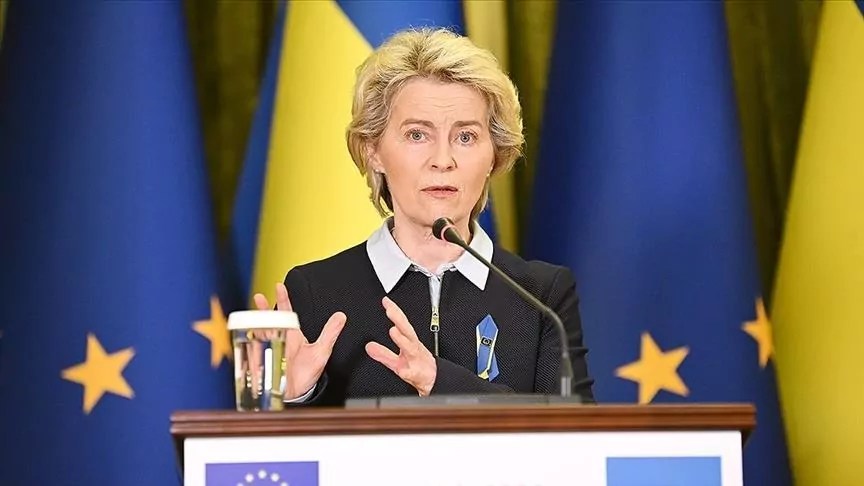
Recently, the head of the European Commission, Ursula von der Leyen, said that the European Union should double its assistance to Ukraine. She went on to say the EU should create a support fund of 50 billion euros by the end of the year and that everything should be done to ensure victory on the battlefield for the Ukrainians.

The European Union has created a “support package” for Ukraine for 2023 of up to €18 billion. This money, however, is not in the form of gifts, grants, or to create an emergency war chest. These billions are a loan under an EU macro-financial assistance program dubbed the MFA+ Instrument. In the fine print, EU member states are guaranteeing these loans as well as paying the interest for the Ukrainians. The move is extraordinary given that Ukraine is not an EU member and that, even before the current conflict, was one of the most corrupt governments on Earth. This begs the question, “Why?”

The EU is issuing special bonds to be sold to investors for this purpose at a time when many people in the European Union go without proper healthcare, services, and even employment. The European Union, EU Member States, and European financial institutions have already dispersed some €49 billion to President Zelensky’s regime. This figure, added to the $76.8 billion already funneled to Ukraine, dwarfs any assistance given to any other country in the world. This very conservative report from the Council of Foreign Relations shows the U.S. alone has shoveled more into Zelensky’s coffers than Afghanistan, Israel, Jordan, Ethiopia, and Iraq combined in 2020.

In all, some 47 countries have given money and arms to Ukraine. As of now, EU Institutions (?) handed Zelensky over €30 billion. The UK has forked over about €10 billion as their pensioners worry about what’s for dinner next. Germany has given somewhere around €8 billion, and Japan almost €7 billion. The Netherlands, Canada, and Poland have pitched in about €5 billion each, and the list of others about €14 billion. The numbers, as you would expect, do not all add up. A U.S. News & World Reports story from earlier this year claimed total aid to Zelensky’s country had exceeded €150 billion as of January of this year. Again, why?

The answer, this time, is really simple. BlackRock, and the new investment initiative to rebuild Ukraine (whatever’s left of it). You already knew this, right? Zelensky and BlackRock’s BlackRock CEO Larry Fink met late last year, and in November, the Ukrainian Ministry of the Economy (MoE) and BlackRock Financial Markets Advisory (FMA) signed a memorandum to structure Ukraine’s reconstruction funds (PDF). Also, in on the moneymaking schemes in war-torn Ukraine are Nestlé, International Finance Corporation, the private investment arm of the World Bank, Australia’s Tattarang Group,

Zelensky has called the rebuilding of his country, once it’s been used up as a proxy NATO against Russia, “the greatest opportunity in Europe since World War Two.” Earlier this year, Fink told Barron’s and other financial magazines that Western investors will be “flooding” Ukraine post-war and the country could become “a beacon to the rest of the world of the power of capitalism”. Also, JPMorgan Chase is joining BlackRock to help Ukraine set up a reconstruction bank to steer public seed capital.

This American Conservative report says, “BlackRock Plots to Buy Ukraine,” in a recent editorial. Author Bradley Devlin outlines the Ukraine case, while also revealing how Fink and BlackRock are transforming America into a nation of renters by artificially elevating the prices of normal houses. If ever a man were appropriately named, Fink is that man.

“Why?” Is there any doubt about why some poor untrained bartender from Kyiv is in a foxhole being bombarded by Russian artillery? Doesn’t all the misleading media, inflated Ukraine military gains, and Joe Biden’s cock of the walk attitude toward a peace deal make more sense now? And Ursula, the lady I fondly refer to as Frau von der Clucky for her chicken-like pecking and strutting about while millions either die or are in harm’s way because of all the Western world barnyard antics right out of Orwell’s Animal Farm. While someone’s Dad takes a bullet or shrapnel in Donetsk, our leaders keep crowing, snorting, braying, and hog-wallering in their capitalistic farm dream.

Why? Greed, that’s why.

EU’s Voluntary Disinformation Code Is Compulsory: Obey or Die

By Declan Hayes

Source: Strategic Culture Foundation

Though Musk is still playing at being NATO’s token non-conformist, the EU is essentially telling him and all of us that any dissent from its Russophobic, Slavophobic and Sinophobic narratives will be severely punished.

The European Union’s enforcers have told Twitter owner Elon Musk that the EU’s voluntary information code is not voluntary and that the EU will fine the pants off Twitter if Musk does not play by NATO’s self-serving rules. Though Musk is still playing at being NATO’s token non-conformist, the EU is essentially telling him and all of us that any dissent from its Russophobic, Slavophobic and Sinophobic narratives will be severely punished.

From the point of view of von der Leyen and NATO’s other EU puppets, that makes absolutely perfect sense. As legacy media’s active shelf life is fast expiring, that just leaves the EU with alternative media to kill off with massive fines in Twitter’s case or, more generally, by crowding out and muzzling any and all truth tellers.

Look at the treatment being meted out to Pink Floyd’s Roger Waters, a life-long anti-fascist, whose father was killed in action fighting the Nazis but which the usual suspects, led as always by the BBC and the Guardian, are trying to ban for supposedly being a Jew-hating Nazi simply because of his support for Palestinian rights, for Julian Assange and for being stupid enough to still be doing live concerts with those unreconstructed views, as he touches 80 years of age.

The EU’s code Waters and Musk are falling foul of “aims to prevent profiteering from disinformation and fake news, as well as increasing transparency and curbing the spread of bots and fake accounts”.

By disinformation, in addition to Waters, von der Leyen’s thugs mean the work of folk like our own excellent Stephen Karganovic, who is not only a quality thinker and writer, but is on every EU and NATO hit list imaginable because he speaks his truths to their power. And others like Fyodor Lukyanov and Timur Fomenko, who file excellent analytical copy for Russia Today which, with this site, is subject to a string of sanctions and name-calling that are as libellous and ignorant as those these EU and NATO morons throw at Waters or any other of their betters.

The objective in labelling SCF, Russia Today, Waters and even Masha and Mishka as dis-information is to control the common space and not to give the ideas of heretics like Jeremy Corbyn, Robert F Kennedy Junior or their type space to survive.

With fake news, the EU is primarily concerned with folk who expose their crimes, family folk like Roger Waters and Julian Assange, who has now done the equivalent of a life tariff for exposing the tiniest fracton of the war crimes the Yanks committed in Iraq, crimes which, remember, included the gang rape of little girls by these harbingers of US-style democracy.

And then there is Gonzalo Lira, who is in the worst of all places, in Ukraine, whose soldiers rape corpses, and whose politicians ban all opposition parties, all opposition media and all religions that do not worship their utterly corrupt system but yet, as the corpse rapists do God knows what to Gonzalo Lira in God knows where, Ukraine has seen its ranking in NATO’s Press Freedom and Transparency Indexes soar like an American bald eagle that is oblivious to the stench below. The Nazi rump Reich is, the EU’s disinformation experts proclaim, the land of the free and the land of the brave, even as it is hell on earth for Lira and millions of Zelensky’s other victims.

The torture of Assange and Lira has silenced countless others and thereby made way for NATO’s own quack journalists to fill the void with their own fake news, which was presented to us up till recently by sexual predators like Philip Schofield, ITV’s equivalent of the BBC’s Jimmy Savile.

Not to put too fine a point on it, but corrupt countries and institutions that elevate Jimmy Saville, Philip Schofield, Ghislaine Maxwell, Lord BoothbyTom Driberg MP, Jeffrey Epstein, Sir Ted HeathCyril SmithKarim Ahmad KhanImran Ahmad Khan and Prince Andrew to positions of power and authority are not in a position to lecture to anyone on transparency or to spin their fake news line on their own terrorist attack on Nordstream.

As regards bots and fake accounts, that smear should have died a death with the end of Russiagate, one of a number of massive CIA/EU efforts to disseminate fake news and opaqueness through their own bots and fake accounts.

But why, the Clinton, Biden, Obama and other organised crime families would ask, re-invent the wheel, when the old smears NATO’s media spin work as well as ever?

What we have with all these rafts of EU laws, fines, sanctions, bluster and bluff is a sort of NATO Cosplay, where von der Leyen and her fellow Cosplay conspirators get to moralise, whilst the Biden, Kerry and Pelosi families get to sprinkle Ukraine with enough bio labs to take out half of Europe’s population, and the New York Post, the only media outlet that reported on the crimes Hunter Biden’s laptop revealed, gets banned and harassed by the FBI goon squads.

Von der Leyen’s Digital Services Act will further criminalise offensive humour such as comparing French dictator Macron to Hitler (though Waters will remain fair game). Some 19 companies, including Alphabet’s Google Maps, Google Play, Google Search, Google Shopping, YouTube, Meta’s Facebook and Instagram, Amazon’s Marketplace, Apple’s App Store, Twitter, Microsoft’s two units LinkedIn and Bing, booking.com, Pinterest, Snap Inc’s Snapchat, TikTok, Wikipedia, Zalando, and Alibaba’s AliExpress will all have to obey von der Leyen’s diktats “to make the internet safer” by erasing so-called disinformation in whatever way von der Leyen and her fellow plagiarists decide to define it from one moment to the next.

Not that war is their only earner needing the censor’s protection. Over 3,400 peer-reviewed papers questioning NATO’s Covid narrative have also been sidelined and ignored. Fake news, Russian propaganda, dis-information or some such stuff. I am one of many who did not take the vaccine von der Leyen’s husband made a fortune pimping. And I am glad I didn’t fall for their dancing nurses and their relentless marketing, irrespective of whether they were peddling fake news with their fake vaccines or not. I have no idea whether those vaccines are effective or not. I am not qualified to opine.

But what I do know is this. There are large groups of American and European politicians, like American fugitive Lindsey Graham who have been promoted because, thick as bricks though they are, they are sufficiently spineless to pimp the wars, vaccines and other societal wrecking balls those who fund and control them are selling.

Speaking of war, NATO and KFOR mercenaries have just slaughtered a bunch of Serbs in Zvecan (northern Kosovo). Though I look forward with interest to getting a proper analysis of this latest NATO war crime from Fyodor Lukyanov, Timur Fomenko and our own excellent Stephen Karganovic, I do know that not only will their take be totally at odds with that of the EU’s semi-literate fact-checkers but that Russia Today and Karganovic will be much nearer to the truth than any of von der Leyen’s minions could ever be because those EU yellow packs are groomed to paint over and hide the crimes against Serbs and Palestinians this article and a thousand others on this site draw attention to.

The war, the separation of the world, or the end of an Empire?

All empires are mortal. So is the “American Empire ».
Painting by Alexandre Granger

By Thierry Meyssan

Source: VoltaireNet.org

Many are those who predict a World War. Indeed, some groups are preparing for it. But the States are reasonable and, in fact, consider rather an amicable separation, a division of the world into two different worlds, one unipolar and the other multipolar. Perhaps we are actually witnessing a third scenario: the “American Empire” is not struggling in the trap of Thucydides; it is collapsing like its former Soviet rival died.

The American “Straussians,” the Ukrainian “integral nationalists,” the Israeli “revisionist Zionists” and the Japanese “militarists” are calling for a generalized war. They are alone and they are not mass movements. No state has yet committed itself to this course.

Germany with 100 billion euros and Poland with much less money are rearming massively. But neither of them seems eager to take on Russia.

Australia and Japan are also investing in armaments, but neither of them has an autonomous army.

The United States is no longer able to replenish its military and is no longer able to create new weapons. They are content to reproduce the weapons of the 1980s in an assembly line fashion. However, they maintain their nuclear weapons.

Russia has already modernized its armies and is organizing itself to renew the ammunition it uses in Ukraine and to mass produce its new weapons, which no one can compete with. China, for its part, is rearming to control the Far East and, in the long term, to protect its trade routes. India thinks of itself as a maritime power.

It is therefore difficult to see who would and could start a World War.

Contrary to their speeches, French leaders are not at all preparing for a high-intensity war [1]. The military programming law, established for ten years, plans to build a nuclear aircraft carrier, but reduces the size of the army. It is a question of giving ourselves the means of projection, but not of defending our territory. Paris continues to reason as a colonial power while the world is becoming multipolar. It is a classic: the generals prepare for the previous war and ignore the reality of tomorrow.

The European Union is implementing its “Strategic Compass”. The Commission coordinates the military investments of its member states. In practice, they all play the game, but pursue different goals. The Commission, on the other hand, is trying to take control of decisions on the financing of armies, which until now have depended on their national parliaments. This would make it possible to build an empire, but not to declare a generalized war.
Clearly everyone is playing a game, but apart from Russia and China, none is preparing for a high-intensity war. Rather, we are witnessing a redistribution of the cards. This month, Washington is sending Liz Rosenberg and Brian Nelson, two specialists in unilateral coercive measures [2], to Europe with the mission of forcing the Allies to comply. In the words of former President George Bush Jr. during the war “against terrorism”: “Whoever is not with us is against us”.

Liz Rosenberg is efficient and unscrupulous. She is the one who brought the Syrian economy to its knees, condemning millions of people to poverty because they dared to resist and defeat the Empire’s surrogates.

The Hollywood western discourse a la George Bush Jr. of good guys and bad guys has failed with Türkiye, which has already experienced the 2016 coup attempt and the 2023 earthquake. Ankara knows that it has nothing good to expect from Washington and is already looking to the Shanghai Cooperation Organization. Yet the same discourse should succeed with the Europeans, who remain fascinated by the power of the United States. Of course this power is in decline, but so are the Europeans. No one has learned any lessons from the sabotage of the Russian-German-French-Dutch gas pipelines, North Stream. Not only did the victims take the blame without saying anything, but they are about to receive further punishment for crimes they did not commit.

The world should therefore be divided into two blocs, on the one hand the US hyperpower and its vassals, on the other the multipolar world. In terms of the number of states, this should be half and half, but in terms of population, only 13% for the Western bloc against 87% for the multipolar world.

The international institutions can no longer function. They should either fall into lethargy or be dissolved. The first examples that come to mind are the effective exit of Russia from the Council of Europe and the empty seats of Western Europeans in the Arctic Council during the year of the Russian presidency. Other institutions are no longer relevant, such as the Organization for Security and Cooperation in Europe (OSCE), which was supposed to organize East-West dialogue. Only the attachment of Russia and China to the United Nations should preserve them in the short term, as the United States is already thinking of transforming the Organization into a structure reserved exclusively for the Allied Nations.

The Western bloc should also reorganize itself. Until now, the European continent was dominated economically by Germany. In order to be certain that Germany would never get closer to Russia, the United States wanted Berlin to be content with the western part of the continent and leave the center in the hands of Warsaw. So Germany and Poland armed themselves to impose themselves in their respective zones of influence, but when the American star faded, they would fight against each other.

When the Soviet Empire fell, it abandoned its allies and vassals. Having seen its inability to solve the problems, the USSR first stopped supporting Cuba economically, then dropped its vassals of the Warsaw Pact, and finally collapsed on itself. The same process is beginning today.
The first U.S. Gulf War, the 9/11 attacks and their host of wars in the broader Middle East, the expansion of Nato and the Ukrainian conflict will have offered only three decades of survival to the American Empire. It was backed by its former Soviet rival. It has lost its raison d’être with its dissolution. It is time for it to disappear too.

Translation
Roger Lagassé

[1] «En 2030, l’armée française ne sera pas prête à une guerre de haute intensité», Jean-Dominique Merchet, L’Opinion, 7 avril 2023.

[2] «US sanction officials plan missions to clamp down on Russia», Fatima Hussein, Associated Press, April 7, 2023.

BYE, BYE KIEV, HELLO COTE D’AZUR: AS WESTERNERS SEND AID, HERE’S HOW UKRAINE’S CORRUPT ELITES ARE PROFITING FROM THE CONFLICT

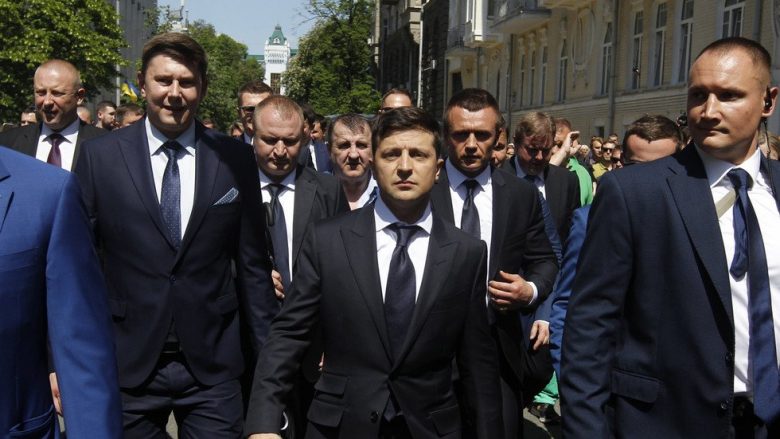
Ukraine’s newly elected President Volodymyr Zelensky (C) walks to his Presidential office after a ceremony of his oath in the Ukrainian Parliament, in Kiev, Ukraine. © STR / NurPhoto via Getty Images

By Olga Sukharevskaya

Source: New Cold War

For years, and particularly since the beginning of Russia’s military offensive in Ukraine, the United States, the European Union – and their allies – have provided Kiev with $126 billion worth of aid, a number almost equal to the country’s entire GDP but Olga Sukharevskaya reports that officials and oligarchs have diverted much of the financial support sent to Kiev
__________________________

Since the beginning of Russia’s military offensive in Ukraine, the United States, the European Union – and their allies – have provided Kiev with $126 billion worth of aid, a number almost equal to the country’s entire GDP. Moreover, millions of Ukrainians have found refuge in the EU where they were given housing, food, work permits, and emotional support. The scope is huge, even by western standards. Considering that the bloc has been funding Kiev while coping with an economic and energy crisis of its own, the assistance is perhaps especially notable.

Kiev bases its endless funding requests on the collapse of its economy, due to the war, and its need to “resist Russian aggression.” But is the aid reaching its intended destination?

The Monaco Battalion

While Ukraine has undergone a general mobilization affecting all men under the age of 60, many former and current high-ranking officials, politicians, businessmen, and oligarchs have moved to safety abroad – mainly to the EU.

The mass flight of Ukrainian elites started even prior to the armed conflict. On February 14, 2022, 37 deputies from the Ukrainian president’s parliamentary faction “Servant of the People” suddenly went “missing.” Had MPs not been banned from leaving the country the very next day, others would’ve definitely joined them. Meanwhile, former officials and oligarchs enjoyed more freedom to move around. According to the Italian newspaper La Repubblica, 20 business jets took off from Kiev’s Boryspol airport on the 14th as well.

Tycoons were at the front of the line. Entrepreneur and MP Vadim Novinsky, businessmen Vasily Khmelnitsky and Vadim Stolar, Vadim Nesterenko, and Andrey Stavnitzer all left the country on charter flights. Millionaire politician Igor Abramovich booked a private flight to Austria for 50 people – taking relatives, business partners, and fellow party members aboard. Oligarchs flew from Kiev to Nice, Munich, Vienna,  Cyprus, and other EU destinations. Another group of businessmen took off from Odessa on private planes. The owner of Vostok Bank departed for Israel, while the head of the Transship group flew to Limassol. An ex-governor of the Odessa region, Stalkanat’s Vladimir Nemirovsky, also left the country.

In the summer and early fall of 2022, ‘Ukrainska Pravda’ prepared several investigative documentaries about fit-for-service Ukrainian billionaires and officials spotted vacationing on the Côte d’Azur during the war. A movie with the ironic title “The Monaco Battalion” shows Ukrainian oligarchs resting at their villas, mansions, and on yachts. In the first part, we see businessman Konstantin Zhevago, who is included on Interpol’s wanted list, relaxing on his private yacht worth $70 million. The yacht graces the shoreline of the Côte d’Azur as Zhevago’s family disembarks. Kharkov entrepreneur Alexander Yaroslavsky, who promised to sell his yacht and transfer the funds towards the restoration of Kharkov, can be seen sailing alongside.

‘Ukrainska Pravda’ journalists also got a glimpse of the Surkis brothers in France, who’re currently renting apartments worth €2 million per year. Meanwhile, a $300,000 Bentley belonging to Ukrainian businessman Vadim Ermolaev was spotted near the casino in Monaco, and Eduard Kohan, the co-founder of Euroenergotrade, was seen at one of Monte Carlo’s chic hotels.

A whole colony of Ukrainian oligarchs has apparently taken up residence in the elite French commune of Cap-Ferrat. Land developer Vadim Solar, oligarchs Dmitry Firtash, Vitaly Khomutynnik, and Sergey Lovochkin are among those enjoying high life in the middle of the war. The Cap-Ferrat villa once belonging to King Leopold II of Belgium was bought by the richest Ukrainian oligarch Rinat Akhmetov. His neighbors are Alexander Davtyan, President of the Investment Group DAD LLC, and Vladislav Gelzin, a former deputy of the Donetsk Regional Council.

As the creators of the film repeatedly emphasize, deputies and businessmen of “pro-Russian” parliamentary factions left the country during the war. Yet many active supporters of the current government also prefer to defend their homeland from abroad.

‘Ukrainska Pravda’ managed to interview Andrei Kholodov, an MP from Vladimir Zelensky’s faction “Servant of the People”, from his current residence in Vienna. The Austrian capital was also chosen by nationalist Nikita Poturaev and Sergei Melnichuk, a former head of the Aidar battalion known for war crimes reported by Amnesty International. The former head of the Constitutional Court of Ukraine, 59-year-old Alexander Tupitsky, and the 45-year-old ex-prosecutor general of Ukraine Ruslan Ryaboshapka also preferred foreign “trenches.”

Members of the Ukrainian parliament are in no hurry to adopt vitally important laws for the country during wartime. According to the Telegram channel “Volyn News,” as of March 11, 2022, more than 20 MPs had moved abroad for unspecified reasons. The geography is extensive: Great Britain, Poland, Qatar, Spain, France, Austria, Romania, Hungary, UAE, Moldova, Israel, etc. In March, the Prosecutor General’s Office of Ukraine launched an investigation into the actions of six parliamentarians who have remained abroad.

Apparently, neither war nor punishment can put Ukrainian legislators to work. Only 99 deputies out of 450 attended the session of the Parliament on July 20. Presumably distracted by summer, the Côte d’Azur, the Maldives, and yachts… As for defending Ukraine itself – just leave it to the foreign volunteers, they say.

Where’s all the military and humanitarian aid going?

Some western benefactors have recently noticed that most of the military and humanitarian aid never reaches Ukraine’s army or ordinary citizens.

In an original documentary, CBS reported that about 70% of military aid failed to find its way to the intended beneficiaries and donor countries are often unable to control its intended use. According to the creators of the report, some of the weapons are sold on the black market. As US Marine Corps veteran Andy Milburn said, “I can tell you unarguably that on the frontline units these things are not getting there. Drones, Switchblades, IFAKs. They’re not, alright. Body armor, helmets, you name it.”

The Grayzone writes that weapons and humanitarian aid provided by the West to the Ukrainian military is being stolen along the way and never reaches the soldiers. At the same time, Ukrainian MPs recently gave themselves a 70% pay raise. The author of the piece argues that billions of dollars from the USA and the EU have been diverted.

A Ukrainian soldier named Ivan told journalists about western funds never reaching the front: “Imagine telling an American soldier that we are using our personal cars in the war, and we’re also responsible for paying for repairs and fuel. We’re buying our own body armor and helmets. We don’t have observation tools or cameras, so soldiers have to pop their heads out to see what’s coming, which means at any moment, a rocket or tank can tear their heads off.”

Samantha Morris, a medical doctor from the US, drew attention to the theft of medical supplies and the overall corruption: “The lead doctor at the military base in Sumy has ordered medical supplies from and for the military at different points in time, and he has had 15 trucks of supplies completely disappear,” she said. The doctors couldn’t even set up courses for medical assistants until a friend of the Sumy region governor interceded.

CNN talked to a retired US colonel who said that Ukrainian troops are short on supplies. Small arms, medical equipment, field hospitals and a lot more are under the control of private organizations – more concerned about stealing money than saving the lives of their compatriots.

As Stephen Myers, a former member of the US Department of State Advisory Committee on International Economic Policy, insisted“There is little to prevent a field commander from diverting some of the equipment to buyers, aka the Russians, the Chinese, the Iranians or whomever, while claiming the equipment and weapons were destroyed…”

Thousands of tons of humanitarian aid is being stolen. In September, the National Anti-Corruption Bureau of Ukraine (NABU) proved that the head of the Office of the President, Andrei Yermak, his deputy Kirill Tymoshenko, the head of “The Servant of the People” faction David Arakhamiya and his friend Vemir Davityan were behind the large-scale theft of humanitarian aid in the Zaporozhye region. Zaporozhye officials Starukh, Nekrasova, Sherbina, and Kurtev only superficially carried out the task of distributing aid. In six months, they organized the theft of 22 sea containers, 389 railway cars, and 220 trucks. Humanitarian aid was sold in ATB and Selpo – supermarkets owned by Gennady Butkevich and Vladimir Kostelman, respectively. Of course, Tymoshenko, Nekrasova and Davityan all became “refugees” and found asylum in Vienna.

Admittedly, not everyone is on the run. Andrei Yarmolsky, the scandalous former deputy head of the Volyn regional administration – accused of stealing humanitarian aid, supplying defective bulletproof vests, and illegally moving men out of the country – was promoted. He now works for the National Security and Defense Council.

Medical supplies are also being stolen. The Telegraph reportsthat “some of the donated supplies later made their way onto the hospitals’ pharmacy shelves: priced, and listed for sale”. Health workers appropriate medicine, bandages, and medical equipment, and resell them to patients for whom they were intended to be free, the article says.

A similar story was told by the aforementioned doctor Dr Morris: “I got a call from a nurse at a military hospital in Dnipro. She said the president of the hospital had stolen all the pain medications to resell them, and that the wounded soldiers being treated there had no pain relief. She begged us to hand-deliver pain medications to her. She said she would hide them from the hospital president so that they’d reach the soldiers. But who can you trust? Was the hospital president really stealing the medications, or was she trying to con us into giving her pain medications for her to sell or use? Who knows. Everyone is lying.”

War for some, Gucci for others

Enormous cash flows from Western countries are continuously used by corrupt Ukrainian officials for personal enrichment and to acquire luxury goods.

In a recently busted corruption scheme, Odessa customs smuggled shirts, backpacks, sports shoes, belts, and other luxury items by Givenchy, Gucci, Polo, Dolce & Gabbana, Michael Kors, Chanel, Louis Vuitton, and Armani under the guise of army equipment. The documents, declaring the cargo as “for the needs of the Armed Forces of Ukraine,” were signed by the acting head of the Odessa customs Vitaly Zakolodyazhny. According to MP Alexander Dubinsky, this is a common theft scheme. “The work of the customs is unsatisfactory because while some are fighting at the front, others are making money under the guise of their customs uniforms,” the parliamentarian said.

To take another example, in May 2022, Western countries abolished customs duties for Ukraine. Within a week, over 14,000 passenger cars were imported into the country. As the Deputy Minister of Infrastructure Mustafa Nayem commented, “Considering we’re a country at war, our partners in Poland, Slovakia, and Romania were quite surprised by this fast-paced upgrade to our vehicle fleet.”

As they go about acquiring luxurious clothes and cars, the thieves are also taking care to withdraw capital from Ukraine.

According to the Bureau of Economic Security of Ukraine, Ukraine’s budget is missing UAH 4.5 billion worth of taxes from agrotraders: “In August-September 2022, almost 12 million tons of grain crops and oil estimated at UAH 137 billion were exported through the customs territory of Ukraine. Of these, almost 4 million tons were exported by fake companies existing only on paper.” Moreover, “most of the non-resident companies to which grain is exported are high-risk and involved in criminal investigations.” Is this the “grain deal” that the global community is actively cheering? It looks like Ukrainian fraudsters are corrupting not just their own country, but foreign states as well. And this is just one example out of many.

When the Surkis brothers left Ukraine, they took $17 million with them. But that’s just a trifle compared to the “heroes of the Euromaidan.” According to former People’s Deputy of Ukraine Oleg Tsarev, after the outbreak of hostilities leading Ukrainian politicians sent both their capital and their families abroad.

He mentions that the parents and relatives of President Vladimir Zelensky and his wife all left the country. Zelensky’s predecessor, former president Petr Poroshenko, moved not just his children but also about a billion US dollars in cash to the UK.

The same applies to other major Ukrainian officials: former Minister of Internal Affairs Arsen Avakov, the head of the Office of the President Andriy Yermak, the second President of Ukraine Leonid Kuchma, the former Prime Minister of Ukraine Arseniy Yatsenyuk and many others all took their families and fortunes, estimated at around a billion dollars, out of the country. And that’s not to mention the numerous politically-affiliated oligarchs.

Scammers of smaller stature can “individually join the EU” as well. A system of bribery allows military-age males to leave the country. According to Izvestia, the fee is currently between $8,000 and $10,000. The Ukrainian media also actively reports on people paying to cross the border.

***

The sympathy of Westerners towards a country at war is understandable. But while some countries are doing their upmost to aid Ukraine – even while facing an economic crisis themselves – corrupt Ukrainian officials are using the funding to amass personal fortunes and live the high life at fancy resorts. And all at the expense of taxpayers in the West.

In 2015, Arseniy Yatsenyuk, upon leaving the post of the Prime Minister of Ukraine, openly declared that he had become a billionaire. It is yet to be seen how many new Ukrainian super rich tycoons – nurtured by foreign military aid – will appear in the West by the end of the conflict.

***

Olga Sukharevskaya is a former Ukrainian diplomat

A war Russia set to win

The Europeans have been nicely played by the Americans

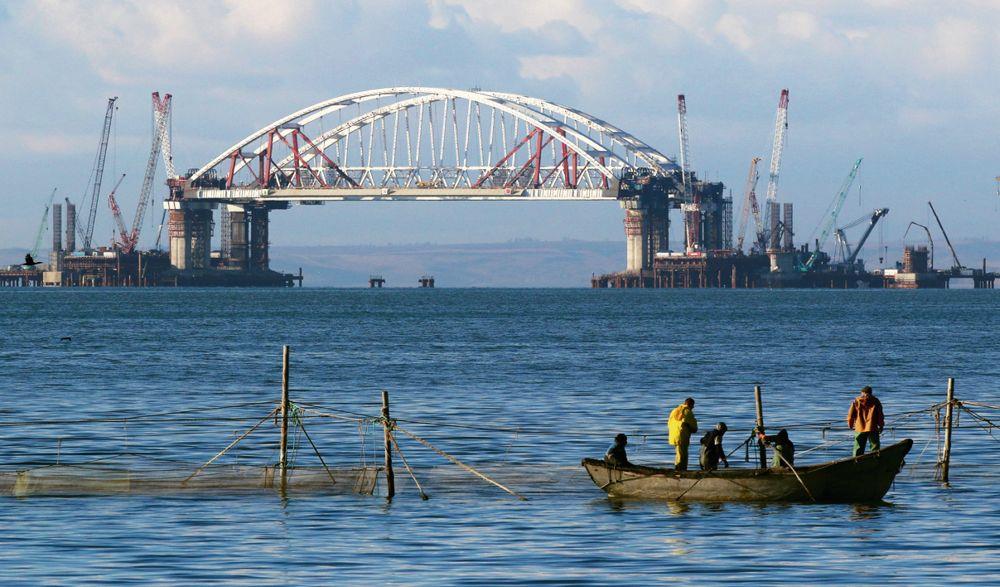
Breached: With the attack on the Crimean Bridge, Ukrainian President Zelenskyy has crossed a red line that Moscow had warned him against. Reuters

By MK Bhadrakumar

Source: The Tribune of India

Two massive terrorist strikes misfired spectacularly and a terrible beauty is born in the Ukraine war. These two carefully planned attacks in quick succession — on Nord Stream gas pipelines and Crimean Bridge — were intended as a knockout blow to Russia. According to President Vladimir Putin, people ‘who want to finally sever ties between Russia and the EU, weaken Europe’ are behind the Nord Stream blasts. He named the US, Ukraine and Poland as ‘beneficiaries’.

Last Wednesday, Russia’s domestic intelligence service FSB identified Ukraine’s military intelligence chief, Kyrylo Budanov, as the mastermind behind the Crimean attack. The New York Times and Washington Post also pointed fingers at Kiev, quoting ‘sources’. While Nord Stream-1 has been crippled, one of the strings of Nord Stream-2 remains intact. Putin said last week that the pipeline could be restored and Russia could deliver about 27 billion cubic metres of gas. ‘The ball is on the side of the European Union, if they want — let’s turn on the tap,’ he said.

But mum’s the word from Brussels. It is a profoundly embarrassing moment for the EU. The triumphalism has vanished as Europe is threatened by years of recession caused by the blowback from sanctions against Russia, where the US insisted on the cut off of energy ties with Moscow. The EU has now become a captive market for Big Oil and is left to buy LNG from the US at the asking price, which is six to seven times higher than the domestic price in the US. (Contracted price for long-term Russian supply for Germany used to be about $280 per 1,000 cubic metres as against the current market price hovering around $2,000.)

Plainly put, the Europeans have been nicely played by the Americans. India should take note of the US’ sense of entitlement. Basically, the Biden administration created a contrived energy crisis whose real aim is war profiteering.

The Crimean Bridge attack of October 8 is much more serious. Zelenskyy has crossed a red line that Moscow had repeatedly warned him against. Putin has disclosed that there have also been three terrorist attacks against the Kursk NPP. Russians will settle for nothing less than the ouster of the Zelenskyy regime.

Russia’s retaliation against Ukraine’s ‘critical infrastructure’, something Moscow refrained from so far, has serious implications. Since October 9, Russia has begun systematically targeting Ukraine’s power system and railways. Noted Russian military expert Vladislav Shurygin told Izvestia that if this tempo was kept up for a week or so, it ‘will disrupt the entire logistics of the Ukrainian military — system for transporting personnel, military equipment, ammunition, related cargo, as well as the functioning of military and repair plants.’

The Americans are cocooned in a surreal world of their self-serving narrative that Russia ‘lost’ the war. In the real world, though, Ivan Tertel, KGB chief in Belarus, who has an insider view of Moscow, said last Tuesday that with Russia boosting its troop strength in the war zone — 3 lakh troops who have been mobilised plus 70,000 volunteers — and the deployment of advanced weaponry, ‘the military operation will enter a key phase. According to our estimates, a turning point will come in the period from November of this year to February of next year.’

Policy-makers and strategists in Delhi should make a careful note of the timeline. The bottom line is, Russia is looking for an all-out victory and will not settle for anything less than a friendly government in Kiev. Western politicians, including Biden, understand that there is nothing stopping the Russians now. The US’ weapon kitty is running dry as Kiev keeps asking for more.

When asked whether he’d meet Biden at the G20 in Bali, Putin derisively remarked on Friday, ‘He (Biden) should be asked whether he is ready to hold such negotiations with me or not. To be honest, I don’t see any need, by and large. There is no platform for any negotiations for the time being.’

However, Washington has not yet thrown in the towel and the Biden administration remains obsessed with exhausting the Russian military — even at the cost of Ukraine’s destruction. And, for the Russians too, there is still much to be worked out on the battlefield: the oppressed Russian populations in Odessa (which suffered unspeakable atrocities from the neo-Nazis), Mykolaiv, Zaporizhya, Dnipropetrovsk, Kharkov are expecting ‘liberation’. It’s a highly emotive issue for Russia. Again, the overarching agenda of ‘demilitarisation’ and ‘denazification’ of Ukraine must be taken to its logical conclusion.

When all that is over, Putin knows Biden will not even want to meet him. Hungarian PM Viktor Orban said last week, ‘Anyone who seriously believes that the war can be ended through Russian-Ukrainian negotiations lives in another world. Reality looks different. In reality, such issues can only be discussed between Washington and Moscow. Today, Ukraine is able to fight only because it receives military assistance from the United States…

‘At the same time, I do not see President Biden as the person who would really be suitable for such serious negotiations. President Biden has gone too far. Suffice it to recall his statements to Russian President Putin.’

India should expect the defeat of the US and NATO, which completes the transition to a multipolar world order. Sadly, Indian elites are yet to purge their ‘unipolar predicament’. Europe, including Britain, is devastated and there is palpable discontent over the US’s ‘transatlantic leadership’. Indo-Pacific strategy is hopelessly adrift. New power centres are emerging in India’s extended neighbourhood, as the OPEC’s rebuff to Washington shows. A profound adjustment is needed in the Indian strategic calculus.

NATO prolongs the Ukraine proxy war, and global havoc

With diplomacy thwarted, the US and its allies plan for “open-ended” military and economic warfare against Russia, no matter the costs at home and abroad.

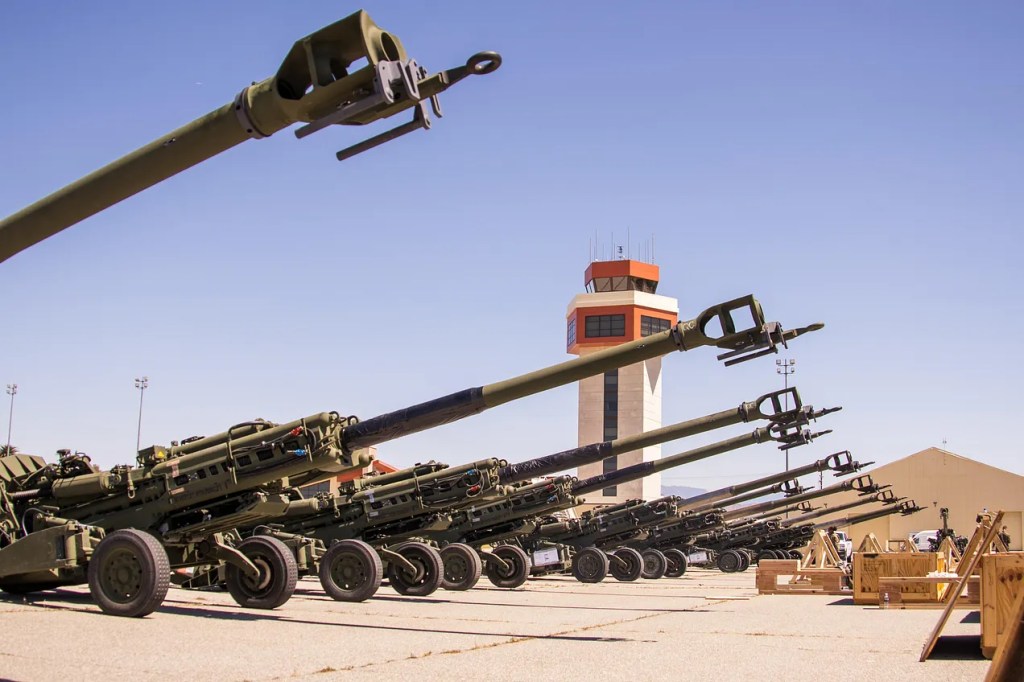
(US Dept. of Defense)

By Aaron Maté

Source: Aaron Mate Substack

Russia has announced plans to mobilize an additional 300,000 troops for the war in Ukraine. In his speech unveiling the expanded war effort, Vladimir Putin vowed to achieve his main goal of the “liberation of Donbas,” and issued a thinly veiled nuclear threat in the process. The move comes days ahead of planned referendums in breakaway Ukrainian areas to formalize Russian annexation.

Russia’s escalation ensures that the fighting is entering an even more dangerous phase. While Russia bears legal and moral responsibility for its invasion, recent developments underscore that NATO leaders have shunned opportunities to prevent further catastrophe and chosen instead to fuel it.

Putin’s announcement comes just after the Ukrainian military’s routing of Russian forces from Kharkiv, which relied extensively on US planning, weaponry and intelligence, sparked triumphant declarations that the tide has turned.

According to The Atlantic’s Anne Applebaum, “Americans and Europeans need to prepare for a Ukrainian victory,” one so overwhelming that it may well bring “about the end of Putin’s regime.”

Beyond the chorus of emboldened neoconservatives, Western officials are less sanguine.

“Certainly it’s a military setback” for Russia, a US official said of the Kharkiv retreat to the Washington Post. “I don’t know if I could call it a major strategic loss at this point.” Germany’s defense chief, General Eberhard Zorn, said that while Ukraine “can win back places or individual areas of the frontlines,” overall, its forces can “not push Russia back over a broad front.”

Whether or not it marked a major strategic loss for Russia, the battle in Kharkiv is already a major victory for NATO leaders seeking to prolong their proxy war in Ukraine and economic warfare next door.

Ukraine’s expulsion of Russian forces in the northeast, the New York Times reports, has “amplified voices in the West demanding that more weapons be sent to Ukraine so that it could win.”

“Despite Ukrainian forces’ startling gains in the war against Russia,” the Washington Post adds, “the Biden administration anticipates months of intense fighting with wins and losses for each side, spurring U.S. plans for an open-ended campaign with no prospect for a negotiated end in sight.”

As has been apparent since the Ukraine crisis erupted, US planning for open-ended proxy warfare against Russia has led it to sabotage any prospect of a negotiated end.

The US rejection of diplomacy around Ukraine has been newly substantiated by former White House Russia expert Fiona Hill. Citing “multiple former senior U.S. officials,” Hill reports that in April of this year “Russian and Ukrainian negotiators appeared to have tentatively agreed on the outlines of a negotiated interim settlement.” Under this framework, Russia would withdraw to its pre-invasion position, while Ukraine would pledge not to join NATO “and instead receive security guarantees from a number of countries.”

In confirming that US officials were aware of this tentative agreement, Hill bolsters previous news that Washington’s junior partner in London was enlisted to thwart it. As Ukrainian media reported, citing sources close to Ukrainian President Volodymyr Zelensky, UK Prime Minister Boris Johnson traveled to Kiev in April and relayed the message that Russia “should be pressured, not negotiated with.” Johnson also informed Zelensky that “even if Ukraine is ready to sign some agreements on [security] guarantees with Putin,” his Western patrons “are not.” The talks promptly collapsed.

In his speech announcing the expanded war effort, Putin invoked this episode. After the invasion began, he said, Ukrainian officials “reacted very positively to our proposals… After certain compromises were reached, Kyiv was actually given a direct order to disrupt all agreements.”

Having undermined the prospect of a negotiated peace in the war’s early weeks, proxy warriors in Washington are openly celebrating their success.

“I like the structural path we’re on here,” Republican Senator Lindsey Graham recently declared. “As long as we help Ukraine with the weapons they need and the economic support, they will fight to the last person.”

Graham’s avowed willingness to expend every “last person” in Ukraine to fight Russia is in line with a broader US strategy that views the entire world as subordinate to its war aims. As the Washington Post reported in June, the White House is willing to “countenance even a global recession and mounting hunger” in order to hand Russia a costly defeat. In Ukraine, this now means also countenancing the threat of nuclear disaster, as the crisis surrounding the Zaporizhzhia nuclear power plant has laid bare.

The prevailing willingness to sacrifice civilian well-being extends to the US public, as National Security Advisor Jake Sullivan has newly made clear. Appearing at the Aspen Security Conference, Sullivan was asked if he is worried about the “American people’s staying power” on the Ukraine proxy war, amid “criticism that we’re spending billions and billions to support Ukraine, and not spending it here.”

 “Fundamentally not,” Sullivan responded. “It’s very important for Putin to understand what exactly he’s up against from the point of view of the United States’ staying power.” That staying power, Sullivan explained, was cemented in the $40 billion war funding measure overwhelmingly approved by Congress (including every self-identified progressive Democrat) in May.

“That can go on, just on the basis of what we have already had allocated to us and resources for a considerable period of time,” Sullivan vowed. “And then, I strongly believe that there will be bipartisan support in the Congress to re-up those resources should it become necessary.”

To policymakers like Sullivan, there is not only an endless pool of money to “re-up” the war, but a “fundamentally” indifferent posture toward the taxpayers footing the bill.

Despite Biden’s reported scolding of Defense Secretary Lloyd Austin for admitting that the US goal in Ukraine is to leave Russia “weakened,” Sullivan – speaking before a friendly Beltway crowd — also forgot to stick to the script.

The US “strategic objective” in Ukraine, Sullivan explained, is to “ensure that Russia’s invasion of Ukraine… is a strategic failure for Putin,” and that “Russia pay a longer-term price in terms of the elements of its national power.” This would teach a “lesson,” he added, “to would-be aggressors elsewhere.”

By “would-be aggressors elsewhere”, Sullivan naturally precludes the US and its allies, whose aggression is not only permitted but promoted under the US-led “rules-based international order.”

President Biden has made that clear by abandoning his pledge to make Saudi Arabia a “pariah” state, notwithstanding its murderous (US-backed) aggression in Yemen. The regular aggression by US ally Israel against Gaza and Syria also continues unabated. The United Nations just reported that an Israeli strike on the Damascus international airport in June – one of hundreds of Israeli bombings on Syria that go largely ignored — “led to considerable damage to infrastructure” and “meant the suspension of U.N. deliveries of humanitarian assistance” to Syrians in need for nearly two weeks. As of this writing, the latest Israeli strike killed five Syrian soldiers, eliciting no Western media and political protest. It is more accurate to describe Israeli aggression on Syria as a joint Israeli-US effort, given that the US reviews and approves the strikes.

Allied NATO leaders are also vocally countenancing the Ukraine proxy war’s costs on their domestic populations. In response to the European sanctions, Russia has now halted gas deliveries to the EU via the key Nord Stream 1 pipeline. Having previously relied on Russia for close to 40 percent of its gas needs, European industries are facing layoffs, factory closures, and higher energy bills that “are pushing consumers to near poverty,” the Financial Times reports.

“People want to end the war because they cannot bear the consequences, the costs,” the EU’s Josep Borell observed this month. While ending the war might appeal to some, it does not interest the EU’s top diplomat. “This mentality must be overcome,” Borell declared. “The offensive on the northeastern front helps with that.”

Europe, NATO chief Jens Stoltenberg recently wrote, may even face “civil unrest,” as economies contract and temperatures drop, but “for Ukraine’s future and for ours, we must prepare for the winter war and stay the course.”

“No matter what my German voters think, I want to deliver to the people of Ukraine,” Germany’s Foreign Minister Annalena Baerbock told a conference in Prague last month. During the upcoming winter, Baerbock acknowledged, “we will be challenged as democratic politicians. People will go in the street and say ‘We cannot pay our energy prices’.” While pledging to help people “with social measures,” Baerbock insisted that the European Union’s sanctions on Russia will remain. “The sanctions will stay also in wintertime, even if it gets really tough for politicians,” she said.

Whereas Western leaders appear confident they can manage civil unrest at home, they face additional resistance abroad. In Africa, a leaked report from the European Union’s envoy to the continent warns that African nations are blaming the EU’s Russia sanctions for food shortages. The report also cautions that “the EU is seen as fueling the conflict,” in Ukraine, “not as a peace facilitator.”

Rather than address these African concerns, the envoy’s office proposes a “more transactional… approach” in which the EU makes “clear” that its “willingness” to “maintain higher levels” of foreign aid “will depend on working based on common values and a joint vision,” – in short, on Africa falling in line.

That is undoubtedly the US policy, as UN Ambassador Linda Thomas-Greenfield made clear last month. After promising a “listening tour,” Thomas-Greenfield instead came to Africa with a dictate and an outright threat. “Countries can buy Russian agricultural products, including fertilizer and wheat,” she decreed. But “if a country decides to engage with Russia” and break US sanctions, “they stand the chance of having actions taken against them.” That Africa faces a food security crisis, with hundreds of millions going hungry, is apparently of lower importance.

While Western sanctions on Russia wreak havoc worldwide, the architects in Washington seem only perturbed by their failure, so far, to inflict the intended levels of suffering on Russian civilians. “We were expecting” that US sanctions “would totally crater the Russian economy” by now, a disappointed senior US official told CNN.

Other US officials are leaving room for hope. “There’s going to be long-term damage done to the Russian economy and to generations of Russians as a result of this,” CIA Director William Burns told a cybersecurity conference this month. Burns’ long-term forecast of harming “generations of Russians” is based on extensive planning. As one US official explained it to CNN, when the sanctions were designed, Biden officials not only “wanted to keep pressure on Russia over the long term as it waged war on Ukraine,” but also “wanted to degrade Russia’s economic and industrial capabilities.” Accordingly, “we’ve always seen this as a long-term game.”

The “long-term game” of trying to destroy Russia’s economy and immiserate “generations” of its citizens is accompanied by increasing plans for a long-term fight. The Biden administration plans to formally name the US military mission in Ukraine – such as in prior campaigns like Operation Desert Storm — while also appointing a general to oversee the effort. The naming, the Wall Street Journal observes, is “significant bureaucratically, as it typically entails long-term, dedicated funding.”

The US plan for a long-term military and economic campaign against Russia is being implemented despite the awareness that Ukraine could face far worse.

“Some American officials express concern that the most dangerous moments are yet to come,” the New York Times reports. To date, “Putin has avoided escalating the war in ways that have, at times, baffled Western officials.” Unlike US military campaigns in Iraq, Russia “has made only limited attempts to destroy critical infrastructure or to target Ukrainian government buildings.”

“The current moment draws attention to a tension that underlies America’s strategy for the war,” the Washington Post observes, “as officials channel massive military support to Ukraine, fueling a war with global consequences, while attempting to remain agnostic about when and how Kyiv might strike a deal to end it.”

These rare admissions not only contradict the typical portrayal of a genocidal Russia that is used to justify the proxy war, but capture the underlying policy driving it. More than six months in, US officials are aware that Russia has “avoided escalating the war” and targeting “critical infrastructure,” – to the point where these same officials are “baffled” by Russian restraint. Despite this, their policy centers on “fueling” this same war, while remaining “agnostic” about ending it.

War being fluid – and US-led military support for Ukraine ever-expanding – it is of course possible that Ukraine will continue to defy expectations and drive out the invading Russian forces.

What the latest developments on and off the battlefield make undoubtedly clear is that NATO states are willing to use Ukraine for as long as it takes to achieve the stated aim of leaving Russia “weakened” or even achieving regime change, no matter the damage knowingly inflicted on Ukrainians, Russians, the Global South, and their own citizens.