By Luther Blissett and J. F. Sebastian of Arkesoul
A few years ago, Neal Stephenson wrote a widely-shared article called Innovation Starvation for the World Policy Institute. He began the piece lamenting our inability to fulfill the hopes and dreams of mid-20th century mainstream American society. Looking back at the majority of sci-fi visions of the era, it’s clear many thought we’d be living in a utopian golden age and exploring other planets by now. In reality, the speed of technological innovation has seemingly declined compared to the first half of the 20th century which saw the creation of cars, airplanes, electronic computers, etc. Stephenson also mentions the Deepwater Horizon oil spill and Fukushima disasters as examples of how we’ve collectively lost our ability to “execute on the big stuff”.
Stephenson’s explanation for this predicament is two-fold; outdated bureaucratic structures which discourage risk-taking and innovation, and the failure of cultural creatives to provide “big visions” which dispute the notion that we have all the technology we’ll ever need. While there’s much to be said about archaic, inefficient (and corrupt) bureaucracies, there’s also a compelling argument invoked over the cultural importance of storytelling and art and how best to utilize it. One of the solutions offered by Stephenson, in this regard, is Project Hieroglyph which he describes as “an effort to produce an anthology of new SF that will be in some ways a conscious throwback to the practical techno-optimism of the Golden Age.”
While Project Hieroglyph may be a noble endeavor, one could argue that it’s based on a flawed premise. The role of science fiction has never been just about supplying grand visions for a better future, but to make sense of the present. There seems to be an assumption that the optimistic Golden Age had a causal relationship with a perceived technological golden age when it may have simply been a reflection of it— just as dystopian sci-fi reflects and strongly resonates with the world today. Stephenson may be correct in his view that much SF today is written in a “generally darker, more skeptical and ambiguous tone”, but this more nuanced perspective does not necessarily signify the belief that “we have all the technology we’ll ever need”. Rather, it reflects decades of collective experience and knowledge of unforeseen and cumulative effects of technologies. Nor does such fiction focus only on destructive effects of technology, as large a component of the narrative it may be simply because it makes for better drama and the subtext is often intended as a critique rather than celebration. For example, the archetypal hacker protagonists of technocratic cyberpunk dystopias employ technology for more positive ends (though some question whether good SF, as in speculative fiction, needs to involve new technology at all).
A particularly positive function for dystopian sci-fi is its use as rhetorical shorthand. It’s increasingly common in public discourse on major issues of the day to invoke dystopian references. Disastrous social effects of peak oil or post-collapse are often characterized as Mad Max scenarios. Various negative aspects of genetic modification and pharmaceutical development conjure Brave New World. Anxiety over out-of-control AI and resultant devaluing of human life brings to mind films as varied as Blade Runner, The Matrix and Terminator films. The expanding police/surveillance state is reminiscent of 1984 and numerous classics which have followed in its footsteps including V for Vendetta and Brazil. General fears of duplicitous, psychopathic power elites and social manipulation have elevated They Live from relatively obscure b-movie to cult classic. The entry of the term “zombie apocalypse” into the popular lexicon may in part stem from fear (and uncomfortable recognition) of images of viral social disintegration and martial law-enforced containment efforts depicted throughout various media. The burgeoning omnipotence of multinational corporations and hackers in Mr. Robot may have been the stuff of cyberpunk dystopias such as Neuromancer and Max Headroom 30 years ago, yet, it still has much to contribute to the public discourse as contemporary drama. Such visions may not prevent (or have not prevented) the scenarios they warn us of but have provided a vocabulary and framework for understanding such problems, and who’s to say how much worse it could be had such cautionary memes never existed?
The prophetic nature of storytelling, inasmuch as it derives from the minds of authors, artists and commentators that coexist with tensions and contexts particular to their epochs, resonate with the oughts, ifs, and whats inherent to our daily lives. As it were, the cautionary element of narrative is a natural product of the human mind, and the premium of what involves sharing our mental reserves to the world. To creatively dwelve and concoct problems and solutions from experience, is an axiom analogous to that of the categorical imperative—purely, and in abstract terms of what rationality involves. Yet, often times, we find material that is in favor of cultural malaise; of all things pathological in our society, such as censorship, conformity, bureaucracy, authoritarianism, militarism, and capital marketing; things which underpin issues that, if left untouched, can engulf the real brilliance of our spirit.
Stephenson fails to see this point. SF, as any form of intelligent culture, denounces and opposes systems of oppression, and even shows us the how, when, and why—the frameworks, the makings of apparent utopias into dystopias. Dystopian storytelling can serve the efforts of downtrodden creators with utopian ideals as effectively as utopian stories can reframe a societal trajectory led by beneficiaries of real world dystopia (though it may be experienced as utopia for a privileged few). SF does not only conjure visions of better futures. They lend us vocabularies and syntaxes to understand, and impede the fallenness of a confused, and ever increasingly isolated humanity. They are languages that pervade our interiorities, and that allow the exterior to change.
At the core, SF is prophecy through reasoned extrapolation and artistic intuition. This is what SF stands for when properly aligned with the subjectivities of the oppressed, and not with the voices of oppression: true testaments of a space and a time; visions of the future that carefully partake in not committing the mistakes of the past; and tools for our personal and collective flourishing.
A film about civilization, why we should bring it down and why most civilized people don’t.
[THE FUCK-IT POINT]
‘When you have had enough. When you decide to take matters into your own hands and don’t care what’s going to happen to you. When you know that from now on you will resist with whatever tactic you think is most effective.’
In 2015, a group of scientists published ” The trajectory of the Anthropocene: The Great Acceleration “. They showed that rising consumption and increasing rates of impact on Earth Systems began after the Second World War. It was the expansion of economic activity charged by increasing resource use that created new technologies that expanded rates of consumption. This was a celebrated new socio-economic phase called the Great Acceleration that was supposed to lead to full employment and a bright future for all. It was also the beginning of a next phase of world capitalism accelerated by increasing urbanization. By 2008 humanity officially entered a new urban phase where 50% of the earth’s population lives in urban spaces. More cities will be built in the next thirty years than in all previous human history. Earth System scientists have shown that all of these changes are having unprecedented impacts on the Earth. Human life is changing the Earth, they call it anthropocene.
But the Great Acceleration did not lead to full employment nor a bright future. In fact, it has led to massive inequality created by a very small percentage of people controlling a staggering amount of wealth. In 2010, OECD countries had 18% of the earth’s population but accounted for 74% of GDP. But only .1% controlled this vast wealth through a system that I call predatory anthropocene.
The system of predatory anthropocene can be found in changes to the global economy and a fundamental shift in the way the economy works through its transformation of subjective, social and environmental ecologies, what Felix Guattari called the Three Ecologies. One aspect of this change has been called semiocapitalism, the blending of imagination, ideas, language and capital. Semiocapitalism works by capturing evolutionary life. Belonging, for instance, is now produced by the consumption of psycho-social products that gain economic value in consumption and are financed by increasing debt. The GDP of the United States is now 70% consumption.
Making community through mass consumption is eroding the anthropological basis upon which human life is built. We need a language for this. Perhaps we need to recognize that the communicative and biological systems of the human species have habitats. The biosphere sustains biological life while the ethnosphere sustains communicational life. The biosphere is quite well known but the ethnosphere less so. Wade Davis suggests that the ethnosphere is a global quilt of local cultures, a band of cultural life functioning in tandem with the biosphere for the creation, organization, and expression of human communicational life.[1] The ethnosphere is a collection of languages, ideas, and dreams. It is the anthropological rituals that have accompanied human evolution, has organized social reproduction, it is the institution of language [2] in all its complexity, but is also beyond language.[3] When people talk about humanity in general, they mean the biosphere and ethnosphere, the cultures of the world in their physical, expressive, subjective dimensions. But now ethnosphere complexity is reduced by global commodities, unique cultures consumed by Hollywood-hegemony, human imagination consumed by consumer products, dreams being replaced by corporate produced and globalized desires. A single system is producing hegemony in ways that no single system was ever before capable. It is necessary for us to see that our species is under threat by a monster system that we have created, a monsterous, cancerous, predatory system poisoning the Earth. Henry Giroux has argued that:
What makes American society distinct in the present historical moment are a culture and social order that have not only lost their moral bearings but produce levels of symbolic and real violence whose visibility and existence set a new standard for cruelty, humiliation, and mechanizations of a mad war machine, all of which serves the interest of the political and corporate walking dead-the new avatars of death and cruelty-that plunder the social order and wreak ecological devastation. We now live in a world overrun with flesh-eating zombies, parasites who have a ravenous appetite for global destruction and civic catastrophe. (2014, xi-xii)[4]
Because I follow Guattari’s cybernetic view I am less certain than Giroux appears to be, that is it possible to tell zombies from non-zombies in a period where a) agribusiness replaces agriculture and transforms all aspects of domestic life that b) creates stretches of suburbs that wipe out, without social discussion, the farmland that has laid the foundation of human flourishing, c) as mounting debt continues without slowing and without discourse in the public sphere, as d) waves of fellow humans are dislocated everyday due to military, economic, and environmental calamities. And none of this is news, we watch all of it studiously, staring at our displays unmoved by the misery and pain we see on the faces, and hear in the cries of fellow humans. Too many of us escape our responsibilities to confront this pain by fleeing to walled-in communities whose walls are maintained, not by bricks but by the capacity to carry the mortgage debt (that machinically contributes to predatory anthropocene) in the hopes of living in relative safety while the poor (who can not access debt) are left in decaying city centers. But as foreclosures swept across America after the housing bubble burst, suburban safety was shown to be precarious. It is important for us to take notice of the fact that we know all of this and collectively do very little to change it. We sign petitions on Facebook, but we still shop at malls that we built on farmland and we clearly have little access to empathy. And I am not saying this to be critical of you. I am truly stuck. After many years of being inspired by Adbusters and semio-politics and culture jamming I’m not sure what the next step is. I feel free space disappearing. I’m looking for options.
This difficulty of expressing empathy tells us something about hegemony under semiocapitalism. We now know that empathy is not something we develop, but something that we shut down. Vittorio Gallese in ” The Manifold Nature of Interpersonal Relations: The Quest for a Common Mechanism” has shown that for us to “know that another human being is suffering or rejoicing, is looking for food or shelter, is about to attack or kiss us, we do not need verbal language” (Virno 2008: 175) we only need the activation of what Gallese called mirror neurons a “class of premotor neurons [that] was discovered in the macaque monkey brain that discharged not only when the monkey executes goal-related hand actions like grasping objects, but also when observing other individuals (monkeys or humans) executing similar actions” (Gallese: 522). Experiments successfully illustrated that mirror neurons were also in the human brain “positioned in the ventral part of the inferior frontal lobe, consisting of two areas, 44 and 45, both of which belong to the Broca region” (Virno: 177). Mirror neurons allow us to experience what we see. When we see someone doing something that we’ve never done, our brain reacts as if we are doing it, what Gallese calls “embodied simulation.” This means that empathy is not something that we need to develop it is something that is functioning in our brains whether we like it or not. But as Paulo Virno points out, humans are clearly adept at seeing other humans as not-humans in order to override “embodied simulation”. We are constantly unmoved watching violent death in both fiction and non-fiction, and constantly enacting laws to restrict sexuality and eroticism in the social sphere. In this context there is little doubt that a public pedagogy of human negation is taking place that values violence and negates the erotic energy that produces new human life! What this means is that “every naturalist thinker must acknowledge one given fact: the human animal is capable of not recognizing another human animal as being on of its own kind.” How does this public pedagogy of negation occur? Virno argues that verbal language, “distinguishes itself from other communicative codes, as well as from cognitive prelinguistic performance, because it is able to negate any type of semantic content.”(176). Through language we are able to negate others as not-human, shutting down the empathy that is produced by mirror neurons. But all is not lost as Paulo Freire points out, pedagogies of dehumanization can be countered through critical pedagogy. That we might learn to negate dehumanization is our hope, to dissolve the oppressor-oppressed binary through the creation of new anti-predatorial segnifications. Virno suggests that while language introduced human-negation into communication it also provides us the technology to negate-negation. In this way critical pedagogy is the negation-of-negation. But only when it is used in this way. I make one amendment to Virno’s suggestion, that it is necessary to go beyond the notion of linguistic negation to identify the ways that negation is in the production of subjectivity, not just in the linguistic negation but in complex existential negations that occur within complex machinic semiotics. It is necessary to see the ways that the production of aesthetic systems produces collective subjectivities that produce We’ness as well as Other’ness.
Cultural technologies produce cultural workers who reproduce subjectivity-producing systems that produce subjects who reduce the ethnosphere and pollute the biosphere. Theodore Adorno was right to be concerned about the culture industry just as Walter Benjamin saw with clear sight the dangers of the absorption of aesthetics into politics. They both saw that the industrialization of the satisfaction of desire, what we might call affective-capitalism, has significant socio-political-economic impacts. There is a real danger when anthropological rituals developed for the social life are replaced by capitalist products. The production and satisfaction of desire on the marketplace is a constantly undermining of love of the local, a replacement of belonging with having the same mass manufactured private property, the replacement of environmentally-embedded anthropological bonds with capital resource consuming exchange. The production of subjectivity is consumed by the factory, negating living, thus extending the contractions of capitalism beyond the factory into all aspects of live time. Giroux has called this a “new kind of authoritarianism that does not speak in the jingoistic discourse of empowerment, exceptionalism, or nationalism. Instead, it defines itself in the language of cruelty, suffering, and fear, and it does so with a sneer and an unbridled disdain for those considered disposable. Neoliberal society mimics the search for purity we have seen in other totalitarian societies” (2014, xvii). And it does so through the production of subjectivity, in the distribution of social subjection and the institution of machinic enslavement. Together these form the contents of the public pedagogy of culture industry, the negation of lived time that blocks access to mirror neurons, limits our ability to negate the negations of the neoliberal culture industry, thus limiting our ability to resist through the production life affirming social machines, liberatory and collectively produced social subjectivations and life affirming machinic enslavements. I, Terminator
Some people however, are arguing that the changes I call predatory anthropocene are a step forward for humanity. Luciano Floridi, for instance, imagines a new humanity as interconnected informational organisms (inforgs) active in “sharing with biological agents and engineered artifacts, a global environment ultimately made of information” (2011,9). Collectively these inforgs produce an infosphere that either replaces or contributes to the ethnosphere. But Floridi does not account for political economy and therefore misses that his dreams of the infosphere are enslaved by the algorithms of capitalism.
Franco ‘Bifo’ Berardi however, shows that inforgs are not liberated informational workers but are ‘cognitariate’ (exploited proletarians of information) controlled by the automatisms of machinic enslavements, no longer disciplined but under subjectively captured within the new means of control. Machinic enslavement is not discipline, but it is none-the-less controlling. No longer is there a need for an authority to hover over your shoulder to keep you in line. Machinic enslavement works to lead you into accepting the circuits of capture and control embedded cybernetically in modes of production, exchange and consumption. In the machinic enslavement of predatory anthropocene your only value is through economic consumption, and control is located in your desire to fulfill your consumptive role. Desire (libidinal, economic, social) is no longer a location of liberation, but a mechanism of discipline. This is power within predatory anthropocene.
Floridi’s infosphere and its cognitarians are colonizers machinically enslaving dreams and desires. Their colonization does not in fact produce the infosphere but instead a nightmarish mechanosphere. The mechanosphere converts the anthropological ethnosphere into capitalist products, cognitive capitalism “produces and domesticates the living on a scale never before seen” (Boutang 2011, 48). Felix Guattari and Franco Berardi “emphasize that entire circuits and overlapping and communicating assemblages integrate cognitive labor and the capitalistic exploitation of its content”[5] in a model they call semiocapitalism, that captures “the mind, language and creativity as its primary tools for the production of value”( Berardi 2009, 21). Our language is being transformed into capitalist value, our words, dreams, desires and subjectivities are lost to the mechanosphere, “the authoritarian disimagination machine that affirms everyone as a consumer and reduces freedoms to unchecked self-interest while reproducing subjects who are willingly complicit with the plundering of the environment, resources, and public goods by the financial elite” (Giroux 2014, xxi).
Predatory anthropocene not only massively increases earth system impacts but creates massive inequality. In early 2015 year Oxfam released Working for the Few a terrifying document that shows, “Almost half of the world’s wealth is now owned by just one percent of the population” and that, “The bottom half of the world’s population owns the same as the richest 85 people in the world,” and that this already extreme economic disparity is getting worse.
But we do not tell stories of predatory anthropocene to our children. Instead we tell myths of consumption, stories of gleeful elves happily working in non-unionized factories making toys for unproblematically good children, all the while supported by a covert group of elf spies that complicit parents move around their house for weeks. This is the childhood public pedagogy of predatory anthropocene where domestic life is machinically enslaved to global capitalism, domesticated to surveillance-of-consumption, young lives converted to effective consumer-citizens. Perhaps it’s time to start telling our children the very true story of predatory anthropocene, the killer system that we have created and released into our world but refuse to name, refuse to accept, and spend a great deal of money and words denying. There is no sense denying predatory anthropocene, we need to talk of the monster that is killing our planet, we need to develop a critical pedagogy of predatory anthropocene, to learn to negate the negation.
Notes
[1] Davis, Wade. (2007). Light at the Edge of the World: A Journey Through the Realm of Vanishing Cultures. Vancouver, BC: Douglas &McIntyre Ltd.
[2] Virno, Paolo. (2008). Multitude: Between Innovation and Negation. Los Angeles, California: Semiotext(e)Foreign Agents Series.
[3] Here I am thinking about post Spinozist philsophers that argue for a semiotics beyond language signification and even beyond logocentric significations and include Gilles Deleuze, Felix Guattari, Michel Foucault, Maurizio Lazzarato, Rosi Braidotti. Most compelling is the Deleuze and Guatarri suggestion that Lazzarato has picked up on in Signs and Machines and Governing by Debt that there is a machinic order as well as a logocentric order. My argument here is that predatory anthropocene functions through a machinic order that is little impacted by traditional semiotics, by political sloganeering, or even by radical critique. That there must be a politics of doing, or dropping out of predatory anthropocene in the way that Franco ‘Bifo’ Berrardi suggests in After the Future.
[4] Giroux, Henry (2014). Zombie Politics and Culture in the Age of Casino Capitalism New York: Peter Lang Press.
[5] Genosko, Gary. 2012. Remodeling Communication: From WWII to WWW. Toronto, Can: University of Toronto Press. (pg. 150)
There is plenty of regret to go around about the wholescale waste of the immense virgin forests in pre-20th century America. These forests represented a cheap, high-quality building material to early Americans and a profitable export that only required rudimentary tools and a healthy portion of elbow grease to attain. Unfortunately, the citizens of 19th century America (a few of whom became very rich) did not exhibit the conscientiousness nor collective restraint to prevent from despoiling the vast majority of these invaluable and dignified forests. It simply did not occur to them (until Teddy Roosevelt spearheaded the conservation movement and hippies formed the environmental movement) that this timber resource is exhaustible, and once exhausted practically irreplaceable.
For example, during the early history of my home state of Michigan, it is said that a squirrel could traverse from Lake Huron to Lake Michigan without ever touching the ground. Yet it took an incredibly small amount of time (mostly 1870-1890) for men with hand-drawn felling saws to systematically evacuate every virgin tree on the entire peninsula. The scale and speed of this relentless logging machine still baffles me to this day. In fact, the harvest was so unimaginably great that a profitable industry exists today of recovering the very small percentage of fine old-growth logs that sank during transport and have rested on the bottom of the Great Lakes for 150 years.
Imagine, if you would, that we had saved some portion of these magnificent, centuries-old trees until today. What would a good violin luthier do these days for some now-rare, quality old-growth tone wood? How impressive would Michigan’s tourism industry be if we had thought to save more than just a few monument virgin trees? We can never know.
Yet we find numerous analogs to this 19th-century state-of-mind today. One remarkable example is our prodigious waste of what is a very finite and valuable resource, helium. Helium and its fellow noble gas, argon, both naturally occur on Earth because of radioactive decay (argon as a decay product of potassium-40, helium as an alpha particle from the decay of various radioactive substances inside the earth, mostly thorium). Interestingly, argon composes about 1% of the Earth’s atmosphere whereas helium is only found in trace quantities. This is because helium is SO light that, once released, it actually floats completely out of the atmosphere, which means once it is extracted from its underground home (through a natural gas well) it must be contained or it will literally disappear into outer space during the next solar storm.
But why is helium valuable, you say? Interesting question. As well as being widely used in arc-welding, manufacture of computer chips, and fiber optics, helium finds applications in ultra-low temperature measurements and experiments (since liquid helium is the coldest liquid there is at 4 degrees Kelvin), and is 2nd to none. Liquid helium is used to cool the magnets in MRI scanning, NMR spectroscopy, and a variety of other low-temperature scientific experiments (96 metric tons of it are used in the particle accelerator at CERN, and 120 metric tons were used to launch the Saturn V rocket). In fact, universities and scientific laboratories have large and expensive apparatuses to recycle the copious amounts of helium that is regularly used in scientific experimentation.
The United States actually has a National Helium Reserve based near Amarillo, Texas which was established in 1925 as a source for airships in a time of war. It expanded during the Cold War as a resource for the Space Race and other scientific research (unfortunately we still live in an era of our nation where technological advancements are almost invariably spearheaded by military research). By 1995 the reserve had accumulated not only 450 million tons of helium but also $1.4 billion in debt, so congress decided to offset the liability through completely selling off the helium by 2015 and privatizing the helium production industry. The Strategic Helium Reserve being the only helium reserve in the world, this rather abrupt selling-off had the effect of greatly reducing the price.
As happened in the 19th century when huge forests were being felled as quickly as possible, a glut of supply and a cheap price creates the natural propensity for wanton waste of a product. Even though party balloons are the most visible and frivolous waste of helium, (at some dollar stores one can purchase a balloon WITH helium for $1) they only account for about 8% of overall consumption. The larger users in industry currently have no incentive to purchase helium recycling systems and collect the helium they use, because it is not currently necessary, or profitable, to do so. More fundamentally, with no government organization stockpiling it, natural gas producers here and around the world have no price incentive to capture helium which naturally occurs in some deposits at a concentration of 1-3% and is not difficult to refine. Most natural gas producers currently vent their helium into the atmosphere. According to Nobel laureate Robert Coleman Richardson, in order to reasonably protect the supply of helium for current and future high-tech applications, the price should be 20 times greater than it currently is.
Much like old-growth forests, we will never truly run out of helium because it is constantly being produced by alpha-decay 0f radioactive particles inside the earth, though at an incredibly slow rate. Thus, it will become progressively less and less accessible, and eventually make industrial applications and invaluable scientific research more difficult to execute without enormous funding. So in other words, the 1996 US congress via Public Law 104-273 helped America go from “hero” to “zero” yet once again.
“Give a man a gun and he’ll rob a bank. Give a man a bank and he’ll rob the world.” –Unknown
Give people just a little bit of knowledge and courage and they will track down those greedy-ass bankers and hold them accountable. All we need is just a little courageous anarchy. The problem, the crux, the fly in the ointment: most people are not courageous enough, and most people don’t want to learn anything that attacks their all-too-precious worldview. Yes, the very worldview that is keeping people indebted to an immoral, unhealthy, unsustainable, unjust system of human governance, is precisely the worldview that the majority of people are clinging to. Indeed, most people, even though they would probably say otherwise, would rather be kissed with a lie than slapped with the truth. They would rather deny facts that tarnish their worldview than reject the deceit that upholds it. But as Martin Luther King, Jr. said, “Human progress is neither automatic nor inevitable. Every step toward the goal of justice requires sacrifice, suffering, and struggle; the tireless exertions and passionate concern of dedicated individuals.”
Healthy human evolution requires authentic vigilance. It requires a consistent upheaval of the status quo. This requires proactive human beings who are willing to be authentically vigilant and consistently rebellious. It requires courageous interdependent individuals who dare to recondition the status-quo-junky original condition. It turns out that the wisdom gained from anarchy is precisely the ability to distinguish between sacrifice that is transformative and healthy from mere suffering caused by the state that we’ve allowed because we were too cowardly or too unimaginative to think of a healthier way to live. Like Stefan Molyneux said, “Never, ever underestimate the degree to which people will scatter themselves into a deep fog in order to avoid seeing the basic realities of their own cages. The strongest lock on the prison is always avoidance, not force.”
Here are five reasons why anarchy will improve human governance and thereby cultivate a healthy human evolution.
1.) It Has Inherent Checks and Balances
“Failure shows us the way –by showing us what isn’t the way.” –Ryan Holiday
This one alone is reason enough to give anarchy a try again. The other four are just icing on the cake. I say “again” because human beings lived in hunter-gatherer groups that were characterized by what anthropologists call Fierce Egalitarian Anarchy. They not only shared things, they demanded that things be shared: meat, shelter, and protection… this was simply the best way to mitigate risk in a survival context in a world with limited resources.
Fierce egalitarianism and primal politics (tribal anarchy) worked exceptionally well for the human race for 95% of our existence on this planet. Indeed, it’s one of the only reasons why we’ve survived as long as we have.
In an amazing game theory study by Duéñez-Guzmán-Sadedin on the topic of police corruption, they concluded that once a police system becomes entrenched, nothing can stop it from eventually becoming corrupt, with the result being a population of gullible sheep and hypocritical overlords. But they didn’t stop the study there. They decided to tweak it ever so slightly. In the words of Suzanne Sadedin: “The results were startling. By making a few alterations to the composition of the justice system, corrupt societies could be made to transition to a state called ‘righteousness’. In righteous societies, police were not a separate, elite order. They were everybody. When virtually all of society stood ready to defend the common good, corruption didn’t pay. Similarly, as it turns out, social norms in hunter-gatherer societies are enforced by the whole group rather than any specially empowered individuals.”
This is a critical aspect of anarchy: that everyone is free to be as moral, or as amoral, as they need to be in order to maintain a healthy cosmic, ecological, and social order. Freedom is primary. Health is secondary. Understanding how everything is connected is third. And immorality is not tolerated.
The monumental problem with our Statist society is that we are not taught to be as moral or as amoral as we need to be in order to maintain a healthy cosmic, ecological, and social order. In fact, statism purposefully forces whatever the state decrees to be healthy, as healthy, whether or not it is actually healthy according to cosmic law. This creates an exorbitant amount of problems.
2.) It Would Nullify Debt Slavery and Eliminate Poverty
“When plunder becomes a way of life for a group of men living in a society, they create for themselves in the course of time a legal system that authorizes it and a moral code that glorifies it.” –Frederic Bastiat
How does our legal system authorize plunder? It allows banks to create fiat money out of thin air and then charge interest on it, which keeps the poor wallowing in poverty, and entrenches the rich in corruptible power structures based upon immoderate wealth.
How does our moral code glorify plunder? It pushes militarization, creates profit prisons, creates “war heroes” out of violent psychopaths, and makes war itself a profitable endeavor. It puts profit over people, equity over equality, transforms elections into auctions, and creates a fundamentally unsustainable and unhealthy money first, human heart second, mentality. Like Naseem Nicholas Taleb said, “Those who do not think that employment is systematic slavery are either blind or employed.”
How does anarchy flip the tables on the authorization and glorification of plunder? It prevents plunder from ever becoming possible because anarchy-based modes of governance are engineered in such a way that groups never get to the point of concentrated centers of power. The monopolization of power never gets to the point to where it becomes corrupt, because of controlled leveling mechanisms such as reverse dominance and wealth expiation. Like Jim Dodge said, “Anarchy doesn’t mean out of control; it means out of their control.” Whoever “they” may be: monopolizing corporations, overreaching governments, tyrants.
Self-aware critical thinker beware: political propaganda, especially in regards to war, money, government, and law, are designed to keep you conditioned and brainwashed into believing whoever is in power is being moral and just with their power. But as George Orwell warned, “Political language is designed to make lies sound truthful and murder respectable, and to give an appearance to solidity to pure wind.”
Have no illusions: within the current systems of human governance, poverty is a business. Profits are made on the labor of the poor, the consumption of the poor, and the debt of the poor. Anarchy is a system of human governance built to lift people out of poverty and into freedom. It gives people hope for a more balanced future of human prosperity. Like Raymond Williams advised, “To be truly radical is to make hope possible rather than despair convincing.”
3.) It Would Be Eco-Morally and Ecologically Healthier and More Sustainable
“The best teachers are those who show you where to look, but don’t tell you what to see.” –Alexandra K.Trenfor
Authority tells you what to see, and therefore must be questioned. Authority is telling you that it’s okay to live immoderate, over-indulgent, violent, ecocidal lifestyles. It’s not okay, because it is fundamentally unhealthy and leads to unsustainable devolution. In a system of human governance that is systematically transforming livingry into weaponry, it is the supreme duty of all healthy, moral, compassionate, eco-conscious, indeed anarchist, people to question authority to the nth degree.
Such audacious questioning has the potential to create robust eco-centric communities based upon permaculture, wellness, creativity, and a sacred economy that takes the interconnectedness of all things into deep consideration. It incentivizes individuals who value human flourishing, environmental flourishing, permaculture, sustainable building, alternative education, and nature-based wellness.
The cornerstone of anarchist modes of human governance is the deep understanding of the interdependence of all living things. As Nikola Tesla proclaimed, “Every living being is an engine geared to the wheelwork of the universe. Though seemingly affected only by its immediate surroundings, the sphere of external influence extends to infinite distance.”
An anarchist society divorced from the oppressive Big Brother bitch-slap of Statism, reveals a society that is capable of preserving the moral Golden Mean and the middle-way, as opposed to the immoral, suffocating greed of state politics. It will uncover a society that exemplifies the Golden Ratio of nature, as opposed to the state’s expropriation of nature and nature-based cultures.
4.) It Would Result in the Expiation of Power and Wealth Through an Ethics of Reciprocity
“A freedom that is interested only in denying freedom must be denied.” –Simone De Beauvoir
The ultimate leveling mechanism inherent within anarchist modes of human governance is the ethics of reciprocity combined with the expiation of power.
Anthropologist Christopher Boehm has proposed a social theory that anarchist, egalitarian hunter-gatherers maintained equality through a leveling mechanism he calls Reverse Dominance: a social system of checks and balances that maintains egalitarian ethos while preventing a dominance hierarchy from forming. Reverse dominance hierarchies are broken down into four different leveling mechanisms: public opinion, ridicule, disobedience, and ostracism. These mechanisms work because human beings are social creatures and hugely influenced by peer pressure and social acceptance.
Anarchist modes of human governance are largely based upon shame as a regulatory method. Within such a society individuals are socially, morally, and ecologically compelled to expiate their power and reciprocate wealth because the alternative is the risk of shaming, ridicule, and/or ostracism. Like A.C. Grayling explained it, “The first task is to win something; the second, to banish the feeling that has been won; otherwise it is a burden.” In order for power and wealth not to become a psychological burden within anarchist systems, the powerful and the wealthy must be able to expiate and reciprocate their power and wealth, lest people become oppressed, and entire systems become corrupt.
But this does NOT mean that skill, courage, intelligence and perseverance are not rewarded. Anarchy does not imply socialism. Ours is a cultural problem. We’ve been raised to believe in the false ideal of greed. We’ve been conditioned to own. Our culture has become ego-centric, as opposed to eco-centric. It has become ownership-based, as opposed to relationship-based.
But prestige and merit can still be highly strived for values within an anarchist society that practices expiation of wealth and the ethics of reciprocity.
As I wrote in Breaking out of a Broken System, “Eco-moralism tames capitalism through holistic checks and balances. Ego-moralism jumpstarts communism through proactive citizenry. What we’re left with is a healthy anarchism with an egalitarian ethos which is less about capital and one-upmanship and more about respect for what is borrowed. It is less about ownership and more about relationships. It is ethical, spiritual, and diverse; as opposed to egotistical, religious, and homogenized by nationalism. Eco-moralism helps us pierce through the smoke and mirrors of hyper-reality and into the way reality actually is: interconnected and interdependent. Ego-moralism helps us become more motivated by revealing that our egos are actually tools towards leveraging a healthy balance between cosmos and psyche.”
Anarchists are crazy enough to think they can change the world, which is precisely why they will.
5.) It Would Create Compassionate, Humble, but Courageous Leadership
“To really understand something is to be liberated from it. Dedicating one’s self to a great cause, taking responsibility, and gaining self-knowledge is the essence of being human. A predatory capitalist’s greatest enemy, and humanity’s greatest ally, is the self-educated individual who has read, understood, delays their gratification, and walks around with their eyes wide open.” –The Four Horsemen, documentary
Anarchist modes of human governance create precisely the type of self-educated, autodidactic individual that predatory capitalist’s and pacifist socialist’s fear. As Louis G. Herman wrote, “When individuals try to balance self-interest with a consideration of the bigger picture, they discover, as Socrates did, that deep self-interest actually includes concern for the good of the whole.” An individual (ego) acting on the good of the whole (eco) is a force of nature first, a person second, which provides them the phenomenal power of standing on the shoulders of giants while also wearing a wide array of masks of self-mastery.
If we can combine fierce egalitarian primal politics along with the type of progressive self-interested people who are capable of considering the bigger interdependent picture, then we have a recipe for a healthy, prestigious anarchic leadership. We have a blueprint for authentically venerated and wise leadership that has the potential to transform the currently unlivable human world into a livable one. Like MLK Jr. said, “The hope of a secure livable world lies with disciplined nonconformists, who are dedicated to justice, peace, and brotherhood. The trailblazers in human, academic, scientific, and spiritual freedom have always been nonconformists. In any cause that concerns the progress of mankind, put your faith in the nonconformist.”
Indeed, it is typically the nonconformist who is the one testing the outer limits of the human imagination: stretching comfort zones, shattering mental paradigms, and flattening status quo boxes that those hooked on conformity so desperately try to think outside of. As Henry David Thoreau said, in true anarchist leadership form, “I was not designed to be forced. I will breathe after my own fashion. Let us see who is the strongest.”
Related video – This has to be the best 5 minutes ever aired on Fox News (that may seem like faint praise but it’s a rare treat to find such an on point rant anywhere on cable television):
In a better world, there’d be no reason to write this. In that world, plastic bags would be outlawed, rednecks would voluntarily stop driving those obnoxious Ford F-350s and the yogis in yuppie neighborhoods would stop believing that a hybrid SUV could save the planet. But that’s not the world we live in.
In this world, when push comes to shove, most of us are too comfortable to care, too polite to speak out. With so much at stake we need to rediscover something we lost along the way: our anger.
I’ve been around a while now and all I can say is that everything has gotten worse. Deforestation. Species extinction. Overfishing. Melting glaciers. CO2 through the roof. We won a few symbolic victories here and there, but the big picture is total loss. And that’s why this isn’t your standard a-better-world-is-possible-peace-and-love-we’re-all-in-this-together-be-the-change-you-want-to-see circle jerk that has become the cachet of an entire generation of professional activists.
I’m a child of the “awareness generation,” the one who grew up learning to reduce, reuse and recycle. I remember first learning about global warming and climate change in high school in the 90s. Back then it was called the Greenhouse Gas Effect. Most of my early environmental knowledge came from classroom videos about acid rain, slash-and-burn logging in the Amazon and the hole in the ozone layer. There was also the slogan “think globally, act locally” plastered across my Social Studies 11 class wall. Those of us who cared two cents about anything believed in that mantra religiously, even though by that point almost everything around us—the school supplies, the clothes on our backs, even the food in our stomachs—came from across an ocean.
At the same time that we were learning to be more conscientious about our market choices, the global bazaar was pried open by the WTO, NAFTA and GATT trade regimes, effectively eliminating any possibility we had to make truly environmental choices. Before we were even old enough to know about our carbon footprint, it was already ten times that of a kid in the developing world. Meanwhile, our history books were full of inspirational Gandhi, MLK and Mandela quotes, all driving home the point that change, even revolution, was sentimental, nice, easy, positive. The first time the cops threatened to arrest us at an environmental protest, we shit our pants. Turns out positivity has its limits. And that’s exactly how we got into this mess.
There’s nothing worse than interorganizational bitching, especially among environmental campaigners and NGOs. We’re like a bunch of abused children taking out our frustrations on each other when we should be unified and directing our focus elsewhere. But since we don’t have the collective gumption to stand up to the man, we squabble among ourselves; it’s the only way to release the impotent rage we all feel. Even so, I have this to say: every time I see one of my environmental heroes jump on the corporate bandwagon to say some stupid-ass shit about how there are no sides in the climate struggle—how pessimism is an affront to the imagination—my heart breaks.
Recently, best-selling environmental author, TED talker, anthropologist and National Geographic explorer-in-residence Wade Davis went down that road. In an interview with a Vancouver newspaper he reflected proudly on his days as an energy company consultant, saying, “In all these resource conflicts, there are no enemies, only solutions.” This kind of well mannered sweetness, in the face of such a violent problem, is our greatest problem.
So if we’re going to get serious about disrupting an increasingly apocalyptic horizon, we’ve got to challenge the feel-good Hallmark sentiments that inundated my generation. We have to say fuck the TED talks, with their sincere but vacuous optimism. Fuck the positivity gurus claiming the world is not dying, it’s only changing. And fuck environmentalists willing to play nice with Big Oil and Big Energy, saying things like: “you’re not going to stop the tar sands. It’s naive to think you can,” as Davis recently proclaimed. This type of thinking sounds a lot like those fearful souls who thought apartheid was too entrenched to defeat, that Big Tobacco was too rich to take on, that austerity was too fixed to shake—that there’s nothing you, or I, or we can do in the face of a multi-trillion dollar industry. Truth is, nothing on this Earth is inevitable.
Last year, I watched in amazement as a group of radical First Nations scholars brought down the house in Vancouver at an academic conference called Global Power Shifts. Rather than reply with academia’s standard response when confronted with a social issue—“that’s problematic”—they had the guts to take a stand. One in particular, Dr. Glen Coulthard of the Yellowknife Dene, delivered a paper saying that folks on the front-lines of land, climate and environmental battles in Canada are tired of being told not be angry; that given the ongoing process of colonization, theft and exploitation, anger is not only the natural response, but the only moral response.
What he hinted at was a resurgent anger. Deep Anger. The type of anger that overturns tables, defends the weak from the strong, would rather die than live on its knees. Most mainstream environmentalists don’t like this kind of language. It means you have to do more than sign a petition. It means you can’t count miniscule corporate concessions as victories. It means you have to let yourself unravel a bit.
In our culture, anger is seen as impolite, brutish, violent and indulgent. It’s politically incorrect. It makes people squeamish. We’re afraid of anger like we’re afraid of obsessive passion and overt eroticism. Anger is dark and dirty, but Deep Anger is a form of empathy, care, even love.
Psychologists explain that anger is a natural and appropriate response to violating behavior, to situations where our boundaries have been crossed. Not having a say in whether or not ecocide is going to happen—and being asked to participate in a calm and nice debate about whether or not the tar sands should expand or not—is a violation of our boundaries. Yet somehow, we’re expected to smile and keep our imaginations open as if positivity were the goal of the movement.
The great irony is that, despite our civilization’s claim to reason, there is a deep irrationality, a fatal blind spot blocking out emotion and sanity. We’re so deeply in denial about what is happening to our planet that we’re risking our own extinction.
Unless humanity breaks through the denial, unless we start to get angry—fuckin’ angry—then we won’t ever be able to accept the challenge at hand. We won’t ever be able to rise up and face our planetary reality … we won’t ever be able to fight … and we won’t be able to win.
The New York Times Magazine recently featured a story by Jon Mooallem on a new invasive ant species that seems straight out of a nightmare or horror film. From the article:
Entomologists report that the crazy ants, like other ants, seem drawn to electronic devices — car stereos, circuit boxes, machinery. But with crazy ants, so many will stream inside a device that they form a single, squirming mass that completes a circuit and shorts it. Crazy ants have ruined laptops this way and, according to one exterminator, have also temporarily shut down chemical plants. They are most likely climbing into these cavities to investigate possible nesting sites. But as David Oi, a research entomologist at the Department of Agriculture, told me, the science-fiction-ish theory that the bugs are actually attracted to the electricity itself can’t be ruled out.
Rasberry crazy ants do not have a painful bite, but they effectively terrorize people by racing up their feet and around their bodies, coursing everywhere in their impossibly disordered orbits. (They’re called crazy ants because their behavior seems psychotic.) Some people in Texas have become so frustrated with crazy ants that they have considered selling their houses or been driven to the verge of divorce. “Usually, the husband doesn’t think it’s such a big deal, and the wife is going batty,” one exterminator explained. An attorney living on an infested farm south of Houston told me: “It reminds me of the scenes in Africa, where you see flies crawling all over people. Occasionally they’ll knock one off, but for the most part they’re so accustomed to it that they finally give up.”
Crazy ants decimate native insects. They overtake beehives and destroy the colonies. They may smother bird chicks struggling to hatch. In South America, where scientists now believe the ants originated, they have been known to obstruct the nasal cavities of chickens and asphyxiate the birds. They swarm into cows’ eyes.
So far, there is no way to contain them. In the fall, when the temperature drops, the worker ants are subject to magnificent die-offs, but the queens survive, and a new, often larger crop of crazy ants pours back in the following spring. Rasberry crazy ants were first discovered in Texas by an exterminator in 2002. Within five years, they appeared to be spreading through the state much faster than even the red imported fire ant has. The fire ant is generally considered one of the worst invasive species in the world. The cost of fire ants to Texas has been estimated at more than $1 billion a year.
Rasberry crazy ants are now in 27 different counties in Texas and have also been spotted in Louisiana, Mississippi, Florida and Georgia…
…Edward LeBrun, an ecologist at the University of Texas at Austin who has been studying the area, believes a single “supercolony” of crazy ants occupies as many as 4,200 acres in Iowa Colony and is spreading 200 meters a year in all directions.
The reporter gave the following horror-inducing account of his first encounter with the ants in Iowa Colony, a rural area south of Houston:
“See! See! See!” the Dukes kept telling me. Wherever they pointed, there were ants: under the door of a microwave oven, crawling out of the electrical outlets, heaped in the flower beds where I mistook them for fresh topsoil. It was shocking, and the Dukes seemed vindicated by my shock. “You don’t feel them crawling up your clothes?” Melvin’s wife, Sharlene, asked me at one point. She was walking around barefoot and in shorts, and I could see ants trickling across her feet and ankles and legs — spelunking between her toes. She clutched a can of a pesticide called Enforcer Instant Knockdown to her chest, more as a security blanket than as a weapon, and constantly swept her hands over her calves.
Soon ants were spiraling up the tongues of my sneakers, onto my sock. I tried to shake them off, but nothing I did disturbed them. Before long, I was sweeping them off my own calves. I kept instinctively taking a step back from some distressing concentration of ants, only to remember that I was standing in the center of an exponentially larger concentration of ants. There was nowhere to go. The ants were horrifying — as in, they inspired horror. Eventually, I scribbled in my notebook: “Holy [expletive] I can’t concentrate on what anyone’s saying. Ants all over me. Phantom itches. Scratching hands, ankles, now my left eye.” Then I got in my car and left.
Of course worse things happen to people, but there’s something uniquely unsettling about the feeling of being overtaken by insects. This type of fear is explored in the following passage from the article:
The Hungarian-born philosopher Aurel Kolnai gave the horrifying qualities of bugs some serious thought. Kolnai ultimately decided that what upsets us is “their pullulating squirming, their cohesion into a homogeneous teeming mass” and their “interminable, directionless sprouting and breeding.” That is, it’s the quantity of crazy ants that’s so destabilizing. As the American psychologist James Hillman argued, an endless swarm of bugs flattens your perception of yourself as precious and meaningful. It instantly reduces your individual consciousness to a “merely numerical or statistical level.”
While there’s definitely some truth to this, I think there’s a little more to it. Though we may instinctively avoid things which could possibly sting or bite, because bugs are also associated with the natural process of decomposition, a reflexive revulsion towards contact with insects (for most people) may also be an expression of the fear of death. Insects might also tap into a xenophobia towards creatures that are most unlike ourselves physically and behaviorally, though we might not be as different from insects like ants as we’d like to believe. Just like humans, the crazy ants can dominate an environment to such an extent that it becomes inhospitable to most other insects and animals. And while we all have the potential ability to think independently, there’s also the potential to adopt a “hive mind” or herd mentality. Perhaps it’s the subconscious awareness of such negative aspects we share with insects that horrify us as much as the differences.
Originally posted at Divided Core on November 1, 2013
It is probable that every major ecological pillar however tenuously stabilizing the structure of the oceans is crumbling. Although some endangered fish populations and coral reef systems are being protected and restored, the seas overall are in deep shit. Overfishing and pollution are reducing biodiversity by killing-off large swaths of ocean life. The destruction of vast marine habitats will have catastrophic repercussions for humanity. [According to some earth scientists, oceanic ecocide poses a greater threat to the existence of humanity than climate change. Higher global temperature averages which melt icecaps and glaciers will lead to higher sea levels and the inundation of a plethora of coastal industries, cities, and urban centers that are responsible for contributing to environmental destruction and the mass production of excessive, heat-trapping, carbon-dioxide emissions. As in times of major economic depressions or financial stagnation, the inundation of coastal megalopolises will result in a decrease of industrial activity which may subsequently benefit nature as a whole (until industrial activity is resumed), but would have horrible consequences for humanity, especially for those hundreds of millions of impoverished coastal inhabitants who already live in deprivation, and who would become environmental refugees in the event of a significant increase in sea levels. (Click here to view an interactive map from National Geographic which depicts how coastlines would change if all glaciers and icecaps on Earth were to melt.)]
Not that there’s anything wrong with them, but human beings have caused a lot of trouble for life in the world’s oceans. The process in which the destruction of sea life occurs is largely two-fold. Large-scale destructive events like oil spills (Deepwater Horizon) and nuclear power plant disasters (Fukushima) can cause serious damage to the affected aquatic areas. Damage from such disasters is often immediately evident, such as the deformed and eyeless fish and shrimp that appeared in the Gulf of Mexico after the Deepwater Horizon oil spill, or the dying sea lions pups and seals with bleeding lesions that have washed up on beaches in California and Alaska the wake of the Fukushima Daiichi Nuclear Power Plant meltdown. Yet as grave and harmful as they are, explosive, headline-making disasters are less deleterious to life in the seas than the cumulative, synergistic effects of routine human activities such as oceanic commerce, commercial fishing, and pollution. For example, a 2002 study by the National Academy of the Sciences found that the 85 percent of the 29 million gallons of marine oil pollution originating from North America derives from runoff from cars and oil-based machines and accessories (like lawnmowers and household robots) – and the sum of these tiny releases of oil, carried into the ocean by streams and storm drains, is equivalent to an Exxon Valdez oil spill every eight months. [As additional food for thought: there are apparently 90,000 cargo ships in the world. (Incidentally, there are also roughly 760 million vehicles and 30,000 commercial airplanes.) Many of these vessels run off of “bunker fuel,” a byproduct of the oil refining process. The burning of bunker fuels in cargo ships may be responsible for 3.5 – 4% of all carbon-dioxide emissions; and particulate pollution (such as sulphur-dioxide fumes) from cargo ships may contribute to as many as 60,000 human deaths a year. These chemical emission-related figures exclude the effects of pollution produced by navy vessels, cruise ships, and fishing fleets. Also, often overlooked are the human costs involved in the process of shipbreaking, where wretched working conditions plague extremely low-paid laborers, mainly on the Indian subcontinent. For a glimpse into their lives, check out the film Ironeaters.]
Daily activities which contribute to ocean pollution and the depletion of fish stocks are decimating underwater habitats, driving down biodiversity, and have the potential to reduce the populations of certain marine species to irrecoverable extents or down to zero. The elimination of any species from an ecological network could have devastating and unforeseen impacts on the rest of the planet. According to the Monterey Bay Aquarium, “Overfishing may be the single biggest threat to ocean ecosystems. Today, 85 percent of the world’s fisheries are either fully exploited, overexploited or have collapsed. The global fishing fleet is operating at 2.5 times the sustainable level – there are simply too many boats chasing a dwindling number of fish.” Commercial, illegal, and game fishing operations are wiping-out the populations of major fish species, such as bluefin tuna and blue and white marlin; both of which species are likely to be overfished to extinction within the century. Dolphins and small whales are facing extinction off the coast of Japan, where over a million such creatures have been hunted and killed over the past seventy years. 100 million sharks are estimated to be killed by humans every year. (Click here to view a picture that was taken earlier this year and shows thousands of shark fins drying on a rooftop in Hong Kong.) It is unlikely that the current rate of exploitation and depletion can be sufficiently curbed in order to allow time for the dwindling populations of many fish species to recover. For those more interested in the subject of overfishing, I highly recommend watching the film End of the Line.
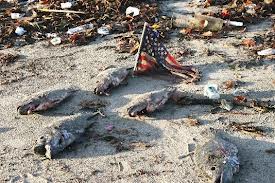
Pollution is another major force contributing to the demise of life in the oceans. Over the last century immense volumes of trash and industrial chemicals have contaminated whole cross-sections of the oceans. Toxins that enter the oceans are spread throughout food chains, and varying degrees of visible and microscopic waste accumulate in the water and on shores. One diabolical clusterfuck that highlights the deleterious effects of pollution on the marine environment is the Great Pacific Garbage Patch. Like other ocean regions, the North Pacific Ocean has immense gyre-like convergence zones which are formed by wind and rotating currents. The Pacific convergence zones currently contain astronomical quantities of accumulated rubbish, much of which has been or is being broken down into tiny particles of microplastic. Subsisting in the gyres and consuming the plastic are around 260 species of fish, sea turtles, birds, and other sea creatures. These animals often die from the consumption of plastic, which may also end-up in the bodies of the predators that feed off them, or, as in the case of the Laysan albatross, in their young. On the Midway Atoll, where twenty tons of plastic wash up every year, as many as one-third of all albatross chicks die due to eating plastic inadvertently fed to them by their parents.
In addition to plastic, a broad range of manufactured organic and toxic chemicals have made their way into the oceans. Many of these contaminants lodge themselves in the tissues of fish and bioaccumulate as the fish are ingested up the food chain. Studies have found high levels of mercury and industrial chemicals like polychlorinated biphenyls (PCBs) in dolphin and whale meat. What the hell are PCBs? Allow Cathy Britt to explain:
PCBs are manufactured organic chemicals that were primarily used as insulating liquids, such as coolants and lubricants in electrical equipment, but were also used in other common materials such as paints, cement, adhesives, and even the flame retardants used in some children’s clothing…Though production of PCBs was banned in the 1970s because of its harmful effects to the environment, the chemical still presents a significant environmental threat today.
Orcas have accumulated such high concentrations of PCBs that when female orcas breast feed their young, the firstborn calf usually dies as a result of receiving a toxic overdose of PCBs contained in its mother’s fatty-rich breast milk. PCBs and other toxins are also known to cause health problems in other large Artic animals, like polar bears and seals. Although PCBs, some pesticides, and other persistent organic pollutants have been phased out and banned, many industrial chemicals (such as brominated flame-retardants) are still widely used and find their way into the oceans. Humans are not immune to this process of bioaccumulation, and toxins are accruing in the bodies of people as a result of eating fish. But perhaps the real blow will come later, when there are no more fish to eat.
Human beings are carrying out a slow kill of the world’s seas, as well as on much of the planet’s other ecosystems. Modern man finds himself in living in a paradox where he knows more than ever about how the natural world functions, and nevertheless the natural world is in its worst shape yet due to how modern man mistreats it. How is that we can care so much about ourselves and our friends and family, but so little about others and the natural systems that we depend on to survive? The Earth revolves through day and night, and it seems that billions of people are clocking-in and out of shifts to partake in the wholesale destruction of the world on their side of the planet. If the day arrives when the seas have become polluted dead zones void of great shoals of fish – assuming there will be humans to witness it, they’ll look out across the grey and desolate tides toward the bleak horizon and ask, “How did we let this happen?” And this is the answer: We let it happen through stupidity, laziness, arrogance, apathy, and greed. We couldn’t stop gorging ourselves, we couldn’t control our insatiable appetite, and we didn’t think to heed the warnings we were given (though we saw them); we didn’t think to step back, to slow down, and to stop ourselves and each other. It was a free for all, and we didn’t care enough about our world and Mother Nature to make a difference and to save her oceans from death. We are like addicts, and we only take; we always take, and we never give back. And in her darkest hour, when nature desperately needed a hand – when her battered reefs became bleached and white like bones, when her bays became choked with smog and clogged with oil, when the whales and dolphins were beaching themselves in mass die-offs along the shores, when the nets that we cast came back with less and less until there was nothing – when she needed us most, we refused to reach out and instead we looked the other way in betrayal. But it doesn’t have to be that way. You can leave this planet in better shape than you found it. You can try to make a difference and stand up for those creatures on this planet that can’t stand up for themselves; even if it doesn’t work, they’ll appreciate that you tried. And you’ll also feel a lot better about yourself that you did.








 After the Crash