Navigating The Space Between Worlds

Mastering the art of being in the world, even when we know it’s filled with heavy challenges and chaos.
By Joe Martino

Source: The Pulse

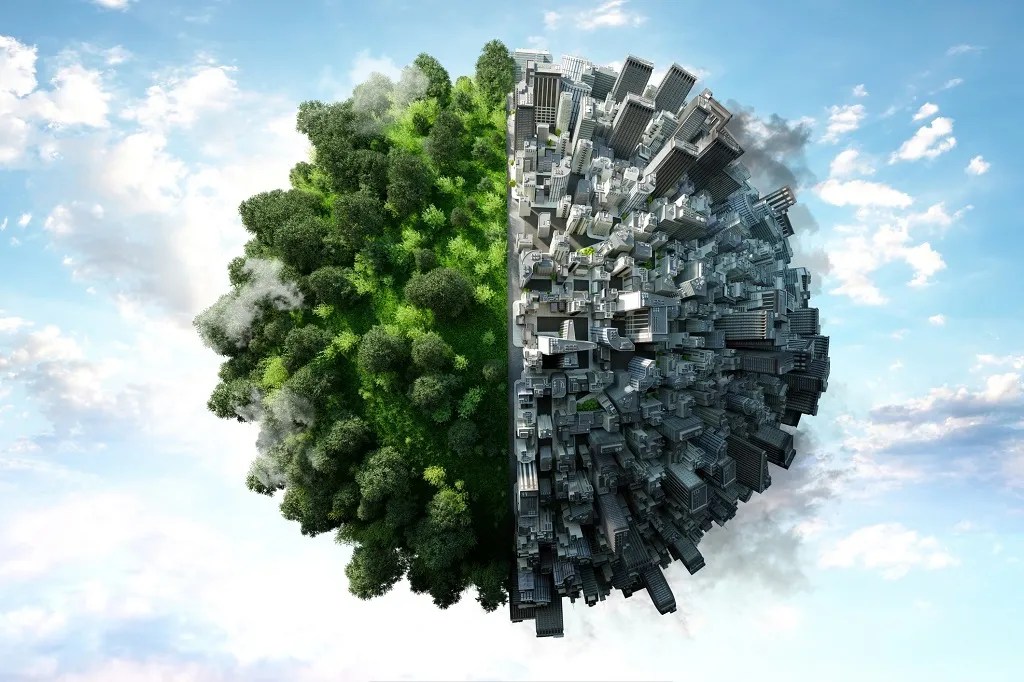
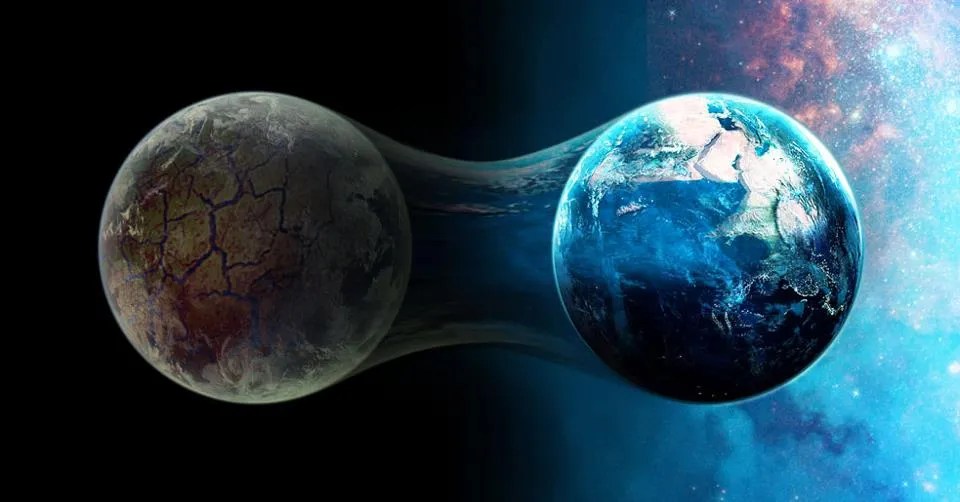
Over the last few decades, many have written about our time as a space where humanity is between worlds. On one hand, we have our current way of life which is incredibly demanding on our minds and bodies, is rather toxic, and filled with conflict and destruction. On the other hand is a vision for a world that’s slower, more connected, more natural, and more loving.

As we navigate what appears to be the dying stages of the old paradigm, the intensity of what it is seems to increase. The qualities of the old system become louder, acting as an evolutionary pressure to push things along.

Many become inspired to explore ways to bring the ‘new world’ to the here and now via their actions.

How do I live without money?
How do I exit the toxicity of our current system?
How do I not participate anymore?

If we aren’t careful, these questions can create a framing of our current world that can make it very hard to live within.

If we deeply judge the need to work, to make money, to pay taxes etc, all of it can become a heavy thing to carry. We end up waking up every day dreading going to work, and having endless conversations, thoughts and emotions about how the bad guys are ruining life for us and we’re the victims in it all.

While there may be truth to some of the observations about our society, the framing of it in our minds is disempowering many of us, and it’s making our current moment dreadful. Further, it holds us back from living and being able to solve the problem.

So how do we work with this? How do we live in the space between worlds?

What Feels Natural To Us?

Indeed, our current societal design is not supportive of human beings thriving. In that sense, it has been poorly designed. We have such an easy time as a species doing this because our higher-order thinking allows us to override what is good for our biology. Simply put: it’s easy to ignore our needs using our thinking, especially when we become so identified with life cognitively.

I have 7 alpacas. The moment they need to poop, they just do it, no thinking, no “I’ll just finish this paragraph,” they just do it. They listen to their biology. Humans on the other hand don’t always listen. In some cases we don’t because we have social structures, social norms, and brains to hold this all together. But we also don’t because we’ve learned to ignore our body, feelings, and emotions in many ways.

While our higher-order thinking is beautiful in one sense, how do we know when it begins to work against us?

I often use an example with friends and clients of a bear. The bear (a mammal like us) was likely raised by an attached parent. It learned how to ‘bear’ and how to be in its environment from that parent in its natural environment. If that bear’s ecosystem was cut down or destroyed by humans, it wouldn’t stay for too long. It would know that concrete, a lack of forest, and a lack of fresh water aren’t good for it, and it would leave to find a suitable home. The bear is simply following its connection to its biology.

We as humans know we are doing this to animals and call it ‘displacing nature/animals.’ Interestingly, we tend to see ourselves ‘outside’ of nature, conveniently ignoring how we’re ‘displacing’ ourselves.

As mentioned, humans are resilient in that we can survive in different environments. We find ways to adjust, cope, and problem solve within environments that are not natural to us. Here I’m not just talking about physical environments but also emotional ones. We find ways to survive in abusive situations for example. We know we should leave, but sometimes we feel we can’t or don’t have the capacity to.

Further, there are difficult elements to our environments like not having access to clean food, clean water, and shelter without having to work very hard to get them.

Because of our amazing thinking brains, humans can do and create incredible things, but we can also become so cognitively and mentally identified that we override our basic biology so much so that we build systems that aren’t attuned to our own well-being.

Thus, humans are currently surviving, but we are in no way thriving. And we did this to ourselves via a disconnection from ourselves.

To be clear, it’s not that we shouldn’t have roads, technology, and societal systems, it’s that they should be designed with human and natural thrivability in mind. Instead, our world is designed with economic thrivability and elite power structures in mind. All at the expense of human wellness.

The tricky part is, that the more people see and experience this truth, the more we can become angered and upset by it. This is fair. A boundary feels crossed because we living now aren’t necessarily the ones who built it or are choosing it. “Why am I subjected to a system I don’t like nor support, yet feel like I can’t escape it?”

As I stated in my essay If No One Wants This, Why Are We Doing It? our way of life doesn’t feel natural to us deep down and it’s overwhelming the challenge is we can’t change it overnight. So what do we do to live within it without driving ourselves mad?

Exploring The Art of Existing Between Worlds

Over the last 15 years exploring alternative thinking and spiritual spaces, I have discovered that it’s common for people to want to fully “exit” the system. They don’t want to integrate, use money, or do anything within the system as they feel it’s “toxic.”

As mentioned, these feelings are somewhat valid, but how we choose to navigate them is everything. Here are a few key observations.

1. Having unprocessed anger, resentment, victimhood and judgment for the system is a recipe for disaster.

If we go to work each day, pay taxes, or drive on highways with the mindset and emotional drive that we are victims and stuck, we will certainly make our lives feel more challenging. Our mental, emotional, physical, and spiritual framing at that point is that of contraction and stuckness. And it’s often built on a nervous system foundation of survival.

Everything will feel much more difficult in this state. Now, this doesn’t mean we can’t observe the state of the world, understand it, and explore how to change it, all of that can be done without getting stuck in mental and emotional traps. But we have to be careful about the general state of mind and being we are taking into our daily lives. Without being aware of this, we give all of our power away to the system and allow it to dictate how we feel.

I’ve watched people panic and freak out about not eating organic apples, yet their mindset and relationship with themselves and the world is creating more toxicity in themselves than a non-organic apple.

When this mindset goes unchecked, our locus of control for our own well-being is outside of us, not inside. (Key note, I’m not suggesting that the system doesn’t have toxic effects on us, I’m saying that there is a space where we can exist within the system with greater wellness.)

Can we begin to see work, life, and what we currently have going as an opportunity? Can we change the lens through which we see it so it doesn’t add to greater dis-ease? Can we support ourselves, our nervous system, and our emotional well-being through practice that helps us build capacity and resilience?

2. Trying to exit completely is incredibly hard, and most end up just as unhappy.

I have found a lot of people trying everything in their power to avoid working and making money. Here I’m not referring to people who are not well or injured and can’t work, I’m talking about folks who can yet have such a degree of judgment toward the system that they avoid being within it.

Often this path leaves people stuck, uninspired, unable to experience much of the world, and unable to even afford fun projects at home. Life begins to become small, and these people rarely seem truly happy.

That said, intentional communities are an interesting path for some. Although they work and exist within the system in more ways than people think. Sure, a few places are fully off grid, but for the most part money, utilities, land purchases, property tax etc, are all part of the mix.

If you don’t have a lot of money, this path is very tough. People can of course move to countries where things are very cheap and start over, but even that is tough for most people as it’s still expensive and work still needs to be found to live well into the future.

1. Exploring capacity and resilience building to exist in our current world and help solve problems within it seems a fruitful path. This includes doing small things within the system to make life more natural.

To me, this is a path that is accessible to most people and provides a meaningful balance of making a difference and enjoying life. I may also be biased toward this as this is the path I’ve chosen and have taught throughout my work since 2009.

For example, I chose to start a company and embrace the world as it was in 2009. I built my business on a foundation of creating an amazing work environment for employees to work, rest, grow, and contribute to a ‘collective evolution.’ Over time, I was able to give back by hiring 14 people to come into this environment of serving something greater than our personal ambitions, yet those were taken care of too.

We did some amazing projects around the world with excess funds, and we helped establish an internet culture of wellness, consciousness and conscious media. If I had kept the system at a distance, those benefits would not have been shared.

Humans have lived for such a long time in unnatural ways, disconnected from ourselves, and not processing our emotions and traumas, our nervous systems hold that history. It is further being re-inforced by the reality that yes, there is toxicity still in our world. It is badly designed.

But still, regulation and capacity at a deep cellular level need to be restored for most of us. We need to clear out the messy stuff. Otherwise, we will take our pains into any revolutionary systems that pops up outside the system anyway. We see this a lot with intentional communities that collapse.

This means focusing on deeply restoring physiological safety, wellbeing, emotional fluidity and regulation is foundational to living well, and it can be done even in the existing system. Even though our system is tough, this path gives us much more energy, resilience and capacity to exist within the system and make as big a difference as possible while enjoying life.

This path is work. It acknowledged that it isn’t easy to feel great in our world due to the poor design, but that it’s still within our capacity if we focus on it.

This doesn’t mean we ignore the need to change or adjust our system. But this path gives us the greatest ability to do so as we will have built the capacity and deep empowerment to actually do it, vs. being feeling stuck, tired and victimized resisting the system so heavily.

Existing in a space between worlds means building individual and collective wellbeing, and creating change along the way. The more resilient we are, the more we can make money and use it as a tool to find ways to make our lives better, less reliant on the system, and healthier.

In that space of wellness, we can have meaningful conversations and learn to hold visions of a future world that isn’t built on hating and resenting the old. If I’m honest, almost all of the successful changes and projects I’ve seen out there have come from this space of being.

In summary, taking stock of whether our observations of the world have become deep disempowering judgements is a worthwhile reflection. Being ‘awake to corruption’ doesn’t have to come with lifelong resentment toward the system, where we comment online about ‘the bad guys’ ruining things for everyone. Or that somehow Biden, Trump, Trudeau etc. are the root of the problems. I hate to say it but, this gets us nowhere.

Questioning whether we are truly living our lives in a way that promotes emotional, physical, and spiritual well-being and expansiveness is important. Without this, our foundation is weak.

The path forward I’m suggesting is one of building enough strength, well-being, and energy to live with wellness in our current system, so we have energy left over to see clearly and act upon changing what is not natural to us. Good sensemaking of our current events goes alongside this, but as you’ll note from my previous work, good sensemaking is built on a healthy nervous system.
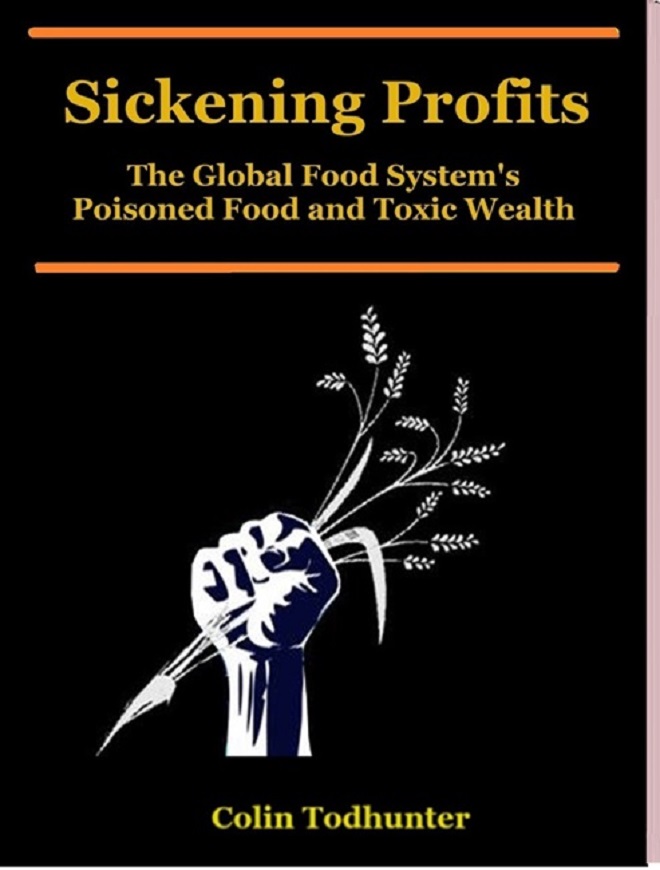
Sickening Profits — The Global Food System’s Poisoned Food and Toxic Wealth

By Colin Todhunter

Source: Off-Guardian

The modern food system is being shaped by the capitalist imperative for profit. Aside from losing their land to global investors and big agribusiness concerns, people are being sickened by corporations and a system that thrives on the promotion of ‘junk’ (ultra-processed) food laced with harmful chemicals and cultivated with the use of toxic agrochemicals.

It’s a highly profitable situation for investment firms like BlackRock, Vanguard, State Street, Fidelity and Capital Group and the food and agribusiness conglomerates they invest in. But BlackRock and others are not just heavily invested in the food industry. They also profit from illnesses and diseases resulting from the food system by having stakes in the pharmaceuticals sector as well. For them, it’s a win-win situation.

Lobbying by agrifood corporations and their well-placed, well-funded front groups ensures this situation prevails. They continue to capture policy-making and regulatory space at international and national levels and promote the (false) narrative that without their products the world would starve.

They are now also pushing a fake-green, ecomodernist agenda and rolling out their new proprietary technologies in order to further entrench their grip on a global food system that produces poor food, illness, environmental degradation, dependency and dispossession.

The prevailing globalised agrifood model is built on unjust trade policies, the leveraging of sovereign debt to benefit powerful interests, population displacement and land dispossession. It fuels export-oriented commodity monocropping and regional food insecurity.

This model is responsible for increasing rates of illness, nutrient-deficient diets, a narrowing of the range of food crops, chemical runoffs, increasing levels of farmer indebtedness and the eradication of biodiversity. And it relies on a policy paradigm that privileges urbanisation, global markets and agrifood corporations’ needs ahead of rural communities, local markets, on-farm resources and food sovereignty.

In addition, there are also the broader geopolitical aspects of food and agriculture in a post-COVID world characterised by food inflation, hardship and multi-trillion-dollar global debt.

There are huge environmental, political, social and health issues that stem from how much of our food is currently produced and consumed. A paradigm shift is required.

All of this is set out in Sickening Profits: The Global Food System’s Poisoned Food and Toxic Wealth (December 2023), published as an open-access (free) e-book by Global Research (it can be read directly on the Global Research website or downloaded as a pdf) and is a follow up to the author’s book Food, Dispossession and Dependency: Resisting the New World Order (2022).

That book contains substantial sections on the agrarian crisis in India and issues affecting the agriculture sector. Aruna Rodrigues — prominent campaigner and lead petitioner in the GMO Mustard Public Interest Litigation in the Supreme Court of India — stated the following about the book:

This is graphic, a detailed horror tale in the making for India, an exposé on what is planned, to hand over Indian sovereignty and food security to big business.”

‘Sickening Profits’ continues in a similar vein. By describing situations in Ukraine, India, the Netherlands and elsewhere, it is another graphic horror tale in the making that is being intensified across the globe. The question is: Can it be stopped?

Rebalancing The Masculine & The Feminine For A New Paradigm

In a time of collapse, witnessing the consciousness and paradigm driving our current moment is paramount. A rebalancing of consciousness may be a solution.

By Anne Baring

Source: The Pulse

When the masculine and the feminine are in balance, there is fluidity, relationship, a flow of energy, unity, totality. This fluidity and balance is perhaps best illustrated by the Taoist image of the indissoluble relationship and complementarity of Yin and Yang.

In the broadest terms, the feminine is a containing pattern of energy: receptive, connecting, holding things in relationship to each other; the masculine is an expanding pattern of energy: seeking extension, expansion towards what is beyond.

More specifically, the feminine reflects the instinctual matrix and the feeling (heart) values of consciousness; the masculine reflects the questing, goal-defining, ordering, and discriminating qualities of consciousness, generally associated with the mind or intellect.

For millennia women have lived closer to the first pattern; men to the second. But now, there is a deep impulse to balance these within ourselves and in our culture. There is an urgent need to temper the present over-emphasis on masculine value with a conscious effort to integrate the feminine one.

In the ancient world the feminine principle in the image of the goddess stood for relationship – the hidden connection of all things to each other. Secondly, it stood for justice, wisdom and compassion. Thirdly, and most importantly, it was identified with the unseen dimension beyond the known world – a dimension that may be imagined as a matrix connecting invisible spirit with visible nature.

The word used then to name this matrix was goddess; later it was soul. The feminine principle offered an image of the oneness, sacredness and inviolability of all life; the phenomenal world (nature, matter, body) was regarded as sacred because it was a theopany or manifestation of invisible spirit.

The greatest flaw in civilisation has been the over-emphasis on the masculine archetype (identified with spirit) and the devaluation of the feminine one (identified with nature). This has been reflected in the fact that the god-head has no feminine dimension.

The history of the last 4000 years has been forged by masculine traits – principally the goals of conquest and control. (this is in no sense intended as a criticism; in the context of prevailing belief systems and general level of consciousness, things could not have been different).

However, religion and science – all our cultural ideas and patterns of behaviour – have developed from this unbalanced foundation. Throughout this time, everything designated as “feminine” (nature, body, woman) was devalued and repressed, including the rich diversity of the Pagan legacy of the ancient world.

In the domain of religion, heretics were eliminated; diverse ways of relating directly to the transcendent were lost. Naturally, this has created a deep imbalance in the culture and in the human psyche. It has led finally to the tyrannies of this century where the lives of some 200 million people have been sacrificed to totalitarian regimes.

The modern tyrant is the extreme reflection of a deeply-rooted pathology derived from a long-standing cultural imbalance between the masculine and feminine archetypes.

Where there is no relationship and balance between the masculine and feminine principles, the masculine principle becomes pathologically exaggerated, inflated; the feminine pathologically diminished, inarticulate, ineffective. The symptoms of a pathological masculine are rigidity, dogmatic inflexibility, omnipotence, and an obsession with or addiction to power and control.

There will be a clear definition of goals but no receptivity to ideas and values that conflict with these goals. The horizon of the human imagination will be restricted by an overt or subtle censorship. We can see this pathology reflected today in the ruthless values that govern the media, politics, and the technological drive of the modern world.

We can see the predatory impulse to acquire or to conquer new territory in the drive for global control of world markets, in the ideology of growth, in new technologies such as the genetic modification of food. We see exaggerated competitiveness – the drive to go further, grow faster, achieve more, acquire more, elevated to the status of a cult.

There is contempt for the feeling values grounded in the experience of relationship with others and with the environment. There is a predatory and compulsive sexuality in both men and women who increasingly lose the capacity for relationship. There is continuous expansion in a linear sense but no expansion in depth, in insight. The pressure of things to do constantly accelerates.

What is the result? Exhaustion, anxiety, depression, illness which afflict more and more people.

There is no time or place for human relationships. Above all, there is no time for relationship with the dimension of spirit. The water of life no longer flows. Men and women and, above all, children, become the victims of this harsh, competitive, uncaring ethos: women, in their disorientation, and because the feminine value has no clear definition or recognition in our culture, are drawn to copy the pathological image of the masculine which itself incorporates fear of the feminine.

Because to a large extent, this whole situation arises unconsciously, not much can be done about it until catastrophe intervenes.

Evolutionary Pressure Emerges

I feel we are living in a time of kairos – a mythic time of choice – a time of stupendous scientific discoveries which are enlarging our vision of the universe, shattering the vessel of our old concepts about the nature of reality.

Yet the delicate organism of life on our planet and the survival of our species are threatened as never before by technologies driven by an ethos of the conquest and control of nature, technologies which are applied with an utter disregard for the perils of our interference with the complex web of relationships upon which the life of our planet depends.

The choice is between clinging to an outworn and unbalanced ethos and maturing beyond it towards a more responsible and sensitive capacity for relationship. If we are unable to develop this empathic capacity to relate, we will surely destroy ourselves and the environment that sustains our life.

Bringing Balance

So how could we help to redress the balance between the masculine and feminine in ourselves and in our culture?

First of all, where are we, as individuals out of balance? Where are we driven by the unbalanced cultural ethos of achieving power and control, ignoring our feelings of depression, anxiety or symptoms of the body’s distress?

Are we allowing ourselves enough time for reflection, for relationships, for connection with a deeper dimension of reality?

The priority as I see it is to make the fact of this pathology a matter of public discussion. Shift the emphasis from achieving power to achieving balance.

Secondly, here are some suggestions for strengthening the feminine principle in our society.

  • Free the Imagination from the stranglehold exercised by a controlling minority which excludes the non-rational from inclusion in our understanding of life.
  • Formulate a new image of spirit as the totality of all that is – both seen and unseen. Recover the lost and devalued feminine aspects of spirit: restore nature, matter and the physical body (including sexuality) to the realm of the sacred.
  • Imagine the Soul as a cosmic internet. We belong to an immense field or matrix of relationships. We could imagine the soul in this new way as something we belong to and can develop a relationship with.
  • Religion – Relinquish the dogmatic formulations of the past: Monotheism as Mytheism. (Ravi Ravindra) Recognise the negative effects of deeply rooted beliefs – such as the belief in original sin – on our interpretation of life and its meaning. Welcome the idea of direct individual experience of the sacred and the numinous.
  • Science – Integrate the principle of empathic relationship with what is studied in scientific teaching and practice. In education give children an empathic understanding of their own bodies and of nature rather than the image of the body and the universe as a machine. Help them to become aware of their environment as a great chain of relationships in which their lives are embedded. Nourish their sense of wonder.
  • The psyche: Heal the split between mind and soul. Recognise that feeling is a valid mode of perceiving reality and must be integrated with thinking. The main problem in our society is emotional immaturity.
  • Politics: develop a forum beyond national and international politics where the true problems of the planet can be articulated and addressed. Recognise grandiosity, standardisation, the drive for control, the proliferation of bureaucracy as symptoms of the pathology of an inflated and unrelated masculine principle.
  • Medicine: integrate alternative (complementary) methods of healing with orthodox ones as a deliberate policy. Focus on preventive medicine. The modern GP has no time for an empathic relationship with his or her patient. The pressure of numbers is simply too great. However, in some surgeries and hospitals alternative practises are being integrated with orthodox ones. This integration could be expanded.
  • Agriculture: Focus on increasing the production of organic food. Removal of pesticides, antibiotics and toxins from our food and water.
  • Care of Children: A much higher level of prenatal care. Compared with the rest of Europe, we are way behind (Sweden is the most advanced). Attention to quality of children’s diet and to nourishing the imagination as well as the intellect.
  • Educate Women to be aware of their own specific value and the importance of their contribution to the culture. Articulating feeling values without fear or shame.
  • Educate Adolescents in awareness of the responsibilities of relationships and of the parent towards the child. Teach them the psychology of the child; its dependency; its sensitivity, its potential for emotional growth. Teach them about the complexities of neuroscience so they understand how their emotions affect their bodies and vice-versa. Ask them to invent ways of caring for the environment.
  • Teaching Methods: integrate right-hemispheric consciousness with the linear consciousness of the left hemisphere – opening to the creative power of the image. Balance in the curriculum between developing the capacity for logical thought and creative imagining and participation. This poem by a 12 year old boy at school in Southampton shows how a teacher can provide the environment in which a child can dare to express his true feelings:

I hear my inner voice talking to me,
Explaining, encouraging,
Opening the part of me that I thought was lost.
In this world of cruelty and fear little lights are burning.
Everyone has a flame inside their hearts,
If only they had the courage to find it.
The light can trickle out through a hole in your mind.
When the inside is out
You are transformed and revealed.
There is no need to be afraid,
But be curious
As you will probably never know
where the force is coming from.
 – Daniel Webster

Each of us is called to focus on rebalancing the masculine and feminine in ourselves and in our culture. This could affect a profound alchemy in our lives. Women and men could both participate in a process of transformation which could bring into being a new cultural focus whose emphasis is no longer on power and control but on relationship, balance and connectedness.

The phrase “the conquest of nature” could be replaced by the awareness that humanity and nature participate in a deeper and still unknown reality that embraces them both.

Millions of people have no choice. Those of us who do have a measure of choice could rise to the immense challenge of defining and living a new and responsible role in relation to each other and our planetary home.

Resisting Genetically Mutilated Food & the Eco-Modern Nightmare: Together, ‘Just You and Me’  

By Colin Todhunter

Source: OffGuardian

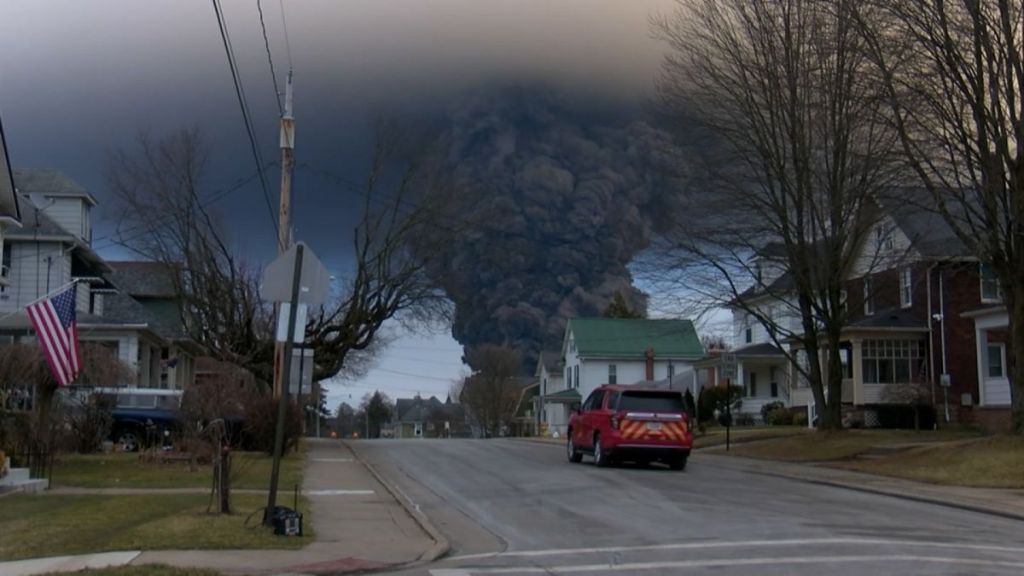
This image is symbolic of everything that is wrong with modern society.

A gas leak from Union Carbide’s pesticide plant in Bhopal in 1984 resulted in around 560,000 injured (respiratory problems, eye irritation, etc.), 4,000 severely disabled and 20,000 dead.

Not only that, but the pesticides produced at the factory and the model of farming promoted has caused well-documented misery for farmers, harm to soil, water sources and the health of the population and a radical transformation of social relations in rural communities. And these issues apply not only to India but also to other countries.

That old advertising brochure dating from around the early 1960s encapsulates the arrogance of billionaires and their companies that think they are the hand of God, that they are the truth and the science, and that we should all be in awe of the technology they produce.

Facilitated by the likes of the Rockefeller Foundation and the Bill and Melinda Gates Foundation, they uproot highly productive traditional agriculture, saying it is deficient. They poison the soil, the food, the waterways and people. But that’s not enough. They pirate, own and genetically engineer the seeds. The chemicals and engineering do not result in more or better food. Quite the opposite. Diets have become narrower, and the nutritional content of many food items has progressively diminished (see McCance and Widdowson’s the Mineral Depletion of Foods). Moreover, food secure regions have become food insecure.

But it goes beyond this.

Consider the amount of killer-chemicals that the likes of Union Carbide’s promised techno-utopian consumer society (Union Carbide produced numerous other similar brochures to the one presented above, promoting the role of science and technology across all sectors) has gifted to humanity in everyday products from shampoos to toys, pans, packaging, sofas and tins.

It is notable that glyphosate, the world’s most used agricultural herbicide, began life as an industrial chelator of minerals in metal pipes to prevent blockages and deterioration. It now ensures mineral depletion/nutrient deficiencies in the human body. Glyphosate affects human soil – the gut microbiome – which directly feeds the major organs. Little wonder we witness a proliferation of illness and disease.

But forget about what has become modernism’s spiralling public health crisis – don’t forget to take that money-spinning experimental booster jab because, remember, they said that they really care about you and your health.

Meanwhile, bioscience parks across the world expand and promise an even more marvellous techno-dystopia than the one already created. They are working on injecting you with nanotechnology to ‘cure’ you of all the diseases that the modernist type of thinking, products and technology created in the first place – or on manipulating your DNA-physiology to hook you up to the internet (of things). The patents are there – this is not speculation.

And as these bioscience parks expand, their success is measured in annual turnover, profits and ‘growth’. They want more and more ‘talent’ to study life sciences and health subjects and to take up positions at the biotech companies. And they call for more public subsidies to facilitate this. More kids to study science so that they can be swept up into the ideology and practices of the self-sustaining paradigm of modern society.

Of course, ‘sustainability’ is the mantra. Sustainability in terms of fake-green, net-zero ideology but, more importantly, sustainable growth and profit.

Meanwhile, across the world, most notably in the Netherlands, these parks demand more land. More land for expansion and more land to house ‘global talent’ to be attracted to work. That means displacing farmers under the notion that they are the major emitters of ‘greenhouse gases’, which, in the Netherlands at least, they are clearly not. Look towards other sectors or even the US military if you require a prime example of a major polluter. But that’s not up for discussion, not least because military-related firms are often intertwined with the much-valued bioscience-business ‘ecosystems’ promoted.

And once the farmers have gone and the farmland is concreted over under the concept (in the Netherlands) of a Tristate City, do not worry – your ‘food’ will be created in a lab courtesy of biosynthetic, nanotechnological, biopharmaceutical, genetically engineered microbes and formulas created at the local bioscience park.

Any carbon-related pollution created by these labs will supposedly be ‘offset’ by a fraudulent carbon credit trading Ponzi scheme – part of which will mean buying up acres in some poor country to plant trees on the land of the newly dispossessed.

This brave new ecomodernism is to be overseen by supranational bodies like the UN and the WHO. National uniparty politicians will not be engaged in policy formation. They will be upholders of the elite-determined status quo – junior ‘stakeholders’ and technocratic overseers of an algorithm/AI-run system, ensuring any necessary tweaks are made.

Of course, not everything that happens under the banner of bioscience should be dismissed out of hand, but science is increasingly the preserve of an increasingly integrated global elite who have created the problems that they now rollout the ‘solutions’ for. It is a highly profitable growth industry – under the banner of ‘innovation’, cleaning up the mess you created.

But the disturbing trend is that the ‘science’ and the technology shall not be questioned. A wealthy financial-digital-corporate elite funds this science, determines what should be studied, how it should be studied and how the findings are disseminated and how the technology produced is to be used.

As we saw with the COVID event, this elite has the power to shut down genuine debate, prevent scrutiny of ‘the science’ and to smear and censor world-renowned scientists and others who even questioned the narrative. And it also pulls the strings of nation states so much so that former New Zealand PM Jacinda Arden said that her government is ‘the truth’. The marriage of science and politics in an Orwellian dystopia.

The prevailing thinking is that the problems of illness, hunger, malnutrition, unemployment, pollution, resource usage and so on are all to be solved down at the bioscience park by what farmer/author Chris Smaje says through technical innovation and further integration into private markets which are structured systematically by centralised power in favour of the wealthy.

The ecomodernist ideology we see embedded within the mindsets of those lobbying for more resources, land and funding have nothing much to say about how humanity got ill, infertile, poor, dispossessed, colonised, depressed, unemployed or marginalised in the first place. Driven by public funding, career progression and profit, they remain blinkered and push ahead with an ideology whose ‘solutions’ only produce more problems that call for more ‘innovation’ and more money.

At the same time, any genuine solutions are too often dismissed as being driven by ideology and ignorance that will lead us all to ruin. A classic case of projection.

As I have written previously, current hegemonic policies prioritise urbanisation, global markets, long supply chains, commodified corporate knowledge, highly processed food and market dependency at the expense of rural communities, independent enterprises and smallholder farms, local markets, short supply chains, indigenous knowledge, diverse agroecological cropping, nutrient-dense diets and food sovereignty.

And this has led us to where we are now.

Trade and agriculture policy specialist Devinder Sharma once said that we need family farms not family doctors. Imagine the reduction in illnesses and all manner of conditions. Imagine thriving local communities centred on smallholder production, nutrient-dense food and healthy people. Instead, we get sprawling bioscience parks centred on economic globalisation, sickness and the manipulation of food and human bodies.

Although a few thousand immensely powerful people are hellbent on marching humanity towards a dystopian ecomodernist future, we can, in finishing, take some inspiration from the words of John Seymour (1912-2004), a pioneer of the self-sufficiency movement.

Seymour was described as a one-man rebellion against modernism by writer and ecologist Herbert Girardet. But as a farmer himself, Seymour regarded himself a ‘crank peasant’ and offered solutions in terms of localism, small-scale economics, a return to the land and organic agriculture.

In a call to action, he stated:

The tiny amount you and I can do is hardly likely to bring the huge worldwide moloch of plundering industry down? Well, if you and I don’t do it, it will not be done, and the Age of Plunder will terminate in the Age of Chaos. We have to do it – just the two of us – just you and me. There is no ‘them’ – there is nobody else. Just you and me. On our infirm shoulders we must take up this heavy burden now… Tomorrow will be too late.”

Restoring A World Out of Balance

Is our expansive evolution in technological advancement a wrong turn for humanity? Or has it evolved without our consciousness keeping up to steward it effectively?

By Tom Bunzel

Source: The Pulse

One of my first really disquieting insights about the planet and the pace of change came when I saw the film “World Out of Balance” or “Koyaanisqatsi” in the 1980’s.

The concept behind the film was that Nature has an exquisite balance between various forces, and that’s when I first thought about the likelihood of the existence of a higher intelligence.

The film was jarring because it showed dramatically, now 40 plus years ago, the havoc that was wreaked by technology not just on the environment, but how human technology was literally putting the world out of balance – a harmony that was naturally sustained prior to human intervention.

Computers Introduced Me to Rapid Change

At that time, I just getting interested in computer graphics and I encountered “Moore’s Law”, which refers to the observation made by Intel co-founder Gordon Moore in 1965 that the number of transistors on integrated circuits doubles approximately every two years.

That meant that processing power doubled in the same span of time, allowing graphics, for example, to go from color, to 3D, to 3D with texture mapping and other effects, and on and on.

One example of this was the original movie Jurassic Park, which was made with 3D models of dinosaurs having their wire frames “texture mapped” – covered with skin and then animated on a Silicon Graphics work station.  The processing power required to render these images quickly enough for a 30 frames per second film was staggering.

I just Googled the company.  As I suspected they are extinct like the dinosaurs; and the process I described above now happens on a phone, or on a website, and films are using artificial intelligence to fool audiences.

As I began writing about digital video and animation, and attended conferences, I found myself on a carousel of a continual need to adapt to change, and “upgrade” my system to keep up with the latest advancements.

It worked for me for a while and I enjoyed integrating solutions based on a creative understanding of what was coming out, but eventually, I realized that I could no longer keep up.

I had to take a break from the relentless pressure, which I did, and ended my tech writing career.

It was around that time I was reading Eckhart Tolle, and learning how the Ego, the voice in my head, always wants MORE.

The Continued Acceleration of Change

Moore’s law for integrated circuits was only the beginning, of course.  We now have the promise of quantum computing and the reality of artificial intelligence, which both have the potential to put the world as we knew it even more out of balance.

When we consider our human conditioning, the wider the gap between one’s childhood where one “learns the ropes” and perhaps conforms for one’s safety and one’s adulthood — when everything has changed creates intense discomfort relative to the gap in years.

For a dinosaur like me the continual need to “download the app” is stressful.  For my friends’ grandchildren it’s just part of being alive.

Peter Russell, in his new book “Forgiving Humanity” uses a sobering term – Exponential Change – as he describes how rapid changes in technology first affected agrarian culture, increased dramatically with the industrial revolution and accelerated again with the advent of computer technology and integrated circuits.

It’s Not You, It’s Exponential Change

He reaches a conclusion that is both profound and daunting:

“This doesn’t mean humankind has taken a wrong turn. Spiraling rates of development, with all their consequences, positive and negative, are the inevitable destiny of any intelligent, technologically-empowered species.”

So the fact that we have knocked the world out of its natural harmony is something that is part of evolution?  In essence, we are a part of nature that keeps pushing the envelope, but it can have dire consequences for a species that goes too far?

That is certainly what we are up against with respect to artificial intelligence, where the notion of exponential change in terms of brute intellectual capacity, is making many experts wary of consequences of an “intelligence” that vastly dwarfs human capabilities.

Consider the difference between exponential change versus simple, let us say, incremental change.  Exponential means that is multiplied by its current value, or the power of 2.  Anyone who has played with relationships like that in math knows how rapidly it can spin out of control.

Calculations of this order of magnitude quickly go beyond what the human brain can process.

And how does this expansion of potential knowledge affect consciousness today?

Peter Russell takes one of the driving forces of exponential change – AI – and discusses his new book by interviewing “his clone” in a fascinating video.

There is the possibility that with enough shocks or consequences that humanity may begin to glean that a purely intellectual approach to reality is the reason for our imbalance, and that knowledge itself, without wisdom or “being”, is fraught with peril.  Blind intellect alone creates conflict with a higher, natural intelligence which it ignores.

Russell uses the analogy of how a wheel that spins faster and faster will eventually come apart.

Taking a Cosmic Perspective – Collectively and Individually

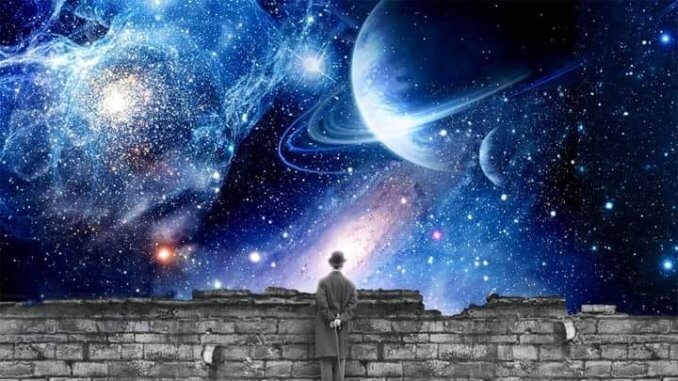
In the video Russell’s “clone” suggests that a way for humanity to adapt, and actually align with the natural forces that have brought it to this point, is to begin to take a truly “cosmic perspective” and see our species in true proportion to the vast universe in which we now find ourselves.

Advances like the Webb Telescope have opened humanity’s eyes to a more accurate understanding of the vast scale of the universe we inhabit.  We now know that galaxies move in clusters of unimaginable proportions.

Russell points out that there are trillions of stars and life might have evolved to an intelligent level on some of these, and that perhaps such life has found itself at the point where we are many times in eternity.

We have to confront the stark reality that from such a perspective within the vastness of Nature, we are here for only a brief interval both as individuals – and indeed perhaps as a species.  

Russell suggests that such a perspective can make us more aware and grateful for our higher capabilities in areas beyond the intellect, such as art, culture, and probably philosophy.  Humanity needs to become more deeply human once again rather than purely mental, as the computers we use are just brute intellect.

A Shift Beyond Copernican Proportions

Such a “renaissance” would be like a new Copernican revolution.  Most of us have a perspective (in consciousness) that WE are the center of all existence. 

But from a “cosmic” perspective we must recognize that cannot be true; it must be an illusion.  We can begin by sensing the truth through our bodies that we are organic beings within dimensions of a vast organism (maybe like the microscopic organisms that exist in our gut and make our “lives” possible are organic beings within us) – and this recognition could serve to dampen both our hubris as a species as to how important we are (dominant on this planet), but also make this a cornerstone of a viable personal philosophy.

I don’t know if I will be here to witness it, but I sense that this shift is very much in line with current trends toward a more dramatic “Disclosure” of our place in the universe – revealing that several other interplanetary or interdimensional species have been here, communicated with humans and are still monitoring human affairs.

Harvard astronomer Avi Loeb, who gained prominence when he speculated that “Oumamoua” – the interstellar object spotted entering and leaving our solar system recently, showed that it was intelligently controlled.  He has since begun Galileo project to search for evidence of extraterrestrial intelligence.

All of this is finally putting to rest the misgivings of the famous Brookings memo that greatly contributed to the secrecy around UFOs – the memo speculated that if extraterrestrial life were a proven reality many social structures, religions and institutions would collapse.  Better to hush it up.

But of course, we are now witnessing the dissolution of many conditioned beliefs and the institutions that these flawed beliefs supported; among them our belief in our dominance as a species and our self-importance as individuals.

It would give me hope to see the shift completed with a deep comprehension of our connection to the universe both epigenetically and spiritually.

How Does Degrowth Apply to Our Minds?

By Erin Remblance

Source: resilience

As an Australian, it troubles me that if the whole world lived like us, we would need 4.5 planet Earths. Thanks to over-consuming nations like mine, worldwide we are living as if we have 1.75 planet Earths, a figure that has increased from 1 (that is, living within our means) since 1970. What this boils down to is that those of us in the global north are taking from both countries in the global south and future generations to fuel our lifestyles today. The ‘Earth Overshoot’ research is supported by the work of the late Earth System Scientist, Professor Will Steffen, who brought to our attention The Great Acceleration, whereby “[a]fter 1950 we can see that major Earth System changes became directly linked to changes largely related to the global economic system.” Steffen is referring to our growth-based economies, and while three percent economic growth each year might sound small, it means that within 24 years we will be consuming twice as many resources as today, and within 100 years 19 times as many. As economist Kenneth Boulding said: “[a]nyone who believes that exponential growth can go on forever in a finite world is either a madman or an economist.”

For this reason, I am a big proponent of degrowth in over-consuming nations in order to fit back within planetary boundaries. For anyone not familiar with the term, degrowth is a planned, democratic reduction in material and energy use in high-income nations while improving the well-being of people in those nations. It is more than this though. While very often the focus of degrowth is on how life can be better in a smaller economy, Federico Demaria and Serge Latouche argue that “[t]he point of degrowth is to escape from a society that is absorbed by the fetishism of growth…. It implies decolonization of the imaginary and the implementation of other possible worlds”. In this respect, the former definition of degrowth applies only to over-consuming nations, while the latter definition applies to all nations, and to all people. It is this second definition of degrowth to which this essay relates.

The concept of degrowth is powerful because it is clear that we need systemic change to avoid ecological collapse: business as usual with a “green tinge” isn’t going to be enough. It is also true that individual change drives cultural change which can be the key to unlocking political change leading to fundamental change. On this point, I find it fascinating to consider how “growth has entered our minds and souls”, and how an awareness of these “mental infrastructures of growth” might free us from growthism and help unlock the cultural changes that will bring about the necessary systemic changes.

With this in mind, here are a couple of points to consider in relation to how growth may be enshrined in the psychological structure of our collective minds, largely based on the work of Harald Welzer:

  • Our dreams for the future are centred around it being better than today, in the sense of ‘more’ (e.g., a bigger house, a larger salary, more travel).
  • We see ourselves as something to continually develop and optimise, our lives are seen as a process of creating biographies or filling curriculum vitae.
  • While we used to see paid labour as drudgery and something we did until we had met our needs, now we view it as noble, esteemed even, to be sought out and with no end. Sadly, this cultural 180° turnaround becomes a regret of many as they are dying.
  • Similarly, society views ‘hard-work’ as virtuous and thus ‘hard-work’ entitles those who undertake it to whatever their heart desires without limit or consideration of the harm caused, their purchases being the fruits of their labour.
  • We typically live by the rhythms of the industrial workday via a standardised worldwide time regime, unaware that there is a natural rhythm of time (for example, consider that in 2023 there will be 13 moons but only 12 calendar months or that, on the whole, our pace of work is unchanged by the seasons).
  • It is a collective belief that we should be able to own parcels of land, excluding others from that land. An example of this is that home (and correspondingly land) ownership in Australia is described as the ‘Great Australian Dream’, a term derived from the ‘American Dream’ of the same nature.

In various ways, these – and probably many more aspects of our modern day lives – relate back to the surpluses created by industrialisation (enabling the future to have more than today, a concept that is “historically quite recent”), the enclosure of the commons (the very foundation of growth-dependent capitalism) and the subsequent imperative to work to have our needs met (rather than simply being able to directly meet our needs). Our ability to recognise and unpick these ‘mental infrastructures’ – that is, the worldview that influences all of our actions – will be key to throwing off the shackles of growth and unlocking a culture of sufficiency, whereby we recognise when we have ‘enough’ in a material sense and from then on meet our “nonmaterial needs nonmaterially”, increasing our sense of wellbeing and contentment.

The work of Antonio Gramsci on cultural hegemony is relevant in unlocking a culture of sufficiency. Michael Mezz describes Gramsci’s theory on how the ruling class maintains power via a cultural form of dominance:

“…the ruling class creates an ideology in which its own values become common sense for the rest of society and Gramsci argued that the role of the state is to maintain institutions such as media and the education system that educate the masses on the cultural ideology of the ruling class. The goal of that education being that the working class develop a sense of freedom and a good life that serves the purposes of the people in power. In other words, the working class starts to value things like innovation and productivity and economic growth that doesn’t actually serve them.”

Gramsci tells us that the way to overcome cultural hegemony is by creating a new culture that is not based on the values of the ruling class. A counter-culture, if you like.

So, what are the counter-hegemonic narratives that we can begin to embrace? What would a mind and soul not infiltrated by growth look like? There is much to learn from indigenous cultures on this topic. As Jeff Sparrow highlights in his book, Crimes Against Nature, First Nation Australians found paid labour to be antithetical to their egalitarian lifestyles:

“Today, we take the wages system for granted. It appears normal, almost eternal, since we can barely conceive of an alternative. It did not seem normal to pre-colonial people. In Australia, as elsewhere in the world, they found capitalist practices utterly horrifying…. Indigenous people, accustomed to an egalitarian ethos and to work carried out for the collective good, saw the authority exerted by employers as tyranny. As late as 1888, a churchman complained of the difficulty he had in persuading Indigenous people that one man was innately better than another, that a certain individual, by virtue of his possessions, mandated obedience from his fellows…. Indigenous people did not despise wage labour primarily because of the effort that it entailed. Rather, they thought the work demanded by capitalists stripped life of its humanity.”

Furthermore, First Nations people lived with the rhythms of nature, not the industrial workday, and there was no private land ownership, they had the wisdom to know that “… you are undone if you once forget that the fruits of the earth belong to us all, and the earth itself to nobody” (Jean-Jacques Rousseau).

There are many examples of counter-hegemonic narratives arising more recently too. The following list is skewed more towards examples from the global North because the global North represents the vast majority of the over-consumption and is therefore where cultural change is most needed. Such examples include:

  • Those people, like the Futuresteaders and others who practice voluntary simplicity and frugal abundance, who appreciate the simple things in life, and find happiness in what they have rather than what they want. Seeking only ‘enough’ and not ‘more’ represents an affront to the dominant culture of dreams of the future being materially greater than today. This point is relevant only to those whose needs are already met. Of course, those who are living in conditions of deprivation should have access to ‘more’, until they too have ‘enough’.
  • People who choose to spend their time doing work that is traditionally undervalued and lacking in both career trajectory and pay increases, but is socially valuable, forgoing future surpluses (think of the stay-at-home parents, childcare workers, teachers, nurses, carers, small farmers, those who work part-time voluntarily, and those who volunteer their time to worthy but under-funded causes).
  • The move towards minimalism which seeks to value time and non-material items over ‘the grind’ and the accumulation of things as a reward for hard work. The Tiny House Movement shows us that it is possible to enjoy living with less, including the freedom of a smaller mortgage.
  • The tang ping (lying flat) movement in China and quiet quitting in the U.S.A. are taking back our right to be humans, not simply workers who devote more time than they would like to paid labour.
  • Anyone advocating for job guarantees, enabling anyone who wants to work to do so. Job guarantees seek to remove the artificial scarcity of employment we see today, where the threat of joblessness looms ever large and we constantly need to better ourselves so that we can compete for work. Those who advocate for a Universal Basic Income – an unconditional liveable wage for all – are fighting to remove the need for waged employment at all.
  • People organising for the community rather than the individual are prioritising others over their own interests, giving up the opportunity to build their own CVs in favour of the greater good, and there are some wonderful examples of such union building herehere and here.
  • The move towards a 4-day work week challenges the dominant narrative that more time at work is better.
  • The Nap Ministry and the related manifesto Rest Is Resistance empowers us to value rest over productivity.
  • The many activists calling out the harm caused by the carbon-intensive lifestyles revered by the dominant culture, such as Greta Thunberg (who beautifully articulated in her book, The Climate Book, that “we all have a responsibility to find quick ways of making that [extremely high-emitting] lifestyle socially unacceptable”), activists who block private jets, people promoting going flight free, and those seeking to reduce the dominance of cars on our streets. For these people, simply having the means to live a materially intensive lifestyle – regardless of the hard work involved in acquiring those means – isn’t enough to justify the harm it causes.
  • The locals of the Greek Island Ikaria, who do things in their own time, not that of the industrial workday. This fascinating paper describes “people arriving to appointments in ‘Ikarian time’, that is, a ‘few hours late’ or shopkeepers telling bewildered tourists that ‘the shop will open when it is time to open’”.
  • Co-operative housingcommunity land trusts and Vienna’s enviable form of social housing show us that there are other ways of providing a community’s housing and land needs that don’t rely on private ownership.

There are, of course, many other wonderful counter-culture examples beyond this short list – this is merely scratching the surface – but the point is that we need to advance these, and those of the same theme, until they become the leading narrative.

Unpicking the dominant, growth-based worldview will mean closely analysing the stories we have been told (and who those stories might serve), and bravely and courageously assessing whether all of this growth really does bring us ‘the good life’. We will likely find that we can achieve ‘a good life’ (that is, harmony with ourselves, our community, and the physical world) by living simpler but more meaningful lives. Perhaps we will even come to realise the very wise words of English writer, Alan Watts: “the meaning of life is just to be alive. It is so plain and so obvious and so simple. And yet, everybody rushes around in a great panic as if it were necessary to achieve something beyond themselves”. The way that growth manifests in our minds, our thoughts, our dreams, and our souls is important to consider because if we can create a culture of sufficiency, we will have found the key to systemic change and avoiding ecological catastrophe. I’m sure we can all agree that this is a worthy task indeed.

Arguments Against Despair

By David Edwards

Source: Media Lens

Eliot Jacobson is a retired professor of mathematics and computer science who regularly appears on our Twitter feed discussing the climate crisis. He sends tweets under the grim title, ‘Your “moment of doom” for the day’. These channel the latest news on rapidly rising carbon emissions and temperatures, catastrophic examples of extreme weather, and so on. It’s depressing fare, and Jacobson is candid about the level of anguish he feels:

‘I woke up feeling angry at about 2:30 AM this morning.

‘It’s easy to find something wrong with just about anything I look at. It’s all projection. I’ve been writing and deleting Tweets, but I still feel angry.

‘I’m angry that there’s very little I can do and there’s no way out.’

In a blog post, he wrote:

‘This sadness is so overwhelming, so all-consuming, that it takes my breath away. The things I do to cope with the weight of it all are mere distractions from this sadness. Volunteer for a few hours, then sadness. Go for a walk, then sadness. Listen to music, read, visit websites, then sadness. Visit with friends or family, then sadness. Sadness returns every time I have a moment to reflect on the predicament of the present moment.’

I’m no stranger to this emotional roller-coaster. 1988 was the big year for me, when NASA scientist James Hansen told the world we were heading for disaster. I had no difficulty believing him.

It seemed inconceivable to me that the profit motive driving global industry could be restrained, let alone reversed, in time. I was then working as a marketing manager for British Telecom in the West End of London where I set up a Green Initiatives Group. Small changes were made, but they were just window dressing – deeper changes impacting profit were completely unthinkable. It seemed obvious to me that this fundamentalist corporate resistance must, sooner or later, lead to disaster.

I first protested for action on climate change with Friends of the Earth on the streets of central London in October 1989. I was 27 when I started campaigning; I’m now 61. I’ve thought a lot, worried a lot, talked a lot, read a lot, and written a lot about these issues for three and a half decades, more than half my life.

It seems absolutely incredible to me – by which I mean it seems something that I honestly would not have believed was possible – that what seemed like an urgent crisis to me in the late 1980s can still seem like ‘hype’, a ‘liberal tax scam’, an ‘oligarch plot’ and ‘bourgeois hysteria’ to large numbers of people in 2023. In the 1980s, we said things would change when there were ‘bodies in the streets’ – but the bodies are all around us now, and there is still no sign of meaningful change.

I say all this to make clear that I am in no way complacent about, or indifferent to, the looming climate catastrophe (it seems absurd to even describe it as ‘looming’). My comments below are not intended to detract from the vital need to take immediate action; they are addressed to the despair that I know many people, like Jacobson, are feeling.

You, Me And The Mysterium Tremendum

After everything I have myself suffered, it seems to me that we have two main tasks at the present time: first, to do everything in our power to avert the terrifying crisis threatening us with extinction. Second, to do everything we can to transform the fear and suffering of our predicament into love and bliss.

The first of these is new. The second may sound preposterous, even annoying, but it has actually always been the great human task.

Many activists devoted to action, to change, despise the very idea that our own happiness should be any kind of concern. The suggestion is dismissed as self-indulgent ‘navel gazing’. We have to dispense with all such ‘sentimentality’ and focus on ‘hard politics’. We have to plunge into the darkness of realpolitik and fight for our lives. It’s going to be bruising, to hurt – forget all kitten-cuddling ideas about ‘love’ and feeling good. And how on earth can you feel ‘bliss’ when the world is falling apart? Such nonsense!

As so often, the anger is rooted in fear – the fear that such concerns will divert energy and attention away from what really matters. The counter-argument is that not giving a damn about personal feelings, about our needs as human beings in this short life, is actually one of the key factors that got us into this fine mess in the first place. (See my Cogitation: ‘Our Indifference To Ourselves’ – Beyond The ‘Virtue’ Of Self-Sacrifice – Parts 1 and 2)

Just as I can’t understand how so many people can fail to see the truth of the existential crisis we’re facing, I can’t understand how people can feel so absolutely certain about the significance, the meaning, of this crisis that they fall into absolute despair.

First of all, we need to remember that despair is a function of mind; it is not something mandated by Existence. As Thoreau noted, we have a choice:

‘However mean your life is, meet it and live it; do not shun it and call it hard names.’ (Thoreau, ‘Walden’, Oxford University Press, 1997, p.292)

This has been as true for everyone in human history facing death from illness, starvation, genocide, as it is for all of us now, facing extinction.

I find the universe so mysterious, so fundamentally Unknown, and even Unknowable, that I cannot establish a solid base of existential certainty that allows me to be confidently desperate about even this situation.

Of course, climate collapse is terrible for us – I don’t want to die, you don’t want to die; we don’t want so-called human ‘civilisation’ to disappear. But we all do have to die and the deeper significance of even a disaster on this scale is fundamentally unknown.

We are a miniscule part of billions of years of existence involving 200 billion galaxies each containing 200 billion stars, and who knows how many planets, swirling over distances that completely defy imagination – all of it emerging out of the mysterium tremendum, the how and why of Existence (we can’t say Creation; we don’t even know if it has a beginning or an end).

This immensity of space and time has led to this moment that stands before us. Here we are! Everything in this cosmos has led us here. We can’t just blame politicians, corporate executives and their journalistic enablers – the universe made them as they are and this is what the universe has given us to deal with.

Who are we to break down in despair as if we were certain about the final meaning of what is happening? What do we really know about anything? Do we really know enough to find a solid position from which we can cast judgement even on the extinction of human life, or even of all life, on this planet? 

In November, spiritual writer Steve Taylor posted a poem, ‘Being Watched by The Moon’, on Facebook. Taylor wrote of our cosmic near neighbour:

‘Then I noticed a look of concern on her face.

There was a glint of disapproval, a hint of dismay

in her gaze, as it followed me home

as if she was witnessing an accident, or a crime.

Had I done something wrong? I wondered.

Had I injured or offended someone?

Had I gone astray, and lost the meaning of my life?

But then I looked closer, and realised:

she wasn’t just watching me.

She was watching the whole world.’

A glint of ‘concern’, ‘disapproval’ and ‘dismay’, as if ‘witnessing an accident, or a crime’? Is this really the most likely reaction of the Moon? After all, she has seen a lot – she’s around 4.5 billion years old, about the same age as the Earth. Human beings have been around for just 2.8 million years, and in our problematic modern form for just 200,000 years. The Sun formed about 4.6 billion years ago from an enormous molecular cloud that gave birth to numerous other stars. Our star has about 5 billion years of life left; she’s in her prime. The universe itself is about 13.8 billion years old – at least in this cycle, if it is a cycle. We don’t know where all this comes from, what it means, what lies at the base of it all. 

Worst case scenarios suggest that human-induced climate change might devastate most animal and plant species to such an extent that it could take five million years for life to recover. But 5 million years is a blink of the cosmic eye to old-timers like the Moon, Earth and Sun whose memories stretch back, not millions, but billions of years. And if things don’t work out here post-climate collapse, maybe they’ll go better among the billions and billions of stars out there – that’s a lot of stars, a lot of possibility. From this perspective, one might surmise that human despair at the prospect of human extinction is one more manifestation of an egotism that causes us to vastly overestimate our own importance.

Might it alter our despairing perspective to consider that the enlightened mystics might be right in declaring that, not just plants and animals, but the entire universe is alive? We think life arises miraculously, ‘accidentally’ (what on earth does that mean?), Lazarus-like, from dead matter. But atoms are pretty lively phenomena; they are whizzing flea circuses of jumping sub-atomic particles, quantum waves and other forms of energy. Might we one day conclude that what we call life arises from these subtler forms of life? Is energy in some sense life?

And might our despair be leavened by the possibility, as mystics also insist, that, not just human beings, but the entire cosmos is conscious? What would it mean, if it turns out that even rocks are consciousness in a kind of coma; that evolution is ultimately a process of consciousness awakening from the slumber (not the death) of matter?

If everything is alive and everything is conscious, then even human beings are unable to inflict any real damage – a manifestation of eternal life rises and falls, comes and goes, but the ocean of living consciousness continues completely unharmed.

The universe seems to consist of objects, of material ‘things’. But that is not all: these rocks, animals, planets and stars appear in the something that is no-thing that we call space. Likewise, our awareness also provides an internal space in which sense perceptions, thoughts and emotions can appear and be known. We assume the universe is material and yet awareness seems non-material, seems entirely other than that which is material. Is it possible that external space and the internal space of awareness are related? Could they actually be the same phenomenon? We tend to see our internal space as an epiphenomenon of the brain, but is external space an epiphenomenon of matter?

Could the mystics even be right when they insist that awareness evolves in the universe by moving from ageing bodies to new ones? Westerners find this a childishly obvious example of wishful thinking. But does that make it untrue? Do we imagine that Buddha, Bodhidharma, Nagarjuna, Lao tse and all other enlightened humans were inventing when they made this claim over and over again? Could they even be right in arguing that consciousness moves from old, exhausted planets to fresh, new planets better suited to the continued evolution of consciousness?

If that sounds ludicrous, is it any crazier than the idea that the universe suddenly emerged from nothingness – nothing, nothing, nothing, then, Bang! – or that it has somehow always existed? These appear to be the only two possibilities, and yet both seem totally nonsensical to us. If the only logical possibilities seem impossible, how can we so confidently root our despair in our clearly inadequate human capacity for logic?

Satchitananda

I controversially suggested our task was to find bliss in the face of looming extinction. Is that possible? Is it moral even to try in the face of so much suffering?

Seasoned meditators tell us that the mysterious awareness perceiving these words is inherently blissful. Not just pleasurable, mind you – ecstatic. We are told the bliss is already there, is always there; that it is the very nature of awareness. The idea is captured in the Sanskrit epithet ‘satchitananda’, or ‘reality, consciousness, bliss’ – existence is aware and awareness is blissful.

This sounds counter-intuitive standing at a bus stop on a rainy Monday morning commute to work. We are here, we are aware, thank you very much, and we are emphatically not beaming with delight.

There are two possible explanations for this contradiction: either all the enlightened mystics were talking nonsense, or we are not in fact here, not in fact aware, and are therefore not able to experience the bliss that is here.

But if we’re not here, where on earth are we?

We are physically here, of course, but our minds are not in the present; they are in the past and in the future. Because the past and future do not exist, because they are mere ideas in the mind, when we are thinking we are absent; we are not truly here.

There are times when I sit in meditation for an hour when thoughts finally drop away; thoughts by which I am otherwise unceasingly plagued by day and night (dreams are thinking in pictures). When thoughts drop away, even for a moment, something very subtle, but very powerful slips through. In my experience, it emerges like a wispy strand of pink candy floss spinning out from some completely unknown depth and melting into my heart (my ‘dantian’ and ‘lower dantian’, in the terminology of Qigong). The melting is experienced as a sweetness, a delight, that glows with unconditional love for everyone and everything.

It is clear, sitting alone in a room, that this loving bliss is uncaused. I may have been as miserable as sin about the state of the world before slumping down to watch my thoughts and feelings – nothing in my world has objectively changed in that hour. In fact, as all the mystics insist, this loving delight has not been caused; it has simply been unveiled, revealed.

Thought is the veil. This is why we can’t feel the bliss of existence: it is hidden from us by layer upon layer of thought, rather like the multiple layers of cloud that typically greet solemn holidaymakers returning to Britain.

Human beings are the only animal that can become lost in the unreal world of mentation. All the virtuous, politically correct and well-intentioned thought by which we have always hoped to make the world a better place – the whole, misguided 17th and 18th century dream of the European ‘Enlightenment’ – has combined with all other thoughts to form an almost impenetrable barrier between us and the real source of civilisation, of personal and global salvation, within us.

The truth is that we have destroyed our planet and become almost completely estranged from the inherent bliss of being because we have sought civilisation and happiness in our heads. In reality, true civilisation – not the ability to build machines to pyrrhically ‘conquer’ nature, other animals and humans – is found when we transcend thought and connect deeply and often with our hearts.

‘The Best People In The World’ – Actual Human Civilisation

The very idea of technological ‘progress’ implies some kind of ‘Manifest Destiny’. It is our ‘destiny’ – the natural path of any ‘advanced’ civilisation on any planet – to develop ever more powerful technology, that we might one day voyage across the cosmic ocean just as we once voyaged across the water and air of our home planet.

But this may be wrong. It may be that the right option is to journey inwards in an exploration of being, of consciousness, to an unimagined brave new world of love and bliss.

Perhaps we don’t hear anything from highly technological ‘civilisations’ out there in the cosmos because the whole effort is a suicidal wrong turn that leads to near-instant decline and extinction. The cosmos may nevertheless be teeming with genuinely civilised beings who have gone in a very different direction.

After all, even on our planet, there have been examples of authentically civilised humans – people who live in their hearts rather than in their heads, who are free of our obsessive thinking. They appear to have rooted their daily lives in the kind of love and bliss that we in the West can only find in meditation.

In his book, ‘The Conquest of Paradise’, writer and ecologist Kirkpatrick Sale described the low-tech, Taino society encountered by the Spanish conquistadors in 1492:

‘So little a part did violence play in their system that they seem, remarkably, to have been a society without war (at least we know of no war music or signals or artifacts, and no evidence of intertribal combats) and even without overt conflict (Las Casas reports that no Spaniard ever saw two Tainos fighting).’ (Kirkpatrick Sale, ‘The Conquest of Paradise’, Papermac, 1992, p.99)

But the lack of violence was only one aspect of the Tainos’ towering civilisation:

‘And here we come to what was obviously the Tainos’ outstanding cultural achievement, a proficiency in the social arts that led those who first met them to comment unfailingly on their friendliness, their warmth, their openness, and above all – so striking to those of an acquisitive culture – their generosity.’ (p.99)

Even Admiral Cristobal Colon (‘Christopher Columbus’ in old money), the man who brought death and disaster to the lives of the Taino, recorded in his journal:

‘They are the best people in the world and above all the gentlest. They became so much our friends that it was a marvel… They traded and gave everything they had, with good will.’ (pp.99-100)

He continued:

‘I sent the ship’s boat ashore for water, and they very willingly showed my people where the water was, and they themselves carried the full barrels to the boat, and took great delight in pleasing us. They are very gentle and without knowledge of what is evil; nor do they murder or steal.’

Colon added:

‘They love their neighbours as themselves, and they have the sweetest talk in the world, and are gentle and always laughing.’ (p.100)

Sale wrote poignantly:

‘It is to be regretted that the Admiral, unable to see past their nakedness, as it were, knew not the real virtues of the people he confronted. For the Tainos’ lives were in many ways as idyllic as their surroundings, into which they fit with such skill and comfort. They were well fed and well housed, without poverty or serious disease. They enjoyed considerable leisure, given over to dancing, singing, ballgames, and sex, and expressed themselves artistically in basketry, woodworking, pottery, and jewellery. They lived in general harmony and peace, without greed or covetousness or theft.’ (pp.100-101)

American geographical scholar Carl Sauer concluded:

‘…the tropical idyll of the accounts of Columbus… was largely true’. (p.101)

The Tainos were human beings who lived in their hearts, not in their heads. They had no august universities packed with thinkers, philosophers and other half-crazed intellectuals; no 24/7 outpourings of media pollution – they lived in the bliss of awareness unclouded by obsessive thought.

As for us! By painful contrast, in his book, ‘Impact of Western Man’, historian William Woodruff commented on the society from which Colon had sailed:

‘No civilization prior to the European had occasion to believe in the systematic material progress of the whole human race; no civilization placed such stress upon the quantity rather than the quality of life; no civilization drove itself so relentlessly to an ever-receding goal; no civilization was so passion-charged to replace what is with what could be; no civilization had striven as the West has done to direct the world according to its will; no civilization has known so few moments of peace and tranquillity.’ (Sale, ibid, p.91, my emphasis)

To live in the head, to sacrifice the moment for the future, to prioritise the ‘serious’, ‘important’ work of the greedy, plotting mind over the bliss of the heart is to build a self-destructive, doomed version of fake ‘civilisation’.

Or consider the experience of the Mexican anthropologist Miguel Covarrubias on visiting the island of Bali in 1938. Covarrubias wrote:

‘No other race gives the impression of living in such close touch with nature, creates such a complete feeling of harmony between the people and the surroundings… The Balinese belong in their environment in the same way that a humming-bird or an orchid belongs in a Central American jungle.’ (Miguel Covarrubias, ‘Island of Bali’, KPI, 1986, p.11)

Covarrubias added:

‘A man is assisted by his neighbours in every task he cannot perform alone; they help him willingly and as a matter of duty, not expecting any reward other than the knowledge that, were they in his case, he would help in the same manner’. (p.14)

The result, Covarrubias wrote, was a village system which operated as ‘a closely unified organism in which the communal policy is harmony and cooperation – a system that works to everybody’s advantage’. (p.15)

In the late 1990s, I worked with the Swedish ecologist and activist Helena Norberg-Hodge who lived for many years among the people of Ladakh on the Tibetan plateau of Northern India. In her book ‘Ancient Futures’, Norberg-Hodge wrote of how she was bewildered by the strange fact that the Ladakhis were always smiling:

‘At first I couldn’t believe that the Ladakhis could be as happy as they appeared. It took me a long time to accept that the smiles I saw were real. Then, in my second year there, while at a wedding, I sat back and observed the guests enjoying themselves. Suddenly I heard myself saying, “Aha, they really are that happy”. Only then did I recognize that I had been walking around with cultural blinders on, convinced that the Ladakhis could not be as happy as they seemed. Hidden behind the jokes and laughter had to be the same frustration, jealousy, and inadequacy as in my own society. In fact, without knowing it, I had been assuming that there were no significant cultural differences in the human potential for happiness. It was a surprise for me to realize that I had been making such unconscious assumptions, and as a result I think I became more open to experiencing what was really there.’ (Helena Norberg-Hodge, ‘Ancient Futures – Learning From Ladakh,’ Sierra, 1992, p.84)

As amongst the Tainos, fighting in traditional Ladakhi society was unknown, disputes were settled quickly and peaceably, and when one person had a problem the entire community did its best to help:

‘In traditional Ladakh, aggression of any sort is exceptionally rare: rare enough to say that it is virtually non-existent… Even arguments are rare. I have hardly ever seen anything more than mild disagreement in the traditional villages—certainly nothing compared with what you find in the West.’ (p.46)

Norberg-Hodge concluded:

‘I have never met people who seem so healthy emotionally, so secure, as the Ladakhis.’ (p.85)

These societies that seem so ‘primitive’ and ‘uncivilised’ to goal-oriented, power-obsessed, head-trapped Europeans, were actually exemplars of authentic human civilisation.

I am not suggesting that we can become like the Tainos, Balinese and Ladakhis. If we are too high-tech primitive to save ourselves from climate disaster, we can obviously not hope to create that kind of paradise on earth.

What I am suggesting, though, is that the existence of these societies powerfully supports the contention of the mystics: that awareness unclouded by obsessive thinking is indeed in the nature of bliss and love. I am suggesting that such low-tech civilisations may exist in abundance, undetected, on other planets that will of course continue to thrive no matter what happens on our planet. I am also suggesting that you and I can create a little patch of this paradise in our own hearts.

Perhaps in our world as it is, genuinely civilised, loving societies are doomed to be destroyed by brutal, head-trapped, Western-style societies. But you and I still have the freedom, even in the face of this wider brutality, even in the face of environmental catastrophe, to live a life overflowing with love and bliss. Maybe that is all that is possible for us, and maybe that is enough. 

East Palestine, Ohio and the Oligarchy

By Margaret Kimberley

Source: Black Agenda Report

A freight train derailment brought environmental catastrophe to a small Ohio town. While the circumstances are somewhat unique, events followed a predictable pattern in a country run by and for the ruling class.

The U.S. is an oligarchy. Stating this fact explains events that may seem mysterious if this simple truth is not spelled out. The ruling class are fully in control and ensure that their needs are met. They disregard the public good and any claims of democracy are easily exposed as a cruel hoax. Americans have no representation in congress or the white house and the corporate media are also part of the oligarchic class. They expose nothing that their partners in crime want to hide. Governmental action and inaction if the wake of a freight train derailment exemplify all of these dynamics.

On February 3, 2023 a 150-car Norfolk Southern freight train derailed in East Palestine, Ohio near the Pennsylvania border. Twenty of those cars were carrying chemicals such as vinyl chloride, butyl acrylate, ethylene glycol, isobutylene, and ethylhexyl acrylate. One doesn’t need to be a scientist to figure out that none of these should be in the air or water.

Despite photographic and video evidence of an environmental catastrophe, the accident initially received little media attention. Nothing is covered unless the Biden administration wants it to be and East Palestine didn’t make the cut when there was war propaganda about Ukraine to stir up. In addition, Biden had already made clear that the railroads are in the class of corporate untouchables who are to be placated. They are among those who were promised that “nothing would fundamentally change” and he kept his promise to them by giving the derailment little attention. However he did give these corporations all the attention they demanded. 

When railroad unions rejected a contract that didn’t include paid sick leave provisions the Biden administration forbade them to strike. There was a phony show among “progressives” about having made a good deal but they were lying. Barack Obama excluded the railroads from a requirement that federal contractors provide paid sick leave. Biden could have issued an executive order changing that policy. But he had no intention of doing anything that might upset the oligarchs, and the Democratic Party succeeded in presenting a false narrative.

Pete Buttigieg is Secretary of the Department of Transportation (DOT), and is responsible for overseeing railroad safety. But he has made it clear that he follows his boss’s dictate to change nothing that would upset their oligarchic bosses.

As DOT Secretary, Buttigieg has the ability to regulate corporations such as airlines in regard to their public service. When a series of Southwest airlines snafus left thousands of passengers stranded during the holiday season, Buttigieg made a great show of saying his hands were tied. Of course he is the one person who can direct the airlines or levy large fines. Buttigieg was a no-show when the people needed him to act.

It took Buttigieg three weeks to show up in East Palestine and he only did so after Donald Trump visited. The town residents may have been better off without him. When he arrived he whined about railroad companies, “fighting us every time we try to do a regulation.” It is hard to believe that Buttigieg makes any effort to fight back when corporate chieftains tell him what to do.

The duopoly worked together to cover up their mess. Ohio’s republican governor Mike DeWine and Biden’s EPA Administrator Michael Regan took a page out of Barack Obama’s Flint, Michigan book by dramatically drinking East Palestine water . Fortunately the U.S. still has plenty of lawyers, and one of many lawsuits filed in recent days specifically names the stunt as having made a “mockery of Ohio citizens.”

The back and forth over freight train regulations isn’t complicated. Trump undid regulations that Obama enacted but Biden didn’t undo what Trump had done. But even worse, regulations currently on the books allowed Norfolk Souther to get away with not labeling the train as carrying hazardous materials because it also carried wheat and vegetables. All over the country trains go through residential areas carrying hazardous materials but the law doesn’t require anyone to be informed of the dangers. And yes, the oligarchs like it that way.

The Biden administration is siding with Norfolk Southern in a case before the Supreme Court . A worker claims to have developed cancer as a result of exposure to carcinogens without having had the proper protective equipment. Norfolk Southern wants to restrict plaintiffs from choosing the venue in which they file suits, a practice known as forum shopping. Corporations are the biggest proponents of forum shopping, for themselves, but want to restrict where they can be sued. The Biden administration filed a brief in favor of Norfolk Southern. It doesn’t matter if the presidents are democrats or republicans, at the end of the day they end up doing what the oligarchs want.

Next year in 2024 the people will be subjected to the quadrennial political hoax, i.e., a presidential election. Let’s tell the truth before the theater begins anew. The power doesn’t rest with the presidency. It rests with the people who do the presidential hiring, and they don’t care about railroad workers or any other workers or people who have hazardous chemicals traveling through their communities. Should an accident happen, their hirelings will just drink water for the camera.