U.S. Interventionism in Latin America is to Blame for Ecuadorian Civil War

Deteriorating social conditions, dollarization and lack of punishment for criminals have been key aspects of Ecuadorian politics since the U.S.-led regime change in the country.

By Lucas Leiroz

Source: Strategic Culture Foundation

In South America, a new scenario of hostilities is emerging. A civil war began in Ecuador, with the local government declaring martial law and a state of “internal armed conflict” in response to several terrorist attacks carried out by drug trafficking groups. At first, this seems like a simple domestic security issue, with no major geopolitical relevance. However, analyzing the case in depth, it is possible to see that the conflict situation is a direct result of U.S. interventionist actions in Latin America.

Ecuador has been going through an extremely turbulent political and economic period over the last seven years. In 2017, Lenin Moreno was elected president in the country as an ally of Rafael Correa. Combining elements of the socialist left with Catholic conservatism, Correa was the leader of the so-called “Citizen Revolution”, having promoted important social reforms over ten years, making the country one of the most prosperous and safe in South America.

Moreno was elected with the promise of continuing Correa’s legacy, having broad popular approval due to the endorsement given to him by his predecessor. However, once coming to power, Moreno undid the legacy of the Citizen Revolution, breaking with Correa and launching a radical neoliberal wave strongly supported by the U.S. Not only that, Moreno was also a key factor in consolidating a reactionary wave across South America, having even sent weapons and war equipment to Bolivia in 2019 in order to support Jeanine Añez’s coup d’état.

The neoliberal shock policy implemented by Moreno and his successor Guillermo Lasso had a brutal social impact in Ecuador. In addition to poverty, unemployment, inflation and other problems in the economic sphere, neoliberal measures also brought with them an exponential increase in crime. The country’s safety indexes quickly dropped. The number of homicides jumped from 970 in 2017 to 4800 in 2022. The country went from being the safest in South America to becoming the most dangerous one, consolidating a drastic social change with catastrophic impacts.

During his years in government, Rafael Correa had implemented both economic measures to reduce social inequalities and strong punitive actions against criminals, halting the growth of the organized crime in the country. He, however, failed to reverse Ecuador’s economic dollarization, which had been implemented before his rise to power. Correa had plans to change Ecuador’s monetary policy, but Moreno’s “soft coup d’état” prevented such a project from being advanced.

It is known that dollarized economies are preferred by drug trafficking cartels and criminal organizations since the absence of exchange mechanisms makes it easier for illegal money to circulate in society, mainly through money laundering schemes. In this sense, since dollarization in 2000, the Ecuadorian authorities have had many difficulties in controlling the illegal economic flow in the country, and this has only gotten worse as criminal networks have gained even more power in the country since Moreno’s neoliberal shock.

Regarding the criminal scenario, Ecuador is known for being a region disputed by Colombian and Mexican cartels. Several gangs operate in Ecuador as proxies for foreign cartels. The country’s location is strategic for the drug market in the southern direction of the continent, which is why Mexican and Colombian traffickers (who control the illegal Latin American market) compete for Ecuadorian territory and back local armed militias to achieve their objectives. In addition, Ecuador is located between Peru and Colombia, which are the two largest global producers of cocaine, further increasing the strategic interest of the Ecuadorian territory for drug trafficking.

Neoliberalism in Ecuador has made the state incapable of controlling the activities of foreign groups in the country, as well as preventing local citizens – increasingly poor and vulnerable – from being co-opted by illegal networks. The result was the emergence of a brutal conflict, with the authorities completely losing control of the situation.

The current outbreak of violence began after the state reacted to the escape from prison of Adolfo Macías — known as “El Fito” — leader of the “Los Choneros” gang. The government declared a state of emergency and tried to impose a siege on the criminals, but suffered several brutal retaliations, with members of Fito’s gang capturing the University of Guayaquil, invading a live TV studio, and even bombing hospitals and public facilities. Furthermore, prisons were captured by criminals, with officers being held hostage, tortured and even hanged. The barbaric scenario led President Daniel Noboa to declare war on the “domestic enemy”, calling on the armed forces to act.

Currently, the streets of Ecuador are the scene of brutal urban warfare, with soldiers facing heavily armed narco-terrorists in intense attrition. The power acquired by criminal groups in the country is impressive, which shows how the impotence of a neoliberal state can have devastating consequences for national security.

It is important to emphasize that U.S.-born Daniel Noboa does not appear to be a skilled politician to reverse this situation completely. He came to power in a tense electoral scenario, in which gangs actively participated in political disputes, even being involved in the murder of a candidate. Noboa is a liberal politician who is extremely aligned with the U.S., and is not interested in resuming Correa’s policies, in addition to suffering a lot of pressure from criminal groups – which have a broad institutional infiltration.

However, it is desirable that at least the public situation in the country returns to normal in some way. The use of military force is the correct way to neutralize gang violence, but it is not the key to solving the drug trafficking problem. To truly undermine the power of criminal networks, it is necessary to implement illiberal policies that reduce poverty, removing ordinary citizens from the sphere of influence of drug trafficking in the country’s periphery. Furthermore, it is necessary to de-dollarize the economy and establish a sovereign currency and exchange rate policy, which make the work of drug trafficking more difficult through strict control of financial flows.

Noboa will certainly not be able to end the drug trafficking problem, as he is not willing to follow the illiberal path, but there is hope that, with the use of force, he will be able to return to normality at some point in the future. After suffering losses on the battlefield, gangs may agree to secretly negotiate a peace agreement with the government to end hostilities on both sides. This will have a positive aspect, as it will put an end to fighting, but it will also have a catastrophic characteristic, as it will definitely turn Ecuador into a Narco-State, where criminal gangs negotiate with the government and act in an institutional manner.

If the U.S. had not intervened in Correa’s Citizen Revolution, perhaps the situation in Ecuador would be different today. But, with neoliberalism and dollarization, the only possible result is a scenario like the current one.

When a CIA Asset Becomes a CIA Liability 

By Craig Murray

Source: CraigMurray.org.ca

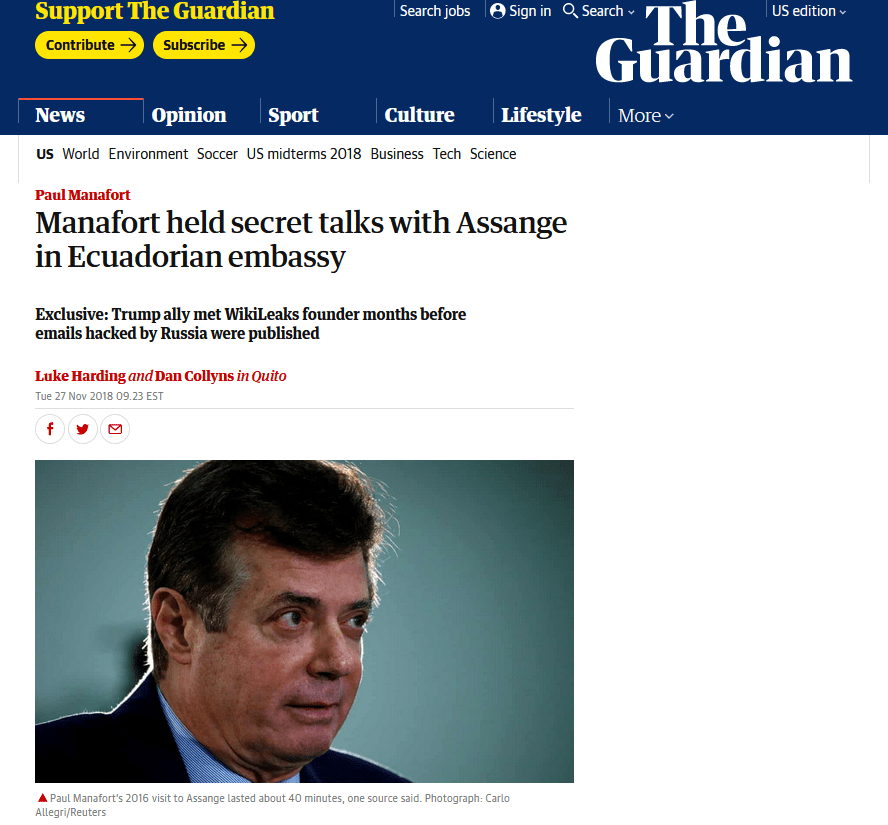
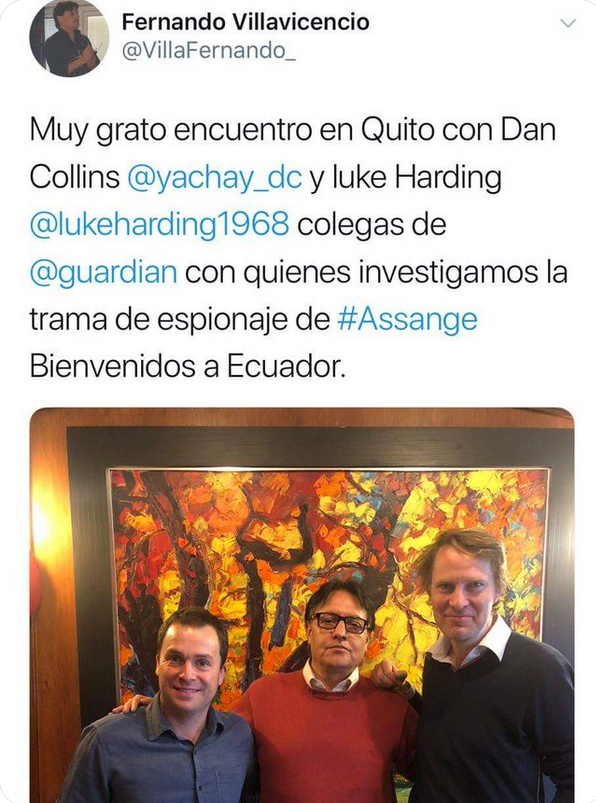
Fernando Villavicencio, who with the Guardian’s Luke Harding and Dan Collyns fabricated the notorious Guardian front page lie that Paul Manafort and Julian Assange held pro-Trump meetings in the Ecuadorean Embassy, has been shot dead in Ecuador.

The appalling lie, which the Guardian’s $700,000 a year editor has refused to retract or remove, despite criticism even from the Washington Post which named Villavicencio as the fabricator, was aimed to give support to Clinton’s flagging “Russiagate” invention, which was crumbling fast.

Here is a photo of CIA assets Collyns, Harding and Villavicencio together in Quito.

Villavicencio’s claim to be an anti-corruption campaigner was highly selective and aimed only at making accusations against left wing figures, including a long history of fabricating documents.

Having been elected to the National Assembly in 2021, he devoted all his energy to obstructing the impeachment for corruption of Ecuador’s current President, fellow CIA asset and banker Guillermo Lasso. That seems rather strange for an anti-corruption campaigner.

Astonishingly, Villavicencio’s Wikipedia page presents him as an anti-corruption hero. It does not refer to the Manafort fabrication at all.

The Wikipedia page states that in 2015 Villavicencio informed Wikileaks of surveillance against Assange in the Ecuadorean Embassy, as well as providing other documents to Wikileaks.

What it does not say is that Wikileaks did not publish Villavicencio’s material because their checks revealed at least some of it to be forged.

I must state here, for legal reasons, that the episode of surveillance on Assange in the Embassy mentioned in Villavicencio’s Wikipedia page, occurred before and was entirely unconnected to the UC Global affair, in which court case I am a witness and victim.

The result of Villavicencio’s information on surveillance of Assange in the Embassy led in fact directly to an attempt to blackmail over intimate moment images. Villavicencio’s role in that is, to say the least, murky. He was not present at the attempted shakedown.

None of which justifies Villavicencio’s awful death. But it does explain why you should not believe anything you are reading about it in the mainstream media.

CIA assets who forge documents, or distribute CIA forged documents, and spread corruption allegations against left wing figures, are most useful working in the shadows. If they become over-ambitious, draw attention to themselves, and run for President as Villavicencio did, when the CIA already has its approved puppet in the race, it is very easy to move from CIA asset to CIA liability.

Which is very bad for your health.

My sincere condolences to Mr Villavicencio’s family and those who loved him.

ARE CENTRAL BANK DIGITAL CURRENCIES (CBDC) DESTINED TO FAIL?

By Timothy Alexander Guzman

Source: Silent Crow News

Since Bitcoin (BTC) was introduced to the world as an alternative to the current central bank system with a dying US dollar that is backed by nothing as its reserve currency, but now there is a plan by several governments to move ahead with implementing their own central bank digital currencies (CBDCs), which is a digital form of currency that is still backed by, you guessed it, nothing.  The Nigerian government had made the decision to be the financial guinea pig for the globalist CBDC scheme, and so far, it has failed and that’s the good news.  The bad news is that certain governments are still moving forward with the idea of using government-issued digital currencies.  In the case of Nigeria, its citizens rejected their government’s plan to issue CBDCs by restricting cash in efforts to create a cashless society and so far, it seems that it has failed in epic fashion according to an opinion piece by author Nicholas Anthony that was published by coindesk.com ‘Nigerians’ Rejection of Their CBDC Is a Cautionary Tale for Other Countries’ is a warning to governments who are willing to take the same step: 

In Nigeria, citizens have taken to the streets to protest the nation’s cash shortage, further objecting to their government’s implementation of a central bank digital currency (CBDC). The shortage came about due to cash restrictions aimed at pushing the country into a 100% cashless economy. Yet, instead of adopting the CBDC, Nigerian protesters are demanding paper money be restored.

The country’s experience strongly suggests the average citizen understands that CBDCs present a substantial risk to financial freedom while providing no unique benefit

Not only did the Nigerian people reject CBDCs, but they also demanded a return to paper currencies because they quickly found out that financial freedoms would be severely limited. 

The concerns ranged from risking financial privacy to the possibility of financial oppression by government institutions.  Anthony mentioned how “the Nigerian government has unleashed a flurry of tricks to spur adoption, but none has proven effective.”  He even gave credit to the Nigerian government in terms of using modest approaches to influence its citizens to use CBDCs and it still failed:

To its credit, the Nigerian government initially tried to encourage use through modest measures. In August 2022, it removed access restrictions so that bank accounts were no longer required to use the CBDC. Then, in October, it offered discounts if people used the CBDC to pay for cabs.  Yet, neither effort proved to be fruitful. Put simply, Nigerians prefer cash

However, the Nigerian government continued its assault on cash:

Unfortunately, the Nigerian government doubled down and moved to more drastic measures by restricting cash itself. In December the Central Bank of Nigeria began restricting cash withdrawals to 100,000 naira (US$225) per week for individuals and 500,000 naira ($1,123) for businesses.

To make matters worse, the Nigerian government also chose to redesign the currency during this time in a “move aimed at restoring the control of the Central Bank of Nigeria (CBN) over currency in circulation” and to “further deepen the push to [a] cashless economy,” according to a CBN press release

The Nigerians had a hard time adapting to the government’s restrictions on their hard earned cash, so they posted their concerns on Twitter, Tik Tok and other social media platforms to let the world know what went wrong.  Soon after, major protests erupted on the streets because of the cash shortages imposed by the Central Bank of Nigeria: 

The government decided to redesign the currency to restore control over the Central Bank of Nigeria as its governor, Godwin Emefiele claimed that “the destination, as far as I am concerned, is to achieve a 100% cashless economy in Nigeria.”  To add insult to injury, “the company that designed the Nigerian CBDC called the cash restrictions a creative use of marketing and said other countries could be expected to take similar steps.”  A top manager from a financial institutional ratings firm called Agusto and Co., Ayokunle Olumbunmi said that the central bank “doesn’t want us to be spending cash. They want us to be doing transactions electronically, but you can’t legislate a change in behavior.”  Anthony concluded that the idea of CBDCs will not go very far, “CBDCs may be popular among central bankers, but money is ultimately a tool for the people. So long as the risks outweigh the benefits, it’s unlikely any CBDC will gain traction in Africa or elsewhere.”

Nicholas Anthony was correct to point out that CBDCs will not become mainstream as several countries have already demonstrated their unwillingness to move forward with the new form of digitized currencies. 

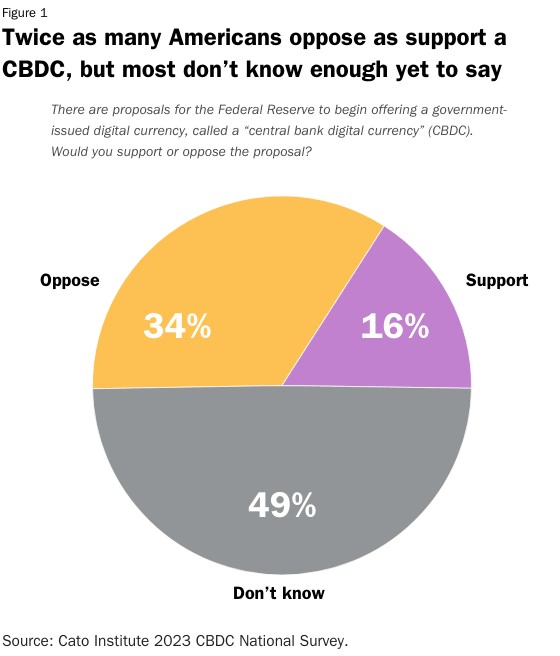
The average human being on earth understands that CBDCs is a bad idea, even in the United States where two-thirds of the population believes almost anything that their government tells them to believe are skeptical of CBDCs according to the Cato Institute, a think tank who also published an article by Nicholas Anthony on the findings of a survey that was conducted by the US federal Reserve Bank on how people view CBDCs.  Here is what they found, “Specifically, more than 66 percent of the 2,052 commenters were concerned or outright opposed to the idea of a CBDC in the United States (Figure 1).”

Bitcoin.com published an article on the GOP’s 2024 presidential candidate, Florida’s governor, Ron DeSantis who is opposed to CBDCs, ‘Ron DeSantis Vows to Prohibit CBDC, ‘Woke Politics,’ and ‘Financial Surveillance’ in Florida,’ he said “I think what the danger of the digital currency is that, one, they want to make that the sole currency, they want to get rid of crypto,” DeSantis continued, “They don’t like crypto because they can’t control crypto. So, they want to put everything in a central bank digital currency.”  There were other politicians who also have similar views on CBDCs:

DeSantis shares the view of several Republican officials who have criticized the idea of a central bank digital currency (CBDC). Minnesota congressman Tom Emmer introduced the Central Bank Digital Currency (CBDC) Anti-Surveillance State Act, while Texas senator Ted Cruz has created legislation against the government developing a CBDC. Georgia representative Marjorie Taylor Greene has also spoken out against CBDCs, and 2024 Democratic presidential candidate Robert Kennedy Jr. has warned that a central bank digital currency could lead to financial slavery

Cash is King! How the CBDC Failed in Japan and Ecuador

Cointelegraph.com, an independent digital news platform that focuses on crypto assets, blockchain technology and emerging fintech trends published an article last year written by Helen Partz based on which countries have rejected CBDCs for one reason or another titled ‘Some central banks have dropped out of the digital currency race’ mentions Japan, who is a major player in the global economy, ultimately rejected developing a CBDC scheme.  The Bank of Japan (BOJ) started testing their digital currency proof-of-concept in 2021 and had planned to finish the first phase by 2022 but in January “former BOJ official Hiromi Yamaoka advised against using the digital yen as part of the country’s monetary policy, citing risks to financial stability.” 

The BOJ issued a report in July 2022 and stated that it had no plan to establish a CBDC system since there is a “strong preference for cash and high ratio of bank account holding in Japan” and that the regulator suggested for a CBDC to be used as a “public good” and it “must complement and coexist” with “private payment services in order for Japan to achieve secure and efficient payment and settlement systems.”  However, it also said that “the fact that CBDC is being seriously considered as a realistic future option in many countries must be taken seriously,” in other words, the CBDC scheme in Japan will not move forward although several countries are still in the early stages of developing a plan for the use of CBDCs, but for Japan, cash is still and will be king well into the foreseeable future.

Ecuador is another example as its central bank, Banco Central del Ecuador (BCE) who launched its own electronic currency known as dinero electrónico (DE) in 2014 to increase some sort of financial inclusion for the public as well as to control the flow of fiat currencies.  According to Partz “As of February 2015, Ecuador managed to adopt DE as a functional means of payment, allowing qualified users to transfer money via a mobile app. The application specifically allowed citizens to open an account using a national identity number and then deposit or withdraw money via designated transaction centers.”  But industry observers were not so sure that the DE can take the form of a CBDC since Ecuador’s currency is the US dollar, and since Ecuador does not currently have its own sovereign currency, many were not so sure that they can call the DE, a form of CBDC.  “The Ecuadorian government cited the support of its dollar-based monetary system as one of the goals behind its DE platform after it started to accept U.S. dollars as legal tender in September 2000.”  It seems that Ecuador remains skeptical on any possibility that issuing CBDCs will be a success:

According to online reports, Ecuador’s DE operated from 2014 to 2018, amassing a total of 500,000 users at its peak out of a population of roughly 17 million people. The project ​​was eventually deactivated in March 2018, with the BCE reportedly citing legislation abolishing the central bank’s electronic money system. Passed in December 2021, the law stated that e-payment systems should be outsourced to private banks.

Years after dropping its central bank digital money initiative, Ecuador has apparently remained skeptical about the whole CBDC phenomenon. In August 2022, Andrés Arauz, the former general director at Ecuador’s central bank, warned eurozone policymakers that a digital euro could potentially disrupt not only privacy but also democracy

Bottom line, the CBDC will not be a standard for financial transactions for the few countries who already tried launching their versions of digital currencies. 

However, in the US, the Federal Reserve’s ‘FedNow’ was supposed to be launched sometime in July 2023.  Here is the Federal Reserve’s Press Release:

The Federal Reserve announced that the FedNow Service will start operating in July and provided details on preparations for launch.  The first week of April, the Federal Reserve will begin the formal certification of participants for launch of the service. Early adopters will complete a customer testing and certification program, informed by feedback from the FedNow Pilot Program, to prepare for sending live transactions through the system.

Certification encompasses a comprehensive testing curriculum with defined expectations for operational readiness and network experience. In June, the Federal Reserve and certified participants will conduct production validation activities to confirm readiness for the July launch.

“We couldn’t be more excited about the forthcoming FedNow launch, which will enable every participating financial institution, the smallest to the largest and from all corners of the country, to offer a modern instant payment solution,” said Ken Montgomery, first vice president of the Federal Reserve Bank of Boston and FedNow program executive. “With the launch drawing near, we urge financial institutions and their industry partners to move full steam ahead with preparations to join the FedNow Service”

For the US population, FedNow is a test that will eventually fail.  People will be skeptical about a central bank digital currency once it proves that it is used to surveil people’s spending habits and control what they spend their money on, and God forbid they are anti-war, anti-vaccine activists, homeschoolers, pro-gun supporters or conspiracy theorists, the bankers can cut them off from using CBDCs and then what happens?  Will there be riots in the streets? 

Since Bitcoin was introduced as an alternative to central bank control, the creation of the CBDC is their answer in hopes of retaining their power, but that idea is not likely to happen, it will in some way, backfire. 

When it comes to Bitcoin, it’s a different story.  In an interesting article written by Jay Speakman of beincrypto.com ‘When You Buy Bitcoin You Gain Freedom’ says that “in a world where economic and political uncertainties abound, owning Bitcoin (BTC) could provide the path toward financial freedom and autonomy. It’s no longer just about investing in a digital asset. It’s about making a revolutionary move to gain control over your finances and future.”  Speakman makes several main points on why people should own Bitcoins and one of those points is that owning sovereign cryptos such as Bitcoins, Ethereum’s and others is a step towards financial freedom:

It provides the opportunity to participate in the global economy without the limitations of traditional banking systems. Bitcoin is not subject to government regulations. At least not yet, and it is free from the inflationary policies which can erode fiat currency values. This means Bitcoin provides an alternative and potentially more secure, store of value

Another reason for owning Bitcoins is for future investment purposes:

Investing in Bitcoin is no longer simply making money. It is about investing in your future and securing your financial freedom. Bitcoin’s decentralized financial system operates independently of central authorities or governments. This means it is resistant to censorship and regulation. Bitcoin holders can make transactions without the need for banks, which are subject to government intervention

“Investment Diversification” is another reason to own Bitcoins since putting all your eggs in one basket, especially in a globalist banking system, is a bit risky:

Investing in Bitcoin can provide portfolio diversification as it is not correlated to traditional assets such as stocks and bonds. This means it may provide a hedge against inflation and market volatility, mitigating the risks associated with traditional investment portfolios

However, owning Bitcoins does have risks like everything else since the “market is notoriously volatile. Prices often fluctuate wildly based on a range of factors, from government regulations to media coverage.”  Speakman also mentions that “BTC transactions can result in a permanent loss of funds. There is also the risk of hacking and theft, as these transactions are irreversible and untraceable.” 

In conclusion, the article lays out what owning Bitcoins could mean for individuals and investors alike especially for those who do not trust the traditional banking system:

The decision to buy BTC is more than just a financial investment. It’s a move towards financial freedom, control, and security. Bitcoin’s feature of allowing individuals to act as their own banks. Providing a secure alternative to traditional banking systems which have exhibited instability and vulnerability to failures.  Furthermore, the appeal goes beyond just financial security and autonomy. The digital currency resonates with libertarians who value individual freedom and limited government intervention. Despite a torrent of dissenting voices Bitcoin continues to gain mainstream adoption. As the technology continues to mature, it may address some of the concerns raised by the dissenting voices.

Investing in digital assets may involve risks such as volatility and the potential for hacking and theft. Yet, the benefits of financial freedom outweigh the downsides. As the world becomes increasingly uncertain, owning Bitcoin could be the first step toward financial security and autonomy

When you look at the difference between CBDCs along with the system imposed by international banking cartels who still maintain some form of financial dominance versus the Bitcoin revolution, there is a difference.  CBDCs means no financial freedoms and owning Bitcoins means the exact opposite.  Even though Bitcoins are still in the early stages, there is hope in the new crypto technology.  But like everything else, you should be cautious, do not invest 100% of your net worth in just one asset, in other words, invest maybe 5% in bitcoins, and the rest? 15% in emergency preparedness (food, water filters, guns, flashlights, etc.)  20% in real estate or invest in a second passport, 20% in hard assets like gold, silver and copper, 20% in high-end watches, antiques, aged wines and liquor, collectibles etc. and the last 20% in foreign stocks especially those that are in politically stabilized environments or in gold and silver mining companies, but that’s just my opinion. 

Government-backed CBDCs will be a failure because the people already do not trust international banking cartels to totally control their finances. So, for these banks to have total control over your financial wellbeing under their CBDC scheme would be an extremely difficult task for them to manage. 

The banking cartel or the financial bureaucrats are about to discover that they will be in over their heads with an angry population.  Just imagine if the banking cartels, certain governments and their corporate conglomerates are in  control over the people’s finances, they will get to determine who eats and who will starve.  This is the ultimate power grab the globalist bankers have been dreaming about for a very long time, but will the people stop this from happening?  I’m an optimist, so I believe that they will demand their financial freedoms and that is something of value that they can hold and control in their own hands.  The case for CBDCs will be a hard sell, so central banks who are proposing this idea should think twice about what they are trying to impose on the public, if not, they will face some form of resistance just like they did in Nigeria.    

Julian Assange’s Imprisonment Is The Intellectual Imprisonment of Us All

By Eric Zuesse

Source: The Duran

Julian Assange has been imprisoned since 2012 because he had provided, to whistleblowers who were in government and who saw and could supply to his WikiLeaks organization, items of evidence which indicated that their government was breaking its own laws, protection of their personal identity, which confidentiality they could then rely upon for their personal safety, to protect those whistleblowers against retaliation by their government. No regular ‘news’-medium could or would reliably do that, but Assange and his WikiLeaks organization could, and they always did. This is why governmental whistleblowers did go to them for this purpose.

The power that a government has to ‘classify’ documents is the power that it has to hide evidence from its public and so to rule its population as being their subjects instead of (authentically) their citizens: it is the ability to BE a dictatorship. (It might arguably be acceptable when a democracy is being invaded by a foreign country, but never — other than that — can there be governmental secrecy to protect itself unless the government is a dictatorship — NOT a democracy — in which case the Government is, itself, being the enemy of its own population.) Without such secrecy against the public, the government would be a democracy, because then the population would be voting in an authentically free information-environment where there exists uncensored information to the public, so that each individual can make one’s OWN individual judgments regarding what is true, and what is false. But, otherwise, a government is a dictatorship.

This power (classifying governmental information) is also a government’s power of legal impunity so that it can violate its own laws and know that the voting public will not know that it did. That routine power of classifying information is the intellectual imprisonment of the nation’s entire population.

Julian Assange is not a subject (‘citizen’) of the U.S. Government, nor is he a subject of the UK Government, nor is he a subject of the other two Governments (Sweden and Ecuador) that have participated in assisting America and Britain to place and keep him in varying forms of (now super-max) imprisonment for over a decade, but they have done it, during all of this time, and never yet has he been tried and convicted of anything other than his having jumped bail in 2012 on a phony rape charge that even its alleged victim admitted had been false; so, in effect, if not in reality, his very imprisonment is an example of those governments’ dictatorships — it has already been long-term imprisonment without trial. ONLY a dictatorship does that. Only a dictatorship can do that.

Assange is instead a subject of the Australian dictatorship, which has done nothing at all to assist him or to protest his being raped by ‘law’ in those foreign lands. The fact that there are not revolutions overthrowing and replacing the Governments in each one of the countries that has participated in this ‘legal’ rape of Assange is testimony to the effectiveness of the intellectual imprisonment of each one of those nations’ populations.

Assange has been in various forms of imprisonment by UK for the last ten years without his ever having been convicted of anything except that in 2012 he was sentenced to 50 weeks in prison for jumping bail (on sexual charges against him that even the alleged accuser denied were true). And yet he remains now in solitary confinement (“23 hours a day locked in their cells”) in a super-max British prison, because the U.S. Government won’t stop its demand that he be extradited to the U.S. (and killed here — imprisoned for up to 175 years — instead of in Britain). His only ‘crime’ was his publishing only truths, especially truths that cut to the core of exposing the U.S. regime’s constant lying. So, this blatant and illegal injustice against an international hero (virtually everywhere except in the United States) is today one prominent disproof of the U.S. and UK lies to the effect that they are democracies. On 26 September 2021, Yahoo News reported (based largely on reporting in Madrid’s El Pais on 5 January 2021) that the Trump Administration felt so embarrassed by some information that had been WikiLeaked, they drew up detailed plans to kidnap Assange at the Ecuadorian Embassy in London to “rendition” him for possible execution by America. The plans, including “meetings with authorities or approvals signed by the president,” were finally stopped at the National Security Council, as being too risky. “Discussions over kidnapping or killing Assange occurred ‘at the highest levels’ of the Trump administration”, even without any legal basis to try him in the United States. So: the Trump Administration then prepared an indictment against Assange (to legalize their extradition-request), and the indictment became unsealed or made public on the same day, 11 April 2019, when Ecuador’s Government allowed UK’s Government to drag Assange out into UK super-max solitary-confinement imprisonment, and this subsequently produced lie-based U.S. & UK tussles over how to prevent Assange from ever again being able to reach the public, either by continuing his solitary confinement, or else by, perhaps, poisoning him, or else convicting him of something and then executing him. On 4 January 2021, a British judge nixed Assange’s defense case: “I reject the defence submissions concerning staying extradition [to U.S.] as an abuse of the process of this court.” Earlier, her handling of Assange’s only ‘trial’, which was his extradition hearing, was a travesty, which would have been expected in Hitler’s courts, and which makes clear that UK’s courts can be just as bad as Nazi courts had been. However, the U.S. regime’s efforts to grab Assange continued on. Barack Obama, Donald Trump, Joe Biden, and the overwhelmingly compliant U.S. Congress, are all to blame for that dictatorial regime’s pursuit against that champion of truth-telling; and the same blame applies to the leadership in UK. On 10 December 2021, BBC bannered “Julian Assange can be extradited to the US, court rules”. Blatantly, both America and England lie in order to refer to themselves as being democracies. In fact, America has the world’s highest percentage of its residents in prisons. It’s the world’s #1 police-state. Is that because Americans are worse than the people in other countries, or is it instead because the thousand or so individuals who collectively control the nation’s Government are, themselves, especially psychopathic? Evidence will now be linked-to on that question: America has been scientifically examined more than any other country has, in regards to whether it is an aristocracy, or instead a democracy, and the clear and consistent finding is that it’s an aristocracy. And it clearly is that at the federal level. (Here is a video summarizing the best single study of that, and it finds America to be an aristocracy, because it’s controlled by the richest few). And Norway’s aristocracy had also been part of this scandal. It is an international scandal, and keeps getting worse.

On June 19th, Chris Hedges headlined “The Imminent Extradition of Julian Assange & the Death of Journalism” and documented that the alleged ‘assurances’ that the U.S. regime had provided to the UK regime on the basis of which the latter dictatorship would be transferring Assange to a super-max prison in the United States, had as many holes in it as a ton of Swiss cheese.

ONLY in barbaric dictatorships is any of this even possible, but here it is real.

Assange’s ‘trial’ will be the trial of ‘democracy’ in whatever nation it will be executed.

—————

Investigative historian Eric Zuesse’s new book, AMERICA’S EMPIRE OF EVIL: Hitler’s Posthumous Victory, and Why the Social Sciences Need to Change, is about how America took over the world after World War II in order to enslave it to U.S.-and-allied billionaires. Their cartels extract the world’s wealth by control of not only their ‘news’ media but the social ‘sciences’ — duping the public.

The Anonymous Executioners of the Corporate State

Imprisoning the David to Chevron’s Goliath is the latest outrage by a US judiciary now engineered to always favor the interests of capital.

by Chris Hedges

By Chris Hedges

Source: Mint Press News

Judge Loretta Preska, an advisor to the conservative Federalist Society, to which Chevron is a major donor, sentenced human rights attorney and Chevron nemesis Steven Donziger to six months in prison Friday for misdemeanor contempt of court after he had already spent 787 days under house arrest in New York.

Preska’s caustic outbursts — she said at the sentencing, “It seems that only the proverbial two-by-four between the eyes will instill in him any respect for the law” — capped a judicial farce worthy of the antics of Vasiliy Vasilievich, the presiding judge at the major show trials of the Great Purges in the Soviet Union, and the Nazi judge Roland Freisler who once shouted at a defendant, “You really are a lousy piece of trash!”

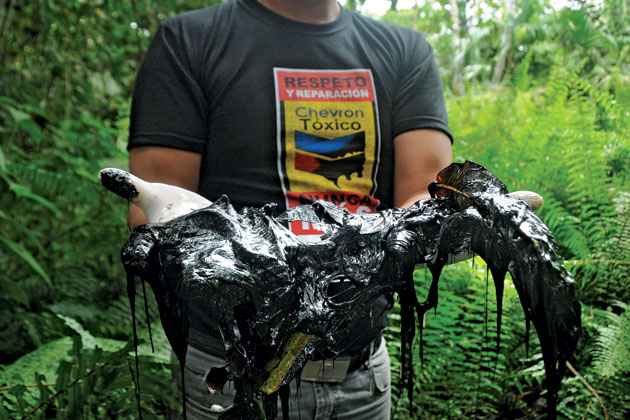
Donziger, a graduate of Harvard Law School, has been fighting against polluting American oil companies for nearly three decades on behalf of indigenous communities and peasant farmers in Ecuador. His only “crime” was winning a $9.5 billion judgment in 2011 against Chevron for thousands of plaintiffs. The oil giant had bought Texaco oil company holdings in Ecuador, inheriting a lawsuit alleging it deliberately discharged 16 billion gallons of toxic waste from its oil sites into rivers, groundwater, and farmland. Since the verdict, Chevron has come after him, weaponizing litigation to destroy him economically, professionally, and personally.

The sentencing came a day after Donziger petitioned the court to consider an opinion by the United Nations human rights council that found his house arrest a violation of international human rights law. The U.N human rights council said his house arrest counted as detention under international law and it was therefore illegal for Judge Preska to demand an additional six months in jail. Amnesty International also called for Donziger’s immediate release.

Donziger and his lawyers have two weeks to appeal the judge’s order that Donziger be sent immediately to jail. Preska denied Donziger bail claiming he is a flight risk. If the Federal Court of Appeals turns down Donziger’s appeal he will go to jail for six months. The irony, not lost on Donziger and his lawyers, is that the higher court may overturn Preska’s ruling against him, but by the time that decision is made he will potentially have already spent six months in jail.

“What Judge Preska is trying to do is force me to serve the entirety of my sentence before the appellate court can rule,” Donziger told me by phone on Monday. “If the appellate court rules in my favor, I will still have served my sentence, although I am innocent in the eyes of the law.”

Donziger, his lawyers have pointed out, is the first person under U.S. law charged with a “B” misdemeanor to be placed on home confinement, prior to trial, with an ankle monitor. He is the first person charged with any misdemeanor to be held under home confinement for over two years. He is the first attorney ever to be charged with criminal contempt over a discovery dispute in a civil case where the attorney went into voluntary contempt to pursue an appeal. He is the first person to be prosecuted under Rule 42 (criminal contempt) by a private prosecutor with financial ties to the entity and industry that was a litigant in the underlying civil dispute that gave rise to the orders. He is the first person tried by a private prosecutor who had ex parte communications with the charging judge while that judge remained (and remains) unrecused on the criminal case.

“No lawyer in New York for my level of offense ever has served more than 90 days and that was in home confinement,” Donziger told the court. “I have now been in home confinement eight times that period of time. I have been disbarred without a hearing where I have been unable to present factual evidence; thus, I am unable to earn an income in my profession. I have no passport. I can’t travel; can’t do human rights work the normal way which I believe I am reasonably good at; can’t see my clients in Ecuador; can’t visit the affected communities to hear the latest news of cancer deaths or struggles to maintain life in face of constant exposure to oil pollution. In addition, and this is little known, Judge [Lewis A.] Kaplan has imposed millions and millions of dollars of fines and courts costs on me. [Kaplan is the judge for Chevron’s lawsuit against Donziger; Preska is his handpicked judge for the contempt charges.] He has ordered me to pay millions to Chevron to cover their legal fees in attacking me, and then he let Chevron go into my bank accounts and take all my life’s savings because I did not have the funds to cover these costs. Chevron still has a pending motion to order me to pay them an additional $32 [million] in legal fees. That’s where things stand today. I ask you humbly: might that be enough punishment already for a Class B misdemeanor?”

Judge Preska was unmoved.

“Mr. Donziger has spent the last seven years thumbing his nose at the U.S. judicial system,” Preska said at his sentencing hearing. “Now it’s time to pay the piper.”

The six-month sentence was the maximum the judge was allowed to impose; she ruled that his house arrest cannot be counted as part of his detention. From start to finish, this has been a burlesque. It is emblematic of a court system that has been turned over to lackies of corporate power, who use the veneer of jurisprudence, decorum, and civility to make a mockery of the rule of law.

When the law is neutered, judges become the enforcers of injustice. These corporate judges, who epitomize what Hannah Arendt called the banality of evil, now routinely make war on workers, civil liberties, unions, and environmental regulations.

Preska sent Jeremy Hammond to prison for a decade for hacking into the computers of a private security firm that works on behalf of the government, including the Department of Homeland Security, and corporations such as Dow Chemical. In 2011, Hammond released to the website WikiLeaks and Rolling Stone and other publications some three million emails from the Texas-based company Strategic Forecasting Inc., or Stratfor. The sentence was one of the longest in U.S. history for hacking and the maximum Preska could impose under a plea agreement in the case. I sat through the Hammond trial. I watched Preska spew her bile and contempt at Hammond from the bench with the same vitriol she used to attack Donziger.

Preska is also infamous for her long judicial crusade to force New York public schools to provide tax-subsidized free space for evangelical churches based on blatantly illogical readings of the Constitution.

The persecution of Donziger fits a pattern familiar to millions of poor Americans who are coerced into accepting plea deals, many for crimes they did not commit, and sent to prison for decades. It fits the pattern of the judicial lynching and prolonged psychological torture of Julian Assange and Chelsea Manning. It fits the pattern of those denied habeas corpus and due process at Guantánamo Bay or in CIA black sites. It fits the pattern of those charged under terrorism laws, many held at the federal Metropolitan Correctional Center (MCC) in Lower Manhattan, who cannot see the evidence used to indict them. It fits the pattern of the widespread use of Special Administrative Measures, known as SAMs, imposed to prevent or severely restrict communication with other prisoners, attorneys, family, the media, and people outside the jail. It fits the pattern of the extreme sensory deprivation and prolonged isolation used on those in our black sites and prisons, a form of psychological torture, the refinement of torture as science. By the time a “terrorist” is dragged into our secretive courts the bewildered suspect no longer has the mental and psychological capability to defend themselves. If they can do this legally to the demonized they can, and one day will, do it to the rest of us. The Donziger case is an ominous warning that the American legal system is broken.

Ralph Nader, who graduated from Harvard Law School, has long decried the capture of the courts and law schools by corporate power, calling the nation’s attorneys and judges “lucrative cogs in the corporate wheel.” He notes that law school curriculums are “built around corporate law, and corporate power, and corporate perpetration, and corporate defense.”

Victor Klemperer, who was dismissed from his post as a professor of Romance languages at the University of Dresden in 1935 because of his Jewish ancestry, astutely noted how at first the Nazis “changed the values, the frequency of words, [and] made them into common property, words that had previously been used by individuals or tiny troupes. They confiscated words for the party, saturated words and phrases and sentence forms with their poison. They made language serve their terrible system. They conquered words and made them into their strongest advertising tools [Werebemittle], at once the most public and most secret.” And, Klemperer noted, as the redefinition of old concepts took place the public was oblivious.

This redefinition of words and concepts has, as Klemperer witnessed during the rise of fascism, allowed the courts to twist the law into an instrument of injustice, revoking our rights by judicial fiat. It has seen the courts permit unlimited dark money into political campaigns under Citizens United, defending our money-saturated elections as the right to petition the government and a form of free speech. The courts have revoked our right to privacy and legalized wholesale government surveillance in the name of national security. The courts grant corporations the rights of individuals, while rarely holding the individuals who run the corporations accountable for corporate crimes.

Very few of the legal rulings that benefit corporate power have popular support. The corporate disemboweling of the country, therefore, is increasingly given cover by Christian fascists, who energize their base around abortion, prayer in schools, guns and breaking down the separation of church and state. These issues are rarely addressed in cases before federal courts. But they distract the base from the slew of pro-corporate rulings that dominate most court dockets.

Corporations such as Tyson Foods, Purdue, Walmart, and Sam’s Warehouse have poured millions into institutions that indoctrinate these Christian fascists, including Liberty University and Patrick Henry Law School. They fund the Judicial Crisis Network and the U.S. Chamber of Commerce, which campaigned for Amy Coney Barrett’s appointment to the Supreme Court. Barrett opposes abortion and belongs to People of Praise, a far-right Catholic cult that practices “speaking in tongues.” She and the other far-right ideologues are hostile to LGBTQ rights. But this is not why she is so beloved by corporations, who are not interested in abortion, LGBTQ equality or gun rights.

Barrett and the Christian fascists embrace an ideology that believes that God will take care of the righteous. Those who are poor, those who are sick, those who go to prison, those who are unemployed, those who cannot succeed in society do so because they have failed to please God. In this worldview there is no need for unions, universal health care, a social safety net or prison reform. Barrett has ruled consistently in favor of corporations to cheat gig workers out of overtime, green-light fossil fuel extraction and pollution and strip consumers of protection from corporate fraud. The watchdog group Accountable.US found that as a circuit court judge, Barrett “faced at least 55 cases in which citizens took on corporate entities in front of her court and 76% of the time she sided with the corporations.”

The Christian fascists, allied with organizations such as the Federalist Society, under the Trump administration gave lifetime appointments to nearly 200 judges, roughly 23 percent of all federal judgeships. That included 53 to the nation’s appellate courts, the court immediately under the Supreme Court. The American Bar Association, the country’s largest nonpartisan coalition of lawyers, has rated many of these appointments as unqualified. There are currently six Federalist Society Supreme Court justices, including Amy Coney Barrett, Neil Gorsuch, and Brett Kavanaugh, who Nader calls “a corporation masquerading as a human being.” Two Federalist Society Supreme Court justices, Clarence Thomas and the late Antonin Scalia, who was an original faculty advisor to the organization founded by conservative law students in 1982, were supported in the nomination process by Joe Biden.

The stacking of the courts with corporate puppets, however, began long before Trump. It was carried out by both Republican and Democratic administrations. Preska was appointed by Republican President G.W. Bush. However, the judge who preceded Preska in the Donziger case, Judge Lewis A. Kaplan, a former lawyer for the tobacco industry who had undisclosed investments in funds with Chevron holdings, according to his public financial disclosure statement, was appointed by Democratic President Clinton.

The targeting of the courts was one of the key goals of Lewis Powell, a corporate lawyer later elevated to the Supreme Court by President Nixon. In Powell’s 1971 memo to the Chamber of Commerce, a blueprint for the slow-motion corporate coup that has taken place, he called on business interests to pack the judiciary with corporate-friendly judges.

The courts in all tyrannies are dominated by mediocrities and buffoons. They make up for their intellectual and moral vacuity with a zealous subservience to power. They turn courtroom trials into opera buffa, at least until the victim is shackled and pushed out the door to a prison cell. They fulminate in caustic tirades at the condemned, whose sentence is never in doubt and whose guilt is never in question.

“It started when Texaco went into Ecuador in the Amazon in the 1960s and cut a sweetheart deal with the military government then ruling Ecuador,” Donziger told me for a column I wrote about his case a year ago. “Over the next 25 years, Texaco was the exclusive operator of a very large area of the Amazon that had several oil fields within this area, 1500 square miles. They drilled hundreds of wells. They created thousands of open-air, unlined toxic waste pits where they dumped the heavy metals and toxins that came up from the ground when they drilled. They ran pipes from the pits into rivers and streams that local people relied on for their drinking water, their fishing, and their sustenance. They poisoned this pristine ecosystem, in which lived five indigenous peoples, as well as a lot of other nonindigenous rural communities. There was a mass industrial poisoning.”

“The verdict came down, about $18 billion in favor of the affected communities, which is what it would take at a minimum to clean up the actual damage and compensate the people for some of their injuries,” Donziger told me. “That eventually got reduced on appeal in Ecuador to $9.5 billion, but it was affirmed by three appellate courts, including the highest court of Ecuador. It was affirmed by the Canadian Supreme Court, where the Ecuadorians went to enforce their judgment in a unanimous opinion in 2015.”

Chevron promptly sold its assets and left Ecuador. It refused to pay the fees to clean up its environmental damage. It invested an estimated $2 million to destroy Danziger. Chevron sued him, using a civil courts portion of the federal law famous for breaking the New York Mafia in the 1970s, the Racketeer Influenced and Corrupt Organizations, or RICO Act. Chevron, which has more than $260 billion in assets, hired an estimated 2,000 lawyers from 60 law firms to carry out its campaign, according to court documents. But the oil giant, which did not want a jury to hear the case, dropped its demand for financial damages, which would have allowed Donziger to request a jury trial. This allowed Judge Kaplan to decide the RICO case against Donziger alone. He found credible a witness named Alberto Guerra, an Ecuadorian judge, relocated to the US by Chevron at a cost of some $2 million, who claimed the verdict in Ecuador was the product of a bribe. Kaplan used Guerra’s testimony as primary evidence for the racketeering charge, although Guerra, a former judge, later admitted to an international tribunal that he had falsified his testimony.

John Keker of San Francisco, one of Donziger’s lawyers on that case, said he was up against 160 lawyers for Chevron and during the trial he felt “like a goat tethered to a stake.” He called the court proceedings under Kaplan “a Dickensian farce” and a “show trial.”

In the end, Kaplan ruled that the judgment in the Ecuadorean court against Chevron was the result of fraud. He also ordered Donziger to turn over decades of all client communication to Chevron, in effect eradicating attorney-client privilege, a backbone of the Anglo-American legal system with roots dating to ancient Rome. Donziger appealed what was, according to legal experts following the case, an unprecedented and illegal order. While Donziger’s appeal was pending, Kaplan charged him with misdemeanor criminal contempt for this principled stance — carrying a maximum sentence of six months — as well as his refusal to turn over his passport, his personal electronics and to refrain from seeking the collection of the original award against Chevron. When the U.S. attorney’s office declined for five years to prosecute his criminal contempt charges against the environmental lawyer, Kaplan, using an exceedingly rare judicial maneuver, appointed the private law firm of Seward & Kissel, to act in the name of the government to prosecute Donziger. Neither the judge nor the law firm disclosed that Chevron has been a client of Seward & Kissel.

Kaplan also violated the established random case assignment protocol to personally assign Preska, who had served on an advisory board of the Federalist Society, a group to which Chevron has been a lavish donor, to hear the case. Kaplan had Preska demand Donziger post an $800,000 bond on the misdemeanor charge. Preska placed him under house arrest and confiscated his passport, which he has used to meet with attorneys around the world attempting to enforce the judgment against Chevron. Kaplan managed to have Donziger disbarred. He allowed Chevron to freeze Donziger’s bank accounts, slapped Donziger with millions in fines without allowing him a jury, forced him to wear an ankle monitor 24 hours a day and effectively shut down his ability to earn a living. Kaplan allowed Chevron to impose a lien on Donziger’s apartment in Manhattan where he lives with his wife and teenage son.

None of this would surprise those targeted by the tyrannies of the past. What would be surprising, perhaps, to many Americans is how advanced our own corporate tyranny has become. Donziger never stood a chance. Neither does Julian Assange. These judges are not, in the end, focused on Donziger or Assange, but on us. The show trials they preside over are meant to be transparently biased. They are designed to send a message. All who defy corporate power and the national security state will be lynched. There will be no reprieve because there is no justice.

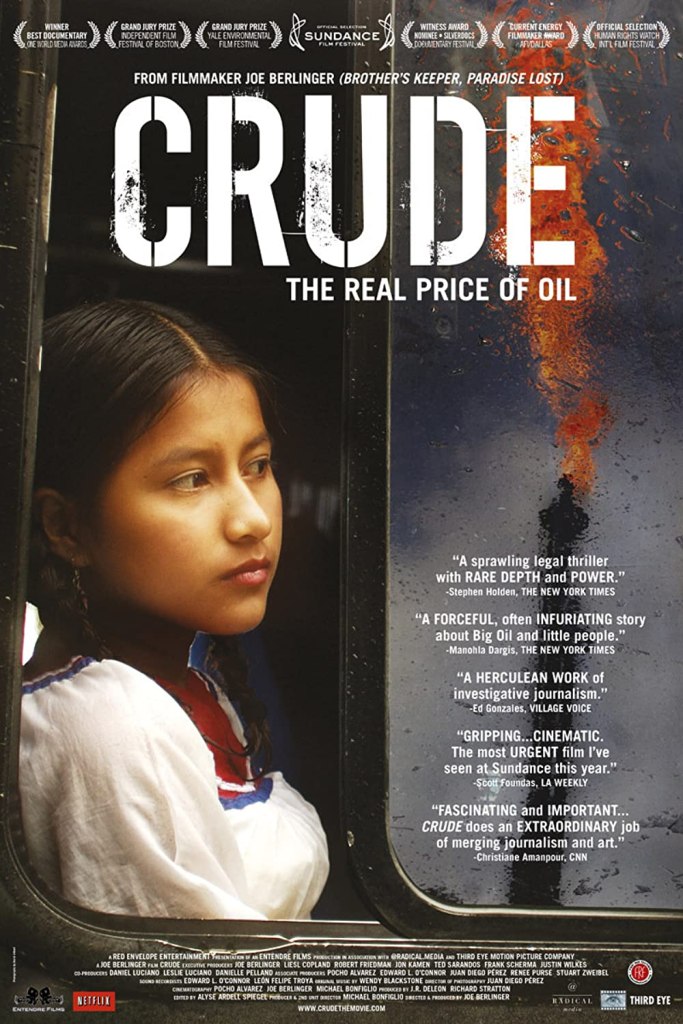
Saturday Matinee: Crude

Crude

Directed by Joe Berlinger

A dramatic documentary about the “Amazon Chernobyl” case where indigenous tribal groups are fighting the multinational corporation Chevron.

Film Review by Frederic and Mary Ann Brussat

Source: Spirituality & Practice

This attention-grabbing documentary directed by Joe Berlinger (Brother’s Keeper) centers on the dramatic story of a legal case that has dragged on for years: Aginda vs Chevron-Texaco. The plaintiffs are 30,000 individuals, including members of five indigenous tribes and colonial settlers in Ecuador who allege that over the course of its quest for oil, Texaco dumped over 18 billion gallons of toxic waste and formation water directly into streams, river, and jungle floor of the Amazon rainforest. In addition, the company is said to have spilled 18 million gallons of crude oil from pipelines, burned more than 235 billion cubic feet of natural gas into the atmosphere, and built nearly 1000 unlined toxic waste pits in the region — an area approximately the size of the state of Rhode Island. Berlinger manages to broaden the documentary out beyond what has been called the “Amazon Chernobyl case” to include material on global politics, celebrity causes, environmental activism, human rights advocacy, the role of the media in controversial trials, the power and wealth of multinational corporations, and the unconscionable treatment of rapidly-disappearing indigenous cultures.

At the center of this David vs Goliath struggle is Pablo Farjardo, the lead attorney for the Aguinda plaintiffs. He grew up in poverty in the Amazon region and attended college and law school under the sponsorship of the Catholic Church. In his first case, which has been running since November 1993, Farjardo is seen making his points during the judicial inspections of the affected regions, rallying support of indigenous tribes, and visiting with families who are suffering with cancer, skin conditions, and birth defects. In 2008, he received the Goldman Environmental Prize in San Francisco honoring his work along with Luis Yanza, President of the Amazon Defense Fund, who has been managing the day-by-day operations of the case. A large role has also been played by Steven Donziger, a New York-based attorney, who has provided invaluable strategy advice and seems to be very savvy about the importance of media coverage (the cover story about the case in Vanity Fair and the involvement of Trudie Styler, the co-founder of the Rainforest Foundation with her husband, the musician Sting).

The cause of Farjardo and associates is helped in 2007 when the new President of Ecuador, Rafael Correa, tours the toxic areas and lends his support. The case for Chevron in the documentary is presented by Ricardo Reis, the Managing Counsel for Chevron Latin America; Sara McMillan, Chevron’s Environmental Scientist who denies any connection between the company’s operations and the deaths and health issues of the indigenous tribes; and Adolfo Callejas and Diego Larrea, the two attorneys representing Chevron.

The proceedings reach a climactic point when the findings of Richard Cabrera, an independent expert, are released. He was appointed by the court to conduct a “global assessment” of the region, evaluating the plaintiffs’ claims and calculating the cost to repair any alleged damages. He found Chevron to be liable for up to $16 billion in damages (later amended to $27 billion) as compensation for health care, environmental remediation, reparations for loss of indigenous culture, cancer deaths, and the oil company’s “unjust enrichment” from its operations. Chevron has rejected the report calling it biased and unqualified. And so, the case continues and we recall that the Exxon Valdez judgment took nearly two decades to appeal.

Update:

Corporate Tyranny: How Chevron Conspired with US Courts to Destroy a Human Rights Lawyer

By Rania Khalek

Source: Breakthrough News

Human rights lawyer Steven Donziger has been thrust into an epic battle with one of the biggest oil companies in the world. He helped win a multi billion dollar lawsuit against the Oil Giant Chevron for polluting the Amazon in Ecuador and poisoning the indigenous community who lives there.

Ever since then Chevron has waged a relentless and global campaign to avoid accountability and to punish Doziger. In what reads like a Hollywood thriller, a US judge with ties to Chevron has conspired with the oil giant to destroy Donziger’s life. As a result of the case, he has been confined to his home on house arrest since 2019. And there’s a corporate media blackout!

Donziger spoke to Rania Khalek on Dispatches from house arrest in New York City, not too far from the New York Times, which has ignored the story.

Donate to Stephen Donziger’s legal defense fund here: https://www.donzigerdefense.com/

How Corporate Tyranny Works

By Chris Hedges

Source: OpEdNews.com

Those, like environmental lawyer Steven Donziger, who fight the corporate control of our society on behalf of the vulnerable find the institutions of power unite to crucify them.

The persecution of the attorney Steven Donziger is a grim illustration of what happens when we confront the real centers of power, masked and unacknowledged by the divisive cant from the Trump White House or the sentimental drivel of the Democratic Party. Those, like Donziger, who name and fight the corporate control of our society on behalf of the vulnerable see the judiciary, the press and the institutions of government unite to crucify them.

“It’s been a long battle, 27 years,” Donziger said when I reached him by phone in his apartment in Manhattan.

Donziger, who has been fighting polluting American oil companies for nearly three decades on behalf of indigenous communities and peasant farmers in Ecuador, has been under house arrest in Manhattan for a year. He will go to trial in federal court in New York on September 9 on contempt of court charges, which could see him jailed for six months. Ever since he won a multibillion-dollar judgment in 2011 against the oil giant Chevron, the multinational has come after him personally through litigation that threatens to destroy him economically, professionally and personally.

“Our L-T [long-term] strategy is to demonize Donziger,” Chevron wrote in an internal memo in 2009, as reviewed by Courthouse News.

It started when Texaco went into Ecuador in the Amazon in the 1960s and cut a sweetheart deal with the military government then ruling Ecuador,” Donziger told me. “Over the next 25 years, Texaco was the exclusive operator of a very large area of the Amazon that had several oil fields within this area, 1500 square miles. They drilled hundreds of wells. They created thousands of open-air, unlined toxic waste pits where they dumped the heavy metals and toxins that came up from the ground when they drilled. They ran pipes from the pits into rivers and streams that local people relied on for their drinking water, their fishing and their sustenance. They poisoned this pristine ecosystem, in which lived five indigenous peoples, as well as a lot of other non-indigenous rural communities. There was a mass industrial poisoning.”

“By the time I went down there in the early 1990s, many people had died, cancer rates were skyrocketing according to several independent health evaluations, people were really hurting. There was zero regard for the lives of the local people by Texaco. I was a very young lawyer back in 1993 when I first went to Ecuador. It was like looking at an apocalyptic scene. There was oil on the roads. People were living in abject poverty. They had no shoes. They would get oil on their feet when they walked along the roads. The oil pollution had permeated every aspect of daily life. It was in the food supply. It was in the water supply. It was in the air. The average person there would get exposed multiple times a day to very harmful, cancer-causing toxins, with foreseeable results.”

“I, with other lawyers, filed a lawsuit in New York against Texaco. The reason we filed in New York was because Texaco’s headquarters were in New York in 1993. The decisions to pollute in Ecuador, to play God to the people of Ecuador, were made in New York. We sued in New York. Texaco tried to get the case back to Ecuador where they had never been held accountable, where they knew the indigenous peoples had no money or resources to find lawyers.”

“They thought it would just go away,” said Donziger. “Over a 10-year period, we battled to get a jury trial in the United States. Ultimately, they won that part of the battle. It went down to Ecuador.”

“We started working with a team of Ecuadoran lawyers in the early 2000s. We went forward with the lawsuit. We produced voluminous scientific and testimonial evidence, showing that they caused probably the world’s worst oil pollution. It was called the ‘Amazon Chernobyl’ by locals and experts. They dumped 16 billion gallons of toxic waste. They did it deliberately to save money. This was unlike the BP spill in the Gulf of Mexico, which was a terrible accident, even though it was a product of horrendous negligence by BP. This was done by design to pollute, knowing that people would die, and that indigenous groups would be decimated, and that this beautiful part of the Amazon would be destroyed.”

The refusal to abide by even minimal environmental regulations saved Texaco an estimated $3 on every barrel of oil produced over 26 years (1964-1992), according to Amazon Watch, or an estimated extra $5 billion in revenue. The hundreds of waste pits the company eventually abandoned in Ecuador, on average, contain 200 times the contamination allowed by typical global standards.

“They tried to grind us down using classic corporate defense tactics,” Donziger said of the legal war. “They filed thousands of motions. We stood strong. We had a great legal team of Ecuadorian lawyers.”

In the end, they won a stunning victory, a rare moment of accountability for first-world conglomerates who rape the environment of developing nations by exploiting weak, corrupt governments.

“The verdict came down, about $18 billion in favor of the affected communities, which is what it would take at a minimum to clean up the actual damage and compensate the people for some of their injuries. That eventually got reduced on appeal in Ecuador to $9.5 billion, but it was affirmed by three appellate courts, including the highest court of Ecuador. It was affirmed by the Canadian Supreme Court, where the Ecuadorians went to enforce their judgment in a unanimous opinion in 2015.”

Chevron, as the evidence mounted against it, sold their assets in Ecuador and left the country. The corporation threatened the plaintiffs with a “lifetime of litigation” if they attempted to collect, and, according to internal Chevron memos, launched a legal and media campaign that has cost an estimated $2 billion to prevent payment of the settlement and to demonize and destroy Donziger.

Donziger came to his epic battle against Chevron through journalism. “I was a journalist on my college newspaper,” he said of his time as a history major at American University. “My first job out of college was as a journalist with [United Press International]. I worked for UPI in Washington. They were strong in Latin America. I traveled to Managua in 1983 or 1984, I don’t remember exactly, and found work in the UPI bureau. I was 23 years old. I worked in the UPI bureau in Managua during the Sandinista era.”

He left UPI after a year in Managua but stayed on in Nicaragua to work as a freelance journalist for newspapers such as The Fort Lauderdale News, The Toronto Star and The Atlanta Constitution. He spent about three years as a reporter before going to Harvard Law School. When he graduated from Harvard Law School in 1991, he worked as a public defender in Washington, D.C. He documented Iraqi civilian casualties in Iraq following the first Gulf War that became a report adopted by the United Nations.

A classmate at law school was from Ecuador. His classmate’s father organized a trip in April 1993 for lawyers and medical professionals to look at the contamination caused by the oil extraction in the Amazon. That trip, which Donziger joined, spawned the suit against Texaco. He would make more than 250 trips to Ecuador over the next two decades.

“Journalism significantly shaped my views and skill set,” he said. “It was vital to allowing my work to be successful. From the beginning this was a unique litigation, for many reasons, but one of the reasons was we, as a team, decided to work across multiple platforms. If we only saw this case as a lawsuit we would never win.”

“Chevron controlled the legal system in Ecuador with their influence. We needed to operate across different platforms, including engaging with the media and carrying out significant public education. Most Ecuadorians, other than those who lived in the region, knew nothing about the pollution that had been happening in their country. We carried out zealous advocacy in the public arena. We realized that the indigenous people would never get a fair trial in Ecuador if they did not illuminate what had happened to them and get public support.”

“The fact that I am detained shows how far we’ve come and how much risk Chevron feels. It’s not a sign we lost. It’s the opposite.”

Steven Donziger

Both the judge who oversaw its lawsuit against Donziger for “racketeering” and Chevron itself “claim that this type of activity is wrong,” he said. “The irony is that what we were doing is what the big oil companies have always done. They always operate in the public relations domain, lobbying Congress to pass legislation to extinguish various legal claims, meeting political leaders behind the scenes. They operate across every platform they can find to exercise their power. We were smart enough to meet them toe-to-toe wherever they were operating and neutralize their ability to undermine the fairness of the trial. That’s how they operate. They try to control court systems.”

“My journalism [experience] sensitized me to injustice. It allowed me to understand the media. I knew how to write press releases, which matters when you do a public case like this. I knew how to work across different platforms to mobilize positive energy around the case. Human rights work involves, first and foremost, justice for victims. But equally important is accountability for the perpetrators. The fact that I am detained shows how far we’ve come and how much risk Chevron feels. It’s not a sign we lost. It’s the opposite.”

Chevron, which had left Ecuador, went back to the New York court, where Donziger had originally filed the lawsuit before Chevron got a change of venue to Ecuador, and sued him, using a civil courts portion of the federal law famous for breaking the New York Mafia in the 1970s, the Racketeer Influenced and Corrupt Organizations Act.

In effect, “They sued me as a civil racketeer, under a civil RICO statute for $60 billion,” he said. “That was the largest amount of money an American individual ever had been sued for. This began a 10-year campaign to demonize me by Chevron and by its judicial allies.”

Chevron, which has more than $260 billion in assets, has hired an estimated 2,000 lawyers from 60 law firms to carry out its campaign, according to court documents. The oil giant dropped its demand for financial damages weeks before the RICO trial, which would have necessitated a jury trial. Judge Lewis A. Kaplan, a former lawyer for the tobacco industry who had undisclosed investments in funds with Chevron holdings, according to his public financial disclosure statement, decided the RICO case alone. He found credible a witness named Alberto Guerra, relocated to the US by Chevron at a cost of some $2 million, who claimed the verdict in Ecuador was the product of a bribe. Kaplan used Guerra’s testimony as primary evidence for the racketeering charge, although Guerra, a former judge, later admitted to an international tribunal that he had falsified his testimony.

“[Kaplan] wouldn’t allow me to bring in any environmental evidence that the Ecuadorian courts had used to find Chevron liable,” Donziger said. “He wouldn’t let me testify on my own behalf on direct. He allowed Chevron to use secret witnesses whose identities he wouldn’t reveal to me. He tried to treat it like a national-security kind of case to try to demonize me. Because Chevron’s whole strategy is to demonize [me] as a way to distract attention from its environmental crimes in Ecuador. And Judge Kaplan, who knows all the tricks in the books because he used to work for [tobacco company] Brown & Williamson, when he was [an attorney with the law firm of] Paul, Weiss. He knows the tobacco industry playbook that they used for years and years and continue to use. And he worked with the Chevron lawyers at Gibson, Dunn & Crutcher to implement them against me without a jury. And there was nothing I could do about it.”

(Paul, Weiss is a large law firm that currently advises Chevron on its $13 billion purchase of another energy company.)

John Keker, one of Donziger’s lawyers on that case, said he was up against 160 lawyers for Chevron and during the trial he felt “like a goat tethered to a stake.” He called the court proceedings under Kaplan “a Dickensian farce” and a “show trial.” In the end, Kaplan ruled that the judgment in the Ecuadorean court against Chevron was the result of fraud.

He also ordered Donziger to turn over decades of all client communication to Chevron, in effect eradicating attorney-client privilege, a backbone of the Anglo-American legal system with roots dating to ancient Rome. Donziger appealed what was, according to legal experts following the case, an unprecedented and illegal order. While Donziger’s appeal was pending, Kaplan charged him with criminal contempt for this principled stance, as well as his refusal to turn over his passport, his personal electronics and to refrain from seeking the collection of the original award against Chevron.

When his criminal contempt charges against the environmental lawyer were ignored by the U.S. attorney’s office for over five years, Judge Kaplan, using an exceedingly rare judicial maneuver, appointed the private law firm of Seward & Kissel, to act in the name of the government to prosecute Donziger. Neither the judge nor the law firm disclosed that Chevron has been a client of Seward & Kissel.

Kaplan also violated the established random case assignment protocol to personally assign Loretta Preska, a member of the right-wing Federalist Society, to hear the case. Chevron is a major donor to the Federalist Society. Preska, in a show of bias, already has said the charges against Donziger appear to be “very strong,” according to Courthouse News. In May, she disallowed him from having his charges heard by a jury.

“The last thing any of them wants is for a group of ordinary citizens to see what has happened to Steven Donziger,” Rick Friedman, one of Donziger’s attorneys, said of Chevron.

“The last thing any of them wants is for a group of ordinary citizens to see what has happened to Steven Donziger.”

Rick Friedman, attorney

Preska’s fealty to corporate power was previously on public display in 2013 when she imposed a 10-year sentence, the maximum allowed under a plea deal, on Jeremy Hammond, the activist who hacked into Stratfor, a private security firm. Hammond made public a barrage of damning internal emails and exposed the email address and password of an account used for business by Preska’s husband, Thomas Kavaler, a partner at the law firm Cahill Gordon & Reindel. Preska, despite the conflict of interest, refused to recuse herself. The 10-year sentence was one of the longest in U.S. history for hacking.

Kaplan had Preska demand Donziger post an $800,000 bond on a misdemeanor charge. Preska placed him under house arrest and confiscated his passport which he has used to meet with attorneys around the world attempting to enforce the judgment against Chevron. Kaplan managed to have Donziger disbarred. He allowed Chevron to freeze Donziger’s bank accounts, slapped Donziger with millions in fines without allowing him a jury, forced him to wear an ankle monitor 24 hours a day and effectively shut down his ability to earn a living. Kaplan allowed Chevron to impose a lien on Donziger’s apartment in Manhattan where he lives with his wife and teenage son.

Donziger is scheduled to go to trial without a jury on September 9 in New York City for contempt. Preska will preside over the trial. There has not been a criminal trial in Manhattan federal court since March because of the pandemic. Donziger’s trial would be the first, although hundreds of other defendants facing far more serious felony charges are waiting in jails, infested with COVID-19, for a trial date. Donziger’s four pro bono lawyers said they do not want to risk their lives by traveling to New York during the pandemic for what is a misdemeanor offense.

“The judgment against Chevron Corporation in Ecuador was the product of fraud, bribery and corruption,” Sean Comey, Senior Advisor – External Affairs Chevron Corporation said when I asked the corporation to comment on the case. “Steven Donziger is a proven liar and an adjudicated racketeer. He committed criminal acts in the U.S. and abroad in pursuit of his extortion scheme in the Ecuadorian courts. Donziger’s continuing lawlessness is now a matter for prosecutors and the U.S. courts to decide. Chevron is not involved in Donziger’s criminal prosecution.”

The flagrant corruption and misuse of the legal system to abjectly serve corporate interests in the Donziger case illustrates the deep decay within our judiciary and democratic institutions, one that was abetted by Democratic administrations that stacked the courts with corporate lawyers — Kaplan was appointed by Bill Clinton — and Donald Trump, who has elevated ideologues selected by the Federalist Society to the federal bench. Ruling after ruling in Donziger’s case has ignored or grossly distorted the law on behalf of Chevron to ensure that Donziger will be prosecuted, sent to prison and remain in debt for life — all while the $9.5 billion settlement is never paid to aid the people harmed in Ecuador.

The International Association of Democratic Lawyers and the international committee of the National Lawyers Guild issued a letter signed by more than 70 organizations calling the persecution of Donziger an “attack on the rule of law.” The letter said his house arrest was “unprecedented” and charged that he was being targeted for what it called “one of the most important corporate accountability and human rights cases of our time.” The letter accused Kaplan of “violating basic notions of fairness in the judicial process that lie at the core of the rule of law.”

“We cannot allow the rule of law to be upended by corporate interests and a highly biased federal judge seeking to destroy the willpower of one lawyer who has already withstood decades of brutal litigation and scathing personal and professional attacks,” the letter read.

Chevron has also used its clout and advertising dollars to keep the story from being reported in numerous media outlets.

“Based on where this story is trending, we have launched a full offensive to kill it or redirect it,” an August 10, 2010 internal memo from Chevron reads concerning a potential report — on the case being done by the Fox News bureau in Miami.

“In addition to working through the Miami bureau, we have reached out to more senior news folks at Fox News, both in NY (through Dana) and in WDC (through Greg Mueller). So, we are trying to attack this story on multiple fronts. To this end, Kent is set to talk to John Stack and Sean Smith who both reside at Fox News in NY at 1:30 today. Finally, if need be, I think we may need to pull the JSW card with Roger Ailes. We have checked John’s availability to place a call to Roger, but his first availability is tomorrow afternoon.”

From 2010 to 2018, John S. Watson was the CEO and chairman of the Chevron Corporation.

The story was killed.

Another internal memo lays out the steps, also ultimately successful, to prevent a similar story from appearing in GQ magazine. The memo suggests that Chevron work …with the Columbia Journalism Review (that ran the rebuke of 60 minutes) and the Media Research Center to expose any degree of bias by GQ and raise alerts about the reporting techniques prior to the story’s publication.”

The memo recommends letting the magazine know that it will face legal action if the story runs and calls on Chevron investigators to “conduct further due diligence on reporter.” Chevron has also hired reporters to produce fake pieces of journalism that peddle the corporation’s propaganda on fake news sites it runs.

The New York Times magazine earlier this year considered a story about Donziger and then dropped it. The newspaper runs its own ad agency called T Brand Studio. Chevron is a major client, meaning The New York Times, through T Brand Studio, produces ads for Chevron.

Jake Silverstein, editor of the magazine, when asked to comment said by email: “It was one of several stories William [Langewiesche] considered writing for us in the past year, one that ultimately we decided not to assign. Many factors go into our decisions about what to assign, and none of them ever include who is or is not a client of T Brand Studio or any other part of the paper’s advertising business.”

Dean Baquet, the newspaper’s executive editor, said, when I reached him by email, that the idea that the magazine piece on Donziger was killed because Chevron is a major advertiser is “a ridiculous claim.” He added, “I didn’t even know Chevron worked with T Brand [Studio].”

But that Chevron has invested tremendous resources to kill stories about this case is indisputable given the detailed campaigns to block coverage outlined in its own internal memos.

“I’ve experienced this multiple times with media over the past 10 to 15 years,” Donziger said. “An entity will start writing the story, spend a lot of time on it, then the reporter disappears. The story doesn’t run.”

While The NationThe Intercept and Courthouse News Service have reported on Donziger’s current legal battle, no major mainstream publication has touched it.

“Corporate influence over our federal judiciary has increased dramatically in recent years,” Donziger said. “This firm [Chevron] has captured an element of power from the government and deployed it against a human rights activist.”

Front Line Defenders issued a report in 2019 that found that 300 human rights activists had been murdered in 31 countries, more than two-thirds in Latin America. Of those killed, 40 percent fought for land rights, indigenous peoples and environmental justice.

“What’s shocking to a lot of people is that this is now happening in the United States,” Donziger said. “I don’t mean murder, but death by a thousand cuts. Chevron does not want me to be a lawyer anymore, at a minimum. They don’t want me advocating even as a non-lawyer. They want to silence me. They want to kill every story they can. They’d rather have no story about this case than even a positive story about their side. They don’t want people to know about it. They want to erase it from people’s thought process.

“I cannot get a fair trial with a judge appointed by Judge Kaplan rather than through the random assignment process,” he lamented. “I cannot get a fair trial with a prosecutor whose law firm [has worked] for Chevron. These are egregious conflicts of interest. Its misconduct on a grand scale. I’ve been locked up four times as long as the longest sentence ever imposed on a lawyer for criminal contempt in New York. Anyone who cares about the rule of law should be appalled.”

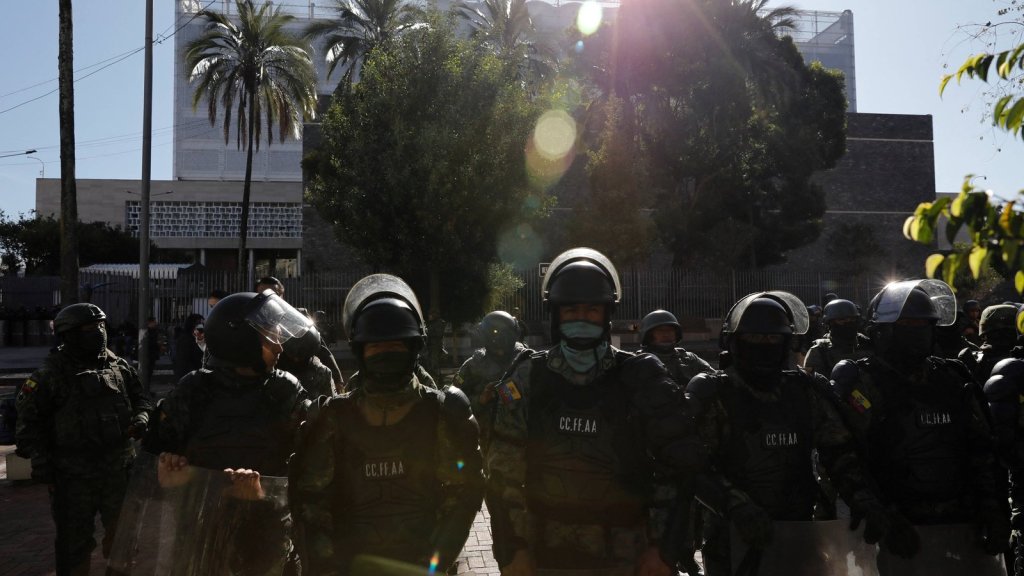
Ecuador Has Been Hit by 40 Million Cyber Attacks Since Assange’s Arrest

By Elias Marat

Source: The Mind Unleashed

The government of Ecuador claims that the country has come under a broad and concerted cyber attack, with approximately 40 million attempts to compromise web portals connected to public institutions ever since the controversial decision to allow UK police to forcibly remove Wikileaks founder Julian Assange from their London Embassy.

Deputy Minister of Information and Communication Technologies Patricio Real told reporters that the wave of attacks began shortly after last Thursday’s arrest of Assange by British authorities. Real said that the attacks “principally come from the United States, Brazil, Holland, Germany, Romania, France, Austria and the United Kingdom, and also from here, from our territory.”

On April 11, Ecuadorian President Lenin Moreno revoked the diplomatic asylum extended to Asange by the South American nation in 2012. In a legally dubious move, Quito also revoked the Ecuadorian nationality granted to Assange in 2017.

Ecuador’s El Comercio reported that the telecommunications ministry’s undersecretary of electronic government, Javier Jara, claimed that following “threats received by these groups related to Julian Assange”–such as the shadowy network Anonymous–the country began suffering “volumetric attacks.

Volumetric attacks are a type of distributed denial of service (DDoS) attack in which servers are flooded with requests in an attempt to overload them with traffic, thus preventing users from accessing the network.

According to AFP, the targets included the foreign ministry, central bank, tax authorities, the office of the president, and a number of other government agencies’ websites. None of the attacks succeeded in destroying or stealing data.

The attacks also come amid the Ecuadorian government’s detention of Ola Bini, a Swedish national and software developer allegedly tied to Wikileaks who was detained last Thursday as he attempted to attend a martial arts event in Japan. Bini, as well as two unidentified Russian “hackers,” are being held for their alleged role in a “hackers’ network” based in the country. Bini, who is accused of having met with Assange 12 times, has also just been accused of playing a role in blackmail attempts targeting President Moreno.

Since 2017, Assange’s relationship with his Ecuadorean hosts sharply deteriorated amid President Lenin Moreno’s attempts to curry favor with international creditors and wealthy governments in the north such as the United States, the United Kingdom and Spain. Moreno began referring to Assange on various occasions as a “miserable hacker,” an “irritant,” and a “stone in the shoe” of his government.

Last year, the London embassy cut off his access to the internet for alleged political meddling following requests by Quito that he stop commenting on affairs in other countries.

Relations took a strong turn for the worse in March following the release of a batch of documents known as the “INA Papers,” which implicated the president in alleged corruption, including money-laundering, offshore bank accounts and a shell company named INA Investment Corporation that is based in Panama and was used by President Moreno’s family to procure furniture, property, and luxury goods.

It is widely speculated that while Wikileaks has still not been directly tied to the release of the INA Papers, President Moreno was enraged after personal photographs were released showing his opulent private life, including photos of the president enjoying lavish lobster breakfast-in-bed and lobster dinners–imagery considered damning by Ecuador’s electorate especially given Moreno’s prior boasting of a poverty diet of eggs and white rice, which he claimed to regularly eat as he rammed through austerity measures that led to thousands of layoffs in the poor yet resource-rich South American country.

Within Ecuador, opinions have been evenly split about Assange, with the country’s right-wing and centrists supporting the decision to end his asylum while the left and supporters of former President Rafael Correa have considered the move a scandalous act of outright prostration before the “imperialists” of the Global North.

As such, social media reactions to the government’s complaints of “cyber attacks” have provoked both outrage and mockery from the Ecuadorian public, with some social media users thanking Assange for releasing the INA Papers and others claiming that the attacks will serve as a convenient smokescreen for the country’s authorities to further plunder the public coffers of the South American country.