Taking Control by Destroying Cash: Beware Cyber Polygon as Part of the Elite Coup

By Robert J. Burrowes

For many people desperate to see a return to a life that is more familiar, it is still easy to believe that the upheavals we have experienced since March 2020 and the changes that have been wrought in their train are ‘temporary’, even if they are starting to ‘drag on’ somewhat longer than hoped.

However, anyone who is paying attention to what is taking place in the background is well aware that the life we knew before 2020 has already ended and what is being systematically put in its place as the World Economic Forum (WEF) implements its ‘Great Reset’ will bear no comparison to any period prior to last year. See ‘Killing Democracy Once and for All: The Global Elite’s Coup d’état That Is Destroying Life as We Know It’.

Of course, those of us who qualify as ‘ordinary people’ have had no say in the shape of what is being implemented: that shaping has been the prerogative of the criminal global elite which is now implementing a plan that has been decades in the making and built on hundreds of years of steady consolidation of elite power.

Also, of course, there is nothing about this shaping that is good for us. In simple terms, it is reshaping the human ‘individual’ so that previously fundamental concepts such as human identity, human liberty, human rights (such as freedom of speech, assembly and movement), human privacy and human volition are not just notions of the past but are beyond the comprehension of the typical ‘transhuman’. At the same time, the global elite is restructuring human society into a technocratic dystopia which is a nightmarish cross between ‘Brave New World’, ‘1984’ and the Dark Age. See ‘Strategically Resisting the New Dark Age: The 7 Days Campaign to Resist The Great Reset’.

The only question remaining is this: ‘Can we mobilize adequate strategic resistance – that is, resistance that systematically undermines the power of the global elite to conduct this coup and restores power to ordinary people – to defeat this coup?’

But before I answer that question, I wish to highlight just one element of the elite coup that is taking place and outline the profound changes that are being left in its wake unless we stop them.

These changes are essentially related to the capacities of computerized technologies to deprive us of what little we have left of our financial autonomy, including because any notion of privacy is rapidly vanishing.

Vanishing Money

One reason for highlighting the issue of money is because while it is good to see increasing critical attention being paid to the ‘injectables’ program, with its devastating consequences for humanity, far too little attention is being paid to the profoundly important transformation being wrought under cover of the elite-driven narrative which has virtually all people’s attention distracted from this deeper agenda. And while this deeper agenda entails a great many aspects, one subset of these is related to the way in which the global financial system is being re-engineered to play its role in fully controlling the human population.

In a series of reports issued in early 2020, the Deutsche Bank claimed that ‘cash will be around for a long time’. See the three reports accessible from ‘Transition to digital payments could “rebalance global economic power”’.

However, these reports are contradicted by other research and the ongoing evidence that cash is vanishing. Most importantly, there is no doubt about the elite intention in this regard. They want cash gone.

The digitization of money has been occurring for decades and it is now being accelerated dramatically.

Moreover, the World Economic Forum and other elite organizations have been actively working towards achieving a cashless economy for years. To get a sense of this trend, see ‘Why we need a “less-cash society”’ and ‘The US should get rid of cash and move to a digital currency, says this Nobel Laureate economist’.

Notably, in this respect, the ‘Better Than Cash Alliance’ has 78 members ‘committed to digitizing payments.’ If you think that this is a grassroots initiative set up by people like you and me, you will be surprised to read that the Bill & Melinda Gates Foundation is a ‘Resource Partner’ to the initiative along with some UN agencies, many national governments and corporations such as Mastercard and Visa.

So while the trend toward a cashless society has been progressing steadily for some decades, with countries like Denmark, Norway and Sweden already virtually cashless and India rapidly moving in that direction – see ‘India’s PM Modi defends cash ban, announces incentives’ – the so-called ‘Covid-19 pandemic’ was contrived partly to provide a pretext for further accelerating the move from cash to cards and apps, with increasing numbers of people using the digital methods, even for small sums, partly because some people were scared into believing that the ‘virus’ could be transmitted by bills and coins.

But there is more. In addition to measures not mentioned here, other plans include the use of a facial scan that records your entry to a store and is linked to artificial intelligence that identifies you and your credit rating. This then enables, or otherwise, your ability to pay for goods and services based on this facial scan.

‘Does all of this matter’, you might ask. Well the convenience of cards and apps has two significant costs: your privacy and your freedom. You lose both simply because while paying with cash is anonymous, paying by card or app leaves a digital trail that is as difficult to follow as an elephant whose tail you are already holding. And this digital trail forms a vital part of the surveillance grid that enables all of those who are tracking and documenting your movement, your payments and your behaviour to do so without leaving the comfort of their chairs. For more detail on this, watch ‘Cash or card – will COVID-19 kill cash?’ which is embedded in the article ‘Cash or Card –  Will COVID-19 Kill Cash? Leaving a Digital Footprint With Every Payment’.

But it goes beyond this. As touched on above in relation to privacy and explained at some length by Whitney Webb, ‘there is a related push by WEF partners to “tackle cybercrime” that seeks to end privacy and the potential for anonymity on the internet in general, by linking government-issued IDs to internet access. Such a policy would allow governments to surveil every piece of online content accessed as well as every post or comment authored by each citizen, supposedly to ensure that no citizen can engage in “criminal” activity online.

‘Notably, the WEF Partnership against Cybercrime employs a very broad definition of what constitutes a “cybercriminal” as they apply this label readily to those who post or host content deemed to be “disinformation” that represents a threat to “democratic” governments. The WEF’s interest in criminalizing and censoring online content has been made evident by its recent creation of a new Global Coalition for Digital Safety to facilitate the increased regulation of online speech by both the public and private sectors.’ See ‘Ending Anonymity: Why the WEF’s Partnership Against Cybercrime Threatens the Future of Privacy’.

But to get back to cash: Unfortunately for us, the global elite does not intend to leave the abolition of cash to our ‘preference for the convenience of cards’ and other moves to entice us to switch to digital payment. It fully intends to force us to accept digital methods as the only means of payment.

In part, this is because electronic payments are extremely lucrative for banks and payment service providers, while the data broker industry is also making huge revenues. See ‘Cash or Card –  Will COVID-19 Kill Cash? Leaving a Digital Footprint With Every Payment’.

And in some ways, ‘killing cash’ is simple. Two obvious ways of doing so are by removing ATMs (including from shopping centres) and closing local bank branches so that cash is simply unavailable. As has been happening for some time. See ‘Why Are ATMs Disappearing at an Alarming Rate after a Wave of Branch Closures?’ and ‘Australian bank branches and ATMs are vanishing’.

But, in this instance, even profitability is at the trivial end of the elite motivation spectrum.

Cash is being forced out of existence because it undermines the elite agenda to take all power from ordinary people.

So, in parallel with other regressions over the past 18 months as the elite coup to take complete control of our lives has continued to unfold, there have been ‘warnings’ from various institutions – including the World Economic Forum and the Carnegie Endowment for International Peace – about the possibility of an ‘allegedly imminent cyber attack that will collapse the existing financial system’.

Following a simulation in 2020, in which the World Economic Forum along with the Russian government and global banks conducted a high-profile cyberattack simulation that targeted the financial industry, another simulation was held on 9 July 2021 involving the World Economic Forum and the Russian government-owned Sberbank as well as other key financial agents. See ‘Cyber Polygon’ and ‘Cyber Polygon 2021’. In reality, of course, such a collapse of the financial system would constitute ‘the final yet necessary step’ to implement the World Economic Forum’s desired outcome of forcing a widespread shift ‘to digital currency and increased global governance of the international economy’.

If this financial collapse happens, the ‘solution’ suggested by key agencies – ‘to unite the national security apparatus and the finance industry first, and then use that as a model to do the same with other sectors of the economy’ – will ensure that we lose what little control is left in our lives, not just in relation to our financial resources but in all other domains as well. For a full explanation, see ‘WEF Warns of Cyber Attack Leading to Systemic Collapse of the Global Financial System’.

And for another account of the deeper agenda and its financial impacts already, including its ‘economic genocide’, as well as what is yet to happen, watch this interview of Catherine Austin Fitts: ‘Globalist Central Banking New World Order Reset Plan’.

Beyond this, if you want some insight into another key threat in the cybercrime realm, check out this video by the Ice Age Farmer in relation to the cyber threat to the power grid. See ‘“Next Crisis Bigger than COVID” – Power Grid/Finance Down – WEF’s Cyber Polygon’.

So How Can We Resist?

Fortunately, there is some resistance already.

In response to concerns in the United States that businesses that refuse cash will disadvantage communities with poor access to traditional banking systems, there are signs that ‘a national movement protecting consumers’ ability to pay in cash may be emerging’ with a number of states and cities already outlawing cashless outlets. See ‘Cash or Credit? State and City Bans on Cashless Retailers Are on the Rise’.

Realistically, however, given what is at stake, considerable elite pressure will be applied to reverse these decisions in time. So we need our defense to be more rigorous and less reliant on agents who are unlikely to be tough enough to defend our interests or will be sidelined or killed for doing so, as at least two national presidents who resisted the elite intention last year have since been killed. See ‘Coronavirus and Regime Change: Burundi’s Covid Coup’ and ‘John Magufuli: Death of an African Freedom Fighter’.

Moreover, given the likelihood that the financial system will be deliberately crashed at some point – and possibly soon – we need to employ a variety of tactics, that build resilience into our resistance, to defeat this initiative.

Hence, storing and paying with cash, moving your accounts to local community banks or credit unions (and away from the large corporate banks) and making the effort to become more self-reliant, particularly in food production, will increase your resilience, as will participating in local trading schemes, whether involving local currencies or goods and services directly.

As with all elements of the defense we implement, it will need to be multi-layered and integrated into the overall defense strategy. The elite intends to kill off many of us – as the depopulation measures within the coup, including the destruction of the global economy throwing 500,000,000 people out of work and killing millions as a result, as well as the ‘injectables’ program already killing tens of thousands, make perfectly clear – and enslave the rest.

For an integrated strategy to defeat the elite coup, see the ‘We Are Human, We Are Free’ campaign, which has 29 strategic goals for defeating the coup including meaningful engagement with police and military forces to assist them to understand and resist, rather than support, the elite agenda.

But for a simpler presentation, see the 7 Days Campaign to Resist The Great Reset. The Telegram group is here.

Conclusion

One of the interesting challenges about the current ‘Covid-19 Crisis’ is that it continues to very successfully distract most people from awareness of the deeper agenda: the Global Elite’s ‘Great Reset’ and related initiatives, such as that discussed above in relation to money.

Hence, apart from the perennial problem of raising awareness and mobilizing resistance among those still believing the elite-driven propaganda, we face two key strategic hazards.

The first hazard is a longstanding one: while virtually all people believe that elite agents – in this case, governments – are controlling events, much ‘resistance’ will focus on begging governments, through such things as petitions and protest demonstrations, to ‘fix it’ for us. The elite has long dissipated our dissent by having us direct it at one or other of its agents. This case is no different. And while we are not using our occasional large rallies to inform people how to resist powerfully every day of their life, these rallies are a waste of time whatever solidarity they build in the short term. History is categorically instructive on that point.

A second strategic hazard we face is that resistance to the ‘vaccine’ and the ‘vaccine’ passport might be ‘successful’ (in the sense that concerted actions stall some government implementation of some measures in relation to these two initiatives) and leave most people believing that they have ‘won’, while the deeper agenda remains in the shadows with virtually no-one resisting.

It is important, therefore, that those who are aware of the deeper agenda continue to provide opportunities for others to become aware of this too and the fundamental threat it poses to us all while also sharing how we can resist its key dimensions in a way that makes a difference. It is not enough to complain about elite agents, such as governments, the medical and pharmaceutical industries, and the corporate media.

We must strategically resist the elite coup itself with actions such as those in the 7 Days Campaign to Resist The Great Reset before we find ourselves locked in a technocratic prison without the free-willed minds necessary to analyze, critique, plan and act.

Robert J. Burrowes has a lifetime commitment to understanding and ending human violence. He has done extensive research since 1966 in an effort to understand why human beings are violent and has been a nonviolent activist since 1981. He is the author of ‘Why Violence?’ His email address is flametree@riseup.net and his website is here.

Have We Reached “Peak Self-Glorifying Billionaire”?

By Charles Hugh Smith

Source: Of Two Minds

Perhaps we should update Marie Antoinette’s famous quip of cluelessness to: “Let them eat space tourism.”

As billionaires squander immense resources on self-glorifying space flights, the corporate media is nothing short of worshipful. Millions of average citizens, on the other hand, wish the self-glorifying billionaires had taken themselves and all the other parasitic, tax-avoiding, predatory billionaires with them on a one-way trip into space.

Have we reached Peak Self-Glorifying Billionaire? If so, where does the downhill slide take us? Let’s start with a bit of history. Correspondent Jim B. summarized historian Arnold Toynbee’s study of the rise and fall of civilizations thusly: “Civilizations fail when their elites change from an admired dynamic creative class to a despised Establishment of corrupt rentiers, an entrenched governing class unfit to govern.”

Despised, check. Corrupt, check. Entrenched, check.

The 2013 book Why Nations Fail: The Origins of Power, Prosperity, and Poverty discusses the differences between failed states and successful states, and concludes that the failed states are fundamentally kleptocracies that answer to a self-serving elite while successful states are answerable to the broad populace.

To summarize: When the few benefit at the expense of the many, the resulting kleptocracy ends up a failed state. When states maintain meaningful, transparent ways of responding to public needs and demands, the result is a successful state.

This is of course a simplification. The perverse effects of colonialism linger, the development of civic organizations public institutions, values and identities that make up what I call the social ontology are not pre-ordained, and nations with low-cost surplus energy can be quite successful kleptocracies until their energy surplus runs out.

But in the main, the question remains: How did previously successful political, social and economic systems change such that they no longer generated beneficial synergies but slid into fatal synergies?

From the point of view of how systems fail to maintain dynamic stability, three factors pop out:

1. Elites become too successful in sluicing the nation’s income, wealth and political power into their own hands.

2. Since the system continues to thrive despite their dominance, then there is obviously no need to change anything–especially if it reduces their share of the nation’s wealth and political power.

3. The elites ignore the intangible decay of leadership, the real-world dynamics of scarcity and over-estimate their own capabilities and the resilience of the system.

I recently described the feedback loop that occurs when a wealthy elite can purchase political power:“as a result of their campaign contributions and lobbying, the elites’ wealth continues expanding, enhancing their political power to further expand their wealth, and so on.”

In a healthy system, there are mechanisms that limit elite ownership of wealth and political power to what the system can bear. Over time, the feedback I described increases elite wealth and power to a point where the limits are crushed and the elite feedback gathers momentum.

With institutional limits no longer in the way, the elite reaches the point where the political system no longer responds to the broad public at all, and the vast majority of income-producing wealth is already in the hands of the elite.

The U.S. is already at this final stage: Wealth/Power Inequality and the Slide Into Disorder.

Testing Theories of American Politics: Elites, Interest Groups, and Average Citizens“Contrary to what decades of political science research might lead you to believe, ordinary citizens have virtually no influence over what their government does in the United States.”

This dominance throws the system out of balance such that, as David Parsons recently put it: (Elite-dominated) “Capitalism makes everyone homeless and then makes award-winning movies about how resilient people are for living in their cars.”

The apparent success of the system even as it grows ever more imbalanced generates a self-serving confidence in the Elites that their dominance is not only benign but permanent.

But this self-serving view is illusory. Beneath the surface, major subsystems are attempting to re-establish stability, but the instability is so extreme that the measures being deployed are also extreme.

These policy extremes only push the system further out of balance in other directions, creating fatal synergies as mutually reinforcing imbalances pile up.

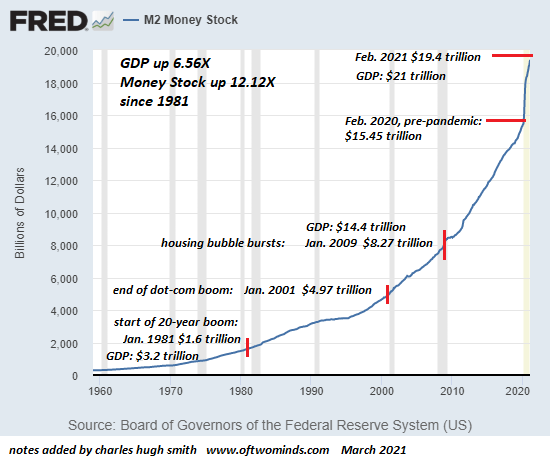
See the chart below of money supply as one example of many.

But the elite is blinded by their confidence and greed to these accelerating imbalances. They reckon that managing the narratives (a.k.a. propaganda), minor policy tweaks and creating more currency and credit are all that’s needed to maintain what they consider the optimal form of stability: they own 99% of political power and 97% of all the income from capital.

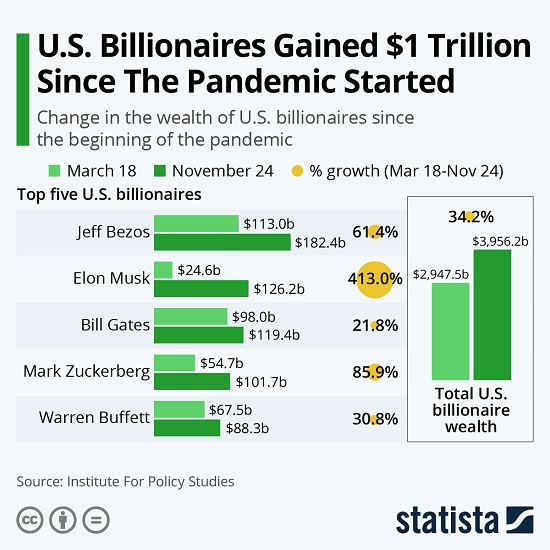
Monopoly Versus Democracy: How to End a Gilded Age“Ten percent of Americans now control 97 percent of all capital income in the country. Nearly half of the new income generated since the global financial crisis of 2008 has gone to the wealthiest one percent of U.S. citizens. The richest three Americans collectively have more wealth than the poorest 160 million Americans.”

I’ve often noted that the wealth of Rome’s political and economic elite went from being 20 times the wealth of a landowning farmer or craftsman to 200,000 times the commoners’ wealth at the end of the Western Empire. Now that three individuals own more wealth than half the American populace, and the top 0.1% hold more wealth than the bottom 80%, I think we can safely declare we’ve reached the same extreme.

The first tranche of American presidents left office less wealthy than when they entered because serving in public office was understood as a noble and valued sacrifice of time and wealth. Now presidents leave office far wealthier than when they entered public service.

Per #3, the elite no longer sees any compelling reason to sacrifice their income, wealth and power to stabilize the system or benefit the common good. In the view of the billionaires, if any sacrifices are necessary, then they should be borne by the bottom 95%, or failing that, the bottom 99.5%.

Given their dominance, their willingness to use their wealth and power to protect their dominance dooms the system to destabilization and collapse, as the resources and value system required to successfully navigate eras of instability and scarcity are no longer available to the state or public.

In effect, the elite uses its power not to restabilize the system but to maintain its extreme dominance and protect it from any political threats.

A once vibrant ecosystem has become a monoculture whose stability is far more precarious than it appears on the surface, as the resilience of monocultures is entirely artificial.

Two recent books illuminate corners of this destabilizing inequality:

Billionaire Wilderness: The Ultra-Wealthy and the Remaking of the American West

‘Jackpot’ Looks at How Inequality Is Experienced by the Very, Very Rich

We are in the final stages of this accelerating destabilization: the refusal of the elite to sacrifice any meaningful share of their wealth and power to save the system from fatal synergies guarantees collapse.

Perhaps we should update Marie Antoinette’s famous quip of cluelessness to: “Let them eat space tourism.” We all know where this cluelessness ultimately leads.

How Breakdown Cascades Into Collapse

By Charles Hugh Smith

Source: Of Two Minds

Maintaining the illusion of confidence, permanence and stability serves the interests of those benefiting from the bubbles and those who prefer the safety of the herd, even as the herd thunders toward the precipice.

The misconception that collapse is an all or nothing phenomenon is common: Either the system rights itself with a bit of money-printing and rah-rah or it collapses into post-industrial ruin and gangs are battling over the last stash of canned beans.

Neither scenario considers the fragility and resilience of the socio-economic system as a whole. It is both far more fragile than the believers in the permanence of the waste is growth model grasp and more resilient than the complete collapse prognosticators grasp.

The recent relatively mild logjams in global supply chains of essentials are mere glimpses of precariously fragile delivery-supply systems. These can be understood as bottlenecks that only insiders see, or as unstable nodes through which all the economy’s connections run. Put another way, the economy’s as a network appears decentralized and robust, but this illusion vanishes when we consider how the entire economy rests on a few unstable nodes.

One such node is the delivery of gasoline and fuels. It’s such an efficient and reliable system that 99.9% of us take it for granted: there will always be plenty of gasoline at every station, the tanks of jet fuel will always be topped off, and so on.

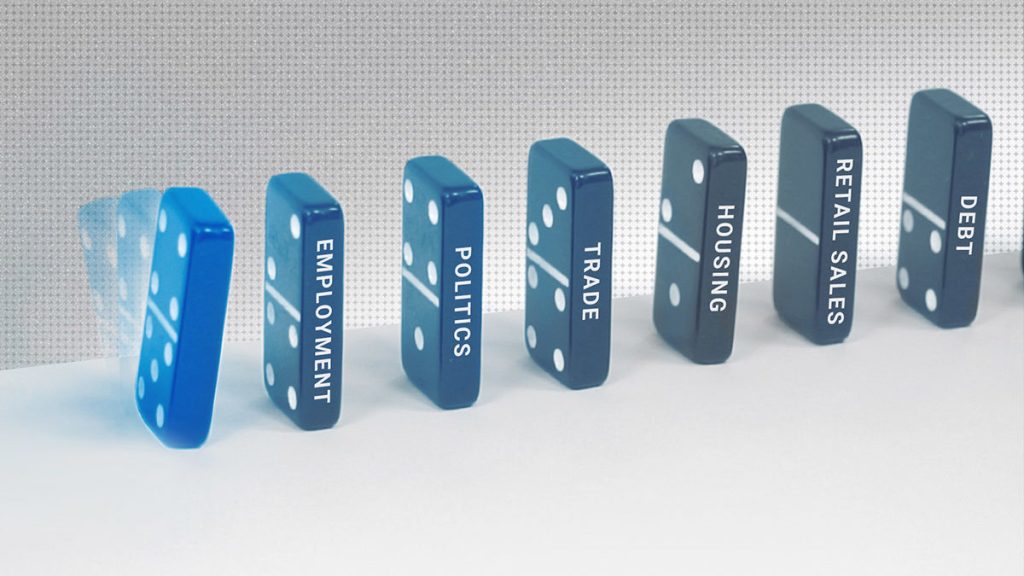
The 0.1% know that this system, once disrupted, would knock over dominoes all through the economy.

Hyper-efficiency and hyper-globalization has reduced the number of producers of essentials to the point that disruptions cannot be overcome with redundant sources. We see this everywhere in the global economy: a handful of plants and companies (sometimes a single source of essential components) process or manufacture essential components in much larger systems.

This is how you end up with thousands of newly manufactured vehicles parked in lots awaiting one critical part that is in short supply.

Another key weakness is the entire system’s reliance on debt, leverage and speculation. Few seem to understand that physical production and delivery systems can grind to a halt for financial reasons–for example, lines of credit being pulled, a counterparty to some arcane commodity swap goes under, taking the presumably solvent corporation down with it, and so on.

The more debt that’s been piled up, the greater the instability of the entire system. Risk always appears low until the system destabilizes, and then all the hedges fail and risk breaks out, flooding through the entire financial system.

Leverage is great fun on the way up, as it magnifies gains. Since the Federal Reserve implicitly guarantees that “buy the dip” will generate massive gains, why not ramp up leverage ten-fold to maximize those Fed-guaranteed gains?

Leverage is less fun on the way down. When the underlying collateral has shrunk to 20% of the leveraged bets being made, a 21% decline in the asset wipes out all the collateral holding up the palace of leveraged debt.

The Fed can print money but it can’t create collateral, nor can it make insolvent entities solvent. All the Fed can do is increase the debt and leverage, which is not the solution, it’s the problem.

Speculation is also inherently unstable, as the euphoric herd, once startled, turns in panic and stampeded in fear. Markets which appeared liquid–i.e., sellers could count on someone buying as many millions of shares as they desired to sell–become illiquid, as buyers vanish like mist in Death Valley. With buyers gone, prices plummet to levels the herd reckoned “impossible” just days before.

The Fed’s entire strategy in the 21st century has been to inflate asset bubbles that generate the illusion of wealth–the so-called wealth effect which is presumed to inspire voracious borrowing and spending.

Unfortunately for the Fed, most of the gains flowed to the top 0.1%, and an economy based on a handful of billionaires buying super-yachts and spaceships is a line of dominoes awaiting the inevitable “accident.” So there are two systemic problems with relying on asset bubbles to generate “wealth”: 1) since 90% of the assets are owned by a thin slice of the populace, bubbles increase destabilizing inequality, and 2) bubbles are intrinsically unstable. So the U.S. economy, dependent on the Fed for the “juice” of monetary stimulus, is now dependent on incredibly unstable bubbles in assets, debt and leverage, bubbles which have generated extremes of wealth/income inequality that are destabilizing the social and political orders.

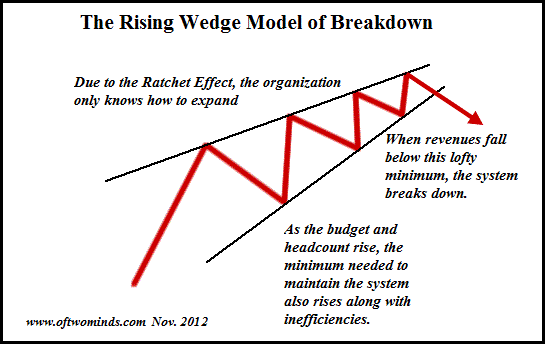
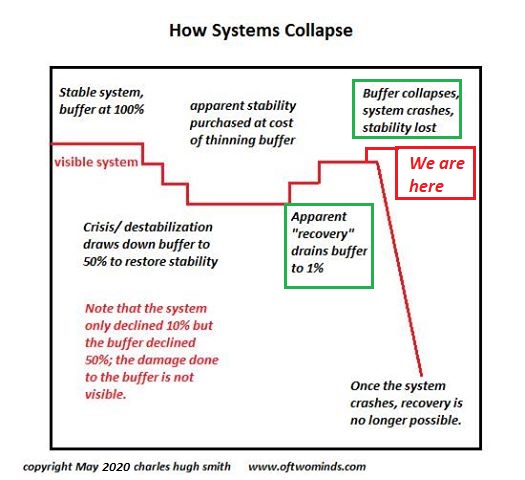
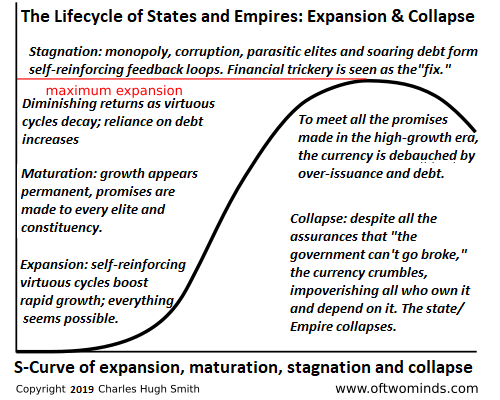
As the three charts below illustrate, the fragility and instability are well hidden until it’s too late: bubbles, debt, leverage, budgets and revenues can only click higher because the system breaks down if there is any sustained decline (the rising wedge model of breakdown). Once the subsystems fail, there’s no putting the eggshell back together.

The second chart depicts how buffers thin beneath the surface, masking the systemic fragility. The loss of redundancy, the decay of maintenance, the loss of experienced workers–all of these are hidden from public view until the system breaks down.

The third chart tracks the S-curve of expansion, confidence, complacency, delusion and collapse followed by human systems, from nations to empires to corporations: as the buffers thin and the rising wedge reaches an apex of vulnerability, the leadership evinces a delusional confidence in the permanence and stability of increasingly fragile, unstable systems.

Maintaining the illusion of confidence, permanence and stability serves the interests of those benefiting from the bubbles and those who prefer the safety of the herd, even as the herd thunders toward the precipice.

This is how breakdowns in apparently stable subsystems triggers the fall of dominoes throughout the larger system, leading to a collapse that was widely viewed as “impossible.” Such is the power of complacency and delusion.

Freedom Rider: How the billionaires rule

Predatory capitalism has driven down wages and created a dystopia for workers.

By Margaret Kimberley

Source: Intrepid Report

President Calvin Coolidge said, “The business of America is business.” The expression is memorable because it always rang true. But nearly 100 years later an old trite saying has taken on an ever more terrifying meaning.

The ruling class wield their power more blatantly than ever. There is little effort to conceal their determination to rule over the people and to control the politicians who are now little more than their personal minions.

When the people get a little help, as happened with additional stimulus funds for the unemployed, politicians across the country took up arms for the ruling class and turned down free money just to stay in the good graces of their bosses.

Currently 25 states out of 50 have rejected additional help for the unemployed. The money came from the federal government and didn’t impact state budgets, but politicians know who calls the shots. When called upon to help struggling people they chose to do just the opposite. They helped their exploiters and, in the process, made a mockery of what passes for democracy.

There is no labor shortage in this country. Instead, there is a shortage of jobs that pay a living wage and that is because of the power of capitalists. They have grown richer precisely because they have forced workers to live in a constant state of precarity, and now it is quite literally better to stay home than to work for a pittance.

Of course, the richest man in the world, Amazon’s Jeff Bezos, is a master at coming up with new ways to subjugate workers. Any reports of job growth should be viewed with a very jaundiced eye as predatory capitalism has driven down wages and created a dystopia for workers. Bezos has mastered squeezing the most and giving the least.

Amazon warehouse workers suffer from injuries at higher rates than other employees in similar jobs but the injuries are part of the cost of doing business. It is expected that the grueling working conditions will create high turnover which is exactly what Amazon wants. A revolving door of employees serves their needs quite nicely. Bezos made a big deal about a $15 per hour starting salary but he could certainly afford to pay a lot more, a real living wage. The tight-fisted billionaire who could potentially become a trillionaire got rich the old fashioned way. He cheats workers.

Bezos also comes up with new and ingenious ways to spread the suffering. Amazon Flex delivery drivers are hired by apps and fired by algorithms. They have no interaction with human resources or any humans at all and they must pay a $200 fee to contest terminations that are rarely decided in their favor.

Even when American workers lose their jobs they are still at the mercy of corporate giants. ID.me contracts with states to provide public access to web sites such as those used for unemployment claims. Their facial recognition software doesn’t verify everyone properly and desperate people wait days and weeks for their unemployment payments to arrive. As with Amazon there is no one to speak to for help. But state governments turn over millions of dollars to ID.me in order to cheat people out of benefits they have earned. Currently 30 states contract with ID.me to make sure that the most vulnerable are kicked while they are down.

The algorithm hirings and firings and the facial recognition technology problems are not bugs in the system. They are features. They are doing precisely what they are intended to do, keep workers poor, desperate, and at the mercy of capitalists. Cruelty is the point.

One might ask who speaks for the people. Workers in several states had their unemployment saved by court decisions but those are few and far between. Politicians are as blatant as their corporate bosses and openly side with them against their constituents.

There is no way to reform this system. Democrats and republicans are equally eager to act at the behest of corporate interests. The people either vote in hopes of change that never comes or are apathetic because they see that the odds are against them.

The workers who refuse low pay under dangerous conditions are moving in the right direction. Whether they know it or not they are potentially building a new movement. A general strike is what the country needs. Of course that is why the hammer fell in an attempt to nip any resistance in the bud and get the cogs back into the machine. But the direction we must move in is clear. There is no salvation from a Biden or a Harris or any other name being floated. The people will have to move in a different direction if they are to save themselves.

Is Inflation “Transitory”? Here’s Your Simple Test

By Charles Hugh Smith

Source: Of Two Minds

Is inflation “transitory” in your household budget? Really? Where?

The Federal Reserve has been bleating that inflation is “transitory”–but what about the real world that we live in, as opposed to the abstract funhouse of rigged statistics? Here’s a simple test to help you decide if inflation is “transitory” in the real world.

Let’s start with some simple stipulations: price is price, there are no tricks like hedonics or substitution. Nobody cares if the truck stereo is better than it was 40 years ago, the price of the truck is the price we pay today, and that’s all that matters.

(Funny, the funhouse statistical adjustments never consider that appliances that used to last 30 years now break down and are junked after 3 years–if we adjusted for that, the $500 washer would be tagged at $5,000 today because it has lost 90% of its durability over the past 30 years.)

Second, inflation must be weighted to “big ticket” nondiscretionary items. The funhouse statistical trickery counts a $10 drop in the price of a TV (which you buy every few years at best) as equal to a $100 rise in childcare, which you pay monthly. No, no, no: a 10% rise in rent, healthcare insurance and childcare is $400 a month or roughly $5,000 a year. A 10% decline in a TV you buy every three years is $50. Even a 50% drop in the price of a TV ($250) is $83 per year–absolutely trivial, absolutely meaningless compared to $5,000 in higher big-ticket expenses.

You can forego the new TV but not the rent, childcare or healthcare. That’s the difference between “big ticket” nondiscretionary and discretionary (meals out, 3rd TV, etc.).

Third, we jettison the painfully obvious manipulation of “owners equivalent rent” for housing costs. Housing costs are the prices we pay for rent, owning a home and paying property taxes, insurance and maintenance costs to own the home. (Have you priced having a new roof put on your house by a licensed, reputable contractor? No? Well, it’s become a lot more expensive than it was a few years ago. Where is that enormous price leap in “owners equivalent rent”? Just how stupid does the Fed reckon we are?)

OK, here’s the test: let’s say markets finally take a deflationary dive from overvalued heights. Housing, stocks and other risk assets fall 30%. Trillions of dollars in “wealth” (that didn’t exist prior to the Everything Bubble inflating) has vanished, generating a reverse wealth effect as all the owners of these assets feel poorer and less inclined to borrow and spend. This is classically considered highly deflationary: demand drops, prices drop.

The three billionaires who own more assets than the bottom 50% of Americans (165 million Americans) will be crying, but how does life change for the 165 million Americans who own a vanishingly thin slice of these assets? Does their rent drop? No, for the reasons I explained in The Fed Is Wrong: Inflation Is Sticky: the big corporate landlords have to keep rents high to placate their lenders. (And let’s not forget greed: the greedy never want to lower prices, preferring to cling to the Fed’s fantasy of “transitory” trouble.)

Now let’s ask about the higher-income 150 million Americans who own homes and pay property taxes, who pay healthcare insurance, college tuition and fees, childcare and elderly care. Even if there is a deflationary crash in stocks and housing, what are the odds the overall costs of owning and maintaining your home will drop significantly?

What are the odds that local government will let property taxes drop with valuations? Shall we be honest and say zero? If real estate valuations plummet, then property tax rates will rise to compensate. Or other “creative” fees will be imposed to make up the shortfall in tax revenues.

What about childcare? What are the odds that childcare costs will drop 30%? Shall we be honest and say zero? The costs paid by childcare providers only go up, and so those who don’t charge enough (marginal providers) will close down, generating a shortage of supply that elevates prices.

What about elderly care? Will assisted living facilities suddenly drop 30% just because asset bubbles pop? No. The costs of assisted living march higher regardless of what asset valuations and interest rates do.

What about healthcare? Will all those costs drop 30% because assets declined? No. Everyone exposed to real-world pricing of healthcare will be paying more.

But what about the roofing contractor? Won’t they charge 30% less? The biggest expenses for the contractor are workers compensation insurance, liability insurance, disability insurance, FICA (Social Security and Medicare) and healthcare insurance, and none of those will drop a single dollar even if stocks drop 30%.

Just as 85% of local government expenses are labor-related, most of the expenses of the roofing contractor are labor-related. The roofing materials dropping a few bucks might lower the cost by a few percentage points, but the material costs are based on the costs of the manufacturers, distributors, truckers, etc., and these are also based on labor-related expenses, taxes, insurance and healthcare–none of which will drop a dime, regardless of what asset prices do.

Economist Michael Spence elucidated the difference between tradable and untradable goods and services. If you want your washer repaired, that service in untradable, as shipping your broken washer to China for repair is not financially viable. As labor costs rise in China and other offshore economies, that raises costs even for tradable goods.

The majority of essential services are untradable and the costs are dependent on “big ticket” expenses which cannot go down without imploding the economy and government: taxes, insurance, healthcare, childcare, elderly care, etc. cannot drop 30% because they’re based on labor costs, highly profitable systemic friction (Big Pharma, the Higher Education Cartel, Big Ag, healthcare and other quasi-monopolies) and the need for ever-higher tax revenues to provide services which the public demands.

Let’s also ponder the consequences of the extreme concentration of wealth and income in the top 5% of U.S. households. The top 10% own roughly 85% of all wealth, and the top 1% own more than half the financial wealth.

Any significant drop in financial assets will have almost no effect on the bottom 90% because they don’t own enough of these assets to be consequential. So the deflationary effect of the reverse wealth effect will be concentrated in the discretionary spending of the top 10%: the luxury imported vehicles, the $100 per plate dinners (those $60 bottles of wine add up), the $500/day resort vacation, the $2,500/week AirBnB rental, etc.

The declines in the cost of these discretionary luxuries may well be noteworthy, but there are thresholds below which prices cannot drop. The high-end restaurant has equally high-end expenses, and so marginal providers will close, leaving only those few who can maintain profitability as demand for luxury dining craters.

The resort has high expenses as well, and once profitability has been lost, resorts will close just like other marginal providers. Supply shrinks along with demand, and the survivors keep prices high enough or they too will close.

So the essential “big ticket” costs will keep rising and the discretionary luxuries only the top 10% can afford will drop–but not by much as all those luxury providers have the same high fixed costs.

So to recap the test: what are the odds of these “big ticket” expenses dropping 30% if asset prices drop 30%?

Taxes: zero.

Healthcare: zero.

Childcare: zero.

Elderly care: zero.

Costs of doing business: zero.

As for housing: the mortgage doesn’t drop if the market value of the house drops 30%, and any declines in insurance will be modest. The costs of maintenance won’t drop much, either, and might actually increase as the supply of skilled workers declines. (Nothing is more expensive than the “cheap” repair that has to be redone correctly.)

Rents may drop in areas nobody wants to live anymore, but rents will rise in places people do want to live.

The larger point here is the long economic cycles have turned. The 40-year decline in interest rates has turned, whether we admit it or not. The 40-year decline in the prices of goods due to financialization (lower interest rates, higher speculative assets) and globalization has turned. The 40-year expansion of the workforce has turned. The 40-year decline of oil/fuel/resources prices has turned. The 40-year fantasy that we can depend on other nations for our essential resources and components is drawing to a close.

Untradable goods and services, cost thresholds, resource security, the end of financialization / globalization and declining interest rates matter. The fantasy that the top 10% can prop up the economy by borrowing and spending the phantom wealth of insanely overvalued asset bubbles is drawing to a close.

Is inflation “transitory” in your household budget? Really? Where?

The Systemic Risk No One Sees

The unraveling of social cohesion has consequences. Once social cohesion unravels, the nation unravels.

By Charles Hugh Smith

Source: Of Two Minds

My recent posts have focused on the systemic financial risks created by Federal Reserve policies that have elevated moral hazard (risks can be taken without consequence) and speculation to levels so extreme that they threaten the stability of the entire financial system.

These risks are well known, though largely ignored in the current speculative frenzy.

But there is another systemic risk which few if any see: the collapse of social cohesion.

President Carter was prescient in his understanding that a nation’s greatest strength is its social cohesion, a cohesion that America’s unprecedented wealth / income / power inequalities has undermined. Consider this excerpt from his 1981 Farewell Address:

“Our common vision of a free and just society is our greatest source of cohesion at home and strength abroad, greater even than the bounty of our material blessings.”

In other words, a nation’s strength flows not just from its material wealth but from its social cohesion–a term for something that is intangible but very real, something that doesn’t lend itself to quantification or tidy definitions.

Here is my definition: Social cohesion is the glue binding the social order; it is the willingness of the citizenry to sacrifice individual gains for the common good.

Social cohesion is the result of the citizenry sharing a common purpose and identity and working toward the common good even at personal cost. Social cohesion arises from a national identity based on shared values and sacrifices.

To maintain social cohesion, opportunities to better their circumstances must be open to all (the social contract of social mobility) and sacrifices must be shared by the entire citizenry. If the privileged elites evade their share of sacrifice, social cohesion is lost and the entire social order unravels.

The glue binding the privileged elites to shared sacrifice is civic virtue, a moral code that demands elites devote a greater share of their own resources to the public good in exchange for their political and financial power.

Though no one dares confess this publicly, America is now a moral cesspool. As a result, the moral legitimacy of the nation’s leadership has been lost. Every nook and cranny of institutionalized America is dominated by self-interest, and much of the economy is controlled by profiteering monopolies and cartels which wield far more political power than the citizenry.

Civic virtue has been lost. What remains is elite self-interest masquerading as civic virtue.

In his Farewell Address, President Carter explained that “The national interest is not always the sum of all our single or special interests. We are all Americans together, and we must not forget that the common good is our common interest and our individual responsibility.”

Social cohesion, civic virtue and moral legitimacy are the foundation of every society, but they are especially important in composite states.

America is a composite state
, composed of individuals holding a wide range of regional, ethnic, religious and class-based identities. The national identity is only one ingredient in a bubbling stew of local, state and regional identities, ethnic, cultural and religious identities, educational/alumni, professional and tradecraft identities, and elusive but consequential class-based identities.

Composite states are intrinsically trickier to rule, as there is no ethnic or cultural identity that unifies the populace. Lacking a national identity that supersedes all other identities, composite states must tread carefully to avoid fracturing into competing regional, ethnic or cultural identities.

Composite states must establish a purpose-based identity that is understood to demand shared sacrifice, especially in crisis. In the U.S., the national purpose has been redefined by the needs of the era, but never straying too far from these core unifying goals: defending the civil liberties of the citizenry from state interference, defending the nation from external aggressors, and serving the common good by limiting the power of special interests and privileged elites.

We’ve failed to limit the power of privileged elites, failed to demand greater sacrifices of the wealthy in exchange for power, and so the moral legitimacy of the regime has been lost. And with the ascendance of self-interest and the elite’s abandonment of sacrifice, social cohesion has been lost.

This loss is reflected in the bitter partisanship, the increasingly Orwellian attempts to control the mainstream and social media narratives, the debauchery of “expertise” as dueling “experts” vie for control, the fraying of social discourse, the substitution of virtue-signaling for actual civic virtue, the institutionalization of white-collar crime (collusion, fraud, embezzlement, etc.), the increasing reliance on Bread and Circuses (stimulus, Universal Basic Income) as real opportunity dissipates, and the troubling rise in shootings, crime, random violence and plummeting marriage and birth rates.

The unraveling of social cohesion has consequences. Once social cohesion unravels, the nation unravels.

What’s the solution?
 At the national level, all that has been lost will have to be restored: civic virtue, moral legitimacy, the social contract of opportunity, shared sacrifice that falls most heavily on the wealthiest and most powerful, and a renewed national purpose centered on serving the common good.

Is such a restoration of moral legitimacy and shared purpose even possible? No one knows. If history is any guide, such a renewal is only possible after the empire of rampant self-interest implodes.

So what do we do in the meantime? Nurture our own social cohesion by living purposefully and sharing sacrifices and bounties with those we trust and admire–those in the lifeboat we chose to join.

There is More to BlackRock Than You Might Imagine

By F. William Engdahl

Source: New Eastern Outlook

A virtually unregulated investment firm today exercises more political and financial influence than the Federal Reserve and most governments on this planet. The firm, BlackRock Inc., the world’s largest asset manager, invests a staggering $9 trillion in client funds worldwide, a sum more than double the annual GDP of the Federal Republic of Germany. This colossus sits atop the pyramid of world corporate ownership, including in China most recently. Since 1988 the company has put itself in a position to de facto control the Federal Reserve, most Wall Street mega-banks, including Goldman Sachs, the Davos World Economic Forum Great Reset, the Biden Administration and, if left unchecked, the economic future of our world. BlackRock is the epitome of what Mussolini called Corporatism, where an unelected corporate elite dictates top down to the population.

How the world’s largest “shadow bank” exercises this enormous power over the world ought to concern us. BlackRock since Larry Fink founded it in 1988 has managed to assemble unique financial software and assets that no other entity has. BlackRock’s Aladdin risk-management system, a software tool that can track and analyze trading, monitors more than $18 trillion in assets for 200 financial firms including the Federal Reserve and European central banks. He who “monitors” also knows, we can imagine. BlackRock has been called a financial “Swiss Army Knife — institutional investor, money manager, private equity firm, and global government partner rolled into one.” Yet mainstream media treats the company as just another Wall Street financial firm.

There is a seamless interface that ties the UN Agenda 2030 with the Davos World Economic Forum Great Reset and the nascent economic policies of the Biden Administration. That interface is BlackRock.

Team Biden and BlackRock

By now it should be clear to anyone who bothers to look, that the person who claims to be US President, 78-year old Joe Biden, is not making any decisions. He even has difficulty reading a teleprompter or answering prepared questions from friendly media without confusing Syria and Libya or even whether he is President. He is being micromanaged by a group of handlers to maintain a scripted “image” of a President while policy is made behind the scenes by others. It eerily reminds of the 1979 Peter Sellers film character, Chauncey Gardiner, in Being There.

What is less public are the key policy persons running economic policy for Biden Inc. They are simply said, BlackRock. Much as Goldman Sachs ran economic policy under Obama and also Trump, today BlackRock is filling that key role. The deal apparently was sealed in January, 2019 when Joe Biden, then-candidate and long-shot chance to defeat Trump, went to meet with Larry Fink in New York, who reportedly told “working class Joe,” that, “I’m here to help.”

Now as President in one of his first appointees, Biden named Brian Deese to be the Director of the National Economic Council, the President’s main adviser for economic policy. One of the early Presidential Executive Orders dealt with economics and climate policy. That’s not surprising, as Deese came from Fink’s BlackRock where he was Global Head of Sustainable Investing. Before joining BlackRock, Deese held senior economic posts under Obama, including replacing John Podesta as Senior Adviser to the President where he worked alongside Valerie Jarrett. Under Obama, Deese played a key role in negotiating the Global Warming Paris Accords.

In the key policy post as Deputy Treasury Secretary under Secretary Janet Yellen, we find Nigerian-born Adewale “Wally” Adeyemo. Adeyemo also comes from BlackRock where from 2017 to 2019 he was a senior adviser and Chief of Staff to BlackRock CEO Larry Fink, after leaving the Obama Administration. His personal ties to Obama are strong, as Obama named him the first President of the Obama Foundation in 2019.

And a third senior BlackRock person running economic policy in the Administration now is also unusual in several respects. Michael Pyle is the Senior Economic Adviser to Vice President Kamala Harris. He came to Washington from the position as the Global Chief Investment Strategist at BlackRock where he oversaw the strategy for investing some $9 trillion of funds. Before joining BlackRock at the highest level, he had also been in the Obama Administration as a senior adviser to the Undersecretary of the Treasury for International Affairs, and in 2015 became an adviser to the Hillary Clinton presidential bid.

The fact that three of the most influential economic appointees of the Biden Administration come from BlackRock, and before that all from the Obama Administration, is noteworthy. There is a definite pattern and suggests that the role of BlackRock in Washington is far larger than we are being told.

What is BlackRock?

Never before has a financial company with so much influence over world markets been so hidden from public scrutiny. That’s no accident. As it is technically not a bank making bank loans or taking deposits, it evades the regulation oversight from the Federal Reserve even though it does what most mega banks like HSBC or JP MorganChase do—buy, sell securities for profit. When there was a Congressional push to include asset managers such as BlackRock and Vanguard Funds under the post-2008 Dodd-Frank law as “systemically important financial institutions” or SIFIs, a huge lobbying push from BlackRock ended the threat. BlackRock is essentially a law onto itself. And indeed it is “systemically important” as no other, with possible exception of Vanguard, which is said to also be a major shareholder in BlackRock.

BlackRock founder and CEO Larry Fink is clearly interested in buying influence globally. He made former German CDU MP Friederich Merz head of BlackRock Germany when it looked as if he might succeed Chancellor Merkel, and former British Chancellor of Exchequer George Osborne as “political consultant.” Fink named former Hillary Clinton Chief of Staff Cheryl Mills to the BlackRock board when it seemed certain Hillary would soon be in the White House.

He has named former central bankers to his board and gone on to secure lucrative contracts with their former institutions. Stanley Fisher, former head of the Bank of Israel and also later Vice Chairman of the Federal Reserve is now Senior Adviser at BlackRock. Philipp Hildebrand, former Swiss National Bank president, is vice chairman at BlackRock, where he oversees the BlackRock Investment Institute. Jean Boivin, the former deputy governor of the Bank of Canada, is the global head of research at BlackRock’s investment institute.

BlackRock and the Fed

It was this ex-central bank team at BlackRock that developed an “emergency” bailout plan for Fed chairman Powell in March 2019 as financial markets appeared on the brink of another 2008 “Lehman crisis” meltdown. As “thank you,” the Fed chairman Jerome Powell named BlackRock in a no-bid role to manage all of the Fed’s corporate bond purchase programs, including bonds where BlackRock itself invests. Conflict of interest? A group of some 30 NGOs wrote to Fed Chairman Powell, “By giving BlackRock full control of this debt buyout program, the Fed… makes BlackRock even more systemically important to the financial system. Yet BlackRock is not subject to the regulatory scrutiny of even smaller systemically important financial institutions.”

In a detailed report in 2019, a Washington non-profit research group, Campaign for Accountability, noted that, “BlackRock, the world’s largest asset manager, implemented a strategy of lobbying, campaign contributions, and revolving door hires to fight off government regulation and establish itself as one of the most powerful financial companies in the world.”

The New York Fed hired BlackRock in March 2019 to manage its commercial mortgage-backed securities program and its $750 billion primary and secondary purchases of corporate bonds and ETFs in no-bid contracts. US financial journalists Pam and Russ Martens in critiquing that murky 2019 Fed bailout of Wall Street remarked, “for the first time in history, the Fed has hired BlackRock to “go direct” and buy up $750 billion in both primary and secondary corporate bonds and bond ETFs (Exchange Traded Funds), a product of which BlackRock is one of the largest purveyors in the world.” They went on, “Adding further outrage, the BlackRock-run program will get $75 billion of the $454 billion in taxpayers’ money to eat the losses on its corporate bond purchases, which will include its own ETFs, which the Fed is allowing it to buy…”

Fed head Jerome Powell and Larry Fink know each other well, apparently. Even after Powell gave BlackRock the hugely lucrative no-bid “go direct” deal, Powell continued to have the same BlackRock manage an estimated $25 million of Powell’s private securities investments. Public records show that in this time Powell held direct confidential phone calls with BlackRock CEO Fink. According to required financial disclosure, BlackRock managed to double the value of Powell’s investments from the year before! No conflict of interest, or?

A Very BlackRock in Mexico

BlackRock’s murky history in Mexico shows that conflicts of interest and influence-building with leading government agencies is not restricted to just the USA. PRI Presidential candidate Peña Nieto went to Wall Street during his campaign in November 2011. There he met Larry Fink. What followed the Nieto victory in 2012 was a tight relationship between Fink and Nieto that was riddled with conflict of interest, cronyism and corruption.

Most likely to be certain BlackRock was on the winning side in the corrupt new Nieto regime, Fink named 52-year-old Marcos Antonio Slim Domit, billionaire son of Mexico’s wealthiest and arguably most corrupt man, Carlos Slim, to BlackRock’s Board. Marcos Antonio, along with his brother Carlos Slim Domit, run the father’s huge business empire today. Carlos Slim Domit, the eldest son, was Co-Chair of the World Economic Forum Latin America in 2015, and currently serves as chairman of the board of America Movil where BlackRock is a major investor. Small cozy world.

The father, Carlos Slim, at the time named by Forbes as World’s Richest Person, built an empire based around his sweetheart acquisition of Telemex (later America Movil). Then President, Carlos Salinas de Gortari, in effect gifted the telecom empire to Slim in 1989. Salinas later fled Mexico on charges of stealing more than $10 billion from state coffers.

As with much in Mexico since the 1980s drug money apparently played a huge role with the elder Carlos Slim, father of BlackRock director Marcos Slim. In 2015 WikiLeaks released company internal emails from the private intelligence corporation, Stratfor. Stratfor writes in an April 2011 email, the time BlackRock is establishing its Mexico plans, that a US DEA Special Agent, William F. Dionne confirmed Carlos Slim’s ties to the Mexican drug cartels. Stratfor asks Dionne, “Billy, is the MX (Mexican) billionaire Carlos Slim linked to the narcos?” Dionne replies, “Regarding your question, the MX telecommunication billionaire is.” In a country where 44% of the population lives in poverty you don’t become the world’s richest man in just two decades selling Girl Scout cookies.

Fink and Mexican PPP

With Marcos Slim on his BlackRock board and new president Enrique Peña Nieto, Larry Fink’s Mexican partner in Nieto Peña’s $590 billion PublicPrivatePartnership (PPP) alliance, BlackRock, was ready to reap the harvest. To fine-tune his new Mexican operations, Fink named former Mexican Undersecretary of Finance Gerardo Rodriguez Regordosa to direct BlackRock Emerging Market Strategy in 2013. Then in 2016 Peña Nieto appointed Isaac Volin, then head of BlackRock Mexico to be No. 2 at PEMEX where he presided over corruption, scandals and the largest loss in PEMEX history, $38 billion.

Peña Nieto had opened the huge oil state monopoly, PEMEX, to private investors for the first time since nationalization in the 1930s. The first to benefit was Fink’s BlackRock. Within seven months, BlackRock had secured $1 billion in PEMEX energy projects, many as the only bidder. During the tenure of Peña Nieto, one of the most controversial and least popular presidents, BlackRock prospered by the cozy ties. It soon was engaged in highly profitable (and corrupt) infrastructure projects under Peña Nieto including not only oil and gas pipelines and wells but also including toll roads, hospitals, gas pipelines and even prisons.

Notably, BlackRock’s Mexican “friend” Peña Nieto was also “friends” not only with Carlos Slim but with the head of the notorious Sinaloa Cartel, “El Chapo” Guzman. In court testimony in 2019 in New York Alex Cifuentes, a Colombian drug lord who has described himself as El Chapo’s “right-hand man,” testified that just after his election in 2012, Peña Nieto had requested $250 million from the Sinaloa Cartel before settling on $100 million. We can only guess what for.

Larry Fink and WEF Great Reset

In 2019 Larry Fink joined the Board of the Davos World Economic Forum, the Swiss-based organization that for some 40 years has advanced economic globalization. Fink, who is close to the WEF’s technocrat head, Klaus Schwab, of Great Reset notoriety, now stands positioned to use the huge weight of BlackRock to create what is potentially, if it doesn’t collapse before, the world’s largest Ponzi scam, ESG corporate investing. Fink with $9 trillion to leverage is pushing the greatest shift of capital in history into a scam known as ESG Investing. The UN “sustainable economy” agenda is being realized quietly by the very same global banks which have created the financial crises in 2008. This time they are preparing the Klaus Schwab WEF Great Reset by steering hundreds of billions and soon trillions in investment to their hand-picked “woke” companies, and away from the “not woke” such as oil and gas companies or coal. BlackRock since 2018 has been in the forefront to create a new investment infrastructure that picks “winners” or “losers” for investment according to how serious that company is about ESG—Environment, Social values and Governance.

For example a company gets positive ratings for the seriousness of its hiring gender diverse management and employees, or takes measures to eliminate their carbon “footprint” by making their energy sources green or sustainable to use the UN term. How corporations contribute to a global sustainable governance is the most vague of the ESG, and could include anything from corporate donations to Black Lives Matter to supporting UN agencies such as WHO. Oil companies like ExxonMobil or coal companies no matter how clear are doomed as Fink and friends now promote their financial Great Reset or Green New Deal. This is why he cut a deal with the Biden presidency in 2019.

Follow the money. And we can expect that the New York Times will cheer BlackRock on as it destroys the world financial structures. Since 2017 BlackRock has been the paper’s largest shareholder. Carlos Slim was second largest. Even Carl Icahn, a ruthless Wall Street asset stripper, once called BlackRock, “an extremely dangerous company… I used to say, you know, the mafia has a better code of ethics than you guys.” 

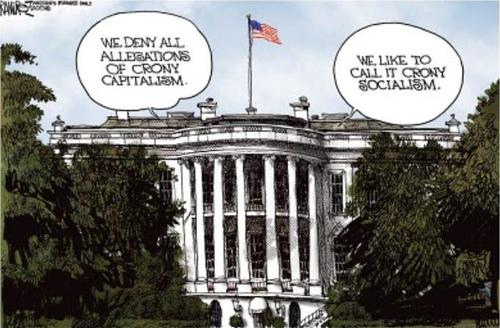
USA 2021: Capitalism For The Powerless, Crony-Socialism For The Powerful

By Tyler Durden

Source: Zero Hedge

The supposed “choice” between “capitalism” and “socialism” is a useful fabrication masking the worst of all possible worlds we inhabit: Capitalism for the powerless and Crony-Socialism for the powerful. Capitalism’s primary dynamics are reserved solely for the powerless: market price of money, capital’s exploitive potential, free-for-all competition and creative destruction.

The powerful, on the other hand, bask in the warm glow of socialism: The Federal Reserve protects them from the market cost of money–financiers and the super-wealthy get their money for virtually nothing from the Fed, in virtually unlimited quantities–and the Treasury, Congress and the Executive branch protect them from any losses: their gains are private, but their losses are transferred to the public. The Supreme Court ensures the super-rich maintain this cozy crony-socialism by ensuring they can buy political power via lobbying and campaign contributions–under the laughable excuse of free speech.

Cronies get the best political system money can buy and you–well, you get to carry a sign on the street corner, just before you’re hauled off to jail for disturbing the peace (and you’re banned by social media/search Big Tech, i.e. privatized totalitarianism, for good measure).

The Federal Reserve is America’s financial Politburo: cronies get a free pass, the powerless get nothing. While the three billionaires who own more wealth than the bottom 165 million Americans can borrow unlimited sums for next to nothing thanks to the Fed (i.e. Crony-Socialist Politburo), the 165 million Americans pay exorbitant interest on payday loans, used car loans, student loans, credit cards and so on.

Capitalism (market sets price of money) for the powerless, Crony-Socialism (nearly free money) for the powerful–thanks to America’s Crony-Socialist Politburo, the Fed. Consider the “free market” plight of America’s working poor: earning low wages that are rapidly losing their purchasing power makes them a credit risk, i.e. prone to defaulting, so lenders (i.e. capital’s exploitive potential) charge high interest rates on loans to the working poor.

Since they pay such high rates of interest and earn so little, they default on their debt at higher rates–just what the lenders expected, and what the lenders created by charging sky-high rates of interest: gee, you’re having trouble paying 24% interest? Too bad you’re poor. You see the point: low wages, poverty and exorbitant rates of interest are mutually reinforcing: a primary driver of defaults and poverty is paying sky-high rates of interest and all the late fees, bounced check fees, etc. that go with 24% interest rates.

The Crony-Socialists have a much different deal with the Fed and its crony-bankers: the super-wealthy arrange for the corporations they own shares in to borrow billions of dollars to fund stock buybacks (which in a less exploitive era were illegal market manipulation). The super-wealthy Crony-Socialist’s personal wealth rises by $100 million thanks to the stock buybacks, and then the super-wealthy Crony-Socialist borrows $10 million for next to nothing against this newly conjured “wealth” (thanks, Fed!) to fund living large.

Crony-Socialist corporations pay no income tax thanks to loopholes and the Crony-Socialists who own the shares report $1 in salary and zero income because they borrowed their living expenses against their Fed-conjured wealth. Do you discern the difference between capitalism for the powerless and crony-socialism for the super-wealthy?

If you can’t yet discern the difference, then ask yourself: can you borrow $1 billion from the Fed’s cronies to buy back shares of your own company, and then borrow $10 million for near-zero rates of interest against the newly conjured “wealth”? You can’t? Well, why not?

If you answer “I don’t have enough collateral,” you missed the key point here: thanks to America’s Crony-Socialist Politburo (the Fed), the super-wealthy have no exposure to the market price of money. The Fed manipulates the cost of money to near-zero, and then funnels unlimited sums of this nearly-free money to corporations, financiers and the super-wealthy.

Collateral is unnecessary in Crony-Socialism; that’s just a excuse given to the powerless. Crony-Socialists borrow $1 billion for next to nothing, buy Treasuries with the free money, put the Treasuries up as collateral (but wait, didn’t they borrow the money? Never mind, it doesn’t matter), originate some financial instruments (CDOs, etc.), post those as collateral, and then leverage up another bet on that fictitious collateral.

If the bets all go bad, the Crony-Socialist claims the whole fraud is now a systemic risk and so the losses are transferred to the public / taxpayers to “save the financial system from collapse.” Isn’t Crony-Socialism fantastic?

Just as the rich kid caught with smack gets a suspended sentence and probation while the powerless kid gets a tenner in the War on Drugs Gulag, the super-wealthy Crony-Socialists avoid all the consequences of their gambles and frauds. America’s Crony-Socialist Politburo (the Fed) takes care of its cronies and the powerless bear the brunt of predatory exploitation that’s passed off as “capitalism.”

The only dynamic that’s even faintly “capitalist” about America’s Crony-Socialism is the price of political corruption is still a “market”: what’s the current price of protecting your monopoly or cartel from competition? It’s moving up fast, so better get those bribes (oops, I mean campaign contributions for the 2022 election) in now before the price of corrupting “democracy” goes even higher.