The Fear Pandemic and the Crisis of Capitalism. Sleepwalking Towards A Global Economic Crisis?

By Colin Todhunter

Source: Global Research

In October 2019, in a speech at an International Monetary Fund conference, former Bank of England governor Mervyn King warned that the world was sleepwalking towards a fresh economic and financial crisis that would have devastating consequences for what he called the “democratic market system”.

According to King, the global economy was stuck in a low growth trap and recovery from the crisis of 2008 was weaker than that after the Great Depression. He concluded that it was time for the Federal Reserve and other central banks to begin talks behind closed doors with politicians.

In the repurchase agreement (repo) market, interest rates soared on 16 September. The Federal Reserve stepped in by intervening to the tune of $75 billion per day over four days, a sum not seen since the 2008 crisis.

At that time, according to Fabio Vighi, professor of critical theory at Cardiff University, the Fed began an emergency monetary programme that saw hundreds of billions of dollars per week pumped into Wall Street.

Over the last 18 months or so, under the guise of a ‘pandemic’, we have seen economies closed down, small businesses being crushed, workers being made unemployed and people’s rights being destroyed. Lockdowns and restrictions have facilitated this process. The purpose of these so-called ‘public health measures’ has little to do with public health and much to do with managing a crisis of capitalism and ultimately the restructuring of the economy.

Neoliberalism has squeezed workers income and benefits, offshored key sectors of economies and has used every tool at its disposal to maintain demand and create financial Ponzi schemes in which the rich can still invest in and profit from. The bailouts to the banking sector following the 2008 crash provided only temporary respite. The crash returned with a much bigger bang pre-Covid along with multi-billion-dollar bailouts.

The dystopian ‘great reset’ that we are currently witnessing is a response to this crisis. This reset envisages a transformation of capitalism.

Fabio Vighi sheds light on the role of the ‘pandemic’ in all of this:

“… some may have started wondering why the usually unscrupulous ruling elites decided to freeze the global profit-making machine in the face of a pathogen that targets almost exclusively the unproductive (over 80s).”

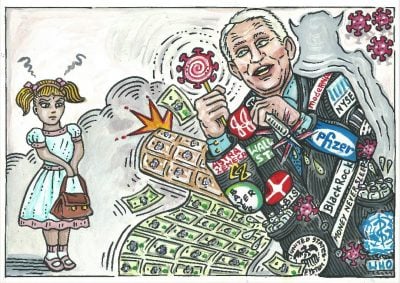
Vighi describes how, in pre-Covid times, the world economy was on the verge of another colossal meltdown and chronicles how the Swiss Bank of International Settlements, BlackRock (the world’s most powerful investment fund), G7 central bankers and others worked to avert a massive impending financial meltdown.

The world economy was suffocating under an unsustainable mountain of debt. Many companies could not generate enough profit to cover interest payments on their own debts and were staying afloat only by taking on new loans. Falling turnover, squeezed margins, limited cashflows and highly leveraged balance sheets were rising everywhere.

Lockdowns and the global suspension of economic transactions were intended to allow the Fed to flood the ailing financial markets (under the guise of COVID) with freshly printed money while shutting down the real economy to avoid hyperinflation.

Vighi says:

“… the stock market did not collapse (in March 2020) because lockdowns had to be imposed; rather, lockdowns had to be imposed because financial markets were collapsing. With lockdowns came the suspension of business transactions, which drained the demand for credit and stopped the contagion. In other words, restructuring the financial architecture through extraordinary monetary policy was contingent on the economy’s engine being turned off.”

It all amounted to a multi-trillion bailout for Wall Street under the guise of COVID ‘relief’ followed by an ongoing plan to fundamentally restructure capitalism that involves smaller enterprises being driven to bankruptcy or bought up by monopolies and global chains, thereby ensuring continued viable profits for these predatory corporations, and the eradication of millions of jobs resulting from lockdowns and accelerated automation.

Author and journalist Matt Taibbi noted in 2020:

“It retains all the cruelties of the free market for those who live and work in the real world, but turns the paper economy into a state protectorate, surrounded by a kind of Trumpian Money Wall that is designed to keep the investor class safe from fear of loss. This financial economy is a fantasy casino, where the winnings are real but free chips cover the losses. For a rarefied segment of society, failure is being written out of the capitalist bargain.”

The World Economic Forum says that by 2030 the public will ‘rent’ everything they require. This means undermining the right of ownership (or possibly seizing personal assets) and restricting consumer choice underpinned by the rhetoric of reducing public debt or ‘sustainable consumption’, which will be used to legitimise impending austerity as a result of the economic meltdown. Ordinary people will foot the bill for the ‘COVID relief’ packages.

If the financial bailouts do not go according to plan, we could see further lockdowns imposed, perhaps justified under the pretext of  ‘the virus’ but also ‘climate emergency’.

It is not only Big Finance that has been saved. A previously ailing pharmaceuticals industry has also received a massive bailout (public funds to develop and purchase the vaccines) and lifeline thanks to the money-making COVID jabs.

The lockdowns and restrictions we have seen since March 2020 have helped boost the bottom line of global chains and the e-commerce giants as well and have cemented their dominance. At the same time, fundamental rights have been eradicated under COVID government measures.

Capitalism and labour

Essential to this ‘new normal’ is the compulsion to remove individual liberties and personal freedoms. A significant part of the working class has long been deemed ‘surplus to requirements’ – such people were sacrificed on the altar of neo-liberalism. They lost their jobs due to automation and offshoring. Since then, this section of the population has had to rely on meagre state welfare and run-down public services or, if ‘lucky’, insecure low-paid service sector jobs.

What we saw following the 2008 crash was ordinary people being pushed further to the edge. After a decade of ‘austerity’ in the UK – a neoliberal assault on the living conditions of ordinary people carried out under the guise of reining in public debt following the bank bail outs – a leading UN poverty expert compared Conservative welfare policies to the creation of 19th-century workhouses and warned that, unless austerity is ended, the UK’s poorest people face lives that are “solitary, poor, nasty, brutish, and short”.

Philip Alston, the UN rapporteur on extreme poverty, accused ministers of being in a state of denial about the impact of policies. He accused them of the “systematic immiseration of a significant part of the British population”.

In another 2019 report, the Institute for Public Policy Research think tank laid the blame for more than 130,000 deaths in the UK since 2012 at the door of government policies. It claimed that these deaths could have been prevented if improvements in public health policy had not stalled as a direct result of austerity cuts.

Over the past 10 years in the UK, according to the Trussell Group, there has been rising food poverty and increasing reliance on food banks.

And in a damning report on poverty in the UK by Professor David Gordon of the University of Bristol, it was found that almost 18 million cannot afford adequate housing conditions, 12 million are too poor to engage in common social activities, one in three cannot afford to heat their homes adequately in winter and four million children and adults are not properly fed (Britain’s population is estimated at around 66 million).

Moreover, a 2015 report by the New Policy Institute noted that the total number of people in poverty in the UK had increased by 800,000, from 13.2 to 14.0 million in just two to three years.

Meanwhile, The Equality Trust in 2018 reported that the ‘austerity’ years were anything but austere for the richest 1,000 people in the UK. They had increased their wealth by £66 billion in one year alone (2017-2018), by £274 billion in five years (2013-2018) and had increased their total wealth to £724 billion – significantly more than the poorest 40% of households combined (£567 billion).

Just some of the cruelties of the ‘free market’ for those who live and work in the real world. And all of this hardship prior to lockdowns that have subsequently devastated lives, livelihoods and health, with cancer diagnoses and treatments and other conditions having been neglected due to the shutdown of health services.

During the current economic crisis, what we are seeing is many millions around the world being robbed of their livelihoods. With AI and advanced automation of production, distribution and service provision on the immediate horizon, a mass labour force will no longer be required.

It raises fundamental questions about the need for and the future of mass education, welfare and healthcare provision and systems that have traditionally served to reproduce and maintain labour that capitalist economic activity has required.

As the economic is restructured, labour’s relationship to capital is being transformed. If work is a condition of the existence of the labouring classes, then, in the eyes of capitalists, why maintain a pool of (surplus) labour that is no longer needed?

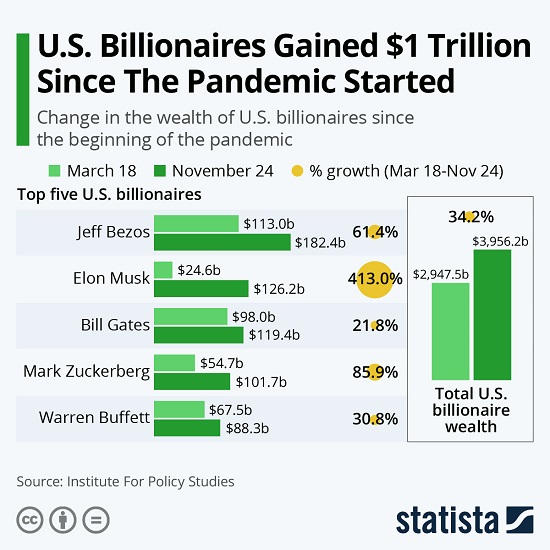
A concentration of wealth power and ownership is taking place as a result of COVID-related policies: according to research by Oxfam, the world’s billionaires gained $3.9 trillion while working people lost $3.7 trillion in 2020. At the same time, as large sections of the population head into a state of permanent unemployment, the rulers are weary of mass dissent and resistance. We are witnessing an emerging biosecurity surveillance state designed to curtail liberties ranging from freedom of movement and assembly to political protest and free speech.

The global implications are immense too. Barely a month into the COVID agenda, the IMF and World Bank were already facing a deluge of aid requests from developing countries that were asking for bailouts and loans. Ideal cover for rebooting the global economy via a massive debt crisis and the subsequent privatisation of national assets.

In 2020, World Bank Group President David Malpass stated that poorer countries will be ‘helped’ to get back on their feet after the various lockdowns but such ‘help’ would be on condition that neoliberal reforms become further embedded. In other words, the de facto privatisation of states (affecting all nations, rich and poor alike), the (complete) erosion of national sovereignty and dollar-denominated debt leading to a further strengthening of US leverage and power.

In a system of top-down surveillance capitalism with an increasing section of the population deemed ‘unproductive’ and ‘useless eaters’, notions of individualism, liberal democracy and the ideology of free choice and consumerism are regarded by the elite as ‘unnecessary luxuries’ along with political and civil rights and freedoms.

We need only look at the ongoing tyranny in Australia to see where other countries could be heading. How quickly Australia was transformed from a ‘liberal democracy’ to a brutal totalitarian police state of endless lockdowns where gathering and protests are not to be tolerated.

Being beaten and thrown to the ground and fired at with rubber bullets in the name of protecting health makes as much sense as devastating entire societies through socially and economically destructive lockdowns to ‘save lives’.

It makes as much sense as mask-wearing and social-distancing mandates unsupported by science, misused and flawed PCR tests, perfectly healthy people being labelled as ‘cases’, deliberately inflated COVID death figures, pushing dangerous experimental vaccines in the name of health, ramping up fear, relying on Neil Ferguson’s bogus modelling, censoring debate about any of this and the WHO declaring a worldwide ‘pandemic’ based on a very low number of global ‘cases’ back in early 2020 (44,279 ‘cases’ and 1,440 supposed COVID deaths outside China out of a population of 6.4 billion).

There is little if any logic to this. But of course, If we view what is happening in terms of a crisis of capitalism, it might begin to make a lot more sense.

The austerity measures that followed the 2008 crash were bad enough for ordinary people who were still reeling from the impacts when the first lockdown was imposed.

The authorities are aware that deeper, harsher impacts as well as much more wide-ranging changes will be experienced this time around and seem adamant that the masses must become more tightly controlled and conditioned to their coming servitude.
Amazon, “Economic Terrorism” and the Destruction of Competition and Livelihoods

By Colin Todhunter

Source: Off-Guardian

Global corporations are colonising India’s retail space through e-commerce and destroying small-scale physical retail and millions of livelihoods.

Walmart entered into India in 2016 with a US$3.3 billion take-over of the online retail start-up Jet.com. This was followed in 2018 with a US$16 billion take-over of India’s largest online retail platform, Flipkart. Today, Walmart and Amazon control almost two thirds of India’s digital retail sector.

Amazon and Walmart have a record of using predatory pricing, deep discounts and other unfair business practices to attract customers to their online platforms. A couple of years ago, those two companies generated sales of over US$3 billion in just six days during Diwali. India’s small retailers reacted by calling for a boycott of online shopping.

If you want to know the eventual fate of India’s local markets and small retailers, look no further than what US Treasury Secretary Steven Mnuchin said in 2019. He stated that Amazon had “destroyed the retail industry across the United States.”

AMAZON’S CORPORATE PRACTICES

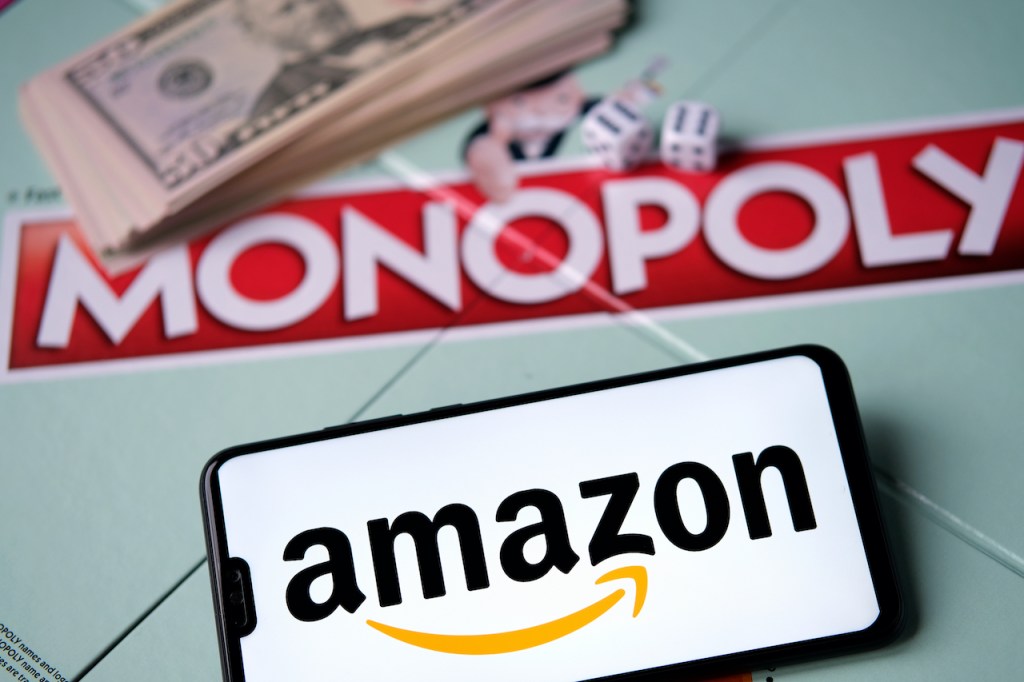
In the US, an investigation by the House Judiciary Committee concluded that Amazon exerts monopoly power over many small- and medium-size businesses. It called for breaking up the company and regulating its online marketplace to ensure that sellers are treated fairly.

Amazon has spied on sellers and appropriated data about their sales, costs and suppliers. It has then used this information to create its own competing versions of their products, often giving its versions superior placement in the search results on its platform.

The Institute for Local Self-Reliance (ILSR) published a revealing document on Amazon in June 2021 that discussed these issues. It also notes that Amazon has been caught using its venture capital fund to invest in start-ups only to steal their ideas and create rival products and services.

Moreover, Amazon’s dominance allows it to function as a gatekeeper: retailers and brands must sell on its site to reach much of the online market and changes to Amazon’s search algorithms or selling terms can cause their sales to evaporate overnight.

Amazon also makes it hard for sellers to reduce their dependence on its platform by making their brand identity almost invisible to shoppers and preventing them from building relationships with their customers. The company strictly limits contact between sellers and customers.

According to the ILSR, Amazon compels sellers to buy its warehousing and shipping services, even though many would get a better deal from other providers, and it blocks independent businesses from offering lower prices on other sites. The company also routinely suspends sellers’ accounts and seizes inventories and cash balances.

The Joint Action Committee against Foreign Retail and E-commerce (JACAFRE) was formed to resist the entry of foreign corporations like Walmart and Amazon into India’s e-commerce market. Its members represent more than 100 national groups, including major trade, workers’ and farmers’ organisations.

JACAFRE issued a statement in 2018 on Walmart’s acquisition of Flipkart, arguing that it undermines India’s economic and digital sovereignty and the livelihoods of millions in India. The committee said the deal would lead to Walmart and Amazon dominating India’s e-retail sector. It would also allow them to own India’s key consumer and other economic data, making them the country’s digital overlords, joining the ranks of Google and Facebook.

In January 2021, JACAFRE published an open letter saying that the three new farm laws, passed by parliament in September 2020, centre on enabling and facilitating the unregulated corporatisation of agriculture value chains. This will effectively make farmers and small traders of agricultural produce become subservient to the interests of a few agrifood and e-commerce giants or will eradicate them completely.

Although there was strong resistance to Walmart entering India with its physical stores, online and offline worlds are now merged: e-commerce companies not only control data about consumption but also control data on production and logistics. Through this control, e-commerce platforms can shape much of the physical economy.

What we are witnessing is the deliberate eradication of markets in favour of monopolistic platforms.

BEZOS NOT WELCOME

Amazon’s move into India encapsulates the unfair fight for space between local and global markets. There is a relative handful of multi-billionaires who own the corporations and platforms. And there are the interests of hundreds of millions of vendors and various small-scale enterprises who are regarded by these rich individuals as mere collateral damage to be displaced in their quest for ever-greater profit.

Thanks to the helping hand of various COVID-related lockdowns, which devastated small businesses, the wealth of the world’s billionaires increased by $3.9tn (trillion) between 18 March and 31 December 2020.

In September 2020, Jeff Bezos, Amazon’s executive chairman, could have paid all 876,000 Amazon employees a $105,000 bonus and still be as wealthy as he was before COVID. Jeff Bezos – his fortune constructed on unprincipled methods that have been well documented in recent years – increased his net wealth by $78.2bn during this period.

Bezos’s plan is clear: the plunder of India and the eradication of millions of small traders and retailers and neighbourhood mom and pop shops.

This is a man with few scruples. After returning from a brief flight to space in July, in a rocket built by his private space company, Bezos said during a news conference:

I also want to thank every Amazon employee and every Amazon customer because you guys paid for all of this.”

In response, US congresswoman Nydia Velazquez wrote on Twitter:

While Jeff Bezos is all over the news for paying to go to space, let’s not forget the reality he has created here on Earth.”

She added the hashtag #WealthTaxNow in reference to Amazon’s tax dodging, revealed in numerous reports, not least the May 2021 study ‘The Amazon Method: How to take advantage of the international state system to avoid paying tax’ by Richard Phillips, Senior Research Fellow, Jenaline Pyle, PhD Candidate, and Ronen Palan, Professor of International Political Economy, all based at the University of London.

Little wonder that when Bezos visited India in January 2020, he was hardly welcomed with open arms.

Bezos praised India on Twitter by posting:

Dynamism. Energy. Democracy. #IndianCentury.”

The ruling party’s top man in the BJP foreign affairs department hit back with:

Please tell this to your employees in Washington DC. Otherwise, your charm offensive is likely to be waste of time and money.”

A fitting response, albeit perplexing given the current administration’s proposed sanctioning of the foreign takeover of the economy, not least by the unscrupulous interests that will benefit from the recent farm legislation.

Bezos landed in India on the back of the country’s antitrust regulator initiating a formal investigation of Amazon and with small store owners demonstrating in the streets. The Confederation of All India Traders (CAIT) announced that members of its affiliate bodies across the country would stage sit-ins and public rallies in 300 cities in protest.

In a letter to PM Modi, prior to the visit of Bezos, the secretary of the CAIT, General Praveen Khandelwal, claimed that Amazon, like Walmart-owned Flipkart, was an “economic terrorist” due to its predatory pricing that “compelled the closure of thousands of small traders.”

In 2020, Delhi Vyapar Mahasangh (DVM) filed a complaint against Amazon and Flipkart alleging that they favoured certain sellers over others on their platforms by offering them discounted fees and preferential listing. The DVM lobbies to promote the interests of small traders. It also raised concerns about Amazon and Flipkart entering into tie-ups with mobile phone manufacturers to sell phones exclusively on their platforms.

It was argued by DVM that this was anti-competitive behaviour as smaller traders could not purchase and sell these devices. Concerns were also raised over the flash sales and deep discounts offered by e-commerce companies, which could not be matched by small traders.

The CAIT estimates that in 2019 upwards of 50,000 mobile phone retailers were forced out of business by large e-commerce firms.

Amazon’s internal documents, as revealed by Reuters, indicated that Amazon had an indirect ownership stake in a handful of sellers who made up most of the sales on its Indian platform. This is an issue because in India Amazon and Flipkart are legally allowed to function only as neutral platforms that facilitate transactions between third-party sellers and buyers for a fee.

UNDER INVESTIGATION

The upshot is that India’s Supreme Court recently ruled that Amazon must face investigation by the Competition Commission of India (CCI) for alleged anti-competitive business practices. The CCI said it would probe the deep discounts, preferential listings and exclusionary tactics that Amazon and Flipkart are alleged to have used to destroy competition.

However, there are powerful forces that have been sitting on their hands as these companies have been running amok.

In August 2021, the CAIT attacked the NITI Aayog (the influential policy commission think tank of the Government of India) for interfering in e-commerce rules proposed by the Consumer Affairs Ministry.

The CAIT said that the think tank clearly seems to be under the pressure and influence of the foreign e-commerce giants.

The president of CAIT, BC Bhartia, stated that it is deeply shocking to see such a callous and indifferent attitude of the NITI Aayog whch have remained a silent spectator for so many years when:

…the foreign e-commerce giants have circumvented every rule of the FDI policy and blatantly violated and destroyed the retail and e-commerce landscape of the country but have suddenly decided to open their mouth at a time when the proposed e-commerce rules will potentially end the malpractices of the e-commerce companies.”

Of course, money talks and buys influence. In addition to tens of billions of US dollars invested in India by Walmart and Amazon, Facebook invested US$5.5 billion last year in Mukesh Ambani’s Jio Platforms (e-commerce retail). Google has also invested US$4.5 billion.

Since the early 1990s, when India opened up to neoliberal economics, the country has become increasingly dependent on inflows of foreign capital. Policies are being governed by the drive to attract and retain foreign investment and maintain ‘market confidence’ by ceding to the demands of international capital which ride roughshod over democratic principles and the needs of hundreds of millions of ordinary people. ‘Foreign direct investment’ has thus become the holy grail of the Modi-led administration and the NITI Aayog.

The CAIT has urged the Consumer Affairs Ministry to implement the draft consumer protection e-commerce rules at the earliest as they are in the best interest of the consumers as well as the traders of the country.

Meanwhile, the CCI probably will complete its investigation within two months.

The Houses of Dead and Crooked Souls

By Edward Curtin

Source: Behind the Curtain

“A house constitutes a body of images that give mankind proofs or illusions of stability.”      – Gaston Bachelard, The Poetics of Space

There is a vast and growing gulf between the world’s rich and poor.  An obscene gulf. If we can read houses, they will confirm this.  They offer a visible lesson in social class.

Houses stand before us like books on a shelf waiting to be read, and when the books are missing, as they are for a vast and growing multitude of the homeless exiled wandering ones and those imprisoned, their absence serves to indict the mansion-dwelling wealthy and to a lesser extent those whose homes serve to shield them from the truth of the ill-begotten gains of the wealthy elites who create the world’s suffering through their avarice, lies, and war making.

Many regular people want to say with Edmund in Eugene O’Neill’s play, Long Day’s Journey into Night:

The fog is where I wanted to be. Halfway down the path you can’t see this house. You’d never know it was here. Or any of the other places down the avenue. I couldn’t see but a few feet ahead. I didn’t meet a soul. Everything looked and sounded unreal. Nothing was what it is.That’s what I wanted – to be alone with myself in another world where truth is untrue and life can hide from itself….Who wants to see life as it is, if they can help it?

Yet the rich don’t hide or give a damn. They flaunt their houses.  They know they are crooks and creators of illusions.  Their nihilism is revealed in their conspicuous consumption and their predatory behavior; they want everyone else to see it too.  So they rub it in their faces.  Their wealth is built on the blood and suffering of millions around the world, but this is often hidden knowledge.

For many regular people prefer the fog to the harsh truth.  It shields them from intense anger and the realization that the wealthy elites who run the world and control the media lie to them about everything and consider them beneath contempt.  That would demand a response commensurate with the propaganda – rebellion.  It would impose the moral demand to look squarely at the houses of death with their tiny cells in which the wealthy elites and their henchmen imprison and torture truth tellers like Julian Assange, an innocent man in a living hell; to make connections between wealth and power and the obscene flaunting of the rich elite’s sybaritic lifestyles in houses where every spacious room testifies to their moral depravity.

The recent news of Barack Obama’s vile selfie birthday celebration for his celebrity “friends” at his 29-acre estate and mansion (he has another eight-million-dollar mansion in Washington, D. C.) on Martha’s Vineyard is an egregious recent case in point.  If he thinks this nauseating display is proof of his stability and strength – which obviously he does – then he is a deluded fool.  But those who carry water for the military-intelligence-media complex are amply rewarded and want to tell the world that this is so.  It’s essential for the Show.  It must be conspicuous so the plebians learn their lesson.

Obama’s Vineyard mansion stands as an outward sign of his inner disgrace, his soullessness.

Trump’s golden towers and his never-ending self-promotion or the multiple million-dollar mansions of high-tech, sports, and Hollywood’s superstars send the same message.

Take Bill Gates’ sixty-three-million-dollar mansion, Xanadu, named after William Randolph Hearst’s estate in Citizen Kane, that took seven years to build.

Take the house up the hill from where I live in an erstwhile working-class town that sold for one million plus and now is being expanded to double its size with a massive swimming pool that leaves no grass uncovered. Every week, three black window-tinted SUVs arrive with New Jersey plates to join two white expensive sedans to oversee the progress in this small western Massachusetts town where McMansions rise throughout the hills faster than summer’s weeds.

Take the blue dolomite stone Searles Castle with its 60 acres, 40 rooms, and “dungeon” basement down the hill on Main St. that was recently bought by a NYC artist who also owns seven grand estates around the country that he showcases as examples of his fine artistic taste.  “All these houses have endless things to do — it’s just mind-boggling,” he has said. The artist, Hunt Slonem, calls himself a “glamorizer,” and his “exotica” paintings, inspired by Andy Warhol’s repetition of soup cans and Marilyn Monroe, hang in galleries, museums, cruise ships, and the houses of film celebrities.  Like his showcase houses, his exotica must have endless things to do.

What would Vincent van Gogh say?  Perhaps what he wrote to his brother Theo: that the greatest people in painting and literature “have always worked against the grain” and in sympathy with the poor and oppressed.  That might seem “mind-boggling” to Slonem.

Such ostentatious displays of wealth and power clearly reveal the delusions of the elites, as if there are no spiritual consequences for living so.  Even if they read Tolstoy’s cautionary tale about greed, How Much Land Does A Man Need?, it is doubtful that its truth would register.  Like Tolstoy’s protagonist Pahόm, they never have enough.  But like Pahόm, the Devil has them in his grip, and like him, they will get their just rewards, a small room, a bit of land to imprison them forever.

His servant picked up the spade and dug a grave long enough for Pahóm to lie in, and buried him in it. Six feet from his head to his heels was all he needed.

Where does the money for all these estates, not just Slonem’s, come from? Who wants to ask?

Getting to the roots of wealth involves a little digging.  Slonem’s castle was originally commissioned in the late 1800s by Mark Hopkins for his wife.  Hopkins was one of the founders of the Central Pacific Railroad, which was built by Irish and Chinese immigrants.  Labor history is quite illuminating on the ways immigrants have always been treated, in this case “the dregs of Asia” and the Irish dogs.  Interestingly enough, the great black scholar and radical, W. E. B. Du Bois, a town native, worked at the castle’s construction site as a young man.  No doubt it informed his future work against racism, capitalism, and economic exploitation.

Wealthy urbanites flooded this area after September 11, 2001, and now, in their terror of disease and death, they have bought every house they could find.  Their cash-filled pockets overflow with blood-money and few ask why. To suggest that massive wealth is almost always ill-begotten is anathema.  But innocence wears many masks, and the Show demands washed hands and no questions asked.

It is rare that one becomes super-wealthy in an honest and ethical way.  The ways the rich get money almost without exception lead downward, to paraphrase Thoreau from his essay, “Life Without Principle.”

Since the corona crisis began, investment firms such as the Blackstone Group have been gobbling up vast numbers of houses across the United States as their prices have gone through the roof.  The lockdowns – an appropriate prison term – have set millions of regular people back on their heels as the wealthiest have gotten exponentially wealthier. Poverty and starvation have increased around the world.  This is not an accident.  Despair and depression are widespread.

There is a taboo in life in general and in journalism: Do not ask where people’s money comes from.  Thoreau was so advised long ago:

Do not ask how your bread is buttered; it will make you sick…

But the super-wealthy do not get sick.  They are sick.  For they revel in their depravity and push it in the faces of regular people, many who envy them and wish to become super-rich and powerful themselves.  Of course there are the blue bloods whose method is understatement, but it takes many decades to enter their theater of deception.  In many ways, these people are worse, for their personae have been crafted over decades of play-acting and public relations so their images are laundered to smell fresh and benevolent.  They often wear the mask of philanthropy, while the history of their wealth lies shrouded in an amnestic fog.

Yet soul murder includes suicide, and while the old and new moneyed ones smoothly justify their oppression of the vast majority, many regular people kill the best in themselves by envying the rich.

Years ago, I discovered some documents that showed that one of this country’s most famous philosophers, known for his lofty moral pronouncements, owned a lot of stock in companies that were doing evil things – war making, poisoning and killings huge numbers with chemicals, etc.  But his image was one of Mr. Clean, Mr. Good Guy. I suspect this is typical and that there are many such secrets in the basements and attics of the rich.

But let us also ask where the writers and presenters of the mainstream and alternative media get their money.  Although “to follow the money” is a truism, few do.  If we do, we will learn that money talks and those who take it toe the line, nor do they live in shacks by the side of the road or rent like so many others.  They invest with Black Rock and their ilk and have money managers who can increase their wealth while shielding them from the ways that money is made on the backs of the poor and working people.  And they lie about people like Assange, Daniel Hale, Reality Winner, Craig Murray, et al., all imprisoned for daring to reveal the depredations of the power elites, the violence at the heart of predatory capitalism.

Yes, houses speak.  But few ever speak of where their money comes from.  Those that are on the take – which has multiple meanings – always plead innocent.  Yes, I can hear you say that I am being too harsh; that there are exceptions.  That is obvious.  So let’s skip the exceptions and focus on the general principle. There is a Buddhist principle that right livelihood is a core ethic in earning money.  Jesus had another way of putting it but was of course in agreement, as were so many others whom people hold in highest esteem.

Thoreau wrote: “If you are acquainted with the principle, what do you care for a myriad instances and applications.”

The truth is that for most people, work, if they can find it, is drudgery and hard, a matter of survival. The late great Studs Terkel called it hell and rightly said that most jobs are not big enough for people because they crush the soul, they lack meaning.  And behind all ledgers of great wealth lie crushed souls.  This reality is so obvious and goes by many names, including class warfare, that further commentary would be redundant.

A few years ago, I visited Mark Twain’s house in Hartford, Connecticut.  It is advertised as “a house with a heart and a soul.”  It is not a house but a mansion, and it was an ostentatious display in Twain’s time. Similar or worse than Obama’s mansion on Martha’s Vineyard today.  It has no soul or heart.  It was built with Twain’s wife’s family money.  Her father was an oil and coal tycoon from upstate New York.  Twain reveled in opulent respectability.  He lived the life of a Gilded Age tycoon, an American magnate. It is not a pretty story, but the Twain myth says otherwise.  Not that he catered to popular tastes to please the crowd and his domineering wife and that he lived in luxury, but that he was a radical critic of the establishment.  This is false.  For he withheld for the most part the publication of his withering take on American imperialism until after his death.  He committed soul murder.  But his mansion impressed his neighbors and his humor distracted from his luxurious lifestyle.  His house still stands as a cautionary tale for those who will read it.

Baudelaire once said that in palaces “there is no place for intimacy.”  This is no doubt why in people’s dreams small, simple houses with a light in the window loom large.  Bachelard says, “When we are lost in darkness and see a distant glimmer of light, who does not dream of a thatched cottage or, to go more deeply still into legend, of a hermit’s hut.”  For here man and God meet in solitude; here human intimacy is possible.  “The hut can receive none of the riches ‘of this world.’  It possesses the felicity of intense poverty; indeed, it is one of the glories of poverty; as destitution increases, it gives access to absolute refuge.”

He is not espousing actual poverty, but the oneiric depths of true desire, the dreams of hope, reconciliation, and simple living that run counter to the amassing of wealth to prove one’s power and majesty. A humble house of truth, not a mansion of lies. This, to borrow the title of William Goyen’s novel, is “the house of breath” where the spirit can live and pseudo-stability gives way to faith, for insecurity is the essence of life.

There is such a hermit’s hut where the light shines.  It is the tiny cell in Belmarsh Prison where Julian Assange hangs onto his life by a thread.  His witness for truth sends an inspiring message to all those lost in the world’s woods to look to his fate and not turn away.  To follow to their sources the money that greases the palms of all the so-called journalists and politicians who want him dead or imprisoned for life, who tell their endless lies, not just about him, but about everything.

The house of propaganda is built on unanimity.  When one person says no, the foundation starts to crumble.  The houses of the rich dead and crooked souls, erected to project the stability of their bloody illusions, start to crumble into sand when people dissent one by one.

Soon the fog lifts and there is no hiding any more.  At the end of the path, you can see the vultures circling overhead as their prey go running out of their mansions in terror.

Sing Hallelujah!

France Neoliberal Macron: Vanguard of a Covid Global Corporate Dictatorship?

By Gilbert Mercier

Source: News Junkie Post

Liberte-Egalite-Fraternite: under Macron’s pass sanitaire guillotine?

For the few of us who are students of history, and its aficionado travelers, meaning those who muse and wonder, at times, about how significant figures of the past would view our often dire predicament, it is rather obvious that, for example, the founding fathers of the French Revolution such as Danton, Mirabeau, St Just, and Robespierre would be shocked and angry by what has recently happened to their Republic. Even France’s last great statesman General de Gaulle, if alive today, would have likely been deeply enraged by the state of affairs in a country he loved and fought for with his heart and soul.

In the era of President Emmanuel Macron, who is merely a cynical actor, figurehead, and France’s public relation person in chief passing for a statesman, but who truly is a loyal servant of global corporatism, our revolution’s founders, as well as the subsequent republics’ principles, like the one of the Fifth Republic of de Gaulle, have been insulted, slapped in the face, and assaulted by some sort of insidious and limp dictatorship, under the cover of a health crisis. A complex authoritarian strategy using the pretense of shielding French citizens, often against their will, in this new lucrative conceptual war.

This war on a virus is even more advantageous than the previous conceptual one: the war on terror. In General Macron’s war, syringes are the weapons delivery system of choice, needles like billions of little worker bees at the ready to jab you for an invitation to control freedom, and a moderate slice of happiness: the joy once you have obtained the French COVID pass Sanitaire to go to museums, movie theaters, inside restaurants, and avoid wearing masks outdoor.

French citizens should be aware that the very motto of our dear Republic, Liberte-Egalite-Fraternite is under the assault of king Ubu Macron and could, without a strong popular resistance, be decapitated by the cold blade of Macron’s virtual guillotine. In a form of dictatorial grab of power for the benefit of big biotech and big pharmaceutical companies. Macron’s pernicious pass sanitaire, just approved by France Assemblee Nationale, is a power grab by global corporate imperialism. Of course, all of it done with a wink, a tan and a smile! All of it done for the greater good of ungrateful “Gaullois refractaire” French citizens, in the continuity of the pesky Gilets Jaunes. Science lover poseur Macron, an enlightened modern day Julius Cesar, is bent on defeating obscurantism armed only with syringes to deliver his brand of salvation thru vaccines. Those who have been in the forefront of the street protest in France to resist this hybrid neoliberal dictatorship personified by Macron are the still active Gilets Jaunes.

From war on terror to war on virus: maximum profit for big tech & pharma

Forget about the good old so-called war-on-terror, fading slightly since its start in September 2001 but still a nice little threat in the background, big enough to keep the military-industrial complex flush with cash. A new conceptual global war was needed: the global war on COVID virus came at the right time. This one is even more promising, as it potentially concern the entire world population or 7.5 billion people. The COVID war has also been an easy sell for the general population, as it can be viewed as a war of necessity with humans “all in it together.” It can also provide an astronomical stream of revenue by making vaccination mandatory. In terms of profit from pandemics, vaccine companies have not been the only beneficiaries of this COVID gold rush.

Big tech companies have racked up billions of dollars at a furious pace since March 2020 and the various restrictive measures of lock-downs and curfews. The likes of Amazon, Zoom and streaming media have handsomely benefited from the imposed partial move to a virtual world. As matter of fact, worldwide stock markets have become junkies to this trend: addicted to the war on COVID benefits.

Needless to say, this vast stream of income is also potentially endless because of the virus mutation into different variants. One loses track of this Greek alphabet catalogue. It was Alpha first or the English variant, then Beta or the Brazilian one, more contagious than the rhythm of Samba, and now it is the Delta variant originally called Indian mutation. As the virus mutates, as they all do, it could potentially take us all the way to Omega, the last letter of the Greek alphabet. The side effect of the Delta variant’s rapid spread has been to allow Macron, and soon many others, head-of-states or figureheads, to tighten back the screw on fundamental liberties.

Rule by decree, states of emergency, arbitrary measures, absurd,or not, are a form of abuse of power that neoliberals like Macron are really enjoying. It is an insidious form of dictatorship under a benevolent disguise of the enlightened rulers forcing their citizenry’s behavior. In France a law is about to pass, in parliament, to make vaccine for healthcare workers across board mandatory. If they do not comply by September 15, 2021, they will be fired. In the case of France, this should be viewed as a prelude to mandatory vaccination for the entire population.

Killing personal freedom and liberties

In France, government controlled mainstream media, critiques rightly calling the Macron administration’s sweeping COVID policies a “dictature sanitaire” or healthcare dictatorship have been labeled conspiracy theorists. This is pure disinformation, as what defines a dictatorship, semantically speaking, is a government, elected or not, forcing policies on its citizens. It is done under the premise that it is an action for the benefit of the common good, but nonetheless it is the exercise of authoritarian power on a population.

Through the COVID-19 pandemics, governments have learned that, if fear and paranoia were prevalent enough, and they run a lot of polls in their respective population, any dictatorial measures could be implemented without risking much social turmoil. A great majority of people did, and would likely comply again to other lock-downs, wearing masks outdoors, curfews, but without much protest. Now the final frontier is mandatory vaccination from 12 years-old on, which will give you some sort of health passport. If approved. this pass would give people the right to live almost free. This new type of passport, given to you as a reward to your obedience, will give you access to a mythical promised land often called by Macron “the return of the happy days!”

COVID fear mongering: subterfuge to hide climate collapse threat

There is no doubt, for any rational minds, that contesting the reality of the COVID pandemic is pure conspiracy theory. More than that, it is full blown lunacy! There are two radical anti-vaxers thought processes here: firstly, deny the existence of the pandemic entirely; secondly, which might be even more disturbing, an unshakable belief that the virus was man made, and released on purpose by the like of Fauci, Bill Gates, and a hand full of mad scientists. And, of course, here’s the icing on the cake: they’re all acting on behalf of a cabal of globalist pedophiles. These are the kinds of conspiracy theories that currently get you banned on social media.

As much as they are colorfully insane, this type of COVID-19 conspiracy theory denials are not, in essence, any worse than climate change crisis denial. The difference being that your average run of the mill climate change denier won’t get banned on social media. The nature of the capitalist global corporatism system, where neoliberals like Macron are leading figures, is not to create a crisis from scratch, which is either an impossible or very challenging task, but instead to take advantage of crisis either to further general policy goals, or in most cases benefit punctually from them like an opportunistic predator. This predatory aspect is after all the very nature of capitalism.

Besides the numerous advantages that Macron, his political colleagues and their patrons from the billionaire class have found in the COVID crisis, as explained above, not only huge financial gains for pharmaceutical companies, but also for tech companies involved in this sort of forced quantum leap to the virtual world. In brief, this has been a chance to brutally shock the global economy. Not to make it more equal or sustainable, but quite exactly the opposite: COVID has been an opportunity to concentrate wealth even more in fewer hands with a net result of more social inequality.

Because in today’s press one story is always used to hide another, the pandemic has been also a blessed opportunity to hide, not the proverbial 800-pound gorilla in the room, but instead the 10,000-ton Godzilla wrecking the planet: Godzilla, in this case, being the growing certainty of an upcoming global climate collapse.

Of the “Liberte-Egalite-Fraternite” motto of the French revolution, all the great values have been trampled and gutted. With lock-downs, curfews, mandatory masks and vaccine, Liberte is now gone. In the era of Macron, a former investment banker, nobody can talk about Egalite in a country which is on its way to become almost as unequal as the United States; and last but not least, how could anyone see any Fraternite left? The community sense of brotherhood died quite sometime ago in France. There is no brotherhood left, no deep sense of connection within the nation, we are not “all in this together”.

In reality, there is only all of us, common men and women worldwide, against the billionaire class that controls the levers of the global corporate imperialist machines, with their political servant facilitators acting as heads of state. The specific names within the political class are of little significance, since they represent the identical interests. It’s a bit like the names given to the COVID variants. The Delta variant, portrayed as the top threat right now, started more modestly as India’s mutation. Who knows, perhaps in some billionaire class circles, Emmanuel Macron is just called factor X, LV or MANU.

Why Don’t Billionaires Pay the Same High Tax Rates the Rest of Us Pay?

By Charles Hugh Smith

Source: Of Two Minds

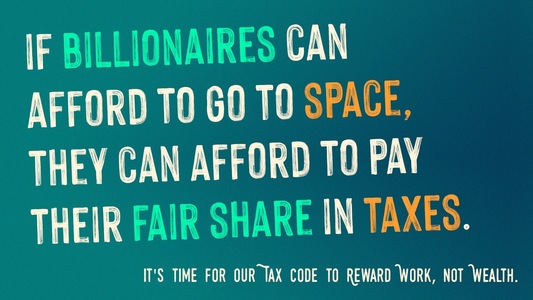
The truth is America has lost its way if commoners pay a rate of 40% but its billionaires pay next to nothing.

As with everything else in polarized America, billionaires proclaiming space tourism is the next big thing for humanity neatly divides opinion into two camps: those who laud the initiative, hard work and innovations of the billionaires as examples of the American Can-Do Dream, and those who wished the billionaire space tourists had taken a one-way flight to a distant orbit of blissful silence.

Setting aside that bitter divide, let’s explore another divide: how our two-tier tax system enables billionaires to become billionaires while the rest of us get poorer. Whenever I discuss the taxes of the non-billionaire self-employed, armies of apologists leap to the defense of the status quo with various quibbles: the 0.9% Medicare surcharge only kicks in above $200,000, the cap on Social Security taxes is $142,800, and so on.

Setting aside the quibbles–and recall the tax code with regulatory notes is thousands of pages–let’s deal with the real issue, which is that billionaires and their corporations pay a thin slice of taxes as a percentage of total income/gains if they pay any at all, while self-employed and small business pay extraordinarily high tax rates.

To all the quibblers: please add the 15.3% Social Security/Medicare tax rate (self-employed / sole proprietors pay both the employee and employer share of this tax) to the federal tax rate of 24% for income above $85,520. It’s 39.3%.

Just how hard would it be to conclude that everyone earning more than $142,000 should pay at least the same rate the rest of us pay? Aren’t we demonstrating all those same laudable traits of the billionaires, just on a smaller scale? Why should we pay 40% and the billionaires pay essentially zero?

Gee, do you reckon paying no taxes might help folks become richer? Garsh, nobody ever asked that question before. And do you reckon paying 40% of your income might make you poorer over time? Golly gee, how come the talking heads worshiping the billionaires never ask these questions?

Since Social Security and Medicare/Medicaid are the bedrock of America’s social safety net, why shouldn’t billionaires pay to support these programs? Well, why not? Just how lame do the excuses have to be to be recognized as laughably self-serving?

Here’s the trick billionaires use to evade taxes. There are countless ways for the super-wealthy to evade taxes–funnel earnings through an Irish post office box, buy a tax break in Washington DC, slide the money into one of dozens of global tax havens, and so on.

But a simple one is to report no income and live large off borrowed money. As the billions of dollars in capital gains pile up as the billionaire’s stock holdings soar (thanks, Federal Reserve, for the free trillions; awful swell of you to give us all that free money), there’s no income generated until the billionaire sells some shares. No sale, no income. Just pay yourself $1 a year in salary, borrow against your billions at super-low rates of interest, and voila, you’re tax-free while you build your super-yacht, buy your private island, and so on.

Just as a thought experiment, suppose the first $50,000 in earnings for everyone were tax-free, and a 40% tax rate was collected on all income above $1 million, both earned and unearned (capital gains), not when the gains were realized in a sale but at the end of every tax year, whether the shares that rose in value were sold or not.

So Billionaire Space Tourist reaped $10 billion in capital gains from the appreciation of stocks held, then the Billionaire pays 40% of those gains: $4 billion. There is a way to not pay any taxes on capital gains–have your portfolio lose value. No gains, no taxes. And to close all the loopholes, the tax rate is on all assets and income connected in any way, shape or form with the U.S. First they pay the U.S. taxes, then if they want to pay other nations’ taxes as well, be my guest. But the 40% is due and payable regardless of any other conditions.

You don’t like it, then stop selling any products in the U.S. or holding any assets in the U.S. Why should billionaires get to set up immensely profitable monopolies, quasi-monopolies, cartels and corporations in the U.S. but pay near-zero in taxes? Why should billionaires be free to profit from America’s economy but pay nothing to support its citizenry?

What precisely is the logic of reducing taxes on the wealthiest few to near-zero? If there is no logic, then we’re left with corruption: America is a moral cesspool.

The truth is America has lost its way if commoners pay a rate of 40% but its billionaires pay next to nothing. Please note Karma and Divine Retribution are not controlled by the billionaire’s lackeys and apparatchiks in the Federal Reserve. The pendulum of exploitation has reached its extreme, and the reversal to the opposite extreme is underway.

Have We Reached “Peak Self-Glorifying Billionaire”?

By Charles Hugh Smith

Source: Of Two Minds

Perhaps we should update Marie Antoinette’s famous quip of cluelessness to: “Let them eat space tourism.”

As billionaires squander immense resources on self-glorifying space flights, the corporate media is nothing short of worshipful. Millions of average citizens, on the other hand, wish the self-glorifying billionaires had taken themselves and all the other parasitic, tax-avoiding, predatory billionaires with them on a one-way trip into space.

Have we reached Peak Self-Glorifying Billionaire? If so, where does the downhill slide take us? Let’s start with a bit of history. Correspondent Jim B. summarized historian Arnold Toynbee’s study of the rise and fall of civilizations thusly: “Civilizations fail when their elites change from an admired dynamic creative class to a despised Establishment of corrupt rentiers, an entrenched governing class unfit to govern.”

Despised, check. Corrupt, check. Entrenched, check.

The 2013 book Why Nations Fail: The Origins of Power, Prosperity, and Poverty discusses the differences between failed states and successful states, and concludes that the failed states are fundamentally kleptocracies that answer to a self-serving elite while successful states are answerable to the broad populace.

To summarize: When the few benefit at the expense of the many, the resulting kleptocracy ends up a failed state. When states maintain meaningful, transparent ways of responding to public needs and demands, the result is a successful state.

This is of course a simplification. The perverse effects of colonialism linger, the development of civic organizations public institutions, values and identities that make up what I call the social ontology are not pre-ordained, and nations with low-cost surplus energy can be quite successful kleptocracies until their energy surplus runs out.

But in the main, the question remains: How did previously successful political, social and economic systems change such that they no longer generated beneficial synergies but slid into fatal synergies?

From the point of view of how systems fail to maintain dynamic stability, three factors pop out:

1. Elites become too successful in sluicing the nation’s income, wealth and political power into their own hands.

2. Since the system continues to thrive despite their dominance, then there is obviously no need to change anything–especially if it reduces their share of the nation’s wealth and political power.

3. The elites ignore the intangible decay of leadership, the real-world dynamics of scarcity and over-estimate their own capabilities and the resilience of the system.

I recently described the feedback loop that occurs when a wealthy elite can purchase political power:“as a result of their campaign contributions and lobbying, the elites’ wealth continues expanding, enhancing their political power to further expand their wealth, and so on.”

In a healthy system, there are mechanisms that limit elite ownership of wealth and political power to what the system can bear. Over time, the feedback I described increases elite wealth and power to a point where the limits are crushed and the elite feedback gathers momentum.

With institutional limits no longer in the way, the elite reaches the point where the political system no longer responds to the broad public at all, and the vast majority of income-producing wealth is already in the hands of the elite.

The U.S. is already at this final stage: Wealth/Power Inequality and the Slide Into Disorder.

Testing Theories of American Politics: Elites, Interest Groups, and Average Citizens“Contrary to what decades of political science research might lead you to believe, ordinary citizens have virtually no influence over what their government does in the United States.”

This dominance throws the system out of balance such that, as David Parsons recently put it: (Elite-dominated) “Capitalism makes everyone homeless and then makes award-winning movies about how resilient people are for living in their cars.”

The apparent success of the system even as it grows ever more imbalanced generates a self-serving confidence in the Elites that their dominance is not only benign but permanent.

But this self-serving view is illusory. Beneath the surface, major subsystems are attempting to re-establish stability, but the instability is so extreme that the measures being deployed are also extreme.

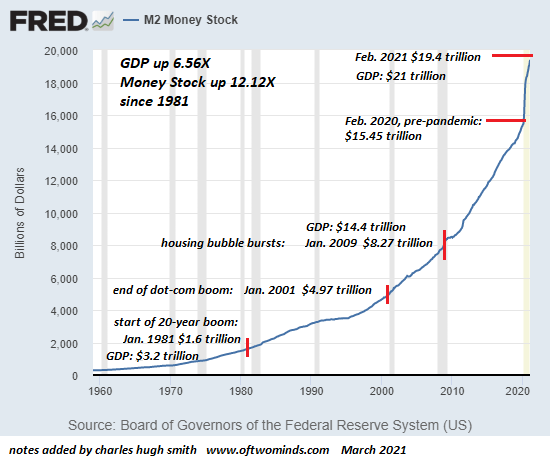
These policy extremes only push the system further out of balance in other directions, creating fatal synergies as mutually reinforcing imbalances pile up.

See the chart below of money supply as one example of many.

But the elite is blinded by their confidence and greed to these accelerating imbalances. They reckon that managing the narratives (a.k.a. propaganda), minor policy tweaks and creating more currency and credit are all that’s needed to maintain what they consider the optimal form of stability: they own 99% of political power and 97% of all the income from capital.

Monopoly Versus Democracy: How to End a Gilded Age“Ten percent of Americans now control 97 percent of all capital income in the country. Nearly half of the new income generated since the global financial crisis of 2008 has gone to the wealthiest one percent of U.S. citizens. The richest three Americans collectively have more wealth than the poorest 160 million Americans.”

I’ve often noted that the wealth of Rome’s political and economic elite went from being 20 times the wealth of a landowning farmer or craftsman to 200,000 times the commoners’ wealth at the end of the Western Empire. Now that three individuals own more wealth than half the American populace, and the top 0.1% hold more wealth than the bottom 80%, I think we can safely declare we’ve reached the same extreme.

The first tranche of American presidents left office less wealthy than when they entered because serving in public office was understood as a noble and valued sacrifice of time and wealth. Now presidents leave office far wealthier than when they entered public service.

Per #3, the elite no longer sees any compelling reason to sacrifice their income, wealth and power to stabilize the system or benefit the common good. In the view of the billionaires, if any sacrifices are necessary, then they should be borne by the bottom 95%, or failing that, the bottom 99.5%.

Given their dominance, their willingness to use their wealth and power to protect their dominance dooms the system to destabilization and collapse, as the resources and value system required to successfully navigate eras of instability and scarcity are no longer available to the state or public.

In effect, the elite uses its power not to restabilize the system but to maintain its extreme dominance and protect it from any political threats.

A once vibrant ecosystem has become a monoculture whose stability is far more precarious than it appears on the surface, as the resilience of monocultures is entirely artificial.

Two recent books illuminate corners of this destabilizing inequality:

Billionaire Wilderness: The Ultra-Wealthy and the Remaking of the American West

‘Jackpot’ Looks at How Inequality Is Experienced by the Very, Very Rich

We are in the final stages of this accelerating destabilization: the refusal of the elite to sacrifice any meaningful share of their wealth and power to save the system from fatal synergies guarantees collapse.

Perhaps we should update Marie Antoinette’s famous quip of cluelessness to: “Let them eat space tourism.” We all know where this cluelessness ultimately leads.

Freedom Rider: How the billionaires rule

Predatory capitalism has driven down wages and created a dystopia for workers.

By Margaret Kimberley

Source: Intrepid Report

President Calvin Coolidge said, “The business of America is business.” The expression is memorable because it always rang true. But nearly 100 years later an old trite saying has taken on an ever more terrifying meaning.

The ruling class wield their power more blatantly than ever. There is little effort to conceal their determination to rule over the people and to control the politicians who are now little more than their personal minions.

When the people get a little help, as happened with additional stimulus funds for the unemployed, politicians across the country took up arms for the ruling class and turned down free money just to stay in the good graces of their bosses.

Currently 25 states out of 50 have rejected additional help for the unemployed. The money came from the federal government and didn’t impact state budgets, but politicians know who calls the shots. When called upon to help struggling people they chose to do just the opposite. They helped their exploiters and, in the process, made a mockery of what passes for democracy.

There is no labor shortage in this country. Instead, there is a shortage of jobs that pay a living wage and that is because of the power of capitalists. They have grown richer precisely because they have forced workers to live in a constant state of precarity, and now it is quite literally better to stay home than to work for a pittance.

Of course, the richest man in the world, Amazon’s Jeff Bezos, is a master at coming up with new ways to subjugate workers. Any reports of job growth should be viewed with a very jaundiced eye as predatory capitalism has driven down wages and created a dystopia for workers. Bezos has mastered squeezing the most and giving the least.

Amazon warehouse workers suffer from injuries at higher rates than other employees in similar jobs but the injuries are part of the cost of doing business. It is expected that the grueling working conditions will create high turnover which is exactly what Amazon wants. A revolving door of employees serves their needs quite nicely. Bezos made a big deal about a $15 per hour starting salary but he could certainly afford to pay a lot more, a real living wage. The tight-fisted billionaire who could potentially become a trillionaire got rich the old fashioned way. He cheats workers.

Bezos also comes up with new and ingenious ways to spread the suffering. Amazon Flex delivery drivers are hired by apps and fired by algorithms. They have no interaction with human resources or any humans at all and they must pay a $200 fee to contest terminations that are rarely decided in their favor.

Even when American workers lose their jobs they are still at the mercy of corporate giants. ID.me contracts with states to provide public access to web sites such as those used for unemployment claims. Their facial recognition software doesn’t verify everyone properly and desperate people wait days and weeks for their unemployment payments to arrive. As with Amazon there is no one to speak to for help. But state governments turn over millions of dollars to ID.me in order to cheat people out of benefits they have earned. Currently 30 states contract with ID.me to make sure that the most vulnerable are kicked while they are down.

The algorithm hirings and firings and the facial recognition technology problems are not bugs in the system. They are features. They are doing precisely what they are intended to do, keep workers poor, desperate, and at the mercy of capitalists. Cruelty is the point.

One might ask who speaks for the people. Workers in several states had their unemployment saved by court decisions but those are few and far between. Politicians are as blatant as their corporate bosses and openly side with them against their constituents.

There is no way to reform this system. Democrats and republicans are equally eager to act at the behest of corporate interests. The people either vote in hopes of change that never comes or are apathetic because they see that the odds are against them.

The workers who refuse low pay under dangerous conditions are moving in the right direction. Whether they know it or not they are potentially building a new movement. A general strike is what the country needs. Of course that is why the hammer fell in an attempt to nip any resistance in the bud and get the cogs back into the machine. But the direction we must move in is clear. There is no salvation from a Biden or a Harris or any other name being floated. The people will have to move in a different direction if they are to save themselves.

Is Inflation “Transitory”? Here’s Your Simple Test

By Charles Hugh Smith

Source: Of Two Minds

Is inflation “transitory” in your household budget? Really? Where?

The Federal Reserve has been bleating that inflation is “transitory”–but what about the real world that we live in, as opposed to the abstract funhouse of rigged statistics? Here’s a simple test to help you decide if inflation is “transitory” in the real world.

Let’s start with some simple stipulations: price is price, there are no tricks like hedonics or substitution. Nobody cares if the truck stereo is better than it was 40 years ago, the price of the truck is the price we pay today, and that’s all that matters.

(Funny, the funhouse statistical adjustments never consider that appliances that used to last 30 years now break down and are junked after 3 years–if we adjusted for that, the $500 washer would be tagged at $5,000 today because it has lost 90% of its durability over the past 30 years.)

Second, inflation must be weighted to “big ticket” nondiscretionary items. The funhouse statistical trickery counts a $10 drop in the price of a TV (which you buy every few years at best) as equal to a $100 rise in childcare, which you pay monthly. No, no, no: a 10% rise in rent, healthcare insurance and childcare is $400 a month or roughly $5,000 a year. A 10% decline in a TV you buy every three years is $50. Even a 50% drop in the price of a TV ($250) is $83 per year–absolutely trivial, absolutely meaningless compared to $5,000 in higher big-ticket expenses.

You can forego the new TV but not the rent, childcare or healthcare. That’s the difference between “big ticket” nondiscretionary and discretionary (meals out, 3rd TV, etc.).

Third, we jettison the painfully obvious manipulation of “owners equivalent rent” for housing costs. Housing costs are the prices we pay for rent, owning a home and paying property taxes, insurance and maintenance costs to own the home. (Have you priced having a new roof put on your house by a licensed, reputable contractor? No? Well, it’s become a lot more expensive than it was a few years ago. Where is that enormous price leap in “owners equivalent rent”? Just how stupid does the Fed reckon we are?)

OK, here’s the test: let’s say markets finally take a deflationary dive from overvalued heights. Housing, stocks and other risk assets fall 30%. Trillions of dollars in “wealth” (that didn’t exist prior to the Everything Bubble inflating) has vanished, generating a reverse wealth effect as all the owners of these assets feel poorer and less inclined to borrow and spend. This is classically considered highly deflationary: demand drops, prices drop.

The three billionaires who own more assets than the bottom 50% of Americans (165 million Americans) will be crying, but how does life change for the 165 million Americans who own a vanishingly thin slice of these assets? Does their rent drop? No, for the reasons I explained in The Fed Is Wrong: Inflation Is Sticky: the big corporate landlords have to keep rents high to placate their lenders. (And let’s not forget greed: the greedy never want to lower prices, preferring to cling to the Fed’s fantasy of “transitory” trouble.)

Now let’s ask about the higher-income 150 million Americans who own homes and pay property taxes, who pay healthcare insurance, college tuition and fees, childcare and elderly care. Even if there is a deflationary crash in stocks and housing, what are the odds the overall costs of owning and maintaining your home will drop significantly?

What are the odds that local government will let property taxes drop with valuations? Shall we be honest and say zero? If real estate valuations plummet, then property tax rates will rise to compensate. Or other “creative” fees will be imposed to make up the shortfall in tax revenues.

What about childcare? What are the odds that childcare costs will drop 30%? Shall we be honest and say zero? The costs paid by childcare providers only go up, and so those who don’t charge enough (marginal providers) will close down, generating a shortage of supply that elevates prices.

What about elderly care? Will assisted living facilities suddenly drop 30% just because asset bubbles pop? No. The costs of assisted living march higher regardless of what asset valuations and interest rates do.

What about healthcare? Will all those costs drop 30% because assets declined? No. Everyone exposed to real-world pricing of healthcare will be paying more.

But what about the roofing contractor? Won’t they charge 30% less? The biggest expenses for the contractor are workers compensation insurance, liability insurance, disability insurance, FICA (Social Security and Medicare) and healthcare insurance, and none of those will drop a single dollar even if stocks drop 30%.

Just as 85% of local government expenses are labor-related, most of the expenses of the roofing contractor are labor-related. The roofing materials dropping a few bucks might lower the cost by a few percentage points, but the material costs are based on the costs of the manufacturers, distributors, truckers, etc., and these are also based on labor-related expenses, taxes, insurance and healthcare–none of which will drop a dime, regardless of what asset prices do.

Economist Michael Spence elucidated the difference between tradable and untradable goods and services. If you want your washer repaired, that service in untradable, as shipping your broken washer to China for repair is not financially viable. As labor costs rise in China and other offshore economies, that raises costs even for tradable goods.

The majority of essential services are untradable and the costs are dependent on “big ticket” expenses which cannot go down without imploding the economy and government: taxes, insurance, healthcare, childcare, elderly care, etc. cannot drop 30% because they’re based on labor costs, highly profitable systemic friction (Big Pharma, the Higher Education Cartel, Big Ag, healthcare and other quasi-monopolies) and the need for ever-higher tax revenues to provide services which the public demands.

Let’s also ponder the consequences of the extreme concentration of wealth and income in the top 5% of U.S. households. The top 10% own roughly 85% of all wealth, and the top 1% own more than half the financial wealth.

Any significant drop in financial assets will have almost no effect on the bottom 90% because they don’t own enough of these assets to be consequential. So the deflationary effect of the reverse wealth effect will be concentrated in the discretionary spending of the top 10%: the luxury imported vehicles, the $100 per plate dinners (those $60 bottles of wine add up), the $500/day resort vacation, the $2,500/week AirBnB rental, etc.

The declines in the cost of these discretionary luxuries may well be noteworthy, but there are thresholds below which prices cannot drop. The high-end restaurant has equally high-end expenses, and so marginal providers will close, leaving only those few who can maintain profitability as demand for luxury dining craters.

The resort has high expenses as well, and once profitability has been lost, resorts will close just like other marginal providers. Supply shrinks along with demand, and the survivors keep prices high enough or they too will close.

So the essential “big ticket” costs will keep rising and the discretionary luxuries only the top 10% can afford will drop–but not by much as all those luxury providers have the same high fixed costs.

So to recap the test: what are the odds of these “big ticket” expenses dropping 30% if asset prices drop 30%?

Taxes: zero.

Healthcare: zero.

Childcare: zero.

Elderly care: zero.

Costs of doing business: zero.

As for housing: the mortgage doesn’t drop if the market value of the house drops 30%, and any declines in insurance will be modest. The costs of maintenance won’t drop much, either, and might actually increase as the supply of skilled workers declines. (Nothing is more expensive than the “cheap” repair that has to be redone correctly.)

Rents may drop in areas nobody wants to live anymore, but rents will rise in places people do want to live.

The larger point here is the long economic cycles have turned. The 40-year decline in interest rates has turned, whether we admit it or not. The 40-year decline in the prices of goods due to financialization (lower interest rates, higher speculative assets) and globalization has turned. The 40-year expansion of the workforce has turned. The 40-year decline of oil/fuel/resources prices has turned. The 40-year fantasy that we can depend on other nations for our essential resources and components is drawing to a close.

Untradable goods and services, cost thresholds, resource security, the end of financialization / globalization and declining interest rates matter. The fantasy that the top 10% can prop up the economy by borrowing and spending the phantom wealth of insanely overvalued asset bubbles is drawing to a close.

Is inflation “transitory” in your household budget? Really? Where?