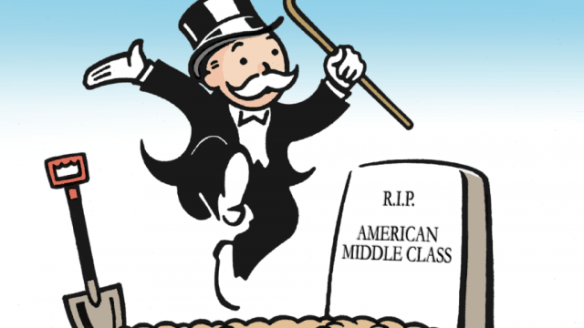
Are We (Collectively) Depressed?

By Charles Hugh Smith

Source: Of Two Minds

We need to encourage honesty above optimism. Once we can speak honestly, there is a foundation for optimism.

Psychoanalysis teaches that one cause of depression is repressed anger.

The rising tide of collective anger is visible in many places: road rage, violent street clashes between groups seething for a fight, the destruction of friendships for holding the “incorrect” ideological views, and so on. I Think We Can Safely Say The American Culture War Has Been Taken As Far As It Can Go.

A coarsening of the entire social order is increasingly visible: The Age of Rudeness.

This raises a larger question: are we as a society becoming depressed as we repress our righteous anger and our sense of powerlessness as economic and social inequality rises?

Depression is a complex phenomenon, but it typically includes a loss of hope and vitality, absence of goals, the reinforcement of negative internal dialogs, and anhedonia, the loss of the joy of living (joie de vivre).

Depressive thoughts (and the emotions they generate) tend to be self-reinforcing, and this is why it’s so difficult to break out of depression once in its grip.

One part of the healing process is to expose the sources of anger that we are repressing. As psychiatrist Karen Horney explained in her 1950 masterwork, Neurosis and Human Growth: The Struggle Towards Self-Realization, anger at ourselves sometimes arises from our failure to live up to the many “shoulds” we’ve internalized, and the idealized track we’ve laid out for ourselves and our lives.

The recent article, The American Dream Is Killing Us does a good job of explaining how our failure to obtain the expected rewards of “doing all the right things” (getting a college degree, working hard, etc.) breeds resentment and despair.

Since we did the “right things,” the system “should” deliver the financial rewards and security we expected. This systemic failure to deliver the promised rewards is eroding social mobility and the social contract while generating frustration, anger, etc.

We are increasingly angry at the system, but we reserve some anger for ourselves, because the mass-media trumpets how well the economy is doing and how some people are doing extremely well. Naturally, we wonder, why them and not us? The failure is thus internalized.

One response to this sense that the system no longer works as advertised is to seek the relative comfort of echo chambers–places we can go to hear confirmation that this systemic stagnation is the opposing political party’s fault.

We don’t just self-sort ourselves into political “tribes” online–we congregate in increasingly segregated communities and states: The Simple Reason Why A Second American Civil War May Be Inevitable.

Americans are moving to communities that align more with their politics. Liberals are moving to liberal areas, and conservatives are moving to conservative communities. It’s been going on for decades. When Jimmy Carter was elected in 1976, 26.8% of Americans lived in landslide counties; that is counties where the president won or lost by 20% of the vote.

By 2004, 48.3% of the population lived in these counties. This trend continues to worsen. As Americans move to their preferred geographic bubbles, they face less exposure to opposing viewpoints, and their own opinions become more extreme. This trend is at the heart of why politics have become so polarizing in America.

We’re self-sorting at every level. Because of this, Americans are only going to grow more extreme in their beliefs, and see people on the other side of the political spectrum as more alien.”

Part of the American Exceptionalism we hear so much about is a can-do optimism: set your mind to it and everything is possible.

The failure to prosper as anticipated is generating a range of negative emotions that are “un-American”: complaining that you didn’t get a high-paying secure job despite having a college degree (or advanced degree) sounds like sour-grapes: the message is you didn’t work hard enough, you didn’t get the right diploma, etc.

It can’t be the system that’s failed, right? I discuss this in my book Why Our Status Quo Failed and Is Beyond Reform: the top 10% who are benefiting mightily dominate politics and the media, and their assumption is: the system is working great for me, so it must be working for everyone. That’s the implicit narrative parroted by status quo mouthpieces.

The inability to express our despair and anger generates depression. Some people will redouble their efforts, others will seek to lay the blame on “the other” (some external group) and others will give up. What few people will do is look at the sources of systemic injustice.

Perhaps we need a national dialog about declining expectations, rising inequality and the failure of the status quo that avoids the blame-game and the internalization trap (i.e. it’s your own fault you’re not well-off).

We need ways to express our resentment, anger, despair, etc. that are directed at the source, the complex system we inhabit, not “the other.” We need to encourage honesty above optimism. Once we can speak honestly, there is a foundation for optimism.


America’s Oligarchs Will Control 70% Of National Wealth By 2021

By Whitney Webb

Source: AntiMedia

America’s rich just won’t quit getting richer, according to a new study released in mid-June by the Boston Consulting Group (BCG), a global management consulting firm. The study, which seeks to analyze the global wealth management industry, as well as the evolution of private wealth, uncovered some startling statistics that suggest that global financial inequality will grow significantly by the year 2021.

The firm found that the already massive gap between the world’s wealthy elite – the approximately 18 million households that hold at least more than $1 million in assets – and everyone else is continuing to widen at a remarkable rate. The estimated 70 million people who make up these households were found to control 45 percent of the world’s $166.5 trillion in wealth. And in just four more years, it is estimated that they will control more than half of the world’s wealth, despite representing less than 1 percent of the world’s current population.

However, while rising inequality is a global phenomenon, it is especially pronounced in the United States. While wealth inequality in the U.S. is by no means an unknown phenomenon, the U.S. is significantly more unequal than most other countries, with the nation’s elite currently holding 63 percent of the private wealth. The U.S. elite’s share of national wealth is also growing much faster than the global average, with millionaires and billionaires expected to control an estimated 70 percent of the nation’s wealth by 2021.

The U.S.’ high wealth inequality largely owes to post-World War II government policies that have seen almost a quarter of all national income go to its wealthiest residents. Meanwhile, wages for the majority of Americans have remained stagnant for decades – in contrast to the richest Americans, their future economic outlook is incredibly bleak by comparison.

The U.S. is also home to more billionaires and millionaires than anywhere else in the world, which partly explains how U.S. policy has come to favor them over the years. According to Bloomberg, two out of five millionaires and billionaires live in the United States – and their ranks are growing.

While the world’s richest citizens may be pleased by the results of BCG’s recent study, there is plenty for them to be worried about if history is any indicator. Indeed, history shows that societies with drastic wealth inequality are much more unstable and more likely to experience drastic economic failure or outright societal collapse.

For instance, a 2014 study conducted by the National Socio-Environmental Synthesis Center noted that over-consumption and wealth inequality have occurred in the collapse of every civilization over the last 5,000 years. That same study also warned that rising inequality could easily lead to an unsustainable use of resources and the “irreversible collapse” of global industrial civilization.

This warning seems particularly prescient, given that wealth inequality in the U.S. is well above that of past civilizations that eventually collapsed as a result of these factors. For example, at the time of the collapse of the Roman Empire, the top 1 percent of the Roman elite controlled just 16 percent of the society’s wealth, a measly figure compared to the percentage commanded by the 1-percenters of the U.S.

While the BCG study paints a rosy picture for the world’s millionaires and billionaires, particularly in the United States, they should be gravely concerned that their growing accumulation of wealth could have drastic consequences – not just for those poorer than them, but for everyone.

The Crisis of US Imperial Governance and the Struggle for a New World

By Danny Haiphong

Source: Black Agenda Report

“Economic crisis at home and endless war abroad has placed finance and monopoly capital in political disarray.”

When I was here last year, I spoke a lot about ideology and how the struggle for social transformation in the mainland of imperialism partly depended upon the ideological development of oppressed people trapped within US borders. The 2016 elections were beginning to pick-up momentum, but it was unclear what direction they would go. Fast-forward to the present and, I don’t know about you all, but I am exhausted. The election of Donald Trump has presented both new and old challenges. It has created an almost circus-like political environment with dire consequences for the masses. What precipitated the circus-show is a crisis of governance that has been intentionally misunderstood by US imperialism’s corporately owned media and political elite.

To distort the crisis, a state of anti-Russian madness has been prescribed to medicate political consciousness in rapidly changing times. The rise of China and Russia has exposed the bankruptcy of US imperialism on all fronts. Economic crisis at home and endless war abroad has placed finance and monopoly capital in political disarray. Donald Trump took advantage of the chaos. He spoke about jobs, he spoke about wars, and he spoke to the growing insecurities of white Americans of working and middle class status who no longer can rely on the wages of whiteness for guaranteed prosperity. The duopoly and its capitalist masters had no one to offer, indeed nothing to offer, so Trump rode in on his orange horse to become the head of state of imperialism.

“The rise of China and Russia has exposed the bankruptcy of US imperialism on all fronts.”

The ruling class does not want people in the United States to understand the context of the Trump Presidency. It has reapplied Cold War fears with Russia as the prime target. Russia’s geopolitical moves away from imperialism have been deemed just as criminal as China’s economic supremacy. The US does not depend as much on Russia in the economic sense, but it trembles in fear at the prospect of growing Russian economic activity across Eurasia. Yet, provoking Russia militarily will lead to World War. This is a risk the ruling class appears willing to take as the anti-Russia narrative in the US has only intensified since Hillary Clinton made the erroneous claim of Russian interference in the 2016 elections.

According to the US ruling class and its “intelligence officials,” Russia promotes “fakes news” to assist Donald Trump. Russian President Vladimir Putin lurks in our social media, and is hacking his way through algorithms to smear the US political system. Russia is infecting minds with its Russia Today “propaganda” arm. The Ruskies have no regard for the damage they have caused to so-called US democracy. Putin wants total control of the US and will wield his most talented social media users to get the job done. This is what the corporate media sounds like these days.

“The U.S. trembles in fear at the prospect of growing Russian economic activity across Eurasia.”

Of course, the US ruling class doesn’t want to talk about how US intelligence already collects the numbers, emails, and calls of every single person in the world who uses a cell phone or computer. They don’t want to tell you about how the US has interfered in every election in Russia since the Soviet Union fell, or how it has led bloody proxy wars and coups in over fifty countries in as many years. They don’t want to discuss how Russia has absolutely nothing to do with the millions of incarcerated people in the US or the fact that it is the US monopoly capitalist economy, not the emerging capitalist economy of Russia, which has automated many of the jobs and siphoned much of the wealth that once belonged to a privileged sector of US workers. No, it would rather attention be placed on the Russian boogeyman.

Anti-Russian hysteria doesn’t just distract the broad masses of people from the legitimate causes of the conditions afflicting the working and unemployed. It feeds into an atmosphere of war that strikes the very roots of the US social order. Imperialism is the rule of monopoly and finance capital. This system has run its course. It cannot hold onto political legitimacy any more than it can spur economic development beyond the meager 1 to 2 percent growth calculated year after year. In a sense, war is all the system has left. And war is exactly what the ruling class will get, with or without Trump.

“They don’t want to tell you about how the US has interfered in every election in Russia since the Soviet Union fell, or how it has led bloody proxy wars and coups in over fifty countries in as many years.”

War with Russia is today’s clarion call for “American unity.” In times of crisis, the US imperial state has relied on war to bring political and economic relief from domestic crisis. Every major US-led war has in part been waged for this purpose. What differs now is that war with Russia could bring about the destruction of humanity. Scientists have confirmed that nuclear war could make the planet uninhabitable.

What is also different about this current war drive with Russia is how it marks the historical conclusion of the current stage in the world imperialist order. When the US threatened nuclear war with the atomic bombing of Japan in 1945 and the Cuban missile crisis almost two decades later, the world was in the midst of a transition from Western monopoly capitalism to proletarian socialism. Revolutions in Vietnam, Cuba, and the Soviet Union, to name a few, threatened to undo the very notion of private property. And while US and Western backlash nearly eliminated the socialist bloc by 1991, the imperialist order entered a transition stage of its own that some call “neo-liberalism.”

Neo-liberalism has greatly expanded the reach of capitalism’s tentacles and widened the impact of capitalist crisis since its inception in the late 1970s. Neo-liberalism has unleashed unfettered capitalist production by imposing economic stagnation on participating countries. Meanwhile, China’s socialist model has paved a different path, one marked by unprecedented growth and poverty reduction. China has understandably attracted underdeveloped nations so desperately seeking to escape from the clutches of neo-colonial impoverishment. Russia has grown close to China, providing both countries with much assistance in the way of constructing a multi-polar economic arrangement based on the principles of sovereignty and mutually beneficial cooperation. According to the logic of neo-liberal capital, only war with Russia and China can save the system from itself.

“War with Russia could bring about the destruction of humanity.”

This conclusion stems from the fact that neo-liberal capital is not growing, it is contracting. Eighty-percent of workers are near-poor in the US while six mega billionaires hold ownership of over half of the planet’s wealth. Concentrated profit does not mean that all is well with the ruling class. Internal contradictions are eating the capitalist system alive. Neither finance capital nor its monopoly investors can arrest the resultant decline. The growth of technology to speed up production and profit has left millions stuck in permanent unemployment. A high-tech system of production is an expensive system of production, requiring lower wages and debt to absorb the falling rate of profit. Global overproduction has thus developed alongside mass misery.

Such conditions are at the root of mass incarceration, where millions of mostly Black and poor workers are warehoused in cages because there is nothing on the outside that the system can offer. They are also the root of mass surveillance, as the system must keep tabs on an increasingly restless population and justify infringements on civil liberties as necessary counter-terror measures. The War on Terror and Drugs have been prerequisites toward keeping the population scared and its attention away from the US capitalist overlords who fund and support drug trafficking and terrorism for political gain. And when all else fails, blame Russia.

“The system must keep tabs on an increasingly restless population and justify infringements on civil liberties as necessary counter-terror measures.”

The struggle against neo-liberal capital and anti-Russian hysteria is a struggle to transform and revolutionize society. This struggle requires both practical political organization and ideological development. There will be no revolution without revolutionary thought, and no revolution without revolutionary action. All too often the left is debating which one is the most important for the future success of a revolutionary movement. The answer is both, together.

For most, this explanation is understandably too broad to inform individual political energy. Liberal thought and action thus becomes attractive because it hides behind the cloak of the possible and pragmatic. It is easier to think in terms of electoral politics than in global struggle. It is far more simple to advocate for a cooperative economy or universal basic income without spelling out the broad context that prevents their formation. In order for any material victories to be won on a mass scale, the victors must understand the world in which they fight.

“A movement for social transformation in the US has still yet to be born.”

Conscious struggle has brought about meaningful and deep changes in recent years. Mumia Abu-Jamal is now receiving Hep-C treatment after years of struggle with the State of Pennsylvania. The release of Chelsea Manning and Oscar Rivera Lopez also come to mind. Solidarity with Cuba freed the Cuban 5 and has given the socialist nation more opportunities to develop its economy. But these victories have come in the midst of great cost. A movement for social transformation in the US has still yet to be born, as the presence of dozens of political prisoners and the ongoing US blockade against Cuba reminds us.

Not once did I mention the Democratic or Republican Party. Both parties have done their part to create the crisis before us. A rejection of the two-parties means an embrace of the struggle against imperialism worldwide. It means that the nations with US targets on their backs should be seen as potential allies. Yes, this includes Russia. And Syria. It includes the left movements in Latin America. In the spirit of Malcolm X, the Black liberation movement, and the historic anti-imperialist struggle around the world, the time has come to search for real bonds of solidarity around the world to aid in the struggle against white supremacy, capitalism, and empire in the US and the West. Let no one, not even those who call themselves “the left,” tell you otherwise.


Danny Haiphong is an Asian activist and political analyst in the Boston area. He canbereachedatwakeupriseup1990@gmail.com

Deep State, shallow politics, dumb economics

By Frank Scott

Source: Intrepid Report

In 1965, the USA had 780,000 people in prison, jail, on parole or on probation.

By 2010, that population had grown by more than nine times, to 7 million and the prison business was booming as never before, creating profits, jobs and unparalleled human misery.

In 1954, the integration of public schools was seen as a great victory for civil rights and Americans now designated as “people of color”*. Today more than 50% of the prison population is designated as “people of color” and the disintegration of the entire public school system continues for all Americans designated as people.

In 2015, there were 536 billionaires in the U.S.A. In a nation of more than 325 million people, that represents less than 2 millionths of one percent of the population. For the textually challenged, that looks like this:.000002%

Wow.

How hard those truly brilliant people must have worked to achieve those riches. And one of them was Donald Trump!

Imagine how many cases they had to plead in court, classes to teach in school, buses to drive, meals to prepare, floors to wash, crops to pick, mail to deliver and deals to make? Well, actually, they mostly made deals using their great wisdom and brilliance at investing wisely. You and I could do as well if we worked as hard and were as smart and industrious as they are, including Donald Trump!

And if we were paid a thousand dollars an hour for our hard work, and we worked twenty four hours a day, seven days a week, fifty two weeks a year, maybe if we stashed all that cash and didn’t spend any of it we might have a billion dollars.

Nope.

In fact, if you worked twenty four hours a day, seven days a week, fifty two weeks a year and did that for ten years, at one thousand dollars an hour, never stopped, never took any time off and never spent any of the money and just stashed it, you still wouldn’t have a billion dollars.

Is this a great democracy or what?

In that same year of 2015, America’s GDP for pets, which was $38.5 billion in 2006, had grown to $60.3 billion. Twelve companies insured 1.4 million pets owned by 79.6 million American families (65% of households) with premiums amounting to 660.5 million dollars.

163.8 million dogs and cats are comfortably housed in a political economy that has half a million of its people homeless and more than 20% of its children living in poverty. This is certainly reason enough for us to demand that Russia, North Korea, Syria and other nations adopt our democratically civilized way of living or suffer the consequences of our superior wrath. Right?

As of March1, 2017, our national debt was close to $20 trillion, which is more than our GDP, which is truly a gross domestic product. We the people of this great democracy pay more than $440 billion a year in interest on that debt.

Who do we pay it to?

Where’d they get the money to loan us?

Who prints and backs this money supply?

If you have any money among your plastic, look at one of the bills of any denomination and note that the power behind the cash is not the dead presidents or Rockefeller, Carnegie, Zuckerburg, Soros, Bezos, Visa or MasterCard but something called “The United States of America.”

That is not a private bank or a billionaire. That’s you. That’s us.

Remember, we, the public, print the money, in our name, and somehow it gets to a private source which loans it to us and charges us interest for the privilege. Would you like to buy a bridge?

Our personal debt, incurred to keep the economy going with our consuming and owed to the same market gods, was over $18 trillion. Almost as high as our public debt. Somehow, we owe it to the same people who loaned us our own money for public expenses. Wow.

Are they really smart?

Or are we really stupid?

Many Americans are treated as lower than scum for being working class and “uneducated.” Why are so many Americans so “uneducated”? Could it have anything to do with the fact that at some point they went through grammar and high schools taught by (drum roll) college-educated people**? And winding up with presidents like a truly brilliant rich guy with degrees from Yale and Harvard (wow!) who starts wars in the Middle East that have gone on longer than any in our history, with the consent of 534 out of 535 democratically (?) elected college graduates in congress?

Whether the organized crime lobby (Wall Street, banks, billionaires) supports guns for individuals, Israelis or the Military Industrial Complex, it remains in control of the political economics of American government. NRAIPAC and its ilk own, rent and control the White House, Congress and Corporate media. That was the case before Trump and still is the case now.

We need resistance to that system of minority control itself, and not simply the servants it hires, leases, rents or outright owns. As long as we allow a gallon of milk to cost more than a gallon of gasoline, as long as we tolerate an economics that will sustain a disease as long as profits for its treatment are greater than profits for its cure***, we not only face long range climate disaster but a much shorter range political economic calamity.

Global capitalism threatens immediate and growing poverty, war, human misery and planetary destruction no matter which political pinhead, pimp or ho lives in the subsidized residency we call the white house. As long as we allow the richest and smallest minority in our history to put only their servants up for our votes, calling this a democracy reduces us to the best-dressed peasants on the Titanic. We need to end the fundamentalist religion of private profit marketing that is becoming a greater menace by the minute and begin democratic action in a social revolution that expresses majority public interest, desire and need. Fast.


Notes

*All members of the human race are “of color” save for a small group called albinos. Some of us have darker or lighter skin but skin tone is of no more racial significance than brown hair, green eyes or long legs. Innocents, the ignorant and morons who still believe otherwise are science deniers at best, and anti-human at worst, no matter their skin tone.

**Those with a stake in maintaining their incomes & consumption are unlikely to participate in efforts to bring about radical change”—Michael D. Yates

***Check cancer, for starters; a multi-multi billion-dollar industry

Luddism and Economic Ideology

ludd1

Source: the HipCrime Vocab

Smithsonian Magazine has a very good feature on the Luddites, well worth a read. There are many elements you just don’t read in many economic histories; for example, the 40-hour work week was not brought down from the mountaintop by Moses and inscribed in stone tablets, despite what you may have heard elsewhere:

At the turn of 1800, the textile industry in the United Kingdom was an economic juggernaut that employed the vast majority of workers in the North. Working from home, weavers produced stockings using frames, while cotton-spinners created yarn. “Croppers” would take large sheets of woven wool fabric and trim the rough surface off, making it smooth to the touch.

These workers had great control over when and how they worked—and plenty of leisure. “The year was chequered with holidays, wakes, and fairs; it was not one dull round of labor,” as the stocking-maker William Gardiner noted gaily at the time. Indeed, some “seldom worked more than three days a week.” Not only was the weekend a holiday, but they took Monday off too, celebrating it as a drunken “St. Monday.”

Croppers in particular were a force to be reckoned with. They were well-off—their pay was three times that of stocking-makers—and their work required them to pass heavy cropping tools across the wool, making them muscular, brawny men who were fiercely independent. In the textile world, the croppers were, as one observer noted at the time, “notoriously the least manageable of any persons employed.”

The introduction of machinery in cloth manufacture did not make these people’s lives better. In fact, it made them a lot worse:

“They [the merchant class] were obsessed with keeping their factories going, so they were introducing machines wherever they might help,” says Jenny Uglow, a historian and author of In These Times: Living in Britain Through Napoleon’s Wars, 1793-1815.

The workers were livid. Factory work was miserable, with brutal 14-hour days that left workers—as one doctor noted—“stunted, enfeebled, and depraved.” Stocking-weavers were particularly incensed at the move toward cut-ups. It produced stockings of such low quality that they were “pregnant with the seeds of its own destruction,” as one hosier put it: Pretty soon people wouldn’t buy any stockings if they were this shoddy. Poverty rose as wages plummeted.

Yes, you read that right- the introduction of “labor-saving” technology made the amount these people worked increase dramatically. It also made their work much, much more unpleasant. It transferred control to a smaller circle of wealthy people and took it away from the workers themselves. It made the rich richer, increased poverty, and tore society apart.

But more technology is always good, right?

And since history is written by the victors, “Luddite” is a term now inextricably wound up with the knee-jerk rejection of new technology. But the Luddites weren’t opposed to new technology at all! What they were fighting against was the economic conditions that took away their autonomy and turned them into mendicants in their own country:

The workers tried bargaining. They weren’t opposed to machinery, they said, if the profits from increased productivity were shared. The croppers suggested taxing cloth to make a fund for those unemployed by machines. Others argued that industrialists should introduce machinery more gradually, to allow workers more time to adapt to new trades.

The plight of the unemployed workers even attracted the attention of Charlotte Brontë, who wrote them into her novel Shirley. “The throes of a sort of moral earthquake,” she noted, “were felt heaving under the hills of the northern counties.”

[…]

At heart, the fight was not really about technology. The Luddites were happy to use machinery—indeed, weavers had used smaller frames for decades. What galled them was the new logic of industrial capitalism, where the productivity gains from new technology enriched only the machines’ owners and weren’t shared with the workers.

In fact, the Luddites actually spared the machines that were used by employers who treated workers fairly. Funny how you never hear that in most popular descriptions of the Luddite revolt:

The Luddites were often careful to spare employers who they felt dealt fairly. During one attack, Luddites broke into a house and destroyed four frames—but left two intact after determining that their owner hadn’t lowered wages for his weavers. (Some masters began posting signs on their machines, hoping to avoid destruction: “This Frame Is Making Full Fashioned Work, at the Full Price.”)

Unlike today, labor actually fought back against these attempts to destroy their way of life:

As a form of economic protest, machine-breaking wasn’t new. There were probably 35 examples of it in the previous 100 years, as the author Kirkpatrick Sale found in his seminal history Rebels Against the Future. But the Luddites, well-organized and tactical, brought a ruthless efficiency to the technique: Barely a few days went by without another attack, and they were soon breaking at least 175 machines per month. Within months they had destroyed probably 800, worth £25,000—the equivalent of $1.97 million, today.

Rather than the “natural course” of free-market economics, once again it was government intervention, including brutal state violence, that made modern capitalism possible:

Parliament was now fully awakened, and began a ferocious crackdown. In March 1812, politicians passed a law that handed out the death penalty for anyone “destroying or injuring any Stocking or Lace Frames, or other Machines or Engines used in the Framework knitted Manufactory.” Meanwhile, London flooded the Luddite counties with 14,000 soldiers.

By winter of 1812, the government was winning. Informants and sleuthing finally tracked down the identities of a few dozen Luddites. Over a span of 15 months, 24 Luddites were hanged publicly, often after hasty trials, including a 16-year-old who cried out to his mother on the gallows, “thinking that she had the power to save him.” Another two dozen were sent to prison and 51 were sentenced to be shipped off to Australia.

But wait, isn’t capitalism all about “freedom and liberty?” Freedom and liberty for some, I guess.

The problem, then as now, was not technology itself, but the economic relations that it unfolded against. What I found most interesting is that even back then, the emerging pseudoscience of economics was used to justify the harsh treatment of the workers and the bottomless greed of capitalists, in particular the “sacred text” of modern Neoclassical economics, Adam Smith’s The Wealth of Nations:

For the Luddites, “there was the concept of a ‘fair profit,’” says Adrian Randall, the author of Before the Luddites. In the past, the master would take a fair profit, but now he adds, “the industrial capitalist is someone who is seeking more and more of their share of the profit that they’re making.” Workers thought wages should be protected with minimum-wage laws. Industrialists didn’t: They’d been reading up on laissez-faire economic theory in Adam Smith’s The Wealth of Nations, published a few decades earlier.

“The writings of Dr. Adam Smith have altered the opinion, of the polished part of society,” as the author of a minimum wage proposal at the time noted. Now, the wealthy believed that attempting to regulate wages “would be as absurd as an attempt to regulate the winds.”

It seems as though nothing’s really changed. Using economic “science” to justify social inequality and private ownership goes back to the very beginnings of the Market.

When Robots Take All of Our Jobs, Remember the Luddites (Smithsonian Magazine). Smithsonian wrote about this before, see also: What the Luddites Really Fought Against

As the above history shows, there is nothing “natural” or normal about extreme busyness and brutally long working hours. It is entirely an artificial creation:

A nice post at the HBR blog…describes how being busy is now celebrated as a symbol of high status. This is not natural. Marshall Sahlins has shown that in hunter-gather societies (which were the human condition for nine-tenths of our existence) people typically worked for only around 20 hours a week. In pre-industrial societies, work was task-oriented; people did as much as necessary and then stopped. Max Weber wrote:

“Man does not “by nature” wish to earn more and more money, but simply to live as he is accustomed to live and to earn as much as is necessary for that purpose. Wherever modern capitalism has begun its work of increasing the productivity of human labour by increasing its intensity, it has encountered the immensely stubborn resistance of this leading trait of pre-capitalistic labour. (The Protestant Ethic and the Spirit of Capitalism, p24”

The backward-bending supply curve of labour was normal.

E.P. Thompson has described how pre-industrial working hours were irregular, with Mondays usually taken as holidays. He, and writers such as Sidney Pollard and Stephen Marglin, have shown how the working day as we know it was imposed by ruthless discipline, reinforced by Christian moralists. (There’s a clue in the title of Weber’s book). Marglin quotes Andrew Ure, author of The Philosophy of Manufacturers in 1835:

The main difficulty [faced by Richard Arkwright] did not, to my apprehension, lie so much in the invention of a proper mechanism for drawing out and twisting cotton into a continuous thread, as in…training human beings to renounce their desultory habits of work and to identify themselves with the unvarying regularity of the complex automation. To devise and administer a successful code of factory discipline, suited to the necessities of factory diligence, was the Herculean enterprise, the noble achievement of Arkwright…It required, in fact, a man of a Napoleon nerve and ambition to subdue the refractory tempers of workpeople accustomed to irregular paroxysms of diligence.”

Today, though, such external discipline is no longer so necessary because many of us – more so in the UK and US than elsewhere – have internalized the capitalist imperative that we work long hours, …Which just vindicates a point made by Bertrand Russell back in 1932:

“The conception of duty, speaking historically, has been a means used by the holders of power to induce others to live for the interests of their masters rather than for their own.”

Against busyness (Stumbling and Mumbling)

Honestly, the five-day workweek is outmoded and ridiculous. It’s more of a babysitting operation for adults than anything else. It’s a silly as arguing that we need over two decades of formal education in order to do our jobs.

I was reminded of this over the holidays. In the U.S. we get virtually no time off from our jobs, unlike most other countries (East Asia might be an exception). But Christmas/New Year’s is a rare exception, and we have several four-day weeks in a row (without pay for some of us, of course). Those weeks are so much more pleasant, and I would even say productive, than the rest of the year. Every year at this time I think to myself, “Why isn’t every week a four-day workweek?” Some places do have such an arrangement, but they justify it by four long, ten-hour days. I don’t know about you, but towards the end of ten hours in a row of “work” I doubt anyone’s accomplishing much of anything. Is 32 hours a week really not enough to keep society functioning in the twenty-first century?

Not only that, but many people use whatever little vacation they do have in order to take the whole time period at the end of the year off. This is typical in Europe, but rarer here. In any case, while going to work I noticed that there was hardly any traffic. The roads were empty. There were plenty of seats on the bus. The streets and sidewalks were empty. There was no waiting in the restaurants and cafes. There was plenty of room for everything. There was a laid-back feeling everywhere. It was so pleasant. I couldn’t help but think to myself, “why isn’t every week like this?” If more people could stay home and work less, it very well could be. Instead we’re trapped on a treadmill. Working less would actually pay dividends in terms of reduced traffic, less crowding, less pollution, and better health outcomes due to less stress and more time to exercise.

There’s also a simple logic problem at work here. If we say the 40-hour week is inviolable and set-in-stone for the rest of time, and we do not wish to increase the problem of unemployment, then literally no labor-saving technology will ever save labor! We might as well dispense with the creation of any labor-saving technology, since by the above logic, it cannot save labor. You could equivocate and say that it frees us from doing “lower” level work and allows us to do “higher” level work, as when ditch diggers become factory workers, or something. That may have been a valid argument a hundred years ago, but in an age when most of us are low-paid service workers or useless paper-pushers, it’s pretty hard to make that case with any seriousness anymore.

***

I often refer to economics as a religion, with its practitioners as priests. So it’s interesting to read that in other contexts. This is from Chris Dillow’s blog, where the above passage about work was taken:

The social power, i.e. the multiplied productive force”, wrote Marx, appears to people “not as their own united power but as an alien force existing outside them, of the origin and end of which they are ignorant, which they thus cannot control.”

I was reminded of this by a fine passage in The Econocracy in which the authors show that “the economy” in the sense we now know it is a relatively recent invention and that economists claim to be experts capable of understanding this alien force:

“As increasing areas of political and social life are colonized by economic language and logic, the vast majority of citizens face the struggle of making informed democratic choices in a language they have never been taught. (p19)”

This leads to the sort of alienation which Marx described. This is summed up by respondents to a You Gov survey cited by Earle, Moran and Ward-Perkins, who said; “Economics is out of my hands so there is no point discussing it.”

In one important sense such an attitude is absurd. Every time you decide what to buy, or how much to save, or what job to do or how long to work, economics is in your hands and you are making an economic decision.

This suggests to me two different conceptions of what economics is. In one conception – that of Earle, Moran and Ward-Perkins – economists claim to be a priestly elite who understand “the economy”. As Alasdair MacIntyre said, such a claim functions as a demand for power and wealth:

“Civil servants and managers alike [he might have added economists-CD] justify themselves and their claims to authority, power and money by invoking their own competence as scientific managers (After Virtue, p 86).”

There is, though, a second conception of what economists should do. Rather than exploit alienation for their own advantage, we should help people mitigate it…

Economists in an alienated society (Stumbling and Mumbling)

This makes a point I often refer to – this depiction of “The Economy” as some of “natural” force that we have no control over, subject to its own inexorable logic. We saw above how the writings of Adam Smith provided the ideological justification for the wealthy merchants to screw over the workers. It cemented the perception that the economy was just a natural force with its own internal logic that could no more be regulated than could the wind or the tides. And over the course of several hundred years, we have intentionally designed our politcal institutions such that government cannot “interfere” in the “natural workings” of the economy. Doing so would only make all of us worse off, or so goes the argument.

There is a telling passage in this column by Noah Smith:

…Even now, when economic models have become far more complex than anything in [Milton] Friedman’s time, economists still go back to Friedman’s theory as a mental touchstone — a fundamental intuition that guides the way they make their models. My first macroeconomics professor believed in it deeply and instinctively, and would even bring it up in department seminars.

Unfortunately, intuition based on incorrect theories can lead us astray. Economists have known for a while that this theory doesn’t fit the facts. When people get a windfall, they tend to spend some of it immediately. So economists have tried to patch up Friedman’s theory, using a couple of plausible fixes….

Milton Friedman’s Cherished Theory Is Laid to Rest (Bloomberg)

Yes, you read that right, economists knew for a long time that a particular theory did not accord with the observed facts, but they didn’t discard it because it was necessary for the complex mathematical models that they use to supposedly describe reality. Rather, instead of discarding it, they tried to “patch it up,” because it told them what they wanted to hear. Note how his economics professor “believed deeply” in the theory, much as how people believe in the Good Book.

Nice “science” you got there.

That methodology ought to tell you everything you need to know about economic “science.” One wonders how many other approaches economists take that such thinking applies to.

Friedman was, of course, the author of “Capitalism and Freedom,” which as we saw above, is quite an ironic title. Friedman’s skill was coming up with ideas that the rich wanted hear, and then coming up with the requisite economic “logic” to justify them, from deregulation, to privatization, to globalization, to the elimination of minimum wages and suppression of unions. His most famous idea was that the sole purpose of a firm is to make money for its shareholders, and all other responsibilities were ‘unethical.’ The resulting “libertarian” economics was promoted tirelessly, including a series on PBS, by wealthy organizations and right-wing think-tanks with bottomless funding, as it still is today (along with its even more extreme cousin, “Austrian” economics). One thing the Luddites did not have to contend with was the power of the media to shape society, one reason why such revolts would be unthinkable today (along with the panopticon police states constructed by capitalist regimes beginning with Great Britain— “freedom” indeed!).

Smith himself has written about what he calls 101-ism:

We all know basically what 101ism says. Markets are efficient. Firms are competitive. Partial-equilibrium supply and demand describes most things. Demand curves slope down and supply curves slope up. Only one curve shifts at a time. No curve is particularly inelastic or elastic; all are somewhere in the middle (straight lines with slopes of 1 and -1 on a blackboard). Etc.

Note that 101 classes don’t necessarily teach that these things are true! I would guess that most do not. Almost all 101 classes teach about elasticity, and give examples with perfectly elastic and perfectly inelastic supply and demand curves. Most teach about market failures and monopolies. Most at least mention general equilibrium.

But for some reason, people seem to come away from 101 classes thinking that the cases that are the easiest to draw on the board are – God only knows why – the benchmark cases.

101ism (Noahpinion)

But the best criticism I’ve read lately is from James Kwak who has written an entire book on the subject: Economism: Bad Economics and the Rise of Inequality. He’s written several posts on the topic, but this post is a good introduction to the concept. Basically, he argues that modern economics allows policies that benefit the rich at the expense of the rest of society to masquerade as objective “scientific” truths thanks to the misapplication of economic ideology. As we saw above ,that goes back to very beginnings of “free market” economics in the nineteenth century:

In policy debates and public relations campaigns…what you are … likely to hear is that a minimum wage must increase unemployment—because that’s what the model says. This conviction that the world must behave the way it does on the blackboard is what I call economism. This style of thinking is influential because it is clear and logical, reducing complex issues to simple, pseudo-mathematical axioms. But it is not simply an innocent mistake made by inattentive undergraduates. Economism is Economics 101 transformed into an ideology—an ideology that is particularly persuasive because it poses as a neutral means of understanding the world.

In the case of low-skilled labor, it’s clear who benefits from a low minimum wage: the restaurant and hotel industries. In their PR campaigns, however, these corporations can hardly come out and say they like their labor as cheap as possible. Instead, armed with the logic of supply and demand, they argue that raising the minimum wage will only increase unemployment and poverty. Similarly, megabanks argue that regulating derivatives will starve the real economy of capital; multinational manufacturing companies argue that new trade agreements will benefit everyone; and the wealthy argue that lower taxes will increase savings and investment, unleashing economic growth.

In each case, economism allows a private interest to pretend that its preferred policies will really benefit society as a whole.The usual result is to increase inequality or to legitimize the widening gulf between rich and poor in contemporary society.

Economics 101, Economism, and Our New Gilded Age (The Baseline Scenario)

All of the above reinforces a couple of points I often like to make:

1.) Capitalism was a creation of government from day one. There is nothing “natural” or “free” about markets.

2.) It is sustained by a particular ideology which poses as a science but is anything but.

These is no fundamental reason we need to work 40 hours a week. There is no reason we have to go into debt just to get a job. There is no benefit to the extreme wealth inequality; it’s not due to any sort of “merit.” And on and on. Economic “logic” is destroying society along with the natural world and preventing any adaptive response to these crises. But its power over the hearts and minds of society seems to be unassailable, at least until it all falls apart.

Our Hopelessly Dysfunctional Democracy

By Charles Hugh Smith

Source: Of Two Minds

When the system is rigged, “democracy” is just another public-relations screen to mask the unsavory reality of Oligarchy.

Democracy in America has become a hollow shell. The conventional markers of democracy–elections and elected representatives–exist, but they are mere facades; the mechanisms of setting the course of the nation are corrupt, and the power lies outside the public’s reach.

History has shown that democratic elections don’t guarantee an uncorrupt, functional government. Rather, democracy has become the public-relations stamp of approval for corrupt governance that runs roughshod over individual liberty while centralizing the power to enforce consent, silence critics and maintain the status quo.

Consider Smith’s Neofeudalism Principle #1: If the citizenry cannot replace a dysfunctional government and/or limit the power of the financial Aristocracy at the ballot box, the nation is a democracy in name only.

In other words, if the citizenry changes the elected representation but the financial Aristocracy and the Deep State remain in charge, then the democracy is nothing but a PR facade for an oppressive oligarchy.

If the erosion of civil liberties and rising inequality characterize the state of the nation, democracy is both dysfunctional and illiberal. A state that strips away the civil liberties of its citizens via civil forfeiture, a war-on-drugs Gulag and unlimited surveillance may be a democracy in name, but it is at heart an oppressive oligarchy.

If the super-wealthy continue to become ever wealthier while the bottom 95% of the citizenry struggle in various stages of debt-serfdom, the state may be a democracy in name, but it is at heart an oppressive oligarchy.

Author/commentator Fareed Zakaria recently addressed the illiberal aspects of America’s faded democracy in an article America’s democracy has become illiberal.

Zakar’s prettified critique avoided the real worm at the heart of our democracy:the state exists to enforce cartels. Some might be private, some might be state-run, and others might be hybrids, such as our failed Sickcare system and our military industrial complex.

The ultimate role of democracy isn’t to “give the people a voice;” the only meaningful role of democracy is to protect the liberties of individuals from state encroachment, break up cartels and monopolies and limit the corruption of private/public money.

America’s democracy has failed on all counts. Civil liberties in a nation of ubiquitous central-state surveillance, a quasi-political Gulag (that nickel bag will earn you a tenner in America’s drug-war Gulag) and civil forfeiture (we suspect you’re up to no good, so we have the right to steal your car and cash) are eroding fast.

In America, the central government’s primary job is enforcing and funding cartels. As many of us have pointed out for years, a mere $10 million in lobbying, revolving-door graft (getting paid $250,000 for a speech or for a couple of board meetings) and bribes (cough-cough, I mean campaign contributions) can secure $100 million in profits–either by erecting regulatory/legal barriers or by direct federal funding of the cartel’s racket (healthcare, defense, “National Security,” etc.).

I explain why this is so in my books Resistance, Revolution, Liberation, Inequality and the Collapse of Privilege and Why Our Status Quo Failed and Is Beyond Reform.

The fact that the corruption is veiled does not mean it isn’t corruption. In the sort of nations Americans mock as fake democracies, the wealthy protect their wealth and incomes with bags of cash delivered at night to politicians.

Nothing so crass or obvious here, of course. Here, the government of Algiers gives $25 million to the Clinton Foundation for “favors,” the Russian government gives hundreds of thousands to John Podesta’s firm for “advice” (heh), the Koch Brothers fund an array of front-organizations that work on behalf of their agenda, K Street lobbying firms rake in tens of millions of dollars every year, and the first thing tech companies do when they realize some interest group might crimp their profits courtesy of lobbying the central state’s politicos is set up their own lavish lobbying and “contribution” schemes.

In theory, democracy enables advocacy by a variety of groups in order to reach a consensual solution to problems shared by everyone. In practice, the advocacy is limited to a select group of insiders, donors and the various fronts of the wealthy: foundations, think-tanks, lobbyists, etc.

Does anyone think America’s democracy is still capable of solving the truly major long-term problems threatening the nation? Based on what evidence? What we see is a corrupt machine of governance that kicks every can down the road rather than suffer the blowback of honestly facing problems that will require deep sacrifices and changes in the status quo.

We see a dysfunctional machine of governance that changes the name of legislation and proposes policy tweaks, while leaving the rapacious cartels untouched. (See the current sickcare “debate” for examples.)

We see an Imperial Project setting the state’s agenda to suit its own desires, and a corporate media that is quivering with rage now that the public no longer believes its tainted swill of “news” and “reporting.”

The divide between the haves and the have-nots is not limited to money–it’s also widening between the few with political power and the teeming serfs with effectively zero political power. When the system is rigged, “democracy” is just another public-relations screen to mask the unsavory reality of oligarchy.


Disposable Americans: The Numbers are Growing

middle-class

By Paul Buchheit

Source: Information Clearing House

As often noted in the passionate writings of Henry Giroux, poor Americans are becoming increasingly ‘disposable’ in our winner-take-all society. After 35 years of wealth distribution to the super-rich, inequality has forced much of the middle class towards the bottom, to near-poverty levels, and to a state of helplessness in which they find themselves being blamed for their own misfortunes.

The evidence keeps accumulating: income and wealth — and health — are declining for middle-class America. As wealth at the top grows, the super-rich feel they have little need for the rest of society.

Income Plummets for the Middle Class

According to Pew Research, in 1970 three of every ten income dollars went to upper-income households. Now five of every ten dollars goes to them.

The Social Security Administration reports that over half of Americans make less than $30,000 per year. That’s less than an appropriate average living wage of $16.87 per hour, as calculated by Alliance for a Just Society.

Wealth Collapses for Half of Us

Numerous sources report that half or more of American families have virtually no savings, and would have to borrow money or sell possessions to cover an emergency expense. Between half and two-thirds of Americans have less than $1,000.

For every $100 owned by a middle-class household in 2001, that household now has just $72.

Not surprisingly, race plays a role in the diminishing of middle America. According to Pew Research, the typical black family has only enough liquid savings to last five days, compared to 12 days for the typical Hispanic household, and 30 days for a white household.

Our Deteriorating Health

In a disgraceful display of high-level disregard for vital health issues, House Republicans are attempting to cut back on lunches for over 3 million kids.

The evidence for the health-related disposability of poor Americans comes from a new study that finds nearly a 15 year difference in life expectancy for 40-year-olds among the richest 1% and poorest 1% (10 years for women). Much of the disparity has arisen in just the past 15 years.

It’s not hard to understand the dramatic decline in life expectancy, as numerous studies have documented the health problems resulting from the inequality-driven levels of stress and worry and anger that make Americans much less optimistic about the future. The growing disparities mean that our children will likely see less opportunities for their own futures.

It May Be Getting Worse

The sense derived from all this is that half of America is severely financially burdened, at risk of falling deeper into debt.

It may be more than half. The Wall Street Journal recently reported on a JP Morgan study’s conclusion that “the bottom 80% of households by income lack sufficient savings to cover the type of volatility observed in income and spending.” Fewer than one in three 25- to 34-year-olds live in their own homes, a 20 percent drop in just the past 15 years.

It may be even worse for renters. The number of families spending more than half their incomes on rent — the ‘severely’ cost-burdened renters — has increased by a stunning 50 percent in just ten years. Billionaire Steve Schwarzman, whose company Blackstone has been buying up tens of thousands of homes at rock-bottom prices and then renting them back while waiting out the housing market, finds the growing anger among voters “astonishing.”

What’s astonishing is the disregard that many of the super-rich have for struggling Americans.


Paul Buchheit is a college teacher, an active member of US Uncut Chicago, founder and developer of social justice and educational websites (UsAgainstGreed.org, PayUpNow.org, RappingHistory.org), and the editor and main author of “American Wars: Illusions and Realities” (Clarity Press). He can be reached at paul@UsAgainstGreed.org.

How 90% of American Households Lost an Average of $17,000 in Wealth to the Plutocrats in 2016

By Paul Buchheit

Source: Information Clearing House

America has always been great for the richest 1%, and it’s rapidly becoming greater. Confirmation comes from recent work by Thomas Piketty, Emmanuel Saez, and Gabriel Zucman; and from the 2015-2016 Credit Suisse Global Wealth Databooks (GWD). The data relevant to this report is summarized here.

The Richest 1% Extracted Wealth from Every Other Segment of Society 

These multi-millionaires effectively shifted nearly $4 trillion in wealth away from the rest of the nation to themselves in 2016. While there’s no need to offer condolences to the rest of the top 10%, who still have an average net worth of $1.3 million, nearly half of the wealth transfer ($1.94 trillion) came from the nation’s poorest 90% — the middle and lower classes, according to Piketty and Saez and Zucman. That’s over $17,000 in housing and savings per lower-to-middle-class household lost to the super-rich.

Put another way, the average 1% household took an additional $3 million of our national wealth in one year while education and infrastructure went largely unfunded.

It Gets Worse: Each MIDDLE-CLASS Household Lost $35,000 to the 1% 

According to Piketty and Saez and Zucman, the true middle class is “the group of adults with income between the median and the 90th percentile.” This group of 50 million households lost $1.76 trillion of their wealth in 2016, or over $35,000 each. That’s a $35,000 decline in housing and financial assets, with possibly increased debt, for every middle-class household.

Housing Wealth for the 90% Has Been Converted into Investment Wealth for the Plutocrats

In the 1980s, the housing wealth of the bottom 90% made up about 15 percent of total household wealth (Figure 8 here and Page 41 here).

In the 1980s, the corporate equities owned by the richest .01% made up about 1.2 percent of total household wealth (Figure 8 here).

Housing was 12 times greater than super-rich stock holdings back then. Now they’re nearly equal. The home values of 112,000,000 households have been reduced to just over 5 percent of total wealth, while the stocks and securities of the richest 12,000 households are approaching 5 percent of total wealth. Our homes have turned to dust, and the plutocrats have turned the dust into gold.

Even the Wages of the Poorest Americans Have Been Transferred to the Plutocrats 

It’s bad enough that the poorest 50% of America have no appreciable wealth, but their income has not increased in 40 years (see Table 1 here). More evidence comes from Pew Research.

As Piketty, Saez, and Zucman note, the richest 1% and the poorest 50% “have basically switched their income shares.” They explain, “We observe a complete collapse of the bottom 50% income share in the US between 1978 and 2015, from 20% to 12% of total income, while the top 1% income share rose from 11% to 20%.”

Making America Great for 1% of Us 

In his book, Glass House: The 1% Economy and the Shattering of the All-American Town, Brian Alexander describes today’s America through the lens of his hometown of Lancaster, Ohio, which had been a leading glasswares manufacturer. But the town started falling apart in the 1980s. A major glasswares company was bought up with borrowed money by private equity firms, which then cut jobs and wages, allowed manufacturing facilities to fall into disrepair, stopped contributing to pensions, moved company headquarters out of state, and demanded tax breaks to keep the glassware plant in Lancaster.

Capitalism as usual. Yet 59 percent of Lancaster’s county voted for Trump. Alexander explains that the people of Lancaster “remained captured by an ultra-conservative, anti-tax philosophy that prevented them from raising funds to repair the crumbling streets..”

Delusions persist about the power of the market and the dangers of governing ourselves. The business media has conditioned us to fear the words ‘social’ and ‘public,’ as if they connote evil or ineptitude or anti-Americanism. But the public good depends on cooperation. Society fosters individual accomplishment, not the other way around.

The obscene transfer of wealth and income to the plutocrats won’t end until we demand a return to the Commons, where we work as a society rather than allow predatory plutocratic individuals to control us. There are 112 million households in America that are giving thousands of their hard-earned dollars to the 1%, and we have finally begun to fight back, together, as a massive force of Americans who refuse to let the theft continue.


Paul Buchheit is a writer for progressive publications, and the founder and developer of social justice and educational websites, including: UsAgainstGreed.org, PayUpNow.org, and RappingHistory.org. This article was first published at Common Dreams