By Robert Daniels
Source: RogerEbert.com
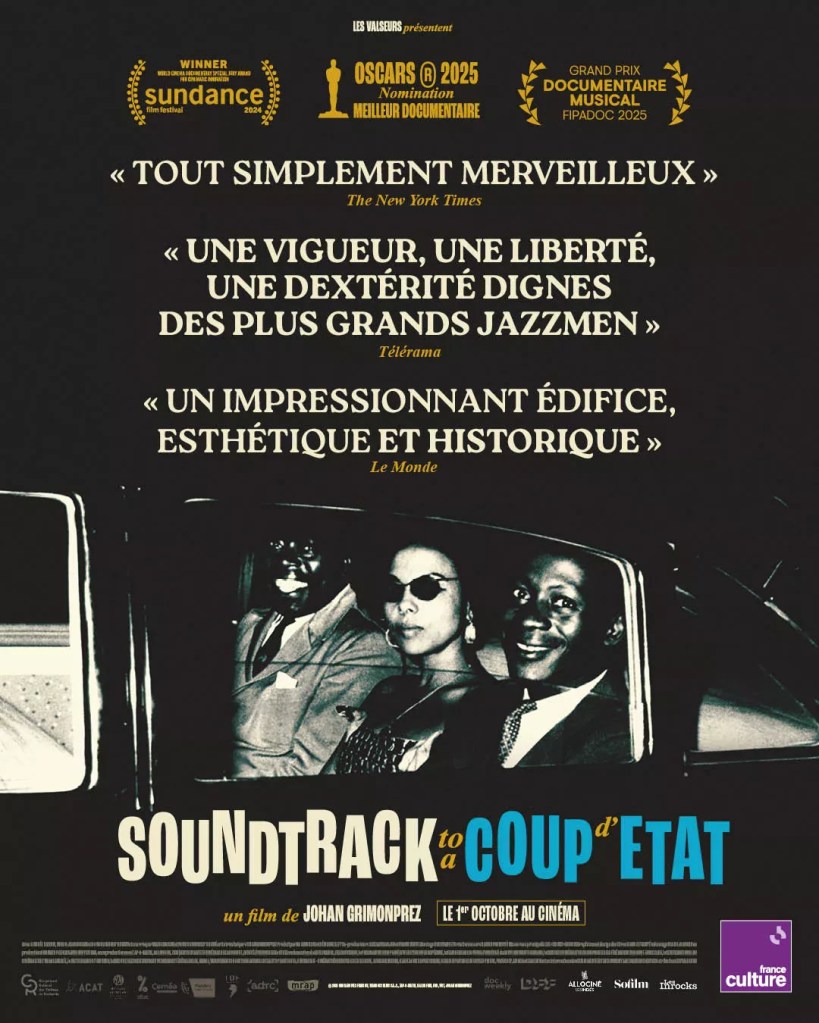
To see the archival footage of Patrice Lumumba, which serves as the backbone to the forceful documentary “Soundtrack to a Coup d’Etat,” is to witness a daring future that, due to the rot of colonialism, tragically never came to pass. The foil to the film’s incisive use of newsreels, excerpts from biographies and political speeches is the kinetic wielding of jazz music.
On October 28, 1960, for instance, Louis Armstrong jubilantly arrived in the Congolese capital of Leopoldville (renamed Kinshasa in 1966) to perform. He came to a country that has always mystified the Euro-centric imagination as part of a U.S. State Department-sponsored tour of Africa. Four months earlier, the Republic of the Congo’s bid for independence had become a living reality. Three months after Armstrong’s performance, with the murder of Lumumba, the dream had already died.
Belgian director Johan Grimonprez’s dense, encyclopedic film “Soundtrack to a Coup d’Etat” does more than tell viewers about the downfall of a revolution, one that conceived of a pan-African movement composed of a dozen countries that gained independence from their colonial overlords. It tells viewers how industrialist countries, primarily in the West, are still picking the bones of a broken promise decades later.
It’s difficult to watch Grimonprez’s intuitive telling of history without feeling the sinister truth of world history: the major powers of the world only see countries like the Congo as an exploitable resource, not as a sovereign state. To tell this reality, Grimonprez takes a similar path traversed by Raoul Peck, whose documentary “Lumumba: Death of a Prophet” is an incredible portrait of a defiant man. Grimonprez dives into the immense span of available footage and writing about Lumumba and that brief period when the idea of a United States of Africa, as coined by Marcus Garvey, to tell how the Congo gained its independence and lost Lumumba.
Nevertheless, the use of music sets Grimonprez’s film apart from Peck’s survey. Similar to the improvisational spirit of jazz, “Soundtrack to a Coup d’Etat” isn’t a linear film. It hops and it bops from 1961 to contemporary ads for Tesla and Apple. The same could be said about the murderer’s row of Jazz legends: Nina Simone, Dizzy Gillespie, Duke Ellington, Abbey Lincoln, Max Roach, and Armstrong—who take center stage. Grimonprez isn’t terribly interested in laying the biographical groundwork of these figures; they’re iconic enough to allow their aura to provide the documentary with an inherent mood and presence. That built-in tenor is necessary in a film that requires plenty of reading with excerpts from Maya Angelou’s The Heart of a Woman, Hugh Wilford’s The Mighty Wurlitzer: How the CIA Played America, and In Koli Jean Bofane’s Congo Inc.: Bismarck’s Testament (Bofane reads passages from his book that speak to world powers’ desire to command the country’s uranium supply).
It’s the latter angle that forms the film’s central thesis. True independence for former territories turned countries was always going to be a fraught proposition in the face of colonial powers afraid to part from the unchecked wealth they gained through ultra-violent oppression. Grimonprez, in fact, looks toward Egyptian President Gamal Abdel Nasser’s 1956 nationalization of the Suez Canal from the British as a potential parallel for the kind of reclaiming of natural resources that other African countries like Congo would’ve sought. Nasser is just one of the many predictions Grimonprez bridges as he crafts a comprehensive view to demonstrate how world powers used Cold War fears to justify assassinations and coups.
The film examines the burgeoning rebellion by these newly independent countries from many angles. For instance, through the analysis of Malcolm X, we find that Asian and African countries possessed outsized power in the UN, whereby anytime they stuck together as a coalition, they could vote down countries like the United States, Belgium, or Britain. And even before she became Lumumba’s chief of protocol, Andrée Blouin, whose home movies and book My Country, Africa are referenced in the film, mobilized African women for political change. As the film informs us, this sense of collective mobilization further frightened world powers.
That anxiety, posits the film, is why music, specifically jazz, became a conduit for political purposes. Grimonprez can be winking, especially when he introduces the Cabinet of Jazz; he and editor Rik Chaubet can also be spontaneous, weaving in and out from any given performance into a narrativization of history that often recalls a late-night setlist. Ella Fitzgerald’s “Lullaby of the Leaves,” for instance, becomes a playful way to pose Soviet leader Nikita Khrushchev’s 1959 visit to the U.S. to meet President Dwight D. Eisenhower as a meeting between two kindred spirits. On the other hand, Nina Simone visiting Nigeria in 1961 on behalf of the American Society of African Culture, a group whose connection to the CIA was unknown by Simone, demonstrates the underhanded ways these artists were pitted against regimes they supported by menacing imperialists.
Even when “Soundtrack to a Coup d’Etat,” which runs at a chunky 150 minutes, struggles to maintain a snappy rhythm, this documentary has an enthralling boldness. This film pushes its audience to absorb every note, clip, and quote that crams an entire study of information into an elegant, slick package. “Soundtrack to a Coup d’Etat” succeeds as an intense piece of reclamation and rejuvenation, giving breath to Lumumba’s spirit by sporting the same kind of defiance the political leader espoused.
Watch Soundtrack to a Coup d’Etat on Kanopy here: https://www.kanopy.com/en/kcls/video/14940555