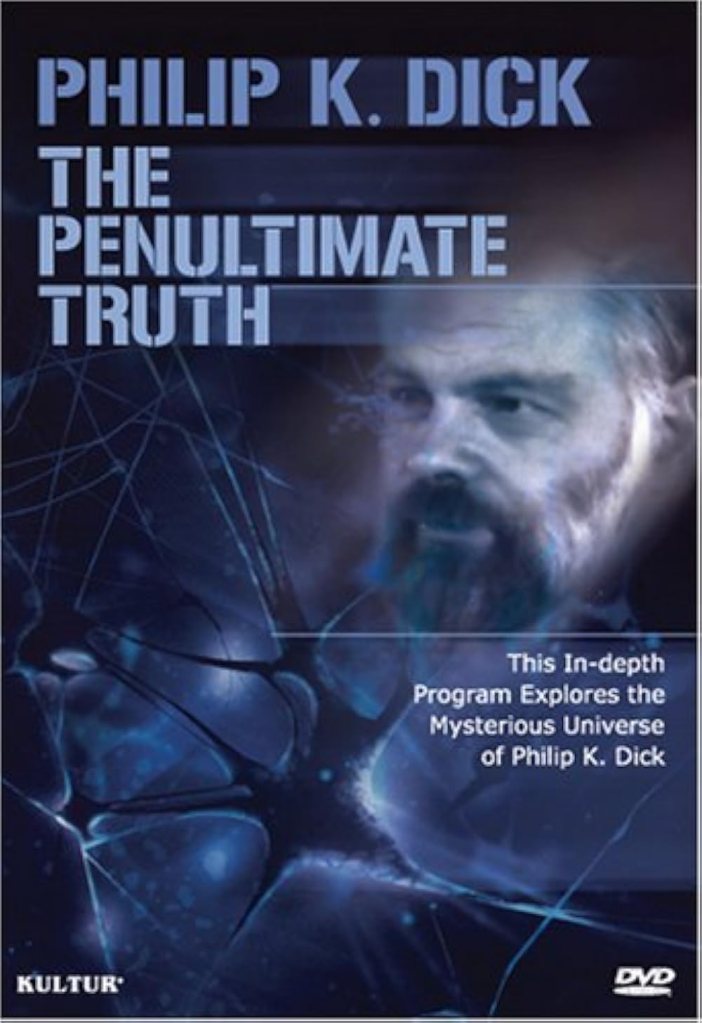
Saturday Matinee: The Penultimate Truth About Philip K. Dick

The Penultimate Truth About Philip K. Dick: Documentary Explores the Mysterious Universe of PKD

By Colin Marshall

Source: Open Culture

Even readers not particularly well versed in science fiction know Philip K. Dick as the author of the stories that would become such cinematic visions of a troubled future as Blade RunnerTotal RecallMinority Reportand A Scanner Darkly. Dick’s fans know him better through his 44 novels, 121 short stories, and other writings not quite categorizable as one thing or the other. All came as the products of a creatively hyperactive mind, and one subject to more than its fair share of disturbances from amphetamines, hallucinogens, unconventional beliefs, and what those who write about Dick’s work tend to call paranoia (either justified or unjustified, depending on whom you ask). But Dick, who passed in 1982, channeled this constant churn of visions, theories, convictions, and fears into books like The Man in the High CastleDo Androids Dream of Electric Sheep?Ubik, and VALIS, some of the most unusual works of literature ever to carry the label of science fiction — works that, indeed, transcend the whole genre.

But what must it have felt like to live with the guy? The Penultimate Truth About Philip K. Dick (named after his 1964 novel of humanity tricked into living in underground warrens) seeks out the writer’s friends, colleagues, collaborators, stepdaughter, therapist, and wives (three of them, anyway), assembling a portrait of the man who could create so many textual worlds at once so off-kilter and so tapped into our real worries and obsessions. Each of these interviewees regards differently Dick’s dedication to the pursuits of both literary achievement and psychonautical adventure, his complicated conception of the true nature of reality, his at times unpredictable behavior, and his penchant for encounters with the divine. Director Emeliano Larre and writer Patricio Vega’s 2007 documentary reveals one of the most fascinating personalities in late 20th-century letters, though, as any professor of literature will tell you, we ultimately have to return to the work itself. Fortunately, Dick’s personality ensured that we have a great deal of it, all of it unsettling but greatly entertaining. Readers taken note. You can Download 14 Great Sci-Fi Stories by Philip K. Dick as Free Audio Books and Free eBooks.

Related Content:

Robert Crumb Illustrates Philip K. Dick’s Infamous, Hallucinatory Meeting with God (1974)

Philip K. Dick Previews Blade Runner: “The Impact of the Film is Going to be Overwhelming” (1981)

Colin Marshall hosts and produces Notebook on Cities and Culture and writes essays on literature, film, cities, Asia, and aesthetics. He’s at work on a book about Los AngelesA Los Angeles Primer. Follow him on Twitter at @colinmarshall.

Saturday Matinee: Dark Star: H. R. Giger’s World

Dark Star: H.R. Giger’s World, In Which The Alien Artist Is Examined

By Supreme Being

Source: Stand By for Mind Control

H.R. Giger, who most famously created the monster design for Alien (and less famously, prior to that, artwork for Jodorowsky’s never-made Dune adaptation), is a pleasant old man at the end of his life in the new documentary, Dark Star: H.R. Giger’s World, much of which follows Giger, his wife, and friends puttering around his cluttered home of many years.

Dark Star is a nicely puttering little movie, refreshingly unlike so many modern docs, those that consist largely of talking heads speedily edited together with rapid-fire clips, so as not to bore audiences. Defensive movie-making, this is called. It’s assumed documentaries bore people, so they’re now edited as jauntily as possible, to keep things moving. Dark Star has very few people sitting down for proper interviews. There are a few, scattered throughout, but they’re not there to relate Giger’s history. Instead they talk about him as a man and as an artist, or talk about his art, or about how he and his artwork affected their lives.

No chronological story is told here. A certain amount of old footage is included of Giger as a younger man, but there’s no narration over it. It’s more that Dark Star, a Swiss production directed by Belinda Sallin, gives an impression of Giger’s life and work, and does so in a gently paced, meandering way. Which style I liked quite a bit. By its nature it was slow to grow on me, but the more I watched, the more the picture was filled in, and the more I became absorbed in it.

At one point I began wishing they’d just show more of his artwork up close, instead of showing shaky shots of it hanging on the walls of his house—and almost as if reading my mind, the movie went into a section showing off his artwork. Well played, Dark Star, well played.

Giger’s art is generally described as being “biomechanoid,” or some other made up word like that. One thing’s for sure: it’s unique. Nobody paints like Giger. Once you’ve seen anything he’s done, and you have, because you love Alien and like me have watched it 500 times, his work, any of it, is instantly recognizeable. It’s all women and bones and machines and warped little children, birth and sex and death, all in the same painting, all happening at the same time.

Well. I’m not going to try to describe his art. Look for yourself. Whatever, exactly, it is, it sticks its fingers deep inside the human psyche and wriggles them around.

A small part of the movie focuses on Alien, with some nice footage of Giger constructing the space-jockey set, and an old interview where he explains that his original alien egg opening—a slit—looked too much like a vagina. “This movie is going to play in Catholic countries,” he was told, so he had to make it less sexual. His solution? Two crossing slits, i.e., two vaginas in the shape of a cross. Take that, Catholics!

There’s no mention of Giger’s earlier, unused work for Jodorowsky’s unrealized Dune project, but again, this isn’t a comprehensive look at Giger. It’s a meandering one. Eventually it meanders to a little Swiss town where Giger grew up. His mother, it turns out, was a huge supporter of his art, though initially Giger worried—as one might expect—about what reaction his parents would have to the things he painted.

Giger spent most the money his art brought in on still other creations. Like the kid-sized, haunted house-like train set in his backyard, which we get to ride around on. Also toward the end of his life, he participated in the creation of a Giger museum in Switzerland to house a large portion of his work, much of which he’d slowly bought back from collectors over the years. For the museum’s opening, Giger signs books and posters and body parts. One of his male fans pulls off his shirt and turns around to reveal his entire back tattooed with one of Giger’s images. “Very nice work,” mutters Giger. One tough-looking, tattooed young man has his art signed, shakes Giger’s hand, and walks away crying. Giger’s work had a profound effect on many people.

Giger died in 2014, shortly after the completion of Dark Star. He does look a bit like he’s near his end while being interviewed. He doesn’t have a lot to say. What comes across clearly is a man who’s satisfied with his work, who got to do exactly what he wanted, who didn’t feel he’d failed to accomplish anything he set out to accomplish.


Watch Dark Star: H. R. Giger’s World on tubi here: https://tubitv.com/movies/704843/dark-star-h-r-giger-s-world

Saturday Matinee: Nationtime

Documentarian William Greaves’s Restored Civil Rights Political Documentary asks, “What Time is it?”

By Jim Tudor

Source: ZekeFilm

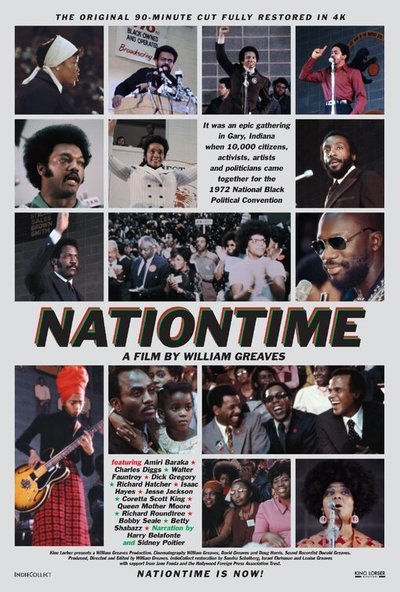
In 1972, the mayor of Gary, Indiana Richard Hatcher welcomed a tremendous gathering of African American leaders, intellectuals, activists and speakers to hold the twentieth century’s first and only National Black Political Convention.  Luminaries such as Amiri Baraka, Charles Diggs, Walter Fauntroy, Dick Gregory, Isaac Hayes, Bobby Seale, Harry Belafonte, Coretta Scott King, Queen Mother Moore and Jesse Jackson took the stage in a crowded sports gymnasium in the fired-up interest of promoting “an independent national black agenda”.  With over 10,000 in attendance, the gathering seeked to bring together differing factions in the cause of Black advancement in America.  More to the point, their goal for the three-day Convention was “unity without uniformity”.

The National Black Political Convention of 1972 was a turning point in the struggle for self determination and equal rights.”

“ The convention adjourned without reaching consensus, and some deemed it a failure.”

“But the cry of ‘Nationtime’ reverberates as America continues to wrestle with its legacy of slavery.

So goes the entirely of the opening text viewed at the start of this newly salvaged presentation of documentarian William Greaves’s Nationtime.  Tasked with documenting the convention, Greaves and his crew do just that; the final version of this 1972 film a sort of fly-on-the-wall highlights reel of the event. Those who know Greaves primarily for his 1968 meta-experimental Symbiopsychotaxiplasm: Take One now have this chance to view one of the filmmaker’s works which falls more into his bread-and-butter wheelhouse of African American-issues documentary filmmaking.

It is apparent that Greaves had no additional access to back-room goings-on and behind the scenes drama of the convention, which there apparently was no shortage of.  Rather, he and his handful of cameramen are relegated to the same level of observation as anyone in ordinary attendance.  As a result, the height of tension- a mass exodus of the contingency from Michigan- occurs with little contextualization. (Greaves’s friend, actor Sidney Poitier, provides occasional narration where needed).

In October of 2020, Kino Marquee released to virtual theaters a black and white version of the newly rediscovered and 4K-restored Nationtime.  At least, it was a black and white version that critics were given access to, thereby resulting in some incorrect statements that the film was shot monochrome.  We know from this subsequent Blu-ray release that that was not the case.  The black and white version is not included on the Blu-ray; Kino Classics instead opting to showcase IndieCollect’s extensive color restoration.  The valiant result remains quite visibly imperfect, though this is no doubt the very best it can ever look.

Nevertheless, a film that’s mostly podium-bound political and social speeches can only have so much traction as cinema.  Roger Ebert famously said that a film isn’t about what it’s about, but rather how it’s about it.  If that’s the case, a film like Nationtime cannot fare tremendously well.  Yet, there’s no denying the historical importance of the event documented, particularly in today’s tragic post-George Floyd world.  Nationtime (originally called “Nationtime – Gary”, for the town it takes place in) is a major, black-organized event as documented by a black filmmaker.  That alone secures it all the credentials it needs in this day and age to rightly present as important.  

But “important” and “cinematically compelling” are two different things.  Though the speakers at the podium are dynamic in their passion, there’s rudimentary catch-as-catch-can quality to Greaves’s film.  It’s an unfortunate showing of seams that often renders the film challenging to stick with.

An informal count reveals that Greaves had no more than five cameras in play, each shooting color film stock.  According to a notation at the end of the film, Nationtime was restored in both color and black and white.  The latter was apparently an attempt to conceal the irregularities in the footage from one camera to the next.  The amateur-esque variations in film stock, lighting, and perhaps exposure are apparent throughout, and unlikely successfully concealed simply by removing color.  (Per David Greaves’s audio commentary recollection, he was given some bad advice from Kodak to use a red filter on his own camera, likely contributing to why the finished film was deemed something of a lost cause at the time. Thankfully, today’s color correction technologies have undone that specific gaffe).  

The end result is what it is: an ultra-low budget effort financed by Greaves himself.   Greaves’s son David, who worked closely with his father and was also there, recalls that outside financing was never secured, though the filmmaker had no intention to not document the event.  According to one story on the new bonus features, William Greaves continued manning his camera during Jesse Jackson’s dynamic speech even when he had run out of film, so enraptured he was in that moment.  

Indeed, the raw enthusiasm of being there and capturing “the happening” of it all shines through the vast imperfections of the film.  Greaves’s knack for knowing and grabbing quality b-roll when he sees it is absolutely apparent.  Through the rough-hewn assembly of it all, apt cutaways of engaged faces and fist-waving crowd enthusiasm are the flourishes that shine.  

Through it all, in the face of all the racial progress in America that’s yet to be made, Reverend Jesse Jackson’s impassioned call and response of “What time is it?” “Nationtime!” resonates anew for a country still in great need of working things out in terms of equality and corrective justice.


Watch Nationtime on Hoopla here: https://www.hoopladigital.com/movie/nationtime-sidney-poitier/17616062

Saturday Matinee: Another Day of Life

Another Day of Life

Directed by Raúl de la Fuente, Damian Nenow

An animated documentary presenting a journalist’s poignant perspectives on the horrors of war.

By Frederic and Mary Ann Brussat

Source: Spirituality & Practice

You must save something if you can. Because people disappear without a trace. Completely and irretrievably. From the world, and then from our memory.
— Ryszard Kapuscinski

Another Day of Life is an intense, chilling, and convincing anti-war animated documentary about the civil war in Angola at the time of its independence in 1975. With the exit of the Portuguese colonizers, two factions fought with each other to determine who would rule and control the country’s thriving businesses and resources, especially diamonds and oil.

The film is based upon a book by acclaimed Polish war correspondent Ryszard Kapuscinski (1932 – 2007) in which he described the situation he witnessed with the Portuguese term confusão, “a state of absolute disorientation.” His story is told through animated recreations of his experiences during the war and filmed interviews with those he met and worked with.

Despite the advice of fellow journalists, Kapuscinski decides to travel from the relatively safe capital of Angola to the southern front in order to interview Farrusco, a military leader of the MPLA, the Soviet- and Cuba-backed People’s Movement for the Liberation of Angola. Other militias were supported by other African interests as well as the United States and South Africa. By the time the war ended in 2002, nearly one million people were displaced and 5,000 were dead.

The film brings us along on Kapuscinski’s travels through dangerous situations and his encounters with memorable people. Since his words (voiced by Kerry Shale) are used for the narration, we empathize with his perspectives — the horror that he and his companion Artur (Daniel Flynn) feel upon coming across a road clogged with corpses, his fascination with a charismatic female freedom fighter named Carlotta (Lillie Flynn), the desire of the people to be photographed so people would know “this is the face I had when I was alive.” At a key moment, the journalist has to decide whether to maintain his objectivity or reveal information that could change the outcome of the conflict.

IndieWire has published a review of Another Day of Life that includes excerpts from interviews with the two directors. We were very impressed with the insights and respect for the substantive themes of this story as explained by director Raul de la Fuente:

“I was fascinated by this surrealistic diary, the desperate chronicle of a reporter at the limit of his strengths, fighting for survival and finding the truth in a chaotic and fuzzy war. This film is a hallucinatory trip into the heart of darkness, a Cold War tale with a thrilling spy mood, magnetic topics, and characters: decolonization, freedom fighters, boy soldiers, epic battles, and, above all, the surreal and poetic approach by Kapuscinski.”

___________________

Watch Another Day of Life on Hoopla here: https://www.hoopladigital.com/movie/another-day-of-life-john-hollingsworth/12738084

Saturday Matinee: A Life on the Farm

A LIFE ON THE FARM Review: Making Movies

By Ernesto Zelaya Miñano

Source: Screen Anarchy

“Charles Carson. Coombe End Farm.”

This story begins with a videotape. Director Oscar Harding finds an old tape he never got to watch in its entirety as a kid. Said video was titled “Life On The Farm”, a feature-length home movie made by Charles Carson, an elderly neighbor of his grandparents’. When looking into how this salt-of-the-earth, unassuming farmer managed to make a movie, Harding uncovers a great story. A Life On The Farm is the result.

At first, the contents of said tape –  a grainy home movie with bad tracking and all those other bugs that make one nostalgic for the VHS era – prove disturbing. Clad in a plaid red shirt and cowboy hat, Charles Carson takes Harding and his viewers on a tour of his laidback country life in Somerset, England, spending days looking after his animals, tending to the land, showing cows giving birth in graphic detail, talking incessantly to his dead cat and ultimately, taking the corpse of his deceased mother around the farm and posing her for pictures with the animals. It’s no wonder that one talking head compares him to Ed Gein, and you’ll probably be thinking of Norman Bates and his unhealthy attachment to Norma more than once.

But just as you expect Harding’s prized discovery to escalate into a full-blown snuff film or something similar, the director does a total bait-and-switch while digging into Charles Carson’s background, and discovers a simple, well-meaning guy who turned to filmmaking due to loneliness; meanwhile, all his interviewees go from laughing and pointing to sincerely admiring the man.

Carson’s story was pretty tragic; having lived nearly all his life on a remote farm, he lost both his parents, a brother, and his wife, who also did not live with him and only visited occasionally. Left alone in the company of cows, cats and other assorted animals, Carson turned to an old video camera and a photography hobby to have a link to the outside world, and one assumes to keep himself sane.

While he first regaled his neighbors with pictures of himself on his land along with funny captions, they soon started receiving what would be his legacy, “Life On The Farm”. Sadly, Carson passed away in the mid 00’s, alone and mostly forgotten. That is, until Harding and an entire community of found footage and vintage VHS enthusiasts got a hold of his film.

Harding’s doc goes from a budding backwoods horror picture to an uplifting story of an unlikely DIY guerrilla filmmaker whose unconventional work is being rediscovered. Carson’s VHS tape also highlights the love many film fans have for physical media, which is largely disappearing in this new era of streaming platforms; bizarre little gems like Carson’s magnum opus can disappear into the ether (though this one is uploaded to YouTube, so at least it’s safe for the time being), and this film is a rallying cry for their continued survival.

Even though it starts to lay the schmaltz on a bit thick, A Life On The Farm ends up as a portrait of a one-of-a-kind artist who’s finally getting his due, whose work for many will be nothing more than a passing curiosity, but who managed to make his mark. Movies are that one special thing that can bring people together, and for Carson, they’re what brought him to the rest of the world.

____________________

Watch A Life On The Farm on Kanopy here: https://www.kanopy.com/en/product/14052224

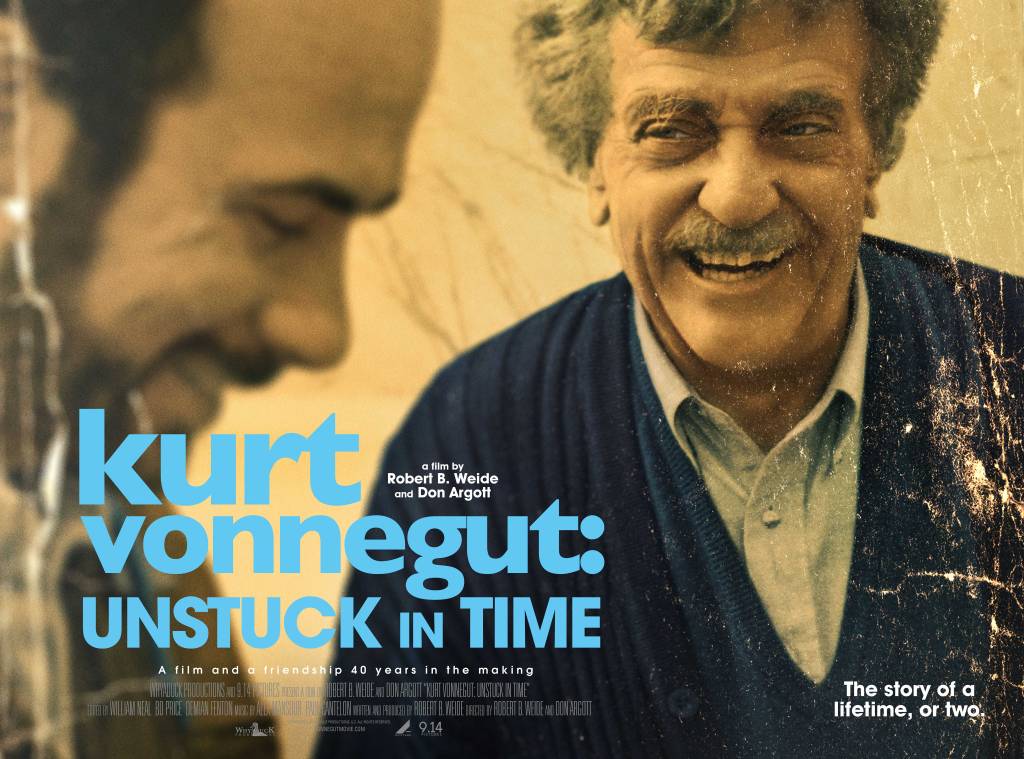
Saturday Matinee: Kurt Vonnegut: Unstuck in Time

By Matt Zoller Seitz

Source: RogerEbert.com

“Kurt Vonnegut: Unstuck in Time” is messy in the way that wakes for dear friends are messy.

Some speakers go on too long, and there are others that you may wish you’d heard from at greater length, or at all. And the raw sentiment coursing through every moment of the affair, however heartfelt, can be overwhelming, especially if you didn’t know the deceased as well as the folks memorializing him. 

The deceased here is Kurt Vonnegut, and the person who planned, executed and hosted this cinematic wake, director Robert B. Weide (a veteran documentarian and an Emmy-winning director for “Curb Your Enthusiasm”), was a friend of Vonnegut’s throughout the final 25 years of his life. This movie, co-directed by Don Argott, runs over two hours. Thematic and structural ideas are introduced, nurtured, forgotten, then reintroduced awkwardly. Weide himself is a major character—as well he should be, considering that Vonnegut essentially made Weide his personal archivist, sending him letters and manuscripts and faxes and video and audio tapes, and this film is as much a portrait of a friendship as it is the warts-and-all record of a great writer’s life—but sometimes the proportions feel off. When Weide disappears for long stretches, I don’t know that it’s exactly a slam to say that you don’t miss him, because people are mainly here for Vonnegut, one of the most important American writers of the 20th century, and a fount of charisma even at his lowest depths of sour narcissism in the 1970s. 

Vonnegut fans know that he specialized in slim, nimbly written books, with short chapters and short paragraphs that jumped wherever Vonnegut’s consciousness happened to take him. “Unstuck in Time” lets us know that it is consciously modeling its structure on Vonnegut’s writing, in particular his widest-read work, the nonlinear novel/memoir “Slaughterhouse Five,” from whence the documentary’s subtitle is drawn (“Billy Pilgrim came unstuck in time,” it starts); and to a lesser extent, Vonnegut’s late-career bestseller “Timequake,” a fragmented, self-aware book that is partly about the difficulty of writing “Timequake.” 

There are also cinematic allusions to Vonnegut’s literary alter-ego, Kilgore Trout, in the way that Weide and Argott and three credited film editors weave together the relationship between Vonnegut and Weide. Weide first meets Vonnegut in 1982 at age 23 after writing him a fan letter inquiring about the possibility of making a documentary about his life, and he holds onto that youthful starstruck quality even in reminiscences shot long after Vonnegut’s death in 2007. Over time, the pupil gains the master’s respect, to the point where Weide writes and coproduces a feature-length adaptation of Vonnegut’s novel “Mother Night,” starring Nick Nolte and directed by actor-filmmaker Keith Gordon, who as luck would have it played Rodney Dangerfield’s son in “Back to School,” a comedy in which Vonnegut played himself.

This may all sound as if it’s articulated more cleanly and effectively than it is. The filmmakers have committed simultaneously and with equal enthusiasm to a couple of filmmaking approaches that are at odds. One is the detached, clinical-mathematical, unsentimental, science-fictional, time-tripping biography, a la “Slaughterhouse Five” and “Timequake,” represented here by inventive cutting from image to image and idea to idea, sometimes lingering on signifiers of creative self-awareness. These include closeups of the timeline on an editor’s computer screen, montages of Vonnegut doing or saying the same thing in different decades of his life, snippets of films based on Vonnegut’s writing, and animated sequences modeled on Vonnegut’s drawings, which were as distinctive as his prose.

The other approach is more straightforward: Weide and Argott are making a straightforward PBS-style documentary about an artist’s life, supervised by a director and fan who knew him intimately, and tghat draws on footage ranging from childhood through old age. The latter might jump around in time in terms of the years in which it was created, but it ultimately tells Vonnegut’s story in a far more conventional way that the movie promises to do in its opening minutes.

This is fine; in fact it’s more than fine, because as Vonnegut and various experts on his work point out, Vonnegut remains readable and relevant in large part because he expressed himself in a direct way, drawing upon what’s described here as a journalistic writing style. Correspondingly, the most moving scenes and moments in “Unstuck in Time” are unmannered accounts of events. These range in emotional character from elating (Vonnegut’s commercial and critical success with “Slaughterhouse Five” after years of financial struggle) to vexing (after that success, he left his first wife, Jane, who’d been by his side during the lean years, moved to Manhattan, and married his mistress) to tragic (Vonnegut’s brother-in-law dying in a train wreck just two days before Vonnegut’s older sister died of cancer) to inspirational (Vonnegut unhesitatingly raising his late sister’s four sons alongside the three kids he had with Jane).

All of this material is fascinating, and articulated in vivid detail thanks to Weide’s trove of material. There are closeups of typewritten revisions of Vonnegut classics, each alteration indicated in pencil or pen, and letters and answering machine messages covering every imaginable life event. The filmmakers lay it all out so elegantly that whenever the movie seems to forget that it’s also about Weide and suddenly interrupts the flow to insert a reference to one of Weide’s own milestone events (such as his wife’s own battle with a debilitating illness and his Emmy win for “Curb,” which seems to be in there so that he can include Vonnegut’s answering machine message congratulating him) it’s awkward because Weide is clearly still grieving, too, and the viewer is torn between wanting to bear witness to Weide’s miseries and triumphs and wanting him to get back to Kurt Vonnegut as quickly as possible.

There is, nevertheless, something to be said for a documentary that tries to do something different and perhaps impossible, even if it doesn’t quite get there. And in the end, any flaws or missed opportunities are subsumed by the movie’s sincerity and wealth of insight. Its analysis of the role that Vonnegut’s World War II experience played in his demeanor as well as his fiction is fascinating and on-point, and the editors bring it all back at the end when Vonnegut, outraged by the second Bush administration’s invasion of Iraq and weaponizing of patriotism, writes a series of columns for “In These Times” magazine that will ultimately be collected in 2005’s “A Man Without a Country,” arguably his last major work.

Weide himself comes across as a sardonic and compassionate witness and guide, often taking the piss out of his own reverence for Vonnegut just when things threaten to get a bit moist. The devotion he displays towards Vonnegut throughout the second half of the writer’s life is as inspiring as Vonnegut’s own high points as a human being. We should all be lucky enough to have a friend who will tell our story.

____________________

Watch Kurt Vonnegut: Unstuck in Time on Kanopy here: https://www.kanopy.com/en/product/13799154

Saturday Matinee: The Occupation of the American Mind

Source: Media Education Foundation

“The Occupation of the American Mind” has been repeatedly attacked and misrepresented by right-wing pressure groups and outright ignored by virtually all mainstream media outlets and North American film festivals.   

To help bring context to U.S. corporate media coverage of the Oct. 7 Hamas attacks and Israel’s escalating bombardment of Gaza, we’re releasing this newly abridged, 49-minute version of our 2016 film “The Occupation of the American Mind.” The film places special emphasis on propaganda efforts designed to conceal Israel’s brutal and illegal decades-long occupation of Palestinian land as a root cause of the conflict, and to cast those who speak up for Palestinian human rights as either anti-Semitic or terrorist-sympathizers. Narrated by Roger Waters, and featuring Noam Chomsky, Rashid Khalidi, Yousef Munayyer, Amira Hass, Norman Finkelstein, Phyllis Bennis, Rula Jebreal, Norman Solomon, Max Blumenthal, Rami Khouri, M.J. Rosenberg, Stephen J. Walt, Mark Crispin Miller, Peter Hart, Henry Siegman, and Sut Jhally.


A transcript of this 49 minute version to follow along with is available by going to https://www.youtube.com/watch?v=-jKRwdsq-As

49 MINUTE VERSION (The restriction is because of violent scenes.)

“The Occupation of the American Mind: Israel’s Public Relations War in the United States.” Despite receiving an overwhelmingly positive response from those who have actually seen it,” The Occupation of the American Mind” has been repeatedly attacked and misrepresented by right-wing pressure groups and outright ignored by virtually all mainstream media outlets and North American film festivals. To bypass this campaign of misrepresentation and suppression, we’ve decided to make the film available for FREE online so that people can make up their own minds about its analysis of U.S. media coverage of the Israeli-Palestinian conflict. Please watch and share widely! Support for the free distribution of this film was provided by the Wallace Action Fund of Tides Foundation, advised by Randall Wallace. If you’d like to help support the effort to provide free distribution of The Occupation of the American Mind, please consider a donation. https://www.mediaed.org/donate/

Saturday Matinee: Kowloon Walled City

By South Sider

Source: YouTube

Credits go to cameraman Hamdani Milas. Christina Wesemann for creation and direction of the film and also to Hugo Portisch for production.

Milas was one of the people that helped filmed this 1989 documentary about the city. I spoke with him recently and he said that he is interested in a follow up video of some sort so we may expect something new on the way.

He mentioned how it was an incredibly tough shoot. They were a five person crew; himself as cinematographer, a camera assistant, focus-puller, sound recordist, a researcher, production assistant and the director, and a very nice Austrian lady who was most willing to collaborate and listen to crew suggestions.

They shot for 6 days continuously, 10-12 hours a day, at the height of the summer of 1987. He mentioned how it smelled very bad inside from the open drainage, the heat was stifling at plus 32ºC with little to no air circulation, also not knowing whether it was sewage or clean water dripping on their heads occasionally, they regularly had to wipe the camera and lens dry.

The claustrophobia- you could hardly turn around in some places with a 7kg Betacam SP camcorder on your shoulder. They had a tripod with them but hardly used it inside because there was nowhere to position it without blocking the narrow passageways.

They also frequently got lost and had to ask the locals for directions. Lunch was much-anticipated each day when they could take a break outside in the fresh air. After a day’s shoot they were absolutely dripping with sweat and the first thing they’d do after getting home was to put all their clothes straight in the wash and have a long shower. Working in those conditions was an immense challenge technically and physically but, as is often the case, none of that shows in the resulting footage.

Here we have a very interesting first hand account of what Hamdani Milas experienced in the walled city itself when he was filming this video. So by what he’s told me we can understand just how much of an incredible risk it was to film inside this city, even though it was near to when the city was demolished and the place was seen as safer it was still a high risk no go area.

I took it upon myself to re-sub the video as best as possible, the 4 part version is hard-subbed on a version of this film with very poor quality, the subs are also worded incorrectly in some places. So all I’ve done is re-subbed the whole thing and put it onto a better quality video clip.

Note: about the section of this video where Jackie Pullinger is speaking, I’m sure anyone can see the subtitles are a transcript of Jackie Pullingers actual words in English and not the narrators. I’ve noticed a comment mentioning how the subs are way off in that part. While subbing this video I realised the narrator wasn’t giving an exact translation so took it upon myself to decipher what she was actually saying over his voice. Sorry I just couldn’t help it but it was out of boredom 😉