

Arguments Against Despair

By David Edwards

Source: Media Lens

Eliot Jacobson is a retired professor of mathematics and computer science who regularly appears on our Twitter feed discussing the climate crisis. He sends tweets under the grim title, ‘Your “moment of doom” for the day’. These channel the latest news on rapidly rising carbon emissions and temperatures, catastrophic examples of extreme weather, and so on. It’s depressing fare, and Jacobson is candid about the level of anguish he feels:

‘I woke up feeling angry at about 2:30 AM this morning.

‘It’s easy to find something wrong with just about anything I look at. It’s all projection. I’ve been writing and deleting Tweets, but I still feel angry.

‘I’m angry that there’s very little I can do and there’s no way out.’

In a blog post, he wrote:

‘This sadness is so overwhelming, so all-consuming, that it takes my breath away. The things I do to cope with the weight of it all are mere distractions from this sadness. Volunteer for a few hours, then sadness. Go for a walk, then sadness. Listen to music, read, visit websites, then sadness. Visit with friends or family, then sadness. Sadness returns every time I have a moment to reflect on the predicament of the present moment.’

I’m no stranger to this emotional roller-coaster. 1988 was the big year for me, when NASA scientist James Hansen told the world we were heading for disaster. I had no difficulty believing him.

It seemed inconceivable to me that the profit motive driving global industry could be restrained, let alone reversed, in time. I was then working as a marketing manager for British Telecom in the West End of London where I set up a Green Initiatives Group. Small changes were made, but they were just window dressing – deeper changes impacting profit were completely unthinkable. It seemed obvious to me that this fundamentalist corporate resistance must, sooner or later, lead to disaster.

I first protested for action on climate change with Friends of the Earth on the streets of central London in October 1989. I was 27 when I started campaigning; I’m now 61. I’ve thought a lot, worried a lot, talked a lot, read a lot, and written a lot about these issues for three and a half decades, more than half my life.

It seems absolutely incredible to me – by which I mean it seems something that I honestly would not have believed was possible – that what seemed like an urgent crisis to me in the late 1980s can still seem like ‘hype’, a ‘liberal tax scam’, an ‘oligarch plot’ and ‘bourgeois hysteria’ to large numbers of people in 2023. In the 1980s, we said things would change when there were ‘bodies in the streets’ – but the bodies are all around us now, and there is still no sign of meaningful change.

I say all this to make clear that I am in no way complacent about, or indifferent to, the looming climate catastrophe (it seems absurd to even describe it as ‘looming’). My comments below are not intended to detract from the vital need to take immediate action; they are addressed to the despair that I know many people, like Jacobson, are feeling.

You, Me And The Mysterium Tremendum

After everything I have myself suffered, it seems to me that we have two main tasks at the present time: first, to do everything in our power to avert the terrifying crisis threatening us with extinction. Second, to do everything we can to transform the fear and suffering of our predicament into love and bliss.

The first of these is new. The second may sound preposterous, even annoying, but it has actually always been the great human task.

Many activists devoted to action, to change, despise the very idea that our own happiness should be any kind of concern. The suggestion is dismissed as self-indulgent ‘navel gazing’. We have to dispense with all such ‘sentimentality’ and focus on ‘hard politics’. We have to plunge into the darkness of realpolitik and fight for our lives. It’s going to be bruising, to hurt – forget all kitten-cuddling ideas about ‘love’ and feeling good. And how on earth can you feel ‘bliss’ when the world is falling apart? Such nonsense!

As so often, the anger is rooted in fear – the fear that such concerns will divert energy and attention away from what really matters. The counter-argument is that not giving a damn about personal feelings, about our needs as human beings in this short life, is actually one of the key factors that got us into this fine mess in the first place. (See my Cogitation: ‘Our Indifference To Ourselves’ – Beyond The ‘Virtue’ Of Self-Sacrifice – Parts 1 and 2)

Just as I can’t understand how so many people can fail to see the truth of the existential crisis we’re facing, I can’t understand how people can feel so absolutely certain about the significance, the meaning, of this crisis that they fall into absolute despair.

First of all, we need to remember that despair is a function of mind; it is not something mandated by Existence. As Thoreau noted, we have a choice:

‘However mean your life is, meet it and live it; do not shun it and call it hard names.’ (Thoreau, ‘Walden’, Oxford University Press, 1997, p.292)

This has been as true for everyone in human history facing death from illness, starvation, genocide, as it is for all of us now, facing extinction.

I find the universe so mysterious, so fundamentally Unknown, and even Unknowable, that I cannot establish a solid base of existential certainty that allows me to be confidently desperate about even this situation.

Of course, climate collapse is terrible for us – I don’t want to die, you don’t want to die; we don’t want so-called human ‘civilisation’ to disappear. But we all do have to die and the deeper significance of even a disaster on this scale is fundamentally unknown.

We are a miniscule part of billions of years of existence involving 200 billion galaxies each containing 200 billion stars, and who knows how many planets, swirling over distances that completely defy imagination – all of it emerging out of the mysterium tremendum, the how and why of Existence (we can’t say Creation; we don’t even know if it has a beginning or an end).

This immensity of space and time has led to this moment that stands before us. Here we are! Everything in this cosmos has led us here. We can’t just blame politicians, corporate executives and their journalistic enablers – the universe made them as they are and this is what the universe has given us to deal with.

Who are we to break down in despair as if we were certain about the final meaning of what is happening? What do we really know about anything? Do we really know enough to find a solid position from which we can cast judgement even on the extinction of human life, or even of all life, on this planet? 

In November, spiritual writer Steve Taylor posted a poem, ‘Being Watched by The Moon’, on Facebook. Taylor wrote of our cosmic near neighbour:

‘Then I noticed a look of concern on her face.

There was a glint of disapproval, a hint of dismay

in her gaze, as it followed me home

as if she was witnessing an accident, or a crime.

Had I done something wrong? I wondered.

Had I injured or offended someone?

Had I gone astray, and lost the meaning of my life?

But then I looked closer, and realised:

she wasn’t just watching me.

She was watching the whole world.’

A glint of ‘concern’, ‘disapproval’ and ‘dismay’, as if ‘witnessing an accident, or a crime’? Is this really the most likely reaction of the Moon? After all, she has seen a lot – she’s around 4.5 billion years old, about the same age as the Earth. Human beings have been around for just 2.8 million years, and in our problematic modern form for just 200,000 years. The Sun formed about 4.6 billion years ago from an enormous molecular cloud that gave birth to numerous other stars. Our star has about 5 billion years of life left; she’s in her prime. The universe itself is about 13.8 billion years old – at least in this cycle, if it is a cycle. We don’t know where all this comes from, what it means, what lies at the base of it all. 

Worst case scenarios suggest that human-induced climate change might devastate most animal and plant species to such an extent that it could take five million years for life to recover. But 5 million years is a blink of the cosmic eye to old-timers like the Moon, Earth and Sun whose memories stretch back, not millions, but billions of years. And if things don’t work out here post-climate collapse, maybe they’ll go better among the billions and billions of stars out there – that’s a lot of stars, a lot of possibility. From this perspective, one might surmise that human despair at the prospect of human extinction is one more manifestation of an egotism that causes us to vastly overestimate our own importance.

Might it alter our despairing perspective to consider that the enlightened mystics might be right in declaring that, not just plants and animals, but the entire universe is alive? We think life arises miraculously, ‘accidentally’ (what on earth does that mean?), Lazarus-like, from dead matter. But atoms are pretty lively phenomena; they are whizzing flea circuses of jumping sub-atomic particles, quantum waves and other forms of energy. Might we one day conclude that what we call life arises from these subtler forms of life? Is energy in some sense life?

And might our despair be leavened by the possibility, as mystics also insist, that, not just human beings, but the entire cosmos is conscious? What would it mean, if it turns out that even rocks are consciousness in a kind of coma; that evolution is ultimately a process of consciousness awakening from the slumber (not the death) of matter?

If everything is alive and everything is conscious, then even human beings are unable to inflict any real damage – a manifestation of eternal life rises and falls, comes and goes, but the ocean of living consciousness continues completely unharmed.

The universe seems to consist of objects, of material ‘things’. But that is not all: these rocks, animals, planets and stars appear in the something that is no-thing that we call space. Likewise, our awareness also provides an internal space in which sense perceptions, thoughts and emotions can appear and be known. We assume the universe is material and yet awareness seems non-material, seems entirely other than that which is material. Is it possible that external space and the internal space of awareness are related? Could they actually be the same phenomenon? We tend to see our internal space as an epiphenomenon of the brain, but is external space an epiphenomenon of matter?

Could the mystics even be right when they insist that awareness evolves in the universe by moving from ageing bodies to new ones? Westerners find this a childishly obvious example of wishful thinking. But does that make it untrue? Do we imagine that Buddha, Bodhidharma, Nagarjuna, Lao tse and all other enlightened humans were inventing when they made this claim over and over again? Could they even be right in arguing that consciousness moves from old, exhausted planets to fresh, new planets better suited to the continued evolution of consciousness?

If that sounds ludicrous, is it any crazier than the idea that the universe suddenly emerged from nothingness – nothing, nothing, nothing, then, Bang! – or that it has somehow always existed? These appear to be the only two possibilities, and yet both seem totally nonsensical to us. If the only logical possibilities seem impossible, how can we so confidently root our despair in our clearly inadequate human capacity for logic?

Satchitananda

I controversially suggested our task was to find bliss in the face of looming extinction. Is that possible? Is it moral even to try in the face of so much suffering?

Seasoned meditators tell us that the mysterious awareness perceiving these words is inherently blissful. Not just pleasurable, mind you – ecstatic. We are told the bliss is already there, is always there; that it is the very nature of awareness. The idea is captured in the Sanskrit epithet ‘satchitananda’, or ‘reality, consciousness, bliss’ – existence is aware and awareness is blissful.

This sounds counter-intuitive standing at a bus stop on a rainy Monday morning commute to work. We are here, we are aware, thank you very much, and we are emphatically not beaming with delight.

There are two possible explanations for this contradiction: either all the enlightened mystics were talking nonsense, or we are not in fact here, not in fact aware, and are therefore not able to experience the bliss that is here.

But if we’re not here, where on earth are we?

We are physically here, of course, but our minds are not in the present; they are in the past and in the future. Because the past and future do not exist, because they are mere ideas in the mind, when we are thinking we are absent; we are not truly here.

There are times when I sit in meditation for an hour when thoughts finally drop away; thoughts by which I am otherwise unceasingly plagued by day and night (dreams are thinking in pictures). When thoughts drop away, even for a moment, something very subtle, but very powerful slips through. In my experience, it emerges like a wispy strand of pink candy floss spinning out from some completely unknown depth and melting into my heart (my ‘dantian’ and ‘lower dantian’, in the terminology of Qigong). The melting is experienced as a sweetness, a delight, that glows with unconditional love for everyone and everything.

It is clear, sitting alone in a room, that this loving bliss is uncaused. I may have been as miserable as sin about the state of the world before slumping down to watch my thoughts and feelings – nothing in my world has objectively changed in that hour. In fact, as all the mystics insist, this loving delight has not been caused; it has simply been unveiled, revealed.

Thought is the veil. This is why we can’t feel the bliss of existence: it is hidden from us by layer upon layer of thought, rather like the multiple layers of cloud that typically greet solemn holidaymakers returning to Britain.

Human beings are the only animal that can become lost in the unreal world of mentation. All the virtuous, politically correct and well-intentioned thought by which we have always hoped to make the world a better place – the whole, misguided 17th and 18th century dream of the European ‘Enlightenment’ – has combined with all other thoughts to form an almost impenetrable barrier between us and the real source of civilisation, of personal and global salvation, within us.

The truth is that we have destroyed our planet and become almost completely estranged from the inherent bliss of being because we have sought civilisation and happiness in our heads. In reality, true civilisation – not the ability to build machines to pyrrhically ‘conquer’ nature, other animals and humans – is found when we transcend thought and connect deeply and often with our hearts.

‘The Best People In The World’ – Actual Human Civilisation

The very idea of technological ‘progress’ implies some kind of ‘Manifest Destiny’. It is our ‘destiny’ – the natural path of any ‘advanced’ civilisation on any planet – to develop ever more powerful technology, that we might one day voyage across the cosmic ocean just as we once voyaged across the water and air of our home planet.

But this may be wrong. It may be that the right option is to journey inwards in an exploration of being, of consciousness, to an unimagined brave new world of love and bliss.

Perhaps we don’t hear anything from highly technological ‘civilisations’ out there in the cosmos because the whole effort is a suicidal wrong turn that leads to near-instant decline and extinction. The cosmos may nevertheless be teeming with genuinely civilised beings who have gone in a very different direction.

After all, even on our planet, there have been examples of authentically civilised humans – people who live in their hearts rather than in their heads, who are free of our obsessive thinking. They appear to have rooted their daily lives in the kind of love and bliss that we in the West can only find in meditation.

In his book, ‘The Conquest of Paradise’, writer and ecologist Kirkpatrick Sale described the low-tech, Taino society encountered by the Spanish conquistadors in 1492:

‘So little a part did violence play in their system that they seem, remarkably, to have been a society without war (at least we know of no war music or signals or artifacts, and no evidence of intertribal combats) and even without overt conflict (Las Casas reports that no Spaniard ever saw two Tainos fighting).’ (Kirkpatrick Sale, ‘The Conquest of Paradise’, Papermac, 1992, p.99)

But the lack of violence was only one aspect of the Tainos’ towering civilisation:

‘And here we come to what was obviously the Tainos’ outstanding cultural achievement, a proficiency in the social arts that led those who first met them to comment unfailingly on their friendliness, their warmth, their openness, and above all – so striking to those of an acquisitive culture – their generosity.’ (p.99)

Even Admiral Cristobal Colon (‘Christopher Columbus’ in old money), the man who brought death and disaster to the lives of the Taino, recorded in his journal:

‘They are the best people in the world and above all the gentlest. They became so much our friends that it was a marvel… They traded and gave everything they had, with good will.’ (pp.99-100)

He continued:

‘I sent the ship’s boat ashore for water, and they very willingly showed my people where the water was, and they themselves carried the full barrels to the boat, and took great delight in pleasing us. They are very gentle and without knowledge of what is evil; nor do they murder or steal.’

Colon added:

‘They love their neighbours as themselves, and they have the sweetest talk in the world, and are gentle and always laughing.’ (p.100)

Sale wrote poignantly:

‘It is to be regretted that the Admiral, unable to see past their nakedness, as it were, knew not the real virtues of the people he confronted. For the Tainos’ lives were in many ways as idyllic as their surroundings, into which they fit with such skill and comfort. They were well fed and well housed, without poverty or serious disease. They enjoyed considerable leisure, given over to dancing, singing, ballgames, and sex, and expressed themselves artistically in basketry, woodworking, pottery, and jewellery. They lived in general harmony and peace, without greed or covetousness or theft.’ (pp.100-101)

American geographical scholar Carl Sauer concluded:

‘…the tropical idyll of the accounts of Columbus… was largely true’. (p.101)

The Tainos were human beings who lived in their hearts, not in their heads. They had no august universities packed with thinkers, philosophers and other half-crazed intellectuals; no 24/7 outpourings of media pollution – they lived in the bliss of awareness unclouded by obsessive thought.

As for us! By painful contrast, in his book, ‘Impact of Western Man’, historian William Woodruff commented on the society from which Colon had sailed:

‘No civilization prior to the European had occasion to believe in the systematic material progress of the whole human race; no civilization placed such stress upon the quantity rather than the quality of life; no civilization drove itself so relentlessly to an ever-receding goal; no civilization was so passion-charged to replace what is with what could be; no civilization had striven as the West has done to direct the world according to its will; no civilization has known so few moments of peace and tranquillity.’ (Sale, ibid, p.91, my emphasis)

To live in the head, to sacrifice the moment for the future, to prioritise the ‘serious’, ‘important’ work of the greedy, plotting mind over the bliss of the heart is to build a self-destructive, doomed version of fake ‘civilisation’.

Or consider the experience of the Mexican anthropologist Miguel Covarrubias on visiting the island of Bali in 1938. Covarrubias wrote:

‘No other race gives the impression of living in such close touch with nature, creates such a complete feeling of harmony between the people and the surroundings… The Balinese belong in their environment in the same way that a humming-bird or an orchid belongs in a Central American jungle.’ (Miguel Covarrubias, ‘Island of Bali’, KPI, 1986, p.11)

Covarrubias added:

‘A man is assisted by his neighbours in every task he cannot perform alone; they help him willingly and as a matter of duty, not expecting any reward other than the knowledge that, were they in his case, he would help in the same manner’. (p.14)

The result, Covarrubias wrote, was a village system which operated as ‘a closely unified organism in which the communal policy is harmony and cooperation – a system that works to everybody’s advantage’. (p.15)

In the late 1990s, I worked with the Swedish ecologist and activist Helena Norberg-Hodge who lived for many years among the people of Ladakh on the Tibetan plateau of Northern India. In her book ‘Ancient Futures’, Norberg-Hodge wrote of how she was bewildered by the strange fact that the Ladakhis were always smiling:

‘At first I couldn’t believe that the Ladakhis could be as happy as they appeared. It took me a long time to accept that the smiles I saw were real. Then, in my second year there, while at a wedding, I sat back and observed the guests enjoying themselves. Suddenly I heard myself saying, “Aha, they really are that happy”. Only then did I recognize that I had been walking around with cultural blinders on, convinced that the Ladakhis could not be as happy as they seemed. Hidden behind the jokes and laughter had to be the same frustration, jealousy, and inadequacy as in my own society. In fact, without knowing it, I had been assuming that there were no significant cultural differences in the human potential for happiness. It was a surprise for me to realize that I had been making such unconscious assumptions, and as a result I think I became more open to experiencing what was really there.’ (Helena Norberg-Hodge, ‘Ancient Futures – Learning From Ladakh,’ Sierra, 1992, p.84)

As amongst the Tainos, fighting in traditional Ladakhi society was unknown, disputes were settled quickly and peaceably, and when one person had a problem the entire community did its best to help:

‘In traditional Ladakh, aggression of any sort is exceptionally rare: rare enough to say that it is virtually non-existent… Even arguments are rare. I have hardly ever seen anything more than mild disagreement in the traditional villages—certainly nothing compared with what you find in the West.’ (p.46)

Norberg-Hodge concluded:

‘I have never met people who seem so healthy emotionally, so secure, as the Ladakhis.’ (p.85)

These societies that seem so ‘primitive’ and ‘uncivilised’ to goal-oriented, power-obsessed, head-trapped Europeans, were actually exemplars of authentic human civilisation.

I am not suggesting that we can become like the Tainos, Balinese and Ladakhis. If we are too high-tech primitive to save ourselves from climate disaster, we can obviously not hope to create that kind of paradise on earth.

What I am suggesting, though, is that the existence of these societies powerfully supports the contention of the mystics: that awareness unclouded by obsessive thinking is indeed in the nature of bliss and love. I am suggesting that such low-tech civilisations may exist in abundance, undetected, on other planets that will of course continue to thrive no matter what happens on our planet. I am also suggesting that you and I can create a little patch of this paradise in our own hearts.

Perhaps in our world as it is, genuinely civilised, loving societies are doomed to be destroyed by brutal, head-trapped, Western-style societies. But you and I still have the freedom, even in the face of this wider brutality, even in the face of environmental catastrophe, to live a life overflowing with love and bliss. Maybe that is all that is possible for us, and maybe that is enough. 
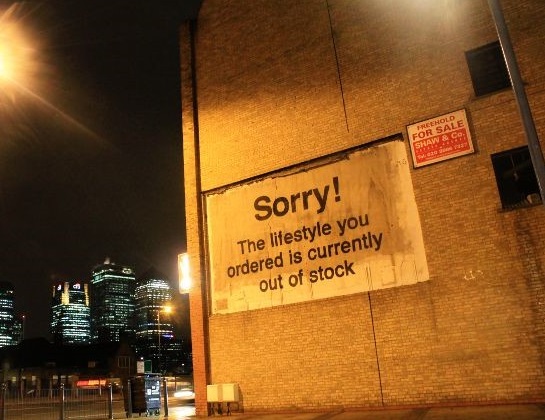
What “Normal” Are We Returning To? The Depression Nobody Dares Acknowledge

By Charles Hugh Smith

Source: Of Two Minds

Perhaps we need an honest national dialog about declining expectations, rising inequality, social depression and the failure of the status quo.

Even as the chirpy happy-talk of a return to normal floods the airwaves, what nobody dares acknowledge is that “normal” for a rising number of Americans is the social depression of downward mobility and social defeat.

Downward mobility is not a new trend–it’s simply accelerating. As this RAND Corporation report documents, ( Trends in Income From 1975 to 2018) $50 trillion in earnings has been transferred to the Financial Aristocracy from the bottom 90% of American households over the past 45 years.

Time magazine’s article on the report is remarkably direct: The Top 1% of Americans Have Taken $50 Trillion From the Bottom 90% — And That’s Made the U.S. Less Secure.

“The $50 trillion transfer of wealth the RAND report documents has occurred entirely within the American economy, not between it and its trading partners. No, this upward redistribution of income, wealth, and power wasn’t inevitable; it was a choice–a direct result of the trickle-down policies we chose to implement since 1975.

We chose to cut taxes on billionaires and to deregulate the financial industry. We chose to allow CEOs to manipulate share prices through stock buybacks, and to lavishly reward themselves with the proceeds. We chose to permit giant corporations, through mergers and acquisitions, to accumulate the vast monopoly power necessary to dictate both prices charged and wages paid. We chose to erode the minimum wage and the overtime threshold and the bargaining power of labor. For four decades, we chose to elect political leaders who put the material interests of the rich and powerful above those of the American people.”

I’ve been digging into downward mobility and social depression for years: Are You Really Middle Class?

The reality is that the middle class has been reduced to the sliver just below the top 5%–if we use the standards of the prosperous 1960s as a baseline.

The downward mobility isn’t just financial–it’s a decline in political power, control of one’s work and ownership of income-producing assets. This article reminds us of what the middle class once represented: What Middle Class? How bourgeois America is getting recast as a proletariat.

This reappraisal of the American Dream is also triggering a reappraisal of the middle class in the decades of widespread prosperity: The Myth of the Middle Class: Have Most Americans Always Been Poor?

Downward mobility excels in creating and distributing what I term social defeat: In my lexicon, social defeat is the spectrum of anxiety, insecurity, chronic stress, fear and powerlessness that accompanies declining financial security and social status.

Downward mobility and social defeat lead to social depression. Here are the conditions that characterize social depression:

1. High expectations of endlessly rising prosperity instilled as a birthright no longer align with economy reality.

2. Part-time and unemployed people are marginalized, not just financially but socially.

3. Widening income/wealth disparity as those in the top 10% pull away from the bottom 90%.

4. A systemic decline in social/economic mobility as it becomes increasingly difficult to move from dependence on the state or one’s parents to financial independence.

5. A widening disconnect between higher education and employment: a college/university degree no longer guarantees a stable, good-paying job.

6. A failure in the Status Quo institutions and mainstream media to recognize social depression as a reality.

7. A systemic failure of imagination within state and private-sector institutions on how to address social depression issues.

8. The abandonment of middle class aspirations: young people no longer aspire to (or cannot afford) consumerist status symbols such as luxury autos or conventional homeownership.

9. A generational abandonment of marriage, families and independent households as these are no longer affordable to those with part-time or unstable employment.

10. A loss of hope in the young generations as a result of the above conditions.

The rising tide of collective anger arising from social depression is visible in many places: road rage, violent street clashes between groups seething for a fight, the destruction of friendships for holding “incorrect” ideological views, and so on.

A coarsening of the entire social order is increasingly visible: The Age of Rudeness.

Depressive thoughts (and the emotions they generate) tend to be self-reinforcing, and this is why it’s so difficult to break out of depression once in its grip.

One part of the healing process is to expose the sources of anger that we are repressing. As psychiatrist Karen Horney explained in her 1950 masterwork, Neurosis and Human Growth: The Struggle Towards Self-Realization, anger at ourselves sometimes arises from our failure to live up to the many “shoulds” we’ve internalized, and the idealized track we’ve laid out for ourselves and our lives.

The article The American Dream Is Killing Us does a good job of explaining how our failure to obtain the expected rewards of “doing all the right things” (getting a college degree, working hard, etc.) breeds resentment and despair.

Since we did the “right things,” the system “should” deliver the financial rewards and security we expected. This systemic failure to deliver the promised rewards is eroding the social contract and social cohesion. Fewer and fewer people have a stake in the system.

We are increasingly angry at the system, but we reserve some anger for ourselves, because the mass-media trumpets how well the economy is doing and how some people are doing extremely well. Naturally, we wonder, why them and not us? The failure is thus internalized.

One response to this sense that the system no longer works as advertised is to seek the relative comfort of echo chambers–places we can go to hear confirmation that this systemic stagnation is the opposing ideological camp’s fault.

Part of the American Exceptionalism we hear so much about is a can-do optimism: set your mind to it and everything is possible.

The failure to prosper as anticipated is generating a range of negative emotions that are “un-American”: complaining that you didn’t get a high-paying secure job despite having a college degree (or advanced degree) sounds like sour-grapes: the message is you didn’t work hard enough, you didn’t get the right diploma, etc.

It can’t be the system that’s failed, right? I discuss this in my book Why Our Status Quo Failed and Is Beyond Reform: the top 10% who are benefiting mightily dominate politics and the media, and their assumption is: the system is working great for me, so it must be working great for everyone. This implicit narrative carries an implicit accusation that any failure is the fault of the individual, not the system.

The inability to express our despair and anger generates depression. Some people will redouble their efforts, others will seek to lay the blame on “the other” (some external group) and others will give up. What few people will do is look at the sources of systemic injustice and inequality.

Perhaps we need an honest national dialog about declining expectations, rising inequality and the failure of the status quo that avoids polarization and the internalization trap (i.e. it’s your own fault you’re not well-off).

We need to value honesty above fake happy-talk. Once we can speak honestly, there will be a foundation for optimism.

America’s Despair

By Vladimir Odintsov

Source: New Eastern Outlook

More and more people in the United States are feeling let down by American capitalism, and the population is being plunged into depression. This was the alarming conclusion reached by two researchers from Princeton University, Anne Case and winner of the Nobel Prize in Economics Angus Deaton. Over the past fifty years, many have been left feeling disillusioned with the American economic model, hyped up extensively within the United States, which even affects life expectancy in America: it has been declining for three consecutive years, a very unusual trend for a developed country. There has been a marked increase in the mortality rate among the white population in particular since the beginning of the new millennium. The number of suicides, as well as deaths from drug and alcohol abuse has increased dramatically.

These are the bleak findings of the research on the situation in the USA conducted by well-known American economists Anne Case and Angus Deaton, who carried out a detailed analysis of the suicide and mortality epidemic that has engulfed America, noting that the United States has been experiencing a “deaths of despair” epidemic since the mid 1990s. The researchers point out that life expectancy for Americans declined for three consecutive years, from 2015 through 2017, something that had not happened since World War One, when the world was gripped by the Spanish influenza pandemic. Among the many different root causes leading to deaths of despair, the study highlights a significant fall in American wages in recent years and a dearth of good jobs, which is weakening core institutions of American life, such as marriage, faith and community. Social spending and housing-related expenses are an increasingly heavy burden for ordinary Americans.

This is despite the fact that the United States had once led the way as the number-one country in the world in terms of reducing mortality rates and increasing life expectancy in the 20th century, and many important discoveries and achievements in medicine have come from the United States.

However, the United States is now leading the way in the opposite direction.

Numerous US researchers believe that the Great Recession which began with the 2008 financial crisis is to blame for today’s greatest woes in America. However, the Great Recession was not what provoked the deaths of despair epidemic among ordinary Americans, although it did lead to the deterioration of living conditions for many people, which provoked anger and division in the United States. The deep-rooted causes of this epidemic can be traced back to a feeling of dissatisfaction with living conditions among Americans which has been there for a long time, and when inequality began to grow, young Americans began realizing that they would never be able to live the lives their parents could afford, while young people without highly professional skills have fallen even further behind.

America’s health care system which has been prescribing more and more opioids is also on the list of “culprits” responsible for the situation America has found itself in today. According to US research, one out of every two unemployed men in the US take painkillers on a daily basis, and these are usually addictive opioids. The national health-care crisis associated with substance abuse has plagued Americans for decades. The opioid epidemic in the United States is largely a failure of regulation and control. This is an area where pharmaceutical companies wield great political influence.

In recent years, there has been a sharp increase in the number of patients reporting pain, difficulties with communication, and depression. Pharmaceutical companies and distributors have taken advantage of people’s growing desperation, seeing an opportunity to promote and ramp up the sales of opioid pain medication such as OxyContin, a legal drug approved by the US Food and Drug Administration even though it is essentially no different to heroin. Between 1999 and 2018, more than 200,000 Americans died of opioid overdoses. Doctors are seeing the increasing amount of harm being caused by these drugs, and have begun prescribing them on a less frequent basis, but these opioids have opened the gateway to illegal drugs: heroin from Mexico, as well as fentanyl from China in more recent years, which is far deadlier. These drugs are causing a huge amount of damage and killing a lot of people. However, when ordinary Americans are faced with hardship and suffering, when there is social upheaval, and people begin to feel that their lives are meaningless, these drugs fill the void, and the number of deaths from drug overdoses goes up, adding to the number of suicides and alcohol-related deaths.

Alcohol-related deaths in American society today are simply ballooning out of control. According to a series of studies, “Alcohol-related deaths” have more than doubled in the last two decades. This is well ahead of the population growth rate over the same period. A study conducted over a twenty-year period found that alcohol had been the cause of more than one million deaths! Apart from people who simply drank themselves “to death”, half of the alcohol-related deaths were due to liver disease and drug overdoses from substances taken together with alcohol. Nine states — Maine, Indiana, Idaho, Montana, New Jersey, New York, North Dakota, Ohio and Virginia — have recorded a significant increase in the number of Americans binge drinking dangerous amounts of alcohol, which can lead to fatal car crashes and other fatal accidents, according to a report recently published by the CDC (The Centers for Disease Control and Prevention). Americans almost all over the country who are trying to “drown their sorrows in alcohol” are already addicted to these hard drinks, and have began drinking more heavily and more often, with a 12% increase seen in the last five years alone.

Historically, there have always been more “deaths of despair” among men than women. However, a study published in the journal Alcoholism: Clinical and Experimental Research, found that the largest annual increase in alcohol-related deaths in recent years was seen among non-Hispanic white women.

But these are not the only scourges of today’s American society. According to the January report published by the National Center for Homeless Education funded by the US Department of Education, over 1.5 million schoolchildren experienced homelessness in the 2017-2018 school year. 100,000 (7%) of these homeless schoolchildren spent the night in the open air and slept wherever they could, 7% slept in motels, 12% stayed in homeless shelters, and 74% stayed at a friend’s. And these are only the most modest estimates, but take figures from the American Institutes for Research, for example, which recorded that 2.5 million children had experienced homelessness in the year 2013. This could almost be considered some sort of historical “record”, with one in thirty American children experiencing homelessness! Criminal gangs, drug dealers, pimps and pedophiles are waiting for these children on the streets. In this context, does it really come as any surprise that crime is on the rise in the United States (especially juvenile crime)?

This grim situation in the US is hardly surprising if you look at the draft $4.8 trillion federal budget that US President Donald Trump is going to propose and use to pave the way for his re-election. After all, this budget is a continuation of a trend that has already been observed in federal budgets drafted in the United States, as we’ll see more big safety-net cuts and increased spending on defense, which even the Wall Street Journal has called out.

All of the Trump administration’s wall-to-wall “America First!” slogans cannot hide the glaringly ugly face of American reality we can see today.

Wasted lives: The worldwide tragedy of youth suicide

Principles of goodness together with the golden seed of social justice – sharing – need to be the guiding ideals of a radically redesigned socio-economic paradigm.

By Graham Peebles

Source: Nation of Change

The pressures of modern life are colossal; for young people – those under 25 years of age – they are perhaps greater than at any other time. Competition in virtually every aspect of contemporary life, a culture obsessed with image and material success, and the ever-increasing cost of living are creating a cocktail of anxiety and self-doubt that drives some people to take their own lives and many more to self-abuse of one kind or another.

Amongst this age group today, suicide constitutes the second highest cause of death after road/traffic accidents, and is the most common cause of death in female adolescents aged 15–19 years. This fact is an appalling reflection on our society and the materialistic values driven into the minds of children throughout the world.

The World Health Organization (WHO) estimates that in total “close to 800,000 people die due to suicide every year, which is one person every 40 seconds. Many more attempt suicide,” and those who have attempted suicide are the ones at greatest risk of trying again. Whilst these figures are startling, WHO acknowledges that suicide is widely under-reported. In some countries (throughout Sub-Saharan Africa, for example) where stigma still attaches to suicide, it is not always recorded as the cause of death when in fact it should be, meaning the overall suicide figures are without doubt a great deal higher.

Unless there is fundamental change in the underlying factors that cause suicide, the WHO forecasts that by 2020 – a mere three years away, someone, somewhere will take their own life every 20 seconds. This worldwide issue, WHO states, is increasing year on year; it is a symptom of a certain approach to living – a divisive approach that believes humanity is inherently greedy and selfish and has both created, and is perpetuated by, an unjust socio-economic system which is at the root of many of our problems.

Sliding into despair

Suicide is a global matter and is something that can no longer be dismissed, nor its societal causes ignored. It is the final act in a painful journey of anguish; it signifies a desperate attempt by the victim to be free of the pain they feel, and which, to them, is no longer bearable. It is an attempt to escape inner conflict and emotional agony, persecution or intimidation. It may follow a pattern of self-harm, alcohol or drug abuse, and, is in many cases, but not all, related to depression, which blights the lives of more than 300 million people worldwide, is debilitating and deeply painful. As William Styron states in Darkness Invisible, “The pain of severe depression is quite unimaginable to those who have not suffered it, and it kills in many instances because its anguish can no longer be borne. The prevention of many suicides will continue to be hindered until there is a general awareness of the nature of this pain.”

Any suicide is a tragedy and a source of great sadness, particularly if the victim is a teenager, or someone in there twenties, who had their whole life ahead of them, but for some reason or another could not face it. As with all age groups, mental illness amongst young people is cited as the principle reason for, or an impelling cause of suicide, as well as for people suffering from an untreated illness such as anxiety anorexia or bulimia; alcohol and drug abuse are also regularly mentioned, as well as isolation.

All of these factors are effects, the result of the environment in which people – young and not so young – are living: family life, the immediate society, the broader national and world society. The values and codes of behavior that these encourage, and, flowing from this environment, the manner in which people treat one another together with their prevailing attitudes. It must be here that, setting aside any individual pre-disposition, the underlying causes leading to mental illness or alcohol/drug dependency in the first place are rooted.

Unsurprisingly young people who are unemployed for a long time; who have been subjected to physical or sexual abuse; who come from broken families in which there is continuous anxiety due to job insecurity and low wages are at heightened risk of suicide, as are homeless people, young gay and bi-sexual men and those locked up in prison or young offenders institutions. In addition, WHO states that, “Experiencing conflict, […] loss and a sense of isolation are strongly associated with suicidal behavior.”

Lack of hope is another key factor. Absence of hope leads to despair, and from despair flows all manner of negative thoughts and destructive actions, including suicide. In Japan, where suicide is the leading cause of death among people aged between 15 and 39 (death by suicide in Japan is around twice that of America, France and Canada, and three times that of Germany and the U.K.), the BBC reports that, “young people are killing themselves because they have lost hope and are incapable of seeking help.” Suicides began to increase dramatically in Japan in 1988 after the Asian financial crisis and climbed again after the 2008 worldwide economic crash. Economic insecurity is thought to be the cause, driven by “the practice of employing young people on short-term contracts.”

Hope is extremely important, hope that life will improve, that circumstances will change, that people will be kinder and that life will be gentler. That one’s life has meaning. Interestingly, in the aftermath of Princess Diana’s death in 1997, suicides in Britain increased by almost 20 per cent, and cases of self-harm rose by 44 per cent. To many people she was a symbol of compassion and warmth in a brittle, hostile world, and somehow engendered hope.

The list of those most vulnerable to suicide is general and no doubt incomplete; suicide is an individual act and flows from specific circumstances and a particular state of mind. Generalizations miss the subtleties of each desperate cry. Some suicides are spontaneous acts, spur of the moment decisions (as is often the case in Asian countries, where poison is the most common method of suicide), others may be drawn out over years, in the case of the alcoholic for example, punctuated perhaps by times of relief and optimism, only to collapse under the weight of life’s intense demands once more.

It is these constant pressures that are often the principle causes of the slide into despair and the desire to escape the agony of daily life. They are all pervasive, hard to resist, impossible, apparently, to escape. Firstly, we are all faced with the practical demands of earning a living, paying the rent or mortgage, buying food, and covering the energy bills etc. Secondly, there are the more subtle pressures, closely related to our ability to meet the practical demands of the day: the pressure to succeed, to make something of one’s life, to be strong – particularly of you’re a young man, to be sexually active, to be popular, to know what you want and have the strength to get it; to have the confidence to dream and the determination to fulfill your dreams. And if you don’t know what you want, if you don’t have ‘dreams’ in a world of dreamers, this is seen as weakness, which will inevitably result in ‘failure’. And by failure, is meant material inadequacy as well as unfulfilled potential and perhaps loneliness, because who would want to be with a ‘failure’?

These and other expectations and pressures constitute the relentless demands faced by us all, practical and psychological, and our ability to meet them colours the way we see ourselves and determines, to a degree, how others see us. The images of what we should be, how we should behave, what we should think and aspire too, the values we should adopt and the belief system we should accept are thrust into the minds of everyone from birth. They are narrow, inhibiting, prescribed and deeply unhealthy.

The principle tool of this process of psychological and sociological conditioning is the media, as well as parents and peers, all of whom have themselves fallen foul of the same methodology, and education.

Beyond reward and punishment

Step outside the so-called norm, stand out as someone different, and risk being persecuted, bullied and socially excluded. The notion of individuality has been outwardly championed but systematically and institutionally denied. Our education systems are commonly built on two interconnected foundations – conformity and competition – and reinforced through methods, subtle and crude, of reward and punishment. All of which stifles true individuality, which needs a quiet, loving space, free from judgment in which to flower. For the most sensitive, vulnerable and uncertain, the pressure to conform, to compete and succeed, is often too much to bear. Depression, self-doubt, anxiety, self-harm, addiction and, for some, suicide, are the dire consequences.

There are many initiatives aimed at preventing suicide amongst young people – alcohol/drug services, mental health treatment, reducing access to the means of suicide – and these are of tremendous value. However if the trend of increased suicides among young people is to be reversed it is necessary to dramatically reduce the pressures on them and inculcate altogether more inclusive values. This means changing the environments in which life is lived, most notably the socio-economic environment that infects all areas of society. Worldwide, life is dominated by the neoliberal economic system, an extreme form of capitalism that has infiltrated every area of life. Under this decrepit unjust model everything is classed as a commodity, everyone as a consumer, inequality guaranteed with wealth and power concentrated in the hands of a tiny percentage of the population – 1% of 1%, or less in fact. All facets of life have become commercialized, from health care to the supply of water and electricity, and the schooling of our children. The educational environment has become poisoned by the divisive values of the market place, with competition at the forefront, and competition has no place in schools and universities, except perhaps on the sports field: streaming and selection should be vetoed totally and testing, until final exams (that should be coursework based), scrapped.

All that divides within our societies should be called out and rejected, cooperation inculcated instead of competition in every area of human endeavor, including crucially the political-economic sphere; tolerance encouraged, unity built in all areas of society, local, national and global. These principles of goodness together with the golden seed of social justice – sharing – need to be the guiding ideals of a radically redesigned socio-economic paradigm, one that meets the needs of all to live dignified, fulfilled lives, promotes compassion, and, dare I say, cultivates love. Only then, will the fundamental causes of suicide, amongst young people in particular, but men and women of all ages, be eradicated.

Are We (Collectively) Depressed?

By Charles Hugh Smith

Source: Of Two Minds

We need to encourage honesty above optimism. Once we can speak honestly, there is a foundation for optimism.

Psychoanalysis teaches that one cause of depression is repressed anger.

The rising tide of collective anger is visible in many places: road rage, violent street clashes between groups seething for a fight, the destruction of friendships for holding the “incorrect” ideological views, and so on. I Think We Can Safely Say The American Culture War Has Been Taken As Far As It Can Go.

A coarsening of the entire social order is increasingly visible: The Age of Rudeness.

This raises a larger question: are we as a society becoming depressed as we repress our righteous anger and our sense of powerlessness as economic and social inequality rises?

Depression is a complex phenomenon, but it typically includes a loss of hope and vitality, absence of goals, the reinforcement of negative internal dialogs, and anhedonia, the loss of the joy of living (joie de vivre).

Depressive thoughts (and the emotions they generate) tend to be self-reinforcing, and this is why it’s so difficult to break out of depression once in its grip.

One part of the healing process is to expose the sources of anger that we are repressing. As psychiatrist Karen Horney explained in her 1950 masterwork, Neurosis and Human Growth: The Struggle Towards Self-Realization, anger at ourselves sometimes arises from our failure to live up to the many “shoulds” we’ve internalized, and the idealized track we’ve laid out for ourselves and our lives.

The recent article, The American Dream Is Killing Us does a good job of explaining how our failure to obtain the expected rewards of “doing all the right things” (getting a college degree, working hard, etc.) breeds resentment and despair.

Since we did the “right things,” the system “should” deliver the financial rewards and security we expected. This systemic failure to deliver the promised rewards is eroding social mobility and the social contract while generating frustration, anger, etc.

We are increasingly angry at the system, but we reserve some anger for ourselves, because the mass-media trumpets how well the economy is doing and how some people are doing extremely well. Naturally, we wonder, why them and not us? The failure is thus internalized.

One response to this sense that the system no longer works as advertised is to seek the relative comfort of echo chambers–places we can go to hear confirmation that this systemic stagnation is the opposing political party’s fault.

We don’t just self-sort ourselves into political “tribes” online–we congregate in increasingly segregated communities and states: The Simple Reason Why A Second American Civil War May Be Inevitable.

Americans are moving to communities that align more with their politics. Liberals are moving to liberal areas, and conservatives are moving to conservative communities. It’s been going on for decades. When Jimmy Carter was elected in 1976, 26.8% of Americans lived in landslide counties; that is counties where the president won or lost by 20% of the vote.

By 2004, 48.3% of the population lived in these counties. This trend continues to worsen. As Americans move to their preferred geographic bubbles, they face less exposure to opposing viewpoints, and their own opinions become more extreme. This trend is at the heart of why politics have become so polarizing in America.

We’re self-sorting at every level. Because of this, Americans are only going to grow more extreme in their beliefs, and see people on the other side of the political spectrum as more alien.”

Part of the American Exceptionalism we hear so much about is a can-do optimism: set your mind to it and everything is possible.

The failure to prosper as anticipated is generating a range of negative emotions that are “un-American”: complaining that you didn’t get a high-paying secure job despite having a college degree (or advanced degree) sounds like sour-grapes: the message is you didn’t work hard enough, you didn’t get the right diploma, etc.

It can’t be the system that’s failed, right? I discuss this in my book Why Our Status Quo Failed and Is Beyond Reform: the top 10% who are benefiting mightily dominate politics and the media, and their assumption is: the system is working great for me, so it must be working for everyone. That’s the implicit narrative parroted by status quo mouthpieces.

The inability to express our despair and anger generates depression. Some people will redouble their efforts, others will seek to lay the blame on “the other” (some external group) and others will give up. What few people will do is look at the sources of systemic injustice.

Perhaps we need a national dialog about declining expectations, rising inequality and the failure of the status quo that avoids the blame-game and the internalization trap (i.e. it’s your own fault you’re not well-off).

We need ways to express our resentment, anger, despair, etc. that are directed at the source, the complex system we inhabit, not “the other.” We need to encourage honesty above optimism. Once we can speak honestly, there is a foundation for optimism.


The Wisdom in the Dark Emotions

107287-693x693r2-YinYang7

I recently rediscovered the following article (through Disinfo.com) which seems more applicable to the world today than when it was originally written more than ten years ago. It may help explain certain questions about our culture such as:

  • Why so many are obsessed with youth while topics of aging and death are often avoided.
  • Why the most popular narratives in mass media always have a happy resolution.
  • Why children are regularly taught to suppress dark emotions and are shielded from them in stories and in life.
  • Why some choose to ignore or deny current events.
  • Why more people impulsively need to keep themselves distracted at every waking moment.
  • Why approximately 1 in 10 Americans are now on antidepressant drugs.

These may all be symptoms of a multitude of complex problems, but they’re also examples of the unhealthy ways we cope with them. In my view, being open to and understanding dark emotions are necessary to attain true emotional resiliency to endure life’s challenges. It’s important not just for survival, but to enable us to more effectively act to rectify socio-economic problems which are connected to personal and global problems.

The Wisdom in the Dark Emotions

By Miriam Greenspan

Originally posted at Shambhala Sun

Grief, fear and despair are part of the human condition. Each of these emotions is useful, says psychotherapist Miriam Greenspan, if we know how to listen to them.

I was brought to the practice of mindfulness more than two decades ago by the death of my first child. Aaron died two months after he was born, never having left the hospital. Shortly after that, a friend introduced me to a teacher from whom I learned the basics of Vipassana meditation: how to breathe mindfully and meditate with “choiceless” awareness. I remember attending a dharma talk in a room full of fifty meditators. The teacher spoke about the Four Noble Truths. Life is inherently unsatisfactory, he said. The ego’s restless desires are no sooner fulfilled than they find new objects. Craving and aversion breed suffering. One of his examples was waiting in line for a movie and then not getting in.

I asked: “But what if you’re not suffering because of some trivial attachment? What if it’s about something significant, like death? What if you’re grieving because your baby was born with brain damage and died before he had a chance to live?” I wept openly, expecting that there, of all places, my tears would be accepted.

The teacher asked, “How long has your son been dead?” When I told him it had been two months, his response was swift: “Well then, that’s in the past now, isn’t it? It’s time to let go of the past and live in the present moment.”

I felt reprimanded for feeling sad about my son’s death. The teacher’s response baffled me. Live in the present? My present was suffused with a wrenching sorrow—a hole in my heart that bled daily. But the present moment, as he conceived of it, could be cleanly sliced away from and inured against this messy pain. Divested of grief, an emotionally sanitized “present moment” was served up as an antidote for my tears. However well meaning, the message was clear: Stop grieving. Get over it. Move on.

This is a familiar message. Its unintended emotional intolerance often greets those who grieve, especially if they do so openly. I call this kind of intolerance “emotion-phobia”: a pervasive fear and reflexive avoidance of difficult emotions in oneself and/or others. This is accompanied by a set of unquestioned normative beliefs about the “negativity” of painful feelings.

Emotion-phobia is endemic to our culture and perhaps to patriarchal culture in general. You’ll find it in sub-cultures as different as spiritual retreats, popular self-help books and psychiatric manuals. In fact, my teacher’s supposedly Buddhist response was very much in line with the prevailing psychiatric view of grief. According to the Diagnostic and Statistical Manual IV (the “bible” of psychiatry), the patient who is grieving a death is allotted two months for “symptoms” such as sadness, insomnia and loss of appetite before being diagnosable with a “Major Depressive Disorder.” Grief, perhaps the most inevitable of all human emotions, given the unalterable fact of mortality, is seen as an illness if it goes on too long. But how much is too long? My mother, a Holocaust survivor, grieved actively for the first decade of my life. Was this too long a grief for genocide? Time frames for our emotions are nothing if not arbitrary, but appearing in a diagnostic and statistical manual, they attain the ring of truth. The two month limit is one of many examples of institutional psychiatry’s emotion-phobia.

Emotions like grief, fear and despair are as much a part of the human condition as love, awe and joy. They are our natural and inevitable responses to existence, so long as loss, vulnerability and violence come with the territory of being human. These are the dark emotions, but by dark, I don’t mean that they are bad, unwholesome or pathological. I mean that as a culture we have kept these emotions in the dark—shameful, secret and unseen.

Emotion-phobia dissociates us from the energies of these emotions and tells us they are untrustworthy, dangerous and destructive. Like other traits our culture distrusts and devalues—vulnerability, for instance, and dependence—emotionality is associated with weakness, women and children. We tend to regard these painful emotions as signs of psychological fragility, mental disorder or spiritual defect. We suppress, intellectualize, judge or deny them. We may use our spiritual beliefs or practices to bypass their reality.

Few of us learn how to experience the dark emotions fully—in the body, with awareness—so we end up experiencing their energies in displaced, neurotic or dangerous forms. We act out impulsively. We become addicted to a variety of substances and/or activities. We become depressed, anxious or emotionally numb, and aborted dark emotions are at the root of these characteristic psychological disorders of our time. But it’s not the emotions themselves that are the problem; it’s our inability to bear them mindfully.

Every dark emotion has a value and purpose. There are no negative emotions; there are only negative attitudes towards emotions we don’t like and can’t tolerate, and the negative consequences of denying them. The emotions we call “negative” are energies that get our attention, ask for expression, transmit information and impel action. Grief tells us that we are all interconnected in the web of life, and that what connects us also breaks our hearts. Fear alerts us to protect and sustain life. Despair asks us to grieve our losses, to examine and transform the meaning of our lives, to repair our broken souls. Each of these emotions is purposeful and useful—if we know how to listen to them.

But if grief is barely tolerated in our culture, even less are fear and despair. The fact is we are all afraid and act as if we’re not. We fear the sheer vulnerability of existence; we fear its unpredictability. When we are unable to feel our fear mindfully, we turn it into anger, psychosomatic ailments or a host of “anxiety disorders”—displacements of fears we can’t feel or name.

According to experts, some 50 million people in this country suffer from phobias at some point in their lives, and millions more are diagnosed with other anxiety disorders. One reason is that we’ve lost touch with the actual experience of primal, natural fear. When fear is numbed, we learn little about what it’s for—its inherent usefulness as an alarm system that we ignore at our peril. Benumbed fear is especially dangerous when it becomes an unconscious source of vengeance, violence and other destructive acts. We see this acted out on the world stage as much as in the individual psyche.

As for despair, how many among us have not experienced periods of feeling empty, desolate, hopeless, brooding over the darkness in our world? This is the landscape of despair. Judging from my thirty years of experience as a psychotherapist, I would say that despair is common, yet we don’t speak of despair anymore. We speak of clinical depression, serotonin-deficiency, biochemical disorder and the new selective serotonin-reuptake inhibitors. We treat the “illness” with a host of new medications. In my view, “depression” is the word we use in our highly medicalized culture for a condition of chronic despair—despair that is stuck in the body and toxified by our inability to bear it mindfully. When we think of all despair as a mental disorder or a biochemical illness, we miss the spiritual metamorphosis to which it calls us.

In retrospect, a more helpful answer from my meditation teacher (and one more in line with the Buddha’s teachings) might have been, If you are grieving, do so mindfully. Pay attention to your grief. Stop and listen to it. Befriend it and let it be. The dark emotions are profound but challenging spiritual teachers, like the Zen master who whacks you until you develop patience and spiritual discipline. When grief shattered my heart after Aaron’s death, that brought with it an expansion, the beginning of my experience of a Self larger than my broken ego. Grieving mindfully—without recourse to suppression, intellectualization or religious dogmatism—made me a happier person than I’d ever been.

What I learned by listening closely to grief was a transformational process I call “the alchemy of the dark emotions.” Many years after Aaron’s death, after a second radiantly healthy child and a third who was born with a mysterious neuromotor disorder, I began to write about these alchemies—from grief to gratitude, fear to joy, and despair to faith—that I had experienced in my own life and witnessed countless times in my work as a psychotherapist.

The alchemy of the dark emotions is a process that cannot be forced, but it can be encouraged by cultivating certain basic emotional skills. The three basic skills are attending to, befriending and surrendering to emotions that make us uncomfortable. Attending to our dark emotions is not just noticing a feeling and then distancing ourselves from it. It’s about being mindful of emotions as bodily sensations and experiencing them fully. Befriending emotion is how we extend our emotional attention spans. Once again, this is a body-friendly process—getting into the body, not away from it into our thoughts. At the least, it’s a process of becoming aware of how our thoughts both trigger emotions and take us away from them. Similarly, surrender is not about letting go but about letting be. When you are open to your heart’s pain and to your body’s experience of it, emotions flow in the direction of greater healing, balance and harmony.

Attending to, befriending and surrendering to grief, we are surprised to discover a profound gratitude for life. Attending to, befriending and surrendering to fear, we find the courage to open to our vulnerability and we are released into the joy of knowing that we can live with and use our fear wisely. Attending to, befriending and surrendering to despair, we discover that we can look into the heart of darkness in ourselves and our world, and emerge with a more resilient faith in life.

Because we are all pretty much novices at this process, we need to discipline ourselves to be mindful and tolerant of the dark emotions. This is a chaotic, non-linear process, but I have broken it down to seven basic steps: 1) intention, 2) affirmation, 3) sensation, 4) contextualization, 5) the way of non-action, 6) the way of action and 7) the way of surrender.

Intention is the means by which the mind, heart and spirit are engaged and focused. Transforming the dark emotions begins when we set our intention on using our grief, fear and despair for the purpose of healing. It is helpful to ask yourself: What is my best intention with regard to the grief, fear and despair in my life? What would I want to learn or gain from this suffering?

The second step in using the dark emotions for growth is affirming their wisdom. This means changing the way we think about how we feel, and developing and cultivating a positive attitude toward challenging feelings.

Emotional intelligence is a bodily intelligence, so you have to know how to listen to your body. The step I call “sensation” includes knowing how to sense and name emotions as we experience them in the body. We need to become more familiar and friendly with the actual physical sensations of emotional energy. Meditation, T’ai chi, yoga and other physical practices that cultivate mindfulness are particularly useful. How does your body feel when you are sad, fearful or despairing? What kinds of stories does your mind spin about these emotions? What happens when you simply observe these sensations and stories, without trying to understand, analyze or change anything?

In step four, contextualization, you acquaint yourself with the stories you usually tell yourself about your emotional suffering, and then place them in a broader social, cultural, global or cosmic context. In enlarging your personal story, you connect it to a larger story of grief, fear or despair in the world. This gets us out of the isolation and narcissism of our personal history, and opens us to transforming our suffering into compassion.

Step five, the way of non-action, is the skill that psychologists call “affect tolerance.” This step extends our ability to befriend the pain of the dark emotions in the body. When you can tolerate the pain of grief, fear and despair without acting prematurely to escape it, you are practicing the way of non-action. Again, it is helpful to meditate on your emotions with the intention of really listening to them. What does your grief, fear or despair ask of you? In meditation, listen to the answers that come from your heart, rather than from your analytic mind.

The dark emotions ask us to act in some way. While the way of non-action builds our tolerance for dark emotional energy, step six is about finding an action or set of actions that puts this energy to good use. In the way of action, we act not in order to distract ourselves from emotion but in order to use its energy with the intention of transformation. The dark emotions call us to find the right action, to act with awareness and to observe the transformations that ensue, however subtle. Action can be strong medicine in times of trouble. If you are afraid, help someone who lives in fear. For example, volunteer at a battered women’s shelter. If you’re sad and lonely, work for the homeless. If you’re struggling with despair, volunteer at a hospice. Get your hands dirty with the emotion that scares you. This is one of the best ways to find hope in despair, to find connection in a shared grief and to discover the joy of working to create a less broken world. Finally, step seven, the way of surrender, is the art of conscious emotional flow. Emotional flow is something that happens automatically when you know how to attend to and befriend your emotions. When we are in flow with emotion, the energy becomes transformative, opening us to unexpected vistas.

When we look deeply into the dark emotions in our lives, we find both the universality of suffering and how much suffering is unnecessary, the result of social inequities, oppression, large scale violence and trauma. Our awareness both of the universality of suffering and of its socially created manifestations is critical to the healing journey. Knowing how our grief, fear and despair may be connected to larger emotional currents and social conditions de-pathologizes these emotions, allowing us to accept and tolerate them more fruitfully, and with more compassion for ourselves and others. We begin to see the dark emotions as messengers, information-bearers and teachers, rather than “negative” energies we must subdue, tame or deny. We tend to think of our “negative” emotions as signs that there’s something wrong with us. But the deepest significance of the feelings is simply our shared human vulnerability. When we know this deeply, we begin to heal in a way that connects rather than separates us from the world.