A ‘Brexit’ Blow to the Establishment

Brexit_Run_620x350

By Robert Parry

Source: Consortium News

The United Kingdom’s “Brexit” vote may cause short-term economic pain and present long-term geopolitical risks, but it is a splash of ice water in the face of the West’s Establishment, which has grown more and more insular, elitist and unaccountable over recent decades.

The West’s powers-that-be, in both the United States and the European Union, too often display contempt for real democracy, maintaining only the façade of respecting the popular will, manipulating voters at election time with red-meat politics and empty promises – before getting back to the business of comforting the comfortable and letting the comfortable afflict the afflicted.

That has been the grim and tiresome reality with America’s two parties and with the E.U.’s bureaucrats. The average American and the average European have every reason to see themselves as a lesser concern to the politicians and the pundits than the special interests which pay the money and call the tune.

In the stunning “Brexit” vote – with 52 percent wanting to abandon the 28-nation European Union – U.K. voters rejected the West’s politics-as-usual despite dire warnings about the downsides of leaving. They voted, in effect, to assert their own nationalistic needs and aspirations over a commitment to continental unity and its more universal goals.

But, in the vote, there was also a recognition that the West’s Establishment has grown corrupt and arrogant, routinely imposing on the people “experts” who claim to be neutral technocrats or objective scholars but whose pockets are lined with fat pay checks from “prestigious” think tanks funded by the Military-Industrial Complex or by lucrative revolving-door trips to investment banks on Wall Street or The City.

Despite the Establishment’s self-image as a “meritocracy,” its corrupted experts and haughty bureaucrats don’t even demonstrate basic competence anymore. They have led Europe and the United States into catastrophe after catastrophe, both economically and geopolitically. And, there is another troubling feature of this Establishment: its lack of accountability.

In the United States, the rewards and punishments have been turned upside-down, with the benighted politicians and pundits who pushed for the Iraq War in 2003 still dominating the government and the media, from Hillary Clinton’s impending Democratic presidential nomination to the editorial pages of The New York Times and The Washington Post.

And, the Iraq War disaster was not a one-off affair. The neocons and their liberal interventionist sidekicks have their fingerprints on other “regime change” messes, from Libya to Ukraine to Syria (still in the works), with their predictable recommendations for more violence and more belligerence. Yet, they have impunity for their crimes and incompetence. They fail up.

Establishment Doesn’t Know Best

So, the West’s Establishment can’t even argue that it knows best anymore, which always had been its ace in the hole. The various insurgents could be painted as the dangerous option – and that is sometimes true as we’ve seen with Donald Trump – but it is arguably a toss-up as to whether Clinton or Trump would be the bigger risk to the world’s future.

Trump may be a blustering buffoon but he challenges the neocon “group thinks” about the wisdom of expanding the West’s war in Syria and launching a costly and existentially risky New Cold War against nuclear-armed Russia and China. Clinton surrounds herself with neocons and liberal hawks and shares their obsession with overthrowing the government of Syria and provoking Russia and China with military operations near their borders.

Trump and “Brexit” advocates also reject the Establishment’s neoliberal consensus on “free trade,” which has depressed (or eliminated) the wages of American and European workers while the benefits accrue mostly to financial and political elites. The Establishment’s embrace of the “winners” and its disdain for the “losers” have further enflamed today’s populism.

Yet, there are undeniably ugly features in the populist sentiment sweeping the U.S. and Europe. Some of it is driven by bigotry toward non-whites, especially immigrants. Some is inspired by wild conspiracy theories from a population that has understandably lost all faith in what it hears from Washington, Brussels and other capitals. Trump has espoused the scary know-nothing notion that the scientific evidence of global warming is “a hoax.”

There is always something unsettling when an incipient revolution takes shape and starts tearing down the old order. What follows is not always better.

In the end, the American election – like the “Brexit” referendum – may come down to whether voters feel more comfortable sticking with the status quo at least for a while longer or whether they want to blow up the Establishment and gamble on the consequences.

Right now, Clinton and the Democrats are carrying the banner of the Establishment, while Trump and his Republican insurgents fly the Jolly Roger. In a political year when the anti-establishment wave seems to be cresting, the Democrats may regret their choice of a legacy, status-quo candidate.


[For more on this topic, see Consortiumnews.com’s “Two Corrupt Establishments”; “Democrats – Too Clever by Half on Clinton”; “The Coming Democratic Crack-up”; “Neocons and Neolibs: How Dead Ideas Kill“; and “The State Department’s Collective Madness.”]

Investigative reporter Robert Parry broke many of the Iran-Contra stories for The Associated Press and Newsweek in the 1980s. You can buy his latest book, America’s Stolen Narrative, either in print here or as an e-book (from Amazon and barnesandnoble.com).

Related Articles:

¡Basta Ya, Brussels! British Voters Reject EU Corporate Slavestate

Global Elite Makes Good on Threats to “Make All of You Poorer” After Britain Independence

Where is the UK Heading Now Due to Cameron’s Policies?

Related Videos:


Hillary Clinton and American Empire

1015636467

By

Source: CounterPunch

Despite the lack of evidence linking Orlando mass murderer Omar Mateen to Daesh (ISIS) in any operational (direct) sense, the first inclination of U.S. Presidential hopeful Hillary Clinton was to renew American bombing of Syria, Iraq and Libya— the very nations that were destroyed by U.S. bombs directed by Mrs. Clinton and from whence Daesh arose. In so doing Mrs. Clinton made it evident that she is an unrepentant militarist whose bloodlust, combined with her longstanding interest in promoting American business interests, ties her to the U.S. imperial project of the last century and one-half. The precise moral difference between mass murders for personal and state reasons depends on a theory of the state at odds with this imperial project.

The company that employed Omar Mateen, G4S, is a British-based ‘security’ company that operates in 120 countries and as a ‘private’ supplier of public services to the Department of Homeland Security, the U.S. Army and to the very same State Department that Mrs. Clinton led as Secretary of State. The company advertises itself capable of ‘mitigating liability’ for the U.S. government— the ruse used by the CIA and other clandestine and quasi-clandestine government agencies to circumvent civil prohibitions on their activities by employing ‘private’ companies to carry them out. The NSA’s domestic surveillance programs tie to those of the FBI, DEA and CIA through this legalistic dodge. And ‘private contractors’ were behind some of the more grotesque slaughters in recent American wars.

The classical liberal separation of economic from political interests used to legitimate state violence is one that the Clintons have spent their ‘public’ careers undermining. As leading proponents of neoliberalism, the Clintons have spent three decades conflating ‘private’ interests with the public interest. In history this tie of U.S. business interests to U.S. military incursions runs from residual European imperialism, including genocide against the indigenous population and slavery, to direct wars, proxy wars, coups, assassinations, murders and particularly odious ‘wars of attrition.’ What is corruption in the liberal worldview is the nature of the capitalist-state acting in / on imperial interests in a Marxian frame. If this corruption is ‘solvable,’ such has yet to be demonstrated in the U.S.

Hillary Clinton’s use of the horrific crime in Orlando to instigate further crimes against untold innocents abroad is hidden behind manufactured fears of a lunatic and craven enemy (ISIS) that is in fact both a product of earlier U.S. atrocities across the Middle East and but a pale ghost of the savagery of combined U.S. actions in the region. The American leadership’s practice of creating crises that it must then ‘respond’ to led the way to the sequential slaughters, disruptions and dislocations that now finds substantial portions of the Middle East in ruins and millions of refugees flooding an increasingly xenophobic Europe. That this leadership never seems to learn from its ‘mistakes’ suggests motivations at work other than those presented at press conferences.

Where G4S, Omar Mateen’s employer, fits in is that Mr. Mateen was in many respects the perfect mercenary— ‘our psychopath’ if we were paying for his services. Murdering 49 people and wounding 50 more is, in addition to being an atrocity, a crime and a moral calamity, a complicated logistical feat. In 2004 U.S. Colonel James Steele was brought to Iraq, in a war that Bill Clinton publicly supported and Hillary Clinton voted for, to engineer like atrocities. Mr. Mateen’s crimes would have been business-as-usual in U.S. led slaughters of innocent civilians in Nicaragua and El Salvador in the 1980s and in Iraq in the 2000s. And G4S is precisely the type of ‘public-private partnership’ favored by the Clintons to ‘mitigate liability’ behind a veil of ‘private’ actions.

This isn’t to suggest that Hillary Clinton had any part in the murders carried out by Mr. Mateen. It is to suggest that in any human and / or moral sense she is congenitally unfit for public office. The most generous explanation of her support for George W. Bush’s criminal slaughter in Iraq is that she was misled by the manufactured evidence proffered by the Bush administration. That the war tied through history to the Clinton’s own sanctions against Iraq that resulted in half a million innocents dying from privation and to eight years of bombing that left much of the country in ruins suggests that Mrs. Clinton probably well understood that Iraq posed no threat to the U.S. in 2001. That the war was coincidentally a boon to Western business interests was / is as grotesque as it was predictable.

If conceptual clarity around these issues seems wanting here— that is the point. Neoliberalism as some unified theory of political economy ties through history to the Washington Consensus that in turn ties to American imperial history. Western imperialism— state-corporatism as division of the global economic spoils through insertion / assertion of ‘national’ interests, has five centuries of reasonably well defined history behind it. In this regard Donald Trump’s relative rhetorical reticence to use military force as a first choice is a threat to this imperial order whereas Hillary Clinton’s willingness to destroy an entire region of the world on a whim to benefit Exxon Mobil and Goldman Sachs makes her the ‘safe’ choice from the institutional perspective.

Washington Consensus precepts are:

*Fiscal discipline

*A redirection of public expenditure priorities toward fields offering both high economic returns and the potential to improve income distribution, such as primary health care, primary education, and infrastructure

*Tax reform (to lower marginal rates and broaden the tax base)

*Interest rate liberalization

*A competitive exchange rate

*Trade liberalization

*Liberalization of inflows of foreign direct investment

*Privatization

*Deregulation (to abolish barriers to entry and exit)

*Secure property rights

Against this imperial history the U.S. view that national elections are an internal matter places U.S. voters as the nominal ‘choosers’ of political economy for much of the world. In political terms, the 800+ military bases that the U.S. keeps around the globe serve as quasi-private security forces to assure repatriation of ‘profits’ for multi-national corporations in the form of resources, plentiful, cheap labor and the broader economy of imperial conquest. In fact, as opposed to theory, these profits are the reciprocal of the death, misery, subjugation and immiseration inevitably put forward by Western economists and politicians as the result of ‘free-choice’ by those on the losing end of American imperial fortune. That increasing numbers of Americans are on this losing end helps explain current (and heretofore slight) political unrest and its reciprocal in establishment support for Mrs. Clinton.

Hillary Clinton’s toxic jargon that “America never stopped being great” poses a seeming conundrum for her supporters who aren’t dedicated sociopaths. If U.S. wars in Southeast Asia, Central America, the Middle East and Northern Africa are evidence of this greatness, then what are the moral and political bases of such a judgment? Mrs. Clinton’s nostalgia for the days of alleged national unity following the attacks of September 11, 2001 is apparently for the erasure of the history that led to the attacks and not for unity per se. Conversely, given the absence of any operational link to Daesh, Omar Mateen could just as well have claimed that his crimes were motivated by Napoleon Bonaparte or Jesus Christ were ISIS not such a well-implanted foe.

Externally, and in contradiction of to the exceptionalists, the democratists and Western neoliberals, the U.S. is broadly considered the greatest threat to world peace on the planet. Brought to the fore in the current Presidential election cycle is that Western elites— inherited wealth, bailout-dependent bankers, the corporate lootocracy dependent on wildly goosed (by the Federal Reserve) asset prices and various and sundry agents, functionaries and court pleaders, are now well-understood to have interests diametrically opposed to those of the vast majority of Americans. The conceptual leap not yet taken by the American electorate is the international nature of this class divide.

bipartychart

Chart: the bi-Party system of electoral control in the U.S. is put forward as representing majority political views when combined it represents less than one-third of voting-age political affiliation. In terms of global political reach, the American political leadership represents such a small minority’s interests that even relatively minor rebellions could quickly overwhelm it. Source: Gallup, Pew Research.

This international ‘footprint’ is fact regardless of whether or not Americans consider it when voting. Internal economic dislocations, such as jobs lost and stagnant wages from trade agreements, find their reciprocals in indigenous economies destroyed, in ‘developing market’ industries shut out through subsidized ‘competition,’ in IMF ‘workouts’ that place ownership of developing industries in Western hands and through commodification and expropriation of millennia of accumulated knowledge to be put back as alien product against the peoples and cultures that developed it. In this respect, the ‘Clinton model’ of sweatshop labor as economic development joins the ‘Obama model’ of subverting civil law in the interests of corporate-state plutocrats.

Calls to unify behind Hillary Clinton in her bid to become President pose the heavily engineered outcome of the Democratic primaries as the popular will. In this sense they are roughly analogous to the calls to unite behind George W. Bush following the Bush v. Gore Supreme Court decision in 2000. The Clintons paved the way for Mr. Bush’s brutal militarism much as Barack Obama maintained the institutional infrastructure of the ‘unitary Presidency’ and the capacity for launching criminal wars of opportunity. Between Hillary Clinton and Donald Trump, it is Mrs. Clinton who has the proven record as guardian of empire and imperial prerogative. Her unbridled militarism is an expression of this prerogative.

The question for Democrats is how evil can someone be to still be worthy of voting for? Alleged stark differences between Hillary Clinton and George W. Bush find very high degrees of synchronicity between their actual policies (and those of Barack Obama). And lest this be unclear, it is the Democratic establishment that chose Mrs. Clinton as its candidate (chart above), and not the politically and economically dispossessed electorate. The grift that American elections reflect the popular will, and therefore confer political legitimacy, contrasts with the facts that the dominant Parties are largely and increasingly unpopular and that the popular will bears no relation to the policies decided upon and enacted by the American political establishment.

Rob Urie is an artist and political economist. His book Zen Economics is published by CounterPunch Books.

Thomas Frank on How Democrats Went From Being the ‘Party of the People’ to the Party of Rich Elites

download

Democrats have gone from the party of the New Deal to a party that is defending mass inequality.

By Tobita Chow

Source: In These Times

The Democratic Party was once the party of the New Deal and the ally of organized labor. But by the time of Bill Clinton’s presidency, it had become the enemy of New Deal programs like welfare and Social Security and the champion of free trade deals. What explains this apparent reversal? Thomas Frank—best known for his analysis of the Republican Party base in What’s the Matter with Kansas?attempts to answer this question in his latest book, Listen Liberal: Or, What Ever Happened to the Party of the People?

According to Frank, popular explanations which blame corporate lobby groups and the growing power of money in politics are insufficient. Frank instead points to a decision by Democratic Party elites in the 1970s to marginalize labor unions and transform from the party of the working class to the party of the professional class. In so doing, the Democratic Party radically changed the way it understood social problems and how to solve them, trading in the principle of solidarity for the principle of competitive individualism and meritocracy. The end result is that the party which created the New Deal and helped create the middle class has now become “the party of mass inequality.” In These Times spoke with Frank recently about the book via telephone.

The book is about how the Democratic Party turned its back on working people and now pursues policies that actually increase inequality. What are the policies or ideological commitments in the Democratic Party that make you think this?

The first piece of evidence is what’s happened since the financial crisis. This is the great story of our time. Inequality has actually gotten worse since then, which is a remarkable thing. This is under a Democratic president who we were assured (or warned) was the most liberal or radical president we would ever see.  Yet inequality has gotten worse, and the gains since the financial crisis, since the recovery began, have gone entirely to the top 10 percent of the income distribution.

This is not only because of those evil Republicans, but because Obama played it the way he wanted to. Even when he had a majority in both houses of Congress and could choose whoever he wanted to be in his administration, he consistently made policies that favored the top 10 percent over everybody else. He helped out Wall Street in an enormous way when they were entirely at his mercy.

He could have done anything he wanted with them, in the way that Franklin Roosevelt did in the ‘30s. But he chose not to.

Why is that? This is supposed to be the Democratic Party, the party that’s interested in working people, average Americans. Why would they react to a financial crisis in this way? Once you start digging into this story, it goes very deep. You find that there was a transition in the Democratic Party in the ‘70s, 80’s and ‘90s where they convinced themselves that they needed to abandon working people in order to serve a different constituency: a constituency essentially of white-collar professionals.

That’s the most important group in their coalition. That’s who they won over in the ’70s, ’80s and ’90s. That’s who they serve, and that’s where they draw from. The leaders of the Democratic Party are always from this particular stratum of society.

A lot of progressives that I talk to are pretty familiar with the idea that the Democratic Party is no longer protecting the interests of workers, but it’s pretty common for us to blame it on mainly the power of money in politics. But you start the book in chapter one by arguing there’s actually something much deeper going on. Can you say something about that?

Money in politics is a big part of the story, but social class goes deeper than that. The Democrats have basically made their commitment [to white-collar professionals] already before money and politics became such a big deal. It worked out well for them because of money in politics. So when they chose essentially the top 10 percent of the income distribution as their most important constituents, that is the story of money.

It wasn’t apparent at the time in the ‘70s and ‘80s when they made that choice. But over the years, it has become clear that that was a smart choice in terms of their ability to raise money. Organized labor, of course, is no slouch in terms of money. They have a lot of clout in dollar terms. However, they contribute and contribute to the Democrats and they almost never get their way—they don’t get, say, the Employee Free Choice Act, or Bill Clinton passes NAFTA. They do have a lot of money, but their money doesn’t count.

All of this happened because of the civil war within the Democratic Party. They fought with each other all the time in the ‘70s and the ‘80s. One side hadn’t completely captured the party until Bill Clinton came along in the ‘90s. That was a moment of victory for them.

Bill Clinton’s presidency is what progressives usually cite as the time when things went bad. But there’s a trend that goes back to the ’70s, right?

Historians always cite the ’68 election as the turning point. The party was torn apart by the controversy over the Vietnam war, protesters were in the streets in Chicago and the Democratic candidate Hubert Humphrey went on to lose. Democrats thought this was terrible, and it was. So they set up a commission to reorganize the party, the McGovern Commission.

The McGovern Commission basically set up our modern system of primaries. Before the commission, we didn’t have these long primary contests in state after state after state. Primaries are a good thing, as were most things the McGovern Commission did.

But they also removed organized labor from its structural position of power in the Democratic Party. There was a lot of resentment towards labor during the Vietnam War. A lot of unions took President Johnson’s side on Vietnam. There was also this sense—which I think was correct at the time—that labor was a dinosaur, that it was out of touch and undemocratic and very white.

There were a lot of reasonable objections to organized labor at the time. The problem is, when you get rid of labor in your party, you also get rid of issues that matter to working people. That’s the basic mistake that Democrats made in the ’70s. Of course, labor still is a big part of the Democratic coalition—it gives them their money, it helps out at election time in a huge way. But unions no longer have the presence in party councils that they used to. That disappeared.

One of the most shocking quotes in the book is from Alfred Kahn, an advisor to Jimmy Carter, who said, “I’d love the Teamsters to be worse off. I’d love the automobile workers to be worse off.” He then basically says that unionized workers are exploiting other workers.

Isn’t that amazing? He’s describing a situation in the 1970s. There was all this controversy in the 1970s about labor versus management—this was the last decade where those fights were front and center in our national politics. And he’s coming down squarely on the side of management in those fights.

And remember, Kahn was a very important figure in the Carter administration. The way that he describes unions is incorrect—he’s actually describing professionals. Professionals are a protected class that you can’t do anything about—they’re protected by the laws of every state that dictate who can practice in these fields. It’s funny that he projects that onto organized labor and holds them responsible for the sins of another group.

This is a Democrat in an administration that is actually not very liberal. This is the administration that carried out the first of the big deregulations. This is the administration that had the great big capital gains tax cuts, that carried out the austerity plan that saw the Federal Reserve jack its interest rates sky high. They clubbed the economy to the ground in order to stop “wage inflation,” in which workers, if they have enough power, can keep demanding higher wages. It was incredible.

What’s the content of the ideology of the professional class and how does it hurt working people? What are their guiding principles?

The first commandment of the professional class is the idea of meritocracy, which allows people to think that those on top are there because they deserve to be. With the professional class, it’s always associated with education. They deserve to be there because they worked really hard and went to a good college and to a good graduate school. They’re high achievers. Democrats are really given to credentialism in a way that Republicans aren’t.

If you look at the last few Democratic presidents, Bill Clinton and Obama, and Hillary Clinton as well, their lives are a tale of educational achievement. This is what opened up the doors of the world to them. It’s a party of who people who have gotten where they are by dint of educational accomplishment.

This produces a set of related ideas. When the Democrats, the party of the professionals, look at the economic problems of working-class people, they always see an educational problem, because they look at working class people and say, “Those people didn’t do what I did”: go and get advanced degrees, go to the right college, get the high SAT scores and study STEM or whatever.

There’s another interesting part of this ideology: this endless search for consensus. Washington is a city of professionals with advanced degrees, and Democrats look around them there and say, “We’re all intelligent people. We all went to good schools. We know what the problems are and we know what the answers are, and politics just get in the way.”

This is a very typical way of thinking for the professional class: reaching for consensus, because politics is this ugly thing that you don’t really need. You see this in Obama’s endless efforts to negotiate a grand bargain with Republicans because everybody in Washington knows the answers to the problems—we just have to get together, sit down and make an agreement. The same with Obamacare: He spent so many months trying to get Republicans to sign on, even just one or two, so that he could say it was bipartisan. It was an act of consensus. And the Republicans really played him, because they knew that’s what he’d do.

To go back to your point about education: At one point you quote Arne Duncan, who was Obama’s secretary of education, saying that the only way to end poverty is through education. Why can’t that work?

The big overarching problem of our time is inequality. If you look at historical charts of productivity and wage growth, these two things went hand in hand for decades after World War II, which we think of as a prosperous, middle-class time when even people with a high school degree, blue-collar workers, could lead a middle class life. And then everything went wrong in the 1970s. Productivity continued to go up and wage growth stopped. Wage growth has basically been flat ever since then. But productivity goes up by leaps and bounds all the time. We have all of these wonderful technological advances. Workers are more productive than ever but they haven’t benefited from it. That’s the core problem of inequality.

Now, if the problem was that workers weren’t educated enough, weren’t smart enough, productivity would not be going up. But that productivity line is still going up. So we can see that education is not the issue.

It’s important that people get an education, of course. I spent 25 years of my life getting an education. It’s basic to me. It’s a fundamental human right that people should have the right to pursue whatever they want to the maximum extent of their individual potential. But the idea that this is what is holding them back is simply incorrect as a matter of fact. What’s holding them back is that they don’t have the power to demand higher wages.

If we talk about the problem as one of education rather than power, then the blame goes back to these workers. They just didn’t go out and work hard and do their homework and get a gold star from their teacher. If you take the education explanation for inequality, ultimately you’re blaming the victims themselves.

Unfortunately, that is the Democratic view. That’s why Democrats have essentially become the party of mass inequality. They don’t really have a problem with it.

So really, the solution would have to be solidarity and organized power.

That was an essential point that I try to make in Listen Liberal: that there is no solidarity in a meritocracy. A meritocracy really is every man for himself.

Don’t get me wrong. People at the top of the meritocracy, professionals, obviously have enormous respect for one another. That is the nature of professional meritocracy. They have enormous respect for the people at the top, but they feel very little solidarity for people beneath them who don’t rise in the meritocracy.

Look at the white-collar workplace. If some professional gets fired, the other professionals don’t rally around and go on strike or protest or something like that. They just don’t do that. They feel no solidarity because everything goes back to you and whether or not you’ve made the grade. If somebody gets fired, they must’ve deserved it somehow.

I have my own personal experience. Look at academia over the last 20 years. They’re cranking out these Ph.D.s in the humanities who can’t get jobs on tenure track and instead have to work as adjuncts for very low pay, no benefits. One of the fascinating parts about this is that, with a few exceptions, the people who do have tenure-track jobs and are at the top of their fields, do very little about what’s happened to their colleagues who work as adjuncts. Essentially this is the Uberizing of higher education. The professionals who are in a position of authority have done almost nothing about it. There are academics here and there who feel bad about what’s happened to adjuncts and do say things about it, but by and large, overall, there is no solidarity in that meritocracy. They just don’t care.

Do you think there’s a connection between the fact that the Democratic Party has turned against workers and the rise of Donald Trump?

Yes. Because if you look at the polling, Trump is winning the votes of a lot of people who used to be Democrats. These white, working-class people are his main base of support. As a group, these people were once Democrats all over the country. These are Franklin Roosevelt’s people. These are the people that the Democrats essentially decided to turn their backs on back in the 1970s. They call them the legatees of the New Deal. They were done with these guys, and now look what’s happened—they’ve gone with Donald Trump. That’s frightening and horrifying.

But Trump talks about their issues in a way that they find compelling, especially the trade issue. When he talks about trade, they believe him. Ironically, he’s saying the same things that Hillary Clinton and Bernie Sanders are saying about trade, but for whatever reason people find him more believable on this subject than they do Hillary Clinton.

Do you think that the rise of the Bernie campaign could herald a new era in the history of the Democratic Party?

I hope so. Both Trump and Bernie are turning their respective parties upside down. What Bernie is doing is very impressive. I interviewed him a few years ago and have always admired him. I think he’s a great man. To think that he could beat a Clinton in a Democratic primary anywhere in this country, let alone many primaries, was unthinkable a short time ago. And he’s done it without any Wall Street or big-business backing. That is extraordinary. It shows the kind of desperation that’s out there.

He has shown the way, and whether he gets the nomination or not (he probably won’t), there’ll be another Bernie four years from now. And there’ll also be another Trump. The Republican Party is being turned on its head much more violently than the Democrats. Hillary will probably get the nomination. I live in Washington, D.C., and I spend time around Hillary-style Democrats. They really think that they’ve got this thing in the bag. And I don’t just mean her versus Bernie. I mean the Democratic Party winning the presidency for the rest of our lives. From here to eternity. They can choose whoever they want. They could nominate anybody and they would win. They think they’re in charge.

One of your villains from the ’70s is Frederick Dutton, who wrote a book about how the Democratic Party needed to realign itself. You have a quote from him saying, “Every major realignment in U.S. political history has been accompanied by the coming of a large new group into the electorate.” You’re very critical of how he uses that idea in the ‘70s. But if you look at the newer voters attached to the Bernie campaign, it looks like the Democratic Party is experiencing something like that now.

Yes, in both cases you’re talking about a generational shift. That’s what he meant in 1971. He was talking about the counterculture and the “Now Generation” and the idea that they would come into the electorate and demand a different kind of politics—specifically his kind of politics.

Everybody always sees this new group that’s coming in as supporting what they want. That’s what he thought. I have a certain amount of contempt for that. Many years ago I wrote a book about the counterculture and how it was used for this purpose—specifically by the advertising industry. But Bernie’s doing the same thing. He’s using it for his own purposes.

Millenials’ take on the world is fascinating. Just a few years ago, people thought of them as very different. But now they’re coming out of college with enormous student debt, and they’re discovering that the job market is casualized and Uberized. The work that they do is completely casual. The idea of having a middle-class lifestyle in that situation is completely off the table for them.

Every time I think about these people, it burns me up. It makes me so angry what we’ve done to them as a society. It really gives the lie to Democratic Party platitudes about the world an education will open up for you. That path just doesn’t work anymore. Millenials can see that in their own lives very plainly.

So I’m very excited that they’re pro-Bernie. They really are the future.

 

Tobita Chow is chair of The People’s Lobby, an independent political organization based in Chicago, and co-author of “The Movement We Need,” a pamphlet on analysis and strategy for the progressive movement. He has been involved in faith-based community organizing on the South Side of Chicago since 2009, and is a leader in the “Moral Mondays Illinois” campaign against state budget cuts. He is an MDiv student at the Lutheran School of Theology at Chicago.

Sports Bar Politics and Corporate Duopolies

GLEN_JackAssaPhant

You don’t have to feel “The Bern” to root for Sanders in the primaries, nor must you be a white supremacist to hope that Trump wins the GOP contest. Both campaigns have the potential to fracture the duopoly electoral system that “ensnares the whole U.S. electoral apparatus and ensures that one of the rich men’s parties will triumph at the end of each electoral cycle.” So, cheers for whatever brings chaos and fracture to the duopoly.

By Glen Ford

Source: Black Agenda Report

“Those who seek fundamental change in U.S. political alignments and structures should root for whatever primary election results that contribute to the dissolution of the Democratic-Republican duopoly system.”

From the perspective of a sports bar, Bernie Sanders’ 57% – 43% victory over Hillary Clinton’s Corporate Demo Crusaders, in Wisconsin, keeps his Leftish Upstarts in the playoffs, although their chances of grabbing the brass ring in Philadelphia this summer are slim to none. Donald Trump’s White Knights stumbled, but may still rally to shut out the Corporate GOP Avengers, in Cleveland, in July.

The problem with sports bar elections is that the Black and progressive teams aren’t playing, and may not even exist. As in professional sports, the “home team” isn’t really from your city: it is comprised of high-paid mercenary athletes beholden to multi-millionaire owners who are bound together in a cabal that manipulates the whole spectacle for their own mega-profits.

The corporate duopoly electoral system is the equivalent of the sports league cabal: whatever the score, the owners win. The best possible outcome of their quadrennial games would be a breakup of the duopoly, through a split in one or both of the corporate parties. For the first time in at least a century, such an earth-shaking fracture is possible, and even likely. Therefore, those who seek fundamental change in U.S. political alignments and structures should root for whatever primary election results that contribute to the dissolution of the Democratic-Republican duopoly system.

“Trump reckoned that the Republican masses wanted a real White Man’s Party – so he’s trying to give them one.”

Donald Trump has done a great service by pushing the Republican Party to the brink of disintegration. For 40 years the GOP has provided its section of the tiny capitalist class with a popular base by acting as the White Man’s Party within the duopoly structure. (Throughout U.S. history, one of the two parties has always been the White Man’s Party, whose organizing principle is white supremacy. This position is permanent, although it may be occupied by different parties at different times.) Until now, racial dog whistles sufficed to inform the white supremacist masses where to caste their ballots. Donald Trump has pumped up the volume to a (Queens-accented) rebel yell, stripping away the GOP “establishment’s” pretenses to civilized bigotry. Trump reckoned that the Republican masses wanted a real White Man’s Party – so he’s trying to give them one.

Such overt misbehavior threatens the post-civil rights ruling class consensus on race and the maintenance of political hegemony in the United States. Far worse, however, are Trump’s heresies regarding U.S. Empire. The billionaire believes he can wheel-and-deal America to continued supremacy in the world, while discarding much of global U.S. military infrastructure, halting wars of “humanitarian” intervention, and confronting China and Russia economically, rather than at the point of a missile. As we wrote in these pages, last week, “If the Trump candidacy can continue to thrive while rejecting the holiest shibboleths of the bipartisan War Party, then we must conclude that the whole U.S. foreign policy debate is a construct of the corporate media and the corporate-bought duopoly political establishments.”

“Two Republican Parties, splitting roughly the same voting constituency, are weaker than one.”

The GOP “establishment” – meaning, the Republican wing of the corporate/financial ruling class – has loudly signaled that it will abandon the Republican emblem if it cannot be retrieved from Trump’s overtly racist and “isolationist” clutches. Trump, for his part, says his followers might “riot” if he is unfairly denied the nomination – and most observers seem to believe them.

Two Republican Parties, splitting roughly the same voting constituency, are weaker than one. Therefore, anti-duopoly “fans” at the political sports bar ought to be cheering for whatever primary election outcomes bring the GOP closer to the breaking point – especially if one of the fractured parts is militarily less bellicose than the current party, while indistinguishable from it on actual racial policy. That’s not cheering for Trump; it’s rooting for a fracturing of the duopoly that ensnares the whole U.S. electoral apparatus and ensures that one of the rich men’s parties will triumph at the end of each electoral cycle.

A similar logic applies to the Democrats that bookend the Republicans. Bernie Sanders eagerly agreed to be a “sheep dog” for Hillary Clinton if she won the nomination. However, polls show that many of his supporters do not feel bound by Sanders’ promise. (And, who knows, at the end of the process, he might not feel honor-bound either, especially if Clinton keeps questioning whether he is a “real” Democrat). By far the greatest contribution the Sanders campaign could make to history would be if it resulted in a genuine and lasting split in the Democratic Party, which is the duopoly holding pen for all but the most radical elements of the U.S. polity. The Democratic Party cannot be transformed from below – and the question will be rendered moot by Clinton’s victory, which is mathematically all but certain. However, with every primary victory won by the Sandernistas, their righteous anger at the corporate stranglehold on the party and their estrangement from its structures, will increase. If Hillary loses discipline and insults them once too often, a real break from the party by a critical mass of Sanders’ left-most followers is possible – whether he swears fealty to Clinton or not.

“By far the greatest contribution the Sanders campaign could make to history would be if it resulted in a genuine and lasting split in the Democratic Party.”

There is no hope that the electoral system can play any positive role as long as the Democrats monopolize all the political terrain to the left of the White Man’s Party(s). The fracturing of the Republican Party – which seems inevitable – is a good thing under any circumstances. However, Hillary will use the crisis in the GOP to create a “big tent” Democratic campaign to absorb millions of disaffected Republicans. No matter what the Democratic Party platform says, Clinton will wage a ferociously “centrist” campaign designed to accommodate refugees from Republican chaos, and she will govern from even further to the right. The Sandernistas historical duty – if they are to have any lasting relevance at all – is to refocus their energies outside the Democratic Party. This is more likely to occur if they do as well as possible in the remaining primary contests, and emerge from the experience with an intense sense of anti-corporate mission – one that is incompatible with the Clinton agenda.

The seats on the left side of the political sports bar should, therefore, be cheering for Bernie in the primaries – and hoping that Hillary behaves like the cackling witch she is, and totally alienates them before, and at, the Philadelphia convention.


BAR executive editor Glen Ford can be contacted at Glen.Ford@BlackAgendaReport.com.

American Cartel: How America’s Two Major Parties Helped Destroy Democracy

cartel

By Frank Castro

Source: The Hampton Institute

Cartel: An association of manufacturers or suppliers with the purpose of maintaining prices at a high level and restricting competition.

A little over two decades ago, on December 2, 1993, the principle engineer of Colombia’s infamous cocaine empire, Pablo Escobar, was killed while fleeing police on the barrio rooftops of his hometown, Medellin. Before he died he had amassed an organization of state-like power, challenging, in fact, the government of Columbia itself over the question of its extradition policies-and winning. Dubbed the Medellin drug cartel, his international cocaine operation grew to prominence functioning similarly to the corporations which dominate today’s global economy. Escobar knew, by controlling every possible link in the drug chain from production to retail, he could corral suppliers under a single umbrella, dictate the price of his product, and severely limit any would-be competitors from challenging his power.

Escobar was not alone in learning from the strategies of corporate giants. If anything he was late. Few organizations have pervasively and durably monopolized a market as well as America’s Republican and Democratic parties. The two dominant machines steering the U.S. electorate have consistently diminished the potential for a freer America. That’s because the reality is, rather than arch rivals, liberals and conservatives are two factions of the same team. Both are capitalist. Both are imperialist. Both are white supremacist surrogates. And both are controlled by a plutocratic elite who have discovered what Escobar learned in his early twenties, that competition is best neutralized by eliminating all possible outliers. We merely perceive the two parties as markedly different because of the degree to which the spectrum of possibilities has been narrowed.
American Cartel

Politics, at its barest, is a market characterized by power-and the struggle for how power will be distributed. As CrimethInc illustrated some time ago, in this market ideas function similar to currency. Delineated by ideas which can build capital enough for the acquisition of more power, and those which might unbind power, political parties are tethered to the same basic operating principles of any capitalist enterprise. They must solidify market share in the realm of ideas and grow, wherever and whenever possible, or go bankrupt. Incubated within this constant power play, self-preservation becomes the party’s central priority; and it does not matter if the ideas which accomplish this outcome are beneficial to the electorate or detrimental, so long as it achieves the imperative to survive.

Political organizations which maintain growth long enough to survive often do so by normalizing their ideological framework. When they have obtained a disproportionate amount of influence over their immediate surroundings, they can metastasize into monopolies and control large swaths of the idea-economy. New ideas about how society ought to function can enter the market to contest old ideas, but usually encapsulated within reforms incapable of unseating the dominant paradigm. Characteristic of any capitalist system, once market monopolies are established “power tends to flow upward to the top of a hierarchy, from which the masters, the ones qualified to employ it, decide matters for everyone else.”

Remember the age-old question, what do all those with power want? More power. As such, two monopolies have dominated American politics for over 150 years-the Democratic Party, founded in 1828, and the Republican Party, founded in 1854. Together, they form a political cartel, or an association of political parties with the purpose of maintaining concentrated power and restricting or repressing competition. Throughout the past century its loosely managed agreements, often wholly unofficial, but embedded deep within its standard operation, have been the quasi-coordinated production, distribution, and enforcement of a set of normalized choices which reflect only the range of needs of private corporate power.

Essentially, to solidify and gain greater control, the two parties staked out a set of positions within a predetermined and standardized framework which express the basic ideas of the status quo. This way any “new” solutions about what might be possible tend toward ideas which pose no serious danger to the framework itself, which produce reforms only capable of gutting radical resistance while leaving the underlying problems intact. Any outliers are assimilated or positioned to enhance the strength of current institutions. In other words, all ideas must first be filtered through the umbrella of the Democrat-Republican cartel, which dictates the pedigree of ideas both old and new, and therefore severely limiting any competition from threatening its hegemony.
American Sicarios

Central to the project of any cartel is control. And within most drug cartels there is an armed group responsible for carrying out violence in an effort to maintain it. In Colombia they were called sicarios. Though the violence is systematically different, American sicarios are most accurately found in state institutions like the Central Intelligence Agency (CIA) and the Federal Bureau of Investigation (FBI). Such an observation should not be seen as hyperbole. Even the most marginally informed American should know their government frequently has been involved in shameful acts of violence, whether it was the assassination, framing, and political neutralization of black, brown, indigenous, and left-radical movements and their leaders, or organized coups in the Middle East, Africa, and Central or South America.

Without enforcers America’s political cartel simply could not exist. As I wrote in Gangs Of The State: Police And The Hierarchy Of Violence , our society operates on a clearly defined, yet often unarticulated, hierarchy of violence; and the function of politicians and police agencies is to normalize and enforce that violence. As an institution, these agencies act as state-sanctioned gangs, or, in this instance, the sicarios of America’s political ideology, charged with the task of upholding the violent, racist hierarchy of white supremacist capitalism. Wherever and whenever possible, they are tasked with solidifying a monopoly of power where all violence from/by those higher on the hierarchy upon those lower can be normalized into business as usual. Any deviation from the status quo, any resistance whatsoever, is met with brutal repression.

For those familiar with United States history, the record of repression against anti-capitalist groups has been a source of considerable alliance between Democrats and Republicans. In A People’s History of the United States, recounting America’s anti-leftist atmosphere after Russia’s Bolshevik Revolution, Howard Zinn wrote:

“In early September 1917, Department of Justice agents made simultaneous raids on forty-eight IWW [International Workers of the World] meetings across the country, seizing correspondence and literature that would become courtroom evidence. Later that month, 165 IWW leaders were arrested for conspiracy to hinder the draft, encourage desertion, and intimidate others in connection with labor disputes. One hundred and one went on trial [en masse] in April 1918; it lasted five months, the longest criminal trial in American history up to that time… [T]he jury found them all guilty. The judge sentenced [IWW president William “Big Bill”] Haywood and fourteen others to twenty years in prison; thirty-three were given ten years, the rest shorter sentences. They were fined a total of $2,500,000. The IWW was shattered.”

Commonality between the United States’ two major political parties has been most visible when viewed through its historically imperialist and anti-communist foreign policy. Beginning with the expansion of Soviet influence, the relationship is best described by a popularized euphemism of the Cold War Era: Partisanship ends at the water’s edge, meaning, if the two factions of the cartel could ever totally agree, it must be on the dismembering of communism everywhere. As the growth of nationalist and anti-colonialist movements abroad strengthened in concert with labor movements in America, a fierce need for bipartisan crackdown to preserve the dominant regime emerged. Zinn once again lends clarity:

“The United States was trying, in the postwar decade [of World War II], to create a national consensus-excluding the radicals, who could not support a foreign policy aimed at suppressing revolution-of conservatives and liberals, Republicans and Democrats, around the policies of the Cold War and anti-Communism. Such a coalition could best be created by a liberal Democratic President, whose aggressive policy abroad would be supported by conservatives… [I]f the anti-Communist mood became strong enough, liberals could support repressive moves at home which in ordinary times would be seen as violating the tradition of liberal tolerance.”

Repressive moves were exactly what happened. Imperialist consensus not only generated cohesion on issues of foreign policy, it refined a coordinated relationship of narrowed domestic power between Democrats and Republicans, providing the groundwork to enact an increasingly clandestine police-state. Repression of previous magnitude would continue against not only anti-capitalists, but against movements for self-determination throughout the ’60s and ’70s among black people, Puerto Ricans, Chicanos, and indigenous populations, most notably through the FBI’s COINTELPRO operations. The tactics for gutting competing political currents pioneered by police agencies then became standard operating procedure, evolved into pervasive surveillance apparatuses, and have been deployed in both recent uprisings against Occupy Wall Street and Black Lives Matter protesters.
American Crime Lords

If there is a position within the cartel’s classic hierarchy embodied by most liberal and conservative politicians, it would not be the rank of crime lord, but rather that of lieutenant, the second highest position. Lieutenants are responsible for supervising the sicarios within their own territories-in our case, their respective states. They are allowed discretion to carry-out the day-to-day operations of the cartel, to ensure its smooth operation. Crucial duties include voting on legislation filtered through existing idea-monopolies, which remain firmly rooted within the sanctioned political spectrum, and policing the spectrum’s established borders by criminalizing outliers, especially ones that cannot be assimilated and must be repositioned to reinforce the existing framework. If they perform well enough, they become the focus of investigative inquiry and obscure the higher authority they serve.

The rank of real crime boss goes to richest of the rich. The multi-billionaires of America who-in recent years-have given up to 42 percent of all election contributions, and captured the state in the process. Brothers Charles and David Koch, owners of Koch Industries, the second largest privately owned company in the United States, are known for funding the Republican political machine, giving over one hundred million dollars to far-right causes. But the Kochs are no more alone in their policy purchasing than Republicans are in begging the super wealthy for campaign funds. Democrats have increasingly relied on it too. Money awarded to Democrats from corporate PACs now far outstrips what used to come from labor unions and trial lawyers. For instance, corporate PACs donated $164.3 million to Republicans during the 2010 election season and $164.3 million to Democrats also. Unions gave $59-$79 million.

Owning a cartel may not seem cheap, but it pays dividends. It accomplishes this not only through generating enormously disproportionate wealth, or even through buying elections, but by imposing upon the impoverished a set of values which ensure their continued exploitation. Karl Marx himself pointed this out, explaining that “the class which is the ruling material force of society, is at the same time its ruling intellectual force.” For the poor American voter this means individuals are made to develop in such a fashion that their development fosters the strength of the capitalist state. At their core, working class people are constantly being sold and resold their own disempowerment, until finally we sell it to ourselves-over and over again. It is a sinister, but brilliant, stroke of genius-what better way to destroy the possibility of expropriation than to make disparity gold.

Michel Foucault described this process of perpetually re-inscribing within ourselves, and each other, the relation we have to power as the effect of unspoken warfare, a war where we build within our social institutions, and our very bodies, an ultimate disequilibrium. We self-police so thoroughly that when power’s effects upon us begin self-reproducing “there is no need for arms, physical violence, [or] material constraints,” just an inspecting gaze, “which each individual under its weight will end by interiorisation to the point that he is his own overseer, each individual thus exercising this surveillance over, and against, himself.” In short, we become our own worst enemies. The rules and values of the rich become the self-inflicted rules and values of the poor. But they never benefit us. And we quit asking why.
American Plutocracy

Democracy describes today’s America by only the most facile standards. It has never really described America anyway. Plutocracy is the accurate word. And our plutocratic overlords keep us in a hamster-wheel choosing which lieutenant we will take orders from next for practical reasons. It gives them, and the political parties they own, a sort of object permanence. We understand the prescriptions of those in power even when we cannot observe them directly; because we have been inundated by their surrogates and transformed into a passive body meant only to ratify our subjugation. Imagine waking up in a prison cell with the choice to continue sleeping on an unpadded iron bench or a concrete floor. No matter what “decision” you make, neither can destroy the cage. This is the reality of our political climate, a series of non-decisions masquerading as choice.

Ultimately, the emergence of plutocracy has not been the fault of the working class. Even though we have internalized many of the mechanisms used to exploit us, we constantly have been outpaced, outgunned, and outright demoralized. And in our attempts at democracy we have fundamentally failed to understand that political freedom cannot exist in the absence of economic freedom. They are inextricably linked, like a tree to its roots. Now that many Americans are beginning to see how capitalism has been the physical incarnation of inequality, we must move forward in this moment and reconcile with another unassailable truth: That capitalism’s relation to democracy will always be characterized by adversary, not coexistence. In such an environment, America’s major political parties remain henchmen to a perverse and morally bankrupt distribution of power.

The Slow, Inevitable Collapse of the Two-Party System

march_of_tyranny

By Russell A. Whitehouse

Source: Strategic Culture Foundation

In this election year, it’s clear that a seismic political shift is rumbling through America.  Widespread discontent for the status quo is surfacing from both the left and right.  A year ago, it would have been impossible to envision a card-carrying socialist and a pre-WWII style populist mounting legitimate presidential campaigns (much less without Super PACs).  Now, far-left and far-right sentiments are emerging from the underground as perfectly palatable options to Middle America.  Establishment darlings like Hillary Clinton, Jeb Bush & Marco Rubio have faced extreme pressure from the New Normal in their respective political tents.

It has become clear that the traditional 2-party system in America is starting to erode.  Sanders’ supporters view Clinton as too untrustworthy & beholden to Big Business.   Meanwhile Trump’s blue-collar base has rejected rank-and-file Republicans as being too unsympathetic to their economic concerns, while his surprising chunk of the evangelical contingent is refuting the Bush-flavored puritanism of Ted Cruz.  Conversely, Clinton’s supporters reject Sander’s bold platform as delusional and Cruz’s base is increasingly being filled by #NeverTrump neocon purists and Romey-ite country club Republicans.

One can see political parallels across the pond, in the UK’s 2015 Parliamentary elections.  The two main parties in Westminster Palace, Conservative and Labour (roughly equivalent to the GOP and Democrats), were shaken up by two popular insurgencies.  UKIP, the UK Independence Party, rose up from the rising flames of the relatively conservative British heartland’s fears of free trade in the EU and immigration, winning an eighth of the popular vote in England. To the north, SNP, the Scottish National Party, won 95% of Scotland’s seats by inspiring among other things, record youth turnout and social media support (sound familiar?), with a message of social democracy and defiance against the British status quo.

Intra-party schisms are also forming in the two Anglophone democracies.  The Tories are tearing themselves apart over the Brexit, austerity and jockeying to succeed Cameron as Party Leader, while the American neocons are assessing the fallout of Trump’s ascendance while in free fall.  Labour officials are debating whether to follow their insurgent leader Jeremy Corbyn to the far Left after 20 years of Tony Blair’s New Labour movement, which moved the party to the center to win back the support of big business and blue-collar voters.  The New Labour centrist putsch coincided with Bill Clinton (and later Obama’s) similar efforts as the face of the Democrats.   Now, Democratic voters are beginning to second-guess this political realignment, spearheaded by the presumptive Democratic nominee’s husband.  Her opponent Bernie Sanders is siphoning away the youth vote and blue-collar moderates from the Democratic establishment, two of the Party’s traditional constituencies, by railing against neoliberal policies like free trade and social welfare cuts.

Given the rise of social-democratic populism and nativist-protectionist populism to either flank of American politics, it would make sense to look at the formation of entirely new parties.  Bernie Sanders can form a Stars-and-Pinstripes version of SNP; he too has the momentum of a more secular, progressive generation reaching political maturity as the more religious, conservative Baby Boomers begin to die out.  Assuming Trump completes his takeover of the Grand Old Party at July’s convention, the neocon brain trust can form a new conservative movement; this is already being planned by members of the #NeverTrump triad. Evangelical and free market diehards can unite to mount a serious challenge to Trump’s right by fielding a Texas crusader like Ted Cruz or Rick Perry, or Mormon elder statesman Mitt Romney.

Regardless of how Trump and Sanders fare in their respective conventions, they could still operate a serious race for the White House.  Both New York loudmouths boast a gigantic wave of rabid new voters, as well as a wellspring of working-class Americans desperate to reverse Wall Street’s increasingly oligarchical dominance, mass layoffs/underemployment, stagnant wages, crumbling infrastructure & the other byproducts of the neoliberal-neoconservative economic policy alliance.  Sanders could march into November as the nominee of the new Democratic Socialist Party, with a trail of young, idealistic future leaders tweeting and live-streaming behind him.  Depending on July’s RNC, we could see a Make America Great Again Party (MAGAP, for short) trumpeting Trump’s message of putting power back in the hands of the American working class or a Romney-Cruz True Conservatives Party ticket touting Christian piety and Wall St fiscal policy.

Get used to Sanders, Clinton, Trump & Cruz.  You may see all 4 of them, come November…

Why America Will Never Hear the Entire Benghazi Story

ct-benghazi-hillary-clinton-20151022

By Larry Hancock

Source: WhoWhatWhy.org

The underlying story of Benghazi is one that cannot and will not be talked about in any open session of Congress. This means that Thursday’s hearing featuring former Secretary of State Hillary Clinton was nothing but an exercise in futility.

It is the story of a covert CIA operation that was operating from a separate facility in the Benghazi compound that was simply known as the “Annex.” Some two dozen CIA case officers, analysts, translators and special staff were a part of this operation and its security was provided by CIA Global Response Staff (GRS), who had entered the country under diplomatic cover.

The CIA’s mission included arms interdiction — attempting to stop the flow of Soviet-era weapons to Central Africa — and very possibly the organization of Libyan arms shipments to vetted insurgent groups on the ground in Syria.

There is also evidence that the mission was working in concert with military personnel from the Joint Special Operations Group Trans-Sahara. At the time of the attack, an unarmed American surveillance drone was in flight over the territory east of Benghazi and Trans-Sahara military personnel were stationed in the Libyan capital of Tripoli.

In contrast, the State Department’s special diplomatic mission facility, classified as “temporary,” was minimally staffed with a rotating series of State Department officers sent to and from Tripoli.

US Ambassador Christopher Stevens had not been in Benghazi for a year. When he arrived for a short stay in September 2012, only a single diplomatic officer was present there, and that officer rotated back to Tripoli upon the ambassador’s arrival. Stevens was accompanied by a communications officer and a handful of Diplomatic Service Security staff. The security personnel provided protection for the ambassador during his travels and meetings in the city. His presence was intended to be extremely low key, but it was exposed in the local media shortly after his arrival.

Fruitless, Meaningless, Pointless Questioning

Asking Clinton to justify maintaining the State Department temporary mission in the face of a worsening security situation is fruitless, given its actual function as a clandestine national security mission cover.

Questioning Clinton about that role would be as meaningless as questioning senior CIA personnel about operational information. Such missions cannot be publicly acknowledged or discussed, and revealing anything about them is strictly prohibited.

The same national security laws constraining State Department and CIA personnel also prevent lawmakers, other than those on select intelligence committees, from being briefed on such missions. And even those privileged individuals could not raise related questions in public — or even in closed sessions that include committee members or staff without the appropriate clearances.

In addition, querying Clinton about her involvement in the immediate response to the attacks is also pointless. The Secretary of State has no legal or operational role in a military response to a diplomatic facility attack. Only National Command Authority (president/secretary of defense) can order a foreign military intervention. The State Department does have Foreign Emergency Support Teams (FEST), composed of personnel from multiple agencies and maintained on alert to respond to crisis. But the FEST teams have no military elements and are dispatched only in the aftermath of a crisis, when the security situation allows. Following an attack their role is damage assessment and recovery.

Earlier investigations have already documented that President Obama ordered a military response immediately upon word reaching Washington. They showed as well that the AFRICOM commander responded to that order right away, directing deployment of the closest military quick reaction units — units which were on station in Spain, training in Eastern Europe, or back in the United States.

There were no armed American aircraft or naval units close enough to respond during the attack, those assets were in operation in Afghanistan, Iraq and around the Horn of Africa in Somalia and Yemen.

Maintaining a Covert Profile

As for the well-equipped paramilitary operatives at the CIA station, according to their own statements, they were initially held back by the CIA station chief — as they had been in other incidents. And the station chief was, in turn, acting under his directive to let local militia groups respond. That practice was intended to maintain the station’s covert profile. Unfortunately, it was not consistent with providing any real time defense for the State Department compound.

Given all of the above, it is clear why the hearing quickly turned into a game of “pin the tail on the donkey.” As Democrats have claimed all along — and some Republicans have recently admitted — the committee’s work is mostly about beating up a political adversary and not at all about advancing the security of American diplomats abroad.


Larry Hancock conducts investigative and historical research in the areas of intelligence and national security. He has studied Benghazi in regard to both its covert aspects and the issues it raises for diplomatic security. That work is published in Shadow Warfare, A History of America’s Undeclared Wars (Counterpoint, 2014) and his most recently published book, Surprise Attack, from Pearl Harbor to 9/11 to Benghazi (Counterpoint, Sept. 2015).

Always Low Wages, More Pollution: Why Barack & Michelle Obama Relentlessly Shill For Wal-Mart

walmart-obama-apmichelle_obama_walmart_030311-thumb-640xauto-2467

Democrats in labor unions and figures like former Labor Secretary Robert Reich and others were justly outraged at Barack Obama’s latest wet kiss to Wal-Mart earlier this month. But First Lady Michelle Obama has been in bed with the giant retailer for years. Is this a nasty bug in the Obama presidency, or a corrupt core feature?

By BAR managing editor Bruce A. Dixon

Source: Black Agenda Report

Low Wages, Always: Barack and Michelle Obama Bestow More Wet Kisses on Wal-Mart

“…the willingness of the Obama Administration to do the bidding of Wal-Mart shows just how hollow has become the pretense of elected black Democrats to representing the poor and oppressed…”

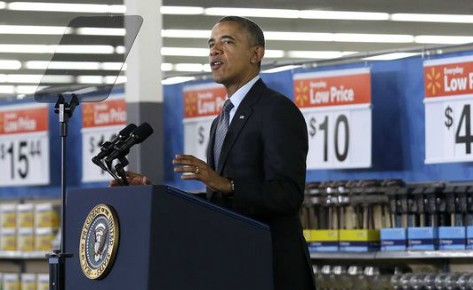
Earlier this month President Obama visited a Bay Area Wal-Mart to praise the world’s largest and most anti-union retailer for its supposed environmental responsibility. The fact is that Wal-Mart’s maintenance of diesel-fueled supply chains between its stores and wherever on the planet wages are lowest and environmental restrictions are totally absent make it a major ongoing contributor to runaway climate change. The president’s appearance therefore, was simply a hypocritical exercise in greenwashing for Wal-Mart.

Though it was an insult to working people and to many of his abject and fervent supporters, it should have been no surprise. It wasn’t President Obama’s first wet kiss to Wal-Mart and with almost three more years in office to go it won’t be his last. Still the willingness of the Obama Administration to do the bidding of Wal-Mart shows just how hollow has become the pretense of elected black Democrats to representing the poor and oppressed.

There was a time when Democrats in the White House did not dare openly shill for the giant retailer. Hillary Clinton served on Wal-Mart’s board of directors through most of the 1980s, while her husband Bill was governor of Arkansas. Even then, Wal-Mart was notorious for overworking and underpaying its workers, violating labor laws to thwart unions, and sopping up prodigious amounts of corporate welfare in the forms of tax breaks and subsidies of all kinds. Being in bed with those crooks wasn’t just an embarrassment, it was a hypocritical affront to Democratic voters, so somewhere on the 1992 road to the White House, Hillary resigned from Wal-Mart’s board. Similarly in 2007 with her husband on the way to the White House, Michelle Obama felt compelled to resign from the board of TreeHouse Foods, a major Wal-Mart vendor. “I won’t shop there,” said presidential candidate Barack Obama when questioned about Wal-Mart at an AFL-CIO labor forum.

Of course labor audiences in 2007 and 2008 were where Obama pledged to renegotiate NAFTA, and immediately raise the minimum wage as soon as he took office. The president never mentioned raising the minimum wage again till about 2012 when Republicans were safely in control of the House of Representatives, and instead of renegotiating NAFTA, President Obama is engaged in secret negotiations to extend it across the Atlantic and Pacific Oceans. Evidently the Obama that promises is a different guy, and far less powerful, than the Obama that acts.

“…The first lady allowed the unscrupulous retailer to leverage her personal image …”

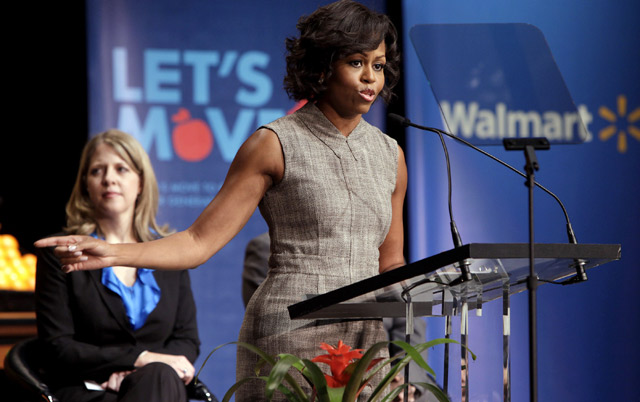
Safely in office, Michelle and Barack Obama have enthusiastically embraced Wal-Mart. The first lady allowed the unscrupulous retailer to leverage her personal image as an advocate of exercise and healthy eating in her “Let’s Move” initiative, and spouting the company line that the best solution to urban “food deserts” is opening more Wal-Mart neighborhood grocery stores. Michelle Obama’s many appearances at and pronouncements around Wal-Mart have done the retailer more good than she and Hillary could ever have done in another decade or two apiece on its board of directors.

Right now Wal-Mart is approaching 30% of the US retail grocery market, with far lower wages, fewer hours, skimpier benefits, and longer and dirtier supply chains than its major competitors. As I said a couple years ago in an article about Michelle Obama’s cynical embrace of Wal-Mart:

Wal-Mart’s business model of corrupting public officials, lying about job creation numbers, rampant sex and race discrimination, relentlessly low wage and benefit levels, and aspirations to monopoly control of local markets across the country make it a bad neighbor, a worse boss, an unfair competitor and sometimes a criminal enterprise.

Wal-Mart has been a leader in the corporate practice of weaponizing its charitable giving, turning it into a lever to open new markets in urban America, to neutralize and isolate opposition, and to curry favor with local political figures. Wal-Mart made it rain on selected charities and ministries in areas like Newark and Chicago when it needed to colonize those new markets. President Obama recognized this “achievement” in the corruption of Democratic party politics in March 2014 by nominating Wal-Mart’s chief of charitable giving to head up his Office of Management and Budget.

Wal-Mart was even allowed, along with McDonalds and other large, low-wage employers, to shape the drafting of regulations governing Obamacare, in ways that exempted the retailer from having to ensure large numbers of its workers for the first several years.

The fiction that elected Democrats represent poor and working people and stand for safeguarding the environment is just that – a fiction. There is a new neoliberal paradigm that allows Democrats to mumble a few words about raising the minimum wage when the other party controls Congress, that claims the moment they took office was the day the oceans stopped rising. If these were curable bugs in the political system, votes and advocacy would wake enough people up to change them. But what if they’re not bugs in the system at all. What if these are its core and immutable features? What then? Isn’t it time to step outside their two-party, capitalist box, to dream and begin to build something else?

Bruce A. Dixon is managing editor at Black Agenda Report and a state committee member of the GA Green Party. He lives and works in Marietta GA and can be reached at bruce.dixon(at)blackagendareport.com.