Why Kim Dotcom Connects The DNC Email Leak To The Murder Of Seth Rich

By: b

Source: Moon of Alabama

Last week we learned a new fact about the DNC email leak in 2016 and of the events that likely led to the killing of Seth Rich.

A quite aggressive Wikipedia page discusses the Murder of Seth Rich:

The murder of Seth Rich occurred on July 10, 2016, at 4:20 a.m. in the Bloomingdale neighborhood of Washington, D.C. Rich died about an hour and a half after being shot twice in the back. The perpetrators were never apprehended; police suspected he had been the victim of an attempted robbery.

The 27-year-old Rich was an employee of the Democratic National Committee (DNC), and his murder spawned several right-wing conspiracy theories, including the false claim, contradicted by the law enforcement branches that investigated the murder, that Rich had been involved with the leaked DNC emails in 2016. It was also contradicted by the July 2018 indictment of 12 Russian military intelligence agents for hacking the e-mail accounts and networks of Democratic Party officials and by the U.S. intelligence community’s conclusion the leaked DNC emails were part of Russian interference in the 2016 United States elections. Fact-checking websites like PolitiFact, Snopes, and FactCheck.org stated that the theories were false and unfounded. The New York Times, the Los Angeles Times and The Washington Post wrote that the promotion of these conspiracy theories was an example of fake news.

Well, that is not what really had happened.

Yes, Seth Rich worked as IT administrator for the Democratic National Committee. He was a fan of Bernie Sanders. During the 2016 primaries DNC functionaries did their best to work against Bernie Sanders and for Hillary Clinton. To make that public Seth Rich collected an archive of all DNC emails, copied it onto an USB stick and looked for someone who would publish them.

UPDATE 20:00 UTC

The former British ambassador Craig Murray said that he was given the USB stick by an intermediary of a disgusted Democratic whistleblower and brought it from Washington DC to Wikileaks which eventually published the emails. The data involved were not only from the DNC but also from Clinton’s campaign chair John Podesta:

WikiLeaks made the DNC messages public in July and the incriminating emails from Podesta were published in October. The messages predominantly showed that DNC officials were bent on sabotaging the presidential campaign of Bernie Sanders in favor of Hillary Clinton. Murray insisted that the information was leaked and not hacked by Russia.

“Neither of the leaks came from the Russians. The source had legal access to the information. The documents came from inside leaks, not hacks…leakers were motivated by disgust at the corruption of the Clinton Foundation and the tilting of the primary election playing field against Bernie Sanders.”

/End Update/

Craig Murray did not mention Seth Rich. Up to last week we did not know if Seth Rich really made contact with Wikileaks.

But we did know that the DNC was never ‘hacked’ by anything Russia. The date/timestamps of the leaked files were consistent with local copying and inconsistent with an internet transfer. The company Crowdstrike which was hired to protect the DNC’s networks and which did an investigation into the case never observed an actual ‘Russian’ hack or any data exfiltration from the DNC network. As ITwire wrote in May 2020:

The controversial American security firm CrowdStrike, which was called in to investigate the alleged Russian hack of DNC servers in 2016, had no proof that any emails from the system had been exfiltrated despite public assertions that this had occurred, according to the transcript of an interview released by the US Government a few days ago.

The transcript was from an interview conducted with CrowdStrike’s president of services and chief security officer Shawn Henry by the US House Permanent Select Committee on Intelligence in December 2017, but only released to the US Special Counsel Robert Mueller who conducted a two-year inquiry into alleged Russian collusion in the 2016 presidential poll.

While the exfiltration of emails from the DNC server has been accepted as a proven fact, Henry’s answers to queries from committee members make it clear that this was definitely not the case.

In one typical exchange, Henry was asked, “What about the emails that everyone is so, you know, knowledgeable of? Were there also indicators that they were prepared but not evidence that they actually were exfiltrated?” To this Henry responded, “There’s not evidence that they were actually exfiltrated. There’s circumstantial evidence – but no evidence that they were actually exfiltrated.”

PolitiFact, Snopes and FactCheck.org are, unsurprisingly, wrong with their assertions.

But how did the emails find their way to Julian Assange at Wikileaks. Assange has never explained that. But Wikileaks set out a $20,000 reward for finding the killer of Seth Rich. That made it obvious that there was a connection between them but no one gave further explanations of it.

It took until last week for the world to learn more about what really happened. On April 21 some rather pungent NAFO activist, Pekka Kallionniemi, launched a Twitter thread with an attack on a person well known in IT circles:

Pekka Kallioniemi @P_Kallioniemi – 10:09 UTC · Apr 21, 2023

In today’s #vatniksoup, I’ll introduce a German-Finnish entrepreneur, conspiracy theorist and propagandist, Kim Dotcom. He’s best-known for his illegal online activities and projects, for his hate towards the US, and for his unwavering support for Putin’s imperialism.
1/18
[…]
In 2017, Dotcom claimed that he worked with Seth Rich, a US citizen and employee on the Democratic National Committee who was murdered during a suspected robbery.His death spawned..
10/18
[…]
..several conspiracy theories stating that he was a whistleblower who had leaked documents damning Hillary Clinton and her campaign manager, John Podesta. The hack-and-leak operation was actually conducted by Russian intelligence service GRU’s hacker group called Fancy Bear.
11/18

Who is Kim Dotcom you might ask:

Kim Dotcom (born Kim Schmitz; 21 January 1974), also known as Kimble and Kim Tim Jim Vestor, is a German-Finnish Internet entrepreneur and political activist who lives in Glenorchy, New Zealand.

Dotcom is the founder and former CEO of the defunct file hosting service Megaupload (2005–2012). In 2012, the United States Department of Justice seized its website and pressed charges against Dotcom, including criminal copyright infringement, money laundering, racketeering and wire fraud. Dotcom was residing in New Zealand at the time; at the request of US authorities, New Zealand police raided his home in 2012 and arrested him. Dotcom posted bail and has been going through legal proceedings ever since to avoid extradition to the United States.

In 2017, Dotcom played a role in spreading conspiracy theories about the murder of Seth Rich.

In May 2017 the Washington Post wrote:

When Seth Rich’s Gmail account received an alert this week from Mega.com, attempting to start a new account on a website created by the New Zealand-based Internet businessman and convicted hacker Kim Dotcom, his family knew that something was off.

Over seven frenzied days, Dotcom had become a leading purveyor of the theory that Rich, a staffer at the Democratic National Committee who was shot dead near his home in Northeast Washington last summer, had supplied DNC documents to WikiLeaks and was killed as a result. Multiple security analysts and an FBI investigation have tied the release to hackers with ties to Russia. D.C. police have said repeatedly that they think Rich was slain in a random robbery attempt.

According to experts and Rich’s family, the emailed invitation from welcome@mega.nz appeared to be an attempt to gain access to Rich’s email. Joel Rich, who monitors his late son’s Gmail account when new emails come in, did not click the link. Dotcom had not worked at Mega itself for years, but he was promising on Twitter to prove that the younger Rich had been in contact with WikiLeaks — and Fox News host Sean Hannity was telling his 2.37 million Twitter followers to be ready for a ­revelation.

Hannity had invited Dotcom to appear on his show for what he said on Twitter would be a “#GameChanger” interview. The implication: that Dotcom would finally offer evidence of his claim that Rich had sent internal DNC documents to WikiLeaks before his death.

All that began to unravel Tuesday afternoon when Fox News retracted a story that had claimed the same Rich-WikiLeaks connection, telling readers that the article was “not initially subjected to the high degree of editorial scrutiny we require for all our reporting.” Fox News did not respond to a request for comment, but Dotcom wrote on his website that he would not speak further about his allegations.

Since then little on the issue was heard from Kim Dotcom. There was no explanation why he was involved in the Seth Rich issue in the first place.

But after Pekka Kallionniemi’s attack was widely retweeted Kim Dotcom contested it:

Kim Dotcom @KimDotcom – 0:41 UTC · Apr 22, 2023

🧵 NAFO bullying exposed

I’m responding to an attempted character assassination by NAFO troll @P_Kallioniemi who prides himself with having attacked over 150 “pro-Russian actors and propagandists.”

His problem is that he picked the wrong guy for his cyber bullying.

Who is Pekka? A research fellow at Tampere University in Finland and a self-proclaimed disinformation expert. Ironic because most of the claims in his attack against me are false. I’m tagging the Dean of Tampere University @SaariJuho to make him aware of Pekka’s NAFO bullying.

First of all I’m in good company because some of the people Pekka has bullied on Twitter are @ggreenwald, @mtaibbi, @rustyrockets & @jimmy_dore. None are “Russian propagandists” or “grifters looking to make some easy money” as Pekka claims. They are truth-tellers, like myself.

False claim 1: Kim was deported from Thailand to Germany.<

Truth: I was never deported from Thailand. I left voluntarily.
[…]
False claim 6: Dotcom claimed that he worked with Seth Rich.

Truth: Seth Rich contacted me and offered information about the DNC. I rejected receiving the data personally and forwarded him to someone close to Wikileaks. That’s how Wikileaks got the DNC and Hillary Clinton leaks.

False claim 7: The (DNC) hack and leak operation was conducted by Russian intelligence.

Truth: A forensic analysis of the leaked DNC data by former US intelligence officials proved that it wasn’t remotely transferred. The meta data shows that the files were transferred locally.

The bold part is significant as it is first time that we learn:

  • That there was a direct connection between Seth Rich and Wikileaks.
  • Why Kim Dotcom had involved himself in the Seth Rich case after Rich had been killed.

You may say that the first claim is not new because many had presumed that. But no one involved had ever actually publicly made the claim. Dotcom’s assertion of this connection through him is new.

After contacting Kim Dotcom Seth Rich was pointed to someone else near to Wikileaks. Eventually Wikileaks asked Craig Murray to fly to DC and to bring the files to Wikileaks. The  Clinton server emails were published by Wikileaks in March 2016. The DNC emails were published in June and July 2016. The Podesta emails were published in October 2016.

I hope that Kim Dotcom will one day write down the complete sequence of events that are related to Seth Rich and the publishing of the Clinton, Podesta and DNC leaks by Wikileaks.

What the Media Still Isn’t Telling You About Russiagate

By Ray McGovern

Source: AntiWar.com

Two years ago last Saturday (May 7, 2020) Adam Schiff (D, California), Chair of the House Intelligence Committee, was forced to perform what Nixon co-conspirator John Ehrlichman famously called a “modified limited hangout.”

On that day, Schiff released sworn testimony that there was zero technical evidence that Russia – or anyone else – hacked those DNC emails so prejudicial to Hillary Clinton (later published by WikiLeaks).

Now, please, before you put me in Putin’s or Trump’s pocket, read on: The testifier was Shawn Henry, the head of the cybersecurity firm CrowdStrike. For reasons former FBI Director James Comey would never really explain, he deferred to CrowdStrike to do the forensic work on the DNC computers that were supposedly “hacked.” Comey told Congress that CrowdStrike “would share with us what they saw.”

In June 2019, it was revealed that CrowdStrike never produced an un-redacted or final forensic report for the government because the FBI never required it to, according to the Justice Department.

Are you starting to smell a rat? What about the “modified limited hangout”?

Well, if some or all of this is news to you, it is because the NY Times and other major media have deep-sixed it for exactly two years now, and counting. It gets worse – much worse.

What Did Schiff Know and When Did He Know It?

Fasten your seatbelts: It was on December 5, 2017 that Shawn Henry gave sworn testimony to the House Intelligence Committee – see the official transcript. Henry testified that there was no technical evidence that Russia, or any other entity, hacked the DNC emails that were published by WikiLeaks just before the Democratic Convention in July 2016. (The emails showed how the deck had been stacked against Bernie Sanders – in the primaries, for example.)

Shawn Henry is a longtime protégé of former FBI Director Robert Mueller and headed Mueller’s FBI cyber investigation unit. After retiring from the FBI in 2012, he took a senior position at CrowdStrike. At his testimony on Dec. 5, 2017, he had Graham M. Wilson, a partner at Perkins Coie, as well as David C. Lashway of Baker & McKenzie in support.

Falling Silently in the Forest

Veteran Intelligence Professionals for Sanity, relying on (1) the extensive expertise and professional experience of two members who happened to have been Technical Directors at NSA, (2) the revelations of Edward Snowden, and (3) the immutable principles of physics, had already concluded that the accusation of that Russian hack on the DNC was phony. (That Brennan’s CIA “believed” it to be credible helped not a whit.)

Below is how we began “Allegations of Hacking are Baseless,” our Memorandum of December 12, 2016 (a year before Shawn Henry was forced to choose between telling the truth or perjuring himself). We wrote:

New York Times report on Monday alluding to “overwhelming circumstantial evidence” leading the CIA to believe that Russian President Vladimir Putin “deployed computer hackers with the goal of tipping the election to Donald J. Trump” is, sadly, evidence-free. This is no surprise, because harder evidence of a technical nature points to an inside leak, not hacking – by Russians or anyone else. (See: “US Intel Vets Dispute Russia Hacking Claims.”)

We even included a brief tutorial on the difference between a “hack” and a leak, but we were already, in Dec. 2016 going up against deeply encrusted popular “belief” based on intelligence-corporate media connivance.

‘Modified Limited Hangout’

Schiff was able to hide Shawn Henry’s testimony for two and a half years. Under considerable pressure from a new Director of National Intelligence, who threatened to release the testimony himself, Schiff finally relented and released it (as mentioned above) on May 7, 2020. As for Establishment media, the transcript of Henry’s testimony fell like the proverbial tree in the forest with no one around to hear it.

Did the NY Times, et al. get “The Memo” ordering all to avoid Henry’s testimony like the plague? Actually, in this particular case, corporate media had quite enough incentive of their own to hide from media consumers the fact that “Russian hacking,” the cornerstone of Russia-gate, was a crock, and that viewers and listeners had been had.

When I wrote about the released – well, sort of released – Shawn Henry transcript the following day, there was a wealth of background information to provide context to this sordid affair. I included a four-minute discussion I had had with Schiff just five days after Trump took office, a reminder that the Dems were well into “Russian hacking” as the centerpiece of Russia-gate from the very start. (That clip, and lots else, is embedded here)

So Schiff knew on Dec. 5, 2017 that “Russian hacking” of those DNC emails was bogus. I was recently asked, why do you suppose he did not tell Robert Mueller, the “Inspector Javert” in hot pursuit of “Russian election interference,” whose $32-million investigation of Russia-gate lasted from May 2017 till March 2019? Good question. Did Shawn Henry misplace the telephone number of Mueller, his old boss and mentor? Or did Mueller know, and despite knowing, continued his Javert-like chase until after the mid-terms in November 2018. (That worked for the Democrats; and, not incidentally, Schiff took back the reins of the Intelligence Committee.)

Most of Americans have no idea how they’ve been had on Russia-gate. And the NYTimes, et al. have every reason to keep them in the dark about “Russian hacking.” Most people have little idea as to how the steady drumming on Russian perfidy has conditioned them not only to distrust “the Russians,” but to hate them. (What, after all, could be more hateful than for being responsible for giving us four years of Trump?) Sadly – and admittedly – it cannot be considered unreasonable to be convinced that everything out of Trump’s mouth is a lie and that he would never ever tell the truth about Russia – given what Obama and others call his “bromance” with Putin.

There are, of course, dangerous implications in all this for what Americans may be asked in terms of confronting Russia on Ukraine.

On wider Russia-gate issues over the past five years and my tree-falling-in-forest attempts to expose the malfeasance of our corporate-captive media, readers may wish to review this.

Another Mega Group Spy Scandal? Samanage, Sabotage, and the SolarWinds Hack

By Whitney Webb

Source: The Unz Review

The devastating hack on SolarWinds was quickly pinned on Russia by US intelligence. A more likely culprit, Samanage, a company whose software was integrated into SolarWinds’ software just as the “back door” was inserted, is deeply tied to Israeli intelligence and intelligence-linked families such as the Maxwells.

In mid-December of 2020, a massive hack compromised the networks of numerous US federal agencies, major corporations, the top five accounting firms in the country, and the military, among others. Despite most US media attention now focusing on election-related chaos, the fallout from the hack continues to make headlines day after day.

The hack, which affected Texas-based software provider SolarWinds, was blamed on Russia on January 5 by the US government’s Cyber Unified Coordination Group. Their statement asserted that the attackers were “likely Russian in origin,” but they failed to provide evidence to back up that claim.

Since then, numerous developments in the official investigation have been reported, but no actual evidence pointing to Russia has yet to be released. Rather, mainstream media outlets began reporting the intelligence community’s “likely” conclusion as fact right away, with the New York Times subsequently reporting that US investigators were examining a product used by SolarWinds that was sold by a Czech Republic–based company, as the possible entry point for the “Russian hackers.” Interest in that company, however, comes from the fact that the attackers most likely had access to the systems of a contractor or subsidiary of SolarWinds. This, combined with the evidence-free report from US intelligence on “likely” Russian involvement, is said to be the reason investigators are focusing on the Czech company, though any of SolarWinds’ contractors/subsidiaries could have been the entry point.

Such narratives clearly echo those that became prominent in the wake of the 2016 election, when now-debunked claims were made that Russian hackers were responsible for leaked emails published by WikiLeaks. Parallels are obvious when one considers that SolarWinds quickly brought on the discredited firm CrowdStrike to aid them in securing their networks and investigating the hack. CrowdStrike had also been brought on by the DNC after the 2016 WikiLeaks publication, and subsequently it was central in developing the false declarations regarding the involvement of “Russian hackers” in that event.

There are also other parallels. As Russiagate played out, it became apparent that there was collusion between the Trump campaign and a foreign power, but the nation was Israel, not Russia. Indeed, many of the reports that came out of Russiagate revealed collusion with Israel, yet those instances received little coverage and generated little media outrage. This has led some to suggest that Russiagate may have been a cover for what was in fact Israelgate.

Similarly, in the case of the SolarWinds hack, there is the odd case and timing of SolarWinds’ acquisition of a company called Samanage in 2019. As this report will explore, Samanage’s deep ties to Israeli intelligence, venture-capital firms connected to both intelligence and Isabel Maxwell, as well as Samange’s integration with the Orion software at the time of the back door’s insertion warrant investigation every bit as much as SolarWinds’ Czech-based contractor.

Orion’s Fall

In the month since the hack, evidence has emerged detailing the extent of the damage, with the Justice Department quietly announcing, the same day as the Capitol riots (January 6), that their email system had been breached in the hack—a “major incident” according to the department. This terminology means that the attack “is likely to result in demonstrable harm to the national security interests, foreign relations, or the economy of the United States or to the public confidence, civil liberties, or public health and safety of the American people,” per NextGov.

The Justice Department was the fourth US government agency to publicly acknowledge a breach in connection to the hack, with the others being the Departments of Commerce and Energy and the Treasury. Yet, while only four agencies have publicly acknowledged fallout from the hack, SolarWinds software is also used by the Department of Defense, the State Department, NASA, the NSA, and the Executive Office. Given that the Cyber Unified Coordination Group stated that “fewer than ten” US government agencies had been affected, it’s likely that some of these agencies were compromised, and some press reports have asserted that the State Department and Pentagon were affected.

In addition to government agencies, SolarWinds Orion software was in use by the top ten US telecommunications corporations, the top five US accounting firms, the New York Power Authority, and numerous US government contractors such as Booz Allen Hamilton, General Dynamics, and the Federal Reserve. Other notable SolarWinds clients include the Bill & Melinda Gates Foundation, Microsoft, Credit Suisse, and several mainstream news outlets including the Economist and the New York Times.

Based on what is officially known so far, the hackers appeared to have been highly sophisticated, with FireEye, the cybersecurity company that first discovered the implanted code used to conduct the hack, stating that the hackers “routinely removed their tools, including the backdoors, once legitimate remote access was achieved—implying a high degree of technical sophistication and attention to operational security.” In addition, top security experts have noted that the hack was “very very carefully orchestrated,” leading to a consensus that the hack was state sponsored.

FireEye stated that they first identified the compromise of SolarWinds after the version of the Orion software they were using contained a back door that was used to gain access to its “red team” suite of hacking tools. Not long after the disclosure of the SolarWinds hack, on December 31, the hackers were able to partially access Microsoft’s source code, raising concerns that the act was preparation for future and equally devastating attacks.

FireEye’s account can be taken with a grain of salt, however, as the CIA is one of FireEye’s clients, and FireEye was launched with funding from the CIA’s venture capital arm In-Q-tel. It is also worth being skeptical of the “free tool” FireEye has made available in the hack’s aftermath for “spotting and keeping suspected Russians out of systems.”

In addition, Microsoft, another key source in the SolarWinds story, is a military contractor with close ties to Israel’s intelligence apparatus, especially Unit 8200, and their reports of events also deserve scrutiny. Notably, it was Unit 8200 alumnus and executive at Israeli cybersecurity firm Cycode, Ronen Slavin, who told Reuters in a widely quoted article that he “was worried by the possibility that the SolarWinds hackers were poring over Microsoft’s source code as prelude to a much more ambitious offensive.” “To me the biggest question is, ‘Was this recon for the next big operation?’” Slavin stated.

Also odd about the actors involved in the response to the hack is the decision to bring on not only the discredited firm CrowdStrike but also the new consultancy firm of Chris Krebs and Alex Stamos, former chief information security officer of Facebook and Yahoo, to investigate the hack. Chris Krebs is the former head of the Department of Homeland Security’s Cybersecurity and Infrastructure Security Agency (CISA) and was previously a top Microsoft executive. Krebs was fired by Donald Trump after repeatedly and publicly challenging Trump on the issue of election fraud in the 2020 election.

As head of CISA, Krebs gave access to networks of critical infrastructure throughout the US, with a focus on the health-care industry, to the CTI League, a suspicious outfit of anonymous volunteers working “for free” and led by a former Unit 8200 officer. “We have brought in the expertise of Chris Krebs and Alex Stamos to assist in this review and provide best-in-class guidance on our journey to evolve into an industry leading secure software development company,” a SolarWinds spokesperson said in an email cited by Reuters.

It is also worth noting that the SolarWinds hack did benefit a few actors aside from the attackers themselves. For instance, Israeli cybersecurity firms CheckPoint and CyberArk, which have close ties to Israeli intelligence Unit 8200, have seen their stocks soar in the weeks since the SolarWinds compromise was announced. Notably, in 2017, CyberArk was the company that “discovered” one of the main tactics used in an attack, a form of SAML token manipulation called GoldenSAML. CyberArk does not specify how they discovered this method of attack and, at the time they announced the tactic’s existence, released a free tool to identify systems vulnerable to GoldenSAML manipulation.

In addition, the other main mode of attack, a back door program nicknamed Sunburst, was found by Kaspersky researchers to be similar to a piece of malware called Kazuar that was also first discovered by another Unit 8200-linked company, Palo Alto Networks, also in 2017. The similarities only suggest that those who developed the Sunburst backdoor may have been inspired by Kazuar and “they may have common members between them or a shared software developer building their malware.” Kaspersky stressed that Sunburst and Kazuar are not likely to be one and the same. It is worth noting, as an aside, that Unit 8200 is known to have previously hacked Kaspersky and attempted to insert a back door into their products, per Kaspersky employees.

Crowdstrike claimed that this finding confirmed “the attribution at least to Russian intelligence,” only because an allegedly Russian hacking group is believed to have used Kazuar before. No technical evidence linking Russia to the SolarWinds hacking has yet been presented.

Samanage and Sabotage

The implanted code used to execute the hack was directly injected into the source code of SolarWinds Orion. Then, the modified and bugged version of the software was “compiled, signed and delivered through the existing software patch release management system,” per reports. This has led US investigators and observers to conclude that the perpetrators had direct access to SolarWinds code as they had “a high degree of familiarity with the software.” While the way the attackers gained access to Orion’s code base has yet to be determined, one possibility being pursued by investigators is that the attackers were working with employee(s) of a SolarWinds contractor or subsidiary.

US investigators have been focusing on offices of SolarWinds that are based abroad, suggesting that—in addition to the above—the attackers were likely working for SolarWinds or were given access by someone working for the company. That investigation has focused on offices in eastern Europe, allegedly because “Russian intelligence operatives are deeply rooted” in those countries.

It is worth pointing out, however, that Israeli intelligence is similarly “deeply rooted” in eastern European states both before and after the fall of the Soviet Union, ties well illustrated by Israeli superspy and media tycoon Robert Maxwell’s frequent and close associations with Eastern European and Russian intelligence agencies as well as the leaders of many of those countries. Israeli intelligence operatives like Maxwell also had cozy ties with Russian organized crime. For instance, Maxwell enabled the access of the Russian organized crime network headed by Semion Mogilevich into the US financial system and was also Mogilevich’s business partner. In addition, the cross-pollination between Israeli and Russian organized crime networks (networks which also share ties to their respective intelligence agencies) and such links should be considered if the cybercriminals due prove to be Russian in origin, as US intelligence has claimed.

Though some contractors and subsidiaries of SolarWinds are now being investigated, one that has yet to be investigated, but should be, is Samanage. Samanage, acquired by SolarWinds in 2019, not only gained automatic access to Orion just as the malicious code was first inserted, but it has deep ties to Israeli intelligence and a web of venture-capital firms associated with numerous Israeli espionage scandals that have targeted the US government. Israel is deemed by the NSA to be one of the top spy threats facing US government agencies and Israel’s list of espionage scandals in the US is arguably the longest, and includes the Jonathan Pollard and PROMIS software scandals of the 1980s to the Larry Franklin/AIPAC espionage scandal in 2009.

Though much reporting has since been done on the recent compromise of SolarWinds Orion software, little attention has been paid to Samanage. Samanage offers what it describes as “an IT Service Desk solution.” It was acquired by SolarWinds so Samanage’s products could be added to SolarWinds’ IT Operations Management portfolio. Though US reporting and SolarWinds press releases state that Samanage is based in Cary, North Carolina, implying that it is an American company, Samanage is actually an Israeli firm. It was founded in 2007 by Doron Gordon, who previously worked for several years at MAMRAM, the Israeli military’s central computing unit.

Samanage was SolarWinds’ first acquisition of an Israeli company, and, at the time, Israeli media reported that SolarWinds was expected to set up its first development center in Israel. It appears, however, that SolarWinds, rather than setting up a new center, merely began using Samanage’s research and development center located in Netanya, Israel.

Several months after the acquisition was announced, in November 2019, Samanage, renamed SolarWinds Service Desk, became listed as a standard feature of SolarWinds Orion software, whereas the integration of Samanage and Orion had previously been optional since the acquisition’s announcement in April of that year. This means that complete integration was likely made standard in either October or November. It has since been reported that the perpetrators of the recent hack gained access to the networks of US federal agencies and major corporations at around the same time. Samanage’s automatic integration into Orion was a major modification made to the now-compromised software during that period.

Samanage appears to have had access to Orion following the announcement of the acquisition in April 2019. Integration first began with Orion version 2019.4, the earliest version believed to contain the malicious code that enabled the hack. In addition, the integrated Samanage component of Orion was responsible for “ensuring the appropriate teams are quickly notified when critical events or performance issues [with Orion] are detected,” which was meant to allow “service agents to react faster and resolve issues before . . . employees are impacted.”

In other words, the Samanage component that was integrated into Orion at the same time the compromise took place was also responsible for Orion’s alert system for critical events or performance issues. The code that was inserted into Orion by hackers in late 2019 nevertheless went undetected by this Samanage-made component for over a year, giving the “hackers” access to millions of devices critical to both US government and corporate networks. Furthermore, it is this Samanage-produced component of the affected Orion software that advises end users to exempt the software from antivirus scans and group policy object (GPO) restrictions by providing a warning that Orion may not work properly unless those exemptions are granted.

Samanage, Salesforce, and the World Economic Forum

Around the time of Samange’s acquisition by SolarWinds, it was reported that one of Samanage’s top backers was the company Salesforce, with Salesforce being both a major investor in Samanage as well as a partner of the company.

Salesforce is run by Marc Benioff, a billionaire who got his start at the tech giant Oracle. Oracle was originally created as a CIA spin-off and has deep ties to Israel’s government and the outgoing Trump administration. Salesforce also has a large presence in Israel, with much of its global research and development based there. Salesforce also recently partnered with the Unit 8200-linked Israeli firm Diagnostic Robotics to “predictively” diagnose COVID-19 cases using Artificial Intelligence.

Aside from leading Salesforce, Benioff is a member of the Vatican’s Council for Inclusive Capitalism alongside Lynn Forester de Rothschild, a close associate of Jeffrey Epstein and the Clintons, and members of the Lauder family, who have deep ties to the Mega Group and Israeli politics.

Benioff is also a prominent member of the board of trustees of the World Economic Forum and the inaugural chair of the WEF’s Centre for the Fourth Industrial Revolution (C4IR), making him one of the most critical players in the unfolding of the WEF-backed Great Reset. Other WEF leaders, including the organization’s founder Klaus Schwab, have openly discussed how massive cyberattacks such as befell SolarWinds will soon result in “even more significant economic and social implications than COVID-19.”

Last year, the WEF’s Centre for Cybersecurity, of which Salesforce is part, simulated a “digital pandemic” cyberattack in an exercise entitled Cyber Polygon. Cyber Polygon’s speakers in 2020 included former UK Prime Minister Tony Blair, the Prime Minister of Russia Mikhail Mishustin, WEF founder Klaus Schwab, and IBM executive Wendi Whitmore, who previously held top posts at both Crowdstrike and a FireEye subsidiary. Notably, just months before the COVID-19 crisis, the WEF had held Event 201, which simulated a global coronavirus pandemic that crippled the world’s economy.

In addition to Samanage’s ties to WEF big shots such as Marc Benioff, the other main investors behind Samanage’s rise have ties to major Israeli espionage scandals, including the Jonathan Pollard affair and the PROMIS software scandal. There are also ties to one of the WEF’s founding “technology pioneers,” Isabel Maxwell (the daughter of Robert Maxwell and sister of Ghislaine), who has long-standing ties to Israel’s intelligence apparatus and the country’s hi-tech sector.

The Bronfmans, the Maxwells, and Viola Ventures

At the time of its acquisition by SolarWinds, Samanage’s top investor was Viola Ventures, a major Israeli venture-capital firm. Viola’s investment in Samanage, until its acquisition, was managed by Ronen Nir, who was also on Samanage’s board before it became part of SolarWinds.

Prior to working at Viola, Ronen Nir was a vice president at Verint, formerly Converse Infosys. Verint, whose other alumni have gone on to found Israeli intelligence-front companies such as Cybereason. Verint has a history of aggressively spying on US government facilities, including the White House, and created the backdoors into all US telecommunications systems and major tech companies, including Microsoft, Google and Facebook, on behalf of the US’ NSA.

In addition to his background at Verint, Ronen Nir is an Israeli spy, having served for thirteen years in an elite IDF intelligence unit, and he remains a lieutenant colonel on reserve duty. His biography also notes that he worked for two years at the Israeli embassy in Washington, DC, which is fitting given his background in espionage and the major role that Israeli embassy has played in several major espionage scandals.

As an aside, Nir has stated that “thought leader” Henry Kissinger is his “favorite historical character.” Notably, Kissinger was instrumental in allowing Robert Maxwell, Israeli superspy and father of Ghislaine and Isabel Maxwell, to sell software with a back door for Israeli intelligence to US national laboratories, where it was used to spy on the US nuclear program. Kissinger had told Maxwell to connect with Senator John Tower in order to gain access to US national laboratories, which directly enabled this action, part of the larger PROMIS software scandal.

In addition, Viola’s stake was managed through a firm known as Carmel Ventures, which is part of the Viola Group. At the time, Carmel Ventures was advised by Isabel Maxwell, whose father had previously been directly involved in the operation of the front company used to sell bugged software to US national laboratories. As noted in a previous article at Unlimited Hangout, Isabel “inherited” her father’s circle of Israeli government and intelligence contacts after his death and has been instrumental in building the “bridge” between Israel’s intelligence and military-linked hi-tech sector to Silicon Valley.

Isabel also has ties to the Viola Group itself through Jonathan Kolber, a general partner at Viola. Kolber previously cofounded and led the Bronfman family’s private-equity fund, Claridge Israel (based in Israel). Kolber then led Koor Industries, which he had acquired alongside the Bronfmans via Claridge. Kolber is closely associated with Stephen Bronfman, the son of Charles Bronfman who created Claridge and also cofounded the Mega Group with Leslie Wexner in the early 1990s.

Kolber, like Isabel Maxwell, is a founding director of the Peres Center for Peace and Innovation. Maxwell, who used to chair the center’s board, stepped down following the Epstein scandal, though it’s not exactly clear when. Other directors of the center include Tamir Pardo, former head of Mossad. Kolber’s area of expertise, like that of Isabel Maxwell, is “structuring complex, cross-border and cross industry business and financial transactions,” that is, arranging acquisitions and partnerships of Israeli firms by US companies. Incidentally, this is also a major focus of the Peres Center.

Other connections to Isabel Maxwell, aside from her espionage ties, are worth noting, given that she is a “technology pioneer” of the World Economic Forum. As previously mentioned, Salesforce—a major investor in Samanage—is deeply involved with the WEF and its Great Reset.

The links of Israeli intelligence and Salesforce to Samanage, and thus to SolarWinds, is particularly relevant given the WEF’s “prediction” of a coming “pandemic” of cyberattacks and the early hints from former Unit 8200 officers that the SolarWinds hack is just the beginning. It is also worth mentioning the Israeli government’s considerable ties to the WEF over the years, particularly last year when it joined the Benioff-chaired C4IR and participated in the October 2020 WEF panel entitled “The Great Reset: Harnessing the Fourth Industrial Revolution.”

Start Up Nation Central, an organization aimed at integrating Israeli start-ups with US firms set up by Netanyahu’s longtime economic adviser Eugene Kandel and American Zionist billionaire Paul Singer, have asserted that Israel will serve a “key role” globally in the 4th Industrial Revolution following the implementation of the Great Reset.

Gemini, the BIRD Foundation, and Jonathan Pollard

In addition to Viola, another of Samange’s leading investors is Gemini Israel Ventures. Gemini is one of Israel’s oldest venture-capital firms, dating back to the Israeli government’s 1993 Yozma program.

The first firm created by Yozma, Gemini was put under the control of Ed Mlavsky, who Israel’s government had chosen specifically for this position. As previously reported by Unlimited Hangout, Mlavsky was then serving as the executive director of the Israel-US Binational Industrial Research and Development (BIRD) Foundation, where “he was responsible for investments of $100 million in more than 300 joint projects between US and Israeli high-tech companies.”

A few years before Gemini was created, while Mlavsky still headed BIRD, the foundation became embroiled in one of the worst espionage scandals in US history, the Jonathan Pollard affair.

In the indictment of US citizen Pollard for espionage on Israel’s behalf, it was noted that Pollard delivered the documents he stole to agents of Israel at two locations, one of which was an apartment owned by Harold Katz, the then legal counsel of the BIRD Foundation and an adviser to Israel’s military, which oversaw Israel’s scientific intelligence-gathering agency, Lekem. US officials told the New York Times at the time that they believed Katz “has detailed knowledge about the [Pollard] spy ring and could implicate senior Israeli officials.”

Subsequent reporting by journalist Claudia Wright pointed the finger at the Mlavsky-run BIRD Foundation as one of the ways Israeli intelligence funneled money to Pollard before his capture by US authorities.

One of the first companies Gemini invested in was CommTouch (now Cyren), which was founded by ex-IDF officers and later led by Isabel Maxwell. Under Maxwell’s leadership, CommTouch developed close ties to Microsoft, partially due to Maxwell’s relationship with its cofounder Bill Gates.

A Coming “Hack” of Microsoft?

If the SolarWinds hack is as serious as has been reported, it’s difficult to understand why a company like Samanage would not be looked into as part of a legitimate investigation into the attack. The timing of Samanage employees gaining access to the Orion software and the company’s investors including Israeli spies and those with ties to past espionage scandals where Israel used back doors to spy on the US and beyond raises obvious red flags. Yet, any meaningful investigation of the incident is unlikely to take place, especially given the considerable involvement of discredited firms like CrowdStrike, CIA fronts like FireEye and a consultancy firm led by former Silicon Valley executives with their own government/intelligence ties.

There is also the added fact that both of the main methods used in the attack were analogous or bore similarities to hacking tools that were both discovered by Unit 8200-linked companies in 2017. Unit 8200-founded cybersecurity firms are among the few “winners” from the SolarWinds hack, as their stocks have skyrocketed and demand for their services has increased globally.

While some may argue that Unit 8200 alumni are not necessarily connected to the Israeli intelligence apparatus, numerous reports have pointed out the admitted fusion of Israeli military intelligence with Israel’s hi-tech sector and its tech-focused venture capital networks, with Israeli military and intelligence officials themselves noting that the line between the private cybersecurity sector and Israel’s intelligence apparatus is so blurred, it’s difficult to know where one begins and the other ends. There is also the Israeli government policy, formally launched in 2012, whereby Israel’s intelligence and military intelligence agencies began outsourcing “activities that were previously managed in-house, with a focus on software and cyber technologies.”

Samanage certainly appears to be such a company, not only because it was founded by a former IDF officer in the military’s central computing unit, but because its main investors include spies on “reserve duty” and venture capital firms linked to the Pollard scandal as well as the Bronfman and Maxwell families, both of whom have been tied to espionage and sexual blackmail scandals over the years.

Yet, as the Epstein scandal has recently indicated, major espionage scandals involving Israel receive little coverage and investigations into these events rarely lead anywhere. PROMIS was covered up largely thanks to Bill Barr during his first term as Attorney General and even the Pollard affair has all been swept under the rug with Donald Trump allowing Pollard to move to Israel and, more recently, pardoning the Israeli spy who recruited Pollard during his final day as President. Also under Trump, there was the discovery of “stingray” surveillance devices placed by Israel’s government throughout Washington DC, including next to the White House, which were quickly memory holed and oddly not investigated by authorities. Israel had previously wiretapped the White House’s phone lines during the Clinton years.

Another cover up is likely in the case of SolarWinds, particularly if the entry point was in fact Samanage. Though a cover up would certainly be more of the same, the SolarWinds case is different as major tech companies and cybersecurity firms with ties to US and Israeli intelligence now insist that Microsoft is soon to be targeted in what would clearly be a much more devastating event than SolarWinds due to the ubiquity of Microsoft’s products.

On Tuesday, CIA-linked firm FireEye, which apparently has a leadership role in investigating the hack, claimed that the perpetrators are still gathering data from US government agencies and that “the hackers are moving into Microsoft 365 cloud applications from physical, on-premises servers,” meaning that changes to fix Orion’s vulnerabilities will not necessarily deny hacker access to previously compromised systems as they allegedly maintain access to those systems via Microsoft cloud applications. In addition to Microsoft’s own claims that some of its source code was accessed by the hackers, this builds the narrative that Microsoft products are poised to be targeted in the next high-profile hack.

Microsoft’s cloud security infrastructure, set to be the next target of the SolarWinds hackers, was largely developed and later managed by Assaf Rappaport, a former Unit 8200 officer who was most recently the head of Microsoft’s Research and Development and Security teams at its massive Israel branch. Rappaport left Microsoft right before the COVID-19 crisis began last year to found a new cybersecurity company called Wiz.

Microsoft, like some of Samanage’s main backers, is part of the World Economic Forum and is an enthusiastic supporter of and participant in the Great Reset agenda, so much so that Microsoft CEO Satya Nadella wrote the foreword to Klaus Schwab’s book “Shaping the Fourth Industrial Revolution.” With the WEF simulating a cyber “pandemic” and both the WEF and Israel’s head of Israel’s National Cyber Directorate warning of an imminent “cyber winter”, SolarWinds does indeed appear to be just the beginning, though perhaps a scripted one to create the foundation for something much more severe. A cyberattack on Microsoft products globally would certainly upend most of the global economy and likely have economic effects more severe than the COVID-19 crisis, just as the WEF has been warning. Yet, if such a hack does occur, it will inevitably serve the aims of the Great Reset to “reset” and then rebuild electronic infrastructure.


RAY McGOVERN: Catapulting Russian-Meddling Propaganda

By Ray McGovern

Source: Consortium News

The fresh orgy of anti-Russian invective in the lickspittle media (LSM) has the feel of fin de siècle. The last four reality-impaired years do seem as though they add up to a century. And no definitive fin is in sight, as long as most people don’t know what’s going on.

The LSM should be confronted: “At long last have you left no sense of decency?” But who would hear the question — much less any answer? The corporate media have a lock on what Americans are permitted or not permitted to hear. Checking the truth, once routine in journalism, is a thing of the past.

Thus the reckless abandon with which The New York Times is leading the current full-court press to improve on what it regards as Special Counsel Robert Mueller’s weak-kneed effort to blame the Russians for giving us Donald Trump. The press is on, and there are no referees to call the fouls.

The recent release of a 1,000-page, sans bombshells and already out-of-date report by the Senate Intelligence Committee has provided the occasion to “catapult the propaganda,” as President George W. Bush once put it.

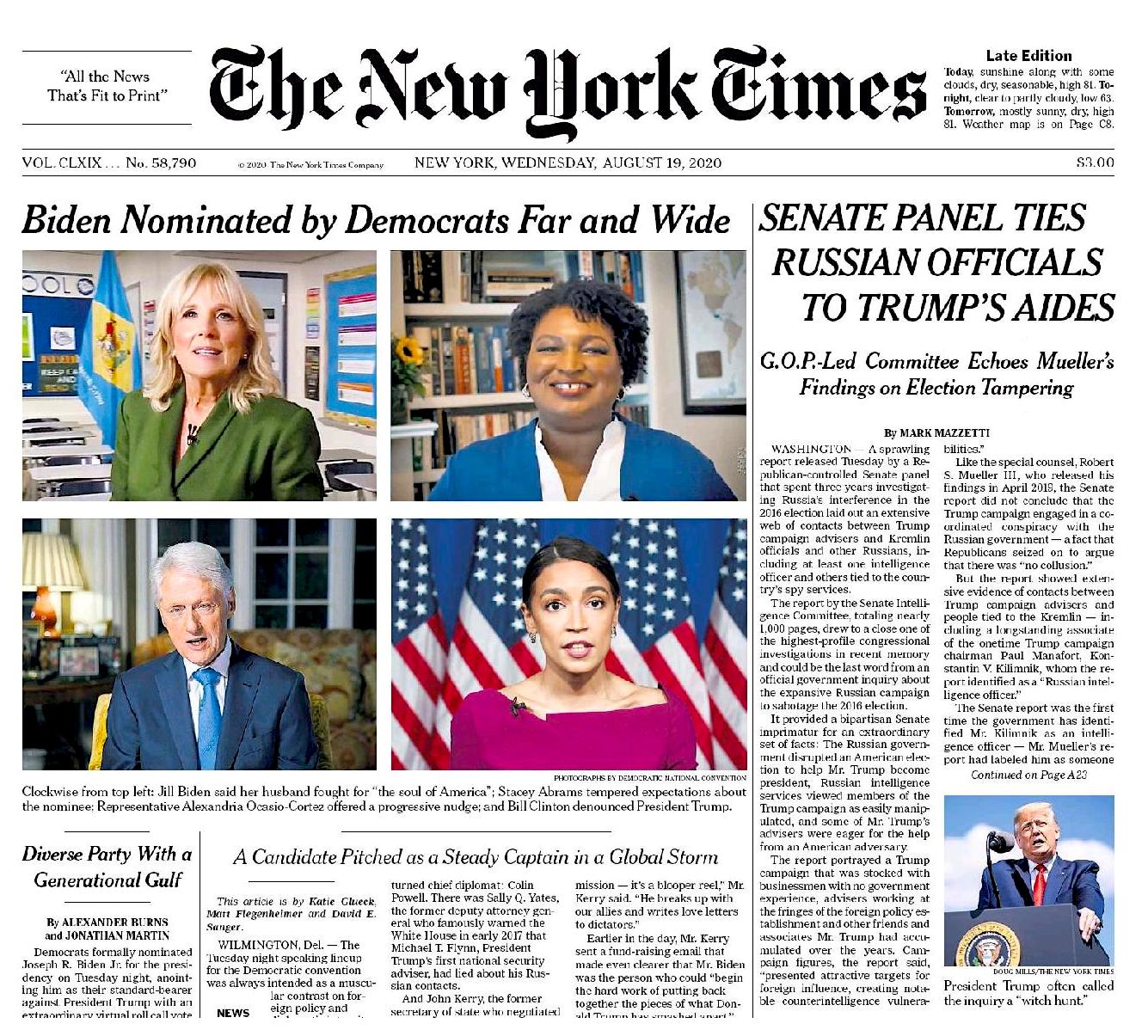
As the the Times‘s Mark Mazzetti put it in his article Wednesday:

“Releasing the report less than 100 days before Election Day, Republican-majority senators hoped it would refocus attention on the interference by Russia and other hostile foreign powers in the American political process, which has continued unabated.”

Mazzetti is telling his readers, soto voce: regarding that interference four years ago, and the “continued-unabated” part, you just have to trust us and our intelligence community sources who would never lie to you. And if, nevertheless, you persist in asking for actual evidence, you are clearly in Putin’s pocket.

Incidentally, Mueller’s report apparently was insufficient, only two years in the making, and just 448 pages. The Senate committee’s magnum opus took three years, is almost 1,000 pages — and fortified. So there.

Iron Pills

Recall how disappointed the LSM and the rest of the Establishment were with Mueller’s anemic findings in spring 2019. His report claimed that the Russian government “interfered in the 2016 presidential election in sweeping and systematic fashion” via a social media campaign run by the Internet Research Agency (IRA) and by “hacking” Democratic emails. But the evidence behind those charges could not bear close scrutiny.

You would hardly know it from the LSM, but the accusation against the IRA was thrown out of court when the U.S. government admitted it could not prove that the IRA was working for the Russian government. Mueller’s ipse dixit did not suffice, as we explained a year ago in “Sic Transit Gloria Mueller.”

The Best Defense …

… is a good offense, and the Senate Intelligence Committee’s release of its study — call it “Mueller (Enhanced)” — and the propaganda fanfare — come at a key point in the Russiagate/Spygate imbroglio. It also came, curiously, as the Democratic Convention was beginning, as if the Republican-controlled Senate was sending Trump a message.

One chief worry, of course, derives from the uncertainty as to whether John Durham, the US Attorney investigating those FBI and other officials who launched the Trump-Russia investigation will let some heavy shoes drop before the election. Barr has said he expects “developments in Durham’s investigation hopefully before the end of the summer.”

FBI attorney Kevin Clinesmith already has decided to plead guilty to the felony of falsifying evidence used to support a warrant from the Foreign Intelligence Surveillance Court to surveillance to spy on Trump associate Carter Page. It is abundantly clear that Clinesmith was just a small cog in the deep-state machine in action against candidate and then President Trump. And those running the machine are well known. The president has named names, and Barr has made no bones about his disdain for what he calls spying on the president.

The cognoscenti and the big fish themselves may be guessing that Trump/Barr/Durham will not throw out heavier lines for former FBI Director James Comey, his deputy Andrew McCabe, CIA Director John Brennan, and Director of National Intelligence James Clapper, for example. But how can they be sure? What has become clear is that the certainty they all shared that Hillary Clinton would be the next president prompted them not only to take serious liberties with the Constitution and the law, but also to do so without taking rudimentary steps to hide their tracks.

The incriminating evidence is there. And as Trump becomes more and more vulnerable and defensive about his ineptness — particularly with regard to Covid-19 — he may summon the courage to order Barr and Durham to hook the big fish, not just minnows like Clinesmith. The neuralgic reality is that no one knows at this point how far Trump will go. To say that this kind of uncertainty is unsettling to all concerned is to say the obvious.

So, the stakes are high — for the Democrats, as well — and, not least, the LSM. In these circumstances it would seem imperative not just to circle the wagons but to mount the best offense/defense possible, despite the fact that virtually all the ammunition (as in the Senate report) is familiar and stale (“enhanced” or not).

Black eyes might well be in store for the very top former law enforcement and intelligence officials, the Democrats, and the LSM — and in the key pre-election period. So, the calculation: launch “Mueller Report (Enhanced)” and catapult the truth now with propaganda, before it is too late.

No Evidence of Hacking

The “hacking of the DNC” charge suffered a fatal blow three months ago when it became known that Shawn Henry, president of the DNC-hired cyber-security firm CrowdStrike, admitted under oath that his firm had no evidence that the DNC emails were hacked — by Russia or anyone else.

Henry gave his testimony on Dec. 5, 2017, but House Intelligence Committee chair Adam Schiff was able to keep it hidden until May 7, 2020.

Here’s a brief taste of how Henry’s testimony went: Asked by Schiff for “the date on which the Russians exfiltrated the data”, Henry replied, “We just don’t have the evidence that says it actually left.”

You did not know that? You may be forgiven — up until now — if your information diet is limited to the LSM and you believe The New York Times still publishes “all the news that’s fit to print.”  I am taking bets on how much longer the NYT will be able to keep Henry’s testimony hidden; Schiff’s record of 29 months will be hard to beat.

Putting Lipstick on the Pig of Russian ‘Tampering’

Worse still for the LSM and other Russiagate diehards, Mueller’s findings last year enabled Trump to shout “No Collusion” with Russia. What seems clear at this point is that a key objective of the current catapulting of the truth is to apply lipstick to Mueller’s findings.

After all, he was supposed to find treacherous plotting between the Trump campaign and the Russians and failed miserably. Most LSM-suffused Americans remain blissfully unaware of this, and the likes of Pulitzer Prize winner Mazzetti have been commissioned to keep it that way.

In Wednesday’s article, for example, Mazzetti puts it somewhat plaintively:

“Like the special counsel … the Senate report did not conclude that the Trump campaign engaged in a coordinated conspiracy with the Russian government — a fact that the Republicans seized on to argue that there was ‘no collusion’.”

How could they!

Mazzetti is playing with words. “Collusion,” however one defines it, is not a crime; conspiracy is.

‘Breathtaking’ Contacts: Mueller (Enhanced)

Mazzetti emphasizes that the Senate report “showed extensive evidence of contacts between Trump campaign advisers and people tied to the Kremlin,” and Sen. Mark Warner (D-VA), the intelligence committee’s vice chairman, said the committee report details “a breathtaking level of contacts between Trump officials and Russian government operatives that is a very real counterintelligence threat to our elections.”

None of that takes us much beyond the Mueller report and other things generally well known — even in the LSM. Nor does the drivel about people like Paul Manafort “sharing polling data with Russians” who might be intelligence officers. That data was “mostly public” the Times itself reported, and the paper had to correct a story that the data was intended for Russian oligarchs, when it was meant for Ukrainian oligarchs instead. That Manafort was working to turn Ukraine towards the West and not Russia is rarely mentioned.

Recent revelations regarding the false data given the FISA court by an FBI lawyer to “justify” eavesdropping on Trump associate Carter Page show the Senate report to be not up to date and misguided in endorsing the FBI’s decision to investigate Page. The committee may wish to revisit that endorsement — at least.

On the Steele Dossier, the committee also missed a ruling by a British judge against Christopher Steele, labeling his dossier an attempt to help Hillary Clinton get elected. Consortium News explained back in October 2017 that both CrowdStrike and Steele were paid for by the Democratic Party and Clinton campaign to push Russiagate.

Also missed by the intelligence committee was a document released by the Senate Judiciary Committee last month that revealed that Steele’s “Primary Subsource and his friends peddled warmed-over rumors and laughable gossip that Steele dressed up as formal intelligence memos.”

Smearing WikiLeaks

The Intelligence Committee report also repeats thoroughly debunked myths about WikiLeaks and, like Mueller, the committee made no effort to interview Julian Assange before launching its smears. Italian journalist Stefania Maurizi, who partnered with WikiLeaks in the publication of the Podesta emails, described the report’s treatment of WikiLeaks in this Twitter thread:

2. the description of #WikiLeaks‘ publishing activities by this #SenateIntelligenceCommittee‘s Report appears a true #EdgarHoover‘s disinformation campaign to make a legitimate media org completely radioactive

3. Clearly, to describe #WikiLeaks and its publishing activities the #SenateIntelligenceCommittee’s Report completely rely on #US intelligence community+ #MikePompeo’s characterisation of #WikiLeaks. There is not even any pretense of an independent approach

4. there are also unsubstantiated claims like:
– “[WikiLeaks’] disclosures have jeopardized the safety of individual Americans and foreign allies” (p.200)
– “WikiLeaks has passed information to U.S. adversaries” (p.201)

5. it’s completely false that “#WikiLeaks does not seem to weigh whether its disclosures add any public interest value” (p.200) and any longtime media partner like me could provide you dozens of examples on how wrong this characterisation [is].

Titillating

Mazzetti did add some spice to the version of his article that dominated the two top right columns of Wednesday’s Times with the blaring headline: “Senate Panel Ties Russian Officials to Trump’s Aides: G.O.P.-Led Committee Echoes Mueller’s Findings on Election Tampering.”

Those who make it to the end of Mazzetti’s piece will learn that the Senate committee report “did not establish” that the Russian government obtained any compromising material on Mr. Trump or that they tried to use such materials [that they didn’t have] as leverage against him.” However, Mazzetti adds,

“According to the report, Mr. Trump met a former Miss Moscow at a party during one trip in 1996. After the party, a Trump associate told others he had seen Mr. Trump with the woman on multiple occasions and that they ‘might have had a brief romantic relationship.’

“The report also raised the possibility that, during that trip, Mr. Trump spent the night with two young women who joined him the next morning at a business meeting with the mayor of Moscow.”

This is journalism?

Another Pulitzer in Store?

The Times appends a note reminding us that Mazzetti was part of a team that won a Pulitzer Prize in 2018 for reporting on Donald Trump’s advisers and their connections to Russia.

And that’s not the half of it. In September 2018, Mazzetti and his NYT colleague Scott Shane wrote a 10,000-word feature, “The Plot to Subvert an Election,” trying to convince readers that the Russian Internet Research Agency (IRA) had successfully swayed U.S. opinion during the 2016 election with 80,000 Facebook posts that they said had reached 126 million Americans.

That turned out to be a grotesquely deceptive claim. Mazzetti and Shane failed to mention the fact that those 80,000 IRA posts (from early 2015 through 2017, meaning about half came after the election), had been engulfed in a vast ocean of more than 33 trillion Facebook posts in people’s news feeds – 413 million times more than the IRA posts. Not to mention the lack of evidence that the IRA was the Russian government, as Mueller claimed.

In exposing that chicanery, prize-winning investigative reporter Gareth Porter commented:

“The descent of The New York Times into this unprecedented level of propagandizing for the narrative of Russia’s threat to U.S. democracy is dramatic evidence of a broader problem of abuses by corporate media … Greater awareness of the dishonesty at the heart of the Times’ coverage of that issue is a key to leveraging media reform and political change.”

Nothingburgers With Russian Dressing: the Backstory

“It’s too much; it’s just too much, too much”, a sedated, semi-conscious Robert Parry kept telling me from his hospital bed in late January 2018 a couple of days before he died. Bob was founder of Consortium News.

It was already clear what Bob meant; he had taken care to see to that. On Dec. 31, 2017 the reason for saying that came in what he titled “An Apology & Explanation” for “spotty production in recent days.” A stroke on Christmas Eve had left Bob with impaired vision, but he was able to summon enough strength to write an Apologia — his vision for honest journalism and his dismay at what had happened to his profession before he died on Jan. 27, 2018. The dichotomy was “just too much”.

Parry rued the role that journalism was playing in the “unrelenting ugliness that has become Official Washington. … Facts and logic no longer mattered. It was a case of using whatever you had to diminish and destroy your opponent … this loss of objective standards reached deeply into the most prestigious halls of American media.”

What bothered Bob most was the needless, dishonest tweaking of the Russian bear. “The U.S. media’s approach to Russia,” he wrote, “is now virtually 100 percent propaganda. Does any sentient human being read The New York Times’ or The Washington Post’s coverage of Russia and think that he or she is getting a neutral or unbiased treatment of the facts? … Western journalists now apparently see it as their patriotic duty to hide facts that otherwise would undermine the demonizing of Putin and Russia.”

Parry, who was no conservative, continued:

“Liberals are embracing every negative claim about Russia just because elements of the CIA, FBI and National Security Agency produced a report last Jan. 6 that blamed Russia for ‘hacking’ Democratic emails and releasing them to WikiLeaks.”

Bob noted that the ‘hand-picked’ authors “evinced no evidence and even admitted that they weren’t asserting any of this as fact.”

It was just too much.

Robert Parry’s Last Article

Bob posted his last substantive article on Dec. 13, 2017, the day after text exchanges between senior FBI officials Peter Strzok and Lisa Page were made public. (Typically, readers of The New York Times the following day would altogether miss the importance of the text-exchanges.)

Bob Parry rarely felt any need for a “sanity check.” Dec. 12, 2017 was an exception. He called me about the Strzok-Page texts; we agreed they were explosive. FBI Agent Peter Strzok was on Special Counsel Robert Mueller’s staff investigating alleged Russian interference, until Mueller removed him.

Strzok reportedly was a “hand-picked” FBI agent taking part in the Jan 2017 evidence-impoverished, rump, misnomered “intelligence community” assessment that blamed Russia for hacking and other election meddling. And he had helped lead the investigation into Hillary Clinton’s misuse of her computer servers. Page was Deputy Director Andrew McCabe’s right-hand lawyer.

His Dec. 13, 2017 piece would be his fourth related article in less than two weeks; it turned out to be his last substantive article.  All three of the earlier ones are worth a re-read as examples of fearless, unbiased, perceptive journalism. Here are the links.

Bob began his article on the Strzok-Page bombshell:

“The disclosure of fiercely anti-Trump text messages between two romantically involved senior FBI officials who played key roles in the early Russia-gate inquiry has turned the supposed Russian-election-meddling “scandal” into its own scandal, by providing evidence that some government investigators saw it as their duty to block or destroy Donald Trump’s presidency.?

“As much as the U.S. mainstream media has mocked the idea that an American ‘deep state’ exists and that it has maneuvered to remove Trump from office, the text messages between senior FBI counterintelligence official Peter Strzok and senior FBI lawyer Lisa Page reveal how two high-ranking members of the government’s intelligence/legal bureaucracy saw their role as protecting the United States from an election that might elevate to the presidency someone as unfit as Trump.”

Not a fragment of Bob’s or other Consortium News analysis made any impact on what Bob used to call the Establishment media. As a matter of fact, eight months later during a talk in Seattle that I titled “Russia-gate: Can You Handle the Truth?”, only three out of a very progressive audience of some 150 had ever heard of Strzok and Page.

And so it goes.

Lest I am accused of being “in Putin’s pocket,” let me add the explanatory note that we Veteran Intelligence Professionals for Sanity included in our most explosive Memorandum for President Trump, on “Russian hacking.”

Full Disclosure: Over recent decades the ethos of our intelligence profession has eroded in the public mind to the point that agenda-free analysis is deemed well nigh impossible. Thus, we add this disclaimer, which applies to everything we in VIPS say and do: We have no political agenda; our sole purpose is to spread truth around and, when necessary, hold to account our former intelligence colleagues.

We speak and write without fear or favor. Consequently, any resemblance between what we say and what presidents, politicians and pundits say is purely coincidental. The fact we find it is necessary to include that reminder speaks volumes about these highly politicized times.

Ray McGovern works with Tell the Word, a publishing arm of the ecumenical Church of the Saviour in inner-city Washington. A CIA analyst for 27 years, he served as Chief of the Soviet Foreign Policy Branch and as a downtown morning briefer of the President’s Daily Brief.

Russiagate’s Last Gasp

By Ray McGovern

Source: Consortium News

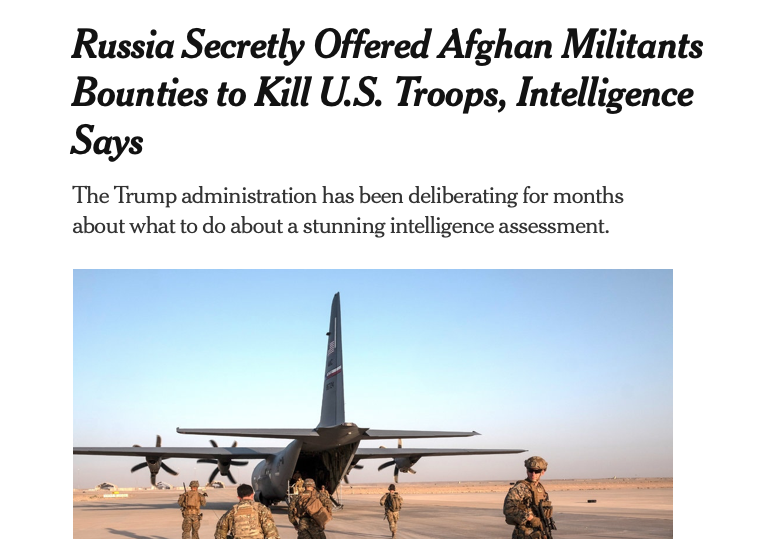
On Friday The New York Times featured a report based on anonymous intelligence officials that the Russians were paying bounties to have U.S. troops killed in Afghanistan with President Donald Trump refusing to do anything about it.  The flurry of Establishment media reporting that ensued provides further proof, if such were needed, that the erstwhile “paper of record” has earned a new moniker — Gray Lady of easy virtue.

Over the weekend, the Times’ dubious allegations grabbed headlines across all media that are likely to remain indelible in the minds of credulous Americans — which seems to have been the main objective. To keep the pot boiling this morning, The New York Times’ David Leonhardt’s daily web piece, “The Morning” calls prominent attention to a banal article by a Heather Cox Richardson, described as a historian at Boston College, adding specific charges to the general indictment of Trump by showing “how the Trump administration has continued to treat Russia favorably.” The following is from Richardson’s newsletter on Friday:

— “On April 1 a Russian plane brought ventilators and other medical supplies to the United States … a propaganda coup for Russia;

— “On April 25 Trump raised eyebrows by issuing a joint statement with Russian President Vladimir Putin commemorating the 75th anniversary of the historic meeting between American and Soviet troops on the bridge of the Elbe River in Germany that signaled the final defeat of the Nazis;

— “On May 3, Trump called Putin and talked for an hour and a half, a discussion Trump called ‘very positive’;

— “On May 21, the U.S. sent a humanitarian aid package worth $5.6 million to Moscow to help fight coronavirus there.  The shipment included 50 ventilators, with another 150 promised for the next week; …

— “On June 15, news broke that Trump has ordered the removal of 9,500 troops from Germany, where they support NATO against Russian aggression. …”

Historian Richardson added:

“All of these friendly overtures to Russia were alarming enough when all we knew was that Russia attacked the 2016 U.S. election and is doing so again in 2020.  But it is far worse that those overtures took place when the administration knew that Russia had actively targeted American soldiers. … this bad news apparently prompted worried intelligence officials to give up their hope that the administration would respond to the crisis, and instead to leak the story to two major newspapers.”

Hear the siren? Children, get under your desks!

The Tall Tale About Russia Paying for Dead U.S. Troops

Times print edition readers had to wait until this morning to learn of Trump’s statement last night that he was not briefed on the cockamamie tale about bounties for killing, since it was, well, cockamamie.

Late last night the president tweeted: “Intel just reported to me that they did not find this info credible, and therefore did not report it to me or the VP. …”

For those of us distrustful of the Times — with good reason — on such neuralgic issues, the bounty story had already fallen of its own weight. As Scott Ritter pointed out yesterday:

“Perhaps the biggest clue concerning the fragility of the New York Times’ report is contained in the one sentence it provides about sourcing — “The intelligence assessment is said to be based at least in part on interrogations of captured Afghan militants and criminals.” That sentence contains almost everything one needs to know about the intelligence in question, including the fact that the source of the information is most likely the Afghan government as reported through CIA channels. …”

And who can forget how “successful” interrogators can be in getting desired answers.

Russia & Taliban React

The Kremlin called the Times reporting “nonsense … an unsophisticated plant,” and from Russia’s perspective the allegations make little sense; Moscow will see them for what they are — attempts to show that Trump is too “accommodating” to Russia.

A Taliban spokesman called the story “baseless,” adding with apparent pride that “we” have done “target killings” for years “on our own resources.”

Russia is no friend of the Taliban.  At the same time, it has been clear for several years that the U.S. would have to pull its troops out of Afghanistan.  Think back five decades and recall how circumspect the Soviets were in Vietnam.  Giving rhetorical support to a fraternal Communist nation was de rigueur and some surface-to-air missiles gave some substance to that support.

But Moscow recognized from the start that Washington was embarked on a fool’s errand in Vietnam. There would be no percentage in getting directly involved.  And so, the Soviets sat back and watched smugly as the Vietnamese Communists drove U.S. forces out on their “own resources.” As was the case with the Viet Cong, the Taliban needs no bounty inducements from abroad.

Besides, the Russians knew painfully well — from their own bitter experience in Afghanistan, what the outcome of the most recent fool’s errand would be for the U.S.  What point would they see in doing what The New York Times and other Establishment media are breathlessly accusing them of?

CIA Disinformation; Casey at Bat

Former CIA Director William Casey said:  “We’ll know when our disinformation program is complete, when everything the American public believes is false.”

Casey made that remark at the first cabinet meeting in the White House under President Ronald Reagan in early 1981, according to Barbara Honegger, who was assistant to the chief domestic policy adviser.  Honegger was there, took notes, and told then Senior White House correspondent Sarah McClendon, who in turn made it public.

If Casey’s spirit is somehow observing the success of the disinformation program called Russiagate, one can imagine how proud he must be.  But sustained propaganda success can be a serious challenge.  The Russiagate canard has lasted three and a half years.  This last gasp effort, spearheaded by the Times, to breathe more life into it is likely to last little more than a weekend — the redoubled efforts of Casey-dictum followers notwithstanding.

Russiagate itself has been unraveling, although one would hardly know it from the Establishment media.  No collusion between the Trump campaign and Russia.  Even the sacrosanct tenet that the Russians hacked the DNC emails published by WikiLeaks has been disproven, with the head of the DNC-hired cyber security firm CrowdStrike admitting that there is no evidence that the DNC emails were hacked — by Russia or anyone else.

How long will it take the Times to catch up with the CrowdStrike story, available since May 7?

The media is left with one sacred cow: the misnomered “Intelligence Community” Assessment of Jan. 6, 2017, claiming that President Putin himself ordered the hacking of the DNC. That “assessment” done by “hand-picked analysts” from only CIA, FBI and NSA (not all 17 intelligence agencies of the “intelligence community”) reportedly is being given close scrutiny by U. S. Attorney John Durham, appointed by the attorney general to investigate Russiagate’s origins.

If Durham finds it fraudulent (not a difficult task), the heads of senior intelligence and law enforcement officials may roll.  That would also mean a still deeper dent in the credibility of Establishment media that are only too eager to drink the Kool Aid and to leave plenty to drink for the rest of us.

Do not expect the media to cease and desist, simply because Trump had a good squelch for them last night — namely, the “intelligence” on the “bounties” was not deemed good enough to present to the president.

(As a preparer and briefer of The President’s Daily Brief  to Presidents Reagan and HW Bush, I can attest to the fact that — based on what has been revealed so far — the Russian bounty story falls far short of the PDB threshold.)

Rejecting Intelligence Assessments

Nevertheless, the corporate media is likely to play up the Trump administration’s rejection of what the media is calling the “intelligence assessment” about Russia offering — as Rachel Maddow indecorously put it on Friday — “bounty for the scalps of American soldiers in Afghanistan.”

I am not a regular Maddow-watcher, but to me she seemed unhinged — actually, well over the top.

The media asks, “Why does Trump continue to disrespect the assessments of the intelligence community?”  There he goes again — not believing our “intelligence community; siding, rather, with Putin.”

In other words, we can expect no let up from the media and the national security miscreant leakers who have served as their life’s blood.  As for the anchors and pundits, their level of sophistication was reflected yesterday in the sage surmise of Face the Nation’s Chuck Todd, who Aaron Mate reminds us, is a “grown adult and professional media person.”  Todd asked guest John Bolton: “Do you think that the president is afraid to make Putin mad because maybe Putin did help him win the election, and he doesn’t want to make him mad for 2020?”

“This is as bad as it gets,” said House Speaker Nancy Pelosi yesterday, adding the aphorism she memorized several months ago: “All roads lead to Putin.”  The unconscionably deceitful performance of Establishment media is as bad as it gets, though that, of course, was not what Pelosi meant.  She apparently lifted a line right out of the Times about how Trump is too “accommodating” toward Russia.

One can read this most recent flurry of Russia, Russia, Russia as a reflection of the need to pre-empt the findings likely to issue from Durham and Attorney General William Barr in the coming months — on the theory that the best defense is a pre-emptive offense.  Meanwhile, we can expect the corporate media to continue to disgrace itself.

Vile

Caitlin Johnstone, typically, pulls no punches regarding the Russian bounty travesty:

“All parties involved in spreading this malignant psyop are absolutely vile, but a special disdain should be reserved for the media class who have been entrusted by the public with the essential task of creating an informed populace and holding power to account. How much of an unprincipled whore do you have to be to call yourself a journalist and uncritically parrot the completely unsubstantiated assertions of spooks while protecting their anonymity? How much work did these empire fluffers put into killing off every last shred of their dignity? It boggles the mind.

It really is funny how the most influential news outlets in the Western world will uncritically parrot whatever they’re told to say by the most powerful and depraved intelligence agencies on the planet, and then turn around and tell you without a hint of self-awareness that Russia and China are bad because they have state media.

Sometimes all you can do is laugh.”

Finally Time for DNC Email Evidence

By Patrick Lawrence

Source: Consortium News

Three years after the narrative we call Russiagate was framed and incessantly promoted, it crumbles into rubble as we speak. The mini-empire of allegations, presuppositions, fallacious syllogisms, leaps of logic, imagined connections and mis– and disinformation marshaled to support charges of Russian interference in the 2016 elections is more or less a ruin.

The total collapse of the Russiagate orthodoxy now appears within reach — this for the first time since the Democratic National Committee set the narrative in motion after its email servers were compromised during the Trump–Clinton presidential contest. There is a good chance — though this is not a certainty — that Attorney General William Barr’s just-launched investigation will fully expose the numerous charges of Russian intervention as fabrications. Evidence of these fabrications, long available but ignored in a remarkably prevalent case of willful blindness, continues to grow such that it may be difficult to obscure it much longer.

It is now officially acknowledged that there is no credible evidence that Donald Trump colluded with Russia to defeat Hillary Clinton in the 2016 election. At this point, the demonstrably bogus assertion that Russian intelligence hacked into the DNC’s email system in mid–2016 is the one remaining feature of the Russiagate orthodoxy that is commonly considered rock solid.

The mythology on this question remains deeply embedded, the absence of any supporting evidence notwithstanding. Press and broadcast reports rarely miss an opportunity to cast Russian responsibility for the DNC email intrusion as a foregone conclusion. But this, too, is a tower built on sand. To put Russiagate decisively in the past now comes to demolishing this last, unsound edifice. The rest is already too discredited for anyone but naïve liberals, wishful-thinking “progressives” and the most committed ideologues to take seriously.
This focuses attention on the evidence — considerable and accumulating — that Russian intelligence agencies, officially charged with intrusion into the DNC’s servers, had nothing to do with it. It is now two years since technically qualified intelligence professionals of long experience reported viaConsortium News that the theft of Democratic Party email in 2016 was neither a hack nor a Russian intelligence operation. In July 2017 Veteran Intelligence Professionals for Sanity presented persuasive evidence that the DNC’s servers had been compromised by someone with direct access to them.

The email messages subsequently posted by WikiLeaks had been pilfered by an insider of unknown identity: This was the conclusion VIPS drew in VIPS50, the group’s report on the mail incident, on the basis of the evidence it had gathered while working with other independent forensic investigators. The “hack,” in short, was not a hack. It was a leak.

A cacophony of objections erupted after Consortium posted VIPS50. Much — vastly too much — has been made of a group of “dissenters” within the VIPS organization who did not endorse the report. But neither these dissenters nor the many others attempting to discredit VIPS50 have succeeded in doing so. No countervailing evidence from any quarter has been presented. Based on continuing research, VIPS subsequently altered some of its initial conclusions, as noted in this space a year ago. But its principal findings stand.

VIPS50 

This puts VIPS50, while still officially excluded from the record, among the most consequential documents to be published since the Russiagate narrative took shape three years ago. If we are to recover from the destructive, divisive nightmare Russiagate has become, VIPS50 will be key to the process. There are indications now that its findings, based on impartially conducted data analysis and forensic science, will soon get the consideration they have deserved from the first. My sources suggest Barr’s office is making use of VIPS report and subsequent findings as it begins its investigation into the genesis of the Russiagate allegations.

Much anticipation preceded the publication in mid–April of the report on Russian interference completed in the office of Special Counsel Robert Mueller. Contrary to prevalent expectations, however, the 448–page document failed to confirm the case for Russiagate and did much to weaken it. Not only did the report conclude that neither President Trump nor anyone in his campaign colluded with Russia as he fought the 2016 election; it also made clear that the special counsel’s office did not undertake a credible investigation of the charge that Russian intelligence hacked the DNC’s mail servers.

Mueller failed to call numerous key witnesses, among them Julian Assange, the WikiLeaks founder and publisher, and Bill Binney, formerly a technical director at the National Security Agency and one of several technical experts in the VIPS group. He also failed to pursue alternative theories in the email-theft case; a duty of any investigator in Mueller’s position. Only the willfully blind can accept these irregularities as legitimate conduct.

Remarkably enough, Mueller’s investigation appears to have conducted no forensic tests of its own to verify allegations of a Russian hacking operation. It relied instead on the patently faulty findings of Crowdstrike, the disreputable cyber-security firm that was working for the DNC by mid–2016. Critically, the special counsel also appears to have neglected to consult the NSA for evidence pertaining to the DNC incident. Had the intrusion been a hack conducted over the internet, by Russians or anyone else, the agency would have a fully detailed digital record of the operation and the means to trace the intervention to its perpetrators. Why, it is perfectly logical to ask, was such a record not cited prominently in the Mueller report?

Mueller’s testimony before two congressional committees on July 24 was a further blow to the Russiagate thesis. The special counsel came over as a detached, out-of-touch figurehead with a very loose grip on his own investigation and poor knowledge of the report bearing his signature. Soon afterward, even Trump’s adversaries in the Democratic camp began to give up the ghost. “In the hours and days after Mr. Mueller gave his opening statement before the House Judiciary Committee,” wrote Samuel Moyn, a Yale law professor, “it became clear how tenaciously many liberals and progressives are clinging to fantasy.” Moyn’s piece appeared in The New York Times. The headline reads, “The Mueller Fantasy Comes Crashing Down.”

Despite the stunningly anticlimactic outcome of the Mueller report and his subsequent appearance on Capitol Hill — which was intended from the first to be a matter of spectacle rather than substance — new allegations of Russian interference  continue to arrive on front pages and in news broadcasts. The latest came the day after Mueller’s testimony, when the Senate Intelligence Committee reported that Russia intruded into the election systems of all 50 states during the 2016 campaigns. The report offered no supporting evidence, per usual. It was heavily redacted at the request of the relevant intelligence agencies, again per usual.

Question of Evidence

This brings us to the question of evidence. To go back to the initial allegations of Russian interference three years ago, at no point since have any of these commonly accepted charges been accompanied by hard, legally and logically sound evidence to back them up. This astonishing lacuna, while intently papered over in the media, on Capitol Hill, at the Justice Department, in the intelligence apparatus, and among law-enforcement agencies, has rendered the Russiagate orthodoxy vulnerable from the first. It now emerges that the evidence problem is worse than even the most committed critics of the Russiagate narrative had thought.

This came to light this spring, during the pre-trial discovery phase of the case against Roger Stone, the onetime Trump aide charged with obstructing justice and misleading Congress. When Stone’s attorneys requested Crowdstrike’s final report on the DNC email theft, which they said was relevant to his defense, prosecutors returned with the stunning revelation that Crowdstrike, the DNC’s cyber-security firm, never submitted a final report. “The government does not possess the information the defendant seeks,” the Justice Department responded via a court filing.

The Federal Bureau of Investigation’s failure to take possession of the DNC’s email servers from Crowdstrike after the mid–2016 intrusion, a shocking case of official malfeasance, has long been dismissed as an unimportant detail. We now know that the FBI, the Justice Department and the Mueller investigation relied on nothing more than three Crowdstrike drafts — all of them redacted by Crowdstrike — to build the case for Russia’s culpability in the theft of the DNC’s email.

Not only did the FBI fail to establish a proper chain of evidentiary custody after the incident at the DNC; it is now clear the bureau knows of the email theft only what Crowdstrike chose to tell it. There is no evidence that the FBI asked the NSA for its records of the incident. Nor is there any indication that Crowdstrike has ever given the FBI or prosecutors in the Stone case the data it used to produce its never-completed report. “Crowdstrike appears to have destroyed evidence or is hiding it,” Bill Binney said in a telephone interview.

The corporate media continue to pretend in their press reports and news broadcasts that the official investigation of the DNC email incident was conducted according to the highest standard of legitimacy. Democrats on Capitol Hill, still pursuing their own investigations, never question the validity of the officially constructed case alleging Russia’s responsibility. The revelation of negligence the Stone trial brings to light, which amounts to corruption, could hardly expose this prolonged charade more starkly.

Forensic investigators, meantime, continue to gather evidence supporting the leak-not-hack case made in VIPS50. The gap thus widens between the official story of the DNC mail incident and the case supported by forensic research done by VIPS and other independent investigators working in association with it.

Last February these investigators discovered that email pilfered in 2016 and subsequently conveyed toWikiLeaks had been stored according to a system called File Allocation Table, or FAT. The FAT system time-stamps data according to their last modifications and, because it is less precise than other storage systems, it rounds up time stamps to the next even number. If the FAT system is used to store data, it is a strong indication that the data were stored on a memory key or another such portable device.

In the 35, 816 email messages investigators examined, the FAT system assigned even-numbered time stamps to all of them. Binney, a mathematician by training, puts the chance of this occurring without the use of a portable storage device at 1 in 2 to the 35,816thpower — meaning it is a virtual impossibility.

The FAT numbering pattern detected in the email messages tested does not indicate at what stage or where a portable device was used. It shows only that such a device was used at some point in the handling of the data; a portable device may or may not have been used to execute the initial download. But the presence of the FAT system in the metadata of the emails tested adds another layer of circumstantial evidence supporting the VIPS case that the theft of DNC mail was a leak executed locally via a portable device and not a remote hack conducted through the internet. At the very least, it is an additional line of inquiry the FBI, the intelligence agencies, and the Mueller investigation have left unexamined.

VIPS Dissenters

Among the critics of VIPS50, none has influenced public opinion as much as the dissenters within the group’s membership. The presence of these dissenters has been evident since VIPS50 went through repeated drafts over a period of nearly two weeks. This is a group of honorable, in many cases brave people. But they advanced no coheren objections to the VIPS document prior to its publication, and this remained the case for some time after Consortium News posted it on July 24, 2017. Having begun reporting on VIPS50 shortly after that date, I found — and continue to find — the dissenters’ position heavily inflected with personal animosities and political leanings having no bearing on the validity of the VIPS50 findings.

A number of dissenters signed a contribution to a forum The Nation hosted after the magazine published a piece I wrote on VIPS50 in August 2017. This was the first time the dissenters publicly presented substantive objections to VIPS50, and they focused on the core of the VIPS case. This case continues to rest primarily on the speed at which a mail theft could be executed in mid–2016. The transfer speed, identified by an analysis of metadata found on documents stolen at that time, was considerably faster than the rate possible over the internet at the time of the intrusion, indicating a leak by someone using a portable storage device and with direct access to the DNC’s servers.

The dissenting group took specific issue with these findings. “Data-transfer speeds across networks and the Internet measured in megabits per second (or megabytes per second) can easily achieve rates that greatly exceed the cited reference in the VIPS memo,” the dissidents wrote.

It was at this point the dissenters repeated the failures of the intelligence apparatus and the Mueller investigation: They produced no evidence. There is no indication the dissenters conducted tests to support their assertion on the speed question. The VIPS memo applied scientific method to the DNC mail theft for the first time and was intended as an “evidence to date” document. This marked a transformative advance in how the DNC incident can be understood: The imperative since has been to bring countervailing evidence to the investigative process, which continues. No one —not the dissenters, not the DNC, not the “intelligence community,” not Mueller, not the press — has done so.

The dissenters have been silent since their contribution to The Nation’s forum. Members have declined invitations to work with VIPS50 signatories to develop further the evidence presented in the memo. When I queried a number of dissenters for this commentary, one replied. This person did not address the findings of forensic investigators while reproducing what VIPS50 signatories term the “emotional arguments” that have characterized the dissenters’ response to the memo since the drafting phase two summers ago. These continuing difficulties appear partly to reflect a desire not to be seen defending either Trump or the Russians.

Barr’s Investigation

The NSA, the CIA, the FBI, the Mueller investigation, the press — none has shown the slightest interest in the findings outlined in VIPS50. This can come as no surprise, given the heavy investments all of these entities have made in the Russians-did-it explanation of the DNC email incident. But this omission is nonetheless negligent when one considers the contradicting evidence VIPS and those associated with it continue to amass. A key question now arises: Will the Barr investigation into the genesis of allegations of Russian interference, begun three months ago, transcend this politically inspired ignorance to expose official accounts of the mid–2016 mail theft as fallacies?

The early signs were that Barr’s investigators would at last explode the Russiagate narrative. Trump was unmistakably determined to do so when he urged Barr to “investigate the investigators” last spring. In mid–May Barr appointed John Durham, a federal prosecutor, to direct this effort. Ten days later Trump gave Barr “full and complete authority to declassify information” related to the conduct of the intelligence agencies, the FBI, and the Justice Department.

It was clear very early that Trump was aware of VIPS50 and entertained a lively interest in its findings. In September 2017, two months after Consortium published the memo, he ordered Mike Pompeo, then director of the CIA, to interview Bill Binney, the leading technical expert within the VIPS group. Pompeo did so in October 2017, but by Binney’s account he flinched: Pompeo heard Binney out at the president’s insistence, but he never pursued the forensic findings the former NSA technical director walked him through.

This was an early sign, it is now plain, that even efforts to unearth the truth of the allegations against Russia that emanate from the White House would meet political resistance. Another came last Friday, when Trump was forced to drop John Ratcliffe, a Texas Republican who pledged to support a full investigation of Russiagate, as his nominee to replace Dan Coats as director of national intelligence. While Ratcliffe considered the orthodox Russiagate narrative bogus, Coats was vigorous in his promotion of it.

This makes political will another key question to ask of the Barr investigation: Full exposure of the travesty of Russiagate is almost certainly within Barr’s power to achieve. Will he do so?

Whether Trump will remain consistent in his backing of Barr is another such question. While Trump habitually terms Russiagate “a hoax,” he has also indicated on a number of occasions that his true objective is simply to escape the charge that he colluded with Russians to win the 2016 election. “I never said Russia did not meddle in the election,” Trump tweeted earlier this year. “I said, ‘It may be Russia, or China, or another country or group, or it may be a 400–pound genius sitting in bed and playing with his computer.’ The Russian ‘hoax’ was that the Trump campaign colluded with Russia—it never did!”

A president who slips and slides, an administrative state — the Deep State if you like — thoroughly committed to defending falsified accounts of the mid–2016 intrusions into the DNC’s email servers, a supine press: It is impossible to say when or whether the truth of the events of three years ago will emerge. The evidence is there, sufficient now to conclude the Russigate case. The greatest remaining obstacle is the willful ignorance that incubated the Russiagate narrative and now prolongs it. We reach a point when evidence and more evidence, along with political integrity, are the only effective replies to this cynical, foolish, and costly recalcitrance.


Patrick Lawrence, a correspondent abroad for many years, chiefly for the International Herald Tribune, is a columnist, essayist, author and lecturer. His most recent book is “Time No Longer: Americans After the American Century” (Yale). Follow him on Twitter @thefloutistHis website is Patrick Lawrence. Support his work via his Patreon site. 

Propaganda Is The Root Of All Our Problems

By Caitlin Johnstone

Source: CaitlinJohnstone.com

new article by Forbes reports that the CEO of Crowdstrike, the extremely shady cybersecurity corporation which was foundational in the construction of the official CIA/CNN Russian hacking narrative, is now a billionaire.

George Kurtz ascended to the billionaire rankings on the back of soaring stocks immediately after the company went public, carried no doubt on the winds of the international fame it gained from its central protagonistic role in the most well-known hacking news story of all time. A loyal servant of empire well-rewarded.

Never mind that US government insiders like Hillary Clinton had been prepping for escalations against Russia well in advance of the 2016 elections, and that their preexisting agendas to shove a geostrategic obstacle off the world stage benefitted from the hacking narrative as much as George Kurtz did.

Never mind that Crowdstrike is tied to the NATO narrative management firm known as the Atlantic Council, which receives funding from the US government, the EU, NATO, Gulf states and powerful international oligarchs. Never mind either that Crowdstrike was financed with a whopping $100 million from Google, which has had a cozy relationship with US intelligence agencies since its very inception.

Never mind that to this day the DNC servers have not been examined by the FBI, nor indeed were they examined by the Special Counsel of Robert “Iraq has WMD” Mueller, preferring instead to go with the analyses of this extremely shady outfit with extensive and well-documented ties with the oligarchic leaders of the US-centralized empire. Also never mind that the Crowdstrike analyst who led forensics on those DNC servers had in fact worked for and was promoted by Robert Mueller while the two were in the FBI.

As I never tire of saying, the real underlying currency in our world is not gold, nor bureaucratic fiat, nor even raw military might. The real underlying currency of our world is narrative, and the ability to control it.

As soon as you really grok this dynamic, you start noticing it everywhere. George Kurtz is one clear example today of narrative control’s central role in the maintenance and expansion of existing power structures, as well as an illustration of how the empire is wired to reward those who advance pro-empire narratives and punish those who damage them; just compare how he’s doing to how Julian Assange is doing, for example.

But you see examples pop up every day:

  • The US State Department just got busted using a $1.5 million troll farm to manipulate public discourse on social media about Iran.
  • Video footage has just surfaced of the OPCW Director General admitting that the OPCW did indeed deliberately omit any mention in its official findings of a report from its own investigation which contradicts the establishment narrative about a chemical strike in Douma, Syria, an admission which answers controversial questions asked by critics of western imperialism like myself, and which the mainstream media have not so much as touched.
  • Mintpress News broke a story the other day about a new narrative management operation known as “The Trust Project”, a coordinated campaign by establishment-friendly mass media outlets for “gaming search-engine and social-media algorithms in collusion with major tech companies like Google and Twitter.”
  • In a new interview with The Canary, UN Special Rapporteur on torture Nils Melzer explicitly named the mass media as largely responsible for Assange’s psychological torture, excoriating them for the way that they “have shown a remarkable lack of critical independence and have contributed significantly to spreading abusive and deliberately distorted narratives about Mr Assange.”
  • In a new essay called “Freeing Julian Assange“, journalist Suzie Dawson reports that “Countless articles appear to have been obliterated from the internet” about Assange and WikiLeaks, amounting to some 90 percent of the links Dawson examined which were shared in tweets by or about WikiLeaks and Assange since 2010.
  • I just finished reading this excellent Swiss Propaganda Research essay about the little-known fact that “most of the international news coverage in Western media is provided by only three global news agencies based in New York, London and Paris.”

Any one of these could have a full-length Caitlin Johnstone essay written about it. I write about this stuff for a living, and even I don’t have the time or energy to write full articles about every single narrative control tool that the US-centralized empire has been implementing into its arsenal. There are too damn many of them emerging too damn fast, because they’re just that damn crucial for maintaining existing power structures.

Because whoever controls the narrative controls the world.

Power used to be much easier to identify in our society: just look for the fellow with the sparkly hat made of gold sitting in a really big chair and bossing everyone around. As our society advanced philosophically, however, people began to tire of having every aspect of their society determined by some schmuck in a golden hat, and started fighting for ideals called “freedom” and “democracy” in their respective nations. And, as far as our parents and teachers have taught us, freedom and democracy are exactly what we have now.

Except that’s all crap. Freedom and democracy only exist within the western empire to the extent that it keeps up appearances. Because the trouble with democracy, it turns out, is that human minds are very hackable, as long as you’ve got the resources. Wealthy and powerful people do have the resources, which means that it’s very possible for wealthy and powerful people to manipulate the masses into voting in a way that consistently benefits the wealthy and powerful. This is why billionaires and narrative control consistently go hand-in-hand.

This dynamic has allowed for western power structures to operate in a way that western democracy was explicitly designed to prevent: for the benefit of the powerful instead of for the benefit of the voting populace. So now we’ve got people in so-called liberal democracies voting to maintain governments which advance wars which don’t benefit them, to advance intrusive surveillance and police state policies which oppress them, to advance austerity policies which harm them, to advance labor policies which exploit them, and to maintain ecocidal environmental policies which threaten the very survival of our species. All because the wealthy and powerful are able to use their wealth and power to manipulate the way people think and vote.

This is why I pay far more attention in my work to narrative control than to politics. Politics is downstream from narrative control, which is why the 2020 US presidential race is already a contest to see what level of Democratic corporatist warmonger will be running against the incumbent Republican corporatist warmonger. The narrative-controlling class does its level best to hide the fact that anything’s fundamentally wrong with the system, then when people notice it’s deeply broken they encourage them to use completely impotent tools to fix it. “Don’t like how things are run? Here, vote for our other puppet!”

The root of all our problems right now is the fact that human minds are very hackable with enough resources, combined with the fact that war, oppression, exploitation and ecocide are highly profitable. This dynamic has caused human collective consciousness to generally dead-end into a kind of propagandized, zombified state in which all our knowledge and all our thinking moves in alignment with the agendas of existing power structures. It’s much easier to continue believing the official narratives than to sort through everything you’ve been told about your society, your nation and your world since grade school and work out what’s true and what’s false. Many don’t have the time. Many more don’t have the courage.

We will remain in this collective dead-end, hurtling toward either Orwellian dystopia or extinction via climate collapse or nuclear armageddon, until we find a way out of it. It won’t come from the tools our rulers have given us, and it won’t come from repeating any of the old patterns which got us here. In order to escape from the increasingly adept narrative control matrix that is being built around our collective mind by the powerful, we’re going to have to change our relationship with narrative altogether. We will either pass this great test or we will fail it, and we absolutely have the freedom to go either way.

Still Waiting for Evidence of a Russian Hack

More than two years after the allegation of Russian hacking of the 2016 U.S. presidential election was first made, conclusive proof is still lacking and may never be produced, says Ray McGovern.

By Ray McGovern

Source: Consortium News

If you are wondering why so little is heard these days of accusations that Russia hacked into the U.S. election in 2016, it could be because those charges could not withstand close scrutiny. It could also be because special counsel Robert Mueller appears to have never bothered to investigate what was once the central alleged crime in Russia-gate as no one associated with WikiLeaks has ever been questioned by his team.

Veteran Intelligence Professionals for Sanity — including two “alumni” who were former National Security Agency technical directors — have long since concluded that Julian Assange did not acquire what he called the “emails related to Hillary Clinton” via a “hack” by the Russians or anyone else. They found, rather, that he got them from someone with physical access to Democratic National Committee computers who copied the material onto an external storage device — probably a thumb drive. In December 2016 VIPS explained this in some detail in an open Memorandum to President Barack Obama.

On January 18, 2017 President Obama admitted that the “conclusions” of U.S. intelligence regarding how the alleged Russian hacking got to WikiLeaks were “inconclusive.” Even the vapid FBI/CIA/NSA “Intelligence Community Assessment of Russian Activities and Intentions in Recent U.S. Elections” of January 6, 2017, which tried to blame Russian President Vladimir Putin for election interference, contained no direct evidence of Russian involvement.  That did not prevent the “handpicked” authors of that poor excuse for intelligence analysis from expressing “high confidence” that Russian intelligence “relayed material it acquired from the Democratic National Committee … to WikiLeaks.”  Handpicked analysts, of course, say what they are handpicked to say.

Never mind. The FBI/CIA/NSA “assessment” became bible truth for partisans like Rep. Adam Schiff (D-CA), ranking member of the House Intelligence Committee, who was among the first off the blocks to blame Russia for interfering to help Trump.  It simply could not have been that Hillary Clinton was quite capable of snatching defeat out of victory all by herself.  No, it had to have been the Russians.

Five days into the Trump presidency, I had a chance to challenge Schiff personally on the gaping disconnect between the Russians and WikiLeaks. Schiff still “can’t share the evidence” with me … or with anyone else, because it does not exist.

WikiLeaks

It was on June 12, 2016, just six weeks before the Democratic National Convention, that Assange announced the pending publication of “emails related to Hillary Clinton,” throwing the Clinton campaign into panic mode, since the emails would document strong bias in favor of Clinton and successful attempts to sabotage the campaign of Bernie Sanders.  When the emails were published on July 22, just three days before the convention began, the campaign decided to create what I call a Magnificent Diversion, drawing attention away from the substance of the emails by blaming Russia for their release.

Clinton’s PR chief Jennifer Palmieri later admitted that she golf-carted around to various media outlets at the convention with instructions “to get the press to focus on something even we found difficult to process: the prospect that Russia had not only hacked and stolen emails from the DNC, but that it had done so to help Donald Trump and hurt Hillary Clinton.”  The diversion worked like a charm.  Mainstream media kept shouting “The Russians did it,” and gave little, if any, play to the DNC skullduggery revealed in the emails themselves. And like Brer’ Fox, Bernie didn’t say nothin’.

Meanwhile, highly sophisticated technical experts, were hard at work fabricating “forensic facts” to “prove” the Russians did it.  Here’s how it played out:

June 12, 2016: Assange announces that WikiLeaks is about to publish “emails related to Hillary Clinton.”

June 14, 2016: DNC contractor CrowdStrike, (with a dubious professional record and multiple conflicts of interest) announces that malware has been found on the DNC server and claims there is evidence it was injected by Russians.

June 15, 2016: “Guccifer 2.0” affirms the DNC statement; claims responsibility for the “hack;” claims to be a WikiLeaks source; and posts a document that the forensics show was synthetically tainted with “Russian fingerprints.”

The June 12, 14, & 15 timing was hardly coincidence. Rather, it was the start of a pre-emptive move to associate Russia with anything WikiLeaks might have been about to publish and to “show” that it came from a Russian hack.

Enter Independent Investigators

A year ago independent cyber-investigators completed the kind of forensic work that, for reasons best known to then-FBI Director James Comey, neither he nor the “handpicked analysts” who wrote the Jan. 6, 2017 assessment bothered to do.  The independent investigators found verifiable evidence from metadata found in the record of an alleged Russian hack of July 5, 2016 showing that the “hack” that day of the DNC by Guccifer 2.0 was not a hack, by Russia or anyone else.

Rather it originated with a copy (onto an external storage device – a thumb drive, for example) by an insider — the same process used by the DNC insider/leaker before June 12, 2016 for an altogether different purpose. (Once the metadata was found and the “fluid dynamics” principle of physics applied, this was not difficult to disprove the validity of the claim that Russia was responsible.)

One of these independent investigators publishing under the name of The Forensicator on May 31 published new evidence that the Guccifer 2.0 persona uploaded a document from the West Coast of the United States, and not from Russia.

In our July 24, 2017 Memorandum to President Donald Trump we stated, “We do not know who or what the murky Guccifer 2.0 is. You may wish to ask the FBI.”

Our July 24 Memorandum continued: “Mr. President, the disclosure described below may be related. Even if it is not, it is something we think you should be made aware of in this general connection. On March 7, 2017, WikiLeaks began to publish a trove of original CIA documents that WikiLeaks labeled ‘Vault 7.’ WikiLeaks said it got the trove from a current or former CIA contractor and described it as comparable in scale and significance to the information Edward Snowden gave to reporters in 2013.

“No one has challenged the authenticity of the original documents of Vault 7, which disclosed a vast array of cyber warfare tools developed, probably with help from NSA, by CIA’s Engineering Development Group. That Group was part of the sprawling CIA Directorate of Digital Innovation – a growth industry established by John Brennan in 2015. [ (VIPS warned President Obama of some of the dangers of that basic CIA reorganization at the time.]

Marbled

“Scarcely imaginable digital tools – that can take control of your car and make it race over 100 mph, for example, or can enable remote spying through a TV – were described and duly reported in the New York Times and other media throughout March. But the Vault 7, part 3 release on March 31 that exposed the “Marble Framework” program apparently was judged too delicate to qualify as ‘news fit to print’ and was kept out of the Times at the time, and has never been mentioned since.

“The Washington Post’s Ellen Nakashima, it seems, ‘did not get the memo’ in time. Her March 31 article bore the catching (and accurate) headline: ‘WikiLeaks’ latest release of CIA cyber-tools could blow the cover on agency hacking operations.’

“The WikiLeaks release indicated that Marble was designed for flexible and easy-to-use ‘obfuscation,’ and that Marble source code includes a “de-obfuscator” to reverse CIA text obfuscation.

“More important, the CIA reportedly used Marble during 2016. In her Washington Post report, Nakashima left that out, but did include another significant point made by WikiLeaks; namely, that the obfuscation tool could be used to conduct a ‘forensic attribution double game’ or false-flag operation because it included test samples in Chinese, Russian, Korean, Arabic and Farsi.”

A few weeks later William Binney, a former NSA technical director, and I commented on Vault 7 Marble, and were able to get a shortened op-ed version published in The Baltimore Sun.

The CIA’s reaction to the WikiLeaks disclosure of the Marble Framework tool was neuralgic. Then Director Mike Pompeo lashed out two weeks later, calling Assange and his associates “demons,” and insisting; “It’s time to call out WikiLeaks for what it really is, a non-state hostile intelligence service, often abetted by state actors like Russia.”

Our July 24 Memorandum continued:  “Mr. President, we do not know if CIA’s Marble Framework, or tools like it, played some kind of role in the campaign to blame Russia for hacking the DNC. Nor do we know how candid the denizens of CIA’s Digital Innovation Directorate have been with you and with Director Pompeo. These are areas that might profit from early White House review.  [ President Trump then directed Pompeo to invite Binney, one of the authors of the July 24, 2017 VIPS Memorandum to the President, to discuss all this.  Binney and Pompeo spent an hour together at CIA Headquarters on October 24, 2017, during which Binney briefed Pompeo with his customary straightforwardness. ]

“We also do not know if you have discussed cyber issues in any detail with President Putin. In his interview with NBC’s Megyn Kelly he seemed quite willing – perhaps even eager – to address issues related to the kind of cyber tools revealed in the Vault 7 disclosures, if only to indicate he has been briefed on them. Putin pointed out that today’s technology enables hacking to be ‘masked and camouflaged to an extent that no one can understand the origin’ [of the hack] … And, vice versa, it is possible to set up any entity or any individual that everyone will think that they are the exact source of that attack.

“‘Hackers may be anywhere,’ he said. ‘There may be hackers, by the way, in the United States who very craftily and professionally passed the buck to Russia. Can’t you imagine such a scenario? … I can.’

New attention has been drawn to these issues after I discussed them in a widely published 16-minute interview last Friday.

In view of the highly politicized environment surrounding these issues, I believe I must append here the same notice that VIPS felt compelled to add to our key Memorandum of July 24, 2017:

“Full Disclosure: Over recent decades the ethos of our intelligence profession has eroded in the public mind to the point that agenda-free analysis is deemed well nigh impossible. Thus, we add this disclaimer, which applies to everything we in VIPS say and do: We have no political agenda; our sole purpose is to spread truth around and, when necessary, hold to account our former intelligence colleagues.

“We speak and write without fear or favor. Consequently, any resemblance between what we say and what presidents, politicians and pundits say is purely coincidental.” The fact we find it is necessary to include that reminder speaks volumes about these highly politicized times.