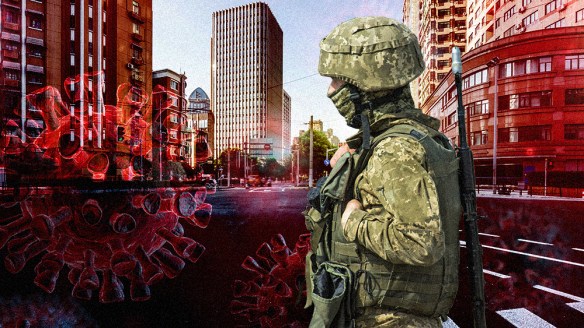
Welcome to the New Communist Police State, blamed on a virus

By Scott Baker

Source: OpEdNews.com

The draconian measures being taken or certainly being talked about – food rationing?!– will end up killing more people than the virus.

How many elderly will die because their caregivers can’t get to them (bye bye meals on wheels)? How many people already on special diets won’t be able to maintain them and get sick as a result? (Me, I eat mostly fresh, unboxed/uncanned food, devoid of extra salt and sugar, instead of the cheap crap that only governments will pay for).

People will die from this too.

Think you can can substitute daily school lunches for actual school and not have the same infection rate? Forget it. It’ll slow it down for a couple of weeks at most. And in New York City, 74% of the children in public school are poor. Without school lunch they go hungry. With school lunch, and then a return to home, their parents – or parent, singular, since many come from single parent households – can’t work, they can’t staff our hospitals, clean our streets, or do any of the hundred things the Departments of Health say are necessary to contain the virus.

People will die from this too.

I’m not usually paranoid, but this seems to be a way of trapping people into a police state. Oh, and yeah, what happens to the actual police who have to enforce this regime of deprivation? Will they use force when someone wants to go for a jog? If they injure someone, who will treat them in the over-crowded hospitals? Supposedly, exercise is fine, but what if you want to go jogging or biking in a group? I am scheduled to lead a 50-person bike group around New York City the end of April. Is that against the laws now? Wait…what law? Expect court challenges…wait, what courts? They are all working remotely or not at all. Our Civil Rights are already gone but we just don’t know it yet. Where is the ACLU? They are silent. Rights for LGBT, for voting…wait, long lines at polling stations. That’s already forbidden. Ohio postponed its primary for today. A half dozen other states did as well.

And recessions kill. You can’t pay your bills. Evictions and utility shutoffs are supposedly illegal in our new communist state, but what happens when the landlord or utility can’t pay its bills? Yes I know, record profits for utilities in the last few years. But that went into buybacks. That wasn’t against the law and still isn’t. It SHOULD be but it wasn’t. And corporations are deep in debt now, and bankruptcies will follow in a week or so; it’s that close. The economy is being unraveled and government can’t, or won’t, even pass the first of dozens of mitigating bills in the New Communism. The New Communism includes tax breaks and bailouts for the largest corporations though, $850 billion worth, so the Administration has learned nothing. Worse, actually, the centerpiece of the proposal is to eliminate the payroll tax, which will save corporations many millions, might trickle down to the employee, unless the corporations pocket the extra, and won’t help those out of a job or working for tips at all. Even worse, it will gut Social Security and Medicare, already due to start running out of money in a few years, even during Trump’s next term – and yes, he will get another term unless Biden or Sanders can distinguish themselves by what they will do differently, AND we have a recession. But, getting back to Social Security and Medicare; Trump has already said he wants to rein in the costs (read: gut or eliminate the programs millions depend upon to survive). Trump wants a permanent underclass, not entitled to any entitlements, even those it earned. He wants the free-to-be-corrupt market to provide for your old age or illness, or to let you die if you don’t plan 40 years ahead, or anticipate cancer.

This is permanent. We are giving up our rights supposedly temporarily. But that’s what was said after 9/11, and we still have the Patriot Act and a permanent war footing. BTW, presidential candidate Tulsi Gabbard wants a $1,000/month guaranteed income for everyone. That would be much more in keeping with our Civil Rights and much more fair. But no one is listening to her in the MSM or debates,where she is excluded.

This is permanent. This will kill more people than the virus ever would.

So, again, more people will die from the measures to contain the virus – which will ultimately fail anyway – than from the virus itself.

US Intel Agencies Played Unsettling Role in Classified and “9/11-like” Coronavirus Response Plan

Medical personnel arrive to perform COVID-19 coronavirus infection testing procedures at Glen Island Park, Friday, March 13, 2020, in New Rochelle, N.Y. (AP Photo/John Minchillo)

As coronavirus panic grips the world, concern over government overreach is growing given the involvement of US intelligence agencies in classified meetings for planning the U.S.’ coronavirus response.

By Whitney Webb

Source: Mint Press News

As the COVID-19 coronavirus crisis comes to dominate headlines, little media attention has been given to the federal government’s decision to classify top-level meetings on domestic coronavirus response and lean heavily “behind the scenes” on U.S. intelligence and the Pentagon in planning for an allegedly imminent explosion of cases.

The classification of coronavirus planning meetings was first covered by Reuters, which noted that the decision to classify was “an unusual step that has restricted information and hampered the U.S. government’s response to the contagion.” Reuters further noted that the Secretary of the Department of Health and Human Services (HHS), Alex Azar, and his chief of staff had “resisted” the classification order, which was made in mid-January by the National Security Council (NSC), led by Robert O’Brien — a longtime friend and colleague of his predecessor John Bolton.

Following this order, HHS officials with the appropriate security clearances held meetings on coronavirus response at the department’s Sensitive Compartmentalized Information Facility (SCIF), which are facilities “usually reserved for intelligence and military operations” and — in HHS’ case — for responses to “biowarfare or chemical attacks.” Several officials who spoke to Reuters noted that the classification decision prevented key experts from participating in meetings and slowed down the ability of HHS and the agencies it oversees, including the Centers for Disease Control and Prevention (CDC), to respond to the crisis by limiting participation and information sharing.

It has since been speculated that the decision was made to prevent potential leaks of information by stifling participation and that aspects of the planned response would cause controversy if made public, especially given that the decision to classify government meetings on coronavirus response negatively impacted HHS’ ability to respond to the crisis.

After the classification decision was made public, a subsequent report in Politico revealed that not only is the National Security Council managing the federal government’s overall response but that they are doing so in close coordination with the U.S. intelligence community and the U.S. military. It states specifically that “NSC officials have been coordinating behind the scenes with the intelligence and defense communities to gauge the threat and prepare for the possibility that the U.S. government will have to respond to much bigger numbers—and soon.”

Little attention was given to the fact that the response to this apparently imminent jump in cases was being coordinated largely between elements of the national security state (i.e. the NSC, Pentagon, and intelligence), as opposed to civilian agencies or those focused on public health issues, and in a classified manner.

The Politico article also noted that the intelligence community is set to play a “key role” in a pandemic situation, but did not specify what the role would specifically entail. However, it did note that intelligence agencies would “almost certainly see an opportunity to exploit the crisis” given that international “epicenters of coronavirus [are] in high-priority counterintelligence targets like China and Iran.” It further added, citing former intelligence officials, that efforts would be made to recruit new human sources in those countries.

Politico cited the official explanation for intelligence’s interest in “exploiting the crisis” as merely being aimed at determining accurate statistics of coronavirus cases in “closed societies,” i.e. nations that do not readily cooperate or share intelligence with the U.S. government. Yet, Politico fails to note that Iran has long been targeted for CIA-driven U.S. regime change, specifically under the Trump administration, and that China had been fingered as the top threat to U.S. global hegemony by military officials well before the coronavirus outbreak.


A potential  “9/11-like” response

The decision to classify government coronavirus preparations in mid-January, followed by the decision to coordinate the domestic response with the military and with intelligence deserves considerable scrutiny, particularly given that at least one federal agency, Customs and Border Patrol (CBP), will be given broad, sweeping powers and will work closely with unspecified intelligence “partners” as part of its response to a pandemics like COVID-19.

The CBP’s pandemic response document, obtained by The Nation, reveals that the CBP’s pandemic directive “allows the agency to actively surveil and detain individuals suspected of carrying the illness indefinitely.” The Nation further notes that the plan was drafted during the George W. Bush administration, but is the agency’s most recent pandemic response plan and remains in effect.

Though only CBP’s pandemic response plan has now been made public, those of other agencies are likely to be similar, particularly on their emphasis on surveillance, given past precedent following the September 11 attacks and other times of national panic. Notably, several recent media reports have likened coronavirus to 9/11 and broached the possibility of a “9/11-like” response to coronavirus, suggestions that should concern critics of the post-9/11 “Patriot Act” and other controversial laws, executive orders and policies that followed.

While the plans of the federal government remain classified, recent reports have revealed that the military and intelligence communities — now working with the NSC to develop the government’s coronavirus response — have anticipated a massive explosion in cases for weeks. U.S. military intelligence came to the conclusion over a month ago that coronavirus cases would reach “pandemic proportions” domestically by the end of March. That military intelligence agency, known as the National Center for Medical Intelligence (NCMI), coordinates closely with the National Security Agency (NSA) to conduct “medical SIGINT [signals intelligence].”

The coming government response, the agencies largely responsible for crafting it and its classified nature deserve public scrutiny now, particularly given the federal government’s tendency to not let “a serious crisis to go to waste,” as former President Obama’s then-chief of staff Rahm Emanuel infamously said during the 2008 financial crisis. Indeed, during a time of panic — over a pandemic and over a simultaneous major economic downturn — concern over government overreach is warranted, particularly now given the involvement of intelligence agencies and the classification of planning for an explosion of domestic cases that the government believes is only weeks away.


Coronavirus reminds us we are organisms in an environment

By Kurt Cobb

Source: Resilience

A close friend of mine, a professor of English literature, has been researching American philosopher John Dewey, whose book Quest for Certainty captivated me so much many years ago that I read it again right after I had finished it the first time. My friend has been reminding me why I found Dewey so profound while shedding new light on the philosopher’s thinking.

Dewey, it turns out, is one of the few thinkers in American life who absorbed the true import of the work of Charles Darwin. Dewey reminds us that, quite simply, Darwin posited that we humans are organisms in an environment just like every other organism. Dewey’s star faded after World War II.  American and world society have since lapsed into a narrative that puts humans above and outside nature, protected by technological advancements that supposedly shield us from nature’s demands and vicissitudes. The general narrative is that we are heading into a push-button, voice-activated technocratic paradise. (I think of the various Star Trek television series as popular cultural reflections of this view.)

But, the first pandemic in a century is forcefully and sadly reminding all of us that Darwin was right about our place in the natural world, more specifically, that we will never be outside of it.

That the world is “wildly unprepared” for this pandemic is in part a result of our belief the we are on a separate journey from the rest of the natural world, headed toward a perfected existence in which nature obeys all of our commands and bothers us not at all. Why prepare for something that is merely a product of nature? We have the technology to overcome it, don’t we? There must be a pill, right? Actually, wrong.

Those who understand human vulnerabilities have been sounding the alarm for years. But the idea that our entire way of life could be dramatically disrupted worldwide simultaneously simply was not on the radar of most governments—at least not enough to get them to stockpile even the most basic medical supplies; face masks come to mind.

There is much talk of creating a vaccine and doing it quickly. But such an endeavor can take more than a year and even more time to manufacture and distribute. There is less talk about the unhealthy lifestyles and chronic disease such as heart disease and diabetes that result from that lifestyle which might need to be addressed if we are going to cope better with the world of microorganisms we inhabit. There is even less talk that those at the bottom of the economic ladder are the most vulnerable and that the wealth gap and the gap in access to health care it implies are actually a huge public health problem for all of us.

The very way in which we live—constantly pressing on the edge of wilderness to develop it and exploit it—puts humans potentially in contact with millions of viruses from which will come the next pandemic. And, the next one will likely come much sooner than 100 years from now.

If we continue to think of health as the absence of illness, of illness as something that is prevented by a pill or a shot—and if not ultimately prevented, treated by a pill or a shot—we humans won’t make the necessary changes as a global society to better withstand more frequent pandemics.

Robust health, not techofixes, is the best way to confront the biological perils of the natural world in which we participate. Such a focus would, however, take a complete rethinking of who we humans are, namely, organisms in an environment. Will the coronavirus awaken any more of us to this fact?

The Economic Cataclysm Ahead

By Charles Hugh Smith

Source: Of Two Minds

The economic storm hasn’t passed; the false calm is only the eye of the financial hurricane.

To understand the economic cataclysm ahead, do the math. Those expecting the Covid-19 pandemic to leave the U.S. economy untouched are implicitly making these preposterously unlikely claims:

1. China will resume full pre-pandemic production and shipping within the next two weeks.

2. Chinese consumers will resume borrowing and spending at pre-pandemic rates in a few weeks.

3. Every factory and every worker in China will resume full pre-pandemic production without any permanent closures or disruptions.

4. Corporate America’s just-in-time inventories will magically expand to cover weeks or months of supply chain disruption.

5. Not a single one of the thousands of people who flew direct from Wuhan to the U.S. in January is an asymptomatic carrier of the coronavirus who escaped detection at the airport.

6. Not a single one of the thousands of people who flew from China to the U.S. in February is an asymptomatic carrier of the coronavirus.

7. Not a single one of the thousands of people who are in self-quarantine broke the quarantine to go to Safeway for milk and eggs.

8. Not a single person who came down with Covid-19 after arriving in the U.S. feared being deported so they did not go to a hospital and are therefore unknown to authorities.

9. Even though U.S. officials have only tested a relative handful of the thousands of people who came from Covid-19 hotspots in China, they caught every single asymptomatic carrier.

10. Not a single asymptomatic carrier caught a flight from China to Southeast Asia and then promptly boarded a flight for the U.S.

I could go on but you get the picture: an extremely contagious pathogen that is spread by carriers who don’t know they have the virus to people who then infect others in a rapidly expanding circle has been completely controlled by U.S. authorities who haven’t tested or even tracked tens of thousands of potential carriers in the U.S.

These same authorities are quick to claim the risk of Covid-19 spreading in the U.S. is low even as the 14 infected people they put on a plane ended up infecting 25 passengers on the flight. These same authorities tried to transfer quarantined people to a rundown facility in Costa Mesa CA that was not suitable for quarantine, forcing the city to file a lawsuit to stop the transfer.

Do these actions instill unwavering confidence in the official U.S. response? You must be joking.

Do the math, people. The coronavirus is already in the U.S. but authorities have no way to track it due to its spread by asymptomatic carriers. People who don’t even know they have the virus are flying to intermediate airports outside China and then catching flights to the U.S.

None of the known characteristics of the virus support the confidence being projected by authorities. The tests are not reliable, few are being tested, carriers can’t be detected because they don’t have any symptoms, the virus is highly contagious, thousands of potential carriers continue to arrive in the U.S., etc. etc. etc.

The network of global travel remains intact. Removing a few nodes (Wuhan, etc.) does not reduce the entire network’s connectedness that enables the rapid and invisible spread of the virus.

Second, what authorities call over-reaction is simply prudent risk management. As I noted yesterday in How Many Cases of Covid-19 Will It Take For You to Decide Not to Frequent Public Places?, when an abstract pandemic becomes real, shelves are emptied and streets are deserted.

It doesn’t take thousands of cases to trigger a dramatic reduction in the willingness to mix with crowds of strangers. A relative handful of cases is enough to be consequential.

Many of the new jobs created in the U.S. economy over the past decade are in the food and beverage services sector, the sector that is immediately impacted when people decide to lower their risk by staying home rather than going out to crowded restaurants, theaters, bars, etc.

Many of these establishments are hanging on by a thread due to soaring rents, taxes, fees, healthcare and wages. Many of the employees are also hanging on by a thread, only making rent if they collect big tips.

Central banks can borrow money into existence but they can’t replace lost income. A significant percentage of America’s food and beverage establishments are financially precarious, and their exhausted owners are burned out by the stresses of keeping their business afloat as costs continue rising. The initial financial hit as people reduce their public exposure will be more than enough to cause many to close their doors forever.

As small businesses fold, local tax revenues crater, triggering fiscal crises in local government budgets dependent on ever-higher tax and fee revenues.

A significant percentage of America’s borrowers are financially precarious, one paycheck or unexpected expense away from defaulting on student loans, subprime auto loans, credit card payments, etc.

A significant percentage of America’s corporations are financially precarious, dependent on expanding debt and rising cash flow to service their expanding debt load. Any hit to their revenues will trigger defaults that will then unleash second-order effects in the global financial system.

The global economy is so dependent on speculative euphoria, leverage and debt that any external shock will tip it over the cliff. The U.S. economy is far more precarious than advertised as well.

The economic storm hasn’t passed; the false calm is only the eye of the financial hurricane.

Why this Draconian Response to COVID-19?

By Jeffrey A. Tucker

Source: Activist Post

Imagine if you are the organizer of a major arts and tech event that attracts a quarter-million attendees. One week out from the conference, the mayor cancels your event. Your event is not named specifically, just that all events involving more than 2,500 people are officially banned. He does this using emergency powers, justified in the name of containing a virus.

And that’s it. This is what happened to South by Southwest, one of the most important events in the world in Austin, Texas, which has thus far not reported a single case of COVID-19. Based on last year’s numbers, It’s the end for:

  • 73,716 conference attendees and 232,258 festival attendees;
  • 4,700 speakers
  • 4,331 media/press attendees
  • 2,124 sessions
  • 70,00 trade show attendees occupying 181,400 square feet of exhibit space
  • 351 official parties and events
  • 612 international acts
  • 1,964 performance acts

Local merchants are devastated. All hotel and flight reservations are lost. It’s a financial calamity for the city (last year brought half a billion dollars for local merchants) and for untold millions of people affected by the abrupt decision.

Draconian, to say the least.

Making matters worse, a vicious and completely false report published by Variety said that the festival was aching for the city to make the call so that the festival could collect insurance money. This turns out to be entirely wrong: South by Southwest had no insurance against infectious disease. It was a smear and response to mass frenzy. After all, a petition on Change.org signed by 55,000 people had demanded the cancellation.

The city acquiesced to the mob. A grand and glorious conference was destroyed – the first of many this season.

Italy now has 16 million people under quarantine, which is to say that they are prisoners.

Anyone living in Lombardy and 14 other central and northern provinces will need special permission to travel. Milan and Venice are both affected. Prime Minister Giuseppe Conte also announced the closure of schools, gyms, museums, nightclubs and other venues across the whole country. The measures, the most radical taken outside China, will last until 3 April.

Americans have been quarantined on cruise ships and then forced to pay for their later hospitalization. The government that quarantines you has zero intention to pay the costs associated with your care, to say nothing of the opportunity costs of missing work.

The press isn’t helping. The New York Times has cheered it all on, aggressively advocating that governments go Medieval on this one.

In six months, if we are in a recession, unemployment is up, financial markets are wrecked, and people are locked in their homes, we’ll wonder why the heck governments chose disease “containment” over disease mitigation. Then the conspiracy theorists get to work.

The containment strategy was never debated or discussed. For the first time in modern history, governments of the world have taken it upon themselves to control population flows in the hopes of stemming the spread of this disease – regardless of the cost and with scant evidence that this strategy will actually work.

More and more, the containment response is looking like global panic. What’s interesting, Psychology Today points out, is that your doctor is not panicking:

COVID-19 is a new virus in a well-known class of viruses. The coronaviruses are cold viruses. I’ve treated countless patients with coronaviruses over the years. In fact, we’ve been able to test for them on our respiratory panels for the entirety of my career.

We know how cold viruses work: They cause runny noses, sneezing, cough, and fever, and make us feel tired and achy. For almost all of us, they run their course without medication. And in the vulnerable, they can trigger a more severe illness like asthma or pneumonia.

Yes, this virus is different and worse than other coronaviruses, but it still looks very familiar. We know more about it than we don’t know.

Doctors know what to do with respiratory viruses. As a pediatrician, I take care of patients with hundreds of different viruses that behave similarly to this one. We take care of the kids at home and see them if the fever is prolonged, if they get dehydrated, or if they develop breathing difficulty. Then we treat those problems and support the child until they get better.

Meanwhile, the New England Journal of Medicine reports as follows:

On the basis of a case definition requiring a diagnosis of pneumonia, the currently reported case fatality rate is approximately 2%. In another article in the Journal, Guan et al. report mortality of 1.4% among 1,099 patients with laboratory-confirmed Covid-19; these patients had a wide spectrum of disease severity. If one assumes that the number of asymptomatic or minimally symptomatic cases is several times as high as the number of reported cases, the case fatality rate may be considerably less than 1%. This suggests that the overall clinical consequences of Covid-19 may ultimately be more akin to those of a severe seasonal influenza (which has a case fatality rate of approximately 0.1%) or a pandemic influenza (similar to those in 1957 and 1968) rather than a disease similar to SARS or MERS, which have had case fatality rates of 9 to 10% and 36%, respectively.

Slate’s piece on this topic offers more perspective:

This all suggests that COVID-19 is a relatively benign disease for most young people, and a potentially devastating one for the old and chronically ill, albeit not nearly as risky as reported. Given the low mortality rate among younger patients with coronavirus—zero in children 10 or younger among hundreds of cases in China, and 0.2-0.4 percent in most healthy nongeriatric adults (and this is still before accounting for what is likely to be a high number of undetected asymptomatic cases)—we need to divert our focus away from worrying about preventing systemic spread among healthy people—which is likely either inevitable, or out of our control—and commit most if not all of our resources toward protecting those truly at risk of developing critical illness and even death: everyone over 70, and people who are already at higher risk from this kind of virus.

Look, I’m obviously not in a position to comment on the medical aspects of this; I defer to the experts. But neither are medical professionals in a position to comment on the political response to this; mostly they have assiduously declined to do so.

Meanwhile, governments are willy-nilly making drastic decisions that profoundly affect the status of human freedom. Their decisions are going to affect our lives in profound ways. And there has thus far been no real debate on this. It’s just been presumed that containment of the spread rather than the care of the sick is the only way forward.

What’s more, we have governments all-too-willing to deploy their awesome powers to control human populations in direct response to mass public pressure based on fears that have so far not been justified by any available evidence. For this reason, we have every reason to be concerned.

Are we really ready to imprison the world, wreck financial markets, destroy countless jobs, and massively disrupt life as we know it, all to forestall some uncertain fate, even as we do know the right way to deal with the problem from a medical point of view? It’s at least worth debating.