Snakes In Suits: Are Psychopaths Running The World?

By Alanna Ketler

Source: Collective Evolution

Often when we think of the word psychopath, we think of deranged serial killers that are hopefully locked up in prison for life. While there are many psychopaths who kill for reasons that are unfathomable to most of us and who are indeed in prison, there is an even greater number roaming free in our society and often using their condition to their advantage in any way possible. In fact, it is very likely that you know some–they might even be your colleagues.

Most of us do not know or work with any serial killers, at least not that we are aware of. So, what exactly is a psychopath and how can we define them? The dictionary definition is as follows:

“A person suffering from a chronic mental disorder with abnormal or violent social behavior.”

As you can probably tell, a lot more than just serial killers will fit into this broad definition. In fact, according to Canadian psychologist Dr. Robert Hare, a world-renowned expert on psychopathy, an estimated 1% of the Earth’s population is psychopathic and around 25% of the population of male inmates at federal correctional facilities are psychopathic.

Psychopathic Traits

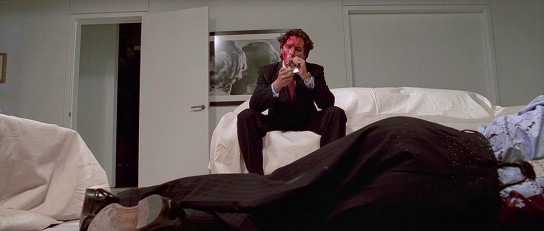
It is important to note that, in contrast with the popular image of the ‘deranged psycho,’ psychopaths tend to be very well composed, take good care of their appearance and are very charming (think of Christian Bale as Patrick Bateman in American Psycho). Because of this you may have a difficult time spotting them out, as they are masters of deception and are able to fake a lot of the qualities that define regular people. Some other psychopathic traits, according to Hare’s Psychopathy Checklist, are as follows:

  • Glib and superficial charm
  • Grandiose estimation of self
  • Need for stimulation
  • Manipulative and cunning
  • Complete lack of remorse or guilt
  • Pathological lying
  • Have a parasitic lifestyle, often latching onto and taking from others
  • Have a history of early behavioral problems
  • Overly impulsive
  • Are very irresponsible
  • Unable to accept responsibility for actions
  • Unable to commit to long-term relationships
  • History of juvenile delinquency
  • Display criminal versatility
  • Experienced a “revocation of conditional release”
  • Lacks realistic long term goals
  • History of promiscuous sexual behavior
  • Have poor behavioral controls
  • Are callous and lack empathy
  • Have a “shallow affect” (psychopaths show a lack of emotion when an emotional reaction is appropriate.)

You can actually rate yourself to find out if you are psychopath. On each criterion, the subject is ranked on a 3-point scale: (0 = item does not apply, 1 = item applies somewhat, 2 = item definitely applies). The scores are summed to create a rank of zero to 40. Anyone who scores 30 and above is most likely a psychopath. Hare has used this test and checklist to detect which inmates are psychopaths.

Snakes In Suits

What many of us may not realize is that psychopaths actually thrive in the corporate world. Hare has actually co-authored a book with Dr. Paul Babiak on this topic entitled, Snakes In Suits: Understanding and Surviving the Psychopaths in Your Office. Psychopaths manipulate others to accrue power, sometimes pitting them against each other in an attempt to divide and conquer. They are often attracted to bigger, dynamic corporations with very little structure or supervision. They generally don’t work well in teams because they don’t like to share information or skills and it brings them joy to watch others fail. They are addicted to power, status and money. Sound familiar?

The corporate world is set up to favor psychopathic traits such as fearlessness, dominant behavior and immunity to stress. Because of this, psychopaths often find themselves in these types of positions, and then have an easier time climbing the corporate ladder and obtaining positions of great power. This is where they can do real damage to society as we see it today.

Are Psychopaths Running The World?

Not only as corporate heads do psychopaths find success in our modern-day society, but also within our governments and political system — often as front-line politicians. This may come as a shock to you, but when you really look at some of the atrocities that are taking place on our planet, and if you’ve ever wondered how things that are so inhumane could actually be happening, well, therein lies part of your answer.

When you consider the war, genocide, senseless murder of civilians, treatment of the indigenous cultures of the world, chemicals in our food, air and water supply, acts of “terrorism”, war crimes and so many other unjust and cruel actions which are often instigated by our political leaders, it becomes easy to see how psychopaths actually fit the requirements for these types of roles quite well. As mentioned before they are masters of deception, pathological liars and often quite charming.

Many soldiers go to war and because they are conditioned to believe that they are fighting an enemy in the name of peace. They do as they are told and commit these heinous acts against other human beings. The reason why so many soldiers suffer from post-traumatic stress disorder is because it is not within human nature to murder other humans, and especially innocent civilians.

We already know how many politicians are crooked, but perhaps its time to start looking at them with the psychopath checklist in mind so that we can be better equipped to protect not only ourselves but our society from their malicious acts.

But Can’t We Help Them?

It is natural for anyone who is involved in spiritual work to have compassion for these individuals and feel compelled to help them overcome their psychopathic behavior. However, most research has pointed towards the understanding that psychopaths are born, not made and therefore cannot be cured. This is one of the main differences that separates sociopaths from psychopaths. Another is that sociopaths have a conscience, albeit a weak one, and will often justify something they know to be wrong. By contrast, psychopaths will believe that their actions are justified and feel no remorse for any harm done. Sociopaths are made, and have a higher likelihood of overcoming their current condition. However, many of those with sociopathic behavior will find themselves in similar corporate positions.

Hare’s research discovered that by attempting to heal or help a psychopath, you might actually be strengthening their cunning abilities, as they will find a way to manipulate you into believing that they are remorseful and understand how their actions were wrong.

How Can a CEO Feel Good About Being Vile?

Heather-Bresch-800x430

Is a big raise enough to make CEOs feel good about being so vile?

By Jim Hightower

Source: OpEdNews.com

Corporate price gouging is never nice. But gouging people on the price of medicines they rely on to stay alive is worse than not nice — it’s predaceously evil.

And if you think corporate morality can’t go lower than that, how about gouging people on the price of a life-saving medicine in order to jack up the personal pay of a drug maker’s CEO? That’s the bottom level of grotesque immorality where Heather Bresch dwells. She is chief executive of Mylan, a pharmaceutical profiteer that markets the EpiPen medical device, which literally is a lifesaver for people who suffer deadly anaphylaxis allergy attacks.

These allergy attacks kill nearly 200 people a year in the U.S. alone. Within seconds, something as common as peanuts or a bee sting can cause severe rash, swelling of the airways, drops in blood pressure, shock, and if not treated right away, death. So, naturally, we would want to increase access to the life-saving medicine that prevents these attacks, right?

Increasing that access is hard to do at today’s price. For years, a two-shot packet of EpiPens cost under $100, but Mylan bought the rights to the injectable drug in 2007, gained monopoly control of the market, and in 2012 suddenly began sticking dependent patients again and again with drastic price hikes. Now, the two-pack averages more than $600, with some paying above $900!

Drug makers routinely claim they must charge high prices to recoup their cost of developing their products — but Mylan didn’t develop the EpiPen, taxpayers did. The original research was initiated by the Pentagon back in 1973. Today, the device and the medicine in it cost Mylan only a few dollars to produce, and the product itself is essentially unchanged from when Mylan bought it. So the company’s only real contribution to the EpiPen has been to raise its price by more than 600 percent — a shameful act of sheer profiteering that rips off hundreds of thousands of users and endangers the lives of those families who simply can’t afford it.

Mylan’s CEO, the one responsible for this price gouge, regards herself as a self-made corporate success story — a woman who came out of hard-scrabble West Virginia and scrambled to the top of the food chain at Mylan. “There is a work ethic and grit about [West Virginia] that allows me to help make a difference,” Bresch told the New York Times.

Well, yes, grit, hard work — and having the advantage of being the daughter of the state’s former governor and current US Senator, Joe Manchin III. Take the MBA degree she got from West Virginia University, an academic credential bestowed on her 10 years after she left the school, having completed only about half of the coursework required to get a degree. The state university later conceded that Bresch was awarded this business degree… well, because her father was governor at the time, overseeing the school’s budget. It’s this sort of ethical “grit” that Mylan’s chief exec has employed to pick the pockets of thousands of vulnerable customers who rely on EpiPen.

Heather’s greed has sparked a furious public backlash, leading to congressional investigations. But, again, her “grit” might pay off, for she has bought off several top allergy-patient advocacy groups who are not backing the people. Why? Because she’s been dispensing millions of dollars to them in PR grants, making them “allies” in her blatant price-gouging scheme.

One thing that has risen higher than EpiPen’s price: CEO Heather Bresch’s paycheck. It’s up by 671 percent since 2007, and last year alone she pocketed $18.9 million! But I wonder — is that enough to make her feel good about being so vile? Of Course, Congress and the courts will do nothing to deter her and the other Big Pharma gougers — but surely the lowest level of Dante’s Inferno has rooms reserved for all of them.


Jim Hightower is an American populist, spreading his message of democratic hope via national radio commentaries, columns, books, his award-winning monthly newsletter (The Hightower Lowdown) and barnstorming tours all across America.


Lifting the Veil of Psychopathic Intrusion in Everyday Life

what-people-think-psychopaths-are-streetdemocracy

By Nozomi Hayase

Source: Dissident Voice

In recent years, the conception of the psychopath has gained a new upsurge of interest. Popular culture’s sensational image of Hannibal Lecter in the movie Silence of the Lambs and notorious killers like Ted Bundy have long cultivated public fascination. Now, awareness is spreading beyond these portrayals of outlandish criminals. More people are beginning to recognize the existence of socialized psychopaths who are not so outwardly violent.

Psychopaths walk among us, quietly blending into society. They could be corporate CEOs who exploit their workers, politicians who lie to get elected or Don Juan-like womanizers who inspire love to play with others hearts. Roughly 1-2 % of individuals in overall society are estimated to have been affected by this pervasive personality disorder (Neumann & Hare, 2008), yet some suggest these numbers are conservative and that many go unnoticed (Kantor, 2006).

The difficulty of accurately identifying psychopaths partly lies in a significant ambiguity among mental health professionals. Psychopathy expert, Robert D. Hare (1996) described the pivotal shift that occurred in 1980 with the publication of the third edition of the American Psychiatric Association’s Diagnostic and Statistical Manual of Mental Disorders (DSM-3), concerning the diagnosis of psychopathy. He noted how in this standard classification of mental disorder that has become the clinician’s bible, psychopathy was renamed antisocial personality disorder (ASPD), and defined by “persistent violations of social norms, including lying, stealing, truancy, inconsistent work behavior and traffic arrests” (para. 5).

Hare (1996) explained how this change was made based on the reasoning that affective and interpersonal traits that play a primary role in understanding psychopathy were difficult to measure. As a result, this diagnostic criteria of ASPD that mainly refer to criminal and outwardly observable antisocial behaviors, stripped off personality traits that are critical factors inherent in psychopathy. The trend of omitting the traits unique to this pathology has not been overturned to this day in the latest version of diagnostic manual DSM-5.

Along with this blurring of diagnosis, the very nucleus of this psychiatric disorder seems to have contributed to creating this lack of clarity. In his seminal work The Mask of Sanity, first published in 1941, psychiatrist Hervey M. Cleckley articulated how, among other personality traits such as their superficial charm, emotional poverty and egocentricity, the essential characteristic of psychopathy lies in its deceitful nature; hiding their lack of internal structure in a façade of normalcy.

Without knowing what to look for, even for professionals it is extremely hard to detect the psychopathic individual. This is made even more difficult when the very characteristics involve deception. All this has unleashed this dangerous population with few restraints, bringing great risk to the public. Their ability to fake and hide makes their exploitation invisible to the public eye. Oftentimes, people do not recognize abuse in a relationship until much of the damage is done. There are even cases where those who suffered harm do not realize they are victims.

Now, with the Internet and social media, a new level of education is happening. Through YouTube channels and online forums, those who experienced significant pain inflicted by these deranged individuals are coming together to gain validation that is desperately needed, yet often lacking in formal therapy. They are spouses, friends and co-workers, whose life had been ruined financially, mentally or emotionally. Those who had close encounters with these unknown members of society have seen the true face of psychopathy. With this sharing of first hand experience and witnesses outside lab experiments, the mystery of psychopathy is slowly being unveiled.

Hollowness as Elusive Core

In Without Conscience, Hare (1993) describes a psychopath as “a self-centered, callous, and remorseless person profoundly lacking in empathy and the ability to form warm emotional relationships with others, a person who functions without the restraints of conscience” (p. 2). The elusive core of this pathology is an absence of empathy. This sets those affected apart from the rest. People equipped with the ability to put themselves into another’s shoes often take this attribute for granted and don’t recognize the crucial role this seemingly innate aspect of human nature plays in forming a sense of one’s own self.

Humans are social beings. We exist in relation and develop identity through making connections with others at an emotional level. For instance, mother’s validation and proper attuning to her baby’s needs is crucial for infants to cultivate their sense of reality.

Psychopaths do not bond in the same way most people do and have not secured healthy attachment to caregivers. Because of this lack of attachment, argued by Hare (1993) as being a symptom of psychopathy, they cannot develop their identity based upon concrete reality.

Empathy unlocks the door into the world of a larger humanity, allowing one to experience higher emotions of joy, love and compassion. As the foundation of their identity is divorced from an empathic ground, psychopaths are emotionally held down in a “pre-socialized world”, lacking the full range of emotions (Meloy, 1988).

There is nothing inside to hold their identity together. As described in a T.S. Eliot’s poem, they are “hollow men… stuffed men -leaning together, headpiece filled with straw” (1934/1951, p. 56). Out of this vacuousness at the center of their personality, a head grows with an intelligence that is cunning and clever and primarily serves narrow selfish interests.

The being personified in this entity is enslaved by an internal void. They are a nobody and are driven to fill an insatiable hunger at any cost. Hare (1993) describes how they are “social predators who charm, manipulate, and ruthlessly plow their way through life, leaving a broad trail of broken hearts, shattered expectations, and empty wallets” (p. xi). Like going out on a hunt, they trespass people’s boundaries, dragging those who enter their proximity into their dark hole of nothingness. Anyone can become a target and once trapped, they are often sucked dry if not completely destroyed.

Idealization, Prelude to Seduction

The psychopath’s predation follows certain destructive relationship patterns that they repeat throughout their life. Regardless of differences in background, the victims all share similar cycles of abuse. Claudia Moscovici (2010) on her blog Psychopathyawareness describes these patterns in three stages; idealization, devaluation and then discard.

The first stage of a psychopathic relationship is idealization. This is a powerful and seductive period when psychopaths allure their potential victims. With superficial charm, this cunning and manipulative population enchants their targets. They put their new love interest on a pedestal, saying whatever the person wants to hear, transfixing whoever has become the unfortunate prey. It could be a whirlwind romance or promising partnership. Showered with flattery and adulation, targets often feel they are finally getting the appreciation they deserve in life.

In Snakes in Suits: When Psychopaths Go to Work, Hare and leading organizational psychologist Paul Babiak (2006) described this period as an assessment phase, where psychopaths examine their targets’ value and utility. They outlined the four main messages that psychopaths convey to their targets to create an instant connection, which they call the “psychopathic bond”. These are: 1) “I like who you are”; 2) “I am just like you”; 3) “Your secrets are safe with me”; 4) “I am the perfect friend, lover, partner for you” (p. 74-78).

If you are chosen, you will be adored and made to feel special. In their idealizing gaze, you are a center of the universe and can do no wrong. This newly acquainted friend or lover taps into fears, insecurity and deep wishes and morphs themselves into becoming anything their victim wants them to be.

Their seemingly caring gestures appear very genuine and many mistake this as empathy. Later, targets would reflect back on that exciting beginning and feel that they had been fooled. Hare describes how, unlike other mental disorders, psychopaths are rational and that “their behavior is the result of choice, freely exercised” (1993, p. 22). Although it is true that some of the deviants are calculative and indeed plot all the way through, at the same time, as Hare suggests, it is often done more instinctively and is not necessarily planned out. Their love-bombing during this phase rather appears to be an effect of their pathology, caused by impaired emotional processing.

Narcissistic Mirror and Erosion of Identity

So, why do they idealize? The idealization is a part of their pathological makeup. Psychopaths are truly outsiders. Without being a part of the world informed by empathy, they live in isolation and develop a sense of self that is divergent from the majority of society. Researchers point to the psychopath as having a “narcissistic and grossly inflated view of their self-worth and importance” (Hare, 1993 p. 38), a “grandiose self-structure” and a “psychopathology of narcissism” (Meloy, 2001, p. 11).

Although psychopathy is different from the other severe personality dysfunction recognized in the psychiatric community as Narcissistic Personality Disorder (NPD), its core of empathy deficit encompasses some of the features exhibited by NPD. Like those who suffer from excessive narcissism, they are trapped in mirrors of self-absorption and can’t recognize others as having their own autonomous thoughts and feelings. Through not being grounded in a consensual reality, they lack objectivity in their assessment of their own selves. For them, reality is constructed not based on who they really are, but who they want and believe themselves to be.

Being cut off from emotional reality, they are dead inside and can’t harvest their own energy. So they become parasites and feed off others’ emotional reactions. When they idealize their partners, they are unconsciously wanting to establish a connection to a source of creativity, that which gives emotional sustenance. Through weaving a fantasy and duping the other into their web of deception, they extract the life forces of the victim.

For psychopaths, relationship is the stage on which they enact their grandiose fantasy. Others are seen as an extension of themselves, as props that can be used. Anyone who comes their way is screened for their ability to perform a role that serves their plot. Their chosen targets become an object of desire and are pursued with great passion. With beam-like attention, they turn the spotlight on the victims. Through mirroring the victims’ positive qualities, predators disarm their prey and bring them under the luminary light of their narcissistic mirror. In this, the victim’s identity is eroded, yet with constant flattery and attention, they feel pumped up and elated.

This internal casting process can be seen as the psychopath launching a parallel persona upon their targets’ identity and then using it as a mask to create a rapport with their target. Yet, this mirroring is not consciously carried out. It is an automatic reflex that happens when they see something they want in others. Also, in some cases, in others’ positive attributes, these self-absorbed individuals see an idealized image of themselves. Like the Greek myth of Narcissus who falls in love with his own reflection in the water and then pines away, this is the effect of psychopaths seeing themselves in another’s reflection that is created by victims favorably responding to idealization and then trying to claim that image for themselves.

This mirroring starts to fade after the psychopaths successfully attach themselves to their hosts and is then replaced with mind games. Without being able to feel genuine emotions, the psychopath from a young age studied human behavior and learned how to effectively create a favorable response. They will slowly start to use this acquired skill of clever manipulation to keep their victims inside their delusional bubble and maintain control.

Devaluation and the Broken Mirror

What comes next is devaluation, marked as a betrayal with broken promises. This is when psychopaths who had always seen their partners in a positive light will begin to criticize and withdraw their attention. They slowly tear down the pedestal they once put victims up on and engage in subtle ridicule and condescension. Confused, the targets often internalize these criticisms and start becoming convinced that they are not as perfect as the psychopaths initially made them feel and that they have faults just like everyone else.

So, why does this devaluation happen? Many who have been taken for a ride wonder why this person who once seemed to love them so much, changes all of sudden. After psychopaths absorb their targets’ good traits, they cannot truly make them their own. There is nothing that can fill their bottomless pit and soon the void starts to grow again. When the initial thrill and excitement of a new target wears off, they get bored. This is the point where those who have been taken in by the charm start to see the mask slipping.

While victims begin to have a glimpse of the hollow man behind the mask of the manufactured persona, in the eyes of the psychopath, the victim ceases to be the perfect mirror that reflects back their delusions of grandeur. This happens because those who were made to be reflections in their mirror are living human beings. When victims start to act autonomously, as every human being is meant to do, these malignantly narcissistic individuals experience their self-image fluctuating and their mirror of absorption beginning to shatter.

In a sense, psychopaths are like bullets that have been fired by a gun they themselves barely understand. Distortion in the mirror that occurs during this devaluation process is experienced by them as an attack on their very existence. When they start to realize their idealized partner is fallible, they experience injury and believe that what pulled the trigger is coming from outside them. The love of life that they once declared quickly becomes malformed or damaged goods and the victim can even be seen as an object of hatred and contempt. The idealized self-image projected onto their partners now disappears from the mirror and they have to look for it elsewhere. Thus, rinse and repeat. They start chasing a new object of ‘affection’ and begin the idealization phase all over again.

Discarded

Little does the victim know, but the person they had fallen for is now gone. The psychopath has already abandoned their masks. At this point, if the target remains useful to them, they would be kept around, but otherwise, the psychopath moves on, as if the previous victim never existed. The duration of each stage leading up to the final discard depends on how fast the targets catch on to their ploy or whether they cease to be useful.

After being cast aside, the victims might feel they were handled dishonestly. They realize that their partners were fraudulent and that what they thought was love or true friendship was an illusion. Those who were wronged ask themselves if their partners really cared about them at all. When the psychopath’s mask is finally blown off and one begins to glimpse the monster behind that mask, one is flooded with questions that may never be answered.

It is important not to forget that these are ‘hollow men’. They suffer from shallow emotions and don’t have the same capacity for feeling as most people do. Hare (1993) describes their apparent lack of emotional depth, noting how they “seem to know the dictionary meanings of words but fail to comprehend or appreciate their emotional value or significance” (p. 128). They are “like a color-blind person who sees the world in shades of gray but who has learned to function in a colored world” (p. 129). Without having vital emotional understanding, they mimic experiences they can’t really understand through simulating emotions and parroting words that others use.

Without this understanding, those with empathy assume the other has a similar orientation and they fill in the blanks by projecting good attributes and interpreting words of those who lack feeling for others according to how they themselves use language. As the relationship unfolds beyond the initial stage, the differences eventually begin to emerge and the shallow consciousness behind the beautiful words starts to unravel.

As they are not tied to others by empathy, psychopaths have little connection to their own history and are uprooted from the shared narrative of humanity. They live in the present moment and are driven by immediate needs and instinctual desires. Just like the hollowness of their soul, their words are empty, rarely matching actions. They promise eternal devotion and love to describe their transient and fleeting desires of the here and now. For them there is no future; there is no past. There is nothing lasting that deeply connects them with other human fellows. They try on one personality and then drop it when it becomes inconvenient and move on to the next as needed.

The Anesthetized Heart

Who are these empty souls, masquerading as friends, lovers and good Samaritans, whose self-gratifying deeds in the end always leave their victims bewildered? The beast inside this small minority of society seizes everything that moves. They conquer the other, turning constantly evolving images of their targets into frozen snapshots of abstraction, which they then possess. In extreme cases, this is seen in the example of serial killers cutting up victims’ dead bodies and sleeping with them. Although the degree might be different, this deadening force that works within is the same. Psychopaths try to wipe out victims’ identity, so to make them a clean slate that can more perfectly mirror their grandiose self. Through lies and re-framing events, they attack their target’s memory, making them doubt their own sense of self. What awaits one toward the end of the relationship, if one does not disentangle themselves in time, can even be a total annihilation of the self.

The horror displayed by psychopathy and this moral bankruptcy often provokes an image of evil. In People of the Lie: The Hope for Healing Human Evil, psychiatrist and author Scott Peck (1983) defined evil as a reversal of the word ‘live’, and portrayed it as something that crushes life. They have what psychologist James Hillman (1992) characterized as an “anesthetized heart, the heart that has no reaction to what it faces, thereby turning the variegated sensuous face of the world into monotony, sameness, oneness” (p. 64).

Empathy is the foundation of conscience. It is to think with the heart and to feel with others. As the psychopath is delinked from the heart; from that which ties all living beings together, they are in a kind of darkness, where the light of conscience cannot reach. They lack insight about the situations they are in. They can intellectually understand what they are doing, but they cannot be fully conscious of their own actions and their devastating effects.

This state of numbness blinds them to the beast within that is devouring their victims. It makes them become deaf to the cries of those who are slowly dying. After the initial honeymoon phase, when their partners don’t defer to the psychopath’s version of reality and question this pretend world, they rush out and punish the victims. When victims strike back, psychopaths often fail to see how those abused are trying to defend themselves and instead twist reality. They deflect, misconstrue conversations to fit a narrative where they are constantly aggrieved and injured, making the victims look like the perpetrators.

No amount of love is enough for them. In the effort to communicate with these disordered individuals, words bounce back off their hardened hearts and become echos that the psychopath cannot hear. They rationalize and make one feel what they can’t feel about themselves, transmitting these emotions like poison. Victims are called too sensitive, crazy or imagining things and are further dragged into the predator’s one-sided reality.

Recovery and Path Back to the Self

How can those who are captured in a toxic web escape this snare and stop the bleeding that has been feeding this beast? These hungry carnivores sink their claws into their prey through the innate human trait of empathy and exploit our trusting nature. Most people relate to others in dialogue, giving a space for another’s perspective to enter in the interaction. Psychopaths on the other hand, not abiding by empathy, live in solipsism and operate in a monologue. While victims are trying to understand their perspective, these emotional vampires move quickly to direct the narrative, giving no chance for their targets to participate in the unfolding story as a co-creator. Through being nitpicky and accusative, they make victims back off from asserting their needs and make them walk on eggshells.

In relationship with these deadly individuals, what remains unconscious, both the dark and bright parts of oneself become vulnerable for manipulation. During idealization, the psychopath, like a puppeteer, attaches invisible heartstrings to their targets. They promise to fill a void, play on one’s vanity, mirroring back desires and enamoring victims with their own reflected beauty. Victims would not know until much later how this idealization was conditioning them to act in a certain way. What happens is a transfer of authority, where without realizing it, victims slowly begin to seek for approval from this pretend friend or partner.

When the devaluation phase sets in, if victims begin to become aware of what is happening and try to fortify their boundaries, they are often so deep in the fantasy and the fog of confusion becomes so thick that they cannot even see the path from which they came. They often suppress their emotions and take the blame in confrontational situations, so as not to ruin this idealized image.

Master manipulators know their prey, their insecurities and desires and know very well which buttons to push to get what they want. Chosen targets become like rats in a maze that leads to a shadow of one’s former self. As long as one performs according to the master’s plot, they will be rewarded, yet when one derails from their story, they are punished. Many desperately try to mend the broken mirror that once reflected their idealized self and focus on fixing what they have been brainwashed to believe as their ‘issues’.

For those who have been abducted into psychopaths’ illusory world, the path back to the self lies within. Recovery from the terror of the anesthetized heart calls for fully reclaiming one’s own empathy. This first requires one to have empathy for oneself; to claim all that was disowned within. Through accepting one’s own emotions without judgment no matter what they are, one can make a more conscious relationship with them and recognize how these emotions have been used as a tool for control. One can then break this hypnotic spell and take back the power to define one’s own reality.

Larger Social Implications

The relationship with a psychopath is like nothing experienced before. Until it is lived on a personal level, it is difficult to understand the depth of its destruction. This is a kind of psychological warfare being quietly waged upon victims. Psychopaths build up their targets and then knock them down under the rug. In the aftermath, victims may come to realize that they have been in a battle for their own life and that what is at stake is something even larger. This psychopathic invasion into one’s life is an infiltration of our deeper humanity. So, what is the agenda behind this dark force and where is it taking us?

Those with imperiled empathy are haunted by an eternal emptiness. They are thirsty, yet they can’t drink from the water of life. All they see are frozen images on the surface. This internal vacuum can turn into a monstrous desire for power that boils below consciousness. Philosopher Friedrich Nietzsche (1920) once signified this force when he urged his readers to make themselves “superior to humanity in power, in loftiness of soul, —contempt” (p. 38). This fighter for human freedom revealed to us the fall of human nature in his call for the will to power. He asked:

What is good? —Whatever augments the feeling of power, the will to power, power itself, in man. What is evil? —Whatever that springs from weakness. What is happiness? —The feeling that power increases—that resistance is overcome. (p. 42-43)

In praise of independence, psychopaths condemn human emotions such as attachment and jealousy as weakness and deny attributes like compassion and cooperation. They hijack and pull the development of the individual into becoming a reflection of their dry and deserted soul.

The encounter with psychopaths brings forth the fundamental question of evil; how can humanity confront what has become so terrifying in the world? Austrian philosopher Rudolf Steiner (1943/1977) once elucidated how the role of evil is to educate us to freedom and love:

Love would be impossible for man and freedom would be impossible for man without the possibility of sailing down into the abyss. A man unable of his own free decision to choose good or evil, would be a being only led on a leading string to a good which must be attained of necessity and who had no power to choose the good of his own fully purified will, by the love which springs from freedom. (p. 206)

We are born into the cradle of nature and unconsciously carried by affects and desires that stem from deep obligation to one another. Governed by this internal law of empathy, emotions that arise from a communal ground such as the sense of guilt or shame or simply feelings for the other, naturally regulate self-interests and restrain actions in consideration of others’ needs.

Unless we are ripped away from this protective world of empathy, how will we become aware of it and understand its true value? Psychopaths make us fight against ourselves. Their assault on empathy awakens us to the force that denies and breaks the bond of brotherhood. It gives us an opportunity to find the strength within to resist this will to power. By being pushed to the edge, we are asked to uphold out of free will all that makes us human.

When one fights this battle consciously, one can see this ‘evil’ for what it truly is. Hare (1993) shared a view held by some investigators that “behind Cleckley’s ‘mask of sanity’ lies not insanity but a young child of nine or ten” (p. 169). Like poet Rainer Maria Rilke’s myth of dragons being transformed into princesses at the last moment, perhaps these frightening members of society are a part of our own humanity that is “waiting to see us just once being beautiful and courageous” (1992, P. 85).

When we find courage to turn to what has become so dark, we find ourselves anew in those who are forgotten or condemned –within the shadows of man. We become survivors and begin to understand the true meaning of this battle.

One day, a stranger knocked at the door and opened our eyes to a side of humanity that we didn’t know existed. Darkness had a gift. It let us see the light that shines from within. With this light, mankind may find its true path toward evolution, becoming a species that can truly love. This is our salvation, where lies the potential for redemption of ourselves and the world.


Nozomi Hayase, Ph.D., is a writer who has been covering issues of freedom of speech, transparency, and decentralized movements. Her work is featured in many publications. Find her on twitter @nozomimagine Read other articles by Nozomi.

Mark Ruffalo: ‘Monsanto Chief is Horrible’

mark-ruffalo-the-hulk

By Mark Ruffalo

Source: EcoWatch

Monsanto chief is horrible … And I got to tell him that to his face after his interview on CBS This Morning.

Approaching someone like this isn’t really my thing. But being so well behaved all the time doesn’t seem to be helping people. It made me really uncomfortable to do it. But that’s how we change. We must become uncomfortable. We must act out of our comfort zones for things to change. We must call out the people who are doing horrible things when they do them.

Hugh Grant (Monsanto CEO not the actor) must be made to feel uncomfortable for what he allows his company to do in the world. That is why I told him what I did and why I am sharing it with you.

Before a segment I was doing for the movie Spotlight with Mike Rezendes on Dec. 2, I was waiting in the green room watching Grant worm his way through the strong questions he was getting from the CBS team. His handlers clearly have been working very hard with him to give him every slippery non-answer to every question he was asked. I was beside myself watching this guy who is responsible for so much misery and sickness throughout the world slime his way through his interview. I could not hold my tongue. He came through the Green Room door ready to do high fives with his press agent and I simply told him this:

“You are wrong. You are engaged in monopolizing food. You are poisoning people. You are killing small farms. You are killing bees. What you are doing is dead wrong.”

A bead of sweat broke out on his head. “Well, what I think we are doing is good,” Grant replied.

“I am sure you do,” I told him.

When people get paid the kind of money he gets paid their thinking becomes incredibly clouded and the first thing to go is their morality.

He says Monsanto needs to do a better job with their messaging.

Hugh, it’s not your messaging that makes you and your company horrible. It’s the horrible stuff you guys do that makes you and your company horrible. People don’t walk around making horrible stories up about good companies because they got nothing else better to do with their time. People like you and your company are horrible because … you are horrible. No matter how much jumping around you do on morning shows (where no one can really nail you down for the horrible stuff you do), you will still always be horrible and people will always greet you the way I did, when you go around trying to cover up the fact that you are horrible.

Want to know more about the real Monsanto and Hugh Grant? Watch this:

There is a lot more horrible stuff to look at here:

Monsanto’s greatest hit jobs.

In 2003, Monsanto settled a lawsuit for $700 million with 20,000 Anniston, Alabama residents who claimed that a Monsanto plant contaminated local rivers, lakes, soil and air with polychlorinated biphenyls (PCBs). Plaintiffs reported a range of health issues including cancer, birth defects and neurological disorders.

New York Times: $700 Million Settlement in Alabama PCB Lawsuit

CBS News: Toxic Secret: Alabama Town Never Warned of Contamination

In 2012, Monsanto settled a lawsuit with tens of thousands of plaintiffs in West Virginia for $93 million. Residents of Nitro, West Virginia claimed they had been poisoned by decades of contamination from cancer-causing chemicals used in the manufacturing of Agent Orange produced in a Monsanto plant.

The Guardian: Monsanto Settles ‘Agent Orange’ Case with US Victims

In March 2015, the International Agency for Research on Cancer (IARC), an arm of the World Health Organization, concluded in a study that glyphosate, the active ingredient in Monsanto’s widely used weedkilling product Roundup, was “probably carcinogenic to humans.”

Shortly after the IARC’s study was made public, France took steps to limit the sale of Roundup. France has also banned the cultivation of genetically modified crops.

Reuters: Frances Bolsters Ban on Genetically Modified Crops

Newsweek: Frances Bans Sale of Monsanto’s Roundup in Garden Centers After UN Names it Probable Carcinogen

In September 2015, a French appeals court in Lyon upheld a decision that held Monsanto liable for poisoning a French farmer. The grain farmer, Paul Francois, developed neurological damage after inhaling Monsanto’s weedkilling product Lasso.

Reuters: French Court Confirms Monsanto Liable in Chemical Poisoning Case

Le Monde: Monsanto Condamné pour L’Intoxicite d’un Agriculteur Francais

In September 2015, two U.S. farm workers filed suit against Monsanto claiming that exposure to Roundup caused them to develop cancer.

Reuters: U.S. Workers Sue Monsanto Claiming Herbicide Caused Cancer

You can find reports of Monsanto products being linked to cancer and other health issues all over the world, for example:

Argentina is the world’s third largest soy-producing country.

According to Mother Jones, nearly 100 percent of the soy crop is genetically altered and Monsanto’s Roundup is very widely used. As the use of pesticides and herbicides in Argentina has increased, cancer clusters have begun to develop around farming communities. A 2010 study at the University of Buenos Aires also found that injecting glyphosate (the active ingredient in Roundup) into chicken and frog embryos caused the same sort of spinal defects that doctors have found to be increasingly prevalent in communities where farm chemicals are used.

Mother Jones: Argentina is Using More Pesticides than Ever. And Now It Has Cancer Clusters

On Monsanto suing small farmers:

The Guardian: Monsanto Sued Small Farmers to Protect Seed Patents

Vanity Fair: Monsanto’s Harvest of Fear


Related Article: Global Citizens Tribunal to Put Monsanto on Trial at the International People’s Court in The Hague


Confronting Industrialism

cost-of-coal_detail

By Derrick Jensen

Source: Counterpunch.org

Some of the most important questions confronting us are: what should we do about this culture’s industrial wastes, from greenhouse gases to pesticides to ocean microplastics?

Can the capitalists clean up the messes they create? Or is the whole industrial system beyond reform? The answers become clear with a little context.

Let’s start the discussion of context with two riddles that aren’t very funny.

Q: What do you get when a cross a long drug habit, a quick temper, and a gun?

A: Two life terms for murder, with earliest release date 2026.

And,

Q: What do you get when you cross a large corporation, two nation states, 40 tons of poison, and at least 8,000 dead human beings?

A: Retirement with full pay and benefits. Warren Anderson, CEO of Union Carbide. Bhopal.

The point of these riddles is not merely that when it comes to murder and many other atrocities, different rules apply to the poor than to the rich. And it’s not merely that ‘economic production’ is a get-out-of-jail free card for whatever atrocities the ‘producers’ commit, whether it’s genocide, gynocide, ecocide, slaving, mass murder, mass poisoning, and so on.

Do we even care? We already know they don’t …

The point here is that this culture is clearly not particularly interested in cleaning up its toxic messes. Obviously, or it wouldn’t keep making them. It wouldn’t allow those who make these messes to do so with impunity. It certainly wouldn’t socially reward those who make them.

This may or may not be the appropriate time to mention that this culture has created, for example, 14 quadrillion (yes, quadrillion) lethal doses of Plutonium 239, which has a half-life of over 24,000 years, which means that in a mere 100,000 years that number will be all the way down to only about 3.5 quadrillion lethal doses: Yay!

And socially reward them it does. I could have used a whole host of examples other than Warren Anderson, who was playing on the back nine long after he should have been hanging by the neck (he was sentenced to death in absentia, but the US refused to extradite him).

There’s Tony Hayward, who oversaw BP’s devastation of the Gulf of Mexico and who was ‘punished’ for this with a severance package worth well over $30 million. Or we could throw another couple of riddles at you, which are really the same riddles:

Q: What do you call someone who puts poison in the subways of Tokyo?

A: A terrorist.

Q: What do you call someone who puts poison (cyanide) into groundwater?

A: A capitalist: CEO of a gold mining corporation.

We could talk about frackers, who make money as they poison groundwater. We could talk about anyone associated with Monsanto. You can add your own examples. I’d say you can ‘choose your poison’ but of course you can’t. Those are chosen for you by those doing the poisoning.

Civilization’s ability to overcome our native common sense

I keep thinking about one of the most fundamentally sound (and fundamentally disregarded) statements I’ve ever read. After Bhopal, one of the doctors trying to help survivors stated that corporations (and by extension, all organizations and individuals) “shouldn’t be permitted to make poison for which there is no antidote.”

Please note, by the way, that far from having antidotes, nine out of ten chemicals used in pesticides in the US haven’t even been thoroughly tested for (human) toxicity.

Isn’t that something we were all supposed to learn by the time we were three? Isn’t it one of the first lessons our parents are supposed to teach us? Don’t make a mess you can’t clean up!

Yet that is precisely the foundational motivator of this culture. Sure, we can use fancy phrases to describe the processes of creating messes we have no intention of cleaning up, and in many cases cannot clean up.

And so we get phrases like ‘developing natural resources’, or ‘sustainable development’, or ‘technological progress’ (like the invention and production of plastics, the bathing of the world in endocrine disruptors, and so on), or ‘mining’, or ‘agriculture’, or ‘the Green Revolution’, or ‘fueling growth’, or ‘creating jobs’, or ‘building empire’, or ‘global trade’.

But physical reality is always more important than what we call it or how we rationalize it. And the truth is that this culture has been based from the beginning to the present on privatizing benefits and externalizing costs. In other words, on exploiting others and leaving messes behind.

Hell, they call them ‘limited liability corporations’ because a primary purpose is to limit the legal and financial liability of those who benefit from the actions of corporations for the harm these actions cause.

Internalizing insanity

This is no way to run a childhood, and it’s an even worse way to run a culture. It’s killing the planet. Part of the problem is that most of us are insane, having been made so by this culture. We should never forget what RD Laing wrote about this insanity:

“In order to rationalize our industrial-military complex [and I would say this entire way of life, including the creation of messes we have neither the interest nor capacity to clean up], we have to destroy our capacity to see clearly any more what is in front of, and to imagine what is beyond, our noses. Long before a thermonuclear war can come about, we have had to lay waste to our own sanity.

“We begin with the children. It is imperative to catch them in time. Without the most thorough and rapid brainwashing their dirty minds would see through our dirty tricks. Children are not yet fools, but we shall turn them into imbeciles like ourselves, with high IQs, if possible.”

We’ve all seen this too many times. If you ask any reasonably intelligent seven-year-old how to stop global warming caused in great measure by the burning of oil and gas and by the destruction of forests and prairies and wetlands, this child might well say, “Stop burning oil and gas, and stop destroying forests and prairies and wetlands!”

If you ask a reasonably intelligent thirty-year-old who works for a ‘green’ high tech industry, you’ll probably get an answer that primarily helps the industry that pays his or her salary.

Part of the brainwashing process of turning us into imbeciles consists of getting us to identify more closely with-and care more about the fate of-this culture rather than the real physical world. We are taught that the economy is the ‘real world’, and the real world is merely a place from which to steal and on which to dump externalities.

Does nature have to adapt to us? Or us to nature?

Most of us internalize this lesson so completely that it becomes entirely transparent to us. Even most environmentalists internalize this. What do most mainstream solutions to global warming have in common? They all take industrialism as a given, and the natural world as having to conform to industrialism.

They all take empire as a given. They all take overshoot as a given. All of this is literally insane, in terms of being out of touch with physical reality. The real world must always be more important than our social system, in part because without a real world you can’t have any social system whatsoever. It’s embarrassing to have to write this.

Upton Sinclair famously said that it’s hard to make a man understand something, when his job depends on him not understanding it.

I would add that it’s hard to make people understand something when the benefits they accrue through their exploitative and destructive way of life depend on it. So we suddenly get really stupid about the waste products produced by this culture.

When people ask how we can stop polluting the oceans with plastic, they don’t really mean, “How can we stop polluting the oceans with plastic?” They mean, “How can we stop polluting the oceans with plastic and still have this way of life?”

And when they ask how we can stop global warming, they really mean, “How can we stop global warming without stopping this level of energy usage?”. When they ask how we can have clean groundwater, they really mean, “How can we have clean groundwater while we continue to use and spread all over the environment thousands of useful but toxic chemicals that end up in groundwater?”

The answer to all of these is: you can’t.

First we must recover our sanity. Then we must act

As I’ve been writing this essay about the messes caused by this culture, there’s an allegorical image I can’t get out of my mind. It’s of a half-dozen Emergency Medical Technicians putting bandages on a person who has been assaulted by a knife-wielding psychopath.

The EMTs are trying desperately to stop this person from bleeding out. It’s all very tense and suspenseful as to whether they’ll be able to staunch the flow of blood before the person dies.

But here’s the problem: as these EMTs are applying bandages as fast as they can, the psychopath is continuing to stab the victim. Worse, the psychopath is making wounds faster than the EMTs are able to bandage them. And the psychopath is paid very well for stabbing the victim, while most of the EMTs are bandaging in their spare time.

And in fact the health of the economy is based on how much blood the victim loses – as in this culture, where economic production is measured by the conversion of living landbase into raw materials, e.g., living forests into two-by-fours, living mountains into coal.

How do we stop the victim from bleeding out? Any child can tell you. And any sane person who cares more about the health of the victim than the health of the economy that is based on dismembering the victim can tell you. The first thing you need to do is stop the stabbing. No amount of bandages will make up for an assault that is ongoing, indeed, one that is accelerating.

What do we do about this culture’s fabrication of industrial wastes? The first step is stop their production. Actually the first step is that we regain our sanity, that is, we transfer our loyalty away from the psychopaths, and toward the victim, toward, in this case, the planet that is our only home.

Once we do that, everything else is technical. How do we stop them? We stop them.

Derrick Jensen is Member of the Steering Committee of Deep Green Resistance. See more details. Read Derrick Jensen’s blog.


The Global Money Matrix: The Forces behind America’s Economic Destruction

money-globe

By Dr. Gary Null

Source: GlobalResearch.ca

On the Brink of Economic Calamity

We are witnessing unprecedented low points in American economic history as 50 million Americans—17 million of them children—are living below the poverty line[i],[ii] while 47 million citizens rely on food stamps[iii].  All told, the 2008 economic collapse cost over $20 trillion globally[iv]. Millions of people lost their homes and jobs, while many of our nation’s children fell deeper into hunger. According to some figures, 53 million people entered the poverty ranks.[v] In the US and other developed nations, suicide rates skyrocketed due to financial stress and disruption of families. The Bureau of Labor Statistics has listed unemployment at 7.5% — a rate that is irreconcilable with reality. The more reliable figure, calculated by economist John Williams from Shadow Government Statistics, places unemployment at 22%. If we are to believe the analyses of Tyler Cowen at the Mercatus Center at George Mason University, we might be looking at an unemployment rate as high as 41%, since 33% of Americans are not working and no longer have the desire to find jobs.[vi]  This group is categorically removed from the government’s labor radar and is absent from the Bureau of Labor Statistics’ fudged data. 

 The Global Money Matrix

In the midst of this economic turmoil there is one group that still manages to flourish: the global elite. With more than $32 trillion stashed in offshore banks around the world, the wealth of the so-called “1%” is staggeringly obscene and grows by the day.[vii]  Their aggregate wealth, larger than the US GDP and national debt combined, is a testament to the tremendous influence and lobbying power held by a coterie of private interests that dominate nearly every sector of society.

Instead of reining in the inordinate control exercised by the elite, most of our elected officials have become little more than shills for these corporate overlords, creating policies that favor their campaign donors instead of the American people. Hundreds of millions of dollars were funneled into Barack Obama’s 2012 presidential campaign by donors whose business affiliations run the gamut from real estate and finance to media and law firms. According to Opensecrets.org, “Together, 769 elites are directing at least $186,500,000 for Obama’s re-election efforts — money that has gone into the coffers of his campaign as well as the Democratic National Committee.”[viii] This figure doesn’t even account for the massive contributions to Obama’s reelection by corporate-driven SuperPACs. Obama is just one example of how our politicians are beholden to the elite agenda. A quick glance at the campaign donation figures presented at Opensecrets.org reveals just how much special interests control Washington’s policymakers.

Given the corporatist influence that infects our halls of power, it is little wonder that our tax dollars continue to fund unconstitutional spying, perpetual war, and neoliberal policies that extend the powers of the world’s richest individuals and organizations. As Americans struggle financially, our social safety nets are increasingly losing priority to military and security expenditures that are historically unmatched anywhere in the world. Increasingly, the actions taken by the world’s most powerful corporations and governments seem to be at odds with public perception and wellbeing. Here are a few examples of how this combined influence has increased at the expense of the average American:

ALEC – This conservative group, funded by donors like the Koch brothers and Exxon Mobil and fueled by politicians including Ohio Governor John Kasich and Wisconsin Governor Scott Walker,[ix] writes model legislation calling to “privatize education, break unions, deregulate major industries, pass voter ID laws, and more.”[x] They do so with the stated aim to “form formal internal Task Forces to develop policy covering virtually every responsibility of state government.”[xi] ALEC’s website claims, “Each year, close to 1,000 bills, based at least in part on ALEC Model Legislation, are introduced in the states. Of these, an average of 20% become law.”[xii]

Federal Taxes and Expenditures – In 2014, President Obama plans to spend 57% of his discretionary budget on military, with 6% going to education, 3% to science, and 1% to food and agriculture.[xiii] And while the federal corporate tax rate is 35% in America, a variety of loopholes means that the average rate paid by corporations is 25%, with some companies paying as low as 10%.[xiv]

Citizens United – This US Supreme Court case set the legal precedent for unlimited campaign donations in US elections, qualifying corporate donations as a form a free speech. Since this case concluded, campaign expenditures have tripled.[xv]

TARP, or “the Bailout” – Following the economic crisis of 2008, US taxpayers handed $700 billion to major players in the automotive, financial, and insurance industries[xvi]. According to The New York Times, “Treasury…provided the money to banks with no effective policy or effort to compel the extension of credit. There were no strings attached: no requirement or even incentive to increase lending to home buyers, and…not even a request that banks report how they used TARP funds.”[xvii]  The Huffington Post reports, “Twenty-five top recipients of government bailout funds spent more than $71 million on lobbying in the year since they were rescued.”

In the Name of Security

The most concerning imbalance of power, however, may lie in the ‘security state’. In 2010, there were over 1900 private corporations with government contracts working for Homeland Security and NSA intelligence projects. Just one of these firms, Booz Allen Hamilton, where Edward Snowden was employed, has over 25,000 employees, nearly half of whom have security clearance of “top secret or higher”.[xviii]  Overall, there are an estimated half million individuals in private firms with access to intelligence secrets.[xix]  The federal intelligence agencies only employ 107,000 individuals; therefore, the bulk of intelligence and surveillance operations are conducted by private workforces.[xx] For fiscal year 2013, the country’s budget for intelligence, across 16 agencies, was approximately $52.6 billion, with 70% going to private contractors.[xxi]

Recent revelations by Edward Snowden unearthed the breadth and scope of this surveillance network. The National Security Agency has collected vast amounts of data to spy upon American citizens, elected legislators in Congress, leaders and populations of other nations, multilateral and international administrations, non profit organizations, and a variety of public and environmental advocacy groups. This defines the current trajectory of the US as a failed republic degenerating into a fascist regime.  For both corporate Republicans and Democrats, the rise of surreptitious surveillance on citizens, in direct violation of the Constitution, is perceived as a matter of national security to protect both the country’s domestic and foreign interests.

NSA Director Gen. Keith Alexander claimed publicly that intelligence surveillance of the American public “foiled” 54 terrorist attacks by extremists. Independent research confirmed that in fact only one, and a possible second attack, could be directly associated with the war on terrorism.  Speaking on the matter, Vermont Senator Patrick J. Leahy stated,

“There is no evidence that [bulk] phone records collection helped to thwart dozens or even several terrorist plots….These weren’t all plots and they weren’t all foiled.”.[xxii]

The Washington Times reported that “Keith B. Alexander admitted that the number of terrorist plots foiled by the NSA’s huge database of every phone call made in or to America was only one or perhaps two—far smaller than the 54 originally claimed by the administration.” General Alexander, under the questioning of Senator Leahy, also admitted that only 13 of the 54 cases were in any way connected to the U.S.  As the Washington Times clarifies,

“The [NSA phone records] database contains so-called metadata—the numbers dialing and dialed, time and duration of call—for every phone call made in or to the U.S.”[xxiii] 

This is but one example highlighting how the consolidation of corporate and political power comes at the cost of human rights and personal liberties for the average citizen.

 Obama has lied to the American people repeatedly about the extent of the security state and its infiltration into the lives of average citizens, including massive data collection of private phone calls, emails, and internet activity. The NSA revelations of Edward Snowden provide documented proof that intelligence surveillance is far more extensive than ever believed. The activities of the FBI, CIA, Pentagon, FISA courts, USDA and FDA, and the Justice Department contribute to the deterioration of citizens’ privacy and freedom. And a recent report by Essential Information entitled Spooky Business describes how some of America’s largest corporations have engaged in corporate espionage to spy on non-profit organizations. Ralph Nader writes, “In effect, big corporations have been able to hire portions of the national security apparatus, and train their tools of spycraft on the citizen groups of our country.”[xxiv] Thus, the powers of government and corporations are fostered and increased by one another, while those of the average American continue to dwindle

Groupthink and the 15%

It is unrealistic to frame the problem of control and socio-economic manipulation as a war between the 1 and the 99.  The 1 percent cannot achieve its goals without support from armies of technocrats and workforces willing to sacrifice moral values to secure careers in corporations and political parties, regardless of the inhumane ruthlessness behind their undemocratic agendas. The private industrial complexes of Too Big to Fail corporations require minions of technocrats and employees—as well as a large network of contracted small businesses, advisors, and consultants—to exert control over the population.  Therefore, we should realistically be speaking of a 15 versus 85 percent in the war on inequality, control, and power.

 When this additional 45 million people, or 15 percent of the population, are added to the formula for who controls the major stakes of power, wealth, influence and policymaking today, we can more easily understand how the psychology of “group think” creates a protective shield around the power brokers calling the shots.  When the psychologist Irving Janis first used the term “groupthink”, he referred to a collective weakening of individuals’ “mental efficiency, reality testing and moral judgment” through pressure to stick with the corporate plan.[xxv]  Among the characteristics common to groupthink, which enables the privileged elite to exert compliance to their mission without dissent, is a false belief in the inherent morality of their jobs. For example, the neoliberal free-market ideology posits that trickle down economics from the top will create more jobs and raise families’ personal income—a persistent myth that has no historical example to prove it as fact.  

The actual facts, according to the 2012 Global Wealth Data Book, show that since the implementation of neoliberal economics in the late 1970s and early 1980s, the financial health of America’s middle class has fallen to 27th globally, behind Qatar, Taiwan, Cyprus and Kuwait. Simultaneously, the US has the most millionaires and billionaires of any other nation.[xxvi]  Groupthink also generates an “illusion of invulnerability,” an insincere and narrow confidence that enables workers to take extreme risks and a distorted group rationalization to deny facts to the contrary of their optimism.  Other characteristics include stereotyping enemies, managerial pressure on nonconformists, and self-censorship of doubts within the organization.  An illusion of unanimity is sustained whereby the image is created and perpetuated that the majority agree with organization’s purpose and mission.[xxvii]

Without the possibility of groupthink and this additional 15 percent passively serving the most powerful 1 percent’s destructive acts, life in the US would be far more democratic, just, and free today. Unfortunately, our society currently necessitates profit for both legitimacy and survival. This unprecedented economic and political atmosphere is giving birth to a new face of fascism.

 The Dominant Culture

When considering the human element in our societal structure, the question arises as to how human beings can act with such blatant disregard for damage incurred. There are varying figures assessing the percent of psychopathology among high level financial and corporate executives. In the general population, approximately 1% can be clinically diagnosed with sociopathic and psychopathic disorders[xxviii]. However, for the wealthy and power elite, estimates are higher.

Canadian psychiatrist Dr. Robert Hare estimates that 4 percent of corporate executives are clinically sociopathic.[xxix] Sherree DeCovny, a former high-powered investment banker now with CFA Financial Magazine, believes it is as high as 10 percent.[xxx] Figures from psychological surveys in the UK place estimates even higher. Psychologist Clive Boddy has argued that the psychopathological behavior of financial executives was a major cause for the 2007 economic collapse. He also notes that individuals with the strongest psychopathic tendencies are those who tend to be promoted fastest.[xxxi]

Research supports this claim. In a survey of 500 senior executives in the US and UK, 26 percent observed firsthand wrongdoing in the workplace and 24 percent believed that it was necessary for professionals in the financial sector to engage in unethical and even illegal conduct in order to be successful. Sixteen percent said they would commit insider trading if they were certain they could get away with it, and 30 percent said that the pressures of compensation plans were an incentive to break the law.[xxxii]

Today, this banking elite owns the lives of millions of Americans by imprisoning them in debt. In the third quarter of 2013, consumer indebtedness reached $11.28 trillion.[xxxiii]  2014 and every year thereafter will see household debt increase. The majority of this debt, in the form of mortgages and outstanding home equity, student loans, auto loans, and credit cards, is money owed to the banking industry. It is by keeping the masses indebted, securing government allegiance and protection to extract money from citizens, that bankers are able to control the economy.

In a letter to Federal Reserve Chairman Ben Bernanke, Representative Alan Grayson and three of his Congressional colleagues raised their concern over large investment banks taking over the real economy.  According to their investment relations reports, both banks are engaged in the “production, storage, transportation, marketing and trading of numerous commodities.”[xxxiv] These include crude oil and oil products, natural gas, coal, electric power, agricultural and food products, and precious and rare metals. Additionally, JP Morgan markets electric power and “owns electricity generating facilities in the US and Europe.”[xxxv] Goldman Sachs has entered the uranium mining market.  According to Rep. Grayson, none of these activities have anything to do with the business of banking, and there is no indication that the Fed or any other agency is regulating these irregular business undertakings.[xxxvi]

In early 2013, the Swiss Federal Institute of Technology in Zurich conducted the most thorough analysis of the financial ties between over 43,000 transnational banks and corporations. This was the first empirical study to identify a network where global power and wealth is most heavily concentrated. Their startling results observed that a small faction of 147 super companies controls over 40 percent of the entire transnational network, with an additional 36 million companies below them. 

Predictably, almost all of the 147 super companies were financial institutions, with Barclays, Capital Group, the Vanguard Group, Deutsche Bank, JP Morgan, Goldman Sachs, Credit Suisse, and Bank of New York among the top of the list.[xxxvii]  With financial instruments of speculative trade insufficient to satisfy greed, such companies have every incentive to move into new territory, particularly resources and services that are essential to life. This includes fuel, water, food and minerals. As it stands, at least twenty-five major US companies have more wealth than entire countries.[xxxviii]

The prediction can be suggested that with current trends, the largest global banks will become the world’s most powerful “nations,” acting with complete autonomy outside of international laws that apply to sovereign states.  As corporate groupthink increases and infiltrates the larger civilian community, the transnationalist mind will persist as a breeding ground for psychopathology.

Conclusion

The consequences of today’s cowboy free market culture have sent the US middle class and economic mobility spiraling downward. Laid off workers have nowhere to use their skills to earn a livelihood for themselves and their families. Consequently, the worker is unable to meet expenditures and falls into a lower income bracket or poverty.  Mortgage defaults, credit card payments, and loans drag him further into debt. Without work and hence unable to pay taxes, the state, county and town suffer. In turn, local entities are forced to reduce their workforce and public services. The final result is the decline in the national quality of life, and the gradual deterioration of the US.  The inequality gap widens as the wealthy get richer and more powerful, while growing numbers of families become destitute.

A clear conflict exists between the values that we promote in the home and those values that are rewarded in the workplace. Unless we apply the same moral requirements to governments and corporations as we do to ourselves, friends, and families, the revolving door at the top of society will continue to consolidate power and wealth at any cost.

Notes

[i] Fessler, Pam. “How Many Americans Live In Poverty?” NPR. http://www.npr.org/blogs/money/2013/11/06/243498168/how-many-americans-live-in-poverty (accessed December 2, 2013).

[ii] National Center for Children in Poverty. “Child Poverty.” NCCP. http://www.nccp.org/topics/childpoverty.html (accessed December 1, 2013).

[iii] Plumer, Brad. “Why are 47 million Americans on food stamps? It’s the recession — mostly.” WashingtonPost.com. http://www.washingtonpost.com/blogs/wonkblog/wp/2013/09/23/why-are-47-million-americans-on-food-stamps-its-the-recession-mostly/ (accessed December 3, 2013).

[iv] Melendez, Eleazar. “Financial Crisis Cost Tops $22 Trillion, GAO Says.” The Huffington Post. http://www.huffingtonpost.com/2013/02/14/financial-crisis-cost-gao_n_2687553.html (accessed December 3, 2013).

 [v] Moench, Brian. “Death by Corporation, Part II: Companies as Cancer Cells.” Truthout. http://www.truth-out.org/news/item/17705-death-by-corporation-part-ii-companies-as-cancer-cells (accessed December 3, 2013).

 [vi]  “The real jobs numbers: 41% of America unemployed, 1 in 3 doesn’t want work at all – RT USA.” RT.com. http://rt.com/usa/jobs-us-employment-welfare-749/ (accessed December 3, 2013).

 [vii] Vellacott, Chris. “Super Rich Hold $32 Trillion in Offshore Havens.” Reuters.com. http://www.reuters.com/article/2012/07/22/us-offshore-wealth-idUSBRE86L03U20120722 (accessed December 13, 2003).

 [viii] “Barack Obama’s Bundlers.” Opensecrets RSS. http://www.opensecrets.org/pres12/bundlers.php

[ix] “What is ALEC?.” ALEC Exposed. http://www.alecexposed.org/wiki/What_is_ALEC%3F#Who_funds_ALEC.3F (accessed December 3, 2013).

[x] Nichols, John. “ALEC Exposed.” The Nation. http://www.thenation.com/article/161978/alec-exposed# (accessed December 3, 2013).

[xi] “History.” ALEC American Legislative Exchange Council. http://www.alec.org/about-alec/history/ (accessed December 3, 2013).

[xii] Ibid.

[xiii] “Where Does the Money Go? Federal Budget 101.” National Priorities Project. http://nationalpriorities.org/budget-basics/federal-budget-101/spending/ (accessed December 2, 2013).

[xiv] The Economist Newspaper. “The Trouble with Tax Reform.” The Economist. http://www.economist.com/blogs/democracyinamerica/2011/02/corporate-tax_reform (accessed December 3, 2013).

[xv] “Daily Kos.” : Buying Elections: Campaign Spending TRIPLES Since Citizens United. If You Can’t Win, Cheat + News!. http://www.dailykos.com/story/2013/03/11/1193246/-Buying-Elections-Campaign-Spending-TRIPLES-Since-Citizens-United-If-You-Can-t-Win-Cheat# (accessed December 3, 2013).

[xvi] Stein, Sam. “Top Bailout Recipients Spent $71 Million On Lobbying In Year Since Bailout.” The Huffington Post. http://www.huffingtonpost.com/2009/11/05/top-bailout-recipients-sp_n_346877.html (accessed December 3, 2013).

[xvii] Barofski, Neil. “Where the Bank Bailout Went Wrong.” NYTimes.com. http://www.nytimes.com/2011/03/30/opinion/30barofsky.html (accessed March 12, 2013).

[xviii] Murphy, Dan. “Booz Allen Hamilton, federal contractor.” Christian Science Monitor. http://www.csmonitor.com/World/Security-Watch/Backchannels/2013/0610/Booz-Allen-Hamilton-federal-contractor (accessed December 4, 2013).

[xix] Jonathan Fahey, Adam Goldman. “NSA Leak Highlights Key Role of Private Contractors,”  Huffington Post. June 10, 2013  http://www.huffingtonpost.com/2013/06/10/nsa-leak-contractors_n_3418876.html

[xx] Barton Gellman, Greg Miller.  “US Spy Network’s Successes, Failures and Objectives Detailed in ‘Black Budget’ Summary,”  Washington Post. August 29. 2013  http://articles.washingtonpost.com/2013-08-29/world/41709796_1_intelligence-community-intelligence-spending-national-intelligence-program

[xxi] Aubrey Bloomfield. “Booz Allen Hamilton: 70% of the US Intelligence Budget Goes to Private Contractors,”  Policymic.  http://www.policymic.com/articles/48845/booz-allen-hamilton-70-of-the-u-s-intelligence-budget-goes-to-private-contractors

[xxii] Waterman, Shaun. “NSA chief’s admission of misleading numbers adds to Obama administration blunders.” Washington Times. http://www.washingtontimes.com/news/2013/oct/2/nsa-chief-figures-foiled-terror-plots-misleading/ (accessed December 3, 2013).

 [xxiii] Ibid.

[xxiv] Nader, Ralph. “Corporate espionage undermines democracy.” The Great Debate RSS. http://blogs.reuters.com/great-debate/2013/11/26/corporate-espionage-undermines-democracy/ (accessed December 2, 2013).

[xxv] “Groupthink in Service of Government.” BATR. http://www.batr.org/wrack/080413.html (accessed December 3, 2013).

 [xxvi] “How Does America’s Middle Class Rank Globally?.” A Lightning War for Liberty. http://libertyblitzkrieg.com/2013/07/23/how-does-americas-middle-class-rank-globally-27/ (accessed December 3, 2013).

[xxvii] BATR.  Ibid.

[xxviii] Hare, Robert. “Focus on Psychopathy.” FBI. http://www.fbi.gov/stats-services/publications/law-enforcement-bulletin/july-2012/focus-on-psychopathy (accessed December 1, 2013).

 [xxix] Bercovici, Jeff. “Why (Some) Psychopaths Make Great CEOs.” Forbes. http://www.forbes.com/sites/jeffbercovici/2011/06/14/why-some-psychopaths-make-great-ceos/ (accessed December 2, 2013).

[xxx] Decovny, Sherree. “The Financial Psychopath Next Door.” CFA Magazine, Mar. – Apr. 2012. http://www.cfapubs.org/doi/pdf/10.2469/cfm.v23.n2.20 (accessed December 3, 2013).

 [xxxi] Boddy, Clive R.. “The Corporate Psychopaths Theory Of The Global Financial Crisis.” Journal of Business Ethics 102, no. 2 (2011): 255-259.

  [xxxii] LaCapra, Lauren Tara, and Leslie Adler. “Many Wall Street Executives Say Wrongdoing is Necessary: Survey.” Reuters. http://uk.reuters.com/article/2012/07/10/business-us-wallstreet-survey-idUKBRE86906G20120710 (accessed December 3, 2013).

[xxxiii] Salas Gage, Caroline. “Household Debt in US Climbed 1.1% in Third Quarter, Fed Says.” Bloomberg.com. http://www.bloomberg.com/news/2013-11-14/household-debt-in-u-s-climbed-1-1-in-third-quarter-fed-says.html (Accessed December 4, 2013.)

 [xxxiv]“Giant Banks Take Over Real Economy As Well As Financial System … Enabling Manipulation On a Vast Scale.” Washingtons Blog. http://www.washingtonsblog.com/2013/07/giant-banks-take-over-real-economy-as-well-as-financial-system-enabling-manipulation-on-a-vast-scale.html (accessed December 3, 2013).

  [xxxv] Hopkins, Cheyenne. “Fed Said to Review Commodities at Goldman, Morgan Stanley.” Bloomberg.com. http://www.bloomberg.com/news/2013-10-01/fed-said-to-review-commodities-at-goldman-morgan-stanley.html (accessed December 3, 2013). 

[xxxvi] “Giant Banks Take Over Real Economy As Well As Financial System … Enabling Manipulation On a Vast Scale.” Washingtons Blog. http://www.washingtonsblog.com/2013/07/giant-banks-take-over-real-economy-as-well-as-financial-system-enabling-manipulation-on-a-vast-scale.html (accessed December 3, 2013).

 [xxxvii] Upbin, Bruce. “The 147 Companies That Control Everything.” Forbes. http://www.forbes.com/sites/bruceupbin/2011/10/22/the-147-companies-that-control-everything/ (accessed December 3, 2013).

Inside the Psyche of the 1%

na50_3514938_1_px_470_

Don Fitz, editor of Synthesis/Regeneration, recently wrote an illuminating overview of what current scientific studies can tell us about psychopaths in positions of power. In the following passage he examines why the psychiatric establishment has focused less on “successful psychopathy” than on other anti-social personality disorders:

The concept of “successful psychopath” is not new. An early text described “complex psychopaths” who were very intelligent and included unscrupulous politicians and businessmen. [6] By the 1970s it was more widely recognized that “this category includes some successful businessmen, politicians, administrators.” [7] In other words, the unsuccessful psychopath might go to jail for swindling dozens of people with home improvement scams while successful psychopaths might swindle millions with bank deals, get bailed out by friends in government, and never spend a day in jail.

Perhaps the most fascinating aspect of the medicalization of the disorder is how the psychiatric establishment departed from science in order to grant partial exemption from being characterized as psychopaths to the wealthy. According to the Diagnostic and Statistical Manual of the American Psychiatric Association, in order to receive a diagnosis of “anti-social personality disorder” (i.e., psychopathy) a person must exhibit at least 3 of 7 listed behavior patterns. These include “arrest,” “physical fights or assaults,” and “failure to sustain consistent work behavior.” [8] This means that those who can pay off cops (or never have charges pressed against them due to their social status), or pay someone else to commit violence on their behalf, or own companies instead of having to work for a living are all less likely to receive an official label of “psychopath.”

An increasing number of psychologists are becoming aware that traditional research was limited by the bias of only looking at people in jail. One wrote that subjects in psychopathy research “were usually institutionalized at the time of testing, and consequently our research may not accurately capture the internal structure and dynamics of the successful antisocial or psychopathic individual.” [9]

Support for the concept of successful and unsuccessful psychopaths is provided by the discovery that the “Psychopathic Personality Disorder” syndrome actually has two factors. [10] Statistical analyses have revealed an “emotional detachment” factor, which includes superficial charm and skill at manipulating others, as well as an “anti-social behavior” factor, which includes poor impulse control and the tendency to engage in activities that are illegal.

Multiple studies have confirmed that run-of-the-mill psychopaths (often studied while in jail) score particularly high on anti-social behavior while successful psychopaths score higher on emotional detachment factors. For example, Babiak [11] looked at “industrial psychopaths” and found that they scored higher on “emotional” factors than “deviant life style” factors. Functioning smoothly in the corporate world, they had a “charming façade” that allowed them to easily manipulate others.

In a study of “disordered personalities at work” other researchers [12] were able to give personality tests to business managers and chief executives. They contrasted their personality scores to psychiatric patients and “mentally disordered offenders.” Compared to the mental patients, the corporate executives showed greater “emotional” components of personality disorder and less “acting out” (such as aggressiveness).

There were no clear-cut differences between “psychopaths” and “normals.”
The authors concluded that “participants drawn from the non-clinical population [i.e., business managers] had scores that merged indiscernibly with clinical distributions.” There were no clear-cut differences between “psychopaths” and “normals.” The most likely explanation of psychopathy is that, like any other personality dimension, it has a bell-shaped curve: a few people have almost none of the characteristics, most people have some characteristics of psychopathy, and a few people have a lot. The most visible outlets for people high on psychopathy scales are petty con artists and corporate conniving. Operating in different worlds, their psychopathy expresses itself in different ways.

Now that it is clear that a streak of psychopathy runs through the 1%, it would be worthwhile to go back to those who espouse that “there is no ethic which requires we treat him [the psychopath] as we treat other adults” and ask if that would apply to corporate psychopaths as well. Will editors of scholarly volumes seek out articles heaping abuse on the 1% with the same vigor with which they find articles despising prison inmates? Will academics proclaim that “public health needs” dictate that we suspend civil liberties of corporate executives even if they “have not been convicted of any crime?” Will professors compare the “needed treatment” of the 1% to the “necessary slaughter” of animals?

Since academics know very well where funding for their research comes from, my guess is that they will be a wee bit less harsh on the corporate class than the jailed burglar who provides no grant money. We can be confident that the Tea Party will not be proposing that, if corporate psychopaths who blast the tops off of mountains wreak a thousand times the havoc of petty thieves who steal copper wire from air conditioners, then their punishments should be 1000 times as great.

Yet, it is important not to overstate the evidence and suggest that every capitalist is a psychopath. Not all corporate executives score high on scales of psychopathy. This is likely because many actually believe their ideology of greed makes for a better world.

Fitz also offers plausible explanations for various studies indicating that, on average, test subjects of a higher income have lower levels of empathy while test subjects of a lower income have higher levels of empathy:

Compassion reflects the opposite of psychopathy. When those with wealth and power plan to strangle social security, they never say they intend to hurt people, but rather they want to help them stand on their own. When corporations drive native people from forests, they tell us it is part of their grand scheme to stop climate change. Are we to believe that they are just as compassionate as everyone else…but that they reveal their compassion in their own way? There is now good evidence that there are, in fact, class differences in levels of compassion.

Social class could be linked to compassion more than to any other emotion.
By definition, the rich and powerful have more material resources and spend more of their time telling others what to do. Those with fewer material resources get told what to do. As a result, the rich value independence and autonomy while those with less money think of themselves as more interdependent with others. [13] In other words, the rich prize the image of the “rugged individual” while the rest of us focus on what group we belong to.

How do people explain the extremely unequal distribution of wealth? Those with more money attribute it to “dispositional” causes—they believe that people get rich because their personality leads them to work harder and get what they deserve. Those with less money more often attribute inequality to “external” factors—people’s wealth is due largely to events beyond their control, such as being born into a rich family or having good breaks in life. [14]

People with fewer financial resources live in more threatening environments, whether from potential violence, being unable to pay medical bills, or fearing the possibility of being evicted from their homes. This means that social classes differ in the way that they view the world from an early age. Children from less financially secure homes respond to descriptions of threatening and ambiguous social scenarios with higher blood pressure and heart rate. [15] Adults with lower incomes are also more reactive to emotional situations than are those with more money.

This means that people with fewer financial resources are more attentive to others’ emotions. Since low income people are more sensitive to emotional signals, they might pay more attention to the needs of others and show more altruism in response to suffering.

This was the thinking behind research linking higher income to less compassion. In one study people either watched a neutral video or one depicting a child suffering from cancer. People with lower income had more change in their heart rate and reported feeling more compassion. But they did not rate other emotions as higher. Social class could be linked to compassion more than to any other emotion. [16]

In another study, people reported their emotions toward a partner when the two of them went through a hypothetical job interview. Lower income people perceived more distress in their partners and expressed more compassion toward them. Again, they did not report more intense feelings of other emotions. Nor did participants show more compassion toward people with the same income level as their own. [17]

Like most psychological research, these findings are limited by their use of university students. This makes it hard to conclude that their findings apply to those not in school. Of course, it is quite possible that effects would be even stronger in situations that are far more intense than the somewhat mild experiences that occur in psychological laboratories. A greater problem is interpreting psychological findings as showing absolute differences between groups rather than shades of grey.

It would not be accurate to claim that research proves that the 1% have no compassion while all of the 99% do. But it strongly implies that the 1% feel less compassion, whether watching a videotape of suffering or participating in a live social interaction. Also, lab studies are consistent with findings that people with fewer financial resources give a higher proportion of what they do have to charity. In economic game research, they give more to others. [18]

The greatest reason is the huge jump in happiness as people move out of poverty …
This line of research confirms that (1) people with fewer financial resources identify with a larger “in-group;” (2) “attention to and recognition of suffering is a prerequisite step before compassion can take place;” and (3) “moral emotion is not randomly distributed across social classes…” [19] Compassion toward the suffering of others is less likely among the 1%.

He follows this with a recap of studies indicating how once the accumulation of wealth and material possessions get people above poverty level, it generally doesn’t correlate to increased levels of happiness. There tends to be a “tolerance” effect for happiness derived from wealth while social connection and altruism are more important for sustained happiness for most non-psychopaths. In his conclusion, Fitz argues that for corporate psychopaths, obtaining wealth and power is an addiction with harmful consequences for everyone and the entire planet, and it’s a societal problem requiring nothing less than a cultural transformation to solve:

The 1% could easily find compassion getting in their way as their actions affect an increasing number of lives. Gaining enough wealth to move out of poverty makes a significant difference in the life satisfaction of a person who has little. Gaining the same amount of wealth has no effect on the happiness of the very rich. They must grab the wealth of many impoverished people in order to have a perceptible increase in happiness. As for a drug addict, the rush from an increase in material possessions of those who already have more than enough is merely a temporary fix.

Soon they will have to prevent even more from rising out of poverty if they are to get another short-term happiness rush. Whether the rush is from the actual possessions or the power that they manifest, it still won’t be enough. They must increase the rate of wealth accumulation that they push through their veins. If those with spectacular quantities of obscene wealth are to get their next high, they cannot merely snort enough happiness objects to prevent masses of people from rising out of poverty—they have to manipulate markets to grind an ever-increasing number into poverty.

The petty psychopath and the grand corporate psychopath seek happiness through the act of obtaining material possessions as much as having them. A major difference between them is that the grand psychopath has the ability to cause so much harm. Even more important, the amount of harm that corporate psychopaths cause grows at an exponential rate. Their financial schemes are no longer millions or billions, but now trillions. Not content to drive individual farmers off their land, they design trade deals that force entire countries to plow under the ability to feed their own people and replace it with cash crops to feed animals or produce biofuels.

Finding that the pollution of small communities generates insufficient funds, they blow off the tops of mountain ranges for coal, raze boreal forests for tar sands, attack aquatic ecosystems with deep sea drilling, and contaminate massive natural water systems by mining gold or fracking for gas. While the petty psychopath may become proficient enough to become a godfather, the grand psychopath is driven not merely to planetary destruction but to a frenetic increase in the rate of destruction at precisely the moment when the tipping point of climate change is most haunting. A natural question might seem to follow: Would getting rid of the current batch of corporate psychopaths benefit the world greatly? Actually, no. It would do no good whatsoever because what psychologists call the “reward contingencies” of the corporate world would still exist. The fact that capitalism prizes accumulation of wealth by the few at the expense of the many would mean that, even if the worst corporate criminals disappeared, they would soon be replaced by marketplace clones.

Progressives should avoid using the same “categorical” model so adored by right wing theorists for its utility in hating the poor. A much better explanation for psychopathy among the 1% is that the corporate drive to put profits before all else encourages norms of manipulating people without compassion. The more readily corporate leaders succumb to this mind set, the more likely they will be to climb the ladder. As the corporate mentality dominates society, it reproduces its attitudes and expectations of behavior throughout every organization, institution and individual it touches.

In challenging what the market does to our souls, Alan Nasser said it so well:

A certain kind of society tends to produce a certain kind of person. More precisely, it discourages the development of certain human capacities and fosters the development of others. Aristotle, Rousseau, Marx and Dewey were the philosophers who were most illuminating on this. They argued that the postures required by successful functioning in a market economy tend to insinuate themselves into those areas of social intercourse which take place outside of the realm of the market proper. The result, they claimed, was that the arena for potentially altruistic and sympathetic behavior shrinks over time as society is gradually transformed into a huge marketplace. [35]As mentioned, there are differences in compassion and types of psychopathy between high and low income people. But the differences are not large. Perhaps, even in the corporate board room, many feel the old norms of group loyalty. It is also possible that differences are small, not because of the unwillingness of corporate executives to be ultra-manipulative, but because capitalism pushes everyone toward a “use people” mode.

Thus, building a new society involves going beyond equalizing material wealth. It means changing the core nature of interpersonal relationships. This requires vastly reducing the emphasis on material possessions. Relationships of people to people can never flourish as long as relationships of people to objects reign supreme.

As long as society continues to be deeply divided between those who tell others what to do and those who get told, it will not be possible to establish the emotional sharing that is the basis of widespread altruism. If the 1% are to develop the same level of understanding of others that the 99% has, they will need to walk in their shoes. If they continue to be the ones who live their lives telling others what to do while the rest of us continue being told what to do, they will not develop levels of compassion typical of the 99%.

This means that in office jobs, they should be able to share the joys of typing letters rather than ordering others to type for them. If we decide mining is necessary, those who are now the 1% should get to know that work life. In work at home, they should not be excluded from washing toilets but should participate in the same human activities as the rest of society. Creating a world of universal compassion requires a world of shared experiences.

Read the full article here: http://www.greens.org/s-r/60/60-06.html