
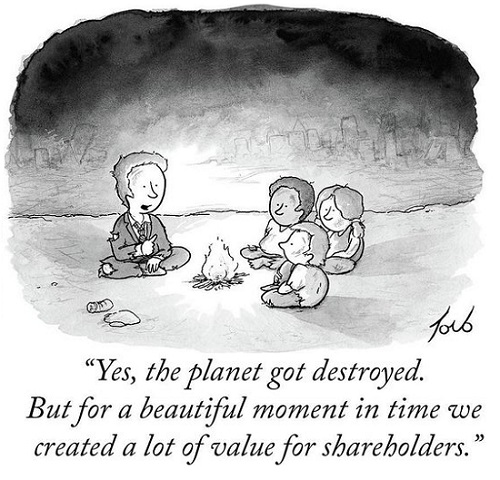
Corporate America Is an Anti-Social Black Plague: Negative Network Effects Run Amok

By Charles Hugh Smith

Source: Of Two Minds

The anti-social carnage unleashed by Corporate America’s “lock-in” / negative network effects has no real limits.

Here’s the U.S.economy in a nutshell: Corporate America is an anti-social Black Plague, gorging on cartel-monopoly profits reaped from negative network effects running amok, enriching the few at the expense of the many and concentrating political power in the hands of the most rapacious, anti-democratic corporate sociopaths.

Let’s start with network effects: the conventional definition is “When a network effect is present, the value of a product or service increases according to the number of others using it.”

So for example, when telephone service was only available to a few users, its value was limited. As more people obtained telephone service, the value of the network increased to both its owners and to users, who could reach more people and conduct commerce more easily as a result of having telephone service.

In the conventional analysis, negative network effects occur from “congestion,” i.e. the network is adding new users so quickly that “more users make a product less valuable.”

But this superficial analysis misses the fatally anti-social consequences of corporate negative network effects, a dynamic described by analyst Simons Chase in this essay. Here is an excerpt:

Even the most imaginative and far-reaching narratives about non-obvious economic fragility and off balance sheet risks are mere rants without constructive ideas about causes and solutions.

Consider network effects, the popular economic construct applied to market concentration and increasing returns for strategies pursued by some leading tech companies. This dynamic economic agent is also known as demand side economies of scale.

W. Brian Arthur, the economist credited with first developing the theory, described the condition of increasing returns as a game of strategic positioning and building up a user base to the point where ‘lock in’ of dominant players occurs. Companies able to tap network effects have been rewarded with huge valuations and highly defensible businesses.

But what about negative network effects? What if the same dynamic applies to the U.S.’s pay-to-play political industry where the government promotes or approves of something through a policy, subsidy or financial guarantee due to private sector influence.

Benefits accrue only to the purchaser of the network effects, and consumers, induced by the false signal of large network size, ultimately suffer from asymmetric risk and experience what I’m calling a loss of intangible net worth for each additional member after the ‘bandwagon’ wares off.

If this were the case, then you would see companies experience rapid revenue growth (out of line with traditional asset leverage models), executives accumulating huge fortunes and political campaign coffers swelling.

But the most striking feature would be the anti-social outcomes, the ones not available without the instant critical mass of government-supported network effects, the ones that, at scale, monetize a society’s intangible net worth.

Some products tied to these metrics include: prescriptions drugs, junk food targeting children, mortgages, diplomas, and social media. The list of industries that are likely to have gained through the purchasing of network effects in D.C. maps closely to the decay that is visible in U.S. society.

The loss of intangible capital and other manifestations of non-obvious economic fragility (to use Simons’ apt phrase) is the subject of my latest book, Will You Be Richer or Poorer? Profit, Power and A.I. in a Traumatized World, in which I catalog the anti-social consequences of negative network effects and other forces eroding our nation’s intangible capital.

Consider Facebook, a classic case of negative network effects running amok, creating immensely anti-social consequences while reaping billions in profits: Facebook isn’t free speech, it’s algorithmic amplification optimized for outrage (TechCrunch.com).

The full social cost of social media’s negative network effects are difficult to tally, but studies have found that loneliness and alienation are correlated to how many hours a day individuals spend on social media. (An Internet search brings up dozens of reports such as NPR’s Feeling Lonely? Too Much Time On Social Media May Be Why.)

Facebook is trying to leverage its social media “lock-in” to issue its own global currency and both Facebook and Google are trying to offer banking services without any of the pesky regulations imposed on legitimate banks. (Will $10 million in lobbying do the trick? How about $100 million? We’ve got billions to “invest” in corrupting and controlling public agencies and political power.)

Once Corporate America locks in cartel-monopoly power, i.e. you have to use our services and products, the corporate sociopaths use their billions in market cap and profits to buy the sociopaths in government. Pay-to-play is the real political machinery; “democracy” is the PR fig-leaf to mask the private sector “lock-in” (monopoly) and the public-sector “lock-in” (regulatory influence, anti-competitive barriers to entry, the legalization of corporate fraud, cooking the books, embezzlement, etc.)

Consider Boeing, an effective monopoly which used $12 billion in profits to buy back its own shares and “invested” millions in buying political influence so it could minimize public-sector oversight.

Rather than spend the $12 billion designing a new safe aircraft, Boeing cobbled together a fatally flawed design dependent on software, as described in The Case Against Boeing (The New Yorker) to maximize the profitability of its “lock-in”.

Google is running amok on so many levels, it’s difficult to keep track of its anti-social “let’s be evil, it’s so incredibly profitable” agenda: Google’s Secret ‘Project Nightingale’ Gathers Personal Health Data on Millions of Americans (Wall Street Journal). The goal, of course, is to reap more billions in profits for insiders and corporate sociopaths.

The anti-social carnage unleashed by Corporate America’s “lock-in” / negative network effects has no real limits. Consider the essentially limitless private and social damage caused by Big Tech: Child Abusers Run Rampant as Tech Companies Look the Other Way (New York Times).

Then there’s the opioid epidemic, whose casualties run into the hundreds of thousands, an epidemic that was entirely a creature of Corporate America seeking to maximize “lock-in” profits by buying regulatory approval and pushing false claims that the corporate products were safe and non-addictive.

Note the media sources of these reports: these are the top tier of American journalism, not some easily dismissed alt-media source.

What does this tell us? It tells us the anti-social consequences are now so extreme and so apparent that the corporate media cannot ignore them. Once Corporate America locks-in market, financial and political power, it acts as a virulent Black Plague on the social order, legitimate democracy, and an entire spectrum of intangible social capital including the rule of law.

As Simons put it: “The ethical dimension underpinning the whole system is this: what’s moral is what’s legal and what’s legal is for sale.” Where does this Black Plague pathology take us? To a collapse of the status quo which enabled it, cheered it, and so richly rewarded it.

Our Political Parties Are Obsolete

By Charles Hugh Smith

Source: Of Two Minds

When the parties do finally implode, the general mood will be: good riddance.

History informs us that once something is obsolete, it can disappear far faster than anyone expected. While we generally think of obsoleted technologies vanishing, social and political systems can become obsolete as well.

Should a poor soul who entered a deep coma a year ago awaken today, we must forgive his/her astonishment at the political wreckage left by the 2016 election. The Democratic Party, a mere year ago an absurdly over-funded machine confident in an easy victory in the presidential race, is now a complete shambles: its leadership in free-fall, its Fat-Cat donors disgusted, and its demented intoxication with pinning collaboration with Russia on the Trump camp eroding whatever feeble legacy legitimacy it still holds. What the party stands for is a mystery, as its Elites are clearly beholden to insiders, special interests and Corporate donors while glorifying the worst excesses of globalism and the National Security State’s endless war on civil liberties.

The newly awakened citizen would also marvel at the chaotic war zone of the Republican Party, in which the Insider Warlords are battling insurgent Outsiders, while the same Elites that fund the Democratic machine are wondering what they’re buying with their millions of dollars in contributions, for it’s unclear what the Republican Party stands for: it’s for Small Government, except when it’s for Bigger Government, which is 95% of the time; it’s for more law enforcement and the militarization of local police, and more intrusion into the lives of the citizenry; it’s for stricter standards for welfare, except for Corporate Welfare; it’s for tax reform, except the thousands of pages of give-aways, loopholes and tax breaks for the wealthy and corporations all remain untouched, and so on: a smelly tangle of special interests masked by a few sprays of PR air freshener to the millions left behind by the globalization that has so enriched Corporate America and the class of financier-owners, bankers, insiders and technocrats–the same group that funds and controls both political parties.

Political parties arose to consolidate centralized control of the central state.We have now reached the perfection of this teleology: the political elites and the financial elites are now one class. In our pay-to-play “democracy,” only the votes of wealth and institutional power count.

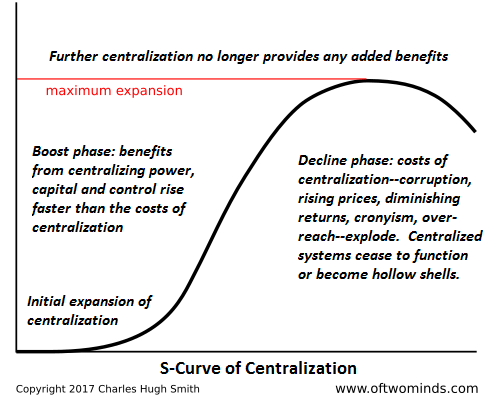
As I have often noted here, the returns on centralization are diminishing to less than zero. The initial returns on centralizing capital, production and social-political power were robust, but now the centralized cartel-state is eating its own tail, masking its financial bankruptcy by borrowing from the future, and cloaking its political bankruptcy behind the crumbling facades of the legacy parties.

Now that technology has enabled decentralized currency, markets and governance, the centralized political parties are obsolete. They are the political equivalent of buggy whips, and those holding tight to the fantasy that their current dissolution will magically be transformed into unity by some future leadership will be disappointed.

The fragmentation of the political parties is not temporary–it is permanent. As I discussed yesterday, political and social fragmentation are the consequence of economic fragmentation–these are self-reinforcing dynamics, as fragmentation in one feeds fragmentation in the others.

Those who have gotten rich inside the bloated machinery of the parties will never accept their era has ended. The dreams of private jets and millions of dollars in contributions die hard. But the voters and donors are both waking up to the cold reality that the parties are nothing but wealth distribution machines that sluice millions from financial elites to various political elites.

All the legacy claims of both parties ring false; neither party gives a hoot about the working class, small business or civil liberties. Their entire game plan is to whip up hot-button social issues to distract a fragmented citizenry and arouse last-gasp emotional loyalty to empty slogans.

Is it any wonder that people are abandoning both parties and claiming Independent status? All the core systems of the nation are failing, visibly, painfully, badly, and yet all the parties can dredge up is more of the same and TINA–there is no alternative.

The citizen who just awakened also awakened to the truth: the legacy parties have no solutions; their game plan is to milk the system as long as they can before it collapses in a rotten heap of corruption, fraud, collusion, debt and profiteering that benefits the few at the expense of the many.

When the parties do finally implode, the general mood will be: good riddance. A centralized spoils system is no longer a viable way to govern the nation. Political systems everywhere are facing a choice: Decentralize or die.

‘What It Takes to Be President of the American Police State: Anti-Big Money, Anti-War, Pro-Constitution, Freedom-Loving Candidates Need Not Apply’

imageedit_4850_9701377216

By John W. Whitehead

Source: A Government of Wolves

“The qualifications for president seem to be that one is willing to commit mass murder one minute and hand presidential medals of freedom to other war criminals in the next. One need only apply if one has very loose, flexible, or non-existent morality.”—Author and activist Cindy Sheehan

Long gone are the days when the path to the White House was open to anyone who met the Constitution’s bare minimum requirements of being a natural born citizen, a resident of the United States for 14 years, and 35 years of age or older.

Today’s presidential hopefuls must jump through a series of hoops aimed at selecting the candidates best suited to serve the interests of the American police state. Candidates who are anti-war, anti-militarization, anti-Big Money, pro-Constitution, pro-individual freedom and unabashed advocates for the citizenry need not apply.

The carefully crafted spectacle of the presidential election with its nail-biting primaries, mud-slinging debates, caucuses, super-delegates, popular votes and electoral colleges has become a fool-proof exercise in how to persuade a gullible citizenry into believing that their votes matter.

Yet no matter how many Americans go to the polls on November 8, “we the people” will not be selecting the nation’s next president.

While voters might care about where a candidate stands on healthcare, Social Security, abortion and immigration—hot-button issues that are guaranteed to stir up the masses, secure campaign contributions and turn any election into a circus free-for-all—those aren’t the issues that will decide the outcome of this presidential election.

What decides elections are money and power.

We’ve been hoodwinked into believing that our votes count, that we live in a democracy, that elections make a difference, that it matters whether we vote Republican or Democrat, and that our elected officials are looking out for our best interests. Truth be told, we live in an oligarchy, and politicians represent only the profit motives of the corporate state, whose leaders know all too well that there is no discernible difference between red and blue politics, because there is only one color that matters in politics—green.

As much as the Republicans and Democrats like to act as if there’s a huge difference between them and their policies, they are part of the same big, brawling, noisy, semi-incestuous clan. Watch them interact at social events—hugging and kissing and nudging and joking and hobnobbing with each other—and it quickly becomes clear that they are not sworn enemies but partners in crime, united in a common goal, which is to maintain the status quo.

The powers-that-be will not allow anyone to be elected to the White House who does not answer to them.

Who are the powers-that-be, you might ask?

As I point out in my book Battlefield America: The War on the American People, the powers-that-be are the individuals and corporations who profit from America’s endless wars abroad and make their fortunes many times over by turning America’s homeland into a war zone. They are the agents and employees of the military-industrial complex, the security-industrial complex, and the surveillance-industrial complex. They are the fat cats on Wall Street who view the American citizenry as economic units to be bought, sold and traded on a moment’s notice. They are the monied elite from the defense and technology sectors, Hollywood, and Corporate America who believe their money makes them better suited to decide the nation’s future. They are the foreign nationals to whom America is trillions of dollars in debt.

One thing is for certain: the powers-that-be are not you and me.

In this way, the presidential race is just an exaggerated farce of political theater intended to dazzle, distract and divide us, all the while the police state marches steadily forward.

It’s a straight-forward equation: the candidate who wins the White House will be the one who can do the best job of ensuring that the powers-that-be keep raking in the money and acquiring ever greater powers. In other words, for any viable presidential candidate to get elected today that person must be willing to kill, lie, cheat, steal, be bought and sold and made to dance to the tune of his or her corporate overlords.

The following are just some of the necessary qualifications for anyone hoping to be appointed president of the American police state. Candidates must:

Help grow the militaryindustrial complex: Fifty-five years after President Dwight D. Eisenhower warned about the growth of the “military-industrial complex” in his farewell address, the partnership between the government, the military and private corporations has resulted in the permanent militarization of America. From militarized police and the explosive growth of SWAT teams to endless wars abroad, the expansion of private sector contractors, and never-ending blowback from our foreign occupations, we have become a nation permanently at war. As the New York Times pointed out, “themilitary is the true ‘third rail’ of American politics.” The military-industrial complex understands the value of buying the presidency, and has profited from the incessant warmongering of Obama and his predecessors. If money is any indicator of who the defense industry expects to win this November, thus far, Hillary Clinton is winning the money race, having collected more campaign contributions from employees with the 50 largest military contractors.

Police the rest of the world using U.S. troops: The U.S. military empire’s determination to police the rest of the world has resulted in more than 1.3 million U.S. troops being stationed at roughly 1000 military bases in over 150 countriesaround the world, including 48,000 in Japan, 37,000 in Germany, 27,000 in South Korea and 9800 in Afghanistan. That doesn’t include the number of private contractors pulling in hefty salaries at taxpayer expense. In Afghanistan, for example, private contractors outnumber U.S. troops three to one. Now comes the news that the U.S. is preparing to sendtroops to Libya on a long-term mission to fight ISIS.

Sow seeds of discord and foment wars among other nations under the guise of democracy: It’s not enough for the commander-in-chief to lead the United States into endless wars abroad. Any successful presidential candidate also needs to be adept at stirring up strife within other nations under the guise of spreading democracy. The real motive, of course, is creating new markets for the nation’s #1 export: weapons. In this way, the U.S. is constantly arming so-called “allies” with deadly weapons, only to later wage war against these same nations for possessing weapons of mass destruction. It happened in Iraq when the U.S. sold Saddam Hussein weapons to build his war machine. It happened in Syria when the U.S. provided rebel fighters with military equipment and munitions, only to have them seized by ISIS and used against us. Now comes the news that President Obama has agreed to sell weapons to Vietnam, lifting a decades-long embargo against the nation whose civil war claimed the lives of more than 90,000 Americans.

Speak of peace while slaughtering innocent civilians: Barack Obama’s campaign and subsequent presidency illustrates this principle perfectly. The first black American to become president, Obama was awarded the Nobel Peace Prize long before he had done anything to truly deserve it. He has rewarded the Nobel committee’s faith in him by becoming one of the most hawkish war presidents to lead the nation, overseeing a targeted-killing drone campaign that has resulted in thousands of civilian casualties and deaths. Ironically, while Obama has made no significant effort to de-escalate government-inflicted violence or de-weaponize militarized police, he has gone to great lengths to denounce and derail private gun ownership by American citizens.

Prioritize surveillance in the name of security over privacy: Since 9/11, the Surveillance State has undergone a dramatic boom, thanks largely to the passage of the USA Patriot Act and so-called “secret” interpretations of the mammoth law allowing the NSA and other government agencies to spy on Americans’ electronic communications. What began as a government-driven program under George W. Bush has grown under Obama into a mass surveillance private sector that makes its money by spying on American citizens. As Fortune reports, “In response to security concerns after 9/11, Americans witnessed the growth of a massive domestic security apparatus, fueled by federal largesse.” That profit-incentive has opened up a multi-billion dollar video surveillance industry that is blanketing the country with surveillance cameras—both governmental and private—which can be accessed by law enforcement at a moment’s notice.

Promote the interests of Corporate America and Big Money over the rights of the citizenry: Almost every major government program hailed as benefiting Americans—affordable healthcare, the war on terror, airport security, police-worn body cameras—has proven to be a Trojan Horse aimed at enriching Corporate America while leaving Americans poorer, less secure and less free. For instance, the so-called “affordable” health care mandated by Congress has become yet another costly line item in already strained household budgets for millions of Americans.

Expand the powers of the imperial president while repeatedly undermining the rule of law: George W. Bush assumed near-absolute power soon after the September 11, 2001, attacks. Unfettered by Congress or the Constitution, Bush led the “war on terror” abroad and championed both the USA Patriot Act and Homeland Security Department domestically. This, of course, led to the Bush Administration’s demand that presidential wartime powers permit the President to assume complete control over any and all aspects of an international war on terrorism. Such control included establishing military tribunals and eliminating basic rights long recognized under American law.

When Barack Obama ascended to the presidency in 2008, there was a sense, at least among those who voted for him, that the country might change for the better. Those who watched in awe as President Bush chipped away at our civil liberties over the course of his two terms as president thought that perhaps the young, charismatic Senator from Illinois would reverse course and put an end to some of the Bush administration’s worst transgressions—the indefinite detention of suspected terrorists, the torture, the black site prisons, and the never-ending wars that have drained our resources, to name just a few. As we near the end of Obama’s two terms in office, that fantasy has proven to be just that: a fantasy. Indeed, President Obama has not only carried on the Bush legacy, but has taken it to its logical conclusion. Obama has gone beyond Guantanamo Bay, gone beyond spying on Americans’ emails and phone calls, and gone beyond bombing countries without Congressional authorization. As journalist Amy Goodman warned, “the recent excesses of U.S. presidential power are not transient aberrations, but the creation of a frightening new normal, where drone strikes, warrantless surveillance, assassination and indefinite detention are conducted with arrogance and impunity, shielded by secrecy and beyond the reach of law.”

Act as if the work of the presidency is a hardship while enjoying all the perks: The race for the White House is an expensive, grueling horse race: candidates must have at a minimum $200 or $300 million or more just to get to the starting line. The total cost for this year’s election is estimated to exceed $5 billion and could go as high as $10 billion. However, for the winner, life in the White House is an endless series of star-studded dinner parties, lavish vacations and perks the likes of which the average American will never enjoy. The grand prize winner will rake in a $400,000 annual salary (not including $100,000 a year for travel expenses, $19,000 for entertaining, $50,000 for “general” expenses and last but not least, $1,000,000 for “unanticipated” expenses), live rent-free in a deluxe, 6-storey, 55,000 square foot mansion that comes complete with its own movie theater and bowling alley, round-the-clock staff, florists, valets and butlers. Upon leaving the White House, presidents are gifted with hefty pensions, paid staff and office space, travel allowances and lifetime medical care. Ex-presidents can also expand upon their largesse by writing books and giving speeches (Bill Clinton was given a $15 million advance for his memoir and routinely makes upwards of $100,000 per speech).

Clearly, it doesn’t matter where a candidate claims to stand on an issue as long as he or she is prepared to obey the dictates of the architects, movers and shakers, and shareholders of the police state once in office.

So here we are once again, preparing to embark upon yet another delusional, reassurance ritual of voting in order to sustain the illusion that we have a democratic republic when, in fact, what we have is a dictatorship without tears. Once again, we are left feeling helpless in the face of a well-funded, heavily armed propaganda machine that is busily spinning political webs with which the candidates can lure voters. And once again we are being urged to vote for the lesser of two evils.

Railing against a political choice that offers no real choice, gonzo journalist Hunter S. Thompson snarled, “How many more of these stinking, double-downer sideshows will we have to go through before we can get ourselves straight enough to put together some kind of national election that will give me and the at least 20 million people I tend to agree with a chance to vote for something, instead of always being faced with that old familiar choice between the lesser of two evils?”

Remember, the lesser of two evils is still evil.

Hillary and Tim Kaine: a Match Made on Wall Street

Hillary-Clinton-likely-to-pick-Virginia-Sen-Tim-Kaine-for-VP

B

Source: CounterPunch

Earlier this week, Bernie Sanders warned that Hillary Clinton’s eventual vice presidential pick must not be someone from the milieu of Wall Street and Corporate America. And while Sanders is still fighting to win the Democratic Party nomination in what many have argued is a rigged system with a foregone conclusion, it appears that Sanders is also intent on influencing the course of the Clinton campaign and the party itself.

In a thinly veiled demand that Clinton embrace the core principles of the Sanders campaign in order to secure the support of Sanders’s political base, the insurgent Democratic candidate hoped aloud “that the vice-presidential candidate will not be from Wall Street, will be somebody who has a history of standing up and fighting for working families, taking on the drug companies…taking on Wall Street, taking on corporate America, and fighting for a government that works for all of us, not just the 1%.”

And while that description may sound positive for its sheer idealism, it does not seem to account for the fact that banks and corporations effectively own both major parties, and that nearly every top Democrat is in various ways connected to the very same entities. In any event, it is useful still to examine a few of the potential Clinton running mates in order to assess just what sort of forces are going to be put in motion to help deliver a Clinton presidency.

The Actors on the Playbill

Beltway pundits are fond of remarking that Tim Kaine, the underwhelming centrist Democrat senator (and former Governor) from Virginia, is at the top of the list for Clinton. He’s safe. He’s experienced. He’s safe. He’s a Democratic Party loyalist with experience fundraising. Oh, and did I mention that he’s safe? Such is the general tenor of the conversation around Kaine, a politician with a long track record and a mostly forgettable personality known more to DC insiders than to the general voting public.

What could be better for Hillary Clinton, perhaps the least liked Democratic (presumptive) nominee in decades, than to have a party establishment insider who represents the status quo as her running mate in an election year that will undoubtedly be remembered for the ostensibly anti-establishment candidates and rhetoric on display throughout?

To be fair, Kaine does represent Virginia, a swing state that is crucial for Donald Trump, and which could spell victory for Clinton should she carry it.  And of course, Kaine can also posture as “tough on Wall Street” from his days as DNC Chairman and party mouthpiece during the passage of the so-called “Wall Street reform” bill.  Despite nothing substantive coming out of the bill, Kaine is still able to cash in the political currency derived from that bill, and perhaps meekly shield Clinton from continued attacks vis-à-vis her connections to Wall Street.

Of course Kaine also comes with his own baggage, including his anti-abortion stance which earned him the ire of many pro-choice activists in Virginia when he was Governor.  Considering the shameless droning from Clinton and her backers about being “the first woman president,” it would certainly raise serious questions – and open up an obvious angle of attack for Trump – were she to sport her feminism and focus on women’s reproductive rights by selecting a man with an anti-abortion record.

A look down the list of other potential choices reveals that Clinton truly has very little to choose from.  Both Housing and Urban Development (HUD) Secretary Julian Castro, as well as Labor Secretary Tom Perez, have both had their names bandied around as Clinton seeks to solidify the Latino vote in an election where the Republican candidate has worked tirelessly to alienate that all-important demographic as much as possible.  But of course, the obvious question to be asked in response to either of these potential selections would be “Who?” Neither Castro nor Perez is well known nationally, nor have either of them won major elections or really done anything of note in their tenure in Obama’s cabinet.  Despite being Latinos, they are utterly forgettable, and unlikely to bring significant returns to Clinton.

While other names such as New Jersey junior senator Cory Booker, as well as Ohio senator Sherrod Brown, have been discussed, both men hail from states with Republican governors, meaning that were they to accept a VP slot, their senate vacancies would be likely filled by Republicans, a scenario that Senate Minority Leader Harry Reid has already said “Hell no!” to, vowing to “yell and scream to stop that.”

Who Else Is “Ready for Hillary”?

So that then leaves the two most interesting potential running mates: Elizabeth Warren and Bernie Sanders himself. Warren, who conspicuously refused to endorse Clinton over Sanders, has tremendous upside for Clinton as she has been perhaps the Democratic Party’s most vehement opponent of Wall Street, having led many high profile attacks on the major banks in her tenure in the Senate.  From a public relations branding perspective, she is essentially the female Bernie Sanders, a progressive Democrat who presents herself as an ally of working people and an enemy of bankers. For Clinton, Warren would also round out the “First Woman…” card, allowing the Clinton campaign to quite literally become a campaign about breaking the glass ceiling in US politics. The stump speeches almost write themselves.

Finally, there’s Mr. #FeelTheBern himself. His latest comments (mentioned above) certainly do have a subtext that implies his willingness to accept a running mate slot.  Having fashioned himself as the champion of the middle class and threat to the Washington establishment, Bernie would provide much in the way of credibility to a lackluster Clinton campaign which has failed to excite even many ardent Democrats.  Sanders would also guarantee a unified Democratic Party ticket, and provide much needed defense of Clinton’s left flank.  In short, Sanders, like Warren, would give anti-Clinton progressives the pretext many of them need to justify their voting for the much-hated Clinton.

Never mind the fact that neither Sanders nor Warren would actually do anything to combat Wall Street finance capital as Vice President.  Never mind the fact that no one on Wall Street is particularly scared of either politician being given the ceremonial power that comes with the Vice Presidency.  These are just the kind of uncomfortable, but inescapable, facts that progressives must choose to ignore.

The difficulty for either Sanders or Warren is the marketing of their decision to left progressives, some of whom would see collaboration with Clinton and the Clinton political machine as a betrayal and a complete sell-out.  However, aside from driving a some relatively small number of progressives to vote for Jill Stein and the Green Party (or stay home entirely), it is unlikely that the negative impact in the progressive base would amount to anything more than some hurt feelings followed by the usual acquiescence to the Democratic Party line.

If such an analysis sounds cynical and jaded, that’s because it is. Perhaps a better descriptor would be disdainful.  Indeed, as someone who watched with bemused melancholy as progressives lined up to support Al Gore in 2000, John Kerry in 2004, and Barack Obama in 2008 and 2012, my position on support for ANY Democrat is the same as Harry Reid’s position on swing state senator VP picks: Hell no!

Indeed, the very notion of collaboration with a war criminal and Wall Street puppet such as Clinton is anathema to everything the left and “progressives” are supposed to stand for.

Of course, there is also the elephant (and donkey) in the room: both major parties are wholly owned subsidiaries of finance capital and the corporations that rule over us. This is the realization that millions of Americans have already made, and which millions more are making.  This is the realization that keeps Democratic and Republican apparatchiks up at night.  And this critical revelation is what Bernie, Liz, & Co. are there to suppress.

Eric Draitser is the founder of StopImperialism.org and host of CounterPunch Radio. He is an independent geopolitical analyst based in New York City. You can reach him at ericdraitser@gmail.com.

Life’s Most Important Dramas Are Being Disrupted

index

By Charles Hugh Smith

Source: Washington’s Blog

The idea that human life subdivides rather naturally into stages is based on our natural progression from childhood into adulthood and eventual (if we’re lucky) old age.

Confucian thought views life as a developmental process with seven stages, each roughly corresponding to a decade: childhood, young adulthood (16-30), age of independence (30-39), age of mental independence (40-49), age of spiritual maturity (50-59), age of acceptance (60-69), and age of unification (70 – end of life).

Each stage has various tasks, goals and duties, which establish the foundation for the next stage.

Each stage is centered on a core human drama: for the teenager, establishing an identity and life that is independent of parents; for the young adult, finding a mate and establishing a career; for the middle-aged, navigating the challenges of raising children and establishing some measure of financial security; for those in late middle-age, helping offspring reach independent adulthood and caring for aging parents; early old age, seeking fulfillment now that life’s primary duties have been accomplished and managing one’s health; and old age, the passage of accepting mortality and the loss of vitality.

The End of Secure Work and the diminishing returns of financialization are disrupting these core human dramas and frustrating those who are unable to proceed to the next stage of life:

1. Teenagers are being pressured to focus their lives on achieving a conventional financial success that is becoming harder to achieve.

2. Young adults without secure full-time careers cannot afford marriage or children, so they extend the self-absorption of late adolescence into middle age.

3. The middle-aged are finding financial security elusive or out of reach as they struggle to fund their young adult children, aging parents and their own retirement.

4. Increasing longevity is pressuring the late-middle-aged’s stage of fulfillment, as elderly parents may require care even as their children reach their own retirement (65-70).

The financial pressures generated by the demise of financialization and the End of Secure Work are not just disrupting each stage; they are upending essential financial balances between the young, the middle-aged and the old.

The elderly, protected by generous social welfare benefits paid by current taxpayers, also benefit from the soaring value of assets such as real estate and stocks. Meanwhile, financialization’s asset bubbles have pushed housing beyond the reach of most young people.

Downsizing, lay-offs, low-paying replacement work and poor decisions to buy houses near the peak of the prior bubble have left many of the middle-aged with high fixed costs and a stagnant or increasingly insecure income.

The stresses of trying to make enough money to afford what was once assumed to be a birthright–a “middle class” lifestyle–is taking a heavy toll on the mental and physical health of the middle-aged, leaving many of them too tired for any fulfilling activities and easy prey for destructive self-medication.

This erosion of opportunities to complete life’s stages and core dramas is gradual, and rarely recognized, much less addressed. We are constantly bombarded with messages to innovate, keep up, be fulfilled, etc.–essentially impossible demands for those with multiple generational and/or business duties.

The most productive response to these financial disruptions is to focus not on what’s scarce and fraught with intense competition (the top 5% slots of conventional financial security) but on what’s still abundant, which is opportunities outside conventional hierarchies, ways of reducing fixed costs and life-skills that are entrepreneurial, adaptive and fulfilling.

When I talk about the Mobile Creative class, I’m not talking about a finance-centric definition of success or a path to join the top 5% in Corporate America and the government. The herd is chasing those dwindling slots, too, guaranteeing frustration and failure for the 95% who won’t secure one of those slots.

What we’re really discussing is a way of living that places a premium on independent thinking, maintaining very low fixed costs, establishing a healthy honesty with oneself and one’s associates and customers, the ability to make realistic assessments of oneself, one’s successes, failures and errors, and a focus on challenges, opportunities, risks, adaptability, flexibility and experimentation, all with a goal of building one’s own human, social and physical capital–the foundations not just of well-being but of any meaningful measure of independent, real wealth.