
ARE CENTRAL BANK DIGITAL CURRENCIES (CBDC) DESTINED TO FAIL?

By Timothy Alexander Guzman

Source: Silent Crow News

Since Bitcoin (BTC) was introduced to the world as an alternative to the current central bank system with a dying US dollar that is backed by nothing as its reserve currency, but now there is a plan by several governments to move ahead with implementing their own central bank digital currencies (CBDCs), which is a digital form of currency that is still backed by, you guessed it, nothing.  The Nigerian government had made the decision to be the financial guinea pig for the globalist CBDC scheme, and so far, it has failed and that’s the good news.  The bad news is that certain governments are still moving forward with the idea of using government-issued digital currencies.  In the case of Nigeria, its citizens rejected their government’s plan to issue CBDCs by restricting cash in efforts to create a cashless society and so far, it seems that it has failed in epic fashion according to an opinion piece by author Nicholas Anthony that was published by coindesk.com ‘Nigerians’ Rejection of Their CBDC Is a Cautionary Tale for Other Countries’ is a warning to governments who are willing to take the same step: 

In Nigeria, citizens have taken to the streets to protest the nation’s cash shortage, further objecting to their government’s implementation of a central bank digital currency (CBDC). The shortage came about due to cash restrictions aimed at pushing the country into a 100% cashless economy. Yet, instead of adopting the CBDC, Nigerian protesters are demanding paper money be restored.

The country’s experience strongly suggests the average citizen understands that CBDCs present a substantial risk to financial freedom while providing no unique benefit

Not only did the Nigerian people reject CBDCs, but they also demanded a return to paper currencies because they quickly found out that financial freedoms would be severely limited. 

The concerns ranged from risking financial privacy to the possibility of financial oppression by government institutions.  Anthony mentioned how “the Nigerian government has unleashed a flurry of tricks to spur adoption, but none has proven effective.”  He even gave credit to the Nigerian government in terms of using modest approaches to influence its citizens to use CBDCs and it still failed:

To its credit, the Nigerian government initially tried to encourage use through modest measures. In August 2022, it removed access restrictions so that bank accounts were no longer required to use the CBDC. Then, in October, it offered discounts if people used the CBDC to pay for cabs.  Yet, neither effort proved to be fruitful. Put simply, Nigerians prefer cash

However, the Nigerian government continued its assault on cash:

Unfortunately, the Nigerian government doubled down and moved to more drastic measures by restricting cash itself. In December the Central Bank of Nigeria began restricting cash withdrawals to 100,000 naira (US$225) per week for individuals and 500,000 naira ($1,123) for businesses.

To make matters worse, the Nigerian government also chose to redesign the currency during this time in a “move aimed at restoring the control of the Central Bank of Nigeria (CBN) over currency in circulation” and to “further deepen the push to [a] cashless economy,” according to a CBN press release

The Nigerians had a hard time adapting to the government’s restrictions on their hard earned cash, so they posted their concerns on Twitter, Tik Tok and other social media platforms to let the world know what went wrong.  Soon after, major protests erupted on the streets because of the cash shortages imposed by the Central Bank of Nigeria: 

The government decided to redesign the currency to restore control over the Central Bank of Nigeria as its governor, Godwin Emefiele claimed that “the destination, as far as I am concerned, is to achieve a 100% cashless economy in Nigeria.”  To add insult to injury, “the company that designed the Nigerian CBDC called the cash restrictions a creative use of marketing and said other countries could be expected to take similar steps.”  A top manager from a financial institutional ratings firm called Agusto and Co., Ayokunle Olumbunmi said that the central bank “doesn’t want us to be spending cash. They want us to be doing transactions electronically, but you can’t legislate a change in behavior.”  Anthony concluded that the idea of CBDCs will not go very far, “CBDCs may be popular among central bankers, but money is ultimately a tool for the people. So long as the risks outweigh the benefits, it’s unlikely any CBDC will gain traction in Africa or elsewhere.”

Nicholas Anthony was correct to point out that CBDCs will not become mainstream as several countries have already demonstrated their unwillingness to move forward with the new form of digitized currencies. 

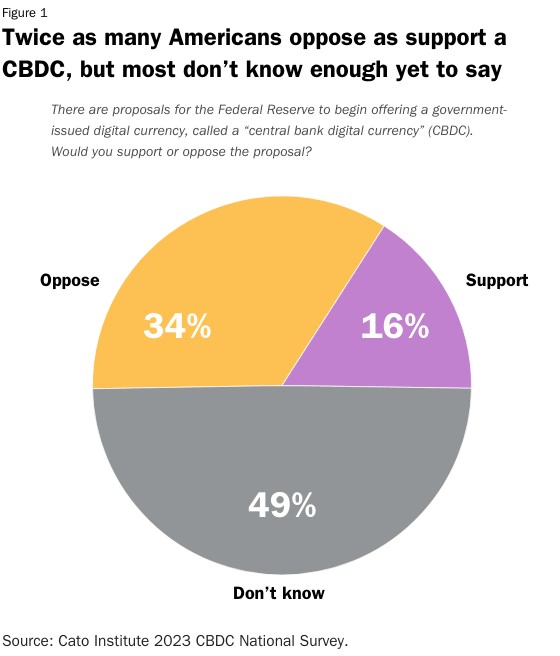
The average human being on earth understands that CBDCs is a bad idea, even in the United States where two-thirds of the population believes almost anything that their government tells them to believe are skeptical of CBDCs according to the Cato Institute, a think tank who also published an article by Nicholas Anthony on the findings of a survey that was conducted by the US federal Reserve Bank on how people view CBDCs.  Here is what they found, “Specifically, more than 66 percent of the 2,052 commenters were concerned or outright opposed to the idea of a CBDC in the United States (Figure 1).”
Bitcoin.com published an article on the GOP’s 2024 presidential candidate, Florida’s governor, Ron DeSantis who is opposed to CBDCs, ‘Ron DeSantis Vows to Prohibit CBDC, ‘Woke Politics,’ and ‘Financial Surveillance’ in Florida,’ he said “I think what the danger of the digital currency is that, one, they want to make that the sole currency, they want to get rid of crypto,” DeSantis continued, “They don’t like crypto because they can’t control crypto. So, they want to put everything in a central bank digital currency.”  There were other politicians who also have similar views on CBDCs:

DeSantis shares the view of several Republican officials who have criticized the idea of a central bank digital currency (CBDC). Minnesota congressman Tom Emmer introduced the Central Bank Digital Currency (CBDC) Anti-Surveillance State Act, while Texas senator Ted Cruz has created legislation against the government developing a CBDC. Georgia representative Marjorie Taylor Greene has also spoken out against CBDCs, and 2024 Democratic presidential candidate Robert Kennedy Jr. has warned that a central bank digital currency could lead to financial slavery

Cash is King! How the CBDC Failed in Japan and Ecuador

Cointelegraph.com, an independent digital news platform that focuses on crypto assets, blockchain technology and emerging fintech trends published an article last year written by Helen Partz based on which countries have rejected CBDCs for one reason or another titled ‘Some central banks have dropped out of the digital currency race’ mentions Japan, who is a major player in the global economy, ultimately rejected developing a CBDC scheme.  The Bank of Japan (BOJ) started testing their digital currency proof-of-concept in 2021 and had planned to finish the first phase by 2022 but in January “former BOJ official Hiromi Yamaoka advised against using the digital yen as part of the country’s monetary policy, citing risks to financial stability.” 

The BOJ issued a report in July 2022 and stated that it had no plan to establish a CBDC system since there is a “strong preference for cash and high ratio of bank account holding in Japan” and that the regulator suggested for a CBDC to be used as a “public good” and it “must complement and coexist” with “private payment services in order for Japan to achieve secure and efficient payment and settlement systems.”  However, it also said that “the fact that CBDC is being seriously considered as a realistic future option in many countries must be taken seriously,” in other words, the CBDC scheme in Japan will not move forward although several countries are still in the early stages of developing a plan for the use of CBDCs, but for Japan, cash is still and will be king well into the foreseeable future.

Ecuador is another example as its central bank, Banco Central del Ecuador (BCE) who launched its own electronic currency known as dinero electrónico (DE) in 2014 to increase some sort of financial inclusion for the public as well as to control the flow of fiat currencies.  According to Partz “As of February 2015, Ecuador managed to adopt DE as a functional means of payment, allowing qualified users to transfer money via a mobile app. The application specifically allowed citizens to open an account using a national identity number and then deposit or withdraw money via designated transaction centers.”  But industry observers were not so sure that the DE can take the form of a CBDC since Ecuador’s currency is the US dollar, and since Ecuador does not currently have its own sovereign currency, many were not so sure that they can call the DE, a form of CBDC.  “The Ecuadorian government cited the support of its dollar-based monetary system as one of the goals behind its DE platform after it started to accept U.S. dollars as legal tender in September 2000.”  It seems that Ecuador remains skeptical on any possibility that issuing CBDCs will be a success:

According to online reports, Ecuador’s DE operated from 2014 to 2018, amassing a total of 500,000 users at its peak out of a population of roughly 17 million people. The project ​​was eventually deactivated in March 2018, with the BCE reportedly citing legislation abolishing the central bank’s electronic money system. Passed in December 2021, the law stated that e-payment systems should be outsourced to private banks.

Years after dropping its central bank digital money initiative, Ecuador has apparently remained skeptical about the whole CBDC phenomenon. In August 2022, Andrés Arauz, the former general director at Ecuador’s central bank, warned eurozone policymakers that a digital euro could potentially disrupt not only privacy but also democracy

Bottom line, the CBDC will not be a standard for financial transactions for the few countries who already tried launching their versions of digital currencies. 

However, in the US, the Federal Reserve’s ‘FedNow’ was supposed to be launched sometime in July 2023.  Here is the Federal Reserve’s Press Release:

The Federal Reserve announced that the FedNow Service will start operating in July and provided details on preparations for launch.  The first week of April, the Federal Reserve will begin the formal certification of participants for launch of the service. Early adopters will complete a customer testing and certification program, informed by feedback from the FedNow Pilot Program, to prepare for sending live transactions through the system.

Certification encompasses a comprehensive testing curriculum with defined expectations for operational readiness and network experience. In June, the Federal Reserve and certified participants will conduct production validation activities to confirm readiness for the July launch.

“We couldn’t be more excited about the forthcoming FedNow launch, which will enable every participating financial institution, the smallest to the largest and from all corners of the country, to offer a modern instant payment solution,” said Ken Montgomery, first vice president of the Federal Reserve Bank of Boston and FedNow program executive. “With the launch drawing near, we urge financial institutions and their industry partners to move full steam ahead with preparations to join the FedNow Service”

For the US population, FedNow is a test that will eventually fail.  People will be skeptical about a central bank digital currency once it proves that it is used to surveil people’s spending habits and control what they spend their money on, and God forbid they are anti-war, anti-vaccine activists, homeschoolers, pro-gun supporters or conspiracy theorists, the bankers can cut them off from using CBDCs and then what happens?  Will there be riots in the streets? 

Since Bitcoin was introduced as an alternative to central bank control, the creation of the CBDC is their answer in hopes of retaining their power, but that idea is not likely to happen, it will in some way, backfire. 

When it comes to Bitcoin, it’s a different story.  In an interesting article written by Jay Speakman of beincrypto.com ‘When You Buy Bitcoin You Gain Freedom’ says that “in a world where economic and political uncertainties abound, owning Bitcoin (BTC) could provide the path toward financial freedom and autonomy. It’s no longer just about investing in a digital asset. It’s about making a revolutionary move to gain control over your finances and future.”  Speakman makes several main points on why people should own Bitcoins and one of those points is that owning sovereign cryptos such as Bitcoins, Ethereum’s and others is a step towards financial freedom:

It provides the opportunity to participate in the global economy without the limitations of traditional banking systems. Bitcoin is not subject to government regulations. At least not yet, and it is free from the inflationary policies which can erode fiat currency values. This means Bitcoin provides an alternative and potentially more secure, store of value

Another reason for owning Bitcoins is for future investment purposes:

Investing in Bitcoin is no longer simply making money. It is about investing in your future and securing your financial freedom. Bitcoin’s decentralized financial system operates independently of central authorities or governments. This means it is resistant to censorship and regulation. Bitcoin holders can make transactions without the need for banks, which are subject to government intervention

“Investment Diversification” is another reason to own Bitcoins since putting all your eggs in one basket, especially in a globalist banking system, is a bit risky:

Investing in Bitcoin can provide portfolio diversification as it is not correlated to traditional assets such as stocks and bonds. This means it may provide a hedge against inflation and market volatility, mitigating the risks associated with traditional investment portfolios

However, owning Bitcoins does have risks like everything else since the “market is notoriously volatile. Prices often fluctuate wildly based on a range of factors, from government regulations to media coverage.”  Speakman also mentions that “BTC transactions can result in a permanent loss of funds. There is also the risk of hacking and theft, as these transactions are irreversible and untraceable.” 

In conclusion, the article lays out what owning Bitcoins could mean for individuals and investors alike especially for those who do not trust the traditional banking system:

The decision to buy BTC is more than just a financial investment. It’s a move towards financial freedom, control, and security. Bitcoin’s feature of allowing individuals to act as their own banks. Providing a secure alternative to traditional banking systems which have exhibited instability and vulnerability to failures.  Furthermore, the appeal goes beyond just financial security and autonomy. The digital currency resonates with libertarians who value individual freedom and limited government intervention. Despite a torrent of dissenting voices Bitcoin continues to gain mainstream adoption. As the technology continues to mature, it may address some of the concerns raised by the dissenting voices.

Investing in digital assets may involve risks such as volatility and the potential for hacking and theft. Yet, the benefits of financial freedom outweigh the downsides. As the world becomes increasingly uncertain, owning Bitcoin could be the first step toward financial security and autonomy

When you look at the difference between CBDCs along with the system imposed by international banking cartels who still maintain some form of financial dominance versus the Bitcoin revolution, there is a difference.  CBDCs means no financial freedoms and owning Bitcoins means the exact opposite.  Even though Bitcoins are still in the early stages, there is hope in the new crypto technology.  But like everything else, you should be cautious, do not invest 100% of your net worth in just one asset, in other words, invest maybe 5% in bitcoins, and the rest? 15% in emergency preparedness (food, water filters, guns, flashlights, etc.)  20% in real estate or invest in a second passport, 20% in hard assets like gold, silver and copper, 20% in high-end watches, antiques, aged wines and liquor, collectibles etc. and the last 20% in foreign stocks especially those that are in politically stabilized environments or in gold and silver mining companies, but that’s just my opinion. 

Government-backed CBDCs will be a failure because the people already do not trust international banking cartels to totally control their finances. So, for these banks to have total control over your financial wellbeing under their CBDC scheme would be an extremely difficult task for them to manage. 

The banking cartel or the financial bureaucrats are about to discover that they will be in over their heads with an angry population.  Just imagine if the banking cartels, certain governments and their corporate conglomerates are in  control over the people’s finances, they will get to determine who eats and who will starve.  This is the ultimate power grab the globalist bankers have been dreaming about for a very long time, but will the people stop this from happening?  I’m an optimist, so I believe that they will demand their financial freedoms and that is something of value that they can hold and control in their own hands.  The case for CBDCs will be a hard sell, so central banks who are proposing this idea should think twice about what they are trying to impose on the public, if not, they will face some form of resistance just like they did in Nigeria.    
Technology and a Tyranny Worse than Prison 

By Bert Olivier

Source: Brownstone Institute

In an outstanding piece of political-theoretical writing, titled ‘The Threat of Big Other’ (with its play on George Orwell’s ‘Big Brother’) Shoshana Zuboff, succinctly addresses the main issues of her book, The Age of Surveillance Capitalism – The Fight for a Human Future at the New Frontier of Power (New York: Public Affairs, Hachette, 2019), explicitly linking it to Orwell’s 1984

Significantly, at the time she reminded readers that Orwell’s goal with 1984 was to alert British and American societies that democracy is not immune to totalitarianism, and that “Totalitarianism, if not fought against, could triumph anywhere” (Orwell, quoted by Zuboff, p. 16). In other words, people are utterly wrong in their belief that totalitarian control of their actions through mass surveillance (as depicted in 1984, captured in the slogan, “Big Brother is watching you”) could only issue from the state, and she does not hesitate to name the source of this threat today (p. 16):

For 19 years, private companies practicing an unprecedented economic logic that I call surveillance capitalism have hijacked the Internet and its digital technologies. Invented at Google in 2000, this new economics covertly claims private human experience as free raw material for translation into behavioural data. Some data are used to improve services, but the rest are turned into computational products that predict your behaviour. These predictions are traded in a new futures market, where surveillance capitalists sell certainty to businesses determined to know what we will do next. 

By now we know that such mass surveillance does not merely have the purpose – if it ever did – of tracking and predicting consumer behaviour with the aim of maximising profits; far from it. It is generally known among those who prefer to remain informed about global developments, and who do not only rely on the legacy media for this, that in China such mass surveillance has reached the point where citizens are tracked through a myriad of cameras in public places, as well as through smartphones, to the point where their behaviour is virtually completely monitored and controlled. 

Small wonder that Klaus Schwab of the World Economic Forum (WEF) does not let an opportunity pass to praise China as the model to be emulated by other countries in this respect. It should therefore come as no surprise that investigative reporter, Whitney Webb, also alluding to Orwell’s prescience, draws attention to the striking similarities between mass surveillance that was developed in the United States (US) in 2020 and Orwell’s depiction of a dystopian society in 1984, first published in 1949. 

In an article titled “Techno-tyranny: How the US national security state is using coronavirus to fulfil an Orwellian vision,” she wrote:

Last year, a government commission called for the US to adopt an AI-driven mass surveillance system far beyond that used in any other country in order to ensure American hegemony in artificial intelligence. Now, many of the ‘obstacles’ they had cited as preventing its implementation are rapidly being removed under the guise of combating the coronavirus crisis.

Webb proceeds to discuss an American government body that focused on researching ways in which artificial intelligence (AI) could promote national security and defence needs, and which provided details concerning the “structural changes” which American society and economy would have to undertake to be able to maintain a technological advantage in relation to China. According to Webb the relevant governmental body recommended that the US follow China’s example in order to surpass the latter, specifically regarding some aspects of AI-driven technology as it pertains to mass surveillance. 

As she also points out, this stance on the desired development of surveillance technology conflicts with (incongruous) public statements by prominent American politicians and government officials, that Chinese AI-technological surveillance systems instantiate a significant threat for Americans’ way of life), which did not, however, prevent the implementation of several stages of such a surveillance operation in the US in 2020. As one knows in retrospect, such implementation was undertaken and justified as part of the American response to Covid-19. 

None of this is new, of course – by now it is well-known that Covid was the excuse to establish and implement Draconian measures of control, and that AI has been an integral part of it. The point I want to make, however, is that one should not be fooled into thinking that strategies of control will end there, nor that the Covid pseudo-vaccines were the last, or worst, of what the would-be rulers of the world can inflict upon us to exercise the total control they wish to achieve – a level of control that would be the envy of the fictional Big Brother society of Orwell’s 1984

For example, several critically thinking people have alerted one to the alarming fact that the widely touted Central Bank Digital Currencies (CBDCs) are Trojan horses, with which the neo-fascists driving the current attempt at a ‘great reset’ of society and the world economy aim to gain complete control over people’s lives. 

At first blush the proposed switch from a fractional reserve monetary system to a digital currency system may seem reasonable, particularly in so far as it promises the (dehumanising) ‘convenience’ of a cashless society. As Naomi Wolf has pointed out, however, far more than this is at stake. In the course of a discussion of the threat of ‘vaccine passports’ to democracy, she writes (The Bodies of Others, All Seasons Press, 2022, p. 194):

There is now also a global push toward government-managed digital currencies. With a digital currency, if you’re not a ‘good citizen,’ if you pay to see a movie you shouldn’t see, if you go to a play you shouldn’t go to, which the vaccine passport will know because you have to scan it everywhere you go, then your revenue stream can be shut off or your taxes can be boosted or your bank account won’t function. There is no coming back from this.

I was asked by a reporter, ‘What if Americans don’t adopt this?’

And I said, ‘You’re already talking from a world that’s gone if this succeeds in being rolled out.’ Because if we don’t reject the vaccine passports, there won’t be any choice. There will be no such thing as refusing to adopt it. There won’t be capitalism. There won’t be free assembly. There won’t be privacy. There won’t be choice in anything that you want to do in your life.

And there will be no escape.

 In short, this was something from which there was no returning. If indeed there was a ‘hill to die on,’ this was it. 

This kind of digital currency is already in use in China, and it is being rapidly developed in countries like Britain and Australia, to mention only some.

Wolf is not the only one to warn against the decisive implications that accepting digital currencies would have for democracy. 

Financial gurus such as Catherine Austin Fitts and Melissa Cuimmei have both signalled that it is imperative not to yield to the lies, exhortations, threats and whatever other rhetorical strategies the neo-fascists might employ to force one into this digital financial prison. In an interview where she deftly summarises the current situation of being “at war” with the globalists, Cuimmei has warned that the drive towards digital passports explains the attempt to get young children ‘vaccinated’ en masse: unless they can do so on a large scale, they could not draw children into the digital control system, and the latter would therefore not work. She has also stressed that the refusal to comply is the only way to stop this digital prison from becoming a reality. We have to learn to say “No!”

Why a digital prison, and one far more effective that Orwell’s dystopian society of Oceania? The excerpt from Wolf’s book, above, already indicates that the digital ‘currencies’ that would be shown in your Central World Bank account, would not be money, which you could spend as you saw fit; in effect, they would have the status of programmable vouchers that would dictate what you can and cannot do with them. 

They constitute a prison worse than debt, paralysing as the latter may be; if you don’t play the game of spending them on what is permissible, you could literally be forced to live without food or shelter, that is, eventually to die. Simultaneously, the digital passports of which these currencies would be a part, represent a surveillance system that would record everything you do and wherever you go. Which means that a social credit system of the kind that functions in China, and has been explored in the dystopian television series, Black Mirror, would be built into it, which could make or break you.  

In her The Solari Report, Austin Fitts, for her part, elaborates on what one can do to “stop CBDCs,” which includes the use of cash, as far as possible, limiting one’s dependence on digital transaction options in favour of analog, and using good local banks instead of the banking behemoths, in the process decentralising financial power, which is further strengthened by supporting small local businesses instead of large corporations. 

One should be under no illusion that this will prove to be easy, however. As history has taught us, when dictatorial powers attempt to gain power over people’s lives, resistance on the part of the latter is usually met with force, or ways of neutralising resistance.

As Lena Petrova reports, this was recently demonstrated in Nigeria, which was one of the first countries in the world (Ukraine being another), to introduce CBDCs, and where there was initially a very tepid response from the population, where most people prefer using cash (partly because many cannot afford smartphones). 

Not to be outdone, the Nigerian government resorted to dubious shenanigans, such as printing less money and asking people to hand in their ‘old’ banknotes for ‘new’ ones, which have not materialised. The result? People are starving because they lack cash to buy food, and they do not have, or do not want, CBDCs, partly because they lack smartphones and partly because they resist these digital currencies. 

It is difficult to tell whether Nigerians’ doubts about CBDCs is rooted in their awareness that, once embraced, the digital passport of which these currencies will comprise a part, would allow the government complete surveillance and control of the populace. Time will tell whether Nigerians will accept this Orwellian nightmare lying down.

Which brings me to the significant philosophical point underpinning any argument about resisting the drive for dictatorial power through mass surveillance. As every enlightened person should know, there are different kinds of power. One such variety of power is encapsulated in Immanuel Kant’s famous motto for enlightenment, formulated in his famous 18th-century essay, “What is Enlightenment?” The motto reads: “Sapere aude!” and translates as “Have the courage to think for yourself,” or “Dare to think!” 

This motto may be said to correspond with what contributors to the activities of Brownstone Institute engage in. Hence, the emphasis on critical intellectual engagement is indispensable. But is it sufficient? I would argue that, while speech act theory has demonstrated, accurately – emphasising the pragmatic aspect of language – that speaking (and one could add writing) is already ‘doing something,’ there is another sense of ‘doing.’ 

This is its meaning of acting in the sense one encounters in discourse theory – which demonstrates the interwovenness of speaking (or writing) and acting through the imbrication of language with power relations. What this implies is that language use is intertwined with actions that find their correlate(s) in speaking and writing. This is compatible with Hannah Arendt’s conviction, that of labour, work and action (the components of the vita activa), action – the verbal engagement with others, broadly for political purposes, is the highest embodiment of human activity.

Philosophers Michael Hardt and Antonio Negri have shed important light on the question of the connection between Kant’s “Sapere aude!” and action. In the third volume of their magisterial trilogy, Commonwealth (Cambridge, Mass., Harvard University Press, 2009; the other two volumes being Empire and Multitude), they argue that although Kant’s “major voice” shows that he was indeed an Enlightenment philosopher of the transcendental method, who uncovered the conditions of possibility of certain knowledge of the law-governed phenomenal world, but by implication also of a practical life of dutiful social and political responsibility, there is also a seldom-noticed “minor voice” in Kant’s work. 

This points, according to them, towards an alternative to the modern power complex that Kant’s “major voice” affirms, and it is encountered precisely in his motto, articulated in the short essay on enlightenment referred to above. They claim further that the German thinker developed his motto in an ambiguous manner – on the one hand “Dare to think” does not undermine his encouragement, that citizens carry out their various tasks obediently and pay their taxes to the sovereign. Needless to stress, such an approach amounts to the strengthening of the social and political status quo. But on the other hand, they argue that Kant himself creates the aperture for reading this enlightenment exhortation (p. 17): 

[…] against the grain: ‘dare to know’ really means at the same time also ‘know how to dare’. This simple inversion indicates the audacity and courage required, along with the risks involved, in thinking, speaking, and acting autonomously. This is the minor Kant, the bold, daring Kant, which is often hidden, subterranean, buried in his texts, but from time to time breaks out with a ferocious, volcanic, disruptive power. Here reason is no longer the foundation of duty that supports established social authority but rather a disobedient, rebellious force that breaks through the fixity of the present and discovers the new. Why, after all, should we dare to think and speak for ourselves if these capacities are only to be silenced immediately by a muzzle of obedience? 

One cannot fault Hardt and Negri here; notice, above, that they include ‘acting’ among those things for which one requires the courage to ‘dare.’ As I have previously pointed out in a discussion of critical theory and their interpretation of Kant on the issue of acting, towards the conclusion of his essay, Kant uncovers the radical implications of his argument: if the ruler does not submit himself (or herself) to the very same rational rules that govern the citizens’ actions, there is no obligation on the part of the latter to obey such a monarch any longer. 

In other words, rebellion is justified when authorities themselves do not act reasonably (which includes the tenets of ethical rationality), but, by implication, unjustifiably, if not aggressively, towards citizens. 

There is a lesson in this as far as the ineluctable need for action is concerned when rational argument with would-be oppressors gets one nowhere. This is especially the case when it becomes obvious that these oppressors are not remotely interested in a reasonable exchange of ideas, but summarily resort to the current unreasonable incarnation of technical rationality, namely AI-controlled mass surveillance, with the purpose of subjugating entire populations. 

Such action might take the form of refusing ‘vaccinations’ and rejecting CBDCs, but it is becoming increasingly apparent that one will have to combine critical thinking with action in the face of merciless strategies of subjugation on the part of the unscrupulous globalists.

A Dollar Collapse Is Now In Motion – Saudi Arabia Signals The End Of Petro Status

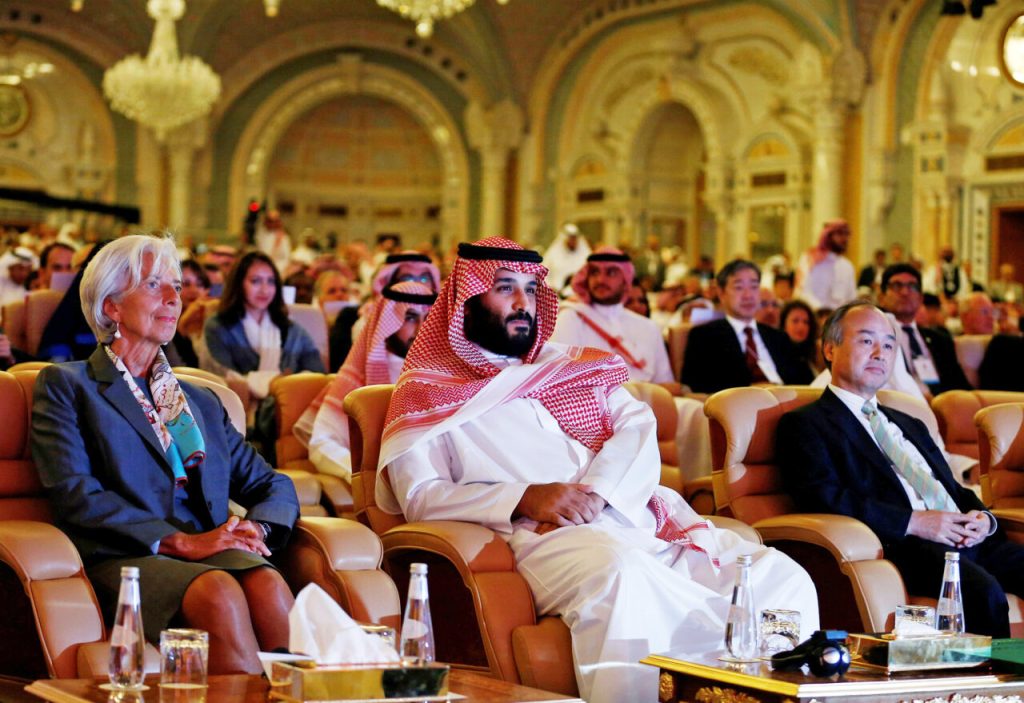
Saudi Crown Prince Mohammed bin Salman, Masayoshi Son, SoftBank Group Corp. Chairman and CEO, and Christine Lagarde, International Monetary Fund (IMF) Managing Director, attend the Future Investment Initiative conference in Riyadh, Saudi Arabia October 24, 2017. REUTERS/Faisal Al Nasser

By Brandon Smith

Source: Alt-Market.us

The decline of a currency’s world reserve status is often a long process rife with denials. There are numerous economic “experts” out there that have been dismissing any and all warnings of dollar collapse for years. They just don’t get it, or they don’t want to get it. The idea that the US currency could ever be dethroned as the defacto global trade mechanism is impossible in their minds.

One of the key pillars keeping the dollar in place as the world reserve is its petro-status, and this factor is often held up as the reason why the Greenback cannot fail. The other argument is that the dollar is backed by the full force of the US military, and the US military is backed by the US Treasury and the Federal Reserve – In other words, the dollar is backed by…the dollar; it’s a very circular and naive position.

These sentiments are not only pervasive among mainstream economists, they are also all over the place within the alternative media. I suspect the main hang-up for liberty movement analysts is the notion that the globalist establishment would ever allow the dollar or the US economy to fail. Isn’t the dollar system their “golden goose”?

The answer is no, it is NOT their golden goose. The dollar is just another stepping stone towards their goal of a one-world economy and a one-world currency. They have killed the world reserve status of other currencies in the past, why wouldn’t they do the same to the dollar?

Globalist white papers and essays specifically outline the need for a diminished role for the US currency as well as a decline in the American economy in order to make way for Central Bank Digital Currencies (CBDCs) and a new global currency system controlled by the IMF. I warned about this years go, and my position has always been that the derailment of the dollar would likely start with the end of its petro status.

In 2017 I published an article titled ‘Saudi Coup Signals War And The New World Order Reset’. I noted at the time that the sudden power shift over to crown prince Mohammed Bin Salman indicated a change in Saudi Arabia’s relationship to the US. I stated that:

To understand how drastic this coup has been, consider this — for decades Saudi Kings maintained political balance by doling out vital power positions to separate, carefully chosen successors. Positions such as Defense Minister, the Interior Ministry and the head of the National Guard. Today, Mohammed Bin Salman controls all three positions. Foreign policy, defense matters, oil and economic decisions and social changes are now all in the hands of one man.”

The rise of MBS was backed by the Public Investment Fund (PIF), a fund comprised of trillions of dollars supplied by globalists within Carlyle Group (Bush family, etc.), Goldman Sachs, Blackstone and Blackrock. MBS garnered the favor of the globalists for one specific reason – He openly supported their “Vision For 2030”, a plan for the dismantling of “fossil fuel” based energy and the implementation of carbon controls. Yes, that’s right, the head of Saudi Arabia is backing the eventual end of oil based energy, and part of that includes the end of the dollar as the petro currency.  

In exchange for their cooperation, the Saudis are being given access to ESG-like funding as well as access to AI advancements and the so-called “digital economy.”  It sounds crazy, but there is much talk of AI developments to cure numerous health problems and extend lifespan.  With those kinds of promises, it’s not surprising that Saudi elites would be willing to dump the dollar and even oil.

In 2017 I noted that:

I believe the next phase of the global economic reset will begin in part with the breaking of petrodollar dominance. An important element of my analysis on the strategic shift away from the petrodollar has been the symbiosis between the U.S. and Saudi Arabia. Saudi Arabia has been the single most important key to the dollar remaining as the petrocurrency from the very beginning.”

I believed that the threat to petro status would ultimately be spurred on by a proxy war between East and West:

World economic war is the real name of the game here, as the globalists play puppeteers to East and West. It is a geopolitical crisis they will have created to engineer public support for a solution they predetermined.”

Back then I thought that such a proxy war would be initiated in the Middle East, possibly in Iran. However, it’s clear that Ukraine is the powderkeg the globalists have chosen, at least for now, with Taiwan being the next shoe to drop.

In the years since I made these predictions the relationship between Saudi Arabia, Russia and China has grown very close. Arms deals and energy deals are becoming a mainstay of trade and this has led to a quiet but steady distancing of the Saudis from the dollar. This past week, the dominoes were set in motion for dollar collapse when Saudi Arabia announced at Davos that they are now willing to trade oil in alternative currencies.

In response, Xi Jinping pledged to ramp up efforts to promote the use of the Chinese yuan in energy deals. This falls in line with another article I wrote in 2017 titled ‘The Economic End Game Continues,’ in which I described how conflict with Eastern nations (China and Russia) would be exploited to create a catalyst for the end of the dollar’s petro status.

The importance of the Saudi announcement cannot be overstated; this is the beginning of the end of the dollar. The dollar’s world reserve status is largely dependent on its petro-status. Without one, you cannot have the other. This is almost the exact same dynamic that led to the implosion of the British Sterling decades ago as the global petro currency which resulted in the rise of the dollar to take its place.

This time, though, it will not be a single foreign currency that takes on the role of world reserve, it will be a basket currency system controlled by the IMF called Special Drawing Rights, along with a single global digital currency that is yet to be named but is now under development.

The consequences of the loss of reserve status will be devastating to the US economy. It is the only glue holding our system together – The ability to defer inflation by exporting it overseas is a superpower only the US enjoys. The Fed can print money perpetually if it wants to in order to fund the government or prop up US markets, as long as foreign central banks and corporate banks are willing to absorb dollars as a tool for global trade. If the dollar is no longer the primary international trade mechanism, the trillions upon trillions of dollars the Fed has created from thin air over the years will all come flooding back to the US through various avenues, and hyperinflation (or hyperstagflation) will be the result.

This dynamic is already in play, as foreign holders of US debt and dollars have been dumping them at record pace since 2017. The process continues at a time when the Federal Reserve is cutting it’s balance sheet and raising interest rates, which means there is no longer a buyer of last resort.

This may be why multiple foreign central banks have renewed their purchases of gold reserves and are once again stockpiling precious metals. They seem to be well aware of what is about to happen to the dollar, while the American public is kept in the dark.

The effects of the decline of the dollar may not be immediately felt, or become obvious for another year or two. What will happen is consistent inflation on top of the high prices we are already dealing with. Meaning, the Federal Reserve will continue to hold interest rates higher and prices will barely budge or they may climb in spite of monetary tightening. Even in the face of a major recessionary contraction, which I predict will be triggered starting in April, prices will STILL remain higher.

All the while the mainstream media and government economists will say they have “no idea” why inflation is so persistent, and that “nobody could have seen this coming.” Some of us saw it coming, but only because we accept the reality that the dollar’s days are numbered.

Not Letting a Good Tragedy Go to Waste, Banking Elite Use FTX Fraud, Crypto Crash to Push CBDCs

CBDCs mean the total death of any economic freedom the public has left…

By Tyler Durden

Source: The Free Thought Project

Central bankers and international corporate financiers have long been pretending to hate the very concept of cryptocurrencies like Bitcoin and Etherium while at the same time investing heavily in blockchain technologies and infrastructure. The purpose of the ruse is not clear, but more than likely it was an attempt at mass reverse psychology – “We don’t like crypto and digital currencies because we supposedly have no control over them; free market proponents should embrace them blindly because that is how you will beat us.”

In the meantime, while major banking firms are investing billions into various blockchain products, central banks and global institutions like the BIS and IMF have been developing their own systems. In fact, the BIS notes with enthusiasm that around 90% of central banks around the world are already in the process of adopting CBDCs.

But why would anyone want to use government and establishment bank controlled cryptocurrencies when they have access to Bitcoin and dozens of other coins that are supposedly independent? Why trade freedom for more centralization?

First, existing cryptocurrencies are not as free as many people believe, with ample government tracking of blockchain transactions in place for years, the notion of the completely anonymous crypto user is a bit of a fantasy, and the idea that a product such as Bitcoin is going to “bring down” the central banks is becoming less realistic by the year.

Second, the crypto market is highly unstable in part because it is still very limited. While crypto use in America is higher than most other countries with around 12% of people using it as an investment (not as a currency), the rest of the world is mostly uninterested with an estimated global footprint of around 4%. Of that 4% only a handful of people actually own the majority of the market; these people are known as “whales” and they have the ability to tip the market up or down with little effort.

This happens in many other trade commodities and paper currencies also. The point is, crypto is not immune to manipulation.

Third, crypto is enticing to people because of the quick profits that can be had, but massive losses are also a danger. The overall crypto market has plunged by $2 trillion in the past year alone – Over 60% of its value. The implosion of huge trading companies like FTX also undermines the stability of the market and usually it’s the average investor that ends up suffering the consequences.

All of these factors and more can be used by banking elites as a rationale for the implementation of CBDCs and global regulation of crypto trading. And, if the bloodbath in existing coins continues, people may even welcome CBDCs as a “safe” investment or currency system.

The investment losses in blockchain products along with the scandals in exchanges is a rather convenient opportunity for the banking establishment to promote their own currencies as a replacement. In the wake of the FTX event, multiple international banks including JP Morgan and Goldman Sachs have called for government regulation and a shift over to CBDCs.

The US House has scheduled hearings on FTX with an emphasis on regulation. In Europe, globalist Christine Lagarde and the ECB are calling for global cooperation on monitoring and controlling cryptocurrencies. Lagarde wants a “digital Euro” to take the place of existing coins and blames FTX and the larger market losses on lack of oversight.

Numerous crypto analysts are also demanding regulation, calling crypto “broken and useless” until governments step in to mediate (control) trade. This is the exact opposite of what crypto activists originally intended over a decade ago when Bitcoin was in its infancy, and digital trade back then was sold as some kind of revolution against the banking oligarchy. However, it’s easy to see where this is all going.

It means even more pervasive centralization. With paper currencies at least there is true anonymity, but with CBDCs the existence of the blockchain ledger precludes any and all privacy in trade. Not only that, but the institutional ability to cut off people from their wealth and economic access is going to be profound. If you think corporate and government led cancel culture is bad now, just wait until they can freeze your digital accounts at a moment’s notice because of something you said on social media. And, in a cashless society there are few alternatives beyond some kind of black market.

CBDCs mean the total death of any economic freedom the public has left, and central banks are exploiting disasters like FTX to make that death happen even faster.

The Cult of Globalism: The Great Reset and its ‘Final Solution’ for Useless People

By Timothy Alexander Guzman

Source: Silent Crow News

The idea of the Great Reset derives from the New World Order which is still alive in the minds of the establishment or who we can call the globalists from people like Henry Kissinger to the current US president, Joe Biden.  Of course there are many others on the top levels of the pyramid whose ideas range from establishing a police state, to implanting microchips the day we are born to track and trace us, to depopulating the planet.  I know it all sounds insane but that’s what the globalists have planned for us for a very long time.  Klaus Schwab’s protégé, Yuval Noah Harari, is an Israeli born intellectual who authored a popular bestseller titled ‘Sapiens: A Brief History of Humankind’ and is also a professor of history at the Hebrew University of Jerusalem.  Harari once asked a disturbing question, “what to do with all these useless people?”  Harari is an intelligent man, there is no doubt about that, but his intelligence has led him to the level of insanity.  Harari is an influential member of the World Economic Forum (WEF) who supports the idea of creating a dystopian society managed by a handful of globalists who will rule over every human being on earth from the day they are born.  According to Harari, planet earth is overpopulated:    

Again, I think the biggest question in maybe in economics and politics of the coming decades will be what to do with all these useless people? The problem is more boredom and how what to do with them and how will they find some sense of meaning in life, when they are basically meaningless, worthless?

My best guess, at present is a combination of drugs and computer games as a solution for [most]. It’s already happening…In under different titles, different headings you see more and more people spending more and more time or solving the inner problems with the drugs and computer games both legal drugs and illegal drugs…

They also want people to stay home connected to the Metaverse world, a virtual reality simulation and at the same time get them addicted to all sorts of drugs.  The kind of world they are trying to create for us is pure lunacy.  Wired, a monthly magazine describes the metaverses as a combination of the digital and physical worlds that creates a virtual reality as in the Hollywood film, ‘Ready Player One,’ The article ‘What is the Metaverse, Exactly?’  answers that question, “Broadly speaking, the technologies companies refer to when they talk about “the metaverse” can include virtual reality—characterized by persistent virtual worlds that continue to exist even when you’re not playing—as well as augmented reality that combines aspects of the digital and physical worlds.”                              

Many other Hollywood films that are based on virtual reality in the future includes Jumanji, Source Code, The Matrix, Total Recall, Inception, and many others.  The globalists want you to believe that a dystopic society is in the works for us, but no worries, you will be completely happy at least according to Klaus Schwab.  In my opinion, the notion that the human species will be living their lives through virtual reality is far-fetched, it’s an illusion that will take decades even centuries to accomplish and that would only happen if we allowed it to happen.  Harari is saying that under a scientific, technocratic world order, the state will be your sole provider for everything, so basically, he says that families are not needed in this new world they are creating for us, in other words, having a family will be a thing of the past:

After millions of years of evolution suddenly within 200 years the family and the intimate community break, that they collapse most of the roles filled by the family for thousands and tens of thousands of years are transferred very quickly to new networks provided by the state and the market, you don’t need children, you can have a pension fund, you don’t need somebody to take care of you, you don’t need neighbors and sisters or brothers to take care of you if you’re sick, the state takes care of you, the states provide you with police, with education, with help with everything

Listen to Harari’s own words in this video:


The World in Crisis: A Stakeholder Economy, the Green Agenda and Covid-19    

Rahm Emanuel worked for US presidents Bill Clinton and Barack Obama under various titles, but one quote he will always be remembered for was when he said “you never let a serious crisis go to waste. And what I mean by that it’s an opportunity to do things you think you could not do before.” That is exactly what happened under the Covid-19 global health emergency.  Klaus Schwab, who is the original founder, and executive chairman of the WEF published an article that outlines three basic components of the Great Reset titled Now is the Time for a ‘Great Reset, in the first component, they would help steer or “improve coordination (for example, in tax, regulatory, and fiscal policy), upgrade trade arrangements, and create the conditions for a “stakeholder economy.”  How would this work? There are more than 195 countries in the world meaning that all these countries would have to establish a “unified” tax, regulatory and fiscal policy, all in sync, all with the same laws and that would be impossible even if they tried because all countries have different tax systems, different economies and cultures and that will not change because of a handful of globalists with outlandish ideas of a unified financial system they want to control for their own benefit.  It’s a ridicules idea.  In fact, more countries today are more open to imposing less taxes and regulations to attract foreign investments to grow their economies, so the WEF ‘s recommendations will never work, in fact its dead-on arrival. 

Then there is the looming financial crisis that can ultimately force the world into a Federal Reserve Bank “Digital Currency” known as central bank digital currencies (CBDCs) that will be tracked by the government on how you spend your money.  What can go wrong with this idea?  If in any case, you are not politically aligned with a particular party or refuse an experimental injection, then the government may block your transactions.  In other words, they can literally control when and how you spend your money and that is something most people will not accept.  An article published by Stefan Gleason who is an investor, political strategist, and grassroots activist wrote an interesting analysis last year for fxstreet.com titled ‘The Great Reset is Coming for the Currency’ asks what will be the next major issue for a Global Reset? “As the Great Reset proceeds from globalist think tanks and technology billionaires to allied media elites, governments, schools, and Woke corporations, what will be “reset” next?  The next reset will most likely take place in the financial sector as “Supporters of the World Economic Forum’s all-encompassing Great Reset agenda are eyeing BIG changes for the global monetary system.”  Biden’s Treasury Secretary and former Federal Reserve Chair, Janet Yellen wants to end the use of various cryptocurrencies and have the International Monetary Fund (IMF) issue CBDC’s.  “Yellen derided Bitcoin as “an extremely inefficient way to conduct transactions” because “the amount of energy consumed in processing those transactions is staggering.”  Gleason says that Yellen and her colleagues are planning to have the public use digitized tokens issued by the central bank.  The bottom line is that “They just want to make sure those digits are issued and controlled by governments and central banks.” 

The best way to avoid the Federal Reserve bank’s control over your finances is to own gold, silver, and other safe-haven assets.  “Anyone who is concerned about the prospect of being herded into a new digital currency regime should make it a high priority to own tangible money that exists outside the financial system.”  Gleason makes the case for owning gold and silver, “No technology or government mandate can change the fact that gold and silver have universally recognized, inflation-resistant value.”  At some point, the public will reject the Federal Reserve and its ‘digital currency’ if they can avoid it.  However, the best way to bypass CBDC’s in the future is to buy gold, silver, and other metals that that can maintain value and become resistant to inflationary pressures.  An important note to consider is that all US silver coins that were produced before 1964 were minted with 90% silver and 10% copper, so keep an eye on your pocket-change just in case you come across some silver coins with value. 

The second component “would ensure that investments advance shared goals, such as equality and sustainability. Here, the large-scale spending programs that many governments are implementing represent a major opportunity for progress.”  Which means that governments will be required to print an unlimited money supply to support their agenda that will eventually lead to inflationary pressures which can devastate their respective economies.  “Here, the large-scale spending programs that many governments are implementing represent a major opportunity for progress. The European Commission, for one, has unveiled plans for a €750 billion ($826 billion) recovery fund. The US, China, and Japan also have ambitious economic-stimulus plans.”  They are pushing for an expensive Green Agenda which is part of Joe Biden’s Build Back Better plan to reduce greenhouse gas emissions that will change how the world operates when it comes to using traditional energy resources such as coal, oil, and natural gas:

Rather than using these funds, as well as investments from private entities and pension funds, to fill cracks in the old system, we should use them to create a new one that is more resilient, equitable, and sustainable in the long run. This means, for example, building “green” urban infrastructure and creating incentives for industries to improve their track record on environmental, social, and governance (ESG) metrics

Last year, Forbes magazine published Why Biden’s Climate Agenda Is Falling Apart’ which does explain how the Green Agenda is an expensive and unreliable scheme:

The vast majority of human beings want high rather than low economic growth, and so politicians ultimately choose policies that make energy cheap, not expensive.

And the limitations of weather-dependent renewables are more visible than ever. If California’s large wind energy project is built, it will provide less than half of the energy of California’s Diablo Canyon nuclear plant Newsom is planning to close in 2025, and it will be unreliable. During the heatwave-driven blackouts last summer, there was little wind in California or other Western states, meaning we can’t count on wind energy when we need it most. 

In other words, the Democrats’ climate change and renewable energy agenda is rapidly falling apart, and the reasons have far more to do with physics than with politics

Schwab proposes that the third component is basically the innovations that will lead to centralized control of the world’s health policies by the World Health Organization (WHO) However, the innovations began the moment  WHO officials declared a global Public Health Emergency more than 2 years ago.  Schwab mentioned the ‘Fourth Industrial Revolution’ which is described on the World Economic Forum’s website as a new system that “shapes new policies and strategies in areas such as artificial intelligence, blockchain and digital assets, the internet of things or autonomous vehicles, and enables agile implementation and iteration via its fast-growing network of national and sub-national centres.” Regarding Covid-19 or any other declared public health emergency in the future, the new system will be able “to support the public good, especially by addressing health and social challenges. During the COVID-19 crisis, companies, universities, and others have joined forces to develop diagnostics, therapeutics, and possible vaccines; establish testing centers; create mechanisms for tracing infections; and deliver telemedicine.”

However, there was a unified response put forward by a several nations including Brazil, India, Russia, China, Iran, South Africa, Malaysia and the practically the entire continent of Africa that rejected a pandemic treaty developed by the World Health Organization.  They all agreed that the treaty would allow authorities from the WHO to gain control of their health policies bypassing their rights as sovereign nations.  As the spirit of Tanzania’s late President, John Magufuli lives on, Reuters published the positive move on behalf of the African continent Africa objects to U.S. push to reform health rules at WHO assembly regarding Africa’s 47 nations who rejected the treaty “African countries raised an objection on Tuesday to a U.S.-led proposal to reform the International Health Regulations (IHR), a move delegates say might prevent passage at the World Health Organization’s annual assembly.”  The treaty brought forward by the WHO and the US government was technically defeated which is a positive outcome considering what’s at stake:

If Africa continues to withhold support, it could block one of the only concrete reforms expected from the meeting, fraying hopes that members will unite on reforms to strengthen the U.N. health agency’s rules as it seeks a central role for itself in global health policy.

The IHR set out WHO members’ legally binding obligations around outbreaks. The United States has proposed 13 IHR reforms which seek to authorise the deployment of expert teams to contamination sites and the creation of a new compliance committee to monitor implementation of the rules.

But the African group expressed reservations about even this narrow change, saying all reforms should be tackled together as part of a “holistic package” at a later stage

Western powers along with top level WHO officials will try to persuade or blackmail sovereign nations who originally rejected the IHR treaty to reverse their decision with a new modified version in hopes of centralized control of any future pandemic, but the current decision made by those nations who rejected the treaty is welcoming news indeed.   

Just imagine the concept of a group of mostly unelected bureaucrats with the power to oversee a centralized control grid to rule over a global pandemic is Orwellian, in fact, the Great Reset kind of reminds me of the 1973 classic Hollywood film, Soylent Green with Charlton Heston based on the 1966 science fiction novel ‘Make Room! Make Room! by Harry Harrison based on a dystopian society.  The story is about a police investigation into the murder of a wealthy businessman while the world is experiencing a slow death from “greenhouse gases” that produced a variety of problems for humanity including overpopulation, pollution, poverty, crime, and the concept of enforced euthanasia by the state. 

Soylent Green is an example of what a deranged group of globalists or in this case, government bureaucrats would do to humanity if we did nothing to stop them.  In the film, Detective Thorn (played by Charlton Heston) warned his colleague Chief Hatcher (Brock Peters) “The ocean’s dying! Plankton’s dying! It’s people – Soylent Green is made out of people! They’re making our food out of people! Next thing they’ll be breeding us like cattle for food! You’ve gotta tell them, you’ve gotta tell them!” Although Soylent Green is obviously fictional, it’s a metaphor on how far globalists will be willing to go so that their agenda of world control and depopulation can succeed.  In the film, the state strongly encouraged and even facilitated suicide which turned the people into food for the remaining population.  It sounds insane but reading about the agenda of the Great Reset of you ‘owning nothing and being happy is the start of something more sinister in our future.  I am not saying that they will try to turn people into food in the future, but they are certainly trying to push forward other outrages solutions to feed the world such as the possibility of people eating insects to survive.  I wish this was a joke, but it’s not. 

Globalists are calling for the world’s population to be completely vaccinated with their Covid-19 experimental injections, in other words, they want total control over the world’s healthcare policies to enforce the use of facemasks and endless vaccination schemes through government-imposed mandates on the population although Covid-19 experimental injections are injuring and even killing thousands of people around the world.  Globalist plotters began their plan of action to implement their vaccine mandates as soon as the Public Health Emergency was announced, but there were governments who rejected the idea from the start.  On December 3rd, 2020, Brazil’s Minister of Foreign Affairs Ernesto Araujo clearly rejected the World Economic Forum’s Great Reset agenda by addressing the United Nations (UN) special session on COVID-19 by saying that “Those who dislike freedom always try to benefit from moments of crisis to preach the curtailing of freedom. Let’s not fall for that trap” In his conclusion, Araujo clearly states what is Brazil’s position on the idea of the Great Reset:

Fundamental freedoms are not an ideology. Human dignity requires freedom as much as it requires health and economic opportunities.  Those who dislike freedom always try to benefit from moments of crisis to preach the curtailing of freedom. Let’s not fall for that trap.  Totalitarian social control is not the remedy for any crisis. Let’s not make democracy and freedom one more victim of COVID-19

Is the World Ready to Embrace the Great Reset?  

In the geopolitical spectrum, globalists are set on punishing sovereign countries who do not obey a rules-based order under the Great Reset agenda in partnership with the US-NATO alliance leading the world to some form of conflict or regime change against Russia, China, Iran, Belarus, Syria, Venezuela, Nicaragua, Cuba, and any other nation who wants to remain sovereign at all costs. There are many who are vehemently opposed to such an idea, for example, on January 27th, 2021, Russian President Vladimir Putin spoke at the World Economic Forum (WEF) and basically rejected the idea of the Great Reset and gave a reasonable idea of humanity working together to achieve a prosperous future for all with “calls for inclusive growth and for creating decent standards of living for everyone are regularly made at various international forums. This is how it should be, and this is an absolutely correct view of our joint efforts” and that “It is clear that the world cannot continue creating an economy that will only benefit a million people, or even the golden billion. This is a destructive precept. This model is unbalanced by default.” Putin’s perception of the Great Reset or a unipolar world order is correct because it is destined for failure since the world is a complex place where nations have distinct cultures and history.  Putin questions how nations would respond to a Great Reset with a rules-based order run by an elite group of psychopaths that expect a harmonious transition from all nations who are willing to comply:

We are open to the broadest international cooperation, while achieving our national goals, and we are confident that cooperation on matters of the global socioeconomic agenda would have a positive influence on the overall atmosphere in global affairs, and that interdependence in addressing acute current problems would also increase mutual trust which is particularly important and particularly topical today.

Obviously, the era linked with attempts to build a centralized and unipolar world order has ended. To be honest, this era did not even begin. A mere attempt was made in this direction, but this, too, is now history. The essence of this monopoly ran counter to our civilization’s cultural and historical diversity.

The reality is such that really different development centers with their distinctive models, political systems and public institutions have taken shape in the world. Today, it is very important to create mechanisms for harmonizing their interests to prevent the diversity and natural competition of the development poles from triggering anarchy and a series of protracted conflicts

The rejection of the Great Reset and its associated global institutions and industries such as the WHO, NATO and Big Pharma is a step in the right direction and the globalists are in panic.  Brazil, Russia, the continent of Africa and others are proving that the Great Reset or that century’s old idea of a New World Order has become a failed project.  Some people might disagree with my analysis because many are pessimistic about their future because they believe that a Great Reset is inevitable, that there is no escape from it because it seems that things are getting out of control with ongoing wars, coming food shortages and a growing danger of a global medical tyranny.  However, I do believe that we are in the early stages of a great awakening, not a rules-based order managed by a group of globalists despite the endless propaganda on how the Great Reset will make the planet a better place for all of us.   

People and certain governments are awakening to the fact that a group of globalists are working against them on every level, and they are starting to fight back.  We do not want to be ruled by a centralized power telling us what to do or how to think.  The concept of the Great Reset has failed in many ways, but there is still work to do. 

Never give up, never allow a group of influential globalists whether they are billionaires or bankers, government bureaucrats or special interest groups, resist this ideology of a unipolar world order.  We can win this war, there is still time, I believe that we will prevail if we just don’t comply with their goal of them trying to control us, the useless people.