
Why you might consider the Buddha’s proposal

By Jack Balkwill

Source: Intrepid Report

The Buddha was said to have predicted the day he would die. When that day approached, his followers, weeping, asked him to stay with them. “I’ve told you that life is about suffering,” he reminded them, “would you have me continue suffering?” With that, his followers let go and allowed their beloved teacher to die in peace.

A thousand years after the Buddha’s death, a monk known as Bodhidharma is said to have brought a version of the Buddha’s philosophy from India to China, where it became known as Ch-an. There is no scientific evidence that Bodhidharma ever existed, but I believe he did, the evidence being the existence of Ch-an, which spread to Korea as Sen, and later to Japan as Zen.

Bodhidharma emphasized the Buddhist opposition to what they call the three poisons—hatred, greed and delusion—defining in three words everything which holds mankind back from constructing a heaven on earth. Understanding this enables adherents to define the causes of suffering and address them.

The Buddha had set out as a young man to discover the cause of suffering, and how to end it. Decades of failed attempts did not deter him. He tried to bring about suffering on himself, but told followers this did not work. Finally, he discovered that intense meditation was the answer to that which he was seeking.

Buddhism is said to have a hundred-thousand sects, but Bodhidharma’s philosophy is one of “Northern School” Buddhism, or “Mahayana” Buddhism, and is about living one’s life to make a better world by opposing hatred, greed and delusion with the goal of ending the suffering of others.

The Buddha was said to have laughed when a follower asked him if he were a god or prophet come to teach them, admitting only that “I am awake.” His Mahayana followers believe he was an enlightened person, with no supernatural powers. The Buddha said that anyone may become so enlightened, primarily through deep meditation, in which one comes in contact with the inherent wisdom of the universe.

Within this philosophy of opposing hatred, greed and delusion to perfect one’s world, there is a teaching that all of us have a role to play should we become aware (the first spark of enlightenment). The belief is that if one meditates long enough, one will discover that role. There is no perfect purpose, nor one better than another, so one person realizes a need to feed the hungry, another furthering the cause of world peace—there are countless ways to relieve suffering in the world.

In this philosophy one recognizes that we are here to make a better world in some way, not to accumulate wealth, or power, or fame, which are seen as delusions by Buddhists.

And so it is that we live in a world where there are thousands of heroes who go unrecognized, driven by a need to make this world a better place. Many may be unaware that they are practicing this engaged form of Zen. They are in the shadows, away from the spotlight of mainstream media. Much of what they do is anathema to the teachings of the establishment.

War, for example, is glorified by the establishment’s mainstream media, because the powers behind mainstream media—its owners, board members and advertisers—make a lot of money from war (through their expanded financial portfolios), and wealth is all that concerns our ruling plutocrats. Guests invited on the cable news networks to discuss wars are often retired generals, many of them on the boards of “defense” companies which profit from war. One does not see peace activists giving the other side, only one side is allowed on all of the TV networks, the side promoting war, guiding the beliefs of the masses.

Watching cable news channels for months one is not likely to see a story about world hunger, a daily problem around the globe. The hungry do not buy products, so are of no interest to the TV “news” networks, existing as they do to profit from the sale of products.

There is a massive amount of work to do in easing suffering that lies outside of mainstream media’s viewpoint.

In my meditation classes I finish my basic course with a discussion about “engaged meditation,” said by many meditation masters of the East to be the highest form of meditation. One meditates on one’s chosen role, sometimes for months, until one discovers one’s chosen role in contributing toward making a better world—free of hatred, greed and delusion.

One student asked me if her work at a battered women’s shelter was a good choice. I replied, of course, if that is what you need to do. Another asked if working at an animal shelter was worthwhile, it seemed to her that it might somehow be a lesser cause than working to end human rights [abuses] or some of the other causes. I replied that of course it is a worthy cause—anything that eases suffering in the world.

We live in a laissez faire capitalist empire in which hatred, greed and delusion are emphasized as ideals. One is told by one’s TV news to hate the Russians, Chinese, Iranians, Venezuelans and North Koreans. One is told that to be successful, all that matters is that one acquires large sums of money at any cost to the public interest. One is told that one’s taxes should go to supporting a worldwide empire which serves the plutocrats against the interests of the masses.

The Buddha would have laughed at all of this, pointing out that following the messages of the mainstream press is delusional. Instead, he would tell you that you have a purpose, and you can find it by meditating deeply on what your role should be in making a better world. Imagine the world we could have if more people did this, united in making a civilization dedicated to ending suffering.
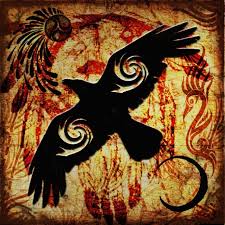
Crow’s God: Ego Dissolution and the Evolution of the Self

By Gary ‘Z’ McGee

Source: Waking Times

“To fall in love is to create a religion that has a fallible god.” ~Jorge Luis Borges

“Trickster god is god’s God,” Crow says, peering from behind The Branches of Lost Time. These branches are a metaphor for our misremembered synapses. They symbolize our having lost touch with both our own nature and with wild Nature, our forgotten link between cosmos and psyche, our misunderstanding of how we-the-microcosm makes up a vital aspect of We-the-macrocosm.

Crow is here to remind us. But Crow’s medicine is harsh. It is ruthless: a tearing apart, a torn off Band-Aid. For Crow is between worlds like no other creature. His moon-eye sees the light. His sun-eye sees the dark. And his shadow is the grayest thing in the universe: The Middle-gray, the Middle Way, casting itself over and above all things. Smearing out yin-yangs, he reveals how nothing is separate; how everything is connected to everything else in a glorious melting down of black and white, dark and light, life and death, finitude and infinity.

Crow is here to remind us that we need to get over ourselves. He is a black beacon in a room filled with blinding light. He’s the Dark Truth in the sugar-coated ointment. He is here to trick us out of unconsciousness. He is here to crucify the ego. But more importantly, he is here to resurrect it as a mighty tool for the self-actualized Soul.

Ego Dissolution

“Buddha is dead. God is dead. The path is littered with insufferable egos. Even your own ego has an enlightened sword penetrating through its self-righteous heart, and your soul is all the stronger for it.” ~Seven Signs You May Be Unfuckwithable

Don’t worry so much. Ego death doesn’t hurt. What hurts is realizing that you’ve been, as they say in Zen, “tied to a post without a rope.” What hurts is admitting that your ego is nothing more than a front for your multilayered self. What hurts is letting go of your expectations. What hurts is letting go –full stop.

Crow is here to help you let go. Crow’s medicine has just the right amount of humor disguised as honor and compassion disguised as courage to fill up the humble pie disguised as a red pill needed to get you past the blue-pill addiction of your un-mighty ego. Sure, Crow shoves it down your unwilling and reluctant throat with a beak blacker than dark matter and harder than God’s Femur, but he gets the job done with a humor of the most-high.

He’s a necessary amoral agent: Zeno’s Compass, Ockham’s hellraiser. He’s here to flip your worldview on its head, to vivisect the animal of your knowledge, to cut what you think you know about the way the world works in half and pluck out the organs of all the things you take for granted. He’s neither gentle nor comforting, but he is sincere in his exact fierceness. He must be, in order to reveal yourself to yourself. In order to transform your whiny, woe-is-me placation into a mighty self-overcoming revelation.

No easy feat, dissolving egos. But Crow does so with pluck and aplomb, with molten mettle and mercurial moxie. The letting go process is easier if you just give your ego over to him to chew-up (courage), to digest (cocoon) and eventually shit-out (rebirth), but he doesn’t mind stealing it from you like a thief in the night either. Actually, he would prefer pulling it out of you kicking and screaming and begging the gods to save you. He would rather stamp out the little light that blinds you so that you can finally see the bigger light that awakens you.

Don’t worry. On the other side of this beautiful annihilation is a soulful illumination: A Three-eyed Raven. He has come to carry you to a terribly exquisite juxtaposition: the gloriously painful journey of self-overcoming.

Evolution of the Self

“Life is a process of becoming, a combination of states we have to go through. Where people fail is that they wish to elect a state and remain in it. This is a kind of death.” ~Anais Nin

At the fork of in the path, at the crossroads, where yesterday’s you meets today’s you in bardo-perfect juxtaposition, there is a psychosocial reckoning at hand. There is an existential decision to make: get busy adapting and overcoming, or get busy stagnating and succumbing. The cliché phrasing is ‘get busy living or get busy dying,’ but on the Path of the Three-eyed Raven there is room for dying (rebirth) as a steppingstone for growth toward living life more profoundly, adventurously, and on-purpose.

So here you are, in a state of in-between, unmolded clay. You’ve been rocked to your foundations with the realization that you are not your ego, that you’ve only ever been unmolded clay. You’re no longer that, and not yetthis. You’ve emerged from your ego’s death with your soul bloody from a thousand and one cutting questions. Your ego is now a pulsing blister inside you, oozing indifference and apathy even as it begins filling itself with interdependence and empathy. It leaps and bounds inside you, a terribly beautiful wound turned primordial womb that purges pettiness and superfluity even as it begins impregnating itself with the world.

Crow is satisfied, perched up high, licking his razor-sharp beak, filled to bursting with the rigid invulnerability of your ego bulging inside him. But the Three-eyed Raven is anything but satisfied. He sees the Infinite Game being played out. He sees how you are an integral catalyst for the progressive evolution of your species. He is a symbol for your ego’s rebirth. The most wide-awake aspect of you that invulnerably and soulfully flexes out; that individuates and self-actualizes as it perpetually overcomes the vicissitudes of self, and thus the vicissitudes of life.

With Crow’s medicine in one hand and your wide-awake ego in the other; with Crow on one shoulder and the Three-eyed Raven on the other, you are ready to self-overcome. You are ready to existentially crush out. You are ready to bridge the gap between man and overman.

Don’t be afraid of this vulnerable power, though it is both the scariest and most powerful thing in the universe, save for the power of a good sense of humor. Embrace it. Be fearless with it. Use it as a tool to leverage wonder and numinous experience into your life. Use it as medicine for a profoundly sick society. You –the you not drowning in ego pettiness and woe-is-me religious placation– are the one the world has been waiting for.