Reflections on War, Injections, and Terror at This Crossroads in History (part 1)

By Prof. Anthony J. Hall

Source: Global Research

In late February the international news cycle moved between two very important focuses. One addressed controversies in Canada. The other continues to highlight events unfolding primarily in Russia, Ukraine, and the USA. While different in many ways, both stories have many-faceted worldwide implications.  

Both involve configurations of power and intrigue that overlap in crucial ways. Both involve conflicts with profound life-and-death implications. Both conflicts highlight that humanity and our civilizational inheritances are at a crossroads.

At this parting of the ways, the most well-travelled autobahn looming up ahead points towards tyrannies far more extreme than anything we have known in history so far.

Whatever highway we follow, it seems there is no escaping the onslaught of new forms of aggressive warfare that are fast pushing humanity into a jagged collision with high-tech weaponry capable of unprecedented destruction.  To say we are living in dangerous times is a gross understatement.

Will humanity be subjected to even greater extremes of outright militarization? Will we continue to be assaulted by a novel array of overt and covert tactics aimed at radically re-engineering society as well as the very genetic attributes of the human genome? Will human beings continue to be reconfigured to advance the conditions of our decline into submissive enslavement? Will we continue to be subject to litanies of media lies, strategies of behavior modification, and unregulated medical experiments aimed at merging our biological persons with aspects of digital technology?

See this and this.

Some common themes wind through the convoluted array of unregulated assaults that menace humanity’s very survival in anything like the God-given form we inherited from nature. Powerful enemy forces are exploiting for their own self-interested advantage, our credulousness, naivety, and susceptibility to programs of mind control. The goal of the master class, it seems, is to modify our behavior so we can be better integrated into a world of pervasive robotization.

Enslavement With the Help of Digital IDs Combined with Cashless Transactions

Right now in the Western countries’ onslaughts of psychological warfare are integral to the military showdown initiated in Eurasia.

While experts in “perception management” are using the media to lure the public into single-minded condemnation of Russia, our attention is being drawn away from stunning revelations coming to light in our midst.

The disclosures underway illuminate the role of COVID Officialdom in forcing on us through mandates and other coercive techniques, highly lethal and injurious medical procedures. These procedures have been purposely designed to induce pathogenic outcomes and depopulation agendas. Throughout Europe and North America, dramatic increases in all-cause rates of death are being reported especially by life insurance companies and funeral homes.

France’s Finance Minister: “We’re waging an all-out economic and financial war on Russia”

One result is that Pfizer and Moderna investors are “running for the exit.” Former BlackRock investment advisor, Edward Dowd, has sounded the alarm on Moderna and Pfizer “as sinking ships that investors need to abandon.”

See this.

The bad news for the vaccine companies and their notoriously negligent regulators is compounded by the fact that their indemnification is threatened.

The companies and their regulators can be sued if it can be demonstrated that they have lied about their products. Indeed, they have lied on an epic scale and continue to do so. The evidence is clear that the inadequately-tested medical injections advertised as “safe and effective” are no such thing. Now there are headlines proclaiming, “Pfizer and Moderna are modern versions of Enron.”

See this and this

As blanket coverage of the Ukrainian conflict dominates the media, the next stage in the insidious COVID con is being executed with blitzkrieg speed. The objective is to rush humanity into a privatized system of universalized and standardized Digital ID before most people have an opportunity to get informed on the fuller implications.

The growing contingent of people devoted to principled non-compliance to the myriad COVID frauds must resist allowing the COVID hucksters to advance their diabolical agenda. The COVID con men and women must be forced to back away from their attempt at making sweeping appropriations and instrumentalizations of yet more elements of our private information. We need to hold the line against slick kleptocrats seeking total control of everything through digital invasion and theft of the little that remains of our personal realms.

Included in the Digital ID con job is the creation of a new type of One World digital currency presently being rushed into existence by the private central banks holding membership in the Swiss-based Bank of International Settlements (BIS). This process is being pushed ahead in partnership with the dystopian World Economic Forum (WEF).

Recently Klaus Schwab, the WEF’s founder, bragged that more than one-half of Prime Minister Justin Trudeau’s Canadian cabinet is infiltrated with WEF insiders. Chrystia Freeland, the Deputy Prime Minister of Canada, is one of them.

In fact Freeland is currently a prominent member of the WEF’s governing body of trustees. As shall become clear, Freeland is emblematic of the abundant conflicts-of-interest and round-the-clock lies that have come to characterize the Liberal Party during the time of Trudeau’s denigration of public office in Canada.

See thisthisthis and this

A pervasive system of social credit scoring is taking shape with the rush to entrench in many jurisdictions a transnational system of Digital IDs. The other necessary element is our willingness to go along with the creation of a single digital currency. The new system requires the consolidation of a One World megabank that is meant as a key element in the so-called Great Reset.

The advancement of a system of total surveillance and total control requires the termination of all cash transactions. Hence our insistence on continuing the conduct of business through the circulation of cash must be an expression of our principled non-compliance.

The merger of Digital ID together with the replacement of cash transactions would give central authorities the ability to cut off our “freedoms,” including, for instance, even our capacity to buy food. The entrapment of people in digital enclosures would put the vast majority of humans in a virtual penitentiary of unmitigated top-down authority.

See this.

A Matter of Life or Death for Russia

The creation of a social credit dystopia is being pushed rapidly forward under the cover of wall-to-wall coverage devoted to Russia’s intervention in Ukraine. According to Russian President Vladimir Putin, Russian troops are intervening with the goal of “demilitarizing and denazifying Ukraine.”

It is also thought that Putin intends to dismantle about fifteen US biological warfare labs. The Pentagon sponsors of these “research facilities” for mass murder would have us believe they are engaged in a “Biologic Threat Reduction Program.”

In his memorable speech of 24 Feb., Putin claims that the Russian mission in Ukraine, “is not a plan to occupy the Ukrainian territory.” The Russian government asserts that its actions in Ukraine are necessary for the protection of the Russian Mother Country. Over many years Putin has been stressing the themes that the Russian Armed Forces are now acting upon.

The explanation of this military operation as an act of self-defense depends on a historical analysis highlighting the decades-long campaign to strangle Russia in a boa constrictor’s grip of NATO’s aggressive militarism. The core agreements enabling the end of the Cold War have been violated by the patterns of NATO’s expansion since 1991.

NATO has been ingesting former Soviet republics into a US-backed militarized zone of organized anti-Russia zealotry. As Putin warned again and again over recent years, the US goal of transforming Ukraine into yet another militarized enemy of Moscow established a “red line,” a “matter of life or death” for Russia.

See this.

Note to readers: Please click the share buttons above or below. Follow us on Instagram, @globalresearch_crg and Twitter at @crglobalization. Forward this article to your email lists. Crosspost on your blog site, internet forums, etc.

Dr. Anthony Hallis editor in chief of the American Herald Tribune. He is currently Professor of Globalization Studies at University of Lethbridge in Alberta Canada. He has been a teacher in the Canadian university system since 1982. Dr. Hall, has recently finished a big two-volume publishing project at McGill-Queen’s University Press entitled “The Bowl with One Spoon”.

He is a regular contributor to Global Research.
Global Technocrat Cabal Exposed Through Network Analysis

“…A very small group of criminal collaborators are at the top of the Great Panic of 2020. Using disciplined network analysis, the players and patterns emerge right before your eyes…According to the anonymous IT specialist who created the document, the core of this “COVID criminal network,” around whom most everything revolves, is no larger than 20 or 30 people”

By Patrick Wood

Source: Technocracy News and Trends

The video above is in German. Click on “Settings” to change the subtitles to English via auto-translate feature.

STORY AT-A-GLANCE

> The German Club of Clear Words takes a deep dive into the network of individuals and organizations responsible for the COVID scam

> Whether blatantly visible or not, you can identify just about any network by connecting dots between individuals and organizations. Who’s working with whom, where, and why? Who’s paying whom? And once you’ve done that, you can more clearly identify the motivations behind various decisions

> The Bill & Melinda Gates Foundation appears to be near the top, or the center, of this COVID plandemic network. Gates is also a major funder of mainstream media, and his network extends into global food and climate change policy

> The Gates Foundation, through its funding of the WEF, also plays an important role in The Great Reset, which was officially unveiled during a WEF summit in May 2020

> Every conceivable aspect of life and society is scheduled to be “reset” according to their plan. Ultimately, that’s where this criminal COVID enterprise is trying to take us

The video above, by the German Club Der Klaren Worte, or the Club of Clear Words, takes a deep dive into the network of individuals and organizations responsible for the COVID scam. The audio is in German but there is a captioned translation at the bottom of the video.

The review is led by journalist and filmmaker Markus Langemann. As noted by Langemann, it’s not necessarily the people with the best ideas who win in life. Rather, the winners are those who are in the “right” network — a network with people in the right places. Never underestimate the power of a network.

Some networks are visible. One example would be an alumni network that you can join and use to promote your career. Other networks are more hidden, secretive and exclusive, and can only be entered into by select invitation by another member.

Whether blatantly visible or not, you can identify just about any network by connecting dots between individuals and organizations. Who’s working with whom, where, and why? Who’s paying whom? And once you’ve done that, you can more clearly identify the motivations behind various decisions.

A Global Network Revealed

In this video, Langemann presents “a network document that is unique in the world and which for the first time shows you the complex network of relationships, from non-governmental organizations (NGOs), companies, documents and people.”

The 170-page document details more than 7,200 links between 6,500 entities and objects, including payment flows and investments.

“In the case of the Bill & Melinda Gates Foundation, already on page 4 of the document, you see that this foundation spent $43 billion [note that is billion with a “b”] in the U.S. alone in the period from 1994 to 2001, and distributed around half a billion dollars in Germany during this period,” Langemann says.

You can review and download the document here.1 The document is mostly in English. It’s incredibly comprehensive in scope, detailing a global network that is working behind the scenes to influence global health, finance and governance.

Download Network Analysis Document

As an interesting aside, the document was actually created using software that investigators and detectives use to help them identify hidden connections between potential suspects. All of the data points, documents, payment data and so on, are publicly available.

Red arrows are used throughout the document to indicate money flows, such as grants, donations and other payments. As one example, as shown on page 3 of the document, at least 21 U.S. universities are financed by and through just three key organizations:

  1. The Bill & Melinda Gates Foundation
  2. The Open Philanthropy project, a research and grantmaking foundation, which is linked to the WEF
  3. The Wellcome Trust, the world’s second-largest health foundation, located in the U.K.

A Small Tight-Knit Group

According to the anonymous IT specialist who created the document, the core of this “COVID criminal network,” around whom most everything revolves, is no larger than 20 or 30 people. Several of them appear on page 36.

They got together May 8, 2019, at a CDU/CSU event where they discussed how to strengthen global health and implement the United Nations Sustainable Development Goals. The CDU/CSU is a political alliance of two German political parties, the Christian Democratic Union of Germany (CDU) and the Christian Social Union in Bavaria (CSU). Attendees included:

Hermann Gröhe, Christian Democration Union (CDU) member and former Minister of Health
Ralph Brinkhaus, Parliamentary leader of the CDU
Dr. Angela Merkel, former Chancellor of Germany and a CDU member
Ilona Kickbush, Ph.D., Graduate Institute of International and Development Studies, Geneva
Tedros Adhanom Ghebreyesus, Director-General of the WHO
Dr. Christian Drosten, a German virologist who in early 2020 created the COVID PCR test
Dr. Clarissa Prazeres da Costa, microbiologist and infectious disease specialist
Joe Cerrell, managing director for Europe, the Middle East and East Asia for The Gates Foundation
Professor Jeremy Farrar, director of the Wellcome Trust
Dr. Georg Kippels, CDU member
Jens Spahn, CDU member and a former Minister of Health

From that May 2019 meeting onward, these individuals are found again and again, in overlapping working groups. You also find them rubbing elbows in the past.

For example, Farrar, Drosten and Kickbush were all present at a February 14, 2019, tabletop exercise on International Response to Deliberate Biological Events, held at the Munich Security Conference, as shown on page 124. Individuals from the Robert Koch Institute, the Chinese CDC and the Gates Foundation were also present.

In 2017 and 2018, Kickbush, Drosten and Farrar were added as members to the International Advisory Board on Global Health. Farrar and Kickbush also joined the Global Preparedness Monitoring Board, a joint arm of the WHO and the World Bank, formally launched in May 2018. (Dr. Anthony Fauci is another member of this board.) Two other key persons within this network are:

  • Dr. Chris Elias, president of the Global Development Program at the Gates Foundation. He too is on both the Global Preparedness Monitoring Board and the International Advisory Board on Global Health, together with Kickbush, Drosten and Farrar.
  • Dr. Peter Piot, a Belgian-British microbiologist known for his research into Ebola and AIDS, a professor of global health, director of the London School of Hygiene and Tropical Medicine, a senior fellow with the Gates Foundation’s Global Health Program, and former undersecretary-general with the United Nations.

Key Organizations

Due to the complexity of the network connections, there’s really no easy way to summarize them here. You simply have to go through the document, page by page. That said, key organizations, whose networking connections are detailed, include:

The Bill & Melinda Gates FoundationThe Wellcome Trust, an organization funded by and strategically linked to GlaxoSmithKline (a vaccine maker in which Bill Gates is financially invested)
The World Health OrganizationThe Rockefeller Foundation
The World Bank GroupThe World Economic Forum (WEF)
GAVI, the Vaccine Alliance, founded by the Gates FoundationCoalition for Epidemic Preparedness Innovations (CEPI), founded by the governments of Norway and India, the Gates Foundation, the Wellcome Trust and WEF
The Global FundForum of Young Global Leaders, founded by WEF in 2004
FIND, the global alliance for diagnostics, seeks to ensure equitable access to reliable diagnosis around the worldBig Pharma
Johns Hopkins UniversityCharité, Universitätsmedizin Berlin
The Robert Koch InstituteThe European Commission
The European Medicines and Healthcare Products Regulatory Agency (MHRA)The Swiss Agency for Therapeutic Products
The German Global Health Hub

Of these, The Bill & Melinda Gates Foundation appears to be near the top, or the center, of this criminal network, depending on how you visualize it. Gates is also a major funder of mainstream media which, of course, is important if you want to ensure one-sidedly good press.

Gates’ Media Control

In the past, the Bill & Melinda Gates Foundation funded the placement of “educational” messages in popular TV shows such as “ER,” “Law & Order: SVU” and “Private Practice,” including topics such as HIV prevention, surgical safety and the spread of infectious diseases, i.e., vaccinations.2 But that was only the beginning.

Via more than 30,000 grants, Gates has contributed at least $319 million to the media, including CNN, NBC, NPR, PBS, The Atlantic, Texas Tribune (U.S.), the BBC, The Guardian, The Financial Times, The Daily Telegraph (U.K.), Le Monde (France), Der Spiegel (Germany), El País (Spain) and global broadcasters like Al-Jazeera.3

More than $38 million of Gates’ money has also been funneled to investigative journalism centers. The majority of that money has gone into developing and expanding media in Africa.4 As you might suspect, Gates’ donations come with strings attached. As reported by Columbia Journalism Review:5

“When Gates gives money to newsrooms, it restricts how the money is used — often for topics, like global health and education, on which the foundation works — which can help elevate its agenda in the news media.

For example, in 2015 Gates gave $383,000 to the Poynter Institute, a widely-cited authority on journalism ethics … earmarking the funds ‘to improve the accuracy in worldwide media of claims related to global health and development.’ Poynter senior vice president Kelly McBride said Gates’s money was passed on to media fact-checking sites …

Since 2000, the Gates Foundation has given NPR $17.5 million [now up to $24.6 million6] through 10 charitable grants — all of them earmarked for coverage of global health and education, specific issues on which Gates works.”

Who Else Controls the Media?

Gates’ power over the media is immense, but he’s a not a sole actor. Other players in media control include BlackRock and the Vanguard Group, the two largest asset management firms in the world, which also control Big Pharma.7 They’re at the top of a pyramid that controls basically everything, but you don’t hear about their terrifying monopoly because they also own the media. As noted in the video, “The Puppet Masters Portfolios,” Vanguard and Blackrock:8

“… own the news that’s been created, they own the distribution of the news that’s been created, they own the lives of the reporters that are reporting the news that’s being distributed that’s being created on your TV screen. CBS, FOX, ABC, it doesn’t matter which you’re watching.”

As it stands, it’s important to be aware that conventional media are under the control of powerful influences — be it Bill Gates, BlackRock or Vanguard — and their primary intent isn’t to give you objective information but, rather, to further the agendas of those influences.

Who Really Owns the World?

BlackRock and Vanguard also own shares in an impossibly long list of virtually every major company in the world. Aside from world media, the companies controlled by Blackrock and Vanguard span everything from entertainment and airlines to social media and communications9 — quite literally everything you can think of, and much that you can’t.

Together, they form a hidden monopoly on global asset holdings, and through their influence over our centralized media, they have the power to manipulate and control a great deal of the world’s economy and events, and how the world views it all.

In all, BlackRock and Vanguard have ownership in some 1,600 American firms, which in 2015 had combined revenues of $9.1 trillion. When you add in the third-largest global owner, State Street, their combined ownership encompasses nearly 90% of all S&P 500 firms.10

Interestingly, Vanguard also holds a large share of Blackrock. In turn, Blackrock has been called the “fourth branch of government” by Bloomberg as they are the only private firm that has financial agreements to lend money to the central banking system.11

Owners and stockholders of Vanguard include Rothschild Investment Corp,12 Edmond De Rothschild Holding,13 the Italian Orsini family, the American Bush family, the British Royal family, and the du Pont family, the Morgan, Vanderbilt and Rockefeller families.14,15

Gates Dictates Global Food Policy Too

In addition to his grip on global health and media, Bill Gates’ network also includes global food and agricultural policy. He’s even one of the largest farmland owners in the U.S.16 Were Gates a proponent of organics, his land ownership would probably be seen as a good thing, but he’s anything but.

On the contrary, not only is he a longtime proponent of GMOs and toxic agricultural chemicals, he’s also gone on record urging Western nations to switch to 100% synthetic lab-grown imitation beef, and has railed against legislative attempts to make sure fake meats are properly labeled, since that will slow down public acceptance.17

Not surprisingly, Gates is financially invested in most of his proposed “solutions” to the world’s problems, be it hunger, disease, viral pandemics or climate change.18

It’s these kinds of self-serving endeavors that have earned Gates the unofficial title of the most dangerous philanthropist in the world. As noted by AGRA Watch,19 Vandana Shiva, Ph.D., and others, Gates’ philanthropy creates several new problems for each one he promises to solve, and can best be described as “philanthrocapitalism.”

Again and again, Gates’ globalist approach to farming has had devastating consequences for food and environmental sustainability in general and local food security in particular. It is profitable for Gates and his corporate allies, though, and furthers the technocratic plan to control the world by owning all the world’s resources.

The WEF, founded by technocrat figurehead Klaus Schwab, is just one of the global nongovernmental agencies that help promote Gates’ destructive agricultural and fake food agenda.

The Great Reset of Life as We Know It

The Gates Foundation, through its funding of the WEF, also plays an important role in The Great Reset, which was officially unveiled during a WEF summit in May 2020. As reported by The Defender, the Great Reset:20

“… is a vision for transferring the world into a totalitarian and authoritarian surveillance state manipulated by technocrats to manage traumatized populations, to shift wealth upward, and serve the interests of elite billionaire oligarchs.”

Every conceivable aspect of life and society is scheduled to be “reset” according to their plan — including global food policies. Leading that specific charge is an organization called the EAT Forum, cofounded by the Wellcome Trust, which describes itself as the “Davos for food.”

The EAT Forum’s largest initiative is called FReSH, which aims to transform the food system as a whole. Project partners in this venture include Bayer, Cargill, Syngenta, Unilever and Google. EAT also collaborates with nearly 40 city governments in Europe, Africa, Asia, North America, South America and Australia, and helps the Gates-funded United Nations Children’s Fund (UNICEF) create updated dietary guidelines.

As you can see, no matter what network you’re looking at, be it global health, finance, media, environmental policy or food, the Gates Foundation, WEF and Wellcome Trust are there, and tying it all together is The Great Reset plan, with its Fourth Industrial Revolution (another Schwab concoction), which is the transformation of humanity itself into internet-connected cyborgs.

Ultimately, that’s where this criminal COVID enterprise is trying to take us. To prevent that dystopian nightmare from becoming our lot, we need to see the hidden networks working behind the scenes.

We need to recognize that decisions are not made by chance. There’s a plan, and decisions in seemingly disparate areas actually have the identical aim. You can’t see that if you’re thinking that people, organizations and even countries are working independently.

They are in fact networked, which is what makes them so powerful. The thing that can interrupt or break that power is public insight into these networks, and understanding that the ultimate goal of all of them is to “reset” and “rebuild” civilization (“Build Back Better”) into one of their own making.

Sources and References

1 Club Klaren Worte, Public-Private Partnership (PDF)

2 Philanthropy News Digest April 3, 2009

3, 4, 6 MintPress News November 15, 2021

5 Columbia Journalism Review August 21, 2020

7, 11 Humans Are Free May 5, 2021

8, 9 The Puppet Masters Portfolios July 31, 2021

10 The Conversation May 10, 2017

12 Fintel Rothschild

13 Fintel Edmond De Rothschild

14 SGT Report May 6, 2021

15 Lew Rockwell April 21, 2021

16 New York Post February 27, 2021

17 Technology Review February 15, 2021

18, 20 The Defender February 4, 2021

19 Third World Network, Philanthrocapitalism: The Gates Foundation’s African Programs Are Not Charity

Patrick Wood is a leading and critical expert on Sustainable Development, Green Economy, Agenda 21, 2030 Agenda and historic Technocracy. He is the author of Technocracy Rising: The Trojan Horse of Global Transformation (2015) and co-author of Trilaterals Over Washington, Volumes I and II (1978-1980) with the late Antony C. Sutton.

Corporate Power: Who Owns the World?

By Dr. Joseph Mercola

Source: The Herland Report

Who Owns the World? A handful of mega corporations — private investment companies — dominate every aspect of our lives; everything we eat, drink, wear or use in one way or another.

These investment firms are so enormous, they control the money flow worldwide.

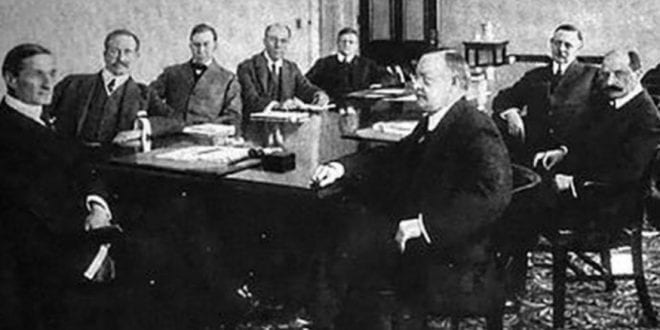
While there appear to be hundreds of competing brands on the market, like Russian nesting dolls, larger parent companies own multiple smaller brands. In reality, all packaged food brands, for example, are owned by a dozen or so larger parent companies. (Feature photo: A rare photo of The Federal Reserve Board of Governors)

These parent companies, in turn, are owned by shareholders, and the largest shareholders are the same in all of them: Vanguard and Blackrock, writes Dr. Joseph Mercola, osteopathic physician, best-selling author and recipient of multiple awards in the field of natural health.

No matter what industry you look at, the top shareholders, and therefore decision makers, are the same: Vanguard, Blackrock, State Street and/or Berkshire Hathaway. In virtually every major company, you find these names among the top 10 institutional investors.

These major investment firms are in turn owned by their own set of shareholders. One of the most amazing things about this scheme is that the institutional investors also own each other.

They’re all shareholders in each other’s companies. At the very top are Vanguard and Blackrock. Blackrock’s largest shareholder is Vanguard, which does not disclose the identity of its shareholders due to its unique structure.

To understand what’s really going on, watch Tim Gielen’s hour-long documentary, “MONOPOLY: Who Owns the World?”

Who Owns the World? Until recently, it appeared economic competition had been driving the rise and fall of small and large companies across the U.S. Supposedly, PepsiCo is Coca Cola’s competitor, Apple and Android vie for your loyalty and drug companies battle for your health care dollars. However, all of that turns out to be an illusion.

Since the mid-1970s, two corporations — Vanguard and Blackrock — have gobbled up most companies in the world, effectively destroying the competitive market on which America’s strength has rested, leaving only false appearances behind.

Indeed, the global economy may be the greatest illusionary trick ever pulled over the eyes of people around the world. To understand what’s really going on, watch Tim Gielen’s hour-long documentary, “MONOPOLY: Who Owns the World?” above.

Corporate Domination

Who Owns the World? As noted by Gielen, who narrates the film, a handful of mega corporations — private investment companies — dominate every aspect of our lives; everything we eat, drink, wear or use in one way or another. These investment firms are so enormous, they control the money flow worldwide. So, how does this scheme work?

While there appear to be hundreds of competing brands on the market, like Russian nesting dolls, larger parent companies own multiple smaller brands. In reality, all packaged food brands, for example, are owned by a dozen or so larger parent companies.

Pepsi Co. owns a long list of food, beverage and snack brands, as does Coca-Cola, Nestle, General Mills, Kellogg’s, Unilever, Mars, Kraft Heinz, Mondelez, Danone and Associated British Foods. Together, these parent companies monopolize the packaged food industry, as virtually every food brand available belongs to one of them.

These companies are publicly traded and are run by boards, where the largest shareholders have power over the decision making. This is where it gets interesting, because when you look up who the largest shareholders are, you find yet another monopoly.

While the topmost shareholders can change from time to time, based on shares bought and sold, two companies are consistently listed among the top institutional holders of these parent companies: The Vanguard Group Inc. and Blackrock Inc.

Pepsi and Coca-Cola — An Example

Who Owns the World? For example, while there are more than 3,000 shareholders in Pepsi Co., Vanguard and Blackrock’s holdings account for nearly one-third of all shares. Of the top 10 shareholders in Pepsi Co., the top three, Vanguard, Blackrock and State Street Corporation, own more shares than the remaining seven.

Now, let’s look at Coca-Cola Co., Pepsi’s top competitor. Who owns Coke? As with Pepsi, the majority of the company shares are held by institutional investors, which number 3,155 (as of the making of the documentary).

As shown in the film, three of the top four institutional shareholders of Coca-Cola are identical with that of Pepsi: Vanguard, Blackrock and State Street Corporation. The No. 1 shareholder of Coca-Cola is Berkshire Hathaway Inc.

These four — Vanguard, Blackrock, State Street and Berkshire Hathaway — are the four largest investment firms on the planet. “So, Pepsi and Coca-Cola are anything but competitors,” Gielen says. And the same goes for the other packaged food companies. All are owned by the same small group of institutional shareholders.

Big Tech Monopoly

Who Owns the World? The monopoly of these investment firms isn’t relegated to the packaged food industry. You find them dominating virtually all other industries as well. Take Big Tech, for example. Among the top 10 largest tech companies we find Apple, Samsung, Alphabet (parent company of Google), Microsoft, Huawei, Dell, IBM and Sony.

Here, we find the same Russian nesting doll setup. For example, Facebook owns Whatsapp and Instagram. Alphabet owns Google and all Google-related businesses, including YouTube and Gmail.

It’s also the biggest developer of Android, the main competitor to Apple. Microsoft owns Windows and Xbox. In all, four parent companies produce the software used by virtually all computers, tablets and smartphones in the world. Who, then, owns them? Here’s a sampling:

  • Facebook — More than 80% of Facebook shares are held by institutional investors, and the top institutional holders are the same as those found in the food industry: Vanguard and Blackrock being the top two, as of the end of March 2021. State Street Corporation is the fifth biggest shareholder
  • Apple — The top four institutional investors are Vanguard, Blackrock, Berkshire Hathaway and State Street Corporation
  • Microsoft — The top three institutional shareholders are Vanguard, Blackrock and State Street Corporation

You can continue going through the list of tech brands — companies that build computers, smart phones, electronics and household appliances — and you’ll repeatedly find Vanguard, Blackrock, Berkshire Hathaway and State Street Corporation among the top shareholders.

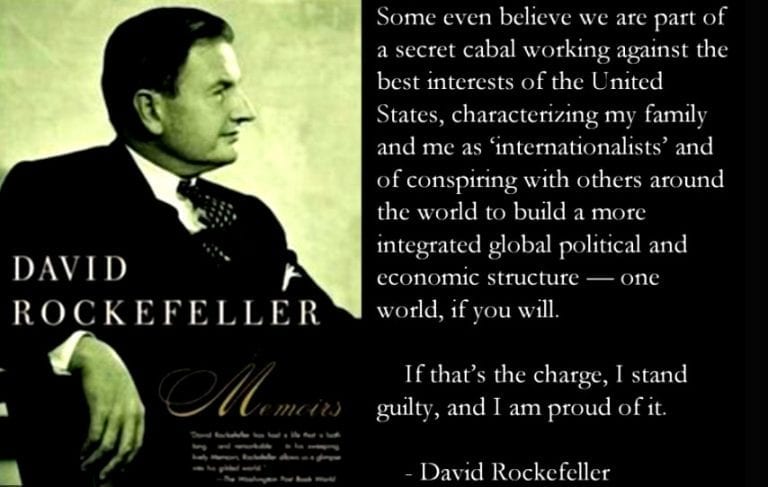
Who Owns the World? A famous David Rockefeller quote, the dream of a global political and economic structure – one world.

Same Small Group Owns Everything Else Too

Who Owns the World? The same ownership trend exists in all other industries. Gielen offers yet another example to prove this statement is not an exaggeration:

“Let’s say we want to plan a vacation. On our computer or smart phone, we look for a cheap flight to the sun through websites like Skyscanner and Expedia, both of which are owned by the same group of institutional investors [Vanguard, Blackrock and State Street Corporation].

We fly with one of the many airlines [American Airlines, Air France, KLM, United Airlines, Delta and Transavia] of which the majority of the shares are often owned by the same investors …

The airline we fly [on] is in most cases a Boeing or an Airbus. Again, we see the same [institutional shareholders]. We look for a hotel or an apartment through Bookings.com or AirBnB.com. Once we arrive at our destination, we go out to dinner and we write a review on Trip Advisor. The same investors are at the basis of every aspect of our journey.

And their power goes even much further, because even the kerosene that fuels the plane comes from one of their many oil companies and refineries. Just like the steel that the plane is made of comes from one of their many mining companies.

This small club of investment companies, banks and mutual funds, are also the largest shareholders in the primary industries, where our raw materials come from.”

The same goes for the agricultural industry that the global food industry depends on, and any other major industry. These institutional investors own Bayer, the world’s largest seed producer; they own the largest textile manufacturers and many of the largest clothing companies.

They own the oil refineries, the largest solar panel producers and the automobile, aircraft and arms industries. They own all the major tobacco companies, and all the major drug companies and scientific institutes too. They also own the big department stores and the online marketplaces like eBay, Amazon and AliExpress.

They even own the payment methods we use, from credit card companies to digital payment platforms, as well as insurance companies, banks, construction companies, telephone companies, restaurant chains, personal care brands and cosmetic brands.

No matter what industry you look at, the top shareholders, and therefore decision makers, are the same: Vanguard, Blackrock, State Street and/or Berkshire Hathaway. In virtually every major company, you find these names among the top 10 institutional investors.

Who Owns the Investment Firms of the World?

Who Owns the World? Diving deeper, we find that these major investment firms are in turn owned by their own set of shareholders. One of the most amazing things about this scheme is that the institutional investors — and there are many more than the primary four we’ve focused on here — also own each other. They’re all shareholders in each other’s companies.At the top of the pyramid — the largest Russian doll of all — we find Vanguard and Blackrock.

“Together, they form an immense network that we can compare to a pyramid,” Gielen says. Smaller institutional investors, such as Citibank, ING and T. Rowe Price, are owned by larger investment firms such as Northern Trust, Capital Group, 3G Capital and KKR.

Those investors in turn are owned by even larger investment firms, like Goldman Sachs and Wellington Market, which are owned by larger firms yet, such as Berkshire Hathaway and State Street. At the top of the pyramid — the largest Russian doll of all — we find Vanguard and Blackrock.

“The power of these two companies is something we can barely imagine,” Gielen says. “Not only are they the largest institutional investors of every major company on earth, they also own the other institutional investors of those companies, giving them a complete monopoly.”

Gielen cites data from Bloomberg, showing that by 2028, Vanguard and BlackRock are expected to collectively manage $20 trillion-worth of investments. In the process, they will own almost everything on planet Earth.

BlackRock — The Fourth Branch of Government

Who Owns the World? Bloomberg has also referred to BlackRock as the “fourth branch of government,” due to its close relationship with the central banks. BlackRock actually lends money to the central bank, the federal reserve, and is their principal adviser.

Dozens of BlackRock employees have held senior positions in the White House under the Bush, Obama and Biden administrations. BlackRock also developed the computer system that the central banks use.

While Larry Fink is the figurehead of BlackRock, being its founder, chairman and chief executive officer, he’s not the sole decision maker, as BlackRock too is owned by shareholders. Here we find yet another curiosity, as the largest shareholder of BlackRock is Vanguard.

Who Owns the World? “This is where it gets dark,” Gielen says. Vanguard has a unique structure that blocks us from seeing who the actual shareholders are. “The elite who own Vanguard don’t want anyone to know they are the owners of the most powerful company on earth.” Still, if you dig deep enough, you can find clues as to who these owners are.

The owners of the wealthiest, most powerful company on Earth can be expected to be among the wealthiest individuals on earth. In 2016, Oxfam reported that the combined wealth of the richest 1% in the world was equal to the wealth of the remaining 99%. In 2018, it was reported that the world’s richest people get 82% of all the money earned around the world in 2017.

In reality, we can assume that the owners of Vanguard are among the 0.001% richest people on the planet. According to Forbes, there were 2,075 billionaires in the world as of March 2020. Gielen cites Oxfam data showing that two-thirds of billionaires obtained their fortunes via inheritance, monopoly and/or cronyism.

“This means that Vanguard is in the hands of the richest families on earth,” Gielen says. Among them we find the Rothschilds, the DuPont family, the Rockefellers, the Bush family and the Morgan family, just to name a few.

Many belong to royal bloodlines and are the founders of our central banking system, the United Nations and just about every industry on the planet.

Gielen goes even further in his documentary, so I highly recommend watching it in its entirety. I’ve only summarized a small piece of the whole film here.

A Financial Coup D’etat

Speaking of the central bankers, I recently interviewed finance guru Catherine Austin Fitts, and she believes it’s the central bankers that are at the heart of the global takeover we’re currently seeing. She also believes they are the ones pressuring private companies to implement the clearly illegal COVID jab mandates. Their control is so great, few companies have the ability to take a stand against them.

“I think [the central bankers] are really depending on the smart grid and creepy technology to help them go to the last steps of financial control, which is what I think they’re pushing for,” she said.

“What we’ve seen is a tremendous effort to bankrupt the population and the governments so that it’s much easier for the central bankers to take control. That’s what I’ve been writing about since 1998, that this is a financial coup d’etat.

Now the financial coup d’etat is being consolidated, where the central bankers just serve jurisdiction over the treasury and the tax money. And if they can get the [vaccine] passports in with the CBDC [central bank digital currency], then it will be able to take taxes out of our accounts and take our assets. So, this is a real coup d’etat.”

Wall Street’s Latest Scheme Is Monetizing Nature Itself

Just in time for the UN’s policy push for “30 x 30” – 30% of the earth to be “conserved” by 2030 – a new Wall Street asset class puts up for sale the processes underpinning all life.

By Ellen Brown

Source: ScheerPost.com

A month before the 2021 United Nations Climate Change Conference (known as COP26) kicked off in Scotland, a new asset class was launched by the New York Stock Exchange that will “open up a new feeding ground for predatory Wall Street banks and financial institutions that will allow them to dominate not just the human economy, but the entire natural world.” So writes Whitney Webb in an article titled “Wall Street’s Takeover of Nature Advances with Launch of New Asset Class”:

Called a natural asset company, or NAC, the vehicle will allow for the formation of specialized corporations “that hold the rights to the ecosystem services produced on a given chunk of land, services like carbon sequestration or clean water.” These NACs will then maintain, manage and grow the natural assets they commodify, with the end goal of maximizing the aspects of that natural asset that are deemed by the company to be profitable.

The vehicle is allegedly designed to preserve and restore Nature’s assets; but when Wall Street gets involved, profit and exploitation are not far behind. Webb writes:

[E]ven the creators of NACs admit that the ultimate goal is to extract near-infinite profits from the natural processes they seek to quantify and then monetize….

Framed with the lofty talk of “sustainability” and “conservation”, media reports on the move in outlets like Fortune couldn’t avoid noting that NACs open the doors to “a new form of sustainable investment” which “has enthralled the likes of BlackRock CEO Larry Fink over the past several years even though there remain big, unanswered questions about it.” 

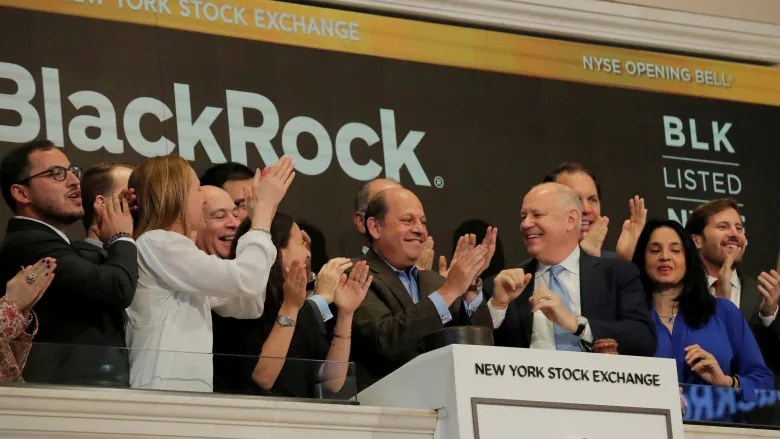
BlackRock is the world’s largest asset manager, with nearly $9.5 trillion under management. That is more than the gross domestic product of every country in the world except the U.S. and China. BlackRock also runs a massive technology platform that oversees at least $21.6 trillion in assets. It and two other megalithic asset managers, State Street and Vanguard (BlackRock’s largest shareholder), already effectively own much of the world. Adding “natural asset companies” to their portfolios could make them owners of the foundations of all life. 

A $4 Quadrillion Asset — The Earth Itself

Partnering with the New York Stock Exchange team launching the NAC is the Intrinsic Exchange Group (IEG), major investors in which are the Rockefeller Foundation and the Inter-American Development Bank, notorious for imposing neo-colonialist agendas through debt entrapment. According to IEG’s website:

We are pioneering a new asset class based on natural assets and the mechanism to convert them to financial capital. These assets are essential, making life on Earth possible and enjoyable. They include biological systems that provide clean air, water, foods, medicines, a stable climate, human health and societal potential.

The potential of this asset class is immense. Nature’s economy is larger than our current industrial economy ….

The immense potential of “Nature’s Economy” is estimated by IEG at $4,000 trillion ($4 quadrillion). 

Webb cites researcher and journalist Cory Morningstar, who maintains that one of the aims of creating “Nature’s Economy” and packaging it via NACs is to drastically advance massive land grab efforts made by Wall Street and the oligarch class in recent years, including those made by Wall Street firms and billionaires like Bill Gates during the COVID crisis. The land grabs facilitated through the development of NACs, however, will largely target indigenous communities in the developing world. Morningstar observes:

The public launch of NACs strategically preceded the fifteenth meeting of the Conference of the Parties to the Convention on Biological Diversity, the biggest biodiversity conference in a decade. Under the pretext of turning 30% of the globe into “protected areas”, the largest global land grab in history is underway. Built on a foundation of white supremacy, this proposal will displace hundreds of millions, furthering the ongoing genocide of Indigenous peoples.

The UN’s “30 x 30”

The land grab of which Morningstar speaks is embodied in a draft agreement called the “Post-2020 Global Biodiversity Framework,” currently being negotiated among the 186 governments that are signatories to the Convention for Biological Diversity. Part I of its 15th meeting (COP15) closed on October 15, just ahead of COP26 (the 26th UN Climate Change Conference of the Parties) hosted in Glasgow from October 31 through November 12. COP26 focuses on climate change, while COP 15 focuses on preserving diversity. Part II of COP15 will be held in 2022. The draft text for the COP 15 nature pact includes a core pledge to protect at least 30% of the planet’s land and oceans by 2030.

In September 2020, 128 environmental and human rights NGOs and experts warned that the 30 x 30 plan could result in severe human rights violations and irreversible social harm for some of the world’s poorest people. Based on figures from a paper published in the academic journal Nature, they argued that the new target could displace or dispossess as many as 300 million people. Stephen Corry of Survival International contended: 

The call to make 30% of the globe into “Protected Areas” is really a colossal land grab as big as Europe’s colonial era, and it’ll bring as much suffering and death. Let’s not be fooled by the hype from the conservation NGOs and their UN and government funders. This has nothing to do with climate change, protecting biodiversity or avoiding pandemics – in fact it’s more likely to make all of them worse. It’s really all about money, land and resource control, and an all out assault on human diversity. This planned dispossession of hundreds of millions of people risks eradicating human diversity and self-sufficiency – the real keys to our being able to slow climate change and protect biodiversity.

30 x 30 in the United States

The 30 x 30 target was incorporated in President Biden’s Executive Order on Tackling the Climate Crisis at Home and Abroad dated January 27, 2021, which includes at Sec. 219 “the goal of conserving at least 30 percent of our lands and waters by 2030.” 

How that is to be done is not clearly specified, but proponents insist it is not a “land grab.” Critics, however, contend there is no other way to pull it off. Only about 12% of land and water in the U.S. is now considered to be “in conservation,” including wilderness lands, national parks, national wildlife refuges, state parks, national monuments, and private lands with permanent conservation easements (contracts to surrender a portion of property rights to a land trust or the federal government). According to environmental expert Dr. Bonner Cohen, raising that figure to 30%, adding 600 million acres to the total, “means putting this land and water (mostly land) off limits to any productive use in perpetuity. To accomplish this goal, the federal government will have to buy up – through eminent domain or other pressures on landowners making them ‘willing sellers’ of their property – millions of acres of private land.”

In July 2021, 15 governors wrote to the Administration opposing the plan, led by Gov. Pete Ricketts of Nebraska. Ricketts said in a press release

This requires restricting a land area the size of the State of Nebraska every year, each year, for the next nine years, or in other words a landmass twice the size of Texas by 2030.

This goal is especially radical given that the President has no constitutional authority to take action to conserve 30% of the land and water. 

The Real Threat to Mother Nature

The federal government may have no constitutional authority to take the land, but a megalithic private firm such as BlackRock could do it simply by making farmers and local residents an offer they can’t refuse. This ploy has already been demonstrated in the housing market. 

According to a survey reported in The Guardian on October 12, 2021, nearly 40% of U.S. households are facing serious financial problems, including struggling to afford medical care and food; and 30% of lower income households (those earning under $50,000 per year) said they had lost all their savings during the coronavirus pandemic. In the first quarter of 2021, 15% of U.S. home sales went to large corporate investors including BlackRock, which beat out families in search of homes just by offering substantially more than the asking price. Sometimes whole neighborhoods were bought up at once for conversion into rental properties. 

BlackRock’s chairman Larry Fink is on the board of the World Economic Forum, which until recently featured a controversial promotional video declaring “You will own nothing, and you’ll be happy.”

We all want a clean environment, and we want to preserve species biodiversity. But that includes human biodiversity – acknowledging the rights of rural landowners and Indigenous peoples, the land’s natural stewards. The greatest threat to the land is not the people living on it but those well-heeled investors who swoop in to buy up the rights to it, financializing the earth for profit. 

Not just private property but those public lands and infrastructure once known as “the commons” are now under threat. We face an existential moment in our economic history, in which accumulated private wealth is acquiring carte blanche control of the essentials of life. Whether that juggernaut can be stopped remains to be seen, but the first step in any defensive action is to be aware of the threat at our doorsteps.

What’s REALLY behind the war on home ownership?

Becoming a “Nation of Renters” is clearly a big part of the New Normal.

By Kit Knightly

Source: Off-Guardian

The incipient “Great Reset” is a multi-faceted beast. We talk a lot about vaccine passports and lockdowns and the Covid-realated aspects – and we should – but there’s more to it than that.

Remember, they want you to “own nothing and be happy”. And right at the top of the list of things you definitely shouldn’t own, is your own home.

The headlines about this have been steady for the last few years, but it has picked up pace in the wake of the “pandemic” (as has so much else). An agenda hidden on back pages, behind by Covid’s meaningless big red numbers, but perhaps no less sinister.

You can find articles all over the net talking up renting over owning.

Last month, for example, Bloomberg ran an article headlined:

America Should Become a Nation of Renters”

Which praises what they call “the liquefaction of the housing market” and gleefully expounds on the idea that “The very features that made home buying an affordable and stable investment are coming to an end.”

The Atlantic published “Why Its Better To Rent Than Own” in March.

Financial pages from Business Insider to Forbes to Yahoo and Bloomberg again are filled with lists titled “9 Ways Renting is Better Than Buying”or similar.

Other publications go more personal with it, with anecdotal columns about ignoring financial advice and refusing to buy your home. Vox, never one to sell their agenda with any kind of subtlety, have a piece titled:

Homeownership can bring out the worst in you

Which literally argues that buying a house can make you a bad person:

It’s the biggest thing you might ever buy. And it could be turning you into a bad person.

So what exactly is the narrative here? What’s the story behind the story?

The short answer is fairly simple: It’s about greed, and it’s about control.

It almost always is, in the end.

The longer answer is rather more complicated. Major investment firms such as Vanguard and Blackrock, along with rental companies such as American Homes 4 Rent, are buying up single-family homes in record numbers – sometimes entire neighbourhoods at a time.

They pay well over market value, pricing families who want to own those homes out of the market, which forces the housing market up whilst the Lockdown-created recession is lowering wages and creating millions of newly unemployed.

Of course, this is motivating people to sell the houses they already own.

People all across America have been saddled with houses worth less than they bought them for since the 2008 economic crash, and are eager to take the cash from private investment firms paying 10-20% over market value. Combine an economic recession with a created housing boom and you have a huge population of motivated sellers.

Of course, many of these sellers don’t realise, until it’s too late, that even if they attempt to downsize or move to a cheaper area, they may be priced out of the market completely, and forced to rent.

As such, in the last year, the private investment share of single-family home purchases is estimated to have increased ten-fold, going from 2% in 2018 to over 20% this year.

As more and more people are forced to rent, of course, rental properties will be in higher and higher demand. This in turn will drive the cost of renting up.

Market Watch has already reported that, in the last year, rent has increased over 3x faster than the government predicted.

This problem is likely to get worse in the near future.

Last night [7/30/21], Congress “accidentally failed” to extend the Covid-related eviction ban.

Which means, this weekend, while Senators adjourn to the summer homes they probably don’t rent, the ban will officially end and a lot of people are likely to have their houses foreclosed or their landlords kick them out.

The newly empty buildings will be a feeding frenzy for the massive corporate landlords. Who will descend on the banks like starving hyenas to snap up the foreclosed properties for pennies on the dollar. Just like they did in 2008.

None of this is any secret, it’s been covered in the mainstream. Tucker Carlson even did a segment on it in early June.

The Wall Street Journal headlined, back in April, “If You Sell a House These Days, the Buyer Might Be a Pension Fund”, and reported:

Yield-chasing investors are snapping up single-family homes, competing with ordinary Americans and driving up prices

However, since then, something has clearly changed. The propaganda machine has kicked into gear to defend Wall Street from any backlash.

No better example of this shift can be found than The Atlantic, which ran this story in 2019:

WHEN WALL STREET IS YOUR LANDLORD
With help from the federal government, institutional investors became major players in the rental market. They promised to return profits to their investors and convenience to their tenants. Investors are happy. Tenants are not.

…and this story last month:

BLACKROCK IS NOT RUINING THE US HOUSING MARKET
The real villain isn’t a faceless Wall Street Goliath; it’s your neighbors and local governments stopping the construction of new units.

Going back to the Vox well we have:

Wall Street isn’t to blame for the chaotic housing market

Which ran just a few days after the Atlantic article, and is practically identical.

Both these (oddly similar) articles argue that Wall Street and private equity firms can’t be blamed for buying up houses, and that the real problem is the lack of supply to meet demand.

You see, all the “selfish” people who already own homes (they did say it makes you a bad person) are blocking the construction of new houses, and thus driving up the cost of property through scarcity.

This has been a logically flawed argument around the housing market for decades.

That there aren’t enough houses for people to buy is patently absurd when the US census data says that there are over 15 million houses currently standing empty. That’s enough to house all of America’s roughly 500,000 homeless people 30x over.

There’s plenty of houses, there’s just not enough money to buy them.

The reason for that is the same reason the California has massive “homeless camps” in its major cities, and that so many people are having to become renters instead of owners: wage stagnation.

For decades now, wage increases have lagged behind increases in the cost of living. In the 1960s one full-time job could afford a decent standard of living for a family of four or more. These days both parents work, sometimes multiple jobs each.

It was huge amounts of financial de-regulation which created this situation. So, whether you believe Vox’s BlackRock apologia or not, one way or another Wall Street very definitely is to blame.

But this isn’t just about money. It never is. Just as the war on cash isn’t just about efficiency, and the environmental push isn’t just about climate change. Ditto veganism. It’s about control. Just like vaccines, lockdowns and masks.

It always comes down to control.

It’s an oft-used cliche, but no less true for that, that homeowning “gives people a stake in society”. A family-owned house is a source of security for the future and something to leave your children. It is also sovereignty and privacy. Your own space that no one else can control or take away.

In short: A homeowner is independent. A renter is not. A renter can be controlled. A homeowner can not.

It’s the same reasoning behind the way working people were encouraged to take out loans and become debt slaves. If you limit people’s options, if you make them rely on you for a roof over their heads, you have control over them.

There’s a great article about this situation called “Your New Feudal Overlords”.

Under Feudalism, land wasn’t owned by the working class, but provided to them by landed barons, hence the term “Land Lord”. If you disrespected your Lord, or broke his rules, or he perceived another peasant/farm animal/crop would be a better use of the land, he could take it back.

Essentially, the behaviour of serfs was kept in check by their reliance on the nobility for a place to live. That’s very much the dynamic they’re going for here.

Rental agreements can be full of any terms and conditions the landlord wants, and the more desperate people get the more of their consumer rights they will sign over.

Maybe you’ll agree to smart meters which monitor your internet or power-usage habits, and then sell the data to behavioural modellers and viral marketers.

Maybe you’ll have to agree to certain power limitations or water shortages in order to “fight climate change”.

Maybe it will get worse than that.

Maybe they’ll go full Black Mirror style corporate dystopia. Maybe, through affiliation programs, the mega-equity firm which owns your rental house has ties to McDonald’s, and as such will require you to not eat at any competing fast-food franchises, or demand you observe at least ninety seconds of Disney advertisements per day.

Maybe it will be as simple as including vaccine status in the tenancy agreement, making it impossible for the unvaxxed to find a home.

Maybe they just want to make poor people miserable.

After all, the super-wealthy have got all the money they could ever need, and all the luxury they could ever use. Their living standards are as high as physically possible. So maybe the only way they can keep “winning”, is to start driving the living standards of us proles down.

No air travel. No vacations. No going out at all. Live in a tiny house, or a pod. Eat bugs. Get rid of your car. Rent your clothes. Or your furniture. Pay taxes on sugar. And alcohol. And red meat.

They’ve been very clear about this. They’ve told you about the Great Reset and the Internet of Things. That’s the plan.

You won’t own a house. And you’ll be happy…or else the mega-corporation you’re forced to rent from will kick you out.

There is More to BlackRock Than You Might Imagine

By F. William Engdahl

Source: New Eastern Outlook

A virtually unregulated investment firm today exercises more political and financial influence than the Federal Reserve and most governments on this planet. The firm, BlackRock Inc., the world’s largest asset manager, invests a staggering $9 trillion in client funds worldwide, a sum more than double the annual GDP of the Federal Republic of Germany. This colossus sits atop the pyramid of world corporate ownership, including in China most recently. Since 1988 the company has put itself in a position to de facto control the Federal Reserve, most Wall Street mega-banks, including Goldman Sachs, the Davos World Economic Forum Great Reset, the Biden Administration and, if left unchecked, the economic future of our world. BlackRock is the epitome of what Mussolini called Corporatism, where an unelected corporate elite dictates top down to the population.

How the world’s largest “shadow bank” exercises this enormous power over the world ought to concern us. BlackRock since Larry Fink founded it in 1988 has managed to assemble unique financial software and assets that no other entity has. BlackRock’s Aladdin risk-management system, a software tool that can track and analyze trading, monitors more than $18 trillion in assets for 200 financial firms including the Federal Reserve and European central banks. He who “monitors” also knows, we can imagine. BlackRock has been called a financial “Swiss Army Knife — institutional investor, money manager, private equity firm, and global government partner rolled into one.” Yet mainstream media treats the company as just another Wall Street financial firm.

There is a seamless interface that ties the UN Agenda 2030 with the Davos World Economic Forum Great Reset and the nascent economic policies of the Biden Administration. That interface is BlackRock.

Team Biden and BlackRock

By now it should be clear to anyone who bothers to look, that the person who claims to be US President, 78-year old Joe Biden, is not making any decisions. He even has difficulty reading a teleprompter or answering prepared questions from friendly media without confusing Syria and Libya or even whether he is President. He is being micromanaged by a group of handlers to maintain a scripted “image” of a President while policy is made behind the scenes by others. It eerily reminds of the 1979 Peter Sellers film character, Chauncey Gardiner, in Being There.

What is less public are the key policy persons running economic policy for Biden Inc. They are simply said, BlackRock. Much as Goldman Sachs ran economic policy under Obama and also Trump, today BlackRock is filling that key role. The deal apparently was sealed in January, 2019 when Joe Biden, then-candidate and long-shot chance to defeat Trump, went to meet with Larry Fink in New York, who reportedly told “working class Joe,” that, “I’m here to help.”

Now as President in one of his first appointees, Biden named Brian Deese to be the Director of the National Economic Council, the President’s main adviser for economic policy. One of the early Presidential Executive Orders dealt with economics and climate policy. That’s not surprising, as Deese came from Fink’s BlackRock where he was Global Head of Sustainable Investing. Before joining BlackRock, Deese held senior economic posts under Obama, including replacing John Podesta as Senior Adviser to the President where he worked alongside Valerie Jarrett. Under Obama, Deese played a key role in negotiating the Global Warming Paris Accords.

In the key policy post as Deputy Treasury Secretary under Secretary Janet Yellen, we find Nigerian-born Adewale “Wally” Adeyemo. Adeyemo also comes from BlackRock where from 2017 to 2019 he was a senior adviser and Chief of Staff to BlackRock CEO Larry Fink, after leaving the Obama Administration. His personal ties to Obama are strong, as Obama named him the first President of the Obama Foundation in 2019.

And a third senior BlackRock person running economic policy in the Administration now is also unusual in several respects. Michael Pyle is the Senior Economic Adviser to Vice President Kamala Harris. He came to Washington from the position as the Global Chief Investment Strategist at BlackRock where he oversaw the strategy for investing some $9 trillion of funds. Before joining BlackRock at the highest level, he had also been in the Obama Administration as a senior adviser to the Undersecretary of the Treasury for International Affairs, and in 2015 became an adviser to the Hillary Clinton presidential bid.

The fact that three of the most influential economic appointees of the Biden Administration come from BlackRock, and before that all from the Obama Administration, is noteworthy. There is a definite pattern and suggests that the role of BlackRock in Washington is far larger than we are being told.

What is BlackRock?

Never before has a financial company with so much influence over world markets been so hidden from public scrutiny. That’s no accident. As it is technically not a bank making bank loans or taking deposits, it evades the regulation oversight from the Federal Reserve even though it does what most mega banks like HSBC or JP MorganChase do—buy, sell securities for profit. When there was a Congressional push to include asset managers such as BlackRock and Vanguard Funds under the post-2008 Dodd-Frank law as “systemically important financial institutions” or SIFIs, a huge lobbying push from BlackRock ended the threat. BlackRock is essentially a law onto itself. And indeed it is “systemically important” as no other, with possible exception of Vanguard, which is said to also be a major shareholder in BlackRock.

BlackRock founder and CEO Larry Fink is clearly interested in buying influence globally. He made former German CDU MP Friederich Merz head of BlackRock Germany when it looked as if he might succeed Chancellor Merkel, and former British Chancellor of Exchequer George Osborne as “political consultant.” Fink named former Hillary Clinton Chief of Staff Cheryl Mills to the BlackRock board when it seemed certain Hillary would soon be in the White House.

He has named former central bankers to his board and gone on to secure lucrative contracts with their former institutions. Stanley Fisher, former head of the Bank of Israel and also later Vice Chairman of the Federal Reserve is now Senior Adviser at BlackRock. Philipp Hildebrand, former Swiss National Bank president, is vice chairman at BlackRock, where he oversees the BlackRock Investment Institute. Jean Boivin, the former deputy governor of the Bank of Canada, is the global head of research at BlackRock’s investment institute.

BlackRock and the Fed

It was this ex-central bank team at BlackRock that developed an “emergency” bailout plan for Fed chairman Powell in March 2019 as financial markets appeared on the brink of another 2008 “Lehman crisis” meltdown. As “thank you,” the Fed chairman Jerome Powell named BlackRock in a no-bid role to manage all of the Fed’s corporate bond purchase programs, including bonds where BlackRock itself invests. Conflict of interest? A group of some 30 NGOs wrote to Fed Chairman Powell, “By giving BlackRock full control of this debt buyout program, the Fed… makes BlackRock even more systemically important to the financial system. Yet BlackRock is not subject to the regulatory scrutiny of even smaller systemically important financial institutions.”

In a detailed report in 2019, a Washington non-profit research group, Campaign for Accountability, noted that, “BlackRock, the world’s largest asset manager, implemented a strategy of lobbying, campaign contributions, and revolving door hires to fight off government regulation and establish itself as one of the most powerful financial companies in the world.”

The New York Fed hired BlackRock in March 2019 to manage its commercial mortgage-backed securities program and its $750 billion primary and secondary purchases of corporate bonds and ETFs in no-bid contracts. US financial journalists Pam and Russ Martens in critiquing that murky 2019 Fed bailout of Wall Street remarked, “for the first time in history, the Fed has hired BlackRock to “go direct” and buy up $750 billion in both primary and secondary corporate bonds and bond ETFs (Exchange Traded Funds), a product of which BlackRock is one of the largest purveyors in the world.” They went on, “Adding further outrage, the BlackRock-run program will get $75 billion of the $454 billion in taxpayers’ money to eat the losses on its corporate bond purchases, which will include its own ETFs, which the Fed is allowing it to buy…”

Fed head Jerome Powell and Larry Fink know each other well, apparently. Even after Powell gave BlackRock the hugely lucrative no-bid “go direct” deal, Powell continued to have the same BlackRock manage an estimated $25 million of Powell’s private securities investments. Public records show that in this time Powell held direct confidential phone calls with BlackRock CEO Fink. According to required financial disclosure, BlackRock managed to double the value of Powell’s investments from the year before! No conflict of interest, or?

A Very BlackRock in Mexico

BlackRock’s murky history in Mexico shows that conflicts of interest and influence-building with leading government agencies is not restricted to just the USA. PRI Presidential candidate Peña Nieto went to Wall Street during his campaign in November 2011. There he met Larry Fink. What followed the Nieto victory in 2012 was a tight relationship between Fink and Nieto that was riddled with conflict of interest, cronyism and corruption.

Most likely to be certain BlackRock was on the winning side in the corrupt new Nieto regime, Fink named 52-year-old Marcos Antonio Slim Domit, billionaire son of Mexico’s wealthiest and arguably most corrupt man, Carlos Slim, to BlackRock’s Board. Marcos Antonio, along with his brother Carlos Slim Domit, run the father’s huge business empire today. Carlos Slim Domit, the eldest son, was Co-Chair of the World Economic Forum Latin America in 2015, and currently serves as chairman of the board of America Movil where BlackRock is a major investor. Small cozy world.

The father, Carlos Slim, at the time named by Forbes as World’s Richest Person, built an empire based around his sweetheart acquisition of Telemex (later America Movil). Then President, Carlos Salinas de Gortari, in effect gifted the telecom empire to Slim in 1989. Salinas later fled Mexico on charges of stealing more than $10 billion from state coffers.

As with much in Mexico since the 1980s drug money apparently played a huge role with the elder Carlos Slim, father of BlackRock director Marcos Slim. In 2015 WikiLeaks released company internal emails from the private intelligence corporation, Stratfor. Stratfor writes in an April 2011 email, the time BlackRock is establishing its Mexico plans, that a US DEA Special Agent, William F. Dionne confirmed Carlos Slim’s ties to the Mexican drug cartels. Stratfor asks Dionne, “Billy, is the MX (Mexican) billionaire Carlos Slim linked to the narcos?” Dionne replies, “Regarding your question, the MX telecommunication billionaire is.” In a country where 44% of the population lives in poverty you don’t become the world’s richest man in just two decades selling Girl Scout cookies.

Fink and Mexican PPP

With Marcos Slim on his BlackRock board and new president Enrique Peña Nieto, Larry Fink’s Mexican partner in Nieto Peña’s $590 billion PublicPrivatePartnership (PPP) alliance, BlackRock, was ready to reap the harvest. To fine-tune his new Mexican operations, Fink named former Mexican Undersecretary of Finance Gerardo Rodriguez Regordosa to direct BlackRock Emerging Market Strategy in 2013. Then in 2016 Peña Nieto appointed Isaac Volin, then head of BlackRock Mexico to be No. 2 at PEMEX where he presided over corruption, scandals and the largest loss in PEMEX history, $38 billion.

Peña Nieto had opened the huge oil state monopoly, PEMEX, to private investors for the first time since nationalization in the 1930s. The first to benefit was Fink’s BlackRock. Within seven months, BlackRock had secured $1 billion in PEMEX energy projects, many as the only bidder. During the tenure of Peña Nieto, one of the most controversial and least popular presidents, BlackRock prospered by the cozy ties. It soon was engaged in highly profitable (and corrupt) infrastructure projects under Peña Nieto including not only oil and gas pipelines and wells but also including toll roads, hospitals, gas pipelines and even prisons.

Notably, BlackRock’s Mexican “friend” Peña Nieto was also “friends” not only with Carlos Slim but with the head of the notorious Sinaloa Cartel, “El Chapo” Guzman. In court testimony in 2019 in New York Alex Cifuentes, a Colombian drug lord who has described himself as El Chapo’s “right-hand man,” testified that just after his election in 2012, Peña Nieto had requested $250 million from the Sinaloa Cartel before settling on $100 million. We can only guess what for.

Larry Fink and WEF Great Reset

In 2019 Larry Fink joined the Board of the Davos World Economic Forum, the Swiss-based organization that for some 40 years has advanced economic globalization. Fink, who is close to the WEF’s technocrat head, Klaus Schwab, of Great Reset notoriety, now stands positioned to use the huge weight of BlackRock to create what is potentially, if it doesn’t collapse before, the world’s largest Ponzi scam, ESG corporate investing. Fink with $9 trillion to leverage is pushing the greatest shift of capital in history into a scam known as ESG Investing. The UN “sustainable economy” agenda is being realized quietly by the very same global banks which have created the financial crises in 2008. This time they are preparing the Klaus Schwab WEF Great Reset by steering hundreds of billions and soon trillions in investment to their hand-picked “woke” companies, and away from the “not woke” such as oil and gas companies or coal. BlackRock since 2018 has been in the forefront to create a new investment infrastructure that picks “winners” or “losers” for investment according to how serious that company is about ESG—Environment, Social values and Governance.

For example a company gets positive ratings for the seriousness of its hiring gender diverse management and employees, or takes measures to eliminate their carbon “footprint” by making their energy sources green or sustainable to use the UN term. How corporations contribute to a global sustainable governance is the most vague of the ESG, and could include anything from corporate donations to Black Lives Matter to supporting UN agencies such as WHO. Oil companies like ExxonMobil or coal companies no matter how clear are doomed as Fink and friends now promote their financial Great Reset or Green New Deal. This is why he cut a deal with the Biden presidency in 2019.

Follow the money. And we can expect that the New York Times will cheer BlackRock on as it destroys the world financial structures. Since 2017 BlackRock has been the paper’s largest shareholder. Carlos Slim was second largest. Even Carl Icahn, a ruthless Wall Street asset stripper, once called BlackRock, “an extremely dangerous company… I used to say, you know, the mafia has a better code of ethics than you guys.” 

THE SAME SHADY PEOPLE OWN BIG PHARMA AND THE MEDIA

By Dr. Mercola

Source: Waking Times

What does The New York Times and a majority of other legacy media have in common with Big Pharma? Answer: They’re largely owned by BlackRock and the Vanguard Group, the two largest asset management firms in the world. Moreover, it turns out these two companies form a secret monopoly that own just about everything else you can think of too. As reported in the featured video:1,2

“The stock of the world’s largest corporations are owned by the same institutional investors. They all own each other. This means that ‘competing’ brands, like Coke and Pepsi aren’t really competitors, at all, since their stock is owned by exactly the same investment companies, investment funds, insurance companies, banks and in some cases, governments.

The smaller investors are owned by larger investors. Those are owned by even bigger investors. The visible top of this pyramid shows only two companies whose names we have often seen …They are Vanguard and BlackRock.

The power of these two companies is beyond your imagination. Not only do they own a large part of the stocks of nearly all big companies but also the stocks of the investors in those companies. This gives them a complete monopoly.

A Bloomberg report states that both these companies in the year 2028, together will have investments in the amount of 20 trillion dollars. That means that they will own almost everything.’”

Who Are the Vanguard?

The word “vanguard” means “the foremost position in an army or fleet advancing into battle,” and/or “the leading position in a trend or movement.” Both are fitting descriptions of this global behemoth, owned by globalists pushing for a Great Reset, the core of which is the transfer of wealth and ownership from the hands of the many into the hands of the very few.

Interestingly, Vanguard is the largest shareholder of BlackRock, as of March 2021.3,4 Vanguard itself, on the other hand, has a “unique” corporate structure that makes its ownership more difficult to discern. It’s owned by its various funds, which in turn are owned by the shareholders. Aside from these shareholders, it has no outside investors and is not publicly traded.5 As reported in the featured video:6,7

“The elite who own Vanguard apparently do not like being in the spotlight but of course they cannot hide from who is willing to dig. Reports from Oxfam and Bloomberg say that 1% of the world, together owns more money than the other 99%. Even worse, Oxfam says that 82% of all earned money in 2017 went to this 1%.

In other words, these two investment companies, Vanguard and BlackRock hold a monopoly in all industries in the world and they, in turn are owned by the richest families in the world, some of whom are royalty and who have been very rich since before the Industrial Revolution.”

While it would take time to sift through all of Vanguard’s funds to identify individual shareholders, and therefore owners of Vanguard, a quick look-see suggests Rothschild Investment Corp.8 and the Edmond De Rothschild Holding are two such stakeholders.9 Keep the name Rothschild in your mind as you read on, as it will feature again later.

The video above also identifies the Italian Orsini family, the American Bush family, the British Royal family, the du Pont family, the Morgans, Vanderbilts and Rockefellers, as Vanguard owners.

BlackRock/Vanguard Own Big Pharma

According to Simply Wall Street, in February 2020, BlackRock and Vanguard were the two largest shareholders of GlaxoSmithKline, at 7% and 3.5% of shares respectively.10 At Pfizer, the ownership is reversed, with Vanguard being the top investor and BlackRock the second-largest stockholder.11

Keep in mind that stock ownership ratios can change at any time, since companies buy and sell on a regular basis, so don’t get hung up on percentages. The bottom line is that BlackRock and Vanguard, individually and combined, own enough shares at any given time that we can say they easily control both Big Pharma and the centralized legacy media — and then some.

Why does this matter? It matters because drug companies are driving COVID-19 responses — all of which, so far, have endangered rather than optimized public health — and mainstream media have been willing accomplices in spreading their propaganda, a false official narrative that has, and still is, leading the public astray and fosters fear based on lies.

To have any chance of righting this situation, we must understand who the central players are, where the harmful dictates are coming from, and why these false narratives are being created in the first place.

As noted in Global Justice Now’s December 2020 report12 “The Horrible History of Big Pharma,” we simply cannot allow drug companies — “which have a long track record of prioritizing corporate profit over people’s health” — to continue to dictate COVID-19 responses.

In it, they review the shameful history of the top seven drug companies in the world that are now developing and manufacturing drugs and gene-based “vaccines” against COVID-19, while mainstream media have helped suppress information about readily available older drugs that have been shown to have a high degree of efficacy against the infection.

BlackRock/Vanguard Own the Media

When it comes to The New York Times, as of May 2021, BlackRock is the second-largest stockholder at 7.43% of total shares, just after The Vanguard Group, which owns the largest portion (8.11%).13,14

In addition to The New York Times, Vanguard and BlackRock are also the top two owners of Time Warner, Comcast, Disney and News Corp, four of the six media companies that control more than 90% of the U.S. media landscape.15,16

Needless to say, if you have control of this many news outlets, you can control entire nations by way of carefully orchestrated and organized centralized propaganda disguised as journalism.

If your head is spinning already, you’re not alone. It’s difficult to describe circular and tightly interwoven relationships in a linear fashion. The world of corporate ownership is labyrinthine, where everyone seems to own everyone, to some degree.

However, the key take-home message is that two companies stand out head and neck above all others, and that’s BlackRock and Vanguard. Together, they form a hidden monopoly on global asset holdings, and through their influence over our centralized media, they have the power to manipulate and control a great deal of the world’s economy and events, and how the world views it all.

Considering BlackRock in 2018 announced that it has “social expectations” from the companies it invests in,17 its potential role as a central hub in the Great Reset and the “build back better” plan cannot be overlooked.

Add to this information showing it “undermines competition through owning shares in competing companies” and “blurs boundaries between private capital and government affairs by working closely with regulators,” and one would be hard-pressed to not see how BlackRock/Vanguard and their globalist owners might be able to facilitate the Great Reset and the so-called “green” revolution, both of which are part of the same wealth-theft scheme.

BlackRock and Vanguard Own the World

That assertion will become even clearer once you realize that this duo’s influence is not limited to Big Pharma and the media. Importantly, BlackRock also works closely with central banks around the world, including the U.S. Federal Reserve, which is a private entity, not a federal one.18,19 It lends money to the central bank, acts as an adviser to it, and develops the central bank’s software.20In all, BlackRock and Vanguard have ownership in some 1,600 American firms, which in 2015 had combined revenues of $9.1 trillion. When you add in the third-largest global owner, State Street, their combined ownership encompasses nearly 90% of all S&P 500 firms.

BlackRock/Vanguard also own shares of long list of other companies, including Microsoft, Apple, Amazon, Facebook and Alphabet Inc.21 As illustrated in the graphic of BlackRock and Vanguard’s ownership network below,22 featured in the 2017 article “These Three Firms Own Corporate America” in The Conversation, it would be near-impossible to list them all.

In all, BlackRock and Vanguard have ownership in some 1,600 American firms, which in 2015 had combined revenues of $9.1 trillion. When you add in the third-largest global owner, State Street, their combined ownership encompasses nearly 90% of all S&P 500 firms.23

A Global Monopoly Few Know Anything About

To tease out the overarching influence of BlackRock and Vanguard in the global marketplace, be sure to watch the 45-minute-long video featured at the top of this article. It provides a wide-view summary of the hidden monopoly network of Vanguard- and BlackRock-owned corporations, and their role in the Great Reset. A second much shorter video (above) offers an additional review of this information.

How can we tie BlackRock/Vanguard — and the globalist families that own them — to the Great Reset? Barring a public confession, we have to look at the relationships between these behemoth globalist-owned corporations and consider the influence they can wield through those relationships. As noted by Lew Rockwell:24

“When Lynn Forester de Rothschild wants the United States to be a one-party country (like China) and doesn’t want voter ID laws passed in the U.S., so that more election fraud can be perpetrated to achieve that end, what does she do?

She holds a conference call with the world’s top 100 CEOs and tells them to publicly decry as ‘Jim Crow’ Georgia’s passing of an anti-corruption law and she orders her dutiful CEOs to boycott the State of Georgia, like we saw with Coca-Cola and Major League Baseball and even Hollywood star, Will Smith.

In this conference call, we see shades of the Great Reset, Agenda 2030, the New World Order. The UN wants to make sure, as does [World Economic Forum founder and executive chairman Klaus] Schwab that in 2030, poverty, hunger, pollution and disease no longer plague the Earth.

To achieve this, the UN wants taxes from Western countries to be split by the mega corporations of the elite to create a brand-new society. For this project, the UN says we need a world government — namely the UN, itself.”

As I’ve reviewed in many previous articles, it seems quite clear that the COVID-19 pandemic was orchestrated to bring about this New World Order — the Great Reset — and the 45-minute video featured at top of article does a good job of explaining how this was done. And at the heart of it all, the “heart” toward which all global wealth streams flow, we find BlackRock and Vanguard.

Meet BlackRock, the New Great Vampire Squid

By Ellen Brown

Source: Web of Debt

BlackRock is a global financial giant with customers in 100 countries and its tentacles in major asset classes all over the world; and it now manages the spigots to trillions of bailout dollars from the Federal Reserve. The fate of a large portion of the country’s corporations has been put in the hands of a megalithic private entity with the private capitalist mandate to make as much money as possible for its owners and investors; and that is what it has proceeded to do.

To most people, if they are familiar with it at all, BlackRock is an asset manager that helps pension funds and retirees manage their savings through “passive” investments that track the stock market. But working behind the scenes, it is much more than that. BlackRock has been called “the most powerful institution in the financial system,” “the most powerful company in the world” and the “secret power.” It is the world’s largest asset manager and “shadow bank,” larger than the world’s largest bank (which is in China), with over $7 trillion in assets under direct management  and another $20 trillion managed through its Aladdin risk-monitoring software. BlackRock has also been called “the fourth branch of government” and “almost a shadow government”, but no part of it actually belongs to the government. Despite its size and global power, BlackRock is not even regulated as a “Systemically Important Financial Institution” under the Dodd-Frank Act, thanks to pressure from its CEO Larry Fink, who has long had “cozy” relationships with government officials.

BlackRock’s strategic importance and political weight were evident when four BlackRock executives, led by former Swiss National Bank head Philipp Hildebrand, presented a proposal at the annual meeting of central bankers in Jackson Hole, Wyoming, in August 2019 for an economic reset that was actually put into effect in March 2020. Acknowledging that central bankers were running out of ammunition for controlling the money supply and the economy, the BlackRock group argued that it was time for the central bank to abandon its long-vaunted independence and join monetary policy (the usual province of the central bank) with fiscal policy (the usual province of the legislature). They proposed that the central bank maintain a “Standing Emergency Fiscal Facility” that would be activated when interest rate manipulation was no longer working to avoid deflation. The Facility would be deployed by an “independent expert” appointed by the central bank.

The COVID-19 crisis presented the perfect opportunity to execute this proposal in the US, with BlackRock itself appointed to administer it. In March 2020, it was awarded a no-bid contract under the Coronavirus Aid, Relief, and Economic Security Act (CARES Act) to deploy a $454 billion slush fund established by the Treasury in partnership with the Federal Reserve. This fund in turn could be leveraged to provide over $4 trillion in Federal Reserve credit. While the public was distracted with protests, riots and lockdowns, BlackRock suddenly emerged from the shadows to become the “fourth branch of government,” managing the controls to the central bank’s print-on-demand fiat money. How did that happen and what are the implications?

Rising from the Shadows

BlackRock was founded in 1988 in partnership with the Blackstone Group, a multinational private equity management firm that would become notorious after the 2008-09 banking crisis for snatching up foreclosed homes at firesale prices and renting them at inflated prices. BlackRock first grew its balance sheet in the 1990s and 2000s by promoting the mortgage-backed securities (MBS) that brought down the economy in 2008. Knowing the MBS business from the inside, it was then put in charge of the Federal Reserve’s “Maiden Lane” facilities. Called “special purpose vehicles,” these were used to buy “toxic” assets (largely unmarketable MBS) from Bear Stearns and American Insurance Group (AIG), something the Fed was not legally allowed to do itself.

BlackRock really made its fortunes, however, in “exchange traded funds” (ETFs). It gained trillions in investable assets after it acquired the iShares series of ETFs in a takeover of Barclays Global Investors in 2009. By 2020, the wildly successful iShares series included over 800 funds and $1.9 trillion in assets under management.

Exchange traded funds are bought and sold like shares but operate as index-tracking funds, passively following specific indices such as the S&P 500, the benchmark index of America’s largest corporations and the index in which most people invest. Today the fast-growing ETF sector controls nearly half of all investments in US stocks, and it is highly concentrated. The sector is dominated by just three giant American asset managers – BlackRock, Vanguard and State Street, the “Big Three” – with BlackRock the clear global leader. By 2017, the Big Three together had become the largest shareholder in almost 90% of S&P 500 firms, including Apple, Microsoft, ExxonMobil, General Electric and Coca-Cola. BlackRock also owns major interests in nearly every mega-bank and in major media.

In March 2020, based on its expertise with the Maiden Lane facilities and its sophisticated Aladdin risk-monitoring software, BlackRock got the job of dispensing Federal Reserve funds through eleven “special purpose vehicles” authorized under the CARES Act. Like the Maiden Lane facilities, these vehicles were designed to allow the Fed, which is legally limited to purchasing safe federally-guaranteed assets, to finance the purchase of riskier assets in the market.

Blackrock Bails Itself Out

The national lockdown left states, cities and local businesses in desperate need of federal government aid. But according to David Dayen in The American Prospect, as of May 30 (the Fed’s last monthly report), the only purchases made under the Fed’s new BlackRock-administered SPVs were ETFs, mainly owned by BlackRock itself. Between May 14 and May 20, about $1.58 billion in ETFs were bought through the Secondary Market Corporate Credit Facility (SMCCF), of which $746 million or about 47% came from BlackRock ETFs. The Fed continued to buy more ETFs after May 20, and investors piled in behind, resulting in huge inflows into BlackRock’s corporate bond ETFs.

In fact, these ETFs needed a bailout; and BlackRock used its very favorable position with the government to get one. The complicated mechanisms and risks underlying ETFs are explained in an April 3 article by business law professor Ryan Clements, who begins his post:

Exchange-Traded Funds (ETFs) are at the heart of the COVID-19 financial crisisOver forty percent of the trading volume during the mid-March selloff was in ETFs ….

The ETFs were trading well below the value of their underlying bonds, which were dropping like a rock. Some ETFs were failing altogether. The problem was something critics had long warned of: while ETFs are very liquid, trading on demand like stocks, the assets that make up their portfolios are not. When the market drops and investors flee, the ETFs can have trouble coming up with the funds to settle up without trading at a deep discount; and that is what was happening in March.

According to a May 3 article in The National, “The sector was ultimately saved by the US Federal Reserve’s pledge on March 23 to buy investment-grade credit and certain ETFs. This provided the liquidity needed to rescue bonds that had been floundering in a market with no buyers.”

Prof. Clements states that if the Fed had not stepped in, “a ‘doom loop’ could have materialized where continued selling pressure in the ETF market exacerbated a fire-sale in the underlying [bonds], and again vice-versa, in a procyclical pile-on with devastating consequences.” He observes:

There’s an unsettling form of market alchemy that takes place when illiquid, over-the-counter bonds are transformed into instantly liquid ETFs. ETF “liquidity transformation” is now being supported by the government, just like liquidity transformation in mortgage backed securities and shadow banking was supported in 2008.

Working for Whom?

BlackRock got a bailout with no debate in Congress, no “penalty” interest rate of the sort imposed on states and cities borrowing in the Fed’s Municipal Liquidity Facility, no complicated paperwork or waiting in line for scarce Small Business Administration loans, no strings attached. It just quietly bailed itself out.

It might be argued that this bailout was good and necessary, since the market was saved from a disastrous “doom loop,” and so were the pension funds and the savings of millions of investors. Although BlackRock has a controlling interest in all the major corporations in the S&P 500, it professes not to “own” the funds. It just acts as a kind of “custodian” for its investors — or so it claims. But BlackRock and the other Big 3 ETFs vote the corporations’ shares; so from the point of view of management, they are the owners. And as observed in a 2017 article from the University of Amsterdam titled “These Three Firms Own Corporate America,” they vote 90% of the time in favor of management. That means they tend to vote against shareholder initiatives, against labor, and against the public interest. BlackRock is not actually working for us, although we the American people have now become its largest client base.

In a 2018 review titled “Blackrock – The Company That Owns the World”, a multinational research group called Investigate Europe concluded that BlackRock “undermines competition through owning shares in competing companies, blurs boundaries between private capital and government affairs by working closely with regulators, and advocates for privatization of pension schemes in order to channel savings capital into its own funds.”

Daniela Gabor, Professor of Macroeconomics at the University of Western England in Bristol, concluded after following a number of regulatory debates in Brussels that it was no longer the banks that wielded the financial power; it was the asset managers. She said:

We are often told that a manager is there to invest our money for our old age. But it’s much more than that. In my opinion, BlackRock reflects the renunciation of the welfare state. Its rise in power goes hand-in-hand with ongoing structural changes; in finance, but also in the nature of the social contract that unites the citizen and the state.

That these structural changes are planned and deliberate is evident in BlackRock’s August 2019 white paper laying out an economic reset that has now been implemented with BlackRock at the helm.

Public policy is made today in ways that favor the stock market, which is considered the barometer of the economy, although it has little to do with the strength of the real, productive economy. Giant pension and other investment funds largely control the stock market, and the asset managers control the funds. That effectively puts BlackRock, the largest and most influential asset manager, in the driver’s seat in controlling the economy.

As Peter Ewart notes in a May 14 article on BlackRock titled “Foxes in the Henhouse,” today the economic system “is not classical capitalism but rather state monopoly capitalism, where giant enterprises are regularly backstopped with public funds and the boundaries between the state and the financial oligarchy are virtually non-existent.”

If the corporate oligarchs are too big and strategically important to be broken up under the antitrust laws, rather than bailing them out they should be nationalized and put directly into the service of the public. At the very least, BlackRock should be regulated as a too-big-to-fail Systemically Important Financial Institution. Better yet would be to regulate it as a public utility. No private, unelected entity should have the power over the economy that BlackRock has, without a legally enforceable fiduciary duty to wield it in the public interest.