What You May Not Know About Today’s Economic War

By Phil Butler

Source: New Eastern Outlook

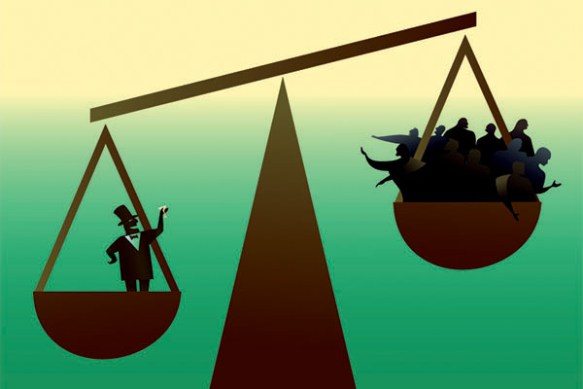
Many people believe the world is spiraling in a downward freefall toward Armageddon. At the same time billions on Earth feel the sting of crippling poverty, sanctions, and austerity imposed by the elites – the numbers of billionaires have risen geometrically. And so have those billionaire’s profits. It’s time we took a closer look at where we stand as of 2018, if we are to be left anything at all to cling to. From the steppes of Russia to the ancient lands of the Minoans, economic terror now reigns.

When I left Germany for Greece several months ago, the common belief there was that the “lazy Greeks” were part of the cause of Deutsche banker discomfort. My neighbors in Germany’s oldest city of Trier honestly believe the bailout of Greece is because Greeks unwilling to work hard. The bitter irony of this believe lies in the fact the average German would melt under the workload of the average citizen here in Heraklion on Crete. As an American what I witnessed in Germany can only be considered a “part-time” employment state. But here in Greece the average person works seven days a week, and usually at more than one job. This microeconomic perception is one that has been implanted by state and corporate controlled media in Germany. There’s a very good reason for this, which I will now explain.

A New Secret Economic Weapon – Organized Failures

The International Monetary Fund, the German and American bankers, the globalist elites who control financial systems in the so-called “west” – they’ve been on a mission since 2008. The “meltdown” of markets when Barack Obama first took office as American president was not some random and chaotic economic mistake. Wall Street and the global markets were turned upside down on purpose. In his book “Secret Weapon”, the CEO of Freeman Global Holdings and a New York Times bestselling author Kevin Freeman presents a persuasive chain of evidence pointing to the fact the crash of September 2008 was the result of a deliberate and well-prepared act of sabotage. Even though the author blames competing governments like China and Iran for what he terms “economic terrorism”, his proofs and theories are correct in so far as the “meltdown” being on purpose. The fact Freeman is founder and chairman of the NSIC Institute, and a Senior Fellow of the Center for Security Policy suggests his work may be a double dealing by the financial community to obscure the real perpetrators. But for my report it’s more important to follow the trail of financial chaos to our financial reality.

Freeman is not alone in his suggestion the economic crisis was a conspiracy. The financial disaster of 2008 costs Americans nearly $20 trillion dollars, as framed in this Forbes piece by investment banker and former Forbes editor, Robert Lenzner. In the report the financial guru inadvertently points the finger at Goldman Sachs and Citigroup, claiming the Greenspan Treasury allowed them to “master their own appetite for profits,” which in turn led to the various collapses that forced the American people to bail out the banks. Lenzner, to his great credit, goes on to describe the lurking dangers for total collapse we still face. But what about Greece, the rest of Eastern Europe, the Germans and the rest of the indebted world? Who can we blame for destroying the futures of a billion people? When I’m done your come to realize the Nazis never lost World War II. Read on.

Win-Win or Lose-Lose for Ukraine

Ukraine was turned into a “scorched Earth” when Hitler’s operation Barbarossa threatened Russia. When the armies commanded by Joseph Stalin during the German Army’s invasion of the Soviet Union in the Second World War destroyed crops and goods in their path, the invaders found nothing to fuel their advance. Today Ukraine is laid waste by an economic Barbarossa where the Russians had no opportunity to defend the steppes. Some will remember Vice President Joe Biden’s son taking a position to reap Ukrainian energy benefits. Other readers may recall when a Franklin Templton investment fund, one controlled by the Rothschild bankers, bought up 20% of Ukraine’s debts at junk bond prices. You see, the US orchestrated situation in Ukraine is not simply about events on the Maidan and the ongoing war in the Donbass as a byproduct of the geopolitics of the United States seeking to cut off Ukraine from Russia. Agri-giant Monsanto and other GMO companies had targeted Ukraine long before the events on Maidan Square, and the fact Ukraine is a Central hub in the supply of Russian gas to Europe cannot be under-stressed. Where foreign profiteering in Ukraine is concerned, this story on my blog tells of an Oakland Institute report where more than 1.6 million hectares of land in Ukraine went under the control of foreign-based corporations. This quote from the report makes my case for economic terrorism by the west for me:

“International financial institutions swooped in on the heels of the political upheaval in Ukraine to deregulate and throw open the nation’s vast agricultural sector to foreign corporations….Monsanto, Cargill, and DuPont, and how corporations are taking over all aspects of Ukraine’s agricultural system.”

These stories were more than two years ago. Today we see the catastrophic effects of the Euromaidan far from the battle front and the Donbass region’s pro-Russian separatists.

When I first learned that the forests in the Ukrainian Carpathians were being chopped to the ground back in 2016, the impending ecological disaster perpetrated by these globalist blood suckers hit home hard. This Counterpunch story tells the tale of a brand of liberty and democracy no Ukrainian can afford. Despite the aerial photos and other proofs Ukraine’s forests were being stolen from under the people, the Lviv Regional Forestry and Hunting Agency denied all such reports in customary Eastern European mafia form. The fact is, the Petro Poroshenko assisted in selling out Carpathian forests. Ecologists now predict an ecological Armageddon for western Ukraine. These photos from Censor.net prove the disaster in progress. This RT story on the firesale by the Poroshenko regime of 22 out of 34 state assets being put up for sale at a 60 percent discount leads us into the Greece situation, where the legacy of a people is up for grabs.

Those lazy Greeks! Funny, I just walked around the corner to the bakery here in Heraklion to get a coffee from the same lady I get coffee from every day. She was there Christmas, and I am sure she’ll be there behind the counter New Year’s Eve and New Year’s Day. The shopkeeper across the street, he sees Alexis Tsipras on TV and shoves an open hand toward Greece’s Prime Minister shouting; “Malaka!”, which can only be translated coldly as “jerk-off”. Also in the hotel lobby, at the donut house in the city center, and at each-and-every shop along Heraklion’s many retail districts, Greece officials are all Malakas (in ancient Greek – mentally ill) or worse. I’ll bet most Germans don’t know or care to know that the VAT in Greece is now 24%, and that the average shopkeeper pays 37% – 45% in income tax on top of the VAT for the goods they purchase. As crazy as it sounds though, Cretans are still especially friendly toward foreigners like me. If they only know what the German and American bankers did to them.

The Greece Fire Sale – A Tsipras Sellout

I just made a report about the great Greek sellout of privatization on my travel news site Argophilia Travel News this morning. Researching it prompted me to do this piece for NEO. The long and short of the Greek economic crash that was assisted by none other than Goldman Sachs, is that the same privatization the globalists had in store for Russia during the Yeltsin years is being exacted on Greeks. The latest sellout by Tsipras, who swore he’d end privatization, the Germans and Americans snapping up the Thessaloniki Port and the future of LNG shipments to Europe through Greece. I found it interesting that one of the principals in this sale, South Europe Gateway Thessaloniki (SEFT) Limited Director, Alexander von Mellenthin Has a distinguished German name. I’m not certain, but I believe he is a close relative of both General of the artillery, Horst Alexander, Alfred Paul von Mellenthin, and his brother, Major General Friedrich Wilhelm von Mellenthin, who served as Hitler’s chief of staff of the XXXXVIII Panzer Corps in the occupied Soviet Union, including the Battle of Kursk, the Battle of Kiev, and the spring 1944 retreat through the western Ukraine. The term “irony” will simply not do if Mellenthin is the son or grandson of a key Nazi general. Financial Blitzkrieg, Financial Armageddon, and the Fourth Reich finalizing the rape of Greece! Wow.

Regardless of whether or not the kin of old Nazis are expanding the Fourth Reich or not, the fact the European Commission, the International Monetary Fund and the European Central Bank have insisted on Greek and other privatization schemes as a condition for much-needed loans for bailouts is a smoking gun held by the same elites who always fuel wars. The fallacy of the “lazy Greek” lives on because of those who would reap the vast financial rewards of yet another deconstructed economy. It’s no coincidence that the Greek privatization plan’s administrator — the Hellenic Republic Asset Development Fund (TAIPED) — so closely resembles Germany’s Treuhandanstalt, or the agency charged with the privatization of East Germany’s state-owned enterprises following unification. Few readers will recall Treuhandanstalt being accused of turning over to West German big business hundreds of billions of Deutsche Marks in national property for little or nothing. And, though a number of Treuhandanstalt managers were ultimately indicted for corruption and embezzlement, this brand of pillaging has escalated in the Greece situation. There was even a plan back in 2014 to convert much of Greece’s protected coastal areas into “composite tourist villages,” a move which would essentially privatize every inch of valuable Greek seaside. Former Greek Finance Minister, Yanis Varoufakis called the Treuhandanstalt-like plan for Greece “an abomination” in this Huff Post piece. Varoufakis, who resigned on principle from the Tsipras administration, goes on to frame the Greek debt debauchery, describing the real IMF scheme:

“The plan is politically toxic, because the fund, though domiciled in Greece, will effectively be managed by the troika. It is also financially noxious, because the proceeds will go toward servicing what even the IMF now admits is an unpayable debt. And it fails economically, because it wastes a wonderful opportunity to create homegrown investments to help counter the recessionary impact…”

Yanis Varoufakis proposed to the Germans and the Rothschild bankers of Luxembourg and Frankfurt a Greek plan for repayment of the staggering debt the Goldman Sachs bankers helped usher into Greece. But the IMF and the new Reich refused, of course. His plan was for Greece to cooperate via its own newly formed central holding company for some Greek assets. The IMF and the banksters would have nothing of it, they needed complete control of what, and for how much Greece was to be auctioned off. Tsipras betrayed his country, and the only decent politician the Greeks have had in decades stepped down.

Why We’re Doomed: Our Economy’s Toxic Inequality

By Charles Hugh Smith

Source: Of Two Minds

Anyone who thinks our toxic financial system is stable is delusional.

Why are we doomed? Those consuming over-amped “news” feeds may be tempted to answer the culture wars, nuclear war with North Korea or the Trump Presidency.

The one guaranteed source of doom is our broken financial system, which is visible in this chart of income inequality from the New York Times: Our Broken Economy, in One Simple Chart.

While the essay’s title is our broken economy, the source of this toxic concentration of income, wealth and power in the top 1/10th of 1% is more specifically our broken financial system.

What few observers understand is rapidly accelerating inequality is the only possible output of a fully financialized economy. Various do-gooders on the left and right propose schemes to cap this extraordinary rise in the concentration of income, wealth and power, for example, increasing taxes on the super-rich and lowering taxes on the working poor and middle class, but these are band-aids applied to a metastasizing tumor: financialization, which commoditizes labor, goods, services and financial instruments and funnels the income and wealth to the very apex of the wealth-power pyramid.

Take a moment to ponder what this chart is telling us about our financial system and economy. 35+ years ago, lower income households enjoyed the highest rates of income growth; the higher the income, the lower the rate of income growth.

This trend hasn’t just reversed; virtually all the income gains are now concentrated in the top 1/100th of 1%, which has pulled away from the top 1%, the top 5% and the top 10%, as well as from the bottom 90%.

The fundamental driver of this profoundly destabilizing dynamic is the disconnect of finance from the real-world economy.

The roots of this disconnect are debt: when we borrow from future earnings and energy production to fund consumption today, we are using finance to ramp up our consumption of real-world goods and services.

In small doses, this use of finance to increase consumption of real-world goods and services is beneficial: economies with access to credit can rapidly boost expansion in ways that economies with little credit cannot.

But the process of financialization is not benign. Financialization turns everything into a commodity that can be traded and leveraged as a financial entity that is no longer firmly connected to the real world.

The process of financialization requires expertise in the financial game, and it places a premium on immense flows of capital and opaque processes: for example, the bundling of debt such as mortgages or student loans into instruments that can be sold and traded.

These instruments can then become the foundation of an entirely new layer of instruments that can be sold and traded. This pyramiding of debt-based “assets” spreads risk throughout the economy while aggregating the gains into the hands of the very few with access to the capital and expertise needed to pass the risk and assets off onto others while keeping the gains.

Profit flows to what’s scarce, and in a financialized economy, goods and services have become commodities, i.e. they are rarely scarce, because somewhere in the global economy new supplies can be brought online.

What’s scarce in a financialized economy is specialized knowledge of financial games such as tax avoidance, arbitrage, packaging collateralized debt obligations and so on.

Though the billionaires who have actually launched real-world businesses get the media attention–Bill Gates, Jeff Bezos, Steve Jobs, et al.–relatively few of the top 1/10th of 1% actually created a real-world business; most are owners of capital with annual incomes of $10 million to $100 million that are finance-generated.

This is only possible in a financialized economy in which finance has become increasingly detached from the real-world economy.

Those with the capital and skills to reap billions in profits from servicing and packaging student loan debt have no interest in whether the education being purchased with the loans has any utility to the indebted students, as their profits flow not from the real world but from the debt itself.

This is how we’ve ended up with an economy characterized by profound dysfunction in the real world of higher education, healthcare, etc., and immense fortunes being earned by a few at the top of the pyramid from the financialized games that have little to no connection to the real-world economy.

Anyone who thinks our toxic financial system is stable is delusional. If history is any guide (and recall that Human Nature hasn’t changed in the 5,000 uears of recorded history), this sort of accelerating income/wealth/ power inequality is profoundly destabilizing–economically, politically and socially.

All the domestic headline crises–culture wars, opioid epidemic, etc.–are not causes of discord: they are symptoms of the inevitable consequences of a toxic financial system that has broken our economy, our system of governance and our society.

The social and economic roots of the attack on democratic rights

Inequality and the American oligarchy

By Eric London

Source: WSWS.org

A report published September 27 by the US Federal Reserve, the Survey of Consumer Finances, shows that the top 10 percent of Americans now own 77 percent of all wealth. The top 1 percent increased its share of wealth from 35.5 percent in 2013 to 38.5 in 2016. The share of the bottom 90 percent declined from 25 percent to 22.9 percent over the same period.

These percentages show a transfer of trillions of dollars from the working class to the rich and affluent in just three years.

The bottom three quarters of the population, some 240 million people, now own less than 10 percent of the wealth. That is, if the United States were a 10-storey apartment building with 100 people, the richest person would be living on the top four floors, the nine next wealthiest people on the next four floors, fifteen on the second floor, and 75 people cramped at the bottom level.

Wealth share by wealth decile, Credit: People’s Policy Project

The Federal Reserve data demonstrates, in empirical terms, profound changes in social relations that affect hundreds of millions of people, touching all aspects of political, cultural and intellectual life. The US is an oligarchy in which the government, trade unions, media, universities, and major political parties are instruments used by the ruling class to manipulate the population, mask its own wealth, and crush social opposition from below.

The figures expose the material basis for the emergence of a campaign in the ruling class to block access to the World Socialist Web Site and other left-wing sites in the guise of combatting “Russian aggression.”

In an oligarchy, social inequality is incompatible with democratic rights. Incapable of and unwilling to address the social needs of the masses of people, the government turns to censorship, surveillance, blacklisting, and violence as its preferred methods for defending unprecedented levels of wealth monopolized by the ruling class.

The data shows that the main dividing line is between the top 10 percent and the bottom 90 percent that comprise the working class. The Federal Reserve figures expose as lies the claims by politicians and media pundits that the bulk of the US population belongs to the “middle class.”

Below the aristocracy and the affluent—concentrated in certain neighborhoods of major centers like New York, the San Francisco Bay Area, Los Angeles, Chicago, Houston, and other cities—the United States is a country dominated by tremendous economic hardship. The data shows that while different strata of the population face economic insecurity at different levels of urgency, decades of social counterrevolutionary policies by both parties are bringing them closer together, marking all with the same scars of class exploitation.

The poorest ten percent of the population, some 32 million people, possess negative wealth. They include the homeless and the hopelessly in debt. For this section of the population, roughly equal to the populations of Texas and New York combined, life expectancy, disease rates, and living standards resemble third world conditions.

The next poorest ten percent have no wealth, between $0 and $5,000 per family, less than the value of a 10-year-old used car. The combined wealth possessed by this layer is not significant as a proportion of overall wealth.

Roughly the lower-middle third of the population, from the 20th to 50th percentile, control just 1.6 percent of total wealth. A family of four with two parents working full-time at the minimum wage with one average-priced vehicle and no other assets would fall in the middle of this broad category of workers.

The 64 million people in the 50 to 70 percent range control just 5.1 percent of the wealth. A family with a below average-priced home worth $150,000, plus a vehicle and $0 in savings would be above the 60th percentile in wealth. A family with two working adults making between $40,000 and $50,000 each would find itself in the 70 to 80 percentile, perhaps possessing two cars, a home valued just above the national average of $175,000, a life insurance policy and $10,000 in savings.

The 80 to 90th percentile owns 11.2 percent of the wealth. Two skilled workers with incomes of $60,000 to $80,000 each, one pension, a $300,000 home, and two vehicles would find themselves in this decile. This section is slightly more comfortable, but by no means financially secure.

The chasm separating the top 10 percent from the working class has widened in recent years. From 2004 to 2016, the working class saw its wealth decline precipitously across all strata. The median family in the poorest fifth lost 29.5 percent of its wealth over this period, followed by 24.7 percent for the median family in the 20th-39th percentile, 10.8 percent in the 40th-59th percentile, 17.3 percent in the 60th-79th percentile, and 1.3 percent in the 80th-89th percentile. This wealth went to the top 10 percent, where median family wealth rose by 38.7 percent over the same period.

As a result of this massive transfer of wealth, median family wealth in the top 10 percent is nearly triple that of the 80 to 90 percent, 20 times greater than a family in the 50th percentile, and 254 times more than the median family net worth in the poorest 20 percent.

The political establishment that has overseen this transfer systematically ignores and aggravates the urgent social problems confronting the vast majority of the population.

Footage of Trump flipping paper towel rolls to victims of the storm in Puerto Rico epitomizes the callous and insulting response of the oligarchy to the problems of the working class. But sanctimonious claims by Democrats that Trump’s actions were “insensitive” ignore the fact that the entire ruling class is responsible for the social catastrophe. After all, it was Barack Obama who travelled to Flint, Michigan and told a crowd of people to “drink the water.” Nobody in the Democratic or Republican parties has made any real effort to address the opioid crisis, homelessness, declining life expectancy, storm protection and disaster infrastructure, skyrocketing student debt and the health care crisis.

The three branches of government, largely comprised of millionaires and billionaires, focus exclusively on the interests and social demands of the top 1, and, more broadly, the top 10 percent of society. A key concern of the affluent 10 percent is blocking the growth of social opposition and protecting their own wealth and privileges. In recent years, the American ruling class has become more aware of the growth of social opposition within the population to war, inequality and poverty.

Fearful that the technological advances of the Internet and social media platforms can increase access to alternative political viewpoints, the oligarchy has initiated a campaign to censor left-wing websites and crack down on social media platforms in the name of blocking “Russian interference” in the US political system. Without a shred of credible evidence to back their claims, newspaper editors, TV talking heads, Senate and House committee members, corporate executives, trade union leaders and academics are engaged in a mad rush to censor the Internet and protect the population from “fake news.”

The anti-fake news censorship and blacklisting initiative is an escalation of a years-long campaign by the ruling class to create the framework for police state methods of rule. At the same time, the growth of social inequality revealed in the Federal Reserve figures points to the inexorable intensification of social and class conflict in the United States, the objective foundation for socialist revolution.

One nation under plutocracy

By Jack Balkwill

Source: Intrepid Report

Americans are brought up believing a fairy tale in which there is somehow democracy in their governance. But the late, great, Leonard Cohen exposed the system’s dirty little secret, “Everybody knows that the dice are loaded, everybody rolls with their fingers crossed.”

Even at the start of the nation, the first Chief Justice John Jay admitted the “democracy” hoax upon which the Supreme Court is built when he conceded, “The people who own the country ought to govern it.” Justices have ruled that way throughout the centuries following, with government serving a privileged ruling class.

The United States has the largest number of billionaires of any country, with 536. They live here because it is the best place to live for a greedy bastard. It was billionaire Leona Helmsley who let the cat out of the bag that “Only the little people pay taxes.”

Grand Prince Billy Gates has his “Foundation,” to ensure that he not even think about paying taxes. What inconvenience if he were to contribute anything for the massive government services he uses to increase his fortune.

It takes oceans of sweat and rivers of blood to make a billionaire. This is the dark secret of the pyramid scheme known as capitalism. Those “little people” who do the sweating and bleeding are not full partners in the sharing of the wealth they produce.

Many of us work from the time we are born to the time we die in order to satisfy the few who control nearly all of the capital.

Increasingly, everything we do benefits the super rich. If our child gets sick or injured, the wealthy may benefit from investments in health insurance, Big Pharma, and private hospitals. If we go to prison, they get paid for it, as many prisons are now privatized. If we die, they increasingly own the funeral parlors (although their corporations often retain the old family names).

The rich profit when we eat, clothe ourselves, enjoy shelter, pay taxes, watch a movie or work (taking the lion’s share of what we produce). They seem to know how far they can push us—that to charge us for breathing might encourage the erection of guillotines (but they have considered buying up all the drinking water).

Michael Parenti once pointed out that the top one-fourth of one percent own more than the entire bottom 99% in the USA.

An old friend once remarked to me “I can’t understand why they don’t have it all.” Well, of course they are not trying to take it all. The more lucid of them are aware they must leave a few crumbs to placate the riffraff.

The biggest scam within this biggest scam is that which euphemistically passes as “national defense.” It does not defend 99% of us, most of us would prefer not to have the wars or 800+ military bases located abroad. We are, however, required to pay for it all, since we are the “little people” so scorned by the likes of Mrs. Helmsley.

Stealth bombers, Minuteman missiles, and Trident submarines are not made for defense, they are made to profit wealthy investors. Most of the profit goes to the wealthiest investors. CEOs of the corporations that make them get 7-figure salaries at the taxpayer’s expense. These weapons are made to deliver nuclear warheads, and the current national push for war with Russia and China is to “justify” making similar profit machines. Americans are told nuclear weapons have something to do with “defense,” but when I asked retired Admiral Gene LaRocque if we had enough nuclear weapons for our defense he replied “You cannot defend someone with a nuclear weapon.”

LaRocque told me he entered the Navy in the 1930s and in those days sailors made much of their own equipment, including weapons. Since nobody profited, they didn’t make weapons they didn’t need. That system, of course, would be called “socialism” today and is no longer allowed. “Defense” is now for the purpose of enriching the rich as priority one.

And the troops are deployed around the world to protect the interests of the billionaires, including foreign billionaires who own stock in the corporations that finance our elections, and therefore have far more political sway in the USA than do average citizens. Our government works for transnational billionaires, not the American people.

The most important part of the scam of capitalism is absolute control of the mass media. No hole may be left unplugged. Every one of the corporate-paid journalists is kept on their knees, a tight liplock on the derrieres of the elite at all times, slobbering and smooching. Not one of the bastards so much as tugs at their leash for fear of a pink slip.

I cringe whenever I hear a corporate media talking head speak of “American democracy.” It is a propaganda term. Often, I am “corrected” by someone when I say this, told that, “No, we don’t have a democracy, we have a republic.”

But a republic is a form of government in which the population is represented, and the American people, aside from the very rich, are not represented, hence, we have a plutocracy.

It should be obvious to the public, who only need open their eyes. We must maintain the largest prison system on earth for American capitalism to function, even as we call it “The Land of the Free.” We are the only industrialized nation on earth where thousands die each year for a lack of medical care, because we don’t have a medical care system, but a system that rewards the rich when people get sick or injured.

Those who are both poor and mentally ill are often left to sleep in our streets, eating out of garbage cans similarly to a third-world existence in the richest nation on earth.

I have often called the system “plutocratic oligarchy,” because the plutocrats don’t usually run the government (President Trump, however, has pretty much set it up that way for his administration with a cabinet filled with fellow billionaires).

Normally, transnational corporations rent the Members of Congress and presidents by financing their election campaigns. These CEOs then, with allegiance to nothing beyond greed, decide who will run the country. But the CEOs in turn work for the wealthy, who own the lion’s share of the investments, so in a back-handed way the rich do always run things, however remotely.

Members of Congress, some of the most corrupt people on the planet, then line up with the corporate media talking heads and begin kissing butt for the money they will need to stay in office. Most of their time in office is spent begging for money, there is little time for much else. The servile bastards soon find out that the best way to do this is to sell out the American people, and those who best sell out the people get buried in campaign money.

Oxfam earlier this year pointed out eight billionaires own as much as the bottom half of humanity, that being 3.75 billion people. Because we have billionaires, we have millions starving to death unnecessarily. There is enough food in the world to feed everyone, but a lot of it rots in warehouses while seeking a price that would please the billionaires.

The super rich want more money, at any cost, and obviously don’t care how many die from unsafe workplaces, unsafe products or a poisoned environment.

It was one of our wealthy slave-owning founders who described the elites who rule today. Thomas Jefferson said “Merchants have no country. The mere spot they stand on does not constitute so strong an attachment as that from which they draw their gains.”

Jefferson always struck me as being the maverick among the ruling class who formed our plutocracy. He told a truth we don’t see in the mainstream press today, where all of this is covered up like the location of President Kennedy’s brain.


Jack Balkwill has been published from the little read Rectangle, magazine of the English Honor Society, to the (then) millions of readers USA Today and many progressive publications/web sites such as Z Magazine, In These Times, Counterpunch, This Can’t Be Happening, Intrepid Report, and Dissident Voice. He is author of “An Attack on the National Security State,” about peace activists in prison.

Now Just Five Men Own Almost as Much Wealth as Half the World’s Population

By Paul Buchheit

Source: CommonDreams

Last year it was 8 men, then down to 6, and now almost 5.

While Americans fixate on Trump, the super-rich are absconding with our wealth, and the plague of inequality continues to grow. An analysis of 2016 data found that the poorest five deciles of the world population own about $410 billion in total wealth. As of 06/08/17, the world’s richest five men owned over $400 billion in wealth. Thus, on average, each man owns nearly as much as 750 million people.

Why Do We Let a Few People Shift Great Portions of the World’s Wealth to Themselves? 

Most of the super-super-rich are Americans. We the American people created the Internet, developed and funded Artificial Intelligence, and built a massive transportation infrastructure, yet we let just a few individuals take almost all the credit, along with hundreds of billions of dollars.

Defenders of the out-of-control wealth gap insist that all is OK, because, after all, America is a ‘meritocracy’ in which the super-wealthy have ‘earned’ all they have. They heed the words of Warren Buffett: “The genius of the American economy, our emphasis on a meritocracy and a market system and a rule of law has enabled generation after generation to live better than their parents did.”

But it’s not a meritocracy. Children are no longer living better than their parents did. In the eight years since the recession the Wilshire Total Market valuation has more than TRIPLED, rising from a little over $8 trillion to nearly $25 trillion. The great majority of it has gone to the very richest Americans. In 2016 alone, the richest 1% effectively shifted nearly $4 trillion in wealth away from the rest of the nation to themselves, with nearly half of the wealth transfer ($1.94 trillion) coming from the nation’s poorest 90%—the middle and lower classes. That’s over $17,000 in housing and savings per lower-to-middle-class household lost to the super-rich.

A meritocracy? Bill Gates, Mark Zuckerberg, and Jeff Bezos have done little that wouldn’t have happened anyway. ALL modern U.S. technology started with—and to a great extent continues with—our tax dollars and our research institutes and our subsidies to corporations.

Why Do We Let Unqualified Rich People Tell Us How To Live? Especially Bill Gates! 

In 1975, at the age of 20, Bill Gates founded Microsoft with high school buddy Paul Allen. At the time Gary Kildall’s CP/M operating system was the industry standard. Even Gates’ company used it. But Kildall was an innovator, not a businessman, and when IBM came calling for an OS for the new IBM PC, his delays drove the big mainframe company to Gates. Even though the newly established Microsoft company couldn’t fill IBM’s needs, Gates and Allen saw an opportunity, and so they hurriedly bought the rights to another local company’s OS — which was based on Kildall’s CP/M system. Kildall wanted to sue, but intellectual property law for software had not yet been established. Kildall was a maker who got taken.

So Bill Gates took from others to become the richest man in the world. And now, because of his great wealth and the meritocracy myth, MANY PEOPLE LOOK TO HIM FOR SOLUTIONS IN VITAL AREAS OF HUMAN NEED, such as education and global food production.

—Gates on Education: He has promoted galvanic skin response monitors to measure the biological reactions of students, and the videotaping of teachers to evaluate their performances. About schools he said, “The best results have come in cities where the mayor is in charge of the school system. So you have one executive, and the school board isn’t as powerful.”

—Gates on Africa: With investments in or deals with MonsantoCargill, and Merck, Gates has demonstrated his preference for corporate control over poor countries deemed unable to help themselves. But no problem—according to Gates, “By 2035, there will be almost no poor countries left in the world.”

Warren Buffett: Demanding To Be Taxed at a Higher Rate (As Long As His Own Company Doesn’t Have To Pay) 

Warren Buffett has advocated for higher taxes on the rich and a reasonable estate tax. But his company Berkshire Hathaway has used “hypothetical amounts” to ‘pay’ its taxes while actually deferring $77 billion in real taxes.

Jeff Bezos: $50 Billion in Less Than Two Years, and Fighting Taxes All the Way 

Since the end of 2015 Jeff Bezos has accumulated enough wealth to cover the entire $50 billion U.S. housing budget, which serves five million Americans. Bezos, who has profited greatly from the Internet and the infrastructure built up over many years by many people with many of our tax dollars, has used tax havens and high-priced lobbyists to avoid the taxes owed by his company.

Mark Zuckerberg (6th Richest in World, 4th Richest in America) 

While Zuckerberg was developing his version of social networking at Harvard, Columbia University students Adam Goldberg and Wayne Ting built a system called Campus Network, which was much more sophisticated than the early versions of Facebook. But Zuckerberg had the Harvard name and better financial support. It was also alleged that Zuckerberg hacked into competitors’ computers to compromise user data.

Now with his billions he has created a ‘charitable’ foundation, which in reality is a tax-exempt limited liability company, leaving him free to make political donations or sell his holdings, all without paying taxes.

Everything has fallen into place for young Zuckerberg. Nothing left to do but run for president.

The False Promise of Philanthropy 

Many super-rich individuals have pledged the majority of their fortunes to philanthropic causes. That’s very generous, if they keep their promises. But that’s not really the point.

American billionaires all made their money because of the research and innovation and infrastructure that make up the foundation of our modern technologies. They have taken credit, along with their massive fortunes, for successes that derive from society rather than from a few individuals. It should not be any one person’s decision about the proper use of that wealth. Instead a significant portion of annual national wealth gains should be promised to education, housing, health research, and infrastructure. That is what Americans and their parents and grandparents have earned after a half-century of hard work and productivity.

Having Their Cake and Eating Ours Too

bill-gates

By Chris Lehmann

Source: The Baffler

What are billionaires for? It’s time we sussed out a plausible answer to this question, as their numbers ratchet upward across the globe, impervious to the economic setbacks suffered by mere mortals, and their “good works” ooze across the fair land. The most recent count from Forbes reports a record 1,826 of these ten-figure, market-cornering Croesuses, with familiar North American brands holding down the top three spots: Bill Gates, Carlos Slim, and Warren Buffett. Esteemed newcomers to the list include Uber kingpin Travis Kalanick, boasting $5.3 billion in net worth; gay-baiting, evangelical artery-hardeners Dan and Bubba Cathy, of Chick-fil-A fame ($3.2 billion); and Russ Weiner, impresario of the antifreeze-by-another-name energy drink Rockstar ($2.1 billion). For the first time, too, Mark Zuckerberg has cracked the elite Top 20 of global wealth; in fact, fellow Californians, most following Zuckerberg’s savvy footsteps into digital rentiership, account for 23 of the planet’s new billionaires and 131 of the total number—more than supplied by any nation apart from China and the Golden State’s host country, a quaint former republic known as the United States.

What becomes of the not-inconsiderable surplus that your average mogul kicks up in his rush to market conquest? In most cases, he (and in the vast majority of cases, it is still a “he”) parks his boodle in inflation-boosted goods like art and real estate, which neatly double as venerable monuments to his own vanity or taste.

But what happens when the super-rich turn their clever minds toward challenges beyond getting up on the right side of their well-feathered beds? Specifically, what are the likely dividends of their decisions to “give back to the community,” as the charitable mantra of the moment has it? Once upon a time, the Old World ideal of noblesse oblige might have directed their natural stirrings of conscience toward the principles of mutuality and reciprocity. But this is precisely where the new millennial model of capital-hoarding falls apart. The notion that the most materially fortunate among us actually owe the rest of us anything from their storehouses of pelf is now as unlikely as a communard plot twist in an Ayn Rand novel.

Look around at the charitable causes favored among today’s info-elite, and you’ll see the public good packaged as one continual study in billionaire self-portraiture. The Bill and Melinda Gates Foundation, endowed by a celebrated prep-school graduate and Harvard dropout, devotes the bulk of its endowment and nearly all of its intellectual firepower to laying waste to the nation’s teachers’ unions. The Eli and Edythe Broad Foundation is but the Gates operation on steroids, unleashing a shakedown syndicate of overcapitalized and chronically underperforming charter schools in the beleaguered urban centers where the democratic ideal of the common school once flourished. The Clinton Global Initiative, when it’s not furnishing vaguely agreeable alibis for Bill Clinton’s louche traveling companions, is consumed by neoliberal delusions of revolutionary moral self-improvement via the most unlikely of means—the proliferation of the very same sort of dubious financial instruments that touched off the 2008 economic meltdown. In this best of all possible investors’ worlds, swashbuckling info-moralists will teach international sex workers about the folly of their life choices by setting them up with a laptop and an extended tutorial on the genius of microloans.

This recent spike in elite self-infatuation, in other words, bespeaks a distressing new impulse among the fabulously well-to-do. While past campaigns of top-down charity focused on inculcating habits of bourgeois self-control among the lesser-born, today’s philanthro-capitalist seigneurs are seeking to replicate the conditions of their own success amid the singularly unpromising social world of the propertyless, unskilled, less educated denizens of the Global South. It’s less a matter of philanthro-capitalism than one of philanthro-imperialism. Where once the gospel of industrial success held sway among the donor class, we are witnessing the gospel of the just-in-time app, the crowdsourced startup, and the crisply leveraged microloan. This means, among other things, that the objects of mogul charity are regarded less and less as moral agents in their own right and more and more as obliging bit players in a passion play exclusively devoted to dramatizing the all-powerful, disruptive genius of our info-elite. They aren’t “giving back” so much as peering into the lower depths of the global social order and demanding, in the ever-righteous voice of privilege, “Who’s the fairest of them all?”

Noblesse Sans Oblige

There was plenty to deride in the Old World model of noblesse oblige; it dates back to the bad old days of feudal monarchy, when legacy-royal layabouts not only abjured productive labor entirely, but felt justified in the notion that they owned the souls of the peasants tethered to their sprawling estates. It’s no accident, therefore, that the idea of the rich being in receipt of any reciprocal obligation to the main body of the social order failed to make it onto the American scene. The sturdy mythology of the American self-made man didn’t really permit an arriviste material adventurer to look back to his roots at all, save to assure those within earshot that he’d definitively risen above them by the sheer force of an indomitable will-to-succeed.

But the relevant defining trait is the oblige part: the notion that the wealthy not only could elect to “give back” when it might suit their fancy, but that they had to positively let certain social goods alone—and assertively fund others—by virtue of their privileged station. Traditions such as the English commons stemmed from the idea that certain public institutions were inviolate, so far as the enfeoffing prerogatives of the landowning class went. The state church is another, altogether more problematic, legacy of this ancien régime; in addition to owning feudal souls outright, the higher orders of old had to evince some institutional concern for their ultimate destiny. There was exploitation and corruption galore woven into this social contract, of course, but for the more incendiary figures who dared to take its spiritual precepts seriously, there were also strong speculative grounds for envisioning another sort of world entirely, one in which the radical notion of spiritual equality took hold. As the Puritan Leveller John Lilburne—a noble by birth—put it in 1646, in the midst of the English Civil War:

All and every particular and individual man and woman, that ever breathed in the world . . . are by nature all equal and alike in their power, dignity, authority, and majesty, none of them having (by nature) any authority, dominion, or magisterial power, one over or above another.

Of course, the Levellers clearly were not on the winning side of British history, but this militant Puritan spirit migrated to the American colonies to supply the seedbed of our own communitarian ideal, expounded most famously in John Winthrop’s social-gospel oration “A Model of Christian Charity” aboard the Arbella in 1630. Throughout his sermon, Winthrop repeatedly exhorted his immigrant parishioners to practice extreme liberality in charity. “He that gives to the poor, lends to the Lord,” Winthrop declared in an appeal to philanthropic mutuality far less widely quoted than his fabled simile of the colonial settlement of New England as a city on a hill. “And he will repay him even in this life an hundredfold to him or his.” Citing a litany of biblical precedent, Winthrop went on to remind his mostly well-to-do Puritan flock that “the Scripture gives no caution to restrain any from being over liberal this way.” Indeed, he drove home the point much more forcefully as he highlighted the all-too-urgent imperative for these colonial adventurers to hand over the entirety of their substance for fellow settlers in material distress. “The care of the public must oversway all private respects,” Winthrop thundered—and then, sounding every bit the proto-socialist that his countryman Lilburne was: “It is a true rule that particular estates cannot subsist in the ruin of the public.”

The Accumulator As Paragon

The story of how Winthrop’s model of Christian charity degenerated into the neoliberal shibboleths of the Gates and Zuckerberg age is largely the saga of American monopoly capitalism, and far too epic to dally with here. But there is a key transitional figure in this shift: the enormously wealthy, self-made, and terminally self-serious steel-titan-cum-social reformer Andrew Carnegie. Born in rural Scotland in 1835 to an erratically employed artisan weaver, Carnegie grew up on the Chartist slogans that, amid the more secular social unrest of the industrial revolution, came to supplant the Levellers’ democratic visions of a world turned upside down. When he rose from an apprenticeship in a Pittsburgh telegraph office to true mogul status in the railroad, iron, and steel industries, Carnegie continued to cleave to the pleasing reverie that he was a worker’s kind of robber baron. Thanks to his own class background, he intoned, he had unique insight into the plight of the workmen seeking to hew their livings out of the harsh conditions of a new industrial capitalist social order. “Labor is all that the working man has to sell,” Carnegie pronounced just ahead of a series of wage cuts at his Pittsburgh works in 1883. “And he cannot be expected to take kindly to reductions of wages. . . . I think the wages paid at the seaboard of the United States are about as low as men can be expected to take.”

It was vital to Carnegie’s moral vanity to keep maintaining this self-image as the benevolent industrial noble, and he did so well past the point where his actually existing business interests dictated (as he saw it) the systematic beggaring of his workers. When the managers of Carnegie-owned firms would sell their workers short, lock them out, or bust their unions, Carnegie would typically blame the workers for not obtaining better contracts at rival iron, steel, and railroad concerns. While he might sympathize with their generally weak bargaining position, Carnegie well understood that he couldn’t have his competitors undercutting his own bottom line with cheaper labor costs—and with cheaper goods to market to Carnegie’s customers.

Carnegie’s patrician moral sentiments were genuine; throughout his career, he erected an elaborate philosophical defense of philanthropy as the only proper path for the disposition of riches, and famously spent his last years furiously trying to disperse as much of his fortune as possible to pay for charitable foundations, libraries, church organs, and the like. As he saw it, the mogul receives a sacred charge from the larger historical forces that conspire in the creation of his wealth: the rich man must act as a “trustee” for the needier members of the community.

Because the millionaire had proved his mettle as an accumulator of material rewards in the battle for business dominion, it followed that he had also been selected to be the most beneficent, and judicious, dispenser of charitable support for the lower orders as well. In Carnegie’s irenic vision of ever-advancing moral progress, all social forces were tending toward “an ideal state, in which the surplus wealth of the few will become, in the best sense, the property of the many, because administered for the common good,” as he preached in his famous 1889 essay “The Gospel of Wealth.” “And this wealth, passing through the hands of the few, can be made a much more potent force for the elevation of our race than if it had been distributed in small sums to the people themselves.” The accomplished mogul was, in Carnegie’s fanciful telling, nothing less than a dispassionate expert in the optimal disbursal of resources downward: “The man of wealth,” he wrote, became “the mere agent and trustee for his poorer brethren, bringing to their service his superior wisdom, experience, and ability to administer, doing for them better than they would or could do for themselves.”

Such blissfully un-self-aware flourishes of elite condescension—and the intolerable contradictions that called them into being—point at the tensions lurking just beneath Carnegie’s placid, controlling social muse. For as his own career as a market-cornering industrialist made painfully clear, precisely none of Carnegie’s fortune stemmed from serving out a benevolent trusteeship in the interests of the poor and working masses. Indeed, something far more perverse and unsightly impelled the business model for Carnegie’s commercial and charitable pursuits, as his biographer David Nasaw notes: Carnegie used the alibi of his own enlightened, philanthropic genius as the primary justification for denying collective bargaining rights to his workers.

Since he was clearly foreordained to serve the best interests of these workers better than they could, it was ultimately to everyone’s benefit to transform Carnegie’s business holdings into the most profitable enterprises on the planet—all the better to sluice more of the mogul’s ruthlessly extracted wealth back into the hands of a grateful hoi polloi, once it was rationalized and sanctified by the great man’s “superior wisdom, experience, and ability to administer.” In the sanctum of his New York study, where he spent the bulk of his days once his wealth disencumbered him of direct managerial duties at his Pittsburgh holdings, Carnegie found thrilling confirmation of his enlightened moral standing in the writings of social Darwinist Herbert Spencer. Yes, the wholesale of workers, widows, and orphans might seem “harsh,” Spencer preached to his ardent business readership. But when viewed from the proper vantage—the end point toward which all of humanity’s evolutionary struggles were ineluctably trending—this remorseless process of deskilling, displacement, and death was actually a sacred mandate, not to be tampered with: “When regarded not separately, but in connection with the interests of universal humanity, these harsh fatalities are seen to be of the highest beneficence.”

And so, indeed, it came to pass, albeit a bit too vividly for Carnegie’s own moral preference. At the center of the Carnegie firms’ labor-bleeding business model was a landmark tragedy in American labor relations: the 1892 strike at Carnegie’s Homestead works. Carnegie’s lieutenant, Henry Clay Frick, locked out the facility’s workforce after the Amalgamated Association of Iron and Steel Workers pressed management to suspend threatened wage cuts and pare back punishing twelve-hour shifts for steel workers. Frick clumsily tried to ferry in Pinkerton forces on the Monongahela River to take control of the plant; Homestead workers, backed by their families and local business owners, fought to repel the Pinkerton thugs. Gunfire was exchanged on both sides, killing two Pinkertons and nine workers. Eventually, Frick got the state militia to disperse the crowds of workers and their supporters; with his field of action cleared, the plant’s manager proceeded to starve out the strikers, breaking the strike five months after it began. The Amalgamated Union collapsed into oblivion the following year. No union would ever again darken the door of a Carnegie-owned business, no matter what sort of lip service he continued to pay to the dignity of the workingman in public.

Homestead was a bitter rebuke to Carnegie’s self-image as the workers’ expert missionizing advocate—but tellingly, it didn’t do any lasting damage to the larger edifice of his charitable pretension. Partly, this was a function of Carnegie’s genuine generosity. More fundamentally, though, the steel mogul’s outsized moral self-regard endured in its prim, unmolested state thanks to the larger American public consensus on the proper Olympian status of men of wealth, especially when gauged against the demoralizing spectacle of industrial conflict.

Strings, Attached

The desperate intellectual acrobatics of the self-made Carnegie were never viewed as pathological, for the simple reason that they mirrored the logic by which American business interests at large pursued public favor. In this scheme of things, the lords of commerce were always to be the unquestioned possessors of a magisterial historical prerogative, and the base, petty interests of a self-organized labor movement were always the retrograde obstacle to true progress. What else could it mean, after all, for the owners of capital to always and forever be acting “in connection with the interests of universal humanity”? Following the broad contours of Carnegie’s founding efforts in this sphere, a long succession of American business leaders would proceed to claim for themselves the mantle of enlightened market despotism, from GM CEO Charlie “Engine” Wilson’s breezy midcentury conflation of his corporation’s grand good fortune with that of its host nation to the confident prognostications of today’s tech lords that we are about to efface global poverty in the swipe of a few well-designed apps.

So how does the philanthropic debauching of the public sphere unfold today, now that Carnegie’s bifurcated model of exploitation for charity’s sake has receded into the dimly remembered newsreel footage of the industrial age? Well, for one thing, it’s become a lot less genteel. Trusteeship isn’t the model any longer; it’s annexation.

Take one especially revealing case involving our own age’s pet mogul crusade of school reform. Just five years ago, Mark Zuckerberg made a splashy, Oprah-choreographed gift of $100 million to the chronically low-performing Newark public school district—an announcement also timed to coincide with the national release of the union-baiting school reform documentary Waiting for “Superman.” The idea was to enlist the Facebook wizard’s fellow philanthro-capitalists in a matching donor drive, so that the city’s schools, already staked to a $1 billion state-administered budget, would also pick up $200 million of private-sector foundation dosh, to be spent on charter schools and other totems of managerial faux-excellence. With this dramatic infusion of money from our lead innovation industries, it would be largely a formality to “turn Newark into a symbol of educational excellence for the whole nation,” as Zuckerberg told a cheerleading Oprah.

And sure enough, all the usual deep-pocketed benefactors turned out in force to meet the Zuckerberg challenge: Eli Broad, the Gates Foundation, the Walton Foundation, and even Zuckerberg’s chief operation officer, Sheryl “Lean In” Sandberg, all kicked into the kitty. At the public forums rolling out the initiative—organized for a cool $1.3 million by Tusk Strategies, a consultancy concern affiliated with erstwhile New York mayor Michael Bloomberg’s own school-privatizing fiefdom—Newark parents more concerned with securing basic protections for their kids in local schools, such as freedom from gang violence and drug trafficking, exhorted the newly parachuted reform class to focus on the mundane prerequisites of infrastructure support and student safety. But try as they might, they found their voices continually drowned out by a rising chorus of vacuous reform-speak. “It’s destiny that we become the first city in America that makes its whole district a system of excellence,” then-mayor Cory Booker burbled at one such gathering. “We want to go from islands of excellence to a hemisphere of hope.”

But for all these stirring reprises of the Spencerian catechism on “the interests of universal humanity,” the actual state of schooling in Newark was not measurably improving. The leaders of the reform effort (which was, of course, entitled “Startup:Education”) couldn’t answer the most basic questions about how the rapidly deployed battery of excellence-incubating Newark charter schools would coexist beside the shambolic wrecks of the city’s merely public schools, where a majority of Newark kids would still be enrolled—or even how parents of charter kids would get their kids to and from school, since these wise, reforming souls neglected to allot due funding for bus transportation. Not surprisingly, the new plan’s leaders were also cagey about explaining how all the individual school budgets, charter and public alike, were to be brought into line.

So in short order, the magic Zuckerberg seed money, together with the additional $100 million in matching grants, had all vanished. More than $20 million of that went to pay PR and consultancy outfits like Tusk Strategies, according to New Yorker writer Dale Russakoff, who notes that “the going rate for individual consultants in Newark was a thousand dollars a day.” Another $30 million went to pad teachers’ salaries with back pay to buy off workers’ good will—and far more important, to gain the necessary leverage to dismiss or reassign union-protected teachers who didn’t project as the privatizing Superman type. The most enduring legacy of Startup:Education appears to be a wholly unintended political one: disenchanted Newark citizens rallied behind the mayoral candidacy of Ras Baraka, former principal of Newark’s Central High School and son of the late radical poet Amiri Baraka, who was elected last year on a platform of returning Newark educational policy to the control of the community.

With all due allowances for the dramatically disparate character of the underlying social order, and the shift from an Industrial Age economy to a service-driven information one, it’s nonetheless striking to note just how little about the purblind conduct of overclass charity has changed since Carnegie’s time. Just as Carnegie’s own sentimental and imaginary identification with the workers in his employ supplied him with the indispensable rhetorical cover for beggaring said workers of their livelihoods and rights to self-determination in the workplace, so did the leaders of Startup:Education evince just enough peremptory interest in the actual living conditions of Newark school families to net optimal Oprah coverage. And once the Klieg lights dimmed, the real business plan kicked into gear: a sustained feeding frenzy for the neoliberal symbolic analysts professionally devoted to stage-managing the appearance of far-seeing school reform. These high-priced hirelings were of course less brutal and bloodthirsty than the Pinkertons Frick had unleashed on the Homestead workers, but their realpolitik charge was, at bottom, equally stark: to discredit teachers’ unions and community activists while delivering control of a vital social good into the hands of a remote investing and owning class. If the parents and kids grew restive in their appointed role as stage props for the pleasing display of patrician largess, why, they could just hire Uber drivers to dispatch themselves to the new model charter schools, or maybe scare off local gang members by assembling an artillery of firearms generated via their 3-D printers.

In truth, no magic-bullet privatization plan could begin to address the core conditions that sent the Newark schools spiraling into systemic decay: rampant white flight after the 1967 riots, which in turn drained the city of the property-tax revenues needed to sustain a quality educational system, combined with corruption within the city’s political establishment and (yes) among the leadership of its teachers’ unions. To make local education districts respond meaningfully to the needs of the communities they serve, reformers would have to begin at the very opposite end of the class divide from where Startup:Education set up shop—by giving power to the members of said communities, not their self-appointed neoliberal overseers. In other words, common schools should rightly be understood as a commons, not as playthings for bored digital barons or as little success engines, managed like startups in the pejorative sense, left to stall out indefinitely in beta-testing mode until all the money’s gone.

Andrew Carnegie, at least, had the depth of character to recognize when his vision of his world-conquering destiny had gone badly off the rails. In the last years of his life, his infatuation with the stolid charms of mere libraries and church organs seemed to fade, so he adopted a quixotic quest to recalibrate human character entirely. Starting with an ardent—and quite worthy—campaign to stem the worst excesses of American imperialism in the wake of the Spanish-American War, Carnegie then turned to the seemingly insoluble challenge of stamping out altogether the human propensity to make war. When this latter crusade ran afoul of the colossal carnage unleashed in the Great War, he became an uncharacteristically depressed, isolated, and retiring figure, barely reemerging in public life before his death in 1919.

In today’s America, however, no one learns from our mogul class’s leadership mistakes and moral disasters—we just proceed to copy them faster. So when New York’s neoliberal governor Andrew Cuomo tore a page from the Zuckerberg playbook and launched a system of lavish tax breaks for tech firms affiliated with colleges and universities—surely these educational outposts would be model incubators of just-in-time prosperity—nemesis once again beckoned. Indeed, when Cuomo’s economic savants unleashed tech money to do its own bidding in the notional public sphere, the end results proved to be no different than they had been in the Zuckerberg-funded mogul playground of Newark charter schools. Cuomo’s ballyhooed, billion-dollar, five-year plan for way-new digital job creation—called, you guessed it, “Startup New York”—yielded just seventy-six jobs in 2014, according to a report from the state’s Committee on Economic Development. This isn’t a multiplier effect so much as a subtraction one; it’s hard to see how Cuomo could have netted a less impressive return on investment if he had simply left a billion dollars lying out on the street.

Just as Newark vouchsafed us a vision of educational excellence without the messy parents, neighborhood social ills, and union-backed teachers who louse the works up, so has Cuomo choreographed a seamless model of tax breaks operating in a near-complete economic vacuum. Say what you will about the abuses of Old World wealth; a little noblesse oblige might go a long way in these absurdly predatory times.