The ‘new normal’ – what will we lose?

By Alex Bartlett

Source: Off-Guardian

This is the question is it not? Even though tens of thousands of experts, thousands of skeptics and all of the rest of us have been consumed over the last year debating, questioning, arguing and worst of all, just listening to endless stream of covid coverage it really comes down to this.

After sifting through all of the science-sourced “facts”, claims, death statistics, cases updates (so many, many cases) and the dire, ever grim projections from our modern-day high priests with their computer models it really just comes down to this question.

What will we lose?

For many reasons I am reluctant to write about this subject. I know nothing of epidemiology or virology or public health. I really have no business writing about loss due to covid 19, my profession is in high demand for the moment, my wife is gainfully employed and recently promoted and our living situation is quite good.

I will not dare pretend that I can speak about real hardship or suffering due to covid compared to what small business owners would be going through or what the working poor have had to endure but at the same time, only a complete fool would suggest that they have not lost anything in the past year.

With this in mind, at the same time, I cannot fully ever hope to comprehend all that I, no, all that we have lost and all of the ways this has happened. The sheer magnitude of these changes, almost all entirely some kind of loss for the vast majority of us is truly staggering. Perhaps for the 1st time in a very long time, perhaps ever, the other majority, the world’s poorest citizens will finally see the rest of us experience real empathy, a genuine understanding of some of the challenges and daily injustices they have been forced to accept as a normal way of living.

The worst aspect of my personal situation so far is that my elderly mother has been basically imprisoned in a care facility for over a year, unable to see any family save for myself and my brother who have been permitted to be designated “essential caregivers” so that she may have a few visitors.

So far with this measure, our Ontario Government has not been heartless enough just yet to completely isolate the elderly but all other friends and family are forbidden to visit. The last time she was allowed outside, almost 8 months ago, she was in the presence of a “minder” who kept us 6 feet apart, masked and who afforded us no privacy. I will lose my mom soon, she may die alone, forcibly confined with simple pleasures like walks in a park, the chaotic, non-judgemental love of grandchildren with their extra exuberance on holidays and birthdays all but eliminated.

My children are also no longer allowed in school even though kids are not and never were at risk and at the moment, over 75% of our schools in Ontario did not even have a single “case” when last in session. They are not only losing education but also social skills, study skills, valuable daily interactions and life lessons as well as exercise and fresh air and tragically, a large portion of that small, finite amount of time where they could just simply be kids.

I feel despair most days when I see my daughter, perched at the dining room table in front of a laptop ready to sign into virtual school, on her own and alone. Our wonderful, neighbourhood school sits shuttered while my daughter emulates the routine of an office worker at the age of 8. At the end of the day we can sometimes catch ourselves almost berating her like low level managerial assholes for not paying attention and fooling around during the day with the computer. For Christ sakes, what have we become as parents?

My 5 years old son cannot even last a 20 minute lesson online by himself. I initially felt frustrated that he could not persist in the same fashion the other young innocents can in these disembodied zoom classes but now I could be more accepting of this except that we both have to work during this “school time” and we need him to be occupied. Maybe this lack of digital “focus” speaks to how little screen time he had prior to this abomination of online “learning” or maybe it is simply because he is just 5 years old and he has no business being treated like this.

Am I surprised at how easily I just became a jaded, middle aged man who mostly complains to like minded friends and who wears himself and others out with the same impotent questions about “why and “how” could this happen? I did try emailing almost anyone in authority to question the safety and efficacy of the school mask mandate but this effort soon failed after so many “cut and paste”, formulaic responses from the bureaucratic minders along with their links on “community spread” and “how to safely wear a mask.”

It would have been nice to actually have been able to talk to school staff about my concerns in person but parents have not been permitted inside the school for over a year now. Will we ever be allowed back inside our schools or will there be new measures, new “threats” to keep us outside or have we simply just lost this ability to view and interact with this critically formative environment we immerse our children into?

I have not had a haircut since November 2020. “Unsafe” they say while putting all hairdressers on welfare for the better part of a year and also while making “working from home” just that much more undignified. Dogs have actually been permitted more frequent access to professional grooming than adults have here in Ontario in the last year.

Perhaps this is why booze, marijuana and fast food have always been available during this pandemic. I guess they know that as long as we remain in a well-fed stupor with Netflix porting us from reality, there will be no real angst or frustration on the streets.

For a brief moment last week, when announcing our latest stay at home order due to our hypersensitive, 47 cycle PCR test cases (approximately 1 case for every 4,500 residents here in Ontario mind you), our bumbling high school educated Premier tried to impose a quasi-martial law edict. The police would have been able to stop you and question your intent if you ventured outside of you home. I found it laughable that you could legally comply by saying you were “off to buy booze, weed or fast food” and these would all be valid, essential destinations for such an excursion. Meeting a friend for a walk in the park though, this is not safe, nor recommended or even permitted!

Luckily, they pulled back from this stance, the lawyers probably said it was unlawful, the police probably said that they did not want to enforce this heavy handed stance and perhaps the weary, bleary eyed, stumbling public would have probably, finally, maybe have said “enough”.

At this point, I think only the naïve believe that our old lives are coming back. Perhaps that is why they are so willing, so adamant to get the jab. It is not really to save the lives of others or prevent the scourge of an infectious disease but because it mainly seems like most people just want to travel again or to have the chance to no longer have to hear or worry about covid constantly.

Once again, I realize I have no business writing about loss. My friends are still all employed, I really do not know anyone who runs a small shop or a restaurant. I have no idea what it would be like to watch your business disintegrate, the debts pile up and the financial vultures start circling around you. I do understand why these small business owners and employees would be so motivated for everyone to get vaccinated so that they can finally open up and claw their way out of this deep covid hole they have been plunged into with the other end of their government issued loan lifelines handed to the big banks as a financial noose around their necks that will continually tighten in the months and years to come.

For the moment the rest of us are all still shielded by this work from home employment model that has not had any significant layoffs due to a massive, unchecked national Government wage subsidy program that even pays a 70% wage subsidy to large, significantly profitable corporations that are still paying dividends to shareholders. This white-collar job market stability is still further enhanced here in Canada by the re-bounding stock market that keeps rising to ever record heights thanks to the government debt printing machines.

So, how much will they really take from us in the months and years to come?

Let’s forget about PCR testing cycles, what constitutes a “case” vs. a clinical case, vaccine trials, if masks work or if lockdowns really achieve anything. These are all unnecessarily divisive discussions that, in the absence of any real or honest mainstream journalism, will never be permitted to be resolved in the public forum.

What we should really care about is that our children have been forbidden to interact with each other, to pursue hobbies, musical lessons, school clubs or just simple play-time with their peers. They are sent to school, when deemed “safe” based on the computer models, bound and gagged as invalids for up to 8 hours a day. Lunchtimes and playtimes are truncated, discouraged and replaced with silent lunches in front of a screen and ”socially distanced” outdoor play during shortened recess periods.

What will school look like in the years to come? What kind of digital ID’s will our children be forced to carry with them at all times and which big Tech conglomerate will collect, curate, market and disseminate all of their medical, scholarly and personal data?

What will replace all of the small restaurants, pubs and shops that have gone under? Will all of these beautiful brick and mortar establishments be bought up on the cheap by a large private equity firm that will offer the least equitable employment terms to desperate applicants?

At the moment I am not supposed to leave my neighbourhood limits. When will I be able to travel internationally and what risks must I accept with new vaccines and boosters to qualify to come and go and what private information must I sacrifice upon request to comply?

I feel that most of the online world I encounter is awash in mis-information, how soon will it be before the small and beleaguered sources of genuine information that I can find online are completely demonetized, de-linked, banned or de-platformed from the internet? The access to content and commenting that we have lost in the last year alone would have been incomprehensible to almost all of us just a few years ago, now the most “liberal democrats” are braying for big tech and the regulators to do more, to take more stringent actions. Soon we may experience a very harsh and unforgiving internet, one that reports us for straying outside of the ever-narrowing community guidelines.

What about my freedom, my right to refuse a hastily developed medical technology, one that has not been thoroughly tested but is still supposed to, guaranteed to (almost) provoke the appropriate immune response to a virus that poses almost no harm to me whatsoever?

What about unintended consequences? What happens to me if I suddenly develop any number of rare or debilitating health conditions in the future? My chances of catching covid-19 or experiencing ill effects from it are quite low so why can’t I be allowed to take this risk without being judged for doing so?

What happened to our acquired knowledge as a society as to how to behave when sick? This has served us well for thousands of years. When our amazing immune systems were fighting a significant illness, it was almost always obvious that the sick individual should be cared for but isolated and kept from others.

Why have we lost this trust in ourselves and in our own judgement? We are still permitted to raise our children (for now) but we are unable to properly assess our own health and infectivity as it may pertain to others at work or at school? Exercising our own good judgement is a critical aspect of a well functioning, civil society. Removing this right, this freedom of choice will only lead to a punitive, dystopian type of society, one that eagerly turns on each other rather than to help one another.

The optimists, those that believe in the system, the same system that has half the planet living in poverty mind you but don’t worry about that, just a minor flaw, they believe this fabulous system of democracy and commerce will deliver us the health outcome we all deserve. It will protect us and our weakest and all we need to do is take a shot, or two or three, every year and don’t mind the costs or how or to whom the money was distributed, it was necessary, it will be worth it.

Once this happens, once we reach the now newly re-defined as solely vaccine derived “herd immunity” then life is back! School, travel, friends and family. You can have it all but you may need a mask for just a bit longer, maybe two masks actually.

The rest of us, a small vocal minority or perhaps, hopefully a larger, mostly silent and dumbfounded mass of citizens will finally start taking stock of what we have lost and what we are truly at risk of losing.

It is hard to do. I still want the others to be right. I want the vaccine to be safe and effective. I want the sacrifice to be worth it. I want to travel and do all the things I imagined I would do with friends and family and at work. I want my kids to have these same options that I had. I want to believe that my government and our health officials are working with our best interests in mind while unaffected by conflicts of interest.

But the data says otherwise. This data that has always been there. That data that shows us that Covid is neither dangerous or all that contagious to anyone under the age of 70. The historical data that tells us that Influenza A and B and all the other sub-types could not possibly just disappear worldwide in the last twelve months. The data, all the data, these recent 12 months of newly acquired covid raw numbers from all over the world that does not lie

So, the media does.

So do almost all Governments as well.

They have the full cooperation of all of the big tech companies for maximum efficacy. Information has never been more widely available but then immediately censored or “fact” checked. Prominent voices of reason, objectivity and truth are shadow banned or de-platformed. Even the miniscule, insignificant frustrated comments I make against my better judgement on our national news website are quickly and automatically deactivated within minutes of posting. I should know better than to waste the pixels, however temporary they might be.

What can be done? Not much on our own but then quite a lot if we all do something. Close to a half a million marched in London on April 24th. It was wonderful to see. How many more will march in May? I hope at least twice as many will next time and that they will persist, and persist and persist. I hope that as the weather warms, more and more people will see that it is possible to be outside and inside, to be together and to celebrate our lives, our professions and our passions together without shame or fear.

What else do we have to lose?
Silicon Valley Algorithm Manipulation Is The Only Thing Keeping Mainstream Media Alive

By Caitlin Johnstone

Source: CaitlinJohnstone.com

The emergence of the internet was met with hope and enthusiasm by people who understood that the plutocrat-controlled mainstream media were manipulating public opinion to manufacture consent for the status quo. The democratization of information-sharing was going to give rise to a public consciousness that is emancipated from the domination of plutocratic narrative control, thereby opening up the possibility of revolutionary change to our society’s corrupt systems.

But it never happened. Internet use has become commonplace around the world and humanity is able to network and share information like never before, yet we remain firmly under the thumb of the same power structures we’ve been ruled by for generations, both politically and psychologically. Even the dominant media institutions are somehow still the same.

So what went wrong? Nobody’s buying newspapers anymore, and the audiences for television and radio are dwindling. How is it possible that those same imperialist oligarchic institutions are still controlling the way most people think about their world?

The answer is algorithm manipulation.

Last month a very informative interview saw the CEO of YouTube, which is owned by Google, candidly discussing the way the platform uses algorithms to elevate mainstream news outlets and suppress independent content.

At the World Economic Forum’s 2021, YouTube CEO Susan Wojcicki told Atlantic CEO Nicholas Thompson that while the platform still allows arts and entertainment videos an equal shot at going viral and getting lots of views and subscribers, on important areas like news media it artificially elevates “authoritative sources”.

“What we’ve done is really fine-tune our algorithms to be able to make sure that we are still giving the new creators the ability to be found when it comes to music or humor or something funny,” Wojcicki said. “But when we’re dealing with sensitive areas, we really need to take a different approach.”

Wojcicki said in addition to banning content deemed harmful, YouTube has also created a category labeled “borderline content” which it algorithmically de-boosts so that it won’t show up as a recommended video to viewers who are interested in that topic:

“When we deal with information, we want to make sure that the sources that we’re recommending are authoritative news, medical science, et cetera. And we also have created a category of more borderline content where sometimes we’ll see people looking at content that’s lower quality and borderline. And so we want to be careful about not over-recommending that. So that’s a content that stays on the platform but is not something that we’re going to recommend. And so our algorithms have definitely evolved in terms of handling all these different content types.”

Progressive commentator Kyle Kulinski has a good video out reacting to Wojcicki’s comments, saying he believes his (entirely harmless) channel has been grouped in the “borderline” category because his views and new subscribers suddenly took a dramatic and inexplicable plunge. Kulinski reports that overnight he went from getting tens of thousands of new subscriptions per month to maybe a thousand.

“People went to YouTube to escape the mainstream nonsense that they see on cable news and on TV, and now YouTube just wants to become cable news and TV,” Kulinski says. “People are coming here to escape that and you’re gonna force-feed them the stuff they’re escaping like CNN and MSNBC and Fox News.”

It is not terribly surprising to hear Susan Wojcicki admit to elevating the media of the oligarchic empire to the CEO of a neoconservative publication at the World Economic Forum. She comes from the same elite empire management background as all the empire managers who’ve been placed in charge of mainstream media outlets by their plutocratic owners, having gone to Harvard after being literally raised on the campus of Stanford University as a child. Her sister Anne is the founder of the genetic-testing company 23andMe and was married to Google co-founder Sergey Brin.

Google itself also uses algorithms to artificially boost empire media in its searches. In 2017 World Socialist Website (WSWS) began documenting the fact that it, along with other leftist and antiwar outlets, had suddenly experienced a dramatic drop in traffic from Google searches. In 2019 the Wall Street Journal confirmed WSWS claims, reporting that “Despite publicly denying doing so, Google keeps blacklists to remove certain sites or prevent others from surfacing in certain types of results.” In 2020 the CEO of Google’s parent company Alphabet admitted to censoring WSWS at a Senate hearing in response to one senator’s suggestion that Google only censors right wing content.

Google, for the record, has been financially intertwined with US intelligence agencies since its very inception when it received research grants from the CIA and NSA. It pours massive amounts of money into federal lobbying and DC think tanks, has a cozy relationship with the NSA, and has been a military-intelligence contractor from the beginning.

Then you’ve got Facebook, where a third of Americans regularly get their news. Facebook is a bit less evasive about its status quo-enforcing censorship practices, openly enlisting the government-and-plutocrat-funded imperialist narrative management firm The Atlantic Council to help it determine what content to censor and what to boost. Facebook has stated that if its “fact checkers” like The Atlantic Council deem a page or domain guilty of spreading false information, it will “dramatically reduce the distribution of all of their Page-level or domain-level content on Facebook.”

All the algorithm stacking by the dominant news distribution giants Google and Facebook also ensures that mainstream platforms and reporters will have far more followers than indie media on platforms like Twitter, since an article that has been artificially amplified will receive far more views and therefore far more clicks on their social media information. Mass media employees tend to clique up and amplify each other on Twitter, further exacerbating the divide. Meanwhile left and antiwar voices, including myself, have been complaining for years that Twitter artificially throttles their follower count.

If not for these deliberate acts of sabotage and manipulation by Silicon Valley megacorporations, the mainstream media which have deceived us into war after war and which manufacture consent for an oppressive status quo would have been replaced by independent media years ago. These tech giants are the life support system of corporate media propaganda.

Gates Unhinged: Dystopian Vision for the Future of Food

By Colin Todhunter

Source: Off-Guardian

We are currently seeing an acceleration of the corporate consolidation of the entire global agrifood chain. The high-tech/data conglomerates, including Amazon, Microsoft, Facebook and Google, have joined traditional agribusiness giants, such as Corteva, Bayer, Cargill and Syngenta, in a quest to impose a certain type of agriculture and food production on the world.

The Bill and Melinda Gates Foundation is also involved (documented in the recent report ‘Gates to a Global Empire‘ by Navdanya International), whether through buying up huge tracts of farmland, promoting a much-heralded (but failed) ‘green revolution’ for Africa, pushing biosynthetic food and new genetic engineering technologies or more generally facilitating the aims of the mega agrifood corporations.

Of course, those involved in this portray what they are doing as some kind of humanitarian endeavour – saving the planet with ‘climate-friendly solutions’, helping farmers or feeding the world. This is how many of them probably do genuinely regard their role inside their corporate echo chamber. But what they are really doing is repackaging the dispossessive strategies of imperialism as ‘feeding the world’.

FAILED GREEN REVOLUTION

Since the Green Revolution, US agribusiness and financial institutions like the World Bank and the International Monetary Fund have sought to hook farmers and nation states on corporate seeds and proprietary inputs as well as loans to construct the type of agri infrastructure that chemical-intensive farming requires.

Monsanto-Bayer and other agribusiness concerns have since the 1990s been attempting to further consolidate their grip on global agriculture and farmers’ corporate dependency with the rollout of genetically engineered seeds, commonly known as GMOs (genetically modified organisms).

In her latest report, ‘Reclaim the Seed’, Vandana Shiva says:

In the 1980s, the chemical corporations started to look at genetic engineering and patenting of seed as new sources of super profits. They took farmers varieties from the public gene banks, tinkered with the seed through conventional breeding or genetic engineering, and took patents.”

Shiva talks about the Green Revolution and seed colonialism and the pirating of farmers seeds and knowledge. She says that 768,576 accessions of seeds were taken from farmers in Mexico alone:

…taking the farmers seeds that embodies their creativity and knowledge of breeding. The ‘civilising mission’ of Seed Colonisation is the declaration that farmers are ‘primitive’ and the varieties they have bred are ‘primitive’, ‘inferior’, ‘low yielding’ and have to be ‘substituted’ and ‘replaced’ with superior seeds from a superior race of breeders, so called ‘modern varieties’ and ‘improved varieties’ bred for chemicals.”

It is now clear that the Green Revolution has been a failure in terms of its devastating environmental impacts, the undermining of highly productive traditional low-input agriculture and its sound ecological footing, the displacement of rural populations and the adverse impacts on village communities, nutrition, health and regional food security.

Aside from various studies that have reported on the health impacts of chemical-dependent crops (Dr Rosemary Mason’s many reports on this can be accessed on the academia.edu website), ‘New Histories of the Green Revolution’ (2019) debunks the claim that the Green Revolution boosted productivity; ‘The Violence of the Green Revolution’ (1991) details (among other things) the impact on rural communities; Bhaskar Save’s open letter to Indian officials in 2006 discusses the ecological devastation of the Green Revolution and in a 2019 paper in the Journal of Experimental Biology and Agricultural Sciences, Parvez et al note that native wheat varieties in India have higher nutrition content than the Green Revolution varieties (many such crop varieties were side-lined in favour of corporate seeds that were of lower nutritional value).

These are just a brief selection of peer-reviewed and ‘grey’ literature which detail the adverse impacts of the Green Revolution.

GMO VALUE CAPTURE

As for GM crops, often described as Green Revolution 2.0, these too have failed to deliver on the promises made and, like the 1.0 version, have often had devastating consequences.

The arguments for and against GMOs are well documented, but one paper worth noting appeared in the journal Current Science in 2018. Along with PC Kesavan, MS Swaminathan – regarded as the father of the Green Revolution in India – argued against introducing GM crops to India and cited various studies about the failings of the GMO project.

Regardless, the industry and its well-funded lobbyists and bought career scientists continue to spin the line that GM crops are a marvellous success and that the world needs even more of them to avoid a global food shortage. GM crops are required to feed the world is a well-worn industry slogan trotted out at every available opportunity. Just like the claim of GM crops being a tremendous success, this too is based on a myth.

There is no global shortage of food. Even under any plausible future population scenario, there will be no shortage as evidenced by scientist Dr Jonathan Latham in his recent paper ‘The Myth of a Food Crisis’.

However, new gene drive and gene editing techniques have now been developed and the industry is seeking the unregulated commercial release of products that are based on these methods.

It does not want plants, animals and micro-organisms created with gene-editing to be subject to safety checks, monitoring or consumer labelling. This is concerning given the real dangers that these techniques pose.

Many peer-reviewed research papers now call into question industry claims about the ‘precision’, safety and benefits of gene-edited organisms and can be accessed on the GMWatch.org website.

It really is a case of old wine in new bottles.

And this is not lost on a coalition of 162 civil society, farmers and business organisations which has called on Vice-President of the European Commission Frans Timmermans to ensure that new genetic engineering techniques continue to be regulated in accordance with existing EU GMO standards.

The coalition argues that these new techniques can cause a range of unwanted genetic modifications that can result in the production of novel toxins or allergens or in the transfer of antibiotic resistance genes. The open letter adds that even intended modifications can result in traits which could raise food safety, environmental or animal welfare concerns.

The European Court of Justice ruled in 2018 that organisms obtained with new genetic modification techniques must be regulated under the EU’s existing GMO laws. However, there has been intense lobbying from the agriculture biotech industry to weaken the legislation, aided by the Gates Foundation.

The coalition states that various scientific publications show that new techniques of genetic modification allow developers to make significant genetic changes, which can be very different from those that happen in nature.

In addition to these concerns, a new paper from Chinese scientists, ‘Herbicide Resistance: Another Hot Agronomic Trait for Plant Genome Editing’, says that, in spite of claims from GMO promoters that gene editing will be climate-friendly and reduce pesticide use, what we can expect is just more of the same – GM herbicide-tolerant crops and increased herbicide use.

The industry wants its new techniques to be unregulated, thereby making gene-edited GMOs faster to develop, more profitable and hidden from consumers when purchasing items in stores. At the same time, the costly herbicide treadmill will be reinforced for farmers.

None of this is meant to imply that new technology is bad in itself. The issue is who owns and controls the technology and what are the underlying intentions. By dodging regulation as well as avoiding economic, social, environmental and health impact assessments, it is clear that the industry is first and foremost motivated by value capture and profit and contempt for democratic accountability.

This is patently clear if we look at the rollout of Bt cotton in India which served the bottom line of Monsanto but brought dependency, distress and no durable agronomic benefits for many of India’s small and marginal farmers. Prof A P Gutierrez argues that Bt cotton has effectively placed these farmers in a corporate noose.

Monsanto sucked hundreds of millions of dollars in profit from these cotton farmers, while industry-funded scientists are always keen to push the mantra that rolling out Bt cotton in India uplifted their conditions.

Those who promote this narrative remain wilfully ignorant of the challenges (documented in the 2019 book by Andrew Flachs – ‘Cultivating Knowledge: Biotechnology, Sustainability and the Human Cost of Cotton Capitalism in India‘) these farmers face in terms of financial distress, increasing pest resistance, dependency on unregulated seed markets, the eradication of environmental learning, the loss of control over their productive means and the biotech-chemical treadmill they are trapped on (this last point is precisely what the industry intended).

When assessing the possible impacts of GMO agriculture, it was with good reason that, in their 2018 paper, Swaminathan and Kesavan called for:

able economists who are familiar with and will prioritise rural livelihoods and the interests of resource-poor small and marginal farmers rather than serve corporate interests and their profits”.

WHAT CAN BE DONE?

Whether through all aspects of data control (soil quality, consumer preferences, weather, etc), e-commerce monopolies, corporate land ownership, seed biopiracy and patenting, synthetic food or the eradication of the public sector’s role in ensuring food security and national food sovereignty (as we could see in India with new farm legislation), Bill Gates and his corporate cronies seek to gain full control over the global food system.

Smallholder peasant farming is to be eradicated as the big-tech giants and agribusiness impose lab-grown food, GM seeds, genetically engineered soil microbes, data harvesting tools and drones and other ‘disruptive’ technologies.

We could see farmerless industrial-scale farms being manned by driverless machines, monitored by drones and doused with chemicals to produce commodity crops from patented GM seeds for industrial ‘biomatter’ to be processed and constituted into something resembling food.

The displacement of a food-producing peasantry (and the subsequent destruction of rural communities and local food security) was something the Gates Foundation once called for and cynically termed “land mobility”.

Technocratic meddling has already destroyed or undermined agrarian ecosystems that draw on centuries of traditional knowledge and are increasingly recognised as valid approaches to secure food security, as outlined in Food Security and Traditional Knowledge in India in the Journal of South Asian Studies, for instance.

But is all of this inevitable?

Not according to the International Panel of Experts on Sustainable Food Systems, which has just released a report in collaboration with the ETC Group: ‘A Long Food Movement: Transforming Food Systems by 2045‘.

The report outlines two different futures. If Gates and the global mega-corporations have their way, we will see the entire food system being controlled by data platforms, private equity firms and e-commerce giants, putting the food security (and livelihoods) of billions at the mercy of AI-controlled farming systems.

The other scenario involves civil society and social movements – grassroots organisations, international NGOs, farmers’ and fishers’ groups, cooperatives and unions – collaborating more closely to transform financial flows, governance structures and food systems from the ground up.

The report’s lead author, Pat Mooney, says that agribusiness has a very simple message: the cascading environmental crisis can be resolved by powerful new genomic and information technologies that can only be developed if governments unleash the entrepreneurial genius, deep pockets and risk-taking spirit of the most powerful corporations.

Mooney notes that we have had similar messages based on emerging technology for decades but the technologies either did not show up or fell flat and the only thing that grew were the corporations.

He says:

In return for trillions of dollars in direct and indirect subsidies, the agribusiness model would centralise food production around a handful of untested technologies that would lead to the forced exodus of at least a billion people from hundreds of millions of farms. Agribusiness is gambling on other people’s food security.”

Although Mooney argues that new genuinely successful alternatives like agroecology are frequently suppressed by the industries they imperil, he states that civil society has a remarkable track record in fighting back, not least in developing healthy and equitable agroecological production systems, building short (community-based) supply chains and restructuring and democratising governance systems.

As stated in the report, the thrust of any ’Long Food Movement’ strategy is that short-termism is not an option: civil society groups need to place multiple objectives and actions on a 25-year roadmap and not make trade-offs along the way – especially when faced with the neoliberal-totalitarianism of Gates et al who will seek to derail anything or anyone regarded as a threat to their aims.

The report ‘A Long Food Movement: Transforming Food Systems by 2045’ can be accessed here.

The New Normal’s Religion of ‘Techno-Voodooism’ has Bewitched the World

If Covid-19 has been a boon for anyone, that would be Big Business and Big Tech – overblowing fears, widening the wealth gap and facilitating global control through all-powerful technology the world now depends on.

By Dr. Mathew Maavak

Source: Covert Geopolitics

What happens when systems cross the threshold of peak complexity and can no longer be improved in their current forms?

Decision-makers can commission competing models in order to pick a winner. This however calls for patience, prudence and sound oversight. Alternately, they can pounce on a fantastical blueprint that will supposedly gel via Artificial Intelligence and get to play monopoly at the same time. An all-in-one solution!

Such thinking was precisely what beleaguered the F-35 combat aircraft program with its estimated $1.7 trillion in lifetime costs. After 20 years of troubled development, the stealth fighter’s problems have become so insurmountable that there is talk in the US Air Force of considering a clean slate fighter jet program to replace its ageing F-16s.

The F-35 illustrates the other barely-analysed pandemic infecting our world – that of ‘technological voodooism’ (coined by the author for want of a better term).

Returns on investments these days are no longer measured by healthy profits generated by proven products. The devotees of techno-voodooism are essentially totalitarians who believe that not just markets, but the world itself, must be reorganized and monopolized by an enlightened few in a smart era called the Great Reset. The prime agency promoting this technopia is the World Economic Forum (WEF) which has promised a wonderful world where we will “own nothing” and yet “be happy.”

The outcome thus far has been societal meltdowns, malfunctioning jets in the skies and iRobot Roomba vacuums that meander aimlessly on the floor. The modern adage ‘if it ain’t broke, don’t fix it’ may have been lost on iRobot’s C-Suite executives. Roomba machines use artificial intelligence to scan room size, identify obstacles and remember the most efficient routes for cleaning.” But the quest for greater efficiency and profits at lesser costs – a process which Buckminster Fuller called ‘ephemeralization’ more than 80 years ago – has resulted in smart updates and berserk gadgets. Even after the vacuum is reset, IoT connectivity ensures that the robot is updated back to its state of regression.

Now, imagine the consequences of similar systems breakdowns worldwide? For starters, consider the point of singularity when robot chefs are updated with a new definition of what constitutes meat? A berserk Roomba machine can at least be switched off and plopped down as a paperweight. That is not an option for Boeing 737 MAX 8 planes which reportedly used artificial intelligence to bend aerodynamic laws on the cheap.

The string of Boeing disasters – as well as other failures mentioned thus far – has not deterred the merchants of techno-voodooism. Instead, every new crisis is seen as an opportunity for AI-mediated quick fixes and big profits. Remember Big Tech’s apocalyptic Covid-19 projections of the previous year?

Pseudosciences, based on the chimera of smart systems have been allowed to run amok, emboldening the WEF to claim that Covid-19 “lockdowns are quietly improving cities around the world.” Tell that to the tens of millions of small businesses who have lost their livelihoods to multinational corporations. Just how did cities improve with the archipelago of trash that piled up during lockdowns? What about the environmental impacts which happen to be a pet peeve of the WEF?

It is not just cities that have supposedly “improved” with Covid-19. Bill Gates is now the largest owner of farmland in the United States – coincidentally at a time when lockdowns have worsened food security and incomes among the poor. Logically, this great humanitarian could have matched his suite of predictive analytics software with owned farmland capacity to alleviate lockdown-induced hunger, but Gates is reportedly too busy promoting synthetic beef and vaccines.

The global ‘coronapsychosis’ has in fact accelerated wealth fractionation at the expense of the mid-to-low income classes. Just 655 people now own $4 trillion in wealth, while 200 million can’t cover a $1,000 expense in the United States alone. Imagine the sheer numbers of the impoverished worldwide, especially in nations bonded to the Anglo-American compact?

As for Covid-19 itself, inconvenient facts are routinely censored or shadow-banned by AI-powered social media platforms and search engines. Annual flu deaths in the US – which the British Medical Journal once questioned whether it was more PR than science – have surprisingly disappeared from official health statistics due to the pandemic.

Big Tech will not allow us to question the efficacy of vaccines developed in the West. After all, Artificial Intelligence has seemingly accelerated the development of vaccines that would have otherwise taken years or decades to research, test and deploy.

We should not ask why dozens of people (as of early February) had contracted a rare blood disorder after taking vaccines from Pfizer and Moderna. Or why there is an alarming number of deaths from Norway to Spain to the Netherlands post-vaccination? Or even how thousands of Israelis could test positive for Covid-19 despite receiving Pfizer/BioNTech jabs?

The Covid-19 vaccination figures in Israel are so alarming that two researchers have even called the fiasco “a new Holocaust.” Yet, the Israeli government wants local authorities to maintain a database of its vaccine refuseniks. (The Nazis, too, once maintained a meticulous database of “undesirables” in localities they were about to occupy, but that historical parallel is lost on today’s lamestream media).

Supine Governments

Techno-voodooism did not emerge in a vacuum. It thrived in tandem with ‘inclusivity’ and ‘sustainability’ programs which, in turn, handed the reins of power, scholarship and opinion-making to a horde of half-wits worldwide. This is one reason why governments, backed by spineless bureaucrats and academics, are increasingly surrendering national sovereignties to Big Tech.

One can imagine the quid pro quo: A post-retirement sinecure; jobs for children and relatives; and coding opportunities for trolls who push the Big Tech agenda. No wonder planes are falling from the skies and a raft of disasters await humanity throughout this decade.

Europe is an exemplar in this regard. Its leaders are now worried that Apple and Google may end up issuing Covid-19 health certificates before the union can reach a consensus. Isn’t that the job of sovereign governments with taxpayer-funded healthcare systems? But this trend is getting more sordid by the day.

Bureaucrats are falling over each other to gift vaccine roadmaps and distributions systems to Big Tech because their AI-driven systems can supposedly deliver optimal outcomes. They should just pick Bill Gates’ concept of using mosquitoes as airborne syringes. Call it a bang for the bite!

These shameless capitulations are not limited to the healthcare sector alone. Entire government machineries are gradually hived off to Big Tech. The trailblazing US state of Nevada may even allow tech giants to set up their own governments. These entities can impose taxes, form school districts and even run the judicial system. The first such ‘smart city’ may break ground as early as 2022. What could possibly go wrong?

In the final analysis, while the author argues that Artificial Intelligence and smart systems have real, sectoral potentials, these have been hijacked by the techno-voodooism of Big Tech. We should therefore brace ourselves for a very turbulent decade!

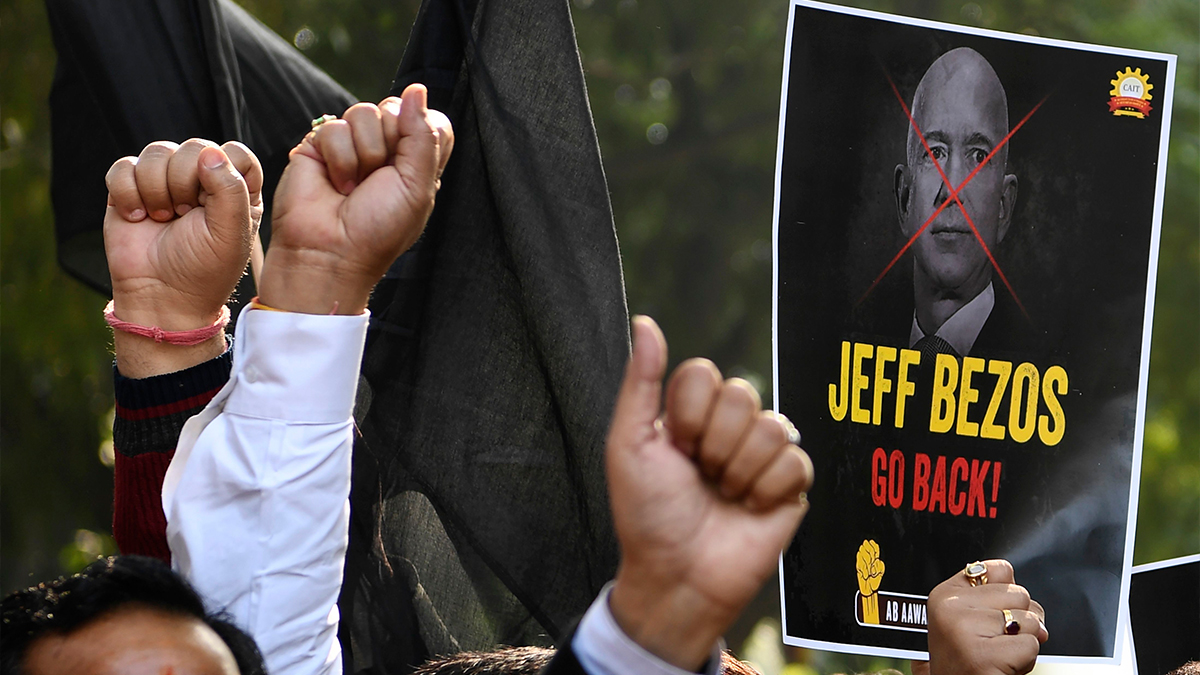
Viral Inequality: From Jeff Bezos to the struggle of Indian Farmers

Billionaires have profited enormously from lockdown, whilst mega corporations are buying out and shutting down independent stores and farms.

By Colin Todhunter

Source: OffGuardian

According to a new report by Oxfam, ‘The Inequality Virus’, the wealth of the world’s billionaires increased by $3.9tn (trillion) between 18 March and 31 December 2020. Their total wealth now stands at $11.95tn.

The world’s 10 richest billionaires have collectively seen their wealth increase by $540bn over this period. In September 2020, Jeff Bezos could have paid all 876,000 Amazon employees a $105,000 bonus and still be as wealthy as he was before COVID.

At the same time, hundreds of millions of people will lose (have lost) their jobs and face destitution and hunger. It is estimated that the total number of people living in poverty could have increased by between 200 million and 500 million in 2020. The number of people living in poverty might not return even to its pre-crisis level for over a decade.

Mukesh Ambani, India’s richest man and head of Reliance Industries, which specialises in petrol, retail and telecommunications, doubled his wealth between March and October 2020. He now has $78.3bn. The average increase in Ambani’s wealth in just over four days represented more than the combined annual wages of all of Reliance Industries’ 195,000 employees.

The Oxfam report states that lockdown in India resulted in the country’s billionaires increasing their wealth by around 35 per cent. At the same time, 84 per cent of households suffered varying degrees of income loss. Some 170,000 people lost their jobs every hour in April 2020 alone.

The authors also noted that income increases for India’s top 100 billionaires since March 2020 was enough to give each of the 138 million poorest people a cheque for 94,045 rupees.

The report went on to state:

…it would take an unskilled worker 10,000 years to make what Ambani made in an hour during the pandemic…and three years to make what Ambani made in a second.”

During lockdown and after, hundreds of thousands of migrant workers in the cities (who had no option but to escape the country’s avoidable but deepening agrarian crisis) were left without jobs, money, food or shelter.

It is clear that COVID has been used as cover for consolidating the power of the unimaginably rich. But plans for boosting their power and wealth will not stop there. One of the most lucrative sectors for these people is agrifood.

More than 60 per cent of India’s almost 1.4 billion population rely (directly or indirectly) on agriculture for their livelihood. Aside from foreign interests, Mukesh Ambani and fellow billionaire Gautam Adani (India’s second richest person with major agribusiness interests) are set to benefit most from the recently passed farm bills that will lead to the wholesale corporatisation of the agrifood sector.

CORPORATE CONSOLIDATION

A recent article on the grain.org website, ‘Digital control: how big tech moves into food and farming (and what it means)’, describes how Amazon, Google, Microsoft, Facebook and others are closing in on the global agrifood sector while the likes of Bayer, Syngenta, Corteva and Cargill are cementing their stranglehold.

The tech giants entry into the sector will increasingly lead to a mutually beneficial integration between the companies that supply products to farmers (pesticides, seeds, fertilisers, tractors, drones, etc) and those that control the flow of data and have access to digital (cloud) infrastructure and food consumers. This system is based on corporate centralisation and concentration (monopolisation).

Grain notes that in India global corporations are also colonising the retail space through e-commerce. Walmart entered into India in 2016 by a US$3.3 billion take-over of the online retail start-up Jet.com which, in 2018, was followed by a US$16 billion take-over of India’s largest online retail platform Flipkart. Today, Walmart and Amazon now control almost two-thirds of India’s digital retail sector.

Amazon and Walmart are using predatory pricing, deep discounts and other unfair business practices to lure customers towards their online platforms. According to Grain, when the two companies generated sales of over US$3 billion in just six days during a Diwali festival sales blitz, India’s small retailers called out in desperation for a boycott of online shopping.

In 2020, Facebook and the US-based private equity concern KKR committed over US$7 billion to Reliance Jio, the digital store of one of India’s biggest retail chains. Customers will soon be able to shop at Reliance Jio through Facebook’s chat application, WhatsApp.

The plan for retail is clear: the eradication of millions of small traders and retailers and neighbourhood mom and pop shops. It is similar in agriculture.

The aim is to buy up rural land, amalgamate it and roll out a system of chemically-drenched farmerless farms owned or controlled by financial speculators, the high-tech giants and traditional agribusiness concerns. The end-game is a system of contract farming that serves the interests of big tech, big agribusiness and big retail. Smallholder peasant agriculture is regarded as an impediment to be replaced by large industrial-scale farms.

This model will be based on driverless tractors, drones, genetically engineered/lab-produced food and all data pertaining to land, water, weather, seeds and soils patented and often pirated from peasant farmers.

Farmers possess centuries of accumulated knowledge that once gone will never be got back. Corporatisation of the sector has already destroyed or undermined functioning agrarian ecosystems that draw on centuries of traditional knowledge and are increasingly recognised as valid approaches to secure food security.

And what of the hundreds of millions to be displaced in order to fill the pockets of the billionaire owners of these corporations? Driven to cities to face a future of joblessness: mere ‘collateral damage’ resulting from a short-sighted system of dispossessive predatory capitalism that destroys the link between humans, ecology and nature to boost the bottom line of the immensely rich.

IMPERIAL INTENT

India’s agrifood sector has been on the radar of global corporations for decades. With deep market penetration and near saturation having been achieved by agribusiness in the US and elsewhere, India represents an opportunity for expansion and maintaining business viability and all-important profit growth. And by teaming up with the high-tech players in Silicon Valley, multi-billion dollar data management markets are being created. From data and knowledge to land, weather and seeds, capitalism is compelled to eventually commodify (patent and own) all aspects of life and nature.

Foreign agricapital is applying enormous pressure on India to scrap its meagre (in comparison to the richer nations) agricultural subsidies. The public distribution system and publicly held buffer stocks constitute an obstacle to the profit-driven requirements of global agribusiness interests.

Such interests require India to become dependent on imports (alleviating the overproduction problem of Western agricapital – the vast stocks of grains that it already dumps on the Global South) and to restructure its own agriculture for growing crops (fruit, vegetables) that consumers in the richer countries demand. Instead of holding physical buffer stocks for its own use, India would hold foreign exchange reserves and purchase food stocks from global traders.

Successive administrations have made the country dependent on volatile flows of foreign capital via foreign direct investment (and loans). The fear of capital flight is ever present. Policies are often governed by the drive to attract and retain these inflows. This financialisation of agriculture serves to undermine the nation’s food security, placing it at the mercy of unforeseen global events (conflict, oil prices, public health crises) international commodity speculators and unstable foreign investment.

Current agricultural ‘reforms’ are part of a broader process of imperialism’s increasing capture of the Indian economy, which has led to its recolonization by foreign corporations as a result of neoliberalisation which began in 1991. By reducing public sector buffer stocks and introducing corporate-dictated contract farming and full-scale neoliberal marketisation for the sale and procurement of produce, India will be sacrificing its farmers and its own food security for the benefit of a handful of unscrupulous billionaires.

As independent cultivators are bankrupted, the aim is that land will eventually be amalgamated to facilitate large-scale industrial cultivation. Indeed, a recent piece on the Research Unit for Political Economy site, ‘The Kisans Are Right: Their Land Is At Stake‘, describes how the Indian government is ascertaining which land is owned by whom with the ultimate aim of making it easier to eventually sell it off (to foreign investors and agribusiness). Other developments are also part of the plan (such as the Karnataka Land Reform Act), which will make it easier for business to purchase agricultural land.

India could eventually see institutional investors with no connection to farming (pension funds, sovereign wealth funds, endowment funds and investments from governments, banks, insurance companies and high net worth individuals) purchasing land. This is an increasing trend globally and, again, India represents a huge potential market. The funds have no connection to farming, have no interest in food security and are involved just to make profit from land.

The recent farm bills – if not repealed – will impose the neoliberal shock therapy of dispossession and dependency, finally clearing the way to restructure the agri-food sector. The massive inequalities and injustices that have resulted from the COVID-related lockdowns are a mere taste of what is to come.

The hundreds of thousands of farmers who have been on the streets protesting against these bills are at the vanguard of the pushback – they cannot afford to fail. There is too much at stake.

The Globalists Are Gonna Need A Bigger Virus As Economic Fraud Is Exposed

Jaws (1975) |  [ Universal / The Kobal Collection ]


By Brandon Smith

Source: Alt-Market.us

It is a general rule that corrupt economies tend to operate on faith and not on fundamentals. And to be clear, it’s not so much about naive faith that the system is stable or functional. No, it’s more about the masses having faith that the corruption and instability will never be derailed. Most people are not as stupid as the establishment and central bankers think they are – Almost everyone knows the system is broken, they just refuse to consider the possibility that the fraud will be disrupted, or that it will be allowed to fail.

The old mantra “too big to fail” is a lie. NOTHING is too big to fail, and that includes the US economy, the dollar and the elaborate Kabuki theater that keeps them both afloat. All it takes is a single moment, an epiphany that the Ponzi scheme is unsustainable rather than unstoppable.

I’m reminded specifically of the inflationary crisis of Argentina in 2001 – 2002.

Argentina’s economy was highly dependent on foreign capital inflows, and its currency peg to the US dollar, not to mention they were precariously reliant on support from the IMF. The IMF openly validated the government of Argentina and their currency peg model, but foreign capital began to decline and the peg became unsustainable. Without tangible growth in manufacturing and a strong middle class, an economy cannot survive for long. A top down system based on illusory “financial products” and creative accounting is doomed to crash eventually.

All it took was for the IMF to criticize the policies they initially endorsed and announced that they were removing financial aid, and all hell broke loose in Argentina.

Almost overnight the Argentina peso plunged in value, interest rates spiked and inflation struck hard. People poured into the streets and civil unrest erupted. The IMF would later admit it made “errors” in its handling of the Argentina situation, but this was simply spin control designed to protect them from further scrutiny. The IMF avoided most of the blame and has been growing into a monstrous global centralization machine ever since.

I think we are witnessing the beginning of a similar end of mass faith in fraud in the US. The recent Robinhood short squeeze event as well as the current decoupling of physical silver prices from the paper ETF market have accelerated the timetable. Not surprisingly, these moves have forced the establishment to intervene to some extent to essentially stop renegade traders from freely investing. Accusations are flying and deplatforming has ensued. The idea that the system is a functional fraud is gone; The world now knows it is a dysfunctional fraud, and collapse cannot be very far behind.

Furthermore the collusion between banks, hedge funds and Big Tech is blatantly revealed. These relationships are supposed to remain hidden in the ether. They are obvious to anyone with any financial knowledge and sense, but they aren’t supposed to be wielded in the open. Conspirators aren’t supposed to admit to the conspiracy? Right?

Some people might say the establishment has been forced to unmask by activists. Maybe. But, as I have been warning for many years, when criminals start openly admitting to their crimes it is probably because they think that it’s too late for anyone to do anything about it.

The point is, bankers and globalists have ways of avoiding responsibility for the disasters they engineer. When the con-game breaks, they always have patsies to take the fall.

This sets up a bizarre dynamic in which the money elites that constructed the economy like a time-bomb are treated like victims (or heroes) and the people telling the truth about the fraud are treated like villains and criminals. Are activist stock market traders and silver market guerrillas to blame for any crisis that erupts in the near future? No, of course not, but they will be blamed anyway.

That said, propaganda narratives and scapegoats may not be enough to save the bankers this time. They will never allow a major fiscal crash to develop in a vacuum. They need more cover, and they need to have the means to lock down the public to prevent civil unrest or rebellion from spilling over into their backyards. I have long suspected that the covid pandemic is a useful tool in this regard. As I noted in my article ‘How Viral Pandemic Benefits The Globalist Agenda’, published in January of 2020:

Even if a pandemic does not kill a large number of people, it still disrupts international travel, it disrupts exports and imports, it disrupts consumer behavior and retail sales, and it disrupts domestic trade. If it does kill a large number of people, and if the Chinese government’s response is any indication, it could result in global martial law. With many economies including the US economy already in a precarious balancing act of historic debt vs. crashing demand and useless central bank repo market intervention, there is little chance that the system can withstand such a tsunami…”

As we all know, medical martial law in the name of “public health” is being established in most countries regardless of the actual death rate. The insane globalist rantings of the World Economic Forum and Klaus Schwab have been very revealing; Schwab and other elites have even called the pandemic a “perfect opportunity” to execute there agenda for the “Great Reset”.

However, the globalists are highly fallible, and mistakes in judgment have been made. During the Event 201 pandemic wargame on a coronavirus outbreak (conveniently held two months before the real thing happened), the elites forecast at least 65 million initial deaths globally from such a virus. We are a year into the pandemic and nowhere near that kind of death rate. In fact, the death rate is so minuscule (0.26%), that the public is beginning to realize the lockdown mandates are pointless.

In the US, conservative states are moving on and keeping their economies wide open. Half the population is refusing to take the vaccines, and many members of law enforcement are refusing to implement lockdown policies. I don’t think this is what the globalists expected at all. They needed mass fear and they are getting mass defiance.

They’re going to need a bigger threat, or a bigger virus.

This is why I have been repeatedly warning that the talk of reopenings by Biden and other democrats is going to be very short lived. I have predicted that Biden will attempt a federal lockdown similar to the Level 4 lockdowns used in Europe and Australia after a couple of months of relative calm. I based this prediction on the covid “mutation” narrative being spread right now by the mainstream media and establishment cronies like Anthony Fauci. It is not hard to see where this is headed.

The globalists must have the “legal” option of restricting public movement as well as large gatherings, and they must have the option of surveillance on individuals 24/7 through contact tracing. This is the only way to prevent rebellion against the Reset and rising anger due to economic turmoil. The veil has been lifted, the conspiracy is being widely broadcast. Martial law alone would only inspire more dissent, medical tyranny in the name of “saving lives” is the ONLY play the globalists have. They have to have help from a large portion of the citizenry, so they must maintain the appearance that they are operating from the moral high ground.

The covid mutation story is clearly the next play, and Bank of America economists appear to agree with me. They recently stated that they see little optimism in terms of a reopening of the economy, and that hard lockdowns will return, possibly in March or April.

Another factor to consider is that the economic crash will have to reach a peak soon because Joe Biden now resides in the White House. If the crash happens in the near term, activist investors can be blamed, Trump can be blamed, and conservatives and liberty activists can be blamed. If the crash happens a year or two from now, only Biden and the globalists will get the blame.

Without lockdowns and scapegoats the scenario will end very badly for the globalists. It might end badly for them anyway. Be ready for more chaos by Spring; I suspect the elites are getting desperate, and if they allow America to go back to normal and for the pandemic to end with a whimper they will never get another chance at their precious Reset.

Social Media’s Threat to Free Speech is Real

By Peter Van Buren

Source: We Meant Well

The interplay between the First Amendment and corporations like Twitter, Google, Amazon, Apple and Facebook is the most significant challenge to free speech in our lifetimes. Pretending a corporation with the reach to influence elections is just another place that sells stuff is to pretend the role of debate in a free society is outdated.

From the day the Founders wrote the 1A until very recently no entity existed that could censor at scale other than the government. It was difficult for one company, never mind one man, to silence an idea or promote a false story in America, never mind the entire world. That was the stuff of Bond villains.

The arrival of global technology controlled by mega-corporations like Twitter brought first the ability the control speech and soon after the willingness. The rules are their rules, so we see the permanent banning of a president for whom some 70 million Americans voted from tweeting to his 88 million followers (ironically the courts earlier claimed it was unconstitutional for the president to block those who wanted to follow him.) Meanwhile the same censors allowed the Iranian and Chinese governments (along with the president’s critics) to speak freely. For these companies violence in one form is a threat to democracy while similar violence is valorized under a different color flag.

The year 2020 also saw the arrival of a new tactic by global media, sending a story down the memory hole to influence an election. The contents of Hunter Biden’s laptop, which strongly suggest illegal behavior on his part and unethical behavior by his father the president, were purposefully and effectively kept from the majority of voters. It was no longer for a voter to agree or disagree, it was now know and judge yourself or remain ignorant and just vote anyway.

Try an experiment. Google “Peter Van Buren” with the quotes. Most of you will see on the first page of results articles I wrote four years ago for outlets like The Nation and Salon. Almost none of you will see the scores of columns I wrote for The American Conservative over the past four years. Google buries them.

The ability of a handful of people nobody voted for to control the mass of public discourse has never been clearer. It represents a stunning centralization of power. It is this power which negates the argument of “why not start your own web forum.” Someone did until Amazon withdrew its server support, and Apple and Google banned the Parler app.

The same thing happened to The Daily Stormer, driven offline through a coordinated effort by tech companies, and 8Chan, deplatformed by Cloudflare. Amazon partner GoDaddy deplatformed the world’s largest gun forum AR15. Tech giants have also killed off local newspapers and other forums by gobbling up ad revenues. The companies are not, in @jack’s words, “one small part of the larger public conversation.”

The tech companies’ logic in destroying Parler was particularly evil – either start censoring like we do (“moderation”) or we shut you down. Parler allowing ideas and people banned by the others is what brought its demise. Amazon, et al, brought their power to censor to another company. The tech companies also said while Section 230 says we are not publishers, we just provide the platform, if Parler did not exercise editorial control to tech’s satisfaction it was finished. Even if Parler comes back online it will live only at the pleasure of the powerful.

Since democracy was created it has required a public forum, from the Acropolis to the town square on down. That place exists today, for better or worse, across global media. It is this seriousness of the threat to free speech that requires us to move beyond platitudes like “it’s not a violation of free speech, just a breach of the terms of service!” People once said “I’d like to help you vote ladies, but the Constitution specifically refers to men, my hands are tied.” That’s the side of history some are standing on.

This new reality must be the starting point, not the end point of discussions on the First Amendment and global media. Facebook, et al, have evolved into something new which can reach beyond their own corporate borders, beyond the idea of a company that just sells soap or cereal. Never mind being beyond the vision of the Founders when they wrote the 1A, it is hard to imagine Thomas Jefferson endorsing having a college dropout determine what the president can say to millions of Americans. The magic game play of words – it’s a company so it does not matter – is no longer enough to save us from drowning.

Tech companies currently work in casual consultation with one another, taking turns being the first to ban something so the others can follow. The next step is when a decision by one company ripples instantly across to the others, and then down to their contractors and supplies as a requirement to continue business. The decision by AirBnB to ban users for their political stance could cross platforms automatically so that same person could not fly, use a credit card, etc., essentially a non-person unable to participate in society beyond taking a walk. And why not fully automate the task, destroying people who use a certain hashtag, or like an offending tweet? Perhaps create a youth organization called Twitter Jugend to watch over media 24/7 and report dangerous ideas? A nation of high school hall monitors.

Consider linkages to the surveillance technology we idolize when it helps arrest the “right” people. So with the Capitol riots we fetishize how cell phone data was used to place people on site, coupled with facial recognition run against images pulled off social media. Throw in the calls from the media for people to turn in friends and neighbors to the FBI, alongside amateur efforts across Twitter and even Bumble to “out” participants. The goal was to jail people if possible, but most loyalists seemed equally satisfied if they could cause someone to lose their job. Tech is blithely providing these tools to users it approves of, knowing full well how they will be used. Orwellian? Orwell was an amateur.

There are legal arguments to extend limited 1A protections to social media. Section 230 could be amended. However, given Democrats benefit disproportionately from corporate censorship and current Democratic control of the government, no legislative solution appears likely. Those people care far more for the rights of some of its citizens (trans people seem popular now, it used to be disabled folks) then the most basic right for all the people.

They rely on the fact it is professional suicide today to defend all speech on principle. It is easy in divided America to claim the struggle against fascism (racism, misogyny, white supremacy, whatever) overrules the old norms. And they think they can control the beast.

But imagine someone’s views, which today match @jack and Zuck’s, change. Imagine Zuck finds religion and uses all of his resources to ban legal abortion. Consider a change of technology which allows a different company, run by someone who thinks like the MyPillow Guy, replacing Google in dictating what you can read. As one former ACLU director explained “Speech restrictions are like poison gas. They seem like they’re a great weapon when you’ve got your target in sight. But then the wind shifts.”

The election of 2020, when they hid the story of Hunter Biden’s laptop from voters, and the election’s aftermath, when they banned the president and other conservative voices, was the coming-of-age moment, the proof of concept for media giants that they could operate behind the illusion of democracy.

Hope rests with the Supreme Court expanding the First Amendment to social media, as it did when it grew the 1A to cover all levels of government, down to the hometown mayor, even though the Constitution specifically only mentions Congress. The Court has long acknowledged the flexibility of the 1A in general, expanding it over the years to acts of “speech” as disparate as nudity and advertising. But don’t expect much change any time soon. Landmark decisions on speech, like those on other civil rights, tend to be more evolutionary in line with society’s changes than revolutionary.

It is sad that many of the same people who quoted that “First they came for…” poem over Trump’s Muslim Ban are now gleefully supporting social media’s censorship of conservative voices. The funny part is both Trump and Twitter claim what they did was for peoples safety. One day people will wake up and realize it doesn’t matter who is doing the censoring, the government or Amazon. It’s all just censoring.

What a sad little argument “But you violated the terms of service nyah nyah!” is going to be then.

Twitter’s ban on Trump will only deepen the US tribal divide

By Jonathan Cook

Source: Jonathan Cook Blog

Anyone who believes locking President Donald Trump out of his social media accounts will serve as the first step on the path to healing the political divide in the United States is likely to be in for a bitter disappointment.

The flaws in this reasoning need to be peeled away, like the layers of an onion.

Twitter’s decision to permanently ban Trump for, among other things, “incitement of violence” effectively cuts him off from 88 million followers. Facebook has said it will deny Trump access to his account till at least the end of his presidential term.

The act of barring an elected president, even an outgoing one, from the digital equivalent of the public square is bound to be every bit as polarising as allowing him to continue tweeting.

These moves threaten to widen the tribal divide between the Democratic and Republican parties into a chasm, and open up a damaging rift among liberals and the left on the limits of political speech.

Claims of ‘stolen’ election

The proximate cause of Facebook and Twitter’s decision is his encouragement of a protest march on Washington DC last week by his supporters that rapidly turned violent as several thousand stormed the Capitol building, the seat of the US government.

Five people are reported to have died, including a police officer struck on the head with a fire extinguisher and a woman who was shot dead inside the building, apparently by a security guard.

The protesters – and much of the Republican party – believe that Trump’s Democratic opponent, Joe Biden, “stole” November’s presidential election. The storming of the Capitol occurred on the day electoral college votes were being counted, marking the moment when Biden’s win became irreversible.

Since the November election, Trump has cultivated his supporters’ political grievances by implying in regular tweets that the election was “rigged”, that he supposedly won by a “landslide”, and that Biden is an illegitimate president.

The social networks’ immediate fear appears to be that, should he be allowed to continue, there could be a repetition of the turmoil at the Capitol when the inauguration – the formal transfer of power from Trump to Biden – takes place next week.

No simple solutions

Whatever we – or the tech giants who now dominate our lives – might hope, there are no simple solutions to the problems caused by extreme political speech.

To many, banning Trump from Twitter – his main megaphone – sounds like a proportionate response to his incitement and his narcissistic behaviour. It appears to accord with a much-cited restriction on free speech: no one should be allowed to shout “Fire!” in a crowded theatre.

But that comparison serves only to blur important distinctions between ordinary speech and political speech.

The prohibition on shouting “Fire!” reflects a broad social consensus that giving voice to a falsehood of this kind – a lie that can be easily verified as such and one that has indisputably harmful outcomes – is a bad thing.

There is a clear way to calculate the benefits and losses of allowing this type of speech. It is certain to cause a stampede that risks injury and death – and at no gain, apart from possibly to the instigator’s ego.

It is also easy to determine how we should respond to someone who shouts “Fire!” in a crowded theatre. They should be prosecuted according to the law.

Who gets to decide

Banning political speech, by contrast, is a more complicated affair because there is rarely consensus on the legitimacy of such censorship, and – as we shall see – any gains are likely to be outweighed by the losses.

Trump’s ban is just the latest instance in a growing wave of exclusions by Twitter and Facebook of users who espouse political views outside the mainstream, whether on the right or the left. In addition, the tech giants have been tinkering with their algorithms to make it harder to find such content – in what amounts to a kind of pre-censorship.

But the critical issue in a democracy is: who gets to decide if political speech is unreasonable when it falls short of breaching hate and incitement laws?

Few of us want state institutions – the permanent bureaucracy, or the intelligence and security services – wielding that kind of power over our ability to comment and converse. These institutions, which lie at the heart of government and need to be scrutinised as fully as possible, have a vested interest in silencing critics.

There are equally good grounds to object to giving ruling parties the power to censor, precisely because government officials from one side of the political aisle have a strong incentive to gag their opponents. Incitement and protection of public order are perfect pretexts for authoritarianism.

And leaving the democratic majority with the power to arbitrate over political speech has major drawbacks too. In a liberal democracy, the right to criticise the majority and their representatives is an essential freedom, one designed to curb the majority’s tyrranical impulses and ensure minorities are protected.

‘Terms of service’

In this case, however, the ones deciding which users get to speak and which are banned are the globe-spanning tech corporations, the wealthiest companies in human history.

Facebook and Twitter have justified banning Trump, and anyone else, on the grounds that he violated vague business “terms of service” – the small print on agreement forms we all sign before being allowed access to their platforms.

But barring users from the chief means of communication in a modern, digitised world cannot be defended simply on commercial or business grounds, especially when those firms have been allowed to develop their respective monopolies by our governments.

Social media is now at the heart of many people’s political lives. It is how we share and clarify political views, organise political actions, and more generally shape the information universe.

The fact that western societies have agreed to let private hands control what should be essential public utilities – turning them into vastly profitable industries – is a political decision in itself.

Political pressures

Unlike governments, which have to submit to intermittent elections, tech giants are accountable chiefly to their billionaire owners and shareholders – a tiny wealth elite whose interests are tied to greater wealth accumulation, not the public good.

But in addition to these economic imperatives, the tech companies are also increasingly subjected to direct and indirect political pressures.

Sometimes that occurs out in the open, when Facebook executives get hauled before congressional committees to explain their actions. And doubtless pressure is being exerted too out of sight, behind closed doors.

Facebook, Twitter, Google and Apple all want their respective, highly profitable tech monopolies to continue, and currying favour with the party in power – or the one coming into power – is the best strategy for avoiding greater regulation.

Either way, it means that, in their role as gatekeepers to the global, digital public square, the tech giants exercise overtly political powers. They regulate an outsourced public utility, but are not subject to normal democratic oversight or accountability because their relationship with the state is veiled.

Censorship backfires

Banning Trump from social media, whatever the intention, will inevitably look like an act of political suppression to his supporters, to potential supporters and even to some critics who worry about the precedent being set.

In fact, to many it will smack of vengeful retaliation by the “elites”.

Consider these two issues. They may not seem relevant to some opponents but we can be sure they will fuel his supporters’ mounting sense of righteous indignation and grievance.

First, both the department of justice and the federal trade commission under Trump have opened anti-trust investigations of the major tech corporations to break up their monopolies. Last month the Trump administration initiated two anti-trust lawsuits – the first of their kind – specifically against Facebook.

Second, these tech giants have chosen to act against Trump now, just as Biden prepares to replace him in the White House. Silicon Valley was a generous funder of Biden’s election campaign and quickly won for itself positions in the incoming administration. The new president will decide whether to continue the anti-trust actions or drop them.

Whether these matters are connected or not, whether they are “fake news” or not, is beside the point. The decision by Facebook and Twitter to bar Trump from its platforms can easily be spun in his supporters’ minds as an opportunistic reprisal against Trump for his efforts to limit the excesses of these overweening tech empires.

This is a perfect illustration of why curbs on political speech – even of the most irresponsible kind – invariably backfire. Censorship of major politicians will always be contested and are likely to generate opposition and stoke resentment.

Banning Trump won’t end conspiracy theories on the American right. It will intensify them, reinforce them, embolden them.

Obnoxious symptom

So in the cost-beneft calculus, censoring Trump is almost certain to further polarise an already deeply divided American society, amplify genuine grievances and conspiracy theories alike, sow greater distrust towards political elites, further fracture an already broken political system and ultimately rationalise political violence.

The solution is not to crack down on political speech, even extreme and irresponsible speech, if it does not break the law. Trump is not the cause of US political woes, he is one obnoxious symptom.

The solution is to address the real causes, and tackle the only too justified resentments that fuelled Trump’s rise and will sustain him and the US right in defeat. Banning Trump – just like labelling his supporters “a basket of deplorables” – will prove entirely counter-productive.

Fixing a broken system

Meaningful reform will be no simple task. The US political system looks fundamentally broken – and has been for a long time.

It will require a much more transparent electoral system. Big donor money will have to be removed from Congressional and presidential races. Powerful lobbies will need to be ousted from Washington, where they now act as the primary authors of Congressional legislation promoting their own narrow interests.

The old and new media monopolies – the latter our new public square – will have to be broken up. New, publicly funded and publicly accountable media models must be developed that reflect a greater pluralism of views.

In these ways, the public can be encouraged to become more democratically engaged, active participants in their national and local politics rather than alienated onlookers or simple-minded cheerleaders. Politicians can be held truly accountable for their decisions, with an expectation that they serve the public interest, not the interests of the most powerful corporations.

The outcome of such reforms, as surveys of the American public’s preferences regularly show, would be much greater social and economic equality. Joblessness, home evictions and loss of medical cover would not stalk so many millions of Americans as they do now, during a pandemic. In this environment, the wider appeal of a demagogue like Trump would evaporate.

If this all sounds like pie-in-the-sky idealism, that in itself should serve as a wake-up call, highlighting just how far the US political system is from the liberal democracy it claims to be.