There is an element of inevitability in play, but it isn’t about central bank bailouts, it’s about Death Spirals and the collapse of unsustainable systems.
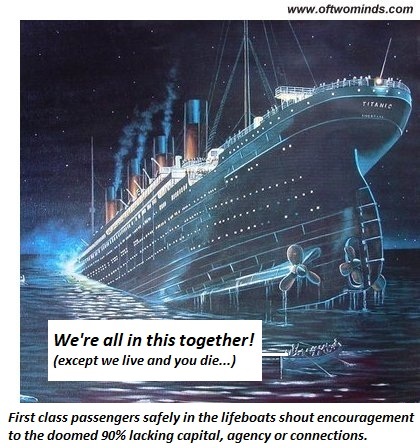
The vapid discussions about “soft” or “hard” landings for the economy are akin to asking if the Titanic’s encounter with the iceberg was “soft” or “hard:” either way, the ship was doomed, just as the global economy is doomed by The New Normal of Death Spirals and Speculative Frenzies.
Death Spirals are the inevitable result of entrenched interests clinging on to the status quo and thwarting any adaptation or evolution that might threaten or diminish their share of the swag–and that includes any real change because any consequential modification has the potential to upset the gravey train.
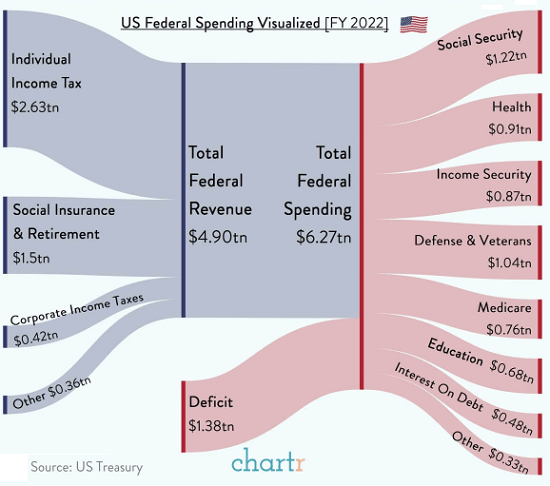
The status quo “solution” is to borrow and blow whatever sums are needed to satisfy every entrenched interest. Filling the federal slop-trough for all the hogs now requires borrowing a staggering $1.4 trillion every year, and billions more in municipal, county and state bonds (borrowing money via selling bonds) on the local level.
This borrow and blow strategy avoids any uncomfortable discipline and difficult trade-offs: everybody gets everything they demand.
This strategy looks “unsinkable” until the iceberg looms dead ahead. History suggests that fiscal and political discipline is eventually imposed by the real world in one fashion or another when diminishing returns enter a Death Spiral.
Any limit on debt is of course “impossible,” just as it was “impossible” for the Titanic to sink. But history is rather implacable in this regard. The self-serving hubris of “impossible” limits on largesse tend to collapse on contact with currency devaluation, structural inflation or a systemic crisis of legitimacy that sweeps away the entire worm-eaten facade of stability.
In other words, the entrenched interests benefitting from the status quo will continue to do what worked in the past until it all implodes. The pain of discipline and modest sacrifices is too great to bear, so let’s collapse the entire system.
Autocracies excel at Death Spirals because they eliminate dissent, transparency and competing nodes of power. Nobody’s left to push back on disastrous policy decisions, so autocratic regimes race toward the iceberg at full speed.
Rather than invest in real long-term solutions, everyone is in the casino, buying options that expire in a few hours. Rather than invest for an entire quarter–whew, three whole months!–speculators now consider a week an unbearably long time to hold a trade.
Speculative frenzies create their own Death Spirals, as gamblers front-run the “guaranteed” bailout of speculators by central banks. This is the consequence of moral hazard being elevated to “guaranteed”: there is no need to actually wait for the inevitable central bank bailout of bets gone bad, we can place bets before the bailout because we know it’s as assured as the sun rising tomorrow morning.
Nice, except central banks and bailouts also reach diminishing returns and enter Death Spirals. Doing more of what’s failed seems to work once, then twice, if you give it enough juice, but the third time is iffy and the fourth time collapses the speculative casino that the status quo was trying to save.
No one who benefits from the Moral Hazard Casino Economy believes it’s no longer sustainable. All the gamblers, big and small, are confident the Federal Reserve and other central banks can cover any losses and make good whatever befalls the casino. The hubris of the punters, big and small, is essentially infinite.
I’ll get out before the house of cards collapses, everyone tells themselves. In the meantime, I’m going to front-run the inevitable bailout of this speculative frenzy.
There is an element of inevitability in play, but it isn’t about central bank bailouts, it’s about Death Spirals and the collapse of unsustainable systems. Death Spirals and speculative frenzies have now been completely normalized. We can’t imagine any other way to operate. But this New Normal won’t last as long as punters believe. Doing more of what worked in the past is only accelerating the casino’s demise.
By what stretch of the imagination can the US be a democracy when ordinary citizens have virtually no influence over what their government does?
“The disregard of popular will is obvious for all to see.”
“Return to the Source” is a series in The Black Agenda Reviewthat reprints previously-published interventions by Black Agenda Reportcontributors. Our title is inspired by an address delivered by Amilcar Cabral on October 15, 1972 at Lincoln University and reprinted in the collection Return to the Source: Selected Speech by Amilcar Cabral (1973). Cabral’s address was titled “Identity and Dignity in the Context of the National Liberation Struggle.” In it, he argued that a “return to the source” was critical to revolutionary transformation—a return to the ideas, culture, and demands that served as the foundational impetus for the struggle for African liberation. Guided by Cabral’s analysis, we will return to some of the “classic” interventions by Black Agenda Report contributors, revisiting their tremendous insights into the contemporary conditions of the Black World.
We are launching the series by reprinting BAR columnist and Prejudentialauthor Margaret Kimberley’s incisive commentary “Democracy is Dead.” Originally published on April 23, 2014, Kimberley describes the domination of the US democratic process by capital, the abandoning of the working classes by the state, and the perplexing tendency of most US citizens to “suspend disbelief” while holding tight to the myth of US exceptionalism. Her analysis is as relevant now as it was when originally written.
Democracy is Dead
by Margaret Kimberley
“The notion that this country is a democracy has become openly farcical.”
Too many Americans love to boast that the United States is a democracy. That idea is accepted uncritically and celebrated as proof of this country’s superiority. Every public activity and event is an opportunity for the false narrative to be repeated and indulged. Events as disparate as elections, holiday celebrations, advertisements, school commencements and religious worship are all used to propagandize and create false belief about the degree of power the average citizen has vis a vis their government. Of course all evidence shows that this narrative is and always was a lie. Dictionaries define democracy as government representing the citizens through elected representatives, or as majority rule, or a society which provides equal rights to all. The history of this country has rarely lived up to any of those descriptions but in the recent past the notion that this country is a democracy has become openly farcical.We have nothing but meaningless trappings and any power exercised by the people is sadly in short supply.
This state of affairs has been obvious to anyone who has been paying close attention. Americans not only don’t get what they want from the political system, they actually get the opposite of what they want. The pace of the oligarchic state has quickened lately but the dynamic has been evident for quite some time.
“Americans get the opposite of what they want.”
Even elite academia is taking notice and has given official imprimatur to a conversation that had been ignored. Professors Martin Gilens of Princeton University and Benjamin Page of Northwestern University are the authors of the study “Testing Theories of American Politics: Elites, Interest Groups, and Average Citizens.” While their work does not as news stories suggest use the word oligarchy, the authors are quite clear about their findings. Professor Gilens gave this brief summary of their conclusions:
“I’d say that contrary to what decades of political science research might lead you to believe, ordinary citizens have virtually no influence over what their government does in the United States [italics mine]. And economic elites and interest groups, especially those representing business, have a substantial degree of influence. Government policy-making over the last few decades reflects the preferences of those groups – of economic elites and of organized interests.”
While this study has however briefly changed public discourse, it is important to note that the disregard of popular will is obvious for all to see. If this were not true, the minimum wage would be higher, there would be no cuts to entitlement programs, and Americans would have a single payer health care system. There would be no NAFTA or TPP free trade agreements which force a race to the bottom for workers, destroy entire eco-systems and violate national and popular sovereignty. If this country were truly democratic, the city of Detroit would not have filed for bankruptcy for the simple reason that voters in Detroit and in the state of Michigan voted to repeal the emergency manager law which brought bankruptcy into being.
“Disregard of popular will is obvious for all to see.”
Americans don’t want the increasingly frequent interventions abroad forced upon by them by president after president yet that is what they get. We want to address the problems created by human made climate change. We don’t want hydraulic fracturing, or the pollution or earthquakes that come with it, but that is what we have. We don’t want rich people to control the political process but the Supreme Court has said time and again that money equals speech and those decisions prove the point of the study. Simply put, money talks and those without money have no voice.
If that were not the case, American workers would not be poorer than their counterparts in the rest of the world. The so-called middle class workers in this country had the distinction of being better off than their peers around the world. That is no longer the case with stagnating wages and job loss and a country that does not practice income distribution that would keep people out of poverty. In a democratic country, Walmart and its low wages would not be the largest employer. The manufacturing that once dominated the economic landscape would still employ the bulk of the work force with its higher wages and other benefits that provide economic security.
In a democracy, the financial services industry that created the worldwide economic meltdown would not have been bailed out. Workers would be bailed out. Corporations wouldn’t get tax breaks and other government subsidies. Workers would get them. And if the average person had any say in the matter, the big time banksters would now be behind bars.
“In a democratic country, Walmart and its low wages would not be the largest employer.”
The myth of American democracy is just one of many that are cherished out of ignorance and suspension of disbelief but that is not a reason to continue the confusion and self-delusion. The only time we get any taste of democracy is when we proclaim that we don’t have it but assert plainly and loudly that we intend to get it.
The phony narrative wears thin as the quality of life diminishes. The United States of America is not a democratic nation if the only right that citizens have is to go to a polling place every few years. It is time to stop fetishizing what clearly does not work for the majority of people and start talking about something new. After all, the definition of insanity is doing the same thing over and over but expecting a different result. The only result we have to show is rule by the elites and if that is acceptable then the people have gone truly insane.
The U.S. economy has been on the verge of collapse for at least a decade, ever since the crash of 2008 and the subsequent explosion in fiat stimulus from the Federal Reserve. While the mainstream media has always claimed that central bankers “saved” us from another Great Depression, what they actually did was set us up for a far worse scenario — a stagflationary implosion of our society.
Here is the primary problem: By injecting trillions of bailout dollars into the system, the Federal Reserve prevented the economy from going through its natural purging cycle. This cycle would have been painful for many, but survivable, and it would have removed large amounts of excess debt, parasitic corporations that produce little or nothing of use, as well as numerous toxic assets with no legitimate value. For a real free market to function, weak or corrupt elements must be allowed to fail and die. Instead, central banks around the world and most prominently the Fed kept all of those destructive elements on life support.
This has created what amounts to a “zombie economy:” a system that needs constant outside support (stimulus) in order to continue moving forward. In the process of keeping zombie corporations and other parts of the body alive, healthy parts of the economy, like the small business sector, get devoured.
The zombie economy is, however, highly fragile. All it takes is one or two major shocks to bring it down, and the moment this happens the whole facade will disintegrate, leaving the public in panic and disarray. This is what is happening right now in 2020, and it will get much worse in 2021.
Bailouts encourage and reward unhealthy financial behavior, and this is why national debt, corporate debt and consumer debt have recently hit historic highs. When every pillar of the economy is encumbered with the weight of debt, any instability has the possibility of bringing all those pillars down at once. The Federal Reserve turned the U.S. into an economic time bomb, and the Fed is itself more like a suicide bomber than some kind of fiscal savior.
The “Great Reset”
I first heard the term “global reset” or “great reset” back in 2014/2015. I wrote an article about how the reset was actually a long term process in my article The Global Economic Reset Has Begun. Christine Lagarde was the head of the IMF back then, and she mentioned it briefly in multiple interviews.
I made a mental note of it because it seemed planted into the discussion very awkwardly, as if it was scripted. I rarely heard it mentioned for years after that. In 2020, as we descend into social and economic chaos, I’m seeing the phrase used everywhere in the media and by globalists.
Over the past decade, globalist institutions have come up with numerous phrases that seem to refer to a worldwide planned and dramatic shift in human society sometime in the near future. The “great reset” is just another phrase for “the new world order.” It is important to understand that the reset these people are talking about has actually been engineered and staged for many years. This is not something that just popped up in 2020 — they have been talking about it since at least 2014. And before that, they talked about the new world order, and “multilateralism,” and the “multi-polar world order,” and Agenda 2030, etc.
The reset is the catalyst phase of an agenda that has been in the works for a long time now. The goal, as they have openly admitted many times, is to centralize the entire globe into one monetary structure, one highly interdependent and socialized economy, and eventually one faceless and unaccountable governing body.
One of the biggest obstacles to the finalization of the reset and the formation of the new world order has been liberty-minded populations across the planet — most of all, the liberty-minded people within America. The U.S. has to be destabilized or eliminated; the old world order has to be brought down before the new world order can be introduced. The people have to be beaten down and desperate, so that when the globalists offer their “reset” as the solution, the people will gladly accept it without question — simply because they want the economic pain and uncertainty to stop.
A common statement made by globalists from Klaus Shwab at the World Economic Forum to the current Prime Minister of Canada, Justin Trudeau, is that the coronavirus pandemic is the “perfect opportunity” to trigger the “great reset.” As globalist Rahm Emanuel is famous for admitting, in crisis there is opportunity to do things you were not able to do before.
In other words, when people panic in the face of crisis, they become easy to manipulate. And, if a crisis doesn’t happen naturally, then why not create a crisis from thin air and use that to cause panic?
Enter the economic lockdowns…
The lockdowns have not only been proven to do nothing to stop the spread of the coronavirus, but they are also a clear attack on what’s left of our economic system. The small business sector in particular is being gutted as more than 60% of those that shut down during the first lockdown were unable to reopen. Small businesses provide more than half of all employment in the U.S.. When they collapse, the U.S. economy will have nothing left except the big-box corporations that the Fed put on life support over a decade ago.
Real unemployment, which is already at 26%, will skyrocket even further if a second national lockdown is initiated. The speedy collapse of the U.S. economy will be assured, and the “great reset” can commence. At least, that is what the globalists want to happen…
With the U.S. presidential election currently being contested, it is hard to say how the next few months will play out in detail. As I have been pointing out since July, a contested election is the best possible scenario for the globalists because it creates a Catch-22 situation:
If Trump stays in office, the political left will accuse him of usurping the presidency and there will be mass riots in the streets. Conservatives will be tempted with the idea of bringing in martial law to suppress rioters, and such measures will undermine the flow of the U.S. economy, causing its fragile structure to implode.
If Biden enters the White House, then he will attempt a Level 4 lockdown similar to the lockdowns we have seen in Australia, France, Germany and the UK; perhaps even worse. Our economy will crumble, conservatives will revolt, and Biden will attempt martial law measures.
Either way, the globalists get their crisis, and therein their opportunity.
Surviving the lockdowns and deterring the globalists
But here is where things get less certain for the elites. If liberty-minded Americans organize immediately for security and mutual aid, we can defuse the Catch-22. If we provide for our own security within our own communities, there will be no rationale for Trump to institute martial law. Community security is an awesome deterrent against leftist rioting and looting, and basic economic trade can continue.
By extension, if we organize our own community security as well as localize our economies with barter and trade, we also act as a deterrent to Biden and any ideas he might have of enforcing national lockdowns. The point is, we can’t allow the globalists to dictate the terms of the crisis. We must act to change the rules of the game.
The reset is not a natural inevitability, it is a con, a trap. No matter how bad the crisis in our nation becomes, it is the people — namely the liberty-minded people — who will determine the future, not the globalists. Their plan relies on our panic. Instead of panic, let’s show them a unified front and a plan of our own.
Every Wall Street bailout program that the Fed has created since September 17 of last year has, according to the Fed, been ostensibly created to somehow help the average American.
According to the Fed’s Term Sheet for the Term Asset-Backed Securities Loan Facility (TALF), it’s going to “help meet the credit needs of consumers and businesses by facilitating the issuance of asset-backed securities.” Not to put too fine a point on it, but asset-backed securities and related derivatives are what blew up Wall Street in 2008, creating the worst economic downturn, at that point, since the Great Depression.
According to the Fed’s most recent H.4.1 filing, it has loaned a total $11.1 billion from TALF. Eleven percent of that money, $1.2 billion, went to a company that has 4 employees (outside of clerical workers) according to its filing with the SEC.
Clearly, 2020 has been unlike any previous year in the last century or so. The world is currently battling against an infodemic of propaganda spewing from the corporate media and official health authorities. Yes, people are sick and dying. However, the statistics make it clear that COVID-19 simply does not warrant a total lockdown of the planet and further destruction of the economy.
Regardless, nations around the world are using COVID-19 as an opportunity to grab more surveillance and police state powers, institute mask and vaccine mandates, accelerate the push towards a completely digital world, enact more corporate bailouts, and generally, extreme control and involvement in citizens lives. The sheer magnitude of the COVID-19 operation is unparalleled, with the most recent similar event being the attacks of September 11, 2001. As with the 9/11 attacks, the predator class is using COVID-19 as the excuse to push plans and agendas which predate the spread of the novel coronavirus.
Even so, the COVID-19 operation is unlike any other event to take place in modern history because the results of this event are affecting people in every single nation on the planet and will continue to for years to come. Also, unlike 9/11 – which took place over the course of one morning – the COVID-19 operation is taking place daily for months on end. The effects of this constant bombardment with fear and panic are taking a toll on the hearts and minds of free people all around the world. Quite simply, the people are ready for this to end and they will do almost anything to achieve this goal. It is within this space of fear and uncertainty which the predator class has now begun to insert themselves, ready to present the “solution” to our ills.
The Great Reset
As every student of power and deception knows, the easiest way to achieve victory over your opponent is to guide them to a predetermined destination which benefits your agenda. If you can do this while convincing your opponent that they are consciously making their own choices and the path is for their own good – well, you are all but guaranteed success. I believe the evidence indicates this is the strategy we are seeing unfold during the COVID-19 operation.
The predetermined path we are being led down is known as “The Great Reset” and was announced in early June by the World Economic Forum. Regular readers will remember that on October 18, 2019, the Bill and Melinda Gates Foundation partnered with the Johns Hopkins Center for Health Security and the WEF on a high-level pandemic exercise known as Event 201. Event 201 simulated how the world would respond to a coronavirus pandemic which swept around the planet. The simulation imagined 65 million people dying, mass lock downs, quarantines, censorship of alternative viewpoints under the guise of fighting “disinformation,” and even floated the idea of arresting people who question the pandemic narrative.
The launch of The Great Reset was supported by Klaus Schwab, the founder and executive chairman of the World Economic Forum; England’s Prince Charles; Antonio Guterres, Secretary-General of the UN; and Kristalina Georgieva of the International Monetary Fund. The kick-off was truly an international event with the participation of Ma Jun, the chairman of the Green Finance Committee at the China Society for Finance and Banking and a member of the Monetary Policy Committee of the People’s Bank of China. The event was also supported by Bernard Looney, CEO of BP; Ajay Banga, CEO of Mastercard; and Bradford Smith, president of Microsoft.
During the launch of The Great Reset, Prince Charles stated that humanity cannot waste time because “we need to put nature at the heart of how we operate.” UN Secretary-General Guterres called for “more equal, inclusive and sustainable economies and societies” that can face pandemics, climate change, and other global challenges.
In an opinion piece published in The Globe and Mail, Klaus Schwab provided more details on the goals of The Great Reset (emphasis added):
COVID-19 lockdowns may be gradually easing, but anxiety about the world’s social and economic prospects is only intensifying. There is good reason to worry: a sharp economic downturn has already begun, and we could be facing the worst depression since the 1930s. But, while this outcome is likely, it is not unavoidable.
To achieve a better outcome, the world must act jointly and swiftly to revamp all aspects of our societies and economies, from education to social contracts and working conditions. Every country, from the United States to China, must participate, and every industry, from oil and gas to tech, must be transformed. In short, we need a “Great Reset” of capitalism.
Schwab goes on to describe several crises facing humanity, including rising government debt, unemployment, and increasing social unrest. Combined with COVID-19, these crises will leave the world less sustainable, less equal and more fragile. “We must build entirely new foundations for our economic and social systems,” Schwab writes. He details the 3 main components of TGR agenda, specifically fairer market outcomes, investments in “equality and sustainability,” and harnessing the innovations of the Fourth Industrial Revolution.
When it comes to producing “fairer market outcomes,” Schwab calls for governments to improve coordination in tax, regulatory, and fiscal policy. He also calls for upgrading trade agreements and moving towards a “stakeholder economy.” When he speaks of equality and sustainability, Schwab means that current and future government stimulus and relief packages should be used to create a new system that is “more resilient, equitable and sustainable.”He also calls for more “green” urban infrastructure and incentivizing industries to improve their environmental record.
Finally, Schwab calls for utilizing the innovations of “the Fourth Industrial Revolution” to support public good. The 4IR is another pet project of Schwab which was first announced in December 2015. To put it simply, the 4IR is the digital panopticon of the future, where digital surveillance is omnipresent and humanity uses digital technology to alter and, hopefully, improve our lives. Sometimes known as “The Internet of Things,” this world will be powered by 5G and 6G technology.
“Ubiquitous, mobile supercomputing. Intelligent robots. Self-driving cars. Neuro-technological brain enhancements. Genetic editing. The evidence of dramatic change is all around us and it’s happening at exponential speed,” Schwab wrote for the announcement of the 4IR.
Of course, for Schwab and other globalists, the 4IR also lends itself towards more central planning and top-down control. The goal is a track and trace society where all transactions are logged, every person has a digital ID that can be tracked, and social malcontents are locked out of society via social credit scores.
In fact, much of this call for a Great Reset is already playing out. For example, Mastercard and the Bill and Melinda Gates Foundation-funded GAVI recently announced a partnership with AI-powered “identity authentication” company, Trust Stamp. As MintPress Newsreported, “The program, which was first launched in late 2018, will see Trust Stamp’s digital identity platform integrated into the GAVI-Mastercard “Wellness Pass,” a digital vaccination record and identity system that is also linked to Mastercard’s click-to-play system that powered by its AI and machine learning technology called NuData.“
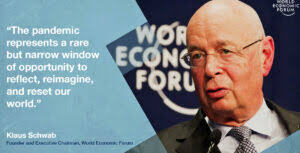
This is why astute readers are skeptical when they hear Schwab say, “the pandemic represents a rare but narrow window of opportunity to reflect, reimagine, and reset our world to create a healthier, more equitable and more prosperous future.”
Who exactly is Schwab speaking to when he speaks of a more prosperous future? How long has this Great Reset been in the works? The answers to these questions can help us understand the true goals of this agenda.
As researcher Brandon Smith reported, Christine Lagarde, former head of the IMF,discussed a global reset as far back as 2014. “The reset is often mentioned in the same breath as ideas like “the New Multilateralism” or “the Multipolar World Order” or “the New World Order.” All of these phrases mean essentially the same thing,” Smith writes.
Smith correctly notes that the Great Reset is not a response to the pandemic, but rather, “the global reset as implemented by central banks and the BIS/IMF is the cause of the collapse. The collapse is a tool, a flamethrower burning a great hole in the forest to make way for the foundations of the globalist Ziggurat to be built.”
New Normal, Same World Order
In early July, Schwab and French author Thierry Malleret released a book outlining the vision of The Great Reset. The book, Covid-19: The Great Reset, explores what the post-pandemic world might look like. “Will there be enough collective will to take advantage of this unprecedented opportunity to reimagine our world, in a bid to make it a better and more resilient one as it emerges on the other side of this crisis?,” Schwab and Malleretpondered at the release of the book. The two men believe COVID-19 triggered “momentous changes and magnified the fault lines that already beset our economies and societies.” They also predict that falling oil prices and a freeze in tourism could lead to a wave of massive anti-government demonstrations.
“One path will take us to a better world: more inclusive, more equitable and more respectful of Mother Nature. The other will take us to a world that resembles the one we just left behind – but worse and constantly dogged by nasty surprises,” the authors argue.
In the book, Schwab expands upon the initial announcement of The Great Reset. Once again he calls for the 4th Industrial Revolution and the digitalization of everything, powered by 5G technology. However, Schwab goes even further in his book, calling for rethinking the “social contract” society has with governments.
Schwab also calls for a nature based or green economy. In January 2020, the WEF released their report, Nature Risk Rising: Why the Crisis Engulfing Nature Matters for Business and the Economy, as part of their New Nature Economy series of reports. The report is “the first of a series of New Nature Economy reports, prepared through the Nature Action Agenda, a platform that aims to encourage a movement of businesses, governments, civil society, academics, innovators and youth to disrupt business-as-usual approaches.”
A second report, The Future of Nature and Business, was released in July. Once again, the WEF states that COVID-19 presents an “opportunity, to change the way we eat, live, grow, build and power our lives to achieve a carbon-neutral, ‘nature-positive’ economy and halt biodiversity loss by 2030. Business as usual is no longer an option.“
In a companion report, the WEF provides some detail on what it means to change the way we eat. “Another set of policy measures that would stimulate more resource-efficient food systems entail directing stimulus packages towards R&D to support the diversification away from diets based on resource intensive animal proteins, and towards four main categories of alternatives – aquatic, plant-based, insect-based and laboratory-cultured,” the report states. This push for alternatives to animal proteins has coincided with a rise in laboratory created fake meat, including products funded by the Bill and Melinda Gates Foundation.
Interestingly, the companion report also calls for “corporate bailout packages for the meat sector” which “could accelerate these developments.” Coincidentally, because of COVID-19, the Trump administration awarded $15.5 billion in relief aid for the meat and dairy industry. Once again, the predictions and declarations of these global institutions appear to play out in reality as perfect as any scripted TV show.
The calls for a Great Reset greatly mimic previous programs and initiatives put forward by other globalist organizations, including the United Nations. Researcher F. William Engdahl provided much-needed clarity in a recent piece on the announcement of The Great Reset. Engdahl notes that, “the declaration by the World Economic Forum to make a Great Reset is to all indications a thinly-veiled attempt to advance the Agenda 2030 “sustainable” dystopian model, a global “Green New Deal” in the wake of the covid19 pandemic measures. Their close ties with Gates Foundation projects, with the WHO, and with the UN suggest we may soon face a far more sinister world after the covid19 pandemic fades.”
Strategic Intelligence, Strategic Partners, and Event 201
In March, the WEF launched the COVID Action Platform which is essentially a call for global government in response to COVID-19. The answer, WEF believes, is to have greater global cooperation, move away from the nation-state, and tackle the world’s problems as one international community.
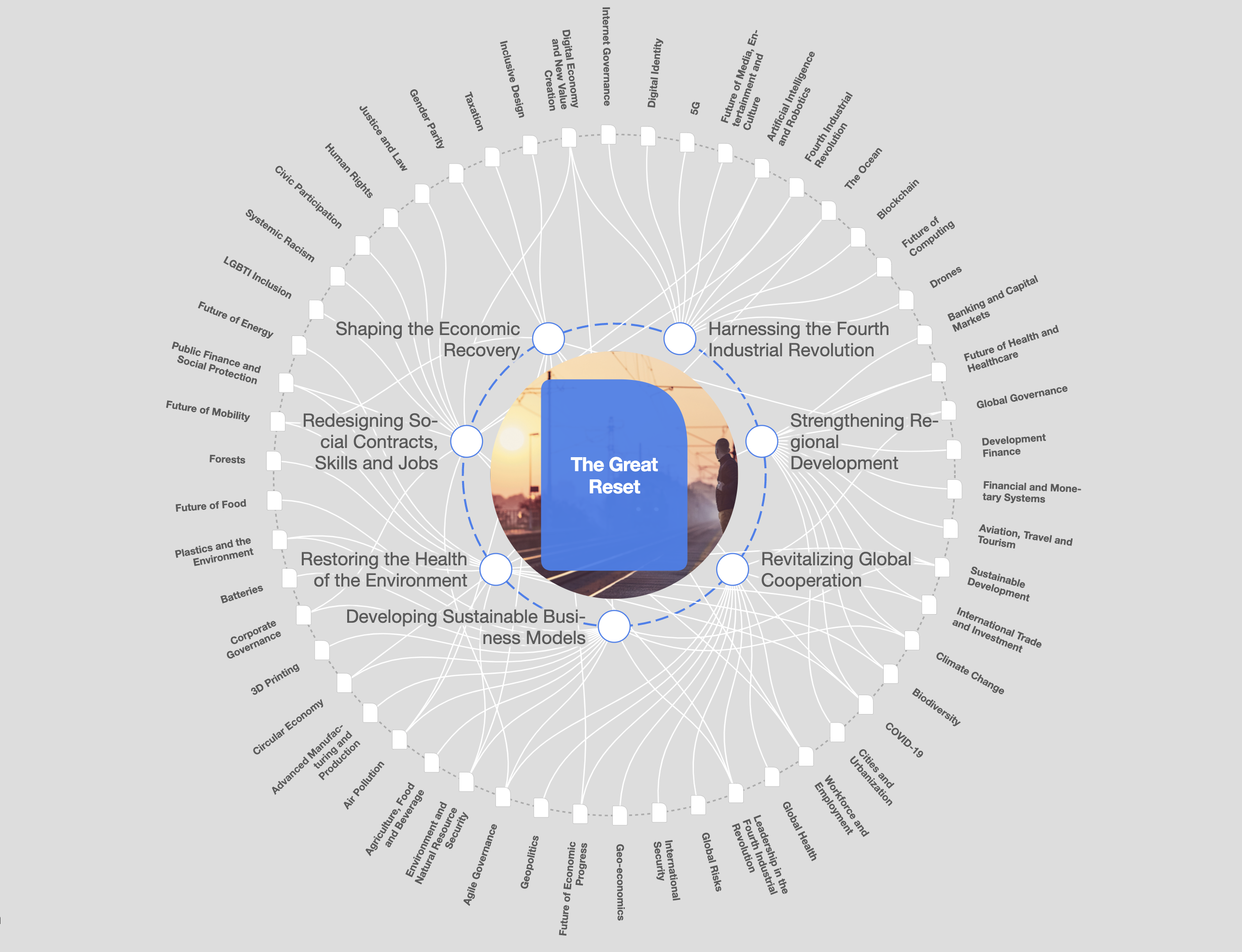
Along with the launch of the Action Platform, the WEF released an impressive graphic as part of their “Strategic Intelligence” platform, which outlines the wide ranging ways their plans will effect and shape the world of the 21st century and beyond. From the media’s role in the pandemic to finding a vaccine, the graphic attempts to provide details on this centrally planned future being promoted by the WEF. I encourage all readers to spend an evening going down the rabbit hole that is the COVID Action Platform for a better understanding of where we are headed.
With the launch of The Great Reset, the WEF also launched a Strategic Intelligence graphic detailing how their plans will unfold. The Great Reset graphic details how everything from drones, blockchain, the future of energy, LGBTI inclusion, and 3D printing will play a role in the New Normal. Once again, I encourage readers to take a dive into this graphic to gain clarity on what the WEF and their partners have planned for the coming decade.
The WEF promotes itself as the “International Organization for Public-Private Cooperation.” They partner with a variety of private companies, philanthropic outlets, and governments to achieve their goals. Researcher Steven Guinness recently outlined how the WEF partners with various institutions to accomplish their stated aims and how the Strategic Intelligence platform is “co-curated with leading topic experts from academia, think tanks, and international organizations.”
“‘Co-curators‘ are perhaps the most important aspect to consider here, given that they have the ability to ‘share their expertise with the Forum’s extensive network of members, partners and constituents, as well as a growing public audience,’” Guinness writes. “It is safe to assume then that when co-curators speak, members and partners of the World Economic Forum listen. This in part is how the WEF’s agenda takes shape.”
As Guinness notes, the co-curators of the Strategic Intelligence road map of the globalist vision include Harvard university, the Massachusetts Institute of Technology, Imperial College London, Oxford University, Yale and the European Council on Foreign Relations. Several of these institutions continue to play an influential role in shaping the narrative around COVID-19.
The WEF’s highest level of partnership is known as Strategic Partners. There are only 100 international companies listed as Strategic Partners. Each partner receives an invitation if they have “alignment with forum values.” These partners “shape the future through extensive contribution to developing and implementing Forum projects and championing public-private dialogue.”
The WEF’s Strategic Partners include Johnson & Johnson, and the Bill and Melinda Gates Foundation. BillGates is also a long time “Agenda Contributor” for the WEF.As mentioned above, the Bill and Melinda Gates Foundation partnered with the Johns Hopkins Center for Health Security and the WEF on the Event 201 pandemic exercise in October 2019. Johnson & Johnson were also partners in the exercise.
As TLAV has previously documented, the Bill and Melinda Gates Foundation operates in a similar fashion to the WEF: their publicly stated goals mask a global control agenda. Thus, it should come as no surprise that Klaus Schwab, founder of the WEF, is a former attendee and member of the Steering Committee for the secretive Bilderberg Group.
The WEF itself is akin to a more public Bilderberg Group which brings together around 3,000 business leaders, international political leaders, economists, celebrities, and journalists for a five day conference to discuss global issues. The WEF meets every January in Davos, Switzerland, to discuss their agenda. The elitism of the WEF has resulted in Schwab and his cohorts being nicknamed The Davos Class.
In January 2021 the theme of the WEF meeting will be “The Great Reset.” It’s important that we keep an eye on the WEF and their push for the Great Reset as we draw closer to election 2020 and a potential Dark Winter. Klaus Schwab, Bill Gates, and their ilk are determined to present themselves as the saviors of humanity. They are using the COVID-19 panic as an opportunity to push their agenda while selling it as the cure to our problems.
This predator class attempts to mask their true intentions with flowery language designed to lull the waking masses back to sleep. To be clear, our world is absolutely, without a doubt existing in an unsustainable paradigm. We do have growing income inequality, police violence, failing healthcare systems, and insufficient food production systems. These problems were apparent before COVID-19 and the fragility of these systems has indeed become more obvious in recent months. However, these psychopaths would prefer if we allowed them to stay in the driver’s seat as they careen us into a future of technocratic control and the end of individual liberty.
While Schwab and Gates would prefer that the people of the world submit to their vision, we must stand against this push for centralization of power and technology. The Great Reset is coming, and perhaps, it should come. We have many issues facing our species that need to be addressed. However, central planning, surveillance, and loss of individual liberty is not the answer. The answer is decentralization, opting out en masse, non-compliance, and non-participation in the systems which have brought us to this predicament.
We, as free people, must decide what path we intend to take. Will we stand by and allow the predators to seize control of all resources and power for the coming generations?Or, will we finally break free from their violent systems and initiate a Great Reset which benefits the people, from bottom to top?
The answer depends on you.
Question Everything, Come To Your Own Conclusions.
The laughably hopeless hope is that by propping up the corpses, the populace will discern some faint flicker of life in the decaying carcasses and return to their free-spending ways.
Call it cultural synchronicity, but it increasingly feels like we’re living in the 1979 Talking Heads song Life During Wartime, which was anchored by the lyric “This Ain’t No Party, This Ain’t No Disco, This Ain’t No Foolin’ Around.” Indeed.
It also feels like Life During Wartime because the propaganda is so blatant and intense:we’re winning the war on Covid-19, and our wars on everything else, too, of course, as war is the favored metaphor and favored policy at the end of the Empire.
The ceaseless propaganda is that “a vaccine is right around the corner.” The inconvenient reality is that Corporate Insiders Pocket $1 Billion in Rush for Coronavirus Vaccine: Well-timed stock bets have generated big profits for senior executives and board members at companies developing vaccines and treatments.
In other words, wartime profiteering isn’t just allowed, it’s encouraged–yet another sign that we’re in the final decay/collapse phase of Imperial Pretensions.
It’s easy to mix up the propaganda and the counter-propaganda, because they’re both so extreme. There is no middle ground, only pre-packaged positions which dictate which “data” is cherry-picked to support the political partisanship that’s being defended.
In a world of thousands of unread papers published in hundreds of scientific journals no one even reads and a corrupt culture of “science for sale,” there’s a veritable orchard to cherry-pick.
“Robert Horton, editor in chief of The Lancet, one of the most respected professional peer reviewed publications in the world dealing with biomedical research had this to say in an editorial published by The Lancet in April of 2015:”
“The case against science is straightforward: much of the scientific literature, perhaps half, may simply be untrue. Afflicted by studies with small sample sizes, tiny effects, invalid exploratory analyses, and flagrant conflicts of interest, together with an obsession for pursuing fashionable trends of dubious importance, science has taken a turn towards darkness.”
“And this, published in 2009, by Dr. Marcia Angell, former editor of The New England Journal of Medicine, another world leading publication in medical research:”
“It is simply no longer possible to believe much of the clinical research that is published, or to rely on the judgment of trusted physicians or authoritative medical guidelines. I take no pleasure in this conclusion, which I reached slowly and reluctantly over my two decades as an editor of The New England Journal of Medicine.”
Metaphorically speaking, the civilian populace believes “we’re winning” until the bombs start dropping on their homes. For some reason, this doesn’t feel like “winning.”
The V-shaped recovery is the propaganda war the status quo must win, for this is the narrative battle for the hearts and minds of the populace. The fear here is that should the populace lose confidence in The V-shaped recovery, they might reduce their borrowing and spending and increase their saving, dooming an economy that depends entirely on marginal spending funded by debt to keep from imploding.
As the chart of the rising wedge model of breakdown below illustrates, when big-ticket costs ratchet higher like clockwork–rent, property taxes, childcare, higher education, debt, healthcare, etc.– while income stagnates for the bottom 90%, any drop in spending, no matter how modest, breaks the system because any reduction in spending reduces tax revenues, corporate profits and debt payments below the critical threshold.
This is why the Federal Reserve is so keen on bailing out bankrupt-in-all-but-name corporations and banks: The laughably hopeless hope is that by propping up the corpses, the populace will discern some faint flicker of life in the decaying carcasses and return to their free-spending ways.
This is also why “stimulus” is being scattered from helicopters: the hope is that by substituting borrowed trillions for earned trillions, people will substitute magical thinking for clear-eyed recognition that the era of “growth” has transitioned into the era of DeGrowth, a state of affairs that signals the demise of all the bloated, sclerotic institutions operated to benefit insiders and Corporate America’s cartels and monopolies: the most protected bastions of the era, colleges and hospitals, are going broke and closing.
As Marx noted, “everything solid melts into air” when it’s no longer financially viable. Helicopter “stimulus” just creates a temporary illusion of solidity.
The foundations are collapsing, but by all means, please keep your eye on the decaying corpses: didn’t an eyelid flicker in that one? I could swear that one moved its foot…
This is “life in wartime,” where the battles are waged in narratives, confidence and magical thinking.
Adam Smith had an elegant idea when addressing the notorious difficulty that humans face in trying to be smart, efficient and moral. In TheWealth of Nations (1776), he maintained that the baker bakes bread not out of benevolence, but out of self-interest. No doubt, public benefits can result when people pursue what comes easiest: self-interest.
And yet: the logic of private interest – the notion that we should just ‘let the market handle it’ – has serious limitations. Particularly in the United States, the lack of an effective health and social policy in response to the coronavirus disease (COVID-19) outbreak has brought the contradictions into high relief.
Around the world, the free market rewards competing, positioning and elbowing, so these have become the most desirable qualifications people can have. Empathy, solidarity or concern for the public good are relegated to the family, houses of worship or activism. Meanwhile, the market and private gain don’t account for social stability, health or happiness. As a result, from Cape Town to Washington, the market system has depleted and ravaged the public sphere – public health, public education, public access to a healthy environment – in favour of private gain.
COVID-19 reveals a further irrational component: the people who do essential work – taking care of the sick; picking up our garbage; bringing us food; guaranteeing that we have access to water, electricity and WiFi – are often the very people who earn the least, without benefits or secure contracts. On the other hand, those who often have few identifiably useful skills – the pontificators and chief elbowing officers – continue to be the winners. Think about it: what’s the harm if the executive suites of private equity, corporate law and marketing firms closed down during quarantine? Unless your stock portfolio directly profits from their activities, the answer is likely: none. But it is those people who make millions – sometimes as much in an hour as healthcare workers or delivery personnel make in an entire year.
Simply put, a market system driven by private interests never has protected and never will protect public health, essential kinds of freedom and communal wellbeing.
Many have pointed out the immorality of our system of greed and self-centred gain, its inefficiency, its cruelty, its shortsightedness and its danger to planet and people. But, above all, the logic of self-interest is superficial in that it fails to recognise the obvious: every private accomplishment is possible only on the basis of a thriving commons – a stable society and a healthy environment. How did I become a professor at an elite university? Some wit and hard work, one hopes. But mostly I credit my choice of good parents; being born at the right time and the right place; excellent public schools; fresh air, good food, fabulous friends; lots of people who continuously and reliably provide all the things that I can’t: healthcare, sanitation, electricity, free access to quality information. And, of course, as the scholar Robert H Frank at Cornell University so clearly demonstrated in his 2016 book on the myth of the meritocracy: pure and simple luck.
Commenting on how we track performance in modern economies – counting output not outcome, quantity not quality, prices not possibilities – the US senator Robert F Kennedy said in 1968 that we measure ‘everything, in short, except that which makes life worthwhile’. His larger point: freedom, happiness, resilience – all are premised on a healthy public. They rely on our collective ability to benefit from things such as clean air, free speech, good public education. In short: we all rely on a healthy commons. And yet, the world’s most powerful metric, gross domestic product (GDP), counts none of it.
The term ‘commons’ came into widespread use, and is still studied by most college students today, thanks to an essay by a previously little-known American academic, Garrett Hardin, called ‘The Tragedy of the Commons’ (1968). His basic claim: common property such as public land or waterways will be spoiled if left to the use of individuals motivated by self-interest. One problem with his theory, as he later admitted himself: it was mostly wrong.
Our real problem, instead, might be called ‘the tragedy of the private’. From dust bowls in the 1930s to the escalating climate crisis today, from online misinformation to a failing public health infrastructure, it is the insatiable private that often despoils the common goods necessary for our collective survival and prosperity. Who, in this system based on the private, holds accountable the fossil fuel industry for pushing us to the brink of extinction? What happens to the land and mountaintops and oceans forever ravaged by violent extraction for private gain? What will we do when private wealth has finally destroyed our democracy?
The privately controlled corporate market has, in the precise words of the late economics writer Jonathan Rowe, ‘a fatal character flaw – namely, an incapacity to stop growing. No matter how much it grew yesterday it must continue to do so tomorrow, and then some; or else the machinery will collapse.’
To top off the items we rarely discuss: without massive public assistance, late-stage extractive capitalism, turbocharged by private interest and greed, would long be dead. The narrow kind of macroeconomic thinking currently dominating the halls of government and academia invokes a simpleminded teenager who variously berates and denounces his parents, only to come home, time and again, when he is out of ideas, money or support. Boeing, Goldman Sachs, Bank of America, Exxon – all would be bust without public bailouts and tax breaks and subsidies. Every time the private system works itself into a crisis, public funds bail it out – in the current crisis, to the tune of trillions of dollars. As others have noted, for more than a century, it’s a clever machine that privatises gains and socialises costs.
When private companies are back up and running, they don’t hold themselves accountable to the public who rescued them. As witnessed by activities since the 2008 bailouts at Wells Fargo, American Airlines and AIG, companies that have been rescued often go right back to milking the public.
By focusing on private market exchanges at the expense of the social good, policymakers and economists have taken an idea that is good under clearly defined and very limited circumstances and expanded it into a poisonous and blind ideology. Now is the time to assert the obvious: without a strong public, there can be no private. My health depends on public health. My freedom depends on social freedom. The economy is embedded in a healthy society with functional public services, not the other way around.
This moment of pain and collapse can serve as a wakeup call; a realisation that the public is our greatest good, not the private. Look outside the window to see: without a vibrant and stable public, life can quickly get poor, nasty, brutish and short.
This is how it happens that boats that were once worth tens of thousands of dollars are set adrift by owners who can no longer afford to pay slip fees.
The increasing concentration of the ownership of wealth/assets in the top 10% has an under-appreciated consequence: when only the top 10% can afford to buy assets, that unleashes an almost karmic payback for the narrowing of ownership, a.k.a. soaring wealth and income inequality: assets crash.
Most of you are aware that the bottom 90% own very little other than their labor (tradeable only in full employment) and modest amounts of home equity that are highly vulnerable to a collapse of the housing bubble. (The same can be said of China’s middle class, only more so, as 75% of China’s household wealth is in real estate, more than double the percentage of wealth held in housing in U.S. households.)
As the chart illustrates, the top 10% own 84% of all stocks, over 90% of all business equity and over 80% of all non-home real estate. The concentration of ownership of assets such as vintage autos, collectibles, art, pleasure craft and second homes in the top 10% is likely even greater.
The more expensive the asset, the greater the concentration of ownership, as the top 5% own roughly 2/3 of all wealth, the top 1% own 40% and the top 0.1% own 20%. In other words, the more costly the asset, the narrower the ownership. (Total number of US households is about 128 million, so the top 5% is around 6 million households and the top 1% is 1.2 million households.)
This means the pool of potential buyers is relatively small, even if we include global wealth owners.
Since price is set on the margins, and assets like houses are illiquid, then we can anticipate all the markets for assets owned solely by the wealthy to go bidless–yachts, collectibles, vacation real estate–because the pool of buyers is small, and if that pool gets cautious due to a drop in net worth/unearned income, there won’t be any buyers except at the margins, at incredible discounts.
As we know, in a neighborhood of 100 homes currently valued ar $1 million each, when a desperate seller accepts $500,000, the value of the other 99 homes immediately drops to $500,000.
Since few of the current bubble-era asset valuations are supported by actual income fundamentals, then the sales price boils down to a very small number of potential buyers and what they’re willing to pay.
Houses have a value based on rent, of course, but rents will drop very quickly for the same reason: prices are set on the margins. The most desperate landlords will drop rents and re-set the rental market from the margins. If demand plummets (which it will as people can no longer afford rents in hot urban markets once they lose their jobs), then vacancies will soar and rents will crash as a few desperate landlords will take $1200/month instead of $2500/month.
Due to the multi-year building boom of multi-family buildings in hot job markets (which inevitably leads to an over-supply once the boom ends), there are now hundreds of vacancies where there were once only a few dozen, and thousands where there were previously only hundreds.
As millions of wait staff, bartenders, etc. who made good money in tips find their jobs have vanished, all the urban hotspots will see mass out-migration: Seattle, Portland, the S.F. Bay Area, L.A., NYC, Denver, etc. as demand for rentals will evaporate and rents will be set on the margins by the most desperate landlords. Everyone holding out for the previous bubble-era rent will have $0 income as their units are vacant.
Tech start-ups and Unicorns are melting like ice cubes in Death Valley, and tech-sector layoffs are already in the tens of thousands. This wave of highly paid techies losing their jobs will become a tsunami, further reducing the pool of people who can afford rents of $2,500 to $3,000 for a studio or one-bedroom apartment.)
The concentration of ownership generates a self-reinforcing feedback that further depresses prices: since the top 10% own most of the assets of the nation, they are most prone to a reversal of “the wealth effect.” As their assets soared in value, the top 10% felt wealthier and more confident in future gains, enabling them to borrow and spend freely on second homes, pleasure craft, new vehicles, collectibles, luxury travel, etc.
Once even one class of assets plummets in value–for example, the recent decline in the stock market– the wealth effect reverses and the top 10% feel poorer and less confident about future gains, and thus less enthused about borrowing and spending. The demand for other costly assets quickly evaporates, further reducing the wealth of the “ownership class,” which further reduces their desire and ability to buy bubble-era assets.
The high-priced assets owned by the top 10% will be the assets least in demand due to their high cost and potential for enormous losses: nothing loses value faster in a recession that narrowly owned assets such as vintage cars, art, vacation homes, yachts, etc.
Once assets start sliding in value, the reverse wealth effect quickly dries up demand for all asset classes with narrow ownership. Since these assets are illiquid–that is, the market for them is thin, with buyers few and far between–the prices are set by a very shallow pool of buyers and desperate sellers.
Consider a pleasure craft that retails new for $120,000. In the boom era of rising stocks and housing, a used boat might fetch $65,000. But as the wealth of the small pool of households able to buy and maintain a costly craft evaporates, the number of qualified buyers evaporates, too.
The seller might be aghast by an offer of $35,000 and reject it angrily. Six months later, he’s praying someone will take it off his hands for $15,000, and in another six months, he’ll accept $500 just to get out from underneath the insurance, slip-rental and licencing fees.
This is how it happens that boats that were once worth tens of thousands of dollars are set adrift by owners who can no longer afford to pay slip fees, and vacation homes are abandoned and auctioned off for overdue property taxes: the market for these luxuries dries up and blows away, i.e. goes bidless–there are no buyers at any price.
Once housing and real estate valuations fall, that will trigger a decline in the value of all other costly, narrowly owned assets, which will reinforce the reverse wealth effect.
This is the systemic payback for concentrating ownership of assets in the hands of the few: when their bubble-era priced assets plummet in value, the bottom falls out of all assets with narrow ownership. The price of superfluous assets such as boats, vintage cars, collectibles, art and vacation homes can quickly fall to a fraction of bubble-era valuations, destroying much of what was always fictional capital.
The Federal Reserve reckons it can “save” the bubble-era valuations of junk bonds by being the “buyer of last resort,” but it will end up being the “only buyer,” effectively making the system even more fragile and prone to collapse.
The public will eventually have to decide if the nation’s central bank should be bailing out assets owned by the financial elite while the upper-middle class watches its assets collapse in value.








 After the Crash