U.S. Interventionism in Latin America is to Blame for Ecuadorian Civil War

Deteriorating social conditions, dollarization and lack of punishment for criminals have been key aspects of Ecuadorian politics since the U.S.-led regime change in the country.

By Lucas Leiroz

Source: Strategic Culture Foundation

In South America, a new scenario of hostilities is emerging. A civil war began in Ecuador, with the local government declaring martial law and a state of “internal armed conflict” in response to several terrorist attacks carried out by drug trafficking groups. At first, this seems like a simple domestic security issue, with no major geopolitical relevance. However, analyzing the case in depth, it is possible to see that the conflict situation is a direct result of U.S. interventionist actions in Latin America.

Ecuador has been going through an extremely turbulent political and economic period over the last seven years. In 2017, Lenin Moreno was elected president in the country as an ally of Rafael Correa. Combining elements of the socialist left with Catholic conservatism, Correa was the leader of the so-called “Citizen Revolution”, having promoted important social reforms over ten years, making the country one of the most prosperous and safe in South America.

Moreno was elected with the promise of continuing Correa’s legacy, having broad popular approval due to the endorsement given to him by his predecessor. However, once coming to power, Moreno undid the legacy of the Citizen Revolution, breaking with Correa and launching a radical neoliberal wave strongly supported by the U.S. Not only that, Moreno was also a key factor in consolidating a reactionary wave across South America, having even sent weapons and war equipment to Bolivia in 2019 in order to support Jeanine Añez’s coup d’état.

The neoliberal shock policy implemented by Moreno and his successor Guillermo Lasso had a brutal social impact in Ecuador. In addition to poverty, unemployment, inflation and other problems in the economic sphere, neoliberal measures also brought with them an exponential increase in crime. The country’s safety indexes quickly dropped. The number of homicides jumped from 970 in 2017 to 4800 in 2022. The country went from being the safest in South America to becoming the most dangerous one, consolidating a drastic social change with catastrophic impacts.

During his years in government, Rafael Correa had implemented both economic measures to reduce social inequalities and strong punitive actions against criminals, halting the growth of the organized crime in the country. He, however, failed to reverse Ecuador’s economic dollarization, which had been implemented before his rise to power. Correa had plans to change Ecuador’s monetary policy, but Moreno’s “soft coup d’état” prevented such a project from being advanced.

It is known that dollarized economies are preferred by drug trafficking cartels and criminal organizations since the absence of exchange mechanisms makes it easier for illegal money to circulate in society, mainly through money laundering schemes. In this sense, since dollarization in 2000, the Ecuadorian authorities have had many difficulties in controlling the illegal economic flow in the country, and this has only gotten worse as criminal networks have gained even more power in the country since Moreno’s neoliberal shock.

Regarding the criminal scenario, Ecuador is known for being a region disputed by Colombian and Mexican cartels. Several gangs operate in Ecuador as proxies for foreign cartels. The country’s location is strategic for the drug market in the southern direction of the continent, which is why Mexican and Colombian traffickers (who control the illegal Latin American market) compete for Ecuadorian territory and back local armed militias to achieve their objectives. In addition, Ecuador is located between Peru and Colombia, which are the two largest global producers of cocaine, further increasing the strategic interest of the Ecuadorian territory for drug trafficking.

Neoliberalism in Ecuador has made the state incapable of controlling the activities of foreign groups in the country, as well as preventing local citizens – increasingly poor and vulnerable – from being co-opted by illegal networks. The result was the emergence of a brutal conflict, with the authorities completely losing control of the situation.

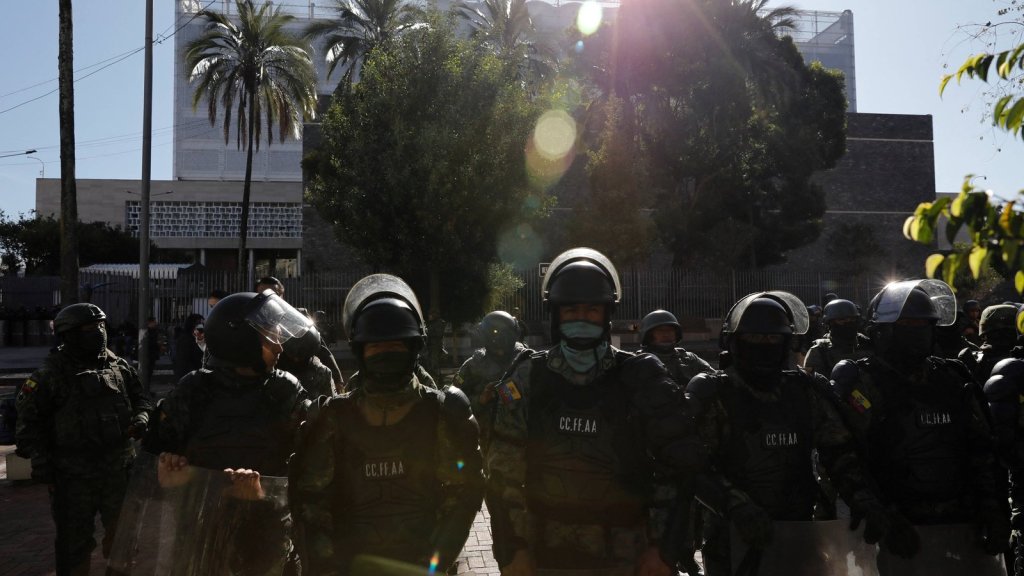
The current outbreak of violence began after the state reacted to the escape from prison of Adolfo Macías — known as “El Fito” — leader of the “Los Choneros” gang. The government declared a state of emergency and tried to impose a siege on the criminals, but suffered several brutal retaliations, with members of Fito’s gang capturing the University of Guayaquil, invading a live TV studio, and even bombing hospitals and public facilities. Furthermore, prisons were captured by criminals, with officers being held hostage, tortured and even hanged. The barbaric scenario led President Daniel Noboa to declare war on the “domestic enemy”, calling on the armed forces to act.

Currently, the streets of Ecuador are the scene of brutal urban warfare, with soldiers facing heavily armed narco-terrorists in intense attrition. The power acquired by criminal groups in the country is impressive, which shows how the impotence of a neoliberal state can have devastating consequences for national security.

It is important to emphasize that U.S.-born Daniel Noboa does not appear to be a skilled politician to reverse this situation completely. He came to power in a tense electoral scenario, in which gangs actively participated in political disputes, even being involved in the murder of a candidate. Noboa is a liberal politician who is extremely aligned with the U.S., and is not interested in resuming Correa’s policies, in addition to suffering a lot of pressure from criminal groups – which have a broad institutional infiltration.

However, it is desirable that at least the public situation in the country returns to normal in some way. The use of military force is the correct way to neutralize gang violence, but it is not the key to solving the drug trafficking problem. To truly undermine the power of criminal networks, it is necessary to implement illiberal policies that reduce poverty, removing ordinary citizens from the sphere of influence of drug trafficking in the country’s periphery. Furthermore, it is necessary to de-dollarize the economy and establish a sovereign currency and exchange rate policy, which make the work of drug trafficking more difficult through strict control of financial flows.

Noboa will certainly not be able to end the drug trafficking problem, as he is not willing to follow the illiberal path, but there is hope that, with the use of force, he will be able to return to normality at some point in the future. After suffering losses on the battlefield, gangs may agree to secretly negotiate a peace agreement with the government to end hostilities on both sides. This will have a positive aspect, as it will put an end to fighting, but it will also have a catastrophic characteristic, as it will definitely turn Ecuador into a Narco-State, where criminal gangs negotiate with the government and act in an institutional manner.

If the U.S. had not intervened in Correa’s Citizen Revolution, perhaps the situation in Ecuador would be different today. But, with neoliberalism and dollarization, the only possible result is a scenario like the current one.

Austerity, War & Dictatorship… the Charade of Western Democracy Is Over. Can We Lose Those Chains?

By Finian Cunningham

Source: Strategic Culture Foundation

Western liberal democracy and its ubiquitous “austerity economics” is a euphemism for fascism. And the charade is finally coming to an end.

Western liberal democracy and its ubiquitous “austerity economics” is a euphemism for fascism. And the charade is finally coming to an end.

Austerity is not some recent policy under neoliberal capitalism. It was born out of the historic crisis in the Western system following the First World War and during the 1930s when fascism became a way to curtail any democratic challenge to the prevailing capitalist system.

That political instrument of repression is wielded today across all Western states. Quite amazingly, for a long time, few people recognized their captive, repressive state as fascism. We generally lived under the illusion that we were free citizens in “liberal democracies”.

In this interview, Clara E Mattei explains how the technocratic-sounding “austerity” is used to hide the brutal reality of dictatorship and repression against the vast majority of citizen workers in Western states.

Clara Mattei is an Assistant Professor in the Economics Department of The New School for Social Research, New York. She is the author of The Capital Order: How Economists Invented Austerity and Paved the Way to Fascism.

Her book investigates the origins of austerity as an economic policy after the crisis of World War One. Crucially, she argues that austerity is not merely about governments balancing financial budgets. Professor Mattei contends that austerity policy implemented by all Western governments is a political instrument of mass repression to prevent any challenge to the prevailing capitalist order.

Austerity forces the vast majority to accept unacceptable conditions that are otherwise shockingly anti-democratic. The precariousness and insecurity of employment, the widespread denial of social services, deprivation and poverty, and the relentless abuse of taxes and resources that are fueling insane militarism and war.

If we really did live in free, democratic societies why are such deformities enforced without any alternative? Austerity is used to crush the political imagination for any reasonable, more humane, more peaceful alternative.

However, as Clara Mattei points out in this interview, the extreme anti-democratic conditions in Western societies are inevitably forcing greater numbers of people to question the injustices and hideous anomalies of the prevailing capitalist order.

People are realizing that Western governments are in reality regimes of repression in service for the enrichment of a minority. That fundamental deformity is why Western societies are collapsing and why the United States and its Western lackeys are driven to increasing conflict against Russia and China.

The charade of “Western democracy” is coming to an end. The rulers and their pantomime political parties are losing the moral authority to hold power over the masses.

As people necessarily seek ways to reinvent societies that are fit for meeting their democratic needs, socialist solutions are beckoning. We have to throw off the mental shackles imposed by our dictators, and realize, as Karl Marx once eloquently said, that we have got nothing to lose except our chains.

The United States Does Not Have an Economy

By Paul Craig Roberts

Source: PaulCraigRoberts.org

The US financial sector has long looted other countries.  A number of participants have described the process.  First a country is enticed with bribes to the leaders to take out loans that cannot be serviced or repaid.  Then in comes the IMF. Austerity is imposed on the population.  Public services and employment are cut to free resources for debt service, and public assets are sold to repay the loan.  Living standards fall, and US corporations take over the country’s economy.

As foreign governments, having experienced or witnessed the economic carnage and fearing accountability, are less willing to be bribed into indebting their countries, American finance is now applying this technique to Americans. Contrary to the narrative in the financial press, the Federal Reserve is not raising interest rates in order to fight inflation.  It is ludicrous to think that a three-quarters of one percent rise in a very low interest rate is going to have any impact on a 9.1% rate of consumer inflation or that speculation that the Federal Reserve has in mind another three-quarters of one percent possibly followed by one half of one percent comprise an anti-inflation policy.  If all these increases occur, it still leaves the interest rate below the inflation rate.

Moreover, as I have previously explained, the inflation is not monetary.  The higher prices are the result of supply disruptions caused by Washington’s Covid lockdowns and Russian sanctions.  Production was stopped and supply chains are broken.  

The Federal Reserve’s rise in interest rates is just a continuation of its policy of concentrating income and wealth in the hands of the One Percent.  Quantitative Easing was the cloak for the Federal Reserve to print $8.2 trillion in new money which was directed or found its way into the prices of stocks and bonds, thus enriching the small number who own most of these financial instruments.  Having maxed out this avenue of wealth concentration, the Federal Reserve is now raising interest rates in order to drive up mortgage costs to aspiring home owners.  The Federal Reserve is driving individuals out of the housing market in order to free up properties for “private equity” firms to purchase homes for their rental values.  That private equity firms see rental income from the existing stock of houses as the best investment opportunity tells us that the US economy has played out.  When investment goes into existing assets, not into producing new assets, the economy ceases to grow.

The Obama regimes policy of bailing out the financial fraudsters responsible for the 2008 crash while foreclosing on their victims, reduced American homeownership from 70% to 63 percent. The Urban Institute predicts further declines. Today homeowners’ equity has declined from 85% after World War II to one-third, leaving two-thirds of homeowner equity in the hands of creditors.  This makes it completely clear that a financialized economy indebts the people for the sake of rentier income to the One Percent.  Indeed, the financialized economy created by the Federal Reserve has reimposed a class system akin to the landed British aristocracy that was overthrown.  Indeed, we have an economically far worst class system.  The landed British aristocrats produced food that fed the nation.  The American class system produces interest and fees for the financial system.

As Michael Hudson has shown us, a no-growth economy is the end result of a financialized economy.  A financialized economy is one in which consumer income is diverted by debt expansion away from the purchase of new goods and services into debt service and fees–interest on mortgages, car loans, credit card debt, student loan debt.  With such a large share of household income spent on debt service, little is left for driving the economy forward.

If American economists were capable of escaping from their neoliberal junk economics, they would realize that “the world’s largest economy” they attribute to the United States is total fiction.  The fact is that the United States does not have an economy.  Corporations driven by Wall Street located American manufacturing in Asia so that the One Percent could benefit from higher profits from lower labor costs, while the deserted city and states had to sell their income streams, such as Chicago’s parking meter revenues for 75 years, to foreigners for one lump sum payment to solve one year’s budget crisis.  

The offshoring of American production, carried out under the cloak of “globalism,” destroyed the American economy and the tax bases of cities and states.  While the real economy declines, the Democrat Party, seeking permanent power, has imposed a policy of open borders for immigrant-invaders.  How are these millions of peoples to support themselves in an economy whose manufacturing has been moved abroad?  How can a population, deserted by American corporations, that is experiencing debt deflation absorb the costs of support and social infrastructure for tens of millions of third world immigrant-invaders?

You will never hear it from the whores in the financial press, but the United States is on the precipice of economic and social collapse.  And what are the fools in Washington doing?  The idiots are ginning up wars with Russia, China, and Iran.  

ARCHITECTS OF POWER: HOW THE GLOBAL ELITE PROFIT FROM EXTREME INEQUALITY & PRE-EMPT THE BACKLASH

By Dr. Tim Coles

Source: Waking Times

There is a new, mega-rich global elite consisting of a small number of billionaires and multibillionaires. Many of them made their money in the technology sector. Others play financial markets or inherit fortunes. They are wealthier and more powerful than some entire nation-states.

The British Ministry of Defence (MoD) says:

“Whilst there have always been differences between the wealthier, better educated and the less privileged, these differences appear likely to widen in the coming decades.”

The mega-rich deliberately order the world in ways that guarantee their wealth by institutionalising inequality. Occasionally, this is admitted. In 1997, a book published by the Royal Institute for International Affairs in the UK acknowledged:

“The present international order may not be the best of all possible worlds, but for one of the ‘fat cats of the West’ enjoying a privileged position in an international society that is structured and organised in ways which perpetuate those privileges, there are good reasons for not pursuing radical change.”

This is also true of internal policymaking. The third richest man in the world, Warren Buffett (worth over $80bn), confirmed this: “There’s been class warfare for the last 20 years, and my class has won.” This echoes his statement in 2006, just prior to the global financial crisis: “There’s class warfare all right… but it’s my class, the rich class, that’s making war, and we’re winning.” Around the same time, the liquidity firm Citigroup circulated an investor memo, stating: “Society and governments need to be amenable to disproportionately allow/encourage the few to retain that fatter profit share.” More recently, the UK MoD admitted: “In the coming decades, the very highest earners will almost certainly remain rich, entrenching the power of a small elite. Vested interests could reduce the prospect of economic reforms that would benefit the poorest.”

Consider the enormous concentration of wealth and power that results from this imbalance.

Ever-Increasing Power

Global and national inequality is staggering and getting worse. By 2011, a mere 147 – mainly US and European – corporations owned and controlled 40% of world trade and investment. Just four corporations influence the profitability and power of these 147: McGraw-Hill, which owns Standard & Poor’s ratings agency; Northwestern Mutual, owner of the indexer Russell Investments; the CME Group, which owns 90% of the Dow Jones market index; and Barclay’s bond fund index. Evaluative decisions by analysts at these firms affect the wealth and performance of each of the 147 giants.

That’s corporate wealth concentration. But what about wealth concentration among individuals?

There are 7.7 billion people in the world. Of those, just 2,153 are billionaires. According to Forbes, their combined wealth totals $8.7 trillion. The list of billionaires reflects where power is most concentrated: in the US. While China and Europe’s number of billionaires declined in the previous 12 months, the US and Brazil gained billionaires. The US is home to 607 billionaires or 0.000001% of the population. It is worth noting that President Donald Trump was a billionaire before he came to power. Trump has cut taxes for his fellow billionaires. As an indication of continued wealth concentration, consider the wealth disparity among the billionaire class itself. He Xiangjian, founder of the Midea Group, is the joint-50th richest person, worth over $19.8bn. Jeff Bezos, by comparison, the founder of Amazon, is the richest man in the world, worth over $131bn – more than six times He Xiangjian.

Part of the problem has been the US-led imposition of an economic dogma called “neoliberalism” (which is neither new nor liberal) on much of the rest of the world.

Neoliberalism can be roughly defined as:

1) Financialisation, i.e., allowing investors to make money from money as opposed to tangible things;

2) Deregulating financial services;

3) Taking out government insurance policies so that working people bail out financial institutions;

4) Cutting taxes for the wealthy;

5) Privatising public services to reduce social mobility;

6) Imposing austerity to make markets more attractive to investors.

Neoliberalism has cut taxes for the super-rich, enabling them to hold onto their wealth at the expense of others. According to Oxfam, the average rate of personal income tax for the wealthy was 62% in 1970. In 2013, it was 38%. In the UK, the poorest 10% pay a higher proportion of their income in taxes than the richest 10%. Global GDP, i.e., how much money there is in the world, is $80 trillion. But, of this, $7.6 trillion is untaxed. In the decade since the financial crisis, the number of billionaires doubled. This reveals that the system rewards greed. In 2017, 43 people owned as much wealth as half the world’s poorest. In 2018, the number was 26.

To put all this into perspective, Jeff Bezos owns as much wealth as the poorest fifty countries. When it comes to more ‘developed’ nations, Bezos’s wealth equals the entire GDP of Hungary. Consider how Bezos makes his money. Amazon is a corporation that primarily advertises and delivers products. The innovation, design, and investment in and of those products is the work of others. Amazon treats “workers like robots” by spying on them, discouraging unions, offering insecure contracts, and encouraging long hours. Amazon is also notorious for paying little or no corporation tax. Amazon is an online retailer. The Internet was developed by the US Defense Department in the 1960s as ARPANET, with public money. The satellites that enable online transactions are first and foremost military hardware. Not only did Amazon take advantage of state-funded innovation, but it also rewards government investors by selling the CIA cloud technology and the Pentagon artificial intelligence.

Bezos is far from being the only one. Bill Gates’s Microsoft and the late Steve Jobs’s Apple, which became the first trillion-dollar company, also enjoy low taxes, technologies developed with government grants, and procurement contracts.

Consider also the immoral activities of other hi-tech nouvelle méga riche. Without making it clear to users, Facebook founder Mark Zuckerberg (worth $66bn) has made his money by selling personal data to insurers and advertisers. Scientists have used Facebook in social media experiments without the knowledge or consent of users in an effort to see how memes affect mood.

Other mega-rich, including the hedge fund manager Robert Mercer of Renaissance Technologies, used Facebook to market political candidates. Other tech billionaires include Google founders Larry Page and Sergey Brin. Google technology was funded by the CIA’s venture capital firm In-Q-Tel. Also relying on technologies developed by the Pentagon with workers’ tax dollars, the company cooperates with the National Security Agency to spy on citizens and it has even enabled US assassination programmes.

Consequences

How do the billionaires get away with it, and what are the social and political consequences? The examples below are from the US, but it should be noted that the US exports its mega-wealth model.

A study by Martin Gilens and Benjamin I. Page on plutocracy (government by the rich) notes that the rich buy political parties. Politicians draft and/or vote for laws that help the rich. The authors analysed 1,779 policy issues in the US and conclude that “average citizens and mass-based interest groups have little or no independent influence.” Unlike the public, “economic elites and organised groups representing business interests have substantial independent impacts on US government policy.” Other research into wealth inequality in the US finds that “[c]ertain policies, such as the decreased support for unions and tax cuts favouring the relatively well-off and corporations, have benefitted a small minority of the population at the expense of the majority and have thus contributed to widening income inequality.”

At the turn of the last century, 9% of American families owned 71% of the nation’s wealth. The elite of the day included familiar names: John D. Rockefeller (oil), J.P. Morgan (banking), W. Averell Harriman (industry), and so on. Things balanced out after the Second World War, with the majority of Americans becoming middle class. Gradually, state controls over the economy were removed, and the situation reverted to the inequality of bygone centuries.

Since the 1970s, the US middle class has been shrinking. Until recently, the middle classes of Asia grew, precisely because strong Asian economies (notably China, South Korea, and Singapore) either retained some state controls or refused to adopt the US neoliberal model.

Alan B. Krueger, a labour economist and key Obama advisor, explains that, “since the 1970s income has grown more for families at the top of the income distribution than in the middle, and it has shrunk for those at the bottom.” Between 1979 and 2007, the top 1% ((multi)millionaires and (multi)billionaires) enjoyed a 278% increase in their after-tax incomes. But 60% of Americans saw their incomes rise by just 40%, which when adjusted for rising living costs means stagnation. Krueger notes that during that period, $1.1 trillion of annual income was moved to the top 1%. “Put another way, the increase in the share of income going to the top 1% over this period exceeds the total amount of income that the entire bottom 40 percent of households receives.”

The exportation of this model means that Australia, Britain, and Canada became what the billionaire-dollar liquidity firm Citigroup calls “plutonomies,” economies in which the rich drive luxury goods markets such as jewellery, fashion, cruises, and sports cars: hence the recent entry of celebrity Kylie Jenner into the billionaire class. The Citigroup document also notes that in plutonomies the top 1% owns 40% as much wealth as the bottom 95%. No matter where you live, you can’t escape the institutional structures that create inequality.

The US military exists, in part, to maintain the unjust status quo. Yet, it acknowledges the dangers of dominance: “A global populace that is increasingly attuned and sensitive to disparities in economic resources and the diffusion of social influence,” thanks in part to the very technologies that enrich the rich, “will lead to further challenges to the status quo and lead to system rattling events,” like Brexit or the Yellow Vest protestors in France.

The mega-rich and international think tanks and forums they sponsor are beginning to reluctantly accept that their status quo political puppets might get voted out of office and give way to so-called far-left or far-right parties unless they address wealth inequality.

New Paradigms of Control

The question, then, is how to deal with the restless and disaffected majority while not radically altering the system and taking away the privileges of the elite. In 1961, US President John F Kennedy said: “If a free society cannot help the many who are poor, it cannot save the few who are rich.” In the 1980s, World Economic Forum founder Klaus Schwab said: “Economic globalisation has entered a critical phase. A mounting backlash against its effects… is threatening a very disruptive impact on economic activity and social stability in many countries… This can easily turn into revolt.” More recently, he said: “Today, we face a backlash against that system and the elites who are considered to be its unilateral beneficiaries.” Likewise, the billionaire Johann Rupert of Cartier jewellery (one of the many luxury services driving plutonomies) said: “We are destroying the middle classes at this stage and it will affect us.” Similarly, the British MoD discusses “[m]anagement of societal inequalities,” as opposed to the elimination of social inequality.

Many of the new elites make people redundant by automating the workplace. While Amazon still relies on human shelf-stackers and delivery drivers, it uses an increasing number of physical robots to stack shelves and algorithmic robots to assist online customers. Likewise, Facebook and Google’s content filters rely on heavy automation. This is creating precarious employment conditions. According to the Washington Post (which is owned by Bezos): “…the modern emerging workforce of tech, urbanised professionals, and ‘gig economy’ labourers all represent an entirely new political demographic.” Politicians then “focus more on education, research and entrepreneurship, and less on regulations and the priorities of labour unions.”

But there are many problems. For one thing, the financial services economy, which markets everything, has made “education” a form of unsustainable debt. The quality of US education is notoriously low by world standards, and many young people are “overqualified” for menial jobs, like delivering for Uber or stacking shelves in Amazon warehouses. The UK MoD acknowledges that, “Freelance work is… often low-paid, lacking the benefits and security of formal employment and, therefore, the growth of the gig economy could increase inequality.”

The crisis of what to do with a young, indebted, restless population automated out of steady work by – and competing with – algorithms and physical robots has been considered for at least 50 years.

Traditionally, ‘education’ meant brainwashing children to work in menial jobs for life in adulthood. But as the economy changes and employment becomes less stable, new methods of ‘education’ for re-skilling adults are required. In the late 1960s, future political advisor Zbigniew Brzezinski authored a book in which he advocated for lifelong learning as a way of re-skilling an aging population that finds its employment opportunities diminished, as small-to-medium-sized businesses get overtaken by tech giants. Around the same time, the British Labour Party (when it was a real labour party) introduced the Open University with the aim of providing lifelong learning. Likewise, in the 1980s, futurist Alvin Toffler envisaged an “electronic village” in which flexible working hours and lifelong learning would be required in a hi-tech economy.

To keep the poor from rioting while trapping them in a system that works for those who design it, today’s multibillionaire elites help to privatise public services and education by offering scholarships and infrastructure investments. In doing so, they train poor people to work for their system by developing others’ technology skills while hiding their own taxable wealth in charity foundations.

Howard G. Buffett is the son of Warren. While enjoying largely tax-free wealth that further impoverishes the global poor, the Buffetts, via Howard’s foundation, invest in dams and irrigation in the poorest nations of Africa. Bezos’s foundation awards scholarships for STEM courses (Science, Technology, Engineering, Mathematics). Zuckerberg’s foundation seeks “to find new ways to leverage technology, community-driven solutions, and collaboration to accelerate progress in Science, Education, and within our Justice & Opportunity work.”

Conclusion

By using free online services, we have allowed ourselves to be the products that tech giants sell to advertisers. By not organising to raise taxes on the mega-wealthy, we have underfunded our public services. By not keeping an eye on who’s funding what, we’ve allowed our political parties to hoover up donations from elites. By failing to understand the economy, we’ve allowed a new normal of instability and political uncertainty to flourish to the advantage of asset managers and hedge fund investors. As the US pursues global domination, this model will continue to be exported. It’s time to wake up.

Inflation Is Stealth Austerity

By Charles Hugh Smith

Source: Of Two Minds

Rather than decry austerity, which demands an open political discussion of trade-offs, we should decry inflation’s stealthy reduction of purchasing power.

Austerity–bad. Inflation–good. Oh wait–they’re the same thing: both are a reduction in purchasing power. The only difference is a reduction via austerity is upfront while inflation is a stealth reduction, obfuscated by “official” distortions and Federal Reserve mumbo-jumbo.

Consider $1,200 in wages, unemployment, stimulus, Social Security payment, etc. If this payment gets cut by 10%–$120–as a result of austerity, pay cut, reduction in hours worked, etc., recipients scream bloody murder.

But if inflation reduces the purchasing power of the $1,200 by 10%, nobody does anything but grumble that “prices keep rising while my income stays the same.” This is the classic boiled frog syndrome: inflation is like the heat being turned up so gradually that the poor frog doesn’t realize he’s about to expire.

Inflation is stealthy because the loss of purchasing power is difficult to monitor. Your $1,200 only buys what $1,080 bought in the recent past; 10% inflation reduced your income exactly the same as if austerity had subtracted the $120 upfront.

Governments and central banks love inflation because the theft goes unnoticed. The public tolerates inflation because it’s easy to passively accept this erosion in their standard of living and difficult to generate the political heat that an outright cut would spark.

Though it’s being openly engineered by the Federal Reserve, inflation appears to be a force nobody controls–unlike austerity which is so clearly a political decision. If Inflation robbed 10% of everyone’s income overnight, people might be roused from their passivity to protest.

But since the theft occurs slowly–what’s 1% a month?–and unevenly across a spectrum of goods and services, this theft doesn’t rouse the same political storm as upfront austerity.

Inflation is a form of sacrifice that few recognize as sacrifice. It seems like everyone’s income is eroded equally, but this isn’t true: the wealthy closest to the Fed’s money spigots are earning multiples of inflation from asset inflation, stock buybacks, etc. Inflation is a pinprick to the wealthy and a stilletto in the kidneys of the bottom 95%.

To the political Aristocracy, inflation is wonderful because they don’t need to ask anyone to sacrifice 10% of their income as they do with austerity; they just steal the 10% a dribble at a time and throw up their hands as if inflation is some mystery force completely beyond their control.

Ironically, austerity–an honest, upfront political decision and sacrifice–is decried, while the dishonest, stealth cut of inflation is passively accepted, even as the Federal Reserve has made a cloaked political decision to reduce the purchasing power of everyone’s income except for the New Nobility (the top 0.1%) that the Fed slavishly serves.

Rather than decry austerity, which demands an open political discussion of trade-offs, we should decry inflation’s stealthy reduction of purchasing power, a Fed policy that benefits the few at the expense of the many.

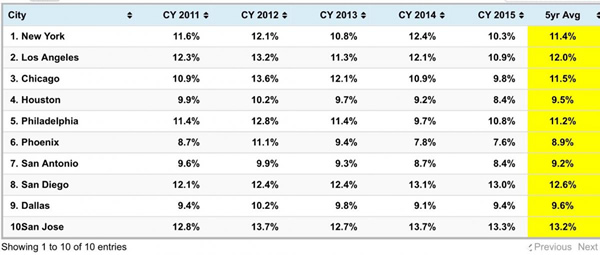
Here is the Chapwood Index of inflation, which carefully measures “apples to apples” costs of essential goods and services in each city:

As inflation erodes purchasing power, workers’ share of the economy has declined dramatically– a double-whammy of declining purchasing power and standard of living.


Get Ready for an Unacceptable New Normal

By Stephen Lendman

Source: StephenLendman.org

At times like now, ideas lying around dormant on the shelf become reality.

Economic and other crisis conditions are times when most people can be convinced to accept unacceptable policies they’d likely reject otherwise.

During and after 2008-09 economic crisis conditions, Americans were brainwashed to accept force-fed austerity, frozen wages, and loss of benefits when economic stimulus and other government help were needed.

Economic recovery was for the nation’s privileged class exclusively. 

Ordinary Americans experienced protracted hard times that may become much worse today looking ahead, the same true in other Western societies.

In his 1995 book titled, “The Rotten Heart of Europe,” noted euro expert Bernard Connolly said the following: 

“The true story of the ERM (Europe’s Exchange Rate Mechanism) has been one of duplicity, skullduggery, conflict; of economic harm done to every country and in the caste interests of the elite; of the distortions of economic logic and the dilution of political accountability,” adding:

“The implication is that increasing globalization of economic activity and mobility of production has been purposely implemented in such a way as to render already destroyed ‘nation-state(s)’ meaningless entit(ies) in economic terms.”  

Protracted “austerity will lead to social unrest” in Europe, the US or elsewhere. Hard times are fertile ground for revolutions and fascist dictatorships.

Censorship is the new normal in the US and West — speech, press, and academic freedoms at risk. Without them all other rights are threatened.

Social and conventional media, Google, and other tech giants are complicit in a campaign to suppress content conflicting with the official narrative.

Controlling the message is the hallmark of totalitarian rule. Anything conflicting with the official narrative on vital issues is considered “inauthentic behavior.”

The US already is a police state. Is martial law the next shoe to drop? Will Trump declare it if current conditions worsen?

While not included in the Constitution, Article 1, Section 9 mentions suspension of habeas, saying the following:

“The privilege of the writ of habeas corpus shall not be suspended, unless when in cases of rebellion or invasion the public safety may require it.”

Will Trump invoke “public safety” or another pretext to take this action?

Article 1, Section 8 empowers Congress to call “forth the Militia to execute the Laws of the Union, suppress Insurrections and repel Invasions.”

The US military and National Guard are today’s “militia.”

Martial law suspends civil rule, replacing it with military authority under the president as commander-in-chief of the nation’s armed forces — including the National Guard when activated.

During the Civil War, Lincoln assumed dictatorial powers.

He suspended the Constitution and habeas corpus, forcefully closed courts, arbitrarily ordered arrests, conscripted US citizens without congressional consent, and closed newspapers opposing his policies.

His Emancipation Proclamation didn’t free a single slave. He wanted them deported at war’s end to maintain America as a white supremacist society.

History taught in the US at all levels of education conceals the nation’s dark side.

What happened before can happen again by presidential diktat.

According to Constitutional Law Professor Bruce Ackerman, US presidents can institute policies by executive orders, military orders, national security and homeland security presidential directives, along with other ways of circumventing Congress and the courts.

They wage illegal wars without Security Council and congressional authorization.

White House lawyers justify the unjustifiable. “They serve as authoritative judges for the executive branch, providing a legal framework for millions of civilian and military personnel as they implement executive decrees,” Ackerman explained.

Checks and balances don’t work, new ones needed, he stressed — enforced to restrain executive power-grabbing.

Following Japan’s December 1941 Pearl Harbor attack, Hawaii, not a US state at the time, was placed under martial law.

After Hurricane Katrina in August 2005, martial law was declared in New Orleans.

Throughout US history, it’s been imposed by federal or state authorities numerous times on the pretext of public safety, restoring order, or another reason.

Will Trump impose it if the US economy is reopened too soon, as apparently planned, and COVID-19 outbreaks increase greatly?

Will larger-scale outbreaks than already if occur be used as a pretext for hardening police state rule, including suspension of the Constitution and imposition of martial law?

Most of the population is locked down. Will Trump by presidential diktat order the extrajudicial arrest and indefinite detention of targeted individuals on the phony pretext of public safety and security?

This type harshness is what fascist tyranny is all about.

Is it coming ahead to the US full-blown in the form of presidential national emergency powers? 

The USA Patriot Act was written before 9/11. Is other draconian legislation on the shelf — ready to be rolled out by congressional action or presidential decree?

Is America the way it was pre-COVID-19, warts and all, to be replaced by hardened rule?

If COVID-19 abates and more greatly flares up this summer or fall will November elections be suspended or cancelled?

Whatever may unfold ahead most likely was planned by the nation’s ruling class.

It happened pre-and-post-9/11. It may be happening again now for ill, not good — including draconian mass surveillance more intensive than before, along with other police state policies.

Is a dystopian future coming for ordinary Americans, resisters subject to harsh repercussions — constitutional rights declared null and void?

What’s unthinkable may be planned and inevitable. 

This holiday season, American workers have little to celebrate

By Danny Haiphong

Source: Intrepid Report

Every year, much of the U.S. population celebrates Thanksgiving and Christmas to show appreciation for their families and friends. Thanksgiving normalizes the colonial origins of the United States and erases the brutality of the English settlers who massacred indigenous people to prepare the land for capitalist accumulation. Christmas is the annual holiday of big business. On no other day are workers more encouraged to spend their wages on the latest consumer product to gift to their loved ones. The holidays bring with them a deep pressure to be merry. Yet on this holiday season, workers have little to celebrate.

A new study by Brookings Institution provides a snapshot into the devastation wrought on the working class by American capitalism. Forty-four percent of all workers between the ages of 18-64 are employed in low-wage sectors and earn an average of $16 or less per hour. The study excluded workers who logged over 98 hours per week over the last year as well as certain sections of the college-educated population such as those living in dormitories and attending graduate school. Had these groups of workers been counted, the percentage of low-wage workers out of the total population would likely be even higher. This verifies prior datasets which proved that around half of the U.S. population makes less $30,000 per year.

The growing poverty of the American worker is a major contributor to the growth of toxic stress and mental illness. Half of all U.S. adults will develop a mental illness over the course of their life. Serious mental health conditions afflict nearly ten million people in the United States and over a quarter of these individuals live below the official poverty line. Suicide rates are at a thirty-year high. An obvious connection exists between rising poverty and the worsening mental health of the American worker.

Workers in the United States see no future under the current stage of capitalism. They struggle to afford rent in a nation where the federal minimum wage cannot pay for a two-bedroom apartment anywhere in the country. They indebt themselves in the trillions to attend college and obtain healthcare. They work in redundant, service sector jobs where hours are long and mistreatment, abuse, and injury are all too common. The American worker is increasingly alienated from themselves and each other. Union density rates in the U.S. have fallen to just ten percent of all workers since World War II.

The shrinking labor movement has followed a larger trend in U.S. society. Privatization has decimated the public sector. Workers have few places to socially convene independent of the machinations of consumer capitalism. Workers are competing for fewer jobs, most of which are not worth competing for at all. Homelessness, mass incarceration, and endless war remind workers that they can easily be turned into cannon fodder if they step out of line. In such an environment, addiction and self-destruction is encouraged while organizing for justice is discouraged.

Economic insecurity and alienation place more pressure on families to make up for stagnant wages and exorbitant amounts of debt. More young workers are living with their parents than at any other time in the last one hundred years. Older workers are not only forestalling retirement but also finding themselves without family or community support as siblings and adult children chase the highest paying jobs and the lowest rents and property values. Couples feel compelled to remain in toxic relationships for economic reasons. A strong link exists between domestic violence and poverty.

Contrary to the messages in Hallmark cards or the corporate media, the holidays are far from a time of celebration. Many workers view the holiday season as a harsh reminder of the loss, alienation, and despair that they’ve experienced over the course of their lives. Holidays place added pressure on workers to dismiss the ills of capitalism and the personal stressors associated with them. It should come as no surprise that most workers already struggling with mental health conditions report that the holidays only worsen their symptoms. Instead of embracing humanity, the holidays encourage workers to embrace rampant commercialism and the nuclear family.

To break from a culture steeped in the profit motive, workers will need to create their own traditions based upon solidarity and social transformation. Not everything about the holidays needs to be thrown out in the process. Spending time with family and friends during a day off from work can and should be rewarding to the psyche and to society. The conditions of capitalism prevent the holidays from serving a social purpose. Holidays under capitalism breed despair but brand themselves as moments of pure joy.

While workers may have little to celebrate this holiday season, there are reasons for the working class to be optimistic in the years to come. Teachers in cities such as Chicago and Los Angeles have won key gains in 2019 by using the most powerful weapon at the disposal of organized labor: the strike. At the beginning of the year, the Los Angeles Teachers won smaller class sizes and more support staff. The Chicago Teachers Union massively increased the number of nurses in the school district by forcing the city to hire nurses rather than continue the inefficient and harmful practice of hiring private contractors. The UAW’s strike of General Motors (GM) earlier this Fall made global headlines even if it was unable to win every demand that the workers put forth. These strikes reflect a growth of class consciousness in the United States. The continued growth of class consciousness will be critical toward building the kind of struggle capable of bringing about massive political and economic change for the working class.

Furthermore, workers around the world are leading the way in the struggle against class inequality and foreign-sponsored wars. Massive protests in Haiti, Chile, Honduras, and Algeria are just a few of many occurring around the globe. The protests have mainly targeted repressive U.S.-backed governments and their neoliberal economic agenda. China is leading the world in poverty reduction. Cuba is the most sustainably developed nation in the world. A vast majority of workers around the world want to see an end of the miseries imposed by global capital and are actively fighting to make their demands a reality.

The question is whether workers in the United States can decisively break from the despair, the racism, and the extreme alienation shaping their current condition. Being determines consciousness. At this moment, the neoliberal race to the bottom has rendered most workers too fearful, disorganized, and full of self-blame to fight back. However, millions of workers have rallied behind the political campaign of Bernie Sanders. Labor unrest is likely to continue as neither political party appears interested in implementing Bernie Sanders’ social democratic agenda. Workers in the United States are in desperate need of a revived labor movement to quench their thirst for a better life. Putting our energies into building this movement will go a long way toward shaking the Holiday Blues and giving workers something to really celebrate: a society run by workers, in the interests of workers.

Media Just Can’t Stop Presenting Horrifying Stories as ‘Uplifting’ Perseverance Porn

By Alan Macleod

Source: FAIR.org

“THIS IS AWESOME!” That’s how Fox 5 DC described its story (5/28/19) about Logan Moore of Cedartown, GA, a disabled two-year-old whose parents were unable to afford to buy him a walker, so employees at Home Depot fashioned one together themselves for him.

“No… it’s not awesome at all. It’s a painful indictment of the state of healthcare in America,” reads the first comment under this tweet by Fox 5 DC (5/28/19).

The story closely resembles another recent CNN report (4/1/19): “A Two-Year-Old Couldn’t Walk on His Own. So a High School Robotics Team Built Him a Customized Toy Car.” That piece noted how Minnesotan toddler Cillian Jackson couldn’t walk due to a genetic condition, and how his parents couldn’t afford treatment. It described the ingenuity of the school children who built him a car, and Cillian’s new found freedom, but did not explore why a baby with a disability had been abandoned by US society.

The clear implication in these stories was that those children would have been left permanently unable to move if not for the help of underpaid employees or the kindness of other children. How many disabled American children with poor parents were not so lucky? The articles did not ask. Instead, they were presented as “uplifting” human interest pieces.

Cillian’s story is part of CNN’s Good Stuff series, which asks its readers:

Want more inspiring, positive news? Sign up for The Good Stuff, a newsletter for the good in life. It will brighten your inbox every Saturday morning.

Unfortunately, these stories are part of a popular trend of unintentionally horrifying “uplifting” news, which we at FAIR have catalogued before (FAIR.org, 8/3/17; 3/25/19), where out-of-touch corporate media give us supposedly charming, wholesome and positive news that actually, upon even minimal retrospection, reveals the dire conditions of late capitalism so many Americans now live under, and makes you feel worse after reading it.

A lot of these stories involve mothers and the extremely difficult circumstances of raising children in the US while poor. CNN’s “feel good” story (8/24/18) about a teacher sitting in a car with her student’s baby so the new mom could attend a job fair raised far more questions than it asked (which was zero). Why is there so little public childcare in the US? Should a new mother really need to immediately find a job so badly? Is this good for infants’ development?

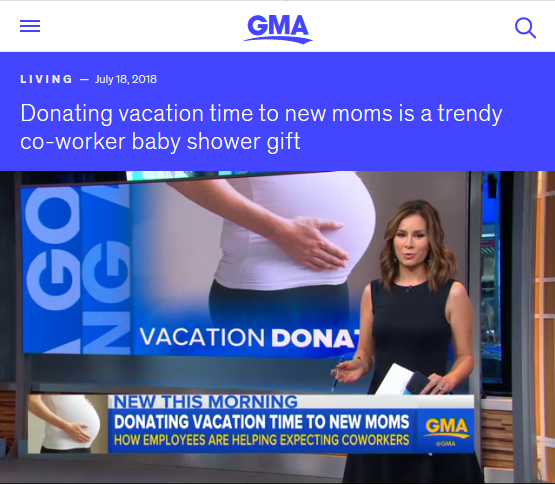
On a similar subject, Good Morning America (7/17/18) describes the “trendy” new baby-shower gift of donating your pregnant co-worker your days off to give her maternity leave. Every country in the world except the US and Papua New Guinea guarantees paid maternity leave, meaning the trend is unlikely to catch on abroad.

Donated maternity leave is a “trendy” gift you don’t need—unless you live in the United States or Papua New Guinea (Good Morning America, 7/17/18).

Many outlets (CBS, 5/20/16; Huffington Post, 8/6/16; People, 4/11/16) cheerfully reported on how one man did at least 15 years of backbreaking labor as a night shift janitor at Boston College so his children could attend for free. But none even mentioned that if he lived in nearly any country in Western Europe, this wouldn’t have been necessary, as university there is free or virtually free to attend.

In fact, rather than discussing ballooning tuition costs, Yahoo! (11/15/17) used the story to take jabs at disloyal millennials:

Millennials move from job to job in order to climb the ladder…. For baby boomers and other generations…loyalty and dedication to a single company or career drove, and still drives, much of their working lives.

Any of these stories could have been used to explore the pressing social and economic realities of being poor in the United States, and having to work for things considered fundamental rights in other countries. But instead they are presented as uplifting features, something only possible if we unquestionably accept the political and economic system.

Kids Do the Darndest Things

Many of what Think Progress (8/2/18) labels “feel-good feel-bad stories” involve children doing things they wouldn’t have to in any reasonable society. CBS invites us to enjoy an account of a boy selling his Xbox computer to help his (single) mom (4/2/19), and another repairing his town’s ravaged roads himself (4/12/19). The Hill (6/10/19), meanwhile, describes a nine-year-old saving his pocket money to pay off his school friends’ “lunch debts.”

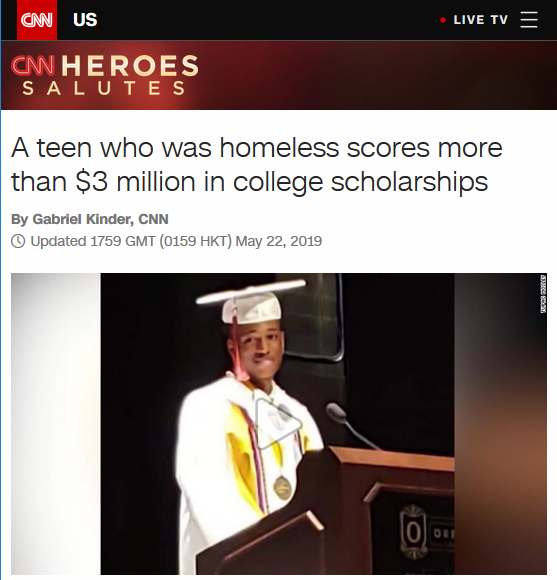
“Hardships were never an excuse for Moseley,” CNN (5/22/19) reports—as they are, implicitly, for homeless teens who aren’t offered millions in scholarships.

NBC (5/22/19) likewise shared the story of homeless Tennessee teen Tupac Moseley graduating high school as a valedictorian and earning many college scholarships, something that was widely reported (BBC, 5/22/19; Newsweek, 5/21/19; Business Insider, 5/21/19). NBC matter-of-factly noted that after his father died, Moseley’s family’s home was foreclosed and they were on the streets, accepting this situation without comment. This was still among the most critical of the reports, however, as many did not even describe why a child in the richest society in history became homeless. CNN’s report (5/22/19), for example, did not explain the background circumstances, let alone comment on them, and frames the story with the sentence, “Hardships were never an excuse for Moseley.”

This sentence is telling: To corporate media, even the trauma of losing a parent and being forced onto the streets is merely an excuse, not a cause for poor grades. The implication is that poor housing, a lack of an adequate safety net, underfunded schools and a decimated public education system are simply excuses from bellyaching lazy people as to why they did not attend the private Boston University (at over $54,000 per year tuition), like the article’s author did.

“No excuses” is a common phrase in “perseverance porn” stories. For example, Today (2/20/17) used it in the headline of a story about a Texas man who is forced to walk 15 miles to work every day. It reveals the ultimate bootstrap ideology of the media, where societal factors are irrelevant and everyone is where they are on merit.

Thus Moseley’s story is effectively weaponized by CNN against anyone who would question the system. Terrible work conditions? No excuses! Homeless? Stop complaining!

In case you thought homeless children were something of an aberration in America, CNN (7/2/19) also recently ran a story about how over 100 homeless children graduated high school in New York City this year alone—again without comment on what this says about US society.

Another reprehensible story treated as heroic by media was that of a Michigan mother who had to quit her job to look after her terminally ill son, who died of leukemia. She could not afford a headstone, so his best friend, 12-year-old Kaleb Klakulak, worked many jobs to attempt to pay for one. Many media outlets (e.g., Associated Press, 12/8/18; Fox News, 12/9/18; NBC Chicago, 12/12/18) celebrated Kaleb’s spirit, but none asked why children are  performing hard, outdoor labor through a Michigan winter so other children can have adequate burials. Such reporting implicitly normalizes this situation, and the system that allows it to happen.

“Sweet” Stories

A common media trope is presenting kids selling lemonade as cute,  sweet stories, no matter how horrifying or depressing the reason, including to pay off school lunch debts (Yahoo! News, 5/21/19; MSN, 5/22/19), or to raise money for their baby brother’s medical treatment (New York Post, 5/28/18; CBS, 5/29/18) or their mother’s chemotherapy (KTSM El Paso, 8/4/18).

Such stories (CBS, 5/29/18) rarely if ever ask why a baby with a life-threatening illness is forced to rely on his nine-year-old brother’s selling lemonade to pay for treatment.

Or how about the story of a New Mexico girl selling lemonade trying to fund her mother’s kidney transplant? People magazine (5/9/18) applauded her resolve, and local radio described it as “heartwarming” that she had raised over $1,000. The massive problem is a kidney transplant in America can cost over $400,000. To anyone with a heart, what this story actually represents is the desperate struggle of a child trying in vain to save her dying mother. Worse still is the fact that if she lived in Sweden, Spain or Saskatchewan, she would be given a kidney free of charge and without question.

Any of the numerous other outlets (ABC, 4/30/18; Good Morning America, 5/1/18; Albuquerque Journal, 4/30/18) that picked it up could have used the story to discuss the dysfunctional healthcare system that is the leading cause of bankruptcy in the country, while producing some of the worst health outcomes in the developed world, or to scrutinize how corporate healthcare gouges the sickest and most vulnerable Americans, including children. Surely the most basic function of government should be to prevent its citizens from needlessly dying? Not if you wholly accept the tenets of neoliberalism, where education, housing and healthcare are not basic, inalienable human rights, but commodities to be bought and sold and bargained for on the market.

To be clear, while we can admire the never-say-die attitude of those in tough conditions, this is no substitute for guaranteed public programs to help those in dire need. The problem with perseverance porn is not the brave subjects of the articles, but the lack of any journalistic scrutiny examining the failings of society that placed them in such desperate circumstances to begin with.

What these articles highlight so clearly is not only the grim, inhuman and unnecessary conditions so many Americans are forced to live under, but the degree to which mainstream corporate journalists have completely internalized them as unremarkable, inevitable facts of life, rather than the consequences of decades of neoliberal policies that have robbed Americans of dignity and basic human rights. Because corporate media wholly accept and promote neoliberal, free-market doctrine, they are unable to see how what they see as “awesome” is actually a manifestation of late-capitalist dystopia.